
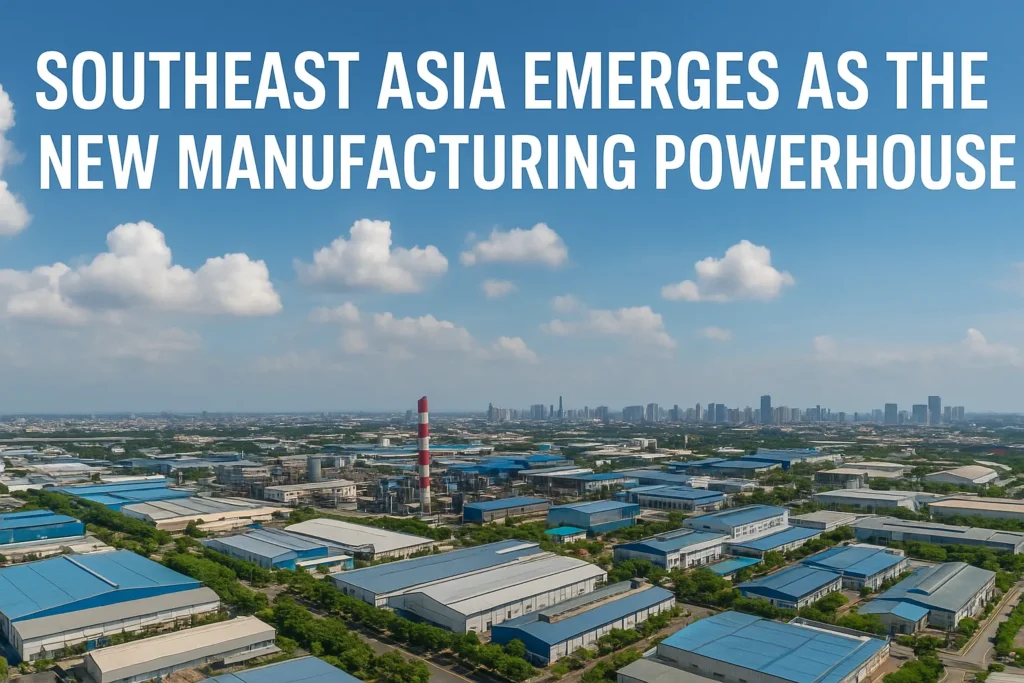

Prologue: The Day the World’s Supply Chains Pivoted
On a day indistinguishable from any other in the humming, fluorescent-lit control room of a Singaporean logistics conglomerate, a single digital order triggered a cascade of recalculations across global networks. The instruction was simple: reroute. A shipment of advanced automotive microcontrollers, originally destined for assembly in Guangdong, China, was now to be broken down, with its constituent parts directed to three new destinations: a testing facility in Penang, Malaysia; a precision machining plant in Batam, Indonesia; and a final assembly line in Hai Phong, Vietnam. This was not an error or an anomaly. It was the execution of a “China+1” diversification protocol, a now-standard clause in the risk management playbooks of every Fortune 500 company. This single rerouting, multiplied by millions of decisions across industries, marks the definitive end of a unipolar manufacturing epoch and the dawn of a new, networked age centered on Southeast Asia.
We are witnessing the most profound recalibration of global production since the Industrial Revolution. Southeast Asia has ceased to be merely an “alternative” or a “low-cost option.” It has matured into a USD 4.3 trillion integrated economic engine, a cohesive and sophisticated manufacturing superorganism. The scale is almost incomprehensible. The region now accounts for over 7.5% of global GDP, with its manufacturing value-add surpassing USD 700 billion annually. It attracts over 25% of all foreign direct investment (FDI) flowing to developing Asia, a figure that has grown steadily even amid global economic uncertainty. This is not a temporary shift based on fleeting cost advantages; it is a permanent, structural re-anchoring of the world’s industrial base, driven by a unique confluence of strategic foresight, demographic vitality, and geopolitical necessity.
Book I: The Foundations – Why the World Couldn’t Look Away
The gravitational pull of Southeast Asia is the result of a powerful, self-reinforcing trinity of advantages: an unprecedented demographic gift, a geographic position of unrivaled strategic value, and a political consensus on economic liberalization that has created a competitive paradise for investors.
Chapter 1: The Demographic Imperative and the Human Capital Revolution
While Europe, Northeast Asia, and North America grapple with the economic headwinds of aging populations and shrinking workforces, Southeast Asia is in the sweet spot of its demographic dividend. With a median age of just 30.2 years—over a decade younger than China’s—the region adds millions of energetic, aspirational workers to its labor pool each year. But the modern factory floor demands more than youthful vigor; it requires cognitive agility and technical proficiency. Recognizing this, Southeast Asian nations have undertaken an educational revolution.
Vietnam’s consistent top-10 global performance in OECD PISA tests for mathematics and science is no accident; it is the outcome of a relentless, state-driven focus on STEM education. In Malaysia, the “TVET Transformation” agenda has overhauled technical and vocational education, creating a direct pipeline from classroom to high-tech factory, with curricula co-designed by industry giants like Siemens and Bosch. Indonesia’s “Digital Talent Scholarship” program aims to train 600,000 new digital professionals by 2025, targeting the specific skills gaps in data analytics, AI, and cloud computing identified by its manufacturing sector.
This focus on human capital is transforming the very nature of work in the region. The goal is no longer to be the world’s cheapest assemblers but to become its most capable technicians, engineers, and problem-solvers. A worker in a Thai automotive plant is now as likely to be programming a collaborative robot (cobot) or analyzing real-time production data on a tablet as performing manual assembly. This upskilling is the critical defense against the “middle-income trap” and the foundation for moving relentlessly up the value chain.
Chapter 2: The Geography of Destiny and the Infrastructure Metamorphosis
Southeast Asia is not just in a strategic location; it is the strategic location. The region forms the linchpin of global maritime trade, cradling the Strait of Malacca—through which one-third of global maritime trade and nearly half of the world’s oil shipments pass. This is not merely a convenience; it is a colossal economic advantage, slashing time-to-market and logistics costs for any manufacturer embedded in the region.
Understanding that geography is only potential without connectivity, the nations of Southeast Asia have embarked on the most ambitious infrastructure build-out since the Marshall Plan. This is not mere construction; it is the deliberate engineering of economic density.
The Ports of Power: A hierarchy of world-class ports has emerged. Singapore remains the undisputed global leader in efficiency and digital integration. Malaysia’s Port Klang and Tanjung Pelepas have evolved into top-15 global hubs. Vietnam’s development of deep-water ports like Cai Mep and Lach Huyen has been so rapid and successful that it has reduced its dependence on transshipment through Singapore, capturing more value and control within its own borders. Indonesia’s “Sea Toll Road” program is a monumental attempt to knit its sprawling archipelago into a single, efficient domestic market, lowering inter-island shipping costs by up to 30%.
The Corridors of Commerce: On land, concrete and steel are forging new economic geographies. The Eastern Economic Corridor (EEC) in Thailand is a USD 45 billion masterplan, creating a dedicated zone for advanced industries with its own ports, airports, and high-speed rail links. The Johor-Singapore Special Economic Zone (JS-SEZ) aims to dissolve the border between the two, creating a fluid zone where Singapore’s capital and R&D marry Johor’s land and manufacturing muscle. The recently completed China-Laos railway is the first vertebra of a future pan-ASEAN rail network that will physically tether mainland Southeast Asia into a contiguous production landscape.
The Digital Nervous System: Beneath the physical layer lies the digital substrate. Southeast Asia is a global leader in 5G adoption for industrial use. Thailand and Malaysia have allocated dedicated spectrum for private 5G networks in industrial parks, enabling real-time machine communication, augmented reality maintenance, and seamless coordination across distributed factories. This digital backbone turns a collection of facilities into a single, responsive, intelligent organism.
Chapter 3: The Policy Catalyst – A Tournament of Investment
Perhaps the most active ingredient in Southeast Asia’s rise has been the fiercely competitive, pro-business policy environment. Governments are not passive recipients of investment; they are aggressive curators, engaging in a “tournament” to offer the most attractive conditions. This has resulted in a virtuous cycle of regulatory innovation.
Vietnam’s success is a textbook case. It has signed 15 free trade agreements (FTAs), including the landmark CPTPP and EVFTA, giving its exporters privileged access to colossal markets. Its Law on Investment offers staggering incentives: high-tech manufacturers can enjoy a four-year tax exemption followed by a 50% reduction for the next nine years, and a mere 5% tax rate thereafter. Indonesia’s “Omnibus Law” was a sweeping reform designed to slash red tape, liberalize labor laws, and streamline licensing, all to accelerate investment. Malaysia’s “National Investment Aspirations” framework strategically guides FDI toward high-tech, high-value projects that create quality jobs and transfer knowledge.
This policy agility extends to crisis response. During the pandemic, when global supply chains seized, Southeast Asian governments acted as facilitators, creating “green lanes” for essential business travel, guaranteeing the operation of industrial zones, and providing wage subsidies to prevent workforce dislocation. This demonstrated a level of partnership and reliability that global CEOs noted, cementing the region’s reputation as a resilient and committed manufacturing base.
Book II: The Mosaic of Power – Specialized Kingdoms in a Unified Realm
The genius of Southeast Asia’s manufacturing ecosystem lies not in homogeneity, but in its brilliantly orchestrated heterogeneity. Each major economy has cultivated deep, world-class expertise in complementary sectors, creating a regional production network of unparalleled flexibility and resilience. This is not a zero-sum game; it is a synergistic symphony.
Chapter 4: Vietnam – The Ascent of the Dynamo
Vietnam’s trajectory is the stuff of economic legend. From the ashes of agrarian poverty, it has built a USD 400 billion export economy in a single generation. Its growth is not broad-based; it is sharply focused on dominating specific, high-value manufacturing verticals.
The Electronics Conquest: Vietnam is no longer just an assembler of smartphones; it is the world’s second-largest exporter of electronics behind only China. Samsung’s commitment is total, with over USD 18 billion invested, making Vietnam responsible for half of its global phone production. The ecosystem effect is profound: over 200 of Samsung’s tier-one suppliers have established operations in Vietnam, creating a localized supply chain that attracts even more investment. Intel has poured USD 1.5 billion into its Saigon chip testing and packaging plant, its largest global facility.
The Textile and Footwear Fortress: While moving up the tech ladder, Vietnam has also cemented its dominance in light manufacturing. It is the largest exporter of footwear to the United States and the second-largest global apparel exporter. Companies like Nike source over 50% of their footwear from Vietnam. The industry is rapidly modernizing, adopting automated cutting and sewing, and integrating sustainable materials to meet global brand mandates.
The “New China” Narrative: Vietnam’s secret weapon is its blend of cost discipline and strategic openness. Wages remain competitive, but its true edge is its dense web of FTAs and its political stability. For corporations seeking to de-risk from China without sacrificing Asian supply chain efficiency, Vietnam has become the default first call. Its manufacturing PMI has consistently stayed in expansion territory, often leading the region, reflecting relentless inflows of new orders.
Chapter 5: Indonesia – The Colossus Awakens
As the G20’s sole Southeast Asian member and the region’s undisputed heavyweight, Indonesia’s strategy is fundamentally different. It leverages its vast scale—270 million people, abundant natural resources, and a booming domestic market—to force a move up the value chain through a policy of mandatory downstreaming.
The Nickel Gambit: Indonesia possesses nearly a quarter of the world’s nickel reserves. Instead of exporting raw ore, it banned its export in 2020, compelling foreign investors to build smelters and processing plants onshore. This masterstroke has made Indonesia the world’s largest producer of stainless steel and, more importantly, the epicenter of the global electric vehicle battery supply chain. Chinese giants like CATL and QMB, and Korean leader LG Energy Solution, are investing tens of billions to build integrated battery production hubs from mine to cathode. Indonesia aims to control the entire EV battery value chain, from nickel mining to finished battery pack assembly.
The Archipelagic Integration Challenge: Indonesia’s geography is its greatest challenge and opportunity. Its “Making Indonesia 4.0” roadmap and the audacious project to build a new capital city, Nusantara, in Kalimantan are attempts to spread development beyond Java and create new growth poles. The domestic market is its stabilizing ballast; even when global demand wavers, internal consumption from a growing middle class provides a reliable base for its automotive, consumer goods, and digital industries.
Chapter 6: Malaysia – The Precision Engine
Malaysia represents the sophisticated, high-value flank of Southeast Asian manufacturing. Having industrialized decades earlier, it has evolved from basic assembly to become a global leader in complex, knowledge-intensive processes.
The Semiconductor Linchpin: Malaysia is the silent, indispensable giant of the global chip industry. It accounts for 13% of global semiconductor trade and is a world leader in Outsourced Semiconductor Assembly and Test (OSAT). While it may not fabricate the most advanced chips, it packages, assembles, and tests them—a process so critical that a shutdown in Penang would paralyze global electronics production. Intel’s recent USD 7 billion investment in advanced packaging in Malaysia underscores this irreplaceable role.
The Medical Technology Hub: Beyond chips, Malaysia has cultivated a thriving medtech sector, producing one in three of the world’s surgical gloves and a significant portion of catheters and medical devices. Its regulatory alignment with international standards and strong IP protection make it a trusted location for life sciences manufacturing.
The Knowledge Bridge: Malaysia positions itself as the perfect bridge between East and West, between high-tech R&D and cost-effective, high-quality production. Initiatives like the Penang Science Cluster foster collaboration between multinationals, local SMEs, and universities, driving continuous innovation and ensuring its workforce stays at the technological frontier.
Chapter 7: Thailand, Singapore, Philippines – The Specialized Pillars
- Thailand: The Automotive Sovereign: Thailand’s title as the “Detroit of Asia” remains undisputed. It is the world’s second-largest producer of pickup trucks and a top-10 global automotive manufacturer. Its strategy is to leverage this entrenched ecosystem of over 2,300 parts suppliers to dominate the transition to electric vehicles. Chinese EV makers (BYD, Great Wall) are investing heavily alongside Japanese incumbents, betting that Thailand’s proven supply chain can deliver EV quality at scale.
- Singapore: The Brain and the Bank: Singapore has gracefully exited labor-intensive manufacturing to become the region’s commanding mind. It is a global leader in biopharmaceuticals manufacturing and aerospace maintenance, repair, and overhaul (MRO). More crucially, it is the regional HQ for nearly every multinational, the conduit for 60% of ASEAN’s FDI, and the provider of the financial, legal, and logistical intelligence that powers the entire regional machine.
- The Philippines: The Precision Specialist: The Philippines excels in the delicate, high-skill areas of semiconductor assembly and testing and the manufacturing of precision components for electronics and automotive. Its highly literate, English-speaking workforce is adept at the meticulous quality control these processes demand.
Book III: The Integration Imperative – Weaving a Single Tapestry
The ultimate competitive advantage of Southeast Asia is not what happens within each nation, but what happens between them. The conscious, relentless drive toward economic integration is transforming a collection of countries into a unified, border-optimized production platform.
Chapter 8: The Legal and Digital Architecture of a Borderless Factory
The dream of the ASEAN Economic Community (AEC) is becoming operational reality through two parallel tracks: legal harmonization and digital interconnection.
The Agreement Web: The Regional Comprehensive Economic Partnership (RCEP) is the cornerstone. As the world’s largest trade bloc, it standardizes rules of origin across 15 Asia-Pacific nations. For a manufacturer, this means components can freely cross multiple ASEAN borders, accruing value, without triggering punitive tariffs when the final product is exported. This makes building a pan-ASEAN supply chain not just possible, but optimal.
The Digital Customs Revolution: The ASEAN Single Window (ASW) is a silent revolution. It links the customs administrations of all ten member states digitally. A shipment crossing from Thailand into Malaysia no longer requires stacks of physical documents and days of clearance. Data is submitted once and flows seamlessly, cutting clearance times from days to hours. This is the digital plumbing that makes “just-in-time” manufacturing across borders a viable, efficient reality.
Chapter 9: The Emergence of Regional Value Chains (RVCs)
This integration is giving birth to true Regional Value Chains (RVCs), the holy grail of economic synergy. Consider the journey of a hard disk drive (HDD):
- The actuator arm is precision-stamped in Thailand.
- The read-write head, a marvel of nanotechnology, is produced in Singapore.
- The controller chip is assembled and tested in the Philippines.
- The final assembly and testing occurs in Malaysia.
- The finished HDD is shipped worldwide from Port Klang.
No single country in Southeast Asia makes a complete HDD, but collectively, they dominate global production. This RVC model spreads risk, optimizes comparative advantage, and creates deep interdependence that benefits all participants. It makes the region “sticky”—once a corporation builds this distributed network, it is exceedingly difficult and costly to replicate elsewhere.
Book IV: The Gathering Storms – Challenges on the Path to Maturity
Ascent invites friction. Southeast Asia’s spectacular rise has placed it at the center of global tensions and exposed internal contradictions that must be navigated with wisdom and resolve.
Chapter 10: The Geopolitical Tightrope
Southeast Asia finds itself in the unenviable position of being the prime arena for U.S.-China strategic competition. The “China+1” strategy is, by definition, geopolitical. Nations must perform a delicate balancing act:
- The Transshipment Dilemma: U.S. tariffs on Chinese goods have led to attempts at circumvention, with goods being lightly processed in Southeast Asia to gain a new country of origin. This has triggered rigorous U.S. Customs investigations and the threat of secondary tariffs on Southeast Asian exports, forcing governments and companies to implement rigorous supply chain transparency protocols.
- The Technology Cold War: U.S. restrictions on exports of advanced semiconductors and chip-making equipment to China create a complex compliance maze for the region’s high-tech manufacturers, who supply both Western and Chinese markets.
- ASEAN Centrality as a Shield: The region’s collective response has been to reaffirm “ASEAN Centrality”—maintaining strategic autonomy, refusing to choose sides, and advocating for inclusive, rules-based regional architecture. This diplomatic unity is its primary defense against being fractured into competing spheres of influence.
Chapter 11: The Internal Fractures
- The Great Skills Chasm: The demand for data scientists, automation engineers, and advanced technicians far outpaces supply. In Indonesia, a youth unemployment rate stubbornly above 17% coexists with tech companies reporting thousands of vacancies. The education system, while improving, often prizes rote learning over critical thinking and digital creativity.
- The Infrastructure Dichotomy: World-class ports coexist with chronic urban gridlock. Reliable 5G in industrial parks contrasts with patchy connectivity in secondary cities. This uneven development creates bottlenecks and limits the diffusion of growth to rural and remote areas.
- The Sustainability Crucible: Rapid industrialization has exacted an environmental toll. Plastic waste chokes rivers, and air quality plummets in industrial hubs. Water stress is a growing concern for water-intensive industries like textiles and semiconductors. Global investors and consumers now demand green manufacturing, forcing a costly but essential transition to circular economy models and renewable energy.
Book V: The Future Factory – Scenarios for 2030 and Beyond
The next decade will determine whether Southeast Asia consolidates its gains or plateaus. Its trajectory will be shaped by its response to the Fourth Industrial Revolution and its own internal cohesion.
Chapter 12: The Industry 4.0 Leap
The factories of the future are being built today in Southeast Asia. This is not about replacing workers with robots, but about creating cyber-physical production systems.
- AI-Driven Everything: From predictive maintenance (anticipating machine failures before they happen) to AI-powered visual quality inspection (spotting microscopic defects invisible to the human eye), artificial intelligence is becoming the central nervous system of the factory.
- Additive Manufacturing’s Ascent: 3D printing is moving beyond prototyping to final part production for aerospace, medical devices, and customized automotive components, enabling on-demand, localized manufacturing that reduces inventory and logistics costs.
- The Digital Twin Revolution: Major industrial complexes are creating “digital twins”—virtual, real-time replicas of their physical operations. This allows for simulation, optimization, and remote management of entire supply chains, pushing efficiency to new frontiers.
Nations are racing to support this leap. Thailand’s “EECi” (EEC of Innovation) is a dedicated district for testing Industry 4.0 technologies. Singapore’s “Smart Industry Readiness Index” is a diagnostic tool used globally to assess manufacturing maturity. The goal is clear: to ensure that Southeast Asian factories are not just cheaper, but smarter, more flexible, and more innovative than their competitors.
Chapter 13: Three Paths to the Future
- The Integrated Innovation Hub (The Optimal Path): In this scenario, Southeast Asia cracks the code on indigenous innovation. R&D spending surges past 2% of GDP, homegrown tech champions emerge in green tech and advanced materials, and the AEC achieves deep, seamless integration. The region becomes a global source of technology, not just a user, commanding premium value and setting global standards for the future of manufacturing.
- The Persistent Execution Center (The Middle Path): The current model is optimized and extended. Southeast Asia remains the world’s most reliable, diversified, and efficient manufacturing platform, but the highest-value IP, design, and profits continue to be captured by foreign HQs. Growth is solid but subject to the cycles and competitive pressures of global contract manufacturing.
- The Fractured Frontier (The Risk Scenario): Geopolitical tensions force binary choices, breaking ASEAN unity. Internal inequalities lead to social unrest. Infrastructure and skills gaps are not closed, causing investors to look elsewhere. The region’s potential fragments, and it becomes a patchwork of middle-income economies unable to escape stagnation.
Epilogue: The Indispensable Nexus
The story that began with a digital rerouting order is now the dominant logic of global commerce. Southeast Asia has accomplished what few thought possible: it has successfully harnessed the centrifugal forces of globalization to create a new, resilient center.
It has shown that development in the 21st century is not a solitary sprint but a collaborative relay. By building a complementary ecosystem where each nation’s strength amplifies the others’, by investing with generational patience in both physical infrastructure and human minds, and by navigating the treacherous waters of geopolitics with pragmatic dexterity, Southeast Asia has engineered a peaceful economic transformation of historic proportions.
The “workshop of the world” is no longer a place. It is a network. It is a dynamic, interconnected, and intelligent system of production, innovation, and exchange. And its most critical nodes, its beating heart, now lie between the Indian and Pacific Oceans. The great pivot is complete. The future of making things for the world has found its home, and it is built to endure.



Alright alright alright, sv388app is where it’s at for some serious action. Smooth gameplay and decent odds, what more can you ask for? Hit it up here: sv388app
Yo, gk88slot is my go-to when I’m feeling lucky. Decent selection of slots and I’ve even had a few lucky spins. Give it a whirl at: gk88slot
99okclub? Not bad at all! Quick registration, decent games, and haven’t had any problems with withdrawals. Check them out: 99okclub