

Imagine standing on a dark, forgotten subway platform. The air is cool and still. The only sounds are the distant drip of water and the faint rumble of a modern train passing somewhere far above your head. For decades, places like this have been considered dead space—relics of a city’s past, sealed off and left to rust. The tiles are cracked and stained. The posters on the walls, advertising products from a century ago, have faded into illegibility. The tracks below are covered in a thick layer of dust and debris. It smells of damp concrete and old metal. It feels like a place time forgot, a ghost of the bustling transit system it once was.
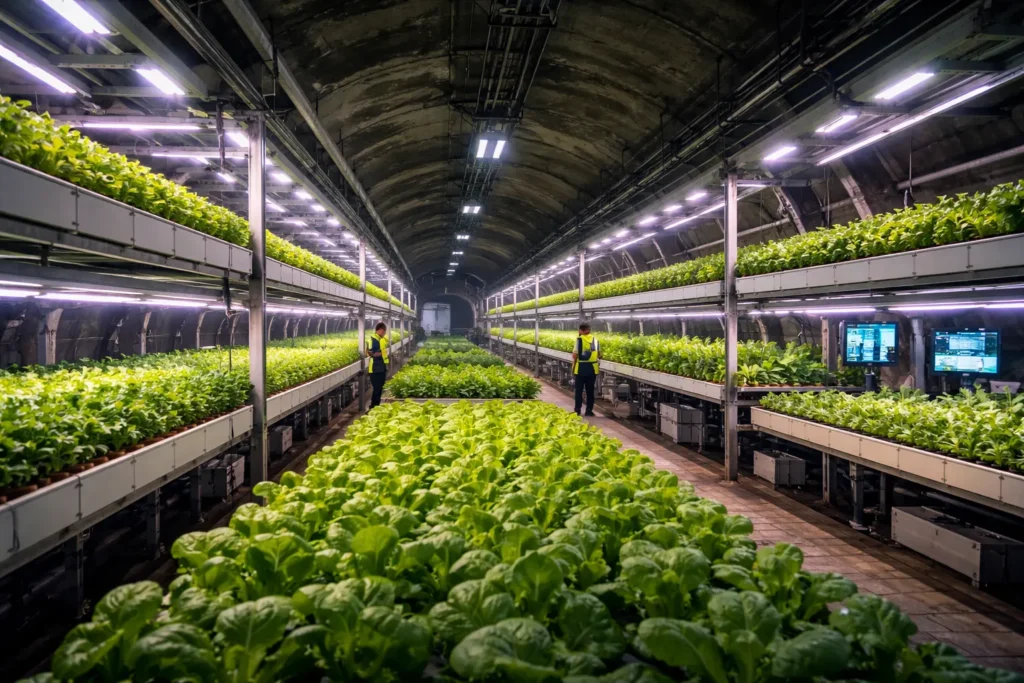
But now, a new sound is echoing through these concrete tunnels. It’s the gentle hum of LED lights and the soft hiss of nutrient-rich mist. The darkness is being pushed back by rows and rows of vibrant green plants. Deep beneath the bustling streets, a quiet revolution is taking root. We are witnessing the rebirth of abandoned infrastructure, not as transportation hubs, but as the world’s most advanced farms. There are estimated to be thousands of miles of such tunnels beneath major cities globally—London alone has over 80 miles of disused tunnels that could potentially be repurposed for agricultural space . What was once a liability is becoming an asset.
This is the story of how we are taking dark, derelict spaces and turning them into bright, productive landscapes. It’s a story about solving some of our biggest problems—food security, climate change, and urban decay—by looking down when everyone else is looking up. It’s a story that combines the grit of industrial history with the gleaming promise of high technology, all to create a future where our food is grown not in distant fields, but right beneath our feet. The transformation underway is not merely about finding new uses for old spaces; it represents a fundamental rethinking of our relationship with food, with our cities, and with the environment itself. As we confront the realities of climate change, population growth, and resource depletion, these underground farms offer a glimpse of a more resilient and sustainable way forward.
1. A Journey into the Underworld: The Forgotten Transit Tunnels
To understand where we are going, we have to first look back. In the late 19th and early 20th centuries, cities like London, New York, Paris, and Tokyo burrowed into the earth. They built intricate networks of subterranean railways to move people and goods, fueling an industrial boom. These tunnels were marvels of engineering, arteries pumping life into the heart of the metropolis. They were lit by gas lamps and later by electric bulbs, filled with the roar of trains and the chatter of millions of commuters. They represented progress, connection, and the triumph of human engineering over the natural world. The construction of these tunnels was a dangerous and labor-intensive endeavor, requiring thousands of workers known as “sandhogs” or “navvies” who risked their lives daily. They dug through rock and soil using little more than pickaxes, shovels, and dynamite, creating the foundations upon which modern cities would grow. These tunnels were not just transportation corridors; they were symbols of human ambition and the belief that technology could overcome any obstacle.
However, times change. Technology evolves. Newer, faster, and deeper lines were built to accommodate growing populations and more efficient trains. Stations that were once grand and busy were deemed unsafe, too small, or simply unnecessary. The entrances were sealed with concrete and steel, and the tunnels were abandoned to the darkness. They became ghost stations, known only to urban explorers, transit historians, and the occasional film crew looking for a gritty, atmospheric location. Some were used as air raid shelters during wars, providing sanctuary during the Blitz and saving countless lives. Others simply sat empty, slowly decaying as the city carried on above them, oblivious to the worlds hidden below. In New York, the old South Ferry station, with its curved platforms and beautiful skylights, was abandoned after newer, longer trains couldn’t fit. In London, stations like Down Street, which once served as a secret bunker for Winston Churchill during World War II, were sealed off and forgotten. Each of these spaces holds layers of history, from the daily commuters who once passed through to the wartime secrets they later harbored.
For years, these spaces were seen as a massive liability. They cost money to maintain, if only to ensure they didn’t collapse and cause sinkholes on the streets above. They posed safety and security risks, attracting the homeless or curious explorers. For city planners, they represented a massive amount of wasted real estate, a sunk cost of a bygone era. But recently, a new generation of visionaries—a mix of farmers, engineers, and entrepreneurs—began to see them not as tombs, but as wombs. They looked past the grime and the darkness and saw something else: insulated, secure environments, already connected to power and water grids, with stable temperatures and existing structural integrity. They saw the potential to bring life back to these forgotten places, not with trains, but with plants . They saw that the future of food might be hidden underground. This shift in perspective represents a broader trend in urban planning and sustainability, where we are learning to see value in what was once discarded, to find opportunity in decay, and to reimagine our cities as living, evolving organisms rather than static monuments.
2. When the Sun Never Shines: Engineering Light with LEDs
The first and most obvious problem with farming underground is the total absence of sunlight. Plants need light to perform photosynthesis, the miraculous process that turns water and carbon dioxide into the food that fuels their growth and, ultimately, feeds us. Without the sun, traditional farming is impossible. You can’t just dig a hole and hope for the best. The darkness is absolute and eternal. For millions of years, plants have evolved under the sun’s full spectrum of light, and removing that light entirely would seem to make agriculture impossible. Yet human ingenuity has found a way to not just replicate sunlight, but to improve upon it.
But today, technology has given us a brilliant and increasingly sophisticated substitute: Light Emitting Diodes, or LEDs. These aren’t the simple red indicator lights on your stereo or the remote control for your TV. Modern horticultural LEDs are powerful, energy-efficient, and incredibly precise pieces of technology. They are the result of years of research into plant biology and physics. Engineers and botanists have worked together to understand exactly which wavelengths of light plants use most efficiently. The development of LED technology for horticulture has been one of the most significant advances in controlled environment agriculture, enabling year-round production in any location, regardless of external light conditions.
It turns out that plants don’t need the whole spectrum of white light that the sun provides. They primarily absorb light in the blue and red parts of the spectrum. Blue light is great for leafy growth and keeping plants compact, while red light is crucial for flowering and fruiting. So, engineers can tune these LEDs to emit specific wavelengths of light—mostly deep reds and blues—that plants use most efficiently . This creates the surreal, sci-fi pink and purple glow that is the signature look of these underground farms. The ability to customize light spectra has opened up new possibilities for manipulating plant growth, flavor, and nutritional content in ways that were never possible with sunlight alone.
In these subterranean farms, the darkness is pushed back by rows and rows of these lights, suspended just inches above the plants. The lights don’t just mimic the sun; in many ways, they improve upon it. Because they are right next to the plants, none of the energy is wasted on heating the vast space of an outdoor field or the atmosphere. The light intensity, or “photoperiod,” can be controlled with the flip of a switch. Farmers can trick lettuce into thinking it’s a long summer day, encouraging it to grow big and fast, or convince strawberries to fruit out of season by providing the specific red-light spectrum they need. Studies have shown that supplementing white LED light with specific amounts of deep red (660 nm) and far-red (730 nm) light can increase the fresh weight of lettuce by 76% and basil by 79% compared to using white light alone . The plants grow faster, more consistently, and often with better flavor and nutrition than they ever could on a sun-drenched field, all because we can now engineer the perfect sun. Research continues to refine these “light recipes” for different crops, with scientists exploring how different wavelengths affect everything from root development to the production of antioxidants and other beneficial compounds.
The energy efficiency of LEDs has improved dramatically over the past decade, with modern fixtures converting over 60% of electrical energy into usable light for plants, compared to just 25% for older technologies like high-pressure sodium lamps. This efficiency is critical for underground farming, where lighting represents one of the largest operational costs. Some farms are now using programmable spectrum LEDs that can be adjusted in real-time based on sensor data and plant needs, further optimizing energy use and plant growth . Companies like Revolution Microelectronics have developed LEDs with lifespans three times the industry standard, reducing waste and improving the sustainability of these operations . As LED technology continues to advance, the cost of lighting continues to fall, making underground farming increasingly economically viable.
3. No Soil? No Problem: The Magic of Hydroponics and Aeroponics
If you dig up the floor of an old subway tunnel, you’re not going to find rich, dark topsoil teeming with earthworms and organic matter. You’ll find gravel, crushed stone, old rail ties made of creosote-soaked wood, and a century’s worth of industrial grime, oil, and metallic dust. It’s toxic, inert, and completely useless for traditional agriculture. You couldn’t grow a weed in it, let alone a healthy head of lettuce. The very history that makes these tunnels fascinating—their long service to industry and transportation—also makes them unsuitable for conventional farming. The soil, if you can call it that, is contaminated with heavy metals, hydrocarbons, and other pollutants that would make any food grown in it unsafe to eat.
So, the farmers of the underworld don’t use soil at all. They have moved beyond it, embracing soilless growing methods that are revolutionizing agriculture. They use two main methods that fall under the umbrella of “soilless agriculture” or “controlled environment agriculture”: hydroponics and aeroponics . These techniques represent a fundamental shift in how we think about growing plants, freeing agriculture from the constraints of soil quality and availability.
- Hydroponics is the more established of the two. It means growing plants with their roots dangling directly into a shallow stream of nutrient-rich water. This water isn’t just H2O; it’s a carefully balanced, life-giving solution. Farmers and plant nutritionists have perfected the recipes, mixing in everything a plant needs for robust growth: nitrogen for leafy greens, phosphorus for strong roots and flowers, potassium for overall health, and a host of trace minerals like calcium, magnesium, and iron. The water is constantly circulated, monitored for pH and nutrient levels, and adjusted automatically. The plants are never thirsty and never hungry. There are several types of hydroponic systems used in underground farms. The nutrient film technique (NFT) involves a thin film of nutrient solution flowing through channels where plant roots are suspended, providing continuous access to water and nutrients while ensuring plenty of oxygen. Deep water culture (DWC) suspends plant roots in a deeper reservoir of nutrient solution, often with air stones providing oxygenation. Each system has its advantages, and farmers choose based on the crops they’re growing and the specific constraints of their tunnel space.
- Aeroponics takes this concept a step further and is where things get really futuristic. In an aeroponic system, the plant roots hang in the air inside a closed, dark chamber. They are not submerged in anything. Instead, every few minutes, a fine mist of that same nutrient solution is sprayed onto them. It’s like giving the roots a refreshing, healthy fog. Because the roots are exposed to the air, they have access to vastly more oxygen, which they absorb directly. This oxygen boost can supercharge their metabolism and lead to even faster growth rates . NASA has even experimented with aeroponics for growing food in space, as it’s an incredibly efficient and lightweight method that could sustain astronauts on long missions to Mars. The closed-loop nature of aeroponic systems means that water and nutrients are used with almost perfect efficiency, with virtually no waste.
Without soil, the plants expend less energy sending out wide root systems to search for food and water, so they put all their effort into growing upwards. This leads to faster harvests and bigger yields. A head of lettuce that might take two months to grow in a field can be ready in just four or five weeks in a hydroponic system. Additionally, without soil, there are no soil-borne diseases or pests like grubs or nematodes. This sterile, controlled environment means the farmers can avoid using any chemical pesticides or herbicides. The food that comes out of these tunnels is not only fresh and local, but often cleaner, safer, and more pure than anything grown in a field . The elimination of pesticides is not just good for consumers; it’s better for the workers who tend the crops and for the environment as a whole, as no chemicals are released into waterways or ecosystems.
The growing media used in these systems has also evolved. While some hydroponic systems use inert materials like rockwool or coconut coir to provide physical support for plants, others rely on the nutrient solution alone. The choice of media affects water retention, oxygen availability, and root development, and farmers carefully select the right medium for each crop. Research continues into developing new growing media that are sustainable, reusable, and optimized for different plant species . Some farms are even experimenting with biodegradable media made from agricultural waste products, further reducing their environmental footprint.
4. A Climate in a Box: Growing Food No Matter the Weather
Up on the surface, farmers are at the mercy of the weather. It is the oldest struggle in human history. A late spring frost can kill a delicate peach crop in a single night. A summer drought can wilt an entire field of corn, turning the leaves brown and the ears stunted. A sudden hailstorm can shred lettuce leaves to pieces in minutes, ruining months of work. Climate change is making these events more frequent, more severe, and less predictable, threatening our global food supply in ways we are only beginning to understand. Traditional farming is becoming a gamble with increasingly bad odds. The FAO reports a global loss of 75 billion tons of soil from arable land each year due to erosion, nutrient leaching, and desertification . Major aquifers that supply 90% of water systems in the United States are being rapidly depleted . These challenges demand new approaches to food production.
This is where the subway farm has a massive, almost unfair, advantage. One hundred feet underground, the weather on the surface simply doesn’t matter. It could be snowing a blizzard or scorching a heatwave, and the temperature in the tunnel remains constant, hovering around 50-60°F (10-15°C) year-round. The thermal mass of the earth acts as a perfect insulator. There is no wind, no rain, no snow, no damaging UV rays. The environment is static and predictable. This geothermal effect is one of the key advantages of underground farming, dramatically reducing the energy needed for heating and cooling compared to above-ground greenhouses or vertical farms . In Canada, farms like Jardin Vertical have capitalized on this effect, locating their operations in basements to take advantage of the natural temperature stability during brutal -30°C winters .
In this controlled environment, farmers become climate engineers. They are no longer subject to the whims of nature; they are in complete command. They can use heaters, air conditioners, humidifiers, and dehumidifiers to create the perfect growing conditions for any crop, 365 days a year. They can grow delicate, heat-sensitive basil in the middle of a freezing winter by keeping the temperature just right. They can cultivate crisp, cool-weather salad greens during a blistering summer heatwave without them bolting (going to seed) or becoming bitter. This is what experts call “climate-resilient agriculture” . It guarantees a steady, reliable, and predictable supply of fresh, local food, regardless of what is happening on the surface. It takes the gamble out of farming and replaces it with science and control. The consistency of the underground environment also means that harvests can be planned with precision, allowing farmers to supply their customers with predictable quantities of produce week after week, month after month.
The ability to control CO2 levels is another advantage of these sealed environments. Plants thrive at higher CO2 concentrations than are found in ambient air, and underground farmers can enrich the atmosphere to optimal levels, boosting photosynthesis and accelerating growth. CO2 levels in these farms are often maintained between 600 and 1000 ppm, significantly higher than the 400 ppm found in outside air, resulting in faster growth and higher yields . This level of environmental control extends to humidity management, which can be adjusted to prevent fungal diseases and optimize plant transpiration, further improving plant health and productivity.
5. The Science of Taste: Manipulating Pressure and Mists
It’s one thing to grow a lot of food quickly and efficiently. That solves a problem of quantity. But it’s another thing entirely to make that food taste amazing. Flavor, texture, and nutritional density are the qualities that make food a joy to eat, not just fuel to survive. In these high-tech underground farms, the science of growing meets the art of flavor in fascinating and innovative ways. The same control that allows farmers to optimize growth also allows them to fine-tune the sensory qualities of their crops, creating produce that is not only fresh but also exceptionally flavorful and nutritious.
Farmers and botanists are essentially becoming flavor chefs, experimenting with the plants’ environment to change how they taste and feel. For example, by slightly adjusting the atmospheric pressure in a sealed growing chamber, they can create a form of gentle, controlled stress on the plants. In nature, a little stress—like a slight drought or cooler temperatures—often signals to a plant that it’s time to prepare for a change in season. It responds by producing more of the compounds that give it flavor and color, as a form of protection. A little stress can make a radish spicier, a head of lettuce crispier, or a basil plant produce more of the aromatic oils that give it that distinctive scent. This concept of “eustress” (beneficial stress) is being actively researched as a way to enhance crop quality without sacrificing yield.
The nutrient-dense mists in aeroponic systems can also be tweaked with incredible precision. It’s not a one-size-fits-all recipe. Farmers can change the “recipe” of the mist at different stages of a plant’s life. Early on, they might use a mix high in nitrogen to promote fast leaf growth. But as the plant matures, they can switch to a formula higher in phosphorus and potassium to boost flowering and fruiting. They can increase the concentration of certain minerals to boost sugar content in strawberries or increase the pungency of wasabi or mustard greens. Research has shown that light spectrum also plays a crucial role in flavor development, with different wavelengths triggering the production of various secondary metabolites that contribute to taste and aroma . For instance, studies on radishes and turnips have shown that these root vegetables respond differently to various light spectra, with implications for both yield and flavor .
It’s like being a chef and a scientist at the same time, “cooking up” the perfect head of lettuce by controlling every single variable down to the parts-per-million of a nutrient in the water. This level of precision is simply impossible in a traditional field, where the plant’s diet depends on the complex and unpredictable chemistry of the soil. The result is produce that consistently meets high standards for flavor and nutrition, pleasing even the most discerning chefs and consumers. Michelin-starred chefs have become early adopters of underground farm produce, drawn by its consistent quality, exceptional freshness, and the ability to request specific varieties or flavor profiles . This high-end market has helped validate the quality of underground-grown produce and provided a foundation for these farms to scale up their operations.
6. From Soot to Sprouts: Cleaning Up the Concrete Arteries
Before any seed can be planted, before any LED light can be switched on, there is a massive, dirty, and unglamorous job that must be done. These tunnels, these forgotten arteries of the city, were once choked with soot from old steam trains and the diesel fumes of more modern engines. The dust, grime, oil, and industrial pollutants of a century have settled on every surface—the curved tile walls, the concrete floor, the iron girders. You can’t just walk in and start planting food in that environment. It would be unsafe and unsanitary. The legacy of industrial use means that these spaces must be thoroughly remediated before they can be used for food production, a process that requires significant investment and expertise.
The transformation from “soot to sprouts” is a story of deep, painstaking cleaning and remediation. It’s a physical process that honors the past while preparing for the future. Teams of workers, often wearing protective gear, go in with industrial scrubbers, wire brushes, and high-pressure washers. They remove layers of greasy, black grime from the walls, revealing the original tiles underneath. They scrape and vacuum decades of debris from the floor. They test for and safely remove any hazardous materials, like asbestos or lead-based paint, that might be present. In some cases, this process reveals beautiful original architecture that has been hidden for generations, adding a layer of historical appreciation to the modern farming operation.
Once the structure is clean, the real work of creating a food-safe environment begins. They seal the old concrete floors and walls with food-grade epoxy coatings to prevent any remaining contaminants from leaching into the new systems. They install brand-new, food-grade plumbing and electrical systems, separate from the old, corroded lines. They build clean rooms and airlocks to prevent outside contaminants from getting in. The farm at Growing Underground in London operates in a sealed clean-room environment with a tailored ventilation system that ensures the air quality meets strict food safety standards . This level of attention to hygiene is essential for producing food that is safe and healthy for consumers.
This process is about more than just hygiene; it’s a profound and symbolic act. It’s washing away the heavy, dirty industrial past to make way for a clean, green, sustainable future. The tunnels that once carried coal and iron and powered an industrial revolution are now being purified to carry vitamins and minerals and power a food revolution. They are being reborn. This transformation also has implications for the surrounding community. Cleaning up these previously neglected spaces can improve the environmental quality of the entire neighborhood, reducing the risk of pollutants leaching into groundwater or releasing harmful dust into the air. It’s a form of environmental justice, bringing new life and purpose to areas that may have been marginalized or forgotten.
7. Bringing the Farm to the City: The Ultimate Local Food
Think for a moment about where your food comes from. A head of lettuce in a supermarket in Chicago might have been grown in California or Arizona. A bunch of basil in a London shop might have been flown in from Israel or Morocco. It was harvested days or even weeks ago, washed, packed, loaded onto a refrigerated truck or a plane, and shipped for thousands of miles. It sat in a distribution center, then on a truck again, then on a supermarket shelf for days. By the time you finally take it home and eat it, it has lost a significant amount of its nutrients, its flavor has dulled, and its texture has softened. This long, complex, and energy-hungry journey is the norm for most of the food in the developed world. The average meal in the United States travels about 1,500 miles from farm to plate, a statistic that underscores the inefficiency and environmental cost of our current food system.
An underground farm solves this problem with breathtaking efficiency. Because the farm is located right in the city, often directly under a busy neighborhood, the food is grown only miles—and sometimes only blocks—from where it will be eaten. It doesn’t have to travel. This is the ultimate expression of “farm-to-table,” or perhaps more accurately, “tunnel-to-table.” The hyper-local business model adopted by farms like Jardin Vertical guarantees that food never travels more than a mile from where it’s grown . This dramatically reduces the carbon footprint associated with food transportation and ensures that consumers get produce at the peak of freshness.
The implications are huge. A chef at a restaurant can place an order in the morning, and the lettuce can be harvested, gently rinsed, packed, and delivered by bicycle or electric van by the afternoon, often still with a bit of tunnel soil on its roots. It’s incredibly fresh—often still alive when it arrives. It hasn’t lost vital nutrients during a long, slow journey from a distant farm. And it hasn’t required a massive amount of fossil fuels to be transported, which means its carbon footprint is a tiny fraction of its traditionally-grown counterpart . One concept brand, “Grow Below,” even proposed using packaging that mimics the famous London Underground logo, telling the story of where the greens came from and guaranteeing delivery within two hours of being picked . This kind of branding creates a powerful connection between consumers and their food, making the origin of the produce visible and meaningful.
By bringing the farm to the city, we slash food miles, reconnect urban dwellers with the source of their meals, and create a food system that is fresher, tastier, and far more sustainable. This localization of food production also has important implications for food security. When supply chains are disrupted—by natural disasters, pandemics, or geopolitical events—cities with local food production are more resilient. Underground farms, protected from surface-level disruptions, can continue to produce food even when transportation networks are compromised. This was demonstrated during the COVID-19 pandemic, when many urban farms were able to maintain production while traditional supply chains struggled.
8. The Workers in the Dark: A New Kind of Urban Farmer
This new world of underground agriculture requires a new kind of farmer. This isn’t your grandfather’s farming, with calloused hands, a straw hat, and a tractor. The farmers of the underworld are just as likely to have degrees in plant science, engineering, or computer programming as they are in agriculture. They are a new breed of urban agriculturalist, combining traditional knowledge of plant care with cutting-edge technical skills. The workforce development implications are significant, as these farms create jobs that didn’t exist a generation ago and require new educational and training pathways.
Their workday is a unique blend of physical and digital tasks. They might start by donning a clean-room suit to check on the health of the plants, looking for any signs of discoloration or stress. Then, they might sit down at a computer terminal to analyze the data from the previous night. How did the pH levels in the nutrient solution fluctuate? Did the LED lights perform at peak efficiency? Was the temperature and humidity within the optimal range? The farm is covered in sensors, all feeding data into a central computer. The farmer’s job is to interpret that data and make constant, tiny adjustments to keep the system running in perfect harmony. This integration of Internet of Things (IoT) devices and data analytics is transforming agriculture into a high-tech industry .
They are part gardener, part data scientist, and part systems engineer. They troubleshoot a clogged misting nozzle one minute and write a new algorithm for the lighting schedule the next. This is skilled, technical work that creates new, high-value jobs in the heart of the city. It’s an opportunity to revitalize local economies and provide meaningful, future-focused employment. It also changes who can be a farmer. It opens up the profession to people who love plants and technology but never had access to land or an interest in the solitary, weather-dependent life of a traditional farmer. The underground farm is a high-tech workplace, and its workers are the pioneers of a new agricultural revolution. Some farms are also engaging with local schools and community organizations to provide training and internship opportunities, helping to build a pipeline of future workers and ensuring that the benefits of this new industry are shared broadly .
The diversity of skills required in these operations also means that they can provide employment for people with a wide range of backgrounds. From plant biologists and agricultural engineers to software developers and logistics specialists, underground farms create a rich ecosystem of jobs. This diversity makes them valuable anchors for urban economic development, attracting talent and investment to neighborhoods that may have struggled with disinvestment and decline.
9. The Concrete Jungle’s Green Harvest: A Story of Sustainability
So, what does all of this add up to? It adds up to a powerful new model for urban sustainability, one that tackles some of our most pressing environmental challenges head-on. Let’s break down the numbers and the impact to see just how transformative this approach can be. The data is compelling and points to a fundamental reimagining of how we can produce food in harmony with urban environments.
- Water: Traditional agriculture is incredibly thirsty. It’s the single biggest consumer of freshwater on the planet, accounting for about 70% of global freshwater use. Much of this water is lost to evaporation, runoff, or simply drains away through the soil. Underground hydroponic and aeroponic farms are radically more efficient. Because the water is recirculated in a closed system—the plants drink what they need, and the excess is collected and reused—these farms use up to 95% less water than traditional, open-field farming . Growing Underground reports using 70% less water than traditional farming , while some advanced aeroponic systems achieve even greater savings. In a world where water scarcity is an increasing threat, this is a game-changer. The water savings become even more significant when considered in the context of climate change, as droughts become more frequent and water resources more contested.
- Land: Our planet has a finite amount of arable land, and we’re losing it to desertification, development, and degradation. The United Nations projects that the global population will reach 9.7 billion by 2050, placing enormous pressure on food production systems . Underground farms use no new land. They repurpose space that is already there and going to waste. Furthermore, they use that space vertically, stacking plants in tall towers or shelves. This “vertical farming” approach produces yields many times higher per square foot than a traditional farm. Crop yields in controlled environment agriculture are reported to range between 10 and 100 times higher than open-field agriculture . One single subway tunnel can produce as much food as several acres of farmland, freeing up land on the surface for parks, housing, or reforestation . This land-use efficiency is particularly valuable in dense urban areas where space is at a premium.
- Transportation & Emissions: By being located directly in the city, these farms eliminate the need for long-haul trucking, shipping, and air freight. This slashes carbon emissions, reduces traffic congestion, and cuts down on the pollution associated with modern food transport. One study found that for a building-integrated farm, the supply chain is so short that it can significantly contribute to the environmental performance of the whole system, especially when paired with renewable energy . The “zero carbon food” mission of farms like Growing Underground, which uses energy entirely from green suppliers and delivers by bike, demonstrates the potential for carbon-neutral urban food production .
- Waste: The current food system is incredibly wasteful. A huge percentage of produce is lost because it’s “ugly” and doesn’t meet supermarket cosmetic standards, or it spoils during its long journey to market. Globally, nearly one-third of food is wasted from farm to fork annually . Because the food in an underground farm is grown to order and doesn’t have to survive a long shipping process, food waste is dramatically reduced. You only grow what people have already ordered. This just-in-time production model aligns supply with demand, eliminating the overproduction and waste that plagues traditional agriculture.
- Energy: This remains the biggest challenge. While LED technology has become incredibly efficient, these farms still require significant electricity for lighting and climate control. Energy accounts for about 25% of operating costs for large vertical farms in the United States . However, innovative solutions are emerging. Some farms are locating in spaces that provide natural geothermal insulation, reducing heating and cooling costs . Others are exploring integration with renewable energy sources, including solar panels and even agrivoltaics, where solar panels are combined with agricultural production . The carbon footprint of indoor farms can be 5.6 to 16.7 times greater than open-field agriculture if powered by fossil fuels , which is why the shift to renewable energy is essential for realizing the full environmental benefits of underground farming.
The abandoned subway is no longer a symbol of decay. It is a powerful symbol of a circular economy—taking a wasted resource and turning it into a productive asset that feeds the community, creates jobs, and protects the planet. This model of urban agriculture aligns with broader sustainability goals, including the United Nations Sustainable Development Goals (SDGs), particularly those focused on zero hunger, sustainable cities, responsible consumption, and climate action .
10. Growing Pains: The Challenges of Farming Below Ground
It would be easy to paint a picture of this new technology as a perfect, problem-free solution. But that wouldn’t be the full story. Like any ambitious endeavor, underground farming has its own set of significant challenges that must be overcome. It’s not cheap or easy, and the pioneers in this field face a tough road. Understanding these challenges is essential for developing realistic strategies to support the growth of this industry and maximize its potential.
The biggest hurdle is energy. While LED technology has become incredibly efficient, it still requires a lot of electricity to run those lights for 16-18 hours a day, every day. All that light generates heat, which then has to be pumped out by powerful ventilation systems to keep the plants from overheating. This creates a cycle of energy use that is the single largest operating cost for these farms. Studies on controlled environment agriculture consistently point to electricity as the dominant contributor to the farm’s overall environmental impact . Making the economics work often means finding access to cheap, renewable energy, or locating the farm in a place with favorable electricity rates. Some farms are experimenting with grid-interactive strategies, where they adjust their energy use in response to grid conditions, providing flexibility services that can generate additional revenue .
Then there’s the cost of construction. Retrofitting a 100-year-old tunnel into a sterile, high-tech clean room is not cheap. It involves massive civil engineering work—sealing leaks, reinforcing structures, removing debris, and installing all-new infrastructure. The start-up costs can be in the millions, which makes it difficult for small entrepreneurs to get started and means the farms need to be financed by larger companies or investors. Growing Underground’s first phase represented more than £750,000 investment , and larger operations can cost tens of millions. This capital intensity creates a barrier to entry and means that the industry is likely to be dominated by well-funded players, at least initially.
There are also regulatory hurdles. Our food safety laws were written for traditional farms and food processing plants. How do you regulate a farm in a former subway tunnel? What new health and safety standards are needed? Zoning laws may also need to be updated to allow for commercial agriculture in what are technically transit or industrial zones. Overcoming these bureaucratic and regulatory challenges requires time, patience, and advocacy. In the United States, multiple government agencies including the USDA, FDA, DOE, and NASA are now collaborating on research to address these challenges and develop appropriate regulatory frameworks for controlled environment agriculture . This interagency cooperation is essential for creating a supportive policy environment for the industry.
Crop selection is another limitation. Currently, underground farms are best suited for high-value, fast-growing crops like leafy greens, herbs, and microgreens. These crops have short growth cycles and high market prices, making the economics work. Staple crops like wheat, corn, and rice, which form the caloric basis of the human diet, are not economically viable in these systems due to their long growth cycles and low value per unit of weight . This means that underground farming is a complement to, not a replacement for, traditional agriculture. It can provide fresh, local produce, but it won’t solve all of our food production challenges.
Technical complexity and the need for skilled labor also pose challenges. These farms require sophisticated knowledge to operate and maintain, and finding workers with the right mix of agricultural and technical skills can be difficult. The industry is investing in training programs and working with educational institutions to develop curricula that prepare students for careers in controlled environment agriculture, but this will take time.
11. A Global Movement: From London to New York and Beyond
This isn’t just a futuristic idea confined to a few experimental labs. It’s a real, growing global movement. Cities around the world are exploring the potential of underground and controlled environment agriculture, adapting the concept to their unique circumstances and needs. The diversity of approaches reflects the flexibility of the underlying technology and the universal appeal of local, sustainable food production.
The pioneering project that put this concept on the map is called “Growing Underground” in London . Tucked away in old World War II air raid shelters and abandoned tunnels 100 feet below the busy streets of Clapham, this farm has been successfully growing microgreens and salads since the mid-2010s. Founded by entrepreneurs Richard Ballard and Steven Dring, with the support of Michelin-starred chef Michel Roux Jr., the farm proved that the concept was commercially viable. They use hydroponics and LED lighting to produce fresh greens for London restaurants and retailers, all with a fraction of the water and transport of traditional farming. The project even received early support from then-Mayor Boris Johnson, who hailed it as a fine example of green business innovation . The farm’s first crops included pea shoots, several varieties of radish, mustard, coriander, Red Amaranth, celery, parsley, and rocket .
In Canada, Jardin Vertical has taken a different approach, locating its tower farm in a basement to take advantage of geothermal effects. This farm is an entirely closed system, fully aeroponic with all LED lighting, making it the first commercial-scale tower farm in Canada . The farm’s hyper-local model ensures that food never travels more than a mile, and the company has plans for five additional farms to extend their coverage . This demonstrates that the concept can be adapted to different urban contexts and scaled up to serve larger populations.
Inspired by these successes, similar projects are popping up or being planned all over the world. In the United States, cities with extensive underground infrastructure, like New York, Boston, and Kansas City, are exploring the potential of their own abandoned spaces. In Paris, planners are looking at the miles of former catacombs and quarry tunnels that riddle the Left Bank. In Tokyo and Seoul, where land is incredibly scarce and expensive, the idea of farming underneath the city is gaining serious traction with urban planners and architects. Singapore has set an ambitious goal to meet 30% of its nutritional needs by 2030 through advanced CEA technology , driving innovation in hydroponics and LED systems. Japan is pioneering the integration of aeroponics and robotics in vertical farming systems . The Netherlands continues to lead in aquaponics and water recycling technologies .
This is becoming a recognized part of the solution for creating sustainable, resilient cities. The Food and Agriculture Organization (FAO) of the United Nations has even highlighted urban and peri-urban agriculture, including innovative forms like vertical and underground farming, as a key strategy for improving food security and building climate resilience in the world’s growing cities . What started as a quirky idea in London is now a serious consideration for city planners and food security experts across the globe. The global agtech market, including vertical farming, is projected to grow dramatically, driven by population growth, resource scarcity, and technological advances .
12. The Future is Down: What’s Next for Underground Agriculture?
This is just the beginning. As cities continue to grow and the effects of climate change intensify, the need for reliable, local, and sustainable food sources will only increase. What started with repurposing old subways is now expanding into a vision for using all kinds of unused urban spaces. The core principles—controlled environment, soilless growing, LED lighting—can be applied almost anywhere. The future of this industry is limited only by our imagination and our willingness to invest in new ways of thinking about food production.
Imagine old, multi-story parking garages in the heart of a city being converted into massive vertical farms. These structures are already designed to handle heavy loads, have existing power and water connections, and are often located in dense urban areas where demand for fresh food is high. Picture decommissioned mines, with their miles of horizontal tunnels, being turned into sprawling underground agricultural complexes. The constant temperature and humidity of these deep underground spaces could be ideal for certain crops. Envision abandoned shopping malls, with their huge, windowless interiors, being gutted and refitted with racks of leafy greens growing under pink LED lights. These spaces are already connected to transportation networks and often have ample parking for delivery vehicles. Any large, empty, enclosed space has the potential to become a farm.
The technology driving this revolution is advancing at a breathtaking pace. Robots are being developed to plant, tend, and harvest in these tight, controlled spaces, reducing labor costs and increasing efficiency. Automated vertical farms have achieved a 40% reduction in operational downtime . Artificial intelligence (AI) and machine learning are being integrated to monitor plant health, detect diseases before they spread, and automatically adjust the lights, nutrients, and climate for optimal growth . AI-driven systems can increase productivity by up to 30% compared to traditional farming . Digital Twins—virtual replicas of physical farming systems—are being developed to simulate and optimize farm operations before they are implemented in the real world . These technologies will make underground farms more efficient, more productive, and more profitable.
Advances in plant science are also contributing. Researchers are working to develop crop varieties specifically bred for controlled environment agriculture, with traits like compact growth habits, rapid growth cycles, and enhanced nutritional content . Engineered microbiomes—beneficial communities of microorganisms—are being developed to enhance plant growth and disease resistance in soilless systems . These biological innovations will complement the technological advances, creating integrated systems that are greater than the sum of their parts.
We are moving towards a future where a farm is not a place, but a system—a highly efficient, data-driven, and automated system for producing food. The integration of renewable energy, such as solar panels on the surface powering LED lights below, will create truly sustainable operations. Agrivoltaics, which combines solar energy generation with agricultural production, offers exciting possibilities for powering underground farms with clean energy . The development of low-cost sensors will democratize the technology, making it accessible to smaller operators and communities . Modular designs will allow farms to scale up or down as needed, adapting to changing market conditions .
The future of food is resilient, local, sustainable, and high-tech. And it might not be found in a sunny valley or on a sprawling plain. It might be hidden right beneath your feet, growing quietly in the dark, powered by science, nurtured by a new generation of urban farmers, and rooted in a vision of a greener, more secure world. The abandoned subway, once a forgotten ghost of the industrial past, has become a powerful blueprint for the future. It proves that sometimes, to move forward, you just have to look down. The revolution in underground agriculture is not just about growing food; it’s about reimagining our relationship with our cities, with our environment, and with each other. It’s a vision of a future where the hidden spaces beneath our feet become sources of life and nourishment, where the legacy of industrial decay is transformed into a foundation for sustainable abundance, and where the food on our plates tells a story of innovation, resilience, and hope.



Okay, so Playdoit? Played it last night and I was pleasantly surprised. Runs smoothly, even on my older phone. Good way to kill some time. Time to Playdoit playdoit
Looking for a specific games? If you check out X666 Game Download, I bet you could probably find it! Give it a look: x666 game download
Looking for a new online casino? Playcity casino is on my list to try out. Heard some good things about their game selection. Will report back after a few rounds! Do not loose your chance know. playcity casino