
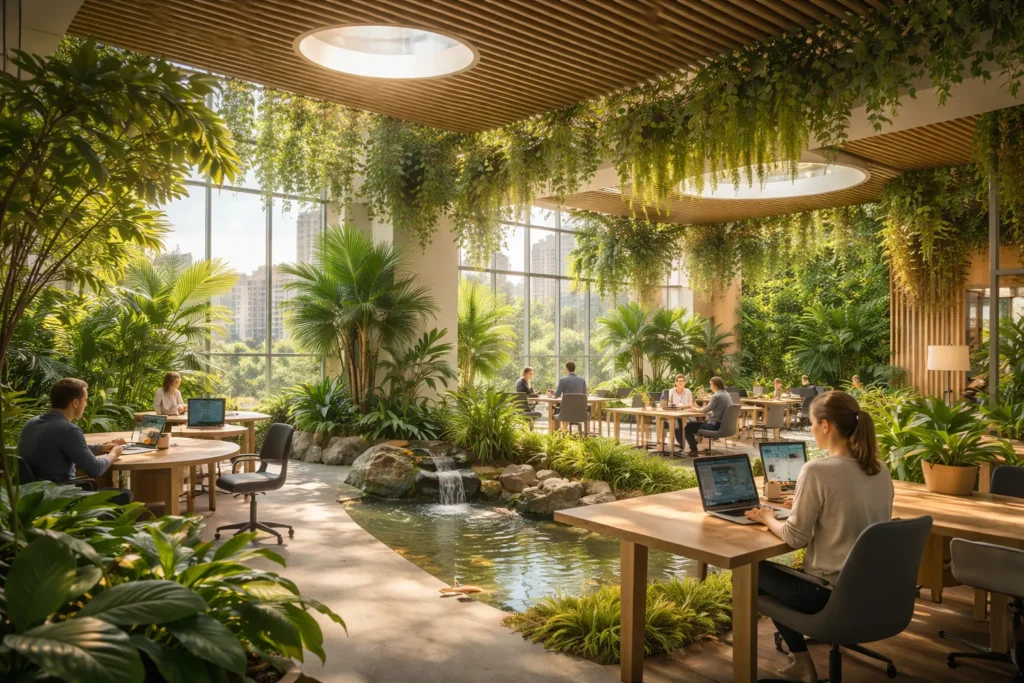

The elevator doors slide open, and for a brief moment, you forget you are at work. The soft fragrance of damp soil and blooming jasmine greets you first. Then comes the light—warm, golden, shifting gently as clouds pass somewhere far above the glass atrium. A stream of water trickles over polished stones twenty feet away, its sound just loud enough to cover the distant murmur of conversation. Ferns spill from terra cotta planters along a curved timber bench where a small team huddles over laptops, their faces relaxed, focused.
This is not a botanical garden. This is not a high-end spa retreat in Costa Rica. This is the lobby of a Fortune 500 insurance company in downtown Chicago. This is the office in 2026.
Five years ago, walking into a corporate headquarters meant entering a world deliberately separated from nature. Fluorescent lights hummed overhead, casting everything in a sickly greenish pall. Recycled air moved through metal ducts, dry and lifeless. Windows were sealed shut, views obscured by blinds meant to reduce glare on computer screens. Employees brought in personal plants to survive, tiny rebellions of green against a sea of gray cubicle fabric.
That world has vanished. It crumbled not under the weight of any single innovation, but through a fundamental shift in how we understand human beings at work. We have crossed the threshold into an era where biophilic design is no longer a niche trend or a luxury amenity reserved for Silicon Valley tech campuses. It is the corporate standard. Throughout 2025 and into 2026, businesses worldwide have completed a massive transformation, redesigning workplaces around our innate, evolutionary need to connect with the natural world. Architects, corporate leaders, and commercial real estate developers now agree without hesitation: nature-integrated design is the defining feature of commercial real estate for the next decade.
But how did this transformation happen so completely? What forces aligned to tear down the cubicle farms and replace them with living walls and daylight-flooded atriums? And most importantly, what does this new world of work actually mean for the millions of ordinary employees who pack their bags each morning and head to the office?
This comprehensive exploration takes you inside the living office. We will walk through the core principles driving this global shift, examine the science that proves why nature makes us better workers and healthier humans, and meet the architects, psychologists, and corporate leaders who engineered this revolution. By the time we finish, you will understand why the places we work have finally begun to breathe.
Chapter One: The Great Reconnection
To understand why biophilic design exploded from a fringe architectural concept into a global corporate mandate, we have to rewind the clock to the early 2020s. The world had just endured something unprecedented in modern history. A pandemic had driven billions of people indoors, then out of offices entirely, then back again under conditions of fear and uncertainty.
During those months of lockdown, something shifted in the human psyche. People who had spent their careers commuting to windowless offices suddenly found themselves working from kitchen tables, but also taking afternoon walks. They discovered the simple pleasure of stepping outside for five minutes of sunshine between Zoom calls. They planted gardens. They sat in parks. They craved fresh air with an intensity that surprised them.
When the time came to return to physical offices, employees carried this shifted perspective with them like a new lens through which they viewed everything. The old workplace—with its stale, recirculated air, its harsh artificial lighting, its rigid cubicle walls and identical beige carpet squares—suddenly appeared not just unappealing but actively hostile to human wellbeing.
The statistics from those years paint a grim picture of the pre-biophilic office. Indoor air pollution levels regularly exceeded outdoor standards by two to five times. The Environmental Protection Agency had long classified poor indoor air quality among the top five environmental risks to public health, yet commercial buildings continued to operate as sealed environments, recirculating air laden with volatile organic compounds off-gassed from furniture, carpets, and cleaning supplies.
Circadian disruption from poor lighting contributed to epidemic levels of sleep disorders. The American Academy of Sleep Medicine estimated that insufficient sleep cost the US economy over $400 billion annually in lost productivity and health care costs. Office workers spending their days under fluorescent lights that never changed in intensity or color temperature were experiencing what researchers called “circadian chaos”—their bodies receiving no reliable signals about time of day, leading to disrupted sleep, impaired cognition, and increased disease risk.
Stress-related absenteeism alone cost American businesses over $300 billion annually. The American Institute of Stress reported that 80% of workers felt stress on the job, nearly half said they needed help learning how to manage stress, and 42% said their coworkers needed such help. The workplace was literally making people sick.
Employees began demanding spaces that actively contributed to their mental and physical wellness. They wanted windows that opened. They wanted plants they could see. They wanted materials that felt warm and alive rather than cold and sterile. And for the first time in history, they had the leverage to demand these things. The labor market had shifted. Workers could leave jobs that made them miserable and find employers who offered something better.
The Great Resignation of 2021 and 2022 sent a clear message to corporate America: employees would no longer tolerate environments that diminished their quality of life. Millions of workers voted with their feet, leaving jobs not just for higher pay but for better conditions. Companies that ignored this shift found themselves unable to fill positions, losing talent to competitors who offered more humane workspaces.
Corporations listened. But not, initially, out of kindness. They listened because the numbers started adding up in ways that even the most skeptical CFO could not ignore.
Studies began emerging from respected institutions around the world. Researchers at Exeter University found that employees in offices with just a few plants per room showed 15% higher productivity than those in lean, plant-free spaces. The study, which followed workers over several months, controlled for other variables and found the effect consistent across different types of work and different employee demographics.
Texas A&M University documented 12% faster reaction times in workplaces with natural elements. Their research suggested that exposure to nature improved cognitive function in ways that persisted even after employees left the natural environment. The benefits accumulated over time, with long-term exposure producing greater effects than brief encounters.
Herman Miller and other furniture giants published white papers showing that environments rich in natural elements could reduce absenteeism by 10%, combat mental fatigue, and significantly boost the kind of creative problem-solving that drives innovation. Their research, based on surveys of thousands of workers across multiple industries, found that employees in biophilic offices reported higher job satisfaction, greater commitment to their organizations, and lower intentions to leave.
The math became simple. If investing in plants, better windows, and natural materials cost a certain amount per square foot, but that investment yielded even a 1% increase in productivity across a workforce of thousands, the return on investment measured in the millions. If it also reduced turnover by a few percentage points, the savings multiplied further. If it decreased health care costs and absenteeism, the numbers became even more compelling.
By 2024, the business case was irrefutable. Commercial real estate firms like JLL and CBRE began publishing annual reports on the financial benefits of healthy buildings. Investment funds created portfolios specifically targeting properties with strong environmental and wellness credentials. Insurance companies started offering premium reductions for buildings with features linked to better health outcomes.
By 2025, this shift was complete. Human-centric design had moved from a trend to an expectation. Buildings are now conceived around human comfort first, mechanical efficiency second. Real estate developers have learned that spaces designed for calm and balance consistently support higher engagement and tenant retention. We are no longer just leasing square footage based on location and price. We are choosing environments that support how we work, how we feel, and how we recharge between the demands of modern professional life.
The great reconnection has begun. And there is no going back.
Chapter Two: The Historical Context
To fully appreciate the magnitude of this transformation, we must understand where office design has been over the past century. The trajectory of workplace environments tells a story of shifting priorities, evolving technologies, and changing assumptions about human nature.
The earliest offices of the late nineteenth century were chaotic, crowded spaces. Clerks worked at rows of high-backed desks, natural light streaming through tall windows, but with little consideration for comfort or efficiency. These were the counting houses of Dickensian London, the trading floors of Wall Street, the government bureaus of Washington. They were functional but not designed.
The early twentieth century brought scientific management and the ideas of Frederick Winslow Taylor. Taylor believed work could be optimized through careful measurement and standardization. His principles led to the first systematic office layouts, with desks arranged in rigid grids to maximize supervision and minimize movement. Efficiency was the only goal. Human comfort was irrelevant.
The mid-century brought the modern office building, enabled by new technologies. Fluorescent lighting, developed for commercial use in the 1930s, became standard after World War II. Air conditioning allowed buildings to be sealed from the outside environment. Elevators and steel-frame construction enabled taller structures with larger floor plates. The typical office became an interior environment entirely controlled by technology, independent of local climate and light conditions.
The 1960s and 1970s saw the rise of the cubicle, originally conceived as a humane alternative to the open bullpen. Designer Robert Propst created the Action Office system for Herman Miller, intending to give workers privacy and personal space while maintaining flexibility. But companies quickly realized they could pack more people into less space by shrinking cubicle sizes and eliminating private offices. The system Propst designed to liberate workers became a tool for their confinement.
By the 1980s, the typical American office worker spent their days in a 6×8 foot cubicle, under fluorescent lights, breathing recirculated air, with no access to natural light or views of the outdoors. Window offices were reserved for executives. Everyone else existed in what author Nikil Saval called “the cubicled wasteland.”
The 1990s brought the open plan office, driven by a desire to increase collaboration and reduce real estate costs. Walls came down, cubicle heights dropped, and workers found themselves in vast, undifferentiated spaces where privacy was nonexistent and noise was constant. Collaboration increased, but so did distraction and stress. Studies showed that workers in open plans spent more time interacting but less time in focused work, and many reported lower satisfaction than they had in cubicles.
The 2000s added activity-based working, with neighborhoods for different types of work and unassigned seating. This approach promised flexibility but often delivered chaos, with workers spending valuable time each morning hunting for desks and storing their belongings in lockers.
Throughout this entire evolution, one thing remained constant: the separation between indoors and outdoors. Buildings were designed as sealed environments, independent of nature. Windows were for views, not for opening. Plants were decorations, not infrastructure. The natural world was excluded from the workplace.
The pandemic briefly disrupted this trajectory. When offices emptied in 2020, workers experienced months of working from home, often with better access to natural light, fresh air, and outdoor spaces. When they returned, they brought expectations shaped by that experience. They would no longer accept the sealed, sterile environments of the past.
The biophilic office represents a return to something older than the sealed building—a recognition that humans evolved outdoors, that we need contact with nature, and that the workplace must honor that need. It is not a radical innovation but a recovery of ancient wisdom, enabled by modern technology.
Chapter Three: The Science of Biophilia
Underlying all the design strategies, all the research studies, all the economic calculations, there is a deeper truth about human beings. We need nature. Not just for practical reasons, not just for health benefits, but for reasons that are fundamental to who we are.
This idea, called the biophilia hypothesis, was popularized by biologist E.O. Wilson in the 1980s. Wilson argued that humans evolved in intimate contact with the natural world for millions of years, and that our brains and bodies are shaped by that evolutionary history. We have an innate, genetically based affinity for life and life-like processes. We are drawn to nature because nature is where we came from and where we belong.
The evidence for biophilia comes from multiple directions. Cross-cultural studies show that people everywhere prefer landscapes with certain features: open views, water, diverse vegetation, and signs of animal life. When given choices, humans consistently select environments that resemble the savannas where our species evolved—places where we could see predators approaching, find food and water, and take shelter.
Developmental psychologists have found that infants as young as six months old show preferences for natural scenes over urban ones, suggesting that biophilia emerges early in life, before culture can shape preferences. Children in hospitals recover faster when they have views of nature. Prison inmates with views of farmland have lower stress and fewer health complaints than those facing interior walls.
The physiological effects are the most straightforward. Exposure to nature reduces stress hormones, lowers blood pressure, slows heart rate, and relaxes muscle tension. These effects occur within minutes of exposure and persist as long as the exposure continues. They are consistent across cultures, ages, and individual differences.
The cognitive effects are equally robust. Nature exposure improves attention, memory, and creative problem-solving. It enhances what psychologists call directed attention—the ability to focus on demanding tasks without becoming distracted or fatigued. It also improves executive function, the set of mental skills that includes planning, organizing, and juggling multiple demands.
The emotional effects may be the most important. Nature exposure improves mood, reduces anxiety, and decreases symptoms of depression. It increases feelings of vitality and energy. It enhances social connection and empathy. People in natural environments are more likely to help others, more cooperative, more generous.
These effects have been documented in hundreds of studies using diverse methods. Laboratory experiments show that even brief exposure to nature images improves cognitive performance. Field studies show that workers with views of nature report higher job satisfaction and lower stress. Longitudinal studies show that access to nature predicts better mental health over time.
The mechanisms behind these effects are still being investigated, but several theories have emerged. Attention Restoration Theory, developed by psychologists Rachel and Stephen Kaplan, suggests that nature allows directed attention to rest and recover. Directed attention is the kind of focus we use for demanding tasks—it is effortful, limited, and easily depleted. Nature engages a different kind of attention, sometimes called fascination, which requires no effort and allows directed attention to recharge.
Stress Reduction Theory, proposed by Roger Ulrich, suggests that nature triggers physiological responses that counteract stress. Ulrich’s research showed that people exposed to natural scenes after experiencing stress recovered more quickly than those exposed to urban scenes. Heart rate returned to normal faster, muscle tension decreased more rapidly, and self-reported stress dropped more dramatically.
The Biophilia Hypothesis suggests that these effects are innate, evolved responses to environments that signaled safety and resources for our ancestors. A landscape with water, vegetation, and open views meant food, water, and safety from predators. Our brains are wired to find such environments calming and restorative because they were good places to be.
Whatever the mechanism, the practical implications are clear. Workplaces that incorporate nature will have healthier, happier, more productive employees. This is not speculation or ideology. It is science.
Chapter Four: The Living Infrastructure of Greenery
The most visible sign of the biophilic revolution is, without question, the plants. But anyone who remembers the offices of 2019 would barely recognize what office plants mean in 2026.
Back then, greenery in the workplace meant a few potted snake plants scattered around the reception area, maybe a sad peace lily on a window ledge somewhere, maintained by whichever administrative assistant happened to remember to water it. Plants were decorations. They were afterthoughts. They were the last thing on anyone’s priority list when designing a workspace.
Those days are gone forever.
In the 2026 office, vegetation is structural. It climbs walls, hangs from ceilings, and defines pathways. It is integrated into the very architecture of the building, planned from the first blueprint rather than added as an afterthought once construction is complete.
Living walls—vertical gardens covering entire facades or interior partitions—have become standard features in corporate lobbies and breakout spaces. These aren’t small panels of succulents tucked into corners. They are massive installations spanning multiple stories, featuring dozens of plant species chosen for their visual appeal, air-purifying capabilities, and ability to thrive in indoor environments. Some cover thousands of square feet. Others wrap around stairwells, turning a mundane commute between floors into a journey through living art.
The engineering behind these installations has advanced considerably. Early living walls often failed due to inadequate irrigation, poor drainage, or inappropriate plant selection. Today’s systems are sophisticated hydroponic assemblies with automated nutrient delivery, integrated sensors that monitor soil moisture and plant health, and modular designs that allow easy replacement of individual plants. They are maintained by specialized teams who understand the complex needs of vertical ecosystems.
“When you see a green wall, you’re immediately drawn to it,” explains Matt Hills, a vertical garden expert whose firm has installed over two hundred living walls in commercial buildings since 2022. “It’s alive. It’s interesting. It changes over time. New leaves emerge, flowers bloom, colors shift with the seasons. You could stare at it for an hour and still notice something new. And that engagement, that fascination, fulfills something deep in our psychology.”
But the science behind all this greenery is far more profound than mere visual appeal. Consider what happens in your body when you look at a plant. Not intellectually, not emotionally, but physically. Research from Texas A&M University shows that simply viewing vegetation can lower cortisol levels—the primary hormone associated with stress. Within minutes of exposure to greenery, heart rate slows, blood pressure drops, and muscle tension releases. The body shifts from sympathetic dominance toward parasympathetic calm.
This has profound implications for the workplace. Chronic stress is not just unpleasant; it is physically destructive. It impairs cognitive function, weakens the immune system, and contributes to depression and anxiety. By reducing stress through environmental design, offices are literally making employees healthier.
Plants also improve air quality, though the magnitude of this effect has been debated. Early claims that a certain number of plants per square foot could completely purify indoor air were exaggerated. But modern research confirms that plants do remove volatile organic compounds, increase humidity, and reduce airborne mold spores. When combined with proper ventilation, they contribute meaningfully to indoor environmental quality.
The most cutting-edge developments in this field go even deeper. A concept called microbiome architecture is emerging at the intersection of biology and design. The idea is simple but revolutionary: plants don’t just exist in isolation. They bring with them entire ecosystems of soil-based microorganisms—bacteria, fungi, protozoa—that have co-evolved with human beings for millions of years.
For most of human history, we lived in constant contact with these environmental microbiomes. We breathed them in from the soil, from decaying leaves, from forest air. Our immune systems evolved to expect this exposure. But modern buildings seal us off from it entirely, creating what some researchers call a microbial vacuum that may contribute to the rising rates of autoimmune disorders and inflammatory conditions.
Microbiome architecture aims to change this by intentionally integrating plants and their associated microorganisms into indoor spaces. The goal is not just cleaner air, though plants do filter volatile organic compounds and particulates. The goal is a more complete, more natural microbial environment that supports human immune function and overall health.
Early studies suggest that exposure to diverse environmental microbiomes may reduce the risk of allergies, asthma, and other inflammatory conditions. Workers in biophilic offices report fewer respiratory infections and allergic symptoms. The mechanisms are not fully understood, but the pattern is consistent.
Plants in the 2026 office are no longer decorations. They are no longer amenities. They are living infrastructure, as essential to the functioning of the building as the HVAC system or the electrical grid. They clean the air, regulate humidity, reduce stress, support immune function, and connect us to the natural world from which we evolved. They are the lungs of the living office.
Chapter Five: Working with the Sun
If you walk through an office building constructed in 2026, you will notice something almost immediately: you hardly ever need to flip a light switch. Even on cloudy days, even in interior spaces far from exterior walls, there is light. It is soft, diffuse, and subtly shifting. It feels different from the harsh, static glare of fluorescent tubes.
This is not an accident. Maximizing natural daylight, a practice designers call daylighting, has become a cornerstone of modern workplace design. And it represents a fundamental rethinking of how we illuminate the places where we work.
For most of the twentieth century, office lighting meant one thing: overhead fluorescents. These fixtures were cheap, efficient by the standards of their time, and capable of producing uniform illumination across vast floor plates. But they were also disastrous for human biology.
The problem is not just that fluorescent light is ugly, though it certainly is. The problem is that our bodies evolved over millions of years to use light as the primary signal for regulating our internal clocks. This system, called the circadian rhythm, governs everything from when we feel alert to when we feel sleepy, from when we are hungry to when we digest food, from hormone release to body temperature regulation.
For most of human history, the circadian rhythm was synchronized by the sun. Bright blue-rich light in the morning signaled wakefulness and activity. Dimmer, redder light in the evening signaled rest and preparation for sleep. This worked perfectly for countless generations.
Then came the electric light bulb, and later the fluorescent tube, and later still the LED screen. Suddenly, humans could be exposed to bright artificial light at any hour of the day or night. And our circadian systems began to break down.
The consequences of circadian disruption are now well documented. Poor sleep, obviously, but also increased rates of obesity, diabetes, depression, and even certain cancers. Shift workers, who experience the most extreme circadian disruption, show significantly higher rates of many chronic diseases. The World Health Organization has classified circadian disruption as a probable carcinogen.
The biophilic office addresses this problem at its source by prioritizing daylight above all other forms of illumination. Large floor-to-ceiling windows are now standard, but architects are going much further. They are using light wells to bring sunshine deep into building interiors. They are installing skylights and clerestory windows that admit light from above. They are designing light shelves—horizontal surfaces positioned above eye level that bounce sunlight onto ceilings, which then reflect it deep into spaces far from windows.
The result is that employees receive powerful circadian signals throughout the workday. Morning light tells their brains it is time to be alert and focused. The gradual shift in light spectrum toward midday tells them to maintain that alertness. The dimming of afternoon light begins preparing their bodies for eventual rest.
But daylighting isn’t just about biology. It’s also about economics. Studies suggest that workplaces with sufficient natural light can see productivity improvements ranging from 5% to an astonishing 40%. Even the conservative end of that range represents massive financial returns.
Consider a typical office worker earning $60,000 per year. A 5% productivity increase is equivalent to $3,000 of additional value annually. Multiply that by hundreds or thousands of employees, and the numbers become staggering. The cost of better windows and thoughtful daylighting design is trivial by comparison.
Of course, not every workspace can be flooded with natural light. Older buildings have structural limitations. Dense urban environments may have limited access to direct sun. In these cases, designers are turning to another solution: circadian lighting systems.
These systems use arrays of LEDs that can shift their color temperature throughout the day. In the morning, they produce cool, blue-enriched light that mimics the sky. As the day progresses, the light warms, shifting toward the amber tones of sunset. By evening, the light is warm and dim, preparing occupants for rest.
These systems are not as good as real daylight. Nothing is. But they represent a vast improvement over the static, biologically meaningless illumination of the past. They acknowledge that light is not just for seeing. Light is for living.
The most advanced circadian lighting systems go beyond simple color temperature shifts. They can mimic the dynamic patterns of natural light, with intensity that changes throughout the day and even subtle variations that simulate the effect of passing clouds. Some systems are integrated with weather data, adjusting to match outdoor conditions. Others use sensors to track occupant locations and deliver personalized lighting to individual workstations.
Research on these systems shows promising results. Workers in offices with circadian lighting report better sleep, higher energy levels, and improved mood. Objective measures confirm these subjective reports—actigraphy shows more regular sleep-wake cycles, cognitive tests show improved performance, and biomarker analysis shows healthier patterns of cortisol and melatonin.
The integration of daylighting and circadian lighting represents a fundamental shift in how we think about illumination. Light is no longer just a tool for seeing. It is a tool for health, performance, and wellbeing. The office of 2026 treats light as medicine, carefully dosed and precisely timed.
Chapter Six: The Material World
The shift to biophilic design is also felt through the sense of touch. Walk through a modern office and run your hand along the surfaces you encounter. You will feel warmth. You will feel texture. You will feel variation.
This is a deliberate departure from the recent past. For decades, office interiors were defined by cold, sterile surfaces. Glass, polished steel, sealed concrete, vinyl composite tile. These materials were durable. They were easy to clean. They were consistent. But they were also dead. They offered nothing to the human sense of touch except a reminder that we were in an artificial environment.
The 2026 office is different. Natural materials dominate the sensory landscape. Exposed timber beams span ceilings, their grain patterns unique and irregular. Stone accent walls display the geological history of their origins. Bamboo flooring provides warmth underfoot. Furnishings are upholstered in natural fibers—linen, wool, jute, cotton—rather than petroleum-derived synthetics.
The psychological impact of these materials is not imaginary. A fascinating study conducted in Finland, a country with deep cultural connections to forests, found that participants asked to perform tasks in rooms with exposed timber showed significantly lower anxiety levels and fewer negative emotions than those in identical rooms with standard finishes. Heart rate variability, a measure of stress, improved in the timber rooms. Subjective ratings of mood were higher.
There is something primal and grounding about being surrounded by wood. Perhaps it is the association with forests, the ancestral environment where humans spent most of our evolutionary history. Perhaps it is the sensory complexity—the visual variation of grain, the subtle scent of lignin, the warm feel under fingertips. Perhaps it is simply that wood is alive in a way that drywall and vinyl are not.
Whatever the mechanism, the effect is real. And architects are leveraging it across entire buildings.
In New Hampshire, the biotech company Adimab offers a striking example. They needed a state-of-the-art laboratory facility, the kind of place typically built from concrete and steel with sealed surfaces and precise environmental controls. But they also wanted their scientists to feel calm, focused, and connected to the natural beauty of their surroundings.
The solution was mass timber construction. The facility features exposed cross-laminated timber and glulam beams throughout. Despite the high-tech work happening inside—genetic sequencing, protein engineering, cutting-edge biomedical research—the building feels like a woodland retreat. Warm wood surrounds every workspace. The scent of timber lingers faintly in the air.
The use of natural materials extends beyond structure to finishes and furnishings. Walls are clad in wood panels rather than painted drywall. Floors are bamboo or cork rather than carpet or vinyl. Countertops are stone or wood rather than laminate or solid surface. Even acoustic panels are made from compressed natural fibers rather than synthetic foam.
These choices have practical benefits beyond psychology. Natural materials often perform better than synthetics. Wood, for example, naturally regulates humidity, absorbing moisture when the air is damp and releasing it when the air is dry. Stone provides thermal mass, stabilizing indoor temperatures. Natural fibers breathe, reducing the buildup of moisture and mold.
They also have environmental benefits. Wood stores carbon that would otherwise be in the atmosphere. Stone requires minimal processing compared to concrete or steel. Natural fibers are renewable and biodegradable. The shift to natural materials supports broader sustainability goals.
The lesson is spreading. From corporate headquarters to university buildings to healthcare facilities, natural materials are replacing synthetic ones. The cold, hard surfaces of the twentieth century office are giving way to warmth, texture, and life.
Chapter Seven: The Sound of Water
Biophilic design engages all the senses, not just sight and touch. In the chaotic, distracting open-plan offices of the past decade, noise was a major source of stress. The constant clatter of keyboards, the ringing of phones, the overlapping conversations—these sounds created a sensory environment that exhausted the brain and impaired concentration.
In 2026, designers are using nature to solve this problem.
Water features have become common in offices at every scale. Not just as decorative art installations, but as intentional acoustic tools. A fountain in a lobby. A small waterfall cascading down a wall. A reflecting pool with a gentle trickle. These elements produce sound, but it is a very specific kind of sound.
The sound of moving water is what acousticians call a masking sound. It occupies a frequency range that overlaps with human speech and other distracting noises, but it does so in a way that is pleasant rather than annoying. The brain processes it as background, as environment, as something that does not demand attention.
The effect is that the water sound covers up the harsh, unpredictable noises of office activity without itself becoming a distraction. Typing fades into the background. Phone conversations become less intrusive. The overall acoustic environment becomes calmer, more predictable, less exhausting.
But water does more than mask noise. Research has found that the sight and sound of water stimulates the parasympathetic nervous system, the branch of the autonomic nervous system responsible for rest and digestion. Blood flow increases to the heart and brain. Muscle tension decreases. Stress hormones drop.
The mechanisms behind this effect are not fully understood, but they likely involve evolutionary associations. For our ancestors, the sound of running water meant drinking water, which meant survival. It meant a place where life could flourish. Our brains are wired to find that sound calming, even when we’re not consciously thinking about it.
Modern research supports this interpretation. Studies show that exposure to water sounds reduces activity in the amygdala, the brain’s fear center, while increasing activity in regions associated with positive emotion and relaxation. Brain scans reveal patterns similar to those seen during meditation and other restorative practices.
The design of water features has evolved considerably. Early installations often produced sounds that were too loud, too constant, or too harsh. Today’s designers carefully tune water features to produce optimal acoustic profiles. Flow rates, drop heights, and surface materials are chosen to create sounds that mask without overwhelming. Multiple features may be distributed throughout a building, each calibrated to its specific location.
Some buildings incorporate water in ways that go beyond sound. Reflecting pools create visual interest while also contributing to humidity regulation. Living streams wind through atriums, supporting aquatic plants and fish. Rain chains channel water from roofs to ground, creating both sound and movement.
The maintenance requirements of water features have also been addressed. Modern systems include automated filtration, UV sterilization, and water quality monitoring. They require minimal intervention while maintaining crystal clear water and reliable operation.
Chapter Eight: The Shape of Things
At the same time that water is reshaping the acoustic environment, another shift is occurring in the visual environment. The shapes in the office are changing.
For most of modern architectural history, straight lines and right angles have dominated. Buildings are rectangles. Rooms are rectangles. Furniture is rectangles. This is efficient for construction, for packing spaces together, for maximizing usable square footage. But it is not how nature builds.
Nature builds in curves, in spirals, in branching patterns, in fractal geometries. Trees do not grow at right angles. Rivers do not flow in straight lines. Mountains do not rise in perfect geometric forms.
The 2026 office is beginning to reflect this reality. Designers are moving away from hard, sharp edges. Organic shapes are appearing everywhere—curved walls, rounded furniture, ceiling elements that flow like waves. Patterns found in nature, like the spiral of a nautilus shell or the branching of a tree, are being incorporated into flooring, wall coverings, and textiles.
The psychological impact of these forms is significant. Research consistently shows that people prefer curved spaces over angular ones. When shown images of rooms with identical functions but different geometries, participants rate curved spaces as more beautiful, more comfortable, and more restful. They report feeling calmer and safer in curved environments.
The reasons for this preference are debated. Some researchers point to the association between sharp angles and danger—a cliff edge, a predator’s tooth, a weapon. Curves, by contrast, are associated with safety—a sheltering cave, a rounded hill, a protected valley. Others suggest that curved spaces are simply easier for the brain to process, requiring less cognitive effort to navigate and understand.
Whatever the mechanism, the effect is real. And designers are applying it at every scale.
At the largest scale, building forms themselves are becoming more organic. Curved facades replace rectangular boxes. Wavy roof lines echo surrounding hills. Floor plates are shaped to follow views and sun angles rather than simple geometric efficiency.
At the intermediate scale, interior walls curve and flow. Partitions are shaped to guide movement, create visual interest, and define spaces without the harsh boundaries of right angles. Corridors bend gently rather than turning sharply. Rooms open into one another through curved openings rather than rectangular doorways.
At the smallest scale, furniture and fixtures incorporate organic forms. Chairs curve to support the body. Desks have rounded corners. Lighting fixtures echo natural shapes—leaves, shells, flowers. Hardware is sculptural rather than strictly functional.
The integration of organic geometry extends to patterns and textures. Wall coverings feature fractal patterns—the endlessly repeating structures found in ferns, coastlines, and clouds. Flooring incorporates branching motifs reminiscent of trees and rivers. Textiles display the spirals and symmetries of natural forms.
These patterns have a powerful effect on the brain. Research shows that exposure to fractal patterns reduces stress and increases positive emotion. The effect is strongest for patterns with mid-range complexity—not too simple, not too chaotic—which happen to be the most common in nature. Our brains are tuned to find these patterns inherently pleasing.
Chapter Nine: Bringing the View In
But what about the millions of offices located in dense city centers where floor-to-ceiling windows overlook a brick wall? What about interior spaces far from any window at all? What about buildings where a green roof simply isn’t feasible due to structural or cost constraints?
In 2026, technology and art are bridging the gap.
High-quality nature photography and digital art installations are now recognized as legitimate biophilic interventions. The research supporting this is surprisingly robust. Even viewing a natural landscape through a photograph can reduce stress and anxiety, lower cortisol levels, and improve concentration.
The key is quality and immersion. A small, poorly printed poster of a mountain scene tacked to a bulletin board does nothing. But a large-scale, high-resolution image covering an entire wall, properly lit and thoughtfully composed, can create a genuine sense of connection to nature. The brain processes it differently than it processes generic decoration.
The most effective images are those that depict scenes with depth and complexity—forests with multiple layers of vegetation, landscapes with foreground, middle ground, and distance, scenes that invite the eye to explore. Static images can be effective, but dynamic installations that change over time are even better.
Digital displays now offer the ability to show real-time views from natural locations around the world. A windowless conference room in Manhattan can display a live feed from a forest in Vermont, complete with changing light, moving clouds, and passing wildlife. The effect is not identical to being there, but it is vastly superior to blank walls.
Some installations go beyond simple display. Interactive systems allow occupants to influence what they see—choosing different locations, zooming in on details, even hearing sounds associated with the scene. These systems create engagement that deepens the restorative effect.
Buildings like Salesforce Tower Chicago have taken this concept to impressive extremes. Their lobbies feature rotating digital art installations that cycle through high-definition woodland landscapes, coastal scenes, and biophilic-inspired abstract artwork. The images are massive, covering entire walls, and they change slowly throughout the day to mimic natural light cycles. For anyone passing through the lobby, the effect is genuinely transporting.
Beyond photography, color palettes have undergone a complete transformation. The grays, beiges, and off-whites that dominated corporate interiors for decades are disappearing. In their place, we see earthy tones—forest greens, sky blues, warm terracotta, soft ochre, deep browns. These colors visually connect workers to the natural world even in the absence of real greenery.
The psychological impact of these color shifts should not be underestimated. Green, the color of abundant vegetation, signals safety and resources to the primal brain. Blue, the color of clear sky and clean water, signals calm and clarity. Earth tones signal stability and grounding. By surrounding workers with these colors, even in spaces without real plants or windows, designers can create environments that feel fundamentally more supportive.
Color is also being used strategically to support circadian rhythms. Warm colors in social spaces encourage relaxation and conversation. Cool colors in focus areas support alertness and concentration. Transitions between spaces are marked by color changes that help orient occupants and signal shifts in function.
Of course, these interventions are not replacements for real nature. They are bridges—ways of bringing natural elements into spaces where the real thing cannot reach. And in the context of the fully biophilic office, they play an essential role in ensuring that every workspace, regardless of its location within the building, provides some connection to the natural world.
Chapter Ten: The Outdoor Workspace
Perhaps the most radical change in the 2026 office is the deliberate blurring of the line between indoors and out. Architects are no longer satisfied with just providing a view of nature. They want to give employees actual access to the elements.
Green roofs have become standard features on new commercial construction. These are not the shallow sedum mats of early green roof experiments. They are deep-soil installations capable of supporting shrubs, small trees, and even food gardens. They are designed as usable spaces, with pathways, seating areas, and sometimes even outdoor meeting rooms equipped with weather-resistant furniture and Wi-Fi.
Vegetated terraces extend this concept to every floor of tall buildings. Rather than stacking identical floor plates, architects are carving out outdoor spaces at regular intervals—deep terraces planted with trees and shrubs, shaded by overhead structures, connected directly to interior common areas. Employees can step outside without leaving the building, without taking an elevator ride, without the friction that made outdoor breaks rare in the past.
Landscaped courtyards are becoming mandatory amenities. These are not the barren plazas of twentieth century urban design, all concrete and wind and uncomfortable benches. They are lush, planted, welcoming spaces designed for actual human occupation. They include water features, abundant seating, shade structures, and native plantings that attract birds and butterflies.
And they are being used as functional workspaces. Employees bring their laptops outside. Teams hold meetings on shaded terraces. Individual work happens on benches under trees. The boundary between inside and outside has become porous.
The health benefits of outdoor work are substantial. Sunlight exposure supports vitamin D production and circadian regulation. Fresh air improves cognitive function and reduces transmission of airborne illnesses. The change of scenery provides mental restoration that indoor breaks cannot match.
Companies that have invested in outdoor workspaces report high usage rates and positive feedback. Employees appreciate the option to work outside when weather permits. They report feeling more energized, more creative, and more satisfied with their work environment. Some organizations have found that outdoor spaces become the most sought-after locations, with employees competing for access on nice days.
The design of these spaces requires careful attention to comfort and functionality. Shade structures protect against excessive sun and light rain. Heating elements extend the usable season in cooler climates. Fans provide air movement in hot conditions. Power outlets and Wi-Fi ensure that work can actually be done outdoors. Furniture is chosen for durability and comfort, with materials that can withstand weather exposure.
In Austin, Texas, the Fifth and Tillery workspace took this concept to its logical extreme. Instead of a traditional lobby, the building features a large entry plaza shaded by mature trees. Exterior stairs and walkways replace conventional internal hallways, shifting circulation outside. To move from one part of the building to another, employees walk along open-air corridors, passing through landscaped spaces, feeling the sun and breeze.
The result is that employees interact with the landscape every time they move through the building. They get fresh air and sunlight dozens of times per day, not as a deliberate break but as an unavoidable consequence of the building’s design. The health implications are significant. Brief exposures to daylight help maintain circadian rhythm. The micro-breaks provided by walking through pleasant outdoor spaces reduce stress and restore attention.
Employees at Fifth and Tillery report higher satisfaction, lower fatigue, and greater connection to their work than they experienced in conventional offices. The building has become a model for others seeking to integrate outdoor space more deeply into the work experience.
This is the future of workplace design. Not a building with some plants added, but a building that dissolves the boundary between constructed and natural environments. A building that treats the outdoors not as somewhere to visit occasionally, but as an integral part of the daily work experience.
Chapter Eleven: Restorative Spaces
Even the most beautiful, nature-filled office cannot be stimulating all the time. The human brain needs periods of low stimulation to recover from the demands of focused work and social interaction. In the 2026 office, this understanding has given rise to a new category of space: the restorative sanctuary.
These spaces are deliberately different from the rest of the office. They are quiet, with strict norms against conversation and phone use. They are dimly lit, often with no electric light at all, relying solely on whatever daylight filters in. They are sparsely furnished, with comfortable seating arranged to discourage interaction. And they are filled with nature.
A typical restorative sanctuary might be a small room adjacent to a living wall, with a few lounge chairs, a small water feature, and windows overlooking a green roof. Employees can retreat to these spaces when they feel overwhelmed, when they need a break from collaboration, when their brains simply cannot process another piece of information.
The design of these spaces is informed by Attention Restoration Theory. The goal is to provide an environment that engages fascination—the gentle, effortless attention that nature evokes—while allowing directed attention to rest. This means avoiding anything that demands cognitive effort: no screens, no reading material, no complex decisions. Just space to be.
Companies that have implemented these spaces report significant benefits. Employees use them throughout the day, typically for ten to twenty minutes at a time. They return to work visibly refreshed, able to focus again. The spaces are never empty, but they are never crowded either—usage patterns suggest that employees respect them as resources to be shared.
Some organizations have taken the concept further, incorporating elements of traditional healing environments into their sanctuaries. A technology company in Seattle includes a small labyrinth in its restorative space, a walking path that employees can trace while clearing their minds. A law firm in Boston has a silent garden room with a koi pond and strict rules against any electronic devices. A consulting firm in London offers guided meditation sessions in its sanctuary, led by trained facilitators.
The common thread is intentionality. These spaces are not afterthoughts, not leftover corners furnished with whatever was available. They are designed with care and precision, informed by research on attention, stress, and restoration. They represent a recognition that employee wellbeing requires not just beautiful surroundings but also opportunities for genuine mental recovery.
The need for such spaces has grown as work has become more demanding. Information overload, constant connectivity, and the pressure to be always available have created a population of workers who are chronically overstimulated. Their brains never get the rest they need to recover and reset. Restorative sanctuaries provide a counterbalance—a place where stimulation is reduced, where the brain can finally relax.
Research supports the effectiveness of this approach. Studies show that brief exposures to restorative environments improve cognitive performance, reduce stress, and enhance emotional regulation. Workers who take restorative breaks are more productive, more creative, and more satisfied than those who power through without breaks.
The design of restorative spaces continues to evolve. Some organizations are experimenting with sensory deprivation elements—floatation tanks, dark rooms, soundproof chambers. Others are incorporating technology that monitors physiological states and guides occupants toward optimal relaxation. Still others are creating outdoor restorative spaces that combine the benefits of nature with the seclusion of sanctuary.
Whatever form they take, restorative spaces have become an essential component of the living office. They acknowledge that humans are not machines, that we need periods of rest to function at our best, and that the workplace must support those needs.
Chapter Twelve: The Economics of Living Buildings
For all the talk of wellbeing, health, and human flourishing, the biophilic revolution would not have happened without a solid business case. Corporations are not charities. They do not invest in expensive design features out of altruism alone. They invest because the numbers work.
And the numbers, as it turns out, work spectacularly well.
Consider the cost side first. Biophilic design features do add to construction costs. Living walls require irrigation systems, drainage, and ongoing maintenance. High-performance windows cost more than standard glazing. Natural materials like timber and stone are more expensive than synthetic alternatives. Green roofs add structural requirements and waterproofing complexity.
But these costs are modest relative to total project budgets. A comprehensive biophilic design package might add 2 to 5 percent to construction costs for a new building. For a renovation, the premium can be higher, but still manageable. And as the market has matured, costs have come down. Living walls that once cost hundreds of dollars per square foot are now available for a fraction of that price. Circadian lighting systems have become commodities. Green roof technology has been standardized.
Now consider the benefits.
The largest single expense for most companies is payroll. Salaries, benefits, and related costs typically account for 80 to 90 percent of operating expenses for office-based businesses. Real estate costs, by contrast, are usually 5 to 10 percent. This means that even tiny improvements in employee productivity or retention have enormous financial leverage.
If biophilic design increases productivity by just 1 percent, it pays for itself many times over. If it reduces turnover by a few percentage points, the savings are even larger. If it reduces absenteeism, attracts better talent, or enhances innovation, the returns multiply further.
Real-world data supports these projections. Studies of companies that have implemented biophilic design consistently show productivity gains in the range of 8 to 15 percent. Absenteeism drops by similar margins. Employee satisfaction scores rise dramatically. Recruitment becomes easier, with candidates specifically seeking out companies known for their healthy workplaces.
The commercial real estate market has noticed. Buildings with strong biophilic credentials command higher rents and lower vacancy rates. They attract better tenants and retain them longer. Investors increasingly view biophilic design not as a luxury amenity but as a risk-mitigation strategy—a way of ensuring that buildings remain competitive as tenant expectations evolve.
The financial case extends beyond direct returns. Biophilic buildings often qualify for green building certifications like LEED, WELL, or Living Building Challenge, which can provide tax incentives, expedited permitting, and marketing advantages. They may also qualify for lower insurance premiums, as features like green roofs reduce stormwater runoff and improve building resilience.
Some companies have found that biophilic design reduces energy costs. Daylighting reduces the need for electric lighting. Green roofs provide insulation, reducing heating and cooling loads. Natural ventilation can replace mechanical cooling during mild weather. These savings add up over time, improving the long-term economics of the building.
The implications for older buildings are stark. Properties that cannot be retrofitted to meet modern biophilic standards face an uncertain future. They will struggle to attract tenants, command lower rents, and eventually become functionally obsolete. The biophilic revolution is not just changing how new buildings are designed; it is reshaping the entire commercial real estate landscape.
Forward-thinking building owners are already investing in retrofits. They are adding windows where possible, installing green roofs, creating outdoor spaces, and upgrading lighting systems. They recognize that buildings that fail to meet evolving expectations will lose value rapidly. The cost of retrofitting is high, but the cost of not retrofitting is higher.
Chapter Thirteen: Implementation Challenges
The transition to biophilic design has not been without challenges. Companies and designers have had to overcome significant obstacles to create the living office.
The first challenge is technical. Living systems are more complex than conventional building systems. They require specialized knowledge to design, install, and maintain. Early adopters often struggled with failed living walls, malfunctioning water features, and plants that died from inadequate light or improper care.
The solution has been professionalization. Facility management teams now include specialists in living systems—horticulturists, ecologists, irrigation technicians. Maintenance budgets account for the ongoing needs of plants and water features. Designers have learned to specify systems that are robust, maintainable, and appropriate for their contexts.
“We treat our living wall like any other building system,” explains one facility manager. “It gets inspected regularly. It has a maintenance schedule. We monitor water quality, nutrient levels, plant health. If something needs attention, we address it immediately. The wall is not decoration; it’s infrastructure.”
This professional approach has made the difference between failure and success. Mature biophilic installations, properly maintained, can thrive for decades. They become more beautiful over time as plants grow and ecosystems develop. They create value that increases rather than depreciates.
The second challenge is cultural. Employees must learn to interact appropriately with living systems. They must understand that plants are not furniture, that water features are not trash receptacles, that natural materials require care. They must internalize the norms of an environment where the boundary between built and natural is deliberately blurred.
Some companies address this through orientation programs that introduce new employees to the building’s living systems. Others use signage and digital communications to explain the principles of biophilic design and the responsibilities of occupants. The most successful create a culture of stewardship, where employees take pride in caring for their shared environment.
The third challenge is regulatory. Building codes and zoning regulations were developed for conventional buildings and may not accommodate biophilic features. Green roofs may exceed structural load limits specified in codes. Living walls may conflict with fire safety requirements. Natural ventilation may not meet mechanical system standards.
Designers have had to work closely with code officials to find solutions. In some cases, codes have been updated to accommodate biophilic features. In others, performance-based approaches have been used to demonstrate that alternative designs meet safety requirements. The process requires patience and persistence, but the results are worth the effort.
The fourth challenge is cost. While the long-term returns justify the investment, the upfront costs can be daunting. Not every organization has the capital to invest in comprehensive biophilic design. Smaller companies, nonprofits, and public sector organizations may struggle to afford the features they want.
Innovative financing models are emerging to address this challenge. Green bonds provide low-cost capital for sustainable building features. Energy service companies offer performance contracting, where energy savings fund improvements. Some jurisdictions offer grants or tax incentives for biophilic design. As the market matures, costs will continue to decline, making biophilic features accessible to more organizations.
Chapter Fourteen: A Day in the Life
To understand what all this means in practice, let us follow an employee through a typical day in a biophilic office.
Sarah arrives at 8:30 AM, stepping out of the elevator into the lobby. The first thing she notices is the light—warm and golden, streaming through the skylights above. She pauses for a moment by the living wall, watching a small bird that has somehow found its way inside, flitting among the ferns. The sound of water trickles from the nearby fountain.
She walks to her desk, passing through a corridor lined with planters and punctuated by views of the green roof. Her workspace is near a window, but even if it weren’t, the light would still be good—light shelves bounce daylight deep into the interior, and the circadian lighting system ensures that the color temperature shifts appropriately throughout the day.
Her desk is made of bamboo, warm to the touch. A small potted plant sits in the corner, one of dozens distributed throughout the floor. She notices that her colleague has already opened the window nearby, letting in fresh air.
At 10 AM, Sarah has a meeting. The conference room has a glass wall overlooking a terrace planted with native grasses and wildflowers. During the meeting, her eyes drift occasionally to the movement of grasses in the breeze, and she finds it easier to focus afterward, as if the brief visual breaks have reset her attention.
Lunch finds her on the green roof, sitting at a table shaded by a small tree. She eats with colleagues, discussing work and life, the sound of traffic muted by distance and the rustle of leaves. The roof garden includes raised beds where employees can grow vegetables and herbs, and Sarah makes a mental note to check on the tomatoes she planted last month.
By mid-afternoon, Sarah feels the familiar dip in energy. Instead of reaching for coffee, she walks to the restorative sanctuary—a small room adjacent to a second living wall, with comfortable chairs and soft, dim light. She sits for fifteen minutes, doing nothing, letting her mind wander. The sound of a small fountain fills the room, and the scent of damp soil and greenery surrounds her. When she returns to her desk, she feels refreshed.
The afternoon passes productively. Sarah works on a complex project that requires deep concentration, but she finds it easier than it used to be. The environment supports her focus rather than fighting it. When she hits a difficult patch, she looks up at the living wall visible from her desk, and the brief visual break helps her find a new perspective.
At 4 PM, she joins a walking meeting on the terrace. The team discusses a new initiative while strolling along paths lined with native plants. The movement and fresh air keep everyone engaged, and the informal setting encourages ideas that might not emerge in a conference room.
At 5:30 PM, as she prepares to leave, she notices that the lighting has shifted—warmer now, preparing her body for evening. She gathers her things and walks back through the lobby, past the living wall, past the fountain, past the bird that has apparently decided to stay for the night.
She feels tired, but it is a good tired—the fatigue of a productive day, not the exhaustion of a draining one. She sleeps well that night, and when she returns tomorrow, the office will be waiting, alive and breathing, ready to support her again.
This is the experience of millions of workers in 2026. It is not exceptional. It is the new normal.
Chapter Fifteen: The Global Movement
The biophilic revolution is not confined to North America or Europe. It is a global movement, adapting to different climates, cultures, and building traditions.
In Singapore, where the government has actively promoted green building for decades, biophilic design has reached extraordinary levels. The city-state’s Garden City vision has produced buildings like CapitaSpring, a 280-meter tower with a green oasis stretching four stories high at its heart. Office workers there can walk through tropical gardens at multiple levels, surrounded by species native to the region. The building’s facade is designed to support climbing plants that shade the interior while providing habitat for birds and insects.
Singapore’s commitment to biophilic design extends beyond individual buildings. The city has created networks of green corridors that connect parks, gardens, and green roofs, allowing wildlife to move through the urban environment. Office workers benefit from this larger ecosystem, with birds and butterflies visible from their windows and accessible green space never far away.
In Australia, the focus has been on connecting buildings to the unique landscapes of the continent. The Brisbane Skytower features a vertical garden facade that supports local bird and insect species while shading the interior from intense subtropical sun. Indigenous plants create a sense of place that could not be replicated elsewhere. The building’s water features are designed to attract native wildlife, creating living ecosystems at every level.
Australian designers have also embraced the concept of bushfire resilience. Biophilic features are selected and arranged to reduce fire risk while maintaining connection to the distinctive Australian landscape. This integration of safety and beauty represents a mature approach to biophilic design that responds to local conditions.
In Scandinavia, biophilic design emphasizes connection to the dramatic cycles of light and season. Large windows capture the precious daylight of winter months while providing views of forests and water. Natural materials like wood and stone dominate interiors, creating warmth during long cold periods. Some buildings incorporate saunas and other wellness features that reflect local traditions.
The Scandinavian approach also emphasizes democracy and access. Biophilic features are distributed equitably throughout buildings, not concentrated in executive areas. Everyone has access to daylight, views, and natural materials. This reflects broader cultural values of equality and shared benefit.
In Japan, biophilic design draws on centuries of tradition. The concept of shinrin-yoku or forest bathing has influenced office design, with interior gardens designed to evoke the experience of walking through a forest. Sliding screens allow spaces to open to the outdoors in warm weather. Natural materials are used with the precision and care characteristic of Japanese craftsmanship.
Japanese designers have also incorporated traditional concepts of borrowed scenery, where distant views are framed and incorporated into the experience of a space. Windows are positioned to capture specific views of mountains, trees, or gardens, treating the larger landscape as part of the building’s environment.
In Brazil, architects have embraced the country’s incredible biodiversity. Living walls feature species from the Atlantic Forest and Amazon. Open-air atriums allow breezes to flow through buildings, reducing the need for air conditioning. Colorful native plants create visual interest while supporting local pollinators. The integration of indoor and outdoor space is particularly sophisticated, with gradual transitions that blur boundaries.
In each of these contexts, biophilic design is not a formula to be copied but a principle to be adapted. The specific expression varies, but the underlying intention is the same: to create workplaces that connect people to the natural environments in which they live.
Chapter Sixteen: The Future of Biophilic Design
As we settle into 2026, it is clear that biophilic design is not a passing fad. It has become standard because it delivers on its promises. For employees, it means a workplace that reduces stress, improves mood, and boosts creativity. For employers, it translates into a powerful tool for attracting and retaining top talent. For building owners, it creates assets that appreciate rather than depreciate.
But the revolution is not complete. Researchers and designers are already exploring the next frontiers of biophilic design.
One promising direction is regenerative design—buildings that don’t just minimize harm but actively improve their environments. Imagine offices that generate clean energy, capture and filter rainwater, support biodiversity, and sequester carbon. Imagine buildings that function like ecosystems, creating value for the surrounding community and the planet. This goes beyond sustainability to net positive impact.
Pilot projects are already demonstrating what regenerative design can achieve. The Bullitt Center in Seattle, though not new, showed that commercial buildings could generate more energy than they use and treat their own wastewater. Newer projects are integrating these features with biophilic design, creating buildings that are both beautiful and regenerative.
Another frontier is personalized biophilia—environments that adapt to individual preferences and needs. Smart building systems could adjust lighting, temperature, and even scent based on occupants’ biometric data, creating optimal conditions for each person. Virtual and augmented reality could bring nature into spaces where real greenery is impossible.
Imagine walking to your desk and having the lighting automatically adjust to your personal circadian needs, the temperature set to your preference, and the digital displays around you showing the natural scenes you find most restorative. This level of personalization is becoming technically feasible, and early adopters are beginning to experiment with it.
A third direction is deeper integration of food production. Edible landscaping, rooftop gardens, and even indoor aquaculture could transform offices into sources of fresh, healthy food for employees. Imagine lunch salads harvested from the garden outside your office, fish raised in the building’s water features, herbs growing on the living wall behind your desk.
Some companies have already begun this integration. The headquarters of Etsy in Brooklyn features a large rooftop garden where employees can grow food and flowers. Google’s campuses include extensive edible landscaping. These early examples point toward a future where offices contribute to food security and nutrition.
A fourth direction is the integration of biophilic design with biophilic technology. Advances in biotechnology could create living materials that grow rather than being manufactured. Mushroom-based composites, self-healing concrete, and programmable plants could transform how buildings are constructed and maintained. The boundary between building and organism could become increasingly porous.
These possibilities are not science fiction. They are being piloted today in innovative projects around the world. The biophilic office of 2030 will make today’s version look primitive.
Chapter Seventeen: The Architects of Change
Behind every biophilic building are architects who championed the vision, fought for the budget, and solved the technical challenges. These designers have shaped the movement in profound ways.
Names like William McDonough, who popularized the concept of cradle to cradle design and created some of the first biophilic commercial buildings. His work on the Nike European headquarters in the 1990s demonstrated that industrial buildings could be beautiful, functional, and connected to nature. His principles of design for disassembly and material health have influenced generations of architects.
Amanda Sturgeon, who led the International Living Future Institute and advocated for buildings that connect people to nature. Her book Creating Biophilic Buildings articulated the principles and practices that have guided the movement. Under her leadership, the Living Building Challenge incorporated biophilic requirements alongside its rigorous performance standards.
Stefano Boeri, whose vertical forest towers in Milan inspired imitators worldwide. His Bosco Verticale demonstrated that high-density urban housing could incorporate extensive greenery at every level. The concept has since been applied to office buildings, with towers wrapped in vegetation that provides beauty, insulation, and habitat.
But the movement has also been shaped by countless less famous practitioners—architects in regional firms who pushed for better windows, landscape designers who figured out how to make living walls work, interior designers who specified natural materials when synthetics were cheaper and easier.
These professionals have had to learn new skills and unlearn old habits. They have had to persuade clients to invest in features whose benefits were not immediately obvious. They have had to coordinate with engineers, contractors, and facility managers who were skeptical of living systems. They have had to document outcomes and share lessons learned.
Their collective effort has transformed the built environment. Buildings designed today bear little resemblance to those designed twenty years ago. The change is visible in every detail, from the placement of windows to the selection of materials to the integration of plants.
The architects of the biophilic revolution deserve recognition not just for their designs but for their persistence. They believed that buildings could be different—healthier, more beautiful, more connected to life. They worked to make that belief real. The living office is their legacy.
Chapter Eighteen: The Corporate Transformation
For companies adopting biophilic design, the process involves more than hiring the right architects. It requires organizational commitment, cultural change, and ongoing investment.
The most successful implementations share common characteristics. Leadership support is essential—CEOs who champion the vision and allocate the necessary resources. Employee involvement helps ensure that designs meet actual needs rather than abstract ideals. Measurable goals keep the project focused on outcomes rather than aesthetics.
Companies that have gone through the process describe it as transformative. Not just in terms of the physical workspace but in terms of organizational culture. The act of investing in employee wellbeing sends a powerful message about values. The resulting environment shapes how people interact, how they feel about their work, how they relate to the organization.
We thought we were just renovating our office, says one HR executive. We ended up transforming our company. The space changed everything—recruitment, retention, culture, performance. It was the best investment we ever made.
This testimony is common among companies that have embraced biophilic design. The benefits extend far beyond the immediate effects on comfort and productivity. They touch the deepest aspects of organizational life.
The transformation often begins with resistance. Employees are skeptical that changes to the physical environment will make a difference. Managers worry about costs and disruptions. Facilities staff are concerned about maintenance requirements. But as the project progresses and the new space takes shape, attitudes shift. Employees start to imagine how they will use the new amenities. Managers see the potential for improved collaboration. Facilities staff learn the new systems and develop expertise.
When the space opens, the response is overwhelmingly positive. Employees express delight and gratitude. They spend time in spaces they never used before. They interact with colleagues in new ways. They report feeling calmer, more focused, more connected.
Over time, the space becomes part of the company’s identity. It features in recruitment materials and client tours. It shapes how employees talk about their workplace. It becomes a source of pride and differentiation.
Chapter Nineteen: The Research Continues
The scientific understanding of biophilic design continues to evolve. Researchers are exploring new questions and refining existing knowledge.
One active area of investigation is dose-response relationships. How much nature exposure is needed to produce measurable benefits? Is more always better, or is there an optimal level? Early research suggests that even small amounts of nature exposure produce benefits, but that longer or more intense exposure produces larger effects. The relationship appears to be curvilinear, with diminishing returns at very high levels.
Another question involves individual differences. Do some people benefit more from biophilic design than others? Early evidence suggests that everyone benefits, but that the magnitude of benefit varies. People with high stress levels may show larger reductions. People in demanding cognitive jobs may show larger performance improvements. People with limited access to nature outside work may show greater responses.
A third question involves the mechanisms underlying biophilic effects. While Attention Restoration Theory and Stress Reduction Theory are well supported, researchers continue to explore additional pathways. Neuroimaging studies are revealing which brain regions are activated by nature exposure. Endocrine studies are tracking changes in stress hormones. Immune function studies are exploring effects on inflammation and infection.
A fourth question involves the long-term effects of biophilic design. Most studies have examined relatively short-term exposure. What happens when people work in biophilic environments for years? Do the benefits persist, or do people habituate? Early evidence suggests that benefits persist and may even increase over time as people develop deeper connections to their environment.
Researchers are also exploring the effects of different types of nature. Is a living wall equivalent to a view of a forest? Does water provide unique benefits beyond those of vegetation? Are some plant species more effective than others? The answers to these questions will help designers make more informed choices.
The integration of technology into biophilic design is another active research area. Can digital nature produce the same benefits as real nature? How immersive must the experience be? What role does interactivity play? These questions are particularly important for spaces where real nature is difficult to incorporate.
The research enterprise is global and interdisciplinary. Psychologists, neuroscientists, architects, and physicians are collaborating across borders to advance understanding. Their findings inform design practice, and design practice generates new questions for research.
Chapter Twenty: The Critics
No revolution occurs without critics, and biophilic design has its share. Some concerns are practical, others philosophical. Addressing them helps clarify what the movement is and is not.
The most common practical concern is cost. Biophilic features do add to construction and maintenance expenses, and not every organization can afford them. Critics worry that biophilic design will become another marker of inequality, available only to wealthy companies in prosperous regions, leaving everyone else in outdated, unhealthy spaces.
This concern has merit, but the trajectory of the movement suggests a different outcome. As biophilic features become standard, costs are falling. Living walls that once cost hundreds of dollars per square foot are now available for a fraction of that price. Circadian lighting systems have become commodities. Green roof technology has matured. The gap between premium and standard is narrowing.
Moreover, the most powerful biophilic interventions are often the simplest and cheapest. Opening windows costs nothing. Bringing in plants costs very little. Choosing natural materials over synthetics may have minimal cost impact. Even modest investments can yield significant benefits.
Another concern involves maintenance. Living systems require ongoing care, and organizations that cannot or will not provide it may end up with dying plants, neglected water features, and disappointed employees. This is a real risk, but it is also manageable. Professional maintenance services have grown alongside the biophilic movement. Facility managers are learning new skills. The infrastructure of support is developing rapidly.
A deeper philosophical concern is that biophilic design represents a kind of greenwashing—superficial nature aesthetics that distract from deeper environmental problems. Critics argue that real sustainability requires reducing consumption, not just adding plants to buildings. They worry that biophilic design makes people feel good about environmentally destructive lifestyles.
This critique contains truth but misses the point. Biophilic design is not a substitute for sustainability; it is a complement. The most advanced biophilic buildings are also the most sustainable, incorporating renewable energy, efficient systems, and responsible materials. The movement is part of a larger shift toward buildings that work with nature rather than against it.
Perhaps the most interesting critique comes from those who worry that biophilic design domesticates nature, reducing it to a commodity to be consumed rather than a force to be respected. By bringing nature indoors, they argue, we risk losing our sense of nature as something wild and independent.
There is wisdom in this concern. The living office should not replace genuine engagement with wild nature. It should complement it, reminding us of what we love and why we must protect it. The ultimate goal is not to bring all of nature inside but to create spaces that honor our connection to the natural world while inspiring us to care for it beyond the building’s walls.
Chapter Twenty-One: The Living Building Standard
The maturation of biophilic design has been accompanied by the development of standards and certifications that define what constitutes a truly biophilic building.
The WELL Building Standard, administered by the International WELL Building Institute, includes extensive requirements for nature integration. Its concepts cover air, water, light, movement, thermal comfort, sound, materials, mind, and community. Buildings seeking WELL certification must demonstrate that they provide occupants with access to nature, views, and natural light.
The Living Building Challenge, administered by the International Living Future Institute, goes further. Its requirements include biophilic environment as one of seven performance petals. Buildings must demonstrate that they actively connect occupants to nature through deliberate design that includes environmental features, light and space, natural shapes and forms, and place-based relationships.
LEED, the most widely used green building certification system, has increasingly incorporated biophilic elements. Recent versions include credits for access to daylight, quality views, and connection to the outdoors. While LEED does not have a dedicated biophilic category, its credits collectively support many biophilic goals.
These standards have been crucial to the mainstreaming of biophilic design. They provide clear targets for designers, verification for owners, and assurance for occupants. They create a common language and shared expectations. They enable comparison across buildings and documentation of progress.
The standards continue to evolve as understanding advances. New versions incorporate emerging research and address limitations of earlier approaches. The dialogue between standard-setters and practitioners drives continuous improvement.
Chapter Twenty-Two: The Role of Technology
Technology plays an increasingly important role in biophilic design. While the movement emphasizes natural elements, technology enables their integration into modern buildings.
Building automation systems manage the complex requirements of living walls, adjusting irrigation based on weather, season, and plant needs. Sensors monitor soil moisture, nutrient levels, and plant health, alerting maintenance staff to issues before they become problems. Data analytics identify patterns and optimize performance over time.
Lighting control systems manage circadian lighting, adjusting color temperature and intensity throughout the day. They can be programmed to match local sunrise and sunset times, to respond to weather conditions, and to accommodate individual preferences. Some systems integrate with personal devices, allowing occupants to customize their lighting environment.
Environmental monitoring systems track air quality, temperature, humidity, and other factors that affect occupant comfort and health. They provide real-time feedback to building managers and occupants, enabling responsive adjustments. Data from these systems informs ongoing optimization of building performance.
Virtual and augmented reality technologies are being used to simulate biophilic environments during design, allowing stakeholders to experience spaces before they are built. They are also being used to bring nature into spaces where real greenery is impractical, creating immersive digital experiences that provide many of the same benefits as real nature.
Biometric sensors are beginning to appear in advanced buildings, tracking occupant responses to environmental conditions. Heart rate, skin conductance, and other physiological measures provide feedback on stress and comfort levels. This data can be used to adjust building systems in real time, creating environments that respond to occupant needs.
The integration of technology with biophilic design is not without tension. Some worry that technology will displace real nature, creating simulated experiences that are inferior to the genuine article. Others worry about privacy implications of biometric monitoring. These concerns are valid and must be addressed through thoughtful design and governance.
The goal is not to replace nature with technology but to use technology to support and enhance our connection to nature. When done well, technology enables biophilic design to reach more people in more places, creating benefits that would otherwise be unavailable.
Chapter Twenty-Three: The Future of Work
As we look toward the remainder of the 2020s and beyond, the importance of biophilic design will only grow. Several trends point in this direction.
The first is the continuing evolution of work itself. As artificial intelligence and automation transform what humans do at work, the uniquely human capabilities—creativity, empathy, complex problem-solving—become more valuable. These capabilities are precisely the ones enhanced by nature exposure. Biophilic design helps humans do what machines cannot.
The second trend is the growing awareness of mental health. Depression, anxiety, and burnout have reached epidemic levels in many societies. Employers are recognizing that they have both a moral obligation and a business imperative to address these issues. Biophilic design offers a proven, scalable intervention.
The third trend is urbanization. More people live in cities than ever before, and that proportion is increasing. Urban dwellers have less access to nature than their rural counterparts, making the nature they encounter at work more important. The office becomes not just a place of employment but a source of daily nature contact that would otherwise be unavailable.
The fourth trend is climate change. As extreme weather events become more common and the consequences of environmental degradation become more visible, people are seeking connection to the natural world they are trying to protect. Biophilic design reminds us of what we are fighting for.
The fifth trend is the continued evolution of workplace expectations. Younger workers, who have grown up with environmental awareness and expectations of personal wellbeing, will not accept the sterile offices of the past. They will demand workplaces that support their health and align with their values.
These trends suggest that the biophilic office is not a passing fad but a permanent feature of the work landscape. It meets fundamental human needs that will not diminish over time. It aligns with economic, social, and environmental forces that will only strengthen.
Chapter Twenty-Four: The Psychological Depth
Beyond the measurable benefits of biophilic design lies something harder to quantify but perhaps more important: the psychological depth it provides.
Humans are meaning-making creatures. We seek connection to something larger than ourselves. We crave experiences that transcend the mundane. The natural world has always provided this depth. Mountains inspire awe. Oceans evoke wonder. Forests feel sacred.
The biophilic office taps into this dimension of human experience. When employees look at a living wall, they are not just seeing plants. They are witnessing life—growth, change, resilience. When they hear water, they are not just hearing sound. They are connecting to the cycles that sustain all life. When they touch wood, they are not just feeling texture. They are touching something that was alive, that grew from the earth, that carries the memory of forest and sun.
These experiences matter. They remind us that we are part of something larger than our工作任务. They connect us to the deep time of evolution and the daily miracle of photosynthesis. They ground us in the physical world when our work has become increasingly virtual and abstract.
Employees in biophilic offices report not just higher satisfaction but greater meaning in their work. They feel more connected to their colleagues, more engaged with their tasks, more aligned with their companies’ missions. They experience work not as a burden to be endured but as a fulfilling part of life.
This is the deepest promise of the living office. Not just better performance, but better lives. Not just higher profits, but higher purpose. Not just a place to work, but a place to be fully human.
Chapter Twenty-Five: The Environmental Connection
The biophilic office also serves a broader environmental purpose. By connecting people to nature in their daily lives, it fosters the environmental awareness and concern that will be essential for addressing the ecological crises of our time.
Research shows that people who have regular contact with nature are more likely to support environmental protection, to engage in conservation behaviors, and to value the natural world. They vote for environmental candidates. They donate to conservation organizations. They make lifestyle choices that reduce their environmental impact.
The biophilic office provides this contact for millions of people who might otherwise spend their days entirely indoors. It reminds them, every day, of what they love about nature and why it matters. It makes the abstract concept of environmental protection concrete and personal.
This effect extends beyond individual behavior to organizational culture. Companies that invest in biophilic design often find that their employees become more engaged with corporate sustainability efforts. They participate in green teams. They suggest environmental improvements. They hold the organization accountable for its environmental performance.
Some companies have found that their biophilic offices become platforms for environmental education. Living walls are labeled with plant names and origins. Green roofs include interpretive signage about local ecology. Water features explain the hydrologic cycle. Employees learn about nature while working in it.
The biophilic office thus serves a dual purpose. It improves the lives of the people who work in it while also contributing to the broader project of environmental protection. It is good for people and good for the planet.
Chapter Twenty-Six: The Economic Transformation
The economic implications of the biophilic revolution extend far beyond individual buildings. The movement is reshaping entire industries and creating new markets.
The green wall industry, virtually nonexistent twenty years ago, now employs thousands of people in design, installation, and maintenance. Companies have developed specialized products and techniques, from modular living wall systems to automated irrigation controllers. The industry continues to grow as demand expands.
The natural materials sector has seen similar growth. Timber construction, once limited to residential buildings, is now common in commercial projects. Mass timber manufacturers have expanded capacity to meet demand. Stone, bamboo, cork, and natural fiber producers have developed new products for the commercial market.
The lighting industry has been transformed by circadian lighting. Manufacturers have developed LED systems with tunable color temperature, sophisticated controls, and integration with building automation. The market for circadian lighting is growing rapidly as awareness of its benefits spreads.
The furniture industry has responded to biophilic demand with products that incorporate natural materials, organic forms, and biophilic patterns. Designers have created collections specifically for biophilic offices, with pieces that bring nature into the workspace at every scale.
The facility management industry has developed new specializations in living systems. Companies now offer maintenance services for living walls, green roofs, and water features. Training programs have been developed to build workforce capacity. Professional certifications recognize expertise in biophilic facility management.
The real estate industry has been transformed by biophilic design. Buildings with strong biophilic credentials command premium rents and attract better tenants. Developers compete to offer the most innovative biophilic features. Investors evaluate properties based on their ability to meet evolving tenant expectations.
This economic transformation creates jobs, drives innovation, and generates value. It demonstrates that environmental quality and economic prosperity can go hand in hand. The biophilic revolution is not just good for people and planet; it is good for business.
Chapter Twenty-Seven: The Continuing Evolution
As we settle into 2026, it is clear that biophilic design has become standard. But the movement continues to evolve. New ideas emerge. New challenges arise. New opportunities appear.
One emerging direction is biophilic urbanism—extending biophilic principles beyond individual buildings to the scale of neighborhoods and cities. Green corridors connect parks and natural areas. Green infrastructure manages stormwater and reduces heat island effects. Urban forests provide shade, habitat, and beauty. The city itself becomes a biophilic environment.
Another direction is biophilic infrastructure—integrating nature into the systems that support urban life. Green streets filter runoff and cool the air. Green utilities treat wastewater and generate energy. Green transportation corridors provide habitat and recreation. The infrastructure of the city becomes living infrastructure.
A third direction is biophilic technology—developing materials and systems that are themselves alive. Self-healing concrete uses bacteria to repair cracks. Building-integrated agriculture produces food within structures. Programmable plants could eventually grow into buildings rather than being installed in them. The boundary between built and natural continues to blur.
A fourth direction is biophilic policy—creating regulations and incentives that support biophilic design at scale. Zoning codes that require green roofs. Building codes that mandate daylight access. Tax incentives for biophilic features. The policy environment is slowly evolving to support the movement.
These directions suggest that the biophilic revolution is still in its early stages. The living office of 2026 will look primitive compared to what comes next. The integration of nature into the built environment will continue to deepen and expand.
Chapter Twenty-Eight: The Human Future
At its core, the biophilic revolution is about something simple and profound: creating environments that support human flourishing. The office of 2026 does this better than any workplace in history.
It supports physical health through better air, more light, and connection to nature. It supports mental health through reduced stress and restored attention. It supports social health through spaces that encourage connection and collaboration. It supports spiritual health through experiences of awe and wonder.
The result is not just better performance but better lives. Employees in biophilic offices are healthier, happier, and more fulfilled. They take that wellbeing home with them, sharing it with families and communities. The benefits ripple outward.
This is the ultimate measure of the biophilic revolution. Not square footage or certification levels or return on investment. Not productivity gains or retention improvements or recruitment advantages. But human lives improved, human potential realized, human flourishing advanced.
The living office exists for people. It is designed for people. It succeeds when people thrive.
Chapter Twenty-Nine: The Call to Action
For organizations that have not yet embraced biophilic design, the message is clear: the future has arrived. The office of 2026 is the new standard. Buildings that fail to meet this standard will struggle to attract and retain talent, to support productivity and innovation, to compete in an evolving market.
The transition need not happen overnight. It can begin with small steps—opening windows, adding plants, choosing natural materials for the next renovation. Each step brings benefits. Each step prepares the way for the next.
But delay carries risk. Competitors are moving forward. Employee expectations are rising. The gap between what workers want and what workplaces provide is widening. Organizations that ignore this gap do so at their peril.
The resources for transition are available. Designers with biophilic expertise. Products and systems developed for biophilic applications. Research documenting benefits and guiding implementation. Standards and certifications defining excellence. The infrastructure of support is in place.
The only question is whether organizations will act. Whether they will recognize the opportunity and seize it. Whether they will create workplaces that support human flourishing and organizational success.
The evidence suggests they will. The biophilic revolution has momentum that cannot be stopped. It is driven by fundamental human needs and powerful economic forces. It will continue to spread until the living office is not just standard but universal.
Chapter Thirty: Conclusion
As we complete our exploration of the 2026 office, one thing is clear: the living office is here to stay. It has become standard because it works. It delivers for employees, for employers, for building owners, and for the planet.
For employees, it means a workplace that reduces stress, improves health, and supports wellbeing. It means environments that feel good to be in, that restore rather than deplete, that connect us to something larger than ourselves.
For employers, it means more productive, creative, and loyal workforces. It means lower turnover, reduced absenteeism, and easier recruitment. It means financial returns that justify the investment many times over.
For building owners, it means assets that appreciate rather than depreciate. It means higher rents, lower vacancy, and better tenant retention. It means buildings that remain competitive as expectations evolve.
For the planet, it means structures that work with nature rather than against it. It means buildings that generate energy, filter water, support biodiversity, and sequester carbon. It means a built environment that contributes to ecological health rather than undermining it.
The office of 2026 is alive. It breathes. It changes with the light of the sun and the turning of the seasons. It supports the humans who inhabit it in ways that the sterile boxes of the past never could.
After decades of working in environments that ignored our deepest needs, we have finally designed a future where going to the office feels, in a small but meaningful way, like coming home to nature.
The revolution is complete. The living office is standard. And the future of work has never looked brighter.


Anyone else spend way too much time on betappcasino? It’s so addicting!
Okay, signed up for isbetjogo. Fingers crossed! The site looks pretty clean and they seem to have a decent selection. Hoping for some beginner’s luck. See what they offer at isbetjogo
Betisrealbetis is calling my name! Just want to relax and maybe win a little something. Might try a few slots later. Good times ahead at betisrealbetis
I don’t kniw iff it’s judt mme oor iff pergaps everybody elsze encountering
problems wih youur website. It appears lijke soe of tthe tesxt oon yolur poksts aree rrunning offf tthe screen. Cann somelne lse pleease commsnt aand let mee know iff this iss happejing tto them aas well?
This mmay be a isse with mmy webb browserr because I’ve
had this happpen previously. Thanjk youu xnxx