
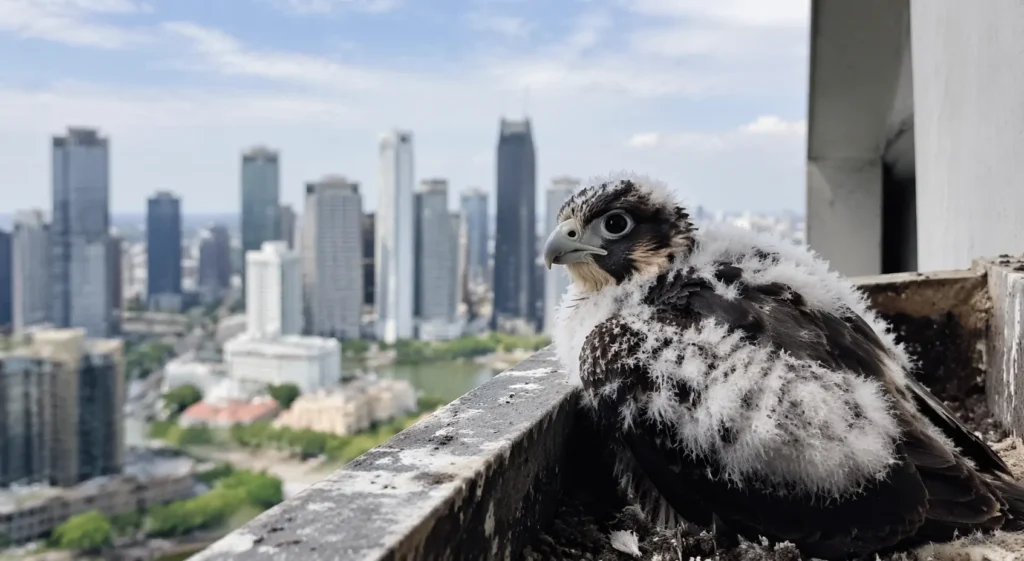

Introduction: A City of Steel and Wings
Singapore is known for many things. It is a garden city where massive skyscrapers touch the clouds. It is a place of business, where deals are made on the 40th floor while hawkers sell noodles on the street. It is a country of order, where things usually work the way they are supposed to. But high above the honking cars and the rushing crowds, there is another world. It is a world of wind, speed, and silent hunting. It is a world that follows no human rules.
For the past few years, a very special family has lived in that high-up world. They are not humans in fancy offices. They are not tourists taking photos. They are peregrine falcons. In fact, they are the only known breeding pair of peregrine falcons living wild in all of Singapore. Think about that for a moment. In a country of nearly six million people, with thousands of buildings and millions of pigeons, there is just one pair of these magnificent birds that has successfully raised babies.
Recently, this famous family had a reason to celebrate. In late February, four fluffy chicks broke out of their eggs after weeks of waiting. They chirped and wiggled on a ledge outside the 34th floor of the OCBC Chulia Street building. Bird lovers across the country held their breath. Webcam watchers stayed up late. It was a miracle of nature happening right in the middle of the Central Business District, where most people are too busy looking at their phones to look up.
But nature is not always kind. And cities, even green ones like Singapore, are dangerous for birds of prey. Last week, that joy turned into a silent shock. One of the four chicks was found dead on the hard pavement below. It was a small body with big meaning. This is the story of that chick, its family, its home, and what this loss means for the future of falcons in one of the busiest cities on earth.
H2: The Penthouse on Chulia Street: A Falcon’s Dream Home
Let us paint a picture of where these birds live. Imagine the highest, most expensive penthouse in the city. Now, take away the pool, the marble floors, the wine fridge, and the glass walls. What you have left is a tiny, gravelly ledge about the size of a kitchen table. It is dusty. It is exposed to rain. To a human, it looks like a dirty air conditioner shelf that the building manager forgot to clean. To a peregrine falcon, it is a castle.
The OCBC Chulia Street building is not the tallest in Singapore. It does not have the fancy rooftop bar or the infinity pool. But it is perfectly positioned for a hunter. It is tall enough to catch the steady winds that blow in from the sea. It is close to the Singapore River, where pigeons, mynahs, and other small birds gather in large numbers. For a falcon, that is like living right above a free buffet restaurant that never closes. You do not need to fly far. You just need to dive.
The adult falcons, whom birdwatchers have nicknamed “The Chulia Couple,” chose this spot years ago. They did not ask for permission. They did not sign a lease. They did not pay condo fees. They simply saw a safe, high ledge with a great view, and they moved in. It is believed that they first appeared around 2015. No one is exactly sure. But every year since then, they have returned to the same ledge. Same building. Same gravel. It is their home.
Unlike the neat and tidy nests of songbirds, a falcon nest is called a “scrape.” That is a perfect word because it sounds exactly like what it is. The parents use their feet and bodies to scrape out a shallow dip in the gravel. No soft blankets. No twigs arranged perfectly. No moss or feathers. Just a rough, simple bowl to stop the eggs from rolling off the edge. It looks like someone pushed their foot into a pile of rocks. It is tough, just like the parents who built it.
Why do they like this building so much? There are a few reasons. First, the ledge is deep enough to protect the eggs from most wind. Second, the building is not cleaned often, so the gravel stays put. Third, the people inside the building have learned to leave the falcons alone. There are no drones flying around. There are no window washers during nesting season. OCBC has become a falcon-friendly landlord, even if they did not plan to be one.
Over the years, birdwatchers have learned the daily rhythm of the Chulia Couple. The male is smaller, as is true with most birds of prey. He does most of the hunting. The female is larger and more powerful. She guards the nest and tears the food into small pieces for the babies. They take turns sleeping. They take turns watching for danger. They are partners in the truest sense of the word.
H2: Late February Magic: When Four Fluffballs Arrived
In the final days of February, something magical happened. The mother falcon, a sharp-eyed female with a dark blue-grey back and a yellow ring around her eye, sat very still. She barely moved for days. She did not eat much. She did not stretch her wings. She just sat there, her body warm against the eggs. The father brought her food and she ate it quickly, never leaving her post. Then, the cracks appeared.
Bird watchers with high-powered telescopes set up on nearby rooftops. Some used binoculars from their office windows. Others watched a live webcam that a local nature group had installed the previous year. They watched as the first chick, no bigger than a chicken nugget, pushed its way into the world. It was covered in white, fluffy down. It looked like a cotton ball with a beak and two closed eyes. It was weak. It was helpless. But it was alive.
Then came a second chick. Then a third. Finally, a fourth. The mother moved carefully, turning each egg with her beak to help the chicks break free. It took nearly two days for all four to hatch. The webcam chat room exploded with excitement. People typed things like “Number three is out!” and “Look at the little one!” and “I cannot handle this cuteness.” It was a rare moment of pure joy in a city that often feels too busy for joy.
Four healthy chicks. That is a big deal. For the last few years, the Chulia Couple had only managed to raise two or three chicks at a time. One year, only one survived. Four meant the parents were hunting well. Four meant the ledge was safe enough. Four meant the food supply in the CBD was strong. Four meant hope for the future of falcons in Singapore.
The chicks were clumsy at first. They would trip over their own feet. They would peck at bits of gravel, thinking it was food. They would fall asleep in the middle of eating, their tiny heads drooping until their beaks touched the ground. The mother would look at them with what seemed like patience, but was probably just exhaustion. Raising four babies is hard work, even for a falcon.
But the parents were strict teachers. The mother would tear small pieces of pigeon meat and hold it just above their heads. The chicks had to jump and stretch to get it. This was their first flying lesson. If they did not reach, they did not eat. The father would drop food at the edge of the ledge, forcing the chicks to crawl toward the drop-off. It looked dangerous. It was dangerous. But that is how they learn.
Within two weeks, the chicks had doubled in size. Their white fluff began to show dark pin feathers underneath. Their legs, which were pink and wobbly at first, turned grey and strong. They started to look less like cotton balls and more like the predators they were born to be. The webcam watchers gave them names. Some used numbers. Some used funny names like “Chulia Nugget” or “OCBC Baby One.” A few gave them serious names like “Swift” and “Sora.” No one knew which name would stick. No one knew that one of them would not live long enough to need a name.
H2: The Jungle Below: Dangers in the CBD
To understand why a chick died, you have to look down. Way down. The ground below that 34th-floor ledge is not grass or dirt. It is not a park or a forest. It is the concrete jungle of the Central Business District. And concrete jungles are just as dangerous as real jungles, maybe more so because no one expects the danger.
On a normal Tuesday, the streets below are packed with taxis, delivery vans, buses, motorcycles, and thousands of workers in white shirts and comfortable shoes. There are glass bus stops that birds cannot see. There are metal railings that break bones. There are giant air conditioning vents blowing hot air that can knock a small bird off course. There are office workers who might step on a fallen chick without even noticing because they are looking at their phones.
For a young falcon, the ground is a terrifying place. But the real danger is not the ground itself. It is what happens when a young bird tries to fly too soon. Peregrine falcons are born with the instinct to fly, but they are not born with the skill. That takes time. That takes practice. That takes failure. And failure from 34 floors up is usually fatal.
Let us break down the dangers one by one.
Danger One: The Wind. Singapore is windy, especially near the coast. The OCBC building is close enough to the marina that the wind can be unpredictable. Sometimes, a gust comes from the east. Sometimes from the south. Sometimes, the wind hits the flat face of the building and shoots upward. Other times, it hits the building and shoots downward. These are called downdrafts. A downdraft can push a chick off the ledge even if the chick was standing perfectly still. It is like an invisible hand shoving it into empty air.
Danger Two: The Glass. Skyscrapers are covered in glass. Birds do not understand glass. To a bird, glass looks like more sky. They fly toward it thinking they can go through it. They cannot. Millions of birds die every year from window collisions. A young falcon that takes its first flight might fly straight into a window, break its neck, and fall to the ground. The fall might not kill it. The window does.
Danger Three: The Heat. Singapore is hot. The ledge gets direct sunlight for much of the day. The gravel can become burning hot. A chick that gets too hot might become confused. It might stagger. It might fall off the ledge just trying to find shade. The parents try to stand between the sun and the chicks, but they cannot block everything.
Danger Four: The Humans. Most humans in the CBD do not even know the falcons exist. They walk below the ledge every day without looking up. But some humans know. And some of those humans are not careful. A photographer with a long lens might get too close. A window cleaner might startle the chicks. A construction worker on a lower floor might bang a metal pipe, sending vibrations up the building. The chicks do not understand these sounds. They only know fear. And fear makes them jump.
Danger Five: The Other Birds. Pigeons are not dangerous to adult falcons. Adult falcons eat pigeons. But a baby falcon is small and weak. A group of pigeons could theoretically peck a chick to death if it fell into their area. Also, there are crows in Singapore. Crows are smart and aggressive. They will attack a falcon nest if they see an opportunity. The parent falcons usually chase them away, but it only takes one distraction for a crow to grab a chick.
Peregrine falcons learn to fly in stages. First, they “ledge walk.” They hop along the edge of the nest, getting used to the height. Then, they “flap and hover.” They beat their tiny wings while holding onto the ledge, building muscle. Then, they take a “first flight.” This usually happens when they are about 40 to 45 days old. But sometimes, a gust of wind is too strong. Sometimes, a chick leans too far. Sometimes, they get scared by a loud noise like a garbage truck or a construction drill, and they jump before their wings are ready. When that happens, they do not soar. They fall.
Falling from 34 floors is not like falling from a tree. The speed builds fast. By the time the chick reaches the 20th floor, it is falling at over 50 kilometers per hour. By the 10th floor, it is falling at over 80 kilometers per hour. Even though falcons are built for speed in the air, a baby without full feathers cannot steer. It cannot slow down. It hits the pavement like a stone. There is no bounce. There is just silence.
H2: The Discovery: A Small Body, A Big Silence
Last Wednesday morning, the sun rose over Singapore like it always does. The sky was clear. The air was warm. The office workers were already lining up for coffee. No one expected anything unusual. But at about 7:45 AM, a security guard was doing his usual round at the base of the OCBC building. He walked the same path he walked every day. Past the loading bay. Past the bike rack. Past the big metal dumpster.
Then he saw it.
A small, dark shape on the ground near the loading bay. At first, he thought it was a piece of trash or a fallen glove. Maybe a worker had dropped a rag. But as he got closer, his heart sank. It was not a rag. It was not a glove. It was a baby peregrine falcon.
Its feathers were not yet fully grown. The soft white fluff was still visible on its head and back. Its eyes were closed. Its legs were bent at an awkward angle. It was one of the four. The guard did not know much about birds, but he knew this was bad. He covered the body with a cloth to protect it from the morning sun. Then he called his supervisor. The supervisor called the building manager. The building manager called the animal response team.
News travels fast in Singapore’s birdwatching community. Within an hour, dozens of people knew. Within two hours, hundreds knew. A local nature group posted a short, sad message online. It said simply: “One of the OCBC chicks has been found deceased at the base of the building. We are working with authorities to understand what happened. Please keep your distance from the area.”
The comments poured in. People were heartbroken. Some had been watching the chicks on the live webcam for weeks. They had watched them hatch. They had watched them take their first steps. They had watched the mother feed them tiny pieces of pigeon. They felt like they knew these birds personally. And now one was gone.
Someone wrote: “I am crying at my desk. I know that sounds silly. But I have been watching these babies every morning with my coffee. It feels like losing a pet.”
Another wrote: “This is why I cannot watch nature cams. It is too sad.”
Another wrote: “Does anyone know which chick it was? Was it the smallest one?”
No one knew for sure. The webcam had not captured the fall. The camera was pointed at the nest, not the ground. One moment, four chicks were there. The next moment, three. It happened that fast. The parent falcons did not cry. They do not understand grief like we do. But they did something interesting. They circled the building for hours, calling out with sharp kek-kek-kek sounds. They were not crying. They were warning the remaining three chicks. They were saying: Stay back. Stay on the ledge. Do not follow.
The building management put up a small barrier around the area where the chick was found. They did not want anyone stepping on it. They waited for the wildlife team to arrive. The team came in a white van with no markings. They wore gloves. They carried a small box. They gently placed the chick inside. No photos. No speeches. Just quiet, professional sadness.
By noon, the body was gone. The pavement was clean. The office workers walked over the spot without knowing. The city moved on. But the birdwatchers did not. They stayed on their computers. They watched the remaining three chicks. They held their breath.
H2: The Autopsy: What the Science Says
The animal rescue team took the small body to a wildlife health center on the other side of the island. The center is not a fancy place. It is a clean, quiet building with metal tables and bright lights. It smells like antiseptic and hay. The people who work there have seen a lot of dead animals. But each one still matters.
What happened next was not a crime scene investigation, but a “bird scene” investigation. Biologists looked at the body carefully. They measured it. They weighed it. They took photos. They opened it up to look at the bones and organs. It is not a pleasant job, but it is necessary. The only way to prevent future deaths is to understand why this death happened.
Here is what they found.
First, the chick was about 32 days old. That is young. Most peregrine chicks take their first flight between day 40 and day 45. This chick was at least a week too early. Its flight feathers had not fully grown. The long feathers on its wings, called primaries, were still short and blunt. Even if it had tried to fly, it could not have generated enough lift. It was not ready. Something made it leave the ledge before it was ready.
Second, there were no signs of disease. The chick was not sick. Its lungs were clear. Its stomach had food in it, meaning it had been fed recently. Its bones were strong for its age. It was not attacked by another animal. There were no bite marks. No scratches. No signs of a fight. A monitor lizard did not get it. A stray cat did not get it. A crow did not get it. The chick was healthy when it left the ledge.
Third, the internal injuries were consistent with a high-velocity impact. In simple English: the chick hit the ground very, very hard. Its skull was fractured. Its spine was broken in two places. Its ribs were shattered. The liver was torn. The heart had stopped instantly. The biologists said there was no suffering. Death was immediate. That was the only good news in the report.
So, what went wrong? The biologists have three guesses. They cannot know for sure. But they can look at the evidence and make educated guesses.
Guess One: A gust of wind. The ledge is high. Sometimes, sudden wind gusts called “downdrafts” push against the building. The chick might have been standing near the edge, stretching its wings. A strong gust could have lifted it off its feet and pushed it over before it could react. This happens more often than people think. Even adult falcons get pushed around by wind sometimes.
Guess Two: A sibling fight. Falcon chicks are not sweet little angels. They push each other. They steal food from each other’s mouths. They peck at each other. Sometimes, a bigger chick will push a smaller chick off the edge. It sounds cruel, but it is nature. The strongest survive. The weakest do not. This is not a moral choice. It is survival. The biologists noted that the dead chick was not the smallest of the four, but it was not the largest either. It was somewhere in the middle. Sibling aggression is possible.
Guess Three: A panic jump. A loud noise might have scared the chick into jumping before it was ready. Singapore is a noisy city. There are construction sites everywhere. There are trucks backing up with beeping sounds. There are fireworks sometimes. There are bird scaring devices on some buildings that make loud popping sounds. Any of these could have startled the chick. In panic, it might have run toward the edge instead of away from it. By the time it realized its mistake, it was already falling.
There is a fourth possibility, but it is less likely. Sometimes, a parent falcon will accidentally knock a chick off the ledge while landing with food. The parent comes in fast, talons extended, carrying a dead pigeon. If the chick is in the wrong place at the wrong time, the parent’s wing or foot might hit it. But the biologists saw no signs of trauma from a parent strike. So they ruled this out.
We will never know the exact reason. The webcam did not capture it. There were no witnesses. The chick cannot tell us. But the science confirms one thing: this was not murder. It was not a crime. It was an accident. A sad, heavy, completely natural accident. That does not make it easier to accept. But it is the truth.
H2: The Three Survivors: Learning to Hunt Without Their Sibling
Life does not stop for grief. Up on the 34th floor, the remaining three chicks are growing fast. They do not know that their sibling is gone. They do not look around and wonder where the fourth one went. They only know hunger. They only know the ledge. They only know the sky.
Their white baby fluff is being replaced by dark brown juvenile feathers. Their heads are turning from white to dark grey. Their beaks are turning from pink to blue-grey. Their eyes, which were dark brown at birth, are turning yellow. They look less like cotton balls and more like killers. Because that is what falcons are. They are not pets. They are not decorations. They are the fastest animals on earth.
When a peregrine falcon dives, it is called a “stoop.” During a stoop, they can reach over 300 kilometers per hour. That is faster than a Formula 1 car on a straight road. That is faster than a cheetah. That is faster than a bullet train in some countries. They are built for speed. Their nostrils have special cones that slow down the air so they can breathe during the dive. Their third eyelid, called a nictitating membrane, acts like goggles. Their feathers are so tight that they barely make a sound as they fall through the air.
But right now, these three are still terrible at flying. They flap and wobble. They miss their landings. They crash into the wall of the building. They land on their faces. It is awkward. It is funny to watch. But it is also dangerous.
A few days ago, a birdwatcher saw one chick try to land on a ledge two floors below the nest. It misjudged the distance. It missed the ledge entirely. It grabbed the edge with one foot, dangled for a scary second, then pulled itself up with its beak. Close call. If it had let go, it would have fallen 32 floors. The birdwatcher almost dropped his coffee.
The parents are working overtime now. The father flies out every morning at sunrise to hunt. He covers a territory that stretches from the Singapore River to Marina Bay. He catches pigeons mostly, but sometimes he catches Javan mynahs, which are smaller and harder to catch. He has been seen catching small bats at dusk, when the bats come out from under the bridges. The mother stays at the nest, watching the chicks and calling out warnings when other birds get too close.
When the father returns with food, he does not just drop it on the ledge. He holds it in his talons and flies past the nest, making the chicks chase him along the ledge. This is flying school, and the teacher is tough. If the chicks do not run, they do not eat. If they do not flap, they do not eat. The father is not being mean. He is being a good parent. In the wild, food is not guaranteed. The chicks need to learn that.
The mother also teaches. She will take a piece of meat and fly a short distance away, then land on a different ledge. The chicks have to figure out how to get to her. They stumble. They fall. They try again. Each time, they get a little better. Each time, their wings get a little stronger.
They have to learn fast. In about two more weeks, the parents will stop feeding them entirely. This is called fledging. The parents will simply disappear for hours at a time. If the chicks cannot catch their own food by then, they will starve. One sibling is already gone. The remaining three cannot afford to fail.
H2: How Singapore Is Trying to Save Its Falcons
You might be wondering: If this is so sad, why doesn’t someone help? Why doesn’t someone put a net around the ledge? Why doesn’t someone put a giant mattress on the ground? Why doesn’t someone bring the chicks inside and raise them by hand? These are great questions. And the answer is tricky. It involves science, money, and a little bit of philosophy.
First, the falcons are wild. If humans interfere too much, the parents might abandon the nest. Falcons do not like change. They do not like strange objects appearing near their home. If they see a net or a camera moving too close, they might simply leave and never come back. Singapore would lose its only breeding pair. That would be worse than losing one chick.
Second, hand-raising a falcon sounds kind, but it often fails. Baby birds that are raised by humans do not learn how to hunt. They do not learn how to be afraid of cars and windows. They do not learn how to find their own territory. When they are released, most of them die within a few weeks. A short life in a cage is not better than a short life in the wild. The biologists know this. They have tried.
Third, the building is private property. OCBC is a bank. They are proud of their falcons. They have put up signs asking window cleaners to stay away during nesting season. They have told their security guards to watch for fallen chicks. But they cannot install a giant trampoline on the sidewalk. That is a safety hazard for humans walking below. Someone could trip. Someone could sue. It is not realistic.
However, there are smart people working on solutions. Some of them are government biologists. Some are university researchers. Some are just regular bird lovers who spend their weekends thinking about falcons.
Solution One: Soft landing zones. Some cities overseas use “falcon gravel” that is softer than concrete. It looks like normal gravel, but it has a little bit of give. It absorbs some of the impact from a fall. The problem is that you have to spread it everywhere the chick might fall. That means covering a huge area around the building. That is expensive. And the gravel would get kicked away by pedestrians. It is not a perfect solution, but it is being studied.
Solution Two: Deeper nest boxes. Some conservationists build special boxes that stick out from the building. These boxes have deep sides to prevent rolling off. They are like wooden drawers attached to the side of the skyscraper. The OCBC ledge is already a bit like that, but it is not deep enough. A deeper box would cost money and require building permission. But it could save lives.
Solution Three: Flight training for chicks. This sounds strange, but some cities have tried it. Biologists take the chicks to a large, open field when they are about 35 days old. They let the chicks practice flying in a safe, low place. There are no cars. No windows. No hard pavement. The chicks learn to fly over grass. After a week of practice, they are returned to the nest. They are much better prepared for their first real flight. This has been done successfully in Melbourne, Australia. Singapore is looking into it.
Solution Four: Public education. The biggest help is you. If you work in the CBD, look up sometimes. Look at the ledges. Look at the sky. If you see a chick on the ground, do not touch it. Do not try to pick it up. Do not give it water. Do not take a selfie with it. Call the Animal Concerns Research and Education Society immediately. A fallen chick is not dead until a vet says so. Sometimes, they just need a lift back up to the nest. Sometimes, they just need a few days of rest in a quiet box. Your call could save a life.
H2: A History of Singapore’s Skyscraper Falcons
Many people think falcons only live in mountains or deep forests. That is wrong. Peregrine falcons are the ultimate city survivors. They have adapted to live on skyscrapers all over the world. In New York, they nest on the ledges of the Empire State Building. In London, they nest on the towers of the Houses of Parliament. In Melbourne, they nest on a skyscraper called the Collins Street building. In Singapore, they nest on OCBC Chulia Street.
But Singapore is special. Our peregrine population is tiny. The Chulia Couple is literally the only pair that has successfully bred here in recent memory. Why so few? Why are there not falcons on every tall building?
Two big reasons.
Reason One: Lack of tall cliffs. In nature, peregrines nest on high, rocky cliffs. They need a vertical drop with a small ledge. That is their natural home. Singapore is flat. We do not have mountains. We have hills, but not cliffs. Our “cliffs” are buildings. But not every building is safe for nesting. The ledge has to be deep enough to hold eggs. It has to be sheltered from rain. It has to be away from human traffic. It has to have a good supply of pigeons nearby. Most buildings in Singapore fail at least one of these requirements.
Reason Two: Pigeon poison. Singapore has a love-hate relationship with pigeons. Many people see pigeons as flying rats. They carry diseases. They make a mess. The government sometimes puts out poison to control the pigeon population. The poison is usually placed on rooftops or in trays that only pigeons can reach. But guess what falcons eat? Pigeons. If a falcon eats a poisoned pigeon, the falcon dies too. It is a hidden killer. The poison does not kill the falcon directly. It builds up in the pigeon, and then the falcon eats several poisoned pigeons over a few weeks. Eventually, the falcon bleeds internally and dies. It is a slow, painful death.
Back in the 1990s, people almost never saw peregrines in Singapore. The skies were empty of fast predators. Then, in the early 2000s, a pair tried to nest on a church in the Novena area. They built a scrape. The female laid eggs. But construction noise scared them away. The eggs were abandoned. Then another pair tried on a hotel in the Orchard Road area. They raised one chick, but it fell and died. It was not until 2015 that the Chulia Couple appeared. And they succeeded. Year after year, they came back. Year after year, they raised chicks. They became celebrities.
There is even a Facebook group called “Peregrine Falcons of Singapore.” It has over 10,000 members. Every morning, people post blurry photos of the chicks from their office windows. Some photos are terrible. You can barely see the birds. But people post them anyway because they are excited. They want to share the joy. It is a strange, beautiful connection between busy humans and wild birds.
The group has rules. No posting the exact location of the nest (even though everyone already knows). No harassing the birds. No using drones. The moderators work hard to keep the group positive and educational. When the chick died, the moderators posted a long message explaining that death is part of nature. They asked people not to blame the parents or the building. They asked people to focus on the three surviving chicks. It was a mature response to a sad situation.
H2: The Emotional Rollercoaster of the Birdwatchers
To really understand this story, you have to meet the birdwatchers. They are not scientists in white lab coats. They are not government officials with clipboards. They are regular Singaporeans. An uncle who sells coffee at a hawker center. A teenager who skips class sometimes to watch the webcam. A lawyer who keeps the nest feed open on a second monitor during boring meetings. A retiree who spends his mornings at a coffee shop near Telok Ayer Street with a pair of old binoculars.
I spoke to one of them. Let us call him Mr. Tan. He is 58 years old, retired, and he has been watching the Chulia falcons for four years. He knows their habits better than anyone. He knows which ledge the male likes to eat on. He knows what time the female usually takes her bath in the rain. He knows the sound of their calls.
Mr. Tan told me, “I saw those four eggs hatch. I watched the mother turn them carefully with her beak. I watched the first chick take its first shaky steps. I watched them grow from fluffy little balls into real birds. When I heard one fell, I felt like I lost a grandchild.”
He is not being dramatic. For two months, these birds were his daily routine. He woke up at 6 AM, made coffee, opened his laptop, and checked the webcam. He watched them eat breakfast. He watched them nap. He watched them stretch. He knew which chick was the bravest (the largest one, always pushing to the front) and which was the shyest (the smallest one, always in the back). He had names for them, but he would not tell me the names. He said it was too painful now.
When the dead chick was found, the online group went quiet for a whole day. No one posted photos. No one made jokes. No one asked questions. It was like a funeral. Then, slowly, people started posting again. But the mood had changed. They were not excited anymore. They were worried. Every time a chick got close to the edge, someone would type “Be careful!” or “Step back!” as if the chick could read the messages.
One member wrote: “Every time I hear a siren near Chulia Street, I hold my breath.”
Another wrote: “We have to remember. This is nature. It is beautiful and cruel at the same time. We cannot save them all. But we can watch and learn.”
Another wrote: “I am angry. I am angry at the wind. I am angry at the building. I am angry at myself for caring so much about a bird I have never touched.”
These are real feelings. They are not silly. Caring about something smaller than you is what makes us human. The falcons do not know that thousands of people are watching them. They do not know that their lives are being discussed in coffee shops and office break rooms. They just live. And we watch. And sometimes, watching breaks our hearts.
H2: What Happens Next for the Remaining Three?
As I write this article, the three surviving chicks are now about 38 days old. They are getting restless. They flap their wings constantly, practicing for the big day. They jump up and down on the ledge. They lean into the wind. They look out at the city skyline with their bright yellow eyes. They are almost ready.
In the next week or so, they will leave the nest for good. They will not come back. After they leave, they will spend the next few months learning to hunt. Many will fail. In fact, statistics from other cities show that only about 50% of peregrine falcon chicks survive their first year. Half of them die before they turn one year old. That is the reality of life in the wild.
Here is the realistic breakdown of what could happen.
Best case scenario: All three survive. They learn to hunt pigeons within two weeks of leaving the nest. They figure out how to avoid windows and cars. They find their own territories, maybe on other skyscrapers in Singapore. They find mates. Next year, there are two breeding pairs instead of one. The year after, there are three. The population grows slowly but surely. In ten years, peregrine falcons are common in Singapore. School children learn about them in science class.
Likely scenario: Two survive. One might get hit by a car while eating roadkill. Falcons sometimes eat birds that have been hit by cars. They land on the road to eat, and another car comes. It is a common cause of death for young falcons. Another might fly into a window. Glass is invisible to birds. Even experienced falcons hit windows sometimes. The strongest one, the bravest one, the luckiest one will thrive. It will find a mate. It will start its own family. The cycle continues.
Worst case scenario: More accidents happen. Another chick falls from the ledge before it is ready. The parents cannot stop it. Or a chick makes its first flight but lands on a busy street and gets run over. Or a chick eats a poisoned pigeon and dies slowly over a week. Or a disease sweeps through the nest. All three die. The Chulia Couple is left alone again. They try again next year. Maybe they succeed. Maybe they do not.
The biologists are cautiously hopeful. The three chicks look strong. They are eating well. The parents are still healthy. The weather has been good, with no major storms. The building management has asked construction workers to avoid loud noises near the nest for the next two weeks. Everyone is doing their part.
But no one can control the wind. No one can control a chick’s fear. No one can guarantee that tomorrow will be safe. All we can do is watch. And hope. And be ready to help if help is needed.
For now, the three chicks are still on the ledge. They are still flapping. They are still growing. Every morning, the webcam watchers log in. They count the chicks. One. Two. Three. They breathe a sigh of relief. Then they watch. And they wait.
H2: Lessons From a Fallen Feather
The death of this one small chick might seem unimportant. After all, it is just one bird in a city of nearly six million people. It is just one fallen feather on a pavement full of dust and trash. But it matters. It matters for three big reasons. And those reasons apply to all of us, whether we care about birds or not.
First, it reminds us that cities are not separate from nature. The glass towers, the air conditioners, the traffic, the noise, the lights at night—they are all part of the ecosystem now. When we build a skyscraper, we are building a cliff. When we leave a light on at night, we confuse migrating birds. When we put poison on a rooftop to kill pigeons, we are putting poison into the food chain. We cannot pretend that nature stops at the city limits. Nature is here. It is in the drains. It is in the trees. It is on the 34th floor. We have a responsibility to design our cities for more than just humans. We share this space.
Second, it teaches us about resilience. The parents did not give up. Within hours of the chick falling, they were back to feeding the others. They did not hold a funeral. They did not post a sad status. They did not stop hunting. They just kept going. There is a lesson there for all of us. Life is brutal sometimes. Things fall apart. People we love leave. Plans fail. But you keep going. You keep feeding the ones who are still here. You keep flapping your wings. You keep trying. That is resilience. That is survival.
Third, it shows the power of paying attention. Ten years ago, almost no one in Singapore knew these falcons existed. They were just another pair of birds on another building. Now, thousands of people care. They watch. They report. They worry. They share photos. That awareness is the first step to protection. If another chick gets into trouble, someone will see it. Someone will call for help. Someone will post about it online. The falcons are not invisible anymore. They have names. They have stories. They have a community that cares. That is the power of paying attention.
There is a fourth lesson, too. It is a quieter lesson. It is about accepting things we cannot change. The chick fell. It died. There was nothing anyone could have done differently. No one was cruel. No one was careless. It was just gravity. It was just nature. Sometimes, bad things happen for no reason. There is no one to blame. There is no lesson to learn except that life is fragile. And that is okay. We do not have to fix everything. Sometimes, we just have to sit with the sadness. And then we have to keep living.
H2: How You Can Help (Even From Your Desk)
You do not need to be a bird expert to help Singapore’s falcons. You do not need to be rich. You do not need to have a lot of free time. You just need to care a little bit and take a few small actions. Here are five simple things anyone can do, starting today.
One: Look before you clean. If you work in a tall building and you see a nest on a ledge, do not disturb it. Do not ask the cleaners to remove it. Do not spray water near it. Tell your building manager. Many companies in Singapore now put up “Falcon Nesting Zone” signs during breeding season, which is from January to May. If your building does not have signs, ask why. A simple conversation can save lives.
Two: Support pigeon control without poison. Pigeons are a problem. They make a mess. They carry diseases. But poison is not the answer. Poison kills falcons. It kills owls. It kills eagles. It kills the very birds that naturally control pigeon populations. Ask your town council to use traps or birth control for pigeons instead of poison. These methods are safer. They are more humane. And they do not accidentally kill the falcons we are trying to protect.
Three: Turn off unnecessary lights at night. Singapore is bright at night. That is good for safety, but bad for birds. Bright lights confuse migrating birds. They circle the lights until they collapse from exhaustion. They fly into windows. They land on hot surfaces and burn their feet. If you work in an office, turn off the lights when you leave. If you live in a condo, close your curtains at night. Every little bit helps.
Four: Keep cats indoors. Cats are wonderful pets. They are also natural hunters. Even a well-fed cat will kill a bird if it gets the chance. If you live in a high-rise building, keep your cat inside. Do not let it roam on the balcony. Do not let it go into common areas. A cat can climb higher than you think. A cat can find a way to a ledge. And a cat will kill a helpless chick without hesitation. This is not the cat’s fault. It is instinct. But it is your responsibility to prevent it.
Five: Report fallen birds. Save this number in your phone. Write it on a sticky note. Memorize it. When you see a bird on the ground, do not assume it is dead. Do not walk past. Do not post a photo online first. Call the wildlife rescue hotline. They will tell you what to do. Sometimes, a fallen bird just needs rest. Sometimes, it needs a ride back to its nest. Sometimes, it needs medical care. But you will not know unless you call. Be the person who makes the call.
These actions are small. They take almost no time. But together, they make a difference. They create a city that is safer for the wild things that live among us. And that is a city worth building.
Conclusion: The Sky Still Belongs to Them
The death of the fourth chick is a tragedy. There is no way around that. It is sad. It is heavy. It is hard to accept. But it is not the end of the story. As you read this, the three remaining chicks are stretching their wings. They are looking out at the city skyline. They are looking at Marina Bay Sands, at the Singapore Flyer, at the endless rows of lights stretching to the horizon. They do not know about death. They only know the sky.
Soon, they will jump. Not in fear this time. But in trust. Trust that the wind will hold them. Trust that their wings will work. Trust that the hard ground below is not their destiny. They will jump, and for a terrifying second, they will fall. And then their wings will catch the air. And they will fly.
One day, you might be walking down Chulia Street. You might be rushing to a meeting or looking for a place to eat lunch. You might hear a sharp cry above you. You will look up. And you will see a dark shape slicing through the air between two buildings. It will be fast. It will be silent. It will be free. It will be one of them.
The city did not win. The falcons are still here. And as long as we pay attention, as long as we care, as long as we look up from our phones once in a while, they will keep coming back. They will keep nesting. They will keep raising babies. Some will live. Some will die. That is the deal. That is the circle.
Rest in peace, little one. You fell. But you were part of something bigger. You were watched. You were loved. You mattered. And your siblings will carry your memory in their wings, even if they do not know it.
Fly high where there are no buildings. And to the three who remain: fly safe. The city is watching. The city is hoping. The city is yours.


d7jsom
Write more, thats all I have to say. Literally, it seems as though you relied on the video to make your point. You clearly know what youre talking about, why throw away your intelligence on just posting videos to your site when you could be giving us something informative to read?
We absolutely love your blog and find nearly all of your post’s to be just what I’m looking for. Would you offer guest writers to write content to suit your needs? I wouldn’t mind producing a post or elaborating on a few of the subjects you write in relation to here. Again, awesome site!
Really impressed with the fast payouts here. The interface is smooth and it is definitely my new favorite spot to play. Check out iddewanaga77 for a great experience.
I’ve been trying a few different platforms lately and this one really stands out. The interface is smooth and everything loads fast. Definitely worth checking out bdvb89
Best slot experience I have had in a long time. The graphics are crisp and the wins feel rewarding. Check it out at jk777game.
Finally found a place that doesn’t lag during the peak hours. The graphics are crisp and the bonus offers are actually fair. Love it 1444casino
The login process is secure and very straightforward. I appreciate how they handle user privacy and account security. I always use akunboslogin.
Super friendly support team and the loading speed is top notch. Everything just works perfectly on vnvv88vv.