

Introduction: A Challenge That Changes Everything
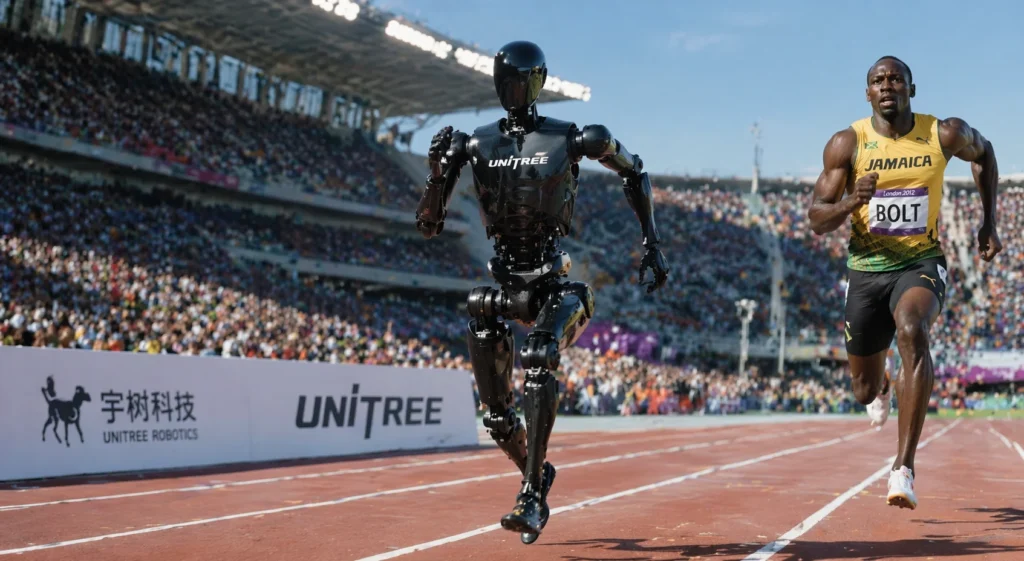
Imagine the roar of a stadium crowd. The air is hot and thick with excitement. Fifty thousand people are on their feet. The camera zooms in on the starting line. But something is different. Instead of a human in neon spikes and a jersey, there is a metallic figure standing on two legs. Its joints hum quietly, like a computer starting up. Its sensors lock onto the track with cold, blue light. The starting gun fires—but not with a loud bang. It fires with a sharp, digital beep.
For sixteen years, the name Usain Bolt has been the final answer to any argument about speed. The “Lightning Bolt” from Jamaica ran 100 meters in 9.58 seconds back in 2009. Scientists said that was near the absolute limit of the human body. Coaches said we might never see that record broken again. Bolt himself said he was done. The record felt safe.
Then, in March 2026, the CEO of Unitree Robotics, a man named Wang Xingxing, stood up at a big conference called the Yabuli Forum. He looked at the cameras. He looked at the investors. And he said something that shocked the sports world and the tech world at the same time. He said, “Within a few months, a humanoid robot will break the 10-second barrier. Ultimately, they will even surpass Usain Bolt’s record of 9.58 seconds.”
Let that sink in. A machine with two legs, a metal spine, and a battery for a heart is about to do what no human on Earth has done since 2009. This is not science fiction. This is not a movie trailer. This is the real story of how metal, electricity, and artificial intelligence are preparing to outrun the greatest athlete in history. And it is a story that will change how you see robots forever.
H2: The “Lightning Bolt” vs. The Machine
Before we talk about wires, circuits, and algorithms, we have to take a moment to respect the human we are trying to beat. Usain Bolt is not just fast. He is a biological masterpiece. He is a freak of nature in the best possible way.
When Bolt ran 9.58 seconds in Berlin on that hot August night in 2009, his body did things that seem impossible. At his top speed, his feet touched the ground for less than one-tenth of a second. Imagine tapping your finger on a table as fast as you can. That is how fast his feet hit the track. But here is the crazy part. With each one of those tiny touches, he applied a force of over 400 pounds into the ground. That is like lifting a grown man with every single step. His heart pumped like a turbo engine. His lungs were on fire. His muscles fired in perfect harmony.
Scientists have studied Bolt’s race for years. They say that for 9.58 seconds, he was the closest a human has ever come to flying without wings. His stride length was nearly eight feet. That is longer than a king-size bed. He took only 41 steps to cover the entire 100 meters. A normal person would need 50 or 60 steps.
But here is the cold truth that engineers like Wang Xingxing understand very well. Biology has limits. Muscles tear. Lungs burn. Bones break. Humans need oxygen to survive. We get tired after a few seconds of all-out effort. We get scared when we feel pain. We get old. Even the greatest athlete in history, Usain Bolt, had to retire because his body started to break down. His hamstrings pulled. His back hurt. He could not do it forever.
Robots have none of these weaknesses.
A robot does not have hamstrings. It has metal joints and electric motors. A robot does not have lungs. It has a battery pack that delivers steady power. A robot does not feel fear. It does not get nervous standing on the starting line. It does not look at the crowd and feel pressure. It just executes a program.
As Wang explained at the Yabuli Forum in March 2026, the situation is about to flip. He stood on stage and admitted something very honest. “Currently, humanoid robots have not yet surpassed humans,” he said. He was being truthful. Right now, in early 2026, the best robots are still a little clumsy. They fall sometimes. They are not quite there yet. But then he added the kicker that made everyone sit up straight. “Within a few months, they will break the 10-second barrier. Ultimately, they will even surpass Usain Bolt’s record of 9.58 seconds.”
This is not a wild guess from a dreamer. This is a roadmap from an engineer who has already built robots that can run, jump, and climb stairs. He has seen the data. He knows the numbers. And the numbers say that the record is coming down.
H2: How Do You Teach a Robot to Sprint?
You might think running is simple. You just move your legs faster, right? Wrong. Running is one of the hardest things for a robot to learn. In fact, for a robot, walking is already a miracle. Running is a controlled fall.
Let me explain the difference. When you run, your brain handles millions of tiny adjustments automatically. You do not think about flexing your ankle to keep your balance on a slightly uneven patch of sidewalk. You do not think about tightening your stomach muscles to keep your spine straight. You just do it. Your brain has been practicing this since you were a toddler. It is second nature.
For a robot, every single movement has to be calculated. Every bend of the knee. Every angle of the foot. Every swing of the arm. If the calculation is off by even one percent, the robot falls flat on its face. And falling is expensive. A 50-kilogram robot crashing into the ground can break its own joints or damage its sensors.
So, how is Unitree solving this problem? They are using something called the “Kung Fu Model.” This is a fancy name for a very clever idea.
Think of it like a video game. In the old days, programmers had to tell the robot exactly how to do everything. They had to write code that said: “Bend right knee to 45 degrees. Angle right foot to 12 degrees. Swing left arm forward 30 degrees.” It was like writing a recipe with ten thousand steps. If you missed one step or typed a wrong number, the robot fell over. This method was slow and painful. It took years to teach a robot to walk a few meters.
The Kung Fu Model changes everything. It uses something called AI learning, or reinforcement learning. Here is how it works. The engineers put the robot in a virtual world, a simulation that looks like a video game. In this simulation, the robot can run millions of races without ever getting hurt. Every time it falls, the AI says, “Don’t do that again.” Every time it stays upright and moves forward, the AI gets a little reward. It is like training a dog with treats, but the dog is a computer program.
After millions of tries, something magical happens. The robot does not need the step-by-step recipe anymore. It just knows how to run. It has learned the pattern. This is the same way that ChatGPT learned to talk and write. But instead of words, the robot is learning movements. It is learning balance. It is learning how to push off the ground with maximum force without tipping over.
Wang explained that this method is advancing so fast that it is scary. He said, “In theory, it is difficult for the average person to outperform a robot standing 1.8 meters tall.” That means if you lined up an average adult against one of his robots right now, the robot would probably win. The only thing standing in the way of the world record is a few more months of training in the virtual world.
H2: The Science of Metal Feet (Deep Dive)
Let us look under the hood. Why will a robot win the race? It comes down to three engineering secrets: Torque, Rigidity, and Endurance. These are not just fancy words. They are the real reasons why metal beats meat.
The Secret of Torque
Torque is a fancy word for twisting force. It is the power that makes your legs push against the ground. Humans have two types of muscle fibers: slow-twitch and fast-twitch. When we sprint, we use the fast-twitch fibers. They are powerful, but they take time to fire. The signal has to travel from your brain, down your spinal cord, through your nerves, and into your muscles. That takes about 30 milliseconds. It does not sound like much, but in a 100-meter race, every millisecond counts.
Robots use electric motors and precision reducers. These devices turn electrical energy into instant rotation. There is no warm-up time. There is no nerve delay. When the robot hears the starting beep, the motor goes from zero to maximum power in less than one millisecond. That is thirty times faster than a human. The robot gets a head start before the human even knows the race has begun.
The Rigid Spine
Watch a human sprinting in slow motion. Their whole body twists and shakes. Their shoulders turn left and right. Their core wobbles. Their head bobs up and down. That is energy leaking out of the system. The human body is soft because it has to protect our organs. Our lungs need room to expand. Our stomach needs to digest food. Our spine has soft disks between the bones to absorb shock. All of that softness is good for living, but it is terrible for running fast. Every bit of twist and wobble is wasted energy that could have gone into moving forward.
A humanoid robot has a metal skeleton. When the legs push against the ground, none of that energy is absorbed by a soft stomach or squishy lungs. There is no twisting. There is no wobbling. One hundred percent of the force goes straight into the track. Experts who study robot running say that the mechanical structure of a robot has “no non-essential wobble.” That means every single part of the robot is designed to send energy forward, not sideways or up and down.
The Unfair Battery
Usain Bolt breathes oxygen. In his 9.58-second race, he used up his body’s emergency energy stores in a massive burst. After the race, he was gasping for air. He was bent over with his hands on his knees. His muscles were burning because of lactic acid. He could not run another 100 meters at the same speed for at least an hour, probably more.
A robot runs on lithium batteries. It does not breathe. It does not produce lactic acid. It does not feel pain. A robot can run the 100 meters, then turn around and run it again ten seconds later with exactly the same speed. It can do this hundreds of times in a row. The only limit is the battery life, and even that is improving every year. Some of the new robot batteries can deliver full power for over an hour of continuous sprinting.
This is why Wang is so confident. Humans are amazing, but we are made of meat and bone. We are optimized for survival, not for speed records. Robots are becoming machines that are designed specifically to win races. They do not have to breathe. They do not have to recover. They just go.
H2: Proof in the Past (The 1500 Meter Victory)
This is not just talk. This is not a press release full of empty promises. Unitree has already put their money where their mouth is. They have already proven that robots can beat humans in real races.
Last year, in Beijing, there was a humanoid sports competition. This was not a small, private tech demo in a dark lab. This was a real event with cameras, judges, and a crowd. Humanoid robots from different companies lined up to compete in running events. Unitree entered their robot into the 400 meters and the 1500 meters. The 1500 meters is almost a full mile. It is a test of endurance, not just speed.
The robot won first place in both events.
Let me say that again. A machine with two legs, weighing about 50 kilograms, beat every other robot in the competition. But here is the funny part that Wang shared with a laugh. The robot finished the 1500 meters in just over six minutes. That is not a world record. A fast human can run 1500 meters in under four minutes. But Wang looked at the crowd and said, “This is faster than any of our internal staff.”
Think about that. The people who built the robot, the engineers who programmed its brain and designed its legs, could not beat it in a long race. While the human engineers were bent over with their hands on their knees, gasping for air, the robot was still jogging smoothly. It did not look tired. It did not slow down. It just kept going.
This is a major clue about the future. If a robot can already beat humans in distance running, where endurance matters more than raw speed, then it is only a matter of time until it beats them in pure speed. The hard part of running is not the first 50 meters. The hard part is keeping good form when you are tired. Robots do not get tired. So once they learn how to sprint fast for 10 seconds, they will keep that form perfectly from start to finish. Humans cannot do that. Even Usain Bolt slowed down slightly in the last 20 meters of his record race. A robot will not slow down. It will get faster as it straightens up and finds its rhythm.
H2: The “Bolt” Robot That Changed the Game
Right now, the fastest kid on the block is not even Unitree’s main model. It is a competitor from a university team. And that is actually good news for Wang’s prediction. It means the technology is spreading. It is not just one company doing the work. It is an entire field of smart people racing toward the same goal.
In February 2026, a team from Zhejiang University and a company called Shanghai JingShi Technology revealed a robot they simply named “Bolt.” The numbers they shared were terrifying for human sprinters.
Bolt hit a peak speed of 10 meters per second.
Let us do the math together. A meter is a little longer than a yard. Ten meters per second means the robot can cover the length of a basketball court in about two seconds. To break Usain Bolt’s record of 9.58 seconds for 100 meters, you need to average about 10.44 meters per second. Bolt’s peak speed, the fastest he ever moved in that race, was 12.27 meters per second. But he could only hold that peak for a split second. The rest of the race, he was accelerating at the start and slowing down at the end.
Bolt the robot is already running at a steady 10 meters per second. That is 36 kilometers per hour, or about 22 miles per hour. That is faster than most high school sprinters. That is faster than many college sprinters. And the engineers at Zhejiang University are just getting started. They are not done optimizing the code. They are not done fine-tuning the joints.
Wang referenced this robot directly in his speech. He sees that the hardware is ready. The motors are strong enough. The batteries are powerful enough. The metal legs are light enough. Now, it is just about refining the AI control software to handle the curves of the track and the explosive start from the blocks. Once that software is finished, the robot will not just be fast. It will be unstoppable.
H2: Why Does a Robot Need to Run? (The Real Reason)
Now, you might be sitting there thinking, “This is cool, but why? Why does the world need a running robot? Is this just a rich person’s toy? Is this just a way to get attention on social media?”
That is a fair question. And the CEO of Unitree has a very clear answer. He says that people ask him this all the time. They ask if the running robots are just “showing off.” His answer is no. It is not about the race. It is about capability.
Think about a large warehouse, like the ones Amazon uses. Right now, robots in warehouses slide around on wheels. They follow lines on the floor. They are very good at moving boxes from point A to point B. But what if a box falls off a high shelf and lands in the middle of the aisle? A wheeled robot gets stuck. It cannot step over the box. It has to wait for a human to come and move the box. That costs time and money.
A legged robot can step over the box. It can balance on one foot while lifting the other foot over the obstacle. It can keep working without stopping.
Now think about a bigger problem, like a disaster. Imagine an earthquake in a big city. A building has collapsed. There are people trapped inside. The floors are broken. There is glass everywhere. There are twisted metal beams sticking out of the ground. A wheeled robot cannot get in. A human firefighter might get hurt trying to climb through the rubble. But a humanoid robot? It can climb over the broken concrete. It can balance on a tilted floor. It can step over the glass and the metal. It can carry a bag of medicine or a bottle of water to a survivor who is trapped.
Wang explained it in simple words that anyone can understand. He said, “High-speed mobility is crucial for industrial handling and disaster rescue scenarios. Athletic ability is a prerequisite for robots to actually do the work.”
That means the robot has to be fast and balanced before it can be useful. Running fast is just the proof that the robot has perfect balance, strong joints, and quick reactions. Once the engineers know the robot can run, they can teach it to carry things while running. They can teach it to climb stairs while carrying a heavy load. They can teach it to walk on uneven ground without falling. The 100-meter record is not the goal. It is the entrance exam. Once the robot passes that exam, it gets to do the real jobs.
H2: The Bumpy Road (Why It Isn’t Easy Yet)
We have to be honest here. It is not all gold medals and victory laps yet. There are still big problems to solve. Even Wang Xingxing admits this openly. He does not pretend that everything is perfect. In fact, he uses a very specific term to describe the biggest problem. He calls it the “lack of generalization ability.”
That is a fancy way of saying: Robots are scared of new places.
Let me explain what that means in real life. In the laboratory, where the floor is perfectly flat and the lights are bright and the temperature is just right, the robot is a champion. It wins the race 99 percent of the time. It looks smooth. It looks powerful. It looks ready for the Olympics.
But if you take that same robot to a park across town, everything changes. The asphalt is rough and bumpy. There is a slight hill that you cannot even see with your eyes. The wind is blowing at 10 miles per hour. The sun is creating shadows that confuse the robot’s cameras. Suddenly, the robot looks clumsy. It slows down. It takes careful, tiny steps. It might fall over after just a few meters.
Why does this happen? Because the AI has never seen that exact patch of ground before. The robot does not actually understand the world the way you do. You see a bumpy sidewalk and you automatically know how to adjust your feet. The robot has to learn every single surface separately. It is like a student who memorized all the answers to a specific test, but then the teacher changes the questions. The student fails because they never learned the subject, they just memorized the answers.
Wang says we are still waiting for the “ChatGPT moment” for physical robots. That is the moment when you can give a robot a command it has never heard before, in a place it has never been, and it just figures out how to do it correctly. ChatGPT can do that with words. You can ask it to write a poem about a cat in space, and it has never seen that exact request before, but it figures it out. Physical robots cannot do that yet. If you ask a robot to walk across a parking lot it has never seen, it will probably fall.
Wang thinks that moment is about two to three years away. That means by 2028 or 2029, robots will be able to walk into any building, any park, any factory, and move around safely without falling. Until then, the robots will mostly stay in controlled environments where the engineers know exactly what the floor looks like.
So, while the robot will probably win the 100-meter dash this year, it will only win on a specific track that it has practiced on thousands of times. Do not expect to see a robot running a marathon through the streets of New York City anytime soon. That is still a long way off.
H2: The Timeline: When to Watch
So, mark your calendars. Pull out your phone and set a reminder. When is this historic event supposed to happen?
Wang spoke at the Yabuli Forum on March 17, 2026. He was not vague. He was not wishy-washy. He gave a specific timeline. He said that by the “middle of this year,” which means Summer 2026, the robots will be ready to break the record.
That is a timeline of just a few months from now.
Why so fast? Because the learning curve for AI is exponential. That means it does not improve slowly, step by step. It improves slowly at first, and then suddenly it explodes upward. A year ago, these robots could barely jog without falling after ten meters. A few months ago, they hit 10 meters per second in a straight line. In a few more months, they will fix the stability issues that cause them to slow down at the start and the finish.
Here is a realistic timeline of what to expect:
Mid-2026: A humanoid robot runs a verified 100 meters in under 10 seconds. This will be the first time a two-legged robot breaks the famous 10-second barrier. It will be headline news around the world.
Late 2026: The same robot, after more training and software updates, runs the 100 meters in 9.4 seconds. That breaks Usain Bolt’s record of 9.58 seconds. The record that stood for 17 years falls to a machine.
2027: The record drops even further. Perhaps 8 seconds. Perhaps even 7 seconds. The engineers will realize that the robot is not even close to its physical limits. The motors can spin faster. The battery can deliver more power. The AI can make better decisions. The only question is how far they want to push it.
2028: By the time of the next Summer Olympics, humanoid robots will be running the 100 meters in under 6 seconds. That is more than three seconds faster than Usain Bolt. At that point, the comparison is almost silly. It is like comparing a cheetah to a human. They are not even in the same league.
Wang predicts that once the technology passes the “technological inflection point,” shipments of running robots will surge. That means companies will start buying them by the thousands. We will stop seeing just one robot running in a lab. We will see fleets of them in warehouses, factories, and disaster zones. The 100-meter record is just the spark that lights the fire.
H2: Are Humans Obsolete? (A Reality Check)
It is very easy to read this article and feel a little bit sad. We love sports because they are about human achievement. We love watching the Olympics because we see people pushing their bodies to the absolute limit. We cry when someone breaks a record because we know how much training, sacrifice, and pain went into that moment. If a machine can do it better, faster, and without any emotion, does it take the magic away?
Maybe a little bit. But let me offer you a different way to look at it.
Cars are much faster than humans. The fastest car in the world can go over 300 miles per hour. Usain Bolt at his peak could run 28 miles per hour. That is not even close. But we still run marathons. We still go to track meets. We still cheer for our favorite runners. The existence of cars did not make running pointless.
Computers can calculate numbers instantly. A $10 calculator can solve a math problem in a second that would take a human a minute. But we still do math in school. We still learn arithmetic. We still feel proud when we solve a hard problem in our heads. The existence of calculators did not make math pointless.
The purpose of these running robots is not to beat us at sports. That is just a side effect. The real purpose is to be our tools. They are the new pickup trucks, the new firefighting equipment, the new warehouse workers. We are not building them to take away our gold medals. We are building them to do our dirty, dangerous, and boring jobs.
Wang sees this as a win for humanity. He is not a villain trying to embarrass human athletes. He is an engineer trying to build useful machines. He envisions deploying “thousands, up to 10,000, humanoids in real-world environments by the end of this year.” They will gather data. They will learn how to navigate our messy, unpredictable world. And eventually, they will do the jobs that humans do not want to do.
Think about the jobs that are too dirty for a person. Cleaning toxic waste. Scrubbing the inside of an oil tank. Working in a sewage treatment plant. These jobs are necessary, but they are also dangerous and disgusting. A robot does not care about getting dirty.
Think about the jobs that are too dull for a person. Standing in a factory for 12 hours, picking up the same box over and over again. Checking the same bolt on the same machine every 30 seconds. These jobs are boring, but they have to be done. A robot does not get bored.
Think about the jobs that are too dangerous for a person. Entering a building that is on fire. Walking into a nuclear reactor that is leaking radiation. Searching for survivors in a building that could collapse at any moment. These jobs are heroic, but they also get people killed. A robot can take that risk instead.
When Usain Bolt ran 9.58 seconds, he proved what a human can do. It was an emotional, physical, spiritual miracle. It was a celebration of the human body and the human will. When the robot breaks that record, it will not be a miracle. It will be engineering. It will be math. It will be hard work from a team of smart people.
And that is okay. Because the robot does not feel the joy of running. It does not hear the crowd cheering. It does not feel pride in its chest. It just crosses the finish line and then waits for the next command. The human experience of running is still ours. No machine can take that away.
H2: Conclusion: The Starting Gun Has Fired
We are living through a strange and wonderful moment in history. For 200,000 years, humans were the fastest things on two legs. We outran every animal on the savanna. We chased down deer until they collapsed from exhaustion. We built civilizations, invented wheels, and eventually forgot that we were once hunters who needed to run for our dinner.
That reign is ending. Not because we got weaker. Not because we stopped training. But because we built something stronger. We looked at our own bodies and said, “We can do better.” We took metal, electricity, and computer code, and we created a new kind of athlete.
Unitree Robotics, along with teams at Zhejiang University and other labs around the world, has solved the puzzle of balance and power. The 100-meter world record is living on borrowed time. Every day, the AI gets a little smarter. Every week, the motors get a little smoother. Every month, the robot gets a little faster.
Wang Xingxing’s prediction is bold. It sounds like a headline grabber. It sounds like something a CEO says to get attention for his company. But look at the evidence. Look at the 1500-meter win in Beijing. Look at the “Bolt” robot hitting 10 meters per second. Look at the Kung Fu Model and the virtual training that runs millions of races every night. The writing is on the wall. Or rather, the writing is on the track.
So, the next time you watch the Olympics or a local track meet, enjoy it. Enjoy the sweat, the tears, and the human spirit. Enjoy the stories of athletes who gave up everything for one shot at glory. But also, keep one eye on the tech news. Keep one eye on the robotics blogs. Because somewhere in a lab in China, a humanoid robot just took its mark.
Its motors are warm. Its sensors are calibrated. Its AI is ready.
And it is about to fly.
Frequently Asked Questions
Q: When exactly will the robot break the record?
A: Unitree CEO Wang Xingxing predicts it will happen by the middle of 2026, specifically during the summer of this year. He gave this timeline at the Yabuli Forum in March 2026.
Q: Has a robot ever beaten a human in a running race before?
A: Yes. Unitree robots have already won first place in the 400-meter and 1500-meter events at humanoid sports competitions in Beijing. The CEO noted that the 1500-meter time was faster than any of their human staff members could run.
Q: Will these robots be used for sports entertainment, like robot Olympics?
A: Probably not as a main goal. The technology is being developed for industrial work, disaster rescue, and warehouse logistics. Speed is just a way to prove that the robot has good balance and powerful joints. The race is a test, not the final product.
Q: What is the main thing stopping the robot from running faster right now?
A: A problem called “generalization.” Robots perform perfectly in labs where conditions are predictable. But they struggle with small changes like wind, rough ground, uneven lighting, or small hills. Fixing this is the hardest part of the engineering challenge.
Q: Will this make human athletes feel bad or become obsolete?
A: No. Humans will continue to compete against other humans. We still run marathons even though cars are faster. We still play chess even though computers are better. Robots beating records shows technological progress, not the end of human sports. The joy of running is still ours.
Q: How heavy are these running robots?
A: Most humanoid running robots weigh between 40 and 60 kilograms, which is about 90 to 130 pounds. That is roughly the same size and weight as a small adult human. They are made of lightweight metals like aluminum and magnesium alloys.
Q: Do the robots look like humans?
A: They have two legs, two arms, and a head-like sensor unit. But they do not have faces or skin. They look more like a skeleton or a mannequin. The engineers care about function, not looks. If a human face made the robot slower, they would not add it.
Q: How much does one of these robots cost?
A: Unitree has not released official prices for the newest running models, but their previous humanoid robots sold for between $30,000 and $100,000 depending on the features. As production scales up, the price is expected to drop significantly.
Q: Can I buy one for myself to race against my friends?
A: Not right now. The running robots are still in development and testing. Unitree is focused on selling to businesses and research labs first. A consumer version might be available in a few years, but it will likely be very expensive at first.
Q: What happens if the robot falls during a record attempt?
A: That is a real risk. Falling is still common in robot running. That is why the record attempt will probably happen in a controlled environment with soft padding on the ground. If the robot falls, the engineers will pick it up, fix the code, and try again. They have infinite tries. Humans only get one or two chances in a lifetime.
Final Thoughts: A New Chapter in Speed
There is a famous saying in sports: “Records are made to be broken.” For 200,000 years, only humans broke human records. Then, for a few decades, only specially trained humans broke them. Now, for the first time in history, the next record breaker might not be human at all.
That is not a sad thing. It is an amazing thing. It means we have created something new. We have taken our knowledge of the human body and used it to build a machine that can go beyond our limits. That is what humans do. We build tools. We extend ourselves. We reach further.
The robot that breaks Usain Bolt’s record will not feel pride. It will not celebrate. It will not cry. But the humans who built it will. They will cheer. They will hug each other. They will call their families. Because that record will be a human achievement too. We did that. We made that metal body move that fast.
So when you see the headline later this year—”Robot Runs 9.4 Seconds, Bolt’s Record Falls”—do not feel sad for the old king. Feel proud of the new creators. The starting gun has fired. The race is on. And everyone wins.



I think this website holds some really excellent information for everyone :D.
Hi! Do you know if they make any plugins to safeguard against hackers? I’m kinda paranoid about losing everything I’ve worked hard on. Any suggestions?
I’ve tried many platforms but this one is really smooth. The payouts are fast and the games are super exciting. Definitely a great choice for locals! phpjiliph
Best experience so far! The bonuses are actually fair and the withdrawal process is smooth as butter. Highly recommend for anyone looking for a reliable site. pkbaji888
Just had a massive win on the live dealer table. The atmosphere feels like a real casino right from my living room. Big thanks to phsg7772.
Really loving the slot variety here. I hit a decent win yesterday and the withdrawal process was a breeze. jilijiliph is my new go-to for daily fun.
Finally found a site with a reliable login system and great customer support. Everything feels secure and professional. Just go to modal777login and start playing.
Super friendly community and a very polished website. I appreciate how they handle the promotions. It is a great place to relax and win some cash. Try beekingph
Really impressed with the bonus offers here. It gave me a great head start when I first signed up. The slots are fair and the graphics are top notch. Give abjilicasino a try if you love big wins!