

Introduction: A Team Building Dream Becomes a Nightmare
It was supposed to be the trip of a lifetime. One hundred and twenty employees from a mid-sized tech company packed their bags for Honduras in early 2017. They had heard about white sandy beaches, dense jungles, and the chance to bond with coworkers around a campfire. The email invitation said, “Survival Challenge: Push Your Limits.”
No one expected to push their limits by eating a tarantula. No one expected to get stranded without a flight rescue. And no one expected to come home with medical bills, nightmares, and a lawsuit.
What started as a corporate adventure ended as a real-life horror story. Years later, the 2017 Honduras trip is still used in business schools and safety training seminars as a warning. If you plan a group trip badly, people can get hurt. If you ignore basic safety rules, people can get sick. And if you treat adults like contestants on a reality show, you can destroy trust forever.
Here is what really happened, why it went wrong, how the employees survived, and what you can learn from their nightmare. This story is long because the mistakes were many. But every detail matters if you ever plan to take a group anywhere outside your hometown.
H2: The Promise of Adventure – Why 120 Employees Said Yes
In early 2017, the company was growing faster than anyone expected. Sales were up by forty percent from the previous year. New hires were joining every month. The CEO, a man named Richard who loved extreme sports, wanted to celebrate. But he didn’t want a boring party in a hotel ballroom with cold chicken and a cash bar. He wanted something “extreme.” He wanted something that would make his company look bold and fearless.
A small travel agency called Extreme Team Adventures pitched a five-day survival trip in the jungles of Honduras. The pitch deck showed beautiful waterfalls, happy employees laughing around a fire, and expert guides with kind eyes. The price tag was huge—almost half a million dollars. But Richard signed off without reading the fine print. He later said in a deposition, “I trusted them. They said they had done this a hundred times.”
Employees were told they would learn jungle navigation, fire-starting, and primitive cooking. They would sleep in hammocks under a starry sky. They would disconnect from phones and laptops for five full days. For many young workers in their twenties and thirties, it sounded like a paid vacation with a little sweat and some cool stories to tell later.
One employee, Maria, was a 28-year-old project manager. She later told reporters, “I thought it would be like a reality TV show. Fun challenges. A little bit of mud. Then we go back to a nice hotel. I never imagined we would be left alone in the dark.”
Another worker, James, was a 34-year-old software engineer. He said he was nervous about bugs and snakes but figured the company had planned for safety. “They gave us a packing list,” he said. “Boots, long pants, a flashlight. I thought, okay, they know what they are doing. I was wrong.”
The company offered a bonus to anyone who completed the entire survival challenge. That bonus was one thousand dollars. For many lower-paid workers, that was real money. So even people who had doubts said yes. They did not want to miss out on the cash. They did not want to look weak in front of their boss.
In total, 120 people signed up. They came from customer service, engineering, sales, and human resources. Some were best friends at work. Others barely knew each other. But they all shared one belief: their company would not put them in real danger.
That belief was about to be shattered.
H2: The Departure – First Signs of Trouble at the Airport
The trouble started before anyone saw a single tree or heard a single monkey. The group flew from six different U.S. cities to San Pedro Sula, Honduras. San Pedro Sula had a reputation at the time for high crime rates. The U.S. State Department had issued a travel advisory warning Americans to be careful. But the company never mentioned that advisory to employees.
Right away, forty people’s bags did not arrive. That is one third of the group. The airline said the bags had been misrouted to Guatemala. They promised to deliver them in two days. But the survival trip was only five days long. So for nearly half the trip, those forty people had no clean clothes, no rain gear, no extra socks, no flashlights, and most importantly, no prescription medicine.
One woman named Lisa had a seizure disorder. Her medication was in her lost bag. She told a trip leader, “I need my pills. I can’t go into the jungle without them.” The trip leader shrugged and said, “We’ll figure it out later.” They never figured it out.
Another employee, a man named Tom, had severe allergies to insect bites. His EpiPen was also in his lost luggage. He asked if there was a pharmacy nearby. The local guide who met them at the airport said, “Pharmacies are far. You will be fine.” Tom was not fine.
The local guides were supposed to meet the group at the airport at 2 p.m. Instead, the employees waited two hours in humid heat that felt like an oven. When a man in a faded green shirt finally showed up, he did not have a sign or a uniform. He just walked up and said, “I am Carlos. The main guide is sick. I am his cousin. I know the jungle.”
No one asked Carlos for credentials. No one asked if he had first-aid training. No one asked if he spoke English well enough to handle an emergency. The group was tired and eager to get moving. So they loaded onto three old buses that smelled like diesel and sweat.
The buses had windows that did not close. The air conditioning broke after one hour on the road. The temperature outside was ninety-five degrees. Inside the buses, it felt like a hundred and ten. People started taking off their shirts and using papers as fans. One woman vomited from heat exhaustion before they even reached the jungle.
The drive from the airport to the jungle camp was supposed to take three hours. It took six. The buses broke down twice. The drivers argued with each other in Spanish. No one in the group spoke enough Spanish to understand what was being said. They just sat there, sweating, thirsty, and confused.
By the time they reached the jungle edge, it was already dark. There were no lights at the campsite. No lanterns. No flashlights provided by the guides. Employees used their phone flashlights to set up hammocks between trees. Some hammocks had holes large enough to put a fist through. Mosquitoes found every bit of exposed skin within minutes.
One young woman named Chloe started crying. She could not find her asthma inhaler. It was in her lost luggage. She had trouble breathing in the thick, humid air. A coworker gave her sips of water and tried to calm her down. But there was no doctor. No nurse. No one with any medical training at all.
That first night, no one slept more than two hours. People heard strange animal sounds in the dark. Howler monkeys screamed like something from a horror movie. Bugs landed on faces. The hammocks swung with every movement. By sunrise, the group looked like survivors of a shipwreck, not employees on a company trip.
H2: Day Two – The Guides Disappear and Hunger Sets In
Morning came slowly. The sun rose red through the thick trees. Employees woke up stiff, itchy, and thirsty. There was no running water. The guides pointed to a brown river and said, “You can wash there. It is safe.” No one believed them.
Breakfast was supposed to be at 7 a.m. But the guides did not show up until 9 a.m. They carried a small bag of cornmeal and a plastic jug of murky water. They made a thin porridge that tasted like nothing. Some employees refused to eat it. The guides laughed and said, “You will be hungry later. Then you will eat what the jungle gives. You are in survival mode now.”
This was the first time the group realized the trip was not going to be a fun vacation with hard beds and hot showers. This was real. They were in a remote jungle. The nearest town was hours away. And the guides seemed to think suffering was part of the entertainment.
The survival challenge officially began at 10 a.m. Employees were split into twelve teams of ten people each. Each team had to find their own lunch using only a machete and a metal pot. No other tools. No food from the guides. The team that found the most creative meal would win a prize. The prize was never specified, but people assumed it might be something useful like extra water or a real blanket.
Teams spread out into the jungle. The heat was brutal. Sweat dripped into eyes. Thorns cut arms and legs. One man stepped on a sharp branch and drove it deep into his foot. He limped back to camp, bleeding. A guide looked at the wound and said, “Put mud on it. Mud stops bleeding.” The man did not put mud on it. He wrapped his shirt around the wound and sat down, dizzy and scared.
Another team found a nest of large grubs under a rotting log. The guide told them to eat the grubs raw. He said, “They are full of protein. Chew fast and don’t think about it.” Three people on that team ate the grubs. Two of them threw up within an hour. The guide said vomiting was normal and meant their stomachs were “adjusting.”
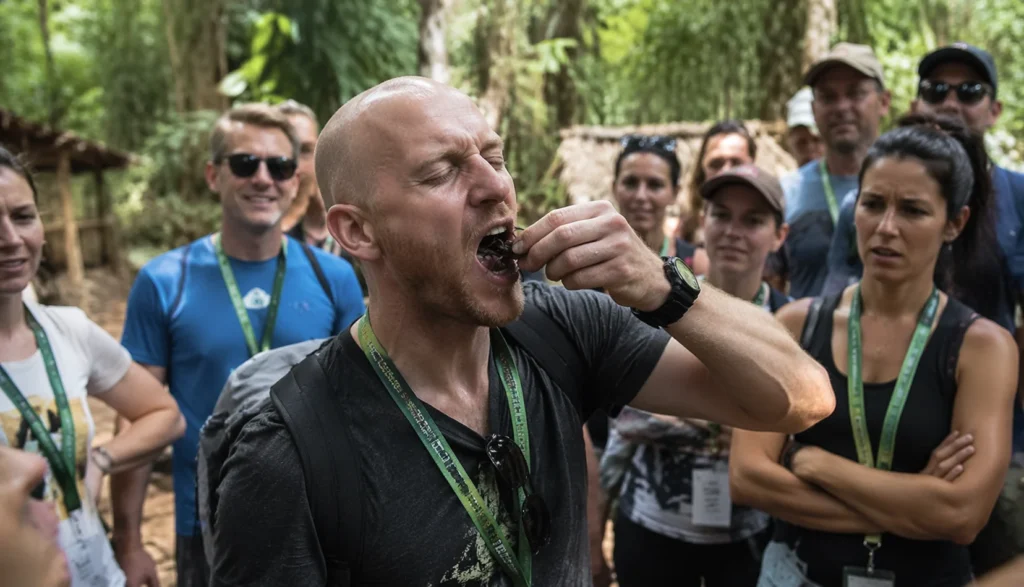
But the worst moment of day two happened when one team found a large, hairy tarantula. The spider was the size of a man’s hand. It was dark brown with thick legs and tiny hairs that can cause skin irritation. The guide told the team to kill it, cook it over an open fire, and eat it.
A video later leaked online. In the video, an employee named Derek holds a charred tarantula on a stick. His hands are shaking. His face is pale. Someone yells, “Eat it! Eat it! Don’t be a coward!” Derek looks around at his teammates. He looks at his boss, who is standing nearby with a camera phone. Derek bites into the spider’s abdomen. He chews twice. His face turns green. He gags. He drops the stick and vomits into the bushes.
The guide laughed and said, “First time is always hard. Tomorrow you will do better.” Derek later said, “I didn’t want to seem weak in front of my boss. So I did it. Then I got sick for two days. My throat burned. My stomach cramped. I couldn’t keep water down.”
No medic checked on Derek. No one took his temperature. The guides said stomach issues were “part of the experience.” They gave him more river water and told him to rest in his hammock.
By the end of day two, more than thirty people had diarrhea. At least ten had fevers. The campsite smelled like vomit and human waste because there were no toilets. People dug holes in the ground with sticks. The holes filled with rainwater and overflowed.
That night, a thunderstorm hit. Rain poured through the tree canopy like someone had turned on a giant faucet. Hammocks filled with water. People used garbage bags as raincoats. Some employees huddled together under a torn tarp that the guides had thrown over a rope. The tarp leaked in six places.
One employee, a quiet man named Paul, started talking to himself. He had not eaten in twenty-four hours. He had not slept. He was dehydrated and confused. His teammates tried to give him water, but he pushed it away. They realized later that Paul was showing early signs of heatstroke. But no one knew what to do. There was no medical kit. No thermometer. No phone signal.
The guides disappeared again that night. No one saw them leave. They just vanished. The 120 employees woke up alone in the jungle with no food, no clear path out, and dozens of sick people.
H2: The Tarantula Meal – When “Survival Food” Went Too Far
Let’s pause and talk more about the tarantula. Because that single moment became the symbol of everything wrong with this trip. It was not just about eating a bug. It was about pressure, fear, and the loss of dignity.
Tarantulas are not poisonous to humans in the way that some snakes are. Their venom is mild, like a bee sting. But their bodies are covered in tiny hairs called urticating hairs. When a tarantula is threatened, it flicks these hairs into the air. If those hairs get into your eyes, nose, or mouth, they cause intense itching, burning, and swelling. If you eat a tarantula that has not been properly prepared, those hairs can stick to your throat and stomach lining. That is why Derek’s throat burned for two days.
In many parts of the world, people do eat tarantulas. In Cambodia, for example, fried tarantulas are a local snack. But those tarantulas are cooked at high temperatures with oil and spices. The cooking process burns off the irritating hairs. The tarantulas on the Honduras trip were thrown directly onto a campfire. The outside got charred, but the inside was barely warm. The hairs were still intact.
Derek did not know any of this. He just knew that his boss was watching. His teammates were watching. The guide was filming on a phone. He felt trapped. Later, he told a friend, “I would have rather quit my job than eat that thing. But in that moment, I couldn’t think straight. I just wanted it to be over.”
Other teams ate different things. One team found a large snake. The guide killed it with a machete and told them to eat the meat raw. Two people tried it. They both got sick. Another team found a nest of ant eggs. The guide said ant eggs were a delicacy. They tasted like sour milk. Most people spat them out.
By the end of day two, almost everyone had eaten something they would never choose to eat. And almost everyone felt ashamed, scared, or angry. The “team building” was not building anything except resentment.
H2: Sickness Spreads – No Doctor, No Medicine, No Rescue
Day three was the worst. By morning, half the group had diarrhea. That is sixty people running into the bushes every twenty minutes. There was no toilet paper. People used leaves. Some leaves were poisonous and caused rashes on sensitive skin.
At least twenty people had fevers above one hundred degrees. One employee, a 29-year-old woman named Lisa, started shaking uncontrollably. She had a history of seizures. Her emergency medication was in her lost bag. She had not taken her pills in two days. Her coworkers were terrified she would have a seizure in the mud.
Lisa’s friend, a woman named Rachel, begged the guides for help. But the guides were gone again. They had taken the only working machete and the only water filter. No one knew where they went. Later, it was discovered that the guides had walked to a nearby village to buy beer. They left sick people alone in the jungle so they could get drunk.
Rachel climbed a hill to get one bar of cell signal on her personal phone. She called the U.S. embassy in Tegucigalpa, the capital of Honduras. An embassy worker answered. Rachel explained the situation: 120 sick Americans, no guides, no medicine, no way out. The embassy worker said they would send help, but it might take twenty-four hours. The nearest road was miles away. The jungle was thick. There were no helicopters available immediately.
Rachel went back down the hill. She told the group what the embassy said. People cried. Some prayed. One man, a former military medic who had kept quiet until now, stepped forward. His name was Steve. He said, “I have some basic training. Let me see who is the sickest.”
Steve made a list. Lisa was at the top. Then Derek, whose throat was so swollen he could barely drink water. Then Paul, the man with heatstroke symptoms. Then three other people with fevers above 103 degrees. Steve gave them the last of his personal water bottle. He used a torn shirt to make a cool compress for Lisa’s forehead.
But Steve could not do much. He had no medicine. No IV fluids. No way to test for serious infections like dengue fever or bacterial dysentery. He was just a regular guy trying to help.
Meanwhile, the stream water that the guides had called “safe” was making more people sick. Later tests would show that the stream contained E. coli bacteria from animal waste. Anyone who drank it without boiling it first was at risk. But boiling water required fire, and fire required dry wood, and everything was soaked from the thunderstorm.
By noon on day three, the campsite looked like a battlefield hospital. People lay in wet hammocks, moaning. Flies gathered around the holes in the ground. The smell was so bad that some people held their shirts over their noses.
And still, no guides. No rescue. No word from the company back home.
H2: No Flight Rescue – Stranded and Scared
This is where the trip turned from bad to terrifying. The company had promised “emergency extraction” in their brochure and in the pre-trip emails. That meant a helicopter or small plane could come get anyone in serious danger. It was one of the main reasons employees felt safe saying yes.
But when employees tried to activate the rescue plan, nothing happened. Rachel called the emergency number listed on the company’s travel packet. The number was disconnected. She called the travel agency’s main office in the U.S. No one answered. She left seven voicemails. None were returned.
Later, during the lawsuit, it was revealed that the travel agency had never actually booked an emergency flight service. They had only written the words on paper to make the trip look professional. There was no helicopter on standby. There was no plane. There was no contract with any air rescue company. It was all lies.
The U.S. embassy arranged for local authorities to help. But local police in that part of Honduras had only one truck. It was an old Ford with a cracked windshield and no air conditioning. The truck could only take five people at a time. The drive to the nearest clinic took two hours on muddy roads. Then the truck had to drive back. Then take five more people.
For eighteen hours, sick employees lay in hammocks while healthy ones took turns fanning them with leaves. Lisa had a small seizure. It lasted about forty-five seconds. Steve held her head so she wouldn’t bite her tongue. When she woke up, she did not know where she was. She asked for her mother.
A second thunderstorm hit. This one was worse than the first. Lightning struck a tree less than two hundred feet from the campsite. The boom was so loud that people covered their ears and screamed. Rain came down in sheets. The tarp ripped completely. Everyone got soaked.
Finally, around midnight, the police truck arrived. It took Lisa first. Then Derek. Then Paul. Then two others. The rest had to wait. Some waited another six hours. By the time the last sick person left the campsite, it was morning of day four.
No plane. No helicopter. Just a broken truck on muddy roads.
H2: The Long Wait – Those Who Stayed Behind
While the sickest people were taken to the clinic, about eighty employees remained at the campsite. They were not as sick, but they were far from healthy. Most had diarrhea. Many had fevers. All were exhausted, scared, and angry.
There was still no word from the guides. No word from the travel agency. No word from their own company. The CEO, Richard, had stayed back in the United States. He did not travel with the group. He later said he was “monitoring the situation from headquarters.” But employees said they never received a single phone call or text from him.
The remaining eighty people had to decide what to do. Some wanted to stay put and wait for more help. Others wanted to try to hike out of the jungle on their own. The problem was that no one knew the way. The trails were not marked. The jungle looked the same in every direction. If they got lost, they could die of dehydration or snakebite before anyone found them.
Steve, the former military medic, took charge. He said, “We stay together. We stay here. We conserve water. We wait for the truck to come back.” People listened to Steve because he was calm and he had helped Lisa during her seizure.
The truck came back four more times over the next twelve hours. Each time, it took five more people. By the evening of day four, only thirty people were left at the campsite. But now the truck had a flat tire. The police said they could not get a replacement tire until morning.
So thirty people spent a fourth night in the jungle. They had no food left. The last of the water was gone. People drank from the stream again because they had no choice. More people got sick.
That night, someone heard a loud noise in the trees. It sounded like a large animal moving branches. People held their breath. They had been told that jaguars lived in this jungle. No one saw a jaguar. But the fear was real.
By sunrise on day five, the truck had a new tire. It came back and took the last thirty people. The drive to the clinic took two hours. When they arrived, they saw their coworkers lying on cots in a small, crowded room. Lisa was hooked up to an IV. Derek was sleeping. Paul was sitting up, drinking electrolyte solution.
The clinic had only one doctor. She was a local woman named Dr. Flores. She spoke some English. She looked at the group and said, “What happened to you? Who sent you here?” No one had a good answer.
H2: The Aftermath – Hospital Visits and Legal Fights
Back in the United States, the nightmare was not over. The company chartered a plane to bring everyone home. But the plane was delayed for eight hours because the company had not paid the charter fee upfront. Employees sat in the San Pedro Sula airport, dirty and sick, while their bosses argued over credit cards.
When they finally landed in Miami, nine employees went straight to the emergency room. They had severe dehydration, bacterial infections, and one confirmed case of dengue fever. Dengue is a mosquito-borne illness that causes high fever, joint pain, and bleeding problems. That employee, a young man named Carlos, spent five days in a Miami hospital. His mother flew from Texas to sit by his bed.
Lisa, the woman with a seizure disorder, spent three days in a Honduran clinic before she was stable enough to fly home. Her mother later told a news reporter, “My daughter almost died because a company wanted a fun team-building story. They took her medicine. They left her in the jungle. They should be in jail.”
Derek, the tarantula eater, developed a painful rash on his hands and mouth. Doctors said it was likely from handling raw, wild insects without gloves. The tarantula hairs had embedded in his skin. He needed steroid cream and antihistamines. He missed three weeks of work.
In total, seventeen employees required follow-up medical care after returning to the U.S. The total medical bills were more than two hundred thousand dollars. The company’s health insurance paid for some of it, but employees were stuck with deductibles and copays. Some had to borrow money from family to pay their bills.
Within a month, forty-five employees filed a joint complaint with the state labor board. They said the company had ignored basic safety rules. They also said the company had pressured them to sign “liability waivers” before the trip. Those waivers were hidden on page eight of a twelve-page document. The waivers said, in small print, that employees could not sue the company for any injury or illness that happened during the trip.
A judge later ruled that the waivers were not valid. The judge said the company had not explained the waivers clearly. The judge also said that no waiver can protect a company from gross negligence. Leaving sick people alone in a jungle without medical care is gross negligence.
The company settled out of court for an undisclosed amount. But the real damage was to trust. Within one year, seventy of the 120 employees quit. Some went to competitors. Some started their own businesses. Some just needed a break from corporate life.
The CEO, Richard, was fired by the board of directors six months after the trip. He tried to start another company, but investors did not trust him. The travel agency, Extreme Team Adventures, went out of business. Its owner filed for bankruptcy and moved to another country.
H2: The Human Cost – What Happened to the Employees Later
It is easy to talk about lawsuits and settlements. But the real story is about people. Let’s check in on some of them years later.
Maria, the woman who cried over her lost inhaler, now runs a safety consulting firm. She helps companies plan trips that are fun but not foolish. Her motto is: “Adventure is great. Abandonment is not.” She speaks at conferences about the Honduras trip. She says, “I don’t want anyone else to feel what I felt. Alone. Scared. Forgotten.”
Derek, the tarantula eater, works at a different tech company. He still gets nervous around group travel. He told a podcast in 2025, “I don’t eat anything I can’t identify. And I never sign a waiver without reading every word. I also carry my own first-aid kit everywhere. Even to the office.”
Lisa, the woman with seizures, moved closer to her mother. She has a service dog now. The dog can sense when a seizure is coming. Lisa still takes medication every day. She told a reporter, “I think about the jungle every night when I close my eyes. The sounds. The smell. The fear. Therapy helps. But I will never be the same.”
Steve, the former military medic who took charge, got a promotion at his new job. His boss said, “Steve is calm under pressure. He knows how to lead.” Steve does not talk much about the Honduras trip. But his wife says he has nightmares about the lightning strike.
Paul, the man with heatstroke, made a full recovery. But he quit his job and became a high school biology teacher. He says, “I wanted to do something meaningful. Something that doesn’t involve fake survival games.”
Carlos, the man with dengue fever, still has joint pain sometimes. Doctors say it is a long-term effect of the illness. He cannot run long distances anymore. He used to be a marathon runner. Now he walks.
Chloe, the woman with asthma, got her inhaler back when her lost luggage finally arrived. It came on day six, one day after she left Honduras. She never opened the bag. She threw it in the trash and bought new clothes.
These are real people with real pain. They are not characters in a story. They went to work one day, said yes to a trip, and came back broken in ways that do not always show on the outside.
H2: What Went Wrong? Five Critical Failures Explained Deeply
Experts who study corporate travel safety looked at the 2017 Honduras trip. They found five major failures. Any one of these could have caused a disaster. Together, they created a perfect storm of suffering.
Failure 1: No medical screening. The company never asked employees about allergies, seizures, asthma, diabetes, or medications. They assumed everyone was equally healthy. That is like assuming everyone can swim before throwing them into deep water. A simple online form would have revealed that Lisa needed her seizure medication, Tom needed his EpiPen, and Chloe needed her inhaler. But the company did not bother.
Failure 2: Fake emergency plan. The “flight rescue” never existed. No helicopter. No plane. No contract. No satellite phone. The company and the travel agency lied on paper. When people got sick, there was no way to call for help except climbing a hill and hoping for a cell signal. In a real emergency, those minutes matter. If someone had had a heart attack or a severe allergic reaction, they would have died.
Failure 3: Bad local partners. The travel agency hired the cheapest guides available. Those guides had no first-aid training, no medical kits, and no loyalty to the group. They left sick people alone to go buy beer. They gave dangerous advice like “put mud on a bleeding wound” and “drink water from a contaminated stream.” A good guide would have stayed with the group, called for help, and kept people calm. These guides did none of that.
Failure 4: Lost luggage protocol. When bags went missing, there was no backup plan. The company should have sent someone to buy medicine and supplies at the nearest town. Instead, they did nothing. People suffered without their prescriptions. A simple rule for group travel is: always keep essential medications in your carry-on bag. But the company never told employees that. Many people checked their bags without thinking.
Failure 5: Group pressure to perform. The tarantula incident happened because people felt they had to “be tough” in front of bosses and coworkers. That is never safe. A good trip leader would have said, “No one has to eat anything they don’t want to eat. This is voluntary.” Instead, the guides and managers encouraged the eating contest. They filmed it. They laughed. They created a culture of shame around saying no.
One safety consultant said, “This trip treated adults like contestants on a game show. Real survival is not a game. Real survival requires clean water, medicine, and a way to call for help. This trip had none of those things.”
H2: How to Plan a Safe Group Trip – Lessons Learned in Detail
The good news is that you can learn from this disaster. Whether you are planning a company retreat, a school field trip, a church group outing, or a family reunion, these rules apply. Write them down. Share them with your group. Follow them like your life depends on it, because sometimes it does.
First, ask hard questions before you book. Who are the local guides? Are they licensed? Do they have insurance? Can you call their references? Do they speak your language well enough to handle an emergency? Do they have first-aid training? Do they have a satellite phone? Do not accept vague answers like “they are very experienced.” Ask for names, dates, and proof.
Second, build a real emergency plan. Write down the nearest hospital address and phone number. Rent a satellite phone if cell service is weak. Make sure everyone in the group knows how to use it. Decide how you will evacuate a sick person in under two hours. Practice the plan. Do not just write it on paper and forget it.
Third, collect medical info privately. Use a simple online form to ask about allergies, medications, conditions, and emergency contacts. Keep that information in a sealed envelope with a trusted trip leader. Do not share it with the whole group. But make sure someone knows who has asthma, who has seizures, who has diabetes, and who has severe allergies.
Fourth, never pressure people to do dangerous things. Eating a tarantula is not team building. Neither is sleeping without shelter, drinking dirty water, or hiking in a thunderstorm. Make it clear that “opting out” is always okay. No one should lose a bonus or a promotion because they refused to do something unsafe. A good leader thanks people for speaking up about their fears.
Fifth, read the fine print on waivers. If a company asks you to sign away your rights before a trip, that is a red flag. A good organizer takes responsibility. They do not hide behind legal documents. If you do sign a waiver, read every word. Ask questions. If something does not make sense, do not sign it. Or cross out the parts you do not agree with. You have that right.
Sixth, pack smart. Never check essential medications. Keep them in your carry-on bag. Also pack a small first-aid kit, a flashlight, extra batteries, a water bottle, and a portable phone charger. Even if the trip promises to provide these things, bring your own. Backups save lives.
Seventh, have a communication plan. Before you leave, agree on how the group will stay in touch. Share phone numbers. Share a meeting point in case anyone gets lost. If you are going somewhere remote, rent a satellite phone or a personal locator beacon. These devices can send your GPS coordinates to rescuers even when there is no cell signal.
Eighth, trust your gut. If something feels wrong before the trip, say something. If something feels wrong during the trip, say something louder. Do not let peer pressure or fear of looking weak keep you quiet. Your safety is more important than anyone’s opinion of you.
H2: Why This Story Still Matters in 2026 and Beyond
You might think, “That was almost ten years ago. Surely companies have learned. Surely travel agencies have changed.” But experts say similar disasters happen every year. Human nature does not change quickly. Greed, laziness, and pressure to perform are still common.
In 2022, a corporate trip to Costa Rica left fifteen people with food poisoning because the resort cut corners on food storage. The resort owner had lied about having a licensed kitchen. Employees spent two days vomiting in their hotel rooms. No one was hospitalized, but the trip was ruined.
In 2023, a church group went on a “wilderness retreat” in Montana. The leader ignored weather warnings. A sudden snowstorm trapped the group on a mountain. They had to be rescued by helicopter. Three people had frostbite. The church paid a large fine for ignoring safety rules.
In 2024, a team-building hike in Arizona ended with two people hospitalized for heatstroke. The leader had promised there would be water stations along the trail. There were no water stations. The temperature reached 112 degrees. One of the heatstroke victims was a 55-year-old man with high blood pressure. He almost died.
In 2025, a company in Texas sent forty employees on a “survival weekend” in a swamp. The guides lost the trail. The group wandered for nine hours without food or water. They were found by a fisherman who heard them yelling. The company’s CEO apologized but kept his job. Employees said they would never trust him again.
These are not old stories. These are new stories. They prove that the lessons of the 2017 Honduras trip have not been learned by everyone. That is why this article is long. That is why the details matter. Every time someone reads this story and changes their plans, a disaster is avoided.
Today, Derek works at a different company. He still gets nervous around group travel. He told a podcast in 2025, “I don’t eat anything I can’t identify. And I never sign a waiver without reading every word.”
Maria, who cried over her lost inhaler, now runs a safety consulting firm. She helps companies plan trips that are fun but not foolish. Her motto is: “Adventure is great. Abandonment is not.”
Lisa, who had the seizure, wrote a short book about her experience. It is called “The Jungle Left Behind.” In the book, she says, “I am not a victim. I am a survivor. But survival should not be the goal of a company trip. Safety should be the goal.”
Conclusion: Travel Smart, Not Scary
The story of 120 employees eating tarantulas and begging for rescue is shocking. It is the kind of story that makes you say, “That could never happen to me.” But it could. It happens every year to people who trust the wrong guides, sign the wrong papers, or stay quiet when they should speak up.
A few smart choices would have changed everything for the Honduras group. A working satellite phone. Real medical checks. Honest guides. A leader who said, “No one has to eat a bug to belong here.” A CEO who stayed with the group instead of watching from headquarters. A travel agency that told the truth instead of lying about helicopters.
If you ever join a group trip, remember this story. Ask questions. Pack your own medicine. Keep your phone charged. Know where the nearest hospital is. And if someone tells you to eat a tarantula, just say no. Your health is worth more than any team-building badge. Your dignity is worth more than any bonus. Your life is worth more than any job.
The jungle does not care about your job title. The jungle does not care about your company’s sales numbers. The jungle cares about water, shelter, and safety. Without those things, even the most successful professional is just a scared person in the dark.
So travel smart. Plan carefully. Speak up when something feels wrong. And never, ever let anyone pressure you into eating a spider. Some experiences are not worth having. Some stories are better left untold. But this story needed to be told, so that others could learn.
Now you know. What you do with that knowledge is up to you.

ProDentim is a modern oral-health supplement formulated with specialized probiotics and naturally sourced ingredients to help maintain firm teeth
ProDentim is a distinctive oral-care formula that pairs targeted probiotics with plant-based ingredients to encourage strong teeth, comfortable gums, and reliably fresh breath.
NerveCalm is a high-quality nutritional supplement crafted to promote nerve wellness, ease chronic discomfort, and boost everyday vitality.
PurDentix is a revolutionary oral health supplement designed to support strong teeth and healthy gums. It tackles a wide range of dental concerns, including gum inflammation and tooth decay
AquaSculpt is a high-quality metabolic support supplement created to help the body utilize fat more efficiently while maintaining steady
GL Pro is a natural dietary supplement formulated to help maintain steady, healthy blood sugar levels while easing persistent sugar cravings.
Backbiome is an advanced daily wellness supplement formulated to help support spinal comfort, reduce feelings of built-up tension, and promote freer, smoother movement throughout everyday life.
Boostaro is a modern mens wellness formula created to support daily vitality, stamina, and confidence through a practical, natural routine.
Saved as a favorite, I really like your blog!
I love the local vibe of this site. It feels tailor-made for us and the bonuses are actually generous. jilione1 is definitely a winner in my book.
Super friendly customer support. They helped me out with my deposit issue in just a few minutes. Five stars for phjili188!
Thank you for the sensible critique. Me & my neighbor were just preparing to do some research about this. We got a grab a book from our local library but I think I learned more from this post. I am very glad to see such excellent information being shared freely out there.
One of the most trustworthy sites I have come across. The promotions are generous and the overall experience is just seamless. pkdewa90
Solid platform with a great variety of options. I highly recommend checking out beephcasinologin if you want a fair gaming experience.