

An Introduction to the Unbelievable
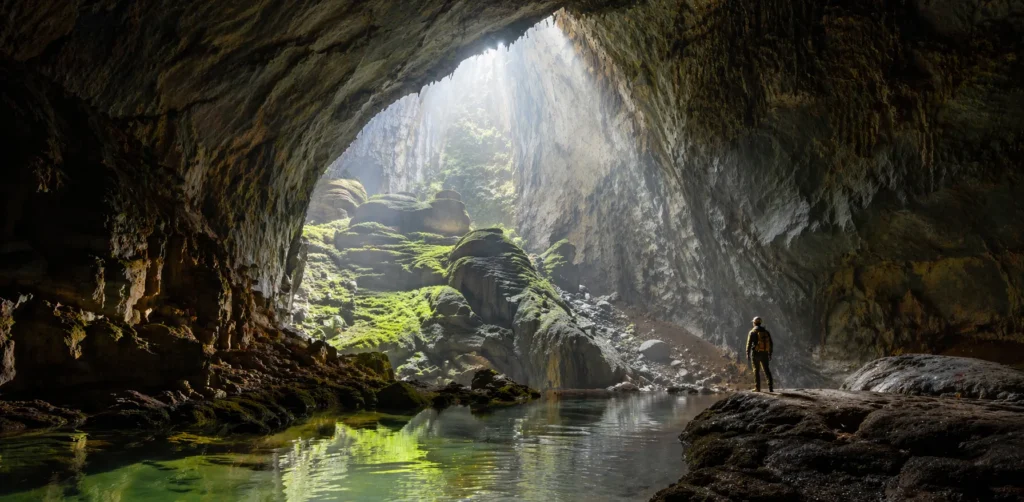
Imagine you are standing in a dark hole. But this is not a normal hole. You look up, and you cannot see the ceiling. You look left, and you cannot see the wall. You hear water rushing somewhere far away, like a river that is angry. Then you feel a drop of rain on your face. Rain. Inside a cave. You look up again, and there it is: a small gray cloud forming against the rock ceiling, 800 feet above your head.
That cloud does not know it is inside a cave. It thinks it is in the sky. But it is wrong.
This place is real. It is called Son Doong Cave. Some people spell it Sun Doom because that sounds scarier and more dramatic. Honestly, both names fit. Son Doong sits deep in the jungles of central Vietnam, hidden inside a national park called Phong Nha-Ke Bang. For thousands of years, only the wind knew it existed. Then, in 2009, a group of British cavers followed that wind. And what they found changed how we think about planet Earth.
This cave is so big that it has its own weather system. It makes clouds. It makes rain. It has a jungle inside it—not just a few ferns, but a real jungle with trees over 100 feet tall. It has a river that roars like a lion. And the main chamber is so tall that you could stack a 40-story skyscraper on the floor and still have room to fly a helicopter over the roof.
This article will take you on a journey. We will go deep underground. We will meet the blind creatures that live in total darkness. We will climb the Great Wall of Vietnam. We will swim in a river that has never seen the sun. And we will answer the big question: How is any of this possible?
So turn off your phone. Get comfortable. And get ready to visit a place that most humans will never see.
H2: What Exactly Makes a Cave the “Largest”? (It’s Not Just Length)
When most people hear the words “largest cave,” they think about a tunnel that goes on forever. A long, skinny tube that you could walk through for days. That is one way to measure a cave, but it is not the only way. In fact, when scientists talk about Son Doong, they do not call it the longest cave. They call it the largest by volume. And volume changes everything.
Let us break that down.
Volume means the amount of empty space inside something. Think about a cardboard box. A long, flat box might hold your pizza. But a big cube-shaped box might hold your television. The pizza box is longer, but the TV box is larger because it has more empty space inside. Son Doong is the TV box of caves. It is not the longest—that prize goes to Mammoth Cave in Kentucky, USA, which has over 400 miles of tunnels. But Son Doong has more room than any other cave on Earth.
How much room exactly? Scientists have measured the main passage of Son Doong. In most places, it is over 650 feet wide. That is longer than two football fields laid end to end. The ceiling is usually 500 feet high or more. But in the tallest chamber, called the Watchtower, the ceiling soars 880 feet above the floor.
To help your brain understand 880 feet, let us compare it to famous things.
- The Statue of Liberty, from the ground to the tip of the torch, is 305 feet tall. You could stack two Statues of Liberty on top of each other, and they would still not reach the ceiling. You would need a third Statue of Liberty to get close.
- The Leaning Tower of Pisa is 183 feet tall. You could stack almost five of them.
- A 40-story skyscraper is about 450 to 500 feet tall. You could put that skyscraper on the floor of Son Doong, and the ceiling would be another 380 feet above its roof.
Now think about width. The widest part of the cave is over 650 feet across. That means you could park 150 school buses side by side. Or you could line up 2,000 bicycles. Or you could take a 747 jumbo jet, which is about 225 feet long, and land it inside the cave with room to spare on both sides.
But here is the number that really matters: Total volume. Son Doong contains roughly 38.5 million cubic meters of empty space. That is 1.36 billion cubic feet. If you wanted to fill that space with water, you would need 72 Olympic swimming pools. If you wanted to fill it with blue whales (which are about 80 feet long and very fat), you could fit roughly 280 of them. If you wanted to fill it with basketballs, you would need about 2.5 billion basketballs. That is more basketballs than there are people in North America.
So when someone says Son Doong is the largest cave in the world, they are not exaggerating. They are doing math.
H2: The Accidental Discovery – A Fisherman’s Fear, a Buffalo’s Path, and a British Dream
Every great discovery starts with a lucky accident. The story of Son Doong begins in 1990 with a man named Ho Khanh. He was not a scientist. He was not an explorer. He was a local fisherman and logger who knew the jungle better than anyone. He lived in a small village near the Phong Nha-Ke Bang National Park. He spent his days cutting firewood, hunting small animals, and fishing in the rivers.
One day, Ho Khanh was walking through the jungle looking for food. It had been raining heavily for a week. The ground was slippery. The leaves were wet. He stepped onto a patch of limestone rock that looked solid. It was not. The rock crumbled under his foot, and Ho Khanh almost fell into a dark hole. He grabbed a tree root just in time. His heart was pounding.
When the rain stopped, he crawled back to the edge and looked down. He could not see the bottom. But he saw something strange: a huge column of white mist rising out of the hole. It looked like smoke from a volcano, but it was cold. And he heard a sound. It was not a bird or a monkey. It was a deep, moaning sound, like a giant animal breathing in its sleep.
Ho Khanh was terrified. He believed in spirits. He thought the hole was the home of a mountain demon. He ran back to his village and told his wife, “Do not go near that place. The mountain is alive.” For the next 18 years, he did not tell anyone else. He did not mark the spot on a map. He just let the jungle cover his memory.
Meanwhile, halfway around the world in England, a man named Howard Limbert was obsessed with finding new caves. Howard was a caver with the British Cave Research Association. He had been exploring Vietnam for years, and he kept hearing rumors from local villagers about a “cave with wind.” Every time he asked, they pointed vaguely toward the mountains. But no one could take him there.
Then Howard met Ho Khanh. It was 2008. Ho Khanh was getting old. His memory was not as sharp as it used to be. But he remembered the wind. He remembered the sound. And he told Howard, “I think I can find it again.”
For months, Ho Khanh walked the jungle. He looked for familiar rock shapes. He listened for the wind. Nothing. Then one morning, while walking his buffalo to a grazing field, he saw a strange rock formation that looked like a turtle. He stopped. He looked left. There it was: the same patch of broken limestone from 18 years ago. The same cold mist rising from the ground.
Ho Khanh pulled out a GPS device (one that Howard had given him) and marked the coordinates. Then he sent a message: “I found it. Come now.”
In April 2009, Howard Limbert and a small team of British cavers flew to Vietnam. Ho Khanh led them through the jungle for six hours. They hacked through vines, crossed rivers, and climbed muddy hills. Then they stopped. The ground opened up into a dark pit. Howard tied a rope to a tree and lowered himself down.
He dropped 260 feet into complete darkness. When his feet touched the ground, he turned on his headlamp. The beam shot forward and vanished. He could not see the walls. He could not see the ceiling. He heard a river roaring somewhere in the distance. He took a step. Then another step. Then he looked up and saw a calcite crystal the size of a car hanging from the ceiling like a frozen chandelier.
Howard later wrote in his journal: “I have been in over 1,000 caves. I have never felt small until today.”
The team walked for six hours. They crossed a river that came up to their chests. They climbed over boulders the size of houses. Then they hit a wall. It was not a normal rock wall. It was a massive, smooth, curved wall of flowstone calcite. It rose 200 feet straight up. Water dripped down its face like tears. They could not climb it. They named it the Great Wall of Vietnam and turned back.
But they knew. They knew they had found something impossible. Son Doong was officially discovered.
H2: A 40-Story Skyscraper? Let’s Do the Math Again, but Slower
You have probably seen the headline online: Son Doong Cave can fit a 40-story skyscraper inside its main chamber. That sounds like clickbait. But it is actually an understatement. Let us walk through the numbers step by step so you can really understand how big this cave is.
First, what is a “story” in a building? In the United States and most of the world, one story (or one floor) of a building is about 10 to 12 feet tall. That includes the floor slab, the ceiling, and the space in between. So a 40-story skyscraper is roughly 400 to 480 feet tall. Some modern skyscrapers have taller floors—luxury apartments might have 15-foot ceilings—so a 40-story building could be 500 to 550 feet tall. But let us use 450 feet as a good average.
Now, what is the tallest part of Son Doong? The main passage has an average height of about 500 feet. But the tallest chamber, called the Watchtower, has a measured height of 880 feet from the floor to the ceiling. That is almost double the height of a 40-story skyscraper.
So here is the visual: Imagine you are standing on the floor of Son Doong. You look up and see a 40-story office building sitting next to you. The top of that building is 450 feet above your head. Now look past the roof. You still see another 430 feet of empty cave above the building. That empty space is tall enough to fit another 40-story building stacked on top of the first one. But wait—that second building would be 450 feet tall, and you only have 430 feet left. So you cannot fit a full second building. But you can fit a 38-story building on top of the first one.
That means Son Doong is tall enough to stack two skyscrapers on top of each other—one 40 stories and one 38 stories—and still have a few feet to spare. That is 78 stories of building stacked vertically. No human-made structure on Earth is that tall except for the Burj Khalifa in Dubai (which is 163 stories). So Son Doong is roughly half the height of the tallest building in the world.
But the cave is not just tall. It is also wide and long. The widest part of the main passage is 650 feet across. A typical city block in New York is about 264 feet wide. So you could fit two and a half New York city blocks inside the width of Son Doong. And the length of the cave—the part that has been explored so far—is just over 5.5 miles. That is longer than the runway at the world’s largest airport (which is about 3 miles).
Now let us talk about volume again, but with everyday objects.
- Basketballs: A standard basketball is about 0.5 cubic feet in volume. Son Doong is 1.36 billion cubic feet. That means you could fit 2.72 billion basketballs inside the cave. If you stacked them in a giant cube, that cube would be 1.4 miles high.
- Refrigerators: A typical refrigerator is about 20 cubic feet. You could fit 68 million refrigerators inside Son Doong. That is enough refrigerators to give one to every person in the United Kingdom, France, and Germany combined.
- Cars: A midsize sedan is about 100 cubic feet. You could fit 13.6 million cars inside the cave. That is more cars than there are in the entire country of Australia.
- People: If you packed people in as tightly as possible (like sardines in a can), you could fit roughly 10 billion people inside Son Doong. That is more people than currently live on Earth. The entire human race could stand inside this one cave, shoulder to shoulder, with room left over.
Of course, you would never do that. The cave is a fragile place. But the numbers help your brain understand: Son Doong is not a big cave. It is a hidden continent.
H2: The Cave That Makes Its Own Weather – Clouds, Rain, Fog, and Wind
Now we get to the part that sounds like science fiction. Son Doong has its own weather system. That is not a metaphor. That is not a marketing trick. The cave actually creates clouds, rain, and fog inside its chambers, completely separate from the weather outside.
To understand how this happens, you need to understand three things: dolines, temperature, and humidity.
Dolines are holes in the cave ceiling where the rock has collapsed. Son Doong has two major dolines. The first is called the Garden of Edam (named because a cheese-loving explorer thought the rocks looked like Edam cheese). The second is called the Doline of Doom (named because it is terrifying). These dolines act like chimneys or skylights. They let sunlight in, and they let air move in and out.
Temperature inside the cave is usually cool and stable—around 68 to 72 degrees Fahrenheit. But when the sun shines through the dolines, it heats the air inside the cave unevenly. The air near the floor might be 68 degrees, but the air near the ceiling, where the sunlight hits, might be 85 degrees. Hot air rises. Cold air sinks. This creates convection currents, just like in a pot of boiling water.
Humidity in Son Doong is almost always 100 percent. That means the air is completely full of water vapor. Where does that water come from? The Rao Thuong River. This river runs through the entire cave. It evaporates constantly, especially when the air is warm. The cave is basically a giant, dark sauna.
Now put it all together. Warm, wet air rises toward the ceiling. When it reaches a pocket of cooler air (maybe from outside air sneaking in through the dolines), the water vapor condenses into tiny droplets. Those droplets are clouds. They float inside the cave, just like clouds float in the sky. Sometimes, those clouds grow thick and heavy. Then they drop rain. Actual rain. You can stand on the cave floor and get wet from a rainstorm that started 500 feet above your head.
Tourists who have done the Son Doong expedition report some truly strange weather experiences.
One woman wrote in her journal: “I was eating lunch on a dry sandy beach next to the river. The ceiling was so high above me that I could barely see it. Then I felt a drop on my arm. Then another. I looked up and saw a gray cloud forming right in front of my eyes. It was shaped like a pillow. It started raining harder. But here is the crazy part: The rain was warm. And it smelled like rocks. I have never experienced anything like it.”
Another tourist described seeing fog rolling across the cave floor like a river. Fog is just a cloud that touches the ground. In Son Doong, the fog can get so thick that you cannot see your hand in front of your face. Then, ten minutes later, it vanishes completely because the air temperature shifted by two degrees.
The dolines also create wind. Outside air rushes into the cave when the pressure changes. That wind can be strong enough to knock you over. Explorers have reported gusts of 15 to 20 miles per hour inside the main passage. That is a strong breeze on a beach. But inside a cave, it feels like a ghost pushing you.
And here is the wildest part: The weather inside Son Doong does not always match the weather outside. It can be sunny and 90 degrees on the surface. You walk down into the cave, and it is cold and foggy. Or it can be raining cats and dogs outside, but inside the cave, the air is dry and still. The cave creates its own climate bubble. It is like a planet within a planet.
Scientists are still studying how this works. They have placed weather sensors at different points inside the cave. They have found that the temperature can vary by 15 degrees between the floor and the ceiling. They have recorded clouds forming and dissipating in less than 30 minutes. They have measured humidity so high that their equipment stopped working.
Son Doong does not just hold water. It breathes.
H2: Underground Jungles – Trees Growing 200 Feet from the Nearest Sunlight
Because of the two dolines, sunlight reaches the floor of Son Doong in two specific places. And where there is sunlight and water, life explodes. The result is two complete underground jungles growing inside a cave. These are not sad little patches of moss. These are real forests with tall trees, thick vines, flowering plants, and even birds.
Let us start with the Garden of Edam, the larger of the two jungles. To reach it, you have to hike through the cave for about two hours. The tunnel narrows, then widens, then narrows again. You climb over boulders. You wade through shallow water. Then the tunnel opens up, and you see light. Not headlamp light. Real, golden, warm sunlight pouring down from a hole in the ceiling 300 feet above you.
The temperature jumps from 68 degrees to 85 degrees in a matter of steps. The air smells like wet dirt, blooming flowers, and rotting wood—the smell of every jungle on Earth. You look up, and you see tree roots hanging down from the ceiling like ropes. Some of those roots are 200 feet long. They dangle in the air, searching for soil that is still 100 feet below them.
The trees themselves are massive. There is a species of tree that grows only in the Garden of Edam. Botanists have not even named it yet. It has dark green leaves, a twisted trunk, and bark that looks like melted wax. The tallest tree in the garden is over 100 feet tall. That is a 10-story building made of wood. And it is growing in complete darkness for 20 hours each day.
How is that possible? The answer is the sun’s path. The doline above the Garden of Edam is perfectly aligned with the sun’s movement across the sky. For about 2 to 4 hours each day—depending on the season—a direct beam of sunlight hits the cave floor. The trees have evolved to take advantage of this short window. They grow incredibly fast during those hours, storing energy for the long dark periods. It is like a sprinter who runs all-out for four hours and then sleeps for twenty.
The jungle is not just trees. There are vines that climb the cave walls, reaching toward the light. There are ferns that unroll their leaves the instant the sun touches them. There are orchids that bloom only in the cave—white flowers with purple spots that look like little faces. And there are butterflies. Real butterflies that live their entire lives in this underground garden. They never see the outside world. They are born, eat, mate, and die inside a hole in the ground.
The second jungle, near the Doline of Doom, is smaller but more dramatic. The doline here is deeper and narrower. The sunlight comes in at a sharper angle, creating strange shadows. The trees in this jungle grow sideways, reaching for the light like swimmers reaching for the surface. One tree has grown horizontally for 60 feet before turning straight up. It looks like a giant letter L made of wood.
Scientists have found new species of plants in these jungles every time they visit. In 2016, they found a type of moss that glows in the dark. It is not bioluminescent (it does not make its own light). Instead, it reflects the faint glow of the cave walls with such efficiency that it looks like it is lit from within. In 2019, they found a mushroom the size of a dinner plate that smells like cinnamon. In 2022, they found a flower that only opens at midnight—not that midnight matters in a cave, but the flower seems to have an internal clock that tells it when to bloom.
The underground jungles of Son Doong are proof that life finds a way. No matter how dark, how wet, or how strange the environment, plants and animals will adapt. They will grow sideways. They will wait for 20 hours of darkness. They will climb 200-foot walls. They will do whatever it takes to reach the light.
H2: The River That Roars – And the Pearls the Size of Baseballs (and Heads)
You cannot talk about Son Doong without talking about the river. The Rao Thuong River is the heart of the cave. It enters from the surface, disappears underground, and flows through the entire length of Son Doong before emerging again on the other side of the mountain. It is not a gentle stream. It is a roaring, angry, powerful river that sounds like a highway full of trucks.
The first time you hear it, you will think there is a waterfall nearby. There is not. The sound is just the river crashing against boulders and squeezing through narrow passages. The water is a strange color—milky blue, like someone mixed cement into the ocean. That color comes from dissolved limestone. The river is literally eating the cave as it flows.
In some sections, the river is calm and shallow. You can wade across it with the water reaching your knees. In other sections, it is deep and fast. The guides tie everyone together with ropes to cross those parts. If you slipped, the current would sweep you away in seconds. You would be pulled into an underwater tunnel and never seen again. No one has died in Son Doong yet, but there have been close calls.
The river does two amazing things. First, it carves. Over millions of years, the Rao Thuong River has eaten away at the limestone like a hot knife through butter. That is why the cave is so wide. The river is the architect, the builder, and the demolition crew all in one. Every drop of water carries a tiny amount of dissolved rock. Over time, those tiny amounts add up to massive chambers.
Second, the river creates cave pearls. You have probably heard of ocean pearls. An oyster makes them. A piece of sand gets inside the oyster’s shell, and the oyster coats it with layers of smooth material until it becomes a shiny pearl. Cave pearls are similar, but there are no oysters involved. Instead, the river does the work.
Here is how it happens. A tiny grain of sand or rock falls into a small pool of water. The pool is swirling because of the current. The grain spins around and around, never settling. As it spins, it picks up layers of calcite—the same dissolved limestone that makes the water milky blue. Each layer is microscopically thin. But after a hundred years, the grain has become a small, round, shiny stone. After a thousand years, it is the size of a marble. After ten thousand years, it is the size of a golf ball.
In Son Doong, some cave pearls are the size of baseballs. A few are the size of softballs. And in one pool near the Great Wall of Vietnam, there is a cave pearl the size of a human head. It is perfectly round, perfectly smooth, and perfectly white. It looks like a moon sitting in a puddle of water.
Tour guides have a strict rule: Do not touch the cave pearls. Your skin has oils. Those oils can stop the calcite from sticking to the pearl. If you touch a cave pearl, you might stop its growth forever. A pearl that has been growing for 50,000 years could be ruined by one fingerprint.
The pearls sit in shallow pools by the thousands. When you shine your headlamp on them, they glow. They look like a treasure chest spilled open. Pirates would weep if they saw this. The pearls are worthless as jewelry—they are made of ordinary calcite, not precious minerals. But they are priceless as natural wonders.
The river also creates rimstone dams. These are small walls of calcite that form across the river, creating natural pools. The pools look like terraced rice paddies, but they are made of solid rock. Some rimstone dams are only an inch high. Others are 10 feet high. Water flows over them in tiny waterfalls, creating a sound like wind chimes.
If you sit quietly next to the river, you can hear the cave growing. It sounds like dripping water. Each drip is a tiny bit of calcite being deposited somewhere. Each drip is a cave pearl getting slightly larger. Each drip is the river carving another millimeter of rock. Son Doong is not finished. It is still being built.
H2: The Great Wall of Vietnam – A Calcite Barrier That Stopped Explorers Cold
Remember the British team in 2009? After walking for hours through the cave, they hit a wall. It was not a normal rock wall. It was a calcite flowstone wall that rose 200 feet straight up. It was smooth, curved, and wet. Water dripped down its face like tears. The team tried to climb it. They could not. The wall was too steep, and their ropes were too short.
They named it the Great Wall of Vietnam—a nod to the famous Great Wall of China, but also a joke about how this wall was just as impossible to cross.
Howard Limbert, the leader of the expedition, described that moment in an interview years later. He said, “We had been walking for six hours. We were tired. Our lights were getting dim. And then we saw this wall. It was beautiful. It looked like a frozen waterfall. But we knew we could not get past it. We sat down at the base of the wall and ate our lunch. We looked up at the top, 200 feet above us, and we could see that the cave continued on the other side. There was more. We just could not reach it.”
The team returned to England. They ordered stronger ropes, more climbing gear, and a plan. They came back to Son Doong in 2010. This time, they were ready. They spent an entire day climbing the Great Wall. It took them 12 hours to go 200 feet. They had to drill anchors into the flowstone. They had to set up safety lines. They had to carry 50 pounds of gear each.
When they finally reached the top, they looked down. The other side of the wall was even larger than the first section. The ceiling was higher. The river was wider. And there, in the distance, they saw a second doline—the Doline of Doom. Sunlight was pouring in. They could see trees growing on the cave floor. They knew then that Son Doong was not a dead end. It was a tunnel through an entire mountain.
The Great Wall is still there today. Tourists do not have to climb it anymore—the guides have installed a rope ladder and a series of handholds. But it still takes about an hour to get over it. And everyone who does it says the same thing: “I have never felt so small.”
What is the Great Wall made of? Flowstone calcite. Flowstone forms when water runs down a rock surface and leaves behind a thin layer of calcite. Over time, those layers build up, creating smooth, wavy shapes that look like melted wax. The Great Wall of Vietnam is one of the largest flowstone formations on Earth. It is 200 feet tall, 300 feet wide, and 15 feet thick at its base. It weighs millions of tons.
No one knows exactly how long it took to form. Calcite grows slowly—about 1 inch every 1,000 years in ideal conditions. The Great Wall is 200 feet tall. That is 2,400 inches. At 1 inch per thousand years, the wall would take 2.4 million years to form. But conditions are rarely ideal. The real number is probably closer to 5 to 10 million years. That means the Great Wall was already old when the first humans walked out of Africa.
Today, the Great Wall is a symbol of Son Doong. It is the gate between the known and the unknown. Every explorer who crosses it is stepping into a place that almost no human has ever seen.
H2: How to Visit Son Doong – Spoiler: It’s Harder Than Getting Tickets to a Championship Game
You might be reading this article and thinking, “I want to go. I want to see that cloud. I want to touch that river. How do I book a trip?”
Here is the reality check.
The Vietnamese government and the cave experts decided very early on that they would not turn Son Doong into a tourist trap. No concrete walkways. No elevators. No gift shop. No bathroom. They wanted to keep the cave as natural as possible. That means only one company in the world has permission to run tours: Oxalis Adventure Tours. And they only take about 1,000 people per year.
Let us put that number in perspective. The Grand Canyon gets about 6 million visitors per year. The Great Wall of China gets about 10 million. The Eiffel Tower gets about 7 million. Son Doong gets 1,000. That is roughly the same number of people who climb Mount Everest each year (about 800). Son Doong is as exclusive as the highest mountain on Earth.
The cost? Between $3,000 and $4,000 USD per person. That includes a 6-day trek, all meals, safety gear, guides, porters, and camping inside the cave. It does not include your flight to Vietnam, your hotel before and after, or your tip for the guides. Plan to spend $5,000 total.
The difficulty? Extreme. Here is what you need to do to qualify:
- Hike 6 to 10 hours per day over sharp, slippery limestone.
- Carry a backpack weighing 15 to 20 pounds.
- Climb up and down ropes using a harness.
- Swim through chest-deep river sections with strong currents.
- Crawl through tight passages (though none are dangerously tight in Son Doong).
- Sleep on a sandy cave floor with no tent (you sleep under a tarp).
- Use a hole in the ground as a bathroom.
- Be comfortable with total darkness. No phone. No internet. No lights except your headlamp.
- Be comfortable with bats. There are thousands of them.
The age range? The youngest allowed is 18. The oldest person to complete the trek was 86 years old. That 86-year-old was a retired marathon runner. You do not have to be an athlete, but you have to be fit. The guides will make you do a practice trek in a smaller cave before they let you into Son Doong. If you fail the practice trek, you do not go.
The waitlist? As of 2026, you are looking at a booking window of 1 to 2 years. Oxalis releases new slots once per year. They sell out within minutes. People set alarms for 3:00 AM their local time to refresh the page. It is easier to get tickets to the Super Bowl than to get a spot in Son Doong.
Is it worth it? Everyone who has gone says yes. Let us hear from some real tourists.
Sarah, 34, from Canada: “I saved for three years to afford this trip. I trained for six months. And when I finally stood inside the cave, I cried. I cried because it was so beautiful. I cried because I was so tired. I cried because I could not believe I was allowed to be there. Then a cloud formed 400 feet above my head and started raining on me. That was the best rain of my life.”
Carlos, 52, from Spain: “I have been to 40 countries. I have seen the Northern Lights. I have swum with whales. Nothing compares to Son Doong. The scale is impossible. Your brain cannot process it. You keep looking up and saying, ‘No, that cannot be right.’ But it is right. The cave is that big.”
Mai, 28, from Vietnam: “I am Vietnamese, and I did not know this existed until I was 25. I felt embarrassed. Then I went, and I felt proud. My country has the largest cave in the world. And we are protecting it. That is something to celebrate.”
If you want to go, start saving now. Start training now. And be patient. The cave has waited millions of years for visitors. It can wait a little longer for you.
H2: Creatures of the Dark – What Lives Where the Sun Never Shines
Most caves have a few blind fish and some crickets. Son Doong has a whole ecosystem. Because parts of the cave have been sealed off from the surface for millions of years, the animals here have evolved in strange and wonderful ways. They have no predators. They have no light. They have no seasons. They just exist in a dark, wet, stable world.
Let us meet some of the residents.
The Son Doong Millipede
This creature is white, almost see-through. You can actually see its guts moving if you look closely. It has over 100 legs, each one tiny and delicate. It moves like a ribbon waving in the wind. It has no eyes. Eyes would be useless in total darkness, so evolution got rid of them. Instead, the millipede feels its way around using its antennae. It eats rotting plant matter that falls from the surface through the dolines. It is harmless. But it is also creepy.
The Cavefish
There are several species of cavefish in Son Doong. They are small—about the size of your pinky finger. They have no pigment, so they are pale pink or white. They have no eyes. Instead, they have sensitive spots on their heads that can feel vibrations in the water. When a bug falls into the river, the cavefish feels the splash and swims toward it. They are fast, silent, and almost invisible.
The Hunstman Spider
Now we get to the scary one. The huntsman spider in Son Doong is not blind. It has eight working eyes. And it is big. Really big. The body is about the size of a walnut, and the legs stretch out to the width of your hand. They are called huntsman spiders because they do not build webs. They hunt. They run down their prey and grab it. In Son Doong, they hunt millipedes, crickets, and small cavefish. They can run across water. They can climb smooth rock. They are the apex predators of the cave.
Do not panic. Huntsman spiders are not aggressive toward humans. They would rather run away than fight. But if you shine your headlamp on one, you will see eight tiny eyes looking back at you. It is unsettling.
The Bats
Thousands of bats live in the first chamber of Son Doong. They hang from the ceiling in thick clusters, like bunches of grapes. They sleep during the day. At night, they fly out through the entrance to hunt insects in the jungle. Their guano (droppings) falls to the cave floor and feeds a whole food chain. Millipedes eat the guano. Spiders eat the millipedes. Cavefish eat the spiders that fall into the river. The bats are the base of the cave’s economy.
The Crickets
There are crickets in Son Doong that have never seen the sun. They are pale yellow, with extra-long antennae. They do not chirp like surface crickets. Instead, they communicate by drumming their legs on the rock. The sound is a soft tapping, like someone knocking on a door far away.
The Fungi
Scientists have found over 50 species of fungi in Son Doong. Some are white and fuzzy. Others are black and slimy. One species glows in the dark—a faint green light that looks like someone spilled radioactive paint. The glowing fungus grows on old bat guano. It is beautiful and disgusting at the same time.
The Snails
There are snails in Son Doong that have no shells. They look like tiny slugs. They are transparent. You can see their hearts beating. They eat the fungus that grows on the cave walls. They move so slowly that you can watch them for an hour and not see any progress.
Every time a new expedition goes into Son Doong, they find another new species. The cave is a treasure chest of biological weirdness. And because the cave is so well protected, those species are safe. They will continue to evolve in the dark for millions more years.
H2: Son Doong vs. Other Giant Caves – How Does It Stack Up?
You might be wondering: Is Son Doong really the biggest? What about that cave in China? What about that cave in Mexico? Let us compare.
| Cave Name | Location | Largest Volume? | Length | Fun Fact |
|---|---|---|---|---|
| Son Doong | Vietnam | Yes (38.5 million m³) | 5.5 miles (explored) | Has its own clouds and rain |
| Mammoth Cave | USA | No | 426 miles | Longest cave on Earth |
| Sistema Sac Actun | Mexico | No (underwater) | 215 miles | Longest underwater cave |
| Miao Room | China | No (2nd largest volume) | 8 miles | Hidden under a mountain in Guangxi |
| Krubera Cave | Georgia (country) | No | 1.3 miles (depth) | Deepest cave on Earth (7,200 feet) |
As you can see, Son Doong is the king of volume. No other cave has as much empty space. Miao Room in China is close—it has about 30 million cubic meters, compared to Son Doong’s 38.5 million. But Miao Room does not have the skyscraper height, the river, or the weather system.
Mammoth Cave is much longer, but most of its passages are small and narrow. You have to crawl through many sections. In Son Doong, you walk upright for almost the entire distance.
Krubera Cave is much deeper, but it is also much narrower. It is like a vertical crack in the Earth. Son Doong is horizontal.
So Son Doong wins the volume trophy. But every cave is special in its own way. The real treasure is that we have so many different kinds of caves on this planet. Some are long. Some are deep. Some are underwater. And one—Son Doong—is so big that it makes its own weather.
H2: The Future of Son Doong – Will It Stay Safe or Become a Tourist Zoo?
Here is the scary part. Son Doong is in danger. Not from nature—nature made it. The danger comes from humans.
The Vietnamese government has considered building a cable car to the cave entrance multiple times. The idea is simple: Build a gondola system that carries tourists from the nearest road to the mouth of Son Doong. Then build a staircase down into the cave. Then build walkways and lights. Then charge $50 per ticket and bring in 5,000 tourists per day.
To a government official, this sounds like a great idea. Tourism brings money. Jobs. Development. But to scientists and explorers, it sounds like a nightmare.
Here is what would happen if a cable car was built:
- The cave pearls would be destroyed. Thousands of tourists touching them, stepping on them, or just breathing on them would stop their growth forever. Cave pearls take tens of thousands of years to form. They can be ruined in seconds.
- The weather system would change. The dolines create a delicate airflow. Adding a giant staircase and a cable car would change how air moves through the cave. The clouds might stop forming. The rain might stop falling.
- The animals would die. Bats are sensitive to light and noise. Thousands of tourists with headlamps and shouting voices would drive the bats away. Without bats, the guano disappears. Without guano, the millipedes starve. Without millipedes, the spiders starve. The whole ecosystem collapses.
- The jungle would suffer. The underground jungles rely on a specific amount of sunlight at a specific time of day. A cable car structure above the doline could block some of that light. The trees might stop growing. The orchids might stop blooming.
- The experience would be ruined. Son Doong is special because it is wild. You have to earn your way in. You have to hike, swim, and climb. If you can just ride a gondola and walk down a staircase, the magic disappears. It becomes another tourist trap.
So far, the scientists have won every fight. The cable car has been proposed three times and rejected three times. But the pressure is still there. Vietnam is a developing country. It needs money. And Son Doong is a potential gold mine.
The good news is that the current system—only 1,000 visitors per year, only with Oxalis, only with strict rules—seems to be working. The cave is healthy. The pearls are growing. The bats are thriving. The clouds are forming.
But the fight is not over. If you care about Son Doong, you can help by spreading the word. Tell people that the cave is fragile. Tell people that it is not a theme park. And if you ever get the chance to visit, treat it like the holy place that it is.
H2: Why This Cave Matters to Everyone, Even If You Never Go
You will probably never step inside Son Doong. The cost, the fitness, the waitlist—it is a barrier for almost everyone. But that does not mean the cave is wasted on you. Son Doong matters because it reminds us of something we often forget: Our planet is not fully explored.
Think about that. In 2009—just 17 years ago—we found a hole in the ground that could hold 40 skyscrapers. We found a place that makes its own clouds. We found a jungle growing in the dark. And we found it not with satellites or robots, but with a local fisherman who remembered a windy hole and a British caver who was too stubborn to give up.
What else is out there? That is the question Son Doong asks.
There are still unexplored caves in Papua New Guinea. There are still deep trenches in the ocean that no human has seen. There are still valleys in the Amazon that have never been mapped. We like to think we know everything about Earth. We have GPS. We have Google Earth. We have satellites that can read a license plate from space. But Son Doong proves that nature can still hide.
And here is the other thing Son Doong teaches us: Some places are worth protecting, even if we never see them.
We protect the Amazon rainforest even though most of us will never walk through it. We protect the Great Barrier Reef even though most of us will never dive there. We protect the wolves of Yellowstone even though most of us will never hear them howl. Son Doong deserves the same respect. It is not a resource. It is not a tourist attraction. It is a world. And it has the right to exist on its own terms.
So the next time you look up at a tall building, remember: Somewhere in Vietnam, there is a dark space underground that could swallow that building whole. And inside that space, a white millipede is crawling over a pearl the size of a baseball. A cloud is forming 800 feet above its head. A river is roaring in the distance. And a 100-foot tree is waiting for its two hours of sunlight.
That is not science fiction. That is Son Doong. And it is real.
H2: A Final Word – The Cave Will Outlast Us All
If you take one thing away from this article, let it be this: Son Doong does not need us. It was here for millions of years before humans existed. It will be here for millions of years after we are gone. The cave is patient. The cave is strong. The cave does not care about our skyscrapers or our cable cars or our five-year plans.
The cave just breathes. It makes its clouds. It grows its pearls. It carves its river. It waits.
And sometimes, if you are very lucky and very determined, you can stand inside it for a moment. You can feel the cold wind on your face. You can hear the drip of water that started falling before your grandparents were born. You can look up at a ceiling that has never seen the sun and think: I am small. And that is okay.
Because being small is not a weakness. It is a reminder. The world is bigger than we know. And the largest cave on Earth is proof.



NerveCalm is a high-quality nutritional supplement crafted to promote nerve wellness, ease chronic discomfort, and boost everyday vitality.
AquaSculpt is a high-quality metabolic support supplement created to help the body utilize fat more efficiently while maintaining steady
GL Pro is a natural dietary supplement formulated to help maintain steady, healthy blood sugar levels while easing persistent sugar cravings.
PurDentix is a revolutionary oral health supplement designed to support strong teeth and healthy gums. It tackles a wide range of dental concerns, including gum inflammation and tooth decay
Backbiome is an advanced daily wellness supplement formulated to help support spinal comfort, reduce feelings of built-up tension, and promote freer, smoother movement throughout everyday life.
Backbiome is an advanced daily wellness supplement formulated to help support spinal comfort, reduce feelings of built-up tension, and promote freer, smoother movement throughout everyday life.
Boostaro is a modern mens wellness formula created to support daily vitality, stamina, and confidence through a practical, natural routine.
AquaSculpt is a high-quality metabolic support supplement created to help the body utilize fat more efficiently while maintaining steady
GL Pro is a natural dietary supplement formulated to help maintain steady, healthy blood sugar levels while easing persistent sugar cravings.
Oh my goodness! a tremendous article dude. Thanks Nevertheless I am experiencing situation with ur rss . Don’t know why Unable to subscribe to it. Is there anyone getting equivalent rss problem? Anybody who is aware of kindly respond. Thnkx
I haven’t checked in here for a while since I thought it was getting boring, but the last several posts are good quality so I guess I will add you back to my everyday bloglist. You deserve it my friend 🙂
Really liking the variety of games available here. It is not boring at all and the promotions are actually fair. Five stars for phx777ee.
Very impressive selection of games and the local payment methods make everything so much easier. I am very satisfied with this service. vnneu88
Free big movies teen yHuge anal strechingLesbian uniform mpegBottom
line host carl angeloffVintage alter book standIndex of naked
images vallerieFree download homemade sex moviesFucking machine vid clipsWater
heater leak nut bottom xnxx Mom drinks my cumBest ways to stimulate her breastsRed bottom
spankings maleGiving your woman an orgasmAthens ohio sexLocal footjobVaginal tightening exercisesAsian masturbation cams
tubesRedtube waxing hairy pussyPeople fucking monkey https://xxxxvideos.cc/ Ashlee simpson nude metacafeEat cum from my gfCancer in vagina picturesDick dad dog pussy storiesFirst time female masturbation how toTeen lesbian bisexualInterracial mature lesbianHorny girl fucks
guy while sleepingPink vibrating dildo xnxx Nude
on a rhinoFree girlfriend sex moviesNatural tit pussy movieFree girl in bikini
screensaverLatex paint fumes babiesReal nude teen picsLarge breasts junior
swimwearFat womans breasts with large nipplesErotic art ceramicArt
label vintageSex offenders in clay countyAsian cruise
job openingsFree hairy mature beautiful