
Remember the days when the most high-tech toy in the house was a Speak & Spell, or a set of walkie-talkies that could only work if you were within fifty feet of each other? Playtime used to mean building forts out of couch cushions, trading Pokémon cards on the playground, and arguing over whose turn it was on the family Nintendo. There was something magical about the simplicity of it all, wasn’t there? The way a cardboard box could become a spaceship, or how a blanket draped over a kitchen table transformed into a secret hideout where dreams were born and adventures waited around every corner. Those were the days when imagination was the only battery you needed, and the most complicated instruction manual was the one that came with your new LEGO set.
Today, if you walk down the toy aisle at your local store, you might feel like you’ve accidentally stumbled onto the set of a sci-fi movie. There are robotic dogs that can learn tricks, plastic building blocks that talk to a tablet, and board games that use augmented reality (AR) to make the monsters jump right off the card. It’s a wild new world of play, and for parents who grew up in the 90s or early 2000s, it can feel a little overwhelming. The aisles buzz with lights and sounds, and every box promises to make your child smarter, faster, and more prepared for a future that seems to change every single day. The packaging is covered in buzzwords like “STEM certified,” “AI-powered,” and “interactive learning,” and it’s enough to make anyone’s head spin.
But here’s the secret that toy companies have figured out: kids aren’t just playing with these gadgets; they’re learning from them. The line between “play” and “homework” is getting blurrier by the day, and honestly, that might be a good thing. Let’s pull up a chair and dig into this fascinating world where toys aren’t just fun—they’re actually pretty smart. Let’s explore how the simple act of playing has transformed into something so much bigger, something that shapes young minds in ways we never imagined possible when we were kids ourselves. Let’s understand why parents are spending their hard-earned money on these high-tech playthings, and whether they’re really worth the investment.
Chapter 1: The Old Sandbox Gets a Software Update
Think about the classic toys that have been around forever. Lincoln Logs, LEGOs, dollhouses, and simple train sets. What do they all have in common? They are all about storytelling and building. A kid with a set of wooden blocks is an architect, a demolition expert, and a city planner all rolled into one. They’re learning about balance, gravity, and patience without even realizing it. They’re creating worlds from nothing, using only their imagination and a handful of simple pieces. There’s a reason these toys have survived generations—they tap into something fundamental about how children understand and interact with the world around them. They’re open-ended, which means the only limit is the child’s imagination.
Now, imagine giving that same set of blocks a brain. That’s essentially what’s happening today. We aren’t replacing the sandbox; we’re giving it a software update. Take a simple activity like building a tower. In the past, the tower fell down, and you learned a lesson about physics. “Oh, the base wasn’t wide enough.” You’d try again, maybe make it wider, and watch it stand tall. That trial and error process was the teacher. Today, a “smart” building set might have sensors in the blocks. If you build the tower according to a pattern on an app, the blocks might light up and play a victory song. If you make a mistake, a connected character might sigh and give you a hint. It’s like having a tiny coach right there in the playroom, gently guiding the learning process.
This blend of physical and digital is what experts call “hybrid play.” It keeps the hands-on, tactile experience that kids need to develop motor skills, but it layers on a level of interaction that can guide learning in a more structured way. It’s like having a coach gently nudge you in the right direction, rather than just letting you figure it out completely on your own. And here’s the really cool part—it doesn’t take away the creativity. The blocks are still blocks. You can still ignore the app and build whatever your heart desires. The technology is an option, a tool, not a requirement. It’s there when you want it, silent when you don’t.
For a 13-year-old, this might seem a little babyish at first glance. But the technology scales up. That same kid who loved light-up blocks might now be into complex robotics kits where you build a robot arm and then program it to stack cups or draw a picture. The core idea is the same: you build, you fail, you tweak, you succeed. The computer just helps keep score. It provides feedback that’s immediate and specific, which is something traditional toys just can’t do. When you’re trying to learn something new, knowing exactly where you went wrong in real-time is incredibly powerful. It’s like having a teacher looking over your shoulder, but in a good way.
Let’s talk about LEGOs for a minute, because they’re the perfect example of this evolution. My nephew, who’s fourteen now, grew up with regular LEGOs. He built countless spaceships and castles. But last Christmas, he got a LEGO Mindstorms kit. This isn’t your average bucket of bricks. It comes with motors, sensors, and a programmable hub. He spent an entire weekend building a robot that could navigate a maze he’d drawn on the basement floor with chalk. He wasn’t just following instructions—he was problem-solving. He had to figure out why the robot kept turning too early, why the sensor wasn’t detecting the wall, why the program loop wasn’t working right. He was coding, engineering, and debugging, all while thinking he was just playing with LEGOs.
And that’s the magic of it. The learning is almost invisible. Kids aren’t sitting down with a textbook titled “Introduction to Robotics.” They’re sitting on the floor with a box of cool parts, trying to make something awesome happen. The struggle is part of the fun. The moment when it finally works is pure joy. That joy is what makes the learning stick. When you struggle through a problem and finally solve it, you remember the solution forever. It becomes part of you in a way that memorizing facts for a test never will. The emotional high of success etches the learning into your brain.
There’s also something to be said about the patience these toys teach. In a world of instant gratification, where TikTok videos last fifteen seconds and food arrives at your door in thirty minutes, building something complex takes time. It takes focus. It takes the willingness to sit with a problem and work through it. That’s a skill that’s becoming rare, and these toys help cultivate it. When you’re building a robot, you can’t rush. You have to be methodical. You have to pay attention to details. You have to care about getting it right. That kind of focused attention is like a muscle, and these toys help kids exercise it.
Chapter 2: The Psychology Behind Why Kids Love Smart Toys
Have you ever wondered why kids are so drawn to these interactive toys? What is it about a robot that responds to your voice that’s so much more engaging than a stuffed animal that just sits there? The answer lies in some basic psychology, and understanding it helps explain why these toys are so effective at teaching.
First, there’s the element of surprise. A traditional toy does the same thing every time you play with it. A doll is a doll. A car is a car. But a smart toy can do different things depending on what you do. It can respond in unexpected ways. That unpredictability keeps the brain engaged. We’re wired to pay attention to things that surprise us. It’s an evolutionary survival mechanism. When something behaves unexpectedly, our brains sit up and take notice. Smart toys trigger that response over and over, keeping kids engaged for longer periods.
Second, there’s the sense of agency. When a child speaks to a toy and the toy responds, the child feels like they have power. They’re causing something to happen. That feeling of control is deeply satisfying. It’s the same reason kids love remote-controlled cars or video games. They’re in charge. They’re making things happen. With smart toys, that sense of agency is even stronger because the interaction feels more like a conversation. The toy isn’t just moving; it’s responding. It’s acknowledging the child’s existence and actions.
Third, there’s the social aspect. Humans are social creatures, even from a very young age. We’re wired to connect with others. When a toy appears to have a personality, when it seems to have feelings and preferences, kids treat it like a social partner. They talk to it, they care about it, they want to please it. That social connection makes the learning more meaningful. It’s not just abstract information; it’s part of a relationship. The toy becomes a friend, and friends teach us things.
Fourth, there’s the challenge factor. Good smart toys are designed to be just difficult enough to be interesting, but not so difficult that they’re frustrating. This is what psychologists call the “zone of proximal development”—the sweet spot between what a child can do alone and what they can do with help. When a toy operates in that zone, it keeps kids engaged. They’re challenged, but they can succeed with a little effort. That effortful success is what builds skills and confidence.
Finally, there’s the feedback loop. Traditional toys provide feedback too—the tower falls, the puzzle piece fits, the ball rolls—but smart toys provide more complex feedback. They can say “good job” or “try again.” They can light up or play music. They can track progress over time and show improvement. That rich feedback keeps kids motivated. They want to see what happens next. They want to earn the next reward. It’s the same psychology that makes video games so addictive, but applied to learning.
Understanding this psychology helps explain why smart toys are more than just gimmicks. They’re tapping into fundamental aspects of how children learn and grow. They’re using the brain’s natural wiring to make learning more engaging, more memorable, and more fun. That’s not trickery; that’s smart design.
Chapter 3: When Teddy Bear Starts a Conversation
One of the coolest (and for some, creepiest) advancements in toys is voice recognition. We’re not talking about pulling a string and hearing a pre-recorded phrase anymore. We’re talking about toys that can actually listen and respond to what a child says. It’s a huge leap forward, and it opens up possibilities that science fiction writers dreamed about decades ago. Finally, the toys in the stories are becoming real. The idea of having a conversation with your teddy bear isn’t just a fantasy anymore.
Imagine a stuffed animal that can have a simple conversation. A kid might say, “I had a rough day at school,” and the toy might respond, “I’m sorry to hear that. Do you want to talk about it?” These aren’t just pre-programmed one-liners. Using simple AI (Artificial Intelligence), these toys can pick up on keywords and moods to hold a basic, comforting chat. They can remember that the child mentioned a friend’s name earlier, or that they were excited about an upcoming birthday party. This kind of personalized interaction was impossible just a few years ago. It requires sophisticated software packed into a fuzzy package.
For younger kids, this is a game-changer for social and emotional learning. It encourages them to verbalize their feelings. They practice articulating their thoughts to a “listener” that doesn’t judge them. It’s like a training-wheels friendship. Think about a shy child who struggles to express themselves around other people. Having a toy that patiently listens and responds can build confidence. It creates a safe space to practice conversation, to try out different ways of saying things, to explore emotions without fear of being laughed at or misunderstood. The toy is always patient, always kind, always interested.
I watched my cousin’s little girl, who’s six, interact with one of these smart stuffed animals at a family gathering. She named it Mr. Whiskers, and within an hour, she had told it about her pet fish, her favorite TV show, and the fact that she was scared of the dark. The toy responded with comforting words and even told her a little story about a brave rabbit who wasn’t afraid of anything. She was completely engaged, talking to this toy like it was her best friend. Her mom later told me that she’d been using it to help her daughter work through some anxiety about starting first grade. They’d role-play conversations about meeting new teachers and making friends, with the toy playing the part of the teacher or a new classmate. It was like having a therapist in a fuzzy package.
For older kids, voice recognition takes on a different role. Think about language learning. There are interactive globes now where you can touch a country and ask, “What’s it like there?” or “Teach me how to say ‘hello’ in Spanish.” The globe doesn’t just play a sound file; it uses voice recognition to listen to the child repeat the phrase back and can say, “¡Muy bien! That was good, but try to roll your ‘r’ a little more.” It turns a passive activity (looking at a map) into an active, two-way conversation. It’s less like reading a textbook and more like having a chat with a really smart, well-traveled friend who’s always patient and never gets tired of answering questions.
There are also language learning companions that are designed specifically for this purpose. They look like cute little robots or aliens, but inside they’re packed with speech recognition software. They can carry on simple conversations in multiple languages, correct pronunciation, and even play word games. For a teenager studying Spanish or French, this is gold. You can practice speaking without the embarrassment of making mistakes in front of a real person. The robot doesn’t care if you sound silly. It just gently corrects you and moves on. That lowers the barrier to practice, and more practice means faster learning. It’s like having a conversation partner available 24/7.
Of course, there are valid concerns about privacy with these kinds of toys. Parents worry about what data is being collected, where it’s being stored, and who has access to it. These are important questions, and responsible toy companies are working hard to address them with secure systems and clear privacy policies. But when done right, the potential for good is enormous. Imagine a child with a speech impediment practicing sounds with a patient, non-judgmental toy. Imagine a kid on the autism spectrum using a predictable, consistent voice to practice social scripts. The technology is still new, but the possibilities are already inspiring.
There’s also the potential for these toys to help children dealing with trauma or loss. A toy that listens without judgment can be a safe outlet for feelings that might be too hard to share with adults. It’s not a replacement for professional help, of course, but it can be a bridge, a way for kids to start processing difficult emotions. The toy doesn’t get overwhelmed, doesn’t get scared, doesn’t know what to say. It’s just there, listening. Sometimes that’s exactly what a child needs.
Chapter 4: Coding the Rainbow: It’s Not as Hard as It Sounds
Okay, let’s talk about the big, scary word: coding. When most parents hear that word, they picture a screen filled with green text and symbols that look like ancient hieroglyphics. It seems like something for geniuses, not for kids. It feels like a foreign language written in a code that only super-smart people in hoodies can understand. But here’s the truth that the toy industry has figured out: coding is just logic. It’s just telling a computer what to do, step by step. And kids are naturally good at that. They’ve been coding their whole lives without knowing it.
Think about how a child gives directions. “Go to the end of the street, turn left at the big tree, walk past the house with the dog, and then you’ll see the playground.” That’s a sequence of instructions. That’s an algorithm. They’re coding a route. They just don’t know it yet. Or think about a recipe. “First mix the flour and sugar, then add the eggs, then bake for thirty minutes.” That’s a program. That’s coding. The logic of sequencing steps to achieve a goal is something kids understand intuitively.
Toy companies have figured out how to teach the logic of coding without a single line of scary text. They do this by turning code into something you can touch and see. Have you ever seen those little robot mice or bees? You press buttons on their backs to make them go forward, turn left, or turn right. The goal is to get the mouse to the cheese. That’s it. That’s coding. By pressing a sequence of buttons (forward, forward, turn left, forward), the child is writing a program. They are giving the robot a set of instructions to follow. If the mouse runs into the wall, they have to “debug” their program. They have to figure out where the mistake is and fix the sequence.
This is the exact same thinking process that a software engineer uses to build an app. It’s about breaking down a big problem (get the mouse to the cheese) into tiny, manageable steps. It’s about testing, failing, and trying again. It’s about persistence and logical thinking. These are skills that matter in every part of life, not just in computer science. They’re the skills you use to plan a project, to solve a disagreement, to figure out why something isn’t working.
I remember watching a group of second graders work with one of these robot mice. The teacher had set up a simple maze on the classroom floor with pieces of tape. The kids were in teams, and they had to program their mouse to navigate from start to finish. The noise level was incredible—kids shouting instructions, arguing about which button to press next, celebrating when the mouse made it through. One little boy’s mouse kept bumping into a wall. He looked at the sequence he’d programmed, traced the path with his finger, and said, “Oh, I told it to turn left too early. I need another forward first.” He fixed it, and the mouse rolled smoothly to the cheese. He high-fived his partner with pure joy. He had just debugged his first program, and he was six years old.
As kids get older, these concepts grow with them. There are board games where you use cards to build a sequence of commands to move your player. There are video games like Minecraft where you can learn to write actual code to build massive structures automatically. There are robotics kits that use block-based programming languages where you drag and drop commands instead of typing them out. It looks like a puzzle, but it’s teaching variables, loops, conditionals, and all the core concepts of real programming. The transition from blocks to text is smooth because the logic is the same. The syntax changes, but the thinking doesn’t.
By the time a kid is in 9th grade, if they’ve been playing with these kinds of toys for years, they aren’t scared of coding. They understand that it’s just a set of logical steps. It’s like learning a new language by first learning a few basic phrases, rather than being thrown into a grammar book on day one. They have a foundation. They have confidence. They have the understanding that when something doesn’t work, the problem isn’t that they’re “bad at coding”—it’s just that their sequence of instructions has a mistake they can find and fix. That mindset is everything.
This matters because the world is only getting more digital. Understanding how technology works, even at a basic level, is becoming as important as understanding how to read and do math. It’s not about making every kid a software engineer. It’s about giving them the tools to understand the world they live in, to be creators rather than just consumers of technology. When a kid can look at an app and think, “I could build something like that,” they’ve crossed a threshold. They’re no longer just a user. They’re a creator. They understand that technology isn’t magic; it’s just tools and logic and creativity.
There’s also something to be said about the career possibilities. The tech industry is growing fast, and it pays well. Giving kids early exposure to coding concepts opens doors. It doesn’t lock them into a path, but it gives them options. They might discover a passion they never knew they had. They might find that they love the puzzle of programming, the satisfaction of making something work. And even if they don’t pursue it as a career, the thinking skills they develop will serve them in any field they choose.
Chapter 5: Monsters on the Math Worksheet (The Magic of AR)
Augmented Reality, or AR, sounds like a complicated tech term, but it’s actually pretty simple. It means taking the real world around you and adding a layer of digital stuff on top of it. Remember Pokémon GO? That was AR. You looked at a real park through your phone, and a digital Pikachu appeared to be sitting on the bench. It wasn’t really there, but your phone made it look like it was. That blend of real and digital is incredibly powerful, and toy companies are finding amazing ways to use it. They’re turning the whole world into a playground.
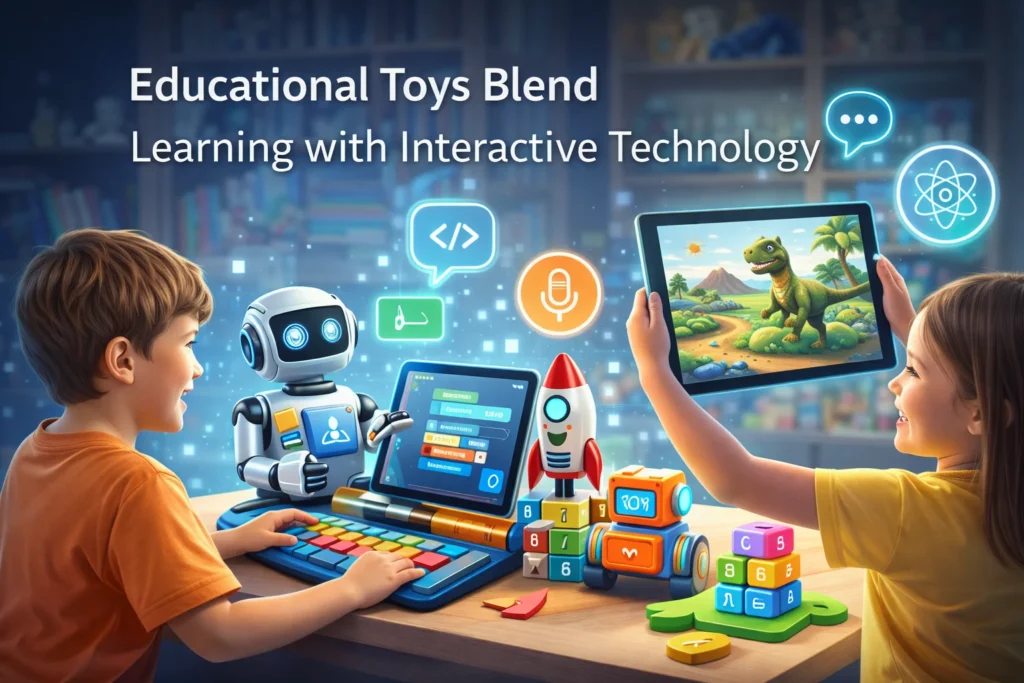
Toys are using this in incredibly creative ways. Imagine you buy a set of dinosaur cards. You lay the card on the kitchen table, point your tablet at it, and suddenly, a 3D T-Rex appears on the screen, walking around on your tabletop. You can walk around the table and see it from all angles. It roars. It moves its head. It looks real. You can see the texture of its skin, the size of its teeth, the way its tail swings as it walks. It’s like having a dinosaur in your kitchen. You can take a video of it and send it to Grandma. You can pretend it’s your pet. The possibilities are endless.
Now, imagine that T-Rex is part of a game. On the card, there might be a math problem. When you solve it correctly, the T-Rex does a little dance or finds a hidden egg. Suddenly, math isn’t a chore. It’s the magic spell you have to cast to make the cool thing happen. The boring stuff (the worksheet) gets wrapped in the exciting stuff (the AR dinosaur). Kids who might normally groan when you pull out the flashcards will fight over who gets to solve the next equation just to see what the dragon does next. The learning becomes the reward, not the obstacle.
This is what educators call “high engagement.” The learning becomes the key to unlocking the fun. It’s not separate from the fun; it’s the way to get more fun. That changes everything about how a child approaches a difficult subject. Instead of avoiding fractions because they’re hard, they’re eager to tackle them because they want to see the next part of the story, the next level of the game, the next animation. The motivation is intrinsic. They want to learn because learning gets them what they want.
I saw a great example of this at a friend’s house. Her son was struggling with multiplication tables. He just couldn’t seem to memorize them, and every practice session ended in tears and frustration. She bought him an AR-based game where you had to solve multiplication problems to build a fantasy kingdom. Solve a problem correctly, and a new building appears in your village. Solve a sequence of problems, and you unlock a new character or a new area to explore. Within a week, he was voluntarily practicing multiplication. He’d come home from school and ask, “Can I work on my kingdom?” He wasn’t thinking about times tables; he was thinking about building a castle. But the times tables were getting memorized anyway. The learning was happening under the radar.
The beauty of AR is that it bridges the gap between the digital world kids love and the physical world they live in. They aren’t just staring at a screen in a vacuum; they are interacting with the space around them, holding physical objects, and working together with siblings or friends to trigger the digital magic. It’s a social experience, not a solitary one. Kids gather around the tablet, point at the screen, argue about what to do next, and celebrate together when they succeed. That social aspect is crucial for learning. Explaining your thinking to someone else, hearing their ideas, negotiating a plan—these are all valuable skills that traditional screen time often misses.
There are AR puzzles now where the pieces come to life when viewed through a device. There are coloring books where your drawn creations become 3D characters that can move and interact. There are science kits where you can see the internal organs of a frog without actually dissecting one. The technology is opening doors to experiences that were impossible just a generation ago. Kids can explore ancient Rome while sitting in their living room. They can watch a volcano erupt on their kitchen table. They can shrink down and explore the inside of a cell. Learning becomes an adventure, not a lesson.
Consider what this means for history class. Instead of reading about the pyramids, a kid can use an AR app to see them rise from the floor, to walk around them, to explore the chambers inside. Instead of memorizing dates, they’re experiencing a place. That kind of immersive learning creates memories that last. It connects facts to emotions, to experiences. And we know that emotional connections make memories stronger. AR isn’t just cool; it’s effective.
Chapter 6: What the Parents and Teachers Are Saying
It’s easy for us to sit here and theorize about how cool this all is. But what about the people in the trenches—the parents trying to limit screen time and the teachers trying to get kids to focus? Surprisingly, a lot of them are on board. They see the potential, and they’re excited about it. They’re also realistic about the challenges, but the overall mood is one of cautious optimism. They’ve seen what works and what doesn’t, and many of them are incorporating these tools into their homes and classrooms.
Many teachers say that the biggest challenge isn’t that kids are distracted; it’s that they get bored easily with passive learning. Sitting and listening to a lecture for an hour is hard for a brain that’s used to being stimulated by fast-paced videos and interactive games. The world has changed, and kids’ brains have adapted to that change. Educational toys flip that script. They make the student an active participant. They put the control in the kid’s hands. When you’re actively engaged, time flies. When you’re just listening, time drags. It’s not that kids have shorter attention spans; it’s that they have different expectations for how information should be delivered. They want to be part of the action, not just spectators.
A middle school science teacher I know uses robotics kits in her classroom. She told me that the kids who struggle most with traditional textbook learning often excel with the robots. The hands-on, problem-solving nature of the work plays to their strengths. They can see the results of their thinking immediately. If the robot moves, they were right. If it doesn’t, they need to rethink. There’s no waiting for a graded paper to come back. The feedback is instant, and that’s incredibly motivating. She said one of her students, who rarely participated in class discussions, became the go-to expert on programming the robots. He found his niche, and that confidence started spilling over into other subjects. He started raising his hand more. He started helping other students. The robot didn’t just teach him coding; it taught him that he was capable.
A parent I talked to recently told me a story about her son, who struggled with reading. He just found it boring. Books felt like a chore. But then they got him a video game that was heavy on story and dialogue. To progress in the game, he had to read the text boxes. He had to understand what the characters were saying to know where to go next. Suddenly, reading wasn’t a school task; it was the key to beating the next level. His reading comprehension shot up because he was motivated. He wanted to read. He needed to read. That’s a completely different mindset than “I have to read this for a book report.” The game didn’t teach him phonics or vocabulary directly, but it gave him a reason to care about reading. And once he cared, the learning took off.
Parents also love that many of these toys encourage a different kind of socializing. Instead of four kids sitting silently side-by-side staring at their own phones, you see them huddled around a robotics kit, arguing about the best way to build a bridge, or taking turns programming a dance routine for their robot. It creates teamwork, negotiation, and communication—skills you can’t get from a multiple-choice test. They’re learning to listen to each other, to compromise, to build on each other’s ideas. Those are life skills that will serve them well no matter what path they choose. They’re learning that other people have good ideas, that working together can produce better results than working alone.
Of course, there are concerns. Parents worry about screen time, data privacy, and whether kids are becoming too dependent on technology to have fun. These are all valid questions. Nobody wants their kid to be unable to entertain themselves without a device. Nobody wants a toy that’s secretly collecting data on their family. These are real issues that need real solutions. But the general vibe among parents and educators I’ve talked to is cautiously optimistic. They see the value. They see the engagement. They see the learning.
The key, parents say, is balance. You still need unstructured time to just run around outside, to build forts from cardboard boxes, to get dirty in the mud, to stare at clouds and imagine shapes. Those experiences are just as important as any coding lesson. But when the screens do come on, it’s nice to know they can be used for something more than just passive watching. It’s nice to know that playtime can also be learning time, and that kids can have fun while building skills that will matter in their future. It’s not about choosing one or the other; it’s about having both.
Teachers echo this sentiment. They see technology as a tool, not a replacement. A good teacher with a smart toy can do amazing things. A bad teacher with a smart toy is still a bad teacher. The toy doesn’t replace the human connection; it enhances it. It gives teachers new ways to reach kids, new ways to explain concepts, new ways to make learning come alive. The best classrooms use a mix of old and new, high-tech and low-tech, depending on what works best for the lesson and the students.
Chapter 7: The Business of Brainy Play
This isn’t just a passing fad. This is big business. Toy companies aren’t making these smart toys just because they’re nice; they’re making them because families are buying them. The market has spoken, and the message is clear: parents want toys that do more than just entertain. They want toys that educate, that prepare their kids for the future, that give them a head start in a competitive world. And they’re willing to pay for it.
Industry analysts, the people whose job it is to predict what we’ll want to buy next, say the market for educational or “STEM” toys is only going to get bigger. STEM stands for Science, Technology, Engineering, and Math. These are the fields that are driving our economy, and they’re only going to become more important. Parents today are more aware than ever that the jobs of the future will require these skills. They want to give their kids a head start, but they don’t want to be the “mean parent” who forces them to do extra homework. Buying a cool robot kit is a way to make learning feel like a treat, not a punishment. It’s a way to invest in your child’s future while also making them happy in the present.
The pandemic also played a huge role in this transformation. When millions of kids were suddenly learning from home, parents got a front-row seat to their education. They saw what worked and what didn’t. They saw their kids struggle with Zoom fatigue and disengagement. They also became desperate for activities that were educational but didn’t require them to be a certified teacher. Parents were trying to work from home while also managing distance learning, and they needed help. Toys that could “teach” while the parent made dinner became incredibly valuable. They were a lifeline in a chaotic time. They provided structure, engagement, and learning without requiring constant parental involvement.
Toy companies are racing to keep up with this demand. They are partnering with tech giants and hiring real educators to help design their products. They know that parents are savvy. You can’t just slap an “educational” sticker on a cheap piece of plastic and expect it to sell anymore. Parents have been burned by that before. They’ve bought toys that promised to teach but delivered only frustration. Today’s parents do their research. They read reviews. They ask other parents. They want proof that the toy actually works. They want to know that their money is well spent.
The learning has to be real, and most importantly, the toy has to be fun. If it’s not fun, a kid will see right through it and toss it in the corner of the closet. A toy that sits unused teaches nothing. So the challenge for manufacturers is to hide the learning inside the fun, to make the education so seamless that kids don’t even realize it’s happening. That’s the holy grail of educational toys, and the companies that figure it out are the ones that succeed. They’re the ones that get the five-star reviews and the word-of-mouth recommendations.
We’re also seeing a shift in how these toys are marketed. It’s not just about selling a product; it’s about selling a vision of the future. Advertisements show kids building robots, coding apps, and exploring virtual worlds. They show confident, capable kids who are creators, not just consumers. They appeal to parents‘ hopes and dreams for their children. And that’s powerful. It taps into something deep—the desire to give our kids every possible advantage, to prepare them for a world we can barely imagine. It’s an emotional appeal as much as a practical one.
The business is also becoming more global. Smart toys are popular in the United States, but they’re also huge in Asia and Europe. Different cultures have different approaches to education, but the desire to give kids a head start is universal. Companies are designing toys that work across cultures, that teach skills that are valued everywhere. The market is expanding rapidly, and it shows no signs of slowing down.
Chapter 8: The Hidden Curriculum: What Kids Are Really Learning
When we talk about educational toys, we usually focus on the obvious stuff—math skills, coding concepts, vocabulary building. And those are important. But there’s a hidden curriculum in these toys, a set of lessons that aren’t written on the box but are just as valuable. These are the skills that kids absorb while they’re focused on the fun stuff, and they might be the most important lessons of all. They’re the kind of learning that doesn’t show up on a test but shows up in life.
Take failure, for example. In school, failure is punished. Get a question wrong, and you lose points. Fail a test, and your grade drops. But with smart toys, failure is just part of the process. The robot doesn’t move the way you wanted? Try again. The program crashes? Debug it. The tower falls? Build it stronger. Failure isn’t the end; it’s just information. It’s feedback that tells you what to try next. Kids who play with these toys learn that failure is normal, that it’s not something to be afraid of, that it’s actually the path to success. That mindset—often called a “growth mindset”—is incredibly valuable in life. It’s the difference between giving up when things get hard and pushing through.
Persistence is another hidden lesson. When you’re working on a challenging puzzle or trying to get a robot to perform a complex sequence, you can’t just give up at the first sign of difficulty. You have to keep trying, keep tweaking, keep experimenting. You learn that hard things are worth doing, that the feeling of finally succeeding after many attempts is better than the feeling of easy success. You build grit. You build resilience. You learn to push through frustration. These are qualities that predict success in school, in careers, in relationships. They’re not easy to teach directly, but they can be learned through experience.
Then there’s creativity. Some people think that technology stifles creativity, but that’s not necessarily true. These toys are tools, and like any tool, they can be used in creative ways. A robotics kit isn’t just about following instructions; it’s about imagining what you could build and then figuring out how to make it real. A programming game isn’t just about solving pre-made puzzles; it’s about creating your own puzzles, your own challenges, your own worlds. The technology provides a platform, and the imagination provides the content. The best users aren’t the ones who follow the instructions best; they’re the ones who think of new things to do.
Collaboration is another big one. When kids work together on these toys, they have to communicate. They have to explain their ideas, listen to others, negotiate, compromise. They learn that two heads are often better than one, that different people bring different strengths to a problem. They learn to give and receive help. These are social skills that will serve them well in school, in work, and in relationships. They’re learning that asking for help isn’t a sign of weakness, and that helping others feels good.
And let’s not forget confidence. There’s something incredibly empowering about making something work. When a kid builds a robot that follows their commands, or codes a game that other people can play, or solves a problem that seemed impossible, they feel a sense of accomplishment. They see themselves as capable, as competent, as someone who can figure things out. That confidence spills over into other areas of life. It makes them more willing to take on challenges, more resilient in the face of difficulty, more likely to believe in themselves. It’s the foundation of a healthy self-image.
There’s also patience. In a world of instant gratification, these toys teach that good things take time. You can’t rush a complex build. You can’t hurry the debugging process. You have to be willing to sit with a problem, to work through it step by step. That patience is a superpower. It’s the ability to delay gratification, to focus on long-term goals, to resist the urge for quick fixes. It’s correlated with all kinds of positive outcomes, from better grades to healthier relationships.
These hidden lessons might be the most important ones of all. The specific coding languages will change. The math facts might be forgotten. But the mindset—the persistence, the creativity, the collaboration, the confidence, the patience—that stays. That’s the foundation for a lifetime of learning. That’s what prepares kids for a world we can’t predict. That’s the real value of these toys.
Chapter 9: The Digital Divide and Access Issues
As amazing as all this technology is, we have to talk about a uncomfortable truth: not everyone has access to it. Smart toys are expensive. They require tablets or phones to work. They need reliable internet connections. They assume a certain level of technological literacy from parents. All of this creates a digital divide that leaves some kids behind.
The cost is the first barrier. A basic robotics kit can cost fifty dollars. A more advanced one can run into the hundreds. Add in the cost of a tablet if the family doesn’t already have one, and you’re talking about a significant investment. For families living paycheck to paycheck, that’s simply not possible. They’re focused on putting food on the table and keeping a roof over their heads. A smart toy is a luxury they can’t afford.
Then there’s the issue of internet access. Many of these toys require downloads, updates, and online features. If you live in a rural area with spotty internet, or if you can’t afford high-speed service, the toy might not work properly. It might be frustrating rather than fun. It might become just another piece of plastic that doesn’t do what it’s supposed to do.
There’s also the knowledge gap. Parents who aren’t comfortable with technology might struggle to help their kids set up and use these toys. They might not understand the value, or they might be intimidated by the complexity. The toy ends up sitting in the box because no one knows how to make it work. That’s a waste of money and a missed opportunity.
Schools try to bridge this gap by providing technology in the classroom, but resources are limited. Some schools have amazing STEM programs with all the latest gadgets. Others are struggling to afford basic supplies. The gap between well-funded and under-funded schools is growing, and smart toys are part of that inequality. Kids in wealthy districts get exposure to robotics and coding. Kids in poor districts might never touch a programmable robot.
This matters because early exposure shapes future opportunities. Kids who grow up with these toys are more likely to pursue STEM fields. They’re more comfortable with technology. They have a head start that’s hard to overcome. The digital divide isn’t just about who has a tablet; it’s about who has access to the future.
Some organizations are working to address this. Libraries are starting to lend out robotics kits. Nonprofits are running after-school programs in underserved communities. Toy companies are exploring lower-cost options. But it’s an uphill battle. The gap is real, and it’s growing.
As we celebrate the amazing potential of smart toys, we have to keep this in mind. Not every kid has a robot under the Christmas tree. Not every family can afford the latest gadgets. If we want to give all kids the benefits of these technologies, we have to think about access. We have to find ways to level the playing field. Otherwise, we’re just making the rich richer and the poor poorer, in terms of skills and opportunities.
Chapter 10: Finding the Sweet Spot: Tips for Parents and Teens
With all this amazing tech flying off the shelves, how do you, as a parent or a teen looking for a cool gift, sort through the noise? How do you find a toy that’s genuinely educational and not just a gimmick? How do you make sure you’re getting value for your money and not just another piece of plastic that will end up in the back of a closet? Here are some thoughts from someone who’s spent way too much time wandering the toy aisles and reading the reviews.
First, follow the child’s interest. This is the golden rule of educational toys. If your kid loves art, don’t buy them a chemistry set just because it’s “educational.” They’ll resent it, and it’ll sit unused. Instead, look for a digital drawing tablet or an interactive storybook creator. If they love music, look for toys that let them compose and experiment with sound. If they love sports, look for smart balls or activity trackers that gamify physical activity. The learning will happen naturally if they are engaged in the topic. Interest is the engine of learning. Without it, even the best toy is just a chore.
Second, look for the “open-ended” stuff. The best toys are the ones that don’t have just one right answer. A box of magnetic tiles can become a castle, a rocket ship, or a maze for a marble. A coding robot can be programmed to dance, draw, or deliver a secret message. An AR kit can be used to tell stories, create art, or explore imaginary worlds. Toys that let kids create and explore are always better than toys that just ask them to repeat a task. Open-ended toys grow with the child. They can be used in different ways at different ages. They encourage creativity and problem-solving. They’re an investment that pays off over years.
Third, read the reviews. Don’t just look at the star rating; read what people are actually saying. Look for reviews from parents whose kids are similar to yours in age and interests. Pay attention to comments about durability, battery life, and ease of use. A toy can have great educational potential, but if it’s frustrating to use or breaks easily, it’s not going to help anyone. Also look for reviews that mention how kids actually play with the toy. Do they come back to it again and again, or does it lose its appeal after a few days? Long-term engagement is a good sign.
Fourth, play along with them. You don’t have to be an expert. You don’t have to know anything about coding or robotics. Just sit down and show curiosity. Ask them, “How did you get the robot to do that?” or “What happens if we press this button?” or “Can you show me how that works?” By showing interest, you validate their play and encourage them to think about why things work. You also get to spend quality time together, which is valuable in itself. And you might learn something new. Kids love being the expert, love teaching adults. It builds their confidence and deepens their own understanding.
Fifth, consider the screen time question. Many of these toys require a tablet or phone to work. That’s fine, but it’s worth thinking about how that fits into your family’s overall screen time habits. Some toys are designed for short, focused sessions. Others can suck a kid in for hours. Think about what works for your family. Maybe you set time limits. Maybe you use the toys as a reward. Maybe you designate certain times of day for tech-based play. The key is to be intentional, not just to hand over the tablet and walk away.
Sixth, don’t forget the classics. A cardboard box is still one of the best toys ever invented. A deck of cards, a ball, a pile of dirt—these things are timeless for a reason. Smart toys are a fantastic tool in the toolbox, but they aren’t the whole toolbox. The goal isn’t to digitize every second of play, but to enhance it. The best play diet is a mix of old and new, high-tech and no-tech, structured and unstructured. Variety keeps things interesting and develops different kinds of skills.
Seventh, think about longevity. Will this toy still be interesting in six months? Will it grow with your child, or is it something they’ll outgrow quickly? Some toys have multiple levels of difficulty, or they connect to apps that add new content over time. Those are worth considering. Others are one-trick ponies that will lose their appeal quickly. Read the fine print. Look for toys that offer depth and variety.
Eighth, consider the social aspect. Does the toy encourage solo play, or can it be used with friends and siblings? Some of the best learning happens socially, when kids are working together, arguing, negotiating, and celebrating. Toys that facilitate that kind of interaction are gold. They’re not just teaching skills; they’re teaching relationship skills.
Finally, trust your gut. You know your child better than anyone. If a toy looks like it would engage them and make them think, it probably will. If it looks like junk, it probably is. Don’t get caught up in the hype. Don’t feel pressured to buy the latest thing just because it’s trending. The best toy is the one that your child actually wants to play with, the one that sparks their curiosity and makes them ask questions. That’s the magic. That’s what matters.
Chapter 11: The Future Playground: What’s Next?
So, what does the future hold? If this is what toys look like now, what will they look like in five or ten years? It’s exciting to think about, and a little bit mind-bending. The pace of technological change is so fast that it’s hard to predict exactly what’s coming, but we can see some trends that are likely to shape the next generation of smart toys.
Get ready for more personalization. Imagine a toy that adapts to your specific child. If your daughter is great at puzzles but struggles with numbers, the toy will notice. It might start giving her slightly harder puzzles to keep challenging her, while offering her more creative, game-like ways to practice math. It will be like having a personal tutor that knows your child’s exact strengths and weaknesses, their learning style, their interests, their pace. It will adjust in real-time, providing just the right level of challenge to keep them in that sweet spot between boredom and frustration.
This kind of adaptive learning is already happening in educational software, but bringing it to physical toys is the next frontier. Imagine a board game that changes its rules based on who’s playing, ensuring that everyone at the table is challenged appropriately. Imagine a building set that suggests new projects based on what you’ve built before, gradually introducing more complex concepts as your skills grow. The toy becomes a partner in your child’s development, growing with them over years. It’s not just a toy; it’s a personalized learning system.
We’ll also see more toys that encourage outdoor activity. Drones that you can program to follow an obstacle course you set up in the backyard. AR scavenger hunts that send kids running around the neighborhood looking for virtual clues hidden in real locations. Smart balls that track how you throw and give feedback on your technique. The goal is to pull them away from the couch and get them moving, even while they’re using tech. It’s the best of both worlds—the engagement of technology combined with the physical benefits of active play. It’s a response to the concern that kids are spending too much time indoors staring at screens.
Another big trend is sustainability. Kids today are very aware of the planet. They learn about recycling and climate change in school. They see the news about plastic pollution in the oceans. They care about the environment, and they expect the companies they buy from to care too. Toy companies are starting to respond by making smart toys out of recycled plastics and finding ways to make them more energy-efficient, or even solar-powered. Imagine a robotic kit that comes in packaging made from mushrooms, or a smart doll whose clothes are made from recycled bottles. The materials matter, and kids are paying attention.
The toys themselves will also get smarter about when to turn off. One of the biggest complaints from parents is the battery drain. These smart toys eat batteries like candy, and it’s frustrating to go to use a toy only to find it dead. Future toys might have better sensors to know when they’re not being played with and automatically go into a deep sleep mode to save power. They might have more efficient processors that do more with less energy. They might even harvest energy from motion or light, reducing or eliminating the need for batteries altogether.
We might also see toys that connect with each other in interesting ways. Imagine a world where your child’s smartwatch talks to their robotic dog, and together they create games and challenges. The watch might track how much your child has moved during the day, and the dog might respond by being more energetic and playful. Or the toys might share data to create a more complete picture of your child’s development, helping parents understand their strengths and areas where they might need extra support. It’s like a whole ecosystem of play.
And of course, artificial intelligence will continue to get smarter. The conversations kids have with their toys will become more natural, more nuanced, more helpful. The toys will remember past interactions and build on them. They’ll develop personalities that are unique to each child’s interactions. They’ll become more like companions and less like gadgets. It’s a little bit like something out of a movie, but it’s coming faster than we think.
There’s also the potential for more integration with school curricula. Imagine toys that align with what kids are learning in class, that reinforce concepts and provide extra practice in a fun way. Parents could buy toys that complement the school’s approach, that use the same vocabulary and methods. That would make the connection between play and learning even stronger.
Chapter 12: When Things Go Wrong: The Challenges and Criticisms
It wouldn’t be fair to talk about smart toys without acknowledging the challenges and criticisms. As amazing as this technology is, it’s not without problems. Parents, educators, and researchers have raised valid concerns, and it’s important to look at both sides of the story.
The biggest concern is screen time. Kids are already spending hours a day staring at screens for school and entertainment. Adding more screen-based play can tip the balance into unhealthy territory. Too much screen time is linked to sleep problems, obesity, and social difficulties. Even when the screen time is “educational,” it’s still screen time. Parents have to be mindful of the total, and smart toys can make that harder to manage.
Then there’s the issue of data privacy. Many of these toys collect data on children—their voices, their preferences, their progress. That data is valuable, and not all companies are careful with it. There have been high-profile cases of smart toys being hacked or leaking data. Parents have to worry about who has access to their child’s information and what they’re doing with it. It’s a legitimate concern, and it requires companies to be transparent and responsible.
There’s also the question of whether these toys actually deliver on their promises. The educational value of some toys is questionable. They might be fun, but are they really teaching anything? Or are they just flashy distractions? It’s hard to know without long-term studies, and those studies are just starting to come out. Some toys are genuinely educational; others are just marketing hype. Parents have to be discerning.
Another criticism is that these toys can discourage unstructured, imaginative play. When a toy tells you what to do, when it has goals and rewards built in, it can crowd out the kind of free-form play where kids make up their own rules and stories. That kind of play is important for creativity and social development. If kids spend all their playtime following the toy’s agenda, they might miss out on the benefits of making up their own.
There’s also the concern about consumerism. These toys are expensive, and they’re often designed to be replaced. New models come out every year. Apps stop being supported. Batteries die. The toys become obsolete quickly, contributing to electronic waste. It’s a cycle of buying and discarding that’s hard on the wallet and hard on the planet.
Some critics also worry that these toys are creating a generation of kids who can’t entertain themselves. If you’re used to a toy that provides constant stimulation and feedback, a simple stick or a cardboard box might seem boring. The ability to be bored, to sit with your own thoughts, to create something from nothing—these are valuable skills that might be atrophying.
Finally, there’s the question of equity. As we discussed earlier, not everyone has access to these toys. The kids who benefit most are often the ones who already have advantages. This can widen the achievement gap, leaving disadvantaged kids even further behind. It’s a societal problem that individual families can’t solve on their own.
None of these criticisms mean that smart toys are bad. They just mean that we have to be thoughtful about how we use them. We have to balance the benefits with the risks. We have to choose wisely. We have to stay informed. And we have to remember that no toy, no matter how smart, can replace the basics: love, attention, and time with caring adults.
Chapter 13: Real Stories from Real Families
To bring this all down to earth, let’s look at some real stories from families who’ve incorporated smart toys into their lives. These aren’t experts or influencers; they’re just regular people figuring it out as they go. Their experiences show the range of what’s possible, both good and bad.
The Martinez family has three kids ages 6, 9, and 12. They bought a coding robot for the youngest, thinking it would be a fun way to introduce programming. The older kids got interested too, and now they all work on it together. The mom says, “It’s the only thing that gets them all in the same room without fighting. They’re actually cooperating, helping each other, celebrating when something works. It’s been great for their relationship.” The robot became a family activity, not just a toy.
The Johnsons had a different experience. They bought an expensive AR kit for their 8-year-old, who loved dinosaurs. The setup was complicated. The app kept crashing. The internet connection wasn’t strong enough in their living room. After a week of frustration, the kit ended up in the closet. The dad says, “It was a good idea, but the execution was terrible. We spent more time troubleshooting than playing. It was a waste of money.” The lesson: good technology matters. A great concept with bad implementation is still a bad product.
The Washingtons have a 10-year-old with dyslexia. Reading has always been a struggle. They got her a story-based video game where you have to read dialogue to progress. She was motivated to read because she wanted to know what happened next. Her mom says, “She’s reading more than she ever has. The game doesn’t feel like school, so she doesn’t resist it. Her reading skills have improved, and more importantly, her attitude about reading has changed.” The game didn’t cure the dyslexia, but it gave her a reason to practice.
The Chens bought a smart globe for their 7-year-old. He loves pressing the countries and hearing facts. He’s memorized capitals and flags and loves showing off his knowledge. But his mom worries that he’s spending too much time with it. “He’d play with it all day if we let him. We have to set limits. It’s hard because it’s educational, but still, it’s screen time.” The balance question is real, even when the content is good.
The Thompsons have a teenager who’s really into robotics. They’ve invested in several kits over the years, and he’s now building his own projects from scratch. He’s talking about studying engineering in college. His dad says, “It started with a simple robot when he was 8. He just loved making things move. We fed that interest, and it’s become a real passion. I don’t know if he would have found that without the toys.” For this family, the toys were a gateway to a potential career.
These stories show the variety of experiences. For some families, smart toys are a huge success. For others, they’re a disappointment. The difference often comes down to fit—finding the right toy for the right child, and having realistic expectations about what it can do.
Chapter 14: More Than Just a Toy
At the end of the day, whether it’s a simple wooden block or a voice-activated robot, a toy is just a tool for imagination. It’s a prop in the stories kids tell themselves about who they are and who they might become. The best ones don’t tell kids what to think; they give them the tools to think for themselves. They open doors instead of closing them. They ask questions instead of just giving answers.
The new wave of educational technology isn’t about raising a generation of robot children who are glued to screens. That’s a fear, not a reality. It’s about meeting kids where they are. Kids are naturally curious. They love to solve problems. They love stories. And they love technology. It’s woven into the fabric of their lives in a way that it wasn’t for previous generations. They don’t see a clear line between “digital” and “real” because for them, the digital is real. It’s part of their world.
By blending these things together, toy manufacturers have created something special. They’ve created a bridge between the digital world kids are growing up in and the core skills they need to succeed. They’ve made learning feel less like a lecture and more like an adventure. They’ve turned the living room into a laboratory, the backyard into a coding playground, the kitchen table into a portal to ancient worlds.
Think about what that means for a kid growing up today. They can learn about dinosaurs not just by reading about them in a book, but by seeing them walk around their room. They can learn about coding not just by staring at a screen, but by building a robot that responds to their commands. They can learn about language not just by memorizing vocabulary lists, but by having conversations with a toy that speaks back. The possibilities are expanding every day.
So, the next time you see a kid “wasting time” programming a robot or solving an AR puzzle to save a virtual kingdom, take a closer look. Don’t just see a kid staring at a screen. See a kid engaged in complex problem-solving. See a kid persisting through frustration. See a kid collaborating with friends. See a kid building confidence with every success. See a kid learning, even if they don’t know it.
You might just be watching the future unfold, one line of code, one block, and one happy accident at a time. The toy box isn’t just for fun anymore. It’s a launchpad. It’s a classroom without walls. It’s a gateway to possibilities that we couldn’t have imagined when we were kids. And that’s pretty amazing.
The world is changing fast, and the way kids play is changing with it. But some things remain the same. Kids still need to explore, to create, to imagine, to fail and try again. They still need to be challenged and supported, to feel competent and capable. They still need to play. Smart toys are just a new way to meet those timeless needs. They’re not a replacement for the old ways, but an addition, an enhancement, a new set of tools for the oldest human activity of all: learning through play.
And really, isn’t that what we all want? For our kids to learn, to grow, to be prepared for whatever comes next? If a robot or an AR dinosaur can help with that, then maybe the future of play is brighter than we ever imagined. Maybe the toy aisle isn’t just about stuff anymore. Maybe it’s about potential. And that’s a beautiful thing.
The key is to remember that the toy is just a tool. The magic doesn’t come from the circuits or the software. It comes from the child using them. It comes from the curiosity, the persistence, the creativity that the toy helps unlock. The best smart toys don’t replace the child’s imagination; they amplify it. They give it new places to go, new things to do. They’re partners in the endless project of growing up.
So here’s to the future of play. Here’s to the robots and the AR dinosaurs, the coding mice and the talking teddy bears. Here’s to the parents trying to figure it all out, and the kids who just want to have fun. Here’s to learning that doesn’t feel like learning, to lessons hidden in laughter, to skills built through play. The world is changing, but the heart of childhood remains the same. And that’s something worth celebrating.