
For sixteen-year-old Mia, the summer of 2023 was supposed to look like every other summer: sleeping until noon, arguing with her little brother about who finished the milk, and spending way too many hours staring at a glowing screen while leveling up her character in a fantasy world. Her parents had grown used to the sound of rapid keyboard clicks and late-night Discord calls echoing through the house. It was, they assumed, just what teenagers did.
But one afternoon, bored and doom-scrolling through short videos while lying on her bed, Mia stopped on a clip that changed the trajectory of her summer—and perhaps her life. It wasn’t a new video game trailer, a dance challenge, or a celebrity gossip update. It was a first-person point-of-view video of a paraglider launching off a mountain in the Swiss Alps.
The video lasted only thirty seconds. In that time, the camera showed the paraglider’s feet leave the grassy cliff, the sudden rush of wind that whipped the camera lens, and then a breathtaking, almost holy silence as the mountains shrank into tiny green bumps below. The only sound was the occasional flutter of the fabric wing and the pilot’s steady, calm breathing. For Mia, it was a spark—the kind that doesn’t just light a fire but starts a slow, steady burn. “I just thought, I have to know what that feels like,” she says, sitting in her bedroom months later, a secondhand paragliding harness now hanging from her closet door. “Not watching it—feeling it. The air, the cold, the quiet. I realized I had never felt anything that real in my entire life.”
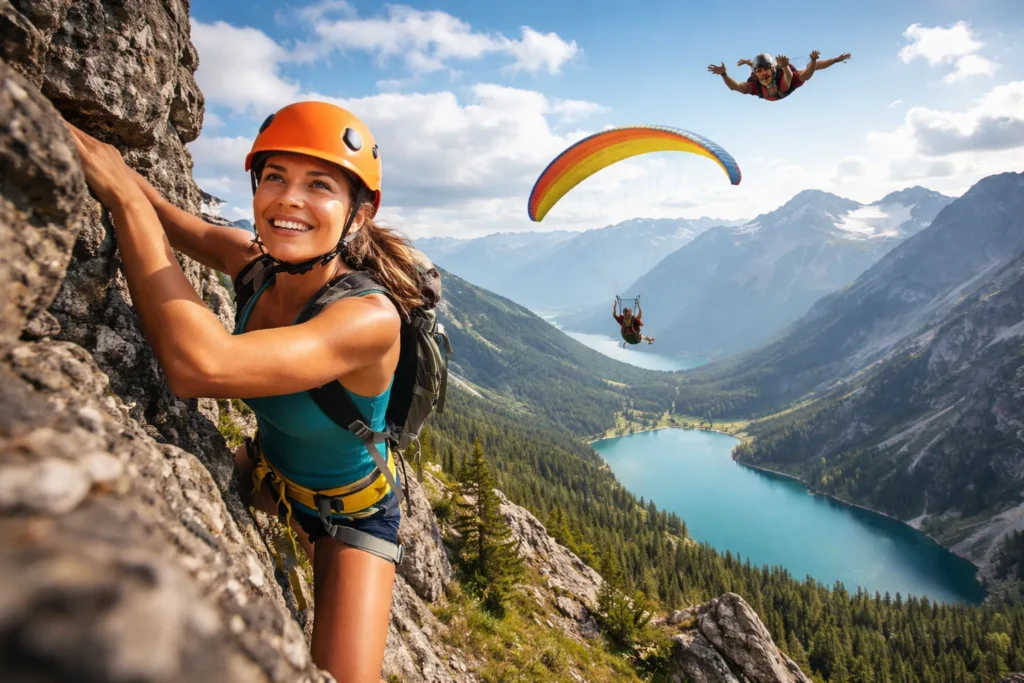
Mia’s story is not unique. In fact, it is becoming the defining narrative of a generation. Across the globe, a massive cultural and physical shift is taking place. The generation that grew up with the internet at their fingertips—the so-called digital natives—are now looking away from their screens to seek something tangible, physical, and often, a little bit terrifying. Rock climbing, paragliding, skydiving, white-water kayaking, big-wave surfing, and mountain biking are no longer niche hobbies reserved for the eccentric or the wealthy. They are becoming the new mainstream passions for millions of young people between the ages of fourteen and thirty.
This isn’t just a trend with an expiration date; it is a profound cultural movement. And to truly understand why, we have to dig deep into the perfect storm of factors driving it: the immersive power of social media, the quiet revolution in safety technology, the shifting psychology of a generation navigating anxiety and uncertainty, the changing economics of adventure, and a deep, almost primal human need to feel alive in a world that often feels overwhelmingly digital, curated, and artificial.
The Scroll That Changes Everything: How Social Media Became the Launchpad
Let’s return to Mia for a moment. How did she even encounter that paragliding video? The algorithm, that invisible architect of modern desire, knew her. It knew she had liked a few hiking videos. It knew she had searched for travel vlogs. But the true magic of modern social media platforms—TikTok, Instagram Reels, YouTube Shorts, and even the resurgence of long-form YouTube documentaries—is their ability to compress the most intense human experiences into digestible, addictive, and deeply aspirational snippets.
In the past, if a teenager wanted to see what rock climbing was like, their options were limited. They might have found a grainy photograph in a National Geographic magazine from 1995, or perhaps a short, poorly lit segment on a local evening news channel about a climbing competition. The experience felt distant, abstract, and inaccessible. It seemed like something reserved for professional athletes with sponsorships, trust funds, and bodies sculpted by years of specialized training.
Today, the content is radically different. It is immersive, intimate, and democratized. It’s the POV (point-of-view) footage that makes your palms sweat as a climber looks down between their feet at a thousand-foot drop. It’s the raw, unedited video of a seventeen-year-old from Ohio showing you, step by step, how she saved up her tips from waiting tables to buy her first climbing harness, how she learned to tie a figure-eight knot, and how she drove three hours with two friends to climb her first real cliff. The camera shakes, she laughs nervously, she falls, she gets back up, and she eventually reaches the top. The video ends not with a professional photoshoot but with a high-five and a shared granola bar.
Normalizing the Extreme
These platforms have done something incredible: they have normalized the extreme. When you see someone your age, with your body type, your socioeconomic background, your fears, and your level of experience successfully completing a skydive, scaling a rock face, or catching a wave that looks like a building, it stops looking like a superhuman feat. It starts looking like a fun Saturday. The psychological distance between “them” and “you” collapses.
Social media has also given rise to a new kind of influencer: the “everyday adventurer.” Unlike the glossy, airbrushed influencers of the early 2010s, these creators often emphasize the gritty, unglamorous side of adventure. They show the dirt under their fingernails, the bruises on their shins from failed climbing attempts, the cold nights spent sleeping in a van, and the expensive gear that broke at the worst possible moment. This authenticity builds trust. Followers don’t just admire these creators; they see them as friends, mentors, and proof that the adventure life is attainable.
The Algorithm of Courage
Social media algorithms are engineered to reward high engagement. Nothing generates higher engagement than a video of a human being overcoming fear. The formula is almost scientific: a shaky hand reaching for a hold on an overhanging cliff face, a nervous laugh before a runner launches off a 150-foot waterfall in a kayak, a quiet moment of hesitation before the green light signals a skydiver to roll out of the plane. These moments are suspenseful, relatable, and emotionally charged. The platforms push this content aggressively because it makes people stop scrolling, watch the entire video, and—most importantly—flood the comments section with reactions.
These comment sections have become something unexpected: digital mentorship zones. A beginner can ask, “What kind of rope should I buy for my first outdoor climb?” and receive a detailed, thoughtful answer from a seasoned climber in Squamish, British Columbia, within minutes. A teenager in Nebraska can ask, “How do I find a paragliding school near me?” and get recommendations from pilots across the country. The digital world, which was once blamed for keeping kids indoors and isolated, has paradoxically become the very map that guides them outdoors and into vibrant, supportive communities.
From Fear to Fun: The Safety Revolution That Opened the Doors
If you ask an average adult why they never tried skydiving or rock climbing, the most common answer is a simple one: “It’s too dangerous. I’d probably die.” This perception, deeply ingrained over decades, is the single biggest barrier that the adventure sports industry has had to overcome. And for the younger generation, this perception is changing rapidly—not because young people are inherently more reckless, but because the reality of these sports has changed.
The truth is that extreme sports today are safer than they have ever been in human history. The industry has undergone a quiet, continuous revolution in materials science, equipment design, and training pedagogy. What was once a genuine “death wish” for the ill-prepared has been transformed into a calculated, manageable, and statistically very safe form of recreation.
The Engineering of Trust
Take rock climbing as a prime example. Twenty or thirty years ago, the gear was heavy, cumbersome, and less forgiving. A climbing rope from the 1980s had a fraction of the “dynamic” stretch that modern ropes have. Today, a modern climbing rope is a marvel of engineering. It is lightweight, often weighing less than a gallon of milk for a full 60-meter length. It is “dynamic,” meaning it is designed to stretch slightly under a fall, absorbing the kinetic energy and reducing the force transferred to the climber, the belayer, and the anchors. This stretch is what turns a potentially bone-jarring, gear-ripping fall into a soft, gentle catch.
Climbing shoes have undergone a similar transformation. Once stiff, uncomfortable leather boots that offered little sensitivity, they are now high-friction, slipper-like tools crafted from synthetic materials that allow a climber to stand on edges smaller than a stack of coins. The rubber compounds used in modern climbing shoes are formulated to grip the rock like a gecko’s foot, turning surfaces that were once considered unclimbable into viable routes.
The Computer in Your Parachute
In skydiving, the safety advancements are even more dramatic and technologically sophisticated. The Automatic Activation Device, or AAD, is a small, computer-controlled device that sits inside a skydiver’s parachute container. This device constantly monitors altitude and descent rate. If a skydiver is falling too fast and is too close to the ground without having deployed their main parachute—whether due to a medical emergency, a loss of consciousness, or simple panic—the AAD automatically fires a small pyrotechnic cutter that deploys the reserve parachute. This device is a non-negotiable safety net, and its widespread adoption has reduced fatality rates in skydiving to an all-time low, making the sport statistically safer than driving a car on a cross-country road trip.
For paragliding, advancements in “wing” design and materials have been transformative. Modern paragliders are constructed from advanced fabrics that are lighter, stronger, and more resistant to tearing. The aerodynamic design of the wings has evolved to be far more stable and resistant to collapses than the “death traps” of the 1980s and 1990s. Modern beginner wings, known as “A” or “school” wings, are designed with passive safety in mind. They are inherently stable, meaning that if a pilot releases the brakes, the wing will naturally return to stable flight without any input. This allows beginners to fly with a level of security that the pioneers of the sport could only dream of.
The Professionalization of Training
It’s not just the gear that has improved; it’s the teaching. The old days of a grizzled adventurer handing you a harness and saying, “Don’t look down, kid,” are long gone. Today, extreme sports are taught through structured, professionalized programs that borrow pedagogical methods from aviation and emergency medicine.
Indoor climbing gyms are the most visible example of this professionalization. These facilities have exploded in number and sophistication over the past decade. They offer a completely controlled environment where a twelve-year-old can learn to belay—to manage the rope for a climbing partner—without any risk of bad weather, loose rock, or falling debris. The walls are color-coded by difficulty, the routes are set by professionals who understand human biomechanics, and the flooring is thick, padded, and designed to absorb falls. It’s a training ground that builds muscle memory, technique, and, most importantly, confidence before a climber ever steps onto real rock.
Tandem skydiving has similarly revolutionized access to the sport. Almost no one makes their first skydive alone. In a tandem jump, the student is strapped to a certified instructor who has made thousands of jumps. The student wears a harness that is attached to the instructor’s harness, forming a single unit. The instructor is responsible for the exit, the freefall, the deployment, and the landing. The student’s only job is to relax, enjoy the view, and, if they wish, practice the arch position. This model allows anyone—from a ninety-year-old grandmother to a teenager with a fear of heights—to experience the sensation of freefall without any of the responsibility or risk associated with solo skydiving.
Simulators have also played a crucial role. Indoor skydiving wind tunnels allow people to practice freefall body position and stability without ever leaving the ground. These vertical wind tunnels generate a column of air moving at over 100 miles per hour, enough to float a human body. A person can walk in with zero experience and, within a few minutes, be flying stable in the air. Similarly, artificial wave pools and surf simulators are creating a new generation of surfers who learn the fundamentals of wave riding in a controlled, predictable environment. These technologies act as “gateway drugs,” lowering the barrier to entry, eliminating the scariest parts of the learning curve, and proving to beginners that they are capable of doing these things.
The Psychology of the Leap: Why We Crave the Thrill
There is a deeper reason why these sports are so addictive to the younger generation, and it goes beyond wanting a cool Instagram photo or a story to tell at parties. It is rooted in brain chemistry, evolutionary psychology, and the unique pressures of modern life.
When a person engages in an activity that involves perceived risk—standing at the edge of a sheer cliff, jumping out of an airplane, paddling into a large wave—their brain initiates a cascade of neurochemical reactions. First comes the adrenaline, also known as epinephrine. This is the “fight or flight” hormone, released by the adrenal glands in response to stress. It sharpens the senses, dilates the pupils, increases heart rate, and diverts blood flow to large muscle groups. In that moment, the world becomes hyper-real. Colors are brighter, sounds are clearer, and time seems to slow down.
Then, once the risky moment has passed and the person is safe, the brain releases a powerful cocktail of reward chemicals. Dopamine, the “feel-good” neurotransmitter associated with pleasure, motivation, and reward, floods the system. Simultaneously, the brain releases endorphins, which are natural opioids that act as powerful painkillers and create a sense of euphoria. This combination creates a natural high that is not only intensely pleasurable but also deeply reinforcing. The brain learns, on a chemical level, that facing fear and surviving is a rewarding experience.
A Chemical Reset for an Anxious Generation
For a generation that often reports record-high levels of anxiety, depression, and chronic stress, this neurochemical reset is incredibly powerful. The constant, low-grade stress of modern life—the endless notifications, the academic pressure, the economic uncertainty, the climate anxiety—creates a persistent background hum of cortisol, the stress hormone. This chronic cortisol elevation is physically and mentally draining.
Extreme sports offer a radical alternative. They replace that constant, low-grade stress with a sharp, acute, and manageable spike of stress that has a clear beginning and a clear end. The fear is intense, but it is temporary. And the reward—the dopamine and endorphin flood—is immediate and profound. It’s like hitting a reset button on the brain’s stress-response system. After a day of climbing or a skydive, the world feels quieter, the anxieties that seemed overwhelming in the morning feel smaller, and the body feels a deep, satisfying exhaustion.
Overcoming the Lizard Brain
There is also a profound psychological benefit to facing fear directly. Sports psychologist Dr. Elena Vance, who works with young adventure athletes, explains it in simple terms: “When a young person successfully does something that their ‘lizard brain’—the primitive, survival-focused part of the brain—screamed at them not to do, it creates a massive and permanent shift in self-perception. They stop seeing themselves as someone who is controlled by fear. They start seeing themselves as someone who can handle fear, who can coexist with it, and who can even use it as a tool.”
This builds what psychologists call “self-efficacy”—the belief in one’s own ability to succeed in specific situations. This belief is not abstract; it is forged in the crucible of real experience. If you can take a twenty-foot “whip” fall on a climbing rope, shake out your hands, and get back on the wall to finish the route, the stress of a high school exam, a college application, or a difficult conversation with a friend seems more manageable. You have proven to yourself, in a visceral and undeniable way, that you are tough, capable, and able to perform under pressure. You have learned that fear is not a stop sign; it is merely a signal that something important is happening.
Breaking the Bank: How Young People Afford the Adventure
One of the most persistent and legitimate questions surrounding this trend is the financial aspect. Let’s be honest: a high-quality paragliding wing can cost as much as a used sedan. A full skydiving license course can run upwards of $3,000. A complete rock climbing rack for traditional (trad) climbing—including cams, nuts, slings, and carabiners—can easily exceed $2,000. Given that many participants are teenagers working part-time jobs, college students with limited budgets, or young adults just starting their careers, how are they affording to participate?
The answer lies in a fundamental shift in priorities, the rise of a robust circular economy for gear, and the creative financial strategies of a generation that values experiences over assets.
The Sharing Economy Meets the Great Outdoors
Unlike a new smartphone, which loses a significant portion of its value the moment you unbox it, high-quality outdoor gear holds its value remarkably well. This has given rise to a massive, vibrant, and well-organized market for used equipment. Facebook Marketplace is a treasure trove of barely-used climbing gear, often sold by people who bought it with enthusiasm, used it twice, and then let it gather dust in a garage. Specialized gear trade forums like Mountain Project, gear swap subreddits, and local “swap meets” organized by climbing gyms and paddling clubs allow beginners to buy high-end gear for a fraction of its original retail price.
Furthermore, the rental market for adventure sports is more sophisticated than ever. You don’t need to own a paraglider to learn to fly; you rent the school’s gear as part of your course tuition. You don’t need to buy a $700 rack of cams to go outdoor climbing for the first time; you can rent a complete “rack pack” from a guide service or a local gear shop for $30 a day. This rental model allows participants to spread out the cost of the sport over time, investing in their own gear piece by piece only after they have determined that it is a long-term passion, not a fleeting interest.
Prioritizing Experiences Over Things
There is a well-documented cultural shift in how young people choose to spend their disposable income. Many are actively choosing to spend their money on experiences—travel, lessons, gear—rather than on material goods. This is sometimes called the “experience economy.” Instead of buying the latest gaming console, a new car, or designer sneakers, they are saving up for a paragliding course in the Alps, a climbing trip to Yosemite National Park, or a season pass to a local white-water park.
Mia, our paragliding enthusiast, is a perfect example. She worked for six months at a local coffee shop, waking up at 4:30 AM to open the store. She put half of every paycheck into a savings account she labeled “Fly Fund” in her banking app. “I had friends who thought I was crazy,” she recalls. “They were buying new clothes every week, getting the new iPhone, going out to expensive dinners. And I was just… saving. I didn’t go to the movies, I packed my lunch every day. But when I posted my first solo flight video on Instagram, all those same friends messaged me. They said, ‘Okay, I get it now.’ They understood why I saved.”
The Gig Economy and Seasonal Work
Another financial strategy is the embrace of seasonal, location-flexible work. A significant number of young adventure athletes work as ski instructors in the winter, river guides in the summer, and wildland firefighters or tree planters in the shoulder seasons. These jobs often provide housing, meals, and a built-in community of like-minded adventurers. The pay is often modest, but the lifestyle allows for maximum time spent outdoors. Others leverage the gig economy, working as freelance graphic designers, web developers, or writers remotely from a van or a shared house in a mountain town. The goal is not to accumulate wealth but to accumulate experiences and skills.
The Titans of the Sky and Stone: A Deep Dive into the Main Sports
While there are dozens of adventure sports gaining traction among young people, a few stand out as the primary drivers of the movement. Each offers a unique blend of physical challenge, mental focus, community, and access to nature.
Rock Climbing: The Vertical Puzzle
Rock climbing has, without question, become the undisputed king of the new extreme sports movement. Its growth has been explosive, driven by the proliferation of indoor climbing gyms, its inclusion in the Olympics, and its unique appeal as a sport that combines strength, flexibility, problem-solving, and social interaction.
Indoor climbing gyms are the primary engines of this growth. They have evolved from dingy, niche warehouses into sprawling, brightly lit, architecturally impressive facilities. They are social hubs. You go with a friend, or you go alone and almost inevitably find a “belaytionship”—a climbing partnership based on mutual trust. The sport is built on trust in a way that few others are. You literally hold your partner’s life in your hands with the rope. If you belay for someone, you are responsible for catching them if they fall. This creates deep, fast friendships. You trust someone with your life after knowing them for an hour.
There are several distinct disciplines within climbing, each with its own culture, equipment, and challenges.
Bouldering is climbing short, challenging walls—typically about 15 feet high—without a rope. Protection is provided by thick, padded crash pads placed on the floor. Bouldering is the most social form of climbing. Groups gather around a “problem” (the sequence of moves) and work on it together, sharing beta (advice on how to do the moves), cheering each other on, and celebrating when someone finally sticks the final hold. It requires explosive power, finger strength, and a high tolerance for falling.
Top-roping is the most common form for beginners. The rope is anchored at the top of the wall, and the climber is belayed from the ground. If the climber falls, they only fall a short distance. This format allows climbers to focus on technique and endurance without the added mental pressure of lead climbing.
Lead climbing is the more advanced form, and the one used in competitive climbing and most outdoor climbing. In lead climbing, the climber clips the rope into pre-placed anchors (or places their own removable anchors in traditional climbing) as they ascend. If they fall, they fall from above their last clipped anchor, potentially resulting in a much longer fall. This adds a significant layer of mental challenge and risk management. Lead climbers must balance physical exertion with strategic decision-making about when and where to clip.
Traditional (Trad) Climbing is the most mentally demanding form. In trad climbing, there are no pre-placed bolts. The climber carries a rack of removable protection—cams, nuts, and hexes—and places them into cracks in the rock as they ascend. The climber must be able to assess the rock quality, choose the correct size and type of protection for the crack, and place it securely. A poorly placed piece of protection can pull out under a fall, with potentially serious consequences. Trad climbing is often described as a physical chess match, requiring not just strength but also a deep understanding of geology, physics, and risk assessment.
Paragliding: The Dream of Personal Flight
For those who have looked up at birds soaring effortlessly and felt a pang of envy, paragliding is the most accessible form of personal aviation. It is the closest a human can come to flying like a bird without a motorized aircraft.
Unlike skydiving, which is a short, intense, vertical experience, paragliding is about sustained, horizontal flight. The pilot sits in a harness, lays out a fabric wing (the paraglider) on a slope, and runs off a hill. Once airborne, the pilot uses the brakes—two handles connected to the trailing edge of the wing—to steer and control speed. The magic of paragliding lies in the use of thermal currents. Thermals are columns of warm, rising air that form when the sun heats the ground. By circling within a thermal, a skilled pilot can gain altitude, climbing thousands of feet in a matter of minutes. From there, they can fly cross-country for dozens or even hundreds of miles, staying aloft for hours.
Young people are drawn to the freedom and the unique perspective. It is quiet, environmentally friendly (no engine), and offers a view of the world that nothing else can match. The learning curve is steep but structured. Schools in mountainous regions offer week-long intensive courses that certify beginners to fly on their own under supervision. The community is tight-knit, with pilots often communicating by radio, sharing information about thermal activity, and helping each other land safely.
White-Water Kayaking: Dancing with the River
White-water kayaking has seen a major resurgence in popularity among young people, driven in part by the rise of YouTube content showing kayakers running seemingly impossible waterfalls and steep, technical creeks.
White-water kayaking is about reading the river—understanding hydrology, currents, eddies, and obstacles. A kayaker must learn to identify the features of a rapid: the “V” that indicates the main flow, the “hole” or “hydraulic” where water recirculates, and the “eddy” where the current reverses behind a rock. It is a sport that demands both athleticism and a deep, intimate knowledge of nature.
The community is nomadic and tight-knit. Kayakers often live out of vans, following the snowmelt and seasonal rains to find the best rivers across the country. For young people who value freedom, a nomadic lifestyle, and a close connection to the natural world, it is a perfect fit. Modern kayaks are a far cry from the long, fiberglass boats of the past. Today’s kayaks are short, made of durable plastic, and highly maneuverable, making it easier for beginners to learn the essential skill of the “roll”—the ability to right oneself after flipping over without exiting the boat.
Skydiving: The Ultimate Rush
Skydiving remains the ultimate bucket-list item for many, but the trend among young people is shifting from doing a single tandem jump to pursuing a license to jump solo.
The United States Parachute Association and similar organizations worldwide have reported a steady increase in the number of “A-license” holders—the entry-level solo license—under the age of 25. These young jumpers are drawn not just to the rush of freefall but to the discipline and progression of the sport. They spend years learning different disciplines: “belly flying” (the traditional flat position), “freeflying” (oriented head-down or head-up for faster, more dynamic movement), and eventually, for the most experienced, “wingsuiting” (wearing a suit with fabric between the arms and body that allows the jumper to fly horizontally for extended periods).
Dropzones, or skydiving centers, have evolved into social campuses. Many have campgrounds, bunkhouses, communal kitchens, and a vibrant, transient community that welcomes young travelers from around the world. A typical dropzone feels like a cross between a summer camp, a college dorm, and an airport. It is a place where people from vastly different backgrounds come together, united by a shared obsession with falling through the sky.
The Environmental Ethic: Protecting the Playgrounds
There is a critical thread woven into the fabric of this trend that is often overlooked by outside observers: the deep and growing environmental consciousness of young adventurers. This generation is not simply using nature as a playground to be consumed and discarded. They are becoming, in many cases, its fiercest protectors.
When you spend a day climbing, you become intimately aware of the rock. You see the texture of the stone, the moss growing in the shadows, the tiny birds nesting in the cracks, the erosion patterns left by centuries of wind and rain. When you paraglide, you feel the wind on your face and see the landscape from a perspective that reveals the impact of deforestation, urban sprawl, or industrial agriculture in stark, undeniable detail. When you kayak a river, you see the condition of the water—the clarity, the temperature, the presence or absence of aquatic life.
This intimacy fosters a powerful sense of stewardship. It transforms the abstract concept of “the environment” into a specific, beloved place. It becomes harder to ignore climate change when you see the glaciers you used to fly over receding year after year. It becomes harder to ignore pollution when you have to pull a plastic bag off your paddle.
Leave No Trace and Active Stewardship
The adventure sports communities have embraced the “Leave No Trace” ethic with a fervor that rivals any environmental organization. The climbing community is known for organizing “crag clean-ups,” where volunteers gather to haul trash—sometimes decades worth of accumulated litter—out of popular climbing areas. The kayaking community often serves as the eyes and ears of rivers, being the first to report pollution spills or illegal dumping. The mountain biking community advocates fiercely for trail access and sustainable trail building.
For many young people, engaging in these sports is a form of activism. It’s one thing to post about climate change on social media; it’s another to spend your weekend physically cleaning up the river you love, advocating for the protection of a public land area, or volunteering with a local trail-building organization. This hands-on, tangible form of environmentalism is deeply satisfying and aligns with the generation’s preference for action over mere awareness.
Breaking Stereotypes: Who Is the Modern Adventurer?
The historical image of the “extreme sports athlete” was a narrow and exclusionary one. It was typically male, typically white, typically in their twenties or thirties, and typically portrayed as a reckless thrill-seeker with a death wish. That stereotype is not just outdated; it is being actively and joyfully dismantled by the current generation of adventurers.
The new face of extreme sports is diverse in every sense of the word. It includes women, people of color, LGBTQ+ individuals, people with disabilities, and people of all body types and ages. This diversification is not happening by accident; it is being driven by grassroots organizations, intentional outreach, and a growing recognition within the industry that the outdoors belong to everyone.
Organizations Leading the Change
Organizations like Brown Girls Climb, Native Women’s Wilderness, Brothers of Climbing, and Pride Outside are working tirelessly to make the outdoors inclusive and welcoming. They provide mentorship programs, gear libraries, group outings, and safe spaces for people who have historically been excluded from or made to feel unwelcome in outdoor spaces. They are not just opening doors; they are building new doors and making sure people know they have a right to walk through them.
For young women, in particular, these sports are deeply empowering. Unlike many traditional sports that emphasize brute strength or specific body types, climbing, kayaking, and paragliding emphasize skill, technique, balance, and mental fortitude. A smaller, lighter climber can often excel on technical routes where a larger, stronger climber might struggle. A female paragliding pilot who weighs less than a male pilot often has an advantage in light wind conditions. This leveling of the playing field is attractive to young women who may have felt sidelined or underestimated in other athletic contexts.
Inclusivity as a Core Value
This inclusivity is not a marketing strategy; it is a core value for the community. The more diverse the community becomes, the more welcoming it feels to newcomers. A young person who might have felt like an outsider—because of their race, their gender identity, their body type, or their socioeconomic background—is now seeing people who look like them leading expeditions, setting records, and running gear companies. This representation matters. It sends a powerful message: “You belong here. This is for you, too.”
The Dark Side of the Flare: Managing Risk and Hype
With any cultural trend, especially one involving physical risk and social media, there is a dark side. The same platforms that inspire and educate can also mislead, and the same pursuit of adventure that builds character can, when approached without proper preparation, lead to tragedy.
The Influencer Effect
There is a well-documented phenomenon known informally as the “influencer effect” in search and rescue circles. Inexperienced adventurers, inspired by a 15-second video they saw on TikTok or Instagram, attempt dangerous stunts or venture into the backcountry without the necessary skills, equipment, or knowledge. They may try to take a “selfie” on a cliff edge without checking if the rock is stable. They may attempt a difficult climb or a remote hike wearing only sneakers, carrying no water, and having no map or means of communication. They may enter avalanche terrain without any training in avalanche safety.
Search and rescue teams across the United States and around the world have reported a significant increase in callouts involving young, unprepared adventurers. The common thread is often a disconnect between the polished, edited content they saw online and the gritty, demanding reality of the outdoors. A beautiful video of someone standing on a summit at sunrise does not show the hours of approach hiking, the careful route planning, the layers of clothing needed to stay warm, or the years of experience required to do it safely.
The Importance of Mentorship and Humility
This is why the role of certified instructors, local guiding services, and the broader adventure community is more critical than ever. Responsible athletes and organizations emphasize that the “cool” part of the sport isn’t the recklessness; it’s the control. The real skill, the thing that takes years to develop, is not just the physical ability to do a difficult move but the judgment to know your limits, the discipline to say “no” when conditions aren’t right, and the humility to walk away from a challenge that exceeds your current ability.
The best climbing gyms, paragliding schools, dive shops, and kayak clubs don’t just teach the physical skills; they teach the “soft skills” of risk assessment: how to read a weather forecast, how to inspect your gear for wear and tear, how to communicate effectively with a partner, and how to make rational decisions under stress. They teach that the most important piece of equipment you carry is not your rope or your helmet but your judgment.
From Participant to Lifestyle: The Van Life Dream
For a growing number of young people, extreme sports are not merely a hobby to be pursued on weekends. They become the organizing principle of their entire lifestyle. This has fueled the massive cultural phenomenon known as “van life.”
A young rock climber might buy a used cargo van, often a Ford Econoline or a Mercedes Sprinter, for a few thousand dollars. With the help of YouTube tutorials and a lot of trial and error, they build out the interior: a simple plywood bed platform, storage for climbing gear, a small cooler for food, and a portable stove for cooking. They might install solar panels on the roof to power a small fridge and charge their devices. This van becomes their home, their gear closet, their transportation, and their ticket to freedom.
They spend years traveling from one climbing destination to another, following the seasons. In the spring, they might be in Red River Gorge, Kentucky. In the summer, they head to the high Sierra in California or the Tetons in Wyoming. In the fall, they migrate to the desert southwest—Joshua Tree, Moab, Indian Creek. In the winter, they might work a seasonal job as a ski instructor or snowboard coach to save up money for the next season.
This lifestyle represents a conscious rejection of the traditional “9-to-5” path. Instead of saving for a mortgage, a new car, or a retirement fund that feels impossibly distant, these young people are investing in experiences, freedom, and mastery of their sport. While it’s not an easy life—it involves cold mornings, fixing broken engines on the side of the road, eating a lot of beans and rice, and navigating the complexities of remote work and health insurance—it’s a life they choose with intention and passion.
Looking to the Horizon: What the Future Holds
Experts in sports marketing, outdoor recreation, and youth culture believe that we are only at the beginning of a long-term structural shift. The current surge in popularity of extreme sports is not a flash in the pan; it is the leading edge of a generational change in how young people relate to leisure, fitness, community, and the natural world.
The Rise of Adventure Tourism
As climate change makes traditional forms of tourism—such as beach vacations in historically predictable locations—less reliable in some regions, adventure tourism is booming. Destinations that were once considered niche are now marketing themselves aggressively as hubs for specific sports. You see this in places like Moab, Utah, which has become a global mecca for mountain biking and climbing. You see it in the Swiss Alps, which have invested heavily in paragliding infrastructure and training. You see it in Costa Rica, which markets itself as a destination for surfing, zip-lining, and white-water rafting. This trend is expected to accelerate, with adventure tourism projected to be one of the fastest-growing segments of the global travel industry over the next decade.
Technology Integration: The Smart Adventurer
We are beginning to see a sophisticated integration of technology into adventure sports, a development that appeals to the digital-native generation. Smart helmets with built-in communication systems allow climbers and skiers to talk to each other without yelling. Wearable airbag vests for skiers, paragliders, and motorcyclists deploy in milliseconds to protect the spine and neck in a crash. GPS watches and satellite communicators allow adventurers to track their routes, monitor their heart rate, and send SOS signals from anywhere on Earth. Drones allow solo adventurers to film themselves in ways that were only possible for Hollywood film crews a decade ago. These technologies enhance safety, expand possibilities, and create a bridge between the digital world and the physical world that feels natural to young people.
The Next Generation of Athletes
Perhaps the most exciting development is the age at which kids are starting these sports. Youth climbing leagues are becoming as common as youth soccer leagues in many communities. There are summer camps dedicated to paragliding, mountain biking, and white-water kayaking. Kids who start at eight or nine years old are developing a level of skill, comfort, and intuitive understanding of their sport that was unheard of in previous generations. They are growing up with a fundamentally different relationship to risk and adventure than their parents did. For them, climbing a rock face or flying through the air is not an exotic, once-in-a-lifetime experience; it is a normal part of childhood.
For Mia, looking toward her future, the path is clear. She’s already planning to get her paragliding “PPL” (pilot license) next summer. “I want to fly in the Alps,” she says, looking at a poster on her wall of the Mont Blanc massif. “I want to see if I can cross a valley using only thermals, like the people in that first video I saw. It’s like the ultimate video game, but it’s real. The graphics are real life. The physics are real physics. And the stakes? The stakes are what make it worth playing.”
A Call to the Curious: How to Start Your Own Adventure
If the stories and information in this article have sparked something in you—a flicker of curiosity, a quiet whisper of “I wonder if I could do that”—you are not alone. Thousands of people have that same feeling every day. And the good news is that starting in extreme sports is more accessible, safer, and more welcoming than it has ever been.
Step 1: Visit a Local Gym or Center
You do not need to fly off a mountain or jump out of an airplane tomorrow. Start where you are. If you are interested in climbing, Google a climbing gym near you. Most have rental gear—shoes, harness, chalk bag—and beginner classes that will teach you how to tie a figure-eight knot, how to belay, and the basic rules of gym etiquette. If you are interested in skydiving, look up a dropzone within driving distance and schedule a tandem jump. If you are interested in kayaking, look for a local paddling club or a pool session where you can learn to roll a kayak in warm, calm water. The first step is the hardest, and it is also the most important.
Step 2: Take a Class from a Certified Instructor
Resist the temptation to try to learn from YouTube videos alone. While online resources are invaluable for learning technique and theory, there is no substitute for in-person instruction from a certified professional. A good instructor will not only teach you the correct techniques but, more importantly, will teach you the safety protocols that will keep you and your partners safe. They will correct your mistakes before they become bad habits. They will assess your readiness and help you progress at a safe, sustainable pace. Investing in quality instruction is the best investment you can make in your adventure career.
Step 3: Rent Before You Buy
Before you invest hundreds or thousands of dollars in gear, rent everything you can. This allows you to experiment with different types of equipment and figure out what you actually like and what fits your body and style. You might think you want to be a boulderer, but after a few sessions, you might discover you prefer the endurance challenge of top-roping. You might think you want a particular model of kayak, but after paddling it, you might find it doesn’t fit your body. Renting allows you to make informed decisions when you are finally ready to buy.
Step 4: Find Your Community
Show up to a climbing gym, a dropzone, a kayak put-in, or a local gear shop and talk to people. The adventure community, despite its intimidating exterior, is famously welcoming to newcomers. Tell people you are new. Ask them what they are working on. Ask them for recommendations for beginner-friendly areas. Ask them if they would be willing to show you the ropes—literally, in many cases. Nine times out of ten, they will be excited to share their passion with you. You might walk in as a stranger and walk out with a new group of friends, a mentor, and a calendar full of plans.
Step 5: Respect the Process
Remember that the people who look incredibly skilled and composed on social media did not get there overnight. They put in the hours. They fell, they failed, they got scared, they made mistakes. The journey is not just a means to an end; it is the entire point. Embrace being a beginner. It is a temporary state, and it is one of the most exciting times in any sport because everything is new, every small success feels monumental, and the world of possibility is wide open in front of you.
Conclusion: More Than Just a Sport
The surge in popularity of extreme sports among younger generations is a complex, multifaceted phenomenon. It is fueled by the visual power and community-building capacity of social media. It is enabled by the quiet revolution in safety equipment and training methods that has made these activities accessible to ordinary people. It is driven by a deep psychological need for authentic, challenging experiences in a world that often feels curated, passive, and disconnected. It is sustained by a financial ethos that prioritizes experiences over possessions and community over status.
But at its core, this movement is about something simpler and more profound: connection.
It is a connection to the physical body after hours of being sedentary, hunched over screens. It is the rediscovery that your body is not just a vehicle for carrying your brain from one place to another but a powerful, capable, adaptable instrument.
It is a connection to a community that supports you, challenges you, and holds you accountable. In a time when loneliness and social isolation are rampant, these sports offer a built-in social network built on trust, shared struggle, and shared triumph.
It is a connection to the natural world in an era of climate anxiety and urban density. It is one thing to read about the importance of conservation; it is another to feel the cold spray of a river on your face, to stand on a summit and see for a hundred miles in every direction, to fly through a cloud and feel the moisture on your skin.
And ultimately, it is a connection to the self—the discovery that you are braver, stronger, more resilient, and more capable than you ever knew. It is the realization that fear is not an enemy to be avoided but a companion to be understood and respected. It is the quiet, unshakable confidence that comes from having faced a challenge, doubted yourself, and done it anyway.
For Mia, standing on that grassy launch pad for her first solo flight, the feeling was not just excitement or fear. It was a sense of arrival. She had spent years consuming content—videos, games, articles, feeds. She had been a passenger in her own life. But in that moment, with the wing inflated above her and the valley spread out below, she was the pilot. She was the creator.
“For years, I was just consuming things,” she reflects, her eyes looking at the harness hanging on her closet door. “I was consuming videos, consuming games, consuming content that other people made. When I fly, I’m creating something. I’m creating a memory, a skill, a moment that is entirely mine. There’s no algorithm that can replicate that. There’s no screen that can show you what it feels like to be alone in the sky.”
The screen will always be there, waiting. It will always offer comfort, distraction, and connection. But for a growing number of young people, the real adventure is just a step outside. The cliff is calling. The river is flowing. The sky is open, vast, and patient. And the only thing left to do is take a deep breath, acknowledge the fear, and go.