
Introduction: The Rocket That Refuses to Quit
Imagine you have an old pickup truck. Not a new one. Not one of those shiny trucks with leather seats and a backup camera that beeps at you when you get too close to a mailbox. We are talking about a real workhorse. A truck from the early 2000s maybe. The paint is peeling on the hood. There is a small dent near the tailgate from that time you backed into a tree. The radio only gets two stations, and one of them is static. The air conditioner works when it feels like it.
Now imagine that you drive that truck to work every single day. Not just to the office down the street. You drive it across the country. You use it to haul rocks for your garden. You help your neighbor move a couch. You load it up with bags of concrete from the hardware store. You drive it through rain, snow, and mud. Most people would say that truck is done after a few years. They would say the transmission will go out. The engine will start knocking. The tires will go bald.
Now imagine that same truck flies into space. Not just once. Not just twice. It flies up past the clouds, past where airplanes fly, past where the sky turns from blue to black. Then it comes back. It lands gently on a floating platform in the middle of the ocean. Then it flies again. Then it comes back again. Then it flies again. Thirty-four times.
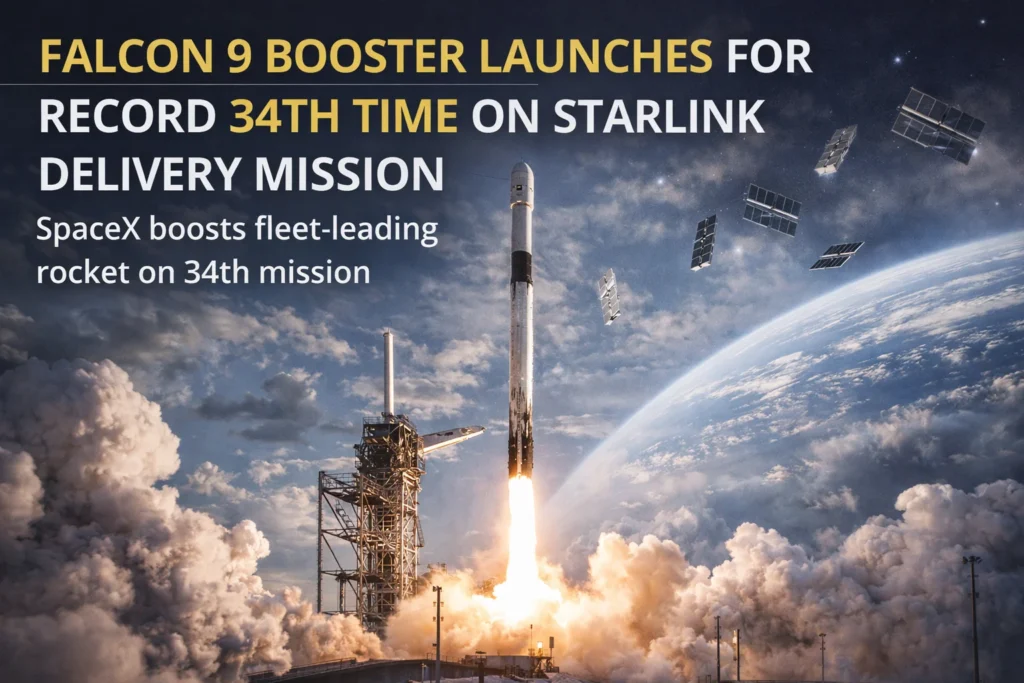
That is not a truck. That is a SpaceX Falcon 9 rocket booster. And on Monday, this booster did something no other rocket in history has ever done. It launched for the 34th time. Not 34 different boosters. The same one. The same metal frame. The same engines. The same scorched, sooty, battle-hardened piece of machinery that first left the ground back when people were still arguing about whether to wear masks indoors.
Let us break down what happened, why it matters, how this old “space truck” is changing the future of internet service for everyone on Earth, and why you should care even if you have never looked through a telescope in your life.
H2: One Monday Morning at Cape Canaveral (The Full Story)
The sun was not even fully up yet over Florida’s Space Coast. The sky had that soft gray color that happens right before sunrise, when the birds start chirping but the streetlights are still on. A light breeze blew in from the Atlantic Ocean, carrying the smell of salt and damp sand. Out on the water, a few fishing boats bobbed gently, their captains probably unaware that they were about to have the best seat in the house for a piece of history.
But at Cape Canaveral Space Force Station, nobody was fishing. Nobody was relaxing. The launch pad was buzzing with energy like a beehive right before it swarms. Engineers in blue polo shirts and khaki pants sipped coffee from travel mugs. Some of them had been awake since 3 AM. Others had never gone to sleep at all. That is how launch days work. Sleep becomes optional. Coffee becomes essential.
Computers beeped and hummed inside a concrete blockhouse a few miles away from the pad. Giant screens showed real-time data from the rocket: fuel levels, engine temperatures, wind speeds at different altitudes. Red numbers, green numbers, yellow warnings that blinked and then went away as systems checked themselves.
Outside, the rocket stood on the pad like a silver skyscraper lying on its side. But it was not lying down. It was pointing straight up, aiming at the stars. Giant tanks filled with super-chilled fuel made hissing sounds. The fuel was so cold that ice formed on the outside of the rocket. It looked like a frozen candle waiting to be lit. Liquid oxygen boiled off and vented into the air, creating ghostly white clouds that swirled around the base of the rocket.
Sitting on that launch pad was a booster that SpaceX fans have nicknamed a “legend.” On Reddit and YouTube and X, people have given it unofficial names like “Old Faithful” and “The Workhorse” and “B1062 Forever.” This was not a brand-new rocket straight out of the factory in Hawthorne, California. This was a veteran. A grizzled survivor. A booster that had already done more than any other rocket in the company’s fleet. It had been to space and back thirty-three times before today. Its metal skin was covered in dark scorch marks from repeated reentries. Engineers called that “battle scarring.” They wore it like a badge of honor.
The countdown clock ticked down from ten minutes. Nine minutes. Eight. A voice over the loudspeaker called out each milestone. “T-minus seven minutes and holding.” That hold was planned. A chance for the team to catch their breath, double-check everything, and make sure no boats had drifted into the danger zone. On the water, a small SpaceX recovery ship stood by, ready to chase the booster after landing.
At T-minus one minute, the hold was released. The final countdown began. The engines started their chill-down sequence. That meant super-cold fuel was flowing through the engine turbopumps to get them ready for ignition. If you were standing at the press viewing area a few miles away, you could hear a low rumble building. Not loud yet. Just a promise.
At T-minus ten seconds, the nine Merlin engines lit one by one in a carefully timed sequence. Green flames first, then orange, then blinding white. The sound hit the press site a moment later. Not a roar exactly. More like a physical wall of noise that you could feel in your chest. Your bones vibrated. Your teeth buzzed. The ground shook.
Then the countdown hit zero. For a split second, nothing seemed to happen. The rocket shook violently but stayed on the pad. That is normal. The engines have to build up full thrust before the computer releases the clamps. Then, with a crack that sounded like the sky itself was tearing open, the Falcon 9 lifted off.
It rose slowly at first. Incredibly slowly for something so powerful. It took a full second to clear the tower. Then it started speeding up. Ten seconds later, it was moving faster than a race car. Thirty seconds later, faster than a jetliner. One minute later, it punched through a layer of clouds and kept going. The flame from the engines was so bright that people watching from a hundred miles away could see it.
At 6:14 PM Eastern Time, the Falcon 9 left Earth behind. Onboard were 29 brand-new Starlink satellites, each one folded up like a piece of origami waiting to be opened. And riding at the bottom of that rocket was B1062, the most experienced rocket booster in human history, about to become even more experienced.
H2: What Is a “Booster” and Why Does It Matter? (A Deep Dive)
Before we go further, let us make sure we understand the basics. A lot of people hear the word “booster” and think of those little rockets that kids launch in a schoolyard. Or they think of a vaccine booster shot. That is not what we are talking about here.
In the world of rockets, a booster is the big bottom part. It has the main engines and most of the fuel. When you see a rocket launch on TV, the giant white cylinder that takes up most of the height is the booster. On top of that booster sits the second stage, which is smaller and carries the cargo. And on top of the second stage sits the payload. In this case, the payload was 29 Starlink satellites packed together like sardines inside a protective nose cone.
Here is how a normal rocket flight works. The booster lights its engines at the ground. It burns for about two and a half minutes. During that time, it pushes the entire rocket up through the thick lower atmosphere. By the time the booster shuts down, the rocket is going thousands of miles per hour and is already above most of the air on Earth. Then the booster separates. It falls away. The second stage lights its own engine and continues the climb to orbit.
In the old days of spaceflight, that was the end of the booster’s life. It would fall back to Earth, tumble through the atmosphere, and smash into the ocean. Sometimes pieces would be recovered for study. But the booster itself was trash. Done. Gone. Every single launch meant building a brand-new booster from scratch. That is like buying a new car every time you drive to the grocery store. It works, but it is incredibly expensive. And wasteful. And slow.
Think about it this way. Imagine if airplanes were disposable. Every time a plane flew from New York to Los Angeles, they would throw the plane away at the end of the flight. A brand-new 747 would cost hundreds of millions of dollars. Tickets would cost a million dollars each. Almost nobody would fly. That is how space used to work.
Then SpaceX came along and did something that people said was impossible. They figured out how to land the booster back on Earth. After separation, the booster flips itself around. It fires its engines again to slow down. It steers itself using tiny grid fins that pop out of the side. It deploys four landing legs made of carbon fiber. Then it touches down gently on a drone ship in the ocean or back on solid ground at a landing pad.
After that, engineers check it over. They fix small issues. They replace worn-out parts. They refill the fuel tanks. And they send it up again. And again. And again.
This booster’s 34th flight is proof that the idea works. Really, really well. Not just in theory. Not just in a computer simulation. In real life, with real fire, real vibration, real space, and real ocean landings. B1062 has now done this 34 times. That is 34 trips to the edge of space and back. That is 34 times that engineers said, “Yes, this old booster is safe to fly again.” And they were right every single time.
H2: The Record-Breaking 34th Launch (A Minute-by-Minute Timeline)
Let us walk through the launch minute by minute so you can feel the action. I want you to close your eyes for a second. Well, not really, because you are reading. But imagine yourself standing at the press site at Cape Canaveral. The sun is setting behind you. The air is warm and sticky. In front of you, three miles away, a rocket sits on the pad. You are about to watch history.
T-minus 10 seconds: The nine Merlin engines start their ignition sequence one by one. There is a flash of green light. That is the TEA-TEB igniter fluid. It catches fire instantly when it touches oxygen. Then the main fuel starts flowing. The flame turns from green to orange to blinding white. A cloud of steam and fire spreads out across the pad. The water deluge system sprays millions of gallons of water onto the pad to absorb the sound. Without that water, the sound would be loud enough to crack concrete. The rocket shakes like a dog coming out of a bath. You feel the vibration in your feet even from three miles away.
T-minus 0 seconds: Liftoff. The hold-down clamps release. The Falcon 9 climbs away from the tower. It is moving slowly at first. You can almost count the seconds as it rises. One Mississippi. Two Mississippi. By the time you get to three, it is already clearing the lightning towers. By five, it is starting to speed up. By ten, it is moving faster than any car you have ever seen. The flame gets smaller as the rocket gets higher, but the sound gets louder. It rolls across the ground like thunder that never ends.
T-plus 30 seconds: The rocket passes through Max Q. That is the point of maximum aerodynamic pressure. The atmosphere is pushing back against the rocket as hard as it ever will. The rocket has to be strong enough to survive this moment. B1062 has survived it 33 times before. This time is no different. The rocket flexes slightly but holds together. On the screen in the control room, the pressure readings spike and then fall.
T-plus 1 minute: The rocket punches through a layer of clouds. You can still see the flame from the ground if you know where to look. It looks like a small sun moving upward. People start to cheer. Not too loud yet. It is still early.
T-plus 2 minutes, 15 seconds: The booster has done its main job. It has pushed the second stage and the 29 Starlink satellites high above most of the atmosphere. The rocket is now moving at more than 5,000 miles per hour. The nine engines shut down in a carefully timed sequence. Three engines cut off. Then three more. Then the last three. The flame disappears. For a moment, the rocket is silent.
T-plus 2 minutes, 45 seconds: Separation. Small explosive charges fire. Pneumatic pushers shove the booster away from the second stage. The two pieces drift apart. The second stage lights its single small engine, the Merlin Vacuum, and keeps climbing. It glows bright red as it accelerates toward orbit. Meanwhile, the booster begins its fall back toward Earth. It is now a giant piece of metal falling from the edge of space. No parachutes. No wings. Just rocket engines and computer guidance.
T-plus 3 minutes: The booster flips itself around using cold gas thrusters. These are small jets that shoot nitrogen gas. They do not provide much force, but in the vacuum of space, a little force goes a long way. The booster points its engines forward, like it is trying to slow down by pushing backward. It is now falling engines-first.
T-plus 4 minutes: The booster starts to feel the atmosphere again. Friction heats up the outside. The temperature rises to hundreds of degrees, then thousands. The metal skin glows red, then orange. A plasma trail forms behind the booster. From the ground, if you had a powerful telescope, you would see a shooting star going sideways.
T-plus 6 minutes: The booster fires its engines again for the “reentry burn.” Three of the nine engines light up. The flame pushes against the direction of travel, slowing the booster down from thousands of miles per hour to just a few hundred. The heat on the outside of the booster reaches nearly 3,000 degrees Fahrenheit. That is hot enough to melt most metals. But the booster’s heat shield and special alloys protect it. The burn lasts about 20 seconds. Then the engines cut off again.
T-plus 7 minutes, 30 seconds: The booster deploys its four landing legs. They fold out from the sides and lock into place. Each leg is made of carbon fiber with a honeycomb core. They are incredibly strong but also very light. The booster is now falling toward the drone ship at about 200 miles per hour. That is still too fast to land safely.
T-plus 8 minutes: The booster fires its engines one last time. This is the landing burn. Only one engine lights this time. The flame hits the drone ship’s deck and creates a blast of steam. The booster slows from 200 miles per hour to zero in just a few seconds. It hovers for a split second, making tiny adjustments with its grid fins. Then it touches down. Softly. Perfectly. The legs absorb the impact. The engine shuts off. The booster stands upright on the deck of the drone ship, swaying slightly in the waves.
At that moment, a room full of SpaceX engineers in Hawthorne, California, erupted. Some cheered. Some high-fived. One older engineer with gray hair and glasses took off his headset and just sat there for a moment with his eyes closed. He had been working on reusable rockets since the early days, when people laughed at the idea. Now he had just watched a booster land for the 34th time. Maybe he cried. Nobody would blame him if he did.
This was history. Not the kind of history you read about in textbooks years later. The kind you watch live on your phone while eating dinner.
H2: Meet the MVP of SpaceX’s Fleet (The Life Story of B1062)
So who is this record-breaking booster? It does not have a cute name like “Bumblebee” or “Freedom” or “Enterprise.” SpaceX gives its boosters serial numbers. It is not very exciting, but it is practical. This one is B1062. That is its full name. B for booster. 1062 for the 1,062nd piece of hardware they tracked.
But just because it has a boring name does not mean it has a boring life. Let me tell you the story of B1062 from the beginning.
B1062 was built in Hawthorne, California, in a factory that used to build Boeing 747 fuselages. It is a giant white building with no windows. Inside, rows of technicians weld aluminum-lithium alloy rings together. They stack them into a long tube. They install nine Merlin engines at the bottom. They add the grid fins, the landing legs, the computers, the fuel tanks, the wiring, and thousands of other parts. The whole process takes months.
B1062 first flew way back in November 2020. That feels like a lifetime ago. TikTok was still new and confusing. People were making sourdough bread during lockdowns. The word “Zoom” had become a verb. And this rocket was just starting its career, bright and shiny with no scorch marks at all.
On its very first mission, B1062 carried a GPS satellite for the U.S. Space Force. That was a big deal. The military does not trust just anyone with their billion-dollar navigation satellites. They need precision. They need reliability. They need to know that the rocket will put the satellite exactly where it needs to go, within a few meters. B1062 delivered perfectly.
After that first flight, B1062 landed on a drone ship and returned to port. Workers sprayed it down with fresh water to remove the salt. They inspected every weld, every wire, every valve. They found a few minor issues. A heat shield tile that needed replacement. A pump seal that was starting to wear. Nothing serious. They fixed it, refueled it, and sent it up again.
Flight two was another GPS satellite. Flight three was a commercial communications satellite. Flight four was the first of many Starlink missions.
Over the next four years, B1062 became the workhorse of the fleet. When SpaceX needed a reliable booster for a customer who was nervous about flying on a used rocket, they picked B1062. When they needed to test a new landing technique, they used B1062. When they wanted to set a turnaround record, launching the same booster twice in 21 days, they chose B1062.
By flight fifteen, B1062 was a veteran. Its outside was covered in dark scorch marks. The white paint was barely visible anymore. Engineers stopped being nervous. They did not cross their fingers during the landing burn. They just expected it to work. And it always did.
By flight twenty-five, B1062 had carried more than 500 satellites into orbit. That is not a typo. Five hundred. Most of them were Starlink satellites, but there were also small cubesats for universities, experimental payloads for NASA, and even a few pieces of art projects that rich people paid to send to space.
By flight thirty, B1062 was showing its age. Not in a bad way. Like a favorite pair of jeans. Comfortable. Broken in. Reliable. The engines had been rebuilt twice. The landing legs had been replaced three times. The grid fins were on their fourth set. But the core structure, the main tank, the backbone of the booster, was still original. That is like driving a car for 200,000 miles but still having the original frame. It is possible, but only if the car was built very well.
Now at flight thirty-four, B1062 has spent more time in the air and space than most people spend on vacation in a lifetime. It has felt the vibration of nine engines screaming at full power. It has seen the blackness of space and the thin blue line of Earth’s atmosphere. It has fallen back through the atmosphere glowing orange-hot. It has landed on a pitching deck in the middle of the Atlantic during a storm. And it is still ready to go again.
H2: What Are Those 29 Satellites, Anyway? (A Deep Dive into Starlink)
Let us talk about the cargo. The Falcon 9 carried 29 Starlink satellites. Each one weighs about 573 pounds. That is roughly 260 kilograms. For comparison, that is about the weight of a large adult male gorilla. Or two big washing machines. Or a small motorcycle.
But these satellites do not look like gorillas or washing machines or motorcycles. They are flat. Really flat. Each one is shaped like a tabletop, about 10 feet long and 4.5 feet wide. They are only about an inch thick. That is thinner than a pizza box. When you stack them together, they look like a stack of cafeteria trays.
Before launch, these 29 satellites are packed tightly together inside the rocket’s nose cone. The nose cone is also called the fairing. It is a clamshell-shaped cover that protects the satellites during the first few minutes of flight, when the atmosphere is thick and the air pressure is high. Once the rocket gets above most of the atmosphere, the fairing splits in half and falls away. The satellites are now exposed to space.
After the second stage reaches the right orbit, it spins slowly. Like a basketball spinning on someone’s finger. The spin creates a small amount of centrifugal force that helps push the satellites away. Then, one by one, small springs release each satellite. They drift apart like dandelion seeds in the wind. Slowly at first, then faster as they separate.
Once a satellite is released, it unfolds its own solar panel. That panel is about the size of a twin bed mattress. It points toward the sun and starts generating electricity. Then the satellite fires a tiny ion thruster. This is not a chemical engine like the ones on the rocket. It uses electricity to accelerate xenon gas out the back. The thrust is incredibly weak. Imagine blowing on a piece of paper. That is about how much force we are talking about. But in the vacuum of space, with no friction, that tiny thrust adds up over time. Over a few weeks, the satellite climbs from its initial low orbit to its final operational orbit about 340 miles above Earth.
These satellites are not just floating junk. They are part of a constellation. Imagine a net made of thousands of little robots circling Earth. They talk to each other with lasers. Lasers that shoot through space from one satellite to another, passing data at the speed of light. They talk to dishes on the ground. Small pizza-box-sized dishes that you can buy for your house. And together, they provide high-speed internet to places that regular cable or fiber cannot reach.
That includes farms in Kansas where the nearest town is an hour away. Villages in Alaska where the ground is frozen solid nine months of the year. Ships in the middle of the Atlantic where the nearest land is a thousand miles away. Remote research bases in Antarctica where scientists study penguins and ice cores. Disaster zones where hurricanes or earthquakes have knocked out all the cell towers.
Starlink is not perfect. It is not cheap. It is not available everywhere. But for the people who need it, it is life-changing. A farmer in rural Australia can now check commodity prices in real time. A student in a remote village in Chile can now do homework online. A doctor in a tiny clinic in Africa can now video-call a specialist in London.
That is what those 29 satellites represent. Not just metal and electronics. But connection. Opportunity. A chance for people on the wrong side of the digital divide to cross over.
H2: Why 34 Flights Is Such a Big Deal (The Numbers Game)
Let us put 34 flights in perspective. Sometimes numbers lose their meaning when they get too big. But these numbers matter.
The Space Shuttle was one of the most amazing machines ever built. It was partially reusable. The orbiter (the plane-like part) could fly again. The giant orange fuel tank was thrown away every time. The two white solid rocket boosters were fished out of the ocean, taken apart, cleaned, and reassembled. The most-flown orbiter was Discovery. It flew 39 times over 27 years. That is an incredible achievement. But Discovery could not land and then launch again a few weeks later. Each shuttle mission took months of refurbishment. Teams of hundreds of people would inspect every tile, every engine, every wire. It was slow and expensive.
The Falcon 9 booster B1062 has flown 34 times in just over four years. That is an average of roughly one flight every six weeks. At its fastest, it has launched again after only 21 days. That is less than a month. Think about that. A machine that goes to space, reenters the atmosphere at hypersonic speeds, lands on a boat, gets hosed down, inspected, refueled, and launched again in three weeks. That is insane. That is like running a marathon, then running another marathon the next day, then another, and another, for four years straight.
Here is a quick comparison table to help you understand how different rockets compare. I will put it in plain text so it is easy to read.
The Space Shuttle Discovery flew 39 times over 27 years. That is an average of 1.4 flights per year. The refurbishment time between flights was usually several months.
The Falcon 9 booster B1062 has flown 34 times over 4 years. That is an average of 8.5 flights per year. The refurbishment time between flights is usually a few weeks.
A typical commercial airplane like a Boeing 737 flies about 50,000 times over 20 years. That is an average of 2,500 flights per year. Refurbishment between flights is just a few hours for basic checks, with deeper maintenance every few months.
So rockets are still not airplanes. They are much more complex. They operate in a much harsher environment. But they are getting closer every year. And B1062 is leading the way.
Here is another way to think about it. Each flight of B1062 costs SpaceX about $15 million internally. That includes fuel, ground support, range fees, and refurbishment. A brand-new Falcon 9 booster costs about $30 million to build. So by flying B1062 34 times, SpaceX has saved roughly $30 million times 33 (since the first flight used a new booster). That is almost one billion dollars in savings. One billion dollars. From one rocket. That is not just a good deal. That is a revolution.
H2: The Human Side of a Rocket’s Life (A Story in 34 Chapters)
Let us imagine the life of B1062 as if it were a person. Not a robot. Not a machine. A person with feelings and memories and a personality. Because the engineers who work on these boosters do think of them that way. They give them nicknames. They pat them on the side before a launch. They say good luck and mean it.
Chapter one: November 2020. B1062 is brand new. Its white paint is so bright it almost glows. It has never felt the heat of reentry. It has never tasted salt spray from the ocean. On its first flight, it carries a GPS satellite for the military. The launch is perfect. The landing is perfect. B1062 returns to port with a crowd of SpaceX fans cheering from the shore. It does not know it yet, but this is the beginning of a long career.
Chapter five: Mid 2021. B1062 has now flown five times. Its paint is starting to darken. There are scorch marks around the engines. The grid fins have small dings from micrometeoroids. But it still flies like new. On this flight, it carries a batch of Starlink satellites. It is the first time B1062 has done a Starlink mission. It will not be the last.
Chapter ten: Early 2022. B1062 is now a veteran. The engineers trust it so much that they assign it to a customer who is nervous about flying on a used rocket. The customer asks for extra inspections. The engineers do them and find nothing wrong. The launch goes perfectly. The customer becomes a believer. B1062 lands and is back in the hangar within 24 hours.
Chapter fifteen: Late 2022. B1062 sets a turnaround record. It launches, lands, and launches again in just 21 days. That is three weeks. The technicians work around the clock. They replace a worn valve. They inspect every inch of the heat shield. They refill the tanks. And B1062 delivers again. The record stands for months before another booster breaks it.
Chapter twenty: Mid 2023. B1062 has now carried more than 400 satellites into orbit. Its engines have been rebuilt once. Its landing legs have been replaced twice. But the core structure, the backbone of the booster, is still the original. Engineers take X-rays of the welds. Everything looks good. They give B1062 a clean bill of health.
Chapter twenty-five: Late 2023. B1062 flies a mission for a small satellite company that cannot afford a new rocket. The company pays a discounted price for a used booster. They are nervous. But B1062 delivers their satellite to exactly the right orbit. The company sends a thank-you note to SpaceX. The engineers hang it on the wall of the hangar where B1062 sleeps between flights.
Chapter thirty: Early 2024. B1062 becomes the fleet leader. It has flown more times than any other booster in the fleet. The previous record holder, B1058, had to be retired after a rough landing damaged its engines. B1062 is still going strong. Engineers start to wonder how far it can go. 35 flights? 40? 50? Nobody knows.
Chapter thirty-four: Monday. B1062 launches for the 34th time. It carries 29 Starlink satellites. The launch is flawless. The landing is flawless. B1062 stands on the drone ship, steam rising from its engines, looking like a giant burned cigar. The recovery ship pulls up alongside. A crew in hazmat suits approaches to check for any dangerous fumes. They secure the landing legs. They attach a tow line. And B1062 begins the slow journey back to port.
Tonight, B1062 will sleep on the drone ship. Tomorrow, it will be towed into Port Canaveral. A crane will lift it off the ship and put it on a truck. The truck will drive it back to the hangar. Technicians will wash off the soot. They will run tests. They will refill the tanks. And in a few weeks, they will roll it back out to the launch pad for flight number thirty-five.
Because B1062 is not done yet. Not even close.
H2: What Happens to the Second Stage? (The Part You Don’t See)
We have talked a lot about the booster. The booster gets all the attention because it comes back and lands. That is the flashy part. That is what makes the news. That is what gets millions of views on YouTube.
But what about the second stage? That is the top part that actually pushes the satellites into their final orbit. What happens to it?
Unlike the booster, the second stage does not come back. It cannot survive reentry. It does not have heat shields. It does not have landing legs. It does not have grid fins. It is built to be as light as possible so it can push as much payload as possible into orbit. Adding reusability features would make it heavier, which would mean fewer satellites per launch. So for now, the second stage is disposable.
Here is what happens. After the booster separates, the second stage lights its single engine, called the Merlin Vacuum. It is a smaller, more efficient version of the booster’s engines, designed to work in the vacuum of space. It burns for about six minutes to reach a parking orbit. Then it coasts. Then it fires again for a short “circularization burn” to round out the orbit. Then it releases the satellites.
After the satellites are gone, the second stage still has a little bit of fuel left. Not much. But enough for one more maneuver. SpaceX mission controllers command it to fire its engine one last time. This is called a “deorbit burn.” It pushes the second stage down into the atmosphere over an empty part of the ocean. Usually the South Pacific Ocean, far away from any shipping lanes or islands.
The second stage enters the atmosphere at about 17,000 miles per hour. That is more than 20 times the speed of sound. The friction heats it up to thousands of degrees. The aluminum structure melts. The engine breaks apart. The fuel tanks explode. Within a minute, the entire second stage has been reduced to tiny pieces of debris, most of which burn up completely. Any remaining fragments fall into the ocean and sink to the bottom.
That is important. Space junk is a real problem. There are old rocket parts, dead satellites, and pieces of broken spacecraft circling Earth at 17,000 miles per hour. One small collision can create thousands of new pieces of debris. Those pieces can then hit other satellites, creating even more debris. It is a chain reaction that could eventually make some orbits unusable. Scientists call it the Kessler Syndrome, named after the NASA scientist who first described it.
SpaceX tries very hard to clean up after itself. Every second stage is deorbited over the ocean. Every booster is landed and reused, not left in orbit. Even the fairings (the nose cone halves) are caught by ships with giant nets and reused. Starlink satellites are designed to burn up completely in the atmosphere at the end of their lives, so they do not become space junk.
So the second stage dies a fiery death high above the Pacific or Indian Ocean. It sounds dramatic, and it is. But it is actually the responsible way to end a mission. Better to burn up in the atmosphere than to become a hazard for future spaceflight.
H2: How Starlink Is Changing the Internet Game (The Big Picture)
You might be thinking, “Okay, cool rocket. But why should I care about 29 more internet satellites? I already have internet. It works fine.”
That is a fair question. If you live in a city or a suburb, you probably have cable or fiber internet. It is fast. It is reliable. You do not think about it much. You just pay the bill and scroll through your phone.
But not everyone lives in a city. Not everyone has fiber. In fact, right now, about 2.6 billion people in the world do not have reliable internet. That is not because the internet does not exist. It is because cables are expensive to lay down. Mountains, oceans, and jungles get in the way. In rural parts of the United States, families still use slow DSL or old-fashioned satellite internet with data caps and high lag. You cannot play video games on that. You cannot do video calls. You cannot stream movies without buffering every few minutes.
Here is an example. Take a family in rural Montana. Their nearest town has 500 people. The nearest city with fiber internet is 100 miles away. The local phone company offers DSL at 3 megabits per second. That is fast enough to check email, barely. But if three people try to use it at the same time, it slows to a crawl. The kids cannot do their homework because the school’s online portal takes forever to load. The parents cannot work from home because the video call keeps freezing. It is frustrating. It is unfair. And it is completely unnecessary in the 21st century.
Now imagine that family gets a Starlink dish. They put it on the roof, pointed at the sky. The dish automatically finds the satellites overhead. Suddenly they have 100 megabits per second. They can do video calls. They can stream movies. The kids can do homework. The parents can work from home. It is like moving from the 1990s to the 2020s overnight.
That is the promise of Starlink. Not just faster internet for people who already have it. But any internet at all for people who have nothing.
There are downsides, of course. Astronomers do not love Starlink. The satellites are bright. They leave streaks across telescope images. For a professional astronomer trying to study distant galaxies, a Starlink streak can ruin hours of work. SpaceX has tried to fix this by adding sunshades and making the satellites less reflective. They have also lowered their orbit so the satellites are less visible. It helps, but it is not perfect.
Also, Starlink is not cheap. The hardware costs around $600. That is the dish, the router, and the cables. The monthly bill is $120 or more. For a family in a rich country, that is doable. For a family in a poor village, it is too much. SpaceX has introduced cheaper plans for low-income users in some countries, but it is not widespread yet.
Still, the trend is clear. More satellites mean better coverage. Better coverage means more people get connected. And more connection means more opportunities for education, work, and entertainment. That is worth a few streaks in telescope images.
H2: What Does the Future Hold for This Booster? (Guessing Game)
So what is next for B1062? Will it fly again? Will it keep breaking records? Or is it nearing the end of its life?
Let me give you the honest answer. Nobody knows for sure. Not even the engineers at SpaceX. But we can make some educated guesses.
First, yes, B1062 will almost certainly fly again. It landed perfectly. The post-flight inspections showed no major issues. The engines are still in good shape. The tanks are still holding pressure. There is no reason to retire it now.
Second, SpaceX has said its goal is to fly each booster up to 40 times for Starlink missions. Starlink missions are less demanding than missions for the military or for NASA. The satellites are light. The orbits are low. The booster does not have to work as hard. So 40 flights is a realistic target.
Third, some boosters might even reach 50 or 60 flights for less demanding missions. SpaceX has a test booster in Texas that has flown more than 100 times in short hops. That is a different design, but it shows what is possible. B1062 could keep flying for years.
But nothing lasts forever. Eventually, the metal will get tired. Tiny cracks will form in places that cannot be fixed. The engines will wear out beyond what a rebuild can fix. The heat shield will become too thin. When that day comes, SpaceX will likely retire B1062.
What happens to a retired booster? Sometimes they become museum pieces. There is a Falcon 9 booster hanging from the ceiling at the Smithsonian Air and Space Museum in Washington, DC. Another one is on display at the Kennedy Space Center Visitor Complex in Florida. B1062 could end up somewhere like that.
But more likely, B1062 will be stripped for spare parts. The grid fins might go on another booster. The landing legs might be reused. The engines might be rebuilt and installed on a different rocket. The main tanks will probably be cut up and recycled. That sounds sad, but it is actually efficient. Every part that can be reused saves money and resources.
For now, though, B1062 is not retired. It is not even close. It will go back to the hangar. Technicians will wash off the soot. They will run tests. They will replace a few small parts. They will refill the fuel tanks. And in a few weeks, they will roll it back out to the launch pad for flight number thirty-five.
Maybe you will watch that launch. Maybe you will see B1062 climb into the sky one more time. And maybe you will remember this article and think, “That is the rocket that would not quit.”
H2: Why Reusable Rockets Matter for All of Us (The Big Dream)
You might still be asking, “Why does any of this matter to me? I am not an engineer. I am not a billionaire. I do not own a telescope. I just want to watch cat videos and pay my bills.”
Here is the big picture. Space used to be only for governments and billionaires. A single launch cost $200 million or more. That is why we only sent a few rockets per year. That is why space felt distant and unreachable. That is why most people never thought about it at all.
Now, because of reuse, a Falcon 9 launch costs around $15 million for SpaceX internally. That is still a lot of money. You or I cannot afford to buy a rocket. But it is ten times cheaper than before. Cheap enough that private companies can afford to launch their own satellites. Cheap enough that students can fly experiments to space. Cheap enough that we can build a giant internet constellation.
And this is just the beginning. SpaceX is building an even bigger rocket called Starship. It is designed to be fully reusable. Both the booster and the spaceship will land and fly again. The booster will be even bigger than the Falcon 9 booster. The spaceship will be able to carry 100 tons of cargo to the Moon or Mars. And because everything is reusable, the cost of getting to space could drop to a few million dollars per launch.
Think about what that means. A few million dollars is what a rich person pays for a fancy house. It is what a medium-sized company spends on marketing in a year. It is not nothing, but it is not astronomical either. At that price, space becomes accessible to universities, small businesses, even wealthy individuals.
That is how we build cities on the Moon. That is how we send humans to Mars. That is how we mine asteroids for rare metals. That is how we build giant solar power stations in orbit and beam clean energy down to Earth. That is how we become a species that lives on more than one planet.
All of that starts with a grimy, sooty, hard-working booster that just keeps showing up. B1062. The rocket that launched 34 times and is not done yet. It is not the most glamorous rocket. It does not have a cool name. It will never carry astronauts. But it is proof that reuse works. And that proof changes everything.
H2: Quick Recap – What You Need to Remember (Bullet Points in Story Form)
Let me tell you the story one more time, but shorter. Imagine you are telling a friend about this over coffee. Here is what you say.
“Hey, did you hear about that SpaceX rocket that launched for the 34th time?”
Your friend says, “No way. The same rocket?”
You say, “Yeah, the same one. It is called B1062. It is a Falcon 9 booster. It first flew in 2020. Now it has flown 34 times.”
Your friend says, “What does it carry?”
You say, “This time it carried 29 Starlink satellites. Those are internet satellites. They beam the internet down to places that do not have cables. Farms, ships, remote villages. Stuff like that.”
Your friend says, “How does the rocket come back?”
You say, “It flips around, fires its engines to slow down, and lands on a drone ship in the ocean. Then they hose it off, fix anything that is broken, fill it up, and launch it again. It only takes a few weeks.”
Your friend says, “That is amazing.”
You say, “Yeah, and it matters because reusable rockets are way cheaper. Cheaper rockets mean more stuff in space. More stuff in space means better internet, more science, and eventually humans on Mars.”
Your friend says, “When is the next launch?”
You say, “Probably in a few weeks. Same rocket. Same drone ship. Same everything. B1062 is not done yet.”
That is the story. That is what you need to remember.
H2: Frequently Asked Questions (Answered Like a Human)
People ask a lot of questions about rockets and Starlink. I have collected the most common ones and answered them here. No jargon. No nonsense. Just plain talk.
Is it safe to reuse a rocket that many times?
Yes. SpaceX inspects the booster after every single flight. They use X-rays, cameras, pressure tests, and old-fashioned eyeballs. They replace any parts that look worn. It is like how airlines inspect airplanes after hundreds of flights. Very safe. Probably safer than a brand-new rocket, because they know exactly how the used one behaves.
Can I see this booster fly in person?
Maybe. SpaceX announces launch dates on their website and on X. If you live near Florida or California, you can watch from public beaches or parks. Check the schedule. Get there early. Bring binoculars. And be prepared for the launch to be delayed. Rockets are picky. They do not like bad weather or boats in the danger zone.
Does Starlink work everywhere?
Not yet. It works best in mid-latitude countries like the United States, Canada, most of Europe, and Australia. It works okay near the equator. It is getting better near the poles with each new batch of satellites. But if you live in a deep valley or under thick trees, it might not work great. You need a clear view of the sky.
How much does a Falcon 9 launch cost a customer?
Around $67 million for a new rocket. Less if you agree to fly on a used booster. SpaceX does not publicly share the exact discount, but it is significant. Some customers pay less than $50 million. Some pay even less if they are flexible on the launch date.
Will this booster fly again?
Almost certainly. SpaceX has not announced any retirement plans. Keep watching the news for flight number thirty-five. And thirty-six. And maybe beyond.
What happens if a booster crashes during landing?
That has happened. Not often, but it has happened. SpaceX calls it a “rapid unscheduled disassembly.” That is their polite way of saying it exploded. When that happens, they lose the booster. But they learn from it. Every crash teaches them something new. And because they have many boosters, losing one is not a disaster.
Are the Starlink satellites a problem for astronomers?
Yes, they can be. The satellites are bright. They leave streaks in telescope images. SpaceX is working on solutions. They have added sunshades. They have lowered the orbit. They are testing even darker coatings. But it is still an issue. Astronomers and SpaceX are talking. Nobody wants to ruin the night sky.
Can I get Starlink right now?
Maybe. Go to the Starlink website. Enter your address. They will tell you if service is available in your area. If it is, you can order the hardware. It ships in a few weeks. You install it yourself. It is not hard. Just put the dish somewhere with a clear view of the sky.
How long will this booster last?
Nobody knows. It could fly to 40. It could fly to 50. It could have a hidden crack that fails on the next launch. Rockets are complicated. But so far, B1062 looks healthy. Engineers are optimistic.
Why should I care about any of this?
Because space is the future. And the future is cheaper, faster, and more accessible than ever before. A rocket that flies 34 times is proof that we are figuring things out. That is exciting. That is worth caring about.
Final Thought: A Rocket That Feels Like an Old Friend
We started this story with an old pickup truck. Maybe that was not the best comparison. A pickup truck does not survive the vacuum of space. It does not fall back through the atmosphere at 5,000 miles per hour. It does not land itself on a floating platform in the middle of the ocean while swaying in ten-foot waves.
But the feeling is the same. Dependability. Toughness. A machine that has proven itself over and over again until you stop being amazed and just start being grateful.
Every time B1062 launches, someone at SpaceX says a quiet thank you. Thank you for not exploding. Thank you for landing straight. Thank you for giving us another chance to do something amazing.
The Falcon 9 booster B1062 launched for the 34th time on Monday. It delivered 29 satellites to orbit. It landed safely on a drone ship named A Shortfall of Gravitas. The recovery team secured it for the journey home.
And somewhere in a SpaceX hangar in Florida, that booster is waiting. Waiting for the next inspection. Waiting for the next refueling. Waiting for the next countdown.
Waiting to do it all over again.
That is not just a record. That is not just a number. That is the future. And it is happening right now, one launch at a time, one booster at a time, one satellite at a time.
B1062. Thirty-four flights and counting. Here is to thirty-five.