
A Simple Bottle, A Serious Problem
Let me tell you about something that happened to a woman named Clara last month. Clara lives in a small apartment in Ohio. She is fifty-two years old. She works as a receptionist at a dental office. Every morning, before the sun is fully up, she stumbles into her bathroom. The tile floor is cold under her feet. She fumbles for the light switch. Then she reaches for the small white bottle on the edge of her sink.
That bottle contains eye drops. Clara has worn contact lenses for over twenty years. Her eyes get dry easily, especially in winter when the heat is running. So every morning, she tips her head back and puts two drops in each eye. It is a small ritual. She never thinks twice about it. She has done it thousands of times.
But one morning last month, something felt different. After the drops went in, her right eye started to itch. Not a mild itch, like from dust. A deep, burning itch that made her want to rub her eye with her knuckles. She resisted. She blinked a few times. The itching got worse. Then her eye turned red. Not pink. Red, like a stop sign.
By lunchtime, Clara could not focus on her computer screen. The words looked blurry. She felt like there was a piece of sand stuck under her eyelid. She excused herself from work and drove to a walk-in clinic. The doctor there looked at her eye with a special light. He frowned. He asked Clara what she had put in her eye that morning. She told him about the eye drops.
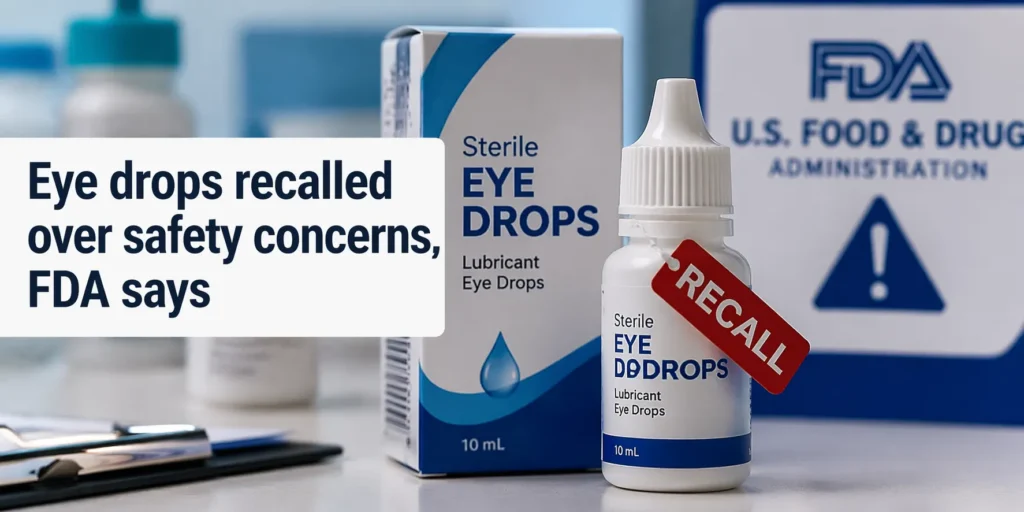
Clara’s story is not unique. It is not even rare. Across the country, hundreds of people have had similar experiences. And now, the U.S. Food and Drug Administration (FDA) has stepped in. They announced that a major pharmaceutical company is voluntarily recalling more than 3 million bottles of over-the-counter eye drops. The reason? The FDA found a “lack of assurance of sterility.”
Let me translate that for you. “Lack of assurance of sterility” is a polite, scientific way of saying: We cannot promise these drops are clean. We cannot promise they are free of bacteria, fungus, or other germs. And because we cannot promise that, they are not safe to put in your eyes.
What Does “Lack of Sterility” Actually Mean?
Sterility is a word you hear in hospitals and doctor’s offices. It has a simple meaning, but it is very important. When a product is sterile, it means there are no living microorganisms inside it. No bacteria. No viruses. No fungi. No mold spores. Nothing that can multiply inside your body and make you sick.
Think about a can of soup. You can leave that can on your shelf for years. When you open it, the soup is still safe to eat. Why? Because the canning process used heat to kill every single germ inside. That is sterility.
Now think about a bandage. It comes in a sealed paper wrapper. When you open it, the pad that touches your wound is sterile. The factory used radiation or heat to kill any germs before sealing the package.
Eye drops are supposed to be like that bandage. They are supposed to be sterile. You are putting them directly into one of the most sensitive parts of your body. Your eyes have natural defenses, like tears and eyelashes. But those defenses are not designed to fight off large amounts of bacteria. They are designed to handle the few germs that float through the air every day.
When the FDA says there is a “lack of assurance of sterility,” it means the company cannot prove that their manufacturing process was clean enough. Maybe a pipe inside the factory had a tiny crack. Maybe the water used to mix the solution was not purified properly. Maybe the plastic bottles were stored in a dusty warehouse. Maybe the workers did not wash their hands correctly. Maybe the testing equipment was broken.
The company did not wait for the FDA to force them to act. They issued a voluntary recall. That means they decided on their own to remove the products from stores. In the business world, this is considered the responsible thing to do. It shows that the company is trying to protect customers rather than waiting for lawsuits.
But for regular people like you and me, it is still scary. We trust that the products we buy are safe. We do not have laboratories in our homes. We cannot test each bottle ourselves. We rely on companies and the FDA to protect us. When that trust breaks, it shakes us.
The Scale of This Recall: More Than 3 Million Bottles
Let me help you picture 3 million bottles. Imagine a football stadium filled to the very top row with tiny plastic bottles. Now imagine that stadium is filled twice. That is a lot of eye drops. That is a lot of people who might have bought them.
These bottles were not sold in some secret underground market. They were sold in major stores across the country. Think of big names like Walmart, CVS, Walgreens, Rite Aid, and Target. They were also sold online through Amazon, eBay, and other websites. Some were sold in grocery stores like Kroger and Safeway. Some were sold in wholesale clubs like Costco and Sam’s Club.
The products in this recall are mostly store-brand eye drops. You know the kind. They sit on the bottom shelf, right next to the expensive name brands. The packaging is plain. The colors are simple. They cost about half as much as the fancy brands. Millions of people buy them to save a few dollars. And honestly, for most of history, that has been fine. Store-brand medicines are usually just as good as name brands. They are made in the same factories, often with the same ingredients.
But not this time.
And here is the tricky part. Many of the people who buy these cheap eye drops are not young and healthy. They are elderly folks with chronic dry eyes. Dry eye syndrome is very common in people over sixty-five. Their eyes do not make enough tears. They need artificial tears several times a day. If they stop using them, their eyes become painful and blurry.
Other buyers are people recovering from eye surgery. After cataract surgery or LASIK, doctors tell patients to use lubricating drops to help the eye heal. These patients are already vulnerable. Their eyes have fresh incisions. Bacteria can get inside those incisions much more easily than into a healthy eye.
Still other buyers are parents. They buy eye drops for their children who have seasonal allergies. A child’s eyes are smaller and more delicate than an adult’s. An infection that would be mild in an adult can be serious in a child.
These are the people most at risk. And they are the ones who need to know about this recall.
How Did This Happen? A Look Inside the Factory
To understand the recall, you have to imagine the factory where these drops were made. Making eye drops is not like making soda. You cannot just mix water and salt and pour it into bottles. That would be dangerous. That would grow bacteria like crazy.
Sterile eye drops are made in what the industry calls “clean rooms.” These are not ordinary rooms. The air in a clean room is filtered through special screens called HEPA filters. These filters remove 99.97 percent of particles that are larger than 0.3 microns. For comparison, a human hair is about 70 microns wide. So we are talking about incredibly tiny particles.
Workers in clean rooms wear special suits that cover every part of their body. They wear hoods over their hair. They wear face masks over their mouths and noses. They wear goggles over their eyes. They wear two layers of gloves. They wear booties over their shoes. Before they enter the clean room, they go through an air shower that blows dust off their suits.
The machines that make the eye drops are sterilized with heat or chemicals. The water used to make the drops is purified through reverse osmosis, which forces water through a very fine membrane that blocks impurities. The bottles are sterilized before they are filled. The caps are sterilized. Even the air inside the bottles is sterilized.
After the bottles are filled and sealed, they are tested. Workers take samples from each batch. They send those samples to a lab. The lab puts the samples into special dishes that grow bacteria. If any bacteria grow, the whole batch is thrown away. That is how the system is supposed to work.
But something went wrong this time. The FDA inspectors found problems. They did not release every single detail to the public. That information is often kept confidential for legal reasons. But they hinted at the issue. The “assurance of sterility” was missing.
What does that mean in plain English? It means the company probably cut corners. Maybe they did not test the drops as often as they should have. Maybe they tested them but ignored the results. Maybe the clean room was not as clean as it should have been. Maybe the workers were not properly trained. Maybe the sterilization machine was broken and they kept using it anyway.
We may never know the full story. But we know the outcome. Three million bottles are being pulled from shelves. And people who used those bottles are at risk.
Not the First Time: A History of Eye Drop Recalls
This is not the first time we have had this conversation. In fact, eye drop recalls have become strangely common over the last two years. It is a pattern that should make all of us pay attention. Let me walk you through some of the recent history.
In early 2023, a company called Global Pharma Healthcare recalled their artificial tears. This was not a small recall. This was linked to an outbreak of a dangerous bacteria called Pseudomonas aeruginosa. This particular strain was drug-resistant. That means normal antibiotics did not kill it. At least fifty people got sick. Several lost their vision. One person died.
The FDA found that the factory in India where those drops were made had serious problems. The workers did not wear proper protective gear. The sterilization equipment was not working. The testing was faked. It was a nightmare.
Later in 2023, another recall happened. This time it was from a company called Pharmedica. They recalled two types of eye drops because of “lack of sterility assurance.” That same phrase. No reported infections that time, but the recall was still serious.
Then in late 2023, yet another recall. This time from a company called Alcon. They recalled some of their eye drops because a small number of bottles had a crack in the tip. That crack could let bacteria in. Again, no infections reported, but the recall happened anyway.
And now we have this one. More than 3 million bottles. The same basic problem. It starts to feel like every few months, we are hearing the same news.
Why is this happening so often? Experts point to a few reasons. First, many eye drops are made in overseas factories where safety standards are looser than in the United States. Second, the demand for cheap store-brand products has skyrocketed as people try to save money. Third, the FDA is understaffed. They have more factories to inspect than they have inspectors. Fourth, some companies simply put profits ahead of safety.
None of these are excuses. But they help explain the pattern.
What Are the Dangers of Contaminated Eye Drops?
Let us be real for a moment. Putting dirty liquid in your eye is a bad idea. But how bad? The answer ranges from “mildly annoying” to “you could lose your vision forever.” Let me break it down for you.
At the low end, you might get conjunctivitis. That is the medical name for pink eye. The conjunctiva is the clear covering over the white part of your eye and the inside of your eyelids. When it gets infected, it turns red. It feels gritty, like there is sand inside your eye. It can produce a discharge that is watery or thick and goopy. In the morning, your eyelashes might be stuck together. Pink eye usually clears up with antibiotic drops, but it is miserable while you have it.
At the middle level, you might get keratitis. That is an infection of the cornea, which is the clear dome at the front of your eye. Keratitis hurts more than pink eye. Your eye might be very sensitive to light. Your vision might get blurry. You might feel like something is stuck in your eye even when nothing is there. Keratitis needs aggressive treatment. If it is not treated quickly, it can scar your cornea.
At the high end, you could get a corneal ulcer. That is an open sore on your cornea. It is exactly what it sounds like: an ulcer, like a stomach ulcer, but on your eye. It hurts. A lot. It can make you feel like someone is stabbing your eye with a hot needle. A corneal ulcer can leave a scar that blurs your vision forever. In severe cases, the infection can go through the cornea and spread inside your eye. That can lead to a condition called endophthalmitis, which is an infection of the interior of the eye. Endophthalmitis often leads to blindness, even with treatment.
Some bacteria are worse than others. The germ called Pseudomonas that I mentioned earlier is especially dangerous. It grows very fast. It produces enzymes that break down human tissue. It resists many common antibiotics. If you get Pseudomonas in your eye, you need emergency treatment. You need strong antibiotics given through an IV. You might need a corneal transplant. It is serious.
Other dangerous germs include Staphylococcus aureus, which can cause severe infections, and Fusarium, which is a fungus that is very hard to kill.
The scary thing is that you cannot tell if your eye drops are contaminated by looking at them. Bacteria are invisible to the naked eye. The drops might look perfectly clear. They might smell like nothing. But they could still be full of germs.
Which Brands and Lots Are Affected?
This is the part where you need to stop reading for a moment and go check your bathroom cabinet. I am serious. Pause this article. Walk to your bathroom. Look at every bottle of eye drops you own. Then come back and finish reading.
The recall covers several different products. Most of them are lubricating eye drops, sometimes called artificial tears. Some are meant for dry eyes. Some are for redness relief. Some are for allergy relief. Some are for contact lens wearers.
The affected brands include Leader, Rugby, and Cardinal Health. Let me be more specific.
Cardinal Health is the main company behind this recall. They make store-brand products for many pharmacies. Their own brand is called “Cardinal Health.” But they also make the “Leader” brand, which is sold at CVS. And they make the “Rugby” brand, which is sold at many independent pharmacies and some chains.
The products have names like:
- Leader Dry Eye Relief
- Leader Lubricating Eye Drops
- Rugby Dry Eye Relief
- Rugby Lubricating Eye Drops
- Cardinal Health Lubricating Eye Drops
- Cardinal Health Dry Eye Relief
There are also some products labeled for “Redness Relief” and “Allergy Relief.” The full list is long.
You need to look at the back of the bottle. Find the lot number. It is usually a combination of letters and numbers printed near the bottom. Also find the expiration date. It is usually printed in the format MM/YYYY.
The company has published a full list of recalled lot numbers. If your bottle’s lot number is on that list, stop using it right now. Do not pass go. Do not collect two hundred dollars. Do not put another drop in your eye.
What if you threw away the box and you cannot find the lot number? Then you have a choice. You can assume your bottle is safe, but that is a risk. Or you can throw it away and buy a new one from a different brand. In my opinion, the second option is better. Eye drops are cheap. Your eyesight is not.
What To Do If You Have Recalled Eye Drops
Let me walk you through this step by step. It is not complicated, but it is very important. Do not skip any steps.
Step one: Stop using the drops immediately. Do not use them one more time. Do not use them “just to get through the day.” Do not give them to a friend or family member. Do not donate them to a shelter. Do not sell them online. Stop. Right now.
Step two: Gather all the recalled bottles. Put them in a plastic bag. Seal the bag. Do not pour the drops down the sink. Do not flush them down the toilet. That puts germs into the water system. It might seem harmless, but wastewater treatment plants are not designed to kill every single bacteria from medicines. Just put the bottles in a sealed bag.
Step three: Check your trash rules. Some cities have medicine take-back programs. They have special drop-off boxes at police stations or pharmacies. If your city has one, use it. If not, throwing the sealed bag in the regular trash is acceptable.
Step four: Call the company. The recall notice includes a phone number. You can also find it on the FDA’s website. When you call, have your bottle ready. They will ask for the lot number and expiration date. They will tell you how to get a refund. Most companies send a prepaid envelope so you can mail back the bottle. Some companies just ask you to send a photo of the bottle.
Step five: Watch your eyes. If you have already used the drops, pay close attention over the next few days. Do your eyes look redder than normal? Do they hurt? Is your vision blurry? Do you see floaters or flashes of light? Do your eyes feel gritty? Are they sensitive to light? Do you have a headache behind your eyes?
If you answer yes to any of those questions, do not wait. Call your eye doctor. If you do not have an eye doctor, go to an urgent care clinic. If it is the middle of the night, go to an emergency room. Tell them about the recall. Tell them which drops you used. Tell them when you used them. Bring the bottle with you if you still have it.
Step six: Tell your family and friends. Your mother might have these drops in her medicine cabinet. Your neighbor might have them. Your coworker might have them. Spread the word. A quick text message could save someone’s eyesight.
What Doctors Want You To Know Right Now
I spoke with an eye doctor for this article. Let me call her Dr. Chen. That is not her real name, but it protects her privacy. She practices in a medium-sized city in the Midwest. She sees patients every week who have problems from eye drops. Some problems are minor. Some are not.
Here is what Dr. Chen wants you to know.
“People think eye drops are like water,” Dr. Chen told me. “They are not. They are medical devices. The FDA classifies them as drugs. They go directly into your body. You should treat them with the same caution you would treat a pill or an injection.”
Dr. Chen also said that many people use eye drops when they do not really need them. “If your eyes feel dry, try blinking more. We blink less when we look at screens. Every twenty minutes, look away from your computer for twenty seconds. Blink hard a few times. That alone helps many people.”
She continued: “Try using a humidifier in your bedroom. Dry air makes dry eyes worse. Try drinking more water. Dehydration affects your eyes just like it affects the rest of your body. Drops are not always the answer. Sometimes lifestyle changes work better.”
Finally, she had this advice for contact lens wearers: “If you wear contacts, take them out before using eye drops. Wait at least fifteen minutes before putting them back in. And never, ever use eye drops that have changed color or look cloudy. Throw them away immediately.”
I asked Dr. Chen what she tells her own family about eye drops. She laughed. “I tell them to buy the single-use vials. They cost more, but they are much safer. There is no bottle to get contaminated. No preservatives to irritate your eyes. You use one tiny tube and throw it away. It is the gold standard.”
How to Talk to Your Pharmacist
Your pharmacist is one of the most underused resources in your life. I mean that sincerely. Pharmacists go to school for six to eight years. They learn about hundreds of drugs. They know more about medications than almost anyone, including many doctors. And they are usually happy to help. That is literally their job.
If you are confused about which eye drops are safe, ask your pharmacist. Bring your old bottle with you. Show them the lot number. They can look it up in their computer system. They can tell you in five seconds whether your bottle is part of the recall.
Your pharmacist can also recommend alternatives. Maybe there is a different store brand that is not recalled. Maybe there is a name brand that is on sale. Maybe there is a gel instead of a drop. Gels last longer in your eye, so you use them less often. Maybe there is an ointment that you use at night. Ointments blur your vision, but they are very moisturizing.
Maybe your pharmacist will tell you that you do not need anything at all. Some people use eye drops out of habit, not because their eyes are actually dry. Your pharmacist can help you figure that out.
Do not be shy. Pharmacists deal with these questions every day. They have seen it all. They have answered questions from embarrassed teenagers, confused elderly people, and anxious parents. They are not judging you. They are helping you.
The Emotional Side: Feeling Anxious, Angry, and Confused
Let me pause the facts for a moment and talk about how this feels. Because facts are important, but feelings are also important. If you are reading this and you have used these drops, you might be scared. That is normal. That is human.
Your eyes are precious. They are how you see your children’s faces, read your favorite books, watch the sunset, drive your car, and do your job. The thought of losing your vision is terrifying. It is one of the deepest fears many people have.
You might feel angry at the company. How dare they sell a product that could hurt people? How dare they cut corners to save money? How dare they put your health at risk?
You might feel stupid for buying the cheap brand. You might be kicking yourself for trying to save two dollars. You might be thinking, “I should have known better.”
You might feel overwhelmed by all the information. The recall notices. The lot numbers. The medical terms. The news articles. It is a lot to process.
Take a breath. A deep one. In through your nose, out through your mouth.
You did nothing wrong. You trusted that a product on a store shelf was safe. That is a reasonable thing to do. That is how society works. We cannot test every single thing we buy. We rely on companies and regulators to protect us. The failure here is not yours. It belongs to the company and the system that let this happen.
And remember: Most people who used these drops will be fine. The recall is a precaution. It does not mean every single bottle was dirty. It means the company could not prove they were clean. That is a meaningful difference. Most bottles are probably fine. But we cannot know which ones. That is why the recall exists.
Still, you should watch for symptoms. And you should see a doctor if anything feels wrong. Do not talk yourself out of going. Do not say, “It is probably nothing.” Let a professional decide.
How to Protect Yourself From Bad Eye Drops in the Future
You cannot control what happens in a factory. You cannot inspect the clean rooms yourself. You cannot test each bottle for bacteria. But you can control what you buy and how you use it. Here are some practical tips that might save your eyesight someday.
Buy name brands when possible. I know they cost more. I know money is tight for many people. I am not judging anyone for buying store brands. I buy store brands myself for many things. But for eye drops, the name brands have more to lose. Companies like Bausch + Lomb, Alcon, and Johnson & Johnson have been making eye drops for decades. They have better quality control. They have more lawyers. They have more to lose if they mess up. That does not make them perfect, but it makes them safer.
Check the FDA website before you buy. The FDA keeps a list of all current recalls. It takes two minutes to search. Type “FDA eye drop recall” into your search engine. Look for the official government website. See if any recalls have been announced recently. Do this especially if you are buying store-brand drops.
Use single-use vials if you can afford them. These are tiny plastic tubes that look like little bullets. You twist off the top, use one drop, and throw the whole thing away. There is no bottle to get contaminated over time. There are no preservatives to irritate your eyes. They cost more per drop, but they are much safer.
Do not share eye drops. Ever. Not with your spouse. Not with your kids. Not with a friend who forgot their own drops. Sharing spreads germs. Even if no one is sick, bacteria live on the tip of the bottle. When you touch the tip to your eye, you transfer those bacteria to the bottle. Then the next person puts that same tip in their eye. It is a great way to share an infection.
Do not let the tip touch anything. When you open a bottle of eye drops, the tip should touch only the air. Do not let it touch your eye. Do not let it touch your fingers. Do not let it touch the counter. If the tip touches anything, bacteria can grow inside the bottle. This is called contamination. Once contaminated, the drops are no longer sterile.
Replace your bottle every thirty days. Write the date on the bottle with a permanent marker. After one month, throw it away. Even sterile drops can grow bacteria once you open them. Preservatives help, but they are not perfect. Thirty days is the standard recommendation.
Store eye drops properly. Do not leave them in a hot car. Heat can break down the preservatives and allow bacteria to grow. Do not leave them in direct sunlight. Do not store them in a damp bathroom cabinet where mold can grow. A cool, dry, dark place is best.
Read the ingredients. If you have sensitive eyes, look for preservative-free drops. The most common preservative is called benzalkonium chloride, or BAK for short. BAK can irritate some people’s eyes, especially if they use drops many times a day. Preservative-free drops are safer for long-term use.
What The Company Is Doing Now
After the FDA announced the recall, the company released a statement. Let me read you what it said, more or less. “We are committed to patient safety. We are voluntarily recalling these products out of an abundance of caution. We are investigating the root cause of the issue. We are working with the FDA to resolve the issue as quickly as possible. We apologize for any inconvenience this may cause.”
That is corporate speak. Let me translate it into plain English.
“We are committed to patient safety” means “We are saying this because we have to.”
“Voluntarily recalling these products out of an abundance of caution” means “The FDA was about to force us, so we did it first.”
“We are investigating the root cause” means “We are trying to figure out who messed up so we can fire them.”
“We are working with the FDA” means “We are trying to avoid a fine or a lawsuit.”
“We apologize for any inconvenience” means “We are sorry you are upset, but we are not really sorry.”
I am being a little harsh. The truth is, some companies do care about safety. Some companies do try to do the right thing. But the fact that this recall happened at all means something went wrong. And that something should not have happened.
Here is what the company is actually doing. They have set up a hotline. They have notified all their store partners to pull the products from shelves. They have sent letters to distributors. They have posted information on their website. They are offering full refunds to anyone who bought the recalled products.
If you bought the drops online from a place like Amazon or Walmart.com, the website should automatically email you about the recall. But do not count on that. Email filters are weird. You might have marked the message as spam. You might have deleted it without reading it. You might have changed your email address. Check your purchase history yourself.
What the FDA Is Doing Now
The FDA is not just sitting around waiting for companies to do the right thing. They have their own responsibilities. Let me explain what the FDA does in a situation like this.
First, the FDA inspects the factory. They send their own investigators. These are people with scientific backgrounds. They know what to look for. They check the clean rooms. They check the water system. They check the sterilization records. They interview workers. They take samples.
Second, the FDA issues a report. This report lists every problem they found. It is called a Form 483. These reports are public information. You can read them on the FDA website. They can be very detailed. For example, a recent Form 483 for a different eye drop factory noted things like “yellow residue on filling nozzles” and “workers did not change gloves between batches.”
Third, the FDA works with the company to fix the problems. They do not just say “you are bad” and walk away. They say “here is what you need to fix, and here is the deadline.” The company has to submit a written plan. The FDA reviews the plan. If the plan is good, the company implements it. Then the FDA comes back to inspect again.
Fourth, if the company does not fix the problems, the FDA can take stronger action. They can issue a warning letter. They can seize products. They can fine the company. They can shut down the factory. In extreme cases, they can refer the case to the Department of Justice for criminal prosecution.
All of this takes time. Months, sometimes years. Meanwhile, the recalled products are off the shelves. But the factory might still be making other products. The FDA has to prioritize. They have limited staff and unlimited factories to inspect.
The Role of Congress and the Government
You might be wondering: Why does the FDA have limited staff? Why can’t they hire more inspectors? Those are good questions. The answer involves Congress and money.
The FDA’s budget comes from Congress. Every year, lawmakers decide how much money to give the FDA. They also decide how that money should be spent. Over the past decade, Congress has cut the FDA’s budget in real terms, meaning after adjusting for inflation. At the same time, the number of factories making medical products has grown, especially overseas.
There are now thousands of factories in China, India, and other countries that make products for the U.S. market. The FDA is supposed to inspect those factories. But they do not have enough inspectors to visit every factory every year. Some factories go years without an inspection.
Some members of Congress have proposed giving the FDA more money. Others have proposed changing the law to make it easier for the FDA to hire foreign inspectors. Still others have proposed requiring companies to pay higher fees to fund more inspections. None of these proposals have passed.
So we are stuck in a situation where the FDA does the best they can with what they have. Sometimes that is good enough. Sometimes it is not. This recall is an example of it not being good enough.
What Happens to People Who Get Sick?
Let me talk about something uncomfortable. What happens to the people who actually get infections from these eye drops? What is their path forward?
First, they go to a doctor. The doctor diagnoses the infection. This usually involves looking at the eye with a special microscope called a slit lamp. The doctor might also take a sample by gently scraping the surface of the eye. That sample goes to a lab to identify the exact bacteria.
Second, the doctor prescribes treatment. For a mild infection, this might be antibiotic eye drops. For a severe infection, this might be antibiotic eye drops every hour, plus oral antibiotics, plus IV antibiotics in the hospital. For a corneal ulcer, the patient might need to be admitted to the hospital for intensive treatment.
Third, the patient follows up. Eye infections take time to heal. The patient might need to see the doctor every day for a week, then every few days for a month. The doctor watches to make sure the infection is clearing and the eye is healing.
Fourth, the patient deals with the long-term consequences. If the infection caused scarring, the patient might need a corneal transplant. That is a surgery where the damaged cornea is removed and replaced with a healthy cornea from a donor. Corneal transplants are successful most of the time, but they are expensive and require months of recovery.
Fifth, the patient might sue. If the infection was caused by a defective product, the patient can file a lawsuit against the company. These lawsuits are called product liability claims. The patient would need to prove that the drops were contaminated and that the contamination caused the infection. This can be difficult to prove, but not impossible. Many lawsuits from previous eye drop recalls are still working their way through the courts.
None of this is fun. None of this is easy. The best outcome is to never get sick in the first place. That is why the recall is so important.
A Closer Look at the Manufacturing Process
Let me take you inside an eye drop factory. Not the one that had problems, but a well-run one. This will help you understand what should happen and why it matters.
The process starts with water. Not tap water. Not bottled water. Water that has been purified through a multi-step process. First, it goes through a carbon filter to remove chlorine. Then it goes through a water softener to remove minerals. Then it goes through a reverse osmosis membrane to remove almost everything else. Then it is exposed to ultraviolet light to kill any remaining bacteria. Then it is passed through a final filter. The result is called Water for Injection, or WFI. It is incredibly pure.
Next, the ingredients are added. Eye drops are mostly water, but they also contain salt to match the saltiness of human tears. They contain a buffer to keep the pH neutral. They might contain a preservative to prevent bacterial growth in the bottle. They might contain a lubricant like glycerin or propylene glycol. Each ingredient is weighed and mixed in a stainless steel tank.
While the solution is being mixed, the bottles and caps are being sterilized. This is often done with ethylene oxide gas or with gamma radiation. The bottles go into a machine that looks like a giant metal box. The gas or radiation kills every living thing inside the bottles.
The filling happens in a clean room. The bottles move along a conveyor belt. A machine fills each bottle with the exact amount of solution. Another machine places the cap. Another machine tightens the cap. Another machine applies the label. All of this happens without human hands touching anything.
After filling, samples are taken. These samples go to the quality control lab. Lab technicians test the samples for sterility. They also test for pH, for salt concentration, for preservative strength, and for visible particles. If any test fails, the entire batch is rejected. That means thousands of bottles get thrown away.
Only after all tests pass are the bottles packaged into boxes and shipped to stores.
That is how it is supposed to work. In a well-run factory, it does work. The problem is that not all factories are well-run. Some cut corners. Some skip tests. Some ignore failed tests. And that is when recalls happen.
The Economics of Cheap Eye Drops
Why do store-brand eye drops cost so much less than name brands? The answer is not as simple as you might think.
Part of it is marketing. Name brands spend billions of dollars on advertising. They run TV commercials. They put ads in magazines. They sponsor doctors. They pay for prime shelf space in stores. All of that money comes from the price of the product. Store brands do almost no advertising. They just sit on the shelf. Their only marketing is the lower price.
Part of it is packaging. Name brands often have fancy bottles with special tips. They might have a patented design. Store brands use simpler, cheaper packaging.
Part of it is research. Name brands invest in research and development. They study new ingredients. They run clinical trials. They get patents. Store brands just copy what the name brands did years ago. They do not have to pay for research because the research is already done.
Part of it is volume. Name brands produce smaller batches with tighter quality control. Store brands produce huge batches with looser quality control. The per-bottle cost goes down when you make millions of bottles at once.
But here is the catch. Looser quality control can lead to problems. Like a recall. Like contaminated drops. Like people getting sick. The money you save at the register might cost you later in doctor bills.
I am not saying you should never buy store brands. I buy store brands for many things. Pain relievers, allergy pills, vitamins. For those products, sterility is not as critical. But for eye drops, sterility is everything. That is why I personally buy name brands for my eyes. The extra few dollars are worth the peace of mind.
How to Read an Eye Drop Label
Let me teach you how to read an eye drop label. It looks like a wall of tiny text, but it contains important information. Once you know what to look for, it becomes much less intimidating.
The drug facts panel. This is required by the FDA. It lists the active ingredient and what it does. For lubricating drops, the active ingredient is usually something like polyethylene glycol or propylene glycol. For redness relief, the active ingredient is usually something like tetrahydrozoline. For allergy relief, the active ingredient is usually something like ketotifen.
The inactive ingredients. These are everything else in the bottle. Water, preservatives, buffers, thickeners. If you have sensitive eyes, look for preservative-free drops. The label will say “preservative free” in big letters. If it does not say that, it contains preservatives.
The expiration date. This is printed as MM/YYYY. Do not use drops after this date. The preservatives break down over time. Old drops can grow bacteria even if they were sterile when you bought them.
The lot number. This is a combination of letters and numbers. It identifies when and where the bottle was made. If there is a recall, the lot number tells you whether your bottle is affected.
The NDC number. This stands for National Drug Code. It is a unique identifier for the product. You do not need to memorize it, but it can be useful if you are looking up information online.
The storage instructions. Most eye drops should be stored at room temperature. Some need to be refrigerated. Read the label. If it says “store between 59 and 86 degrees,” do not leave it in a hot car.
The warnings. These are important. They might say “do not use if the safety seal is broken” or “do not use if the solution changes color” or “discard 30 days after opening.” Follow these warnings.
Now you know how to read the label. It is not so hard once you know what to look for.
The Difference Between Prescription and Over-the-Counter Drops
This recall is about over-the-counter drops. That means you can buy them without a prescription. They sit on the shelf next to the aspirin and the bandages. Anyone can walk in and buy them.
Prescription eye drops are different. You need a doctor’s order to get them. They are usually stronger. They treat specific conditions like glaucoma, infections, or inflammation. They are also more strictly regulated. The FDA inspects prescription drug factories more often than over-the-counter factories. The quality standards are higher.
But here is the thing. Prescription drops can also be recalled. It happens less often, but it happens. In 2019, a batch of prescription eye drops was recalled because of a contamination problem. So even prescription drops are not 100 percent safe. Nothing is.
If you use prescription eye drops, you should still follow the same precautions. Do not share them. Do not let the tip touch your eye. Replace them on schedule. Watch for signs of infection.
A Deeper Dive Into Bacteria
Let me tell you more about the bacteria that could be in contaminated eye drops. This is a little science-heavy, but I will keep it simple.
Bacteria are single-celled organisms. They are everywhere. On your skin. In your mouth. On your phone. In the air. Most bacteria are harmless. Some are even helpful. The bacteria in your gut help you digest food. The bacteria on your skin protect you from harmful germs.
But some bacteria are dangerous. They are called pathogens. They have evolved to invade human bodies and cause disease. They do this by releasing toxins that damage your cells. Your immune system fights back, but sometimes it loses.
Pseudomonas aeruginosa is one of the most dangerous pathogens for eyes. It is common in soil and water. It likes wet environments. It grows quickly. It produces a slime that protects it from antibiotics. It can cause a corneal ulcer in less than twenty-four hours. Treatment requires strong antibiotics given every fifteen to thirty minutes. Even with treatment, vision loss is common.
Staphylococcus aureus is another dangerous pathogen. It lives on human skin. Most people carry it without getting sick. But if it gets into the wrong place, like an eye, it can cause a severe infection. Some strains are resistant to methicillin, an antibiotic. These are called MRSA. MRSA eye infections are very hard to treat.
Streptococcus pneumoniae is a bacterium that usually causes pneumonia. But it can also cause eye infections. It is especially dangerous for people who have had eye surgery. Their eyes are more vulnerable.
Fusarium is not a bacterium. It is a fungus. Fungal eye infections are rare but very serious. They are hard to treat because antifungal eye drops are not very effective. Patients often need surgery to remove the infected tissue.
The good news is that most contaminated eye drops do not contain these super-dangerous germs. Usually, the contamination is with common environmental bacteria that are not very harmful. But you do not know. That is the problem. You cannot tell by looking. You cannot tell by smelling. You cannot tell by feeling. The only way to know is to test the drops in a lab.
How to Talk to Your Eye Doctor
If you have used recalled eye drops, you should talk to your eye doctor. But what should you say? Here is a script. You can use these exact words.
“Hello, I have been using [name of eye drops]. I just found out they were recalled because of possible contamination. I have used them for [number of days or weeks]. My eyes feel [normal / a little red / painful / blurry]. Should I come in for an exam?”
That is all you need to say. Your doctor will ask follow-up questions. Answer them honestly. Do not downplay your symptoms. If your eye hurts, say it hurts. If your vision is blurry, say it is blurry. The doctor needs accurate information to make a good decision.
Your doctor might tell you to come in right away. Your doctor might tell you to wait and watch. Your doctor might tell you to use a different brand of drops. Trust your doctor. They have years of training. They have seen many eye infections. They know what to look for.
If you do not have an eye doctor, find one. The American Academy of Ophthalmology has a search tool on their website. You can also ask your primary care doctor for a referral. You can ask friends and family for recommendations. Eye exams are important for everyone, not just people with problems.
The Cost of Eye Infections
Let me talk about money for a minute. Because eye infections are not just painful. They are expensive.
A visit to an eye doctor costs between one hundred and two hundred dollars, depending on where you live. If you have insurance, you might pay a copay of twenty to fifty dollars. If you do not have insurance, you pay the full amount.
Antibiotic eye drops cost between fifty and two hundred dollars, depending on the drug. Some are generic and cheap. Some are brand-name and expensive. Many insurance plans cover them, but you still pay a copay.
If you need to go to the emergency room, that costs much more. An ER visit for an eye infection can cost five hundred to two thousand dollars. If you need to be admitted to the hospital, that costs tens of thousands of dollars.
If you need surgery, like a corneal transplant, that costs twenty thousand to fifty thousand dollars. Insurance covers some of that, but you still pay deductibles and copays. If you do not have insurance, you are looking at a life-changing bill.
And that is just the medical costs. There are also indirect costs. Missing work. Hiring childcare. Paying for transportation to appointments. Buying special eye drops and medications.
All of this because of a two-dollar bottle of contaminated eye drops.
I am not telling you this to scare you. I am telling you this to explain why the recall matters. It is not just about health. It is also about money. And time. And stress. Preventing an infection is much easier than treating one.
What About Contact Lens Solution?
You might be wondering: Is contact lens solution also at risk? The answer is yes, but less so. Contact lens solution is regulated differently than eye drops. It is classified as a medical device, not a drug. The sterility standards are still high, but not quite as high.
Contact lens solution recalls do happen. In 2022, a brand of contact lens solution was recalled because of a contamination problem. Several people got serious eye infections. The company pulled the product from shelves.
If you wear contacts, you should follow the same precautions with your solution. Do not share it. Do not let the tip touch anything. Replace the bottle every month. And never, ever use tap water on your contacts. Tap water contains bacteria that can cause a severe eye infection called Acanthamoeba keratitis. It is rare but very serious.
Also, never sleep in your contacts unless your doctor specifically tells you it is okay. Sleeping in contacts increases your risk of infection by six to eight times. Your eyes need oxygen. Contacts block some of that oxygen. When you sleep, your eyes get even less oxygen. Bacteria love low-oxygen environments.
A Story From the Recall Hotline
Let me tell you a story that I heard from someone who works on the recall hotline. I will change the names and details to protect privacy, but the story is true.
A man named Robert called the hotline last week. He was seventy-four years old. He had been using the recalled drops for three months. He bought them at his local grocery store because they were on sale. He used them every morning and every night.
Robert’s voice was shaky. He told the hotline worker that his right eye had been red for a week. He thought it was allergies. He put more drops in. The redness got worse. Then his eye started to hurt. Not a sharp pain, but a dull ache that would not go away. He went to his eye doctor. The doctor did an exam. He found a small ulcer on Robert’s cornea.
Robert was scared. He had never had an eye problem before. He did not even know what a corneal ulcer was. The doctor prescribed strong antibiotic drops. Robert had to put them in every hour, even during the night. He set an alarm on his phone. For three days, he barely slept.
The ulcer healed, but it left a small scar. Robert’s vision in that eye is now slightly blurry. He cannot drive at night because the headlights look fuzzy. He cannot read small print without a magnifying glass. He is angry. He is sad. He is frustrated.
Robert called the hotline because he wanted to know if the company would pay for his medical bills. The hotline worker gave him a number to call. Robert is now talking to a lawyer.
This story has a relatively happy ending. Robert did not lose his eye. He did not go blind. But his life is changed. A small scar on his cornea changed how he sees the world. All because of a bottle of cheap eye drops.
The Importance of Reporting Problems
If you get sick from recalled eye drops, you should report it. There are two places to report.
First, report to the company. Call their hotline. Tell them what happened. They need to know so they can track the scope of the problem. If many people report similar symptoms, the FDA might expand the recall.
Second, report to the FDA. The FDA has a system called MedWatch. You can report online or by mail. The FDA uses these reports to identify safety problems. If enough people report eye infections from a certain product, the FDA will investigate.
Reporting is easy. It takes about ten minutes. You will need your bottle of eye drops, the lot number, and information about your symptoms. You do not need to be a doctor. You do not need to have proof. Just tell your story.
Your report could save someone else’s eyes. The next person who buys that product might not be as lucky as you. They might lose their vision. Your report could trigger an investigation that pulls the product off the shelves before that happens.
A Final Word of Hope
I want to end this long article on a hopeful note. Because even though this recall is scary, even though contaminated eye drops are dangerous, even though the system has problems, there is good news.
The recall happened. The company took responsibility. The FDA did their job. Stores pulled the products. News outlets reported the story. You are reading this article right now, learning how to protect yourself.
That is progress. That is the system working, imperfectly but genuinely.
Twenty years ago, this recall might not have happened. The company might have hidden the problem. The FDA might not have found it. Stores might have kept selling the drops. People might have gotten sick without ever knowing why.
But today, we have better regulations. Better testing. Better communication. We have the internet to spread the word. We have hotlines to call. We have doctors who know what to look for.
You have the power to protect yourself. You know how to check for recalls. You know how to read a label. You know what symptoms to watch for. You know when to call a doctor.
That knowledge is your best defense. Keep using it. Keep paying attention. Keep asking questions.
Your eyes are precious. They are worth protecting.
And now you know how.