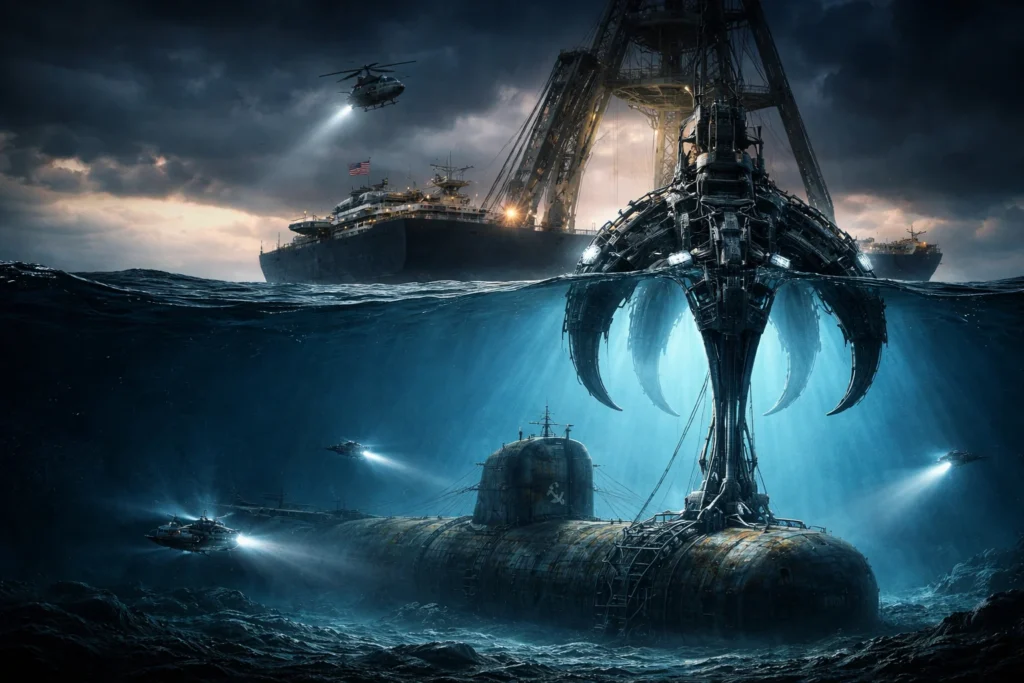

Six kilometers beneath the Pacific Ocean, a giant mechanical claw waits in the dark. The water pressure is so intense that it would crush a military tank like a soda can. The temperature is just above freezing. And somewhere in this endless, silent blackness lies a sunken Soviet Goliath—a submarine packed with nuclear missiles, secret codebooks, and the hidden keys to the Cold War.
The United States wants it back. Not to return it. To steal it.
Imagine trying to find a specific grain of sand on a beach the size of Texas. Now imagine that the grain of sand is made of steel and rust. Now imagine you have to pick it up with a pair of chopsticks attached to a rope that is three miles long. Now imagine that the owner of that grain of sand is watching you from across the street with a pair of binoculars and a very bad temper.
That was the job facing the Central Intelligence Agency in the summer of 1974.
The Cold War between the United States and the Soviet Union was the longest staring contest in human history. Both sides had enough nuclear bombs to turn the entire planet into a parking lot. Neither side could blink. Neither side could afford to be weaker than the other. So when a Soviet submarine carrying nuclear missiles suddenly vanished in the middle of the Pacific Ocean, the CIA saw a once-in-a-lifetime opportunity.
If they could find that submarine, lift it from the abyss, and pick through its wreckage, they could steal the Soviet Union’s most precious secrets. They could learn how to decode enemy messages. They could figure out how to detect Soviet submarines before those submarines got close to American shores. They could even reverse-engineer Soviet nuclear warheads.
There was only one problem.
No one had ever lifted anything that heavy from that deep before. No one had even come close.
The deepest salvage operation attempted before Project Azorian was just a few hundred feet down. The K-129 was resting at a depth of nearly three miles. At that depth, the pressure is about 7,000 pounds per square inch. That means every square inch of that submarine’s hull was being squeezed by the weight of a small car. Humans could not go down there. Standard diving equipment would be crushed instantly. Even the most advanced military submarines of the day could only dive to about 1,500 feet before their hulls started to groan and crack.
The CIA had to invent technology that did not exist. They had to build a ship that looked like one thing but acted like another. They had to hire a famous billionaire as a decoy. They had to lie to Congress, lie to the press, and lie to their own workers. And they had to do it all without the Soviet Union ever finding out.
This is the story of Project Azorian. It is a story of brilliant engineers, desperate spies, and a giant claw named Clementine. It is a story of what happens when humans decide to reach into the deepest, darkest places on Earth and pull out a secret that was never meant to be found.
H2: The Vanished Goliath: A Mystery Wrapped in Rust and Nuclear Fuel
To understand why the CIA was willing to spend nearly a billion dollars on what looked like a crazy fishing trip, we have to go back to the beginning of the Cold War. The year was 1968. The world was tired, scared, and jumpy.
H3: The Cold War’s Dangerous Game
The Cold War was not a war in the normal sense. There were no huge battles with tanks and planes. Instead, it was a war of spies, secrets, and threats. The United States and the Soviet Union both had thousands of nuclear weapons aimed at each other. The theory was simple: if you knew that attacking me would mean your own destruction, you would never attack. They called this “Mutually Assured Destruction,” which had a fittingly scary nickname: MAD.
But MAD only worked if both sides knew what the other side was doing. If the Soviets secretly built a better missile, or found a way to hide their submarines, the balance of power could shift. One side might get confident enough to strike first. That was the nightmare that kept presidents and generals awake at night.
The United States Navy was the best in the world on the surface. But under the waves, the Soviets were catching up. They were building a fleet of submarines that could launch ballistic missiles from underwater. These “boomers,” as they were called, could hide in the vast silence of the deep ocean and wait. If a Soviet submarine got close enough to the American coast, it could launch its missiles and hit Washington, D.C., in less than ten minutes. There would be no warning. No time to fight back.
So the U.S. Navy spent billions of dollars building listening networks. They strung microphones across the ocean floor. They sent spy planes to track Soviet subs. They even built special submarines designed to follow Russian boats without being detected. It was a deadly game of hide-and-seek played in the dark, cold water.
H3: The K-129 Leaves Home
In February 1968, a Soviet submarine called the K-129 left its home port on the Kamchatka Peninsula, a frozen, volcanic finger of land in the far east of Russia. The K-129 was not the newest or fanciest submarine in the Soviet fleet. It was a Golf II class boat, which meant it was diesel-powered rather than nuclear. Diesel submarines have to surface every few days to run their engines and charge their batteries. That makes them noisier and easier to find than nuclear subs, which can stay underwater for months.
But the K-129 was still dangerous. It carried three SS-N-4 ballistic missiles. Each of those missiles carried a nuclear warhead powerful enough to destroy a medium-sized city. The sub also had nuclear torpedoes in its nose. If the K-129 had ever gotten close enough to launch, it could have killed hundreds of thousands of Americans.
The K-129 had a crew of ninety-eight sailors. They were young, mostly in their twenties. Many had left behind wives and children. They had been trained to live in a metal tube for months at a time, breathing recycled air and eating canned food. They knew the risks. Submariners on both sides of the Cold War accepted that if something went wrong deep underwater, there was no rescue. There was only the deep.
The K-129 was heading toward Hawaii. Its mission was to patrol the Pacific and be ready to launch its missiles if World War III started. The crew settled into their routine: eat, sleep, watch the sonar screens, and listen for American destroyers.
But somewhere in early March, something went terribly wrong.
H3: The Explosion That Shook the Ocean Floor
On March 8, 1968, a network of underwater microphones operated by the U.S. Navy picked up an unusual sound. It was not the normal rumble of a submarine engine or the crackle of distant waves. It was a sharp, powerful bang, followed by a series of smaller thuds. The sound was too big to be a torpedo test. It was too deep to be a surface explosion.
The Navy’s sound experts analyzed the recording. They concluded that a submarine had imploded or exploded and sunk to the bottom. The sound had come from a remote part of the Pacific, about 1,500 miles northwest of Hawaii. That was a known patrol area for Soviet submarines.
The United States had a secret weapon in the hunt for lost subs: a network of listening stations called SOSUS (Sound Surveillance System). SOSUS used long arrays of hydrophones—underwater microphones—placed on the ocean floor. These arrays could detect the unique sound signature of different submarines. They could tell the difference between an American sub, a Soviet sub, and a whale singing a love song.
The SOSUS data pointed to one conclusion: a Soviet Golf II submarine had suffered a catastrophic explosion and sunk to the bottom of the Pacific.
The U.S. Navy immediately reported this to the CIA. The CIA’s job was to collect intelligence on the Soviet Union. And this was the biggest piece of potential intelligence to come along in years. If the sub was intact enough, it could contain codebooks, missile designs, and nuclear warheads. It could be a gold mine.
H3: The USS Halibut’s Secret Mission
But finding a sunken submarine in the middle of the Pacific was like looking for a specific car in a junkyard the size of a small country. The Navy needed a special boat, one designed for secret, deep-water searches. They had exactly the right ship: the USS Halibut.
The Halibut was a strange submarine. It had been built as a nuclear missile submarine, but it had been converted into a spy sub. Its missile tubes had been ripped out and replaced with underwater cameras, powerful lights, and a special sonar system that could take pictures of the ocean floor. The Halibut was essentially a deep-sea detective.
In the summer of 1968, the Halibut crept into the area where the explosion had been detected. For weeks, the crew trolled back and forth across the ocean floor, taking pictures and listening for any sign of the wreck. It was boring, exhausting work. The ocean floor at that depth is flat and muddy, covered in a fine gray silt that looks like moon dust. There are no fish, no plants, just endless nothing.
Then, one day, the sonar operator saw something on his screen. A shape. A big shape. It was not a rock. Rocks do not have the long, cigar-shaped profile of a submarine.
The Halibut moved closer. They turned on the underwater lights. And there it was: the K-129, sitting upright on the bottom like a ghost ship waiting for its crew. The hull was cracked in the middle, probably from the explosion, but the front and back sections were mostly intact. The missile hatches were open. The nuclear weapons were still inside.
The crew of the Halibut took hundreds of photographs. They circled the wreck for days, mapping every inch. Then they quietly slipped away and reported back to Washington.
When the CIA director heard the news, he reportedly smiled. He knew that stealing that submarine would be the greatest intelligence coup in American history. He also knew it would be nearly impossible.
H3: Why the Soviets Couldn’t Find Their Own Sub
One of the strangest parts of this story is that the Soviet Union had no idea where the K-129 was. They searched for months. They sent ships and planes across the Pacific. They even asked the United States for help, pretending they had lost a submarine in an accident. The U.S. Navy knew exactly where the sub was, but they kept their mouths shut.
Why couldn’t the Soviets find their own submarine? The answer is technology. The Soviet Navy did not have a deep-sea search system as good as the American SOSUS network. Their underwater listening gear was older and less sensitive. They also did not have a submarine like the Halibut, equipped with deep-sea cameras and sonar. The Soviets were good at building weapons, but they were behind in the subtle art of finding things on the ocean floor.
So the K-129 sat in the dark, waiting. The Soviets eventually declared the sub and its ninety-eight crew members lost forever. They notified the families that their sons and husbands had died. They held memorial services. They moved on.
But the Americans had not moved on. They were already planning the most audacious heist in history.
H2: Building a “Mining Ship” That Was Actually a Trap
The CIA had a problem. A huge problem. They knew where the K-129 was. They knew it contained valuable secrets. But how do you steal a 2,000-ton submarine from three miles underwater without anyone noticing?
The answer came from an unlikely place: the strange, brilliant, and deeply weird mind of Howard Hughes.
H3: The Reclusive Billionaire and the Perfect Cover
Howard Hughes was one of the richest and most famous men in America in the 1960s and 1970s. He had made his fortune in aviation, movies, and tools. He had broken speed records in airplanes. He had produced Hollywood films. But by the late 1960s, Hughes had become a recluse. He lived alone in dark hotel rooms, wearing tissue boxes on his feet to keep his toes clean. He rarely saw anyone. He gave orders through a small group of loyal employees.
But Hughes was also an eccentric genius. He loved big, impossible engineering projects. He had built the Spruce Goose, the largest airplane ever made, even though it only flew once. He was always looking for the next wild challenge.
The CIA saw an opportunity. If they could get Howard Hughes to pretend that he was building a giant deep-sea mining ship, no one would ask questions. Hughes was famous for spending huge amounts of money on weird projects. A ship that could scoop up manganese nodules from the ocean floor sounded exactly like something Hughes would do.
Manganese nodules are small, potato-sized rocks that sit on the deep ocean floor. They are rich in valuable metals like nickel, copper, and cobalt. In the 1970s, a lot of people thought deep-sea mining was going to be the next big industry. It was the perfect cover story. It was boring enough that no one would look too closely, but interesting enough to explain a giant, weird-looking ship.
The CIA approached Hughes with the deal. They would provide the money and the technical experts. Hughes would provide his name and his company’s reputation. The ship would be built by Hughes’s company, but it would be owned and operated by the CIA. The cover story would be that the ship was mining for metals. The real mission was submarine theft.
Hughes agreed. He reportedly thought the whole thing was hilarious. He loved the idea of tricking the Russians and the American press at the same time.
H3: The Great Lie Begins
The CIA created a fake company called Global Marine Development Inc. This company was supposedly in charge of building the mining ship. They leased office space in Los Angeles. They hired real oceanographers and mining engineers to make the cover story look real. These experts had no idea they were actually working on a spy mission. They thought they were designing a mining ship.
The real work was happening in secret. The CIA had gathered a team of the best deep-sea engineers in the world. These men had worked on oil rigs, deep-sea cameras, and military submarines. They were given a simple but terrifying assignment: design a machine that can lift a 2,000-ton submarine from 16,500 feet down.
One of the engineers later said that when he first heard the plan, he laughed out loud. He thought it was a joke. Then he saw the photographs of the K-129 on the ocean floor, and he stopped laughing. He realized the CIA was completely serious.
The engineering challenges were staggering. First, the ship had to be huge. It needed to carry miles of pipe, a giant claw, and enough fuel to stay at sea for months. Second, the ship had to be stable. Waves on the surface can move a ship up and down by twenty feet or more. That movement would snap the pipe string if it wasn’t controlled. Third, the claw had to operate in total darkness, under crushing pressure, without any human control. The crew on the ship could not see the claw. They had to rely on sensors and sonar.
It was like trying to thread a needle while riding a roller coaster in a pitch-black room.
H3: The Construction of the Glomar Explorer
The ship that would make all this possible was named the Hughes Glomar Explorer. It was built in pieces at different shipyards so that no one could see the whole thing at once. The hull was built in Pennsylvania. The special pipe-handling system was built in Florida. The giant claw, nicknamed Clementine, was built in California.
The Glomar Explorer was 619 feet long—longer than two football fields. It was 115 feet wide. It displaced over 50,000 tons of water. It had a giant hole in the middle of the hull called a “moon pool.” The moon pool was a vertical shaft that went from the main deck all the way through the bottom of the ship. This was where the claw would be lowered into the water.
The ship had a special dynamic positioning system. Most ships use anchors to stay in one place. But the water over the K-129 was three miles deep. No anchor rope was that long. Instead, the Glomar Explorer used powerful thrusters and a computer system that talked to sonar beacons on the ocean floor. The computer could adjust the thrusters hundreds of times per second to keep the ship exactly above the wreck, even in rough seas.
Building the Glomar Explorer cost about $200 million. But that was just the ship. The total cost of Project Azorian, including the claw, the research, and the crew, was nearly $800 million. In today’s money, that is over $4 billion.
The CIA paid for all of it using secret funds. They did not tell Congress. They did not tell the President’s full cabinet. Only a handful of people knew the truth. The rest of the world was told that Howard Hughes was building a fancy mining boat.
H3: Clementine: The Claw That Could Catch a Submarine
The heart of Project Azorian was a giant mechanical claw nicknamed Clementine. The name came from an old folk song about a miner who loses his daughter, Clementine. It was a dark joke among the engineers. They were deep-sea miners, and if they lost Clementine, they would lose everything.
Clementine was 200 feet long and weighed about 2,000 tons. It looked like a giant steel bed frame with massive teeth sticking out of the bottom. The teeth were actually long steel pipes that could slide under the submarine. Once the teeth were in place, hydraulic lifts would push up, raising the submarine off the ocean floor.
But Clementine had to do much more than just lift. It also had to close around the submarine like a giant hand. The engineers designed a system of heavy steel doors that could swing shut once the sub was inside. These doors would hold the sub in place while it was lifted to the surface.
Lowering and raising Clementine required a pipe string that was three miles long. The pipe was made of special lightweight steel alloy. Each section of pipe was 60 feet long and weighed several tons. The ship had a huge derrick, like a giant oil rig tower, to stack and connect the pipes. It took about eight hours to lower Clementine to the bottom and another eight hours to bring it back up.
The biggest fear was the pipe breaking. If the pipe snapped under the weight of the claw and the submarine, the whole mission would fail. The claw would fall back to the bottom, and the Soviet sub would be lost forever. The engineers designed the pipe to be flexible enough to bend with the waves but strong enough to hold 2,000 tons. It was a miracle of metallurgy.
H3: The Crew That Didn’t Know the Truth
One of the strangest parts of Project Azorian was the crew. The Glomar Explorer had about 120 crew members. Most of them were ordinary sailors and marine engineers. They had been hired to work on a deep-sea mining ship. They believed they were looking for manganese nodules.
Only about 30 people on board knew the truth. These were the CIA officers and the special engineers who had designed Clementine. The rest of the crew was kept in the dark. They saw the giant claw. They saw the moon pool. But they were told that the claw was a mining bucket and that the moon pool was just an access hatch for ocean floor samples.
The CIA had thought carefully about this. They knew that if the crew knew they were stealing a Soviet submarine, someone might talk. Sailors talk in bars. They write letters home. Secrets leak. By keeping most of the crew ignorant, the CIA reduced the risk of exposure. The sailors who thought they were mining for metals could not spill a secret they did not know.
The CIA also had a cover story for the ship’s destination. They told the crew they were going to a mining site near Hawaii. In reality, the ship sailed to the exact spot where the K-129 lay on the ocean floor. The crew never knew the difference.
H2: The Heist Begins: Sailing Into the Danger Zone
On June 20, 1974, the Hughes Glomar Explorer left the harbor in Long Beach, California. It was a beautiful, sunny day. The ship was painted a dull gray. It looked like a cross between an oil rig and a cargo ship. There were no flags, no banners, no signs of celebration. The ship slipped out of port quietly, like a thief leaving a house in the middle of the night.
The voyage to the wreck site took about two weeks. The Glomar Explorer sailed at a steady, unremarkable speed. It did not want to attract attention. Other ships passed by. Planes flew overhead. No one paid much attention to another strange ship from Howard Hughes’s fleet.
But as the ship got closer to the wreck site, the tension started to build. The crew who knew the truth gathered in the secure areas of the ship, checking and rechecking the equipment. The giant pipe string was laid out on the deck. Clementine sat in the moon pool, its steel teeth gleaming in the artificial light. Everything had to work perfectly. There was no backup plan.
H3: The Russians Are Watching (And Getting Suspicious)
On July 4, 1974, the Glomar Explorer arrived at the wreck site. It was American Independence Day. Fireworks were exploding over cities back home. But here, in the middle of the Pacific, there was only the gray sky and the gray sea.
The crew began the careful process of positioning the ship directly over the K-129. The sonar beacons on the ocean floor sent up signals. The computer controlled the thrusters. Slowly, silently, the ship settled into place.
Then a lookout spotted something on the horizon. A ship. A Soviet ship.
The Russian Navy had not found the K-129, but they had noticed the Glomar Explorer. A strange American ship hanging out in the middle of nowhere for no obvious reason was suspicious. The Soviet ship changed course and headed straight for the Glomar Explorer.
Panic swept through the CIA officers on board. They had expected the Russians to show up eventually, but not this soon. The Glomar Explorer was not ready. The claw was still in the moon pool. The pipe string was not connected. If the Russians got too close, they might see something they shouldn’t.
The captain of the Glomar Explorer ordered the crew to cover the sensitive equipment with tarps. The giant claw was hidden as best as possible. The crew put on their hard hats and pretended to be busy mining workers. A few of the braver sailors walked to the edge of the deck and waved at the approaching Soviet ship.
The Soviet ship pulled within a few hundred yards. Sailors on both sides stared at each other through binoculars. The Russians launched a helicopter. It circled the Glomar Explorer, taking photographs. The whop-whop-whop of the rotors echoed across the water.
One of the CIA officers later said that his heart was beating so hard he could feel it in his throat. If the Russians landed that helicopter, they would see the moon pool. They would see the claw. The secret would be over.
The crew of the Glomar Explorer did something desperate. They ran to the landing pad and stood in a line, blocking the helicopter from landing. They waved their arms and shouted that the pad was not safe. The helicopter hovered for a few minutes, then turned and flew back to the Soviet ship.
For weeks, the Russians stayed nearby. They did not know exactly what the Glomar Explorer was doing, but they knew it was something secret. The American crew had to work around the clock, pretending to be clumsy miners while secretly preparing the claw for the big lift.
H3: The Long Descent
Finally, on July 15, 1974, the Soviet ship sailed away. It had run low on fuel and needed to return to port. The crew of the Glomar Explorer knew they had a small window of time before the Russians came back with a replacement ship. They had to act fast.
The order was given: lower Clementine.
The giant pipe string began its slow, trembling descent into the ocean. Section by section, the crew connected the pipes and fed them through the moon pool. The derrick groaned under the weight. The water in the moon pool churned and bubbled as the claw disappeared into the depths.
It took eight hours to lower Clementine to the bottom. The crew watched the depth gauge tick upward: 1,000 feet, 5,000 feet, 10,000 feet. The pressure outside the claw grew to thousands of pounds per square inch. The steel walls of the pipe flexed and groaned. The ship rose and fell with the waves, and the computer fought to keep the pipe string straight.
At 16,500 feet, the sensors on Clementine reported contact. The claw had reached the ocean floor. The submarine was somewhere nearby.
H3: Finding the K-129 in the Dark
Now came the hardest part. The claw had to find the submarine in total darkness. The cameras on Clementine could only see a few feet in the murky water. The sonar could only paint a fuzzy picture. The operators on the ship had to guide the claw using nothing but those fuzzy images and their own intuition.
It was like trying to pick up a specific coin from the floor of a dark room while wearing oven mitts and standing on a trampoline.
For hours, the crew maneuvered Clementine back and forth across the ocean floor. They bumped into rocks. They stirred up clouds of silt that blinded the cameras. They lost the signal from the sonar beacons. Each time something went wrong, they had to stop, wait for the silt to settle, and try again.
Then, finally, the cameras showed something. A long, dark shape. The K-129.
The submarine was sitting upright in the mud, just as the USS Halibut had seen it years earlier. The hull was cracked near the middle, but the front section looked intact. The missile hatches were open, the tubes empty. The nuclear missiles were still inside.
The operators guided Clementine over the front section of the submarine. The steel teeth slid under the hull. The hydraulic lifts pushed up. The submarine groaned and shifted in the mud. The sensors showed that the claw had a firm grip.
The captain of the Glomar Explorer gave the order: start the lift.
H3: The Snap That Changed Everything
For days, the crew of the Glomar Explorer pulled the submarine toward the surface. The winches turned slowly, relentlessly. The pipe string creaked and groaned. The ship’s computer worked overtime to keep the pipe straight. The crew worked in shifts, eating cold coffee and stale sandwiches, too nervous to sleep.
The depth gauge showed the claw getting closer to the surface: 10,000 feet, 8,000 feet, 5,000 feet. The crew started to believe they might actually pull it off. They were going to steal a Soviet submarine from under the Russians’ noses.
Then, on the third day of the lift, disaster struck.
The depth gauge was reading about 3,000 feet when the ship suddenly lurched upward. The winches spun backward. The pipe string went slack. The weight on the gauges dropped by thousands of tons.
The submarine had broken in half.
Clementine had grabbed the front section of the K-129, but the heavy rear section—the part with the nuclear missiles and the main code room—had slipped through the claw’s grip. The stern section fell back into the abyss. It tumbled through the dark water for three miles and crashed back into the mud.
On the ship, there was silence. The crew stared at the gauges in disbelief. They had come so close. They had done the impossible. And now, half the prize was gone.
The captain made a quick decision. They would continue the lift. They would bring up whatever was left in the claw. Maybe it would still contain something valuable.
The pipe string started to turn again. Slowly, painfully, the claw rose through the final 3,000 feet. The crew held their breath.
When the claw broke the surface, the crew saw what they had caught: a 38-foot section of the submarine’s bow. It was about one-third of the whole boat. The stern, with the missiles and the codes, was gone.
H3: What They Found Inside
The crew opened the giant doors of the moon pool and pulled the wreckage inside the ship. The bow section was a tangled mess of steel, wires, and human remains. The explosion that had sunk the K-129 had been violent. The metal was twisted and blackened.
But there were still valuable things inside.
First, the salvage team found two nuclear torpedoes. These were not the big ballistic missiles the CIA had hoped for, but they were still important. The torpedoes gave American scientists a chance to see how the Soviets built their nuclear warheads. They learned that Soviet nuclear technology was rugged but crude. The Americans were ahead, but not by as much as they had hoped.
Second, the team found pieces of the submarine’s hull and machinery. They analyzed the steel, the welding techniques, and the design of the engines. This information helped the U.S. Navy figure out how noisy Soviet submarines really were. It turned out they were noisier than the Americans had thought. That was good news.
Third, and most importantly, the team found what appeared to be parts of the submarine’s code room. The codebooks themselves were probably lost when the stern fell, but there were scraps of paper, fragments of coding machines, and other clues. Some intelligence experts believe that the CIA was able to piece together enough information to read Soviet naval messages for years after Project Azorian.
But the salvage team also found something else: the bodies of six Soviet sailors. They had been preserved by the cold, dark water. Their uniforms were still intact. Their faces were peaceful.
The CIA now faced a moral question. What do you do with the bodies of your enemy?
H2: The Spoils of War and a Burial at Sea
The CIA decided to give the six Soviet sailors a proper burial at sea. It was a decision that showed a surprising amount of humanity in the middle of a secret spy mission.
H3: A Ceremony in Secret
The crew of the Glomar Explorer prepared the bodies for burial. They wrapped each sailor in a Soviet naval flag. The flags had been secretly sewn by the CIA for this exact purpose. They placed the bodies in a special metal container.
On a calm, gray morning in the middle of the Pacific, the crew gathered on the deck of the ship. A chaplain said prayers. The American flag was lowered, and the Soviet naval flag was raised. The crew stood at attention, their heads bowed.
One of the CIA officers read a short speech in Russian. He thanked the sailors for their service and wished them peace. Then the metal container was tipped over the side of the ship. It splashed into the water and disappeared beneath the waves.
The crew played the Soviet national anthem. It was a strange, haunting sound in the middle of the Pacific, surrounded by American sailors who had just stolen their submarine.
The CIA filmed the entire ceremony. The footage was kept secret for nearly twenty years. When the Cold War ended, CIA Director Robert Gates gave a copy of the video to Russian President Boris Yeltsin. Yeltsin reportedly watched it in silence, then thanked Gates with tears in his eyes. The families of the lost sailors finally knew that their sons and husbands had been honored, even by their enemies.
H3: What the CIA Didn’t Get
The loss of the stern section was a bitter blow. The CIA had wanted the nuclear missiles. They had wanted the codebooks. They had wanted the submarine’s logbooks, which would have told them exactly what the K-129 was doing when it sank.
Without those things, Project Azorian was only a partial success. The CIA had proven that it was possible to lift a submarine from three miles down. They had recovered some valuable intelligence. But they had not gotten the big prize.
Some experts later argued that the CIA was too ambitious. They should have tried to lift the submarine in smaller pieces. They should have built a claw that could grab the stern separately. But hindsight is always 20/20. At the time, the engineers did the best they could with the technology they had.
The stern section of the K-129 still sits on the ocean floor today. It is covered in silt and rust. The nuclear missiles are still inside. The codebooks are still scattered across the mud. Russian and American ships still visit the site from time to time, just to make sure no one else is trying to steal it.
H2: The Blowout: How a Burglar Busted the Secret
The CIA had planned to keep Project Azorian a secret forever. They had planned a second mission, called Project Matador, to go back and recover the stern section that had fallen off. But those plans were ruined by a burglar in Los Angeles.
H3: The Theft That Changed Everything
In June 1974, just as the Glomar Explorer was sailing toward the wreck site, a group of thieves broke into Howard Hughes’s office in Los Angeles. They stole a safe full of documents. Among those documents was a memo that mentioned the Glomar Explorer and the CIA.
The thieves did not know what they had. They tried to sell the documents to various people. Eventually, the FBI got involved. The FBI recovered most of the documents, but word started to leak out. Journalists began asking questions.
A reporter named Jack Anderson was famous for exposing government secrets. He had a network of sources inside the intelligence community. In early 1975, Anderson got hold of the story. He learned that the Hughes Glomar Explorer was not a mining ship. It was a CIA spy ship. And it had tried to steal a Soviet submarine.
On March 18, 1975, Anderson went on national television and spilled the beans. He described the entire mission in detail. He named the ship. He named the submarine. He even described the claw.
The headline in the Los Angeles Times the next morning read: “U.S. Reported After Russ Sub.”
The story spread around the world. The Soviet Union was furious. They issued a formal protest to the United Nations. They accused the United States of piracy on the high seas. They sent a warship to the wreck site and announced that they would shoot down any American aircraft that came too close.
Project Matador was canceled. The CIA could not go back for the stern section. The rest of the K-129 would stay on the ocean floor forever.
H3: The “Glomar Response”
When reporters asked the CIA for details about Project Azorian, the agency refused to comment. They came up with a clever phrase that has become famous in legal and spy circles. They said they could “neither confirm nor deny” the existence of the project.
This became known as the “Glomar response.” It is still used today by government agencies when they want to avoid answering a question without actually lying. If an agency says it can neither confirm nor deny something, it is usually a sign that the something is true.
The Glomar response has been used in hundreds of Freedom of Information Act cases. It has become a standard tool of government secrecy. And it all started with a stolen submarine and a burglar in Los Angeles.
H2: The Aftermath: What Happened to the Players?
Project Azorian ended in 1975, but the story did not end there. The people involved went on to live strange and interesting lives.
H3: The Glomar Explorer’s Second Life
The Hughes Glomar Explorer was too expensive to scrap and too famous to hide. The CIA tried to sell it, but no one wanted a giant spy ship with a hole in the bottom. Eventually, the ship was sold to a real deep-sea mining company. It was converted into a drillship for oil exploration.
For years, the Glomar Explorer drilled for oil in the Pacific and the Atlantic. It was a strange fate for a ship that had been built to steal a submarine. The ship was finally scrapped in 2015. Most of it was melted down and turned into scrap metal.
The giant claw, Clementine, was stored in a warehouse in California. It sits there today, rusting and forgotten. Occasionally, a visitor will ask about it. The warehouse workers usually just shrug. They have no idea what it is.
H3: Howard Hughes’s Strange End
Howard Hughes never publicly acknowledged his role in Project Azorian. He continued to live as a recluse, hiding in hotel rooms and giving orders through intermediaries. He grew more and more paranoid. He stopped cutting his hair and fingernails. He ate only soft foods because he was afraid of breaking his teeth.
Hughes died in 1976, on a private plane flying from Mexico to Houston. He was 70 years old. When the doctors examined his body, they found that he had been severely malnourished and dehydrated. His kidneys had failed. His arms were covered in needle marks from all the painkillers he had taken.
The world never learned the full extent of Hughes’s involvement in Project Azorian until years later. His legacy is a strange mix of genius, madness, and secrecy. He helped the CIA pull off one of the greatest heists in history, and he never told a soul.
H3: The Crew’s Silence
The sailors and engineers who worked on Project Azorian kept their secrets for decades. Many of them took their stories to the grave. They had signed secrecy agreements. They had been warned that talking would mean prison time.
In the 1990s, after the Cold War ended, some of the crew members started to speak publicly. They wrote books. They gave interviews. They told the world what they had done.
One of the engineers, a man named Dave Sharp, said that he still has nightmares about the pipe string snapping. He said he can still hear the groaning of the steel and the shouting of the crew. He said he is proud of what they accomplished, but he is also sad about the sailors who died.
Another crew member, a young sailor named Mike, said that he did not learn the truth about Project Azorian until he saw it on television years later. He had spent months on the Glomar Explorer thinking he was mining for metals. He was shocked to learn that he had been part of a spy mission. He laughed when he told the story. He said it was the best job he never knew he had.
H3: The Soviet Reaction
The Soviet Union never fully recovered from the embarrassment of Project Azorian. They had lost a submarine and not even known where it was. The Americans had found it, lifted it, and stolen its secrets. And the Russians had been powerless to stop it.
The Soviet government tried to downplay the incident. They called it a “provocation” and a “capitalist plot.” But internally, the Soviet Navy was furious. They launched a review of their submarine safety procedures. They improved their deep-sea search capabilities. They never lost another submarine without knowing where it went.
After the Cold War ended, Russian officials quietly acknowledged that Project Azorian had been a brilliant piece of engineering. They still did not like it, but they respected the skill and audacity of the Americans who had pulled it off.
H2: The Legacy of Project Azorian: Did It Matter?
Historians and intelligence experts still argue about whether Project Azorian was worth the money. $800 million was a huge sum in the 1970s. That money could have built schools, hospitals, or roads. Instead, it was spent on a giant claw that broke a submarine in half.
H3: The Intelligence Wins
The CIA says that Project Azorian was a success. They point to the nuclear torpedoes, the hull samples, and the codebook fragments. They say that the intelligence gathered from the K-129 helped the United States maintain its edge over the Soviet Union for the rest of the Cold War.
Some experts disagree. They say that the information recovered from the K-129 was not worth the cost. They say that the CIA could have learned the same things from spy satellites and human agents. They say that Project Azorian was a giant waste of money driven by ego and Cold War paranoia.
The truth is probably somewhere in the middle. The K-129 did contain valuable secrets. But those secrets were not the silver bullet that won the Cold War. The Cold War ended because of economic pressure, political change, and the sheer exhaustion of the Soviet system. A rusty submarine from the bottom of the ocean had very little to do with it.
H3: The Engineering Legacy
Project Azorian’s real legacy is in engineering. The technology developed for the mission—the deep-sea cameras, the pipe-handling systems, the dynamic positioning—is now used all over the world. Oil companies use similar systems to drill in deep water. Oceanographers use similar technology to explore the deepest trenches of the sea.
Without Project Azorian, deep-sea technology might have taken decades longer to develop. The engineers who built Clementine were pioneers. They pushed the limits of what was possible. They proved that humans could reach into the abyss and touch the bottom of the ocean.
That legacy lives on every time an oil rig drills in a mile of water or a research submersible explores a deep-sea vent. The technology is so common now that we take it for granted. But it all started with a secret CIA mission to steal a Soviet submarine.
H3: The Human Legacy
The most lasting legacy of Project Azorian is the human story. Ninety-eight Soviet sailors died when the K-129 exploded. They left behind families who never knew what happened to them. The CIA gave six of those sailors a proper burial. The other ninety-two are still scattered across the ocean floor.
In 1992, a Russian Navy ship sailed to the wreck site of the K-129. The crew lowered a metal plaque to the bottom. The plaque was inscribed with the names of the ninety-eight sailors and a simple prayer: “Rest in peace.”
The Cold War is over. The Soviet Union is gone. The United States and Russia are no longer enemies. But the deep sea still holds its secrets. The K-129 still sits on the bottom of the Pacific, slowly rusting away. The nuclear missiles are still there. The codebooks are still scattered in the mud.
Maybe someday, someone will go back for the rest of the sub. Maybe not. Either way, the story of Project Azorian will remain as one of the strangest, boldest, and most audacious missions in the history of espionage.
H2: Conclusion: The Audacity of Azorian
Project Azorian was a mission born of fear and ambition. The Cold War made people do crazy things. They built bombs that could destroy the world. They built submarines that could hide for months. And they built a giant claw to steal an enemy’s secrets from three miles under the sea.
The mission did not go perfectly. The submarine broke in half. The stern fell back to the bottom. The secret got out. The Russians found out. The CIA had to cancel the second mission.
But in the end, Project Azorian succeeded in ways that mattered. It proved that humans could do the impossible. It gave the United States valuable intelligence about its enemy. It showed that even in the darkest depths of the Cold War, there was room for honor and humanity.
The deep sea does not give up its secrets easily. The K-129 is still down there, waiting. The claw that tried to grab it is rusting in a warehouse. The ship that carried it has been turned into scrap.
But the story remains. It is a story of engineers who refused to give up, spies who refused to blink, and sailors who died in the cold, dark water far from home. It is a story of how close we came to the edge, and how far we were willing to go to stay ahead.
And somewhere, three miles beneath the Pacific, the rest of the K-129 waits. The nuclear missiles are still there. The secrets are still buried in the mud. The deep sea keeps its own counsel.