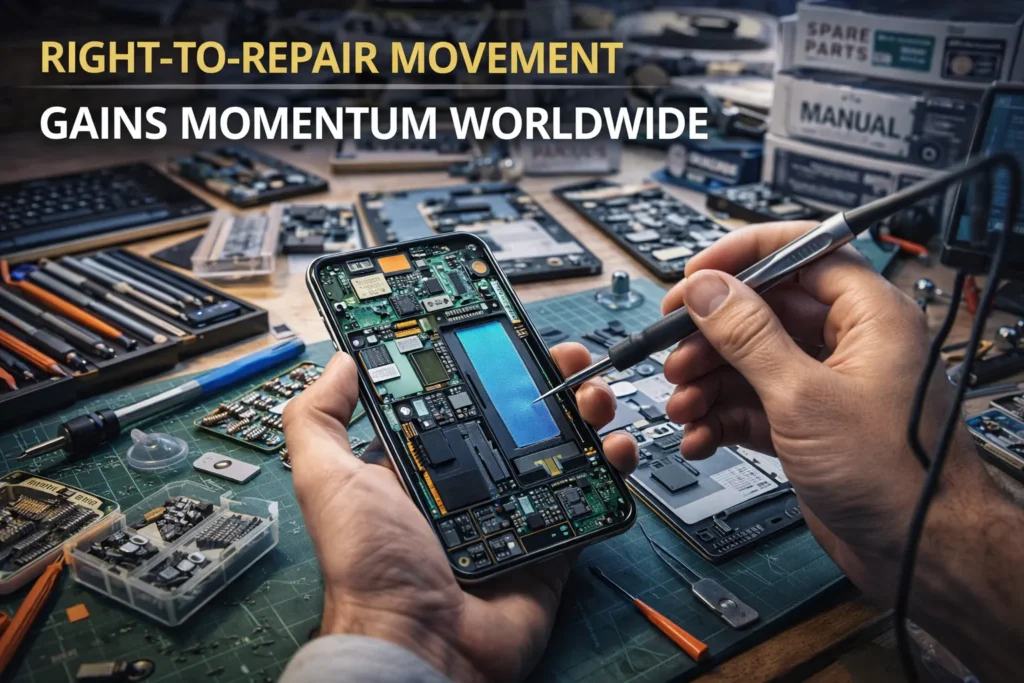

Imagine this. You are sitting at your kitchen table on a rainy Saturday morning. You spill a glass of water. Not a big deal—except your laptop was sitting right next to the glass. You dry it off fast, but the screen starts flickering. Then the keyboard stops working. Your heart sinks.
You call the company that made your laptop. They say, “Sorry, that model is two years old. We don’t sell replacement keyboards. You can send it to us for $400, or you can buy a new laptop for $1,200.”
You look at the broken machine. It worked perfectly five minutes ago. Now it is basically a brick. You feel stuck. You feel frustrated. And you feel something else, too: a quiet anger that you don’t even have the option to fix it yourself.
If that story makes you angry, you are not alone. Millions of people around the world feel exactly the same way. And that shared frustration has grown into a global movement called Right-to-Repair.
This is not a small trend. It is not just a few geeks in basements with soldering irons. This is a serious, growing, worldwide push to change the law, change how companies behave, and change the way we think about the stuff we own.
Let me tell you the whole story. It is a story about glue, secret software, angry farmers, French shopping scores, and a future where you actually own your phone.
Part One: How We Lost the Right to Fix
The Good Old Days of Repair
Let me take you back in time. Not ancient history. Just the 1980s or 1990s.
Your dad’s car broke down? He popped the hood. Your grandma’s radio got staticky? She took off the back cover. Your VCR ate a tape? You unscrewed four screws and pulled out the tangled ribbon.
Back then, things were made to be fixed. Companies actually printed repair manuals on paper and included them in the box. You could walk into any hardware store and buy a part. If you didn’t know how to fix something, your neighbor did. Repair was a normal, boring, everyday part of life.
Then everything changed.
The Computer Revolution (And the Glue Gun)
When computers started shrinking, manufacturers faced a problem. Small devices are harder to build. To make a phone thin enough to fit in your pocket, you cannot use big screws and easy-access panels. You have to glue things together. You have to stack parts on top of each other like a tiny, electronic lasagna.
At first, this was just a design choice. But very quickly, companies realized something sneaky. If a customer cannot fix a device, they have to buy a new one. And buying new devices is incredibly profitable.
So the glue got stronger. The screws got weirder. Apple created the pentalobe screw, a five-pointed star shape that no normal screwdriver could turn. If you didn’t have that specific, secret tool, you couldn’t even open the case.
Batteries went from sliding out the back to being buried under the motherboard, held down by industrial-strength adhesive. Screens were fused to glass so that cracking the glass meant replacing the entire display assembly for $300 instead of a $5 piece of glass.
The Warranty Void Scare Tactic
Have you ever seen those little stickers that say “Warranty void if removed”? They are usually placed over a screw hole. For decades, companies told us that if we peeled that sticker, we lost our right to any free repairs forever.
Here is the truth that repair advocates have been screaming for years: those stickers are illegal in the United States. The Federal Trade Commission (FTC) said back in the 1970s that “warranty void if removed” stickers are not allowed under the Magnuson-Moss Warranty Act. But companies kept using them anyway because most people did not know the law. They scared us into compliance.
That fear—the fear of breaking the warranty, the fear of “messing it up,” the fear of getting shocked—is a huge reason why we stopped fixing things. We handed our power over to the manufacturers.
Part Two: The Birth of a Movement
The First Spark: Automobiles
The modern Right-to-Repair fight actually started with cars, not phones. In the early 2000s, car companies began putting computers in vehicles. Those computers controlled everything: the engine timing, the brakes, the airbags, the transmission.
Independent mechanics (your local shop, not the dealership) realized they could no longer diagnose problems. The car’s computer held secret error codes, and only the dealership had the key to read them. If you took your car to Joe’s Garage, Joe could not even tell you why the “check engine” light was on.
Massachusetts passed the first auto Right-to-Repair law in 2012. It forced car companies to share their diagnostic information with all repair shops. Today, thanks to that law, you can take your car to almost any mechanic. The auto industry fought it hard, but they lost. And that victory became the blueprint for everything that came next.
The Smartphone Explosion
While the car fight was happening, something else exploded: the smartphone. In 2007, the iPhone changed everything. It was a beautiful, seamless, glass-and-metal slab. It looked like it came from the future. But it was also a repair nightmare.
The battery was not removable. The screen was glued in. The screws were tiny and weird. And Apple set up a system where only “Apple Geniuses” could open the phone. If you tried to do it yourself, you would probably crack the glass or tear a ribbon cable.
At first, people accepted this. The phone was magic. Who would want to open magic?
But over time, the frustration grew. Batteries wear out. Screens crack. Charging ports get full of pocket lint. These are simple, normal problems. And the only official solution was to pay Apple $80 for a battery or $300 for a screen repair. Or buy a new phone for $1,000.
The First Repair Heroes
In 2003, a guy named Kyle Wiens was in college. He dropped his laptop and cracked the screen. Apple said it would cost $800 to fix. Kyle thought that was insane. So he bought a replacement screen on eBay for $100, found a PDF manual online, and fixed it himself.
He realized that the only thing stopping most people from fixing their own stuff was a lack of information. So he started a website called iFixit. The idea was simple: take things apart, photograph every step, and post the instructions for free. Ifixit became the Wikipedia of repair. Today, it has millions of visitors every month. They sell tools and parts, too, but the heart of the site is the belief that knowledge should be free.
Then came Louis Rossmann. If iFixit was the librarian of repair, Louis was the angry street preacher. He ran a tiny repair shop in Manhattan. He specialized in fixing MacBooks that Apple had given up on. Louis filmed himself working on the dirty, soldering-smoke-filled bench. He cursed. He laughed. He showed the world the dirty secrets of Apple’s repair policies.
He showed how Apple used software to detect “unauthorized” repairs. Even if you replaced a broken screen with an identical official Apple screen, the computer would detect that the serial number didn’t match and would disable the True Tone feature. The screen would work, but it would look slightly yellow and wrong. This was not a safety issue. This was not a technical limitation. This was a deliberate middle finger to anyone who tried to fix their own computer.
Louis became a folk hero. He testified in front of the New York State Senate. He debated Apple’s lawyers on YouTube. He made repair cool.
Part Three: The Unlikely Heroes – Farmers
A Tractor Is a Computer Now
If you had asked me ten years ago who would be the loudest voice for Right-to-Repair, I would have guessed tech nerds or environmentalists. I would never have guessed farmers. But farmers changed everything.
Let me explain. A modern tractor is a marvel of engineering. It has GPS that can steer itself within an inch of accuracy. It has sensors that measure soil moisture, seed spacing, and fuel efficiency. It has a giant touchscreen display in the cab that looks like a Tesla’s dashboard.
These tractors cost $300,000 to $800,000. For a family farm, that tractor is the most expensive thing they own besides their land. When harvest season comes, the tractor runs 18 hours a day. It cannot break down. But it does break down. Everything breaks.
The John Deere Nightmare
The problem started when John Deere, the biggest tractor company in the world, began locking down their software. If a sensor failed or an error code appeared, the tractor would slow down or stop completely. The only way to clear the error was to plug in a dealership computer and run a proprietary program.
The dealership might be 100 miles away. Their mechanic might be busy with five other broken tractors. They might not be able to come for three days. Meanwhile, the farmer is losing $5,000 per day in unharvested crops. The farmer is watching the weather forecast, knowing that rain is coming tomorrow, which will ruin the wheat if it is not cut today.
So some farmers tried to hack their own tractors. They found Ukrainian software that could bypass the locks. They shared instructions on Facebook groups. They fixed their own $500,000 machines with $50 laptop cables and a lot of prayer.
John Deere responded by suing farmers for copyright infringement. Yes, copyright. They argued that the tractor’s software was protected intellectual property, and that fixing your own tractor was a form of piracy.
This infuriated the farming community. These were not activists. These were conservative, salt-of-the-earth, business owners. They had never protested anything in their lives. But John Deere pushed them too far.
The Nebraska Fight
In 2015, the American Farm Bureau Federation (a huge farming organization) started pushing for Right-to-Repair laws. They partnered with repair advocates like Kyle Wiens and Louis Rossmann. It was an unlikely alliance: Nebraska corn growers and New York City laptop repair guys. But they had a common enemy.
The farmers testified in state legislatures across the Midwest. They told stories about losing entire harvests because of a software lock. They held up broken tractors and said, “I own this. Let me fix it.”
Their voices were powerful because they could not be dismissed as “lazy millennials who want to save the planet.” These were business owners who just wanted to run their businesses. The movement gained serious credibility.
Part Four: The Environmental Disaster We Cannot Ignore
The E-Waste Mountain
Let me give you a mental picture. Imagine a line of dump trucks, bumper to bumper, stretching from New York City to Los Angeles. Now imagine that line of dump trucks driving past you every single day. That is how much electronic waste—e-waste—the world creates every year.
Fifty million tons. That number is so big it stops meaning anything. So let me break it down differently.
Every year, we throw away:
- 150 million phones
- 40 million laptops
- 20 million tablets
- 300 million other devices (smart watches, headphones, game consoles, smart speakers)
Most of these devices are not broken. They are just old. Or slow. Or the battery doesn’t last as long as it used to. Or the screen has a tiny crack that costs $300 to fix, so you just buy a new one.
Where Does It Go?
Here is the part that should make you angry. A huge amount of our e-waste does not get recycled in clean, safe factories. Instead, it gets loaded onto cargo ships and sent to developing countries, especially in West Africa and Southeast Asia.
In Agbogbloshie, Ghana, there is a massive e-waste dump. It is a wasteland of smoking piles of computer monitors, crushed printers, and shattered phone screens. Young boys—some as young as eight years old—walk barefoot through the toxic ash. They smash circuit boards with rocks to get at the tiny flecks of copper and gold inside. They burn plastic wires over open fires to melt off the insulation and get at the metal.
The smoke contains lead, mercury, arsenic, and cadmium. The boys breathe it in. The water in the nearby stream runs blue and green from dissolved metals. People get sick. People die young. And all of this happens so that we can buy a new phone every 18 months.
The Right-to-Repair movement says: this is insane. The vast majority of this e-waste could be avoided if we simply fixed our devices. A phone that lasts six years instead of two cuts the waste stream by two-thirds.
The Carbon Footprint of a Laptop
It is not just about the dump. It is also about the climate. Making a new laptop requires mining rare earth metals from deep pits in China or Congo. Those metals have to be shipped to factories. The factories use huge amounts of energy to melt, shape, and assemble the parts. Then the finished laptop is shipped across an ocean to you.
By the time you open the box, that laptop has already created about 300 kilograms of carbon dioxide. To put that in perspective, driving a car for 700 miles creates the same amount.
If you use that laptop for four years and then replace it, you have created a carbon footprint of about 75 kilograms per year. If you repair it and use it for eight years, you cut that footprint in half. And you avoid mining more metals, which is destructive to mountains, rivers, and the people who live near the mines.
The greenest device is the one you already own. Repair is climate action. Full stop.
Part Five: Europe Takes the Lead
The EU’s Bold Move
While the United States was still arguing, Europe got to work. The European Union is a group of 27 countries that make laws together. And in 2019, they passed something that changed the game: a law requiring manufacturers to provide spare parts for up to 10 years for certain products.
Let me repeat that. Ten years.
If you buy a washing machine in Paris in 2026, the company must still sell you a door seal, a heating element, and a control board in 2036. They cannot just say “sorry, that model is discontinued.” They have to support it for a decade.
The EU law also says that repairs must be possible with common tools. No more pentalobe screws. No more glue that requires a heat gun and a prayer. A regular person with a regular screwdriver should be able to replace the basic parts.
France’s Repairability Index (Genius Idea)
France took it even further. In 2021, France introduced the Repairability Index. When you go to buy a new laptop, television, smartphone, or lawnmower in France, the box has a clear score from 0 to 10.
A score of 0 means “this thing is glued shut, has no spare parts, and you will throw it away in a year.” A score of 10 means “easy to open, cheap parts available, and clear instructions online.”
Suddenly, manufacturers started caring about repairability. Not because they wanted to, but because French customers could see the score before buying. A laptop with a 4/10 sat on the shelf while a laptop with an 8/10 flew off the shelf.
Companies like Samsung and Apple quietly started making their devices more repairable so they could get better scores. The index worked exactly as intended: it used the power of the market, not just regulation, to change behavior.
What Comes Next: The Right to Repair Directive
The EU is now working on a broader “Right to Repair Directive” that would go even further. It would require companies to offer repairs at a “reasonable price.” It would ban “contractual, hardware, or software barriers” to repair. It would create online platforms to connect broken device owners with independent repair shops.
If this directive passes (and it likely will), Europe will have the strongest repair laws in the world. And because Europe is such a huge market, companies will have to apply those changes globally. It is much cheaper to make one repairable phone for everyone than to make two versions (one for Europe, one for everywhere else). So Europe’s laws will effectively raise the repair standard for the entire planet.
Part Six: The United States Finally Moves
Years of Stalling
For a long time, the US lagged behind. Big tech companies spent millions of dollars lobbying against Right-to-Repair bills in state legislatures. They hired former members of Congress to argue that repair laws would “help hackers” or “cause fires.”
These arguments were mostly nonsense. There is no evidence that allowing people to fix their own phones increases hacking. And batteries can be dangerous, sure, but so are car engines. We let people change their own oil and brakes. We can handle a phone battery.
The real reason the industry fought so hard was money. Apple’s services division (which includes repairs) makes over $20 billion per year. That is more money than the entire GDP of some small countries. They did not want to give that up.
The First Crack: New York
In 2022, after years of failed attempts, New York State passed the first Right-to-Repair law in the United States. It was not perfect. In fact, many advocates were disappointed. The law exempted many products, including cars, medical devices, and farm equipment (ironically, the very thing that started the fight). It also allowed manufacturers to sell “assemblies” instead of individual parts. For example, instead of selling a $10 charging port, they could sell a $200 “logic board assembly” that includes the port.
Still, it was a crack in the dam. For the first time, a major US state had said, “Consumers have a right to fix their stuff.”
The Wave Spreads
After New York, other states moved quickly.
Colorado passed a law focused on electric wheelchairs and other mobility devices. This was a huge win for people with disabilities, who often rely on expensive, hard-to-fix equipment.
Minnesota passed a broad law covering electronics, including phones, laptops, and tablets. Minnesota’s law was stronger than New York’s because it required manufacturers to provide parts to independent repair shops, not just to individuals.
California, the home of Silicon Valley, passed a law in 2024. This was a major blow to the tech industry. When California speaks, the world listens. California’s law requires manufacturers to provide parts, tools, and manuals for devices sold after July 1, 2024, for three years for devices under $100 and for seven years for devices over $100.
Oregon passed a law specifically targeting “parts pairing”—the practice of using software to block repairs even when the hardware is identical. Oregon’s law says that if a part is functionally identical, the software cannot reject it. This is a huge deal because it strikes at the heart of the software locks that Louis Rossmann and others have fought for years.
Federal Interest
In Washington, DC, the Federal Trade Commission (FTC) has taken notice. Under the Biden administration, the FTC issued a report called “Nixing the Fix,” which condemned repair restrictions and promised to enforce existing laws against warranty void stickers. The FTC also sued several companies (including Harley-Davidson and Weber) for illegally voiding warranties if customers used third-party parts.
The federal government has not yet passed a national Right-to-Repair law. But the momentum is building. Several bills have been introduced in Congress. It may still take a few years, but the direction is clear.
Part Seven: The Companies That Get It
Fairphone: The Lego Phone
Not every company fought the movement. Some saw the future and built their entire business around it.
Fairphone is a Dutch company that makes a phone you can repair with your fingernail. No joke. The back cover snaps off. The battery slides out. The screen is held in by two tiny screws. The camera module pops out. The charging port is a separate little board that you can replace for $20.
You do not need a heat gun. You do not need a pentalobe screwdriver. You do not need a YouTube tutorial (though they have them). You just need the tiny screwdriver that comes in the box.
Fairphone also focuses on ethical sourcing. They buy tin and tantalum from mines in conflict-free regions. They pay fair wages to their assembly workers in China. They design the phone to last five years (and they provide software updates for that long, too).
The Fairphone is not the fastest phone. It does not have the best camera. But it is the most repairable phone on the planet. And thousands of people have bought it specifically for that reason.
Framework: The Laptop You Actually Own
Framework is doing for laptops what Fairphone did for phones. Their laptop is a modular dream. Every single port (USB-C, USB-A, HDMI, DisplayPort, headphone jack) is a tiny magnetic tile. You can slide them in and out. If your charging port breaks, you slide out the old tile and slide in a new one for $15.
The battery is held in by four screws. The memory and storage are standard off-the-shelf parts (not soldered to the motherboard). The screen is replaceable. The keyboard is replaceable. Even the motherboard (the main brain of the laptop) can be upgraded. You can buy a new motherboard three years later and snap it into the same case, keeping your screen, keyboard, battery, and ports.
Framework publishes all their repair manuals online for free. They sell every single part on their website. They have partnered with iFixit to sell tools and parts, too.
When Framework released their first laptop, the big companies (Dell, HP, Lenovo) did not know what to do. They had spent 20 years making laptops thinner and less repairable. Now here was a startup proving that you could have a thin, light, powerful laptop that was also easy to fix.
Apple’s Slow, Reluctant Shift
Even Apple, the king of repair restrictions, has started to move. Under pressure from investors and lawmakers, Apple launched a Self Service Repair program in 2022. For the first time, regular people could buy genuine Apple parts (screens, batteries, cameras) and rent Apple tools to fix their own phones.
The program is not perfect. The parts are still expensive. The rental tool kit costs $49 and weighs 70 pounds (it comes in two huge Pelican cases). The software still requires you to call Apple to “authorize” the repair, which can take hours.
But it is a start. Five years ago, the idea of Apple selling a screen to a random person was unthinkable. Now it is real. The movement forced them to change.
Part Eight: The Next Battles
Parts Pairing: The Final Boss
We have won many battles. Screws are getting simpler. Spare parts are becoming available. Warranty void stickers are disappearing.
But the final boss is parts pairing. This is the practice of using software to lock a part to a specific device. Even if you buy an identical, genuine, official part from the manufacturer, the device will reject it unless you also have a special software tool that only the manufacturer’s authorized repair centers possess.
Apple does this with screens, batteries, and cameras. If you replace an iPhone screen with another official Apple screen, True Tone stops working. The phone shows an annoying “Unknown Part” warning in settings forever. The warning does not affect performance. It is purely a psychological scare tactic.
John Deere does this with tractors. If you replace a sensor with an identical sensor from the same factory, the tractor’s computer says “unauthorized part” and limits speed to 5 miles per hour.
Parts pairing has no legitimate safety or security justification. It exists for one reason: to force you to go to authorized repair centers where the manufacturer controls the price.
Oregon’s new law takes aim at parts pairing. The EU’s upcoming directive will ban it outright. This is the frontier of the movement.
Medical Devices: Life and Death
The next major frontier is medical devices. CPAP machines (for sleep apnea), insulin pumps, continuous glucose monitors, and even hospital ventilators are increasingly locked down. If a CPAP machine breaks, you cannot fix it yourself. You cannot even take it to a local electronics repair shop. You have to send it back to the manufacturer.
For someone with severe sleep apnea, being without a CPAP machine for two weeks means two weeks of terrible sleep, headaches, and increased risk of heart problems. For someone with diabetes, a broken insulin pump could be life-threatening.
Medical device manufacturers argue that repairs must be done by trained professionals to ensure safety. That is a fair point. But the Right-to-Repair movement responds: then let us train more professionals. Provide the manuals and parts to independent medical equipment repair shops. Create a certification program. Do not force every single repair to go through the manufacturer’s slow, expensive channel.
Several states are now considering Right-to-Repair laws for medical devices. This is a harder fight because safety is a genuine concern. But the movement is pushing forward.
Gaming Consoles: The Black Box Problem
If you have ever owned a PlayStation, Xbox, or Nintendo Switch, you know the frustration. These devices are black boxes. You cannot replace the hard drive easily. You cannot fix a broken HDMI port without advanced soldering skills. The controllers use weird screws and glued-in batteries.
Sony, Microsoft, and Nintendo have all fought repair laws aggressively. They argue that opening consoles could allow cheating or piracy. But repair advocates point out that you can already cheat and pirate games without opening the console. The security argument is weak.
The Nintendo Switch is a particular nightmare. The Joy-Con controllers are famous for “drifting”—the thumbstick moves on its own even when you are not touching it. This is a hardware flaw. Nintendo offered free repairs for a while, but the program was slow and annoying. Many people just bought new controllers for $80. The right-to-repair movement says: sell us the replacement thumbsticks for $5 and let us fix it ourselves.
Part Nine: How You Can Be Part of the Story
You do not need to be a lobbyist or a YouTuber or a farmer to help the Right-to-Repair movement. Every single person can make a difference with small, everyday choices.
Before You Buy, Check the Score
Before you spend money on a new phone, laptop, tablet, or even a coffee maker, do a quick search. Type the model name plus “repairability” or “iFixit score.” If the device has a low score (say, 2 out of 10), think twice. Is it really worth buying something that is designed to fail?
If enough people start voting with their wallets, manufacturers will notice. They always do.
Buy Used or Refurbished
The most repair-friendly device is one that already exists. Buying a used or refurbished phone keeps that device out of the dump and avoids the environmental cost of manufacturing a new one. Plus, it is usually much cheaper.
Refurbished phones often come with a warranty. Sites like Back Market, Swappa, and even Amazon Renewed sell certified refurbished devices. You can save hundreds of dollars and help the planet at the same time.
Learn One Repair Skill
You do not need to become a master electrician. Just learn one thing. Learn how to replace a phone battery. Learn how to swap a laptop hard drive. Learn how to fix a broken headphone plug with a soldering iron (it is easier than it looks).
Once you fix one thing, you will feel a rush of confidence. You will realize that these devices are not magic. They are just machines. And machines can be understood.
YouTube is your friend. There is a repair tutorial for almost everything. Search for “replace battery [your phone model]” or “fix broken charging port [your device].” Watch the video before you start. Take your time. Use the right tools (a basic iFixit toolkit costs $30 and contains every bit you will ever need).
Find a Repair Cafe
In hundreds of cities around the world, volunteers gather once a month at repair cafes. You bring your broken toaster, your dead lamp, your slow laptop. They bring their tools and their knowledge. You sit together, drink coffee, and learn how to fix it.
Repair cafes are free (though donations are welcome). They are also incredibly fun. You meet interesting people. You learn weird skills. And you save stuff from the landfill.
To find a repair cafe near you, search “repair cafe [your city name].” If there is not one, consider starting one. The international Repair Cafe Foundation has free guides to help you get started.
Call Your Representatives
This sounds like homework, but it is actually easy. Your state representative and your member of Congress have staff whose job is to listen to constituents. You can send an email or leave a voicemail in 60 seconds.
Say: “Hi, I am a voter in your district. I support Right-to-Repair laws. Please co-sponsor the [name of bill] and vote yes when it comes to the floor. Thank you.”
One call does not change the world. But a thousand calls do. A hundred thousand calls definitely do. Politicians pay attention when people speak up.
Share the Story
Tell your friends. Post on social media. When your cousin complains about a $400 phone repair, tell them about Right-to-Repair. When your coworker throws away a laptop with a broken keyboard, ask them if they considered fixing it.
Movements grow when stories spread. You are reading this article right now. You are part of the story. Share it.
Part Ten: The Future We Are Building
A World Without E-Waste
Imagine a future where electronic waste is rare. Not because we stopped using electronics, but because we stopped throwing them away.
In this future, every phone has a removable battery. Every laptop has standard screws. Every device comes with a repair manual in the box (or a QR code that leads to a free video). Spare parts are sold on Amazon for cheap. Repair shops are on every main street, like coffee shops.
When your phone screen cracks, you pay $20 for a replacement and spend 15 minutes fixing it. When your laptop battery wears out after three years, you spend $30 and five minutes swapping it. When your earbuds stop charging, you clean the contacts instead of throwing them away.
This future is not a fantasy. It is technically possible today. The only thing standing in the way is corporate policy and outdated laws. And both of those are changing, right now, as you read this.
The End of Planned Obsolescence
Planned obsolescence is the dirty secret of the consumer electronics industry. It is the practice of designing products to fail or become obsolete after a certain amount of time. Software updates that slow down old phones. Batteries that are glued in and impossible to replace. Screens that crack if you look at them wrong.
Right-to-Repair is the antidote to planned obsolescence. When you can fix your device, you decide when it dies. Not the manufacturer. You.
Companies will adapt. They will compete on durability and repairability instead of thinness and sealed cases. The market will reward devices that last. And we will all save money, reduce waste, and feel less frustrated.
A Cultural Shift
The most exciting change is not legal or technical. It is cultural. We are rediscovering the lost art of fixing things.
For a few decades, we were told that repair was for poor people, that fixing things was embarrassing, that we should just buy new stuff. That message came from companies that profit when we consume. But the message is starting to fade.
There is pride in fixing something with your own hands. There is satisfaction in looking at a broken device and saying “I can fix that.” There is community in sharing knowledge and tools.
The Right-to-Repair movement is not just about laws. It is about a mindset. It is about rejecting the throwaway economy. It is about taking back control.
Conclusion: The Screwdriver Is in Your Hand
Let me take you back to that rainy Saturday morning. The water spilled. The laptop flickered. The keyboard died.
In the old story, you felt helpless. You called the company. They told you to pay $400 or buy a new one. You felt angry and stuck.
But in the new story—the story we are writing right now—you do something different. You search online. You find a repair guide. You order a $20 replacement keyboard. You watch a 10-minute video. You open the laptop (using a normal screwdriver, because the company stopped using pentalobe screws). You swap the part. You close it up. It works.
You saved $380. You kept a laptop out of the dump. You learned a skill. You felt powerful.
That is the promise of the Right-to-Repair movement. It is not about hating technology or fighting companies. It is about remembering that you own your stuff. Not the other way around.
The movement has momentum. Farmers, YouTubers, French lawmakers, repair cafe volunteers, and ordinary people with screwdrivers are pushing the world in the right direction. Laws are passing. Companies are changing. The future is repairable.
But the movement needs you. Every time you fix something instead of trashing it, you cast a vote for a better world. Every time you choose a repairable product, you send a message to the industry. Every time you teach a friend how to swap a battery, you spread the culture.
The screwdriver is in your hand. The manual is online. The movement is ready.
Go fix something.
Key Takeaways (In Plain English)
- Right-to-Repair means you have the legal right to fix your own electronics without being blocked by the manufacturer.
- Manufacturers have spent years making devices hard to fix so you would buy new ones instead.
- Farmers became unlikely heroes when tractor companies locked them out of repairing their own $500,000 machines.
- E-waste is a massive environmental disaster, with 50 million tons of electronics thrown away every year, much of it poisoning people in developing countries.
- Europe is leading the world with laws requiring 10 years of spare parts and repairability scores on product boxes.
- The United States is catching up, with New York, California, Minnesota, Colorado, and Oregon passing repair laws.
- Parts pairing (software locks) is the next big battle. Oregon and the EU are taking it on.
- Companies like Fairphone and Framework prove that repairable products can be good, beautiful, and successful.
- You can help by checking repairability scores before you buy, learning basic repair skills, visiting repair cafes, and calling your representatives.
- The future is a world where planned obsolescence ends, e-waste shrinks, and fixing things becomes normal again.