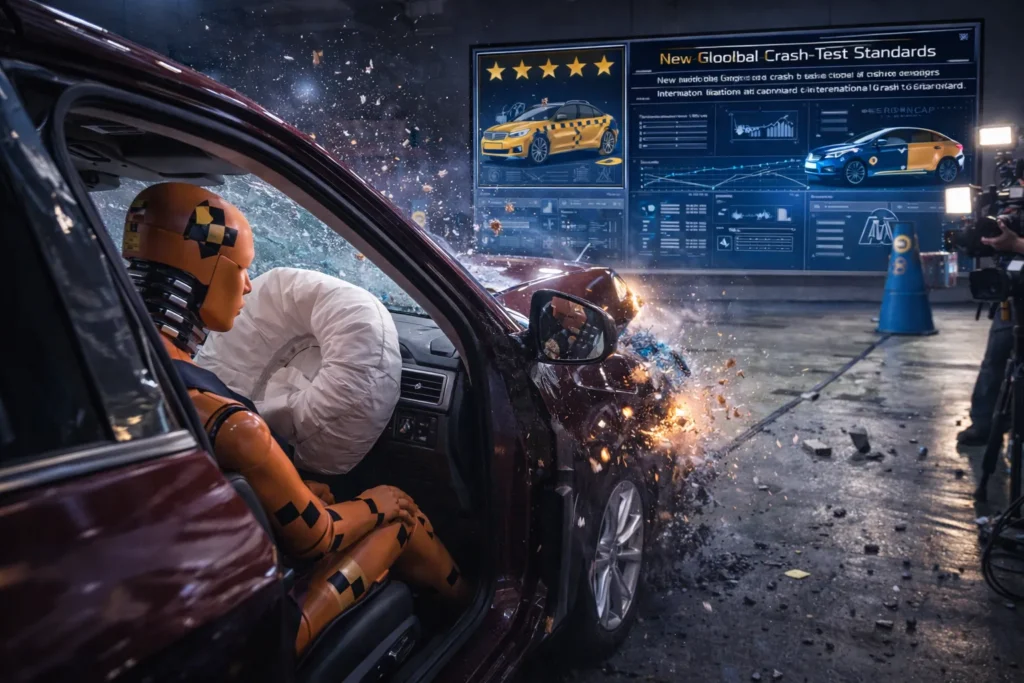

Prologue: The Intersection Where Everything Changed
Picture a typical intersection on a Tuesday afternoon. The crosswalk signal turns white, and a woman steps off the curb, her eyes briefly glancing down at her phone to check the time. She doesn’t see the delivery truck running the yellow light. She doesn’t hear the electric car approaching silently from her left. In the split second that follows, everything hinges on one question: Will the car’s computer see her before the driver does?
Now multiply this scene by millions. Every day, across every city, town, and village on earth, pedestrians and vehicles negotiate the same dangerous dance. Most end safely. Some don’t. But the outcome of that split second is no longer left purely to chance or human reaction time. For the first time in automotive history, international regulators have decided that the car shares equal responsibility for that moment.
The new global crash-test standards rolling out across North America, Europe, Asia, Africa, and Australia represent the most significant shift in vehicle safety regulations since the three-point seatbelt became mandatory in the 1950s and 1960s. They are not just updated rules with a few new requirements tacked onto existing protocols. They are a complete reimagining of what safety means on public roads, a fundamental restructuring of the relationship between vehicle and pedestrian, between machine and human, between metal and flesh.
To understand why this matters, why it represents a turning point in the history of transportation, and how it will affect every single person who ever steps onto a street or into a car, we need to walk through the history of car safety, the technology making it possible, the human lives at stake, the massive industrial effort underway to reshape the automobiles we drive, the economic implications for families and nations, the psychological impact on drivers and pedestrians alike, and the long arc of progress that points toward a future where traffic fatalities become a rarity rather than an inevitability.
This is the story of how we learned to build cars that see, that think, that react faster than any human ever could. It is the story of how regulators, engineers, safety advocates, and ordinary people came together to demand something better. And it is the story of how the next decade will fundamentally change the relationship between the vehicles we drive and the world they move through.
H2: A Brief History of Crashing Cars: From No Rules to New Rules
The Era Before Regulation: When Cars Were Beautiful Death Traps
In the 1950s and early 1960s, cars were magnificent machines. They had gleaming chrome bumpers, fins that soared toward the sky, and interiors that looked like the living rooms of wealthy Americans. They represented freedom, status, and the open road. They were also, by any modern standard, rolling death traps waiting to claim their victims.
Consider what happened when a typical 1950s automobile struck an obstacle or another vehicle. The steering column, rigid and unyielding, pointed directly at the driver’s chest like a spear. In a frontal collision, that column would often impale the driver, causing injuries that even modern medicine could not survive. The dashboard was made of stamped steel covered with a thin layer of paint, offering no cushioning for the passenger who flew forward when the car stopped abruptly. Door latches, weak and poorly designed, would spring open on impact, ejecting occupants onto the pavement where they would be crushed by their own vehicle or struck by following traffic.
Seatbelts, those simple straps that today we take for granted, were optional extras. If you wanted to protect yourself, you had to pay extra and have them installed, assuming your dealer even offered them. Many people considered them uncomfortable or unnecessary. After all, who plans to crash?
Windshields were made of ordinary glass that shattered into jagged daggers upon impact, slashing faces and necks. Interior surfaces had sharp edges and protruding knobs designed for style rather than safety. The fuel systems could rupture in even minor collisions, spilling gasoline that often ignited, trapping occupants in burning vehicles.
If you had suggested to a Detroit auto executive in 1955 that cars should be designed specifically to protect pedestrians, you would have been laughed out of the boardroom. The prevailing philosophy was simple, brutal, and widely accepted: roads belong to cars. Everyone else must get out of the way. Pedestrians hit by cars were considered unlucky, perhaps foolish, but certainly not victims of poor design. The car was king, and the road was its kingdom.
The First Cracks in the Armor: Early Safety Advocates
Even in this wilderness of indifference, there were voices crying out for change. Claire Straith, a plastic surgeon from Michigan, saw the results of poor design every day in his operating room. He treated countless facial lacerations caused by windshields, chest injuries from steering columns, and head trauma from unyielding dashboards. In the 1930s, he began advocating for padded dashboards, recessed controls, and stronger door latches. He even designed a rubber dashboard cover and tried to interest automakers in his ideas. They weren’t interested.
Hugh DeHaven, a Cornell University researcher who had survived a plane crash as a young man, dedicated his career to understanding how to make vehicles safer. He studied crashes and analyzed injuries, developing the fundamental insight that the goal should be to manage the forces on the human body, to provide space and cushioning so that people could survive the violent deceleration of a crash. His work laid the foundation for modern crashworthiness engineering, but it took decades for his ideas to reach production vehicles.
Ralph Nader and the Birth of Modern Safety
Everything changed in 1965 when a young lawyer named Ralph Nader published a book called “Unsafe at Any Speed.” He targeted the Chevrolet Corvair specifically, exposing how its swing-axle rear suspension made it prone to rollovers during cornering. But the book was about much more than one flawed car. It was a sweeping indictment of an entire industry that prioritized style and profit over human life.
Nader documented how automakers resisted safety innovations, fought regulation, and marketed speed and power while ignoring the carnage on American roads. He showed that they had the technology to make cars safer but chose not to use it because safety didn’t sell. The book was meticulously researched and passionately argued, and it struck a nerve with the American public.
The outrage was immense and immediate. General Motors, in a stunningly stupid move, hired private investigators to follow Nader, dig up dirt on his personal life, and harass him. When this became public, the backlash was even greater. GM’s president was called before a Senate subcommittee to apologize. Nader became a household name and a hero to consumer advocates.
By 1966, the political pressure had become irresistible. The United States passed the National Traffic and Motor Vehicle Safety Act, creating the first federal safety standards and establishing the agency that would become the National Highway Traffic Safety Administration (NHTSA). Suddenly, cars needed padded dashboards, stronger door latches, standardized gear shifts, and energy-absorbing steering columns. The era of voluntary safety was over. The era of regulation had begun.
The Rise of the Crash Test Dummy
To test these new standards, engineers needed something to put inside the cars. They needed to measure the forces that would be experienced by real human beings in real crashes. They needed something that could be crashed over and over again without complaint. They needed the crash test dummy.
The first dummies were simple, crude devices. Sierra Sam, developed in 1949 for testing aircraft ejection seats and aviation helmets, was adapted for automotive use. He was little more than an articulated skeleton with basic sensors, capable of measuring a few forces but not representing human anatomy particularly well.
Over decades, these dummies evolved into sophisticated instruments costing hundreds of thousands of dollars each. The Hybrid III family, introduced in the 1970s and still widely used today, represented a quantum leap in biofidelity. They have flexible necks that whip realistically, chests that compress under load, and detailed instrumentation throughout.
The latest generation, called THOR (Test device for Human Occupant Restraint), is even more sophisticated. THOR has a more human-like spine, a face with multiple sensors to measure facial impacts, and advanced instrumentation in the neck and pelvis. THOR can measure forces in ways that help engineers understand not just whether an occupant would survive, but what injuries they might suffer.
These dummies come in different sizes representing different populations. There are dummies representing the average adult male, the small adult female, and children of various ages. There are even pregnant dummies with instrumented fetuses, allowing researchers to understand how crashes affect unborn children.
For fifty years, these dummies were the undisputed stars of the safety show. Every commercial showing a car smashing into a wall, every five-star safety rating splashed across magazine ads, every airbag deployment test, every slow-motion video of a car crumpling in glorious detail—it was all about protecting the occupants inside. The dummies inside those cars were the only ones that mattered.
The Euro NCAP Revolution: How Star Ratings Changed Everything
In 1997, a consortium of European governments, motoring organizations, and consumer groups launched something new: the European New Car Assessment Programme, better known as Euro NCAP. Unlike government regulations, which set minimum standards that all vehicles must meet, Euro NCAP created a star rating system from one to five. Consumers could see at a glance which cars were safest, and which were dangerously inadequate.
The impact was immediate and transformative. When the first results were published, many popular cars scored poorly. The Rover 100, a bestseller in Britain, scored a humiliating one star. The media coverage was brutal, and sales plummeted. No manufacturer wanted to see their flagship model embarrassed in the press, and no dealer wanted to explain to customers why the car on their lot scored two stars while a competitor’s scored five.
Euro NCAP created a competitive market for safety. Automakers began competing for five-star ratings the way they competed for horsepower or fuel economy. They redesigned structures, added airbags, improved seatbelt systems, and invested in crash avoidance technology—all to earn that coveted top rating.
Other regions followed suit. The Insurance Institute for Highway Safety (IIHS) in the United States developed its own rigorous testing program, including the famous offset crash test that proved challenging for many vehicles. The IIHS ratings became essential marketing tools, with Top Safety Pick awards featured prominently in advertising. Japan, China, South Korea, Australia, and Latin America all developed their own programs, creating a global patchwork of testing protocols that together pushed safety forward faster than any single regulation could.
The Missing Piece: The Vulnerable Road User
Despite all this progress, despite fifty years of safer cars, better dummies, and star ratings, one group remained largely unprotected by crash testing: the people outside the car. Pedestrians, cyclists, motorcyclists, scooter riders, skateboarders, wheelchair users—they accounted for more than half of traffic deaths in many urban areas, yet car design barely considered them.
A pedestrian hit by a car traveling at 40 miles per hour has less than a 50 percent chance of survival. At 30 miles per hour, survival rates jump to around 90 percent. At 20 miles per hour, the risk of death is low, though serious injuries remain possible. The difference between life and death is not just speed, but also how the front of the car interacts with the human body when they meet.
When a car strikes a pedestrian, a predictable sequence unfolds. The bumper strikes the legs, typically below the knee. The leading edge of the hood strikes the pelvis or thighs. Then the pedestrian’s torso and head rotate onto the hood and windshield, where the head may strike the hood, the windshield, or the A-pillar (the vertical support on either side of the windshield). Each of these impacts can cause devastating injuries.
For years, safety advocates argued that cars should be designed to be less deadly during this sequence. They pointed out that a tall, blunt SUV front end strikes an adult pedestrian in the pelvis or chest, causing severe internal injuries, while a lower, sloping front end catches the legs, folding the pedestrian onto the hood where the impact is somewhat softer. They demonstrated that stiff A-pillars, necessary for roof strength in rollovers, were deadly to heads. They showed that hoods with insufficient clearance above hard engine components offered no cushioning.
The industry was slow to respond. Pedestrian protection was seen as a niche concern, important in dense European cities but less relevant elsewhere. Regulations requiring pedestrian protection existed in some markets, but they were weak and easily met with minimal effort. Real innovation lagged far behind occupant protection.
The Tipping Point: Rising Pedestrian Deaths Sound the Alarm
In the late 2010s, something alarming happened across the developed world. After decades of steady decline, pedestrian deaths in the United States began rising sharply. In 2009, approximately 4,100 pedestrians were killed in traffic crashes. By 2018, that number had jumped to over 6,200—a 50 percent increase that shocked safety researchers and advocates.
Europe saw similar trends, though less dramatic. Pedestrian deaths had been falling steadily, but the rate of decline slowed, and some countries saw increases. In the United Kingdom, pedestrian deaths rose for several consecutive years after decades of improvement.
Researchers scrambled to understand what was happening. They identified multiple factors converging to create this crisis:
The rise of SUVs and trucks played a major role. These vehicles, with their tall, blunt front ends, now dominate the new vehicle market. They are more deadly to pedestrians than traditional cars, and as they replaced older, more pedestrian-friendly vehicles in the fleet, the risk to pedestrians increased.
Smartphone distraction became epidemic among both drivers and pedestrians. Drivers glancing at phones miss pedestrians they would otherwise see. Pedestrians with eyes on screens step into traffic without looking. The combination is deadly.
Infrastructure funding lagged behind need. Crosswalks, sidewalks, lighting, and traffic calming measures that protect pedestrians were neglected in many communities, particularly lower-income areas where walking is more common.
Vehicle speeds remained high in urban areas. Despite evidence that lower speeds dramatically reduce pedestrian deaths, many cities maintained speed limits that made streets dangerous for anyone outside a car.
And perhaps most significantly, safety regulations had not kept pace with changing vehicle design and usage patterns. The tests that ensured occupant protection simply didn’t address pedestrian protection adequately. A car could earn five stars for occupant safety while being deadly to anyone it struck.
The Technological Opportunity: Cars That Can See
At the same time that pedestrian deaths were rising, a new technology was emerging that offered a potential solution. Cars were beginning to see.
For decades, cars had been blind. They had no idea what was around them, no awareness of the world beyond their sheet metal. Drivers provided the only intelligence, and drivers are fallible.
But advances in cameras, computing, and artificial intelligence changed that. Cameras became cheap enough to install on mass-market vehicles. Processors became powerful enough to analyze video in real time. Machine learning algorithms became sophisticated enough to recognize pedestrians, cyclists, and other obstacles with remarkable accuracy.
By the mid-2010s, the first production vehicles with pedestrian detection were reaching the market. They could automatically brake to avoid or mitigate collisions with pedestrians. Early systems were imperfect—they worked in some conditions but not others, detected some pedestrians but missed others—but they proved the concept was viable.
Safety advocates saw the potential immediately. If pedestrian detection could be improved, if it could be made to work reliably in the chaotic reality of urban streets, it could reverse the rising tide of pedestrian deaths. But it would have to be required, not optional. It would have to be tested rigorously, not just demonstrated in ideal conditions. And it would have to be integrated with other safety systems to provide comprehensive protection.
The Regulators Respond: New Standards Take Shape
The convergence of rising deaths and emerging technology created the conditions for regulatory action. Safety advocates demanded change. Insurers, facing rising claim costs, supported stronger requirements. Some manufacturers, seeing competitive advantage in safety leadership, pushed for higher standards that would disadvantage laggards.
In Europe, Euro NCAP announced a new roadmap that would dramatically increase the emphasis on pedestrian protection and advanced driver assistance systems. Starting in 2020, vehicles would be tested on their ability to detect and avoid pedestrians in a range of realistic scenarios, including children darting from behind obstacles and pedestrians crossing at night.
In the United States, the Insurance Institute for Highway Safety introduced new tests for pedestrian detection, rating systems as Basic, Advanced, or Superior based on their performance in a standardized battery of scenarios. The IIHS also began rating headlight performance, recognizing that most pedestrian fatalities occur at night and that good headlights are essential for both drivers and detection systems to see pedestrians.
The National Highway Traffic Safety Administration, traditionally focused on occupant protection, announced plans to update its New Car Assessment Program to include pedestrian protection ratings. While the process moved slowly through the federal rulemaking machinery, the direction was clear: pedestrian safety was coming to American crash testing.
In Japan, China, and South Korea, similar programs were updated or created. China’s C-NCAP, once criticized as less rigorous than its European counterpart, added pedestrian detection requirements that pushed manufacturers to equip vehicles sold in China with advanced safety systems.
For the first time, a nearly global consensus emerged: vehicles must be designed to protect people outside the car, and they must be capable of avoiding crashes altogether, not just surviving them.
H2: The New Standards: What Changed, Why It Matters, and How It Works
The Regulators Behind the Rules: A Global Patchwork with Common Purpose
The new global standards did not emerge from a single source, signed by all nations at once. They are the result of coordination, competition, and convergence among multiple organizations working in parallel toward similar goals.
In Europe, Euro NCAP released its latest roadmap in 2020, outlining the new testing protocols that would take effect in 2023 and 2024. These protocols were developed through extensive consultation with manufacturers, suppliers, research institutions, and advocacy groups. They reflect the latest understanding of crash biomechanics, pedestrian injury mechanisms, and the capabilities of advanced sensor systems.
In the United States, the Insurance Institute for Highway Safety introduced its new “Top Safety Pick+” criteria in stages, raising the bar each year for pedestrian detection, automatic braking, and headlight performance. The IIHS, funded by auto insurers, has no regulatory authority but enormous influence through its widely publicized ratings.
The National Highway Traffic Safety Administration, after years of study and stakeholder input, proposed updates to its New Car Assessment Program that would for the first time include pedestrian protection in the government’s five-star rating system. The process is slow and political, but the trajectory is clear.
In Japan, the National Agency for Automotive Safety and Victim’s Aid (NASVA) operates its own assessment program with increasingly stringent pedestrian protection requirements. Japanese manufacturers, who dominate their domestic market, have responded with advanced systems tailored to the unique challenges of Japanese urban streets.
China’s C-NCAP, administered by the China Automotive Technology and Research Center, has rapidly evolved from a weak imitation of Euro NCAP to a rigorous program in its own right. With China now the world’s largest automotive market, C-NCAP standards influence vehicle design globally, as manufacturers cannot afford to build different cars for different markets.
South Korea’s KNCAP, Australia’s ANCAP, and Latin America’s Latin NCAP all contribute to the global push for safer vehicles. While specific tests vary slightly between regions, the direction is identical: protecting vulnerable road users and testing advanced driver assistance systems rigorously.
The Pedestrian Impact Tests: Simulating the Unthinkable
The new pedestrian safety tests are brutal and specific. They simulate real-world collisions using sophisticated pedestrian dummies that represent the latest understanding of human anatomy and injury mechanisms.
The primary pedestrian dummies used in testing are called POLAR and FlexPLI. These are not the simple articulated figures of decades past. They are highly sophisticated instruments costing over $200,000 each, packed with sensors measuring forces on every major bone and organ.
POLAR, developed by Honda and refined through international collaboration, represents a 50th percentile adult male. Its design is based on detailed studies of human anatomy and injury patterns from real pedestrian crashes. POLAR has a flexible spine that mimics human bending, ribs that fracture under sufficient load, and instrumented legs that measure bending and shear forces at the knee.
FlexPLI, the Flexible Pedestrian Legform Impactor, focuses specifically on lower leg injuries. It simulates the complex behavior of the human leg when struck by a bumper, measuring the bending angle of the knee and the shearing forces that can tear ligaments and cause permanent disability.
The test procedure is straightforward but gruesome. The pedestrian dummy is launched into a stationary car at 40 kilometers per hour (about 25 miles per hour). High-speed cameras capture every millisecond of the impact. Sensors throughout the dummy record the forces experienced by each body region.
But that’s just one test. The pedestrian dummy is launched from different angles, simulating different crossing scenarios. It’s launched from the side, simulating a pedestrian stepping into the street. It’s launched from the front, simulating a pedestrian walking toward the car. It’s launched with different postures, simulating someone looking at a phone or carrying packages.
The data from these tests is analyzed in excruciating detail. If forces exceed certain thresholds on the head, neck, spine, pelvis, legs, or knees, the car loses points. If the dummy’s head strikes the A-pillar with too much force, the car loses points. If the bumper design causes unnatural bending of the knee, the car loses points.
The Head Impact Zones: Where Pedestrians Strike and Why It Matters
The head impact tests are among the most revealing in the new protocols. Engineers place multiple sensors across the hood and windshield areas, then fire a headform impactor at each location at high speed. The headform, a metal hemisphere covered with synthetic skin and packed with accelerometers, simulates a pedestrian’s head striking the car.
The results are mapped onto the vehicle, creating a heat map of injury risk. Green areas indicate where the hood provides adequate cushioning. Yellow areas indicate borderline performance. Red areas indicate danger zones where a pedestrian’s head would experience forces likely to cause severe brain injury or death.
The testing revealed a troubling pattern that engineers had long suspected but now had to confront directly. The stiffest parts of a car’s front end—the A-pillars (the vertical supports on either side of the windshield), the cowl (the base of the windshield where the wipers mount), the hinges of the hood, and the structural supports underneath—are precisely where a pedestrian’s head is most likely to strike.
This creates a fundamental engineering conflict. The A-pillars must be strong enough to support the roof in a rollover and maintain the integrity of the occupant compartment in a crash. But that strength comes from steel or aluminum structures that are unyielding to a human head. Making them safer for pedestrians could compromise occupant protection. Making them safer for occupants makes them more deadly to pedestrians.
The solution, pursued by many manufacturers, involves multiple layers of innovation. Hood hinges now incorporate pyrotechnic devices that lift the hood slightly upon impact, creating space between the hood and the hard engine components underneath. The A-pillars are being reshaped to be less aggressive, with softer outer materials that deform on impact while maintaining structural integrity underneath. Some manufacturers are adding external airbags that deploy along the windshield base to catch a pedestrian’s head, providing cushioning exactly where it’s needed most.
The Leg Impact Tests: Protecting Mobility and Preventing Disability
The leg tests address a different but equally important aspect of pedestrian injuries. While head injuries are often fatal, leg injuries are among the most common and debilitating consequences of pedestrian crashes. A severe leg injury can mean months of rehabilitation, permanent disability, loss of livelihood, and dramatically reduced quality of life.
The legform impactor, simulating an adult leg complete with detailed representation of the knee joint, is fired into the front bumper at 40 kilometers per hour. Sensors measure the bending angle of the knee and the shearing forces on the ligaments that hold the joint together.
The biomechanics of leg injury are complex. The knee can bend in ways it shouldn’t, exceeding the normal range of motion and tearing the ligaments that stabilize the joint. The bones of the lower leg can fracture, sometimes breaking through the skin in compound fractures that carry high infection risk. The blood vessels and nerves running through the leg can be crushed or severed.
Engineers are responding by redesigning front bumpers to engage the leg lower down, ideally below the knee joint where the forces are less likely to cause ligament damage. They’re adding foam padding behind the bumper cover, carefully tuned to absorb energy without being so soft that the leg contacts the rigid structure behind. They’re ensuring that the bumper structure itself has no sharp edges or protrusions that could cause severe soft tissue damage.
The Active Safety Tests: Scenarios That Mirror Real Life
The new advanced driver assistance system tests go far beyond simple straight-line braking on a clear track. They simulate the chaotic, unpredictable reality of urban streets where pedestrians and vehicles interact in complex ways.
One test scenario involves a child darting from behind a parked car. A pedestrian dummy on a moving platform accelerates suddenly from behind an obstruction, exactly as a child might when chasing a ball into the street without looking. The timing is randomized so the test vehicle cannot anticipate the exact moment of emergence. The test vehicle, approaching at speeds ranging from 20 to 60 kilometers per hour, must detect the child and brake automatically to avoid or mitigate the collision.
Another scenario tests a pedestrian walking from the opposite direction, then suddenly crossing the path of the vehicle. This simulates the common situation where someone misjudges the speed of oncoming traffic and steps out too early, expecting to have time to cross before the vehicle arrives. The pedestrian’s path crosses the vehicle’s path at a right angle, requiring the system to detect the crossing trajectory and brake accordingly.
A third scenario involves a pedestrian walking parallel to the road, then turning into the vehicle’s path. This simulates someone walking along the sidewalk who suddenly steps off the curb without looking, perhaps because they see a bus approaching or recognize a friend across the street.
A fourth scenario tests a cyclist riding parallel to the road, then turning left across the vehicle’s path. Cyclists are particularly vulnerable because they move faster than pedestrians and often appear suddenly from blind spots. They also present a different visual profile than pedestrians, with the bike adding complexity to the recognition task.
Night Testing: Where Most Deaths Occur
One of the most significant and challenging additions to the new standards is night testing. Approximately 75 percent of pedestrian fatalities occur after dark, when both drivers and detection systems struggle to see. Yet previous testing protocols focused exclusively on daylight conditions, leaving a massive gap between laboratory performance and real-world protection.
Night tests are conducted on unlit roads with only the vehicle’s own headlights illuminating the scene. The pedestrian dummy wears dark clothing, simulating the worst-case real-world scenario where a pedestrian is difficult to see against a dark background. The test is conducted at various speeds and in various scenarios, with the vehicle’s camera and radar systems required to detect the pedestrian and brake automatically.
The night tests revealed wide variations in system performance. Some vehicles, with excellent headlights and sensitive cameras, performed nearly as well at night as during the day. Others, with weak headlights or cameras that struggle in low light, performed poorly or not at all. The gap between best and worst performers was dramatic.
This requirement is forcing automakers to improve their headlight technology dramatically. Matrix LED headlights, which can selectively dim portions of the beam to avoid blinding oncoming drivers while maintaining full illumination elsewhere, are becoming essential. Some manufacturers are integrating infrared cameras that can see pedestrians and animals by their heat signature, far beyond the reach of conventional headlights. Others are developing intelligent headlight systems that actively track pedestrians and keep them illuminated even as they move.
The Turn-Across-Path Test: Intersection Safety
Perhaps the most complex new test involves turning across the path of an oncoming pedestrian. The test vehicle approaches an intersection and begins a left turn (or right turn in left-hand drive countries). A pedestrian dummy approaches from the opposite direction, crossing the same intersection at the same time.
This scenario is extremely challenging for sensors and algorithms. The pedestrian is coming from the side, not straight ahead. The vehicle’s own turning motion changes the relative geometry and complicates the sensor readings. The A-pillar may briefly block the camera’s view at the critical moment. The headlights are pointing in the direction of travel, not toward the pedestrian, so illumination may be poor.
Yet the system must detect the pedestrian and brake if a collision is imminent. It must distinguish between a pedestrian who will cross safely ahead of the vehicle and one who will arrive in the path at the same moment. It must make this decision in fractions of a second, with incomplete information and while executing its own turning maneuver.
The turn-across-path test revealed that many systems that perform well in straight-line tests struggle in turning scenarios. The additional complexity exposes limitations in sensor coverage, processing power, and algorithm sophistication that are invisible in simpler tests.
The Reverse Testing: Protecting Children in Driveways
Backover accidents, where a driver backing out of a driveway or parking space fails to see a small child behind the vehicle, kill dozens of children every year in the United States alone. These tragedies occur in the places that should be safest: home driveways, school parking lots, quiet residential streets.
The new standards include reverse automatic braking tests specifically designed to address this risk. A child-sized dummy is placed directly behind the test vehicle, positioned low to the ground where it might be invisible to the driver. The vehicle backs up at low speed, simulating a driver leaving a driveway without a clear view.
The rear sensors must detect the dummy and stop automatically before impact. This requires sensors with wide fields of view, covering the entire area behind the vehicle without blind spots. It requires rapid processing, as the distance closes quickly even at slow speeds. And it requires reliable detection of small children, who present a very different sensor signature than adults.
Some systems use radar sensors mounted in the rear bumper, which can detect objects through plastic bumper covers and in poor weather. Others use cameras with wide-angle lenses, providing a clear view of the area behind the vehicle. The best systems combine multiple sensor types, with radar providing robust detection and cameras providing confirmation and identification.
The Scoring System: How Stars Are Earned and Lost
The new tests are integrated into comprehensive scoring systems that determine a vehicle’s overall safety rating. Euro NCAP, for example, awards points across four categories: Adult Occupant Protection, Child Occupant Protection, Vulnerable Road User Protection, and Safety Assist Technologies.
To earn five stars, a vehicle must perform well across all categories. A vehicle that excels at protecting occupants but ignores pedestrians cannot achieve the top rating. This creates powerful incentives for manufacturers to invest in pedestrian protection, even for customers who rarely walk anywhere.
The Vulnerable Road User category includes scores from the physical impact tests (how well the vehicle protects a pedestrian it cannot avoid hitting) and the active safety tests (how well it avoids hitting pedestrians in the first place). A vehicle must perform well in both to score highly.
The scoring thresholds are calibrated to push continuous improvement. As technology advances and more vehicles meet current standards, the thresholds are raised, forcing manufacturers to innovate further. This ratchet mechanism has driven dramatic safety improvements over the past two decades and will continue to do so for the foreseeable future.
H2: The Technology Revolution: How Cars Learned to See, Think, and Act
The Blind Driver Problem: Human Limitations
To appreciate the significance of the technology now entering vehicles, we must first understand the profound limitations of human drivers. We are, in many ways, terrible at operating heavy machinery at high speeds.
Our reaction times are slow by machine standards. When a hazard appears, it takes about 1.5 seconds for a typical driver to see the threat, process what they’re seeing, decide to act, move their foot from the accelerator to the brake, and begin applying pressure. In that time, a car traveling 30 miles per hour covers 66 feet. At 60 miles per hour, it covers 132 feet—more than a third of a football field.
Our attention wanders constantly. We glance at phones, adjust radios, sip coffee, talk to passengers, and daydream about the day ahead. Even when we’re trying to pay attention, our brains are wired to miss things we’re not specifically looking for. The famous “invisible gorilla” experiments showed that people focusing on counting basketball passes can completely miss a person in a gorilla suit walking through the scene.
Our vision has blind spots. The A-pillars that support the roof can hide a pedestrian or cyclist completely. The area directly behind the vehicle is invisible without cameras or sensors. Our peripheral vision is poor at detecting detail, so something glimpsed from the corner of the eye may not register until it’s too late.
Our judgment is impaired by fatigue, stress, distraction, and sometimes alcohol or drugs. We misjudge distances and speeds. We assume others will behave predictably. We take risks that seem small but have catastrophic consequences.
The fundamental promise of advanced driver assistance systems is simple but profound: machines compensate for human limitations. A camera can detect a hazard in 50 milliseconds, thirty times faster than a human. A computer can decide to apply the brakes in another 50 milliseconds, then execute the braking instantly. That one-second advantage can mean the difference between a close call and a funeral, between a minor fender bender and a life-changing injury, between going home and going to the hospital.
The Sensor Suite: Cameras That See Everything
The eyes of modern vehicles are cameras, and they have evolved dramatically from the simple backup cameras that first appeared on luxury vehicles in the early 2000s.
High-end cars now carry anywhere from four to twelve cameras mounted strategically around the vehicle. They look forward through the windshield, providing a wide-angle view of the road ahead. They look backward through the rear window or integrated into the trunk lid, covering the area behind the vehicle. They look sideways from the side mirrors, covering blind spots that drivers cannot see. Some look down at the road surface, reading lane markings and detecting road edges. Others scan the horizon for distant obstacles.
These cameras are not simple video recorders capturing images for later viewing. They are sophisticated image sensors running neural networks trained on millions of miles of real-world driving. They don’t just record images; they interpret them in real time, identifying objects, classifying them, and predicting their future motion.
The latest cameras operate in high dynamic range, meaning they can handle the transition from bright sunlight into dark tunnels without losing detail in shadows or blowing out highlights. Some use infrared sensitivity to see at night better than human eyes can, detecting pedestrians by their heat signature. Others are stereo cameras, using two lenses spaced apart like human eyes to judge distance precisely through parallax.
The resolution of automotive cameras has increased dramatically. Early systems used VGA resolution (640×480 pixels), barely enough to detect large objects at short range. Modern systems use megapixel sensors that can read street signs at a distance, distinguish between different types of vehicles, and identify pedestrians by their shape and movement patterns.
The Sensor Suite: Radar That Sees Through Weather
Cameras have fundamental limitations. They struggle in heavy rain, fog, or snow, when water droplets scatter light and obscure the view. They can be blinded by direct sunlight shining into the lens. They require massive computing power to process all those images in real time, and they can be fooled by unusual lighting conditions or optical illusions.
Radar solves these problems elegantly. Radar sensors emit radio waves at specific frequencies, then listen for the echoes that bounce back from objects in the environment. By measuring the time delay between transmission and reception, the radar can determine exactly how far away an object is. By measuring the frequency shift caused by motion (the Doppler effect), it can determine how fast the object is moving toward or away from the vehicle.
Radar works in any weather, day or night. Radio waves penetrate rain, fog, snow, and spray from trucks with minimal attenuation. A radar sensor can see a pedestrian through a rainstorm that would blind any camera. It doesn’t need visible light, so it works equally well in bright sunshine and complete darkness.
Modern automotive radars are sophisticated devices. They use multiple frequencies to improve resolution and reduce interference. They employ phased arrays to steer the beam electronically, scanning the environment rapidly without moving parts. They can measure not just distance and speed but also the angular position of objects, building a detailed picture of the vehicle’s surroundings.
The latest generation of imaging radar goes even further. Using multiple transmitters and receivers in a MIMO (Multiple Input Multiple Output) configuration, these radars can achieve angular resolution approaching that of lidar, distinguishing between multiple objects at the same distance and creating a rough image of the environment.
However, radar has its own limitations. It struggles to identify exactly what an object is. A radar sensor knows there is something ahead at a certain distance and speed, but it doesn’t know whether that something is a pedestrian, a cyclist, a deer, or a piece of debris blowing across the road. That’s where camera data becomes essential.
The Sensor Suite: Lidar That Maps the World in 3D
The newest and most sophisticated player in automotive sensing is lidar, which stands for Light Detection and Ranging. Lidar shoots out thousands of laser pulses per second and measures how long they take to bounce back from objects in the environment. The result is a precise, three-dimensional point cloud representing everything around the vehicle.
Imagine standing in a dark room and throwing thousands of tennis balls in every direction, then measuring how long each takes to return. You could build a three-dimensional map of the room based solely on those return times. That’s essentially what lidar does, but with light instead of tennis balls and at incredible speed.
Lidar creates a high-definition map of the world in real time. It can detect a tire lying in the road, a pedestrian bending down to tie a shoe, a dog running into traffic, or a construction barrel that doesn’t match any pattern in the camera’s training data. It works at night as well as during the day, because it provides its own illumination through the laser pulses.
For years, lidar was too expensive for mass-market cars. Early units used in autonomous vehicle research cost $75,000 or more, limiting them to prototype vehicles and wealthy research programs. Prices have dropped dramatically as the technology has matured, with solid-state lidar units now available for a few hundred dollars in volume.
The trend will continue. As lidar production scales to millions of units per year, costs will fall further, bringing true 3D sensing to ordinary vehicles within the next decade. Some manufacturers are already integrating lidar into their vehicles, betting that the safety benefits justify the cost.
The Sensor Suite: Ultrasonic for Close Quarters
For the closest-in sensing, vehicles use ultrasonic sensors similar to the parking sensors that have been common for years. These sensors emit sound waves at frequencies above human hearing and listen for the echoes.
Ultrasonic sensors are simple and cheap, but they have limited range—typically a few meters at most. They’re used for parking assistance, blind spot monitoring at low speeds, and the final few feet of automatic parking maneuvers. They can detect objects too close for other sensors to see clearly, providing a safety net for the final approach.
In the new safety systems, ultrasonic sensors play a supporting role. They confirm that the area immediately around the vehicle is clear before movement, and they provide backup coverage for the final instant before a potential collision.
The Brain: Computing Power That Rivals Supercomputers
All these sensors generate an overwhelming flood of data. A single autonomous driving test vehicle can generate multiple terabytes of data per day—more than the entire printed collection of the Library of Congress. Processing that data in real time, extracting meaningful information from the deluge, and making split-second decisions requires immense computing power.
The latest vehicles contain supercomputers on wheels. NVIDIA’s DRIVE platform, used by many automakers, delivers over 300 trillion operations per second. That’s roughly equivalent to the computing power of several hundred high-end gaming PCs, all packaged into a single module designed to survive under the hood of a car for a decade of vibration, temperature extremes, and constant use.
This computing power runs the neural networks that interpret camera images, fusing data from multiple sensors, predicting the future paths of pedestrians and other vehicles, and deciding when to intervene. The algorithms are constantly running, even when the car appears to be doing nothing, monitoring the environment for threats that may require action.
The computing requirements will only increase. As sensor resolution improves, as more sensors are added, and as algorithms become more sophisticated, the demands on onboard processing will grow. Future vehicles may need computing power measured in petaflops (quadrillions of operations per second) to achieve full autonomy.
The Software: Training the Brain on Millions of Miles
Hardware is useless without software, and the software that powers modern safety systems is among the most complex ever deployed in consumer products. The algorithms that drive perception, prediction, and decision-making are not explicitly programmed in the traditional sense. They are trained on massive datasets using machine learning techniques.
Companies like Tesla, Waymo, Mobileye, and every major automaker have fleets of vehicles constantly recording video, radar, and lidar data. This data is sent back to massive data centers where it is labeled by human annotators and used to train neural networks.
When a pedestrian steps into the street, the system compares that moment to millions of similar moments from its training data. It knows what a pedestrian looks like from different angles, in different clothing, in different lighting, in different weather. It knows how pedestrians typically move—the way they accelerate, the way they turn, the way they pause to check for traffic. It knows where pedestrians are likely to appear—near crosswalks, near bus stops, near schools.
This training never stops. Every time a vehicle encounters an unusual situation—a person in a wheelchair, a child on a skateboard, a construction worker in reflective gear, a pedestrian carrying an oddly shaped object—that situation can be added to the training set, making all vehicles smarter in the future through over-the-air software updates.
The Sensor Fusion: Combining Strengths, Covering Weaknesses
No single sensor type is perfect. Cameras provide rich detail but struggle in bad weather and darkness. Radar works in any weather but provides limited detail. Lidar provides precise 3D data but is expensive and can struggle in heavy precipitation.
The magic happens when these sensors are combined in a process called sensor fusion. The vehicle’s computer takes data from all available sensors and combines it into a single, coherent understanding of the environment.
The radar says there’s something at a certain distance and speed, moving in a certain direction. The camera says that something looks like a pedestrian, based on its shape and movement patterns. The lidar confirms the precise location and provides a 3D profile that matches a human form. The fusion algorithm combines these inputs, weighing their respective strengths, to create a confident detection.
If one sensor is degraded—the camera blinded by sun, the radar obscured by heavy rain—the others can compensate. The fused system is more robust than any individual sensor, providing reliable detection across the full range of operating conditions.
The Prediction Engine: Anticipating the Future
Detecting objects in the present is only half the challenge. To avoid collisions, the vehicle must predict where those objects will be in the future. A pedestrian detected at the side of the road may step into the street, or may continue walking along the sidewalk. The vehicle must anticipate both possibilities and prepare for the worst.
Modern prediction systems use sophisticated motion models trained on real-world data. They recognize context: a pedestrian near a crosswalk is more likely to cross than one in the middle of a block. A pedestrian looking at the road is more likely to be aware of traffic than one looking at a phone. A child is more unpredictable than an adult.
The system generates multiple possible future paths for each detected object, assigning probabilities to each. Then it compares the vehicle’s own planned path with these predicted paths. If there’s overlap in space and time, a collision is possible. The system calculates time to collision and assesses the severity of the threat.
The Decision Engine: When to Intervene
If the threat assessment determines that a collision is imminent, the system must decide whether to intervene and how. This decision is not binary; there are gradations of intervention.
The mildest intervention is a warning to the driver. The system may flash a visual alert on the dashboard, sound a chime, or vibrate the steering wheel. This alerts the driver to the hazard, relying on them to take appropriate action.
If the driver doesn’t respond, or if the time to collision is too short for human reaction, the system may prepare the vehicle for impact. It may pre-charge the brakes so they respond instantly when the driver applies them. It may tighten the seatbelts to reduce occupant motion. It may adjust the seats to an optimal position for crash protection.
If a collision is unavoidable, the system applies maximum braking. It may also steer to avoid the obstacle if the vehicle has that capability and if steering is safe given the surrounding traffic. The goal is to mitigate the severity of the impact, reducing speed as much as possible before collision.
All of this happens in less time than it takes to blink an eye. The system processes sensor data, detects objects, predicts their motion, assesses threat, and decides to intervene in a few hundred milliseconds—faster than any human could react.
H2: The Engineering Challenge: Redesigning the World’s Cars
The Hood Height Dilemma: Safety Versus Style
Automotive designers face a fundamental conflict that has no perfect solution. Consumers want SUVs and trucks with high, commanding driving positions that make them feel safe and in control. These vehicles sell in enormous numbers and generate the profits that sustain automakers.
Safety regulators and advocates want low, sloping front ends that protect pedestrians by catching them lower on the body and folding them onto the hood rather than striking them in the chest or head. This creates a direct conflict between what consumers want and what safety requires.
Reconciling these demands requires creative engineering that satisfies both objectives as much as possible. The solution emerging from many automakers is the “double-decker” front end. The upper portion, at traditional SUV height, provides the styling and driving position consumers want. But below that, the actual structure that would strike a pedestrian is lower and more deformable. The visual height is an illusion created by styling panels that collapse easily on impact, while the real safety structure sits lower.
This approach requires careful coordination between design and engineering. The visual designers get the look they want, within limits. The safety engineers get the protection they need, within limits. The result is a compromise that satisfies neither group completely but advances both objectives.
Active Hood Systems: Pyrotechnics for Pedestrians
Volvo, long a leader in pedestrian safety, pioneered the active hood system that has now been adopted by many manufacturers. Sensors in the front bumper detect when a pedestrian impact is occurring, distinguishing it from impacts with other objects. Within milliseconds, pyrotechnic actuators lift the rear of the hood by several inches.
This creates space between the hood and the hard engine components below—the engine itself, the valve cover, the intake manifold, the various brackets and accessories that fill the engine bay. That space allows the hood to deform and cushion the pedestrian’s head, reducing the forces that cause traumatic brain injury.
The system must be incredibly fast. A pedestrian’s head strikes the hood about 70 milliseconds after the legs hit the bumper. In that time, the system must detect the impact, confirm that it’s a pedestrian and not a deer or a shopping cart, fire the actuators, and lift the hood. It’s a race against physics that the system usually wins.
The challenge is making these systems reliable enough to deploy only when needed, never accidentally, while reacting fast enough to protect the pedestrian. False deployments are expensive and potentially dangerous, as a suddenly rising hood could startle the driver or obstruct vision. Manufacturers have invested heavily in discrimination algorithms that can tell a pedestrian from other impact objects with high confidence.
External Airbags: Cushioning the Blow
Taking the concept further, some manufacturers are developing external airbags that deploy on the outside of the vehicle. These airbags cover the A-pillars and the base of the windshield—the areas where pedestrian heads most commonly strike and where injuries are most severe.
ZF, a major automotive supplier, has demonstrated a system that uses a camera and radar to detect an imminent pedestrian collision before impact occurs. A small external airbag deploys from under the hood, covering the windshield base and part of the A-pillars milliseconds before the pedestrian arrives. The airbag provides a cushion that dramatically reduces head injury risk.
The technical challenges are significant. The airbag must deploy fast enough to be fully inflated before impact, which requires detection before the pedestrian actually strikes the vehicle. It must deploy in a controlled manner that doesn’t itself cause injury. It must stay inflated long enough to cushion the impact, then deflate without obstructing the driver’s view.
Other manufacturers are exploring different approaches. Some are developing airbags that deploy from the A-pillars themselves, covering the most dangerous areas. Others are looking at airbags that deploy from the hood or from the base of the windshield. The optimal solution may vary by vehicle type and design.
The Sensor Placement Challenge: Seeing Without Being Seen
Placing sensors where they can see effectively while surviving the harsh automotive environment and maintaining aesthetic appeal is a major engineering challenge. Sensors must have clear fields of view, unobstructed by body panels, grilles, or other vehicle components. They must be protected from impacts, weather, and vandalism. And they must not ruin the carefully crafted appearance of the vehicle.
Cameras face particular challenges. They must be kept clean and free of ice, snow, and mud. Some manufacturers hide them behind the windshield, where wipers can clean them and where they’re protected from the elements. This works well for forward-facing cameras but isn’t possible for side- or rear-facing cameras.
For exterior cameras, manufacturers have developed integrated cleaning systems. Small nozzles spray washer fluid onto the camera lens, while heaters prevent ice buildup. Some systems use air jets to blow away dust and water droplets. Others use hydrophobic coatings that cause water to bead up and roll off.
Radar sensors must be behind materials that are transparent to radio waves. This means they cannot be hidden behind thick metal panels, which would block the signal entirely. Most are placed behind plastic grilles or lower bumper covers specifically designed to allow radar signals to pass through. The plastic must be carefully formulated to have the right electromagnetic properties, and the paint must be applied in a way that doesn’t interfere.
Lidar sensors, often mounted on the roof in early prototypes, are being integrated more elegantly into production vehicles. Some are hidden behind the windshield, alongside the camera. Others are integrated into the headlights or grille. The challenge is balancing sensor performance with aesthetic design, ensuring that the sensors have clear views without looking like afterthoughts.
Thermal Management: Keeping Cool Under Pressure
All these sensors and the computers that process their data generate heat. A modern autonomous driving computer can consume several hundred watts of power—comparable to a small space heater. That heat must be dissipated without allowing the electronics to overheat, even when the car is parked in direct sunlight in Phoenix or Riyadh.
The problem is compounded by the need for reliability. These systems must function for the entire life of the vehicle, through summers and winters, through stop-and-go traffic and highway cruising, through parking lots and desert roads. Any failure could disable safety systems at a critical moment.
Automakers are developing sophisticated cooling solutions. Some use liquid cooling systems similar to what high-end gaming PCs use, circulating coolant through the computer and rejecting heat through radiators. Others use advanced heat sinks and forced air cooling, carefully ducting air from the vehicle’s HVAC system or from external vents.
The cooling systems must be completely reliable with no maintenance required. There are no users who will periodically clean dust from heat sinks or top up coolant levels. The systems must work for a decade or more with no attention.
Redundancy and Fail-Safe Operation: Never a Single Point of Failure
If a sensor fails or gets blocked by mud or snow, the system must detect the failure and respond appropriately. It cannot simply stop working or, worse, continue working with bad data. The new standards require manufacturers to warn the driver when critical safety systems are unavailable.
More sophisticated systems incorporate redundancy at multiple levels. If the front camera is blinded by sun, the radar can still detect obstacles, though with less detail. If the radar fails, the camera continues to provide detection within its limitations. If both fail, the ultrasonic sensors may provide limited capability for low-speed maneuvers.
The vehicle’s computer constantly monitors all sensors, assessing their health and adjusting system behavior accordingly. If a sensor is degraded but not completely failed, the system may reduce its confidence in that sensor’s data or rely more heavily on other sensors. If a sensor fails completely, the system enters a degraded mode with reduced functionality and warns the driver.
Some systems incorporate physical redundancy as well as functional redundancy. Higher-end vehicles may have two independent braking systems, two steering actuators, and two power supplies, ensuring that no single failure can disable critical functions. This level of redundancy is expensive but essential for the highest levels of automation.
The Calibration Challenge: Precision Down to Fractions of a Degree
Sensors must be precisely aligned to function correctly. A camera that’s misaligned by even half a degree will see the world slightly off, causing objects to appear in the wrong locations. A radar that’s tilted slightly will measure distances incorrectly. The cumulative effect of small misalignments can be catastrophic for safety systems.
During manufacturing, sensors are carefully calibrated using specialized equipment. Cameras are aimed at targets at known distances and angles, and their position is adjusted until they meet specifications. Radars are tested with reflectors that provide known returns, verifying that they measure distance and angle correctly.
But calibration doesn’t end at the factory. Over the life of the vehicle, sensors can shift due to vibration, impacts, or thermal cycling. Some systems include self-calibration algorithms that use the vehicle’s own motion and observed stationary objects to continuously verify and adjust alignment. If the system detects that a sensor has shifted beyond acceptable limits, it may warn the driver and require service.
H2: The Human Element: How Real People Benefit Every Day
The Teenage Driver: Inexperience Compensated by Technology
Consider a sixteen-year-old named Marcus, just getting his driver’s license after months of practice and preparation. His reaction times are good—better than average for his age—but his judgment is untested. He hasn’t yet developed the instinct for danger that comes from years of experience. He doesn’t know, in his bones, how quickly situations can turn deadly.
It’s late on a Friday night in October. Marcus is driving home after a basketball game, tired but exhilarated by the win and the post-game celebration with friends. The road is dark, a four-lane arterial through a mixed residential and commercial area. Streetlights cast pools of light separated by long stretches of darkness.
A pedestrian in dark clothing, a man in his forties who had a few drinks at a bar and decided to walk home rather than drive, jaywalks across the road ahead. He’s in the crosswalk, technically, but the crosswalk is unlit and he’s wearing a black jacket and dark jeans. He steps off the curb without looking, assuming that any approaching car will see him.
Marcus doesn’t see the pedestrian until the last second, when his headlights catch the man’s pale face turning toward the oncoming car. His foot moves toward the brake, but there isn’t time. His brain is still processing what he’s seeing, still deciding whether it’s a real threat, still sending the signal to his foot.
In a 2015 vehicle, the outcome would be tragic. The car would strike the pedestrian at nearly full speed, causing catastrophic injuries. Marcus would carry the guilt for the rest of his life, even though his fault was only inexperience and the pedestrian’s fault was in poor judgment.
In his family’s new 2025 SUV, everything is different. The forward-facing camera detected the pedestrian 150 milliseconds after he entered the headlight beam, when Marcus’s brain was still registering the presence of an object. The radar confirmed the detection and measured the closing speed. The fusion algorithm calculated a 94 percent probability of collision and initiated automatic braking.
By the time Marcus’s foot reaches the brake pedal, the car has already slowed by 12 miles per hour. By the time of impact, the car is traveling at 18 miles per hour instead of 30. The pedestrian is still injured—a broken leg, some bruises, a concussion—but he survives. He’ll spend time in the hospital and months in rehabilitation, but he’ll go home to his family. And Marcus, shaken but relieved, will drive home with a new understanding of how quickly things can go wrong and how technology can make things right.
The Elderly Pedestrian: Declining Senses Augmented by Machines
Seventy-eight-year-old Elena walks to the pharmacy every Tuesday morning. It’s a ritual she’s maintained since her husband passed away three years ago—a reason to get out of the house, to interact with the world, to feel connected to the community she’s lived in for fifty years.
Her hearing isn’t what it used to be. The high-frequency sounds that once alerted her to approaching traffic are now inaudible. Her vision has declined enough that she sometimes misjudges the speed of oncoming cars, particularly at dusk or in challenging light. Her reflexes have slowed, so even when she sees danger, she can’t move as quickly as she once could.
But Elena is determined to maintain her independence. She walks slowly, carefully, using crosswalks and waiting for signals. She’s been doing this for decades and knows the routes intimately. She’s careful.
This Tuesday morning, she reaches the crosswalk at the intersection of Main and Oak. The light is changing, and she has the walk signal. She steps off the curb, her cane tapping the pavement ahead of her.
A delivery truck approaching from her left is running late. The driver sees the yellow light and accelerates to beat the red, a calculation that saves him thirty seconds but creates a dangerous situation. He doesn’t see Elena until she’s in front of him—she’s small, slow-moving, and partially obscured by the A-pillar of his truck.
But the truck is a 2024 model equipped with the latest safety systems. The forward-facing radar detected Elena when she was still on the curb, identified her as a pedestrian, and began tracking her position. When she stepped into the crosswalk, the system calculated her path and the truck’s path, determining that they would intersect unless the truck slowed.
The forward collision warning system blares an alarm, a loud beep that cuts through the driver’s focus on making the light. An instant later, the automatic braking engages, applying maximum stopping power a full second before the driver would have hit the brakes on his own.
The truck stops inches from Elena, who never even realized how close she came. She continues across the crosswalk, unaware that a collision was prevented entirely by software. The driver sits for a moment, hands shaking, realizing that his decision to save thirty seconds nearly cost a woman her life.
The Family Cyclist: Vulnerable Road Users Protected
The Chen family likes to bike together on weekends. It’s their tradition, their way of staying active and connected in a world that constantly pulls them in different directions. Dad pulls a trailer with the three-year-old, a bright yellow capsule on wheels that the child loves. Mom rides alongside, and the seven-year-old pedals ahead on her own bike, proud of her growing independence.
They stick to bike lanes when they can, quiet residential streets when they can’t. They wear bright clothing and helmets. They follow traffic laws and try to be predictable. They know they’re vulnerable—a cyclist against a multi-ton vehicle is no contest—but they refuse to let fear keep them home.
On a Sunday afternoon in spring, they’re riding along a four-lane road with a bike lane on the right. Traffic is light. The seven-year-old is ahead, as she likes to be, feeling grown-up and fast. Dad is behind with the trailer, keeping an eye on his daughter and the traffic around them.
A driver in a sedan glances down at his phone for just two seconds to check a text message. In those two seconds, his car drifts to the right, crossing the lane line and entering the bike lane. He doesn’t see the seven-year-old ahead, doesn’t hear the warning shouts from other drivers.
The car’s lane-keeping assist detects the drift immediately. The camera sees the lane markings and recognizes that the vehicle is leaving its lane without a turn signal. The system provides a warning vibration through the steering wheel, then applies gentle steering torque to guide the car back toward the center of the lane.
The driver looks up, startled, and sees the child on the bike just ahead. He jerks the wheel hard left, overcorrecting, then stabilizes. The moment of crisis has passed. The Chen family continues their ride, the seven-year-old unaware that a collision was avoided by a camera and some software.
The School Zone: Children Protected by Design
Every weekday afternoon, the crosswalk in front of Oak Elementary School becomes controlled chaos. Children stream across in waves, parents park illegally to pick up their kids, crossing guards try to maintain order, and drivers navigate through the confusion with varying degrees of patience and attention.
A fifth-grader named Jamal breaks away from the crossing guard’s group, chasing a friend across the street without looking. He’s excited about something that happened at recess, eager to share the news before he forgets. The friend is already on the other side, waiting.
Three cars approach from different directions. The first two have attentive drivers who see Jamal and stop. The third driver is a parent picking up her own child, distracted by a phone call about a schedule change. She’s looking at her phone, not at the road, as she approaches the crosswalk.
But her car, a 2024 model, is watching. The forward-facing camera detects Jamal’s small form darting into the street, recognizes the imminent collision, and initiates automatic braking. The system applies maximum stopping power, bringing the car to a halt just feet from where Jamal stands, frozen in the middle of the crosswalk, suddenly aware of how close he came.
The driver looks up, sees the child, and feels her heart stop. She pulls over to the side of the road, hands shaking, and sits for a long moment before she can continue. She thinks about what almost happened, about how a moment of distraction could have changed everything for that child, for his family, for her. She thinks about how technology just saved a life.
The Night Shift Worker: Animals and Darkness
Maria works the night shift at a regional hospital, starting at 11:00 PM and ending at 7:00 AM. She drives home on rural roads with no streetlights, through areas where deer are common. She’s learned to be vigilant, scanning the roadsides for the telltale glow of eyes reflecting her headlights.
Her previous car hit a deer two years ago, causing thousands in damage and totaling the vehicle. The deer died; Maria was shaken but unhurt. She bought her new car specifically for its safety features, including animal detection that she hoped would prevent a recurrence.
One morning in November, driving home after a particularly difficult shift, Maria is tired but alert. The road ahead is dark, the forest pressing close on both sides. Her headlights cut a tunnel through the darkness.
A deer steps onto the road ahead, a large doe followed by two yearlings. They’re directly in her path, frozen by the headlights in that characteristic deer-in-headlights posture.
Maria sees them and begins to brake, but she’s tired and her reaction is slower than usual. Her car’s animal detection system, trained on thousands of images of deer, elk, and moose, detected the doe 200 milliseconds after she entered the headlight beam. The system recognizes the distinctive shape, the movement pattern, the heat signature.
The automatic braking engages, slowing the car rapidly while the headlights flash a warning pattern designed to startle the deer into moving. Maria’s foot joins the braking an instant later. The car stops safely short of the deer, which bound away into the forest.
Maria sits for a moment, heart pounding, then continues home. She thinks about how different this morning could have been—a wrecked car, an injured animal, possibly injuries to herself. Instead, she’s home in time for breakfast, grateful for the technology that watches even when she’s tired.
The Urban Commuter: Chaos Managed
Carlos commutes to his office in the city center every day, driving through some of the densest urban traffic in the country. His route takes him through neighborhoods where pedestrians, cyclists, scooters, delivery robots, and vehicles of all sizes compete for space.
The chaos is constant. Pedestrians step off curbs without looking, distracted by phones. Cyclists weave between lanes of stopped traffic. Delivery drivers double-park, forcing others to go around. Children chase balls into the street. Elderly people cross slowly, taking longer than the signal allows.
Before his current car, Carlos was constantly stressed by this environment. He had to watch everything at once, anticipate every possible threat, be ready to react at any moment. The mental load was exhausting, and he knew that someday his attention would lapse at exactly the wrong moment.
Now his car shares the load. It watches constantly, never blinking, never getting distracted. When a pedestrian steps out suddenly, the car alerts Carlos and prepares to brake. When a cyclist swerves into his lane, the car warns him. When a child runs after a ball, the car is already tracking the child’s movement before Carlos even notices.
Carlos is still attentive, still responsible, still the driver. But he no longer feels alone in the task. The car is his partner, watching his back, covering his blind spots, compensating for his human limitations. He arrives home less stressed, less exhausted, more able to be present for his family.
H2: The Numbers Game: Measuring Success in Lives Saved
The Current Toll: 1.3 Million Deaths Annually
To understand what’s at stake with the new safety standards, we must confront the raw, terrible numbers of global road deaths. According to the World Health Organization, approximately 1.3 million people die in road traffic crashes annually. That’s nearly 3,700 deaths every single day, every day of the year.
Between 20 and 50 million more suffer non-fatal injuries, many resulting in permanent disability. For every death, there are dozens of injuries that change lives forever—paralysis, brain damage, loss of limbs, chronic pain, psychological trauma.
Road traffic injuries are the leading cause of death for children and young adults aged 5 to 29 years. They kill more young people than HIV/AIDS, tuberculosis, or malaria. They rob families of parents, children of futures, communities of contributors.
The economic cost is staggering. Most countries lose approximately 3 percent of their gross domestic product to road crash consequences—medical costs, lost productivity, property damage, insurance administration, emergency services. For low- and middle-income countries, where 93 percent of road deaths occur, this loss can cripple development.
The Vulnerable Road User Toll: Half of All Deaths
Pedestrians, cyclists, and other vulnerable road users account for more than half of these deaths in many countries. In Africa, pedestrians represent nearly 40 percent of all road deaths. In Southeast Asia, motorcyclists and cyclists dominate the statistics. In Europe and North America, pedestrian deaths have been rising even as overall traffic deaths have declined.
The disparity is striking. Those inside vehicles benefit from decades of safety improvements—airbags, seatbelts, crumple zones, strengthened cabins. Those outside vehicles have no such protection. A pedestrian hit by a car at 30 miles per hour has about a 10 percent risk of death. At 40 miles per hour, that risk jumps to 50 percent. At 50 miles per hour, survival is unlikely.
In the United States, pedestrian deaths have increased by 50 percent since 2009, even as overall traffic deaths have declined. The trend is driven by multiple factors—the rise of SUVs, the prevalence of smartphone distraction, inadequate infrastructure, and vehicle designs that prioritize occupant protection over pedestrian safety.
The Projected Savings: Thousands of Lives Annually
Safety advocates and regulators project that the new standards will reverse these trends and save thousands of lives annually once fully implemented.
The European Commission estimates that advanced automatic emergency braking with pedestrian detection could prevent approximately 1,000 deaths and 100,000 injuries annually in Europe alone once fully deployed across the vehicle fleet. That’s 1,000 families spared the worst day of their lives, 100,000 people who continue working, caring for their families, contributing to their communities.
In the United States, the Insurance Institute for Highway Safety calculates that pedestrian detection systems reduce pedestrian crash rates by 27 percent overall and by 30 percent in low-light conditions where most fatalities occur. If every vehicle on American roads had such systems, more than 5,000 pedestrian deaths could be prevented annually.
These are not small numbers. They represent entire communities spared the grief of losing loved ones. They represent children who grow up with parents who might otherwise have been taken. They represent elderly couples enjoying retirement together instead of one spending their final years alone. They represent the cumulative effect of thousands of individual tragedies averted.
The Long Tail: Fleet Turnover Takes Time
The benefits of new safety standards will not appear overnight. The average car on American roads is about 12 years old. In Europe, the average is slightly lower but still over 10 years. In developing countries, vehicle fleets are often much older, with cars remaining in service for decades.
It takes approximately 15 to 20 years for new safety technology to penetrate the entire vehicle fleet. A car purchased today with the latest pedestrian detection systems will protect its occupants and the people around it for the next decade and beyond. But a used car purchased five years from now may lack these systems entirely. The safety divide between new and used vehicles will widen before it narrows.
This lag between introduction and full fleet penetration is frustrating for safety advocates, but it’s an inevitable consequence of the durable nature of vehicles. Cars last a long time, and the safety benefits of new technology only fully manifest when old vehicles are finally retired.
The Insurance Angle: Data Drives Discounts
Insurance companies are watching these developments closely, because their business model depends on accurately predicting risk. Vehicles with advanced safety systems present lower risk of crashes, which means lower claim costs, which means they can be insured for lower premiums.
Many insurers already offer discounts for vehicles with automatic emergency braking, and those discounts will likely increase as the systems prove themselves in real-world data. The Insurance Institute for Highway Safety has documented that AEB reduces rear-end crashes by 50 percent, a dramatic reduction that directly translates into fewer claims.
Some insurers are even partnering with automakers to offer usage-based insurance, where premiums are based on actual driving behavior monitored by the vehicle’s systems. Safe driving, augmented by safety technology, translates directly into lower costs. This creates a virtuous cycle: safer vehicles lead to lower insurance costs, which incentivize the purchase of safer vehicles.
The Data Challenge: Proving Effectiveness
Demonstrating the effectiveness of safety systems requires massive amounts of real-world data. Manufacturers and researchers analyze crash statistics, comparing vehicles with and without specific features to measure the reduction in crashes and injuries.
The early data is promising but limited. Pedestrian detection systems have only been widely available for a few years, and the number of vehicles equipped with them is still relatively small. As the equipped fleet grows, the data will become more robust, allowing more precise estimates of effectiveness.
Naturalistic driving studies, which equip volunteer drivers’ vehicles with cameras and sensors to record everything that happens, provide rich data on near-misses as well as actual crashes. These studies reveal how often safety systems intervene, how often they would have prevented a crash if the driver hadn’t already reacted, and how they perform across a wide range of real-world conditions.
The Public Health Perspective: A Preventable Epidemic
From a public health perspective, road deaths are a preventable epidemic. Unlike cancer or heart disease, which have complex causes and no simple solutions, road deaths have known causes and proven interventions. Slower speeds, safer infrastructure, better vehicles, and improved behavior all reduce deaths.
The new crash-test standards represent a vehicle-focused intervention, but they’re part of a broader strategy that includes road design, speed management, enforcement, and education. The Safe System approach, adopted by many countries, recognizes that humans make mistakes and that the system should be designed to ensure that those mistakes don’t result in death or serious injury.
Under this approach, roads should forgive errors. Speeds should be low enough that survival is likely if a crash occurs. Vehicles should protect both occupants and vulnerable road users. And all elements should work together to create a system where death is not the price of a mistake.
H2: The Economic Impact: Costs, Savings, and Market Forces
The Manufacturer Investment: Billions for Safety
Developing and implementing these new safety systems is enormously expensive. A single new vehicle platform can cost automakers billions of dollars to develop, and safety systems represent a growing portion of that investment.
The sensors alone add significant cost to each vehicle. A forward-facing radar module costs manufacturers approximately $100 to $150. A high-resolution camera adds another $50 to $100. A lidar unit still costs several hundred dollars, though prices are falling rapidly as production scales. The computing hardware adds hundreds more, and the software development costs are spread across millions of vehicles.
Beyond the component costs, there are massive engineering investments. Developing the algorithms that power perception and decision-making requires teams of PhDs working for years. Validating the systems requires millions of miles of testing, both on roads and in simulation. Integrating everything into a reliable, manufacturable product requires countless hours of engineering effort.
For a mass-market vehicle selling for $30,000, adding $1,000 in safety technology is a significant cost increase that must be absorbed, passed to consumers, or offset by savings elsewhere. Manufacturers are constantly balancing the cost of safety against consumer willingness to pay.
The Consumer Cost: Higher Prices, Higher Value
New car prices have been rising steadily for decades, and safety technology is one factor among many. The average new vehicle transaction price in the United States now exceeds $48,000, up nearly 30 percent from a decade ago. Similar trends exist in other markets.
However, the cost of safety technology is often offset by the value consumers place on it. Surveys consistently show that safety is among the top considerations for new car buyers, and many are willing to pay more for vehicles with higher safety ratings. Safety sells, and manufacturers know it.
The resale market also rewards safety. Vehicles with good safety ratings hold their value better than those with poor ratings, meaning the additional upfront cost is partially recovered when the vehicle is sold. For consumers who keep their vehicles for many years, the safety benefits continue throughout ownership.
The Societal Savings: Billions in Avoided Costs
From a broader perspective, the cost of safety technology is dwarfed by the societal savings from reduced crashes. The Centers for Disease Control and Prevention estimates that motor vehicle crashes cost American society over $55 billion annually in medical costs and lost productivity alone. Including property damage, emergency services, legal costs, and quality of life impacts pushes the total much higher.
If advanced safety systems reduce crashes by even 10 percent, the annual savings would exceed $5 billion in the United States alone. Over the life of a vehicle fleet, the savings accumulate into hundreds of billions of dollars.
These savings are not abstract. They represent real money that doesn’t have to be spent on hospital care, rehabilitation, emergency response, and funeral services. They represent productivity that isn’t lost when people are killed or disabled. They represent economic activity that continues instead of being interrupted by tragedy.
The Insurance Savings: Lower Premiums Over Time
Insurance premiums reflect crash costs. As vehicles become safer and crash rates decline, insurance premiums should theoretically decline as well. However, other factors complicate the picture.
Vehicles are also becoming more expensive to repair. A simple fender bender that once required a new bumper cover and paint may now require replacing and recalibrating radar sensors, aligning cameras, and resetting safety systems. The cost can be thousands instead of hundreds, and these costs are reflected in insurance premiums.
The net effect on insurance premiums depends on the balance between fewer crashes and more expensive repairs. Early data suggests that the reduction in crashes outweighs the increase in repair costs, leading to modest premium reductions for vehicles with advanced safety systems. As the technology matures and repair costs stabilize, the savings should become more significant.
The Repair Cost Challenge: Calibration Is Expensive
The sensors that enable safety systems are not cheap to repair. A damaged radar sensor must be replaced and calibrated, a process that requires specialized equipment and trained technicians. The calibration can cost several hundred dollars, even for a minor replacement.
Camera systems also require calibration after windshield replacement. If the windshield is replaced with the wrong glass, or if the camera isn’t properly aligned, the safety systems may not function correctly. Some vehicles require that the windshield be from the original manufacturer, with specific optical properties that aftermarket glass may not provide.
These repair costs have led some critics to argue that the high cost of repairing sensor-laden vehicles could lead to more vehicles being declared total losses after relatively minor collisions. When repair costs approach the value of the vehicle, insurers write it off, increasing waste and insurance costs.
Manufacturers are working to reduce sensor costs and simplify calibration, but the fundamental economics of high-tech repairs will likely persist. As the technology matures and becomes more standardized, costs should decline, but they will never return to the levels of pre-sensor vehicles.
The Market Competition: Safety as a Selling Point
Safety has become a competitive advantage in the automotive market. Manufacturers that excel in safety ratings use those ratings in their marketing, attracting safety-conscious buyers. This competition drives innovation faster than regulation alone ever could.
Volvo has long positioned itself as the safety leader, using its reputation to justify premium pricing and attract loyal customers. Subaru has built its brand around safety, with top ratings across its lineup driving sales in the competitive crossover segment. Toyota and Honda have made safety a central part of their mass-market appeal.
Chinese manufacturers, eager to expand into European and American markets, have invested heavily in safety technology. They know they cannot compete in developed markets without five-star safety ratings, so they’ve built the engineering capability to achieve them. This competition benefits consumers everywhere, as safety technology spreads across the global market.
H2: The Global Patchwork: Different Rules for Different Roads
Europe: The Pioneer in Pedestrian Protection
Europe has consistently led the world in pedestrian safety regulation. The European Union mandated automatic emergency braking with pedestrian detection on all new vehicles starting in 2022, years ahead of other regions. Euro NCAP’s star ratings have driven safety innovation for two decades, with each new iteration raising the bar for manufacturers.
European cities are also leading the way in Vision Zero initiatives, aiming to eliminate traffic deaths entirely. Cities like Oslo, Helsinki, and London have dramatically reduced pedestrian deaths through a combination of vehicle design requirements, infrastructure changes, and speed reduction.
Oslo, the capital of Norway, recorded zero pedestrian or cyclist deaths in 2019, a remarkable achievement in a city of 700,000 people. The city achieved this through a comprehensive approach: reducing speed limits, narrowing streets to calm traffic, building protected bike lanes, and improving crossings. Vehicle technology played a supporting role, but infrastructure and policy led the way.
The dense urban fabric of European cities, with narrow streets and high pedestrian volumes, makes pedestrian protection particularly urgent. European regulators have been responsive to this reality, pushing for standards that reflect the actual conditions on their roads. The new tests, with their emphasis on urban scenarios and vulnerable road users, reflect European priorities.
The United States: A Different Approach, Similar Destination
American roads are fundamentally different from European roads. Lower density, higher speeds, and a vehicle fleet dominated by trucks and SUVs create different safety challenges. American regulators have historically focused more on occupant protection than pedestrian safety, though that is changing rapidly.
The Insurance Institute for Highway Safety has been particularly influential in pushing pedestrian detection requirements in the United States. IIHS testing has revealed wide variations in system performance, embarrassing manufacturers into improving their technology. The IIHS ratings, widely publicized and heavily marketed, create market pressure for safety even without government mandates.
The National Highway Traffic Safety Administration has proposed including pedestrian protection in its updated New Car Assessment Program, which would make it a formal part of the government’s five-star rating system. If implemented, this would accelerate adoption across the American market, as manufacturers compete for the top ratings that drive sales.
American cities are also adopting Vision Zero policies, though implementation has been uneven. New York, Los Angeles, Chicago, and other major cities have committed to eliminating traffic deaths, but progress has been slow. The scale of American cities, with their vast road networks and car-dependent design, makes transformation difficult and expensive.
Asia: The Megacity Challenge
Asian markets face unique challenges that require unique solutions. Megacities like Tokyo, Shanghai, Mumbai, Bangkok, and Jakarta combine enormous populations with intense vehicle density. Pedestrians, cyclists, and motorcyclists share space with cars, trucks, and buses in ways that would be unthinkable in most Western cities.
In Mumbai, pedestrians account for more than half of all traffic deaths, reflecting the city’s density and the prevalence of walking as a primary mode of transportation. In Bangkok, motorcyclists dominate the death statistics. In Shanghai, electric scooters and bicycles create complex traffic patterns that challenge both human drivers and automated systems.
Japan has long been a leader in pedestrian safety, with domestic manufacturers like Toyota, Honda, and Nissan developing sophisticated systems for their home market. Japanese cities, with their narrow streets and high pedestrian volumes, have driven innovation in pedestrian detection and automatic braking.
Chinese manufacturers are rapidly catching up, driven by domestic regulations and the demands of consumers in cities where traffic chaos is the norm. China’s C-NCAP program has become increasingly rigorous, pushing manufacturers to equip vehicles sold in China with advanced safety systems. The sheer scale of the Chinese market—over 25 million vehicles sold annually—means that decisions made for China influence vehicle design globally.
The Developing World: Where Most Deaths Occur
While the new standards are being adopted in developed markets, most road deaths occur in low- and middle-income countries. Africa, Southeast Asia, and Latin America have the highest road fatality rates in the world, yet they have the oldest vehicles, the weakest regulations, and the least safety technology.
A pedestrian in Lagos or Nairobi is far more likely to be killed by a vehicle than a pedestrian in London or Tokyo. The vehicles on their roads are older, lacking modern safety features. The roads are more dangerous, with inadequate sidewalks, crossings, and lighting. The enforcement of traffic laws is weaker. The emergency medical care is less available.
The new standards will eventually benefit these regions, but only after many years. As safer vehicles enter the global fleet, they will eventually reach developing markets through the used car trade. A vehicle sold in Europe today may end up in Africa in ten years, bringing its safety technology with it.
Some advocates argue that this is too slow, that lives are being lost while we wait for fleet turnover. They push for stronger regulations in developing countries, for incentives to import safer vehicles, and for technology transfer that allows local manufacturers to build safer cars. Progress is being made, but it remains far too slow.
The Harmonization Challenge: One World, One Standard?
While the direction is consistent globally—more protection for vulnerable road users, more testing of advanced systems—the specific requirements vary significantly between regions. A system calibrated for European roads may struggle with the different lighting, infrastructure, and behavior patterns of American or Asian roads.
Manufacturers must develop systems that can adapt to different regions, either through different calibration or through machine learning that allows the system to improve based on local driving conditions. This adds complexity and cost, but it’s essential for global platforms that sell in multiple markets.
There are ongoing efforts to harmonize standards globally, to create a single set of tests that would be accepted everywhere. The United Nations World Forum for Harmonization of Vehicle Regulations works toward this goal, developing global technical regulations that countries can adopt. Progress is slow, as each country has its own priorities and political constraints, but the trend is toward convergence.
H2: The Technical Deep Dive: How Detection Actually Works
The Perception Pipeline: From Photons to Decisions
Understanding how a car detects a pedestrian and decides to brake requires walking through the entire perception pipeline, from raw sensor data to braking command. It’s a journey through physics, electronics, and software that happens in fractions of a second.
Step 1: Data Acquisition. The camera captures an image, converting photons into electrons through millions of tiny light-sensitive pixels. The radar emits radio waves and listens for echoes, measuring the time delay and frequency shift of returning signals. The lidar shoots out laser pulses and measures their return time, building a point cloud of the environment. All this happens in a few milliseconds, synchronized precisely so the data from different sensors corresponds to the same moment in time.
Step 2: Preprocessing. Raw sensor data is cleaned and corrected before it can be used. Camera images are adjusted for exposure, white balance, and lens distortion. Radar data is filtered to remove noise and interference. Lidar point clouds are aligned and corrected for vehicle motion. The goal is to present the cleanest possible data to the perception algorithms.
Step 3: Object Detection. The camera image is fed into a neural network trained to identify pedestrians, cyclists, vehicles, and other objects of interest. The network doesn’t just look for people-shaped objects; it looks for patterns that indicate a person, even if partially obscured or in unusual poses. It can detect a pedestrian behind a bush, or a child kneeling to tie a shoe, or a person in a wheelchair.
The radar data is processed to identify moving objects and stationary obstacles. Radar doesn’t provide the rich detail of cameras, but it provides precise distance and velocity measurements that cameras can’t match.
Step 4: Sensor Fusion. The detections from different sensors are combined in a process called sensor fusion. The radar says there’s something at a certain distance and speed, with a certain radar cross-section. The camera says that something looks like a pedestrian, with a certain confidence level. The lidar provides a 3D point cloud that matches the shape of a human.
The fusion algorithm weighs these inputs, considering the strengths and weaknesses of each sensor in the current conditions. If the camera is confident and the radar agrees, the fused detection is highly confident. If the camera is uncertain but the radar is clear, the fused detection relies more heavily on radar. The result is a single, robust object track representing that pedestrian.
Step 5: Path Prediction. The system doesn’t just know where the pedestrian is now; it must predict where they will be in the next few seconds. Using motion models trained on real-world data, and recognizing context clues from the environment, the system estimates multiple possible future paths.
The pedestrian near a crosswalk may have a high probability of crossing. The pedestrian looking at their phone may have a lower probability of sudden movement. The child near a school may have a higher probability of erratic behavior. The system generates probability distributions for each possible path.
Step 6: Threat Assessment. The system compares the vehicle’s own planned path with the pedestrian’s predicted paths. If there’s overlap in space and time, a collision is possible. The system calculates time to collision and assesses the severity of the potential impact based on relative speed.
The threat assessment considers not just whether a collision will occur, but how severe it might be. A collision at 20 miles per hour is less threatening than one at 40 miles per hour, so the system may tolerate a closer approach at lower speeds.
Step 7: Decision Making. If the threat exceeds certain thresholds, the system decides to intervene. The nature of the intervention depends on the situation and the vehicle’s capabilities.
If there’s time, the system may first warn the driver with visual and audible alerts. If the driver doesn’t respond, or if time is short, the system may prepare the brakes for maximum response. If a collision is imminent, the system applies full braking.
Step 8: Execution. The braking command is sent to the brake system, which applies maximum stopping power. Modern brake systems can build pressure in milliseconds, far faster than any human could. If the vehicle has electronic stability control, it may modulate braking to maintain control while stopping.
All of this—from photon to braking—happens in less time than it takes to blink an eye. The entire pipeline executes in 200 to 300 milliseconds, about a quarter of a second. By the time a human driver would be starting to react, the automatic system has already stopped the vehicle.
The Neural Network Training: Learning from Millions of Examples
The neural networks that power perception are not programmed in the traditional sense. They are trained on massive datasets of labeled images, learning to recognize pedestrians by finding patterns in the pixels.
Companies collect millions of images and video clips of pedestrians in every conceivable situation: day and night, rain and shine, summer clothes and winter coats, adults and children, alone and in crowds. They collect images from different angles, different distances, different lighting conditions. They collect images of people in wheelchairs, on crutches, carrying packages, pushing strollers.
Each image is manually labeled by human annotators, drawing boxes around every pedestrian and specifying attributes like pose, occlusion, and distance. This is tedious, painstaking work, but it’s essential for creating the training data that teaches the network what a pedestrian looks like.
The labeled images are fed into the neural network, which adjusts its internal parameters to minimize the difference between its predictions and the human labels. This process, called backpropagation, is repeated millions of times over weeks or months, gradually refining the network’s ability to recognize pedestrians.
The training process requires enormous computing resources. Training a single state-of-the-art perception model can cost millions of dollars in cloud computing time, using thousands of specialized processors running for weeks. The largest models have billions of parameters and require correspondingly massive training efforts.
The Edge Cases: Rare but Critical
The hardest part of pedestrian detection is handling edge cases: situations that are rare but critical. A person in a wheelchair. A child in a Halloween costume. A pedestrian carrying a large sign. A construction worker in reflective gear that confuses the radar. A person pushing a shopping cart. A person walking a dog on a long leash.
These situations may not appear frequently in the training data, so the network may not have learned to handle them correctly. A pedestrian in a wheelchair looks different from a standing pedestrian; the network might not recognize them as a person at all. A child in a costume might be mistaken for an animal or an inanimate object.
Manufacturers spend enormous effort collecting edge-case data and augmenting their training sets to cover as many rare scenarios as possible. They use simulation to generate synthetic images of rare situations. They mine real-world driving data for unusual events. They continuously update their models as new edge cases are discovered.
The Validation Challenge: Proving Safety
Before a safety system can be released to the public, it must be validated as safe. This validation process is extraordinarily difficult because the system must work correctly in an infinite variety of real-world situations.
Manufacturers typically validate through a combination of simulation, closed-course testing, and real-world fleet testing. They may drive millions of miles with prototype vehicles, logging every detection and intervention for later analysis. Every time the system brakes, they analyze why, confirming that the intervention was appropriate.
Simulation allows testing of millions of scenarios that would be impossible to reproduce physically. Engineers create virtual worlds with virtual pedestrians and run the perception software through them, verifying that it behaves correctly. They can generate rare edge cases by the thousands, ensuring that the system handles them properly.
Closed-course testing provides controlled validation of specific scenarios. Engineers set up exact replicas of the regulatory tests, with pedestrian dummies and precise timing, to verify that the system meets the required performance. They also test scenarios beyond the regulations, pushing the system to its limits.
Real-world fleet testing provides the ultimate validation. Vehicles driven by ordinary customers, in ordinary conditions, accumulate millions of miles of real-world experience. The data from these vehicles is analyzed to find any instances where the system behaved unexpectedly or failed to perform. These rare events become the focus of further development.
H2: The Human-Machine Interface: Communicating with the Driver
The Trust Problem: Building Confidence in Automation
Advanced safety systems only work if drivers trust them and use them correctly. If drivers don’t understand what the systems do, they may override them unnecessarily or become confused when the system intervenes. If they don’t trust the systems, they may disable them entirely, defeating their purpose.
Building trust requires clear communication. Drivers need to know when the system is active, what it’s detecting, why it’s taking action, and what they should do in response. They need this information quickly and intuitively, without distraction from the primary task of driving.
The human-machine interface (HMI) is therefore critical to the success of safety systems. Poorly designed interfaces can undermine even the most capable technology. Well-designed interfaces can make the technology feel like a natural extension of the driver’s own capabilities.
Visual Displays: Showing What the Car Sees
Most vehicles communicate safety system status through the instrument cluster or head-up display. When a pedestrian is detected, an icon may appear showing a person in the vehicle’s path. If the system is preparing to brake, the icon may flash or change color.
Some vehicles show a more detailed view, with graphics representing the detected objects around the vehicle. A top-down view may show pedestrians, cyclists, and other vehicles in their relative positions. This transparency helps drivers understand what the system is seeing and builds confidence in its capabilities.
The challenge is presenting this information without overwhelming the driver. Too many warnings become noise, ignored or even annoying. Too few warnings leave the driver unaware of what the system is doing. The best interfaces provide just enough information to build trust without creating distraction.
Audible Alerts: Getting Attention Fast
Audio is powerful for getting immediate attention. A beep or chime can alert the driver to a hazard more effectively than a visual icon, which requires the driver to look at the display. Audio works even when the driver is looking elsewhere.
However, audio alerts must be carefully designed to be noticeable without being startling or annoying. A sound that’s too loud or harsh can cause the driver to react poorly, perhaps jerking the wheel or slamming the brakes unnecessarily. A sound that’s too soft may not be heard over conversation or music.
Different manufacturers have different philosophies. Some use progressively more urgent sounds as the threat increases, starting with a gentle chime and escalating to a loud alert. Others use voice alerts that speak specific warnings: “Pedestrian ahead, brake now.” Voice has the advantage of conveying specific information, but it takes longer to deliver than a simple tone.
Haptic Feedback: Feeling the Warning
Some systems use haptic feedback, vibrating the steering wheel or seat to alert the driver. This can be particularly effective because it doesn’t require the driver to look at a display or hear a sound, which may be masked by conversation or music. The vibration is felt directly, cutting through any distraction.
Haptic feedback can also convey directional information. Vibrating the left side of the seat might indicate a threat from the left, helping the driver orient their attention appropriately. Some systems use pulsed vibrations that increase in intensity as the threat grows, providing an intuitive sense of urgency.
The challenge with haptic feedback is that it can be ambiguous. A vibration could mean many things, and drivers may not immediately understand what it signifies. Combining haptic feedback with visual or audible cues provides redundancy and clarity.
The Takeover Problem: When Control Transitions
When an automatic intervention occurs, the driver may need to take over control. If the system brakes hard, the driver might want to steer around the obstacle. If the system stops the vehicle, the driver must decide what to do next—proceed when safe, back up, or wait.
Designing smooth transitions between automatic and manual control is challenging. The driver must understand why the intervention happened and what they should do now, all while potentially stressed and surprised by the sudden braking.
The best systems provide clear information about why they intervened and what the driver should do. After braking for a pedestrian, the system might display a message: “Pedestrian detected. Check surroundings before proceeding.” This simple guidance helps the driver understand the situation and respond appropriately.
The Overreliance Concern: Trusting Too Much
Some safety experts worry that drivers will become overreliant on safety systems, paying less attention to the road and reacting more slowly when the systems fail. This phenomenon, sometimes called risk compensation, has been observed with other safety technologies.
If drivers believe the car will always brake for pedestrians, they may be more likely to glance at their phones or engage in other distractions. When the system inevitably fails to detect a pedestrian in some unusual situation—a rare edge case, a sensor blocked by mud, a software glitch—the inattentive driver may not react in time.
Manufacturers are aware of this concern and design systems to monitor driver engagement. Some vehicles now use interior cameras to track driver eye gaze, issuing alerts if the driver looks away from the road for too long. Others monitor steering inputs and following distance, detecting signs of inattention.
The goal is to create a partnership between driver and system, where each compensates for the other’s limitations. The system watches for hazards the driver might miss. The driver watches for situations the system might mishandle. Together, they’re safer than either alone.
H2: The Future Beyond 2030: Where We’re Headed
Vehicle-to-Everything Communication: Cars That Talk
The next frontier beyond onboard sensors is communication between vehicles and infrastructure, and between vehicles themselves. Vehicle-to-everything (V2X) technology allows cars to talk to traffic lights, to each other, and even to pedestrians’ smartphones.
Imagine a pedestrian about to step off the curb, looking at their phone. Their phone could broadcast their position to approaching vehicles using low-power radio, alerting the cars even if the pedestrian is hidden by a parked truck. The car could warn the driver or brake automatically, preventing a collision that no onboard sensor could have seen.
Imagine a traffic light broadcasting its timing to approaching vehicles. The car could adjust its speed to catch the green light, reducing fuel consumption and improving traffic flow. More importantly, it could warn the driver if it predicts they’ll run a red light, or brake automatically if necessary.
Imagine vehicles sharing information with each other. A car that detects a pedestrian ahead could broadcast that information to following vehicles, giving them advance warning even before their own sensors detect the pedestrian. A car that brakes hard could alert the vehicle behind, reducing the risk of rear-end collisions.
Several pilot programs are testing these technologies, with promising results. Widespread deployment requires infrastructure investment and industry standards that are still evolving, but the potential is enormous.
The Autonomous Vehicle Connection: No Driver Needed
Fully autonomous vehicles represent the ultimate expression of pedestrian protection. Without a human driver, the vehicle’s sensors and computers are entirely responsible for avoiding collisions. The same perception technology being developed for today’s safety systems is the foundation for tomorrow’s self-driving cars.
As autonomous technology matures, pedestrian detection will become even more capable. Vehicles will not just brake to avoid pedestrians; they will navigate around them, predict their intentions with greater accuracy, and communicate their own intentions through external displays or signals.
An autonomous vehicle approaching a crosswalk might slow slightly, projecting a message onto the road: “I see you. Please cross.” The pedestrian would see the message and know it’s safe to proceed. This kind of explicit communication could transform the relationship between vehicles and pedestrians.
The Ethical Dimensions: Choosing Who to Save
As vehicles become more capable of avoiding collisions, they will inevitably face situations where collision is unavoidable. The vehicle must decide how to minimize harm, potentially choosing between hitting a pedestrian and hitting a different obstacle, or between protecting the occupants and protecting people outside.
These ethical dilemmas have been much discussed in the context of autonomous vehicles, but they also apply to increasingly capable safety systems. How should a vehicle balance competing priorities when a collision is inevitable?
If the vehicle must choose between hitting a pedestrian and swerving into oncoming traffic, what should it do? If it must choose between hitting an adult and hitting a child, how should it decide? If swerving to avoid a pedestrian would put the occupants at greater risk, whose safety should take priority?
There are no easy answers, and different cultures may have different expectations. Some countries may prioritize protecting pedestrians, others may prioritize protecting occupants. Manufacturers will need to navigate these waters carefully as systems become more capable, and regulators may eventually need to provide guidance.
The Regulatory Evolution: Raising the Bar
The new standards are not the end of the regulatory road. As technology improves, regulators will continue raising the bar, requiring better performance in more challenging scenarios.
Future standards may require pedestrian detection at higher speeds, in more complex scenarios, with greater reliability. They may require detection of other vulnerable road users, including cyclists, motorcyclists, and scooter riders, each with different characteristics that require different detection strategies.
They may require systems to work in more challenging conditions, such as heavy rain or snow, where current sensors struggle. They may require vehicles to communicate with each other and with infrastructure, using V2X technology to provide an additional layer of safety.
The ratchet mechanism that has driven safety improvement for decades will continue turning, pushing manufacturers to innovate and improve. Each generation of vehicles will be safer than the last, and the cumulative effect over decades will be measured in millions of lives saved.
H2: The Skeptics and Critics: Addressing Concerns
The False Positive Problem: When Systems Brake Unnecessarily
Systems that brake unnecessarily can cause their own problems. A car that slams on the brakes for a shadow or a plastic bag risks being rear-ended by following traffic. False positives can also annoy drivers, leading them to disable the systems entirely, defeating their purpose.
Balancing sensitivity and specificity is a constant challenge for engineers. Too sensitive, and the system becomes a nuisance with frequent false alarms. Too specific, and it misses real threats. Finding the right balance requires extensive testing and careful tuning.
Manufacturers have made significant progress in reducing false positives. Modern systems are much better at distinguishing real pedestrians from non-threatening objects. But false positives still occur, and they will never be eliminated entirely. The goal is to make them rare enough that drivers accept them as the price of having a system that saves lives.
The Privacy Implications: Who’s Watching?
Safety systems that constantly monitor the environment raise privacy questions. Some vehicles now record video continuously, storing it locally or transmitting it to the manufacturer. This data could potentially be accessed by law enforcement or used for other purposes.
When a vehicle detects a pedestrian, it’s essentially recording that pedestrian’s presence and behavior. If that data is stored and could be linked to the individual, it raises privacy concerns. Who owns that data? Who can access it? How long is it kept?
Manufacturers have generally been careful to protect privacy, with most systems storing data only locally and only for short periods. Video is typically overwritten within minutes unless a crash triggers preservation. Data transmitted to manufacturers is usually anonymized and aggregated.
However, as vehicles become more connected and data becomes more valuable, privacy concerns will likely grow. Regulators may need to establish rules for how safety data can be collected, stored, and used.
The Repair Cost Issue: Economic Consequences
The sensors that enable safety systems are expensive to replace and require careful calibration after any collision. This has driven up repair costs and insurance premiums, partially offsetting the savings from fewer crashes.
A simple fender bender that once required a new bumper cover and paint may now require replacing and calibrating radar sensors, costing thousands instead of hundreds. Some critics argue that this could lead to more vehicles being declared total losses after relatively minor collisions, increasing waste and insurance costs.
Manufacturers are working to reduce sensor costs and simplify calibration. Some are integrating sensors into modules that can be replaced without complex calibration. Others are developing self-calibrating systems that can realign themselves after repair. Over time, repair costs should decline as the technology matures and becomes more standardized.
The Equity Concern: Who Gets Safety?
The new safety systems are expensive, and they’re appearing first on expensive vehicles. This means that wealthy people get the latest safety technology, while poorer people drive older, less safe vehicles. The safety gap between rich and poor widens before it narrows.
This is a legitimate concern. Safety should not be a luxury good available only to those who can afford it. Everyone deserves to be protected on the roads, whether they’re driving a new luxury SUV or a twenty-year-old economy car.
The eventual solution is fleet turnover and technology cost reduction. As safety systems become mandatory on all new vehicles, and as economies of scale drive down costs, the technology will eventually reach all vehicles. But that takes time—decades, in fact—and in the meantime, the safety gap persists.
Some advocates propose subsidies or incentives for lower-income buyers to purchase safer vehicles. Others push for regulations that require safety technology on all vehicles, regardless of price. The debate over how to ensure equitable access to safety will continue as technology advances.
H2: The Stories Behind the Statistics: Human Lives and Human Efforts
The Engineer’s Motivation: Personal Loss Drives Innovation
Dr. Sarah Chen leads pedestrian safety engineering at a major automaker. She’s responsible for the algorithms that detect pedestrians and decide when to brake. Her team is among the best in the industry, and their systems have saved countless lives.
She started her career after her younger brother was struck and killed by a delivery truck while crossing the street. He was twelve years old. The driver never saw him until after impact.
“It’s personal for me,” she says quietly. “Every time we improve our detection algorithms, every time we reduce the forces on the pedestrian dummy’s head, I think about him. I think about how different things might have been if that truck had seen him sooner. If it had braked automatically. If it had been designed to protect him rather than just the people inside.”
Her team works long hours, often under intense pressure to meet deadlines and budget targets. But they share a mission that transcends quarterly profits or market share. They’re trying to save lives, to prevent the kind of loss that Sarah experienced, to make sure that fewer families have to go through what hers went through.
The Survivor’s Perspective: Living with the Consequences
Marcus Johnson was struck by a car while jogging three years ago. He was in a crosswalk, had the signal, and was wearing reflective clothing. The driver was turning left and didn’t see him until after impact.
Marcus spent months in rehabilitation, learning to walk again, struggling with chronic pain, dealing with the psychological trauma of the crash. He lost his job, his savings, and nearly his marriage. The driver, a young woman who had looked away for just a second, was charged with careless driving and still struggles with guilt.
Now Marcus testifies at regulatory hearings, advocating for stronger pedestrian safety standards. He shares his story with anyone who will listen, hoping to put a human face on the statistics.
“That driver wasn’t a bad person,” he says. “She was just a person who made a mistake, looked away for a second. That’s all it took. A camera wouldn’t have looked away. A radar wouldn’t have been distracted. We have the technology to prevent this. We just have to require it.”
The Regulator’s View: Decades of Work
Helena van der Meer leads pedestrian safety regulation at Euro NCAP. She’s spent two decades developing the tests that now drive industry behavior, pushing for ever-higher standards and ever-better protection.
When she started in the early 2000s, pedestrian protection was a niche concern. Few manufacturers paid attention, and those that did made minimal efforts. The first pedestrian tests revealed that most cars were deadly to anyone they struck.
“It was discouraging at first,” she recalls. “We would publish the results, and manufacturers would complain that the tests were too hard, that we were asking for the impossible. They said you couldn’t design a car that was both stylish and safe for pedestrians.”
But she persisted, working with researchers to understand injury mechanisms, developing test protocols that reflected real-world conditions, building consensus among stakeholders. Gradually, the industry responded. First a few manufacturers, then more, began improving pedestrian protection.
“Now it’s normal,” she says. “Manufacturers compete on pedestrian safety. They advertise their scores. Consumers look for them. We’ve changed the conversation entirely.”
The First Responder’s Experience: What They See
Firefighter Michael O’Brien has served for twenty-five years in a major city. He’s extracted hundreds of crash victims from wrecked vehicles, performed CPR at the roadside, notified families that their loved ones won’t be coming home.
“The ones that haunt me are the kids,” he says quietly. “You never forget the kids. The calls where a child has been hit by a car—those stay with you forever. The sound of the parents. The silence when it’s over.”
He’s seen the evolution of vehicle safety over his career. He’s watched airbags become standard, crumple zones improve, electronic stability control reduce rollovers. He’s pulled people from wrecks that should have been fatal but weren’t, thanks to better design.
“If these new systems prevent even one of those calls,” he says, “they’re worth everything. Everything. I’d rather have a boring shift where nothing happens than get called to another scene where a family’s life is destroyed in an instant.”
The Parent’s Gratitude: A Close Call
Amanda Chen’s seven-year-old daughter, Lily, was nearly hit by a car last year. She darted into the street after a ball, not looking, not thinking, just chasing. The driver was distracted, glancing at a phone.
The car braked automatically, stopping inches from Lily. The driver, shaken, got out and apologized. Amanda, who had been watching from the sidewalk, rushed to her daughter, held her, and cried.
“I didn’t even know the car had that feature,” she says now. “We bought it because it had good safety ratings, but I didn’t really understand what that meant. I just thought it would protect us in a crash. I didn’t know it would prevent the crash entirely.”
She’s become an advocate now, sharing her story with other parents, urging them to consider safety technology when buying vehicles. “It saved my daughter’s life,” she says. “I’ll never be able to repay that.”
H2: The Manufacturing Transformation: Building Safer Cars
The Supply Chain Evolution: New Players, New Relationships
The shift to sensor-based safety has transformed the automotive supply chain. Traditional suppliers of mechanical parts—brakes, steering, suspension—have been joined by technology companies from the consumer electronics and software industries.
Companies like Mobileye, which began as a vision technology startup in Israel, now supply perception systems to multiple automakers. Mobileye’s cameras and chips are in millions of vehicles, detecting pedestrians and preventing collisions. The company was acquired by Intel for over $15 billion, reflecting the strategic importance of its technology.
NVIDIA, known for gaming graphics cards, provides the computing platforms that power many autonomous driving systems. Its DRIVE platform is used by Mercedes, Volvo, and numerous other manufacturers. The same technology that renders video game graphics now processes camera images to save lives.
Bosch and Continental, traditional automotive suppliers with century-long histories, have reinvented themselves as providers of sensor and software systems. They now compete with tech companies for the business of automakers, leveraging their deep relationships and manufacturing expertise.
This transformation has created new relationships and new challenges. Automakers must integrate technology from multiple suppliers into coherent systems, ensuring that cameras from one company, radars from another, and computers from a third work together seamlessly. The integration challenge is enormous.
The Assembly Line Changes: New Processes, New Skills
Building a sensor-rich vehicle requires new processes on the assembly line. Cameras must be calibrated precisely, with their alignment verified to within fractions of a degree. A misaligned camera will see the world wrong, potentially causing safety system failures.
Radar sensors must be checked for proper operation and freedom from obstruction. Even a small amount of misalignment can affect performance, so each sensor is tested after installation. Some vehicles have multiple radar sensors, each requiring individual calibration.
Lidar sensors, still rare on production vehicles, require even more precise alignment. The laser beams must be aimed exactly where they’re supposed to go, and the returning signals must be interpreted correctly.
These calibration steps add time and complexity to manufacturing. Some automakers have developed automated calibration stations that can align multiple sensors simultaneously, using robotic arms and computer vision to achieve precision quickly. These stations are expensive but necessary for high-volume production.
The Quality Control Challenge: No Defects Allowed
Sensors are more delicate than mechanical parts. A camera that gets scratched during assembly must be replaced. A radar sensor with moisture inside will fail. A connector that isn’t fully seated can cause intermittent problems that are difficult to diagnose.
Manufacturers have had to develop new quality control processes to ensure that sensors are installed correctly and remain undamaged throughout the assembly process. Clean rooms, careful handling procedures, and rigorous inspection are now standard in plants building sensor-equipped vehicles.
End-of-line testing now includes verification of all safety systems. Vehicles are driven through test areas with simulated obstacles to confirm that sensors detect them correctly. Any vehicle with a safety system fault is held back for diagnosis and repair.
The goal is zero defects. A safety system that fails in the field could have catastrophic consequences, so manufacturers invest heavily in ensuring that every vehicle leaving the factory has fully functional safety systems.
H2: The Consumer Guide: What Buyers Need to Know
Reading the Ratings: Beyond the Stars
For consumers shopping for a new vehicle, understanding safety ratings is more complex than ever. The simple five-star rating now encompasses dozens of individual tests, each with its own scoring and each revealing different aspects of vehicle performance.
The IIHS ratings in the United States are particularly detailed. Vehicles can earn ratings of Good, Acceptable, Marginal, or Poor in multiple categories. The coveted Top Safety Pick+ award requires Good ratings in all crashworthiness tests and Advanced or Superior ratings for front crash prevention, including pedestrian detection.
Consumers should look beyond the overall rating to understand specific strengths and weaknesses. A vehicle might earn five stars overall but score poorly in pedestrian protection, indicating that it’s safe for occupants but dangerous to people outside. Another might excel in pedestrian protection but have weaknesses in occupant protection.
Euro NCAP ratings include separate scores for adult occupant protection, child occupant protection, vulnerable road user protection, and safety assist technologies. The vulnerable road user score is particularly important for those concerned about pedestrian safety.
The Features That Matter: What to Look For
Not all safety systems are created equal. When shopping for a vehicle, consumers should look for specific features that have been proven effective.
Automatic emergency braking with pedestrian detection: Not all AEB systems include pedestrian detection. Some only detect other vehicles. Check the specifications carefully and look for systems that have been tested by IIHS or Euro NCAP.
Reverse automatic braking: Essential for families with young children, this system prevents backover accidents by detecting obstacles behind the vehicle and braking automatically.
Headlight performance: Since most pedestrian fatalities occur at night, good headlights are critical safety features. Look for vehicles with adaptive headlights that illuminate curves and have automatic high beams. Check the IIHS headlight ratings, which reveal wide variations in performance.
Camera quality: A high-resolution, wide-angle camera provides better pedestrian detection. Some systems use multiple cameras for overlapping coverage, reducing blind spots.
System updates: Some manufacturers can update safety system software over the air, improving performance over time. This capability ensures the vehicle doesn’t become obsolete as technology advances, as new algorithms can be downloaded without visiting a dealer.
The Used Car Market: Navigating Older Technology
For buyers of used vehicles, the safety landscape is more challenging. Pedestrian detection systems only became widely available around 2018, and early systems may not perform as well as current technology.
However, even older systems offer some protection. Research from the IIHS shows that early pedestrian detection systems reduced pedestrian crashes by about 20 percent, significant though less than the 30 percent reduction from current systems.
Buyers of used vehicles should research the specific capabilities of the model they’re considering. Some manufacturers offered pedestrian detection as optional equipment, so not all vehicles of a given model year have it. Checking the original window sticker or consulting online resources can reveal whether a specific vehicle has the feature.
The Maintenance Imperative: Keeping Systems Working
Safety systems require maintenance to function properly. Cameras must be kept clean—a dirty lens can blind the system. Windshields must be free of cracks that could obscure the camera’s view. Radar sensors behind plastic covers must remain unobstructed by snow, ice, or mud.
If a vehicle is involved in any front-end collision, even a minor one, the radar and camera alignment should be checked. Misalignment by even a fraction of a degree can affect system performance significantly. Many repair shops now have the equipment to perform this calibration, but not all do.
When replacing windshields, it’s essential to use the correct glass. Some windshields have special coatings or heating elements for the camera area. Using the wrong glass can interfere with camera operation, potentially disabling safety systems. Consumers should ensure that any windshield replacement is done with OEM-spec glass and that the camera is recalibrated afterward.
H2: The Environmental Connection: Safety and Sustainability
Lightweighting vs. Safety: Resolving the Tension
There has long been tension between safety and fuel economy. Heavier vehicles protect their occupants better in crashes but consume more fuel, emitting more greenhouse gases. Lighter vehicles save fuel and reduce emissions but may offer less crash protection.
Advanced safety systems that prevent crashes altogether resolve this tension. A crash that doesn’t happen requires no protection at all. This allows manufacturers to pursue lightweight designs for fuel economy without compromising safety, because the risk of crashing is reduced.
The relationship is complex, but the direction is clear. Crash avoidance reduces the need for crash protection, creating opportunities for lighter, more efficient vehicles that are still safe.
The Sensor Power Draw: Energy Consumption
The computers and sensors that enable safety systems consume electricity, increasing the load on the vehicle’s alternator and slightly reducing fuel economy. For conventional vehicles, the effect is small but measurable—perhaps a few tenths of a mile per gallon.
For electric vehicles, the power draw directly reduces range. A continuous computing load of several hundred watts can reduce range by a few miles, a small but non-zero cost. As computing becomes more efficient and sensors draw less power, this impact will diminish.
Future systems may actually reduce energy consumption by enabling more efficient driving. Adaptive cruise control maintains steady speeds, reducing fuel consumption compared to human driving with its constant speed fluctuations. Predictive systems that anticipate traffic conditions can optimize speed for efficiency. The net effect may be positive.
The Manufacturing Footprint: Environmental Costs
Producing sensors and computers has its own environmental footprint. The rare earth elements in some sensors require mining with significant environmental impacts. The energy-intensive semiconductor manufacturing process produces greenhouse gas emissions. The eventual electronic waste must be managed responsibly.
However, these impacts are dwarfed by the environmental benefits of preventing crashes. Crashes cause traffic jams that waste fuel and increase emissions. They require vehicle repairs that consume resources and energy. They can lead to vehicle replacement, with all the environmental costs of manufacturing a new vehicle.
The net environmental effect of safety systems is almost certainly positive. Preventing crashes saves far more emissions and resources than the systems themselves consume.
H2: The Psychological Impact: How Safety Systems Change Us
Peace of Mind: Reducing Driving Stress
For many drivers, advanced safety systems provide peace of mind. Knowing that the car is watching, that it will react faster than they can, reduces the stress of driving. This is particularly valuable for parents driving children, for elderly drivers with slower reactions, and for those who drive in challenging conditions.
A parent driving with young children in the back seat has countless distractions. The kids are arguing, someone dropped a toy, someone needs a snack. The driver’s attention is divided. Knowing that the car is watching the road, ready to intervene if necessary, reduces the anxiety of that situation.
An elderly driver with declining vision and slower reflexes may still want to maintain independence. Safety systems can compensate for their limitations, allowing them to drive safely longer than they otherwise could. The peace of mind extends to their family members, who worry less about their safety.
The Anxiety of Automation: When Cars Behave Strangely
For others, the systems create anxiety. The car does things they don’t expect. It brakes for no apparent reason. It beeps warnings they don’t understand. They feel less in control, not more.
This anxiety is particularly common among older drivers who didn’t grow up with technology. They may find the systems confusing and overwhelming, leading them to disable features or avoid driving altogether.
Manufacturers must design systems that inspire confidence, not confusion. This requires not just technical performance but careful attention to how systems communicate with drivers. Clear explanations, predictable behavior, and intuitive interfaces are essential.
The Generational Divide: Different Expectations
Younger drivers, who have grown up with technology, tend to adapt more easily to safety systems. They expect the car to have features like their phones do—automatic updates, intelligent assistance, seamless integration. They’re comfortable with technology making decisions.
Older drivers may struggle with the complexity, finding the systems overwhelming rather than helpful. They may prefer to be in control, to make their own decisions, to trust their own judgment rather than a computer’s.
Dealers play a crucial role here, spending time with new car buyers to explain how the systems work and build confidence in their operation. A good delivery experience can transform anxiety into appreciation.
H2: The Political Economy of Safety: How Change Happens
The Regulatory Process: Slow but Steady
Safety regulations don’t emerge from a vacuum. They result from years of research, advocacy, negotiation, and political pressure. Industry lobbyists push back against requirements they consider too costly or technically infeasible. Safety advocates push for faster, stronger action. Regulators try to balance competing interests while advancing public safety.
The new pedestrian protection standards were years in the making. They required extensive research to establish test protocols, determine acceptable injury thresholds, and verify that compliance was achievable. The process is slow by design, ensuring that regulations are based on sound science and practical considerations, but frustratingly slow to those waiting for safety improvements.
The Role of Advocacy: Pushing for Change
Safety advocates have been essential to every major advance in automotive safety. Ralph Nader in the 1960s. Clarence Ditlow and the Center for Auto Safety in the 1970s and beyond. Joan Claybrook at NHTSA. The advocates at IIHS, Euro NCAP, and countless other organizations.
These advocates collect data, publicize failures, lobby regulators, and educate the public. They keep pressure on manufacturers and governments to prioritize safety over profit and convenience. Without them, progress would be much slower.
The Global Competition: Safety as Competitive Advantage
Safety has become a competitive advantage in the global automotive market. Manufacturers that excel in safety ratings use those ratings in their marketing, attracting safety-conscious buyers. This competition drives innovation faster than regulation alone ever could.
Chinese manufacturers, eager to expand into European and American markets, have invested heavily in safety technology. They know they cannot compete in developed markets without five-star safety ratings, so they’ve built the engineering capability to achieve them. This competition benefits consumers everywhere, as safety technology spreads across the global market.
H2: The Technical Challenges That Remain
Adverse Weather: The Ongoing Battle
Rain, snow, and fog remain challenging for all sensor types. Cameras lose visibility as water droplets scatter light and obscure the view. Radar can be affected by heavy precipitation, though less than cameras. Lidar struggles with snowflakes that create false returns, making it difficult to distinguish real obstacles from precipitation.
Manufacturers are working on solutions. Sensor cleaning systems use air or fluid to keep lenses clear, automatically activating when dirt is detected. Advanced signal processing can filter out some weather effects, distinguishing between raindrops and real obstacles. Heating elements prevent ice buildup on critical surfaces.
But perfect all-weather performance remains elusive. In heavy fog or blizzard conditions, even the best systems may be degraded. Drivers must remain attentive and ready to take over when conditions exceed system capabilities.
Dirty Sensors: The Maintenance Challenge
Cameras and radar sensors mounted on the exterior of vehicles get dirty. Road spray, mud, snow, and bugs can obscure them, degrading performance. A camera covered with mud is blind. A radar sensor behind a layer of ice may not see through.
Some manufacturers have addressed this with integrated cleaning systems. Cameras may have built-in washers and wipers, automatically activated when dirt is detected. Radar covers may be heated to melt snow and ice. Ultrasonic sensors may have self-cleaning capabilities.
But these systems add cost and complexity, and they’re not yet universal. On many vehicles, sensor cleaning remains the driver’s responsibility. A dirty sensor is a disabled safety system, and drivers may not realize it.
Sensor Failure: Redundancy Required
Like any electronic component, sensors can fail. A camera can stop working. A radar can lose calibration. A connector can work loose. The vehicle must detect these failures and inform the driver, but some failures may be gradual or intermittent, making detection difficult.
Redundancy helps. Multiple sensors covering the same area mean that failure of one doesn’t leave a blind spot. If the front camera fails, the radar may still provide detection, though with less detail. If the radar fails, the camera continues to function.
But redundancy adds cost, and budget vehicles may have minimal coverage. A single camera and a single radar may be the only protection, leaving the vehicle vulnerable if either fails.
The Edge Cases: Rare but Dangerous
Despite massive training datasets and sophisticated algorithms, there will always be situations the perception system hasn’t seen before. A pedestrian in an unusual costume. A person carrying an oddly shaped object. An animal that looks like a person or vice versa. A construction zone with confusing signage.
Handling these edge cases requires systems that can reason about the world, not just match patterns. They need to understand that a person in a wheelchair is still a person, even if they don’t look like the typical pedestrian in the training data. They need to recognize that a child in a Halloween costume is still a child, even if they’re dressed as a ghost.
This is an area of active research, with approaches ranging from better training data to fundamentally different AI architectures that incorporate common sense reasoning. Progress is being made, but the edge cases will never be completely eliminated.
H2: The Role of Infrastructure: Roads Matter Too
Safe Streets for All: The Built Environment
Vehicle technology alone cannot solve the pedestrian safety problem. Infrastructure matters enormously. Well-designed crosswalks, adequate lighting, protected bike lanes, traffic calming measures, and reduced speed limits all reduce risk.
A well-designed crosswalk with good lighting, clear markings, and pedestrian refuge islands is safer than a poorly designed one, regardless of what vehicles are doing. A road designed for 20 miles per hour is safer than one designed for 40, even with the best safety technology.
The new vehicle standards and improved infrastructure are complementary. Better infrastructure reduces the demands on vehicle systems, making their job easier. Better vehicle systems provide a backup when infrastructure fails or when humans make mistakes.
Smart Infrastructure: Roads That Communicate
The next frontier is infrastructure that communicates with vehicles. Traffic lights that broadcast their timing to approaching vehicles. Crosswalks that detect waiting pedestrians and alert approaching cars. School zones that automatically reduce speed limits when children are present.
Several cities are piloting these technologies, with promising results. In Tampa, Florida, a connected vehicle pilot project has demonstrated how communication between vehicles and infrastructure can reduce crashes and improve traffic flow.
Widespread deployment will require investment and standardization. Cities will need to install communication equipment at intersections. Vehicles will need to be equipped to receive and act on the information. Standards will need to ensure that different manufacturers’ systems can communicate with different cities’ infrastructure.
The Maintenance Gap: Infrastructure Decay
Infrastructure requires maintenance. Crosswalk markings fade. Lights burn out. Signs get knocked down. In many communities, maintenance budgets are stretched thin, leaving safety infrastructure degraded.
A crosswalk that was well-designed when installed may become dangerous over time as markings fade and lights fail. A school zone sign that’s been knocked down may not be replaced promptly. The safety infrastructure that pedestrians rely on may be compromised.
Vehicle systems that don’t rely on infrastructure have an advantage here. They work regardless of the condition of the road markings or signage. But they work even better when infrastructure is well-maintained.
H2: Conclusion: The Road Ahead
The new global crash-test standards represent a turning point in automotive history. For the first time, vehicles are being designed not just to protect their occupants, but to protect everyone who shares the road. The shift from passive protection—surviving crashes—to active protection—avoiding crashes altogether—is fundamental and permanent.
The technology enabling this shift is remarkable. Cameras that see in the dark. Radar that penetrates fog. Computers that process billions of operations per second. Neural networks trained on millions of miles of real driving. All working together to prevent the split-second failures of human attention that cause so much tragedy.
But technology alone is not enough. The standards must be enforced. The systems must be maintained. Drivers must understand their capabilities and limitations. Infrastructure must be improved. And the political will to prioritize safety must be sustained.
The payoff will be measured in lives. Thousands of pedestrians who would have died will instead go home to their families. Thousands of drivers who would have carried the guilt of a fatal collision will instead live with a close call. The cumulative effect over decades will be measured in millions of lives extended, millions of injuries prevented, millions of families spared the worst day of their lives.
The new standards are not the end of the journey. They are a milestone on a longer road. Technology will continue to improve. Regulators will continue to raise the bar. And someday, perhaps, we will look back on traffic fatalities the way we look back on smallpox or polio: as a scourge that once seemed inevitable but was ultimately defeated by human ingenuity and determination.
Until then, the work continues. In engineering labs and test tracks, in regulatory hearings and corporate boardrooms, in the quiet moments when engineers think about why they do what they do, the mission remains the same: make the roads safer for everyone. One car at a time. One standard at a time. One life at a time.
The intersection where a woman steps off the curb, glancing at her phone, is still there. The truck running the yellow light is still there. But now, for the first time, the car shares the responsibility for that moment. It watches when the driver doesn’t. It reacts when the driver can’t. It protects when the driver fails.
And that changes everything.
The roads of the future will be safer not because drivers become perfect—they never will—but because vehicles become partners in safety. They’ll compensate for our limitations, cover our blind spots, and react when we can’t. They’ll turn the split second that determines life or death from a gamble into a certainty.
The new crash-test standards are the mechanism that makes this happen. They set the bar, force the innovation, and ensure that every new vehicle contributes to a safer world. They’re the product of decades of advocacy, engineering, and political struggle. And they’re just the beginning.
The next decade will bring more advances, more lives saved, more families spared. The decade after that will bring more still. And someday, in the not-too-distant future, we may achieve what once seemed impossible: roads where no one dies.
That’s the promise of the new standards. That’s the future we’re building. One car, one test, one life at a time.