

Book One: The Witnesses
Chapter One: Before Memory
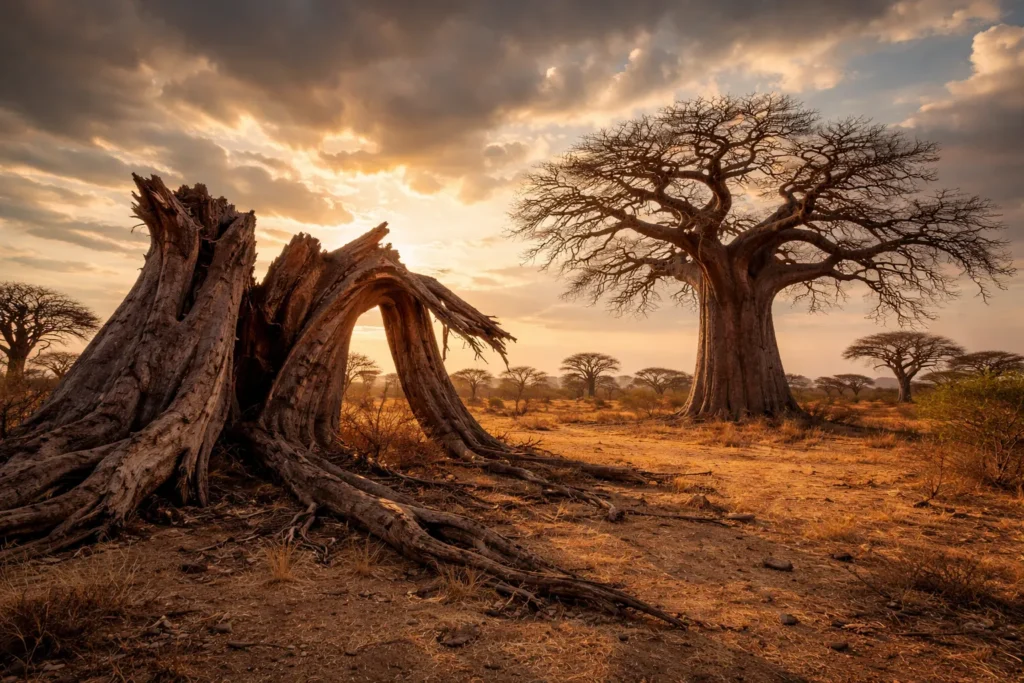
There is a moment just before dawn when the African savanna holds its breath. The darkness begins to soften, fading from black to deep purple to the first hint of gold along the eastern horizon. The animals that have moved through the night, the hyenas and leopards and porcupines, slip back into their dens and thickets. The animals of the day, the impalas and warthogs and baboons, stir from their resting places and begin their slow movement toward water. And in that moment, the baobabs stand as they have always stood, silent and enormous, their twisted branches reaching toward the light like the arms of ancient prayers.
There is a baobab in the Limpopo Province of South Africa that当地人 call the Big Tree. It is not the biggest baobab in Africa, not by a long measure, but it is big enough to take your breath away. Its trunk measures more than forty meters around, which means that if you wanted to hug this tree, you would need more than twenty of your closest friends to join hands around it. Its branches spread outward and upward, covering an area larger than a basketball court. It has been standing here for more than twelve hundred years, which means it was already old when the first European ships rounded the Cape of Good Hope. It was already old when the Great Zimbabwe empire was at its height, trading gold with merchants from China and Persia. It was already old when Charlemagne was crowned Holy Roman Emperor in a distant land across the sea.
The Big Tree has seen things that no human chronicle has recorded. It has watched the climate shift from wetter to drier and back again, cycles that played out over centuries while the tree simply grew. It has felt the tremors of earthquakes and the scorch of lightning strikes. It has provided shade for countless generations of travelers, warriors, hunters, herders, and refugees. It has been a meeting place, a landmark, a source of food and water and medicine. And until recently, it seemed as permanent as the hills themselves.
But in 2016, something changed. Visitors to the Big Tree noticed that one of its massive branches had begun to lean, tilting toward the ground at an angle that seemed wrong. The crack where the branch joined the trunk widened slowly over the following months. Park rangers monitored the situation, but there was nothing they could do. A tree of this size cannot be propped up or braced. It must stand on its own or fall.
In 2017, the branch fell. It crashed to the ground with a sound that echoed across the valley, sending dust billowing into the air. When the dust settled, the Big Tree was still standing, but it was diminished. A gaping wound marked the place where the branch had been, exposing the hollow interior of the trunk to the sky for the first time in a millennium. The tree survived, but it was forever changed.
The Big Tree is not alone. Across the African continent, from the dry woodlands of Senegal to the river valleys of Mozambique, the ancient baobabs are falling. They are collapsing under their own weight, splitting apart, dying. The losses include some of the most famous trees in the world, individuals that had become landmarks and tourist attractions. The Chapman Baobab in Botswana, which was so large that it had its own mailbox and served as a navigation point for pilots, collapsed in 2016. The Panke Baobab in Zimbabwe, estimated to be 2,450 years old, died in 2011. The Sunland Baobab in South Africa, which housed a pub in its hollow trunk, split apart in 2016 and 2017.
For trees that have survived everything nature could throw at them for two thousand years or more to fall in a single decade is more than a coincidence. It is a mystery that demands explanation. And the search for that explanation has taken scientists across the continent, into the hearts of these ancient giants and into the complex web of factors that shape their lives.
Chapter Two: The Shape of Wonder
To understand why the baobabs are falling, you must first understand what a baobab is. This is not as simple as it sounds because the baobab defies easy categorization. It is not a typical tree in any sense. Its trunk is not made of hard wood like an oak or a maple. Its branches do not grow in the orderly patterns of a pine or a fir. Its leaves appear and disappear with the seasons, and its flowers bloom for only one night, opening at dusk and withering by dawn.
The baobab belongs to the family Malvaceae, which includes hibiscus and cotton, but it is placed in its own genus, Adansonia, named for the French naturalist Michel Adanson. Adanson was the first European to describe the baobab in detail, having encountered it in Senegal in the mid-eighteenth century. He was astonished by the tree’s size and strangeness, and he spent years studying its biology and uses. His work laid the foundation for all subsequent research on the baobab, but even he could not fully explain its peculiarities.
The most striking feature of the baobab is its trunk. In mature trees, the trunk is massively swollen, often wider than it is tall. This swelling is not for show. It is a water storage organ, a living reservoir that allows the tree to survive months of drought. The wood of the baobab is soft and fibrous, composed of large cells that can expand and contract as water is stored and used. During the rainy season, the tree drinks greedily, absorbing water through its shallow root system and storing it in the trunk. A large baobab can hold more than 140,000 liters of water, enough to supply a small village for weeks.
This stored water sustains the tree through the long dry season, when no rain falls for months on end. It also sustains the animals that live around it. Elephants tear into the bark with their tusks to reach the moist fibers inside. Baboons crack open the hard fruit shells to eat the powdery pulp. Birds nest in the branches, safe from ground predators. Humans draw water from hollow trunks, a practice that has saved countless lives in times of drought. The baobab is truly the Tree of Life, a name it has earned through millennia of service to the creatures of the savanna.
But the baobab’s water storage ability comes with a cost. The soft wood that makes storage possible is also vulnerable to damage. Elephants can gouge deep wounds with their tusks. Fire can burn through the bark and into the heartwood. Rot can spread through the trunk, hollowing it out from within. The tree’s survival depends on its ability to heal these wounds, to grow new tissue around the damage and seal it off from infection.
This healing ability is remarkable. When a baobab is wounded, it does not simply cover the wound with scar tissue. It grows new wood around the wound, incorporating the damaged area into the trunk. Over time, the wound may be completely enclosed, hidden within the tree’s interior. This is why many old baobabs are hollow. They have suffered injuries over the centuries, and they have healed around those injuries, leaving empty spaces where the damaged wood once was.
The hollowing process is not a sign of decline. On the contrary, it is a sign of resilience. A hollow baobab can live for centuries, its living tissue confined to the outer layers of the trunk. The hollow interior may be large enough to hold a room, as in the case of the Sunland Baobab, which housed a pub with seating for fifteen people. The tree was not bothered by the pub. It continued to grow, to flower, to fruit, as if the hollow space were simply a part of its architecture.
But hollowing also creates vulnerability. A hollow tree is weaker than a solid one. Its structural integrity depends on the thickness of the living shell around the hollow center. If that shell becomes too thin, or if the wood within it becomes too dry or too waterlogged, the tree may collapse under its own weight. This is what happened to the Sunland Baobab. The hollow interior, which had been a novelty for decades, became a weakness when the tree was stressed by drought and heat.
Chapter Three: The Oldest Living Things
How old can a baobab get? This question has fascinated scientists and travelers for centuries. Early European explorers in Africa marveled at the size of the baobabs and assumed they must be extremely old, but they had no way to measure their age. The trees do not produce reliable annual growth rings, so traditional dendrochronology is useless. For years, estimates of baobab ages were based on size and historical records, both of which are unreliable.
In the 1950s, radiocarbon dating offered a new approach. By measuring the decay of carbon-14 in wood samples, scientists could determine when that wood was formed. But even this method had limitations. The oldest parts of a baobab are often hollow and rotten, making them difficult to sample. And the tree’s growth is so irregular that samples from different parts of the same tree can yield very different ages.
Despite these challenges, researchers have managed to date many of the largest baobabs. Their findings are astonishing. The oldest reliably dated baobab was the Panke tree in Zimbabwe, which was estimated to be 2,450 years old when it died in 2011. That means it began growing around 440 BC, during the time of the Persian Empire. It was already five hundred years old when Jesus was born. It was a thousand years old when the Viking Age began. It was two thousand years old when Europeans first began to explore the African coast.
Other ancient baobabs have been found across the continent. The Sagole Baobab in South Africa, the largest tree in the country, is estimated to be around 1,200 years old. The Glencoe Baobab in South Africa, which collapsed in 2009, was estimated to be 1,835 years old. The Omusati Region baobabs in Namibia include individuals that may be more than a thousand years old. These trees are not just old. They are ancient, living links to a past that would otherwise be completely inaccessible.
The age of these trees raises profound questions about time and memory. When you stand before a two-thousand-year-old baobab, you are standing before a being that has witnessed the entire sweep of human history in its region. It has seen kingdoms rise and fall. It has seen droughts that destroyed civilizations. It has seen the arrival of new peoples, new technologies, new ways of life. It has seen all of this and said nothing, storing its memories in the silent language of growth and survival.
But now, these ancient witnesses are falling. The oldest trees, the ones that have survived the longest, are dying at an unprecedented rate. The 2018 study by Adrian Patrut and his colleagues documented the deaths or collapses of nine of the thirteen oldest baobabs in southern Africa over just twelve years. This is not a slow decline. It is a sudden and catastrophic loss.
Chapter Four: The Alarm Sounds
When Patrut’s study was published in the journal Nature Plants in June 2018, it made headlines around the world. “Africa’s Oldest Baobabs Are Dying Suddenly, Scientists Say,” announced the New York Times. “Mystery as Africa’s Oldest Baobab Trees Die,” reported the BBC. “Climate Change May Be Killing Africa’s Ancient Baobabs,” speculated National Geographic.
The story was compelling. Here were trees that had survived for millennia, through droughts and floods, through fires and elephant attacks, through everything nature could throw at them. And now, in the space of a single decade, they were collapsing. The obvious suspect was climate change. Southern Africa was warming faster than the global average. Droughts were becoming more frequent and more severe. It seemed logical that the trees, stressed by heat and lack of water, were simply giving up.
Patrut himself was cautious in his conclusions. “It is definitely shocking and dramatic to experience during our lifetime the demise of so many trees with millennial ages,” he told reporters. But he stopped short of blaming climate change definitively, noting that more research was needed. Nevertheless, the connection was hard to ignore. The baobabs were falling at a time when the climate was changing rapidly. The coincidence was too striking to dismiss.
The study sparked a flurry of research and debate. Scientists who had been studying baobabs for decades weighed in with their own observations and data. Some agreed with Patrut’s findings, reporting similar die-offs in their study areas. Others were skeptical, noting that baobab populations in many areas appeared healthy and stable. The debate was not about whether ancient baobabs were dying. They clearly were. The debate was about why they were dying and what it meant for the species as a whole.
To understand this debate, we have to look more closely at the evidence. Patrut’s study focused on the oldest and largest baobabs, the ancient giants that had survived for more than a thousand years. These trees are rare. There are only a handful of them in all of Africa. Their deaths, while dramatic, may not reflect the health of the broader population. Younger trees, which are far more numerous, might be doing just fine.
This is exactly what Sarah Venter, a baobab ecologist at the University of the Witwatersrand, found when she examined her study populations. Venter has been studying baobabs for more than twenty years, monitoring hundreds of trees in the Venetia Limpopo Nature Reserve and other areas. In all that time, she has not recorded a single death among adult trees. Her trees have survived the same droughts and heat waves that Patrut’s trees faced. They are still standing, still growing, still producing fruit.
Does this mean Patrut was wrong? Not necessarily. It means that the situation is more complex than a simple narrative of decline. The ancient trees are indeed under stress. Some are dying. But the species as a whole is not collapsing. Young trees are still germinating and growing. Adult trees are still reproducing. The baobab, it seems, is more resilient than we thought.
Chapter Five: The Skeptic’s View
Sarah Venter is not the kind of scientist who dismisses inconvenient data. She has spent her career in the field, climbing baobabs, measuring their growth, counting their fruit, studying their ecology. She knows these trees as well as anyone alive. When she read Patrut’s study, she felt that something was missing.
“I look after a population of 116 trees,” she explained in an interview. “I’ve been monitoring them since 1998. In that whole time, not one adult tree has died.” This was not a matter of opinion. It was a fact, documented in years of field notes and measurements. Her trees had survived the same conditions that Patrut’s trees had faced. They had endured the same droughts, the same heat, the same pressures. And they were still alive.
This raised an obvious question. Were Patrut’s findings representative of the broader population, or had he focused on a subset of trees that were already near the end of their natural lives? To find out, Venter and her team set out to revisit the trees Patrut had studied. They traveled across southern Africa, locating the ancient giants and assessing their condition. What they found was a more nuanced picture than the 2018 study had painted.
Of the thirteen oldest trees Patrut had identified, Venter confirmed that only five had actually died. Several of the others were still alive, though they had collapsed or split. And crucially, four of the collapsed trees were showing signs of regrowth. New stems were sprouting from the fallen trunks, reaching toward the sun. The trees were not dead. They were simply continuing a cycle of collapse and regeneration that had been part of baobab ecology for millions of years.
This discovery did not disprove Patrut’s findings, but it did put them in context. The ancient trees were indeed under stress. Some were dying. But the population as a whole was not crashing. Young trees were still growing. Adult trees were still reproducing. The species was not on the brink of extinction, at least not in southern Africa.
Venter’s findings were published in Nature Plants in 2024, as a response to Patrut’s original study. The debate between the two researchers highlighted the challenges of studying long-lived organisms in a rapidly changing world. Baobabs live on timescales that dwarf human lifespans. A scientist can spend a career watching a single tree and see almost no change. To understand what is happening to the species as a whole, you need to look across vast areas and long periods. And even then, the signals can be ambiguous.
What both sides agree on is that the ancient trees are under threat. Whether the current mortality rate is unprecedented or merely a natural part of the baobab life cycle, the fact remains that some of the oldest and largest trees are falling. And if the conditions that caused their collapse become more common, the losses will only accelerate.
Chapter Six: The Limits of Life
No living thing lives forever. This is a truth so obvious that it hardly needs stating. But when we look at trees that have survived for two thousand years, it is easy to forget that they are mortal. They seem permanent, eternal, beyond the reach of time. But they are not.
Every species has a maximum lifespan, a limit beyond which even the healthiest individuals cannot go. For baobabs, that limit appears to be around two to three thousand years. The oldest reliably dated baobab, the Panke tree, died at 2,450 years. The second oldest, the Glencoe tree, died at 1,835 years. It is possible that some baobabs have lived longer, but if so, we have not found them.
The causes of death in very old trees are complex. They do not die of old age in the same way that animals do. There is no programmed senescence, no built-in expiration date. Instead, they die because their accumulated vulnerabilities finally overwhelm their ability to cope. A wound that was healed centuries ago may become a weak point. A hollow that was stable for a thousand years may suddenly give way. A root that has supplied water for millennia may finally rot.
The deaths documented by Patrut may simply be the natural passing of a generation of trees that sprouted during the time of Caesar. If that is the case, then the current mortality rate is not a crisis. It is a cycle, a renewal. The old trees fall, making way for the young trees that will replace them.
But this interpretation raises its own questions. If the ancient trees are dying naturally, why are they dying now? Why not a hundred years ago, or a hundred years from now? The timing is suspicious. The trees are falling at a time when the climate is changing rapidly, when droughts are becoming more frequent, when temperatures are rising. It is hard to believe that this is a coincidence.
The most likely explanation is that the ancient trees are being pushed to their limits by environmental stress. They have always been vulnerable to collapse, but in the past, the conditions that triggered collapse were rare. Now they are becoming more common. The trees that survived for millennia because they never encountered fatal stress are finally encountering it. They are dying not because they are old, but because the world has changed.
Book Two: The Elements
Chapter Seven: The Architecture of Water
Water is the currency of life in the African savanna. Plants and animals alike are adapted to survive long periods without it, storing it, conserving it, seeking it out. But water is also a source of danger. Too little, and organisms desiccate and die. Too much, and they drown or rot. The baobab’s relationship with water is particularly complex because the tree must balance two opposing needs. It must store enough water to survive the dry season, but it must also keep that water from destroying its own structure.
The baobab’s wood is designed for water storage. It consists of large, thin-walled cells that fill with water during the rainy season. These cells are arranged in concentric layers, like the rings of an onion, but they are not rigid like the wood of an oak. They are soft and flexible, allowing the trunk to expand as water is stored. In a healthy tree, this flexibility is a strength. The trunk can swell and shrink with the seasons without cracking.
But when the tree becomes waterlogged, the cells cannot drain quickly enough. They remain swollen for too long, and the connections between them begin to break down. Fungi and bacteria invade the weakened tissue, accelerating the decay. Eventually, the entire structure becomes unstable. The tree is still alive, still producing leaves and fruit, but it is no longer sound. A strong wind, a heavy rain, or simply the force of gravity can trigger a catastrophic failure.
This process is known as hydraulic failure, and it is one of the leading causes of baobab collapse. It occurs when the tree’s water balance is disrupted, either by too much water or by too little. In the case of too much water, the tree simply cannot get rid of the excess fast enough. In the case of too little water, the tree’s tissues dry out and become brittle, losing the flexibility that allows them to withstand stress.
Both scenarios are becoming more common as climate change alters rainfall patterns across Africa. In some areas, total rainfall is decreasing, leading to more frequent and severe droughts. In others, rainfall is becoming more intense, with heavy downpours concentrated in shorter periods. Both extremes stress the trees. Drought depletes their reserves, leaving them brittle. Floods saturate their roots, leading to rot. The trees are caught between two dangers, unable to escape either.
Chapter Eight: The Drought That Never Ends
The drought that began in southern Africa in 2015 was one of the worst on record. Across the region, rainfall was far below average. Crops failed. Rivers dried up. Reservoirs dropped to record lows. In cities, water restrictions were imposed. In rural areas, people walked miles to find water. And in the bush, the animals suffered.
For the baobabs, the drought was a test of survival. These trees have evolved to withstand dry periods, but even they have limits. As the drought dragged on, month after month, year after year, the trees began to show signs of stress. Their leaves, which normally appear at the start of the rainy season, were delayed or absent. Their branches began to die back from the tips. Their trunks, which should have been swollen with stored water, began to shrink.
The problem was not just the lack of rain. It was also the heat. Temperatures during the drought were consistently higher than average, increasing the rate of evaporation from the leaves. The trees were losing water faster than usual, drawing down their reserves more quickly. By the time the rains finally returned, many trees had exhausted their stored water. They were running on empty.
The effects of the drought were most visible in the ancient trees. These giants, with their massive crowns and extensive root systems, require more water than younger trees. They have larger reserves, but they also have larger demands. When the drought stretched on, they were the first to show signs of distress. Their branches died back. Their bark peeled away. Their trunks cracked and split.
Some trees survived. Others did not. The ones that died were not necessarily the oldest or the largest. They were the ones that happened to be in the wrong place at the wrong time, on shallow soils or exposed slopes, with root systems that could not reach whatever groundwater remained. The drought was a filter, culling the vulnerable and leaving the resilient.
But resilience has its limits. If droughts become more frequent and more severe, even the most resilient trees will eventually succumb. The 2015-2016 drought may be a preview of the future, a future in which the baobabs face conditions for which their millennia of evolution have not prepared them.
Chapter Nine: The Floods That Follow
If drought were the only problem, the baobabs might adapt. They have survived droughts before, countless times over their long lives. But the changing climate does not bring only drought. It also brings floods.
In recent years, parts of southern Africa have experienced increasingly intense rainfall events. The same atmospheric patterns that cause drought in one area can cause floods in another. When the rains finally come, they come hard, dumping months’ worth of water in a matter of days. The ground cannot absorb it fast enough. The water runs off, carrying soil and nutrients with it. And the trees, adapted to survive dry periods, are suddenly inundated.
For a baobab, too much water can be as deadly as too little. The tree’s shallow root system, designed to capture moisture from light rains, is not equipped to handle prolonged saturation. When the soil is waterlogged, the roots cannot breathe. They begin to rot. And as the roots rot, the tree’s ability to take up water and nutrients is compromised.
The problem is worst in winter, when the trees are dormant and leafless. Without leaves to pump water away from the roots, the moisture accumulates in the trunk, saturating the fibrous wood. This creates ideal conditions for fungi and bacteria, which invade the tree’s tissues and begin to break them down. The tree may not show any signs of trouble for months or even years, but the decay is progressing, weakening the structure from within.
When the next dry season comes, the tree faces a double challenge. Its roots are damaged, limiting its ability to take up water. Its trunk is weakened, making it more vulnerable to collapse. If the drought is severe, the tree may not have enough stored water to survive. If a storm comes, the tree may not have enough strength to stand.
This combination of drought and flood, of too little water followed by too much, is a hallmark of climate change. The weather patterns that once brought reliable rains are breaking down, replaced by extremes. The baobabs, which evolved in a world of predictable seasons, are struggling to cope.
Chapter Ten: The Heat That Changes Everything
Water is not the only factor. Temperature also plays a critical role in the health of baobabs. These trees are adapted to a specific range of temperatures, and when that range is exceeded, they suffer.
Across Africa, temperatures are rising. The continent is warming faster than the global average, and southern Africa is warming faster than the rest of the continent. Since 1900, average temperatures in the region have increased by more than one degree Celsius. By the end of this century, they are projected to increase by another two to four degrees, depending on global emissions.
For a baobab, higher temperatures mean higher rates of evaporation. The tree loses water more quickly through its leaves, drawing down its stored reserves. This is particularly problematic during the dry season, when no rain is falling to replenish the supply. A tree that could once survive a six-month dry season may now face an eight-month dry season, with higher temperatures increasing the demand for water throughout.
Higher temperatures also affect the tree’s physiology. The biochemical reactions that drive growth and reproduction are temperature-sensitive. When temperatures are too high, these reactions slow down or stop. The tree may stop growing, stop flowering, stop fruiting. It may enter a state of suspended animation, waiting for conditions to improve. But if conditions do not improve, the tree may never recover.
There is evidence that this is already happening. In some areas, baobabs are producing fewer flowers and fruits than they did in the past. Their growth rates have slowed. Their leaves are smaller and fewer. These are subtle changes, invisible to the casual observer, but they add up over time. A tree that is stressed by heat may survive for years, even decades, but it is slowly declining. Its reserves are being depleted. Its structure is being weakened. And when the final stress comes, whether it is a drought, a flood, or a storm, the tree may collapse.
Chapter Eleven: The Groundwater Crisis
Beneath the surface, another drama is unfolding. The baobab’s roots, unlike those of most large trees, do not reach deep into the earth. They spread out horizontally, just below the surface, covering an area much larger than the tree’s crown. This shallow root system allows the tree to capture moisture from even light rains, but it also makes the tree dependent on the upper layers of the soil. When those layers dry out, the tree has no way to reach deeper water.
This is where groundwater comes in. In many areas, the water table is close enough to the surface that the baobab’s roots can tap into it during dry periods. The tree draws moisture from the saturated soil below, supplementing the water stored in its trunk. This groundwater is a critical buffer against drought, allowing the tree to survive even when no rain falls for months or years.
But groundwater levels are not stable. They fluctuate with the seasons, rising during wet periods and falling during dry ones. And in recent decades, they have been falling across much of Africa. The reasons are complex. Climate change plays a role, reducing rainfall and increasing evaporation. But human activities are also important. Farmers pump groundwater to irrigate their crops. Cities pump it to supply their residents. Mines pump it to keep their excavations dry. All of this extraction lowers the water table, pulling it further and further from the surface.
For a baobab, a falling water table is a death sentence. The roots, adapted to capture moisture near the surface, cannot follow the water down. They are left hanging in dry soil while the life-sustaining moisture retreats beyond their reach. The tree must rely entirely on the water stored in its trunk, and that water is finite. Once it is gone, the tree begins to die.
This process is invisible from the surface. The tree may look healthy for years, its trunk swollen with stored water, its leaves green and full. But beneath the soil, the roots are drying out, and the connection to the groundwater is severed. When the stored water runs out, the decline is rapid. The leaves yellow and fall. The branches die back. The bark loosens and peels away. And then, often without warning, the tree collapses.
Scientists are only beginning to understand the role of groundwater in baobab health. It is a difficult subject to study because the water is hidden, and the trees are scattered across vast landscapes. But early research suggests that groundwater depletion may be a major factor in the collapse of the ancient giants. In areas where mining or intensive agriculture has lowered the water table, baobabs are dying at higher rates. In areas where the water table remains stable, the trees are doing better.
The connection between groundwater and tree health has important implications for conservation. It means that protecting baobabs is not just about protecting the trees themselves. It is about protecting the entire hydrological system on which they depend. It means regulating groundwater extraction, limiting mining near baobab populations, and ensuring that enough water remains in the soil to sustain the trees through dry periods.
Chapter Twelve: The Wind and the Lightning
Water and heat are the primary drivers of baobab health, but they are not the only ones. Wind and lightning also play a role, and their effects may be magnified as the climate changes.
Baobabs are not built to withstand strong winds. Their massive trunks and heavy crowns make them vulnerable to uprooting, especially when the soil is saturated and the roots have less grip. In areas where cyclones or severe thunderstorms are becoming more frequent, wind damage may increase. A tree that has stood for centuries may be felled by a single storm.
Lightning is another threat. Baobabs are often the tallest objects in the landscape, making them attractive targets for lightning strikes. A direct strike can kill a tree outright, splitting the trunk and setting the wood on fire. Even a glancing strike can cause serious damage, wounding the bark and providing an entry point for pests and pathogens.
In the past, lightning strikes were rare enough that trees could recover. The wounds healed, the fires burned out, and the tree continued to grow. But as storms become more frequent and intense, the risk of lightning damage increases. A tree that might have been struck once in a thousand years may now be struck twice in a century. The cumulative damage may be more than the tree can bear.
Book Three: The Animals
Chapter Thirteen: The Engineers
Elephants are the largest land animals on Earth, and they have a correspondingly large impact on their environment. They knock down trees to reach the leaves and bark. They dig water holes with their tusks and trunks. They create paths through the dense bush that other animals follow. They are ecosystem engineers, shaping the landscape in ways that benefit countless other species.
For millions of years, elephants and baobabs have coexisted in Africa. The trees have evolved defenses against the elephants’ appetites. Their bark is thick and fibrous, resistant to tearing. Their wood is soft, allowing the tree to heal quickly after damage. And their massive size means that even a hungry elephant cannot consume the entire tree. The relationship is one of balance, with the elephants taking what they need and the trees recovering over time.
But balance depends on context. When elephant populations are healthy and their range is extensive, the damage they do to baobabs is sustainable. The trees have time to heal between attacks. When elephant populations are compressed into small areas, or when natural water sources dry up, the balance shifts. The elephants become more destructive, and the trees have less time to recover.
This is exactly what has been happening in protected areas across southern Africa. As human populations grow and expand, elephant habitat shrinks. The animals are confined to parks and reserves, where they cannot migrate to escape drought or find new food sources. Their populations, protected from poaching, grow larger than the land can support. And when drought strikes, they turn to the baobabs.
Chapter Fourteen: The Scars of Desperation
In Mapungubwe National Park, the evidence of elephant desperation is written on the trees. Baobabs that stood for centuries are now riddled with scars. Deep gouges mark the places where tusks tore into the bark. Holes expose the fibrous interior, where trunks reached in to pull out chunks of wood. Some trees have been completely hollowed out, their living tissue reduced to a thin shell around an empty core.
The elephants are not being malicious. They are simply trying to survive. When the Limpopo River dried up during the 2015-2016 drought, the animals that depended on it had nowhere else to go. Elephants from Botswana and Zimbabwe, where populations are high and pressure is intense, crossed the dry riverbed and entered South Africa. They were desperate for water and food. And when they found the baobabs, they found a source of both.
The damage they caused was unprecedented. In some areas, more than half of the large baobabs were severely damaged. Trees that had survived for centuries were reduced to ruins in a matter of months. Park rangers watched helplessly as the destruction unfolded. There was nothing they could do. The elephants were too numerous, the trees too many, the drought too severe.
The scars left by elephants are not just cosmetic. They are entry points for fungi, bacteria, and insects. They weaken the tree’s structure, making it more vulnerable to collapse. And they reduce the tree’s ability to store water, compromising its survival during future droughts. A tree that has been badly damaged by elephants may never fully recover, even if the elephants never return.
Chapter Fifteen: The Fire After
Elephant damage does not occur in isolation. It is often followed by fire. Savanna fires, whether started by lightning or by humans, sweep through the landscape regularly. In a healthy ecosystem, fires are a natural part of the cycle, clearing out dead vegetation and stimulating new growth. Baobabs have evolved to survive these fires. Their thick bark provides insulation, protecting the living tissue beneath.
But when elephants have damaged a baobab, the bark is no longer intact. The wounds expose the inner wood, which is dry and flammable. When a fire sweeps through, it enters these wounds and burns the wood inside. The tree may smolder for days, the fire eating away at its core. By the time the fire is out, the tree may be nothing but a charred shell.
Even if the tree survives the fire, it is weakened. The heat damages the living tissue, reducing its ability to transport water and nutrients. The wounds are enlarged, providing even better entry points for pests and pathogens. And the stress of the fire may trigger a cascade of physiological failures that eventually lead to collapse.
This combination of elephant damage and fire is particularly deadly. The elephants create the wounds, and the fire exploits them. Together, they can kill trees that might have survived either threat alone. And as climate change makes both droughts and fires more frequent, the risk to baobabs increases.
Chapter Sixteen: The Goats and the Future
Elephants are not the only animals that damage baobabs. In rural areas, livestock pose an even greater threat, especially to young trees. Goats, in particular, are hard on baobab seedlings. They browse the tender leaves and stems, nibbling them down to the ground. A goat can kill a young tree in seconds, and in areas with high goat populations, the survival rate for baobab seedlings is near zero.
This is a crisis that receives far less attention than the collapse of the ancient giants, but it may be even more important in the long run. The ancient trees, for all their majesty, are a finite resource. They cannot live forever. If new trees are not growing to replace them, the population will eventually crash, no matter how healthy the adults look today.
Studies in communal grazing lands have found that up to ninety percent of young baobabs die within their first three years. The primary cause is browsing by goats and other livestock. The seedlings simply cannot get big enough fast enough to escape the animals’ reach. They are nibbled down again and again until they run out of energy and die.
This is a problem that can be solved with relatively simple measures. Fencing young trees to protect them from livestock is effective. So is reducing goat populations in areas where baobabs are struggling. But these measures require resources and commitment, and in many communities, they are not a priority. People need their goats for milk, meat, and income. They cannot afford to fence off every young baobab. The trees, for all their cultural significance, are competing with immediate human needs, and they are losing.
Chapter Seventeen: The Beetles and the Blights
As if elephants, goats, fire, drought, and flood were not enough, the baobabs also face growing threats from insects and diseases. Pests that were once kept in check by environmental conditions are spreading, finding new opportunities in the changing climate.
In Togo, in West Africa, scientists have documented a dramatic increase in damage caused by the beetle Analeptes trifasciata. This insect, which feeds on the bark and living tissue of baobabs, has long been present in the region, but it was never considered a major threat. In recent years, however, its populations have exploded. The beetles attack healthy trees, girdling branches and trunks, and their damage can be fatal.
Why the sudden increase? The most likely explanation is climate change. Warmer temperatures allow the beetles to complete their life cycles more quickly, producing more generations per year. Longer dry seasons stress the trees, making them more vulnerable to attack. And changes in rainfall patterns may disrupt the natural enemies that once kept beetle populations in check.
Whatever the cause, the result is the same. Across Togo, baobabs are dying. Models suggest that by 2055, nearly half of the highly favorable habitat for baobabs in the country could be lost to a combination of climate stress and beetle damage. The trees are being squeezed from all sides.
Nor are beetles the only threat. Fungi that cause root rot and stem rot are spreading in areas where waterlogging has become more common. Bacteria that infect wounds left by elephants or fires are finding new opportunities. Viruses that weaken trees and reduce their ability to reproduce are being discovered for the first time. The baobab’s immune system, honed over millions of years of co-evolution with its enemies, is being overwhelmed by novel threats.
This is a pattern that ecologists see across the natural world. When climate changes rapidly, the relationships between species break down. Pests escape their predators. Diseases find new hosts. The balance that maintained stability for millennia is disrupted, and the consequences ripple through the ecosystem. The baobabs, with their slow growth and long lives, are particularly vulnerable because they cannot adapt quickly enough to keep pace with the changes.
Book Four: The People
Chapter Eighteen: The Tree of Life
Throughout this story, the baobabs have been the main characters. But they do not exist in isolation. They are deeply connected to human communities, and their fate is intertwined with ours.
In rural Africa, the baobab is a source of food, medicine, and income. The fruit, known as monkey bread or buyu, contains a powdery pulp that is rich in vitamin C, calcium, and antioxidants. It is used to make drinks, porridge, and sauces. The leaves are eaten as a vegetable, similar to spinach. The bark is stripped to make rope, baskets, and cloth. The seeds are pressed for oil. Almost every part of the tree has a use, and for many families, the baobab is a crucial source of nutrition and cash.
The nutritional value of baobab fruit is remarkable. The pulp contains six times more vitamin C than oranges, twice as much calcium as milk, and high levels of potassium, magnesium, and iron. It is also rich in antioxidants, which help protect the body from damage by free radicals. For communities that lack access to diverse diets, the baobab is a vital source of essential nutrients.
The leaves are equally valuable. They are rich in protein, vitamins A and C, and minerals. They are typically dried and ground into a powder, which is added to soups and sauces. In some areas, the leaves are a staple food, consumed throughout the year.
The bark provides fiber for making rope, baskets, and cloth. The fiber is strong and durable, and it has been used for centuries to create everything from fishing nets to clothing. In some cultures, the bark is also used medicinally, as a treatment for fever, diarrhea, and other ailments.
The seeds are pressed to extract oil, which is used for cooking and as a base for cosmetics. The oil is rich in essential fatty acids and has a long shelf life, making it a valuable trade commodity.
Chapter Nineteen: The Market and the Money
The commercial potential of baobab products has attracted increasing attention in recent years. In 2008, the European Union approved the import of baobab fruit as a novel food, opening up a lucrative market for African producers. Companies in Europe and North America now sell baobab powder as a superfood, marketing it to health-conscious consumers willing to pay premium prices. This trade has the potential to lift thousands of families out of poverty, providing a sustainable income from a renewable resource.
But it also creates new pressures. As demand for baobab fruit grows, so does the incentive to harvest more intensively. In some areas, collectors are stripping trees of all their fruit, leaving none to regenerate naturally. In others, they are damaging the trees in their haste to collect. The balance between sustainable use and overexploitation is delicate, and it is not always maintained.
There is also the question of who benefits. The baobab trade is often controlled by intermediaries who buy fruit from collectors at low prices and sell it to exporters at high prices. The collectors, usually rural women, see only a tiny fraction of the final value. Efforts to establish fair trade certification and cooperative ownership are underway, but they are in their infancy.
The challenge is to develop a baobab economy that benefits local communities while protecting the trees. This requires investment in infrastructure, training, and market access. It requires regulations to prevent overharvesting and ensure that harvesting methods do not damage the trees. And it requires a commitment to equity, ensuring that the people who have cared for the baobabs for generations share in the rewards of their commercialization.
Chapter Twenty: The Sacred and the Profane
Beyond their material value, baobabs hold deep cultural and spiritual significance. In many African societies, the trees are sacred. They are believed to house ancestral spirits, and offerings are left at their base. Important ceremonies are held beneath their branches. Stories are told about their origins and powers.
In some cultures, it is believed that the baobab was once a proud tree that angered the gods. As punishment, the gods uprooted it and replanted it upside down, leaving its roots exposed to the sky. This is why the tree’s branches look like roots. In other cultures, the baobab is seen as a protector, a guardian that watches over the community and keeps evil at bay.
These beliefs are not mere superstition. They are expressions of a deep relationship between people and trees, a relationship built on millennia of coexistence. The baobabs are woven into the fabric of community life, their presence a source of continuity and meaning.
When a baobab falls, it is not just a biological event. It is a cultural tragedy, a tear in the fabric of the landscape that cannot be easily mended. The loss is felt not only by the people who live nearby but by all who recognize the tree’s significance. The baobabs are part of Africa’s heritage, as important as any monument or artifact.
Chapter Twenty-One: The Healers and the Medicine
Traditional healers have used baobabs for centuries to treat a wide range of ailments. The bark, leaves, fruit, and seeds are all used in various preparations. The fruit pulp is used to treat fever and diarrhea. The leaves are used to treat inflammation and pain. The bark is used to treat malaria and other fevers. The seeds are used to treat skin conditions and wounds.
Modern research has begun to validate some of these traditional uses. Studies have shown that baobab extracts have antimicrobial, anti-inflammatory, and antioxidant properties. They may be effective against a range of pathogens, including bacteria and fungi. They may also help to reduce inflammation and protect against oxidative stress.
But the knowledge of how to use baobab medicinally is held by traditional healers, and it is at risk of being lost. As younger generations move to cities and adopt modern lifestyles, the old ways are forgotten. The healers are aging, and few young people are learning their craft. When a healer dies, it is as if a library has burned down.
Efforts are underway to document traditional knowledge and preserve it for future generations. Researchers are working with healers to record their practices and identify the active compounds in baobab medicines. This work is urgent, because the knowledge is disappearing fast. And as the baobabs themselves come under threat, the loss of traditional knowledge compounds the tragedy.
Chapter Twenty-Two: The Farmers and the Land
In rural areas, baobabs grow on land that is also used for farming. Farmers must balance the needs of their crops with the presence of the trees. Baobabs compete with crops for water and nutrients, and their shade can reduce yields. But they also provide benefits, improving soil fertility and providing food and medicine.
The relationship between farmers and baobabs is complex and varies from place to place. In some areas, farmers protect and nurture baobabs, recognizing their value. In others, they cut them down to make room for crops. The outcome depends on many factors, including the farmer’s knowledge, the availability of alternatives, and the pressures of the market.
As climate change makes farming more difficult, the pressure to clear land may increase. Farmers who are struggling to feed their families may not have the luxury of thinking about the long-term value of baobabs. They need to produce food now, and if that means cutting down trees, they will do it.
This is where conservation must engage with the realities of rural life. Protecting baobabs cannot mean telling farmers that they cannot use their land. It must mean finding ways for farmers to benefit from the trees, to see them as assets rather than obstacles. This requires investment in agroforestry, in payment for ecosystem services, in alternative livelihoods. It requires a holistic approach that considers the needs of people as well as trees.
Chapter Twenty-Three: The Researchers and the Questions
Scientists have been studying baobabs for centuries, but there is still much we do not know. How do the trees sense and respond to stress? What are the limits of their resilience? How will they cope with the changes to come?
These questions are urgent, because the answers will determine the future of the species. If we can understand what makes baobabs vulnerable, we can take steps to protect them. If we can identify the conditions they need to thrive, we can work to maintain those conditions.
Research on baobabs is challenging because the trees live so long and grow so slowly. A study that lasts a decade is just a snapshot in the life of a thousand-year-old tree. To understand long-term trends, we need long-term data, and that requires commitment and continuity.
Fortunately, there are researchers who have made that commitment. Sarah Venter has been studying her trees for more than twenty years. Adrian Patrut has been radiocarbon dating baobabs for nearly as long. Others have joined them, building a body of knowledge that will inform conservation for generations.
But research is expensive, and funding is limited. In a world of competing priorities, baobabs do not always rank high. They are not as charismatic as elephants or lions, not as economically valuable as crops or timber. They are easy to overlook, easy to neglect.
This is a mistake. The baobabs are indicators, sentinels that tell us about the health of the ecosystems they inhabit. If they are struggling, it is a sign that something is wrong. By paying attention to the baobabs, we can learn about the broader changes unfolding across the African landscape.
Book Five: The Places
Chapter Twenty-Four: The Limpopo Valley
The Limpopo River Valley is the heart of baobab country. Here, along the border between South Africa, Botswana, and Zimbabwe, the trees reach their greatest size and abundance. The valley is hot and dry, with unpredictable rainfall and frequent droughts. It is a harsh environment, but the baobabs thrive in it.
The Limpopo Valley is also a place of deep history. The Mapungubwe Kingdom, which flourished here between 1200 and 1300 AD, was the first sophisticated state in southern Africa. Its rulers traded gold and ivory with merchants from as far away as China and India. They were buried on a hilltop overlooking the river, surrounded by golden artifacts and the bones of cattle.
The baobabs were here long before the kingdom rose, and they are still here today. They have witnessed the entire sweep of human history in this region, from the first farmers to the colonial conquest to the struggles of independence. They are the only living witnesses to it all.
But the Limpopo Valley is changing. The climate is becoming hotter and drier. The river flows less reliably. The elephants are more desperate. The baobabs are under pressure, and some are falling.
The Mapungubwe National Park, established to protect the region’s cultural and natural heritage, is a refuge for the trees. But even within the park, the threats are real. Elephants damage the trees. Drought stresses them. Fire burns them. The park managers do what they can, but they cannot control the climate or the elephants’ hunger.
Chapter Twenty-Five: The Venetia Limpopo Nature Reserve
Not far from Mapungubwe, the Venetia Limpopo Nature Reserve offers a different picture. Here, Sarah Venter has been monitoring her population of baobabs for more than twenty years. In all that time, not one adult tree has died.
Why the difference? The reserve is better managed than some areas, with controlled elephant populations and active fire management. But that is not the whole story. The reserve may also be in a slightly different climatic zone, with more reliable rainfall and deeper soils. The trees here may simply have better growing conditions.
The contrast between Mapungubwe and Venetia is instructive. It shows that local conditions matter. Baobabs are not all facing the same pressures. Some are in better shape than others. Conservation efforts must be tailored to local circumstances, addressing the specific threats that each population faces.
Venter’s long-term study is a model for how to understand these dynamics. By tracking individual trees year after year, she can see how they respond to droughts, floods, and other events. She can identify the factors that make some trees more resilient than others. And she can provide recommendations for management that are grounded in evidence.
Chapter Twenty-Six: The Tuli Block
Across the Limpopo River, in Botswana, the Tuli Block is another stronghold of baobabs. This is a region of rugged beauty, with rocky hills and dry riverbeds. The baobabs here are famous for their size and abundance. Some are estimated to be more than a thousand years old.
The Tuli Block is also famous for its elephants. The elephant population here is one of the densest in Africa, and the animals have a significant impact on the landscape. They knock down trees, create paths, and dig water holes. And they damage baobabs.
The relationship between elephants and baobabs in the Tuli Block is a subject of ongoing research. Some scientists argue that the elephants are damaging the trees beyond recovery. Others argue that the trees are resilient and will recover as they have for millennia. The truth probably lies somewhere in between. The elephants are certainly causing damage, but the trees may be able to cope if the damage is not too severe and they have time to heal between attacks.
The challenge is that the elephants are not the only threat. Drought, fire, and climate change are also at work. The combination of pressures may be more than the trees can handle, even in a place as rich in baobabs as the Tuli Block.
Chapter Twenty-Seven: The Avenue of the Baobabs
On the other side of the continent, in Madagascar, the baobabs face a different set of challenges. Madagascar is home to six species of baobab that are found nowhere else on Earth. They are among the most iconic trees on the island, drawing tourists from around the world.
The most famous of these is the Avenue of the Baobabs, a dirt road lined with towering Adansonia grandidieri trees. The avenue is a national symbol, featured on postcards and in travel guides. Tourists come to watch the sunset behind the trees, photographing their silhouettes against the orange sky.
But the trees of the avenue are under threat. The forest that once surrounded them has been cleared for agriculture, leaving them isolated in a landscape of rice paddies and cattle pastures. They are vulnerable to wind, fire, and encroaching development. Their habitat is shrinking, and their future is uncertain.
The situation in Madagascar is more urgent than on the mainland. The island’s baobabs have smaller populations and more restricted ranges. They are less resilient to disturbance. And the pressures on them are intense. Deforestation, climate change, and poverty are combining to push them toward extinction.
Chapter Twenty-Eight: The West African Woodlands
In West Africa, the baobab is a common sight in the dry woodlands that stretch from Senegal to Nigeria. Here, the trees are smaller than their southern cousins, but they are no less important. They provide food, medicine, and shade for millions of people.
West Africa is also where the baobab faces some of its most serious threats. The region’s population is growing rapidly, and the demand for land is intense. Forests are cleared for agriculture, and trees are cut for fuel. The baobabs are caught in the middle.
Climate change is adding to the pressure. Rainfall in the Sahel has been declining for decades, and droughts are becoming more frequent. The trees are stressed by the lack of water, and they are more vulnerable to pests and diseases. In some areas, baobabs are dying at alarming rates.
The beetle Analeptes trifasciata is a particular problem in West Africa. Its populations have exploded in recent years, and it is attacking baobabs with unprecedented intensity. The beetles girdle branches and trunks, cutting off the flow of water and nutrients. Affected trees may die within a few years.
The combination of climate stress and pest damage is deadly. Models suggest that by mid-century, large areas of West Africa may become unsuitable for baobabs. The trees will be forced to retreat to refuges where conditions are more favorable. Whether they can reach those refuges, and whether the refuges will be protected, remains to be seen.
Chapter Twenty-Nine: The Eastern Highlands
In East Africa, baobabs grow in scattered populations from Kenya to Mozambique. They are less abundant here than in the south or west, but they are still an important part of the landscape. Some of the largest baobabs in the world are found in this region, including trees in Tanzania that may be more than a thousand years old.
East Africa is also home to some of the most dramatic examples of baobab collapse. In recent years, several large trees have fallen in Kenya and Tanzania, drawing international attention. The causes are not always clear, but drought and age are likely factors.
The eastern populations are particularly vulnerable because they are small and isolated. They have less genetic diversity than the large populations in the south, making them less able to adapt to change. And they are scattered across a region that is experiencing rapid development and population growth.
Conservation efforts in East Africa are hampered by lack of resources and political instability. In some areas, baobabs are not protected at all. They are cut for timber, burned for charcoal, or cleared for agriculture. The losses are cumulative, and they are adding up.
Book Six: The Mysteries
Chapter Thirty: The Hollow Hearts
One of the greatest mysteries of the baobab is its hollow heart. Many old baobabs are hollow, their interiors empty spaces where the heartwood once was. These hollows can be enormous, large enough to hold a room or even a small house.
How do the hollows form? The process begins with injury. When a baobab is wounded, by elephant, fire, or lightning, the damaged tissue dies. The tree grows new tissue around the wound, sealing it off. Over time, the dead tissue rots away, leaving an empty space. The space grows as the tree continues to heal, enclosing more and more of the original wound.
The hollow heart is not a sign of decline. On the contrary, it is a sign of resilience. The tree has survived an injury that might have killed a less hardy species. It has healed around the damage, incorporating it into its structure. The hollow space is a record of past trauma, a scar that has been transformed into a feature.
But the hollow heart also creates vulnerability. A hollow tree is weaker than a solid one. Its structural integrity depends on the thickness of the living shell around the hollow center. If that shell becomes too thin, or if the wood within it becomes too dry or too waterlogged, the tree may collapse.
This is what happened to the Sunland Baobab. The hollow interior, which had been a novelty for decades, became a weakness when the tree was stressed by drought and heat. The shell was not thick enough to support the weight of the crown, and the tree split apart.
Chapter Thirty-One: The Upside-Down Tree
The baobab’s strange appearance has inspired countless legends. The most common is that the tree was once beautiful and proud, but it angered the gods. As punishment, the gods uprooted it and replanted it upside down, leaving its roots exposed to the sky. This is why the branches look like roots and the trunk looks like an inverted stump.
This legend captures something true about the baobab. It does look upside down. Its branches are thin and gnarled, reaching outward like roots searching for soil. Its trunk is massive and swollen, like a storage organ. The overall effect is otherworldly, as if the tree belongs to a different reality.
The legend also captures something about the tree’s resilience. Being upside down, the baobab is forced to survive in a world not designed for it. It must make do with what it has, storing water in its trunk, healing its wounds, enduring the harshest conditions. It is a survivor, and its survival is a testament to its strength.
Chapter Thirty-Two: The Fruit of Life
The baobab fruit is one of the most nutritious foods on Earth. Its pulp contains more vitamin C than oranges, more calcium than milk, and high levels of potassium, magnesium, and iron. It is also rich in antioxidants, which help protect the body from damage by free radicals.
The fruit has been used for centuries by African communities as a food and medicine. It is typically dried and ground into a powder, which is added to drinks, porridge, and sauces. The powder has a tangy, citrus-like flavor that is refreshing and satisfying.
In recent years, baobab powder has become popular in Western countries as a superfood. It is sold in health food stores and online, marketed to consumers seeking natural sources of nutrition. The market is growing rapidly, and with it, the demand for baobab fruit.
This demand has the potential to benefit African communities, providing income from a renewable resource. But it also creates risks. If harvesting is not managed sustainably, it could damage the trees and reduce their ability to reproduce. The challenge is to develop a baobab economy that benefits people without harming the trees.
Chapter Thirty-Three: The Water of Life
The water stored in a baobab’s trunk has saved countless lives. Travelers lost in the bush have tapped into baobabs to quench their thirst. Communities facing drought have drawn water from hollow trunks. The tree is a living reservoir, a source of water when all other sources have failed.
The water is stored in the tree’s fibrous wood. The wood acts like a sponge, absorbing water during the rainy season and releasing it slowly during the dry season. The tree can hold as much as 140,000 liters of water, enough to supply a small village for weeks.
But the water is not free. Extracting it damages the tree. Cutting into the trunk creates wounds that may become infected. Repeated tapping can weaken the tree and reduce its ability to store water. The balance between using the tree and protecting it is delicate.
In some areas, communities have developed sustainable methods for tapping baobabs. They cut small holes that can be plugged, allowing the tree to heal. They rotate the trees they tap, giving each one time to recover. These practices ensure that the trees continue to provide water for generations.
Chapter Thirty-Four: The Bark That Heals
The bark of the baobab is as remarkable as its wood. It is thick and fibrous, providing insulation against fire and protection against insects. It is also medicinal, used by traditional healers to treat a range of ailments.
The bark contains compounds with antimicrobial and anti-inflammatory properties. Extracts from the bark have been shown to inhibit the growth of bacteria and fungi. They may also help to reduce inflammation and promote healing.
Harvesting bark is a delicate operation. If done improperly, it can damage the tree and create entry points for pests and diseases. But if done carefully, with respect for the tree’s needs, it can be sustainable. The bark regenerates over time, and the tree can continue to provide this valuable resource for centuries.
Chapter Thirty-Five: The Leaves That Nourish
The leaves of the baobab are a staple food in many African communities. They are rich in protein, vitamins A and C, and minerals. They are typically dried and ground into a powder, which is added to soups and sauces. The powder has a mild, slightly bitter flavor that complements other ingredients.
The leaves are also medicinal. They are used to treat inflammation, pain, and fever. They are applied to wounds to promote healing. They are brewed into teas to relieve digestive complaints.
Harvesting leaves does not damage the tree if done sustainably. The leaves grow back quickly, and the tree can provide a continuous supply. In some areas, communities have developed systems for managing leaf harvest, ensuring that the trees remain healthy while meeting human needs.
Book Seven: The Future
Chapter Thirty-Six: The Climate Models
What does the future hold for the baobabs? Climate models provide some answers, but they are fraught with uncertainty. The models project that temperatures across Africa will continue to rise, with southern Africa warming faster than the global average. Rainfall patterns will shift, with some areas becoming drier and others wetter. Extreme events, such as droughts and floods, will become more frequent.
For the baobabs, these changes are a mixed bag. Some populations may benefit from increased rainfall, if it comes at the right time and in the right amounts. Others may suffer from increased drought, if the dry seasons become longer and hotter. The outcome will depend on local conditions and the trees’ ability to adapt.
The models also project that the range of suitable habitat for baobabs will shift. Areas that are currently marginal may become more favorable, while areas that are currently ideal may become too harsh. The trees will need to move to track these changes, but their movement is slow. Seeds dispersed by animals can travel only so far, and the trees themselves cannot move at all.
This means that human intervention may be necessary. Assisted migration, moving seeds or seedlings to new locations, could help the trees keep pace with climate change. But this approach is controversial. It raises questions about genetics, adaptation, and the integrity of natural systems. It is not a decision to be taken lightly.
Chapter Thirty-Seven: The Conservation Strategies
Conservation strategies for baobabs must address the full range of threats they face. This means protecting existing populations, restoring degraded habitats, and managing the pressures that cause decline.
Protected areas are the cornerstone of conservation. National parks and nature reserves provide refuge for baobabs, shielding them from the worst of human impacts. But protected areas are not enough on their own. They are too small, too isolated, too vulnerable to the effects of climate change. To secure the future of the baobabs, conservation must extend beyond park boundaries.
This means working with communities. It means helping farmers to protect young trees from goats. It means supporting sustainable harvesting practices that provide income without damaging the trees. It means recognizing the cultural value of the baobabs and involving local people in decisions about their management.
It also means addressing the root causes of decline. Climate change is the biggest threat, and it cannot be solved by conservation alone. Reducing greenhouse gas emissions is essential, and that requires global action. Conservationists must advocate for policies that address climate change, even as they work on the ground to protect the trees.
Chapter Thirty-Eight: The Community Solutions
Communities are the front line of baobab conservation. They live with the trees, use them, depend on them. Their support is essential for any conservation effort to succeed.
In some areas, communities have already developed innovative solutions to the challenges facing baobabs. In Senegal, women’s groups have organized to harvest and process baobab fruit, selling it through fair trade channels and using the proceeds to fund community projects. In Namibia, communal conservancies have been established that give local people a stake in protecting the trees and wildlife on their land. In South Africa, researchers are working with traditional healers to document the medicinal uses of baobabs and ensure that harvesting does not damage the trees.
These efforts are small in scale, but they point the way forward. They show that it is possible to balance human needs with conservation goals, to protect the trees while also benefiting the people who live among them. The challenge is to scale up these efforts, to replicate them across the vast range of the baobab.
Chapter Thirty-Nine: The Role of Science
Science has a crucial role to play in the future of the baobabs. Researchers are working to understand the threats the trees face and to develop strategies for addressing them. They are monitoring populations, studying genetics, modeling climate impacts. They are documenting traditional knowledge and testing its validity. They are building the evidence base that will inform conservation decisions.
But science alone is not enough. The knowledge that scientists generate must be translated into action. It must reach the people who manage the land, the communities who depend on the trees, the policymakers who set the rules. This requires communication, collaboration, and trust.
It also requires funding. Research is expensive, and it is not always a priority for governments and donors. The baobabs compete for attention with more charismatic species, with more immediate crises, with more pressing needs. But the baobabs are important, and they deserve our support.
Chapter Forty: The Global Responsibility
The baobabs are Africa’s trees, but they belong to the world. They are part of the planet’s natural heritage, as significant as the redwoods of California or the sequoias of the Sierra Nevada. Their loss would be a loss for all humanity.
This means that the responsibility for protecting them is global. It cannot rest solely on the shoulders of African communities and governments. The international community must provide support, financial and technical, for conservation efforts. It must address the root causes of climate change, which threaten not only baobabs but countless other species. It must recognize that the fate of the baobabs is connected to the fate of the planet.
There are signs of hope. International organizations are funding baobab research and conservation. Companies are investing in sustainable supply chains. Consumers are demanding products that are ethically sourced and environmentally responsible. These efforts are small, but they are growing.
Book Eight: The Hope
Chapter Forty-One: The Resilient Giants
Despite the threats they face, the baobabs are resilient. They have survived for millions of years, through countless changes in climate and landscape. They have evolved strategies for coping with stress, for healing wounds, for regenerating after damage. They are not fragile, and they are not doomed.
The evidence of their resilience is all around. Trees that have collapsed are sprouting new stems from their fallen trunks. Trees that have been damaged by elephants are healing their wounds. Trees that have survived drought are producing fruit and seeds. The baobabs are fighting back, and they are winning some battles.
The question is whether they can win the war. The pressures they face are unprecedented in their speed and scale. Climate change is altering the conditions to which they are adapted. Human activities are fragmenting their habitat and depleting their resources. The combination may be more than even the resilient baobab can handle.
But we do not know yet. The outcome is not determined. It depends on the choices we make, the actions we take, the priorities we set. The baobabs are resilient, but they need our help.
Chapter Forty-Two: The New Generation
The future of the baobabs lies with the young trees. They are the ones that will inherit the landscape, that will adapt to the changing climate, that will carry the species forward. Protecting them is essential.
Young baobabs face different threats than the ancient giants. They are vulnerable to browsing by goats and other livestock. They are susceptible to drought and fire. They are easily overlooked, easily destroyed. But they are also resilient, if given a chance.
Fencing young trees to protect them from livestock is effective. So is planting them in areas where they have room to grow. So is managing fire to reduce the risk of damage. These are simple measures, but they make a difference.
In some areas, communities are taking action. They are fencing off areas where baobab seedlings are growing. They are planting new trees in degraded lands. They are involving children in tree planting, teaching them the value of the baobabs. These efforts are creating a new generation of trees and a new generation of stewards.
Chapter Forty-Three: The Seeds of Hope
Baobab seeds are remarkably resilient. They can remain viable for years, waiting for the right conditions to germinate. They are dispersed by animals, by water, by wind. They are the vehicle through which the species moves across the landscape.
Collecting and storing seeds is a key conservation strategy. Seed banks preserve genetic diversity, providing a backup in case wild populations are lost. They also provide material for restoration projects, for planting new trees in areas where they have been lost.
Several seed banks in Africa and around the world are collecting baobab seeds. They are working with communities to gather seeds from diverse populations, ensuring that the genetic diversity of the species is preserved. The seeds are dried, stored, and tested for viability. They can be kept for decades, waiting for the day when they are needed.
But seed banks are not a solution on their own. They are a safety net, a last resort. The real work of conservation is in the wild, protecting the trees where they grow, ensuring that they have the conditions they need to survive.
Chapter Forty-Four: The Power of Story
Stories have power. They shape how we see the world, what we value, what we protect. The story of the baobabs is a story worth telling.
It is a story of ancient giants that have witnessed the sweep of human history. It is a story of resilience and adaptation, of survival against the odds. It is a story of connection, between trees and people, between past and future, between Africa and the world.
Telling this story is part of conservation. It raises awareness, builds support, inspires action. It reminds us why the baobabs matter, why their loss would be a tragedy. It connects us to something larger than ourselves, something ancient and enduring.
The story is still being written. Its ending is not determined. It depends on the choices we make, the actions we take, the priorities we set. We have the power to shape the story, to write an ending in which the baobabs survive and thrive.
Chapter Forty-Five: The Call to Action
The silent sentinels are falling. But they are also calling. They are calling us to pay attention, to act, to care. They are calling us to be worthy of the world we have inherited and the world we will leave behind.
The call is urgent. The threats are real, and they are growing. Climate change is accelerating. Habitat loss is continuing. Pressures are mounting. We do not have unlimited time to act.
But the call is also hopeful. The baobabs are resilient. The solutions are known. The will to act exists. We have the knowledge, the tools, the capacity to protect these ancient giants. What we need is the commitment.
That commitment must come from all of us. From scientists and conservationists, from communities and governments, from businesses and individuals. It must be global and local, collective and personal. It must be sustained over generations, because the baobabs live on timescales that dwarf our own.
The silent sentinels are falling. But they do not have to fall. We can save them. We can ensure that they stand for another thousand years, watching over a world that has learned to live in balance with itself. We can write an ending worthy of the trees.
Epilogue: Under the Baobab
I am sitting under a baobab as the sun sets over the African savanna. The tree is massive, its trunk wider than my car, its branches spreading outward like the arms of a giant. It has been here for centuries, maybe millennia. It has seen things I cannot imagine.
The light is golden, softening the edges of the landscape. A herd of impalas moves through the grass, stopping to drink at a waterhole. A pair of hornbills calls from a nearby acacia. The air is warm and still, heavy with the scent of dust and flowers.
I think about all that this tree has witnessed. The people who have gathered beneath it, seeking shade and shelter. The animals that have rested in its branches, safe from predators. The storms that have lashed its trunk, the droughts that have tested its resilience. The centuries of change, of loss, of survival.
And I think about the future. The threats that this tree faces, the pressures that are mounting. The climate that is warming, the water that is disappearing, the elephants that are desperate. The possibility that this tree, which has stood for so long, might not stand much longer.
But I also think about hope. The resilience of this tree, its ability to heal and regenerate. The people who are working to protect it, the communities who value it, the scientists who study it. The possibility that we can make a difference, that we can ensure that this tree and others like it continue to stand.
The sun dips below the horizon, and the sky turns orange, then purple, then dark. The first stars appear, faint at first, then brighter. The tree becomes a silhouette, its shape black against the fading light.
I stay for a while longer, not wanting to leave. I want to absorb something of this tree’s patience, its endurance, its ancient wisdom. I want to carry it with me, back to the world of deadlines and distractions, of noise and hurry. I want to remember what matters.
The tree says nothing. It does not need to. Its presence is enough.
I stand, brush the dust from my clothes, and walk back to my car. The engine starts, the lights come on, and I drive away. But part of me stays behind, under the baobab, watching the stars come out.
The silent sentinel stands alone in the darkness, waiting for whatever comes next. It has waited for centuries. It will wait a while longer.
And if we are wise, if we are brave, if we are committed, it will wait for centuries more.
This is the story of the baobabs, the ancient giants of Africa. It is a story of mystery and science, of loss and hope, of the deep connections between trees and people. It is a story that is still unfolding, with an ending that has not yet been written. And it is a story that belongs to all of us, because the fate of the baobabs is bound up with the fate of the planet we share.
The silent sentinels are falling. But they are also rising, in the hearts and minds of those who love them. And as long as they rise there, they will never truly fall.
Let us write a good ending. Let us write an ending in which the baobabs stand for another thousand years, watching over a world that has learned to live in balance with itself. Let us write an ending in which the silent sentinels are heard, and heeded, and honored for the wisdom they offer.
Let us write an ending worthy of the trees.



**back biome**
Backbiome is a naturally crafted, research-backed daily supplement formulated to gently relieve back tension and soothe sciatic discomfort.