
Genesis: The Gathering Storm Over the Río de la Plata
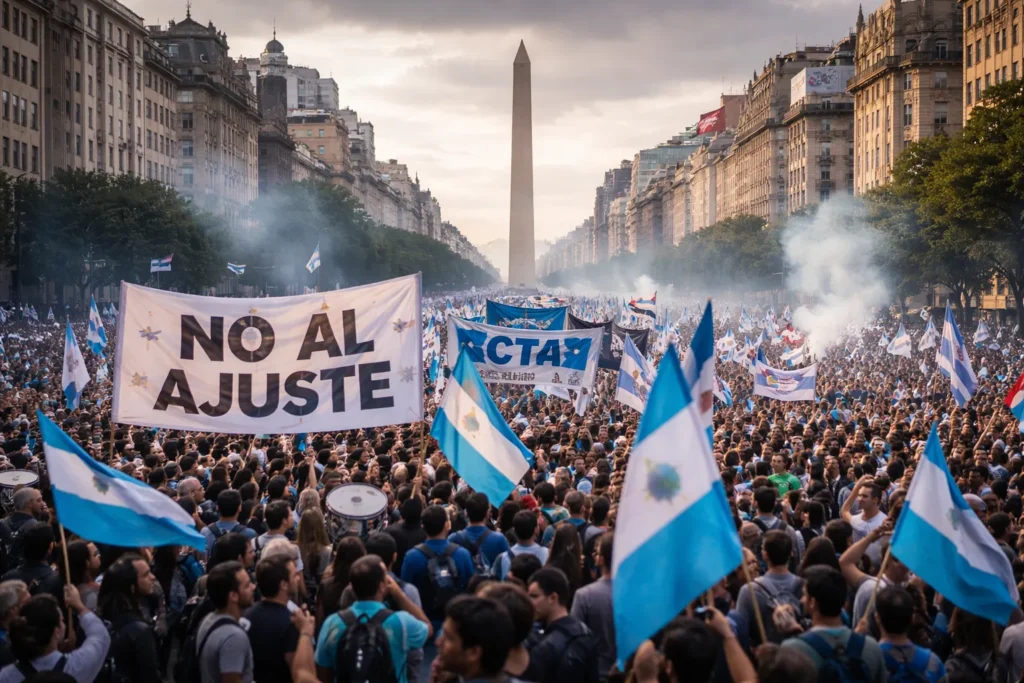
The bone-chilling winds that sweep across the vast Río de la Plata estuary in the twilight of Argentina’s autumn carry more than just the promise of the coming winter; they carry the echoes of a nation’s fractured conversation. In the grand, European-style avenues of Buenos Aires, beneath the stoic gaze of statues commemorating independence heroes, a modern-day struggle unfolds with a passion and persistence that has captured the world’s attention. The scenes are visually striking and emotionally potent: elderly women wrapped in hand-knitted shawls linking arms with university students adorned with backpacks; municipal workers in reflective vests standing shoulder-to-shoulder with teachers holding graded papers; the rhythmic, defiant bang of pots and pans—the cacerolazo—rising from balconies in both crumbling tenements and upscale high-rises.
This is the frontline of Argentina’s profound and painful economic transformation. What began as isolated grumblings over a sharp increase in subway fares has metastasized into a sustained, multifaceted social movement protesting President Javier Milei’s comprehensive package of austerity measures. The government, wielding the chainsaw that became its electoral symbol, has executed deep cuts to public spending, eliminated long-standing subsidies for transportation and utilities, and frozen public sector wages in a dramatic bid to slash the fiscal deficit and tame one of the world’s highest inflation rates. They speak a language of bitter but necessary medicine, of short-term pain for long-term survival, of breaking a pernicious cycle of populist spending that has led the country to the brink of economic collapse time and again.
Yet, on the cobblestone streets surrounding the iconic Pink House (Casa Rosada) and the domed National Congress, a different narrative takes physical form. Here, the discourse is not of macroeconomic indicators but of human endurance. It is measured in the kilometers a pensioner must now walk because the bus fare consumes too much of her fixed income; in the empty spaces on a family’s dinner table where meat, a traditional staple, once lay; in the anxious calculations of a father working three informal jobs to keep his children in a decaying public school. The protests are a visceral response to what labor unions and social organizations have termed a state of “social emergency,” a looming humanitarian crisis they warn will become unbearable during the harsh winter months when the need for heating and adequate shelter collides headlong with soaring utility costs and evaporating social supports.
This sprawling article seeks to move beyond the simplistic headlines of “protesters vs. government” to explore the deep, interconnected layers of Argentina’s current crisis. We will delve into the historical ghosts of past economic traumas that haunt the present, examine the intricate tapestry of the protest movement itself, give voice to the human stories within the statistics, analyze the government’s unorthodox strategy and philosophy, and contemplate the possible futures that lie at the end of this rocky road. This is the story of a nation engaged in a high-stakes experiment, where the very fabric of its social contract is being tested, and the outcome will resonate far beyond its borders.
Part I: The Weight of History – Understanding Argentina’s Economic DNA
The Phoenix Cycle: Boom, Bust, and Collective Memory
To dismiss Argentina’s current turmoil as merely another episode of Latin American instability is to commit a grave analytical error. Argentina’s relationship with economics is unique, tortured, and deeply woven into its national psyche. At the dawn of the 20th century, Argentina was not a developing nation; it was a global powerhouse, one of the ten wealthiest countries per capita on earth. Blessed with fertile pampas that fed Europe, it attracted millions of immigrants with promises of prosperity. This golden age left an indelible mark—a deeply ingrained belief in Argentina’s destined greatness, a sentiment that persists even amidst decay.
The 20th century, however, became a laboratory of economic dysfunction. A rhythmic, tragic cycle took hold: periods of growth and optimism would be brutally punctured by military coups, catastrophic hyperinflation, crippling foreign debt defaults, and devastating currency devaluations. Each crisis left generational scars. The Peronist experiments with state-led industrialization and wealth redistribution created powerful political identities and entrenched expectations of state benevolence. The brutal military dictatorship of 1976-1983 not only disappeared tens of thousands of people but also embarked on radical neoliberal reforms that deindustrialized the nation and exploded foreign debt.
Then came the trauma of 2001-2002, a fresh wound in the living memory of most adult Argentines. The economy contracted by nearly 11% in a single year. The government, in a desperate move that shattered public trust for a generation, enacted the corralito—a freeze on bank accounts that prevented people from accessing their life savings. Overnight, the middle class was pauperized. Poverty rates skyrocketed to over 50%. The street cry of “¡Que se vayan todos!” (“They all must go!”) echoed against the backdrop of five presidents in two weeks. This event is not mere history; it is the primal scene of modern Argentine economic anxiety. It explains the instinctive hoarding of US dollars under mattresses, the deep suspicion of the banking system, and the pervasive fear that political elites will inevitably betray the people.
The Kirchner Era: A Pendulum Swing and Its Aftermath
In the rubble of 2001, a new political force arose: the Kirchners—Néstor (2003-2007) and later his wife, Cristina Fernández de Kirchner (2007-2015). They harnessed the fury of the crisis to build a political project that rejected the Washington Consensus policies they blamed for the disaster. Their approach was characterized by heterodox economics: heavy government intervention, currency controls (cepo cambiario), generous subsidies for energy and transport, expansive social welfare programs, and the nationalization of private pension funds and the oil company YPF. Funded initially by a historic commodity boom, this model produced a decade of solid growth, falling poverty, and renewed national confidence.
But the model contained the seeds of its own crisis. When commodity prices fell, the government resorted to financing its deficits by printing money at the central bank. Inflation, officially underreported but felt daily in supermarkets, began its relentless climb. The currency controls created a labyrinthine system of multiple exchange rates and a thriving black market for dollars. Productivity stagnated. By the time Mauricio Macri (2015-2019) was elected on a promise of normalization, the imbalances were severe. His attempt at a gradual, negotiated adjustment with international creditors failed to tame inflation or attract sustained investment, and he was swept out of office amid another economic recession.
Cristina Kirchner returned as Vice President under Alberto Fernández (2019-2023), but the magic was gone. The global pandemic hit Argentina brutally, exposing the frailties of the state. The printing presses ran at full tilt to finance emergency aid, and inflation exploded into the triple digits. The psychological breaking point for many Argentines was not just the number, but the velocity—the sensation that money was melting in one’s hands between paychecks. This atmosphere of exhaustion, fear, and desperation with the entire political establishment created the perfect petri dish for a political outsider who promised not to tinker with the system, but to dynamite it.
Enter the Lion: Javier Milei and the Politics of Chainsaws
Javier Milei was not a product of the traditional political machinery. A televised economist known for his flamboyant style, lion-tamer gestures, and blistering, profanity-laden critiques of the “political caste,” he channeled the populist rage of the moment but directed it toward a radically libertarian, anarcho-capitalist solution. His message was simple, visceral, and resonated deeply with a segment of the population worn down by decades of managed decline: the state is not your friend; it is a parasitic entity that steals your wealth through inflation and taxes. His solution was equally simple: drastic, immediate shrinkage of the state through spending cuts, deregulation, and dollarization.
His symbol, the chainsaw, was a masterstroke of political communication. It promised decisive action, an end to technocratic dithering. It was a violent metaphor for a violent economic surgery. In December 2023, against all odds and the predictions of the political class, Milei was elected President. He immediately embarked on the most aggressive austerity program Argentina has seen in decades. His first act was a 54% devaluation of the peso, a move that acknowledged the painful reality of the overvalued currency but instantly halved the purchasing power of Argentines’ pesos. This was followed by a blizzard of presidential decrees aiming to deregulate vast swaths of the economy, and an omnibus bill sent to Congress proposing sweeping legislative changes.
The stage was set for an inevitable, explosive confrontation. On one side, a government with a powerful electoral mandate to break things. On the other, a society with a deep historical memory of economic pain and powerful institutions, like labor unions, ready to defend the remnants of the welfare state. The protests that fill the streets today are not just about bus fares; they are the latest battle in Argentina’s century-long war over what kind of country it wants to be—a conflict between the promise of future stability and the defense of present dignity.
Part II: The Anatomy of the Protest Movement – A Mosaic of Discontent
The Many Faces of Resistance: From Pensioners to Piqueteros
The protest movement in Argentina is not a monolith. It is a sprawling, sometimes unwieldy coalition of diverse groups, each with its own grievances, strategies, and histories, united by a common opposition to the speed and depth of Milei’s adjustments. Understanding this mosaic is key to understanding the movement’s strength and its potential fractures.
1. The Pensioners and Retirees: Perhaps the most sympathetic and potent symbol of the resistance. Argentina has an aging population, and many retirees rely solely on state pensions that have been severely eroded by inflation. Milei’s decision to suspend quarterly pension adjustments tied to inflation indices was a direct attack on their survival. Their protests are often the most poignant—lines of elderly men and women, some with walkers, holding signs that read, “I survived the dictatorship, I survived 2001, I will survive you.” They represent a powerful moral force, framing the government’s policies as an assault on those who have already contributed a lifetime to the country.
2. The Labor Unions: The backbone of organized resistance. The General Confederation of Labor (CGT), Argentina’s main trade union umbrella, has called repeated general strikes that have brought the country to a halt. Beyond the CGT, sector-specific unions—teachers, truckers, state workers, oil workers—have staged their own actions. They are fighting not just against current wage erosion but against the government’s proposed labor reform, which seeks to reduce severance pay, extend probation periods, and weaken collective bargaining power. Their power lies in their ability to disrupt the economic life of the nation.
3. The Piquetero Movements: Born in the ashes of the 2001 crisis, piquetero (picketer) groups are organizations of the unemployed and informally employed. They are known for their tactic of blocking major roads and highways to demand work programs and social assistance. While often vilified in the media, they represent a vast sector of Argentine society that exists in the precarious margins of the formal economy. They are militant, highly organized at the neighborhood level, and have become a permanent fixture of Argentina’s social landscape. The government’s cuts to social programs directly threaten their constituents, making them a relentless force in the protests.
4. The Middle Class and Students: This is a crucial and expanding wing of the protest movement. University students, facing skyrocketing transportation costs and a defunded public education system, have been at the forefront of many marches. But increasingly, traditionally apolitical middle-class professionals—doctors, engineers, small business owners—are joining the fray. They are feeling the squeeze of inflation on their salaries, the removal of consumer subsidies, and the deterioration of public services they rely on. Their participation signals a broadening of discontent beyond the traditionally mobilized poor and working class.
5. Human Rights Organizations: Groups like the Mothers and Grandmothers of the Plaza de Mayo, iconic figures from the struggle against the dictatorship, have drawn explicit parallels between past political violence and what they see as the economic violence of the current policies. Their involvement elevates the protest from a purely economic dispute to a struggle over fundamental human rights and social justice, grounding it in Argentina’s powerful human rights tradition.
The Geography of Discontent: Beyond the Obelisco
While the world’s cameras are trained on the massive marches down Buenos Aires’ Avenida de Mayo toward the Plaza de Mayo, the protest movement has a vital and often overlooked provincial dimension. Argentina is a federal republic, and the impact of austerity is felt differently—often more acutely—in the interior.
In resource-poor northern provinces like Jujuy, Salta, and Formosa, where poverty rates can exceed 40%, the national government’s cuts to revenue-sharing funds have been catastrophic. Provincial governments, the main employers in many of these regions, have been forced to delay salary payments or pay in IOUs. Public hospitals lack basic medicines, and schools close for lack of funds. Protests here are less about political ideology and more about immediate survival, often taking the form of roadblocks cutting off supply routes to major cities.
In the industrial heartlands of Córdoba and Santa Fe, the fear is of deindustrialization. Workers in manufacturing, already struggling, see the government’s open embrace of free trade and lack of industrial policy as a death knell for their factories. Their protests are often led by powerful local unions and focus on protecting national industry and jobs.
Even within Greater Buenos Aires, the gran Buenos Aires that surrounds the capital, a stark divide exists. The more affluent northern suburbs experience austerity as an inconvenience. The working-class southern suburbs, with their vast informal economies and dependence on public services, experience it as an existential threat. It is in these sprawling barrios where the piquetero movements are strongest and where protests often begin as localized, neighborhood actions before converging on the city center.
This geographic diversity presents both a strength and a challenge for the movement. It demonstrates the nationwide reach of the discontent, but it also makes coordination and the articulation of a unified set of demands incredibly complex. A pensioner in Buenos Aires wants indexation restored, a teacher in Chubut wants her back pay, and an unemployed construction worker in Mendoza wants a work plan. Uniting these diverse needs under a single banner is the daily work of the movement’s organizers.
Tactics and Terrain: The Dance of Protest and Repression
The protest landscape in Argentina is a highly sophisticated and evolved ecosystem, with its own rituals, tactics, and rules of engagement, now being dramatically rewritten by the Milei government.
The Traditional Playbook: For decades, protesting in Argentina followed a recognizable pattern. Unions and social organizations would announce a march, negotiate a route with the government, and mobilize their members. Marches would be loud, colorful, and largely peaceful, culminating in speeches in front of Congress or the Plaza de Mayo. Roadblocks (piquetes) were a common tactic, especially for piquetero groups, and while controversial, they were often tolerated as a form of pressure. The security forces, for the most part, played a containment role.
The New Security Protocol: The Milei administration, particularly Security Minister Patricia Bullrich, has thrown this old playbook out. Bullrich, a longtime hardliner on social protest, has implemented a “zero tolerance” protocol. Its principles are stark: protests that block streets or disrupt traffic will be dispersed immediately; organizers can be held financially liable for damages; and security forces are given broader latitude to use force preemptively. The goal is not just to manage protests but to deter them entirely by raising the cost of participation.
This has led to a dramatic shift in the street dynamic. Protesters now face a far more aggressive and militarized police response from the onset. The use of rubber bullets, tear gas, and water cannons has become more frequent and, according to human rights groups, less discriminate. The infamous case of Pablo Grillo, a journalist shot in the head with a tear gas canister at close range during a protest, became an international symbol of this harsh new approach. The government’s narrative frames protesters not as citizens exercising a right but as “terrorists” or “criminals” disrupting public order, a rhetorical move designed to legitimize the strong-handed response.
Adaptation and Innovation: In response, the protest movement is adapting. There is a move toward more decentralized, “flash mob” style protests that are harder for police to anticipate and contain. The use of social media for real-time coordination has become more sophisticated. Symbolic, non-disruptive actions—like mass pot-banging from balconies at a specific hour—have regained popularity as a way to show dissent without presenting a physical target for repression. The movement is also investing more in legal observation and human rights monitoring to document police actions and challenge them in court.
This evolving dance between protest and repression is a central feature of the crisis. It raises fundamental questions about democracy and the right to dissent. The government argues it is defending the right of the “common citizen” to go about their life unimpeded; the protesters argue the government is criminalizing poverty and dissent to impose an economic model without popular consent. The outcome of this tactical struggle will significantly influence whether the protests can sustain their momentum or be gradually worn down by state power.
Part III: The Human Cost – Lives in the Balance
Portraits of Precarity: Stories from the Economic Frontlines
Behind the macroeconomic charts and the political rhetoric are millions of individual Argentines recalculating their lives daily. Their stories give dimension to the abstract concept of “austerity.”
Claudia, 68, Retired Teacher (Villa Lugano, Buenos Aires): Claudia’s monthly pension is 350,000 pesos (approximately $350 at the official exchange rate, but with far less purchasing power). Her monthly rent for a small one-bedroom apartment is 200,000 pesos. After paying for utilities (which have tripled since subsidy removals), she has about 100,000 pesos left for everything else—food, medicine, transportation. “A box of my blood pressure pills costs 30,000,” she says. “So I skip some days to make them last. Meat is a memory from another life. I walk everywhere, even with my bad knees, because the bus is a luxury. I worked for 45 years. I taught generations of children. This is not the dignity I was promised.”
Marcos, 42, Municipal Worker (Morón, Province of Buenos Aires): Marcos is formally employed by the municipality, collecting garbage. His base salary is equivalent to about $200 a month. To survive, he depends on mandatory overtime, working 12-hour days, six days a week. Even then, his pay is often delayed. “They call it a ‘hunger salary,’ and that’s exactly what it is,” he explains. “My wife works cleaning houses informally. We have two kids. We’ve taken them out of after-school activities. We buy only the cheapest cuts of meat, and less of it. The worst is the anxiety—the constant calculation in your head, the fear that the bike will break down, that a kid will get sick. We are one small problem away from collapse.”
Valentina, 22, Medical Student (University of Buenos Aires – UBA): Valentina commutes two hours each way from her family’s home in the suburban district of Quilmes to the university hospital. “The subway fare increase meant I had to choose between coming to class five days a week or eating lunch,” she says. “Now I bring rice and beans from home and only come four days, missing some practical labs. The hospital itself is falling apart. We lack gloves, basic supplies. Professors tell us to leave the country as soon as we graduate because there’s no future here. We’re protesting for our education, but also for our country. If all the young professionals leave, what remains?”
Don Roberto, 55, Informal Vendor (Once Neighborhood, Buenos Aires): Don Roberto lost his job in a textile factory years ago. Now he sells socks and phone chargers from a blanket on a crowded street. The informal economy is his lifeline, but it’s under pressure. “People have no money to spend,” he notes. “A pair of socks lasts. They don’t need new ones. The police are also harassing us more, clearing the sidewalks to make the city ‘look better’ for tourists. I understand the government wants things to be formal, but where are the formal jobs? They are cutting, cutting, cutting, but not building anything for people like me.”
The Social Fabric Under Stress: Health, Education, and Community
The impact of austerity radiates through the fundamental pillars of society, straining systems that were already fragile.
Public Health on the Brink: Argentina’s public hospitals, which serve the majority of the population, are in a state of declared emergency. Budget cuts have led to critical shortages of everything from anesthesia and chemotherapy drugs to surgical gloves and syringes. Elective surgeries are postponed indefinitely. Doctors and nurses, their salaries decimated by inflation, are staging their own protests, sometimes even in their scrubs. The situation creates a two-tiered system of suffering: those with private insurance (a shrinking minority) can access care, while those dependent on the public system face potentially life-threatening delays and shortages. Human rights organizations are beginning to frame this as a violation of the right to health.
The Erosion of Public Education: Argentina’s tuition-free public universities, like the prestigious UBA, are a point of national pride and a powerful engine of social mobility. They are now facing unprecedented budget cuts. Libraries are canceling journal subscriptions, laboratories cannot repair broken equipment, and buildings are in disrepair. High school teachers, paid poverty wages, are striking for months, leaving an entire generation with disrupted schooling. The long-term consequence is a depletion of the country’s human capital—the very resource it will need to rebuild. The student protests are not merely about bus fares; they are a fight for the future of Argentina’s intellectual and professional base.
The Rise of Solidarity Networks: In the vacuum left by a retreating state, grassroots solidarity networks are expanding. Community kitchens (comedores populares) run by churches and neighborhood organizations are seeing lines grow longer. Barter clubs, a hallmark of the 2001 crisis, are re-emerging, allowing people to trade goods and services without cash. These networks represent both a desperate adaptation and a form of quiet resistance—a demonstration that society can organize itself to provide what the state will not. They also, however, risk letting the government off the hook, allowing it to outsource its social obligations to private charity.
The cumulative effect is a society under profound stress. Mental health professionals report a surge in cases of anxiety, depression, and stress-related illnesses. Family tensions are rising. The social contract—the implicit agreement that the state will provide a basic foundation of security in exchange for civic participation—feels broken for many. This is the human terrain on which the political and economic battle is being fought: a population grappling with fear, uncertainty, and a deep sense of betrayal.
Part IV: The Government’s Gambit – Philosophy, Strategy, and Dilemmas
The Libertarian Revolution: More Than Just Economics
To view the Milei government solely through the lens of economic adjustment is to miss its radical, revolutionary nature. Milei and his inner circle, including influential figures like his sister and political secretary Karina Milei, are not pragmatic technocrats making tough choices; they are ideological warriors pursuing a profound transformation of the relationship between the individual, society, and the state in Argentina.
Their philosophy is a raw, Argentine-branded form of libertarianism, heavily influenced by the Austrian School of economics (Ludwig von Mises, Friedrich Hayek) and thinkers like Murray Rothbard. They view the state as inherently coercive and predatory, the root cause of Argentina’s problems. Inflation is not just a monetary phenomenon but a “tax” imposed by a thieving political class. In this worldview, social programs are not rights or investments but instruments of dependency that stifle individual initiative and corrupt the free market.
Therefore, the chainsaw is not merely a budget tool; it is a philosophical instrument. Cutting spending is an act of liberation. Removing regulations is an act of freedom. Suffering, in this narrative, is not a regrettable side effect but a necessary purgative—the price of breaking free from decades of “socialist” and “collectivist” control. Milei frequently employs a religious and martial vocabulary, speaking of a “battle” against the “political caste,” casting himself as a messianic figure leading the people out of Egypt. This framing is powerful because it turns technical policy debates into moral crusades, making compromise seem like surrender to evil.
The Economic Theory in Practice: Shock Therapy with Argentine Characteristics
The government’s economic plan, overseen by Economy Minister Luis Caputo, is a form of orthodox shock therapy with several distinct, aggressive features:
1. Fiscal Anchor Above All: The non-negotiable core of the plan is achieving a primary fiscal surplus (government revenue minus spending, excluding debt payments). This is to be achieved almost exclusively through spending cuts, with no significant tax increases on wealth or large estates. The goal is to send an unequivocal signal to financial markets that Argentina has broken with its deficit-financing past.
2. Monetary Discipline: The Central Bank, now under orthodox leadership, has dramatically raised interest rates and, crucially, has stopped printing money to finance the Treasury. This is the key mechanism for squeezing inflation out of the system, by brutally reducing the amount of pesos in circulation relative to goods. The resulting credit crunch and recession are seen as unavoidable costs.
3. Controlled Devaluation and “Blindaje” (Armoring): After the initial massive devaluation, the government has adopted a crawling peg, allowing the peso to depreciate at a rate slightly below inflation. The goal is to achieve a slow, predictable realignment rather than sudden shocks. Simultaneously, they are attempting a “blindaje” or armoring of the economy by building foreign currency reserves through export incentives and securing loans from international allies to pay off looming debt to the IMF and other creditors, thus avoiding a catastrophic default in the short term.
4. Deregulation by Decree: Milei’s sweeping DNU (Necessity and Urgency Decree) aimed to deregulate everything from the rental market and healthcare plans to the rules for privatizing state-owned companies. While parts have been struck down by the courts, it signaled an intent to unleash market forces across the board with minimal legislative debate.
Table: The Milei Economic Shock Therapy – Theory vs. Lived Reality
| Policy Pillar | Theoretical Goal | Instrument Used | Short-Term Human Impact | Political & Social Risk |
|---|---|---|---|---|
| Fiscal Surplus | Halt deficit financing of inflation; regain market trust. | Deep cuts to transfers to provinces, subsidies, public works, culture. | Collapse of local govt. services; soaring utility/transport costs. | Rebellion of governors; collapse of social safety net. |
| Monetary Discipline | Crush inflationary expectations; stabilize currency. | Ultra-high interest rates; halt of money printing for Treasury. | Credit freeze for SMEs; recession; job losses in construction/retail. | Bankruptcy wave; surge in unemployment; middle-class anger. |
| Exchange Rate Management | Avoid sudden collapses; slow peso convergence to true value. | Crawling peg devaluation; import liberalization. | Continued erosion of wage value; cheaper imports hurt local industry. | Deindustrialization; perpetual wage decline vs. prices. |
| Deregulation | Unleash productive forces; attract investment. | DNU decree overriding hundreds of laws on rents, labor, privatization. | Legal uncertainty; tenant evictions; loss of consumer protections. | Judicial backlash; perception of authoritarian rule by decree. |
The Political Calculus: Governing Without a Majority
Milei’s political strategy is as unconventional as his economics. His party, La Libertad Avanza, holds a small minority in both chambers of Congress. He cannot govern through normal legislative channels. This has led to a distinctive approach:
Governing by Decree and Symbolic Confrontation: The use of DNUs allows him to bypass Congress entirely, though their constitutionality is constantly challenged in the courts. This creates a perpetual state of institutional warfare with the judiciary and legislature, which Milei turns to his advantage by painting these institutions as part of the corrupt “caste” obstructing the people’s will.
The Permanent Campaign: Milei maintains a direct, almost daily communication channel with his base through fiery social media posts and television appearances. He uses the protests as a foil, framing them as the work of “parasites” and “privileged sectors” (like union leaders) who are terrified of losing their illicit benefits. This strategy of constant mobilization and polarization aims to keep his base energized and to pressure opposition lawmakers from their constituencies.
Fragile and Transactional Coalitions: To pass critical legislation, like the failed omnibus bill or the budget, Milei’s team must engage in old-fashioned, messy horse-trading with provincial governors and right-wing factions of the traditional opposition (like the PRO party). These coalitions are based not on ideology but on practical concessions—promises of public works funds or political favors for governors. This is the great irony: the anti-caste crusader is forced to make deals with the very political bosses he denounces, revealing the limits of his outsider purity.
The government’s great dilemma is time. Its theory requires that the “good” macroeconomic numbers—falling inflation, a fiscal surplus—eventually translate into renewed investment, growth, and jobs before social patience is exhausted. It is a race against the clock, and every protest, every strike, every story of hunger is a reminder that the clock is ticking loudly. The heavy-handed security protocol is, in part, an attempt to control the tempo of this race, to suppress the social reaction long enough for the economic medicine to—theoretically—start working.
Part V: The International Chessboard – Argentina on the Global Stage
The IMF and the Creditors: A Dance with Old Ghosts
No analysis of Argentina’s situation is complete without addressing the elephant in the room: the International Monetary Fund (IMF). Argentina holds the unenviable title of the IMF’s largest debtor, with over $40 billion owed from the record-breaking loan agreed with the previous government of Mauricio Macri. This relationship is fraught with historical baggage, as many Argentines blame the IMF’s prescribed austerity for deepening the 2001 crisis.
The Milei government’s relationship with the Fund is paradoxical. Ideologically, Milei has railed against the IMF as part of the global “socialist” apparatus. Practically, however, his policies of fiscal austerity and monetary orthodoxy align perfectly with the IMF’s traditional prescription. The Fund has thus become an unlikely ally, praising Milei’s “bold actions” and working to restructure the debt repayment schedule to give his plan breathing room. For the IMF, a successful Milei administration would serve as a powerful vindication of its orthodox policy toolkit in the developing world.
The broader community of international creditors (bondholders, the Paris Club) is watching closely. Milei’s commitment to achieving a primary surplus is the key signal they require to consider eventually lending to Argentina again at reasonable rates. The government’s effort to build a “blindaje” is essentially an attempt to scrape together enough dollars from exports, multilateral loans from friendly nations, and other sources to make near-term payments and avoid a default that would shut the country out of capital markets for years. This external constraint is a powerful driver of domestic austerity; every cut is justified, in part, by the need to satisfy these international financial actors.
Geopolitical Alignments: From Buenos Aires to Washington and Beyond
Milei has made a dramatic shift in Argentina’s foreign policy, explicitly rejecting the non-alignment and regional integration favored by the previous Kirchnerist governments. He has positioned Argentina as an unabashed ally of the United States and the “West” in a new cold war framework. He calls China an “assassin” and refuses to join the BRICS bloc (which Argentina had been invited to join). He has been a vocal supporter of Israel and has proposed dollarizing the economy with possible technical support from the US.
This realignment is strategic. It is an effort to secure political and financial backing from Washington and its allies. The Biden administration, while occasionally uncomfortable with Milei’s rhetoric, views him as a useful counterweight to leftist governments in Brazil and Mexico and has supported Argentina’s negotiations with the IMF. This geopolitical patronage provides Milei with a degree of international legitimacy and a potential financial lifeline.
The reaction from regional neighbors is mixed. Brazil, under Lula da Silva, views Milei with deep suspicion, seeing his ideology as a threat to Mercosur, the regional trade bloc. Diplomatic relations are frosty and pragmatic, focused on maintaining commercial ties despite political differences. Chile’s more conservative government has been more sympathetic. This regional tension adds another layer of complexity, as Argentina’s economic recovery is still deeply tied to trade with its neighbors, especially Brazil.
The World is Watching: Argentina as a Global Test Case
Argentina’s experiment is being monitored far beyond financial circles. For free-market libertarians, particularly in the United States and Europe, Milei is a heroic figure—the first politician to seriously attempt to implement their ideology at a national scale. His success or failure will be claimed as evidence for or against the libertarian project worldwide.
For critics of neoliberalism and defenders of the welfare state, Argentina represents the dystopian preview of what happens when libertarian ideology is applied without restraint—a cautionary tale of social devastation in the name of macroeconomic purity.
For other developing nations grappling with debt, inflation, and IMF programs, Argentina is a live case study. Are Milei’s shock tactics the only way to break a vicious cycle of crisis, or do they represent a cure worse than the disease? The answer Argentina eventually provides will influence policy debates from Egypt to Pakistan to Ecuador.
Thus, the protests in Buenos Aires are not just a local affair. They are a central act in a global drama about the future of capitalism, democracy, and social justice in the 21st century. The world is watching, knowing that the outcome on the streets of Argentina will echo in economic ministries and social movements across the globe.
Part VI: Scenarios for the Future – Pathways Through the Crisis
The Fork in the Road: Three Plausible Trajectories
As Argentina moves deeper into its painful adjustment, with winter approaching and social tensions high, several distinct paths forward are conceivable. Each depends on a complex interplay of economic variables, political decisions, and social endurance.
Scenario 1: The “V”-Shaped Recovery (The Government’s Bet)
This is the optimistic scenario envisioned by the Milei administration. Inflation continues its rapid fall, reaching single digits by mid-2026. The primary fiscal surplus is achieved and maintained, sending a powerful signal of credibility. International investors, convinced the country has finally turned a corner, begin to pour capital into mining, energy, and agribusiness sectors. The peso stabilizes, and capital begins to return. By late 2026, the economy begins to grow again, creating formal jobs. The social pain, while severe, is seen in retrospect as a necessary catharsis. The protest movement, unable to point to an immediate economic collapse and facing a weary population, gradually loses steam. Milei consolidates power and wins re-election or sees his political project continue. This scenario requires everything to go right on the economic front and for social patience to hold out longer than it ever has in Argentine history.
Scenario 2: The Social Explosion and Political Crisis
In this scenario, the economic numbers improve slightly, but the human suffering becomes intolerable. A tragic event—a death due to hospital shortages, a violent police repression with multiple fatalities—acts as a spark. The disparate protest groups unite into a sustained, nationwide movement of civil disobedience that paralyzes the country. Key institutions, like the judiciary or even factions of the police and military, show reluctance to continue repressing the population. Provincial governors, facing outright rebellion in their territories, break with the national government. The opposition in Congress unites to block all legislation and possibly even initiates impeachment proceedings. Faced with ungovernability, the Milei administration is forced into a major political negotiation or collapses. This could lead to a transitional government, early elections, or a forced moderation of the austerity program through a “social pact” that includes some stimulus for the most affected sectors.
Scenario 3: The Muddling Through and Stagnation
This is perhaps the most historically common Argentine outcome. The economy doesn’t collapse but doesn’t recover robustly either. Inflation settles at a stubbornly high rate (e.g., 20-30%). Investment remains timid. The government, lacking the political capital for deeper reforms, implements a stop-and-go policy: it eases up on austerity when protests peak, then tightens again when market pressure mounts. The country enters a prolonged period of low-growth stagnation, with high poverty and a debilitated state. Society becomes exhausted and cynical. The protest movement continues as a constant, background hum—unable to force a change of course but preventing the government from claiming full success. Argentina remains stuck in its middle-income trap, having paid a high social price for mediocre economic results.
The Winter Catalyst and the Role of Key Actors
The approaching southern hemisphere winter (June-August) will be a critical stress test. The combination of higher energy needs, seasonal unemployment in sectors like construction, and the full effect of utility subsidy removals could create a humanitarian crisis that forces the situation toward either Scenario 2 (explosion) or a hurried version of Scenario 3 (muddling through with emergency measures).
The behavior of key actors will be decisive:
- The Labor Unions (CGT): Can they maintain unity and mobilize effectively for a prolonged period, or will internal divisions or membership fatigue set in?
- The Opposition Political Parties: Can they move beyond opportunistic criticism to offer a coherent, credible alternative economic plan that captures public imagination?
- The Judiciary: Will it continue to act as a partial brake on executive power, or will it be cowed by government pressure?
- The Security Forces: Will their loyalty hold if ordered to escalate repression against persistent, massive, and peaceful civil disobedience?
- International Actors (IMF, USA): Will they continue their unwavering support if social unrest threatens stability, or will they push for a more moderated pace of adjustment?
The Search for a New Social Contract
Ultimately, Argentina’s crisis is a crisis of the social contract. The old Peronist contract of a benevolent, distributive state has been financially bankrupt for years. Milei offers a radical new contract based on individual responsibility and minimal state, but it is being rejected by a significant portion of the populace that sees it as social Darwinism.
Somewhere between these two poles lies the potential for a new Argentine consensus. It might involve a state that is smarter and more efficient but still actively invests in human capital and infrastructure. It might involve market-friendly policies coupled with a robust, well-targeted social safety net that protects the vulnerable during transitions. It might require a commitment to export-led growth that benefits more than just the agricultural elite, perhaps through value-added industrialization.
Forging this new consensus would require a level of political dialogue, trust, and long-term thinking that has been in short supply in Argentina for generations. It would require the political right to acknowledge that social cohesion is an economic asset, not a liability. It would require the political left to acknowledge that fiscal and monetary discipline are prerequisites for sustainable development, not neoliberal impositions.
The protests, in their essence, are a loud, messy, and painful part of this search. They are the sound of a society arguing with itself about its fundamental values and its future. Whether this argument leads to renewal, rupture, or more of the same debilitating stalemate is the question that hangs over the beautiful, troubled city of Buenos Aires and the vast, rich country that stretches out behind it. The answer will be written not just in economic reports, but in the decisions made in the halls of power, the resilience of communities, and the courage of ordinary citizens who take to the streets to say, “¡Basta!”—”Enough!”