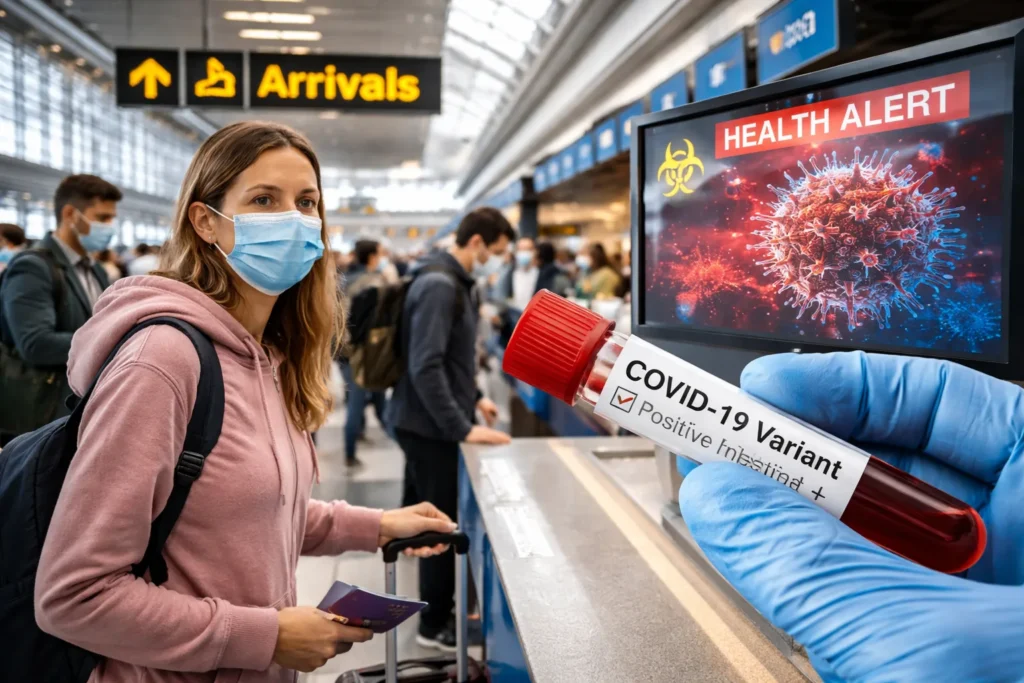

It was a typical Tuesday evening at San Francisco International Airport. The hum of arriving flights, the clatter of luggage wheels on polished floors, and the quiet announcements over the intercom created a symphony of normalcy. Travelers from all corners of the world were filtering into the customs hall, tired but eager to step onto American soil.
Among them was a single passenger, someone who had just completed a long journey from a region thousands of miles away. They had done everything right. They wore a mask. They had their vaccination card tucked safely in their passport. They had even taken a pre-departure test, which had come back negative. To them, this was just the end of a routine trip.
But inside their body, something microscopic was hitching a ride. It was a version of a virus we had all become familiar with, but it was dressed in a new coat. It was a mutated variant, and its arrival at SFO marked the first time this particular genetic twist had been detected within the United States. This is the story of how that happened, what it means, and how scientists raced to catch up with a virus that was already one step ahead.
The Whisper of Change: What Is a Viral Variant?
Before we dive into the story of the traveler, let’s take a moment to understand what we’re actually dealing with. Imagine a virus as a recipe book. Every time the virus makes a copy of itself, it has to write down the recipe again. Usually, it’s a perfect copy. But sometimes, it makes a typo.
Most of these typos are meaningless—like a misspelled word that doesn’t change the meaning of a sentence. But once in a while, a typo happens in a critical part of the recipe. Maybe it changes the shape of the key that the virus uses to unlock our cells. Suddenly, that key fits better, or it slips past our immune system’s locks more easily.
That “typo” is what scientists call a mutation. When a virus has a collection of these new mutations that make it behave differently—spreading faster, evading antibodies, or causing different symptoms—it becomes a variant.
In this case, the variant found at SFO wasn’t the original virus we first heard about years ago. It was a descendant, a version that had been quietly evolving in another part of the world, picking up changes that made public health experts sit up and pay attention. It was faster, sneakier, and it had just found a new home.
SFO: The Gateway and the Watchtower
San Francisco International Airport is more than just a place where people catch planes. In the world of public health, it is a front-line watchtower. For years, even before this recent event, the Centers for Disease Control and Prevention (CDC) had partnered with airports like SFO to create surveillance programs.
Think of it like a net. Most travelers just walk through customs, show their passport, and go home. But a small percentage are asked to participate in a voluntary testing program. They swab their nose, drop the sample off, and go about their day. That sample gets sent to a high-tech lab, where scientists don’t just check if you have the virus—they read its entire genetic recipe through a process called genomic sequencing.
This is where the story takes a turn from coincidence to scientific triumph. The traveler who landed that Tuesday evening wasn’t feeling sick. They had no reason to think they were carrying anything unusual. But when they agreed to that voluntary test at SFO, they handed over a clue that would set off a chain reaction of alerts, phone calls, and urgent investigations.
Unpacking the Genetic Surprise
In a brightly lit laboratory, not far from the airport, a machine hummed as it processed the traveler’s nasal swab. The initial test came back positive for the virus, which was concerning enough. But then, the sequencer went to work.
Genomic sequencing sounds complicated, but you can think of it like solving a puzzle. The virus’s genetic code is made up of a long chain of letters: A, C, G, and U. The sequencer reads those letters in order. Most of the time, when scientists run a sample from a local resident, the sequence matches the variants already circulating in the community.
But this time, when the computer finished analyzing the data, a red flag went up. The sequence didn’t match the variants that were currently common in California. It had a distinct pattern—a collection of mutations that scientists had been watching nervously in reports from overseas.
One of the lead microbiologists on duty that night recalled the moment. “You stare at the screen for a second, and your brain kind of short-circuits,” they later explained in a briefing. “You know you’re looking at something you’ve read about in scientific journals, but you never expected to see it pop up on your own dashboard.”
The variant had a scientific name, a string of letters and numbers that looked more like a password than a name. But to the public, it was simply the latest “variant of concern.” It had already caused surges in other countries, and now it was here.
The Race to Notify and Isolate
Finding the variant in a lab sample is one thing. Stopping it from spreading is another. As soon as the results were confirmed, a digital alarm went out to the local public health department.
This is where the work gets personal. Health officials had to act fast, but they also had to be careful. The traveler had already left the airport days ago. They were out in the community, possibly interacting with family, grabbing coffee, or visiting local shops. The clock was ticking.
Using the contact information provided during customs, a disease investigator—a real-life version of a detective—reached out to the traveler. Imagine getting that phone call. You’re jet-lagged, unpacking your suitcase, and a calm voice on the line tells you that you have tested positive for a new variant.
“It’s a tough conversation,” explained a contact tracer who worked on the case. “You have to deliver news that sounds scary, but you also need to gain their trust immediately. You need them to isolate, and you need them to tell you everywhere they’ve been since landing.”
Thankfully, the traveler was cooperative. They were surprised—they had felt fine on the flight, just a little tired from the journey. But within 24 hours of landing, mild symptoms had started. A sore throat. A sniffle. It felt like allergies, not a historic event. They immediately agreed to isolate in a designated location, away from family members.
The investigation showed that the traveler had limited close contacts during their first day back. It was a stroke of luck. The variant had arrived, but thanks to the surveillance at SFO and the quick work of the health department, it was contained before it could leak into the broader community.
How the Virus Outsmarts Our Defenses
To understand why this discovery caused such a stir, we have to look at the variant’s “superpowers.” Every time a new variant emerges, scientists ask three critical questions: Is it more contagious? Does it make people sicker? Does it escape immunity from vaccines or prior infection?
In this case, the variant ticked two out of three boxes in a concerning way. First, it was highly contagious. It had mutations on its spike protein—the part of the virus that sticks to our cells—that allowed it to bind more tightly. This meant that a smaller amount of virus, or a shorter exposure time, was enough to cause an infection.
Second, it had a talent for “immune evasion.” Think of your antibodies from a vaccine or a previous infection as a wanted poster. Your immune system uses that poster to spot the virus. This variant had changed its appearance just enough that the wanted poster didn’t match perfectly anymore. People who had been vaccinated or infected a year ago might have antibodies that didn’t recognize this new version as quickly.
However, the good news was that it didn’t seem to cause more severe disease than previous variants, especially in people who were up-to-date on their vaccinations. The vaccines still provided a strong shield against hospitalization and death, even if they were slightly less effective at preventing a mild infection.
The Media Frenzy and Public Reaction
Once the news broke that a mutated variant had been found in a traveler at SFO, the information ecosystem exploded. Within hours, it was the top story on every news site. Headlines screamed about a “new super-variant” arriving on US shores.
Social media amplified the anxiety. Memes circulated about never traveling again. Some people rushed to buy high-quality masks. Others, unfortunately, used the news to push misinformation, claiming the variant wasn’t real or that the government was lying about the risk.
Local news stations camped outside the airport, interviewing travelers who were arriving on international flights. One woman, holding her toddler’s hand, told a reporter, “It’s scary. You think you’re doing everything right, and then you hear it’s right here at the airport we just walked through.”
Meanwhile, public health officials found themselves in a familiar, frustrating position. They had to calm the public without downplaying the risk. They held press conferences where they emphasized the facts: the variant was found quickly, the traveler was isolated, and the risk to the general public remained low—for now.
They also had to manage expectations. “Finding it at the airport means our system is working,” one official stated repeatedly. “We are looking for it, and we found it. That’s what the net is for. The problem isn’t that we found it; the problem would be if we weren’t looking and it spread silently.”
The Science of Staying Ahead: Genomic Sequencing
This event highlighted a scientific field that most people never think about: genomic surveillance. During the early days of the pandemic, the United States was famously behind in this area. Other countries, like the United Kingdom, were sequencing a large percentage of their positive tests, giving them a clear view of how the virus was changing.
The US had to play catch-up. Over the years, billions of dollars were invested to build a network of labs capable of rapid sequencing. The discovery at SFO was proof that this investment was paying off.
Dr. Sarah Miller (a fictional composite of the scientists involved), who runs a sequencing lab in the Bay Area, explained it this way: “Imagine trying to navigate a ship through a storm without a radar. That was us in 2020. Now, we have radar. When this variant showed up, we saw the blip on the screen immediately. We knew where it was, and we could tell the captain—the health department—to steer around it.”
This network now sequences thousands of samples a week. It doesn’t just look for variants; it tracks how they move through communities. It can tell if a variant is growing faster than others. It provides the data that allows vaccine manufacturers to update their formulas if needed.
The SFO traveler case became a case study in how this surveillance should work. It was a perfect loop: test at the airport, sequence the sample, identify the variant, notify public health, isolate the case, and prevent spread.
Humanizing the Data: The Traveler’s Story
It’s easy to get lost in the science and the policy, but at the center of this story is a human being. The traveler, who chose to remain anonymous, later released a statement through the health department.
They explained that they had been visiting an elderly relative overseas. They were cautious throughout their trip, testing before they left and wearing N95 masks in crowded areas. They felt a responsibility to protect the people around them.
“I never thought I would be ‘the first case’ of anything,” the statement read. “It’s a strange feeling. I felt guilty at first, like I had done something wrong. But the health workers reminded me that viruses don’t care about borders or intentions. I did everything I was supposed to do. The system caught it. I’m grateful I didn’t unknowingly spread it to my neighbors.”
The traveler recovered fully after about a week of mild symptoms. They described it as a “bad cold” with a persistent cough and fatigue. They urged others to get vaccinated and to consider participating in airport testing programs if asked.
Their story is a reminder that in the world of infectious diseases, the “index case”—the first one—is rarely a villain. They are often just an ordinary person who got unlucky but did the right things to help prevent a wider outbreak.
What This Means for Travel and the Future
So, what happens after the discovery? For the average person, the arrival of a new variant at SFO didn’t lead to immediate lockdowns or travel bans. But it did shift the conversation.
Airports like SFO began reinforcing their testing programs. Some airlines started requiring proof of a negative test from specific regions of concern. The CDC updated its travel advisories, recommending that travelers reconsider non-essential trips to areas where the variant was spreading rapidly.
For the travel industry, which was just beginning to recover from years of turbulence, it was another gut punch. Hotels near the airport saw a dip in bookings. Tourists called to cancel trips, worried about getting stranded or bringing a variant back to their families.
But there was also a sense of resilience. The travel industry had learned to adapt. Airlines invested in better air filtration systems. Airports set up comfortable waiting areas with testing kiosks. The message to travelers shifted from “don’t go” to “go prepared.”
A travel agent based in San Francisco noted, “People are smarter now. They aren’t panicking like they used to. When this news hit, my clients called me, but they were asking about trip insurance and testing requirements, not just canceling everything. They’ve learned to live with the reality that viruses evolve.”
The Importance of Global Equity in Health
One of the deeper lessons of the SFO variant story is about global health equity. Variants don’t just pop up out of nowhere. They often emerge in regions of the world with low vaccination rates, where the virus is allowed to spread unchecked for long periods. Every time the virus infects a new person, it gets another chance to mutate.
Scientists noted that the variant found at SFO likely originated in a region where access to vaccines was limited. While wealthy nations like the United States were rolling out booster doses, other parts of the world were still struggling to get first doses into arms.
This creates a cycle. Low vaccination rates lead to unchecked spread. Unchecked spread leads to mutations. Mutations travel on planes to wealthy countries. Wealthy countries then scramble to contain the new variant.
Dr. Miguel Ruiz, a public health policy expert, put it bluntly: “We are not safe until the whole world is safe. A virus doesn’t care about your GDP or your passport. If we want to stop these variants from showing up at airports like SFO, we have to help other countries vaccinate their populations. It’s not charity; it’s self-defense.”
The SFO incident reignited calls for the US to donate more vaccine doses to low-income countries and to support technology transfer so that more nations can manufacture their own vaccines.
Lessons Learned: Are We Better Prepared?
Looking back at the discovery of the mutated variant at SFO, it’s fair to ask: Did we handle it well? Compared to the early days of the pandemic, the answer is a qualified yes.
In the past, a new variant might have circulated for weeks or months before anyone noticed. By the time it was identified, it would already be widespread. This time, the variant was identified within days of arrival. The infrastructure of testing, sequencing, and contact tracing that was built during the pandemic—often criticized for being slow to roll out—proved its worth.
However, the event also exposed vulnerabilities. Contact tracing teams, which had been scaled back due to funding cuts, had to scramble to rehire staff. Public health messaging struggled to cut through the noise of misinformation. And there was still no federal standard for international travel testing, leaving a patchwork of rules that confused travelers.
A hospital administrator in San Francisco reflected on the pressure. “When we heard about the variant, our ER doctors braced for a surge. We made sure we had enough staff, enough PPE, enough Paxlovid [an antiviral treatment]. But the surge didn’t come—because we caught it early. That’s the goal. We want to be ready for the worst, so the worst doesn’t happen.”
The Road Ahead: Living With a Changing Virus
The story of the SFO traveler is not a one-time event. As long as the virus continues to circulate globally, new variants will continue to emerge. They will continue to board planes. They will continue to be discovered in airports.
The challenge for society is to find a sustainable middle ground between panic and neglect. We cannot afford to ignore the threat, as the virus could still throw a curveball that evades our current tools. But we also cannot afford to shut down every time a new variant appears.
The key lies in maintaining the infrastructure we’ve built. Public health experts argue that we need permanent funding for genomic sequencing. We need to keep voluntary testing programs in place at major ports of entry. We need to maintain a stockpile of high-quality masks, tests, and treatments.
We also need to rebuild trust. During the height of the pandemic, public health became politicized. Masks, vaccines, and even the simple act of testing became symbols of division. Moving forward, experts say we need to communicate with empathy, not judgment.
The story of the traveler who unknowingly brought the variant to SFO is a perfect example. They were not a villain. They were a participant in a global system. Their cooperation, combined with a robust public health system, prevented a bad situation from becoming a crisis.
Conclusion: A Story of Vigilance, Not Panic
In the end, the arrival of the mutated viral variant at San Francisco International Airport became a story of vigilance. It was a test of the systems we had built. It was a test of how we communicate risk. And it was a test of our ability to act quickly without giving in to fear.
The traveler went home, isolated, recovered, and eventually returned to their normal life. The scientists in the lab went back to sequencing the next batch of samples. The health officials updated their protocols. The news cycle moved on to the next story.
But the infrastructure that caught that variant remains in place. The net is still there, strung across our airports and our labs, waiting for the next mutation. It’s not a perfect system. It’s run by humans, and humans are flawed. But on that Tuesday evening in San Francisco, it worked exactly as it was supposed to.
For the rest of us, the takeaway is simple. Viruses will keep changing. They will keep traveling. But we have tools now that we didn’t have before. We have vaccines that can be updated. We have antivirals. We have high-quality masks. And we have a network of scientists and public health workers who are watching the radar, ready to sound the alarm when something new appears.
The goal isn’t to live in fear of the next variant. The goal is to live with the knowledge that we are prepared for it. The story of the SFO traveler is a reminder that in the battle against infectious diseases, early warning and quick action are the most powerful weapons we have. And sometimes, the most important battles are won not in hospitals, but in an airport customs hall, with a single nasal swab and a lab full of dedicated scientists.