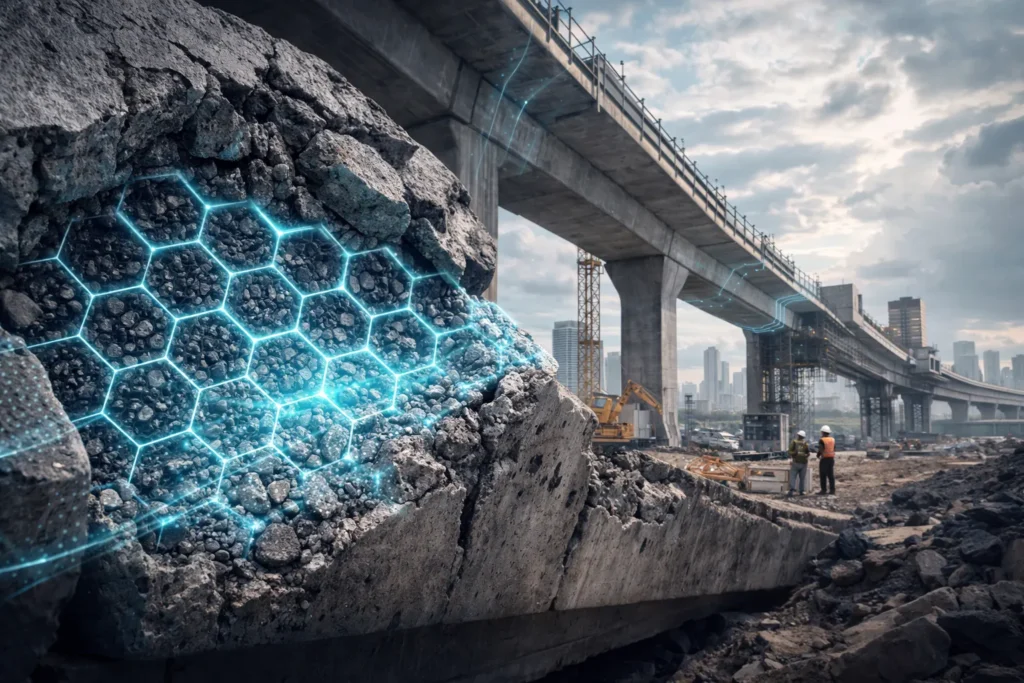

Introduction: A Tale of Two Materials
Imagine you are walking across a busy bridge during rush hour. Below your feet, thousands of cars rumble past, their drivers unaware of the massive structure holding them safely above a river. The bridge has stood there for decades, through scorching summers and freezing winters, through storms and floods. Now, imagine that this bridge—made of thousands of tons of steel and concrete—could talk to you. What if it could tell you exactly where a tiny crack was forming deep inside one of its support beams? What if it could warn engineers that it was feeling stressed before that crack ever became a danger to the public? What if it could even begin to heal that crack on its own, without any human intervention at all? What if it could tell you how much weight was crossing it at any given moment, or alert you to the exact second when a heavy truck overloaded beyond legal limits passed over its deck?
This might sound like something from a science fiction movie, but thanks to a miracle material called graphene, it is rapidly becoming our new reality. To understand just how big of a deal this is, we have to start with a hard truth about the world we have built for ourselves. We live in a concrete jungle, but that jungle is showing its age.
Concrete is everywhere. It is the gray stuff that paves our sidewalks, forms the foundations of our homes, and stacks up into the skyscrapers that define our city skylines. It lines our tunnels, anchors our wind turbines, and forms the dams that hold back our rivers. It is the foundation of parking garages, the structure of airport runways, and the material that encases the nuclear reactors powering our cities. In fact, concrete is the second most consumed substance on Earth, right after water. The average person on the planet uses about three tons of concrete every single year. For thousands of years, humans have relied on it to build civilizations, from the Roman Pantheon to the Hoover Dam, from the Great Wall of China to the Burj Khalifa, from the ancient aqueducts of Rome to the Channel Tunnel connecting England and France.
But concrete has a dirty secret, and it is one that we can no longer afford to ignore. To make concrete, you need cement. And the process of making cement requires cooking limestone and clay in massive kilns at extremely high temperatures—hot enough to make rocks glow, typically around 1,450 degrees Celsius. This process, called calcination, is incredibly energy-intensive. It is responsible for nearly 8% of the entire world’s carbon dioxide (CO2) emissions. To put that in perspective, if the concrete industry were a country, it would be the third-largest polluter on the planet, behind only China and the United States. Every single year, we produce over four billion tons of cement, and for every ton of cement, roughly a ton of CO2 is released into the atmosphere.
Not only is it polluting, but it also has a fundamental weakness: it is brittle. It has excellent compressive strength, meaning you can stack a lot of weight on top of it, but it has poor tensile strength, meaning it pulls apart easily. That is why we put steel inside it. Over time, water seeps in through microscopic pores, steel reinforcement bars (rebar) inside rust and expand, and the concrete cracks from the inside out. This “concrete cancer” costs billions of dollars a year in repairs, and it threatens the safety of our aging infrastructure worldwide. In the United States alone, the American Society of Civil Engineers gives our infrastructure a grade of C-minus, estimating that there is a repair backlog of over two trillion dollars. Bridges are falling apart, roads are crumbling, and dams are aging past their designed lifespans.
But what if we could fix that? What if we could take this ancient, essential material and give it a 21st-century upgrade? What if we could make it stronger, longer-lasting, and better for the planet all at the same time? What if we could turn it from a passive material into an active participant in our infrastructure networks?
Enter graphene. Discovered in a lab in 2004 by two scientists who famously used sticky tape to peel flakes off a piece of graphite—the same stuff in pencils—graphene is a sheet of carbon that is just one atom thick. It is the thinnest material known to humanity, but it is also, pound-for-pound, the strongest material ever tested—over 200 times stronger than steel. It is flexible, transparent, and conducts electricity better than copper. It is also an excellent conductor of heat, and it is completely impermeable to gases and liquids. For years, it was a lab curiosity, a wonder material looking for a purpose. Scientists called it a miracle material and then spent years trying to figure out what to do with it.
But now, engineers have figured out how to mix this “wonder material” into concrete. By injecting these atom-thick carbon lattices into industrial concrete, we are finally able to bridge the molecular gaps that trigger structural failure. We are building a future where our roads, bridges, and buildings are not just strong, but smart. We are entering an era where our infrastructure can think, feel, and even heal itself.
This is the story of that revolution. It is a story of tiny particles making a massive difference, of ancient materials getting a futuristic upgrade, and of how the very ground beneath our feet is about to get a whole lot smarter. It is a story that begins at the atomic level and ends with the transformation of our entire built environment.
Chapter 1: Understanding the Magic—What is Graphene?
To really get why graphene is such a game-changer for stuff like roads and bridges, you first have to imagine something almost impossible to picture: a sheet of paper that is one atom thick. That is graphene. It is so thin that you would need to stack three million sheets of it to reach a height of just one millimeter. A single gram of graphene contains enough surface area to cover multiple football fields. Yet, despite being practically two-dimensional, it is incredibly tough. It is the fundamental building block of graphite, which is just countless layers of graphene stacked on top of each other.
Let us break it down. You have probably heard of carbon. It is in every living thing on Earth. It is the basis of all organic chemistry, the element that life itself is built upon. Your body is about 18% carbon. Every plant, every animal, every microbe contains carbon. In nature, carbon atoms can arrange themselves in different shapes, like LEGO bricks forming different structures. When they stack up in loose, flat layers that slide past each other easily, you get graphite—the soft, slippery stuff in your pencil lead that leaves a mark on paper because the layers slide apart easily. When they arrange into a super-strong, three-dimensional pyramid shape under intense heat and pressure deep underground, you get diamond, the hardest natural material known and one of the most valuable gemstones on Earth.
Graphene is the building block for both. It is a single, flat layer of carbon atoms arranged in a pattern that looks like a honeycomb or a chicken-wire fence. The atoms are bonded together in a hexagonal lattice, and those bonds are incredibly strong. In fact, the carbon-carbon bond in graphene is one of the strongest chemical bonds known to science. Each atom is connected to three others, creating a stable, repeating pattern that gives graphene its remarkable properties.
Think of it like this: If you could peel a single, one-atom-thick layer off a diamond, you would have graphene. It holds the record for being the strongest material ever measured. A sheet of graphene as thin as plastic wrap could hold the weight of an elephant without tearing. If you had a hammock made of graphene, it could hold the weight of a full-sized car without stretching or breaking. But it is not just strong. Graphene is also an amazing conductor of electricity and heat. Electrons zip through it faster than through almost any other material, moving at about one three-hundredth the speed of light, which is why tech companies are so excited about using it in flexible phones, ultra-fast computer chips, and next-generation batteries.
For a long time, the biggest problem was not figuring out what graphene could do; it was figuring out how to make enough of it cheaply and consistently. Early batches were like snowflakes—no two were exactly alike, which made builders nervous. You cannot build a bridge if you are not sure your materials will perform the same way every time. You need consistency, reliability, and predictability. But we have gotten much better at manufacturing it. Now, companies are producing it by the ton, using it as a magic powder to sprinkle into concrete mixes. When you add this tiny amount—usually less than 0.1% of the weight of the cement—it does not just sit there. It gets to work on a molecular level, transforming the concrete from the inside out.
There are different forms of graphene used in construction. There is pristine graphene, which is the perfect honeycomb lattice with no defects or attachments. This is the strongest form, but it is also the hardest to work with because it does not mix well with water. Then there is graphene oxide (GO), which is graphene with oxygen molecules attached, including hydroxyl, epoxy, and carboxyl groups. These oxygen molecules actually help the graphene mix better with water and cement, acting like little handles that grab onto the surrounding material. They make the graphene hydrophilic, meaning water-loving, so it disperses more easily.
Recent studies have shown that adding just 0.05% to 0.1% graphene oxide can increase compressive strength by nearly 18% and flexural strength by an astonishing 75% in some formulations. That is the kind of improvement that makes engineers sit up and take notice. Some formulations have shown even more dramatic results, with compressive strength increases of up to 50% in ready-mix applications. The exact numbers depend on the type of graphene, the dispersion method, the cement chemistry, and the curing conditions, but the trend is clear and consistent across hundreds of studies.
Then there is reduced graphene oxide (rGO), which is graphene oxide that has been treated to remove some of the oxygen, restoring more of graphene’s original conductivity. This form is particularly interesting for smart concrete applications where electrical sensing is desired. There are also graphene nanoplatelets (GNPs), which are small stacks of graphene sheets, typically less than 10 layers thick. These are easier to produce in large quantities and are finding their way into commercial construction products.
Chapter 2: The Problem with Plain Old Concrete
Before we get too excited about the future, we have to respect the stuff we have been using for centuries. Concrete is basically a recipe with four ingredients: cement (the glue), water, sand, and rocks (called aggregate). When you mix them, the cement and water create a paste that coats the sand and rocks. When this paste hardens through a process called hydration, it locks everything together into a man-made rock. It is cheap, it is versatile, and it can be poured into any shape you can imagine. It is, in many ways, the perfect building material for a growing world.
The history of concrete goes back thousands of years. The ancient Romans used a form of concrete made from volcanic ash, lime, and seawater to build structures like the Pantheon, which still has the world’s largest unreinforced concrete dome. Roman concrete was so durable that some of their harbors, submerged in seawater for two millennia, are still intact. They had discovered a recipe that, through chemical reactions with seawater, actually became stronger over time. After the fall of Rome, the recipe was lost, and it was not until the 19th century that modern Portland cement was invented.
The trouble with modern concrete is that this “man-made rock” is actually full of tiny holes. If you looked at regular concrete under a high-powered microscope, you would not see a solid block. You would see something that looks more like a dense sponge, full of microscopic pores and capillaries ranging from nanometers to millimeters in size. This porosity is an inevitable result of the mixing and hydration process. When water combines with cement, it forms calcium silicate hydrate (C-S-H), which is the glue, and calcium hydroxide. But as the mixture hardens, water evaporates and leaves behind empty spaces.
This “pervious nature” is the enemy of durability. Water, road salt, carbon dioxide, and aggressive chemicals can slowly seep into these microscopic pores. Once inside, they start causing trouble. Chlorides from road salt can reach the steel reinforcement and break down the protective oxide layer that normally prevents rust. Carbon dioxide from the air can react with calcium hydroxide to form calcium carbonate, a process called carbonation, which lowers the pH of the concrete and also exposes the steel to corrosion.
If there is steel rebar inside the concrete (and there usually is), water and salt will cause it to rust. When steel rusts, it expands. Iron oxide, the chemical name for rust, takes up more volume than the original iron. This expansion creates immense pressure inside the concrete, forcing it to crack and split apart from the inside. This is often called “spalling,” and it is the reason roads have potholes, bridge decks crumble after a few harsh winters, and seaside structures develop gaping holes. It is a slow but steady process of internal corrosion that triggers structural failure, shortening the lifespan of our infrastructure and forcing expensive repairs.
The problem is exacerbated by freeze-thaw cycles. Water seeps into cracks and pores. When it freezes, it expands by about 9%, exerting tremendous pressure on the surrounding concrete. Over many winters, this gradual expansion and contraction widens cracks and creates new ones. In cold climates, this is one of the primary mechanisms of concrete deterioration. De-icing salts make it even worse because they lower the freezing point of water, causing more freeze-thaw cycles, and they introduce those aggressive chloride ions.
Then there is the carbon problem. Making cement is inherently dirty. To make Portland cement, the most common type, you have to heat limestone (calcium carbonate) to over 1,400 degrees Celsius. This process, called calcination, releases a massive amount of CO2 directly from the chemical reaction itself: calcium carbonate breaks down into calcium oxide (quicklime) and CO2. Plus, you have to burn fossil fuels to reach those temperatures, which releases even more CO2. For every ton of cement produced, roughly a ton of CO2 is emitted. With over four billion tons of cement produced every year, the numbers become staggering. The construction industry is under immense pressure to decarbonize, and finding a way to use less cement without sacrificing strength is one of the holy grails of modern materials science.
We have accepted concrete’s weaknesses as normal for too long. We build structures expecting them to deteriorate, budgeting for maintenance and repair over their lifetimes. But what if we could build structures that did not deteriorate in the first place? That is the promise of graphene.
Chapter 3: The Birth of a Wonder Material—The Discovery of Graphene
The story of graphene is one of those scientific tales that sounds too good to be true. It involves a Friday night, some sticky tape, and a moment of serendipity that changed the world of materials science forever.
It was 2004 at the University of Manchester in England. Two physicists, Andre Geim and Konstantin Novoselov, were working in the physics department. They had a simple goal: to make the thinnest possible piece of carbon. They were interested in the properties of two-dimensional materials, which were largely theoretical at the time. Most scientists believed that a true two-dimensional crystal could not exist in free-standing form—they thought it would be thermodynamically unstable and would roll up or decompose.
Their method was surprisingly low-tech. They used ordinary sticky tape—the kind of Scotch tape you would use to wrap a birthday present—to peel away layer after layer from a chunk of high-quality graphite. Think about it. Every time you use a pencil, you are leaving behind tiny flakes of graphite. Those flakes are made of countless layers of graphene stacked together. Geim and Novoselov simply kept peeling, using the tape to shave off thinner and thinner layers. They would press the tape onto the graphite, peel it off, and then press it onto another piece of tape, repeating the process over and over. Each time, the graphite split, getting thinner and thinner.
Eventually, after many repetitions, they managed to isolate a flake that was just a single atom thick. They transferred it onto a silicon wafer and examined it under a microscope. There it was: a perfect, one-atom-thick layer of carbon atoms arranged in a hexagonal lattice. They had discovered graphene. The Nobel Prize committee later called it “the first two-dimensional material ever created.”
It was one of those moments in science that changes everything. They quickly realized that this material had extraordinary properties. It was not just thin; it was incredibly strong, highly conductive, and almost completely transparent. They published their findings in the journal Science in October 2004, and the scientific world went crazy. Researchers around the globe immediately began exploring graphene’s properties and potential applications.
In 2010, just six years after their discovery, Geim and Novoselov were awarded the Nobel Prize in Physics. The sticky tape method became legendary, a reminder that sometimes the biggest discoveries come from the simplest experiments. Geim had a history of playful research—he had previously won an Ig Nobel Prize for levitating a frog with magnets. His willingness to experiment and play in the lab had led to one of the most significant scientific breakthroughs of the 21st century.
Since then, researchers have found countless ways to make graphene. There are high-tech methods like chemical vapor deposition (CVD), where carbon atoms are deposited onto a copper surface in a vacuum chamber at high temperatures, forming large, high-quality graphene films. This method is great for electronics applications but is expensive and slow for construction uses.
There are chemical methods that involve dissolving graphite in strong acids to produce graphene oxide, which can then be reduced to graphene. This method is cheaper and more scalable, but the graphene produced has more defects. There are electrochemical methods that use electricity to exfoliate graphite in liquid solutions. And there are mechanical methods that are essentially high-tech versions of the sticky tape trick, using shear forces in liquid to peel apart graphite layers.
The key now is scaling up production to meet the demands of industries like construction, which need materials by the ton, not by the gram. Companies are now building factories capable of producing thousands of tons of graphene per year, finally making it practical for use in concrete. The price has dropped from thousands of dollars per gram in the early days to perhaps tens of dollars per kilogram today, and it continues to fall as production methods improve and economies of scale kick in.
Chapter 4: Molecular Bonding—How Graphene Bridges the Gaps
So, how does a tiny pinch of atom-thick carbon fix the problem of a massive concrete bridge? It all comes down to chemistry and physics at the tiniest scale. Graphene acts as both a mechanical support and a chemical catalyst, working on a level that human hands could never reach. It is a nanoscale reinforcement that changes the very structure of the cement paste.
Think of the cement hydration process like making a batch of cookies. The cement particles are the flour, and the water is the wet ingredient. As you mix them, they form a paste that hardens. Now, imagine throwing a bunch of ultra-strong, super-tiny mixing rods into the bowl. That is the graphene. The graphene flakes nestle themselves between the cement particles. Because they are so incredibly small and have a huge surface area—a single gram of graphene can cover many football fields—they provide millions of spots for the cement crystals to grow on.
This does two important things. First, it fills in the microscopic gaps. The graphene physically blocks the tiny channels that water and salt would normally use to sneak in. It acts like a million tiny umbrellas, shielding the concrete from the elements at the molecular level. The graphene sheets are impermeable themselves, so water cannot pass through them. They create a tortuous path that water and aggressive ions must navigate, dramatically slowing down any ingress.
Second, it guides the growth of the cement crystals, making them align in a way that creates a much denser, tighter structure. In normal concrete, the C-S-H forms in a relatively random, porous arrangement. With graphene present, the crystals nucleate on the graphene surface and grow outward in a more ordered fashion. This creates a denser microstructure with fewer weak points. It is like turning a sponge into a solid sheet of plastic.
But the magic goes even deeper. Researchers using reactive force-field molecular dynamics have studied exactly how graphene bonds with calcium silicate hydrate (C-S-H), which is the glue that holds concrete together. They found that the functional groups on graphene oxide—things like hydroxyl (OH) and carboxyl (COOH)—form strong chemical bonds with the calcium ions in the cement. These are not just physical connections; they are actual chemical bonds that lock the materials together.
In some cases, protons from the functional groups transfer to the cement structure, enhancing the polarity of the graphene surface and strengthening the bond even further. Calcium and aluminum ions near the surface act as bridges, linking the oxygen atoms in the cement to the hydroxyl groups in the graphene. This creates a kind of “cage” at the molecular level that stabilizes the entire structure and prevents water molecules from diffusing through.
The carboxyl groups (COOH) are particularly interesting. When they approach the highly alkaline environment of hydrating cement, they tend to lose their proton and become negatively charged COO- groups. These negatively charged groups are then strongly attracted to positively charged calcium ions (Ca2+) in the cement pore solution. They form what are called ionic bonds or coordination bonds, which are quite strong and stable. This essentially tethers the graphene sheets directly to the cement hydrate structure.
Furthermore, the silicate chains in C-S-H have what are called “non-bridging oxygen sites”—places where the silicon-oxygen network has a dangling bond or a spot where the structure is looking to connect with something. These sites can also interact with the functional groups on graphene, creating additional bonding points. By reinforcing the traditional aggregates with graphene’s strong hexagonal bonds, we create a composite material that is far less brittle. The graphene holds everything together, stopping tiny cracks from forming in the first place and preventing them from growing if they do appear.
This crack-bridging ability is crucial. When a microscopic crack begins to form in the cement paste, it might encounter a graphene sheet. The crack has to either break the graphene sheet or go around it. Breaking graphene requires enormous energy, so the crack tends to deflect or stop. The graphene acts like millions of tiny speed bumps for cracks, preventing them from propagating and growing into larger failures.
Chapter 5: Super Strength—Doubling Lifespan and Slashing Emissions
When you make concrete denser and stronger, you unlock a cascade of benefits. The most obvious one is that the stuff simply lasts longer. Because water and salt cannot get in, the steel rebar does not rust. This eliminates internal corrosion, which is the number one killer of concrete structures. Bridges that might need major repairs in 25 years could easily last 50 or even 100 years with graphene reinforcement. This extended lifespan means fewer disruptions, less maintenance traffic, and lower long-term costs for taxpayers.
Consider the economic implications. The Federal Highway Administration in the United States estimates that there are over 600,000 bridges in the country, and more than 40% of them are at least 50 years old. Many were designed for a 50-year service life and are now approaching or exceeding that. The cost to repair or replace them is staggering. If graphene concrete can double the lifespan of new bridges, it could save billions of dollars over the coming decades.
But the environmental benefits might be even bigger than the durability ones. Because graphene makes the concrete paste so much stronger, you do not need to use as much of it to do the same job. In many cases, engineers can reduce the amount of cement in the mix by a significant margin. Remember, cement is the villain when it comes to CO2 emissions. If you can use less cement and replace it with a tiny amount of graphene, you slash the carbon footprint of your project.
Studies and real-world trials have shown that using graphene can reduce the carbon footprint of concrete by 16% to 30%. How? By replacing some of that high-emission cement with a tiny bit of low-emission graphene. For example, one company’s graphene-enhanced concrete produces about 6.3 kilograms of CO2 per tonne, compared to traditional concrete which can be much higher when you factor in the steel reinforcement. The total estimated reduction in CO2 emissions for a single commercial slab in Manchester was over 4,200 kilograms compared to a traditional concrete solution.
Recent trials in the UK are producing approximately 600 tonnes of graphene-enhanced cement, with expectations of reducing CO2 emissions by about 16% due to the partial replacement of clinker—the most energy-intensive component of cement. If the global construction industry adopted this technology, it could shave a whopping 2% off worldwide emissions. That is like taking millions of cars off the road forever. It is the kind of climate solution that politicians and engineers dream about.
The numbers are worth dwelling on. Global CO2 emissions from fossil fuels and industry are about 37 billion tons per year. Two percent of that is 740 million tons. That is more than the total annual emissions of Germany, or about the same as all the cars in the United States. A single technology, applied to one material, could have that kind of impact. That is why governments and companies around the world are investing heavily in graphene concrete research and development.
And the reductions come from multiple sources. First, there is the direct reduction from using less cement. Second, there is the reduction from longer lifespan—structures last longer, so fewer replacement structures need to be built. Third, there is the potential for lighter structures that require less material overall. Fourth, there is the possibility of using lower-grade, less energy-intensive cements that graphene can help strengthen. All of these add up to a significant environmental win.
Chapter 6: Smart Infrastructure—Turning Structures into Sensors
Here is where things get really wild. Remember how we said graphene is not just super strong, but also great at conducting electricity? Well, that gives concrete a superpower it never had before: the ability to feel.
Regular concrete acts as an insulator—it blocks electricity. You cannot send a signal through it any more than you can send one through a brick wall. Its electrical resistivity is very high. But when you add graphene, you create a network of conductive pathways throughout the material. These tiny graphene flakes touch each other, forming an invisible web of electrical connectivity. This turns the entire slab of concrete into a sensor. Scientists call this the “piezoresistive effect.” In simple terms, when you squeeze or stretch the graphene concrete, the internal structure changes slightly, which changes its electrical resistance. It is like the concrete has a nervous system.
By running a tiny, safe current through the concrete and monitoring its resistance continuously, engineers can tell exactly what is happening inside. If a heavy truck drives over a bridge, the concrete compresses, the graphene flakes get slightly closer together, the conductive pathways become more connected, and the resistance drops. If a crack starts to form, the concrete stretches, the flakes pull apart, the pathways are disrupted, and the resistance spikes. We are transforming brittle foundations into conductive, self-sensing frameworks.
This is a massive leap forward for what is called Structural Health Monitoring (SHM). Right now, to check if a bridge is safe, inspectors have to go out in person and look for cracks. They might use fancy tools like ultrasound or ground-penetrating radar, or they might hang underneath the bridge in a “snooper truck” with a hammer, tapping on the concrete and listening for hollow sounds that might indicate delamination. But these methods are expensive, time-consuming, and subjective. They can only see the surface or require expensive, time-consuming surveys. These inspections happen maybe once a year or once every few years. A lot can happen in between.
Graphene concrete lets us monitor the inside of a structure in real-time, 24 hours a day, 7 days a week. It provides continuous data, not just snapshots. It can tell us exactly where damage is occurring, how stressed a beam is, and when it needs fixing, long before a problem becomes visible to the human eye. This is predictive maintenance instead of reactive maintenance. It allows engineers to move from a schedule-based approach to a condition-based approach.
Imagine a world where your smartphone can alert the city maintenance department that the bridge you drive over every day is developing a problem. Imagine roads that tell traffic control centers the moment they start to crack under the summer heat. Imagine buildings that monitor their own structural integrity after an earthquake and tell rescue workers exactly where it is safe to enter. Imagine tunnels that can detect changes in stress caused by nearby construction or geological shifts. This is not science fiction. This is the near future of infrastructure.
The sensitivity of graphene concrete sensors is remarkable. Studies have shown that they can detect strain changes as small as a few microstrains, which is far beyond what human inspectors could ever notice. They can detect the difference between a car and a truck crossing a bridge. They can monitor the gradual creep and shrinkage of concrete over time. They can even detect the onset of corrosion before any visible damage occurs.
And because the entire structure becomes the sensor, there are no vulnerable external sensors to damage or replace. The sensing capability is built into the material itself. It cannot be stolen, vandalized, or damaged by weather. It is as durable as the concrete itself, which means it can last for decades with no maintenance.
Chapter 7: The Science of Healing Itself
If strength and sensing were not enough, graphene is also helping concrete develop a trait that was once only found in living things: the ability to heal itself. Self-healing materials have been a dream of engineers for decades, and graphene is bringing that dream closer to reality. Imagine a world where cracks in your basement wall seal themselves before water can leak through, where potholes never form because the road repairs itself overnight.
Researchers are developing smart, self-healing coatings using graphene derivatives. The idea is simple but brilliant. Because graphene is such an amazing barrier—it is impermeable to almost all gases and liquids—coatings made with it can form an incredibly dense layer on the surface of concrete. This stops erosive materials like chlorides and sulfates from even touching the concrete. It is like wrapping your concrete in an invisible force field. A coating just a few microns thick can provide better protection than conventional coatings many times thicker.
But the “self-healing” part goes deeper. When tiny cracks form in graphene-enhanced concrete, the structure of the material can sometimes bridge the gap. Furthermore, because graphene helps the cement hydrate more completely, there are often unreacted cement particles inside. When a crack lets water in, it can react with these particles, creating new crystals that grow into the crack and seal it back up. This natural “autogenous healing” is supercharged by the dense, chemically active environment created by the graphene.
In normal concrete, autogenous healing occurs only for very small cracks, typically less than 0.1 millimeters wide, and only when water is present. In graphene concrete, the effect is enhanced because the denser microstructure means more unhydrated cement particles are available to react, and the graphene helps guide the growth of healing crystals. Cracks up to several times larger can be healed.
Then there is the truly futuristic stuff: bacteria-based self-healing. Researchers are now incorporating bacteria into concrete that can produce limestone. These bacterial spores can lie dormant for decades, waiting for a crack to form. When water seeps in, it wakes them up, and they start producing calcium carbonate, essentially growing new rock to fill the crack. The bacteria essentially become tiny biological factories, converting nutrients into mineral fillers.
However, there is a problem: the high pH inside concrete is harsh on bacteria. Concrete has a pH around 12 or 13, similar to bleach, which kills most microorganisms. Graphene oxide is being used to solve this. When added to the hydrogels that encapsulate the bacteria, graphene helps regulate the pH around the cracks, creating a more hospitable environment for the bacteria to do their work. Studies have shown that with graphene oxide, bacteria-mediated calcium carbonate production is accelerated, leading to faster crack closure and even complete restoration of flexural strength.
The process works like this: bacteria of specific strains, often from the genus Bacillus, are encapsulated in protective shells made of hydrogels or porous aggregates along with a calcium source and nutrients. When a crack forms and water enters, the spores germinate and begin metabolizing. They convert calcium lactate or similar compounds into calcium carbonate, which precipitates and fills the crack. The graphene helps ensure that the environment around the bacteria stays within their tolerance range, and it may also help nucleate the calcium carbonate crystals.
We are moving toward a future where a tiny crack in your basement wall might just fix itself before it becomes a leak, where bridge piers constantly repair microscopic damage before it can grow into a major problem. This is the ultimate form of durability—materials that do not just resist damage but actively repair it.
Chapter 8: The Chemistry of Connection—Understanding the Interface
To truly appreciate how graphene transforms concrete, we have to dive even deeper into the chemistry. This is where the real magic happens, at the interface between the graphene and the cement hydrates. It is a world of atoms and molecules, of chemical bonds and electrostatic forces.
The primary binding phase in concrete is calcium silicate hydrate, or C-S-H. It is a complex, poorly crystalline material that forms when cement reacts with water. It makes up about 50-60% of the volume of hydrated cement paste and is responsible for most of the strength and binding properties. Its exact structure is still debated, but it is known to consist of layers of calcium oxide with attached silicate chains. For years, scientists have tried to understand exactly how to make C-S-H stronger. Graphene provides an answer.
Using advanced computer simulations like reactive force-field molecular dynamics, researchers can watch the atoms interact in virtual time. These simulations model the actual chemical bonds between atoms, allowing scientists to see how graphene and cement interact at the most fundamental level. They have discovered that the functional groups on graphene oxide play a crucial role.
Hydroxyl groups (C-OH) and carboxyl groups (COOH) on the graphene surface interact strongly with the calcium ions in the C-S-H. In fact, carboxyl groups tend to lose a proton (de-protonate) when they get near the highly alkaline cement surface, transforming into COO- groups. These negatively charged groups then form incredibly stable bonds called COOCa with the calcium ions. This is essentially a salt-like bond, similar to what you would find in calcium carbonate or calcium oxide.
This is not just a weak attraction; it is a strong chemical bond that ties the graphene directly into the concrete’s structure. The graphene becomes part of the glue, not just an additive floating around. Furthermore, the silicate chains in the C-S-H provide numerous “non-bridging oxygen” sites—places where the silicon-oxygen network has a dangling bond or a spot where the structure is looking to connect with something. These sites grab onto the functional groups from the graphene, creating a tightly interlocked network.
The result is a composite material where the graphene and the cement are chemically married at the atomic level. When you try to pull them apart, you are not just overcoming friction or weak physical bonds; you are breaking actual chemical connections. This is why graphene-reinforced concrete is so much tougher. The interfacial shear strength—the force required to slide the graphene relative to the cement—is dramatically increased.
It is also why it resists water penetration so well. Water molecules move through concrete by diffusing through the nano-porous C-S-H gel. The presence of graphene sheets, strongly bonded to the C-S-H, blocks many of these diffusion pathways. And because the graphene itself is impermeable, water cannot pass through it. The pathways that water would normally use are now blocked by strongly bonded graphene sheets.
The simulations also show that the graphene surface itself becomes partially hydroxylated, meaning it picks up hydroxyl groups from the surrounding environment. This further enhances the bonding with the cement and increases the overall stability of the interface. Some studies suggest that calcium and aluminum ions from the cement can actually migrate to the graphene surface and form bridging structures that link multiple graphene sheets together.
This molecular-scale understanding is not just academic. It is guiding the design of even better graphene-cement composites for the future. By tuning the type and density of functional groups on the graphene, researchers can optimize the interfacial bonding for specific applications. By controlling the size and aspect ratio of the graphene flakes, they can maximize the reinforcing effect. The chemistry is becoming a design tool.
Chapter 9: Real-World Trials—From the Lab to the Parking Lot
This all sounds great on paper, but does it actually work in the real world? The answer is a resounding yes. Graphene-enhanced concrete has already left the laboratory and is being poured into real projects right now. It is no longer a theoretical concept; it is a practical construction material that is being tested and validated in the field.
In the UK, a company called Nationwide Engineering partnered with the University of Manchester’s Graphene Engineering Innovation Centre (GEIC) to develop a product called Concretene. They used it to build a new mezzanine floor at a massive regeneration site in Manchester called Mayfield. This was not just a test patch; it was a full-scale commercial slab measuring 54 by 14 meters, which was set to become a roller disco. It was the first commercial use of graphene concrete in a suspended slab, proving it could work in complex, high-rise type construction.
The results were impressive. The pour used about 30% less cement than a conventional mix, yet achieved higher strength. Some pours achieved their target 28-day strength in just 12 hours, which dramatically speeds up construction times and saves money. The material flowed well, finished nicely, and behaved just like normal concrete during placement, which meant the construction crews did not need special training or equipment.
Meanwhile, in Derbyshire, UK, the Breedon Group produced a whopping 600 tonnes of graphene-enhanced cement in a single day at their Hope Cement Works. This material, incorporating about three tonnes of PureGRAPH graphene, is being used for multiple applications. FP McCann is using 40 to 60 tonnes of it to make roof tiles at its plant in Leicestershire. Morgan Sindall Group is using graphene-enhanced concrete, batched by Capital Concrete, for railway infrastructure ground slabs in London.
These projects are testing everything from how easy it is to lay the concrete (spoiler: it is exactly the same as regular concrete) to how much stronger it is after 28 days. They are also testing long-term durability, resistance to freeze-thaw cycles, and the actual carbon savings achieved. Early data is extremely promising.
The partnership between Concretene and the GEIC has been extended for another three years, with Concretene attracting £1.9 million in UK government funding and £6 million in venture capital investment. They have grown to a staff of 20 and are working on projects funded by Innovate UK, including GraphEnhance for scaling up the graphene supply chain, SMART for pre-cast foundation pilings, and GCRE for low-carbon railway sleepers with Cemex.
Prototype trials have demonstrated compressive strength increases up to 50% in ready-mix applications and 15-20% in pre-cast applications. That is not just a marginal improvement; it is transformative. It means that for the same amount of material, you can build stronger structures, or for the same strength, you can use much less material.
In Australia, researchers at RMIT University have been working with industry partners to test graphene concrete in real-world conditions. They have produced precast elements like parking curbs and barriers that show improved strength and durability. In the United States, several companies are exploring graphene additives for concrete, with pilot projects in California and Texas.
These real-world trials are crucial because they reveal issues that might not appear in the lab. They test the material under real construction conditions, with real crews, real equipment, and real weather. They show that graphene concrete can be batched in standard ready-mix trucks, transported over normal distances, placed with conventional pumps and chutes, and finished with standard tools. The transition from lab to field has been remarkably smooth.
Chapter 10: Fixing the Past—Retrofitting Old Structures
It is one thing to build new things with fancy materials, but what about all the stuff that is already there? Our cities are filled with aging bridges, crumbling sea walls, and old buildings. Tearing them all down and starting over is not realistic. It would be incredibly expensive, wasteful, and disruptive. The embodied carbon in existing structures is already spent; demolishing them would release that carbon and require new carbon to replace them. That is why retrofitting and extending the life of existing structures is so important.
Graphene concrete is not just for new pours. It can also be used to repair and strengthen old structures. Imagine an old concrete bridge column that is starting to crack and weaken. Maybe the steel inside has started to rust, or the concrete has spalled from freeze-thaw cycles. Traditionally, you might wrap it in a heavy steel jacket, which is expensive, heavy, can rust, and changes the appearance of the structure. Alternatively, you might use fiber-reinforced polymers (FRP), which are better but still costly and require skilled labor to apply.
Instead, engineers are exploring using a thin layer of graphene-enhanced concrete as a retrofit material. This can be applied as a shotcrete (sprayed concrete) layer around the existing column, or as a cast-in-place jacket. Because graphene concrete bonds so well to existing surfaces and is so strong, a thin shell of this new material can significantly boost the strength and durability of the old column. It acts like a high-tech cast on a broken arm, providing external support and preventing further damage.
The graphene helps the new concrete adhere tightly to the old, creating a composite structure that is much stronger than either material alone. The bond between old and new concrete is critical—if it fails, the retrofit is useless. Graphene’s chemical bonding and densifying effects help ensure that this bond is strong and durable.
For structures suffering from corrosion damage, the dense microstructure of graphene concrete also provides a barrier against further ingress of chlorides and water. It seals the structure, protecting the remaining steel from additional corrosion. In some cases, corrosion inhibitors can be added to the graphene repair material to provide even more protection.
This represents a paradigm shift in infrastructure maintenance. We can give a second life to old infrastructure by using graphene to create high-performance jackets and coatings that lock out moisture and provide structural support. It is a cheaper, faster, and more sustainable way to keep our cities safe without having to rebuild everything from scratch.
For historic structures, this is especially important. Many older buildings and bridges have architectural or historical value that would be lost in demolition. Graphene repairs can preserve the original fabric while upgrading its performance to meet modern safety standards. A thin, nearly invisible layer of graphene concrete can strengthen a historic arch bridge without changing its appearance.
Research is also exploring the use of graphene in grouts for crack injection. Fine cracks in concrete can be injected with low-viscosity grouts that contain graphene, sealing the crack and restoring structural integrity. The graphene enhances the bond strength and durability of the repair, and if conductive formulations are used, can even provide crack monitoring capability.
Chapter 11: Economic Feasibility—The Cost Question
One of the biggest questions surrounding any new technology is whether it makes economic sense. Builders and developers are not in the business of using exotic materials just because they are cool. They need to see a return on investment. Graphene has historically been expensive, but prices are falling rapidly as production scales up. The key question is: at what price does graphene concrete become cost-effective?
A recent comprehensive study published in late 2025 tackled this exact question. Researchers evaluated the techno-economic feasibility of incorporating graphene oxide into concrete, looking at both the improved mechanical properties and the potential savings from reduced cement usage and CO2 emissions. They conducted mechanical strength testing, microstructural analysis, and even simulated the response of buildings to seismic forces to understand how graphene reinforcement affects structural performance under extreme loads.
The optimal formulation they found used 0.1% graphene oxide by weight of cement, which improved compressive strength by nearly 18% and flexural strength by almost 75%. That is a massive improvement. Using this formulation, structural models indicated that the weight of structural elements could be reduced by 8% to 24%. Lighter structures mean lower seismic forces, making it easier to comply with earthquake safety standards. They also require less material overall—less concrete, less steel, less foundation work.
The economic analysis revealed some important numbers. For low-rise buildings, graphene-enhanced concrete becomes beneficial if the price of graphene oxide is between €50 and €80 per kilogram, depending on the price of carbon credits. If carbon credits are high—say €200 per tonne of CO2—then even higher graphene prices are justified. For taller buildings, the economics are a bit more restrictive, requiring graphene prices between €50 and €70 per kilogram and carbon credit prices starting at €100 per tonne.
Another study found that while graphene oxide increases the upfront material cost, the overall cost-performance ratio remains competitive when you account for the enhanced strength and reduced cement usage. The key is that graphene allows you to do more with less, and when you factor in the longer lifespan and lower maintenance costs, the lifecycle economics look very attractive.
Consider a bridge built with graphene concrete. It might cost slightly more upfront, but if it lasts twice as long and requires half the maintenance, the lifecycle cost is lower. Add in the reduced carbon footprint, which might have financial value through carbon credits or carbon taxes, and the case becomes even stronger. For infrastructure owners like transportation departments, which are responsible for maintaining assets over decades, lifecycle cost is often more important than initial cost.
As graphene production scales up and prices continue to fall, the economic case will only get stronger. Current graphene prices for construction-grade material are already in the tens of dollars per kilogram, and some producers claim they can get below $10 per kilogram with large-scale production. At those prices, the economics become compelling even without considering carbon credits.
There is also the value of time. Graphene concrete’s faster curing can accelerate construction schedules, saving money on labor, equipment rentals, and site overhead. For a large commercial project, shaving weeks off the schedule can translate into millions of dollars in savings. That alone can justify the use of graphene, even before considering the material benefits.
Chapter 12: Faster Construction—The Time Savings
One of the less discussed but incredibly important benefits of graphene concrete is how much faster it can make construction. Time is money on a construction site. Every day you save on a project is a day you do not have to pay for labor, equipment rental, and site overhead. Graphene concrete can shave days or even weeks off construction schedules.
The reason is simple: graphene accelerates the hydration reaction. Cement does not harden instantly. It goes through a series of chemical reactions over time. When water is added to cement, the tricalcium silicate (C3S) and dicalcium silicate (C2S) begin to dissolve and react, forming C-S-H and calcium hydroxide. This process takes time. Standard concrete typically reaches its “design strength” after 28 days of curing. You cannot strip forms, apply loads, or move to the next phase of construction until the concrete is strong enough. That 28-day wait is baked into project schedules.
Graphene changes this by acting as a nucleation site for cement hydrates. It gives the crystals more places to start growing, which speeds up the whole process. It provides surfaces for the C-S-H to precipitate on, accelerating the early-age reactions. Real-world pours of Concretene have achieved their target 28-day strength in just 12 hours.
Think about what that means. If you are building a high-rise tower, you might have a construction cycle of one floor per week. The concrete for each floor needs to cure before you can build the next floor on top of it. If you can cut that curing time from days to hours, you can accelerate the entire project. You could potentially build a skyscraper in half the time.
For precast concrete operations, where items are cast in a factory and then shipped to the site, faster curing means you can reuse molds more quickly. Molds are expensive, and the number of pieces you can produce in a day is limited by how fast the concrete hardens. With graphene, you can demold pieces sooner, get them out of the way, and start casting the next piece. This increases productivity and reduces costs. A precast plant could potentially double its output with the same equipment and floor space.
For road repairs, faster curing means lanes can be reopened to traffic sooner, reducing congestion and disruption. A road closure that might have taken a weekend could be done overnight. This has enormous economic value in terms of reduced traffic delays and improved safety for workers.
For emergency repairs after disasters, the ability to get concrete to high strength quickly could be life-saving. Imagine a bridge damaged by an earthquake that needs to be reopened for emergency vehicles. Graphene concrete could allow repairs to be completed in hours instead of days.
The time savings from graphene concrete are a huge economic driver that often gets overlooked. In the construction industry, schedule compression is incredibly valuable. Developers can start collecting rent sooner. Contractors can move on to the next project faster. Owners get their infrastructure back in service quicker. These time savings can easily offset any additional material costs.
Chapter 13: Standardization and Certification—Building Trust
For any new construction material to gain widespread acceptance, it needs standards. Builders, engineers, and government agencies need to know that the material will perform reliably every time. They need specifications they can write into contracts and test methods they can use to verify quality. This is where standardization comes in, and the graphene industry has been making significant progress.
In late 2025, a major step forward was taken with the publication of new Product Category Rules (PCR) for graphene and graphene-based products. These rules create a framework for transparent sustainability reporting. They establish exactly how producers should carry out Life Cycle Assessments (LCAs) and prepare Environmental Product Declarations (EPDs) in line with international standards like ISO 14044.
This is huge for the concrete sector. Now, when a graphene producer claims their product reduces carbon emissions, they have a standardized way to prove it. They can produce an EPD that quantifies the environmental impact of their graphene, from raw material extraction to manufacturing to delivery. Construction companies can then use these EPDs to compare graphene-enhanced concrete against traditional solutions and make informed procurement decisions. This is especially important for projects seeking sustainability certifications like LEED or BREEAM, or for government contracts with carbon reduction requirements.
Terrance Barkan of the Advanced Carbons Council put it well: “As industries face growing pressure to demonstrate sustainability, the ability to provide robust, standardised data has become not only a compliance requirement but also a competitive advantage.” With reliable data now available, graphene-enhanced products can be more easily assessed and approved. This builds trust in the industry and paves the way for wider adoption.
But sustainability is only one aspect. There are also efforts underway to develop standards for the material properties of graphene itself. Organizations like ISO and ASTM are working on definitions, test methods, and specifications for graphene materials. This is critical because “graphene” can mean many different things—from single-layer pristine sheets to few-layer nanoplatelets to oxidized forms. Builders need to know exactly what they are getting.
There are also standards being developed for testing graphene-enhanced concrete. How do you measure the dispersion quality? How do you assess the improvement in durability? What accelerated testing methods correlate with real-world performance? These questions are being addressed by technical committees around the world.
Building codes are another hurdle. Most building codes are prescriptive, specifying minimum cement contents, water-cement ratios, and other parameters. Graphene concrete often falls outside these prescriptive limits because it uses less cement. To be widely adopted, it needs to be accepted through alternative means, such as performance-based specifications that focus on the final properties rather than the ingredients. This is happening gradually as more data becomes available.
Insurance and liability are also considerations. Engineers and contractors need to be able to get insurance for projects using new materials. Insurers want to see a track record of reliable performance. As more real-world projects are completed and monitored, the data accumulates, and insurers become more comfortable.
Chapter 14: Challenges on the Road Ahead
For all its promise, graphene concrete is not taking over the world overnight. There are still hurdles to clear, and it is important to be realistic about the challenges that remain.
The biggest one, ironically, is the very thing that makes it great: its size. Because graphene flakes are so tiny and have such a huge surface area, they tend to clump together. This is due to van der Waals forces—the same forces that make dry sand clump when it gets damp. Graphene sheets are attracted to each other, and they tend to stack up into graphite-like aggregates. If you just dump graphene powder into a concrete mixer, you will end up with clumps of graphene surrounded by plain concrete. The graphene does not get a chance to do its job, and you have wasted your expensive additive.
Getting it evenly dispersed is like trying to mix a drop of honey into a glass of water—it takes work. Scientists are getting around this by using special mixing techniques, chemical dispersants, and by pre-mixing the graphene with water or admixtures before adding it to the concrete. Some studies have found that a tailored, non-invasive mixing strategy—where graphene oxide is pre-dispersed during synthesis—can achieve optimal performance without high-shear mixing or ultrasonication. Others use surfactants or polymers to coat the graphene and keep the sheets separated.
Another challenge is the variability of cement. Cement is not a uniform product; its chemistry varies depending on the source of the raw materials and the manufacturing process. Different cements can react differently with graphene. A formulation that works perfectly with one cement might need adjustment for another. This means that graphene additives need to be optimized for local materials, which adds complexity.
Then there is the supply chain. For a long time, it was hard to get large amounts of consistent, high-quality graphene. A builder in London needs to know that the graphene they buy this year will perform exactly the same as the batch they bought last year. They need reliable suppliers with quality control systems. The industry is maturing, with companies now producing graphene at scale, but it takes time to build robust supply chains that can serve the massive construction industry.
Worker training is another consideration. While graphene concrete handles like normal concrete, workers need to understand that it may set faster or require different finishing timing. They need to know how to handle the additives safely. This requires education and training, which takes time and resources.
Long-term durability data is still being collected. While laboratory tests and accelerated aging studies suggest that graphene concrete will be more durable, we are still waiting for decades of real-world performance data. Engineers are conservative by nature, and many want to see 20 or 30 years of proven performance before fully embracing a new material. This is a chicken-and-egg problem: to get long-term data, you need long-term projects, but to get long-term projects, you need acceptance.
Finally, there is the cost. Graphene used to be incredibly expensive—thousands of dollars per gram in the early days. But as manufacturing improves, prices are dropping. For it to make economic sense for a low-rise building, the price of graphene needs to be just right, and it helps if there is a price on carbon emissions that rewards cleaner building materials. For specialized jobs, like repairing a critical bridge or building a high-performance industrial floor, the cost is already worth it for the performance gains. As production scales up and prices continue to fall, the economic case will only strengthen.
Chapter 15: The Global Race—Who is Leading the Way?
The development of graphene-enhanced concrete is a global effort, with researchers and companies around the world racing to perfect the technology and bring it to market. Different regions are taking different approaches, and it is fascinating to see how this competition is playing out.
The United Kingdom has emerged as a clear leader, thanks largely to the University of Manchester, where graphene was discovered. The Graphene Engineering Innovation Centre (GEIC) is a world-class facility dedicated to taking graphene from the lab to the market. It provides companies with access to equipment, expertise, and funding to develop and scale their technologies. Companies like Concretene have grown out of this ecosystem, benefiting from close collaboration with researchers.
The UK government has also been supportive, funding projects through Innovate UK and creating frameworks that encourage innovation in construction materials. The Industrial Strategy Challenge Fund has invested millions in graphene commercialization. The result is a vibrant ecosystem of startups, established companies, and researchers all working on graphene concrete.
Australia is also making significant strides. Research funded by Heidelberg Materials Australia and the SmartCrete CRC is exploring the macro-scale performance of graphene oxide enhanced concrete. A comprehensive study published in 2025 examined everything from fresh properties like slump and air content to hardened properties like compressive, flexural, and tensile strength, as well as drying shrinkage and elastic modulus. They confirmed that graphene oxide accelerates cement hydration and promotes the formation of strength-giving C-S-H. Australian researchers are also working on standards and specifications to enable wider adoption.
India is getting into the game as well. Researchers at the Thapar Institute of Engineering and Technology are developing sustainable nano-engineered smart self-healing concrete using graphene and its derivatives. Their project, funded by the Science and Engineering Research Board, aims to develop organo-modified graphene-based epoxy coatings that can protect concrete from aggressive ions. They are even exploring the use of graphene made from in-house coal-based graphite, which could be cheaper than traditional methods. India’s massive infrastructure needs make it a huge potential market for graphene concrete.
Singapore is contributing through research on bacteria-based self-healing concrete with graphene oxide, as discussed earlier. The country’s tropical climate, with high humidity and salt exposure, creates unique durability challenges that graphene could help address. Researchers at Nanyang Technological University are also working on graphene-based sensors for structural health monitoring.
China continues to publish foundational research on the molecular dynamics of graphene-cement interactions. Chinese researchers have been prolific in this area, producing hundreds of papers exploring different aspects of the technology. China’s massive construction industry means that any successful technology will find a huge market there.
The United States has been slower to adopt graphene concrete, but research is underway at universities like MIT, Northwestern, and Rice. The Federal Highway Administration has shown interest in the technology for bridge applications. Several US startups are working on graphene additives for concrete, and pilot projects are beginning to emerge.
Europe, through the European Union’s Horizon Europe program, is funding collaborative research projects involving multiple countries. The European concrete industry, with its focus on sustainability and carbon reduction, is actively exploring graphene as a tool to meet emissions targets.
This global collaboration and competition is accelerating the development of the technology, bringing us closer to widespread adoption. Knowledge is shared through scientific publications and conferences, but companies also compete to develop proprietary formulations and manufacturing processes. This dynamic tension drives progress.
Chapter 16: Graphene vs. Other Additives—Why It Wins
Graphene is not the only additive that has been tried in concrete. Over the years, researchers have experimented with all sorts of things to improve concrete’s performance, from fly ash and silica fume to steel fibers and polymers. So why is graphene different? What makes it special?
Fly ash and slag are common cement replacements. They are industrial byproducts—fly ash from coal-fired power plants, slag from iron production—that can improve concrete’s durability and reduce its carbon footprint. They work through a pozzolanic reaction, where they react with calcium hydroxide to form additional C-S-H. They work well, but they are essentially fillers that modify the chemistry of the cement. They do not provide the same kind of nanoscale reinforcement that graphene does. Their particles are micrometers in size, not nanometers.
Fiber reinforcements—like steel, glass, or polypropylene fibers—can prevent cracking and improve toughness. They work by physically bridging cracks, holding the concrete together when it tries to pull apart. They provide post-crack ductility, meaning that after the concrete cracks, the fibers hold it together so it does not fail catastrophically. But these fibers are relatively large—visible to the naked eye, typically millimeters in length and tens of micrometers in diameter. They reinforce the concrete at the millimeter scale, but they do nothing to strengthen the cement paste itself at the molecular level. They are a macro-scale solution.
Silica fume is a very fine pozzolanic material, with particles about 100 times smaller than cement grains. It can improve strength and durability by filling microscopic voids and reacting with calcium hydroxide. It works at a finer scale than fly ash, but still not at the nanoscale of graphene. Silica fume particles are amorphous silica, not the strong, ordered lattice of graphene.
Graphene works at an entirely different scale. It reinforces the material from the bottom up, strengthening the very glue that holds everything together. It is not just a filler or a physical bridge; it is a chemical participant in the hydration process. It guides the formation of cement crystals, blocks the pathways for water and aggressive ions, and creates an electrically conductive network that turns the concrete into a sensor. No other additive can do all of that.
Carbon nanotubes (CNTs) are probably the closest competitor. They are also nano-sized carbon structures with amazing strength. They are essentially rolled-up sheets of graphene, forming tiny tubes. They have exceptional tensile strength and stiffness. But they are expensive and even harder to disperse than graphene. They tend to tangle and form bundles, and their one-dimensional shape gives them less surface area for interaction with the cement paste. Graphene’s two-dimensional sheet-like structure gives it a larger surface area than one-dimensional nanotubes, meaning more contact area with the cement paste. For the price and performance, graphene is emerging as the winner.
There is also nano-silica, which is engineered silica particles at the nanoscale. These can be effective at improving strength and durability, but they lack the electrical conductivity and crack-bridging ability of graphene. They also require significant energy to produce.
The combination of properties that graphene offers—extreme strength, high surface area, chemical reactivity, electrical conductivity, and impermeability—is unique. It is not just another additive; it is a multifunctional material that can simultaneously improve mechanical performance, durability, and functionality. That is why it has generated so much excitement.
Chapter 17: What This Means for Homeowners
You might be thinking, “This is all very interesting for bridges and skyscrapers, but what does it mean for my house?” The answer is: quite a lot, eventually.
As graphene concrete becomes more common, it will trickle down to residential construction. Imagine a house with a foundation that is completely impervious to water. No more damp basements. No more mold problems. No more foundation cracks from freeze-thaw cycles. Your house would sit on a base that is practically indestructible. That means no more expensive foundation repairs, no more water seepage, no more musty basement smell.
Imagine a driveway that never cracks, never needs sealing, and can handle the weight of any vehicle you park on it. No more filling cracks every spring, no more potholes, no more weed growth through the pavement. Imagine patio slabs that do not shift or settle. Imagine sidewalks in front of your house that never heave from frost and never need replacement. The durability benefits of graphene concrete would be a gift to homeowners everywhere.
Imagine a garage floor that can withstand oil spills, road salt tracked in from your car, and heavy tool chests without staining or cracking. Imagine a pool deck that stays cool underfoot, resists chlorine damage, and never needs resealing. The applications around the home are numerous.
And if you ever decide to sell your house, being able to say it has a graphene-enhanced foundation could be a major selling point. It would signal to potential buyers that the house is built to last, with lower maintenance costs and higher durability. In a competitive real estate market, that could be a significant advantage.
For new home construction, graphene concrete could become a premium feature, much like energy-efficient windows or smart home technology. Builders could offer “graphene packages” that include enhanced foundations, driveways, and patios. Homebuyers would pay a bit more upfront but save on maintenance over the life of the home.
On a larger scale, the roads you drive on every day would last longer and require fewer repairs. That means fewer construction delays, less tax money spent on maintenance, and safer driving conditions. The bridge you cross on your commute would be monitored constantly for safety. The parking garage at the mall would not have crumbling concrete and rust-stained columns.
The benefits of this technology will eventually touch everyone, even if they never know the word “graphene.” They will just notice that things seem to last longer, require less maintenance, and work better. That is the ultimate goal: technology that fades into the background, making our lives better without demanding our attention.
Chapter 18: A New Era for Civil Engineering
For civil engineers, graphene concrete represents a fundamental shift in how they think about their work. For generations, engineers have worked with materials whose properties were more or less fixed. You specified a certain strength concrete, and you got it. But the concrete itself was passive—it did what it did, and you had to design around its limitations. You could not change how it cured, how it sensed stress, or how it resisted cracking.
Graphene concrete is different. It offers the possibility of tuning the material’s properties to meet specific needs. Need faster curing? Adjust the graphene formulation. Need higher strength? Add a bit more. Need better crack resistance? Optimize the dispersion. Need sensing capability? Make sure the graphene network is conductive. The material becomes customizable at the nanoscale.
This opens up new possibilities for design. Lighter, stronger structures mean longer spans, taller towers, and more elegant forms. You could design a bridge with thinner deck sections, reducing weight and material costs. You could design a high-rise with smaller columns, increasing usable floor space. You could design a shell structure that is both strong and beautiful.
Self-sensing structures mean we can build with less conservative safety factors because we will know in real-time how the structure is performing. Traditional design uses safety factors to account for uncertainties in material properties, construction quality, and loads. With real-time monitoring, those uncertainties are reduced. If you know exactly how the material is performing, you can design closer to the limits, using less material.
Self-healing capabilities mean we can design for longer lifespans and lower maintenance costs. A bridge designed for 100 years of service with self-healing concrete might realistically last 150 years with minimal intervention. That changes the economics of infrastructure dramatically.
Engineering education will need to evolve to include nanomaterials and their interactions with traditional building materials. Young engineers will need to understand not just macro-scale behavior, but also the molecular-scale chemistry that determines that behavior. They will need to know about surface chemistry, colloid science, and nanoscale characterization techniques. It is an exciting time to be entering the profession.
Professional practice will also change. Engineers will need to work more closely with materials scientists and chemists. They will need to understand the supply chain for nanomaterials. They will need to specify not just concrete strength, but also things like graphene type, dispersion quality, and sensing characteristics. New testing methods and quality control procedures will be required.
The role of the engineer is expanding from designing with fixed materials to designing the materials themselves. This is a profound shift that will play out over the coming decades.
Chapter 19: Environmental Impact Beyond Carbon
While carbon emissions get most of the attention, graphene concrete has other environmental benefits that are worth exploring.
First, there is the reduction in raw material extraction. If graphene concrete allows us to use less cement and less steel, that means less mining of limestone, clay, iron ore, and coal. Less mining means less habitat destruction, less water pollution, and less energy use in extraction and transportation. It means fewer quarries scarring the landscape and fewer mines disrupting ecosystems.
Second, there is the reduction in transportation emissions. If structures are lighter, they require less material to be transported to the site. If structures last longer, fewer replacement materials need to be transported over the life of the infrastructure. Every ton of material that does not need to be moved is a ton of CO2 saved from truck or train fuel.
Third, there is the potential for using waste materials. Some researchers are exploring the production of graphene from waste carbon sources, such as biomass or even recycled plastics. If graphene can be made from waste, it becomes even more sustainable. Imagine taking plastic waste that would otherwise end up in the ocean and turning it into a material that makes our buildings stronger.
Fourth, there is the potential for energy harvesting. Conductive graphene concrete could potentially be used to generate electricity from vibrations or temperature differences. Piezoelectric materials generate a voltage when deformed, and graphene’s conductivity could help harvest that energy. Imagine a road that generates a small amount of electricity every time a car drives over it, powering streetlights or traffic signals.
Fifth, there is the potential for improved indoor air quality. Some researchers are exploring photocatalytic graphene coatings that can break down air pollutants. When exposed to sunlight, these coatings can oxidize nitrogen oxides and volatile organic compounds, cleaning the air around buildings. This could be particularly valuable in urban areas with poor air quality.
Sixth, there is the potential for reduced heat island effects. Cities are often several degrees warmer than surrounding rural areas because dark surfaces like roads and roofs absorb solar energy. Graphene’s thermal properties might be harnessed to create reflective or radiative cooling surfaces that reduce urban temperatures and lower air conditioning demand.
Seventh, there is the potential for improved water management. Permeable graphene concrete could be designed to allow water to pass through while filtering out pollutants, helping to manage stormwater runoff and recharge groundwater. The same material that is impermeable in one application could be engineered to be porous in another.
The environmental story of graphene concrete is not just about carbon. It is about a fundamental rethinking of how we interact with the materials we build with.
Chapter 20: The Next Frontier—What’s Coming Next?
As exciting as the current developments are, researchers are already looking ahead to the next frontiers. Graphene-enhanced concrete is just the beginning. Here are some things to watch for in the coming years.
First, we will see more sophisticated multifunctional materials. Imagine concrete that not only senses stress but also harvests energy from vibrations or temperature changes. Piezoelectric materials can generate electricity when deformed, and graphene’s conductivity could help harvest that energy to power sensors or even LED lights embedded in roads. Imagine a highway with lane markings that light up at night, powered by the cars driving over them.
Second, we will see integration with other smart technologies. Graphene concrete sensors could communicate with autonomous vehicles, telling them about road conditions ahead. They could integrate with traffic management systems to optimize traffic flow. They could even be used for security, detecting the weight and movement of vehicles or pedestrians and alerting authorities to unusual activity.
Third, we will see continued improvements in manufacturing and cost. As graphene production scales up and becomes more efficient, prices will continue to fall. New methods of producing graphene from waste materials or biomass could make it even more sustainable. We might eventually see graphene become as common and cheap as cement is today. Some researchers are even exploring the possibility of growing graphene directly on cement particles, creating a pre-reinforced material that could be used like ordinary cement.
Fourth, we will see the development of new standards and building codes specifically for graphene-enhanced materials. As more data becomes available from real-world projects, engineers will gain confidence in specifying these materials for a wider range of applications. Insurance companies will become comfortable with them. Governments will mandate their use for certain projects.
Fifth, we will see the technology spread around the world. Developing countries, which are building massive amounts of new infrastructure, could leapfrog straight to graphene-enhanced construction, avoiding the mistakes and pollution of the past. This could have profound implications for sustainable development globally. Imagine new cities in Africa or Asia built from the ground up with smart, durable, low-carbon concrete.
Sixth, we will see convergence with other emerging technologies. Additive manufacturing (3D printing) with concrete is already being explored. Graphene-enhanced concrete could make 3D-printed structures even stronger and more durable. Self-healing capabilities could address one of the concerns about printed concrete—the bond between layers. Robotics and automation could be used to apply graphene coatings or monitor sensor data.
Seventh, we will see biological integration. Beyond bacteria, researchers are exploring the use of fungi, algae, and even plants in combination with graphene concrete. Imagine buildings with living facades that clean the air, generate energy, and regulate temperature, all integrated with a graphene-enhanced structure.
Eighth, we will see circular economy approaches. How do we recycle graphene concrete at the end of its life? Can the graphene be recovered and reused? Can crushed graphene concrete be used as aggregate in new concrete, with the graphene providing continued benefit? These questions are just beginning to be explored.
The pace of innovation in this field is accelerating. Each year brings new discoveries, new applications, and new demonstrations. The next decade will be transformative.
Chapter 21: Debunking Myths About Graphene Concrete
As with any new technology, there are myths and misconceptions about graphene concrete. Let us address a few of the most common ones.
Myth: Graphene concrete is dangerous because it contains nanoparticles.
Reality: Graphene is made of carbon, the same element that makes up pencil lead and diamond. The flakes are bound within the concrete matrix and do not become airborne. Numerous studies have examined the safety of graphene, and when properly handled during manufacturing, it poses no greater risk than many other industrial materials. The World Health Organization and other bodies have not classified graphene as hazardous. In the finished concrete, the graphene is permanently embedded and cannot escape.
Myth: It is too expensive to ever be practical.
Reality: While graphene was once prohibitively expensive, prices have dropped dramatically and continue to fall. When you factor in the reduced cement usage, longer lifespan, lower maintenance costs, and potential carbon credits, the lifecycle cost of graphene concrete is already competitive for many applications. For high-performance applications, it is already cost-effective.
Myth: It is unproven and experimental.
Reality: Graphene concrete has already been used in multiple commercial projects, from warehouse floors to railway infrastructure. It has been tested by independent laboratories and research institutions around the world. While it is still a relatively new technology, it is far beyond the experimental stage. Hundreds of peer-reviewed papers have been published, and dozens of companies are commercializing products.
Myth: It is just a marketing gimmick.
Reality: The improvements from graphene are real and measurable. Molecular dynamics simulations show the chemical bonding mechanisms at work. Laboratory tests show significant strength improvements. Real-world projects demonstrate practical benefits. The science is solid. While there will always be companies that exaggerate claims, the core technology is proven.
Myth: It will replace steel reinforcement.
Reality: Graphene concrete can reduce the amount of steel reinforcement needed, but it will not eliminate it entirely for most applications. Steel is still needed for tensile strength in beams and columns, especially where large bending moments occur. Graphene makes the concrete itself stronger and more durable, but steel remains an important partner in reinforced concrete structures. The two materials work together.
Myth: It requires special equipment or training to use.
Reality: Graphene concrete can be mixed, transported, placed, and finished using standard concrete equipment. Workers do not need special training. The material behaves similarly to conventional concrete during placement. Some formulations may set faster, but this is easily managed with proper planning.
Myth: Graphene is a single material with fixed properties.
Reality: Graphene comes in many forms—different numbers of layers, different lateral sizes, different functional groups, different defect densities. Each form has slightly different properties and is suited for different applications. This diversity is a strength, allowing the material to be tailored to specific needs.
Myth: It only works in high-performance concrete.
Reality: Graphene can benefit all types of concrete, from high-strength structural concrete to everyday ready-mix. The improvements may be more dramatic in some mixes than others, but the fundamental mechanisms work across the board.
Chapter 22: How to Get Involved
If you are a student, engineer, builder, or just someone interested in this technology, you might be wondering how to get involved. Here are some suggestions.
For students, consider studying materials science, civil engineering, or chemistry with a focus on nanomaterials. Universities like the University of Manchester, Rice University, and Nanyang Technological University are at the forefront of graphene research. Look for programs that offer hands-on experience with advanced materials. Consider pursuing graduate research in this area—there are still many unanswered questions and opportunities for discovery.
For engineers and construction professionals, start educating yourself about graphene concrete. Attend conferences and webinars. Read the research papers and industry publications. Talk to suppliers and manufacturers. When you specify materials for your projects, ask about graphene-enhanced options. Consider pilot projects to gain experience with the material.
For builders and contractors, consider partnering with companies that produce graphene concrete. Get trained on how to handle and place it. The good news is that it works with existing equipment and techniques, so there is no need for major capital investment. Start with small projects to build experience and confidence.
For policymakers, support research and development into low-carbon construction materials. Create incentives for using materials with lower embodied carbon. Update building codes to accommodate new technologies. Fund demonstration projects that can prove the benefits in real-world conditions. Consider requiring the use of low-carbon materials in public infrastructure projects.
For investors, pay attention to companies working on graphene production and graphene-enhanced construction materials. The market is growing, and the potential is enormous. Look for companies with strong partnerships, solid intellectual property, and real-world projects under their belts. Be patient—this is a long-term play.
For homeowners and citizens, ask questions about the materials being used in your community’s infrastructure projects. Encourage your local government to consider innovative, sustainable materials. Support policies that promote innovation in construction. When you build or renovate, ask your contractor about graphene options.
For researchers, there are still many open questions. How do different graphene formulations affect long-term durability? How can we optimize dispersion for different cement types? What is the best way to scale up production? How do we recycle graphene concrete? How do we model the long-term performance? There is plenty of work to be done.
Chapter 23: A Vision for 2050
Let us fast-forward to the year 2050. What does the world look like with graphene-enhanced infrastructure?
You step out of your apartment building onto a sidewalk that has not needed repair in 30 years. It is smooth, crack-free, and warm to the touch—embedded heating elements powered by solar panels keep it free of snow and ice in winter. The sidewalk communicates with the building’s maintenance system, reporting any anomalies in real-time. You walk to a bridge that spans the river. This bridge was built in 2035, and it has been continuously monitoring its own health ever since. Tiny sensors embedded in the concrete send data to a central system that analyzes it for any signs of stress or damage. The system predicts maintenance needs years in advance, so repairs are always planned, never emergency. The bridge has never been closed for unexpected repairs.
A maglev train whisks you to the next city at 300 miles per hour. The track is made of graphene-enhanced concrete that maintains perfect alignment despite temperature changes and ground movements. The train ride is silent and smooth. Looking out the window, you see wind turbines standing on tall towers made of the same material. The foundations are impervious to the elements, and the towers themselves are so strong that they can support longer blades that generate more power. The turbine bases monitor stress from wind loads and alert operators to any issues.
You arrive at an office building that was constructed using 30% less concrete than a traditional building, thanks to the strength of graphene. The building’s environmental dashboard shows that its embodied carbon was half that of a conventional structure. The building manager tells you that in 25 years of operation, they have never had a leak in the basement or a crack in the foundation. The maintenance costs have been minimal. The building’s structure is part of its security system, detecting any unusual vibrations or impacts.
Driving home, you travel on a highway made with graphene concrete. The road surface is quiet—graphene’s damping properties reduce tire noise. The lanes are marked with embedded LED strips that light up at night, powered by the piezoelectric effect of cars driving over them. The road has sensors every 100 meters that monitor traffic flow, detect accidents instantly, and communicate with autonomous vehicles. When a heavy truck passes, the road records its weight and speed, enforcing weight limits automatically.
You pull into your driveway, which has never cracked or settled. Your garage floor is stain-free and strong enough to support a lift if you ever want to work on your car. Your basement is bone-dry, with no sign of moisture after decades. Your home’s foundation was one of the first residential applications of graphene concrete, and it is performing flawlessly.
This is not a utopian fantasy. It is a realistic projection of where current technology is leading us. Every piece of this vision is based on research that is happening right now. The only question is how quickly we can make it a reality.
Chapter 24: The Environmental Imperative
We cannot talk about the future of construction without talking about the environment. The climate crisis is the defining challenge of our time, and the construction industry is a major part of the problem. But it can also be a major part of the solution.
Cement production alone accounts for 8% of global CO2 emissions. That is more than all the trucks and cars on the world’s roads combined. If we are going to meet the goals of the Paris Agreement and keep global warming below 1.5 degrees Celsius, we have to decarbonize cement and concrete. There is no way around it.
The International Energy Agency (IEA) has mapped out pathways to net-zero emissions by 2050. In every scenario, the cement industry must reduce its emissions dramatically. This requires a combination of approaches: improving energy efficiency, switching to alternative fuels, using low-carbon cements, and capturing and storing CO2. Graphene concrete fits into this mix by enabling the use of less cement and lower-clinker cements.
If the technology can achieve a 20% reduction in cement use across the industry, that would be a 1.6% reduction in global emissions—a massive contribution from a single technology. The potential to shave 2% off worldwide emissions is within reach. That is equivalent to the annual emissions of Germany, or about 200 million cars.
But the benefits go beyond carbon. By making structures last longer, we reduce the need for replacement and the associated emissions from demolition and new construction. By making them more durable, we reduce the maintenance burden and the resources consumed by repairs. By making them self-sensing, we can detect problems early and fix them before they become major, resource-intensive projects.
From a lifecycle perspective, graphene concrete is simply a more sustainable choice. It does more with less. It lasts longer. It requires less maintenance. It can even help us monitor and optimize the performance of our infrastructure. For anyone concerned about sustainability, this is a technology worth watching—and supporting.
The urgency of the climate crisis means we cannot afford to wait decades for new technologies to trickle into use. We need to accelerate adoption. This requires action from governments, industry, and individuals. It requires investment in research, demonstration projects, and workforce training. It requires policies that incentivize low-carbon materials and penalize high-carbon ones. It requires a commitment from all of us to build a more sustainable world.
Chapter 25: Conclusion—Building the Future, One Atom at a Time
We have covered a lot of ground in this journey. We have gone from the atomic structure of carbon to the global emissions of the construction industry. We have explored the chemistry of cement hydration and the economics of carbon credits. We have seen real-world projects in Manchester and Derbyshire, and we have imagined the cities of 2050.
The thread that ties it all together is simple: graphene is changing the way we build. This miracle material, discovered with sticky tape in a Manchester lab, is finally making its way into the real world. It is making concrete stronger, more durable, more sustainable, and smarter. It is turning the dumb, gray blocks of the past into intelligent, responsive structures of the future.
The graphene revolution is not coming; it has already begun. From the roller disco floor in Manchester to the railway slabs in London, the first seeds of this technology have been planted. Companies are scaling up production, researchers are refining the science, and engineers are gaining experience with real-world applications. The momentum is building.
As we continue to refine the recipe, lower the costs, and scale up production, graphene-enhanced materials will become the new normal. They represent a massive leap forward in our ability to build a world that is safer, more sustainable, and infinitely smarter than the one we live in today. We are literally building the future, one atom at a time.
The next time you walk across a bridge or drive down a highway, take a moment to think about what is beneath you. For thousands of years, it has been just rock and steel. But soon, it might be something more. Soon, it might be smart. It might be self-healing. It might be sustainable. It might be graphene.
This is not just about making better concrete. It is about reimagining our relationship with the materials we build with. It is about recognizing that the stuff we use to construct our world can be active, responsive, and intelligent. It is about moving from a paradigm of consumption and disposal to one of stewardship and longevity.
The challenges we face—climate change, aging infrastructure, resource scarcity—are daunting. But they are not insurmountable. With ingenuity, investment, and commitment, we can build a better world. Graphene concrete is one piece of that puzzle, but it is an important piece. It shows what is possible when we combine fundamental science with practical engineering, when we look at the atomic scale to solve problems at the human scale.
And that is a future worth building.