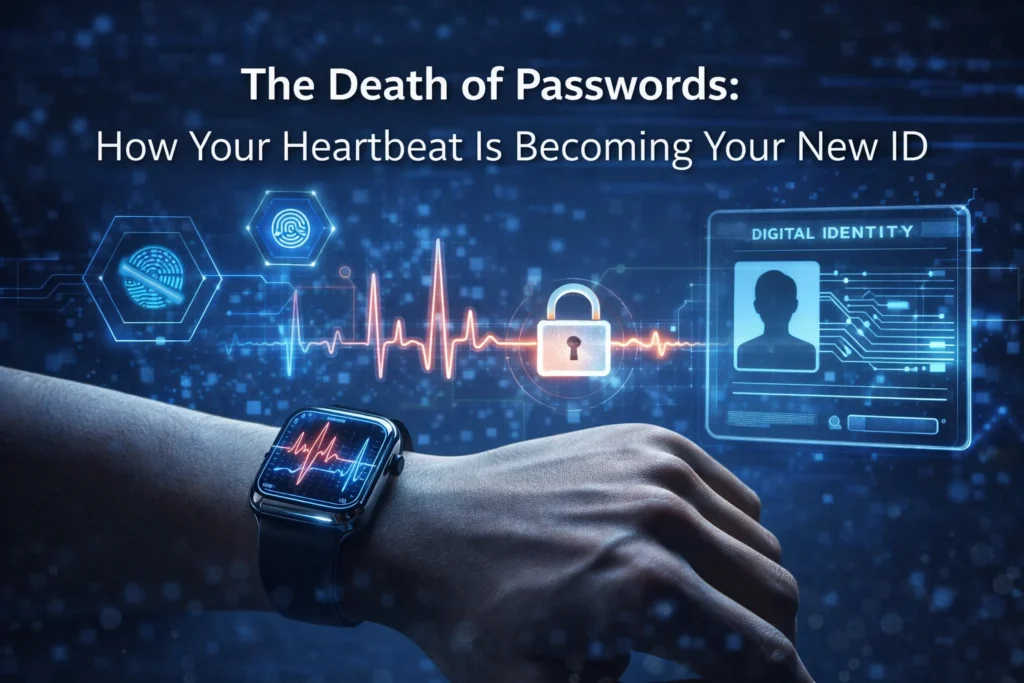

Meta Description: Tired of forgetting passwords and getting hacked? Discover the fascinating future of cybersecurity. Learn how your unique heartbeat rhythm is replacing vulnerable passwords with unhackable biometric authentication that can’t be stolen, copied, or forgotten. Complete guide with everything you need to know.
Slug: /death-of-passwords-heartbeat-id-ultimate-guide
Book One: The Password Prison
Chapter One: The Day the Digital Walls Came Crumbling Down
The notification arrived at 2:47 AM on a Wednesday. Amanda Chen was dreaming about something pleasant—a beach, maybe, or her grandmother’s kitchen—when her phone screamed her awake with an urgency that made her heart pound before her eyes even opened.
“Security Alert: $23,847.92 transferred to external account. If you did not authorize this transaction, contact us immediately.”
She stared at the screen, her hands trembling so badly she could barely tap the “call now” button. The woman who answered at the bank’s fraud department spoke in the tired, scripted tones of someone who’d had this conversation a thousand times before. Yes, the transfer was made from her account. Yes, it used her correct password. No, there was nothing they could do until morning.
Amanda didn’t sleep again that night. She sat in her dark kitchen, drinking cold coffee, watching the minutes tick toward dawn while somewhere in the world, a stranger spent money she’d saved for three years. Money from her second job. Money for her daughter’s college fund. Money that represented thousands of hours of work, now vanished into the digital ether.
By the time the sun rose and she reached her bank’s local branch, the money was gone. Wire transferred through three different countries, laundered through cryptocurrency, impossible to trace. The bank was sorry, but sorry doesn’t pay tuition. Sorry doesn’t replace retirement savings. Sorry doesn’t undo the violation of having your digital self stolen.
Amanda’s story isn’t unique. It isn’t rare. It isn’t even particularly unusual. Every single day, thousands of people just like her wake up to find that their digital identities have been hijacked by criminals who are simply better at guessing passwords than regular people are at remembering them.
The problem isn’t that Amanda was careless. She wasn’t. She used different passwords for different sites. She changed them regularly. She never clicked suspicious links. But somewhere along the way, one of the companies she trusted with her data got hacked. Their database leaked. Her email and password combination ended up on the dark web. And because she’d used that same combination for her bank account—because who can remember fifty different complex passwords?—the hackers had the key to everything.
This is the world we’ve built. A world where we protect our most valuable digital assets with strings of characters that are too hard to remember and too easy to steal. A world where the average person spends sixteen hours a year just typing passwords. A world where “password” and “123456” remain the most common credentials year after year after year.
But that world is ending. Slowly, quietly, inevitably, the password is dying. And in its place, something extraordinary is rising: the electrical rhythm of your own beating heart.
Chapter Two: The Impossible Burden of Memory
Let’s sit down together and have an honest conversation about something that frustrates every single person reading these words. Think about your typical morning. The alarm goes off. You grope for your phone. And immediately, you’re faced with a wall of password requests.
Your email app wants a password. Your social media wants a password. Your banking app wants a password. Your news subscription wants a password. Your work VPN wants a password. Your password manager—the thing you installed to help with all these passwords—wants a password. Before you’ve even had your first sip of coffee, you’ve typed credentials half a dozen times.
Now multiply that morning by 365 days. Multiply it by the 30 years you’ve been using digital devices. That’s tens of thousands of password entries over your lifetime. Tens of thousands of opportunities to make a mistake, to forget, to get locked out.
The human brain is magnificent, but it wasn’t designed for this. Our ancestors needed to remember where the water was, which berries were poisonous, and who in the tribe could be trusted. They didn’t need to remember that their Amazon password has to include one capital letter, one number, and one special character, but can’t include their name or birthdate, and has to be changed every 90 days.
Researchers who study memory have found that the average person can comfortably remember about five passwords. Five. But the average person today has over 100 password-protected accounts. That’s not a memory problem—that’s a mathematical impossibility disguised as a security requirement.
So we cope. We cope by reusing the same password across multiple sites. We cope by choosing passwords that are easy to remember and therefore easy to guess. We cope by writing them down on sticky notes attached to our monitors. We cope by using “Password123” and hoping for the best.
And the criminals know this. They’ve built entire industries around exploiting our impossible burden.
Chapter Three: The Hacker’s Playbook
To understand why passwords fail, you need to think like a hacker for a moment. Not a Hollywood hacker with sunglasses and dramatic typing, but a real hacker—someone who understands human nature better than most psychologists.
The first thing hackers know is that they don’t need to crack your specific password. That would be too much work. Instead, they hack companies. Big companies, small companies, any company with a database of user credentials. They breach these databases and walk away with millions of username and password combinations.
Now they have a list. Let’s say it’s 10 million email addresses and 10 million passwords. They take this list and run automated programs that try every combination on every major platform—Gmail, Facebook, Chase Bank, PayPal, Netflix, Amazon.
This process is called credential stuffing, and it works terrifyingly well. Because remember how you use the same password for your yoga app and your bank? The yoga app got hacked, and now the hackers have your bank password. They didn’t crack anything. They just exploited your understandable need to remember things.
But credential stuffing is just the beginning. Hackers also use phishing—sending fake emails that look real, tricking you into typing your password on a fake website. They use keyloggers—malware that records every keystroke you make. They use social engineering—calling your service provider, pretending to be you, and asking them to reset your password.
And when all else fails, they just guess. They try “password.” They try “123456.” They try “qwerty.” They try your dog’s name, your birthday, your favorite sports team. You’d be shocked how often this works.
The result is a multibillion-dollar industry built on the foundation of our forgetfulness. The FBI’s Internet Crime Complaint Center receives an average of 2,000 complaints per day, with total losses exceeding $10 billion annually. Individual victims lose an average of $12,000 when their accounts are compromised. But the financial cost is just the beginning.
Identity theft victims spend an average of 200 hours and $1,500 recovering from the crime. They deal with damaged credit scores, denied loans, and the emotional trauma of having their personal lives invaded. Some victims report being denied jobs because background checks revealed fraudulent activity tied to their stolen identity. Marriages have ended under the strain. Suicides have been attributed to the hopelessness of financial ruin from digital theft.
We have built a world where our most valuable asset—our identity—is protected by the digital equivalent of a paper lock. And we’re finally ready for something better.
Book Two: The Quest for Something Better
Chapter Four: A Brief History of Proving Who You Are
The problem of proving identity is as old as human civilization. For most of history, it was solved by physical presence. If you stood in front of someone, they knew who you were because they could see your face, hear your voice, recognize your walk. Identity was embodied.
But as societies grew and trade expanded, people needed to prove who they were across distances and time. They needed methods that worked when they weren’t physically present.
The Era of Physical Tokens
The first solution was physical tokens. A wax seal with a unique impression proved a document came from nobility. A signet ring served as a portable identity, pressed into hot wax to authenticate correspondence. A physical key proved you belonged in a locked room. A government-issued ID card proved you were who you claimed to be when dealing with officials.
These physical tokens worked reasonably well in a world without photography or instant communication. If you had the king’s signet ring, you could seal documents with his authority. If you had the key to the city gates, you could enter after dark. If you had the right documents, you could cross borders.
But physical tokens had one massive, obvious flaw: they could be stolen. They could be lost. They could be copied by skilled forgers. When someone stole your physical key, they effectively became you, at least as far as that particular lock was concerned. There was no way to distinguish between the legitimate owner and a thief holding the stolen object.
The Rise of Knowledge-Based Authentication
As society became more complex and eventually digital, we shifted from something you have to something you know. Passwords, PINs, and security questions became the standard for authentication. This seemed more secure because knowledge existed only in your mind—it couldn’t be physically stolen like a key.
The military used this approach with challenge-response systems. Guards would ask for a password, and only those who knew the correct response could pass. Banks used it with PINs for ATM access. Computers used it with login credentials.
But knowledge-based authentication introduced new problems that we’re still grappling with today. Human memory is fallible and limited. We forget things under stress. We forget things as we age. We forget things when we haven’t used them in a while. And perhaps most critically, we share knowledge carelessly.
Security questions became a particular weakness. “What was your mother’s maiden name?” “What was the name of your first pet?” “What street did you grow up on?” This information is often publicly available or easily discovered through social media. Hackers quickly learned that they didn’t need to crack complex passwords—they just needed to stalk someone’s Facebook page long enough to find their dog’s name.
The First Biometric Experiments
The idea of using the human body as a password isn’t new. Ancient Babylonians used fingerprints on clay tablets to seal business contracts. Chinese merchants used palm prints and footprints on paper documents. Nineteenth-century police departments began systematic fingerprinting for criminal identification.
But using biometrics for everyday authentication required technology that didn’t exist until recently. You couldn’t easily capture and compare fingerprints without computers. You couldn’t recognize faces without cameras and algorithms. The concept was ancient, but the implementation had to wait for the digital age.
The Biometric Revolution Begins
The first real improvement in consumer authentication came with biometrics—using physical characteristics as passwords. Fingerprint scanners appeared on laptops in the early 2000s and exploded in popularity when Apple introduced Touch ID on the iPhone 5S in 2013. Suddenly, unlocking your phone was as simple as pressing your thumb.
Fingerprint authentication felt like magic. It was fast, convenient, and uniquely tied to your body. For the first time, you didn’t need to remember anything—you just needed to be yourself. The psychological shift was profound. Your body became your key.
But fingerprints, for all their convenience, have limitations that became apparent over time. They’re external, which means you leave copies of them on everything you touch. Your coffee cup at work contains a perfect replica of your fingerprint. Your phone screen is covered in them. A determined attacker with the right resources can lift these latent prints and create artificial fingers that fool scanners.
Researchers demonstrated this vulnerability repeatedly. In 2002, a Japanese researcher fooled fingerprint scanners using gelatin fingers made from lifted prints. In 2014, the Chaos Computer Club in Germany published photos of Germany’s defense minister’s fingerprint, taken from a press conference, and used it to create a working replica. Your fingerprint isn’t secret—you leave it everywhere.
Facial recognition followed fingerprints, offering even greater convenience. Just look at your device and it unlocks automatically. No touching required. But facial recognition has its own weaknesses. Twins can fool many systems. High-quality photographs have been used to trick basic cameras. Changes in lighting, hairstyle, or facial hair can cause false rejections. And like fingerprints, your face is public—every camera you pass potentially captures it.
Iris recognition offered higher accuracy by scanning the intricate patterns of your eye. These patterns are incredibly complex and stable throughout life. But iris scanners require users to position their eyes precisely and look directly at a camera, making them impractical for casual authentication.
Voice recognition promised hands-free operation but proved vulnerable to recordings and affected by illness or emotion.
Each biometric advanced the field but fell short of the ultimate goal: an identifier that was unique, permanent, impossible to steal, and inherent proof of life.
Chapter Five: The Search for the Unhackable Key
As the limitations of external biometrics became clear, researchers began looking inward. What if the best identifier wasn’t on your surface but deep inside you? What if your identity was literally a matter of heart?
The heart had long fascinated medical researchers as a source of individual variation. Cardiologists had noticed for decades that they could often recognize patients by their ECG tracings alone. The electrical signature of each heart seemed subtly but consistently different.
This observation made intuitive sense. The heart’s electrical activity is determined by its physical structure—the size and shape of the chambers, the location of the conduction pathways, the distribution of nerve tissue. These anatomical features vary between individuals due to genetics, development, and life experience. Your heart is physically unique, and that uniqueness expresses itself electrically.
But could this electrical uniqueness be captured reliably enough for authentication? Could it be measured through clothing and skin? Would it remain stable over time? Could sensors be made small enough for everyday devices?
These questions launched a research effort that has spanned decades and involved hundreds of scientists across dozens of countries. The answers they’ve found are remarkable.
The heart’s electrical signal is strong enough to be detected on the skin’s surface. It penetrates clothing and doesn’t require direct skin contact with conductive gel, as medical ECGs do. The signal remains remarkably stable over years, even decades, as long as no major cardiac events occur. And the sensors required to capture it have shrunk from suitcase-sized hospital machines to chips smaller than a fingernail.
By the early 2010s, the technology had reached a tipping point. The pieces were all there: sensitive enough sensors, powerful enough processors, sophisticated enough algorithms. What remained was integration into consumer devices.
Chapter Six: The Electrical Symphony Inside Your Chest
Before we can fully appreciate why the heart makes such an excellent password, we need to understand what’s actually happening inside your body every moment of every day. The human heart isn’t just a mechanical pump—it’s an electrical organ conducting a symphony that’s uniquely yours.
The Conductor of Life
Deep within your heart, tucked away in the right atrium, sits a tiny cluster of cells called the sinoatrial node. This is your natural pacemaker, the conductor of the electrical orchestra that keeps you alive. About 100,000 times per day, this node fires an electrical impulse that spreads through your heart muscle like ripples across a pond.
This electrical impulse travels along specific pathways, causing different parts of your heart to contract in precise sequence. First, the upper chambers squeeze, pushing blood into the lower chambers. A fraction of a second later, the lower chambers contract powerfully, sending blood surging into your arteries. This perfectly timed sequence happens about once per second at rest, faster during exercise, slower during sleep.
The electrical signal itself is measurable. It’s generated by the movement of charged ions—sodium, potassium, calcium—across cell membranes. These ion movements create voltage changes that propagate through your tissues and can be detected on your skin. That’s what an electrocardiogram—ECG or EKG for short—actually does. It places sensors on your body that pick up these tiny electrical changes and translate them into a visual waveform.
The Language of the ECG
Medical professionals learn to read ECGs like a language. Each wave and interval tells them something about the heart’s condition.
The P wave represents the electrical impulse spreading through the upper chambers, causing them to contract. It’s usually small and rounded, like a gentle hill.
The QRS complex follows—a sharp, dramatic spike that shows the impulse moving through the lower chambers. This is the most prominent feature of the ECG, the part that makes the characteristic “thump” sound when you hear your heartbeat through a stethoscope.
The T wave comes last, a broader hump representing the heart’s electrical recovery as it prepares for the next beat. The heart doesn’t just stop after contracting—it has to reset electrically, and that reset generates its own signal.
Between these waves are intervals—the PR interval between the P wave and QRS complex, the QT interval from the QRS to the end of the T wave. These intervals reflect the timing of electrical conduction through different parts of the heart.
Why Your Waveform Is Like a Snowflake
Here’s where it gets truly fascinating. While all healthy hearts follow the same basic pattern—P wave, QRS complex, T wave—the exact shape of these waves is unique to each individual.
Think of it like handwriting. All cursive writing follows similar rules. Letters connect in predictable ways. But your specific handwriting—the pressure you apply, the slant of your letters, the way you loop your lowercase L’s, the speed of your pen strokes—is distinctively yours. Forensic document examiners can identify you by your handwriting with reasonable accuracy.
Heart waveforms work the same way. The distance between your P wave and your QRS complex falls within a specific range that’s characteristic of your heart. The height of your R wave reflects the electrical strength of your heart muscle. The shape of your T wave shows how your heart repolarizes after each beat. The overall contour of each wave—whether it’s sharp or rounded, symmetrical or skewed—carries information about your unique cardiac anatomy.
Together, these measurements create a pattern that’s as unique as your fingerprint—but hidden safely inside your chest. No one can see it. No one can photograph it. No one can lift it from a surface you’ve touched.
The Science of Stability
What makes the heart such an excellent biometric identifier is its remarkable stability combined with just enough variability. Your heart rate changes constantly based on your activity, emotions, and environment. When you’re scared, it speeds up. When you’re relaxed, it slows down. When you exercise, it pounds. When you sleep, it barely whispers.
But the underlying waveform—the relative timing and shape of those electrical peaks—remains remarkably consistent. It’s like the bass line in a song. The melody might change tempo, but the fundamental rhythm and structure stay the same.
Researchers have studied this stability extensively. They’ve followed subjects for years, capturing ECGs repeatedly to see how much the waveform changes. They’ve found that a person’s heart waveform remains identifiable even across years of aging, as long as no major cardiac events occur. Your heartbeat at 25 is recognizable as the same heartbeat at 65, even though your heart rate might have changed and your heart muscle might have weakened slightly.
This stability makes the heart ideal for authentication. Once the system learns your unique waveform, it can recognize you whether you’re calm or panicked, resting or running, happy or sad. The signal varies just enough to prove you’re alive, but not so much that it becomes unrecognizable.
Book Three: The Technology of Tomorrow
Chapter Seven: From Hospital Wires to Wearable Tech
For most of medical history, capturing an ECG required a visit to the hospital. Patients would lie on an examination table while a technician attached up to twelve sticky electrodes to their chest, arms, and legs. Wires ran from each electrode to a machine the size of a small suitcase. The patient had to remain perfectly still while the machine recorded their heart’s activity, because any movement created electrical noise that corrupted the signal.
This process was obviously not practical for everyday authentication. You couldn’t exactly strip off your shirt and attach electrodes every time you wanted to check your email. The technology needed to shrink, simplify, and integrate into daily life.
The Miniaturization Revolution
The first step toward wearable ECG technology came in the 1990s with Holter monitors—portable devices that patients wore for 24 to 48 hours to capture heart data during normal activities. These were still bulky, with multiple wires and a recording unit worn on a shoulder strap. Patients had to keep a diary of their activities and symptoms so doctors could correlate them with the recorded heart data.
But Holter monitors proved that ECG could work outside the hospital. They showed that with proper filtering and shielding, you could get usable readings even while patients moved around, went to work, and lived their normal lives.
The real breakthrough came with advances in microelectronics and sensor technology. Engineers figured out how to detect the tiny electrical signals of the heart using just two points of contact instead of twelve. They learned to filter out the electrical noise created by muscle movement and external interference. They shrank the necessary circuitry from a suitcase to a circuit board the size of a postage stamp.
The Apple Watch Moment
When Apple introduced the Apple Watch Series 4 in 2018, they included a feature that seemed almost magical at the time: a FDA-cleared ECG app. Users could open the app, rest their finger on the digital crown, and within thirty seconds receive a reading that approached medical-grade accuracy.
This was a watershed moment for consumer heart monitoring. Suddenly, millions of people had access to their own heart data anytime, anywhere. The technology that once required a hospital visit and medical expertise was now available on a device that cost a few hundred dollars and fit comfortably on your wrist.
Other manufacturers quickly followed suit. Samsung added ECG to their Galaxy Watch series. Fitbit integrated the feature into their premium devices. Withings created dedicated heart health watches with advanced sensors. Google announced plans for heart monitoring in their Pixel Watch. The technology was no longer experimental—it was consumer-grade and widely available.
How Modern Sensors Work
Today’s wearable ECG sensors use a combination of technologies to capture your heart’s electrical activity. Most use photoplethysmography—a fancy word for shining light through your skin to detect blood flow changes—combined with actual electrical sensors that touch your skin.
The electrical sensors are typically made of conductive materials like stainless steel or titanium. They’re built into the back of the watch where it contacts your wrist, and sometimes into the bezel or crown where your finger touches. When you take a reading, you complete an electrical circuit that allows the device to detect the tiny voltage changes created by your heart.
These voltages are measured in millivolts—millionths of a volt—so the sensors need to be incredibly sensitive. For comparison, a standard AA battery produces 1.5 volts, which is 1.5 million times stronger than the signals your heart generates. The sensors amplify these tiny signals thousands of times while filtering out interference from nearby power lines, muscle movements, and even the device’s own electronics.
The result is a clean waveform that shows your heart’s activity in real-time. That waveform contains all the unique characteristics that make your heartbeat identifiable. And because the sensor is always on your wrist, it can capture this data passively throughout the day without any effort on your part.
The Next Generation of Sensors
Research continues on even better sensors. Some labs are working on sensors that work through thicker clothing, or that can detect heart signals from farther away. Others are developing flexible sensors that conform better to the skin, improving signal quality. Still others are exploring sensors that don’t require any intentional action—they just continuously monitor your heart as you wear the device normally.
The ultimate goal is sensors that are so seamless and unobtrusive that you forget they’re there. Your heartbeat becomes a constant background signal, always available for authentication whenever needed, without any conscious effort on your part.
Chapter Eight: How Your Heartbeat Becomes a Password
Now we arrive at the practical question: how does that waveform on your wrist actually become a key that unlocks your digital life? The process involves sophisticated mathematics, secure storage, and clever engineering that makes the system both accurate and practical.
Step One: Enrollment
The first time you use heartbeat authentication, you’ll go through an enrollment process similar to setting up fingerprint or face recognition on your current phone. The system will ask you to take several ECG readings over the course of a minute or two.
During this enrollment phase, the device captures multiple heartbeats and analyzes them to create a template. It looks for the distinctive features that define your unique waveform: the exact timing between peaks, the relative heights of different waves, the subtle shape characteristics that persist across beats.
The device doesn’t store actual recordings of your heartbeats. That would be both storage-intensive and privacy-invasive. Instead, it extracts the key features and creates a mathematical representation—a template—that captures what makes your heartbeat unique without preserving the actual heartbeat itself.
Think of it like storing a friend’s phone number. You don’t need to remember their entire life story to call them—you just need the ten digits that connect you. Similarly, the device doesn’t need your entire heartbeat history—it just needs the mathematical essence that identifies you.
Step Two: Feature Extraction
Feature extraction is the technical heart of the system. The device’s processor analyzes each heartbeat and identifies specific points that serve as landmarks. Medical professionals call these fiducial points—reference marks that can be reliably identified across different readings.
The most important points include:
- The onset of the P wave, where atrial depolarization begins
- The peak of the P wave, showing maximum atrial electrical activity
- The Q point, where the QRS complex begins its sharp downward deflection
- The R peak, the highest point of the QRS complex
- The S point, where the QRS complex returns toward baseline
- The J point, where the QRS complex ends and the ST segment begins
- The peak of the T wave, representing maximum ventricular repolarization
- The end of the T wave, where the heart’s electrical recovery completes
But advanced systems go much deeper than these basic landmarks. They analyze the slopes between points—how quickly the voltage changes from one moment to the next. They calculate the areas under curves—the total electrical activity during each phase. They examine the subtle irregularities that make each heartbeat distinct, like the tiny notches or variations that appear consistently in your waveform.
Think of it like recognizing a friend’s voice. You don’t need to analyze every frequency of every word they say. You just need to notice the characteristic pitch, cadence, and accent that make their voice recognizable. The same principle applies to heartbeat recognition—the system learns the essential characteristics that define your cardiac signature.
Step Three: Cryptographic Transformation
Once the device has extracted your heartbeat’s unique features, it performs a critical transformation. It converts those features into a cryptographic key—a long string of numbers that can be used for mathematical authentication.
This transformation is one-way, meaning you can go from heartbeat features to cryptographic key, but you cannot go from cryptographic key back to heartbeat features. This is similar to how password systems store hashed versions of your password—they keep the result of a mathematical operation, not the original input.
The one-way nature of this transformation is crucial for privacy. Even if someone steals the cryptographic key stored on your device, they cannot reverse-engineer it to discover what your heartbeat looks like. They have a number that works for authentication, but they don’t have your actual biometric data.
The resulting key is typically 128 or 256 bits long, providing security equivalent to the strongest encryption used by banks and militaries worldwide. Your heartbeat becomes the seed for cryptographic security that would take supercomputers millions of years to crack through brute force.
Step Four: Secure Storage
The cryptographic key derived from your heartbeat must be stored somewhere, but not just anywhere. It needs to be protected by hardware-level security that even the device’s main operating system cannot access.
Modern devices use dedicated secure enclaves—isolated processors with their own memory that’s physically separated from the main system. Apple’s Secure Enclave, Qualcomm’s Secure Processing Unit, and similar technologies in other devices provide this hardware-level protection.
When your heartbeat template is created, it’s stored directly in the secure enclave. The main processor never sees it. The operating system never accesses it. Even if someone fully compromises the main system, they cannot reach the secure enclave because it’s designed to be impenetrable from software attacks.
Step Five: Matching
When you later want to authenticate, the process repeats. You touch your wearable sensor, it captures a few seconds of heartbeats, extracts the features, generates a new cryptographic key, and sends this key to the secure enclave for comparison with your stored template.
The comparison isn’t looking for an exact match—that would be impossible since your heartbeat varies with every beat. Instead, it looks for statistical similarity using sophisticated matching algorithms.
These algorithms calculate a similarity score based on how closely the new reading matches the stored template. If the score exceeds a predetermined threshold, the system accepts it as a match. If it falls below, authentication fails.
This threshold is critically important. Set it too tight, and legitimate users get rejected when their heart rate varies normally. Set it too loose, and imposters might be accepted. Engineers spend enormous effort finding the perfect balance that maximizes security while minimizing frustration.
Modern systems use adaptive thresholds that adjust based on context. If you’re trying to access a low-security app, the threshold might be looser for convenience. If you’re authorizing a large bank transfer, the threshold tightens to ensure maximum security. The system learns when to be strict and when to be forgiving.
Step Six: Continuous Authentication
The most sophisticated implementations don’t just authenticate you once at login. They continuously verify your identity throughout your session.
Your wearable device periodically checks your heartbeat and confirms that the same person who logged in is still present. If someone steals your phone after you’ve unlocked it, the system would detect the different heartbeat and automatically re-lock. If you walk away from your computer, it would lock the moment your heartbeat leaves the sensor range.
This continuous verification creates a security bubble that follows you everywhere, protecting your data even in moments of inattention. It’s the digital equivalent of having a bodyguard who never blinks.
Chapter Nine: The Unbreakable Nature of Cardiac Authentication
What makes heartbeat authentication fundamentally more secure than passwords, fingerprints, or facial recognition? The answer lies in the unique properties of the heart as a biometric identifier. These properties combine to create a system that approaches true unbreakability.
Property One: Internal vs. External Biometrics
Fingerprints, facial features, and even iris patterns are all external biometrics. They exist on the surface of your body, exposed to the world every moment you’re awake. Every surface you touch collects your fingerprints. Every camera you pass captures your face. Every look in someone’s direction reveals your iris.
Your heartbeat, by contrast, is internal. It generates electrical signals that radiate through your body, but those signals are far too weak to detect at a distance. Someone would need direct skin contact with sensitive electrodes to capture your cardiac signature. You don’t leave heartbeats on doorknobs or coffee cups.
This internal nature makes heartbeat authentication virtually immune to the kind of surreptitious collection that threatens other biometrics. A hacker can’t scrape your heartbeat from social media photos or lift it from a glass you touched at a restaurant. They can only capture it with your knowledge and cooperation.
Property Two: Liveness Detection Built by Nature
Perhaps the most remarkable property of cardiac authentication is that it inherently proves you’re alive. This seems obvious, but it’s actually a revolutionary security feature that other biometrics lack.
Fingerprint scanners can be fooled by gelatin replicas made from lifted prints. Researchers have demonstrated this repeatedly—press a gelatin finger against a scanner, and it often unlocks just as reliably as a real finger. The scanner has no way of knowing that the finger isn’t attached to a living person.
Facial recognition can be tricked by high-quality photos or videos. Early systems were famously fooled by holding a printed photo up to the camera. Modern systems use liveness detection—asking you to blink or move your head—but these can sometimes be bypassed with sophisticated video playback.
Iris scanners have been bypassed using contact lenses printed with stolen patterns. Voice recognition can be fooled by high-quality recordings.
In each case, the attacker presents a replica of a biometric that came from a living person but isn’t attached to one anymore. The system sees the correct pattern but has no way of knowing that the pattern isn’t coming from living tissue.
Heartbeat authentication can’t be fooled this way because it requires a beating heart. A gelatin finger doesn’t pulse with electricity. A photograph doesn’t generate an ECG waveform. A recording doesn’t produce real-time electrical activity. The only way to produce the required signal is to have a living, functioning heart connected to a living, functioning person.
This liveness detection is seamless and automatic. The system doesn’t need to ask you to blink or move your head—it just needs to feel your pulse. If there’s no pulse, there’s no access. It’s authentication that literally requires you to be alive.
Property Three: The Impossibility of Remote Theft
Password theft can happen from anywhere in the world. A hacker in Russia can steal a password stored on a server in California without ever touching the victim. They can break into company databases, intercept network traffic, or trick users into revealing their credentials through phishing emails.
Fingerprint databases, when breached, expose biometric data that victims can never change. The 2015 breach of the US Office of Personnel Management compromised 5.6 million fingerprints. Those fingerprints are now permanently compromised—their owners can never use fingerprint authentication securely again.
Heartbeat authentication defeats remote theft through multiple layers of protection.
First, the best implementations keep your cardiac template stored locally on your device, not in the cloud. There’s no central database for hackers to breach. Even if a company’s servers are completely compromised, they contain no heartbeat data because that data never leaves your device.
Second, even if someone stole the mathematical template from your device, they couldn’t reverse-engineer it into an actual heartbeat. The one-way cryptographic transformation ensures that the template reveals nothing about your original cardiac signal.
Third, generating a valid authentication requires real-time cardiac activity. You can’t replay a recorded heartbeat because the system expects the natural variability of a living heart. Each heartbeat is slightly different, and the system recognizes this variation as proof of liveness.
Property Four: Stability with Variability
The ideal biometric identifier balances two competing requirements: it needs to be stable enough for reliable recognition, but variable enough to prevent replay attacks.
If your biometric is perfectly stable—if your fingerprint never changes—then someone who captures it once can replay it forever. They have a permanent key to your identity.
If your biometric is too variable, you’ll constantly be locked out of your own accounts because the system can’t recognize you from one day to the next.
Heartbeat authentication strikes the perfect balance. Your underlying waveform remains stable over years, providing reliable recognition. But each individual heartbeat varies slightly in timing and amplitude, creating a constantly changing signal that can’t be successfully replayed.
Think of it like a song. The melody and structure are consistent—that’s what makes the song recognizable. But each performance varies slightly in tempo, emphasis, and expression—that’s what makes it a live performance rather than a recording.
Property Five: Involuntary and Continuous
Unlike passwords, which require conscious effort to enter, your heartbeat operates automatically and continuously. You don’t have to remember to beat your heart—it just happens. This involuntary nature makes heartbeat authentication seamless.
Unlike fingerprints or face scans, which require intentional action—pressing a finger, looking at a camera—heartbeat authentication can happen passively. Your wearable device can continuously monitor your cardiac signal without any action on your part.
This enables continuous authentication, where your identity is verified throughout your session, not just at login. It creates security that adapts to your presence, locking automatically when you leave, unlocking automatically when you return.
Chapter Ten: The Mathematics of Uniqueness
Behind the elegant simplicity of heartbeat authentication lies complex mathematics that ensures the system works reliably for billions of people. Understanding this mathematics helps explain why the heart works so well as an identifier.
The Probability of Duplication
The fundamental question for any biometric is uniqueness: what are the chances that two people share the same pattern? For fingerprints, the probability of two people having identical prints is estimated at about 1 in 64 billion—far less than the world’s population.
For heartbeats, the mathematics is still being studied, but early research suggests similar levels of uniqueness. The heart has multiple independent features that combine to create your signature: the timing intervals between waves, the amplitudes of peaks, the shapes of complexes, the subtle variations in morphology.
If each of these features has a certain range of possible values, and if these features vary independently, the number of possible combinations becomes astronomical. Even with conservative estimates, the probability of two people having identical cardiac signatures is vanishingly small.
Feature Independence
The key to biometric uniqueness is feature independence. If all features were correlated—if knowing one feature told you everything about the others—then there would be far fewer possible combinations. But cardiac features are largely independent.
The height of your R wave doesn’t predict the length of your QT interval. The shape of your T wave doesn’t determine the slope of your ST segment. These features arise from different aspects of cardiac anatomy and physiology, so they vary independently across individuals.
This independence multiplies the possibilities. If you have 10 features, each with 10 possible values, that’s 10^10—10 billion—possible combinations. Add more features, and the possibilities explode exponentially.
Temporal Stability with Individual Variation
The mathematics must also account for changes over time. Your heartbeat isn’t perfectly constant—it varies with heart rate, activity, and physiology. The recognition algorithms must be sophisticated enough to distinguish between the variations that are characteristic of you and the variations that are just random noise.
This is where machine learning excels. Algorithms trained on thousands of heartbeats learn the difference between your personal variation patterns and the patterns that would indicate a different person. They recognize that your heart rate might increase during exercise, but the relative timing of your waves remains consistent. They understand that your signal might be noisier when you’re moving, but the underlying structure persists.
False Acceptance and False Rejection
Every biometric system involves tradeoffs between two types of errors: false acceptance (letting an imposter in) and false rejection (keeping a legitimate user out).
False acceptance is the security risk. You want this as low as possible—ideally zero. False rejection is the convenience risk. You want this low too, because users get frustrated when they’re locked out of their own accounts.
The two errors trade off against each other. Make the matching threshold stricter, and false acceptance goes down but false rejection goes up. Make it looser, and false rejection goes down but false acceptance goes up.
Heartbeat authentication achieves excellent balance. Research studies report false acceptance rates below 0.1% and false rejection rates below 1% in controlled conditions. Real-world performance varies based on sensor quality, device placement, and user factors, but the technology continues to improve.
The Impact of Population Size
As biometric systems scale to billions of users, the mathematics of matching becomes more challenging. With a small population, it’s easy to distinguish between individuals. With a large population, the chances of similar patterns increase.
This is why biometric systems use multiple features and sophisticated matching algorithms. They don’t just look for rough similarity—they analyze detailed characteristics that provide high discrimination even across large populations.
For heartbeat authentication, the feature space is rich enough to support global scale. The combination of timing, amplitude, and morphological features provides enough information to distinguish individuals even among billions.
Book Four: The World Reimagined
Chapter Eleven: Real-World Applications Reshaping Industries
The potential applications for heartbeat authentication extend far beyond unlocking your phone. This technology has the power to transform entire industries, solving problems that have plagued security professionals for decades.
Healthcare: Your Heartbeat as Your Medical ID
Imagine arriving at an emergency room unconscious and alone. No wallet, no phone, no identification. You’re bleeding internally, and every second counts. Currently, doctors would treat you as John or Jane Doe, unable to access your medical history, allergies, or medications. They’d make decisions without knowing your blood type or pre-existing conditions. They’d guess at which medications are safe for you.
With heartbeat authentication, your wearable device could transmit your identity to hospital systems, granting immediate access to your complete medical records. Doctors would know about your penicillin allergy before administering antibiotics. They’d know your blood type before ordering a transfusion. They’d know about your implanted pacemaker before attempting certain procedures. They’d know about your rare blood disorder that affects anesthesia response.
This application saves lives directly. Studies show that medical errors increase significantly when patient identity is uncertain. Misidentification leads to wrong procedures, wrong medications, and wrong blood transfusions—errors that can be fatal. By tying identity directly to biology, heartbeat authentication eliminates that uncertainty entirely.
The benefits extend beyond emergencies. Regular doctor visits become streamlined—your heartbeat verifies your identity, automatically loading your records for the physician. Pharmacy pickups become secure—your heartbeat confirms you’re the patient picking up controlled substances. Clinical trials ensure data integrity—researchers know that the data they’re collecting actually comes from the enrolled participant.
Banking: The End of Credit Card Fraud
Credit card fraud costs consumers and financial institutions over $30 billion annually. Most of this fraud happens because cards can be stolen, numbers can be copied, and signatures can be forged. Payment authentication relies on something you have (the card) and something you know (the PIN), both of which can be compromised.
Heartbeat authentication changes this fundamentally. Imagine walking into a store, selecting your items, and approaching the checkout. Instead of swiping a card or tapping a phone, you simply touch the payment terminal with your finger. The terminal detects your pulse through your fingertip, verifies your identity against your bank’s authentication system, and approves the transaction.
This system would make stolen credit cards worthless. A thief could have your physical card, know your PIN, and still couldn’t complete a purchase because their heartbeat wouldn’t match yours. The card becomes just a piece of plastic with no value without your living pulse.
Card-not-present transactions—online purchases—would require touching a sensor on your computer or phone. Every online purchase becomes a biometric event, ensuring that only you can authorize payments from your accounts. No more stolen credit card numbers used for fraudulent online shopping.
The implications extend to all financial services. Opening new accounts becomes more secure—your heartbeat verifies your identity remotely. Wire transfers require cardiac confirmation. ATM withdrawals use pulse sensors instead of PINs. The entire financial system becomes resistant to identity theft.
Physical Security: Doors That Know You
High-security facilities currently use a combination of keycards, PIN codes, and biometric scanners to control access. These systems are expensive, cumbersome, and still vulnerable to credential theft. A stolen keycard combined with an observed PIN gives an intruder full access.
Heartbeat authentication could replace all of this. Imagine walking up to a secure door and simply touching a sensor plate. The sensor reads your pulse, verifies your identity, and unlocks the door if you’re authorized. No cards to lose, no codes to remember, no fingerprints to lift.
This technology is particularly valuable for facilities with many authorized personnel. Adding or removing access becomes a simple database update rather than collecting and reprogramming physical credentials. When an employee leaves, their cardiac access is simply revoked—no need to collect keys or change locks.
The audit trail is undeniable. If your heartbeat opened a door at 2 AM, it was definitely you, not someone using your stolen card. This creates accountability that physical credentials can’t provide.
Residential applications follow naturally. Your front door unlocks when it detects your heartbeat. Your garage door opens as you approach. Your safe recognizes only your pulse. The key to your physical world becomes as intrinsic as the key to your digital world.
Digital Inheritance and End-of-Life Planning
One fascinating application involves end-of-life digital access. Currently, when someone dies, their digital accounts become inaccessible. Families can’t access photos stored in cloud accounts, can’t close online accounts, and can’t retrieve important documents. Tech companies have struggled with how to handle deceased users’ data, often requiring court orders for access.
Heartbeat authentication could enable elegant solutions to this problem. Upon detecting no heartbeat for a specified period—say, 24 hours of continuous absence—systems could trigger predetermined inheritance protocols.
These protocols might gradually grant access to designated beneficiaries. Photos could become accessible to family members. Financial accounts could transition to executors. Social media profiles could convert to memorial pages. The system would know, definitively, that the user is gone because their heartbeat has ceased.
This would preserve digital legacies while maintaining security during life. Your data remains private while you’re alive, protected by your living pulse. After death, it transitions according to your wishes, verified by the ultimate proof—the absence of your heartbeat.
Continuous Authentication
Perhaps the most sophisticated application is continuous authentication. Rather than checking your identity once at login, systems could continuously verify that you’re still you throughout a session.
Your wearable device could periodically check your heartbeat and confirm that the same person who logged in is still present. This creates a security bubble around you.
If someone steals your phone after you’ve unlocked it, the system would detect the different heartbeat through the touch sensors and automatically re-lock. The thief would have a locked device, useless to them.
If you walk away from your computer, it would lock the moment your heartbeat leaves the sensor range. No more forgetting to lock your screen when you go to lunch. No more colleagues accessing your accounts while you’re away.
If you’re in a meeting and someone else picks up your tablet to show a colleague something, the device would recognize the foreign heartbeat and restrict access to only the content you’ve explicitly shared.
This continuous verification creates security that adapts to your presence, protecting your data even in moments of inattention. It’s the digital equivalent of a bodyguard who follows you everywhere, ensuring that only you have access to your information.
Workplace Productivity and Security
Enterprises spend billions on identity and access management—systems that control which employees can access which resources. These systems are complex, expensive, and still vulnerable to credential sharing.
Heartbeat authentication could transform workplace security. Employees would access their computers, networks, and applications using their cardiac signature. No passwords to forget, no tokens to lose, no credentials to share.
The system would know definitively that the person accessing sensitive data is actually the authorized employee. Credential sharing becomes impossible—you can’t give someone else your heartbeat.
Remote work becomes more secure. Companies can verify that the person logging in from home is actually their employee, not someone who stole their credentials. Continuous authentication ensures that the same person remains at the keyboard throughout the work session.
Time tracking becomes automated. Your presence at your workstation is verified by your continuous heartbeat signal. Billing hours becomes accurate and undeniable.
Transportation and Automotive
Modern cars are computers on wheels, with sophisticated systems that control everything from entertainment to engine function. Car theft remains a multibillion-dollar problem, with thieves using electronic devices to bypass traditional ignition systems.
Heartbeat authentication could make car theft nearly impossible. Steering wheel sensors would detect the driver’s pulse and only allow ignition if the authorized heartbeat is present. Even if thieves broke in and hotwired the electronics, they couldn’t start the engine without the correct cardiac signature.
Beyond theft prevention, heartbeat authentication enables personalization. The car recognizes you as you approach and automatically adjusts seat position, mirror angles, climate preferences, and entertainment presets. Your profile loads before you even open the door.
For families sharing vehicles, each driver gets their own authenticated profile. Teenage drivers could have speed limitations and curfew alerts. Elderly parents could have enhanced safety monitoring. The car knows who’s driving and adapts accordingly.
Fleet management becomes more secure. Commercial vehicles only start for authorized drivers, preventing unauthorized use and ensuring that only qualified operators are behind the wheel.
Travel and Border Control
International travel involves repeated identity verification—passports, visas, customs declarations. Each verification is a potential point of fraud or delay.
Heartbeat authentication could streamline travel while enhancing security. Imagine approaching an airport security checkpoint and simply touching a sensor. Your heartbeat verifies your identity against your passport records, confirming that you are the person who booked the ticket.
No documents to present (though you’d still need them for legal purposes). No questions about whether your face matches your photo. Just instant, reliable verification that you are who you claim to be.
Border control could use heartbeat authentication to verify returning citizens. Frequent travelers could enroll in expedited programs where heartbeat verification replaces document checks. Immigration processing becomes faster and more secure.
The technology also prevents passport fraud. Stolen passports become useless because the thief’s heartbeat won’t match the passport’s biometric record. Identity verification becomes tied to living biology rather than paper documents.
Education and Testing
Academic integrity is a growing concern, particularly with remote learning and online testing. How do schools know that the student taking the test is actually the enrolled student?
Heartbeat authentication provides an answer. Students could be continuously authenticated throughout exams, with their heartbeat signal verifying their presence. The system would know if the test-taker changes mid-exam because the heartbeat would change.
This enables secure remote testing that maintains academic integrity. Students can take exams from home while schools have confidence that the right person is completing the work.
Beyond testing, heartbeat authentication could control access to educational resources. Sensitive research materials would only be accessible to authorized researchers. Library systems would check out books to verified students. Campus facilities would open only for enrolled students.
Gaming and Entertainment
The gaming industry loses billions to account theft and cheating. Players invest hundreds of hours building characters and achievements, only to have accounts stolen and stripped.
Heartbeat authentication would make gaming accounts virtually unstealable. Your account is tied to your living pulse—no one else can access it, no matter what credentials they have.
Parental controls become more effective. Games could verify that the player is actually the child they’re supposed to be, enforcing age-appropriate content and time limits. No more kids using parents’ accounts to access mature games.
Competitive gaming gains integrity. Tournament organizers can verify that the player competing is actually the registered competitor. Cheating through account sharing becomes impossible.
Voting and Democratic Processes
Election integrity depends on verifying that each voter votes only once and that their vote is counted accurately. Current systems struggle with voter identification, leading to concerns about fraud and disenfranchisement.
Heartbeat authentication could revolutionize voting security. Voters would verify their identity at polling places using pulse sensors, ensuring that each person votes only once. Remote voting becomes possible with cryptographic verification—your heartbeat authorizes your ballot, which is recorded anonymously but verifiably.
This wouldn’t replace existing voter registration systems but would add a layer of biometric verification that’s virtually impossible to fake. Election officials would have high confidence that votes come from eligible voters, while voters would have confidence that their votes are counted accurately.
Humanitarian Applications
Beyond commercial applications, heartbeat authentication has humanitarian potential. Refugee populations often lack identification documents, making it difficult to access aid, open bank accounts, or prove their identity for resettlement.
Heartbeat authentication could provide portable, unforgeable identity for people without documents. A simple wearable device would store their cardiac template, allowing them to prove who they are anywhere in the world. Aid organizations could verify recipients before distributing resources. Banks could open accounts for the unbanked. Resettlement agencies could process cases with confidence in identity.
This technology could restore identity to people who’ve lost everything else.
Chapter Twelve: The Technology Deep Dive
The elegant simplicity of heartbeat authentication conceals enormous technical complexity. Engineers have overcome staggering challenges to make this technology practical, accurate, and secure enough for everyday use.
Sensor Technology: Capturing the Impossible
The electrical signals generated by your heart are incredibly faint. We’re talking about voltages measured in microvolts—millionths of a volt. For comparison, a standard AA battery produces 1.5 volts, which is 1.5 million times stronger than the signals your heart generates.
Capturing these faint signals requires sensors with extraordinary sensitivity. Modern ECG sensors use instrumentation amplifiers specifically designed to detect tiny voltage differences while rejecting common-mode noise—interference that affects both sensors equally. They operate like a microphone that can hear a whisper across a football stadium while ignoring the roaring crowd.
These sensors face additional challenges when integrated into wearables. They must work through clothing, tolerate movement, and compensate for the varying quality of skin contact. Dry electrodes—those without conductive gel—have higher impedance than medical electrodes, meaning they pick up more noise and weaker signals.
Engineers have developed adaptive filtering algorithms that continuously adjust to changing conditions. When you’re sitting still, the system can use more sensitive settings. When you’re moving, it adapts to the increased noise. When skin contact is poor, it detects the degradation and either compensates or requests better contact.
Signal Processing: Finding the Signal in the Noise
Raw ECG data is messy. It contains not just your heartbeat but also electrical noise from multiple sources:
- Muscle activity (electromyographic noise) from any movement
- Power line interference at 50 or 60 Hz depending on your location
- Baseline wander from breathing and body movement
- Electrode motion artifact from poor skin contact
- Radio frequency interference from nearby electronics
- Quantization noise from the analog-to-digital conversion
Separating the meaningful signal from this noise requires sophisticated signal processing.
The first step is filtering. Digital filters remove known interference frequencies while preserving the frequency range where heartbeat information lives. A notch filter removes the specific frequency of power line noise. A high-pass filter removes slow baseline wander. A low-pass filter removes high-frequency muscle noise.
But fixed filters have limitations. They remove some frequencies completely, potentially losing cardiac information that happens to fall in those ranges. More advanced systems use adaptive filters that learn the noise patterns present in each reading and subtract them from the signal without losing cardiac content.
Once filtered, the signal must be analyzed to identify individual heartbeats. This is harder than it sounds because heartbeats vary in shape and timing. Detection algorithms look for the characteristic sharp spike of the QRS complex, which is usually the most prominent feature. They use pattern matching, slope detection, and wavelet analysis to locate each beat even in noisy conditions.
Once one heartbeat is located, the algorithm can predict where the next one should occur based on the current heart rate and search that region. This predictive approach improves detection accuracy and speed.
Feature Extraction: Characterizing Your Unique Signal
After identifying individual heartbeats, the system must extract the features that make your heartbeat unique. This is where the real magic happens.
Basic feature extraction measures the obvious landmarks: the timing between waves, the heights of peaks, the depths of valleys. But these basic features alone don’t provide enough discrimination for reliable identification across large populations.
Advanced systems extract dozens or even hundreds of features from each heartbeat:
- Temporal features: intervals between all combinations of fiducial points
- Amplitude features: heights of peaks relative to baseline and to each other
- Morphological features: shapes of waves, characterized by curve fitting or template matching
- Slope features: rates of voltage change at various points
- Area features: integrated area under curves between points
- Frequency features: spectral content of different segments
- Statistical features: means, variances, and higher moments of distributions
Some systems use principal component analysis to identify the combinations of features that provide the most discrimination. Others use deep learning to automatically discover relevant features without human guidance.
The result is a feature vector—a long list of numbers—that captures the essence of your cardiac signature. This vector is typically much smaller than the raw ECG data but contains the information needed for reliable identification.
Machine Learning: Teaching Computers to Recognize Hearts
The final recognition step relies heavily on machine learning—computers that learn from examples rather than following explicit instructions. Developers train recognition algorithms using thousands of heartbeat recordings from hundreds of people, teaching the system to distinguish the subtle differences between individuals.
Traditional machine learning approaches use classifiers like support vector machines or random forests. These algorithms learn decision boundaries that separate one person’s heartbeats from everyone else’s. They become experts at recognizing your heart the way you recognize your mother’s voice on a crackly phone line.
Modern systems increasingly use deep neural networks with multiple processing layers. Each layer extracts increasingly abstract features from the raw signal:
- The first layer might detect basic waveform shapes—peaks, valleys, slopes
- The second layer combines these shapes into recognizable complexes—P waves, QRS complexes, T waves
- The third layer captures relationships between complexes—intervals, ratios
- The fourth layer models the overall rhythm pattern across multiple beats
- The final layer makes the identification decision based on the complete feature set
These deep networks learn features that human engineers might never think to specify. They discover subtle patterns in the data that provide discrimination but aren’t obvious to human observers.
The networks are trained on massive datasets—millions of heartbeats from thousands of people. They learn to ignore the variations that don’t matter for identification (changes in heart rate, temporary signal quality issues) while focusing on the features that remain stable over time.
Secure Enclaves: Protecting Your Heart Template
The most critical technical component is the secure storage where your heartbeat template lives. This can’t be regular device storage, which is vulnerable to malware and physical attacks. Instead, manufacturers use dedicated secure enclaves—isolated processors with their own memory that’s physically separated from the main system.
Apple’s Secure Enclave, introduced with the A7 chip in 2013, set the standard for hardware-level biometric protection. It’s a separate processor running its own operating system, with memory that’s encrypted and accessible only to the enclave itself. The main processor can request authentication services—”is this fingerprint a match?”—but never sees the actual biometric data.
Qualcomm’s Secure Processing Unit provides similar capabilities for Android devices. ARM’s TrustZone technology creates a secure world separate from the normal operating system. Other manufacturers have developed their own secure enclave implementations.
These secure enclaves ensure that your heartbeat template never leaves protected hardware unencrypted. Even if someone fully compromises the main operating system, they can’t access the template because it simply isn’t accessible through normal channels. Physical attacks require sophisticated equipment and are impractical against modern secure enclaves.
When authentication happens, the sensor data goes directly to the secure enclave for processing. The main processor never sees your heartbeat—it only receives a yes/no answer about whether the authentication succeeded. This architecture keeps your biometric data completely private even from the device’s own operating system.
Template Update and Adaptation
Your heartbeat changes slightly over time due to aging, health changes, and other factors. A static template would eventually become inaccurate, leading to false rejections.
Modern systems address this through template adaptation. Each successful authentication provides a new sample that can be used to gradually update the stored template. The system learns how your heartbeat is slowly evolving and adjusts accordingly.
This adaptation must be carefully controlled to prevent an attacker from gradually changing the template through repeated authentication attempts. Secure enclaves implement policies that limit adaptation rates and require high-confidence matches before updates occur.
Some systems store multiple templates representing different states—resting heartbeats, exercise heartbeats, different body positions. This multi-template approach improves recognition across different conditions.
Liveness Detection
Preventing replay attacks requires reliable liveness detection—verifying that the heartbeat signal is coming from a living person right now, not a recording or simulation.
Heartbeat signals naturally contain tiny variations that are difficult to simulate. The timing between beats varies slightly (heart rate variability) in patterns characteristic of living autonomic nervous systems. The waveform morphology changes subtly with each beat. These variations provide a signature of liveness.
Advanced systems analyze these variations to ensure they match the complexity expected from a living heart. They look for the chaotic but structured patterns that characterize biological systems, distinguishing them from the too-perfect regularity of electronic simulations.
Some systems incorporate challenge-response mechanisms. They might briefly vibrate the device, causing a measurable change in heart rate that a living person would exhibit but a recording wouldn’t. Or they might measure other physiological signals—skin conductivity, temperature—that correlate with living status.
The combination of multiple liveness indicators makes simulation increasingly difficult.
Power Efficiency
Continuous authentication requires continuous monitoring, which could drain batteries quickly. Engineers have developed power-efficient approaches that balance security with battery life.
The sensor system can operate in low-power modes when full authentication isn’t needed. It might sample at lower rates, process less data, or only wake fully when potential authentication is detected.
Event-driven architectures trigger full processing only when authentication is actually requested. Between authentications, the system sleeps, consuming minimal power.
Some implementations use the heart signal itself as a wake-up source. The presence of a heartbeat triggers the system to begin processing, eliminating the need for continuous active monitoring.
These optimizations enable continuous authentication on battery-powered wearables that users can wear all day without recharging.
Chapter Thirteen: Privacy and the Surveillance Question
No discussion of biometric technology is complete without addressing the legitimate privacy concerns that arise whenever we talk about using our bodies as passwords. These concerns deserve serious consideration, not dismissal.
The Permanence Problem
The most fundamental privacy concern with any biometric is permanence. When a password is compromised, you change it. When a credit card is stolen, you cancel it and get a new one. But when your heartbeat is compromised, you’re stuck. You can’t get a new heart just because a hacker stole your cardiac template.
This permanence makes biometric data uniquely valuable to attackers and uniquely damaging when exposed. A stolen heartbeat is a key that works forever, or at least until your heart stops beating.
The engineering response to this concern is the one-way transformation discussed earlier. Your actual heartbeat never leaves your device. What gets stored and potentially transmitted is a mathematical representation that can’t be reverse-engineered into the original heartbeat. If that representation is stolen, the attacker hasn’t stolen your actual heartbeat—they’ve stolen a key that only works with the specific system that created it.
This is similar to how passwords are stored as hashes rather than plain text. The difference is that with passwords, you can change the hash by changing the password. With biometrics, you’re stuck with the same biometric forever, so protecting the hash becomes absolutely critical.
The Revocability Challenge
Ideally, biometric credentials would be revocable—if compromised, you could cancel them and get new ones. Heartbeat authentication approaches this through cryptographic transformations.
When you enroll, the system creates a cryptographic key from your heartbeat. If that key is compromised, you can simply create a new key by using a different transformation. Your heartbeat stays the same, but the key derived from it changes.
This is analogous to how websites store password hashes with salt—random data added before hashing to ensure that the same password produces different hashes on different sites. Similarly, your heartbeat can be combined with device-specific or application-specific salt to create different keys for different contexts.
If one key is compromised, others remain secure. You can revoke the compromised key and generate a new one without changing your heartbeat.
Government Surveillance and Biometric Databases
A different concern involves government collection of biometric data. Several countries have already implemented national fingerprint databases. Facial recognition cameras monitor public spaces in major cities worldwide. The prospect of governments adding heartbeat surveillance to their capabilities raises serious civil liberties questions.
Could law enforcement demand access to your wearable device to prove you were at a certain location? Could governments require heartbeat registration for all citizens, creating a national cardiac database? These questions aren’t hypothetical—they’re actively debated by privacy advocates and civil rights organizations.
The technical community’s answer is to build systems that prevent this kind of surveillance by design. Local storage, on-device processing, and cryptographic protections make it technically difficult for governments to collect heartbeat data at scale. But technical protections only go so far—legal frameworks and public awareness are equally important.
Some jurisdictions have already enacted strong biometric privacy laws. Illinois’ Biometric Information Privacy Act requires companies to obtain consent before collecting biometric data and establishes strict rules for storage and sharing. Other states and countries are considering similar legislation.
The Consent Question
Another privacy dimension involves consent and awareness. When you walk down a street with facial recognition cameras, you might not know you’re being watched. When you touch a doorknob with heartbeat authentication, you know exactly when you’re providing biometric data because you have to intentionally make contact.
This intentionality matters for privacy. Heartbeat authentication requires active participation—you must choose to authenticate by touching a sensor. This creates a natural consent mechanism that passive surveillance methods lack. You can’t have your heartbeat scanned without knowing it, at least with current technology.
Future developments could change this. If heartbeat sensors become ubiquitous in environments—door handles, desks, public terminals—passive collection becomes possible. But even then, collection requires physical contact, which is harder to hide than remote sensing.
Corporate Data Practices
Perhaps the most immediate privacy concern involves how companies handle heartbeat data. Will device manufacturers sell anonymized cardiac data to insurance companies? Will advertisers use heart rate information to target emotional states? Will employers monitor workers’ heartbeats to detect fatigue or stress?
These concerns have already emerged with existing wearables. Insurance companies offer discounts for sharing fitness tracker data. Employers provide wellness incentives for health monitoring. The same practices could extend to heartbeat data, raising questions about discrimination and privacy.
If insurance companies know your heart rate variability patterns, could they adjust your premiums based on perceived stress or health risks? If employers monitor your cardiac activity, could they penalize you for moments of inattention or fatigue? If advertisers detect emotional responses to content, could they manipulate you more effectively?
These questions demand answers before widespread deployment. Privacy regulations will likely play a role in shaping acceptable practices.
Data Minimization and Purpose Limitation
Privacy engineers advocate for data minimization—collect only the data necessary for the specific purpose. For authentication, the system doesn’t need your complete medical history—it just needs to verify your identity.
Secure enclaves implement this principle by design. The authentication system sees only the features needed for matching, not the raw heartbeat data. It can’t infer your heart rate variability, detect arrhythmias, or monitor your health because it doesn’t have access to that information.
Purpose limitation goes further—data collected for authentication shouldn’t be used for other purposes without explicit consent. Your heartbeat template shouldn’t be sold to advertisers or shared with insurers just because it exists.
Transparency and Control
Users deserve transparency about what data is collected, how it’s stored, and who has access. They deserve control over their biometric information—the ability to review, export, and delete their data.
Good systems provide dashboards showing when authentication occurred and which applications requested it. They allow users to revoke consent and delete templates. They explain privacy practices in plain language, not legalese.
These transparency features build trust, which is essential for widespread adoption. People won’t use technology they don’t trust with their most personal data.
The Right to Anonymity
Not everyone wants to be identified. There are legitimate reasons to seek anonymity in certain contexts—political dissent, domestic survival, personal privacy. A world where every transaction requires biometric authentication threatens this anonymity.
Balancing security with anonymity requires careful thought about when authentication is truly necessary. Low-stakes activities might not need strong identity verification. Anonymous payment methods and pseudonymous accounts should remain available for those who need them.
Some systems might support tiered authentication—full identity for high-stakes transactions, pseudonymous verification for medium stakes, no authentication for low stakes. This preserves anonymity options while providing security where needed.
Differential Privacy
Differential privacy is a mathematical framework for sharing aggregate data without revealing information about individuals. It adds carefully calibrated noise to query results, ensuring that the presence or absence of any individual doesn’t significantly affect the output.
This approach could enable valuable research using heartbeat data without compromising individual privacy. Researchers could study population health trends, device performance, or authentication accuracy without accessing anyone’s personal information.
Book Five: The Path Forward
Chapter Fourteen: Current Limitations and Technical Hurdles
Despite enormous progress, heartbeat authentication isn’t ready for prime time deployment everywhere. Several significant challenges remain before this technology can replace passwords entirely.
Medical Conditions and Cardiac Variability
The most significant technical challenge involves people with cardiac conditions. Millions of people live with arrhythmias—irregular heartbeats that don’t follow the predictable patterns healthy hearts display. Atrial fibrillation, premature ventricular contractions, heart block, and other conditions all alter the electrical activity of the heart in ways that could confuse recognition algorithms.
Atrial fibrillation, for example, causes completely irregular timing between beats. The normal relationship between P waves and QRS complexes breaks down. The waveform morphology varies dramatically from beat to beat. A recognition algorithm trained on healthy hearts would fail completely.
Engineers are working on solutions that identify the stable characteristics within irregular rhythms. Even arrhythmic hearts have consistent features—the way the irregularity manifests, the specific pattern of skipped or extra beats, the underlying morphology when the rhythm is stable. These features could serve as identifiers just as reliably as normal sinus rhythm.
For some conditions, the irregularity itself becomes the identifier. The pattern of when extra beats occur, the characteristic shape of abnormal complexes, the unique signature of the condition in your specific heart—these provide identification even when the basic rhythm is chaotic.
But this work is still in early stages. Most current research focuses on healthy hearts, leaving cardiac patients underserved. Solving this challenge is essential for equitable deployment.
Age-Related Changes
Hearts change with age. The heart muscle may thicken. Conduction pathways may slow. The overall electrical activity may weaken. These changes could affect recognition accuracy over long periods.
Research suggests that healthy aging causes gradual changes that recognition algorithms can accommodate through template adaptation. The system continuously updates your template with each successful authentication, learning how your heart is slowly evolving.
But rapid changes due to illness or medication could pose problems. Certain medications affect cardiac conduction. Heart attacks dramatically alter cardiac electrical activity. Surgery changes the heart’s physical structure. These events might require re-enrollment.
The Sensor Gap
Widespread adoption of heartbeat authentication requires sensors in the devices people actually use. Right now, that means smartwatches and fitness trackers—devices that still haven’t achieved universal adoption. Many people don’t wear any wearable device, and those who do often remove them for charging or sleeping.
For heartbeat authentication to replace passwords completely, sensors need to be integrated into devices that everyone already uses. Laptops could have touchpads that read finger pulses through capacitive sensing. Mice could have built-in sensors in the palm rest. Phone screens could detect heartbeats through the fingers holding them. Door handles, car steering wheels, and payment terminals could all incorporate cardiac sensors.
This integration will take years and requires convincing manufacturers that the feature is worth the cost. It’s a chicken-and-egg problem: consumers won’t demand heartbeat authentication until it’s widely available, and manufacturers won’t invest in sensors until consumers demand them.
Speed and Convenience
Current heartbeat authentication takes several seconds—long enough to capture enough beats for reliable identification. This is slower than fingerprint scanners, which work almost instantly, and much slower than facial recognition, which works as you raise your phone.
For everyday authentication, speed matters. Users won’t wait five seconds to unlock their phones hundreds of times per day. Engineers are working to reduce the required capture time by extracting more information from each heartbeat, but there’s a theoretical limit based on heart rate. At a resting rate of 60 beats per minute, you need at least one full second to capture a single heartbeat.
Some approaches use continuous authentication that eliminates the need for explicit authentication events. Your device always knows it’s you because it’s constantly monitoring your pulse. When you pick it up, it’s already authenticated. This bypasses the speed issue entirely but requires always-on sensors that could affect battery life.
Environmental Interference
ECG sensors are sensitive to electrical interference from the environment. Power lines, nearby electronics, and even other people can introduce noise that corrupts the signal. Wearable devices must work reliably in offices, factories, outdoors, and anywhere else users might go.
This challenge is being addressed through better shielding, smarter filtering, and adaptive algorithms that recognize when signal quality is insufficient and request a new reading. But perfect performance in all environments remains elusive.
User Acceptance
Perhaps the biggest hurdle isn’t technical—it’s psychological. People are uncomfortable with the idea of their heartbeat being used as a password. It feels invasive, personal, almost creepy. The “Black Mirror” factor is real.
Overcoming this discomfort requires education about how the technology works and what protections exist. People need to understand that their actual heartbeat isn’t being stored or shared—just a mathematical template. They need to trust that companies won’t misuse their cardiac data. They need to see clear benefits that outweigh their unease.
This acceptance will grow gradually as people become familiar with the technology. Early adopters will pave the way, demonstrating that heartbeat authentication is safe, private, and convenient.
Chapter Fifteen: Competing Technologies in the Passwordless Future
Heartbeat authentication isn’t the only contender to replace passwords. Several other technologies are racing toward the same goal, each with strengths and weaknesses. Understanding the competitive landscape helps explain why heartbeat authentication might ultimately prevail.
Fingerprint Authentication
The current biometric champion remains fingerprint recognition. It’s mature, inexpensive, and widely deployed on everything from phones to laptops to door locks. Modern ultrasonic sensors work through screen protectors and can’t be fooled by simple gelatin replicas. The user experience is excellent—just touch and go.
But fingerprints have inherent limitations. They’re external and leave traces everywhere. You can’t use them if your hands are wet or dirty. They can be damaged by manual labor, skin conditions, or simple aging. And they don’t inherently prove liveness—a detached finger could theoretically fool some sensors, though modern systems have countermeasures.
The biggest concern is permanence combined with exposure. Your fingerprints are everywhere, and if they’re compromised, you can’t get new ones. This makes fingerprint authentication a high-stakes choice for primary security.
Facial Recognition
Facial recognition has made enormous strides, particularly with the introduction of depth-sensing cameras that create 3D maps of faces. Apple’s Face ID, for example, projects 30,000 infrared dots to create a detailed depth map, then captures an infrared image. The combination makes it nearly impossible to fool with photos or masks.
The user experience is seamless—just look at your device and it unlocks. No touching required. The technology works in various lighting conditions and adapts to changes in appearance like glasses, facial hair, or aging.
The main drawbacks involve privacy and environmental dependence. Facial recognition cameras can work without your knowledge, raising surveillance concerns. They struggle in poor lighting or when faces are partially obscured. And like fingerprints, your face is public—every camera you pass potentially captures it.
Iris Recognition
Iris scanning is perhaps the most accurate existing biometric, with false match rates approaching zero. The intricate patterns of the human iris are incredibly complex—more distinctive than fingerprints—and remain stable throughout life. The iris is protected behind the cornea, making it difficult to damage or alter.
But iris scanners require users to position their eyes precisely and look directly at a camera. This makes them impractical for casual authentication and has limited their deployment to high-security applications like border control and military facilities. The user experience is too cumbersome for everyday phone unlocking.
Voice Recognition
Voice biometrics offer the convenience of hands-free operation and work with existing phone microphones. Your voice contains unique characteristics based on your vocal tract shape, speaking patterns, and learned habits. It’s natural and non-intrusive.
However, voice is vulnerable to recording and replay attacks. High-quality recordings can fool many systems. Background noise degrades accuracy. Illness can temporarily change your voice enough to cause false rejections. And like other external biometrics, your voice is public—anyone can record you speaking.
Behavioral Biometrics
An emerging category involves how you behave—your typing rhythm, mouse movements, walking gait, phone handling patterns, and even how you swipe on touchscreens. These behavioral patterns are difficult to fake and can provide continuous authentication throughout a session.
Behavioral biometrics work in the background without requiring any action from users. They’re passive and unobtrusive. They can detect anomalies that might indicate someone else is using your device.
But they’re less accurate than physical biometrics and require extensive data collection to establish reliable patterns. They’re better suited for continuous verification alongside other methods than for primary authentication.
Multimodal Biometrics
The most secure systems combine multiple biometrics. Your phone might use facial recognition for initial login, fingerprint for payment authorization, and behavioral analysis for continuous verification throughout the session.
Multimodal systems are exponentially harder to fool than any single biometric. An attacker would need to defeat multiple independent systems simultaneously, each with different vulnerabilities.
Heartbeat authentication fits naturally into multimodal systems. It provides liveness detection that other biometrics lack, and its internal nature complements external biometrics beautifully. Combined with face or fingerprint, it creates authentication that’s virtually unbreakable.
Why Heartbeat May Win
Heartbeat authentication combines the best features of competing approaches while avoiding their worst weaknesses.
It’s internal, so it can’t be observed remotely. You don’t leave your heartbeat on surfaces or broadcast it to cameras. This privacy advantage is fundamental.
It inherently proves liveness. No other biometric provides such natural, seamless liveness detection. The system knows you’re alive because it requires your living pulse.
It’s stable over time but varies enough to prevent replay attacks. The underlying waveform persists for years, but each individual beat is slightly different.
It can be collected passively from wearables that users already wear for other purposes. As wearable adoption grows, the sensor infrastructure grows with it.
No single technology will likely win entirely. The most secure systems will combine multiple factors—perhaps heartbeat plus face plus behavior—creating layered authentication that’s virtually impossible to defeat. But heartbeat will almost certainly play a major role in this multi-factor future.
Chapter Sixteen: Preparing for the Passwordless World
The password isn’t dead yet, but its decline is inevitable. While we wait for heartbeat sensors to appear in everyday devices, there are practical steps you can take to prepare for the coming authentication revolution.
Start Using a Password Manager Today
The single best thing you can do right now is adopt a password manager. Services like 1Password, Bitwarden, LastPass, and Dashlane generate and store complex, unique passwords for every site you use. You only need to remember one strong master password—the rest is handled automatically.
Password managers bridge the gap between current password requirements and the passwordless future. They eliminate the need to remember dozens of credentials while providing security far beyond what most people achieve on their own. Many password managers are already adding biometric authentication, letting you unlock your password vault with fingerprint or face recognition.
When choosing a password manager, look for:
- Strong encryption (AES-256 is standard)
- Zero-knowledge architecture (the company can’t see your passwords)
- Multi-factor authentication support
- Cross-platform compatibility
- Regular security audits
Enable Multi-Factor Authentication Everywhere
Multi-factor authentication adds a second layer of security beyond your password. Typically, this means receiving a text message with a code, using an authenticator app, or inserting a physical security key.
Enabling MFA on every account that supports it dramatically reduces your risk of compromise. Even if a hacker steals your password, they can’t access your account without the second factor. This gets you comfortable with the idea that authentication involves more than just something you know—it can involve something you have or something you are.
For maximum security, use authenticator apps (like Google Authenticator or Authy) rather than SMS. SMS messages can be intercepted through SIM swapping attacks. Hardware security keys (like YubiKey) provide even stronger protection.
Embrace Existing Biometrics
If your phone supports fingerprint or facial recognition, use it. Get comfortable with the idea that your body can serve as a password. The more familiar you become with biometric authentication, the more natural the transition to heartbeat authentication will feel.
Pay attention to how these systems handle failures and edge cases. Notice when they work well and when they struggle. This awareness will help you understand the strengths and limitations of biometrics generally.
Protect Your Wearable Data
If you already wear a smartwatch or fitness tracker, review its privacy settings carefully. Understand what data it collects, where that data is stored, and who has access to it. Consider whether you’re comfortable with the company’s data practices and adjust settings accordingly.
Look for devices that process data locally rather than sending everything to the cloud. Check whether you can opt out of data sharing for research or marketing. Read privacy policies to understand what happens to your data if the company is acquired or goes bankrupt.
As heartbeat authentication becomes more common, the data your wearable collects will become increasingly sensitive. Getting in the habit of managing these privacy settings now will serve you well in the future.
Stay Informed About Authentication Technology
The authentication landscape is changing rapidly. New technologies emerge constantly, and security best practices evolve just as quickly. Following reputable technology news sources and security blogs will help you stay aware of developments that affect your digital safety.
When heartbeat authentication becomes available on consumer devices, you’ll want to understand how it works, what protections it offers, and what privacy implications it carries. Starting your education now positions you to make informed decisions when the technology arrives.
Practice Good Security Hygiene
While we wait for better authentication, basic security practices still matter:
- Use different passwords for different accounts
- Change default passwords on devices
- Keep software updated
- Be cautious about phishing emails
- Lock your devices when not in use
- Use encryption for sensitive data
These habits will serve you well regardless of what authentication technology you ultimately use.
Chapter Seventeen: The Ethical Dimensions of Biometric Identity
As we move toward a world where our bodies become our passwords, we must consider the broader ethical implications of this transformation. Technology never exists in a vacuum—it shapes society even as society shapes it.
Inclusion and Accessibility
Biometric systems must work for everyone, not just people with typical bodies and health profiles. This means designing for people with cardiac conditions, physical disabilities, and diverse anatomical variations. It means testing across age groups, ethnicities, and medical histories.
The history of biometrics includes troubling examples of exclusion. Early facial recognition systems performed poorly on people with darker skin because training datasets weren’t diverse enough. Fingerprint scanners struggled with manual laborers whose fingerprints were worn smooth. Voice recognition sometimes fails for people with speech impediments or accents.
Heartbeat authentication must avoid similar failures by deliberately designing for inclusion from the start. This requires diverse training data that represents the full spectrum of humanity. It requires testing with people who have cardiac conditions to ensure the technology works for them. It requires ongoing monitoring for bias and continuous improvement.
The Digital Divide
Biometric authentication risks creating a two-tiered society where those with access to advanced devices enjoy superior security while those without remain vulnerable to password-based attacks. Wearable devices cost money, and not everyone can afford them.
This divide could deepen existing inequalities. People with fewer resources already face higher risks of identity theft and financial fraud. If heartbeat authentication becomes the standard for banking and government services, those without compatible devices could be locked out of essential systems.
Addressing this requires thoughtful deployment that maintains alternative authentication methods for those who need them, along with efforts to make biometric technology affordable and accessible to all. Public infrastructure—libraries, government offices, community centers—could provide heartbeat authentication terminals for those who don’t own wearables.
Generational Considerations
Children and elderly people present unique challenges for biometric systems. Children’s bodies are still developing—their heart waveforms may change as they grow. Elderly people experience age-related changes in cardiac function that could affect recognition accuracy.
Systems must accommodate these changes through periodic re-enrollment or adaptive templates that evolve with the user. They must also handle the sensitive situation of declining health without locking people out of their own accounts.
For children, parental controls will need to manage authentication until they’re old enough to take responsibility. For elderly users, caregivers may need authorized access to assist with accounts. These social dimensions require careful design.
The Right to Anonymity
Not everyone wants to be identified. There are legitimate reasons to seek anonymity in certain contexts—political dissent, domestic survival, personal privacy. A world where every transaction requires biometric authentication threatens this anonymity.
Balancing security with anonymity requires careful thought about when authentication is truly necessary. Low-stakes activities might not need strong identity verification. Anonymous payment methods and pseudonymous accounts should remain available for those who need them.
Some systems might support tiered authentication—full identity for high-stakes transactions, pseudonymous verification for medium stakes, no authentication for low stakes. This preserves anonymity options while providing security where needed.
Data Sovereignty
Who owns your biometric data? Who controls it? These questions become critical as biometric authentication expands.
Current frameworks often give companies ownership of data collected through their devices. You generate the data, but the company controls it. This imbalance creates risks—companies can change privacy policies, sell data, or be acquired by less scrupulous operators.
Some advocate for data sovereignty—the principle that individuals own and control their personal data. Under this model, your heartbeat template would belong to you, not the device manufacturer. You would decide who can access it and for what purposes.
Technical implementations could support data sovereignty through personal data stores—secure repositories that you control, which provide access to third parties only with your explicit consent.
Algorithmic Accountability
Biometric systems make decisions that affect people’s lives—whether they can access their money, enter their workplace, or prove their identity. When these decisions are wrong, the consequences can be severe.
Algorithmic accountability means holding these systems and their creators responsible for their performance. It means transparency about error rates, particularly for different demographic groups. It means mechanisms for appeal when systems make mistakes.
Regulators are beginning to address these issues. The European Union’s proposed AI Act would classify biometric identification as high-risk, subject to strict requirements for accuracy, transparency, and human oversight.
Chapter Eighteen: The Future Beyond Heartbeats
As remarkable as heartbeat authentication is, it may eventually seem primitive compared to what comes next. Researchers are already exploring even more exotic forms of biometric identification that push the boundaries of what’s possible.
Brainwave Authentication
Your brain generates electrical patterns just as your heart does. Electroencephalography—EEG—can detect these patterns through sensors on the scalp. Early research suggests that certain brainwave responses to specific stimuli are unique enough to serve as identifiers.
Imagine logging in by thinking of a particular image or sound. Your brain’s unique response pattern would verify your identity without any physical action. This level of authentication would be virtually impossible to fake because it requires the actual neurological activity of a living brain.
The challenges are substantial. EEG signals are much weaker than ECG signals and require more sensitive sensors. They’re more affected by mental state and environmental factors. And wearing EEG sensors is currently impractical for everyday use.
But brain-computer interfaces are advancing rapidly. If neural implants or comfortable headbands become common, brainwave authentication could follow.
DNA Authentication
Your DNA is the ultimate identifier—the complete blueprint of your biological identity. Portable DNA sequencers are shrinking rapidly, raising the possibility of authentication based on genetic samples.
The challenges here are enormous. DNA authentication would require obtaining cells from your body—skin cells, saliva, blood—which raises obvious hygiene and consent issues. DNA also reveals enormous amounts of sensitive information beyond identity, including disease predispositions and family relationships. Processing DNA takes time—minutes at best, much longer than other biometrics.
Some researchers are exploring partial DNA analysis that focuses only on identifying markers, not health-related genes. But even this raises privacy concerns.
Chemical Biometrics
Your body produces a unique chemical signature. The mix of compounds in your sweat, the oils on your skin, the bacteria living on your surface—all of these vary between individuals. Chemical sensors could potentially identify you by analyzing these compounds.
This approach is still highly experimental, but it offers interesting possibilities for continuous authentication. Imagine a phone that reads the chemical signature of your hand as you hold it, continuously verifying your identity throughout use.
Chemical biometrics would be extremely difficult to fake because they involve complex biological processes that aren’t easily replicated. But they’re also affected by hygiene, environment, and daily variations.
Gait Recognition
The way you walk is surprisingly unique. Your stride length, cadence, arm swing, and posture combine to create a gait pattern that can identify you from a distance. Researchers have demonstrated gait recognition using cameras, floor sensors, and even accelerometers in phones.
Gait recognition works without any action from the user—you just walk, and the system identifies you. This makes it ideal for surveillance applications but raises obvious privacy concerns.
Vein Pattern Recognition
The pattern of veins beneath your skin is unique and stable. Near-infrared light can reveal these patterns because hemoglobin absorbs infrared differently than surrounding tissue. Hand vein scanners are already used in some high-security applications.
Vein patterns combine the uniqueness of fingerprints with the internal nature of heartbeats. They’re difficult to observe or replicate because they’re beneath the skin. But they require dedicated sensors and specific hand positioning.
Ear Shape Recognition
Your ears have distinctive shapes that remain stable throughout life. Ear recognition uses images of the ear to identify individuals. It’s less accurate than face or iris recognition but can work in situations where faces are obscured.
Odor Recognition
Your body odor is influenced by genetics, diet, and the unique community of bacteria living on your skin. Electronic noses can detect these odor profiles and potentially use them for identification. This is highly experimental and faces obvious practical challenges.
Multimodal Fusion
The most likely future combines multiple biometrics into seamless authentication systems. Your phone might simultaneously check your heartbeat through contact sensors, your face through the front camera, your gait through accelerometers, and your behavior through how you hold and interact with the device.
These multimodal systems would be exponentially more secure than any single biometric. An attacker would need to replicate multiple independent aspects of your identity simultaneously—a challenge that approaches theoretical impossibility.
Fusion algorithms combine the signals from different modalities, weighting each based on confidence and context. If one modality is compromised or unavailable, others still provide authentication.
Chapter Nineteen: What the Experts Are Saying
Researchers and industry leaders have strong opinions about heartbeat authentication’s potential. Their perspectives help illuminate both the promise and the challenges ahead.
Dr. Sarah Chen, Biometric Security Researcher at Stanford University
“The heart represents the holy grail of biometrics because it combines uniqueness with inherent liveness detection. Every other biometric can be faked with enough resources and expertise. But generating a convincing fake heartbeat requires mimicking the complex electrical activity of a living heart in real-time. That’s a completely different level of challenge.
What excites me most is the potential for continuous authentication. With fingerprints or face, you authenticate once at login and then you’re trusted for the whole session. With heartbeat, we could continuously verify that the same person remains present. This would transform security.”
Marcus Williams, Chief Security Officer at Major Financial Institution
“We’ve been saying the password is dying for twenty years, and it’s still here. The reality is that replacing something as entrenched as password authentication takes decades, not years. Think about how long it took to get chip cards in the US—that was a simple technology change, and it took over a decade.
Heartbeat technology is promising, but we need to be realistic about the timeline. We’ll be using passwords alongside biometrics for the foreseeable future. The goal is to reduce password usage, not eliminate it overnight.”
Elena Rodriguez, Privacy Advocate at Digital Rights Organization
“My concern isn’t the technology itself—it’s how it gets used. Every new biometric capability becomes a tool for surveillance if we’re not careful. We need strong legal frameworks that limit what governments and corporations can do with cardiac data before this technology becomes widespread, not after.
The good news is that the technical architecture being built—local storage, on-device processing, one-way transformations—provides strong privacy protections by design. But technology alone isn’t enough. We need laws that enforce these protections and give people recourse when they’re violated.”
Dr. James Thompson, Cardiologist and Medical Researcher
“From a medical perspective, the stability of the cardiac waveform is remarkable. I’ve been reading ECGs for thirty years, and I can often recognize patients by their tracings alone. The heart has a signature that persists through all kinds of physiological changes. Using that for identification makes perfect sense.
The challenge is medical conditions. We need to ensure this technology works for people with arrhythmias, heart disease, and other cardiac issues. That’s millions of people who can’t be left behind. The algorithms need training on diverse cardiac data, not just healthy hearts.”
Jennifer Park, Product Manager at Wearable Technology Company
“Users are surprisingly open to heartbeat authentication once they understand how it works. The initial reaction is often ‘that’s creepy,’ but when we explain that their actual heartbeat never leaves their device and can’t be reconstructed from the stored template, they relax.
The key is transparency and control. We need to be crystal clear about what data is collected, how it’s protected, and what users can do to manage it. When people feel in control, they’re much more willing to adopt new technology.”
Dr. Raj Patel, Cryptography Researcher
“The cryptographic aspects are solid. One-way transformations, secure enclaves, local storage—these provide strong protection. But we need to think about the entire system, not just the pieces. How does enrollment work? How is initial trust established? What happens when devices are lost or stolen? How do we handle account recovery?
These operational questions are where the real challenges lie. The core technology works. Making it usable at scale is the hard part.”
Chapter Twenty: A Day in the Passwordless Life
Let’s paint a picture of what daily life might look like once heartbeat authentication becomes universal. This isn’t science fiction—it’s a plausible vision of the near future, built on technology that exists today.
Morning
Your alarm goes off at 7 AM. As you groggily pick up your phone to silence it, the device reads your pulse through the hand holding it and automatically unlocks. No passcode, no face scan—just seamless access because your heartbeat proves it’s you.
You check your overnight notifications. Your bank sent a security alert—someone tried to access your account from an unrecognized device. The attempt was automatically blocked because the authentication request didn’t include a valid heartbeat signature. You smile and go back to sleep for a few more minutes.
When you finally get up, you step on your smart scale. The scale reads your heart rate through your bare feet and automatically syncs your weight to your health app, tagged with your identity so it knows which family member is weighing in. Your spouse will step on later, and the scale will recognize them by their different heartbeat.
Commute
You drive to work, but the car doesn’t need keys. Touch sensors on the steering wheel read your palms and start the engine only when they detect your unique cardiac signature. If a car thief somehow got inside, they couldn’t drive away—the engine requires your specific heartbeat.
The car recognizes you personally and adjusts everything automatically—seat position, mirror angles, climate preferences, radio presets, even the suspension firmness. Your profile loads before you’ve fully settled in.
At the office parking garage, you touch the entry terminal with your finger. The gate opens and charges your company account for parking. No badge to tap, no code to remember. The system logs your entry time automatically for security tracking.
Work
At your desk, your computer continuously authenticates through a sensor in your mouse. When you step away for coffee, the computer locks within seconds because your heartbeat is no longer detected. When you return and touch the mouse, it unlocks immediately. You never think about locking your screen—it just happens.
A secure document arrives from legal. Opening it requires additional verification—you touch a separate sensor that captures a longer ECG reading, confirming your identity at a higher assurance level for sensitive content. The document opens, and your access is logged with cryptographic proof that only you could have opened it.
A colleague stops by to discuss a project. They pick up your tablet to show you something from their account. The tablet detects their foreign heartbeat and automatically restricts access—they can see only the content they’re authorized to share, not your personal files or emails.
Lunch
During lunch, you buy a sandwich. At the register, you simply place your finger on the payment terminal. The terminal reads your heartbeat, verifies your identity with your bank, and completes the transaction. No wallet, no phone, no card. The receipt appears in your banking app instantly.
The sandwich shop has a loyalty program—your sixth sandwich free. The system automatically credits your purchase because your heartbeat identifies you as a loyalty member. No need to scan a card or enter a phone number.
Afternoon
You have a doctor’s appointment. At check-in, you touch a sensor at the reception desk. Your heartbeat verifies your identity and pulls up your records. The receptionist confirms your appointment without asking for insurance cards or ID.
In the exam room, the doctor accesses your records through a tablet with a built-in heartbeat sensor. They know it’s really you, not someone using your stolen identity. They review your cardiac data from your wearable, noticing some interesting patterns that might indicate early signs of a condition. They order additional tests.
Evening
After work, you visit the gym. Your locker opens when you touch the lock—your heartbeat is the only key you need. The cardio machines read your pulse through the handlebars and automatically load your preferences and workout history. Your progress syncs to your health app automatically.
You try a new machine that offers personalized coaching. The system recognizes you by your heartbeat and loads your fitness goals, recent performance, and recommended workout. The coach on screen addresses you by name and adjusts the difficulty based on your real-time heart rate.
At home, your smart TV recognizes you through the remote’s touch sensors and loads your profile. Your streaming recommendations, saved shows, and viewing history are all tied to your cardiac identity. Your spouse picks up the remote later, and the TV seamlessly switches to their profile.
You order dinner through a food delivery app. The payment authorizes with your heartbeat through your phone’s touch sensor. The app knows your regular orders and dietary preferences because it recognizes you.
Before bed, you review your day’s authentication log through a secure app. Every time your heartbeat was used as identification appears—the car, the parking garage, your computer, the payment terminal, the doctor’s office, the gym locker, the TV remote. You see a complete record of when and where your biometric data was used, with no surprises.
You sleep soundly, knowing your identity is safer than ever before. No passwords to remember, no credentials to steal, no anxiety about whether you’ve been hacked. Your heart, beating steadily as it has since before you were born, is the only key you need.
Conclusion: The Beat Goes On
Amanda Chen, whose story opened this journey, eventually recovered financially from the hack that emptied her bank account. It took two years of fighting with banks, credit agencies, and lawyers. It took hundreds of hours of paperwork and phone calls. It took an emotional toll that she still feels when she logs into any account.
But she never recovered her sense of digital safety. Every time she types a password, she wonders if this will be the time her credentials fail her again. Every security alert makes her heart race with fear. She represents millions of people who have been victimized by an authentication system that was never designed for the digital age.
Passwords worked when we had three accounts—an email, a bank login, maybe a work system. They were never meant to secure dozens of accounts across decades of technological change. They were never meant to protect identities worth stealing. They were a temporary solution that became permanent through inertia.
The shift from alphanumeric passwords to heartbeat authentication represents more than a technological upgrade. It’s a fundamental reimagining of what identity means in the digital world. For the first time, we’re moving authentication from the realm of memory—something fallible, forgettable, and stealable—to the realm of biology—something fundamental, permanent, and living.
Your heartbeat has been keeping you alive since before you were born. It has never taken a vacation. It has never forgotten its rhythm. It has never been successfully replicated. It is the most reliable thing about you.
Soon, it won’t just be the thing that keeps you alive. It will be the thing that proves you’re you in every digital interaction. The password is dying—slowly, yes, but inevitably. Long live the heartbeat.
The technology exists. The research is solid. The privacy solutions are being built. What remains is the gradual, decades-long process of integration into the devices and systems we use every day. It will happen account by account, device by device, until one day we’ll look back and wonder how we ever trusted our digital lives to strings of characters we could never quite remember.
When that day comes, we’ll have our hearts to thank—not just for pumping blood, but for keeping us secure in a world that never stops demanding proof of who we are.
The beat goes on. And it’s finally becoming the key to everything.
Frequently Asked Questions About Heartbeat Authentication
Q: Can a heart attack change my cardiac password?
A: Yes, major cardiac events can alter your heart’s electrical activity enough to affect recognition. If you experience a heart attack or certain cardiac procedures, you may need to re-enroll your devices with your new cardiac signature. Minor changes with aging typically don’t cause problems because recognition algorithms are designed to accommodate gradual drift through template adaptation.
Q: What happens if my wearable device is stolen?
A: The device itself doesn’t contain your actual heartbeat—it contains a mathematical template that can’t be reverse-engineered. More importantly, the device requires your living pulse to authenticate. A thief wearing your stolen watch won’t generate your heartbeat, so they can’t use it to access your accounts. You should still report the theft and remotely wipe the device, but immediate account compromise is unlikely.
Q: Can this technology be used to monitor my heart health without my consent?
A: Technically possible, but good systems are designed with privacy in mind. On-device processing means your raw heartbeat data never leaves your device unless you explicitly choose to share it for health monitoring. Read privacy policies carefully and choose devices from manufacturers with strong privacy practices. Look for devices that process data locally and give you control over what’s shared.
Q: How accurate is heartbeat authentication compared to fingerprints?
A: Current research shows accuracy comparable to fingerprint recognition, with false acceptance rates below 0.1% and false rejection rates below 1% in controlled conditions. Real-world performance varies based on sensor quality, device placement, and user factors. The technology continues to improve rapidly as algorithms learn from larger datasets.
Q: Will heartbeat authentication work if I’m exercising or nervous?
A: Yes. While heart rate changes dramatically with activity, the underlying waveform shape remains consistent. Recognition algorithms are trained to identify the stable features that persist regardless of rate. Exercise might actually improve accuracy by increasing signal strength. The system recognizes that your heart is beating faster but still beating with your unique pattern.
Q: Can multiple people use the same device with heartbeat authentication?
A: Yes, just as multiple fingerprints can be stored on a phone. Each user would enroll their cardiac signature, and the device would recognize whoever is using it at the moment. This works well for family devices shared among trusted users. The device might even support fast user switching—when a different person picks it up, it automatically switches to their profile.
Q: What happens if I have a cardiac arrhythmia?
A: This is an active area of research. Some arrhythmias may actually enhance uniqueness because the irregular pattern itself becomes an identifying feature. Other arrhythmias may require specialized algorithms designed for irregular rhythms. If you have a cardiac condition, you may need to wait for systems specifically designed to handle variability before heartbeat authentication works reliably for you. Researchers are actively working on inclusive solutions.
Q: Is heartbeat authentication available now?
A: Not yet for general authentication purposes. The sensors exist in many wearables, and researchers have demonstrated the technology extensively, but commercial deployment for logging into accounts is still in early stages. Watch for announcements from major technology companies in the next few years. Some limited deployments are already happening in research settings and pilot programs.
Q: How do I know my heartbeat data isn’t being sold to insurance companies?
A: Read privacy policies carefully before purchasing devices. Look for clear statements about data sharing and whether data is processed on-device or in the cloud. In many jurisdictions, biometric data receives special legal protection that limits how companies can use it. Choose manufacturers with strong privacy reputations and a track record of protecting user data.
Q: Will this technology work for children or elderly users?
A: Yes, with appropriate adaptations. Children’s hearts follow the same electrical patterns as adults’, though their faster heart rates may require adjustments. Elderly users may experience age-related changes that require periodic re-enrollment, but the technology generally works across all ages. Developers are working to ensure the technology is inclusive and accessible to everyone regardless of age or health status.
Q: What happens if I’m in an accident and my heart stops temporarily?
A: This raises important questions about emergency access. Systems need mechanisms for emergency services to access critical information when you’re unable to authenticate. This might involve emergency override protocols, trusted contacts who can authorize access, or medical ID information that’s accessible even without authentication. These are active areas of design and policy development.
Q: Can I still use passwords if I don’t want heartbeat authentication?
A: For the foreseeable future, passwords will remain available as an alternative. The transition will be gradual, and not everyone will adopt new technology at the same pace. Companies will likely support multiple authentication methods for years, allowing users to choose what works for them.
Q: How does heartbeat authentication handle twins?
A: Identical twins share the same DNA but have different hearts. Their cardiac anatomy develops independently based on each twin’s unique physiology and life experiences. Research suggests that twins have distinguishable heart waveforms, just as they have distinguishable fingerprints. The technology should work for twins just as it works for anyone else.
Q: What about people with pacemakers or other cardiac implants?
A: Pacemakers and implanted devices affect the heart’s electrical activity, sometimes dramatically. People with these devices would need to enroll after implantation, and their cardiac signature would reflect the device’s influence. This should work for authentication, though it adds another variable that recognition algorithms must handle. Researchers are studying this population specifically.
Q: How much does heartbeat authentication cost?
A: The incremental cost of adding heartbeat sensors to devices is relatively low—a few dollars per device for the necessary components. As the technology matures and volume increases, costs will continue to fall. For consumers, heartbeat authentication will likely be a standard feature included in devices, not a paid upgrade.
Q: Can heartbeat authentication work through gloves?
A: Standard ECG sensors require skin contact to detect the tiny electrical signals. Thick gloves would block the signal. However, specialized sensors might work through thin, conductive gloves. For most applications, users would remove gloves for authentication, just as they would for fingerprint scanning.
Q: What happens if multiple people touch the sensor at once?
A: The sensor would detect a composite signal from multiple hearts, which wouldn’t match any enrolled template. Authentication would fail, and the system might flag the attempt as suspicious. Some systems might detect the presence of multiple heartbeats and trigger appropriate responses.
Q: Can heartbeat authentication be used for large groups, like stadium entry?
A: Not with current technology, which requires individual contact with sensors. For high-throughput applications like stadium entry, other biometrics like facial recognition would be more practical. Heartbeat authentication excels for personal devices and secure access points where throughput isn’t the primary concern.
Q: How does heartbeat authentication handle account recovery if I lose my device?
A: Account recovery procedures will need to evolve for a biometric world. Options might include recovery codes stored securely offline, trusted contacts who can vouch for your identity, in-person verification at authorized locations, or backup biometrics like fingerprints. The goal is to make recovery possible while maintaining security.
Appendix: Glossary of Terms
Authentication: The process of verifying that someone is who they claim to be.
Biometric: A physical or behavioral characteristic used for identification, such as fingerprints, face, voice, or heartbeat.
Credential stuffing: A hacking technique where stolen username/password combinations are automatically tried on multiple websites.
Cryptographic key: A string of characters used in encryption and authentication algorithms.
ECG/EKG: Electrocardiogram, a recording of the heart’s electrical activity.
Feature extraction: The process of identifying distinctive characteristics in biometric data.
Fiducial points: Specific landmarks in a signal that can be reliably identified, such as the peak of an ECG wave.
False acceptance: When a biometric system incorrectly identifies an imposter as an authorized user.
False rejection: When a biometric system incorrectly rejects an authorized user.
Liveness detection: Methods to ensure that a biometric sample comes from a living person, not a replica or recording.
Multi-factor authentication: Using two or more different types of authentication (something you know, something you have, something you are).
One-way transformation: A mathematical operation that’s easy to compute but difficult to reverse, used to protect biometric templates.
Password fatigue: The exhaustion and frustration caused by managing multiple passwords.
Phishing: Fraudulent attempts to obtain sensitive information by disguising as trustworthy entities.
P wave: The first wave of the ECG, representing atrial depolarization.
QRS complex: The largest wave of the ECG, representing ventricular depolarization.
Secure enclave: A dedicated processor and memory region isolated from the main system, used for secure storage and processing.
Template: A mathematical representation of biometric features, stored for comparison during authentication.
T wave: The final wave of the ECG, representing ventricular repolarization.
Wearable: A device worn on the body, such as a smartwatch or fitness tracker, that can contain sensors for biometric measurement.
The Final Word
The password served us well for a time. It was better than nothing, better than leaving our digital doors unlocked. But its limitations have become crises. Its convenience has become burden. Its security has become illusion.
We stand at a threshold. On one side lies the past—decades of password reset emails, security breaches, identity theft, and the constant mental load of remembering strings of characters that computers could crack in seconds. On the other side lies a future where your identity is as natural as your breath, as constant as your pulse.
Your heartbeat has accompanied you through every moment of your life. It has accelerated with joy, slowed with peace, pounded with fear, and fluttered with love. It has been the most faithful companion you’ve ever had. And soon, it will be the most secure key you’ve ever carried.
The death of passwords is not a loss—it’s a liberation. It’s freedom from the burden of memory. It’s freedom from the fear of theft. It’s freedom to move through the digital world with the same natural confidence you feel in the physical world.
Your heart knows who you are. Soon, everything else will too.