
Introduction: A Light in the Darkness
Imagine you are driving through a desert at midnight. There are no streetlights. No houses. No other cars. Just you, the sand, and a sky so full of stars it looks like someone spilled salt on black velvet. The air is cold and dry. Your eyes are heavy. You are starting to fall asleep at the wheel.
Then, you see something strange.
A orange glow appears on the horizon. At first, you think it might be the sun rising early. But no—the sun rises in the east, and this glow is in the north. You think it might be a wildfire. But there are no trees in this desert. You think it might be a military base. But you are hundreds of miles from any city.
As you drive closer, the glow gets brighter. Brighter. Soon, it is so bright that you don’t need your headlights anymore. The sand around you turns orange and red. Then you hear it. A deep, constant roar. Like a jet engine. Like a waterfall. Like a giant breathing.
You stop the car. You step out. You walk toward the sound.
And then you see it.
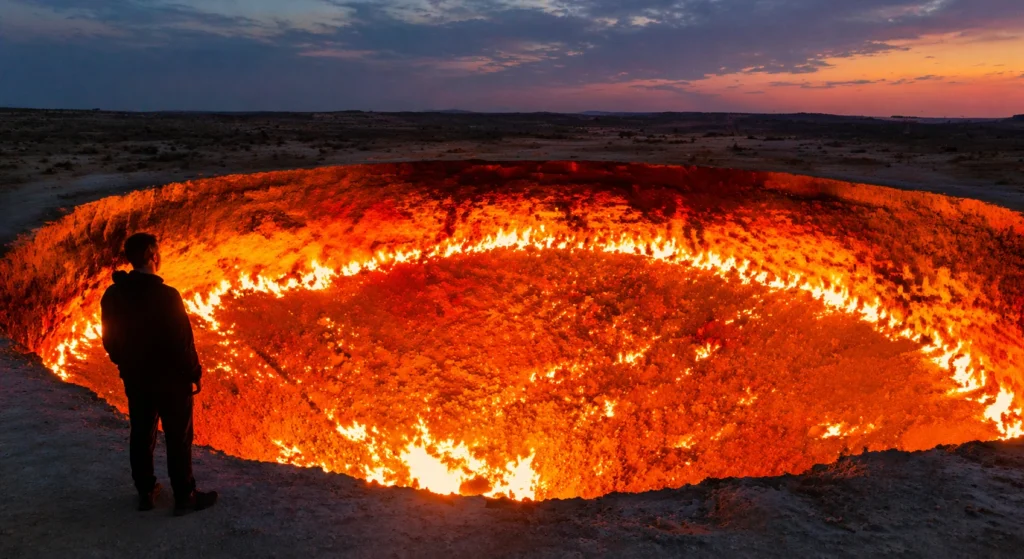
A massive hole in the earth. Two hundred and thirty feet wide. Sixty-five feet deep. And every inch of it is on fire. Flames leap into the night sky. The heat hits your face like a physical wall. The air shimmers and dances. You cannot look away.
This is not a movie. This is not a dream. This is the Darvaza Gas Crater. And for more than fifty years, it has been known by a much simpler name: The Door to Hell.
H2: 1. The Land Before the Fire – Life in the Karakum Desert
Before we talk about the fire, we have to talk about the desert. Because the Door to Hell did not appear in a forest or a city. It appeared in one of the most extreme environments on planet Earth.
The Karakum Desert covers nearly seventy percent of Turkmenistan. That is a country the size of California, but most of it is empty sand. The word “Karakum” comes from Turkic languages. It means “Black Sand.” But the sand is not really black. It is a mix of gray, brown, and golden colors. The name comes from the dark bushes that grow in some areas.
This desert is huge. We are talking about 135,000 square miles. That is bigger than Germany. Bigger than Japan. You could fit the entire country of Italy inside the Karakum Desert and still have room left over.
The climate is brutal. In summer, the temperature regularly hits 120 degrees Fahrenheit. That is hot enough to fry an egg on a rock. Hot enough to melt a crayon. Hot enough that if you touch a metal car door without gloves, you will get a blister. The ground gets so hot that you cannot walk barefoot for more than a few seconds.
Winter is different. Winter nights can drop below freezing. Snow is rare, but it happens. The temperature can swing from 100 degrees during the day to 30 degrees at night. That is a seventy-degree swing. Your body never gets used to it.
Water is almost nonexistent. The Karakum Desert gets less than four inches of rain per year. For comparison, London gets twenty-three inches. New York gets forty-six inches. Four inches is nothing. It is a light sprinkle a few times a year. The rest of the time, the sky is clear and cruel.
Despite this harshness, life finds a way. There are desert bushes called saxaul. They have roots that go down thirty feet to find underground water. There are beetles that roll balls of dung. There are scorpions that hide under rocks during the day and hunt at night. There are sand vipers—snakes that bury themselves so only their eyes show.
And there are people. Not many. But some. The people who live in the Karakum are mostly Turkmen herders. They raise camels, sheep, and goats. They live in yurts—round tents made of felt and wood. They move from place to place, following the tiny patches of grass that grow after rain. They know the desert like you know your own neighborhood. They know where the wells are. Where the shade is. Where the dangerous animals hide.
One of their villages is called Darvaza. It is a small settlement of a few hundred people. The name “Darvaza” means “gate” in the Turkmen language. For centuries, that name meant nothing special. It was just a name. Then, in 1971, it became one of the most famous names in the world.
H2: 2. The Soviet Union – Giants of the Earth
To understand how the Door to Hell was created, you need to understand the Soviet Union. The Soviet Union was a giant country that existed from 1922 to 1991. At its peak, it covered one-sixth of the land on Earth. It stretched from the Baltic Sea in the west to the Pacific Ocean in the east. It included Russia, Ukraine, Kazakhstan, and many other states—including Turkmenistan.
The Soviets were obsessed with two things: power and resources. They wanted to be stronger than the United States. They wanted to be richer than Europe. And to do that, they needed oil and natural gas.
Oil and gas were the blood of the modern world. Without them, you cannot run tanks, airplanes, factories, or power plants. The Soviets had plenty of oil in Siberia. But they wanted more. They sent geologists all over their empire to look for new deposits.
In the 1960s, Soviet geologists started paying attention to Turkmenistan. They knew that the Karakum Desert sat on top of ancient seabeds. Millions of years ago, that area was underwater. Tiny sea creatures died, fell to the bottom, and were buried by sand and mud. Over time, heat and pressure turned those remains into oil and natural gas.
The Soviets drilled their first successful gas wells in Turkmenistan in the 1950s. By the 1960s, they had dozens of wells. They built pipelines. They built towns for the workers. They were convinced that Turkmenistan could become one of their main gas suppliers.
The geologists were excited. The engineers were ready. The politicians were demanding results. So in 1971, a team of Soviet engineers packed their equipment and headed to a spot near the village of Darvaza. They had good reason to believe that a massive pocket of natural gas lay beneath the sand.
They set up their drilling rig. They started to drill. At first, everything went according to plan.
Then the ground opened up.
H2: 3. The Day the Earth Collapsed – A Firsthand Account
Let us imagine what that day in 1971 looked like. We do not have a video recording. We do not have a written diary from the engineers. But we have reports, interviews, and the memories of local people who saw it happen.
It was a normal morning. The sun was already hot. The engineers were drinking tea and eating bread. The drilling rig was a tall metal tower. It made a constant pounding sound as it drilled deeper and deeper into the earth.
The crew boss was a man named something like Ivan or Vladimir. We do not know his real name. He was probably in his forties. Tough. Experienced. He had drilled wells in Siberia, in Kazakhstan, in the frozen tundra. He thought he had seen everything.
He was wrong.
Around midday, the drill bit hit something unexpected. The ground started to vibrate. The drilling tower wobbled. The workers looked at each other. Then they heard a sound like thunder—but coming from below, not above.
The ground began to crack. Long, jagged cracks spread out from the drilling rig like spiderwebs. Sand and rock fell into the cracks. The drilling rig leaned to one side. The crew boss yelled, “Everybody out! Now!”
The workers ran. They did not grab their tools. They did not grab their coats. They just ran. Behind them, the ground collapsed. Not slowly. Not gently. It fell like a trapdoor opening.
The drilling rig disappeared into the earth. The sound was enormous. A deep, rumbling crash that lasted for several seconds. When it stopped, the workers turned around. They could not believe what they saw.
Where there had been flat desert, there was now a massive hole. The hole was almost two hundred feet wide. It was so deep that you could not see the bottom clearly. Dust and sand were still falling from the edges. The air smelled strange—like rotten eggs and metal.
The crew boss counted his men. Everyone was alive. They had lost the drilling rig, the pipes, the pumps, and a full day of work. But no one was dead. That was the good news.
The bad news came a few minutes later. One of the workers lit a cigarette. A small flame from his lighter created a tiny pop. Then another worker noticed something terrifying. His gas detector—a simple handheld device—was going crazy.
Methane. The hole was filling with methane gas. It was leaking from the broken gas pocket below. Methane is odorless, but the gas in that area had trace amounts of sulfur compounds. That was the rotten egg smell. And methane is extremely flammable.
The crew boss knew he had a disaster on his hands. If that methane cloud spread, it could suffocate animals for miles. If it found a spark—a car engine, a lightning strike, a campfire—it could explode with the force of a bomb.
He radioed his headquarters. He explained the situation. He asked for instructions.
The answer came back: “Burn it.”
H2: 4. Lighting the Match – The Decision That Changed Everything
The decision to burn the gas seemed logical. It seemed smart. It seemed like the kind of quick thinking that Soviet engineers were famous for.
Here is how they saw the problem. A massive amount of natural gas was leaking out of a hole in the ground. There was no way to stop the leak. The hole was too big. The ground was too unstable. If they tried to cover it with dirt, the gas would just push through. If they tried to pump cement into it, the cement would crack.
So, they thought, why not burn it? Natural gas burns cleanly. It turns into carbon dioxide and water vapor. Carbon dioxide is not flammable. Water vapor is harmless. If they set the gas on fire, it would burn itself out in a few days. The hole would be safe. The gas would be gone. Problem solved.
The engineers set up a flare. A flare is a device that creates a controlled flame. They aimed it at the crater. They lit it.
The result was beyond anything they expected.
The gas ignited with a roar that could be heard for miles. A column of fire shot two hundred feet into the air. The heat was so intense that the engineers had to run backward. Their eyebrows were singed. Their skin felt sunburned in seconds.
For a moment, they were afraid. Then they laughed. They patted each other on the back. They had done it. They had solved the problem. Now all they had to do was wait a few days for the fire to burn out.
They packed up their remaining equipment. They drove back to their base. They filed a report saying that the gas leak had been neutralized. Then they moved on to their next drilling project.
Days passed. The fire did not go out.
Weeks passed. The fire roared on.
Months passed. The fire was still there.
The engineers had made a critical mistake. They thought the gas pocket was a small bubble. In reality, it was a massive underground reservoir connected to a much larger gas field. Every time the fire burned the gas at the top, more gas rose from below. It was like trying to empty the ocean with a bucket.
The fire was not a temporary solution. It was a permanent fixture.
And the locals had a new name for it: “The Door to Hell.”
H2: 5. The First Visitors – How Locals Reacted to the Burning Pit
Imagine you are a herder living near Darvaza in 1971. You have lived in the desert your whole life. You know every dune, every well, every rock. You have seen sandstorms that turn day into night. You have seen flash floods that carve new rivers in an hour. You think you have seen it all.
Then one day, you see a giant pillar of fire on the horizon.
At first, you might think it is a volcano. But there are no volcanoes in the Karakum. You might think it is a plane crash. But there is no smoke, only flame. You might think it is the end of the world.
You gather your family. You load your camels. You walk toward the fire. It takes you half a day to get there. And when you arrive, you cannot believe your eyes.
A hole in the earth. Full of fire. No one tending it. No one controlling it. Just fire. Burning on its own. Day and night.
The older people in the village might have remembered old stories. Stories about a “gate to the underworld” somewhere in the desert. Stories passed down from grandparents to grandchildren for generations. They had always thought those stories were just fairy tales. Now, they were not so sure.
The younger people were more practical. They saw the fire as a danger. They kept their children away from it. They warned travelers to avoid the area. They worried that the fire might spread underground and set the whole desert on fire.
But as weeks turned into months, and months turned into years, the fire became normal. It was just there. Like a mountain or a river. You did not think about it every day. You just accepted it.
At night, the sky above Darvaza glowed orange. You could see the glow from miles away. It was like a second moon. Some people found it comforting. It was a light in the darkness. A sign that the earth was still alive.
Others found it terrifying. They had nightmares about falling into the fire. They moved their camps farther away. They told their children never to go near the crater.
But no one tried to put out the fire. No one had the tools. No one had the knowledge. And honestly, no one wanted to get close enough to try.
The fire was there to stay. And the Door to Hell was open.
H2: 6. The Science of Fire – Why Methane Burns and Never Stops
Let us take a break from the story and talk about science. Do not worry. This will not be boring. Science is just the story of how things work. And the story of how the Door to Hell works is fascinating.
Methane is the main ingredient in natural gas. Its chemical name is CH4. That means one carbon atom with four hydrogen atoms attached. Methane is the simplest hydrocarbon. A hydrocarbon is just a fancy word for a molecule made of hydrogen and carbon.
Methane is lighter than air. That is why it rises. When it leaks from the ground, it floats upward. If there is no spark, it just mixes with the air and drifts away. But if there is a spark, the methane molecules break apart. They combine with oxygen from the air. This reaction releases energy in the form of heat and light. That is fire.
The chemical equation looks like this: CH4 + 2 O2 → CO2 + 2 H2O + heat. That is methane plus oxygen makes carbon dioxide, water, and heat. Simple.
But here is the key. For fire to keep burning, you need three things: fuel, oxygen, and heat. Take away any one of those, and the fire goes out. That is how firefighters work. They spray water to remove heat. They spray foam to block oxygen. They clear away trees and bushes to remove fuel.
At the Darvaza crater, all three things are present in abundance. The fuel is the methane rising from the underground gas field. The oxygen is the air all around. The heat comes from the fire itself. Once the fire started, it created its own endless loop. The heat keeps the methane burning. The burning methane creates more heat. The heat draws more methane. And on and on.
The underground gas field is enormous. Geologists estimate that it contains billions of cubic feet of natural gas. That is enough to heat every home in a small country for decades. The crater is just a tiny leak in that huge reservoir. Think of it like a pinhole in a water balloon. The water does not stop coming out just because you have a small hole. It keeps coming until the balloon is empty.
The same is true for the crater. The fire will keep burning until the gas field runs dry. And no one knows when that will happen. It could be fifty years. It could be one hundred years. It could be two hundred years.
Some scientists think the fire might even burn for a thousand years if the gas field is deep enough. That is longer than the United States has existed. Longer than the printing press has existed. Longer than most castles in Europe have been standing.
That is why the Door to Hell is so amazing. It is not just a fire. It is a fire that spans generations. The people who lit it are dead now. The country they worked for is gone. But the fire they started is still roaring. It is a reminder that human actions can have consequences that last far beyond our own lives.
H2: 7. A Tour of the Crater – What You See, Hear, and Feel
Now let us take a virtual tour. Close your eyes for a moment and imagine you are there. Actually, keep your eyes open to read. But use your imagination.
You arrive at the crater just before sunset. The sky is painted in shades of orange, pink, and purple. The desert stretches in every direction. There are no trees. No buildings. No signs of civilization except your car and the crater itself.
You park your car about one hundred yards from the edge. Your guide tells you to stay back. The ground near the crater is unstable. You walk slowly. The sand crunches under your boots.
As you get closer, you notice the sound first. A low, constant rumble. It sounds like a waterfall mixed with a freight train. The sound gets louder with every step. Soon, you can feel it in your chest. It vibrates through your bones.
Then you feel the heat. At fifty yards, it is like standing near a campfire. At twenty yards, it is like opening an oven door. At ten yards, you have to squint. The heat dries out your eyes. Your skin feels tight. Your lips feel cracked.
You reach the edge. You look down.
The crater is a perfect circle. Almost too perfect. It looks like someone took a giant cookie cutter and punched a hole in the earth. The walls are steep. They are made of sand, clay, and rock. They are cracked and crumbly. Small chunks fall off occasionally and tumble into the fire below.
The bottom of the crater is about sixty-five feet down. That is as tall as a six-story building. But you cannot see the bottom clearly because of the flames. Dozens of small fires burn all over the floor. But in the center, there are three or four main vents. These vents are like blowtorches. They shoot flames twenty or thirty feet into the air.
The flames are not all the same color. Near the edges, they are orange and yellow. Near the center, where the gas is hottest, they burn blue and white. Blue flames are hotter than orange flames. The center of the crater is over one thousand degrees Fahrenheit. That is hot enough to melt aluminum. Hot enough to turn sand into glass.
You see smoke rising from the crater. But it is not thick, black smoke like from a tire fire. It is thin and gray. It rises in twisting columns. Then the wind catches it and blows it away.
You notice something strange. There are no bugs. No flies. No mosquitoes. The heat and gas keep them away. The only living things you see are a few desert bushes growing about fifty yards back. They are tough, scraggly plants. They look like they are holding on by sheer stubbornness.
You take a picture. Your phone feels hot in your hand. You put it away quickly. You do not want it to melt.
Your guide tells you to step back. The edge is crumbling. You take three steps back. The heat drops noticeably. You can breathe easier.
You stay for an hour. You watch the fire dance. It never changes. It never stops. It is hypnotic. You could watch it forever. But eventually, the cold desert night sets in. You go back to your tent. You try to sleep. But the roar of the fire follows you into your dreams.
H2: 8. Night at the Crater – Sleeping Next to Hell
Most tourists do not just visit the Darvaza crater for a few hours. They camp overnight. And camping next to the Door to Hell is an experience you will never forget.
Your tour company sets up camp about half a mile away from the crater. That is far enough to be safe, but close enough to see the glow. The camp usually consists of a few large tents or traditional yurts. A yurt is a round tent made of a wooden frame covered with felt. The felt is made from sheep’s wool. It keeps the yurt warm in winter and cool in summer.
The camp has a cooking area. Your guide prepares dinner over a propane stove. Do not worry—the propane stove is far from the crater. No one wants an accidental explosion. Dinner is usually simple: rice, vegetables, bread, and tea. Sometimes there is meat if you are lucky.
After dinner, you sit around a campfire. Yes, a campfire next to a giant hole of fire. It feels a little silly. But the campfire is for cooking and warmth. The crater is too hot to get close to for more than a few minutes.
Your guide tells stories. Some are true. Some are exaggerated. Some are completely made up to scare the tourists. He tells you about the Soviet engineers. He tells you about the legends of the underworld. He tells you about the time a tourist got too close and his shoes started to melt.
Then he tells you to go to sleep. Tomorrow will be a long drive back to Ashgabat.
You crawl into your sleeping bag. The tent is dark. But not completely dark. The glow from the crater filters through the fabric. It casts orange shadows on the walls. You hear the roar of the fire. It is a constant, low sound. At first, it keeps you awake. But after a while, it becomes like white noise. Your eyes get heavy. You drift off.
In the middle of the night, you wake up. You have to use the bathroom. You unzip your tent and step outside.
The desert is freezing cold. Your breath turns to steam. The stars are so bright and so many that you feel like you could reach up and grab them. And there, on the horizon, is the crater. It looks like a giant eye staring at the sky. The flames are brighter than ever. The roar is louder than ever.
For a moment, you feel a chill that has nothing to do with the cold. You are standing in the dark, alone, next to a hole in the earth that has been on fire for fifty years. It feels ancient. It feels powerful. It feels like something humans were never meant to see.
You go back to your tent. You zip it up. You listen to the fire and the silence. And eventually, you fall back asleep.
In the morning, the crater looks different. The sunlight washes out the flames. They are still there, but they look smaller. Less threatening. You eat breakfast. You pack up. You drive away. The glow in your rearview mirror gets smaller and smaller until it disappears.
But you never forget it. Not really. The Door to Hell stays with you. It becomes a part of your memory. And years later, when someone asks you about the most amazing thing you have ever seen, you will tell them about the fire in the desert that never goes out.
H2: 9. The Dangers – Why You Must Respect the Door
We have talked about the beauty of the Darvaza crater. Now we must talk about the danger. Because make no mistake—this place can kill you. It has not killed anyone yet, as far as official records show. But that does not mean it is safe.
Let us list the dangers one by one.
Danger #1: The Heat. The crater is over one thousand degrees Fahrenheit at its center. That is hot enough to melt some types of metal. The heat radiates outward. Within ten feet of the edge, the temperature can be over two hundred degrees. That is hot enough to give you second-degree burns in seconds. If you fell into the crater, you would be dead before you hit the bottom. Your lungs would cook. Your skin would char. Your clothes would ignite. There would be no rescue. There would be no body to bury.
Danger #2: The Toxic Gases. Methane itself is not poisonous. But it can kill you by replacing oxygen. If you stand in a low spot where methane has pooled, you might not get enough oxygen to breathe. You would feel dizzy, then confused, then unconscious, then dead. And you would not even smell the methane because it has no odor. The sulfur smell you sometimes notice is from other gases. Those gases can also be toxic in high amounts. Headaches, nausea, and shortness of breath are common if you stay too long.
Danger #3: The Unstable Ground. The crater was created by a collapse. The ground around the edge is not solid rock. It is sand and clay that have been baked hard by the heat. But baking makes things brittle. The edge is cracked and crumbly. Every year, small chunks fall into the fire. If you stand too close, you might be standing on a chunk that is about to fall. One crack. One shift. And you are gone. There are no fences. No warning signs. Just you and your common sense.
Danger #4: The Smoke. The smoke from the crater contains carbon monoxide. Carbon monoxide is a poisonous gas. It binds to your blood and prevents it from carrying oxygen. You cannot see it. You cannot smell it. You only know you have been poisoned when you start to feel sick. Headache, dizziness, weakness, nausea. If you breathe too much, you will pass out. And if you pass out near the crater, you will roll into the fire.
Danger #5: The Wildlife. The heat keeps most animals away. But not all. Scorpions live in the desert. They hide under rocks and in cracks. If you sit on a rock that has a scorpion under it, you might get stung. The sting is painful but rarely deadly. Snakes also live in the area. Sand vipers are venomous. They are shy and will not attack you unless you step on them. So watch where you step. And check your boots before putting them on in the morning.
Danger #6: Dehydration. The desert is dry. The crater adds even more heat. You will sweat without realizing it. Your body will lose water quickly. If you do not drink enough, you will get dehydrated. Dehydration causes headache, fatigue, confusion, and eventually organ failure. You should drink at least one gallon of water per person per day. More if you are active. And no, soda and tea do not count. Drink water.
Danger #7: Getting Lost. The Karakum Desert is vast and featureless. There are no road signs. No gas stations. No cell phone towers. If you leave your car and wander away from the crater, you could easily get lost. The desert all looks the same. Sand, sand, more sand. Without a compass or GPS, you might walk in circles until you collapse from heat and thirst. Always stay with your group. Always stay near your vehicle.
Danger #8: The Government. This is a different kind of danger. Turkmenistan is not a democracy. It is a dictatorship. The government controls everything. Tourists must have a guide. You cannot wander freely. You cannot take pictures of military buildings or government offices. You cannot say bad things about the president. If you break the rules, you could be arrested, fined, or deported. Some tourists have been detained for taking photos of the wrong things. Be respectful. Be quiet. Follow the rules.
Despite all these dangers, thousands of people have visited the Darvaza crater and returned home safely. The key is respect. Respect the fire. Respect the desert. Respect the rules. And you will be fine.
H2: 10. How to Get There – A Practical Travel Guide
You have read this far. That means you are seriously thinking about visiting the Door to Hell. Good. Let us talk about the practical details. This is not a trip you can book on Expedia. It takes planning, money, and patience.
Step 1: Get a Visa. Turkmenistan requires most visitors to have a visa. The visa process is complicated. You cannot just show up at the airport and ask for one. You must apply in advance. You need an invitation letter from a licensed travel agency in Turkmenistan. That agency will sponsor your trip. The visa fee is around fifty to one hundred dollars. Processing takes two to four weeks. Some nationalities can get a transit visa for five days if they are passing through to another country. But a tourist visa is easier.
Step 2: Book a Tour. You cannot visit the Darvaza crater on your own. The government requires foreign tourists to be accompanied by a registered guide. You can book a tour online. Many companies offer two-day, three-day, or five-day trips. A typical two-day trip from Ashgabat to Darvaza and back costs around two hundred to four hundred dollars per person. That includes transportation, guide, meals, and camping equipment. It does not include your international flights or hotel in Ashgabat.
Step 3: Fly to Ashgabat. The capital city of Turkmenistan is Ashgabat. The airport code is ASB. There are flights from Istanbul, Moscow, Dubai, and a few other cities. There are no direct flights from the United States. You will have to connect somewhere. Plan on spending at least one night in Ashgabat before your desert trip. Ashgabat is a strange and beautiful city. It is full of white marble buildings. The streets are clean and empty. The government does not allow homeless people or beggars. It feels like a movie set more than a real city.
Step 4: Prepare Your Gear. Your tour company will provide tents, sleeping bags, and food. But you should bring your own supplies. Here is a checklist:
- A hat with a wide brim.
- Sunglasses with UV protection.
- Sunscreen with SPF 50 or higher.
- Lip balm with sunscreen.
- A scarf or face mask for dust.
- A warm jacket for cold desert nights.
- Long pants and long sleeves to protect from sun and bugs.
- Sturdy boots with good grip.
- At least two liters of water in reusable bottles.
- Snacks like nuts, dried fruit, and energy bars.
- A flashlight or headlamp.
- A power bank for your phone.
- Cash in US dollars or Turkmen manat. There are no ATMs near the crater.
- A camera with a good lens. But be careful—heat can damage electronics.
Step 5: The Drive. From Ashgabat, you drive north. The road is paved for the first two hours. Then it turns to gravel. Then it turns to sand. The last hour is off-road. You will bounce around in the back of a 4×4 vehicle. It is uncomfortable but fun. The drive takes four to five hours each way. Bring music or a book. There is nothing to see except sand.
Step 6: Arrival. You will reach the crater in the late afternoon. Your guide will set up camp. You will have dinner. Then you will walk to the crater. You will spend several hours there. Then you will sleep. In the morning, you will have breakfast. Then you will drive back to Ashgabat.
Step 7: Go Home. After your trip, you will probably fly out of Ashgabat. Do not forget to get your exit stamp at the airport. The government tracks everyone who enters and leaves. If you overstay your visa, you will be fined and banned from returning.
That is it. That is how you visit the Door to Hell. It is not easy. It is not cheap. But it is worth it. Because how many people can say they have stood at the edge of Hell and looked inside?
H2: 11. The Best Time to Visit – Seasons and Weather
Timing matters. The Karakum Desert is not kind to visitors. You need to choose your travel dates carefully.
Summer (June to August). Do not go. Seriously. Summer temperatures in the Karakum regularly exceed 110 degrees Fahrenheit. On some days, they hit 120 or higher. The ground becomes an oven. The air feels like a hair dryer blowing in your face. The crater adds even more heat. Standing near the crater in summer is dangerous. You will sweat out all your water in minutes. You will get dizzy. You might pass out. Even the tour companies stop operating in summer. It is just too hot.
Winter (December to February). Winter is cold. Daytime temperatures are around 40 to 50 degrees Fahrenheit. Nighttime temperatures can drop below freezing. Snow is rare but possible. The crater itself is still hot, so you will have a weird experience: your front is warm from the fire, your back is cold from the desert wind. Winter is a good time to visit if you do not mind the cold. The skies are clear. The crowds are small. But pack warm clothes. A winter jacket, gloves, and a hat are essential.
Spring (March to May). This is the best time to visit. Spring temperatures are mild. Daytime highs are around 70 to 80 degrees Fahrenheit. Nights are cool but not freezing. The desert blooms with small flowers after the winter rains. The air is clear. The winds are calm. Spring is also the busiest season. You will share the crater with other tourists. But it is worth it for the perfect weather.
Autumn (September to November). Autumn is almost as good as spring. The summer heat has faded. The temperatures are comfortable. The skies are blue. The crowds are smaller than in spring. Autumn is a great time for photography because the light is golden and soft. Just avoid October if you hate wind. October is the windiest month in the Karakum. Strong winds can kick up sand and make viewing difficult.
Special Note: Ramadan. Turkmenistan is a majority Muslim country. During the holy month of Ramadan, many locals fast from sunrise to sunset. This does not affect tourists directly, but some restaurants and shops may have limited hours. Be respectful. Do not eat or drink in public during daylight hours if you are in a city. In the desert, it is fine because there are no locals watching.
Special Note: Holidays. Turkmenistan has several national holidays. The biggest is Independence Day on September 27. There are parades, fireworks, and celebrations. It is a fun time to be in Ashgabat, but some services may be closed. Check the holiday calendar before you book.
In summary: go in spring or autumn. Avoid summer at all costs. Winter is okay if you dress warmly. And always check the weather forecast before you go. The desert is unpredictable.
H2: 12. What to Bring – The Ultimate Packing List
You do not want to be the person who forgets something important. Use this packing list. Check it twice.
Clothing:
- Lightweight, long-sleeved shirts. Cotton or linen. Light colors.
- Long pants. Not shorts. The sun will burn your legs.
- A wide-brimmed hat. Baseball caps do not protect your ears or neck.
- A warm jacket or fleece for cold nights.
- A scarf or shemagh for dust and sun.
- Sturdy hiking boots with ankle support.
- Wool socks. Not cotton. Cotton stays wet and causes blisters.
- A change of clothes for the second day.
- Swimsuit? No. There is no water. Leave it at home.
Sun Protection:
- Sunscreen. SPF 50 or higher. Water resistant.
- Lip balm with SPF.
- Sunglasses with UV protection. Wraparound style is best.
- A bandana or neck gaiter.
Health and Safety:
- First aid kit with bandages, antiseptic, and pain relievers.
- Anti-diarrhea medication. Traveler’s stomach is common.
- Rehydration salts or electrolyte tablets.
- Insect repellent. There are not many bugs, but the ones that exist are annoying.
- Hand sanitizer.
- Toilet paper and wet wipes. There are no bathrooms.
- Prescription medications. Bring enough for your whole trip plus a few extra days.
- A copy of your passport and visa. Keep the originals in a safe place.
Gear:
- Headlamp or flashlight with extra batteries.
- Power bank for your phone and camera.
- Camera. A DSLR or mirrorless camera will take better photos than a phone. But a modern phone camera is fine.
- Tripod for night photos. You will want long exposures to capture the flames and stars.
- Binoculars. Not necessary, but fun for looking at the crater details.
- A small backpack for carrying your water and snacks.
Food and Water:
- At least two liters of water per person. Your tour company will provide more, but bring your own for the drive.
- Energy bars, nuts, dried fruit, or trail mix.
- Instant coffee or tea bags if you are picky about your morning drink.
- A reusable water bottle. Do not buy plastic bottles. They create trash in the desert.
Miscellaneous:
- Cash. US dollars are accepted in many places. Turkmen manat is better for small purchases.
- A pen and small notebook for taking notes.
- A deck of cards or a book for the long drive.
- A garbage bag. Pack out everything you pack in. Leave no trace.
- A positive attitude. The desert is harsh. Things will go wrong. Laugh about it.
Do not bring:
- Drones. They are illegal without special permission. Also, the heat can melt them.
- Fireworks. Are you crazy?
- Alcohol. It dehydrates you. Save the celebration for after the trip.
- Valuables. Leave your expensive jewelry and watches at home.
- Expectations of luxury. You are camping in a desert. There is no Wi-Fi. There is no shower. Embrace the dirt.
H2: 13. The Legend of the Door – Local Myths and Stories
We have talked about science and history. Now let us talk about magic. Because every great place has stories that cannot be explained by facts alone. The Door to Hell is no different.
The older people in Darvaza village tell a story. They say that long before the Soviets came, long before the drilling rig, long before anyone wrote anything down, there was a gate. A gate in the middle of the desert. A gate that led to the underworld.
No one knows who built the gate. Some say it was built by demons. Some say it was built by an ancient king who made a deal with the devil. Some say it was always there, as old as the earth itself.
The gate was not a physical door, the story goes. It was a place where the ground was thin. Where you could hear whispers if you pressed your ear to the sand. Where animals refused to go. Where the air smelled of sulfur and ash.
The local people avoided the place. They told their children to stay away. They told their children to tell their children. The gate was cursed. The gate was evil. The gate was not for the living.
Then the Soviets came. They did not believe in curses. They did not believe in gates to the underworld. They believed in drills and pipes and gas. They drilled right into the cursed place. And the ground opened up.
But here is the twist in the story. Some of the old people say the fire is not an accident. It is a seal. A lock. A barrier. The fire is the only thing keeping the evil inside. If the fire goes out, the gate will open. And whatever is on the other side will come through.
Is it true? Probably not. Stories like this exist all over the world. Every culture has its version of a haunted place. But standing at the edge of the crater at midnight, listening to the roar, feeling the heat on your face… you might understand why the story survived for so long.
Other stories are less dramatic but more believable. Some tourists claim they have seen strange lights floating above the crater. Others say their cameras malfunctioned for no reason. A few have reported hearing voices in the roar of the fire. Psychologists would say these are hallucinations caused by dehydration and exhaustion. But the people who experienced them do not care what psychologists say. They know what they saw. Or what they think they saw.
There is also a modern legend about a man who tried to climb into the crater. According to the story, he was a scientist. He wanted to take a soil sample from the bottom. He wore a heat-resistant suit. He rappelled down on a rope. He got about halfway. Then his rope caught fire. He fell. His body was never recovered. Is this story true? No one knows. There is no official record. But every guide tells a version of it to scare careless tourists.
Whether you believe the legends or not, one thing is certain. The Darvaza crater feels magical. It feels like a place where the normal rules do not apply. And that feeling is real, even if the magic is not.
H2: 14. The President vs. The Fire – Will They Extinguish Hell?
For fifty years, no one in power cared about the Darvaza crater. It was just a weird thing in the desert. A curiosity. A tourist attraction. But then, in 2019, the President of Turkmenistan visited the crater. And everything changed.
The president’s name is Gurbanguly Berdimuhamedow. He is a former dentist. He has been the leader of Turkmenistan since 2006. He is known for his strange hobbies: he races horses, writes songs, and once drove a race car around the streets of Ashgabat. He also has a gold statue of himself that rotates to always face the sun.
In 2019, the president flew to Darvaza by helicopter. He stood at the edge of the crater. He looked at the flames. And he did not look happy.
He saw the fire as a waste. A waste of natural gas. A waste of money. A waste of a resource that could be sold to other countries. Turkmenistan has the fourth-largest natural gas reserves in the world. But the country is poor. The government wants to sell every cubic foot of gas it can. And here was a crater burning through millions of dollars’ worth of gas every year.
The president gave an order. He told his scientists and engineers to find a way to put out the fire. He gave them a deadline. He wanted the Door to Hell closed.
In January 2022, the president announced a plan. The plan had three steps. First, drill a new well near the crater. Second, suck the gas out of the ground before it reaches the crater. Third, let the fire die on its own. Simple, right?
Not exactly.
Putting out a gas crater fire is not like putting out a campfire. You cannot just pour water on it. Water would turn to steam instantly. You cannot cover it with dirt. The gas would push through. You cannot use explosives. That would make the crater bigger.
The president’s plan relies on reducing the gas pressure underground. If they can drill a new well and release the gas in a controlled way, the crater will get less fuel. The flames will shrink. Eventually, they will go out. Then the engineers can seal the crater with concrete or clay.
But there are problems. First, drilling near the crater is dangerous. The ground is unstable. A mistake could create a second crater. Second, the gas field is huge. One new well might not make a difference. They might need ten or twenty wells. Third, the fire has been burning for so long that the ground around the crater has changed. The heat has baked the sand into a hard crust. Drilling through that crust is difficult.
As of 2026, the crater is still burning. The president’s plan has not been carried out. There are rumors that the government has given up. There are other rumors that they are waiting for better technology. No one knows for sure.
Some people want the fire to stay. They say it is a natural wonder. A tourist attraction. A symbol of Turkmenistan. Putting it out would be like putting out the Statue of Liberty’s torch.
Other people want the fire gone. They say it is an environmental disaster. A waste of resources. A danger to local people. The sooner it is extinguished, the better.
The debate continues. But for now, the Door to Hell remains open. And the president’s plan remains just a plan.
H2: 15. Other Burning Pits – Hellish Places Around the World
The Darvaza crater is the most famous burning pit in the world. But it is not the only one. Let us take a quick tour of other “hellish” places on Earth.
Centralia, Pennsylvania, USA. In 1962, a fire started in the coal mines beneath the town of Centralia. The fire is still burning today. It has been burning for over sixty years. The ground is hot. Steam rises from cracks in the pavement. Trees have died from the heat. The town was abandoned. Only a few residents remain. The fire is estimated to burn for another two hundred years. There are no flames visible on the surface, but the underground fire is just as real as Darvaza.
The Eternal Flame Falls, New York, USA. This is a much smaller and friendlier version of Darvaza. Behind a waterfall in Chestnut Ridge Park, there is a small natural gas leak. The gas burns with a flame about six inches high. The flame is behind the waterfall, so the water does not put it out. Locals call it the “Eternal Flame.” It has been burning for decades. You can walk right up to it and roast a marshmallow. Do not try that at Darvaza.
Burning Mountain, New South Wales, Australia. This is the oldest known burning pit. A coal seam beneath the mountain has been on fire for approximately six thousand years. Yes, six thousand. That is older than the pyramids. Older than writing. Older than most human civilizations. The fire burns deep underground. You cannot see flames, but you can see smoke rising from cracks in the rock. The ground is hot to the touch. Scientists say the fire will keep burning for thousands more years.
Yanar Dag, Azerbaijan. This is a burning mountain on the Absheron Peninsula. Natural gas seeps from the ground and burns continuously. The flames are about ten feet long. They have been burning for thousands of years. In ancient times, this was a center of Zoroastrianism, a religion that worshipped fire. Today, it is a tourist attraction. Unlike Darvaza, Yanar Dag is safe and easy to visit. There are stairs, railings, and a parking lot.
The Gates of Hell, Iceland. Iceland has active volcanoes and geothermal areas. In the 1700s, a massive eruption created a lava field called Eldhraun. The eruption killed thousands of people and destroyed many farms. Locals called the area “Hell” (Hel in Old Norse). Today, there are no continuous flames, but the ground steams and bubbles with hot water. It is not a single burning pit like Darvaza, but it is still hellish.
Why is Darvaza the most famous? Because it is the most dramatic. Centralia is hidden underground. The Eternal Flame Falls is tiny. Burning Mountain is invisible. Yanar Dag is safe and tame. Darvaza is a roaring, open, visible pit of fire that you can walk up to. It is dangerous. It is beautiful. It is terrifying. That is why people call it the Door to Hell.
H2: 16. Environmental Impact – Is the Crater a Disaster?
We love looking at the fire. But we have to ask: Is it hurting the planet? The answer is yes. But the scale might surprise you.
Every day, the Darvaza crater burns approximately 1.5 million cubic feet of natural gas. That is a lot. That is enough gas to heat fifteen thousand homes for a day. But compared to the rest of the world, it is a tiny amount.
The United States alone burns about 27 billion cubic feet of natural gas per day. That is eighteen thousand times more than the crater. So the crater is like a single leaky faucet compared to a thousand fire hoses.
That does not mean the crater is harmless. The methane that burns becomes carbon dioxide. Carbon dioxide is a greenhouse gas. It traps heat in the atmosphere. It contributes to climate change. The crater releases about 30,000 tons of carbon dioxide per year. That is the same as six thousand cars.
Is that bad? Yes. But again, the world releases about 37 billion tons of carbon dioxide per year. The crater is a tiny fraction of that. Putting it out would make a difference, but it would not save the planet by itself.
There are other environmental concerns. The fire releases small amounts of nitrogen oxides and sulfur dioxide. These gases can cause acid rain. But the Karakum Desert is so dry that acid rain almost never falls. The gases just drift away and dilute in the atmosphere.
The heat from the crater affects the local area. The ground within a few hundred feet is baked dry. Plants cannot grow close to the crater. But the desert was already dry and barren. The crater did not destroy a rainforest. It destroyed a patch of sand.
Some scientists worry about groundwater. If there is fresh water underground near the crater, the heat could evaporate it or contaminate it. But no one has found fresh water in that area. The Karakum is one of the driest places on Earth. Groundwater, if it exists, is too deep to be affected.
The biggest environmental impact is not pollution. It is waste. The gas that burns at Darvaza could have been used to generate electricity, heat homes, or power factories. Instead, it is just making pretty flames. The lost economic value is estimated at millions of dollars per year. For a poor country like Turkmenistan, that money could have built schools, hospitals, and roads.
So is the crater an environmental disaster? Not really. It is more of an economic disaster. A small, slow, burning waste of money. But for tourists, that waste is beautiful.
H2: 17. The Future – What Will Happen in the Next 50 Years?
Let us look ahead. You are reading this in 2026. The fire is fifty-five years old. What will happen by 2076? Let us imagine three possible futures.
Future 1: The Fire Burns Out Naturally. One day, the pressure in the underground gas field drops. The flames get smaller. The roar becomes a whisper. The glow fades. Finally, after decades of burning, the fire dies. The crater becomes a hot, smoky hole in the ground. Tourists stop coming. The village of Darvaza goes back to its quiet life. The crater is forgotten. The desert reclaims it.
Is this likely? It depends on the size of the gas field. If the field is small, the fire could die in twenty or thirty years. If the field is large, it could burn for two hundred years. Most geologists believe the field is large. They think the fire will burn for at least another fifty years. So Future 1 is possible but not certain.
Future 2: Humans Extinguish the Fire. The president’s plan works. Engineers drill relief wells. They redirect the gas away from the crater. The fire starves and dies. Then they seal the crater with concrete and clay. The Door to Hell becomes a smooth, flat patch of desert. A small monument is built. A plaque explains what happened. Tourists still come, but they see a memorial instead of a fire. Is this likely? It depends on money and politics. Extinguishing the crater would cost millions of dollars. The president might decide the money is better spent elsewhere. Or he might decide to do it for national pride. Future 2 is possible but not guaranteed.
Future 3: The Fire Burns Forever. The gas field is deeper and larger than anyone imagined. The fire keeps burning for centuries. Future generations build a glass dome over the crater. They install walkways and railings. They charge admission. Robots fly inside to take samples. The Door to Hell becomes a permanent landmark of Earth, like the Grand Canyon or Mount Everest. People from all over the solar system come to see it. Is this likely? It sounds like science fiction. But so did a fifty-year fire in the desert in 1971. Never say never.
Which future will happen? No one knows. That is the exciting part. The Door to Hell is not finished with its story. The next chapters are being written right now. And you are alive to read them.
H2: 18. Why We Are Drawn to Fire – The Psychology of the Crater
There is something about fire that pulls us in. Humans have been staring into flames for hundreds of thousands of years. We cooked our food over fire. We warmed our bodies by fire. We told stories around fire. Fire is in our bones.
The Darvaza crater is fire on a scale that is hard to understand. It is not a campfire. It is not a fireplace. It is not a burning building. It is a hole in the earth that has been on fire for longer than most people have been alive. It is primal. It is ancient. It is terrifying.
Psychologists say that humans are drawn to danger when it is controlled. We like roller coasters because they scare us but do not hurt us. We like horror movies because they make us jump but then we laugh. The Darvaza crater is the same. It is dangerous, but we can stand at the edge and feel safe. That mix of fear and safety is exciting.
There is also a spiritual aspect. Many people who visit the crater describe it as a religious experience. They feel small. They feel humble. They feel connected to something bigger than themselves. The fire is indifferent. It does not care about their hopes or fears. It just burns. And that indifference is powerful.
Some visitors cry. Some laugh. Some just stand in silence. Everyone feels something. The crater does not leave you unchanged.
Maybe that is why the Door to Hell is so famous. It is not just a tourist attraction. It is a mirror. It shows us our own smallness. It reminds us that the earth is old and powerful and will continue long after we are gone. We lit the match. But the fire belongs to the earth now.
H2: 19. Interviews with Travelers – Real Stories from the Edge
Let us hear from people who have actually visited the Darvaza crater. These are real quotes from real travelers. Their names have been changed for privacy.
Sarah, 34, from Canada: “I did not know what to expect. I had seen photos online. But photos do not prepare you for the sound. The sound is huge. It is like standing next to a waterfall made of fire. I could not stop smiling. My face hurt from smiling. My husband thought I was crazy.”
Miguel, 42, from Spain: “The heat was unbelievable. I stood at the edge for maybe two minutes. Then I had to step back. My cheeks were red like I had been sunburned. I drank a whole liter of water in five minutes. But I would do it again. A thousand times again.”
Aisha, 28, from Kenya: “I went alone. I was nervous. The guide was kind. He told me to stay back. I did. But I leaned over as far as I dared. The flames looked like dancers. They moved and twisted. I watched for an hour. I forgot about my phone. I forgot about my job. I just watched. It was meditation.”
David, 55, from Australia: “I have seen a lot of things. I have been to forty countries. I have seen volcanoes and glaciers and rainforests. The Darvaza crater is in my top three. It is not the most beautiful. It is not the most famous. But it is the most strange. It does not belong on Earth. It looks like something from Mars.”
Li, 31, from China: “I was scared. My hands were shaking. I did not want to go close. But my friend pulled me. When I saw the fire, I forgot to be scared. I just felt… peace. That sounds crazy. A hole of fire made me feel peace. But it is true.”
Elena, 47, from Russia: “My grandfather was a Soviet engineer. He worked in Turkmenistan in the 1970s. He never talked about the crater. But after he died, we found a photo in his things. A black and white photo of a small fire in the desert. The photo was labeled ‘Darvaza, 1971.’ I went to see what my grandfather saw. I think I understand now why he never talked about it. Some things are too big for words.”
These stories are just a few of thousands. Every visitor has a different experience. But they all share one thing: the crater changes them. Even a little. Even for a moment. It changes them.
H2: 20. Final Thoughts – What the Door to Hell Teaches Us
We have traveled a long way together in this article. We started with a desert. We met Soviet engineers. We learned about methane and fire. We explored dangers and legends. We imagined the future. Now it is time to end.
What does the Door to Hell teach us?
First, it teaches us humility. Humans are smart. We can build cities and rockets and computers. But we can also make mistakes. A simple drilling error created a fifty-year fire. We cannot always control nature. Sometimes, nature controls us.
Second, it teaches us patience. The Soviet engineers wanted a quick fix. They lit the fire and drove away. They thought the problem would be gone in days. Fifty years later, the problem is still burning. Quick fixes do not always work. Sometimes, the best solution is to wait and watch.
Third, it teaches us wonder. The world is full of amazing things. Some are beautiful. Some are terrifying. Some are both. The Door to Hell is both. It is a reminder that our planet is alive. It breathes. It burns. It changes. We are just guests here.
Fourth, it teaches us responsibility. The fire was an accident. But now it is our problem. We cannot ignore it forever. Someday, someone will have to decide what to do with it. Put it out? Leave it burning? Build a dome around it? That decision will affect future generations. We owe it to them to make a wise choice.
Finally, it teaches us about ourselves. Why do we call it the Door to Hell? Because we are storytellers. We see a fire in the desert and we imagine demons and ghosts. We see a hole in the ground and we imagine a gate to another world. That is what makes us human. We look at a pile of rocks and see a castle. We look at a burning pit and see Hell. The fire is just fire. The meaning is what we bring to it.
So the next time you see a candle or a campfire, think of Darvaza. Think of the engineers who lit a match and ran. Think of the villagers who learned to live with a glow on the horizon. Think of the tourists who travel thousands of miles to feel the heat on their faces. And think of the fire itself—patient, ancient, indifferent. Burning on. Waiting for nothing. Needing nothing.
The Door to Hell is open. It has been open for fifty years. It may stay open for fifty more. Or five hundred. No one knows. But while it burns, we watch. We wonder. We remember.
And that is enough.
Frequently Asked Questions (FAQ) About the Darvaza Gas Crater
Q: Is the Darvaza crater really called “The Door to Hell”?
A: Yes. That is the nickname given by locals and popularized by tourists. In the Turkmen language, “Darvaza” actually means “gate.” So the name fits perfectly.
Q: Can you die from visiting the crater?
A: Yes, if you are careless. The heat, toxic gases, unstable ground, and lack of medical help make it dangerous. However, if you follow your guide’s instructions and stay back from the edge, you will be safe.
Q: Is there any life inside the crater?
A: No. Nothing can survive those temperatures. However, scientists have found heat-resistant bacteria living in the rocks around the rim. These bacteria are similar to ones found near deep-sea volcanic vents.
Q: Has anyone ever fallen into the crater?
A: There are no official records of anyone falling in. However, local guides tell stories of careless tourists and scientists who fell. These stories are likely legends meant to scare people into being careful.
Q: What is the best month to visit?
A: Spring (April–May) and autumn (September–October) are best. Summers are dangerously hot. Winters are cold but bearable.
Q: Is the crater getting bigger?
A: Very slowly. The edges crumble and fall into the fire at a rate of a few inches per year. It will not double in size anytime soon, but it is slowly growing.
Q: Can I fly a drone over the crater?
A: Drones are illegal without special permission from the Turkmen government. Also, the heat can melt plastic parts and damage electronics. Most tour companies will not allow drones.
Q: Does the fire ever go out during rain or sandstorms?
A: No. Rain does not affect it. Sandstorms might reduce visibility, but the flames keep burning. Gas fires are very hard to smother.
Q: How much gas does the crater burn every day?
A: Estimates vary, but most experts agree it is around 1.5 million cubic feet per day. That is enough to heat fifteen thousand homes.
Q: Will the president really extinguish the fire?
A: As of 2026, the fire is still burning. The president’s plan has not been carried out. It is unclear if it ever will be.
Q: Can I visit the crater without a guide?
A: No. The Turkmen government requires foreign tourists to be accompanied by a registered guide. You cannot visit on your own.
Q: Is it safe to take pictures?
A: Yes, but be careful. The heat can damage camera lenses and phone batteries. Do not leave your camera near the edge. Also, do not take pictures of military or government buildings anywhere in Turkmenistan.
Q: What should I do if I feel sick near the crater?
A: Move away from the crater immediately. Go upwind of the smoke. Drink water. Tell your guide. If symptoms persist, the guide will arrange transportation back to Ashgabat.
Q: Are there bathrooms near the crater?
A: No. There is nothing. You will have to go behind a sand dune. Bring toilet paper and hand sanitizer.
Q: Can I bring my children?
A: Most tour companies do not recommend bringing young children. The heat, gas, and unstable ground are too dangerous. Teenagers are fine if they are responsible.
Q: Is the crater visible from space?
A: No. It is too small. Astronauts on the International Space Station cannot see it with the naked eye. However, satellites can photograph it.
Q: How deep is the crater?
A: About 65 feet (20 meters) deep. That is as tall as a six-story building.
Q: How wide is the crater?
A: About 230 feet (70 meters) wide. That is longer than a Boeing 747 airplane.
Q: What is the temperature inside the crater?
A: The center reaches over 1,000 degrees Fahrenheit (540 degrees Celsius). The edges are cooler but still dangerously hot.
Q: Will the crater ever become a UNESCO World Heritage Site?
A: Possibly. Turkmenistan has submitted the crater for consideration. But UNESCO has not made a decision yet. Some experts say the crater is too dangerous and too recent to be a World Heritage Site.
Glossary of Terms
Methane: A colorless, odorless gas that is the main ingredient in natural gas. It is highly flammable.
Natural gas: A fossil fuel made mostly of methane. It is used for heating, cooking, and generating electricity.
Hydrocarbon: A molecule made of hydrogen and carbon atoms. Methane is the simplest hydrocarbon.
Carbon dioxide (CO2): A gas released when methane burns. It is a greenhouse gas that contributes to climate change.
Greenhouse gas: A gas that traps heat in the atmosphere. Examples include carbon dioxide, methane, and water vapor.
Geologist: A scientist who studies the earth, including rocks, minerals, and fossil fuels.
Drilling rig: A machine used to drill holes in the ground to reach oil or natural gas.
Flare: A device that creates a controlled flame to burn off excess natural gas.
Sulfur: A yellow chemical element that smells like rotten eggs. It is often found with natural gas.
Carbon monoxide: A poisonous gas released when methane burns incompletely. It has no color or smell.
Dehydration: A condition caused by losing more water than you drink. Symptoms include headache, dizziness, and confusion.
Yurt: A round tent made of a wooden frame covered with felt. Traditional homes for nomadic people in Central Asia.
Karakum: A desert in Turkmenistan. The name means “Black Sand” in Turkic languages.
Turkmenistan: A country in Central Asia. It was part of the Soviet Union until 1991.
Soviet Union: A country that existed from 1922 to 1991. It included Russia, Ukraine, Turkmenistan, and many other states.
Visa: A document that allows you to enter a foreign country. You must apply for a visa before traveling to Turkmenistan.
4×4: A vehicle with four-wheel drive. Needed for driving on sand and rough terrain.
Eternal flame: A fire that burns continuously without human intervention. The Darvaza crater is an eternal flame.
Final Note
The Door to Hell is real. It is burning right now as you read these words. If you ever have the chance to see it, go. But go with respect. Go with preparation. Go with an open mind. And when you stand at the edge, feeling the heat on your face and hearing the roar in your ears, remember that you are looking at a fire that has outlived the people who started it. It will likely outlive you too.
That is not scary. That is beautiful.
The door is open. But you do not have to walk through. Sometimes, just looking is enough.