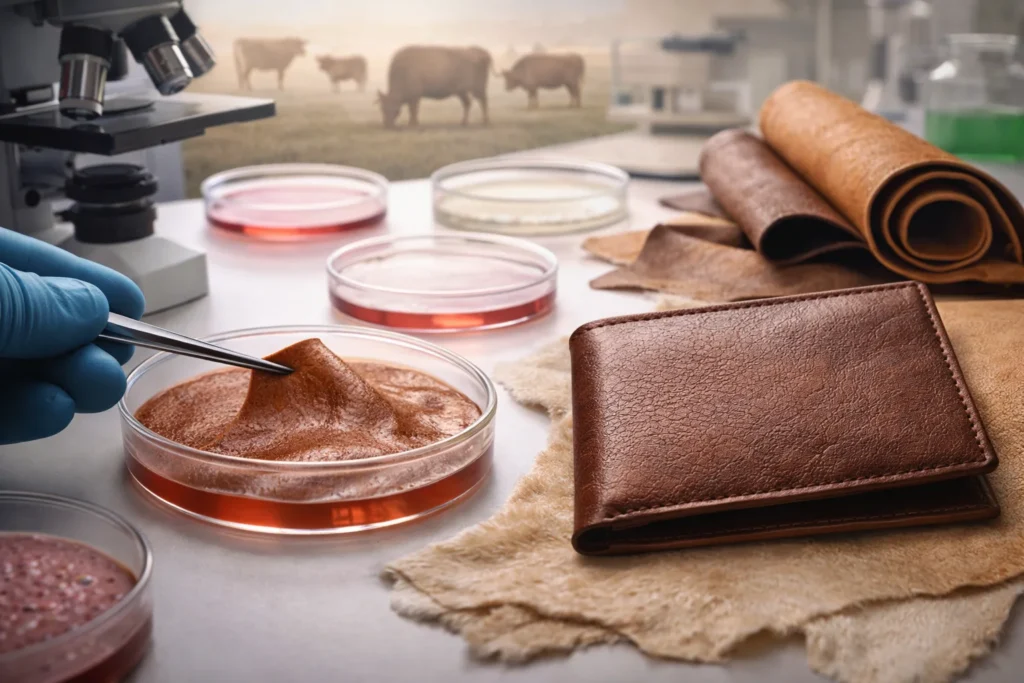

The morning sun cast long shadows across the rolling hills of the countryside, where generations of farmers had raised cattle for as long as anyone could remember. The old barn stood weathered but sturdy, its wooden beams holding stories of a hundred years and a thousand seasons. Inside, the familiar smell of hay and leather mingled in the air, a scent that spoke of tradition, of craftsmanship passed down from father to son, of a way of life that seemed as permanent as the hills themselves.
But change was coming. Not with the slow pace of seasons or the gradual shift of generations, but with the sudden, breathtaking speed of scientific breakthrough. In laboratories thousands of miles away from that old barn, something remarkable was happening. Scientists were doing what would have seemed like magic just a few decades ago. They were growing leather. Not synthetic imitations or plastic substitutes, but real, genuine leather, made from actual animal cells, without ever needing to raise the animal itself.
When the announcement came that regulatory agencies in multiple major markets had approved this lab-grown leather for commercial sale, it sent shockwaves through industries that had remained largely unchanged for centuries. The fashion houses of Milan and Paris took notice. The automotive giants of Germany and Japan started making phone calls. Environmental activists celebrated what they saw as a turning point in the fight against climate change. And in that old barn, the farmer leaned against the fence and wondered what this all meant for the life he had always known.
This is the story of that breakthrough. It’s a story of science and tradition, of environmental hope and economic uncertainty, of a material so familiar to human civilization that we rarely stop to think about where it actually comes from. It’s the story of leather, and how a handful of microscopic cells might just change everything.
The Ancient Partnership Between Humans and Hides
To truly understand why this moment matters so much, we need to travel back in time. Not just a few decades, but thousands of years, to when our ancestors first discovered that the skin of an animal could be transformed into something useful.
Picture a small group of early humans huddled around a fire somewhere in prehistoric Europe. They had successfully hunted a large animal, perhaps a deer or an ancient relative of the cow. The meat would feed the tribe for days, but the hide was too valuable to waste. Someone, probably by accident, discovered that if you scraped the flesh from the skin and treated it with certain substances, it wouldn’t rot and decay like other organic matter. It would become something else entirely. It would become leather.
This discovery changed everything. Leather meant protection from the cold. It meant durable coverings for shelters. It meant footwear that could carry hunters across rough terrain. It meant shields for warriors and containers for carrying water. From the earliest days of human civilization, leather was there, a constant companion to our species as we spread across the globe.
The ancient Egyptians used leather for sandals and military equipment. The Romans equipped their mighty legions with leather armor and boots that could march hundreds of miles. In medieval Europe, leather workers formed powerful guilds that controlled the secrets of their trade with fierce determination. The great explorers who crossed oceans and discovered new worlds carried leather maps and wore leather clothing. Cowboys in the American West depended on leather for nearly everything they owned, from saddles to chaps to boots.
Through all of this history, the basic process remained remarkably similar to what those prehistoric hunters discovered by the fire. You start with an animal hide. You clean it. You treat it with substances that prevent decay. You work it and shape it until it becomes the strong, flexible, durable material that humans have relied on for millennia.
The scale changed, of course. What began as individual hunters processing a single hide grew into massive industries. In the 19th and 20th centuries, tanneries became industrial operations, processing thousands of hides at a time. The meat industry grew alongside the leather industry, each supporting the other in a symbiotic relationship that seemed as natural as the cycles of nature itself.
But the fundamental truth remained unchanged: if you wanted leather, you needed the animal. You needed the ranch, the feed, the water, the land. You needed the entire vast infrastructure of livestock farming that had shaped human civilization for ten thousand years. That was simply how leather was made. There was no other way.
The Ancient Craft of Tanning Through the Ages
The transformation of a raw animal hide into durable leather is one of humanity’s oldest chemical processes, a craft that evolved over millennia through trial, error, and the accumulated wisdom of countless generations. Understanding this ancient art helps us appreciate just how revolutionary it is to bypass it entirely.
In the earliest days, before humans understood the chemistry involved, they discovered by accident that certain treatments worked. Smoke from fires seemed to help preserve hides. Rubbing brains or fats into the skin made it softer. Soaking hides in water with certain tree barks produced unexpected results. These weren’t scientific discoveries in the modern sense, but they were effective, and knowledge spread from tribe to tribe, culture to culture.
The ancient Hebrews developed sophisticated tanning techniques that were described in the Old Testament. The Egyptians created leather so fine that some examples have survived to this day, still flexible after thousands of years in tombs. The Chinese were tanning leather with alum as early as 2000 BCE, producing soft, white leather that was prized throughout Asia.
The Romans elevated leather production to an industrial art. They built large tanneries, some of which have been excavated by archaeologists, revealing complex systems of vats and processing areas. Roman leather goods were traded throughout the empire, from Britain to Syria, and the durability of Roman leather is legendary. Examples recovered from archaeological sites still show the marks of the craftsmen who made them.
In medieval Europe, leather working became one of the most important trades. Tanners, curriers, and cordwainers formed powerful guilds that regulated every aspect of production. The secrets of the trade were closely guarded, passed from master to apprentice after years of training. Leather was so valuable that it was often used as currency or payment for debts. A good leather worker could command respect and wealth that rivaled merchants in other trades.
The Industrial Revolution transformed leather production just as it transformed everything else. Mechanical rollers replaced hand tools. Chemical tanning agents replaced natural ones. Steam power allowed tanneries to process hides faster than ever before. By the late 19th century, leather had become a mass-produced commodity, available to ordinary people for the first time in history.
Yet even with all this industrialization, the fundamental relationship remained unchanged. The hides still came from animals raised on farms and ranches. The tanneries still processed those hides into leather. The craftsmen still shaped that leather into products. The chain from farm to finished good might have gotten longer and more complex, but it was still the same basic chain that had existed for thousands of years.
The Global Scale of Modern Leather Production
To understand the significance of lab-grown leather, we need to grasp the enormous scale of the industry it seeks to transform. The numbers are almost too big to comprehend, spanning continents and involving millions of people in a complex global web of production and trade.
Every year, the global leather industry processes approximately 1.8 billion hides and skins. That’s billion with a B. To put that in perspective, if you laid all those hides end to end, they would circle the Earth multiple times. Stacked on top of each other, they would form a pile miles high. The sheer volume of material is staggering.
Cattle hides make up the vast majority of this production, accounting for about 65% of the total. Sheep and goat skins contribute another significant portion, prized for their softness and used primarily in clothing and gloves. Pig skins, buffalo hides, and exotic leathers from animals like crocodiles, snakes, and ostriches fill out the remaining categories, each with its own specialized market and processing requirements.
The geographic distribution of leather production tells a story of global economics. China is by far the world’s largest leather producer, processing hundreds of millions of hides each year in enormous industrial facilities. Brazil, India, Russia, and Italy round out the top producers, each with its own specialized niches and strengths. Italy, in particular, is famous for high-end leather production, supplying the world’s luxury fashion houses with materials of exceptional quality.
The value of the global leather trade is measured in hundreds of billions of dollars annually. Finished leather products including footwear, clothing, accessories, furniture, and automotive interiors represent a market of more than $400 billion each year. This isn’t a niche industry. It’s a massive global enterprise that touches nearly every aspect of modern life.
The employment implications are equally enormous. Millions of people work in leather-related industries worldwide. Ranchers raise cattle. Slaughterhouses process animals and remove hides. Tanners turn those hides into leather. Manufacturers cut, sew, and assemble leather products. Retailers sell those products to consumers. At every step of the chain, people depend on the leather industry for their livelihoods.
In developing countries, leather production often provides crucial economic opportunities. Tanneries in Bangladesh, Pakistan, and Ethiopia employ thousands of workers who might otherwise struggle to find jobs. Leather exports bring foreign currency into countries that need it desperately. For many communities, the leather industry is not just a business but a lifeline.
This global scale means that any change to the leather industry will have ripple effects throughout the world economy. Lab-grown leather isn’t just competing with a product. It’s competing with an entire economic system that has developed over centuries and now spans the planet.
The Environmental Toll of Traditional Leather
As the scale of leather production grew, so did its environmental impact. What had once been a relatively small-scale craft became an industrial process with consequences that could no longer be ignored.
Water consumption is perhaps the most immediately visible issue. A single cowhide represents thousands of gallons of water when you account for everything. The animal itself drinks about 10 to 20 gallons per day over its lifetime. The crops grown to feed it require enormous amounts of irrigation water. The tanning process uses still more water for soaking, washing, and chemical treatments. When you add it all up, the water footprint of a leather product is staggering.
In water-stressed regions of the world, this consumption has real consequences. Rivers run dry. Groundwater aquifers are depleted. Communities compete with industry for access to increasingly scarce water resources. The leather industry, along with the cattle industry that supplies it, is a significant contributor to water scarcity in many areas.
Land use presents another major concern. Cattle ranching occupies approximately 30% of the Earth’s ice-free land surface. That’s an area larger than the entire continent of North America. Forests have been cleared, grasslands converted, and ecosystems destroyed to make room for grazing cattle.
The Amazon rainforest provides the most dramatic example. Vast areas of the world’s most biodiverse ecosystem have been burned and cleared to create pasture for cattle. The smoke from these fires rises into the atmosphere, visible from space. Species that existed nowhere else on Earth disappear before scientists can even discover them. Indigenous communities are displaced from lands they’ve occupied for centuries. All of this happens because the world demands beef and leather.
Greenhouse gas emissions from cattle are another major concern. Cattle are ruminant animals, which means they digest their food through a process that produces methane. Methane is a potent greenhouse gas, many times more effective at trapping heat than carbon dioxide, at least over the short term. The United Nations Food and Agriculture Organization estimates that livestock production generates more greenhouse gas emissions than the entire transportation sector combined.
The tanning process adds its own environmental burdens. Traditional chrome tanning, which produces about 85% of the world’s leather, uses chromium salts that can be toxic if not properly managed. In tanneries with poor environmental controls, chromium and other chemicals can contaminate soil and water, creating health hazards for surrounding communities.
In some parts of the world, the legacy of leather production is visible in polluted rivers, contaminated groundwater, and communities suffering from higher rates of certain diseases. The environmental justice implications are significant, as the communities most affected are often poor and lack political power to demand change.
Even when tanneries operate with modern environmental controls, the tanning process consumes significant energy and produces waste that must be managed. Sludge from treatment plants, solid waste from processing, and air emissions from drying and finishing all contribute to the environmental footprint of leather production.
The Social and Human Costs
Beyond the environmental toll, traditional leather production carries social and human costs that are often overlooked in discussions of the industry. These costs affect workers, communities, and sometimes even consumers in ways that are difficult to quantify but impossible to ignore.
Workers in tanneries face significant occupational hazards. The chemicals used in tanning can be dangerous to human health, especially with prolonged exposure. Respiratory problems, skin conditions, and various cancers have been associated with tannery work in studies around the world. Even in developed countries with strong workplace safety regulations, tannery workers face risks that exceed those in many other industries.
In developing countries where regulations are weaker or enforcement is lax, the risks are even greater. Workers may handle toxic chemicals without proper protective equipment. Ventilation may be inadequate to remove harmful fumes. Children may work in or around tanneries, exposed to the same hazards as adults. The human cost of leather production is borne disproportionately by the world’s poorest and most vulnerable people.
Communities near tanneries also suffer. Water pollution from tannery waste can affect entire regions, contaminating drinking water sources and damaging fisheries that communities depend on. Air pollution from drying and finishing operations can cause respiratory problems for people living nearby. The smell of tanneries, a combination of rotting organic matter and industrial chemicals, can make life unpleasant for miles around.
In some cases, the damage has been severe enough to prompt government action. Tanneries have been shut down in some countries after protests from affected communities. In others, entire districts have been designated as sacrifice zones, where environmental degradation is accepted as the price of economic activity.
The animal welfare implications are also significant. While leather is often described as a byproduct of the meat industry, the reality is more complex. The quality of leather affects the price paid for hides, which in turn affects decisions about animal husbandry. Practices that maximize meat production may not be optimal for hide quality, and vice versa.
Animals raised for leather and meat often live in conditions that animal welfare advocates consider unacceptable. Crowded feedlots, long-distance transport, and stressful slaughterhouse conditions are common in the industry. For consumers who care about animal welfare, these realities pose an ethical dilemma. Can you love leather and also care about the animals it comes from?
The Genesis of an Idea: How Scientists Started Growing Leather
The idea of growing animal products without animals didn’t emerge from nowhere. It grew out of decades of research in cell biology, tissue engineering, and related fields. The path from basic science to commercial product was long and winding, filled with challenges that seemed insurmountable at times.
The story begins in medical research. For decades, scientists had been growing human cells in laboratories for research purposes. They could take a tiny sample of tissue, place it in a culture medium with the right nutrients, and watch as the cells multiplied. This technology helped researchers understand how cells work, how diseases develop, and how potential treatments might affect living tissue.
In the 1980s and 1990s, tissue engineering emerged as a distinct field. Scientists began to explore the possibility of growing not just sheets of cells but actual functional tissues. Skin grafts for burn victims were among the first successes. Researchers could take a small sample of a patient’s skin, grow it in the lab, and produce enough healthy skin to cover wounds. This technology saved countless lives and limbs.
Somewhere along the way, someone had a revolutionary thought. If we can grow human skin for medical purposes, why can’t we grow animal skin for leather? The basic biology was the same. The cells didn’t know or care whether they were destined for a patient or a handbag. Give them the right conditions, and they would do what cells have always done: multiply and organize themselves into tissue.
This insight sparked a wave of research and entrepreneurship. In the early 2000s, a handful of scientists and visionaries began working on the problem in earnest. They faced enormous challenges. The culture media that worked for medical applications were too expensive for commercial production. The processes that produced small quantities for research couldn’t scale to industrial levels. The regulatory pathways for novel materials were unclear and untested.
Progress was slow at first. Early attempts produced material that was too thin, too weak, or too expensive to be commercially viable. Skeptics in the leather industry dismissed the whole idea as science fiction. Even some environmental advocates, who should have been natural allies, worried that the technology would never amount to anything practical.
But the researchers persisted. They refined their culture media, finding cheaper sources of nutrients. They improved their bioreactors, achieving higher cell densities and faster growth. They developed techniques to guide cell organization, producing material with the complex structure of real hide. Slowly, painfully, they moved from science project to commercial possibility.
The Science of Growing Leather: A Detailed Look
To appreciate the achievement represented by lab-grown leather, it helps to understand the science in some detail. The process is elegant in its simplicity and profound in its implications.
It all starts with a single, painless biopsy. A veterinarian visits a farm and, with the farmer’s permission, takes a tiny tissue sample from a cow. The procedure is routine, causing the animal no more discomfort than a vaccination. That tiny sample, smaller than a pencil eraser, contains millions of cells, each one carrying the complete genetic instructions for building hide.
The sample is carefully packaged and transported to a laboratory. There, scientists dissociate the tissue, separating individual cells from the extracellular matrix that held them together. This step requires care to avoid damaging the cells, but with modern techniques, it’s routine.
The cells are then placed in a culture medium. This liquid is the secret sauce of the whole process, a carefully formulated cocktail of nutrients that cells need to survive and multiply. The exact composition varies from company to company, but the basic ingredients are consistent: sugars for energy, amino acids for building proteins, vitamins and minerals for various cellular functions, and growth factors to signal the cells to divide.
In traditional cell culture, scientists might use medium derived from animals, often fetal bovine serum. But for lab-grown leather aimed at the commercial market, that wouldn’t work. It would defeat the purpose of avoiding animal products and would be prohibitively expensive at scale. So companies have developed animal-free media, using plant-based or synthetic ingredients to feed their cells.
The cells grow in vessels called bioreactors. These aren’t your grandfather’s fermentation tanks, though the basic principle is similar. Bioreactors maintain perfect conditions for cell growth: the right temperature, usually around body temperature for the source animal; the right pH, slightly basic for most animal cells; the right oxygen levels, carefully controlled to match cellular demand.
Sensors throughout the bioreactor constantly monitor these conditions, feeding data to computer control systems that make tiny adjustments as needed. If the temperature drifts up, cooling kicks in. If the pH drops, a buffer is added. The goal is to keep everything optimal for cell growth, twenty-four hours a day, seven days a week.
Inside the bioreactor, cells multiply exponentially. One cell becomes two. Two become four. Four become eight. In a matter of weeks, the original millions of cells become billions and then trillions. The invisible work of these microscopic builders becomes visible as a sheet of material begins to form.
But growing a random mass of cells isn’t enough. Leather has structure, a complex three-dimensional architecture that gives it strength and flexibility. The collagen fibers that form the backbone of leather must be organized in specific ways to achieve the right properties.
To guide this organization, scientists use scaffolds. These are three-dimensional structures that provide a template for cell growth. Cells attach to the scaffold, follow its contours, and deposit collagen along its lines. Over time, the scaffold degrades or is absorbed, leaving behind organized tissue with the desired structure.
Different companies use different scaffold materials. Some use plant-based materials like cellulose. Others use synthetic polymers designed to degrade at controlled rates. The choice of scaffold affects the final properties of the leather and the cost of production.
After several weeks, the material is ready for harvest. It’s removed from the bioreactor, and the scaffold, if still present, is removed. What remains is a sheet of material that is biologically identical to the hide you’d get from a cow. The same cells, the same proteins, the same structure. The only difference is the origin story.
The Journey from Lab to Commercial Reality
Taking a technology from the laboratory to commercial reality is a journey filled with challenges. For lab-grown leather, that journey has taken years of effort and millions of dollars in investment. The recent regulatory approvals represent a major milestone, but they’re just one step in a longer process.
The first challenge was proving that the technology could work at all. Early researchers had to demonstrate that they could grow animal cells outside the body and get them to form tissue with the right properties. This took years of basic research, funded by government grants, university support, and eventually venture capital.
Once the basic science was established, the next challenge was scaling up. Growing a few square inches of material in a petri dish is one thing. Growing square feet or square yards is something else entirely. It requires larger bioreactors, more efficient processes, and careful attention to economics.
Companies experimented with different bioreactor designs. Some used stirred tank reactors, like those used in brewing. Others used perfusion systems that continuously flow fresh medium through the culture. Each approach had advantages and disadvantages, and finding the right one required extensive testing.
The culture medium presented another scaling challenge. The medium that worked in small-scale experiments was too expensive for commercial production. Companies had to develop cheaper alternatives, using agricultural byproducts or synthetic ingredients instead of expensive purified components. This required extensive research and optimization.
Process optimization was equally important. Every step of the production process had to be streamlined and automated. Cell seeding, medium exchange, harvesting, and downstream processing all had to be designed for efficiency at scale. Companies that succeeded in this optimization gained significant advantages over competitors.
Regulatory approval was perhaps the most daunting challenge. Lab-grown leather is a novel product, and regulators had to determine how to classify it and what standards to apply. Is it a food product? A medical device? A textile? The answers weren’t obvious, and companies had to work closely with regulators to develop appropriate frameworks.
The approval process required extensive documentation. Companies had to demonstrate that their production processes were consistent and controlled. They had to prove that the final product was safe for consumers, free from contaminants and harmful residues. They had to show that their claims about the product were accurate and supported by data.
The recent approvals in multiple markets represent the culmination of years of work. They validate the technology and open the door to commercial sales. But they’re not the end of the regulatory journey. As companies expand into new markets, they’ll need to secure approvals in each jurisdiction, navigating different regulatory systems and requirements.
The Environmental Promise in Detail
The environmental benefits of lab-grown leather are often cited in general terms, but the details are worth exploring. The potential improvements are dramatic across multiple dimensions.
Water use is perhaps the most straightforward comparison. Traditional leather production is extraordinarily water-intensive. A single cowhide requires water for the animal to drink throughout its life, water to grow the crops that feed the animal, and water for the tanning process. Estimates vary, but a typical figure is around 15,000 to 20,000 liters of water per hide.
Lab-grown leather production uses water primarily for the culture medium and for cleaning equipment. The culture medium is mostly water, but it’s recycled and reused in efficient systems. Cleaning water can also be treated and reused. Total water consumption per square foot of lab-grown leather is estimated to be 90 to 95% lower than conventional leather.
Land use shows even more dramatic differences. Cattle grazing occupies vast areas of land. A single cow might require several acres of pasture, depending on the quality of the land and the climate. Multiply that by the 1.8 billion animals processed annually for leather, and the land area becomes enormous.
Lab-grown leather production takes place in vertically stacked bioreactors in industrial buildings. A single facility occupying a few acres can produce as much leather as thousands of acres of grazing land. The land savings are so large that they’re almost hard to comprehend. If lab-grown leather captured even a significant fraction of the market, millions of acres could be freed for other uses, including forest restoration, wildlife habitat, or crop production.
Greenhouse gas emissions present a more complex picture. Cattle produce methane through their digestive processes, and methane is a potent greenhouse gas. Eliminating cattle from the leather production process eliminates this methane source entirely. However, lab-grown leather production requires energy for bioreactors, lighting, heating, cooling, and other processes. If that energy comes from fossil fuels, it generates carbon dioxide emissions.
The net effect depends on the energy source. With current energy mixes, life cycle analyses suggest greenhouse gas reductions of 60 to 80% compared to conventional leather. With renewable energy powering production, reductions could approach 95% or more. The industry is acutely aware of this and is working to source renewable energy for its facilities.
Chemical use is another area of potential improvement. Traditional tanning often uses chromium and other heavy metals that can be toxic. Even with proper waste treatment, some of these chemicals end up in the environment. Lab-grown leather can be tanned with alternative agents, including plant-based compounds that are biodegradable and less toxic.
Some companies are developing tanning processes that use enzymes instead of chemicals, mimicking natural processes. Others are exploring closed-loop systems that capture and reuse tanning agents, eliminating waste entirely. The clean start provided by lab-grown leather opens up possibilities that aren’t feasible with conventional hides.
Biodiversity impacts are harder to quantify but potentially significant. Cattle ranching is a major driver of deforestation, particularly in tropical regions. By reducing demand for cattle hides, lab-grown leather could reduce pressure on forests and the species that depend on them. The ripple effects through ecosystems could be substantial, though they would take years or decades to materialize.
The Economic Transformation Underway
The economic implications of lab-grown leather extend far beyond the product itself. This technology has the potential to reshape industries, create new markets, and shift economic power between regions and sectors.
For investors, lab-grown leather represents a massive opportunity. The global leather market is worth hundreds of billions of dollars annually, and even a modest share of that market would represent enormous revenues. Venture capital firms have poured hundreds of millions of dollars into lab-grown leather companies, betting that they can capture significant market share over time.
The companies themselves are racing to scale up production. Some are building pilot facilities to demonstrate their technology at commercial scale. Others are planning full-scale production facilities that could produce millions of square feet of material annually. The competition is intense, with multiple companies pursuing different technical approaches and business strategies.
For the fashion industry, lab-grown leather offers both opportunity and disruption. Brands that embrace the technology early can position themselves as sustainability leaders, attracting environmentally conscious consumers. They can also gain experience with the material, learning how to work with it before their competitors.
Luxury brands face particular decisions. Their customers expect the highest quality, and they’re willing to pay for it. If lab-grown leather can deliver that quality while also delivering sustainability benefits, it could become the material of choice for high-end products. Some luxury houses are already exploring partnerships with lab-grown leather companies.
For the automotive industry, lab-grown leather offers consistency and sustainability. Automakers use enormous quantities of leather for seats, steering wheels, and interior trim. The consistency of lab-grown leather could reduce waste and simplify manufacturing. The sustainability benefits could help automakers meet increasingly stringent environmental requirements.
For the tanning industry, lab-grown leather presents both threat and opportunity. Traditional tanneries could be displaced if lab-grown leather captures significant market share. But tanneries could also adapt, positioning themselves as finishing facilities for lab-grown material. The skills and equipment needed for finishing are similar regardless of the hide’s origin.
For farmers and ranchers, the implications are complex. Reduced demand for cattle hides would reduce a source of income, potentially affecting profitability. But farmers could also participate in the new industry by supplying the initial cell samples. Some might even host bioreactors on their land, diversifying their operations while maintaining their connection to agriculture.
For workers, the transition could be challenging. Tannery workers have skills that may not transfer directly to lab-grown leather production. New facilities may be located in different areas, requiring workers to move or find new careers. Managing this transition fairly will require attention from companies, governments, and communities.
For developing countries, lab-grown leather could disrupt an important industry. Many developing countries rely on leather exports for foreign exchange and employment. If lab-grown leather captures market share, these countries could lose economic opportunities. However, they could also participate in the new industry by hosting production facilities or supplying inputs.
The Consumer Perspective: What Shoppers Need to Know
For ordinary consumers, the arrival of lab-grown leather raises practical questions. How should you evaluate products made with this material? What should you look for? How should you think about the choice between conventional and lab-grown leather?
The first thing to understand is that lab-grown leather is real leather. It’s not pleather, vinyl, or any other synthetic substitute. It’s made from actual animal cells and has the same composition and structure as conventional leather. When you buy a lab-grown leather product, you’re getting the real thing.
The second thing to understand is that lab-grown leather can be more sustainable. The environmental benefits are substantial, particularly in terms of water use, land use, and greenhouse gas emissions. If sustainability matters to you, choosing lab-grown leather is one way to reduce your environmental footprint.
The third thing to understand is that early products may be more expensive. Like any new technology, lab-grown leather carries higher costs initially. Early adopters will pay a premium for the privilege of being first. Over time, as production scales up and processes improve, prices will come down.
When shopping for lab-grown leather products, look for transparency. Good brands will clearly label their products and provide information about the material’s origin. They’ll be happy to answer questions about their supply chain and sustainability practices. If a brand is vague or evasive, that’s a red flag.
Consider the whole product lifecycle. A leather product’s environmental impact depends not just on the material but on how it’s made, how long it lasts, and what happens at the end of its life. A well-made product that lasts for decades is more sustainable than a cheap product that falls apart after a year, regardless of the material.
Think about what matters to you personally. If animal welfare is your primary concern, lab-grown leather offers a way to enjoy leather without supporting the livestock industry. If climate change is your focus, the greenhouse gas reductions are significant. If water scarcity worries you, the water savings are dramatic. Different people have different priorities, and lab-grown leather addresses many of them.
Be patient with the early products. Any new technology has a learning curve. The first generation of lab-grown leather products may not be perfect, but they’ll improve over time as companies refine their processes and gain experience. Supporting early products helps drive that improvement.
Stay informed about the industry. The technology is evolving rapidly, and new developments happen regularly. Companies announce new partnerships, new products, and new capabilities. Following industry news can help you make informed choices as the market develops.
The Ethical Dimensions of Choosing Lab-Grown Leather
Beyond the practical considerations, choosing lab-grown leather raises ethical questions that are worth examining. These questions touch on our relationship with animals, with the environment, and with each other.
The animal welfare question is perhaps the most obvious. Conventional leather comes from animals that are raised and slaughtered for their meat and hides. Even under the best conditions, this involves ending the animal’s life. For people who are uncomfortable with this reality, lab-grown leather offers an alternative that avoids animal slaughter entirely.
But the picture is more complex than it first appears. The cells used to grow lab-grown leather come from animals, and those animals must be maintained to provide continuing cell lines. While the number of animals involved is tiny compared to conventional leather production, it’s not zero. Some people might question whether using animals at all, even in this minimal way, is ethically acceptable.
The environmental ethics are clearer in some ways but more complex in others. Reducing water use, land use, and greenhouse gas emissions are clearly good things from an environmental perspective. But the full environmental picture depends on how production is powered and how waste is managed. A lab-grown leather facility powered by coal might have a different environmental profile than one powered by solar energy.
There are also questions about economic justice. The leather industry employs millions of people, many of them in developing countries where alternative employment is scarce. Disrupting this industry could harm vulnerable communities unless the transition is managed carefully. Consumers who care about global justice need to consider these effects.
The question of naturalness is more philosophical but still relevant. Some people value products that come from traditional processes, seeing them as more authentic or meaningful. A leather jacket from a traditional tannery might carry different significance than one from a lab, even if the material is identical. These subjective values matter, even if they’re hard to quantify.
There’s also the question of unintended consequences. Every technology has ripple effects that are hard to predict. Lab-grown leather could reduce pressure on ecosystems, but it could also enable more consumption by making leather seem guilt-free. It could create new industries and jobs, but it could also disrupt existing ones. The net effect depends on how the technology is deployed and used.
For consumers trying to navigate these ethical dimensions, there are no simple answers. Different people will weigh different factors differently. What matters is thinking carefully about the choices we make and their implications, rather than accepting simple narratives about good and bad.
The Regulatory Journey: How Approval Was Achieved
The regulatory approvals that made lab-grown leather commercially available didn’t happen overnight. They were the result of years of work by companies, regulators, and other stakeholders to develop appropriate frameworks for novel products.
The first challenge was determining which regulatory agency had jurisdiction. In the United States, for example, the FDA regulates food and drugs, while the USDA regulates agricultural products. Lab-grown leather didn’t fit neatly into either category. Was it a food product because it was made from animal cells? Was it an agricultural product because it derived from agriculture? The answer wasn’t obvious.
Companies worked with regulators to develop appropriate classifications. They provided extensive documentation about their processes and products. They participated in meetings and consultations to help regulators understand the technology. Over time, a consensus emerged that lab-grown leather could be regulated under existing frameworks with appropriate modifications.
The safety evaluation was a major focus of regulatory review. Regulators needed assurance that lab-grown leather was safe for consumers. This required testing for contaminants, residues, and potential allergens. Companies had to demonstrate that their production processes were clean and controlled, and that the final product met safety standards.
The testing requirements were extensive. Companies analyzed their materials for microbial contamination, heavy metals, chemical residues, and other potential hazards. They conducted studies to ensure that the material wouldn’t cause skin irritation or allergic reactions. They documented every step of their production process to identify potential points of contamination.
The consistency of production was another focus. Regulators needed assurance that every batch of material would be the same quality and safety as every other batch. Companies had to demonstrate that their processes were reproducible and that they had quality control systems in place to catch any deviations.
The labeling of products was also considered. How should lab-grown leather be described to consumers? What claims could companies make about their products? Regulators worked with companies to develop labeling guidelines that would be accurate and not misleading.
The approval process in different countries followed different timelines and requirements. Some countries moved faster than others, depending on their regulatory systems and priorities. The recent approvals in multiple major markets represent a significant achievement, demonstrating that the technology can meet regulatory standards in diverse jurisdictions.
Looking ahead, companies will need to maintain compliance with regulatory requirements as they scale up production. They’ll need to continue documenting their processes, testing their products, and working with regulators to address any issues that arise. Regulatory approval is not a one-time achievement but an ongoing commitment.
The Global Race for Leadership in Biofabrication
The development of lab-grown leather is part of a broader race for leadership in biofabrication, the use of biological systems to produce materials. Countries around the world are positioning themselves to capture the economic benefits of this emerging industry.
The United States has taken an early lead, thanks to its strong venture capital ecosystem and world-class research universities. American companies have raised hundreds of millions of dollars from investors eager to back the next big thing. The regulatory pathway in the US, while complex, has been navigable, and several companies have secured necessary approvals.
The research base in the US is particularly strong. Universities like Harvard, MIT, and Stanford have produced foundational research in tissue engineering and cellular agriculture. Graduates from these programs have gone on to found companies and advance the technology. The ecosystem of talent, capital, and ideas creates a virtuous cycle that reinforces American leadership.
Europe presents a more mixed picture. Countries like the Netherlands and Germany have strong research programs and supportive policies for biotechnology. The European Union’s emphasis on sustainability aligns well with the environmental benefits of lab-grown leather. However, the regulatory environment in Europe has been more cautious, with longer approval timelines and more complex requirements.
Some European companies have chosen to focus on markets outside Europe initially, securing approvals elsewhere before tackling European regulations. Others are working closely with European regulators to navigate the approval process. The outcome of these efforts will help determine Europe’s role in the industry.
Asia represents both a huge market and a potential production hub. Countries like Singapore have been particularly forward-thinking, creating regulatory pathways for novel foods and materials. Singapore’s approval of lab-grown meat in 2020 was a landmark moment that demonstrated the country’s openness to cellular agriculture.
China’s role is particularly significant given its position as the world’s largest leather producer and consumer. Chinese companies are investing in lab-grown leather research and development, and the Chinese government has identified biotechnology as a strategic priority. If lab-grown leather takes off, China could leverage its manufacturing expertise to become a major producer.
Other countries are also positioning themselves. Israel has emerged as a hotbed of cellular agriculture innovation, with numerous startups working on lab-grown meat and leather. Brazil, with its enormous cattle industry, sees both threat and opportunity in the technology. Japan’s strength in materials science could translate into advantages in developing new applications.
The global race is still in its early stages, and the ultimate winners and losers aren’t yet clear. What’s certain is that the countries and companies that move early and move smartly will have advantages that could persist for decades.
The Technology’s Future: What’s Next for Lab-Grown Leather
The lab-grown leather that’s receiving regulatory approval today is just the beginning. The technology is evolving rapidly, and future generations of products will likely be dramatically different from what’s available now.
One area of active research is improving the efficiency of production. Current processes require significant inputs of energy and nutrients. Researchers are working on ways to reduce these requirements, making production cheaper and more sustainable. This includes developing more efficient bioreactors, optimizing culture media, and finding ways to recycle nutrients.
Another focus is improving the properties of the material. Nature produces leather with variations in thickness, strength, and flexibility that correspond to different parts of the animal’s body. Researchers are learning to replicate these variations intentionally, growing material with specific properties for specific applications. Want leather that’s extra flexible for a shoe upper? We can grow that. Want leather that’s extra durable for a work glove? We can grow that too.
The possibility of growing leather in specific shapes is particularly exciting. Instead of growing sheets and cutting them to shape, with all the waste that entails, researchers envision growing pre-formed components. Imagine a shoe upper grown in exactly the shape needed, with no cutting waste at all. Or a car seat cover grown to fit perfectly, reducing assembly steps and material use.
The integration of color and patterns during growth is another frontier. Instead of dyeing leather after it’s grown, researchers are exploring ways to incorporate color directly into the growing material. This could eliminate the dyeing step entirely, saving water and chemicals while enabling new design possibilities. Patterns could be grown into the material, creating effects that are impossible with conventional leather.
The range of leather types could expand dramatically. The current focus is on cow leather, but the same technology could produce leather from any animal. Imagine exotic leathers from endangered species, grown without threatening the animals themselves. Or leather from extinct species, brought back in material form if not in living form. The possibilities are limited only by imagination.
The integration with other technologies opens up additional possibilities. Leather could be grown with embedded sensors, creating smart materials that can monitor their own condition or interact with electronic devices. It could be grown with antimicrobial properties, reducing odors and extending useful life. It could be grown with self-healing capabilities, repairing minor damage automatically.
The timeline for these advances is uncertain. Some may arrive within a few years; others may take decades. What’s clear is that the technology is still in its early stages, and the most exciting developments may be yet to come.
The Integration with Traditional Leather Craft
One of the most interesting questions about lab-grown leather is how it will integrate with traditional leather craft. Will it displace traditional techniques, or will it complement them? The answer likely involves both.
Traditional leather craft is built on generations of accumulated knowledge. Tanners know how to handle hides, how to recognize quality, how to adjust processes based on the characteristics of each batch. Leather workers know how to cut, sew, and finish products, how to work with the material’s grain and texture. This knowledge is valuable and shouldn’t be lost.
Lab-grown leather offers consistency that traditional hides can’t match. Every sheet is identical, with no variations from animal to animal or from one part of the hide to another. This consistency could actually benefit traditional craftspeople by reducing waste and simplifying their work. Instead of working around imperfections and variations, they could focus entirely on their craft.
The finishing processes used for traditional leather apply equally to lab-grown material. Dyeing, buffing, embossing, and other techniques work the same way. Craftspeople who understand these techniques can apply them directly to the new material, without extensive retraining.
Some traditional skills may become more valuable, not less. The ability to judge quality, to select the right material for each application, to create beautiful finished products—these skills transcend the specific origin of the leather. Craftspeople who possess them will be in demand regardless of where their materials come from.
At the same time, new skills will be needed. Working with lab-grown leather may require understanding its properties and how they differ from traditional hides. Craftspeople may need to adjust their techniques to account for the material’s consistency or lack of grain. The best practitioners will adapt and evolve, incorporating new knowledge while preserving traditional wisdom.
The relationship between lab-grown and traditional leather could be symbiotic rather than competitive. Traditional leather might occupy a premium niche, valued for its heritage and natural variation. Lab-grown leather might occupy the mainstream, valued for its consistency and sustainability. Both could coexist, serving different markets and different consumer preferences.
The Cultural Significance of Leather Through History
Leather’s significance extends beyond its practical uses. Throughout human history, leather has carried cultural meaning that varies across time and place. Understanding this cultural dimension helps explain why the arrival of lab-grown leather matters beyond the material itself.
In many cultures, leather has been associated with toughness and durability. Leather clothing signified someone who worked outdoors, who faced the elements, who could withstand hardship. Cowboys, soldiers, laborers—all wore leather as a badge of their occupation and character. This association persists today in the idea of the leather jacket as a symbol of rebellion and toughness.
Leather has also been associated with luxury and status. Fine leather goods have always been expensive, accessible only to those with means. A leather-bound book, a leather handbag, leather shoes—these items signaled wealth and taste. The craft involved in producing them added to their value, making them objects of desire and aspiration.
In some cultures, leather has spiritual significance. Native American peoples used leather for ceremonial objects, believing it carried the spirit of the animal. Some traditions hold that leather connects the wearer to the natural world, serving as a reminder of our relationship with other species. These meanings are deeply embedded in cultural practices and beliefs.
The materiality of leather matters too. Leather ages in ways that synthetic materials don’t. It develops a patina over time, accumulating marks and changes that tell the story of its use. A well-worn leather jacket carries the history of its owner in ways that a new jacket cannot. This quality of developing character over time is deeply valued by leather enthusiasts.
The smell of leather is another dimension of its cultural significance. The distinctive scent of a tannery or a leather goods store is instantly recognizable and evocative. It connects us to the material’s origins and to all the leather goods we’ve encountered throughout our lives. This sensory dimension is hard to replicate and contributes to leather’s cultural resonance.
Lab-grown leather challenges some of these cultural associations while preserving others. It maintains the material properties that people value, including the ability to develop patina over time. It can be crafted into the same objects and carry the same meanings. But it severs the connection to the living animal, which may affect how some people perceive it.
Whether lab-grown leather will develop its own cultural meanings remains to be seen. Early adopters may value it for its innovation and sustainability, creating new associations that future generations will inherit. Over time, it may become as culturally significant as traditional leather, but in different ways.
The Potential for New Applications and Markets
As lab-grown leather becomes more available and affordable, it could enable applications that weren’t feasible with traditional leather. The combination of consistency, customizability, and sustainability opens up new possibilities across multiple industries.
In the automotive sector, lab-grown leather could be used more extensively than traditional leather. Currently, leather is reserved for high-end vehicles because of its cost and the waste involved in cutting irregular hides. With consistent, grow-to-size material, leather could become practical for mass-market vehicles, improving interiors across the price spectrum.
The aviation industry could benefit similarly. Aircraft interiors must meet strict safety standards for flammability and smoke emission. Lab-grown leather could be engineered to meet these standards while providing the luxury feel that passengers expect in premium cabins. Consistent material would also simplify maintenance and replacement.
In the marine industry, leather has always been problematic because of its susceptibility to water damage and mold. Lab-grown leather could be engineered for better water resistance, making it practical for boat interiors and other marine applications. This would open up a new market segment that traditional leather couldn’t serve.
Medical applications are another possibility. Leather has been used for medical purposes throughout history, but concerns about sterility and consistency have limited its use in modern medicine. Lab-grown leather, produced under controlled conditions, could be manufactured to medical-grade standards, enabling applications in prosthetics, supports, and other medical devices.
The sporting goods industry could see new possibilities. Baseball gloves, footballs, and other equipment require consistent material properties for optimal performance. Lab-grown leather could provide that consistency while allowing customization for different positions or playing styles. Athletes could have equipment tailored precisely to their needs.
In the luxury goods sector, lab-grown leather could enable new forms of personalization. Customers could specify the exact thickness, flexibility, and color they want, with material grown to their specifications. This level of customization isn’t possible with traditional leather, which varies naturally and can only be selected, not specified.
The possibilities extend to entirely new product categories. Leather that’s grown with embedded electronics could create smart furniture that responds to users. Leather that’s grown with antimicrobial properties could be used in healthcare settings where hygiene is paramount. Leather that’s grown in complex three-dimensional shapes could be used for architectural applications that aren’t feasible with flat sheets.
As the technology matures and costs come down, these applications will become increasingly practical. The lab-grown leather industry of 2050 may look very different from the industry of today, serving markets we can’t yet imagine.
The Educational Imperative: Teaching People About the Technology
For lab-grown leather to achieve its potential, people need to understand what it is and why it matters. This educational challenge falls to companies, governments, educators, and advocates who recognize the technology’s importance.
The first educational task is explaining the basic concept. Many people have never heard of cellular agriculture and have no framework for understanding how leather can be grown without animals. Clear, accessible explanations are essential, using analogies that people can relate to. The beer brewing analogy works well for many audiences, comparing cell growth in bioreactors to yeast growth in fermentation tanks.
Dispelling misconceptions is equally important. Some people assume that lab-grown leather is synthetic or artificial, not realizing that it’s made from actual animal cells. Others worry about safety, not understanding the rigorous testing and regulatory oversight involved. Addressing these misconceptions head-on helps build trust and acceptance.
The environmental story needs to be told clearly and accurately. The benefits in terms of water, land, and emissions are compelling, but they need to be presented in ways that people can understand. Comparing the water saved by choosing lab-grown leather to familiar quantities, like swimming pools or daily household use, makes the numbers meaningful.
The quality story matters too. People need to know that lab-grown leather feels, looks, and performs like traditional leather. Demonstrations and testimonials from designers and craftspeople can help build confidence. Seeing and touching the material is the most effective way to convey its quality.
For younger audiences, the technology can be framed in terms of innovation and the future. Students who learn about lab-grown leather today may become the scientists, entrepreneurs, and consumers who shape its development tomorrow. Incorporating the topic into science and sustainability curricula could have lasting impact.
Public engagement through media and events is another important channel. Documentaries, news stories, and public demonstrations can reach wide audiences with compelling stories about the technology. Science museums and other public institutions can feature exhibits that explain cellular agriculture in interactive, engaging ways.
Social media offers opportunities for direct engagement with interested audiences. Companies and advocates can share updates, answer questions, and build communities around the technology. The visual nature of leather products lends itself to social media, with photos and videos showing the material in use.
The educational effort will need to continue for years as the technology evolves and reaches new audiences. Building broad understanding and acceptance is a long-term project, but it’s essential for realizing the technology’s potential.
The Investment Landscape: Money Flowing into Biofabrication
The development of lab-grown leather has attracted significant investment from a variety of sources. Understanding this investment landscape provides insight into the industry’s trajectory and prospects.
Venture capital has been the primary source of funding for lab-grown leather startups. Firms that specialize in biotechnology, sustainability, and food technology have led investment rounds, providing the capital needed for research, development, and scaling. The amounts involved have grown over time, from early seed rounds of a few million dollars to later rounds of tens or even hundreds of millions.
The profile of investors has broadened as the technology has matured. Early investments came primarily from specialized venture funds with expertise in emerging technologies. More recently, mainstream venture capital firms have entered the space, along with corporate venture arms from fashion, automotive, and materials companies.
Strategic investors from established industries have taken particular interest. Fashion brands see lab-grown leather as a way to secure sustainable supply chains and differentiate their products. Automotive companies see opportunities for consistent, high-quality interior materials. Chemical companies see potential for supplying inputs to the production process.
Government funding has also played a role, particularly in the early stages of research. Grants from agencies like the National Science Foundation and the Department of Agriculture in the US have supported foundational research. Similar programs exist in other countries, providing non-dilutive funding that helps startups get off the ground.
Philanthropic funding has supported some efforts, particularly those focused on environmental and animal welfare benefits. Foundations interested in climate change, sustainable agriculture, and animal protection have provided grants to researchers and organizations working on cellular agriculture.
The total investment in lab-grown leather to date is measured in the hundreds of millions of dollars, with billions more invested in related fields like lab-grown meat. These numbers are significant but small compared to the potential market. As the technology proves itself, investment is likely to increase substantially.
The returns for early investors could be enormous if lab-grown leather captures significant market share. The global leather market is worth hundreds of billions of dollars annually, and even a modest share represents massive revenues. The companies that establish leadership positions early could generate returns that justify the risks involved.
At the same time, the risks are substantial. Technology development is unpredictable, and many promising startups fail. Market acceptance is uncertain, and consumer preferences can shift. Regulatory hurdles remain in many jurisdictions. Competition is intense, with multiple companies pursuing similar opportunities. Investors in lab-grown leather are placing bets on an uncertain future.
The Role of Partnerships in Scaling the Industry
No company can build the lab-grown leather industry alone. Success will require partnerships across multiple sectors, each bringing complementary capabilities and resources.
Partnerships with fashion brands are essential for market development. Brands provide design expertise, manufacturing capabilities, and customer relationships that startups lack. They also provide credibility, signaling to consumers that lab-grown leather is a legitimate, high-quality material. Early partnerships with well-known brands have been crucial for generating awareness and interest.
Partnerships with material science companies can accelerate technology development. These companies have deep expertise in processing, finishing, and characterizing materials. They can help lab-grown leather companies optimize their products for specific applications and ensure consistent quality. Some material science companies have invested directly in lab-grown leather startups, creating aligned incentives.
Partnerships with equipment manufacturers are needed for scaling production. Bioreactors, sensors, control systems, and other equipment must be designed and built to meet the industry’s needs. Equipment manufacturers who understand the requirements can develop specialized products that improve efficiency and reduce costs.
Partnerships with ingredient suppliers are important for securing inputs. The nutrients, growth factors, and other components of culture media must be available in sufficient quantity and at reasonable cost. Suppliers who invest in producing these ingredients at scale can help the industry grow.
Partnerships with research institutions provide access to cutting-edge science. Universities and research institutes conduct foundational research that companies can build upon. Collaborative arrangements, including sponsored research and licensing agreements, help translate academic discoveries into commercial applications.
Partnerships with contract manufacturers can accelerate capacity building. Building production facilities takes time and capital. Contract manufacturers with existing facilities can produce material more quickly, allowing companies to enter the market while their own facilities are under construction.
Partnerships with logistics companies ensure efficient distribution. Lab-grown leather must be transported from production facilities to customers, often across international borders. Logistics partners with experience in handling sensitive materials can ensure that products arrive in perfect condition.
Partnerships with retailers provide access to consumers. Online and brick-and-mortar retailers who feature lab-grown leather products help build awareness and drive sales. Some retailers may develop exclusive partnerships with lab-grown leather companies, creating differentiation for their offerings.
The partnership landscape will evolve as the industry matures. Early partnerships may be experimental, testing the waters with limited product runs. Later partnerships may be more substantial, involving multi-year supply agreements and joint development efforts. The companies that build strong partnership networks will have significant advantages over those that go it alone.
The Long View: Imagining Leather in 2050
Looking ahead to 2050, what might the leather industry look like? The trajectory of technology and market development suggests several possibilities.
By 2050, lab-grown leather could be the dominant form of leather in many applications. Production costs will have fallen dramatically as processes improve and scale increases. Quality will be excellent, with material tailored precisely to each application. Consumers will have forgotten that leather once came primarily from animals.
Traditional leather will likely still exist but as a premium niche product. Small-scale producers will supply discerning customers who value heritage and tradition. Prices will be high, reflecting the craftsmanship involved and the scarcity of the product. Traditional leather will occupy a position similar to artisanal products in other categories.
The environmental benefits of the transition will be substantial. Millions of acres of land previously used for cattle grazing will have been restored to natural ecosystems. Water consumption for leather production will be a fraction of historical levels. Greenhouse gas emissions will be dramatically reduced, contributing to climate goals.
The geographic distribution of production will have shifted. Lab-grown leather production will be located near major markets, reducing transportation emissions and enabling just-in-time delivery. Countries that invested early in the technology will have captured significant economic benefits. Developing countries that relied on traditional leather production will have adapted, finding new roles in the industry.
New applications for leather will have emerged that we can’t imagine today. Smart leather with embedded electronics will be common in homes, vehicles, and workplaces. Custom-grown products will be available for everything from medical devices to architectural features. The material will have expanded far beyond its traditional uses.
The workforce will have transformed. Tannery workers of the past will have been replaced by bioprocess operators, quality control technicians, and materials scientists. New educational programs will have trained generations of workers for careers in biofabrication. The skills valued in the industry will be different, but the opportunities will be real.
Consumer attitudes will have evolved. People will have grown up with lab-grown leather as a normal material, no more remarkable than plastic or paper. The debates of the 2020s will seem quaint, remembered as a transitional moment when society grappled with the implications of new technology.
The relationship between humans and animals may have shifted subtly. With less need to raise animals for materials, our interactions with them may become more about companionship and conservation than utility. This could have profound effects on how we think about other species and our place in the natural world.
None of this is certain, of course. The future is always uncertain, shaped by forces we can’t predict and decisions we haven’t made. But imagining possibilities helps us think about what we want and how to get there. The choices we make today will shape the world of 2050.
The Philosophical Implications of Biofabrication
Beyond the practical questions of production and consumption, lab-grown leather raises profound philosophical questions about the nature of materials, the relationship between humans and nature, and the direction of technological progress.
What does it mean for a material to be natural? Leather from a cow is natural, we might say, because it comes from a living animal that grazed on grass and breathed the air. But lab-grown leather comes from the same cells, grown with the same biological processes. Is it less natural because it was grown in a bioreactor rather than on a ranch? The question doesn’t have an obvious answer.
What is the relationship between the material and the organism that traditionally produced it? For millennia, leather has connected us to the animals that provided it, reminding us of our dependence on other species for our survival. Lab-grown leather severs that connection, replacing it with a connection to technology and human ingenuity. Is that a loss or a gain? Different people will answer differently.
What does it mean to be authentic? A vintage leather jacket from a traditional tannery has a story that some people value. A lab-grown leather jacket has a different story, one of innovation and environmental responsibility. Both are authentic in their own ways, telling true stories about their origins. Which story resonates more is a matter of personal values.
How should we think about technological progress? Lab-grown leather is clearly a technological solution to environmental problems. Some people celebrate this as evidence of human ingenuity solving the challenges we face. Others worry that technological solutions distract from the need for deeper changes in how we live and what we consume. Both perspectives have merit.
What is our responsibility to future generations? The environmental benefits of lab-grown leather will accrue primarily to people who aren’t yet born, who will inherit a planet with less pressure on its resources. This intergenerational dimension is often overlooked but deeply important. The choices we make today shape the world our descendants will inhabit.
What is the proper role of animals in human society? If we can produce leather without raising animals for slaughter, does that change our ethical obligations to the animals that remain? Should we continue to raise animals for food and materials, or should we phase out these practices entirely? These questions become more urgent as alternatives become available.
How should we balance different values? Environmental sustainability, animal welfare, economic opportunity, cultural tradition, consumer choice—all of these matter, and they sometimes conflict. There’s no simple formula for weighing them against each other. Different people will strike different balances, and society will need to accommodate that diversity.
These philosophical questions won’t be answered by scientists or entrepreneurs. They’re questions for all of us, for society as a whole. Engaging with them thoughtfully is part of what it means to be a responsible citizen in a time of technological change.
The Personal Story: One Farmer’s Perspective
To make the transition to lab-grown leather more concrete, consider the story of a farmer we’ll call John. John’s family has raised cattle in the American Midwest for five generations. His great-great-grandfather homesteaded the land in the 1880s, clearing trees and building the barn that still stands today.
John grew up on this land, learning from his father how to care for cattle, when to rotate pastures, how to spot illness before it became serious. He took over the operation when his father retired, proud to continue the family legacy. The rhythm of the seasons, the cycle of calving and grazing and marketing—this was the life he knew and loved.
When John first heard about lab-grown leather, he dismissed it as another pie-in-the-sky idea from people who’d never set foot on a farm. He’d seen technologies come and go, promises made and broken. This would be no different, he figured. People would always want real leather from real cows.
But as the technology advanced and regulatory approvals came through, John began to pay attention. He read articles, watched videos, talked to extension agents who’d studied the issue. Slowly, he came to understand that this was different. This was real, and it was coming whether he liked it or not.
The realization hit him hard. His family had invested everything in this land, in this way of life. What would happen to them if the market for cattle hides collapsed? What would happen to the communities that depended on cattle farming? What would happen to the land itself, which had been in his family for more than a century?
John’s initial reaction was anger. It wasn’t fair, he thought, for people to develop technologies that would destroy his livelihood without asking him or people like him. The same environmental advocates who celebrated lab-grown leather had never worried about what would happen to farmers. They just assumed farmers would adapt, without understanding how hard adaptation could be.
Over time, John’s anger softened into something more complex. He started thinking about what he might do next. Maybe he could diversify into other types of farming. Maybe he could supply cell samples to lab-grown leather companies. Maybe he could host bioreactors on his land, generating income while preserving the family farm.
He also thought about the environmental arguments. He’d always considered himself a steward of the land, caring for it so it could support future generations. If lab-grown leather really could reduce pressure on land and water, wasn’t that consistent with his values? Could he find a way to support the transition while protecting his family’s interests?
John doesn’t have answers yet. He’s still thinking, still planning, still trying to figure out what comes next. But he’s no longer dismissing the technology out of hand. He’s engaging with it, trying to understand how he might fit into a future that looks very different from the past.
His story is being repeated on farms and ranches around the world. Millions of people whose livelihoods depend on cattle are facing an uncertain future. How they navigate that uncertainty will shape not just their own lives but the character of the transition to new ways of producing leather.
The Urban Consumer’s Perspective
Across the country from John’s farm, in a bustling city apartment, lives a young professional we’ll call Maria. Maria cares about the environment. She recycles, avoids single-use plastics, and tries to buy from sustainable brands. She’s also a fashion lover who appreciates quality and style.
Maria owns several leather items: a handbag she saved up for, a pair of boots that have lasted for years, a wallet that was a gift from her grandmother. She loves these items not just for their appearance but for their durability and the way they’ve aged. They feel substantial and meaningful in ways that synthetic materials don’t.
When Maria first heard about lab-grown leather, she was intrigued but skeptical. Was it really leather? Would it feel the same? Would it last as long? She’d been burned before by products that promised sustainability but delivered poor quality. She wasn’t about to make that mistake again.
She started researching, reading articles and watching videos about the technology. She learned about the process, the science, the regulatory approvals. She discovered that the material was biologically identical to traditional leather, made from the same cells using the same biological processes. That gave her confidence.
The environmental story resonated with her. She knew that cattle farming had significant impacts, though she hadn’t realized how large they were. The water savings alone were impressive. The land savings were even more dramatic. If she could enjoy leather while reducing her environmental footprint, that seemed like a win-win.
When Maria learned that a favorite brand was planning to release a handbag made with lab-grown leather, she decided to be an early adopter. The price was higher than comparable conventional products, but she considered it an investment in the future. If enough people bought these products, prices would come down and the industry would grow.
When the handbag arrived, Maria examined it carefully. The leather felt right—supple yet substantial, with the characteristic grain she expected. It smelled like leather, looked like leather, and performed like leather. She couldn’t tell the difference from her conventional leather items, and she suspected no one else could either.
Maria feels good about her purchase. She has a beautiful, high-quality item that she’ll use for years. She’s supporting a technology that could make a real difference for the planet. And she’s part of a movement of consumers who are voting with their wallets for a more sustainable future.
Her story represents the millions of consumers who will ultimately determine the success of lab-grown leather. If they embrace the technology, it will thrive. If they reject it, it will struggle. Their choices matter, and they’re making them based on the information available to them.
The Designer’s Perspective
In a studio in Milan, a designer named Alessandro works with leather every day. He comes from a family of leather craftsmen, learning the trade from his father and grandfather. He knows leather the way a chef knows ingredients, understanding its possibilities and limitations at a tactile level.
When Alessandro first encountered lab-grown leather, he was skeptical. He’d seen too many synthetic materials that tried to imitate leather and failed. They lacked the warmth, the character, the soul of real leather. He assumed this would be more of the same.
But when he actually handled the material, his skepticism gave way to surprise. The sample in his hands felt like leather. It cut like leather, sewed like leather, and responded to tools like leather. He couldn’t find anything about it that was different from the hides he’d worked with his entire life.
Alessandro started experimenting, making samples and prototypes to understand the material’s capabilities. He found that its consistency was actually an advantage. With traditional hides, he had to work around variations and imperfections, adjusting his patterns and techniques for each piece. With lab-grown leather, every sheet was the same, allowing him to focus entirely on his design.
The sustainability story resonated with Alessandro on a personal level. He loved leather but worried about its environmental impact. He’d seen photos of deforestation in the Amazon, of polluted rivers near tanneries, of the scale of cattle operations. Lab-grown leather offered a way to continue working with the material he loved while reducing the harm it caused.
Alessandro began incorporating lab-grown leather into his collections, starting with small accessories and moving to larger pieces as he gained confidence. His customers responded positively, intrigued by the technology and appreciative of the sustainability story. Some didn’t even notice the difference until he pointed it out.
Now Alessandro is something of an evangelist for lab-grown leather within the fashion community. He talks to other designers about his experience, demonstrating the material and answering questions. He encourages them to experiment with it, to see for themselves what it can do. He believes that the more designers work with it, the more they’ll appreciate its potential.
His story illustrates how adoption happens in creative industries. It’s not enough for a material to be technically excellent. It has to win over the craftspeople and designers who work with it every day. Their judgment matters, and their endorsement carries weight with consumers and other professionals.
The Environmental Advocate’s Perspective
In a cluttered office at an environmental nonprofit, a campaigner named Sarah has spent years working on issues related to livestock production. She’s visited factory farms, documented pollution from tanneries, and lobbied for stronger environmental regulations. She knows the damage caused by the leather industry better than most.
When Sarah first heard about lab-grown leather, she was cautiously optimistic. She’d seen too many supposed solutions that turned out to be greenwashing or that created new problems while solving old ones. But as she learned more about the technology, her optimism grew.
The numbers were compelling. Ninety percent less water. Ninety-five percent less land. Eighty percent fewer greenhouse gas emissions. These weren’t incremental improvements; they were transformative changes. If lab-grown leather could capture even a significant fraction of the market, the environmental benefits would be enormous.
Sarah also appreciated that lab-grown leather addressed multiple problems at once. It wasn’t just about climate change or water use or land conservation. It addressed all of these simultaneously, along with issues of chemical pollution and animal welfare. That kind of multi-solving was rare and valuable.
As an advocate, Sarah saw opportunities to push for responsible development. She wanted to ensure that lab-grown leather was produced with clean energy, that workers were treated fairly, that the benefits were shared broadly. She engaged with companies early, offering constructive feedback and pushing for transparency.
Sarah also recognized that the transition would be difficult for some communities. She advocated for programs to support farmers and tannery workers affected by the shift, arguing that environmental progress shouldn’t come at their expense. Just transition, as it’s called, became part of her messaging around the technology.
When the regulatory approvals were announced, Sarah issued a statement celebrating the milestone while noting the work that remained. She praised the companies that had developed the technology and the regulators who had carefully evaluated it. She called for continued investment in research and development, and for policies that would support responsible scaling.
Sarah’s story represents the environmental community’s engagement with the technology. It’s not uncritical acceptance, but it’s genuine enthusiasm for the potential. For advocates who’ve spent years fighting losing battles against entrenched industries, a genuine solution feels like a gift.
The Investor’s Perspective
In a glass-walled office overlooking San Francisco, a venture capitalist named David manages a fund focused on sustainable technologies. He’s seen thousands of pitches, invested in dozens of companies, and developed a keen sense for what might succeed.
When David first encountered lab-grown leather, he was intrigued but cautious. The technology was unproven at scale. The regulatory pathway was uncertain. Consumer acceptance was unknown. There were a dozen reasons to pass and only a few to invest.
But as he dug deeper, the reasons to invest grew stronger. The market opportunity was enormous, with hundreds of billions of dollars in annual sales. The environmental benefits were compelling, creating a strong value proposition for consumers and brands. The team behind the company was world-class, with deep expertise in both biology and business.
David also saw parallels to other technologies he’d invested in. Solar panels had seemed impossibly expensive at first, but costs had fallen dramatically as scale increased. Electric vehicles had seemed like a niche product, but they were now going mainstream. Lab-grown leather followed the same pattern: expensive at first, but with a clear path to lower costs through scale and learning.
The regulatory approvals were the validation David had been waiting for. They demonstrated that the technology could meet government standards and that the path to market was clear. They also signaled that other investors would take the space seriously, creating momentum that would benefit all the companies in the space.
David’s firm led a significant investment round in a lab-grown leather company, committing tens of millions of dollars to scaling production. They joined the board, worked with management on strategy, and helped open doors to potential partners. They were all in on the technology’s potential.
The investment was risky, David knew. The company might fail to scale, or consumers might reject the product, or competitors might develop better technology. But the potential reward justified the risk. If the company succeeded, the returns could be enormous, and the environmental impact could be transformative.
David’s story represents the investor community’s growing interest in lab-grown leather. The capital flowing into the space is funding the research, development, and scaling that will determine the technology’s trajectory. Without that capital, the technology would remain a laboratory curiosity. With it, it can become a commercial reality.
The Policy Maker’s Perspective
In a government office in Washington, a policy advisor named Michael works on issues related to agriculture and trade. He’s spent years navigating the complex interactions between technology, industry, and regulation, trying to craft policies that serve the public interest.
When lab-grown leather first appeared on Michael’s radar, it was as a novelty, a curiosity that might or might not amount to anything. He filed it away in the back of his mind, not giving it much thought. There were always new technologies demanding attention, and most of them never went anywhere.
As the technology advanced and companies sought regulatory approval, Michael’s attention sharpened. This was real, and it raised real questions for policy. How should it be regulated? What standards should apply? How should it be labeled? What support, if any, should the government provide?
Michael and his colleagues worked with regulatory agencies to develop appropriate frameworks. They consulted with companies, with environmental groups, with industry associations. They studied how other countries were handling similar issues. They tried to balance competing interests while ensuring public safety and promoting innovation.
The approval process took years, requiring extensive documentation and analysis. Michael’s office reviewed safety data, production processes, and labeling proposals. They consulted with scientific experts and sought public input. When the approvals were finally granted, Michael felt a sense of satisfaction. The system had worked, carefully evaluating a novel technology and determining that it met appropriate standards.
But Michael knew that approvals were just the beginning. Questions remained about trade policy, about support for affected communities, about research funding for continued innovation. He began working on a broader policy framework that would address these issues, positioning his country to benefit from the technology while managing its impacts.
Michael’s story illustrates the role of government in shaping technological transitions. Regulations can either enable or inhibit innovation, depending on how they’re designed. Support programs can ease transitions for affected workers and communities. Research funding can accelerate progress. The choices policy makers make matter enormously.
The Global South Perspective
In a bustling city in Bangladesh, a development economist named Fatima studies the leather industry that employs so many of her countrymen. Bangladesh is one of the world’s major leather producers, with tanneries employing hundreds of thousands of workers and exports generating billions of dollars in revenue.
When Fatima first learned about lab-grown leather, her reaction was alarm. If this technology succeeded, it could devastate her country’s leather industry. Workers would lose jobs. Exports would decline. Communities built around tanneries would struggle. The human cost could be enormous.
But as she studied the technology more carefully, Fatima’s perspective became more nuanced. Yes, there were risks, but there were also opportunities. Bangladesh could potentially host lab-grown leather production, leveraging its manufacturing expertise and low costs. The country’s skilled workforce could transition to new roles in the emerging industry.
Fatima began advising government officials on how to prepare for the transition. She recommended investing in education and training programs that would prepare workers for biofabrication jobs. She suggested reaching out to lab-grown leather companies about potential partnerships. She advocated for policies that would attract investment while protecting vulnerable communities.
The challenges were significant. Bangladesh’s leather industry was deeply embedded in the economy, with supply chains and communities built around it. Transitioning to something new would require time, money, and political will. But ignoring the technology wasn’t an option. The choice was between managing the transition or being overwhelmed by it.
Fatima’s story represents the perspective of developing countries that could be disrupted by lab-grown leather. These countries have the most to lose from the decline of traditional leather production, but they also have the most to gain if they can position themselves in the new industry. Their success in navigating the transition will depend on foresight, investment, and international cooperation.
The Animal Welfare Advocate’s Perspective
In a modest office at an animal protection organization, a campaigner named James has spent his career advocating for better treatment of farm animals. He’s documented conditions in feedlots and slaughterhouses, lobbied for stronger welfare standards, and encouraged consumers to make compassionate choices.
When James first heard about lab-grown leather, he was immediately interested. Here was a technology that could eliminate the need to raise and slaughter animals for leather. No more cattle confined in crowded feedlots. No more stressful transport to slaughterhouses. No more killing. From an animal welfare perspective, this was huge.
James began researching the technology, talking to companies and scientists, understanding the details. He learned that a small number of animals would still be needed to provide initial cell samples, but the numbers were tiny compared to conventional production. The welfare benefits were enormous.
He started advocating for lab-grown leather within the animal protection community, encouraging other organizations to support it. He wrote articles and gave presentations explaining the technology and its implications. He engaged with companies, offering feedback and encouragement.
James also recognized that lab-grown leather wasn’t a complete solution to animal welfare issues. Animals would still be raised for meat, dairy, and eggs. But every hide that came from a lab instead of a slaughterhouse was a small victory. Over time, those victories could add up to significant change.
When the regulatory approvals were announced, James celebrated. This was validation that the technology was real and that it could make a difference. He looked forward to the day when lab-grown leather was common, when consumers could choose leather products without supporting factory farming.
James’s story represents the animal welfare community’s embrace of lab-grown leather. For advocates who’ve spent years fighting for incremental improvements in terrible systems, a technology that bypasses those systems entirely feels like a breakthrough. It’s not just about making animal agriculture slightly less bad. It’s about replacing it with something fundamentally different.
The Cultural Traditionalist’s Perspective
In a small workshop in rural England, a master saddler named Thomas practices a craft that his family has pursued for two centuries. He makes saddles, bridles, and other equestrian equipment using techniques passed down through generations. His customers come from around the world, seeking quality that can’t be found in mass-produced goods.
When Thomas first heard about lab-grown leather, his reaction was dismissive. How could anything grown in a lab compare to leather from animals raised on English pastures, tanned by skilled craftsmen, and worked by hands that understood its nature? The very idea seemed absurd.
But as lab-grown leather became more real, Thomas’s dismissiveness turned to concern. What if this technology succeeded? What if young people no longer learned traditional leather crafts? What if the knowledge accumulated over centuries was lost? The cultural heritage represented by his workshop was irreplaceable.
Thomas began speaking out about the value of tradition, about the importance of maintaining skills and knowledge that couldn’t be reduced to technology. He argued that lab-grown leather, however good, couldn’t carry the same meaning as leather from animals raised on the land, carrying the history of particular places and practices.
At the same time, Thomas was practical enough to recognize that the world was changing. He started thinking about how his craft might adapt, how traditional skills might be applied to new materials. The cutting, stitching, and finishing techniques he’d mastered would work on any leather, regardless of origin. The knowledge in his hands was transferable.
Thomas’s story represents the cultural traditionalist’s ambivalence about lab-grown leather. There’s genuine concern about losing heritage and meaning, alongside recognition that adaptation is necessary. The challenge is preserving what’s valuable while embracing what’s new.
The Scientific Researcher’s Perspective
In a university laboratory, a biologist named Dr. Chen has spent fifteen years studying tissue engineering. She’s grown skin for burn victims, cartilage for joint repair, and blood vessels for bypass surgery. Her work has saved lives and improved countless others.
When Dr. Chen first heard about applying tissue engineering to leather, she was intrigued. The scientific challenges were similar to those she’d tackled in medical applications, but the scale was completely different. Medical applications require small amounts of tissue for individual patients. Leather requires enormous quantities for global markets.
Dr. Chen began collaborating with a lab-grown leather company, applying her expertise to their challenges. How could they grow tissue faster? How could they make it thicker? How could they ensure consistency across millions of square feet? These were scientific questions with practical implications.
The work was rewarding in ways that surprised her. Yes, she was helping a commercial company, but she was also contributing to environmental sustainability. The leather industry’s impacts were real, and reducing them mattered. Her research could make a difference in ways that extended beyond the laboratory.
Dr. Chen also appreciated the scientific challenges. Growing tissue for medical applications required mimicking the body’s complex environment. Growing tissue for leather required different properties: thickness, strength, consistency. Adapting her techniques to these new requirements pushed her thinking in productive directions.
When the regulatory approvals were announced, Dr. Chen felt a sense of pride. The science she’d helped develop was now ready for the world. Years of work by countless researchers had culminated in something real, something that could make a difference. It was a good feeling.
Dr. Chen’s story represents the scientific community’s engagement with lab-grown leather. For researchers who’ve spent careers in basic and applied science, seeing their work translated into real-world impact is deeply satisfying. The challenges are scientific, but the rewards are personal and societal.
The Conclusion: A New Chapter in an Ancient Story
The old barn still stands on that hillside, and the farmer still leans on the fence, watching his cattle graze. The sun still rises and sets, the seasons still turn, and the work of raising animals continues as it has for generations. But something has changed. The world is different now.
In laboratories thousands of miles away, cells are multiplying, growing into sheets of material that will become jackets and shoes and handbags. Those sheets are leather, real leather, made from the same cells that would have been part of a living animal. But no animal was raised to produce them. No land was cleared for grazing. No water was diverted from communities that needed it. No methane was released into the atmosphere.
This is the promise of lab-grown leather. It’s not a rejection of the past but an evolution of it. Leather has been with us for thousands of years, serving us well through countless generations. Now we have the opportunity to continue that relationship in a new way, one that honors the material’s value while dramatically reducing its cost to the planet.
The regulatory approval announced recently is just the beginning. It’s the starting gun for a race that will transform industries, create new opportunities, and challenge us to think differently about the materials we use every day. There will be bumps along the road, problems to solve, and questions to answer. But the direction is clear. We’re moving toward a future where the things we love don’t have to cost the Earth.
The farmer on the hillside will adapt, as farmers always have. Some will find new roles in the new economy. Others will focus on premium markets where traditional methods still have value. The best of them will combine old knowledge with new technology, finding ways to participate in both worlds. The story of leather is too long and too rich to end abruptly. It’s simply entering a new chapter.
And what a chapter it promises to be. A chapter where innovation and tradition work together. Where environmental responsibility and material quality are not opposing forces but partners. Where the ancient human need for durable, beautiful materials is met in ways that preserve the planet for future generations.
The hide is no longer just from the herd. It’s also from the lab. And the future of fashion, of transportation, of furniture, of countless products we use every day, has never looked so fascinating. The cells are growing, the bioreactors are humming, and a new world of materials is being born. It’s a world we can all look forward to, a world where the things we love and the planet we love can finally coexist in harmony.