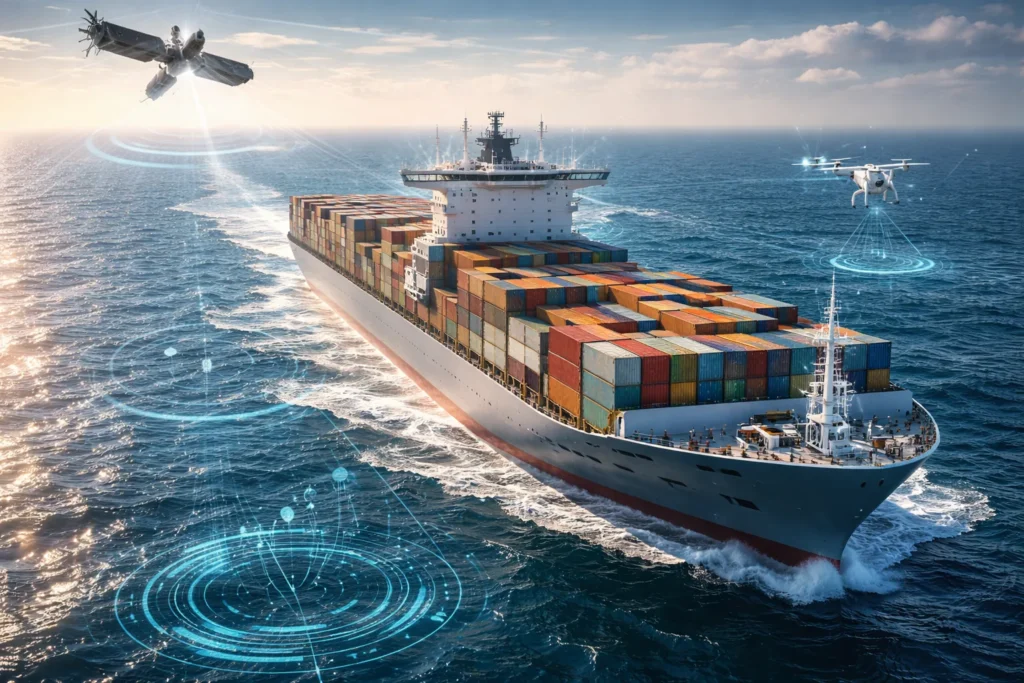

An In-Depth Exploration of the Maritime Revolution
Part One: The Dawn of a New Era
Chapter 1: Standing at the Edge of Tomorrow
Imagine standing on a rocky cliff somewhere on the coast of Portugal, perhaps near the historic Cabo da Roca, the westernmost point of mainland Europe. The Atlantic wind whips salt spray into your face with a ferocity that demands respect. You pull your jacket tighter and stare out at the endless blue horizon, watching the way the sunlight dances across the rolling swells. It is a timeless scene, one that has not changed much since the days of Portuguese explorers who sailed from these very coasts centuries ago, their caravels laden with hope and ambition, bound for unknown lands that existed only in imagination and rumor.
As you stand there lost in thought, a shape materializes on the horizon. At first it is just a smudge, a trick of the light, a disturbance in the perfect line where sky meets sea. But slowly it takes form, growing larger with each passing minute, resolving from ambiguity into certainty. Soon you can make out the distinctive silhouette of a massive cargo vessel, stacked high with thousands of colorful containers that look like children’s building blocks from this distance, each one holding a piece of someone’s life, someone’s livelihood, someone’s connection to the wider world. It is the kind of ship that carries the modern world within its steel belly, your running shoes perhaps, or the computer chips that power your phone, or the coffee beans that will fuel your morning tomorrow, or the medicine that keeps someone alive, or the book someone will read before sleep.
But as the vessel glides closer, something begins to feel wrong, not dangerous wrong but deeply unusual, the kind of wrong that makes you look twice and then a third time, trying to reconcile what your eyes are seeing with what your mind knows must be true. You scan the bridge, the elevated command center near the front of the ship where someone should be standing watch, where generations of sailors have stood watch since the first vessels ventured beyond the sight of land. There is no one there. The glass reflects only the sky and the sea, empty of human presence. You look at the deck, expecting to see crew members in brightly colored safety vests going about their daily tasks, checking equipment, conducting maintenance, simply existing in the space that has been their home for weeks. The deck is completely empty. Your eyes search the railings, the hatches, every place a sailor might be found leaning against a rail, lost in thought, staring at the same horizon you are staring at from your cliff. Nothing. Not a single soul in sight.
The massive ship continues its steady progress, engines humming with quiet confidence, cutting through the swells with precision that would be the envy of any human captain. It adjusts its course slightly, seemingly responding to a fishing boat a mile ahead, calculating distances and speeds with machine accuracy, then settles back on its original heading as the fishing boat passes safely astern. It is all happening without a single human hand touching a wheel, without a single pair of human eyes watching the horizon from the bridge, without a single human voice breaking the silence of the empty ship. The vessel is a ghost, a giant gliding silently through the waves, and it is heading toward a port thousands of miles away where no one is waiting to guide it in, where cranes will unload its cargo automatically, where it will refuel and resupply without any human setting foot on its decks.
This is not a scene from a science fiction novel, despite how it sounds. This is not a preview of some distant future that may or may not arrive in our lifetimes, something to be debated in academic journals and technology conferences. This is happening right now, in our world, on our oceans, while most of us go about our daily lives completely unaware that the fundamental nature of global trade is transforming beneath our feet. Recently, for the first time in the long and storied history of human maritime travel, a fleet of semi-autonomous cargo ships completed a major transoceanic journey. They sailed from the busy ports of Northern Europe, down through the challenging waters of the Atlantic, past the coast of Africa, through the narrow confines of the Suez Canal, across the vastness of the Indian Ocean, and finally into the bustling ports of Asia. They navigated busy shipping lanes where hundreds of vessels cross paths daily, where the consequences of error can be measured in billions of dollars and sometimes in human lives. They avoided treacherous storms that have sent ships to the bottom in centuries past, storms that have tested the courage and skill of sailors since the first vessels dared the open ocean. They dodged fishing boats with unpredictable paths and leisure craft with oblivious operators, small vessels whose crews never realized they were sharing the water with a ship that had no one at the helm. And they did it all with minimal human help, monitored from control rooms thousands of miles away by operators who could have been in any office building anywhere in the world.
This achievement marks a turning point in human history, though you might not have heard much about it yet. It is not just about cool technology or impressive engineering, though there is plenty of both involved. It is about something much bigger, how we will move the things we need, want, and use across the planet for the next hundred years and beyond. It is about the future of global trade, the jobs of millions of people, the health of our environment, the security of our supply chains, the nature of work itself, and the very essence of human relationship with the sea that has shaped our civilizations since the first humans looked at the water and wondered what lay beyond.
Let us dive deep into this story, exploring not just the technology but the people, the history, the challenges, and the profound implications of sending ghost ships across our oceans. This is a story that touches every single person on the planet, whether they realize it or not, because it is ultimately about how our world connects and how that connection is about to change in ways we are only beginning to understand. It is a story of human ingenuity and human anxiety, of progress and loss, of possibilities and limitations. It is, in short, the story of our time told through the lens of the ships that carry our world.
Chapter 2: The Invisible Highway That Moves Your World
To truly understand why this maritime milestone matters so much, we need to start not on the ocean but on land. We need to start in your world, in your daily life, in the spaces where you live and work and play, in the ordinary moments that make up your existence. Because the shipping industry, for all its invisibility in our daily consciousness, is the hidden scaffolding upon which our entire modern way of life is built, the unseen foundation that supports virtually everything we touch, use, consume, and enjoy.
Take a moment right now to look around the room you are in. Really look, with fresh eyes, as if you are seeing everything for the first time, as an anthropologist from another planet might see it, trying to understand how this space came to be. Start with the obvious things. The chair you are sitting in, for instance. Perhaps it is made of wood. That wood might have started its journey in the vast forests of British Columbia in Canada, where Douglas firs have stood for centuries, or in the sustainably managed timberlands of Sweden where forestry has been practiced for generations, or in the tropical hardwood forests of Indonesia where the air is thick with humidity and the sounds of creatures unknown in temperate lands. Someone somewhere cut that tree, operating machinery that itself came from somewhere else, processed it into lumber in a mill powered by equipment from yet another place, and loaded it onto a truck that had traveled from a factory in a different country entirely. That truck took it to a port, perhaps Vancouver or Gothenburg or Jakarta, where it joined thousands of other logs or finished lumber products waiting to begin their ocean voyage. From there, it traveled across an ocean on a ship just like the ones we are discussing, stacked among thousands of other containers or perhaps in the hold of a specialized bulk carrier, crossing thousands of miles of water over weeks of travel. It arrived at another port, was unloaded by cranes operated by skilled workers who may have learned their trade from parents who learned it from theirs, traveled by train or truck to a furniture factory where artisans shaped it into the form you now occupy, and then traveled through a complex distribution network of warehouses and delivery vehicles to the store where you bought it or directly to your home. The journey of that simple chair, before it ever supported your weight, may have covered more miles than most people travel in a lifetime.
Now look at the fabric covering that chair. If it is synthetic, as most modern fabrics are, it likely started as crude oil pumped from deep underground in places like Saudi Arabia, where the desert hides oceans of ancient organic matter, or Russia, where the frozen tundra gives up its resources grudgingly, or Texas, where the landscape is dotted with pump jacks that have become icons of American industry. That oil traveled by pipeline, itself a marvel of engineering stretching across continents, to a refinery where heat and pressure transformed it into plastic pellets small enough to hold in your hand. Those pellets crossed an ocean to a textile mill somewhere in Asia, perhaps in China or India or Vietnam, where they were melted and spun into fibers finer than hair, then woven into fabric on looms that click and clatter in buildings the size of football fields. The fabric was dyed with chemicals that likely came from yet another part of the world, Germany perhaps, with its proud history of chemical engineering, or Japan, where precision is a cultural value as much as an industrial one. The finished fabric was shipped to a factory, possibly in Vietnam or Bangladesh or Indonesia, where workers sitting at rows of sewing machines attached it to the frame of your chair, their skilled hands moving with the speed that comes from years of practice. The completed chair was then packed into a cardboard box made from trees that grew somewhere else entirely, loaded onto another truck, taken to another port, placed on another ship, and began its final journey to you.
Look at the device you are reading this on right now. Whether it is a phone, a tablet, or a computer, it contains minerals from dozens of countries, a geological map of the world compressed into a device that fits in your hand. The lithium in its battery probably came from the salt flats of Bolivia, where the white expanse stretches to the horizon under a sky of impossible blue, or from the mines of Australia, where giant trucks haul ore from depths that would have seemed impossible to previous generations. The cobalt came from the Democratic Republic of Congo, a journey that involves complex supply chains and significant ethical considerations, passing through countries and hands and legal jurisdictions that would take years to fully trace. The rare earth elements used in its screen and speakers came from China, which dominates the processing of these critical materials to an extent that has geopolitical strategists worried about supply security. The copper in its circuits came from Chile or Peru, where mines at altitudes that leave visitors gasping for air produce the red metal that conducts the electrons making this text appear before your eyes. The gold used in tiny amounts in its connectors came from South Africa, where mines descend miles into the earth in conditions that test human endurance, or perhaps from recycled sources that themselves traveled globally before being melted down and reborn in your device. All of these materials moved across oceans on ships before they ever reached the factory where your device was assembled, likely in China or Taiwan or South Korea, in buildings filled with workers whose skills and dedication make the modern digital world possible.
Now think about what you ate today. That banana you had with breakfast probably grew on a plantation in Ecuador, where the volcanic soil and equatorial sun create perfect conditions for the world’s most popular fruit. It was picked while still green, by workers who start before dawn to beat the heat, packed carefully into refrigerated containers that maintain exactly the right temperature and humidity, and loaded onto a specialized ship designed to keep fruit fresh during a voyage that might take weeks across oceans and through canals. The coffee that woke you up this morning likely started as beans on a hillside in Colombia, where the combination of altitude and latitude produces some of the world’s most sought-after arabica, or in Ethiopia, where coffee drinking may have originated with a goatherd who noticed his animals dancing after eating certain berries, or in Vietnam, which has become a coffee powerhouse in recent decades. The beans were picked by hand, processed to remove the fruit surrounding them, dried in the sun, sorted by size and quality, bagged in burlap, and shipped across oceans to a roaster near you. The sugar you might have stirred into that coffee came from Brazil, where vast plantations stretch across former rainforest, or from India, where sugarcane has been cultivated for thousands of years, or from the Caribbean islands where the crop shaped colonial history in ways whose effects are still felt today. The wheat in your bread grew in the vast fields of the American Midwest, where combines crawl across horizons unbroken by trees, or the Ukrainian steppes, whose rich black soil is among the most fertile on Earth, or the Australian outback, where farming is a constant battle against drought and distance. Even if you try to eat only locally produced food, shopping at farmers markets and growing your own vegetables, the odds are overwhelming that many items in your kitchen traveled across oceans to reach you, whether the spices in your cabinet, the olive oil on your counter, the salt in your shaker, or the tea in your cupboard.
The numbers behind this global movement are almost too big to comprehend, too vast for the human mind to truly grasp. Approximately ninety percent of everything we use, wear, and eat is moved by ships at some point in its journey to us. The global shipping industry moves about eleven billion tons of goods every single year, a number so large it loses meaning without context. That is roughly one and a half tons for every person on the planet, every man, woman, and child, every year. If you loaded all the containers moved by ships in a year onto a train, that train would stretch to the moon and back multiple times, a ribbon of steel and cargo reaching into space. The global fleet of commercial vessels numbers somewhere around fifty thousand ships, ranging from small coastal freighters that look like toys next to their larger cousins to massive container ships that can carry more than twenty thousand containers at once, their decks covering an area larger than several football fields. These ships are crewed by about one and a half million sailors from virtually every country on Earth, speaking dozens of languages, practicing many religions, representing a cross-section of humanity that would be impossible to assemble anywhere else. They spend months away from their families, living in cramped quarters, facing dangers that would make most of us run for solid ground, all so that the rest of us can have bananas in winter and affordable shoes and phones that connect us to the world.
The shipping industry is the invisible highway that connects our world, the hidden circulatory system of the global economy, the silent partner in every transaction that crosses borders. It is the reason we have so many choices in stores, with fresh produce available even in winter and products from every corner of the globe within reach of anyone with internet access and a credit card. It is the reason prices stay relatively low, because moving goods by ship is incredibly efficient, it costs only a few cents to move a t-shirt from Asia to North America by water, compared to several dollars by air and even more by land. It is the reason that globalization has been possible, that economies have grown, that standards of living have risen in countries around the world. Without shipping, the world as we know it would simply cease to exist.
For centuries, moving these goods has relied entirely on the skill, courage, and endurance of sailors. These are the men and women who spend months away from their families, living in cramped quarters, facing dangers that would make most of us run for solid ground. They deal with pirate threats in dangerous waters like the Gulf of Aden and the Strait of Malacca, where small boats crewed by armed men can appear from nowhere and change everything in moments. They face extreme weather, from hurricanes in the Atlantic that can generate waves the height of buildings to typhoons in the Pacific that test the limits of ship design to the fearsome Southern Ocean storms that circle Antarctica unimpeded by any landmass, creating conditions that have been described by those who survived them as like being inside a washing machine during its most violent cycle. They navigate some of the most challenging waterways on Earth, threading massive ships through narrow straits where a moment’s inattention can mean grounding on rocks that have waited centuries for a victim, avoiding treacherous shallows where the bottom rises unexpectedly, and sharing crowded seas with everything from tiny fishing boats whose operators may not understand the rules of navigation to naval vessels engaged in exercises to leisure craft whose operators may be more interested in their cocktails than their surroundings.
The loneliness of the open ocean is something few landlubbers can truly appreciate, something that cannot be conveyed in words or images. Imagine weeks going by without seeing another human being outside your small crew, the same faces day after day, the same conversations, the same routines. Imagine missing birthdays, anniversaries, the birth of children, the first steps, the first words, the school plays and soccer games and family dinners that make up the fabric of life. Imagine the constant hum of engines, the endless horizon, the knowledge that you are responsible for a vessel worth tens of millions of dollars and cargo worth even more, that any mistake could have consequences measured in lives and dollars and environmental damage. Imagine the psychological weight of that responsibility, carried day after day, week after week, with no one to share it but your equally burdened shipmates. It is a tough life, a dangerous life, a vital life that has powered global trade since the first humans dared to venture beyond the sight of land, and it is a life that is about to change forever.
But recently, the industry has faced pressures that even the most experienced sailors could not have predicted a generation ago. There is a growing shortage of people who want to become sailors, especially in developed countries where young people have more options and maritime careers can seem unappealing compared to life on land with its comforts and connections. The average age of sailors is rising, and recruitment is struggling to keep pace with retirements, creating a demographic crisis that threatens the industry’s ability to crew its ships. Fuel costs have become a massive burden, eating into already thin profit margins and making efficiency more critical than ever as oil prices fluctuate and environmental regulations tighten. And the world is demanding that shipping clean up its act, reducing the pollution that comes from burning some of the dirtiest fuel on the planet, fuel that in some cases is so thick it must be heated before it can even be pumped.
For decades, shipbuilders, shipping companies, and maritime engineers have been asking the same fundamental question, “There must be a better, safer, cheaper, and cleaner way to do this.” The recent autonomous voyage across the ocean suggests they may have finally found the answer they have been seeking. But like all answers to complex questions, this one opens up a whole new set of questions about technology, jobs, safety, law, ethics, and the future of human relationship with the sea. It is those questions that we will explore in the pages that follow, as we try to understand what the ghost ships mean for all of us.
Chapter 3: A Short History of Moving Things by Water
Before we dive deeper into the autonomous revolution, it is worth taking a moment to appreciate how we got here, to understand the long arc of maritime history that has brought us to this moment. The story of shipping is, in many ways, the story of human civilization itself, the story of how we learned to cross the waters that separate us and in doing so, connected the world. From the moment our ancestors first realized that a log could carry them across a river, we have been trying to move ourselves and our goods more efficiently over water, and each advance in that effort has reshaped human society in profound ways.
The earliest ships were simple affairs, humble beginnings for what would become a global industry. Hollowed-out logs, what we now call dugout canoes, represent some of the earliest human watercraft, created by people who observed that wood floats and that a shaped log floats better than a round one. Bundles of reeds lashed together, like the totora reed boats of Lake Titicaca that have been used for thousands of years and are still made today, show how people used available materials to create vessels capable of carrying significant loads. Animal skins stretched over wooden frames, like the curraghs of Ireland and the coracles of Wales, demonstrate the principle of the skin boat that would later evolve into more sophisticated designs. But even these humble vessels allowed our ancestors to fish in deeper waters, to trade with neighboring communities across rivers and lakes, to explore new horizons that were previously inaccessible. They were the first steps in humanity’s relationship with the water, steps that would eventually lead to the global shipping network we have today.
The ancient Egyptians were building sophisticated wooden ships more than four thousand years ago, vessels capable of sailing the Nile and venturing into the Mediterranean. These ships, some of which have been found preserved in tombs, were constructed without nails, using mortise and tenon joints like giant pieces of furniture, held together with ropes that could be tightened or loosened as the wood swelled and shrank. They carried obelisks weighing hundreds of tons from the quarries of Aswan to the temples of Luxor and Karnak, a feat of engineering that still impresses modern observers. They traded with the mysterious land of Punt, somewhere in the Horn of Africa, bringing back incense, ivory, and exotic animals that would never have been seen in Egypt otherwise. Egyptian art from this period shows ships with sails and oars, with crews working in coordination, with cargo stacked on decks, scenes that would be recognizable to sailors thousands of years later.
The Phoenicians, based in what is now Lebanon, became the great traders of the ancient world, their ships carrying purple dye made from murex snails, glass that was prized throughout the Mediterranean, and cedar wood that was used for building and shipbuilding. They established trading posts and colonies across the Mediterranean, including Carthage, which would later become a power in its own right and challenge Rome for control of the sea. Phoenician ships were among the first to venture beyond the Mediterranean, with some evidence suggesting they may have circumnavigated Africa, a feat that would not be repeated for nearly two thousand years. They developed the bireme and trireme, ships with multiple banks of oars that could achieve speeds that sailing ships could not match in calm weather, and their designs influenced shipbuilding throughout the ancient world.
The Polynesians accomplished perhaps the most remarkable feat of ancient navigation, using outrigger canoes to explore and settle islands across the vast Pacific, an ocean covering one third of the Earth’s surface. Starting from somewhere in Southeast Asia, they spread east across thousands of miles of open water, finding and settling islands that were no more than specks on the map, using navigation techniques that remain impressive today. They read the stars, knowing which rose at which point on the horizon at different times of year. They read the waves, detecting patterns of reflection and refraction that indicated land beyond the horizon. They read the birds, following species that returned to land each evening. They read the clouds, recognizing the distinctive formations that form over islands. With no instruments, no charts, no written language, they populated the Pacific, from Hawaii in the north to New Zealand in the south to Easter Island in the east, a triangle of settlement that represents one of humanity’s greatest achievements.
The Greeks and Romans built on these foundations, creating massive trading networks that moved grain from Egypt to Rome, olive oil from Greece to Gaul, wine from Italy to Britain. Their ships were powered by a combination of sails and oars, with banks of rowers providing muscle when the wind failed, often slaves or prisoners of war whose labor was cheap and whose lives were considered expendable. The Romans in particular understood the importance of shipping to their empire, investing heavily in ports, lighthouses, and harbor infrastructure that would serve as models for centuries to come. They built the Port of Ostia at the mouth of the Tiber, with warehouses and docking facilities that could handle the grain ships from Egypt that kept Rome fed. They built lighthouses around the Mediterranean, including the famous Pharos of Alexandria, one of the Seven Wonders of the World, whose light could be seen for miles guiding ships to safety. They developed harbors with moles and breakwaters that protected ships from storms, and they created a legal framework for maritime commerce that influenced shipping law for millennia.
The medieval period saw the rise of new ship types and new trading powers, as the center of maritime activity shifted and new players entered the game. The Vikings perfected the longship, a masterpiece of naval architecture that could cross the Atlantic, navigate shallow rivers, and carry raiders to the coasts of England, France, and beyond. These ships, with their clinker-built hulls and square sails, were fast, maneuverable, and seaworthy, capable of voyages that would have seemed impossible to earlier peoples. They could be sailed in open water and rowed in rivers, allowing Viking raiders to strike deep into the heart of Europe, appearing where they were least expected and vanishing before resistance could be organized. The Vikings also developed the knarr, a broader, deeper ship designed for cargo rather than raiding, which carried the settlers who colonized Iceland and Greenland and briefly attempted settlement in North America.
The Hanseatic League, a confederation of merchant guilds from northern German cities, dominated trade in the Baltic and North Seas with their sturdy cogs, round-hulled ships that could carry substantial cargoes. The cog, with its straight stem and stern, its single mast and square sail, was the workhorse of northern European trade for centuries, carrying grain from Poland, timber from Scandinavia, fish from the North Sea, and wool from England. The League established trading posts, called kontors, in cities from London to Novgorod, creating a trading network that linked the resources of the north with the markets of the south. At its height, the League could field armies and negotiate with kings, so powerful was its control of trade.
In the Mediterranean, Italian city-states like Venice and Genoa built vast trading empires based on their control of shipping routes, their galleys carrying spices, silks, and luxuries from the East to eager European markets. Venice, built on islands in a lagoon, was a maritime republic in the most literal sense, its existence dependent on the sea. Its Arsenal was one of the largest industrial complexes in the world before the Industrial Revolution, capable of producing a ship in a day using assembly line techniques that would not be seen again until Henry Ford. Venetian merchants traveled to Constantinople, Alexandria, and beyond, bringing back goods that would be sold throughout Europe, making Venice one of the wealthiest cities in the world.
The age of exploration that began in the fifteenth century would have been impossible without advances in ship design, without vessels capable of crossing oceans and surviving conditions that had defeated earlier attempts. The caravel, developed by the Portuguese, was a revolutionary vessel that combined the best features of existing ship types. It was small enough to be maneuverable in coastal waters, sturdy enough to face Atlantic storms, and equipped with lateen sails that allowed it to sail closer to the wind than previous vessels, giving it unprecedented flexibility in choosing courses. It was in ships like these that Portuguese explorers crept down the coast of Africa, pushing further each year, driven by Prince Henry the Navigator’s vision of reaching India by sea. It was in a caravel that Columbus crossed the Atlantic, though his estimates of the distance were wildly optimistic and only luck and the existence of the Americas prevented his crew from perishing in the middle of an ocean he had no idea was so vast. It was in caravels that Vasco da Gama reached India, opening the sea route that would transform European access to Asian goods.
The carrack and later the galleon carried Spanish treasure from the Americas, silver from Potosi and gold from Colombia, across the Atlantic in fleets that were the targets of pirates and privateers for centuries. These ships, larger than the caravels that preceded them, could carry more cargo and more guns, making them both more profitable and more defensible. They sailed in convoys for protection, their schedules dictated by the need to avoid hurricane season and to coordinate with the winds that carried them across the ocean. The Manila galleons crossed the Pacific annually for two and a half centuries, carrying silver from Mexico to the Philippines and silk and spices back, creating the first regular trade link between the Americas and Asia.
The industrial revolution transformed shipping as thoroughly as it transformed everything else, replacing sail with steam, wood with iron, craftsmanship with industry. Steam power freed ships from dependence on the wind, allowing them to travel on predictable schedules regardless of weather, a development that was as revolutionary for its time as autonomy is for ours. Early steamships were inefficient, carrying more coal than cargo, but improvements in engine design gradually made them practical for longer voyages. Iron hulls replaced wooden ones, allowing ships to grow much larger and stronger, and making possible hull forms that would have been impossible in wood. The screw propeller proved more efficient than paddle wheels, and its development in the mid-nineteenth century gave steamships a decisive advantage over paddle steamers.
The opening of the Suez Canal in 1869 and the Panama Canal in 1914 shortened voyages dramatically, reshaping global trade patterns in ways that are still felt today. The Suez Canal, cutting through the Egyptian desert, eliminated the need to sail around Africa to reach Asia, reducing the distance from London to Bombay by more than forty percent. The Panama Canal, a feat of engineering that cost tens of thousands of lives, did the same for voyages between the Atlantic and Pacific, eliminating the treacherous passage around Cape Horn. These canals became choke points of global trade, strategic locations whose control was worth fighting for, as demonstrated by the Suez Crisis of 1956.
By the early twentieth century, steam had largely replaced sail, though a few sailing vessels hung on in niche roles until surprisingly recently. The last commercial sailing ships, used for carrying grain between Australia and Europe, operated into the 1940s, and windjammers remained competitive on some routes long after steam had triumphed elsewhere. But the writing was on the wall, and the age of sail was over.
The true revolution in modern shipping, however, came with the invention of the shipping container, a development as important as the transition from sail to steam and perhaps even more consequential. Before containers, loading and unloading a ship was a labor-intensive nightmare that would be unrecognizable to anyone who has seen a modern port. Goods were packed into barrels, crates, bales, and sacks of every imaginable shape and size, each requiring individual handling. Longshoremen would carry each item individually onto the ship, often along narrow gangplanks, where it would be stowed in whatever space was available by workers who had to be skilled in the art of packing irregular objects into irregular spaces. The process took days or even weeks, cost a fortune, and provided endless opportunities for theft and damage as goods passed through multiple hands in multiple locations.
Then came Malcolm McLean, a North Carolina trucker who had a simple but revolutionary idea in the 1950s. What if truck trailers could be lifted directly onto ships, without unloading their contents? What if goods traveled in standardized boxes that could move seamlessly from truck to train to ship without ever being opened, without ever being handled by human hands except at the very beginning and end of their journey? McLean’s idea became the shipping container, and it changed the world more profoundly than almost any other invention of the twentieth century.
The container standardizes everything. A container is eight feet wide, eight and a half feet high, and either twenty or forty feet long, dimensions that have become the universal language of global trade. Cranes are designed to lift them. Trucks are designed to carry them. Trains are designed to haul them. Ships are designed to stack them. Ports are designed to handle them. The entire global logistics system is built around this simple box, and the results have been transformative.
Today, more than two hundred million container movements occur each year, moving everything from electronics to clothing to food to furniture to machinery to medicine. A single container ship can carry more goods than an entire fleet of the vessels that plied the oceans just a few decades ago, and can load and unload those goods in hours rather than weeks. The cost of moving goods has plummeted, making it economical to produce things anywhere and sell them everywhere. The world has been reshaped by the container, and most people have never heard of Malcolm McLean.
The scale of modern container ships is almost incomprehensible, even to those who work with them every day. The largest can carry more than twenty thousand containers, each twenty or forty feet long, stacked in rows that rise higher than apartment buildings. If you lined up those containers end to end, they would stretch for more than one hundred miles, a line of boxes reaching from New York to Philadelphia or from London to Paris. The ships themselves are longer than the tallest buildings are tall, more than a quarter mile from bow to stern. They are wider than a football field, with decks that cover acres of space. They are so deep that they require specially dredged channels to enter many ports, channels that must be maintained at enormous expense to accommodate their draft. Their engines produce more power than thousands of cars, with cylinders so large that a person could stand inside them. Their fuel tanks hold millions of gallons of heavy fuel oil, enough to power a small city for months.
And yet, for all this progress, for all these advances in size and speed and efficiency, the basic principle of ship operation remained the same for thousands of years, humans on board, watching the horizon, steering the vessel, making decisions based on experience and judgment. Until now.
Chapter 4: The Big Idea – What Does Autonomous Really Mean?
When most people hear the word autonomous, they immediately think of something that operates entirely on its own, without any human input or oversight. They imagine robots that think and act independently, making decisions without reference to human values or preferences, pursuing goals that may or may not align with human interests. They picture a world where machines have taken over completely, leaving humans as passive passengers in a technological future we no longer control, spectators to our own obsolescence.
The reality of autonomous shipping, like the reality of most emerging technologies, is considerably more nuanced and interesting. Autonomy is not a simple on-off switch, a binary state where a ship is either fully crewed or fully independent. It is a spectrum, a range of capabilities that can be mixed and matched depending on the situation, the vessel, the cargo, the route, and the preferences of the company operating it. To understand this spectrum, it is helpful to use the framework developed for autonomous vehicles on land, adapted appropriately for the maritime context, a framework that provides a common language for discussing different levels of automation.
At the most basic level, we have Level Zero autonomy. This is the way ships have operated for most of human history, from the dugout canoes of our ancestors to the container ships of the present day. Every function, from steering to navigation to engine control to lookout duties, is performed by human beings on board the vessel. The captain makes decisions based on training and experience, drawing on years of practice and the accumulated wisdom of generations of sailors. The crew carries out those decisions, their actions coordinated by hierarchy and routine. Technology may assist, in the form of radar or GPS or electronic charts, but every significant action requires human initiation and human oversight. The human is always in charge, always responsible, always the final authority. This is still how the vast majority of the world’s ships operate today, and it will likely remain common for decades to come.
Level One autonomy introduces the first small steps toward automation, steps that are already familiar to anyone who has driven a modern car. This is analogous to cruise control in a car, where the vehicle can maintain a set speed without constant human input, or automatic pilot in an aircraft, which can hold a heading and altitude while the pilots attend to other tasks. On a ship, Level One might mean the vessel can maintain a steady course automatically, freeing the helmsman from constantly adjusting the wheel, allowing him to focus on other duties or simply to rest his hands. The autopilot systems that have been common on ships for decades are examples of Level One autonomy, simple feedback loops that keep the ship pointing in the right direction. But the human crew is still fully responsible for navigation, collision avoidance, and all other aspects of ship operation. The automation is simply a tool to reduce workload on straightforward tasks, not a replacement for human judgment.
Level Two autonomy represents a significant jump in capability, moving from simple automatic functions to integrated systems that can handle multiple tasks simultaneously. At this level, the vessel can handle multiple functions without constant human input, combining course-keeping with speed adjustment, maintaining an optimal route based on weather conditions and traffic. It might have basic collision avoidance capabilities, alerting the crew if another vessel gets too close, perhaps even suggesting evasive maneuvers. It can integrate data from multiple sensors to build a picture of the situation around the ship, displaying that information in ways that help the crew make better decisions. But a human must still be constantly monitoring the situation, ready to take over at a moment’s notice. The vessel cannot handle unexpected situations on its own, and the crew remains fully responsible for safety. Level Two is about assistance, not replacement, about giving humans better tools rather than taking them out of the loop.
Level Three autonomy is where things get really interesting, where the relationship between human and machine begins to shift in fundamental ways. This is the level achieved by the vessels that recently completed their historic transoceanic voyage, and it represents a qualitative change in how ships operate. At Level Three, the vessel can handle all aspects of navigation and collision avoidance for extended periods without any human input whatsoever. It can see other vessels using its suite of sensors, predict their movements with considerable accuracy, and make legally compliant decisions about how to avoid them. It can optimize its route for fuel efficiency, weather, and traffic, continuously adjusting as conditions change. It can handle routine situations completely on its own, freeing human operators from the need for constant monitoring, allowing them to focus their attention where it is most needed.
But Level Three vessels are not completely independent, not yet anyway. They are semi-autonomous or conditionally autonomous, meaning they can handle normal situations but may need human assistance in abnormal ones. If the vessel encounters something confusing, perhaps a fishing boat behaving unpredictably as its crew works their nets, or a previously uncharted navigation hazard revealed by unusual currents, or a severe storm that requires judgment beyond its programming, it sends an alert to a human operator. That operator, sitting in a control center perhaps thousands of miles away, can assess the situation using the ship’s sensors and cameras, draw on experience and judgment, and make a decision. The vessel then carries out that decision autonomously, translating the human’s command into precise control inputs. The machine handles the routine, the human handles the exceptional.
This is the human in the loop model that characterizes most current thinking about autonomous shipping, the approach that the recent voyage successfully demonstrated. The machine handles the routine, the boring, the predictable, all the situations it has been trained to handle through millions of miles of simulated and actual operation. The human handles the exceptional, the confusing, the unprecedented, all the situations that require judgment beyond what can be programmed. It is a partnership that leverages the strengths of both, the machine’s tireless attention and perfect memory, the human’s creativity and judgment and ability to reason about novel situations. Neither could do the job alone as well as they can do it together.
Level Four autonomy takes this a step further, moving from conditional independence to full independence within defined parameters. At Level Four, the vessel can handle all situations, including emergencies, without human intervention, at least within its designated operational domain. It might still have a remote monitoring capability, and humans might be able to take control if they wish, but the vessel does not need them. It can deal with anything the ocean throws at it, from sudden storms to unexpected obstacles to equipment failures, making decisions and taking actions based on its programming and the specific situation it faces. Level Four vessels do not exist yet, at least not for long-distance commercial voyages. They remain a goal for the future, a target that researchers and engineers are working toward, a challenge that will require advances in artificial intelligence, sensor technology, and system reliability.
Level Five autonomy is the ultimate destination, the fully autonomous vessel that requires no human involvement at any time, in any situation, under any conditions. These ships would be loaded, sailed, unloaded, and maintained entirely by machines, with no provision for human presence at any stage. They might not even have any provision for human presence, no bridge, no accommodations, no life support systems, no safety equipment for people who will never be there. They would be pure cargo carriers, optimized entirely for efficiency without any consideration for human needs or comfort, their shapes determined by hydrodynamics rather than by the requirements of human habitation. Level Five autonomy is still a long way off, if it ever arrives at all. There are many who argue that some human involvement will always be desirable, if only for the judgment and flexibility that humans bring to unexpected situations, for the ethical reasoning that machines cannot replicate, for the simple fact that machines are tools and tools need tool users.
So when we talk about the autonomous ships that just made history, we are talking about Level Three autonomy. These are vessels that can sail themselves for weeks at a time, navigating complex traffic situations and responding to changing conditions, but they are constantly monitored by human operators who can step in when needed. They are not replacing human judgment, they are extending it, allowing a small number of operators to oversee many vessels, intervening only when their expertise is truly needed. They are the first step on a long journey, the opening chapter of a story whose ending we cannot yet know.
Chapter 5: The Dreamers and Builders – Who Made This Possible?
Every great technological achievement stands on the shoulders of countless individuals, some famous, most obscure, who contributed their ideas, their labor, and their passion to making the impossible possible. The autonomous ships that crossed the ocean are no exception. Behind the gleaming technology and the impressive statistics are real people who dreamed of a different future and worked for years to bring it into being, people whose names will never appear in headlines but whose efforts made the voyage possible.
Meet Dr. Sarah Chen, a marine robotics specialist who started her career designing underwater exploration vehicles for oceanographic research, machines that could dive to depths where no human could survive and explore worlds of perpetual darkness. She spent months at sea on research vessels, watching scientists struggle to collect data in dangerous conditions, watching them risk their lives to study the ocean they loved. She began to wonder, if we can send robots to explore the deepest ocean trenches, to withstand pressures that would crush any human-occupied vehicle, why are we still sending humans to do routine jobs on the surface? Her early work on autonomous surface vehicles caught the attention of a major shipping company, and she was hired to lead their autonomy program, a position that would have been unthinkable a decade earlier. For the past decade, she and her team have been developing and testing the systems that made the recent voyage possible, working through countless setbacks and disappointments, celebrating small victories and learning from failures. She is quick to deflect credit, insisting that the real heroes are the sailors and engineers who helped refine the technology through countless trials, the software developers who wrote millions of lines of code, the technicians who installed and maintained the systems on rolling ships in stormy seas. But everyone in the industry knows her name, and her vision has shaped the entire field.
Then there is Captain James Okonkwo, a veteran mariner who spent twenty-five years at sea before joining the autonomy revolution, a man whose face is mapped with the lines that come from staring into sunrises and sunsets on every ocean. He started as a deck cadet on a Nigerian coastal vessel, learning his trade the old way, from experienced sailors who had learned from experienced sailors before them. He worked his way up through the ranks, from third mate to second mate to chief mate to master, and eventually commanded some of the largest container ships in the world, vessels longer than skyscrapers are tall, carrying cargo worth billions. He has seen it all, pirates off Somalia who approached in small boats with ladders and automatic weapons, typhoons in the South China Sea that made the ship feel like a toy, mechanical failures in the middle of the ocean that required improvised repairs with limited tools, crew conflicts that threatened to turn deadly in the close quarters of a ship at sea. When he first heard about autonomous ships, he was skeptical, even hostile. No machine could replace the experience and judgment of a skilled captain, he thought. No algorithm could replicate the gut feeling that tells you something is wrong before any instrument shows it. But then he was invited to participate in a simulation, to test the autonomous systems and try to find their weaknesses. He spent days trying to trick the system, throwing every scenario he had encountered in his career at the software, every near-miss and close call, every situation that had tested his own skills to the limit. To his surprise, the machine handled most of them well, sometimes better than he would have, calculating escape routes and collision avoidance maneuvers with a speed and precision that no human could match. When it failed, the failures were instructive, revealing edge cases that the programmers had not considered, leading to improvements in the code. Captain Okonkwo came away convinced that autonomy had a place in shipping, and he joined the company as a consultant, helping to ensure that the technology respected the realities of life at sea, that it was built by people who understood what they were building.
Dr. Yuki Tanaka approaches the problem from a completely different angle, bringing perspectives that would never occur to engineers or sailors. He is a cognitive psychologist who studies how humans and machines can work together effectively, how to design systems that leverage the strengths of both without falling into the weaknesses of either. His research focuses on the handoff problem, what happens when an autonomous system encounters a situation it cannot handle and needs to alert a human operator. How do you make sure the human understands the situation quickly enough to make a good decision, especially when they may have been monitoring multiple vessels and may not have been focused on this particular ship? How do you present the relevant information in a way that can be grasped in seconds, without overwhelming the operator with data? How do you prevent the human from being overwhelmed by alerts from multiple vessels, each demanding attention at the same time? How do you maintain human attention during long periods when nothing is happening, when the systems are running smoothly and the operator has nothing to do but watch? Dr. Tanaka’s insights have shaped the design of the remote control centers, the interfaces that operators use to monitor and interact with the vessels, the training programs that prepare operators for their unique responsibilities. He is concerned with the human side of the equation, the psychological and cognitive factors that will determine whether autonomous shipping succeeds or fails, the subtle ways that design choices affect human performance.
And then there are the thousands of people whose names will never appear in any article or history book, whose contributions will never be recognized outside their immediate circles, but without whom the autonomous voyage would have been impossible. The welders in South Korean shipyards who built the hulls with precision that would have amazed their parents, running beads of molten metal that would hold back the ocean for decades. The software engineers in India who wrote millions of lines of code, debugging late into the night, drinking coffee and staring at screens, chasing bugs that only appeared in certain conditions. The electronics technicians in Germany who assembled the sensor arrays with painstaking care, soldering connections that had to withstand vibration and corrosion and temperature extremes. The data analysts in London who processed the results of countless test voyages, identifying patterns and suggesting improvements, finding needles of insight in haystacks of information. The port workers who helped integrate the autonomous vessels into existing operations, teaching the machines the peculiarities of their facilities, the local currents and wind patterns that don’t appear on any chart. The regulators who spent sleepless nights trying to figure out how to write rules for a technology that did not exist when they started their careers, balancing innovation against safety, progress against precaution.
The autonomous voyage that just concluded is the product of all these people and thousands more, a collective achievement that spans continents and disciplines. It represents not just technological achievement but human achievement, the culmination of countless individual efforts directed toward a common goal. The ships may have sailed themselves across the ocean, but they were built, programmed, tested, and monitored by humans every step of the way. The ghost ships are haunted not by spirits but by the collective intelligence and effort of the people who made them possible, and that is a kind of haunting we should all be proud of.
Part Two: The Technology Behind the Miracle
Chapter 6: The Brain of the Boat – Understanding the Electronic Captain
How does a steel vessel the size of a small office building think? How does a machine with no consciousness, no intuition, no life experience navigate the complex and unpredictable environment of the open ocean, where conditions change by the minute and the consequences of error can be catastrophic? The answer lies in algorithms, those sets of rules and instructions that tell a computer how to solve problems, how to process information, how to make decisions. In the case of an autonomous ship, the problem is deceptively simple to state but enormously complex to solve, how do I get from Point A to Point B safely, efficiently, and legally, without hitting anything or endangering anyone?
The ship’s brain is a powerful computer system, actually multiple computers working in tandem for redundancy, that runs a sophisticated piece of software often called an Electronic Captain by its developers. This software is the culmination of decades of research in robotics, artificial intelligence, navigation, and maritime operations, drawing on insights from fields as diverse as control theory, cognitive science, and oceanography. It is not a single program but a suite of integrated modules that handle different aspects of the ship’s operation, all communicating constantly to ensure coordinated action, sharing data and reconciling conflicts.
The Electronic Captain begins with a fundamental understanding of the vessel itself, a detailed model of the ship’s capabilities and limitations. It knows the ship’s exact dimensions, its length and beam and depth, information that is critical for navigating tight channels and avoiding obstacles. It knows its draft, how deep it sits in the water, which varies with loading and must be constantly updated as fuel is consumed and cargo shifts. It knows its turning radius at different speeds, how quickly it can change direction in response to helm commands, data that is essential for collision avoidance. It knows its acceleration and deceleration characteristics, how long it takes to build up speed or to stop, information that determines how far ahead it must look to avoid trouble. It knows its handling in various sea conditions, how it responds to wind and waves, how much leeway it makes when the wind pushes against its high sides. It knows its performance characteristics, how fuel consumption varies with speed and weather, data that is used to optimize routing for efficiency. This self-knowledge is constantly updated as the voyage progresses, with the computer tracking fuel burned, cargo shifted, and any changes in the vessel’s behavior, maintaining an accurate model of the ship it is controlling.
The Electronic Captain also carries within it an extraordinarily detailed model of the world it will traverse, a digital representation of the ocean and its features. It has electronic charts that include not just coastlines and depths but also navigation aids like buoys and lighthouses, restricted areas where entry is prohibited or controlled, shipping lanes that concentrate traffic in defined corridors, anchorage areas where vessels can wait, and countless other features that mariners need to know. These charts are updated constantly via satellite, ensuring that the vessel always has the most current information about changing conditions, about new obstacles or altered channels, about temporary restrictions or hazards. The computer knows where the shallow water is, where the rocks lurk just below the surface, where the underwater cables and pipelines lie protected by exclusion zones. It knows the locations of ports and harbors, the approaches and channels that must be followed, the local regulations that apply in different jurisdictions, the peculiarities of each destination.
But the most critical knowledge the Electronic Captain possesses is the Rules of the Road, the International Regulations for Preventing Collisions at Sea, commonly known as COLREGs. These are the official rules that tell every vessel operator who has the right of way in any situation, how vessels should approach each other, what actions are required to avoid collision, how to communicate intentions in the universal language of navigation. They have been developed over more than a century of maritime experience, refined through countless incidents and court cases, tested in every conceivable situation, and they form the foundation of safe navigation everywhere on Earth’s oceans.
The COLREGs are surprisingly complex, far more nuanced than most people realize, full of exceptions and special cases that challenge even experienced human sailors. Rule Thirteen, for instance, deals with overtaking, a vessel overtaking another must keep out of the way of the vessel being overtaken, regardless of any other considerations, even if the overtaken vessel is normally required to give way. Rule Fifteen covers crossing situations, when two power-driven vessels are crossing so as to involve risk of collision, the vessel which has the other on its own starboard side, its right side, must keep out of the way. Rule Eighteen specifies the relationships between different types of vessels, a power-driven vessel must keep out of the way of a sailing vessel, which must keep out of the way of a vessel engaged in fishing, and so on through a hierarchy that includes vessels not under command, vessels restricted in their ability to maneuver, and vessels constrained by their draft. There are rules for narrow channels, rules for traffic separation schemes, rules for vessels in sight of one another and for vessels in restricted visibility. There are rules about sound signals, about light configurations, about day shapes displayed on masts. The complete body of regulations runs to dozens of pages, and mastering them is a significant part of every mariner’s training.
The Electronic Captain has all of these rules programmed into its core, not as simple if-then statements but as a sophisticated decision-making framework that can handle the ambiguity and complexity of real-world encounters. When the ship’s sensors detect another vessel, the computer identifies its type based on size, shape, behavior, and navigation lights, categorizing it according to the COLREG classifications. It calculates its speed and heading, using radar tracking over time to establish a reliable vector. It predicts its future position, projecting its path forward and accounting for the possibility of course changes. It determines whether a risk of collision exists, using the concepts of closest point of approach and time to closest point of approach that are fundamental to collision avoidance. If it does, the computer evaluates the applicable COLREG rules, considering all the factors that might affect which vessel is required to give way. It considers the available options for avoiding collision, evaluating each against the rules and against the ship’s maneuvering capabilities. It selects the safest and most legally compliant maneuver, the one that minimizes risk while respecting the rights of other vessels. All of this happens in seconds, continuously updated as the situation evolves, as new vessels appear and old ones disappear, as courses and speeds change.
This is perhaps the most remarkable aspect of the Electronic Captain, its ability to handle multiple encounters simultaneously, to track dozens of vessels at once and plan maneuvers that account for all of them. In busy waterways like the English Channel or the Singapore Strait, a ship might be surrounded by dozens of other vessels, all moving in different directions at different speeds, all with their own intentions and capabilities. A human captain must prioritize, focusing on the most immediate threats while keeping track of the overall situation, a cognitive challenge that pushes the limits of human attention. The Electronic Captain can track every single vessel within range, predicting their paths, evaluating collision risks, and planning maneuvers that account for the entire traffic situation. It is like having a chess grandmaster who can play dozens of games simultaneously, never losing track of any piece on any board, calculating multiple moves ahead for each. This is not a replacement for human judgment, it is a supplement to it, a tool that extends human capabilities beyond their natural limits.
Chapter 7: The Seeing Ship – Sensors, Radar, and Digital Eyes
A brain without senses is useless, trapped in permanent darkness with no awareness of the world, no way to know what is happening beyond its own boundaries. For the Electronic Captain to navigate safely, it needs a constant stream of information about its environment, a continuous flow of data that describes the world in enough detail to support safe decision-making. It needs to see the other vessels, the coastline, the hazards, the weather, everything that might affect its passage. It needs to know where it is with precision, how it is moving, and what is happening around it. This is the job of the ship’s sensor suite, an array of technologies that work together to create a comprehensive picture of the vessel’s situation, each sensor contributing its unique capabilities to the overall understanding.
Radar is the old standby of maritime navigation, a technology that has been keeping ships safe for more than eighty years, since its development during World War II transformed naval operations and then spread to the commercial fleet. It works by broadcasting radio waves and listening for their echoes as they bounce off objects, the same principle as shouting in a canyon and hearing your voice return. The time it takes for an echo to return tells the radar how far away the object is, radio waves travel at the speed of light, so the delay is tiny but measurable. The direction from which the echo comes tells where the object is located, using a rotating antenna that scans the horizon. Modern radar systems are extraordinarily sophisticated, capable of detecting everything from large ships to small buoys, tracking hundreds of targets simultaneously, and filtering out clutter from waves and rain that would have confused earlier systems. The autonomous ship’s radar provides continuous information about other vessels, landmasses, and potential hazards, day or night, in any weather, with a reliability that has been proven over decades of use.
But radar has limitations, as every technology does. It can tell you that something is there and where it is, but it cannot tell you what it is with certainty, cannot distinguish between different types of vessels or between vessels and other objects. A small fishing boat looks much like a large piece of debris on radar, both return echoes of similar strength and character. A sailboat under sail might not return a strong enough signal to be detected reliably, especially if it is made of wood or fiberglass rather than metal. And radar can be confused by heavy rain or rough seas, which create their own echoes that must be filtered out, a process that can also remove real targets if not done carefully. That is why the autonomous ship needs additional sensors to complement its radar, to provide information that radar cannot.
LIDAR, which stands for Light Detection and Ranging, works on the same principle as radar but uses laser light instead of radio waves, sending out pulses of light and measuring the time they take to return. It creates an incredibly detailed three-dimensional map of the ship’s surroundings, with enough resolution to distinguish a small buoy from a piece of driftwood, to identify the precise shape of another vessel, to detect hazards that radar might miss. The laser pulses bounce off surfaces and return, building up a point cloud that represents the world in three dimensions, each point corresponding to a location where light was reflected. LIDAR is particularly valuable close to shore, where precision matters most, where the difference between safe water and danger can be measured in meters. Its main limitation is range and weather, laser light does not travel as far as radio waves, and it can be blocked by fog or heavy rain, which scatter the light and prevent it from reaching distant objects.
High-definition cameras provide the visual information that humans rely on, translated into a form the computer can use. Multiple cameras are mounted around the ship, providing 360-degree coverage with no blind spots, ensuring that whatever approaches from any direction will be seen. They are stabilized to compensate for the ship’s motion, ensuring steady images even in rough seas, using gyroscopes and motors to keep the cameras pointed where they should be. They include low-light capabilities for nighttime operation, using sensitive sensors that can amplify available light, and zoom lenses that can bring distant objects into clear view for identification. The cameras provide color information that other sensors cannot, allowing the computer to see navigation lights, to read markings on other vessels, to distinguish different types of ships by their appearance.
But raw images are not enough, not for the computer to understand what it is seeing. The computer needs to interpret those images, to identify objects and understand their behavior, to extract meaning from pixels. This is where artificial intelligence comes in, specifically a branch of AI called computer vision, which has made remarkable progress in recent years. The system has been trained on millions of images of ships, boats, buoys, navigation marks, wildlife, and other objects that might be encountered at sea, learning to recognize them as a child learns to recognize animals and objects. When the cameras capture a new image, the AI compares it to its training data, identifying each object and classifying it by type. That is a container ship. That is a fishing trawler. That is a sailboat. That is a navigation buoy. That is a whale. The identification happens in milliseconds, continuously updating as the scene changes, as objects move and new ones appear. The computer does not just see shapes, it sees meaning.
Infrared cameras add another layer of capability, especially at night or in reduced visibility, when visible light cameras are limited. They detect heat rather than light, revealing objects by their thermal signature, by the infrared radiation they emit. A fishing boat with a warm engine shows up clearly against the cooler background of the sea, its heat standing out like a beacon. A person in the water, if anyone were so unlucky, would be visible by their body heat, a warm spot in the cold ocean. Infrared can penetrate fog and light rain better than visible light, providing a valuable backup when conditions degrade, when visible cameras are blinded by mist or precipitation. It works in total darkness, requiring no illumination at all, seeing only the heat that objects naturally emit.
GPS and other navigation sensors tell the ship exactly where it is, with precision measured in centimeters, using signals from satellites orbiting thousands of miles above. Modern systems use multiple satellite constellations for redundancy and accuracy, GPS from the United States, GLONASS from Russia, Galileo from Europe, BeiDou from China, each providing independent position information that can be cross-checked against the others. They combine satellite positioning with inertial navigation systems that track the ship’s motion using gyroscopes and accelerometers, ensuring that position information continues even if satellite signals are temporarily lost, in tunnels or under bridges or in places where reception is poor. They also include sensors for water depth, using echo sounders that bounce sound off the bottom, for wind speed and direction, using anemometers mounted on masts, for current speed and direction, inferred from the difference between the ship’s motion through the water and its motion over the ground. These sensors provide the context that the ship needs to navigate safely.
All of this data floods into the central computer continuously, a torrent of information that would overwhelm any human operator, millions of data points every second from dozens of sensors. The computer’s job is to fuse it together, to combine radar, LIDAR, camera, infrared, and navigation data into a single coherent picture of the world, resolving conflicts and filling gaps. It knows that the radar shows something at two miles on the port bow, the LIDAR confirms it is a vessel of a certain size and shape, the camera identifies it as a fishing trawler with its navigation lights showing it is engaged in trawling, and the infrared shows the heat signature of its engine running. The computer now has a complete understanding of that vessel, what it is, where it is, what it is doing, and how it is likely to behave based on typical fishing vessel patterns. With that understanding, the Electronic Captain can make safe and appropriate decisions about how to interact with it.
Chapter 8: Keeping It All Together – Power, Redundancy, and Reliability
A modern autonomous ship is one of the most complex machines ever built, with millions of components working together in an environment that is famously hostile to technology. Salt water corrodes everything it touches, eating away at metal and plastic alike, finding its way into seals and connections that were supposed to be watertight. Vibration shakes components loose, loosening screws and fatiguing wires, causing intermittent failures that are hard to diagnose. Temperature extremes stress materials, from the heat of the tropics to the cold of northern latitudes, causing expansion and contraction that can break connections. And there is no repair shop around the corner, no technician who can come aboard to fix things when they break, no roadside assistance for a ship in the middle of the ocean. The ship must be designed for reliability from the ground up, with redundancy built into every critical system, so that the failure of any single component does not compromise the vessel’s safety.
Redundancy is the key concept, the fundamental principle that makes complex systems reliable. It means having backups for everything, multiple ways of accomplishing each essential function, so that the failure of any one component leaves others to carry on. The autonomous ship has redundant computers, so that if the primary system fails, a secondary system takes over instantly, with no interruption in operation, no loss of control. The backup computers run the same software, have access to the same sensor data, can control the same systems, so that the transition is seamless and the ship continues as if nothing happened. There may be three or even four computers in the chain, so that multiple failures can be tolerated before any loss of capability.
The ship has redundant power supplies, with backup batteries and generators that can keep critical systems running even if the main engines fail, even if the ship loses all propulsion. The batteries provide instantaneous power for electronics and controls, bridging the gap until generators can start. The generators, powered by diesel or by shaft generators driven by the main engines, provide longer-term backup, able to run for days if necessary. The power distribution system is designed so that a failure in one part does not cascade to others, so that a short circuit in one area does not bring down the whole ship.
The ship has redundant sensors, with multiple ways of detecting obstacles and navigating, so that the loss of one sensor type does not blind the ship. If the radar fails, LIDAR and cameras can still see. If the cameras are blinded by fog, radar and infrared can still see. If GPS is lost, inertial navigation can maintain position for hours or days. The sensor fusion system constantly compares inputs from different sensors, detecting when one is giving anomalous readings and weighting its data accordingly. A sensor that disagrees with the others may be failing, and the system will rely less on it until it can be checked.
The propulsion system, the heart of the vessel, is designed with redundancy as well. Most autonomous ships have at least two engines and two propellers, often in azimuthing pods that can steer as well as propel, rotating to direct thrust in any direction. If one engine fails, the other can maintain way and maneuverability, albeit at reduced speed and with some limitations. If one propeller is damaged, perhaps by striking debris, the other can bring the ship safely to port, though steering may be affected. The steering system is similarly redundant, with multiple actuators and control surfaces that can compensate for failures, with backup systems that can take over if the primary ones are damaged.
Communication is perhaps the most critical system of all, because it is the ship’s link to the human operators who monitor and occasionally control it, the umbilical cord that connects the machine to its human supervisors. The autonomous ship carries multiple communication systems, satellite links for long-range communication when far from land, cellular links for when it is near shore where towers provide coverage, radio links for ship-to-ship and ship-to-shore communication in port areas and busy waterways. These systems use different frequencies, different satellites, different technologies, so that a failure in one does not cut the ship off from the world. If one satellite system fails, another can take over. If all satellites are blocked, perhaps by solar activity or jamming, radio may still work. The communication links are monitored constantly, and if the ship detects a degradation in quality, it can automatically switch to a backup, maintaining the connection that operators depend on.
The ship also has sophisticated diagnostic systems that monitor the health of every critical component, watching for early signs of trouble. Sensors track temperature, looking for overheating that might indicate impending failure. They track vibration, looking for changes that might indicate wear or imbalance. They track current draw, looking for increases that might indicate resistance or impending short circuits. They track dozens of other parameters, building a picture of system health that can be compared to normal operating ranges. If a component starts to show signs of impending failure, perhaps a bearing running hotter than usual or a motor drawing more current, the system can alert the remote operators, who can decide whether to schedule maintenance at the next port or take more immediate action. In some cases, the system can even reconfigure itself automatically, isolating a failing component and switching to backups without any human involvement, maintaining full capability while the failed component is taken offline.
All of this redundancy and reliability comes at a cost, of course. Autonomous ships are more expensive to build than conventional vessels, with their multiple systems and sophisticated electronics, their redundant computers and sensors, their complex integration. But proponents argue that the cost is justified by the benefits, reduced crew costs, improved fuel efficiency, enhanced safety. And as the technology matures and production scales up, the cost premium is likely to shrink, making autonomous ships increasingly competitive with traditional vessels. The economics of shipping are relentless, and if autonomous ships prove cheaper to operate over their lifetimes, they will eventually dominate the industry.
The ultimate test of reliability came during the recent transoceanic voyage. For weeks, the ships operated continuously, thousands of miles from any possible assistance, relying entirely on their onboard systems. They encountered storms that would have tested any vessel, traffic situations that would have challenged experienced human crews, and the endless monotony of the open ocean that can lull human watch-keepers into complacency. Through it all, the systems performed as designed, proving that autonomous ships can handle the rigors of real-world operation. The technology has moved from the laboratory to the ocean, and it has passed its first major test.
Chapter 9: The Human in the Loop – Inside the Remote Control Room
For all the sophistication of the autonomous systems, the ships that crossed the ocean were never truly alone. At every moment of their voyage, they were connected via satellite to a control center on land, where human operators monitored their progress and stood ready to intervene if needed. These operators are the human in the loop, the essential link between machine autonomy and human judgment, the bridge between the world of algorithms and the world of human experience.
Imagine stepping into one of these control centers for the first time. The room looks like something from a science fiction movie, a blend of air traffic control tower and NASA mission control, designed for maximum situational awareness and minimum distraction. Massive screens cover the walls, displaying live video feeds from cameras on multiple ships, along with charts showing their positions, weather data overlays showing conditions along their routes, and status displays showing the health of every critical system. Operators sit in high-tech chairs at curved consoles, each monitoring several vessels at once, their attention shifting smoothly between ships as situations require, their eyes moving constantly across the displays.
The atmosphere is calm but focused, quiet but alert. Unlike the chaos of a ship’s bridge during an emergency, with alarms sounding and crew members shouting, the control center maintains a steady hum of professional concentration. Operators speak in low voices when they need to communicate, but most of their interaction is with their screens, reading data, assessing situations, making decisions. The background noise is the soft click of keyboards, the occasional murmur of conversation, the gentle hum of electronics. It is a workspace designed for sustained attention, for the long hours of monitoring that autonomous shipping requires.
This is where the new maritime professionals work. They are not traditional sailors anymore, though many of them have years of experience at sea, years of standing watches and navigating ships and dealing with the unpredictable ocean. They are a new breed, combining maritime knowledge with technological skills, comfortable both with the ways of the ocean and with the capabilities of advanced computer systems. They manage fleets rather than piloting single ships, overseeing vessels scattered across the globe from a single comfortable room, their reach extending to every ocean.
A typical shift for a remote operator might unfold something like this. They arrive at the control center, grab a cup of coffee from the well-stocked break room, and settle into their station. Logging in, they are presented with a dashboard showing the status of their ships, the vessels they are responsible for monitoring during this shift. Perhaps there are five ships under their watch, scattered across different oceans and time zones, each in different conditions, each with its own story.
One ship is in the middle of the Pacific, days from any land, with clear weather and no other vessels within fifty miles. It is operating in full autonomous mode, handling its own navigation with ease, its systems reporting normal parameters. The operator glances at its status display, confirms that all systems are nominal, and moves on. This ship requires minimal attention, just occasional checks to ensure nothing has changed, to verify that the data streaming in continues to show normal operation.
Another ship is approaching the coast of Japan, where traffic is picking up as it nears the busy waters around Tokyo Bay. The operator zooms in on the camera feed, watching as the ship threads its way through increasing numbers of fishing boats, coastal freighters, and ferries. The autonomous system is handling the situation well, making small course adjustments to maintain safe distances, calculating encounter geometries and executing compliant maneuvers. But the operator watches closely, ready to step in if the computer seems uncertain, if the traffic becomes too dense, if any vessel behaves unexpectedly. The machine is doing the work, but the human is supervising.
Suddenly, an alert sounds on the console, a soft but insistent tone that commands attention. One of the operator’s ships, currently in the South China Sea, has encountered something unexpected. The operator’s attention shifts immediately, fingers moving across the controls to bring up the relevant displays, eyes scanning for the source of the alert. The ship’s cameras show a cluster of small fishing boats, apparently operating as a group, moving in patterns that do not match the usual behavior of such vessels. The autonomous system has identified a potential collision risk but is unsure how to resolve it because the fishing boats are not following predictable paths, because their movements are erratic and their intentions unclear.
The operator studies the situation for a moment, drawing on years of experience with fishing vessel behavior in this region, on knowledge gained from time spent at sea. They recognize that these boats are likely using drift nets, which means they will be moving with the current, their paths determined more by oceanography than by navigation, by the water rather than by the will of their crews. The operator selects a course change for the autonomous ship, a wide detour that will keep it well clear of the fishing fleet while maintaining safe water depth, while avoiding any other traffic. They confirm the command, and the ship begins its turn, its systems executing the operator’s intention with precision. The operator watches for a few minutes to ensure the situation is resolving safely, then returns attention to the other vessels, but keeps one eye on this ship until it is clear of the area.
This is the essence of the human-in-the-loop model. The machine handles the routine, the predictable, the situations it has been trained to handle through millions of miles of simulated and actual operation. The human handles the exceptional, the ambiguous, the situations that require judgment beyond what can be programmed, the novel circumstances that no algorithm could have anticipated. The human is the safety net, the supervisor, the source of wisdom and experience that no machine can yet replicate, the final authority when things go beyond the expected.
The relationship between operator and vessel is intimate in its way, despite the thousands of miles that separate them. Operators come to know their ships, their quirks and characteristics, the way their systems respond in different conditions, the subtle differences between vessels that are nominally identical. They develop a feel for when something is not quite right, a gut sense that something needs attention even before the alarms sound, based on patterns they have learned to recognize unconsciously. They know which ships tend to run hot in certain conditions, which have sensors that are occasionally finicky, which handle particular sea states better than others. It is a new kind of seamanship, a new way of being connected to the ocean and the vessels that traverse it, but it is seamanship nonetheless, the application of human skill to the challenges of the sea.
Chapter 10: The Shore Control Center as a Workplace
The remote control centers where these operators work are fascinating environments, carefully designed to support the unique demands of monitoring autonomous vessels over long periods. They are the product of extensive research into human factors, ergonomics, and cognitive psychology, all aimed at creating conditions that keep operators alert and effective during long shifts, that support sustained attention and rapid response when needed.
Lighting is carefully controlled, bright enough to prevent drowsiness but not so bright as to cause glare on screens, not so bright as to cause eye strain during long hours of watching. It can be adjusted to match the time of day at the operator’s location, helping to maintain natural circadian rhythms even during night shifts, when the body wants to sleep but the work demands wakefulness. Some centers even use lighting that simulates natural daylight, with color temperature changing through the day, combating the sense of isolation that can come from working in a windowless room, helping operators stay connected to the outside world.
Sound is managed just as carefully, perhaps even more so given the importance of auditory alerts. The control room is acoustically treated to absorb excess noise, creating a quiet environment where operators can concentrate without distraction, where conversations do not carry across the room, where the hum of electronics is damped to near silence. Alerts are designed to be noticeable but not startling, with different tones for different types of situations, so operators can begin to assess an alert even before looking at the relevant screen. The overall sound level is kept low enough that operators can converse normally when needed, but high enough that the room never feels oppressively silent, that there is always a sense of presence.
Workstations are ergonomically designed for comfort during long shifts, recognizing that physical comfort affects cognitive performance. Chairs are adjustable in every conceivable way, supporting good posture and reducing fatigue, with lumbar support and arm rests and adjustable height. Desks can be raised or lowered to accommodate standing or sitting, allowing operators to vary their position throughout the day, to move between postures as their bodies demand. Multiple monitors are arranged to minimize head movement, with the most important information placed where it can be seen with a glance, with peripheral displays for less critical data. Everything is within easy reach, nothing requires stretching or straining.
Shift scheduling is a science in itself, drawing on research into circadian rhythms and sleep patterns, into the effects of fatigue on cognitive performance. Operators typically work shorter shifts than traditional sailors, often four to six hours at a time, with regular breaks to maintain alertness. Shifts are rotated to prevent monotony, and operators are encouraged to move between different types of monitoring tasks to keep their minds engaged, to prevent the mind-wandering that comes with prolonged attention to unchanging displays. Some centers incorporate short physical activities into the daily routine, stretching or walking or simple exercises, recognizing that sedentary work can be as tiring as physical labor in its own way.
The social environment is carefully nurtured as well, recognizing that humans are social animals who need connection. Operators work in teams, with opportunities for collaboration and mutual support, for discussing situations and sharing insights. They debrief after significant events, sharing lessons learned and building collective knowledge, turning individual experience into team wisdom. They have regular training sessions to keep their skills sharp and to practice handling unusual situations, working through scenarios in simulators that replicate the challenges they might face. The best centers foster a culture of psychological safety, where operators feel comfortable raising concerns and asking questions without fear of criticism, where the focus is on learning rather than blaming.
All of this attention to human factors reflects a fundamental insight, the success of autonomous shipping depends as much on the people in the control centers as on the technology on the ships. No matter how sophisticated the machines become, human judgment will remain essential for the foreseeable future, for handling the exceptional, the ambiguous, the unprecedented. Creating conditions that support that judgment, that keep operators alert and effective, that help them make good decisions under pressure, is as important as any technical innovation. The best technology in the world is useless if the people using it are tired, distracted, uncomfortable, or unsupported.
Chapter 11: The Psychology of Remote Operation – Staying Alert When Nothing Happens
One of the greatest challenges facing remote operators is not handling emergencies but handling their absence, the long periods when nothing happens, when the systems are running smoothly and there is nothing to do but watch. Human attention is not designed for sustained monitoring of unchanging displays, for hours of watching screens that show the same thing shift after shift. The mind wanders, attention drifts, vigilance declines. This is a well-documented phenomenon in every field that requires sustained monitoring, from air traffic control to security surveillance, and it is a central concern for autonomous shipping.
The psychology of vigilance has been studied for decades, and the findings are clear, humans are not good at staying alert for long periods when nothing happens. Detection rates decline over time, response times increase, and the probability of missing critical signals rises. After about thirty minutes of continuous monitoring, performance begins to degrade. After an hour, it is significantly worse. After two hours, most people are missing signals they would have caught easily at the start. This is not a matter of willpower or training, it is a fundamental characteristic of human cognition, a feature of how our brains work.
The control centers address this through various strategies, drawing on the research into vigilance and attention. Shifts are kept short, typically no more than four hours, with breaks between to reset attention. Operators rotate between different vessels and different types of monitoring, so that the displays change and the mind stays engaged. The systems themselves are designed to provide variety, with information presented in different ways, with occasional status updates that break the monotony even when nothing is happening.
But the most important strategy is to design the operator’s job around active engagement rather than passive monitoring. Operators are not just watching screens, they are actively managing their vessels, checking systems, reviewing routes, analyzing weather data, planning for future contingencies. They have tasks that keep them engaged even when the ships are running smoothly, that give them something to do besides stare at unchanging displays. The monitoring is part of their job, but it is not the whole job.
Training also plays a role, helping operators understand the nature of vigilance and develop strategies for maintaining attention. They learn to recognize the signs of drifting attention, to take breaks when needed, to use techniques like self-talk and mental rehearsal to stay engaged. They practice in simulators that replicate the long periods of monotony punctuated by sudden emergencies, learning to maintain readiness even when nothing is happening.
The social environment helps as well. Operators can talk to each other, discuss situations, share observations. The simple act of conversation can help maintain alertness, providing stimulation that passive monitoring lacks. Teams develop rhythms of interaction, checking in with each other, sharing coffee breaks, maintaining the social connections that help keep everyone engaged.
None of this completely solves the vigilance problem, because it cannot be completely solved within the limits of human cognition. But it manages it, reduces its impact, keeps operators as alert as possible under the circumstances. And as the technology improves, as the systems become more reliable and the need for intervention decreases, the role of the operator may shift further, from monitoring to exception handling, from watching to managing. That will bring its own challenges, but it is the direction the industry is heading.
Part Three: The Voyage Itself
Chapter 12: Preparing for History – The Years of Testing
The recent transoceanic voyage did not happen overnight. It was not a sudden breakthrough or a flash of inspiration. It was the culmination of years of preparation, testing, and refinement, a journey that began long before the first autonomous ship left port, long before the first line was cast off. Understanding that preparation helps us appreciate just how significant this achievement really is, how much work went into making it look easy.
The story starts more than a decade ago, in the simulation labs of universities and research institutes around the world, where researchers began the long process of teaching machines to sail. Before any autonomous system was allowed anywhere near a real ship, it was tested millions of times in virtual environments, in digital oceans where mistakes cost nothing and lessons could be learned without risk. Researchers created digital oceans populated by digital ships, running simulations that compressed years of real-world experience into weeks of computer time, that exposed the systems to more situations than any human captain would encounter in a lifetime. They tested every conceivable scenario, collisions, storms, equipment failures, unexpected traffic, navigation errors, the full range of challenges the sea can present. They pushed the systems to their limits and beyond, identifying weaknesses and refining algorithms, learning from every failure.
When the simulations showed promising results, when the systems could handle the digital ocean reliably, the testing moved to small scale. Researchers equipped model boats with autonomous systems and set them loose on lakes and sheltered bays, on waters where they could be observed and, if necessary, rescued. These models, perhaps a few meters long, could test navigation and collision avoidance at lower cost and lower risk than full-size vessels, could be put through thousands of encounters in controlled conditions. Their performance was recorded and analyzed, their algorithms tweaked and improved based on real-world experience. They bumped into things, got stuck, made mistakes, and each mistake taught the researchers something new.
The next step was to test on real ships, but with human crews standing by to take over if needed, with safety boats following and observers watching. These early trials were cautious affairs, conducted in relatively uncrowded waters with plenty of room for error, with the autonomous system running but the human crew ready to intervene. The autonomous system would handle the ship for increasing periods, first minutes, then hours, then days, while the human crew watched and evaluated, ready to take control if anything went wrong. Every intervention by the crew was analyzed to understand why the system had needed help, what it had missed, what it had done wrong. Each intervention led to further refinements, to improvements in the algorithms and the sensors.
Gradually, the testing expanded to more challenging environments, as confidence in the systems grew. Ships navigated busy shipping lanes under autonomous control, with crews ready but increasingly confident, with observers watching but rarely needing to act. They handled encounters with fishing boats and pleasure craft and naval vessels, with ships of every size and type. They operated in fog and rain, at night and in daylight, in calm seas and rough weather, in the full range of conditions the ocean can produce. Each successful voyage built confidence in the technology, while each challenge revealed areas for improvement. The systems learned, the researchers learned, and the gap between autonomous and human performance narrowed.
The ships themselves were modified extensively for autonomous operation, transformed from conventional vessels into testbeds for new technology. They were fitted with the full sensor suites described earlier, with radar and LIDAR and cameras and infrared, with all the equipment needed to see the world. They were equipped with redundant computer systems, with backups for every critical function, with communication links to the shore control centers. Their propulsion and steering systems were upgraded for computer control, with actuators that could translate digital commands into physical action. Their bridges were simplified, with traditional controls supplemented or replaced by digital interfaces, with displays showing the information the autonomous system was using.
The shore control centers were built and staffed, their operators trained on simulators before ever monitoring a real vessel, learning to interpret the data, to recognize the signs of trouble, to intervene effectively when needed. Procedures were developed for every conceivable situation, from routine monitoring to emergency response, from handling sensor failures to dealing with cyberattacks. Communication protocols were established with port authorities, coast guards, and other vessels, ensuring that everyone knew how to interact with the autonomous ships. The human infrastructure was built alongside the technical infrastructure, ensuring that when the ships sailed, the people were ready.
By the time the transoceanic voyage was attempted, the autonomous systems had accumulated thousands of hours of real-world operating experience. They had encountered and handled situations that would have challenged any human crew, had proven themselves in the demanding environment of coastal waters where traffic is dense and hazards are many. The open ocean, with its vast spaces and relatively few encounters, was actually less challenging than the coastal waters where the systems had already succeeded. The voyage would test endurance rather than intensity, reliability rather than responsiveness.
Yet the transoceanic voyage still represented a significant leap, a step beyond anything attempted before. It would test the systems over weeks rather than days, in conditions that could not be fully predicted in advance, across oceans where the nearest help was days away. It would require the ships to operate far from any possible assistance, relying entirely on their onboard systems and the remote operators, with no margin for error and no second chances. It would demonstrate whether autonomous shipping was ready for the big time, or whether more development was needed.
Chapter 13: Departure – Leaving Port for the Last Time
The morning of departure was crisp and clear in the Port of Rotterdam, one of Europe’s busiest and most modern harbors, a place where ships from all over the world come and go in a constant stream. Three midsized container ships sat at their berths, their colorful containers stacked high, their decks gleaming in the early sun, their hulls reflecting in the calm water of the harbor. To the casual observer, they looked like any other vessels preparing for a voyage, like the thousands of ships that have departed from this port over the centuries. But those who knew what to look for could see the differences, the extra sensor pods mounted on their masts, the simplified bridge with its banks of screens, the absence of crew members hurrying about their duties, the quiet that hung over vessels that should have been bustling with activity.
The departure procedure had been rehearsed countless times, in simulations and in actual port departures during the testing phase, but this was the real thing, the moment when all the preparation would be tested. In the shore control center, hundreds of miles away, operators worked through their checklists, verifying that every system was functioning properly, that every sensor was reporting, that every communication link was active. They checked communications links, confirming that data was flowing smoothly between ship and shore, that the bandwidth was adequate, that the latency was acceptable. They reviewed the planned route, ensuring that weather forecasts and traffic predictions were up to date, that no new hazards had been reported, that all clearances were in order. They confirmed that port authorities had cleared the vessels for departure and that all necessary notifications had been made, that the tugs were standing by, that the channel was clear.
On the ships themselves, the autonomous systems ran through their own pre-departure checks, a automated ritual that verified every component. Engines were tested, running up to power and back down, confirming that they responded to commands. Steering gear was exercised, putting the rudders through their full range of motion, checking for any stiffness or delay. Sensors were calibrated, checking their alignment and accuracy, comparing their readings to known references. The computers verified their own health, running diagnostics on every critical component, checking memory and processing and storage. They confirmed that they had the latest charts and weather data, that their navigation plans were properly loaded, that they understood the local regulations for departing Rotterdam, that all systems were go.
Then came the moment of departure. With no human hand to cast off lines, the ships relied on automated mooring systems that released the ropes holding them to the dock, systems that had been tested hundreds of times but never for a voyage of this significance. The ropes slackened and fell away, the ships floating free for the first time. Tugboats, operated by human crews but coordinated with the autonomous systems, moved in to gently nudge the vessels away from the berth and into the channel, their powerful engines pushing against the massive hulls. The ships’ own engines took over, their propellers biting into the water with the characteristic vibration that means a ship is under way, and they began to move.
For the first few miles, the ships remained within the jurisdiction of Rotterdam port control, which required them to follow specific procedures and maintain communication with harbor authorities, to report their positions and intentions, to coordinate with other traffic. The autonomous systems handled this easily, acknowledging instructions, reporting positions, and coordinating with other vessels, their digital voices blending seamlessly into the human conversation of the port. Then, as they passed the last buoys marking the port boundary and entered the open waters of the North Sea, they shifted into full autonomous mode. The voyage had truly begun.
In the shore control center, operators watched as the ships settled onto their planned routes, as the autopilots engaged and the engines adjusted to cruising power. Camera feeds showed the Dutch coast receding into the distance, the last traces of land disappearing below the horizon, the ships alone on the gray North Sea. Data displays showed engine performance, fuel consumption, navigation status, all within expected parameters, all normal. The operators allowed themselves a moment of satisfaction, years of work finally culminating in this historic departure, this moment that would be remembered in the industry for decades. Then they settled in for the long watch ahead, for the weeks of monitoring that would test their endurance as much as the ships’.
Chapter 14: Week One – Navigating the North Sea Gauntlet
The first week of the voyage presented the most concentrated challenge of the entire journey, the most intense test of the autonomous systems’ capabilities. The North Sea is one of the busiest waterways on the planet, a shallow arm of the Atlantic bounded by some of Europe’s most industrialized nations, a place where centuries of maritime activity have created a complex web of routes and regulations. It is crisscrossed by shipping lanes carrying vessels to and from the great ports of Rotterdam, Hamburg, Antwerp, and London, a constant stream of traffic moving in every direction. It is thick with fishing boats from dozens of countries, their crews pursuing the rich harvests of these productive waters, their movements dictated by the location of fish rather than the convenience of other vessels. It is dotted with oil and gas platforms, their structures rising from the sea like metallic islands, surrounded by exclusion zones that vessels must avoid, with pipelines running along the bottom that must not be disturbed. Ferries shuttle constantly between the United Kingdom and the continent, their schedules as regular as clockwork, their paths predictable but their presence constant. And throughout it all, leisure craft of every description add an element of unpredictability that challenges even the most experienced human crews, their operators sometimes ignorant of the rules, sometimes indifferent to them, sometimes just unlucky.
The autonomous ships entered this crowded environment with their sensors fully engaged, their computers processing the constant stream of data from radar, LIDAR, and cameras, building a picture of the world around them. The Electronic Captain identified every vessel within range, tracking their movements, predicting their paths, evaluating collision risks using the algorithms that had been refined through years of testing. For most encounters, the solution was simple, maintain course and speed, letting the other vessel pass at a safe distance, trusting that they would do the same. But for a significant minority, action was required, a course change or speed adjustment to avoid a close encounter.
One particularly challenging encounter came on the third day, a situation that would have tested any human captain. The ship was transiting the Dover Strait, the narrow passage between England and France that is the busiest shipping lane in the world, a bottleneck where traffic from the Atlantic converges with traffic from the North Sea. A southbound container ship was approaching on a crossing course, the classic situation that COLREGs address with clear rules about right of way. But complicating the situation was a cluster of small fishing boats operating between the two vessels, their movements unpredictable as they worked their nets, their paths determined by where the fish were rather than by navigation rules. And to make matters worse, a fast ferry was approaching from behind, its speed making it a factor in any maneuvering, its schedule requiring it to maintain speed if possible.
The Electronic Captain analyzed the situation in milliseconds, considering multiple possible actions and evaluating each against the rules and against safety. It could slow down, letting the southbound ship pass ahead while giving the fishing boats more time to clear, but that might bring it into conflict with the ferry approaching from behind. It could speed up, crossing ahead of the southbound ship if that could be done safely, but that would require precise timing and might put it closer to the fishing boats. It could turn to starboard, giving more room to the southbound vessel but potentially interfering with the ferry or entering shallower water. Each option was evaluated against the COLREGs, against the ship’s maneuvering capabilities, against the predicted paths of all the other vessels, against the need to maintain safe water depth.
The chosen solution was elegant in its simplicity, the kind of decision that experienced captains would recognize as good seamanship. The ship maintained its course but reduced speed slightly, timing its passage to slip between the southbound ship and the fishing boats with comfortable margins, leaving plenty of room for all. The ferry, seeing the situation developing, adjusted its own course slightly to pass safely astern, its human captain making the same calculation the machine had made. The entire encounter unfolded without any drama, without any human intervention, without anyone on any of the involved vessels even realizing that one of the ships had no one at the helm. It was just another day in the Dover Strait, another safe passage among thousands.
Throughout the week, similar situations arose and were resolved. The autonomous system proved itself adept at handling the complexities of congested waters, making decisions that respected both the letter and the spirit of the COLREGs, that prioritized safety over convenience, that gave other vessels the benefit of the doubt. It showed a conservative bias, preferring to give extra room rather than cutting things close, a characteristic that its developers had deliberately instilled, recognizing that the sea rewards caution. Safety first, efficiency second, that was the guiding principle, and it served the ship well in the crowded North Sea.
As the ships passed through the Strait of Dover and entered the English Channel, the traffic gradually thinned. The western approaches to the Channel, where the waters widen toward the Atlantic, are still busy but less intensely congested than the narrow strait. The ships settled into a rhythm, their engines humming steadily, their sensors scanning the horizon, their computers processing the endless flow of data, their autopilots holding course with precision. The first major test had been passed.
Chapter 15: Week Two – The Bay of Biscay and the Spanish Coast
The Bay of Biscay has a fearsome reputation among sailors, a name that evokes respect and sometimes fear in those who know the sea. This curved indentation in the western coast of Europe, bordered by France to the east and Spain to the south, is known for its rough seas and unpredictable weather, for conditions that can test the stoutest vessels and the most experienced crews. The combination of Atlantic swells rolling in from the west, shallow continental shelf waters that steepen waves, and frequent storms sweeping down from the north can create conditions that have sent many ships to the bottom over the centuries. For the autonomous ships, it would be a proving ground, a chance to demonstrate their ability to handle real ocean weather.
As the vessels rounded the northwestern corner of Spain and entered the bay, the weather began to deteriorate. A low pressure system was moving in from the Atlantic, bringing strong winds and building seas, the kind of conditions that make sailors grateful for well-found ships and reliable crews. The ships’ weather routing systems, which constantly monitor forecasts and adjust routes for optimal conditions, recommended a slight course alteration to stay in slightly calmer waters, to take advantage of a patch of relative shelter near the Spanish coast. The ships complied, their computers calculating the fuel savings that would result from avoiding the worst of the weather, the reduced stress on hull and machinery, the safer passage.
The seas built steadily over the next twenty-four hours, as the low pressure system intensified and the fetch of wind over water increased. By the second day in the bay, waves were running four to five meters, significant but not extreme for vessels of this size, the kind of conditions that experienced sailors take in stride but that demand respect. The ships rolled and pitched in the typical motion of a vessel in a seaway, their stabilizers working to reduce the motion, their hulls designed to handle much worse. Their autonomous systems took it in stride, continuing to monitor and navigate as if nothing were unusual. The sensors, stabilized to compensate for ship motion, continued to provide clear data. The computers continued to process that data, adjusting course as needed to maintain the planned route while keeping the ride comfortable for the nonexistent crew.
One concern that developers had worried about was the effect of heavy weather on sensor performance, on the ability of the systems to see through spray and rain. Spray and green water washing over the decks could potentially block camera lenses or interfere with LIDAR, could obscure the sensors at the moment they were most needed. The ships were designed with this in mind, sensors mounted high enough to avoid most spray, on masts and structures that rise above the deck. They were equipped with cleaners and heaters to deal with any accumulation, with wipers and air jets that could clear lenses if they became obscured. As the ships plowed through the Biscay seas, the systems proved their worth, maintaining clear vision throughout the storm, providing the Electronic Captain with the data it needed.
The most dramatic moment came on the fourth night in the bay, when the storm reached its peak. The storm had intensified further, with winds now gusting to fifty knots and waves reaching seven meters, the kind of conditions that make even experienced sailors nervous. The ship’s motion was violent enough to challenge even seasoned sailors, rolling and pitching in ways that would have sent loose objects flying, though of course there were no sailors aboard to experience it. In the shore control center, operators watched with concern as the data showed the vessel taking heavy rolls, its stabilizers working hard to keep it upright, its hull stressed by the forces of the sea.
Then came the alert, a soft but insistent tone that demanded attention. One of the engine room sensors was showing an anomaly, a slight temperature rise in a bearing that could indicate a problem, could be the first sign of impending failure. The autonomous system, detecting the anomaly, had already begun diagnostic procedures, running tests to determine the cause and severity, checking related sensors for corroborating data. In the control center, operators pulled up detailed displays showing the affected system, reviewing the data and considering possible actions, their years of experience helping them interpret what the numbers meant.
After analysis, the consensus was that the temperature rise was within acceptable limits, likely a result of the increased loads imposed by the heavy seas, of the engine working harder to maintain speed against wind and waves. The system agreed, having reached the same conclusion independently through its own diagnostic routines. No action was required beyond continued monitoring, beyond watching to ensure the temperature did not continue to rise. The ship plowed on through the storm, its engines never missing a beat, its systems performing as designed, its hull shrugging off the waves as it was designed to do.
By morning, the storm was abating, the low pressure system moving east and the winds decreasing. The ships emerged from the Bay of Biscay into the calmer waters off Portugal, their hulls and systems none the worse for wear, their sensors still working, their computers still processing. They had faced one of the Atlantic’s most challenging stretches and had come through with flying colors, had proven that autonomous ships could handle real ocean weather. The confidence of the operators, already high after the North Sea transit, increased further.
Chapter 16: Week Three – The Gibraltar Passage and Mediterranean Transit
The Strait of Gibraltar is one of the world’s great maritime chokepoints, the narrow passage where the Mediterranean Sea meets the Atlantic Ocean, where the waters of two great bodies mix in complex patterns. At its narrowest, the strait is only about eight miles wide, with Europe on one side and Africa on the other, the continents almost touching. Through this constriction flow hundreds of ships every day, along with powerful currents that can reach several knots, driven by the difference in salinity and temperature between the two seas. And winds can funnel through with surprising force, accelerated by the topography on either side. Navigating the strait requires attention, skill, and respect for the forces at work.
The autonomous ships approached the strait after their Biscay ordeal, their systems functioning normally, their routes carefully planned to account for traffic and currents. As they entered the strait, traffic density increased dramatically, as ships from all over the world converged on this narrow passage. Some were inbound to the Mediterranean, heading for the ports of southern Europe and the Middle East. Some were outbound to the Atlantic, heading for the Americas and northern Europe. Tankers from the Middle East, laden with oil for European refineries. Container ships from Asia, carrying goods for Mediterranean markets. Bulk carriers from Black Sea ports, with grain for African consumers. All funneling through the same narrow gap, all depending on the rules of the road to keep them safe.
The Electronic Captain managed the situation with its usual calm competence, its algorithms running through the same calculations they had performed countless times before. It identified each vessel, predicted its path, evaluated collision risks, and planned its own movements accordingly. The current, which can reach three knots or more in the narrowest part, was factored into every calculation, the computer continuously adjusting the ship’s heading to maintain the desired track, compensating for the sideways push of the water. The wind, funneling through the strait with increased force, was similarly compensated for, the ship crabbing slightly into the wind to maintain its course, its hull presenting a slightly different angle to the water than its heading would suggest.
The most delicate moment came when the ship had to pass a tanker in the narrowest part of the strait, where the channel is constricted and room for maneuver is limited. With limited room to maneuver and significant current running, any mistake could have serious consequences, could lead to a collision that would spill oil into these sensitive waters. The Electronic Captain calculated the passing with precision, adjusting speed and heading to maintain a safe distance while accounting for the effects of current and wind, while ensuring that the tanker had enough room to maintain its own course. The tanker, presumably with a human crew on its bridge, held its course and speed, its captain trusting that the autonomous ship would do what it was supposed to do. The two vessels passed safely with plenty of room to spare, their wakes intermingling briefly before they continued on their separate ways.
Once through the strait and into the Mediterranean, the ships entered a different maritime world, a sea with a history as long as civilization itself. The Mediterranean is an ancient sea, its waters crossed by traders and warriors for millennia, by Phoenicians and Greeks and Romans and Byzantines and Venetians and Ottomans. Today, it remains one of the world’s busiest shipping zones, with traffic concentrated along the routes between the Suez Canal and the Strait of Gibraltar, along the coasts of Europe and Africa. The ships would follow these routes for the next week, traversing the length of the Mediterranean from west to east, passing the coasts of Spain, France, Italy, Greece, and the North African nations.
The Mediterranean leg of the voyage was relatively uneventful, which was exactly what the operators wanted after the drama of Biscay. The ships settled into a routine, their autonomous systems handling the day-to-day navigation while the operators monitored from afar. Weather was generally good, with the famous Mediterranean sun warming the decks. Traffic was manageable, dense in places but nothing like the North Sea or Gibraltar. The ships made steady progress toward their next major challenge, the Suez Canal, passing ancient headlands that had guided sailors for thousands of years.
Chapter 17: The Suez Canal – Where Autonomy Meets Human Control
The Suez Canal is unlike any other waterway in the world, a human creation that has reshaped global trade. This 120-mile artificial waterway cuts through the Egyptian desert, connecting the Mediterranean Sea to the Red Sea and providing the shortest maritime route between Europe and Asia. It eliminates the need to sail around Africa, saving thousands of miles and weeks of travel, and it carries about twelve percent of all world trade through its narrow channel. Transiting the canal is a highly structured process, with ships moving in convoys, guided by canal pilots who know every twist and turn of the waterway, who have spent years learning its peculiarities.
For the autonomous ships, the canal presented a unique challenge, a situation that the systems had not been designed to handle autonomously. The structured nature of canal transits, with their strict procedures and human pilots, their narrow channels and precise scheduling, does not easily accommodate autonomous operation. The solution was to temporarily suspend autonomy and hand control to remote operators for the duration of the canal passage, to let humans handle the parts of the voyage that machines were not yet ready for.
As the ships approached the canal entrance at Port Said, they communicated digitally with canal authorities, providing all required information about their dimensions, cargo, and status, about their autonomous nature and their capabilities. The authorities, who had been briefed on the autonomous nature of the vessels and had participated in planning for their transit, assigned them positions in the northbound convoy and arranged for pilots to come aboard.
The pilots who boarded the ships faced an unusual situation, one that none of them had encountered in all their years of transiting the canal. They were used to boarding vessels with full crews, where they would climb a pilot ladder to the deck, be greeted by the chief mate, and escorted to the bridge to confer with the captain about the transit ahead. Here, there was no captain to confer with, no bridge crew to give orders to, no one on board at all. Instead, the pilots were escorted, by remote operators guiding them via radio, to a small control room equipped with screens showing the ship’s systems and a communication link to the shore control center.
In that center, hundreds of miles away, operators prepared to take direct control of the ship for the canal transit, to set aside their monitoring role and become active pilots. This was a carefully rehearsed procedure, practiced many times in simulations, with the operators using the ship’s cameras and sensors to see exactly what the pilot was seeing, coordinating with the pilot to execute the precise maneuvers required for the canal. The operators could see the canal ahead, the banks close on either side, the other ships in the convoy, all through the ship’s eyes.
The transit itself was tense but successful, a demonstration of how humans and machines can work together even when the machines are far away. The canal is narrow, with little room for error, and the banks are lined with equipment and facilities that must be avoided, with sand on one side and water on the other. The remote operators, guided by the pilot’s local knowledge, steered the ship with precision, their commands transmitted via satellite to the ship’s steering and propulsion systems. The ship responded instantly, its computer systems translating the operator’s intentions into precise control inputs, its rudders moving, its engines adjusting.
Twelve hours after entering the canal, the ship emerged into the Great Bitter Lake, a wide section where northbound and southbound convoys pass, where ships can wait for clearance to proceed. Here, the ship anchored briefly, awaiting instructions to continue through the southern section of the canal. Then it was on to the final stretch, past the city of Suez and out into the Red Sea, past the place where the canal meets the open water. The canal was behind them, and the vast Indian Ocean lay ahead.
Chapter 18: Weeks Four Through Six – The Long Haul Across the Indian Ocean
The Indian Ocean crossing was the longest single leg of the voyage, more than two weeks of open water sailing with few encounters and little drama, a test of endurance rather than intensity. It was also, in some ways, the most important test of the autonomous systems, because it demonstrated their ability to maintain reliable operation over extended periods without human intervention, to handle the long, empty stretches that are the ocean’s default state.
The ships sailed south through the Red Sea, past the coast of Yemen and the Horn of Africa, where piracy remains a concern despite international patrols. The autonomous systems maintained a sharp lookout, their sensors scanning for small boats that might pose a threat, for the kind of vessels that pirates use to approach and board. If any suspicious vessels had approached, the ships could have taken evasive action or alerted authorities, but the voyage passed without incident, the waters clear of the small boats that have made this region notorious.
Once clear of the Gulf of Aden, the ships turned east across the open Indian Ocean, heading for the Strait of Malacca and the ports beyond. For days on end, the sensors detected nothing but empty sea and sky, the vastness of the ocean that covers so much of our planet. The cameras showed an unchanging view of blue water and blue sky, the horizon a perfect circle around the vessel, the only movement the occasional cloud or the ship’s own wake. The radar showed no contacts for hundreds of miles in any direction, the screens blank except for the ship’s own position. The ships were alone in a way that is almost impossible to experience on land, surrounded by an ocean that seemed empty but was full of life beneath the surface.
This kind of prolonged solitude can be psychologically challenging for human crews, a test of mental endurance as much as physical. The monotony, the isolation, the lack of stimulation can lead to boredom, complacency, and even depression, can make the weeks at sea feel like an eternity. For the autonomous systems, of course, such considerations do not apply. The computers continued their steady monitoring, processing data that never changed, ready to respond instantly if anything appeared. They do not get bored, they do not get tired, they do not get lonely. They just keep watching, second after second, hour after hour, day after day, with the same level of attention at the end of the voyage as at the beginning.
The operators in the shore control center, however, had to contend with the human challenge of extended monitoring, with the long periods when nothing happens and attention naturally drifts. With nothing happening for days on end, maintaining alertness becomes difficult, a challenge that the control centers addressed through careful design. Shift scheduling kept operators fresh, with regular breaks and rotation between vessels. The systems provided occasional status updates that broke the monotony, reminders that the ships were still there and still functioning. Operators had other tasks to keep them engaged, analysis work and planning and communication, so that they were not just staring at unchanging screens.
As the ships crossed the Indian Ocean, they encountered the northeast monsoon, a seasonal wind pattern that brings steady breezes from the Asian continent, from the cold interior of Asia toward the warmer ocean. The ships’ routing systems took advantage of the wind, adjusting courses to use it to their advantage where possible, to gain a little extra speed or save a little fuel. Fuel consumption remained consistently below projections, the continuous optimization paying dividends in efficiency, the algorithms finding small savings that added up over the long voyage.
The only notable event of the Indian Ocean crossing came on the tenth day, when the ship’s systems detected a distress signal from a small vessel, a radio transmission on emergency frequencies indicating a boat in trouble somewhere over the horizon. The autonomous system immediately calculated the best course to render assistance, to go to the aid of those in distress as the traditions of the sea require. But before it could act, before it could change course, a conventional vessel responded to the distress and began proceeding to the location, its human crew answering the call. The autonomous ship continued on its way, but the incident demonstrated that the systems were capable of responding to emergencies if needed, that they could recognize a distress call and calculate a rescue course. The tradition of the sea, that ships help those in need, had been programmed into the machine.
Chapter 19: The Final Approach – Navigating Asian Waters
As the ships approached the Strait of Malacca, the gateway between the Indian Ocean and the South China Sea, traffic density began to increase dramatically, the empty ocean giving way to one of the busiest waterways on Earth. This narrow strait, bordered by Indonesia, Malaysia, and Singapore, is one of the world’s busiest shipping lanes, carrying about a quarter of all global trade through its congested waters. Through its narrow channel pass supertankers from the Middle East, their decks low in the water with oil for Asian refineries. Container ships from Europe, stacked high with goods for Asian consumers. Bulk carriers from Africa, with ores and minerals for Asian industry. And a constant stream of regional traffic serving the ports of Southeast Asia, the ferries and fishing boats and coastal freighters that are the lifeblood of local economies.
The autonomous systems, well-rested after the long Indian Ocean crossing, resumed their intensive monitoring mode, their sensors coming alive with targets. Radar and LIDAR tracked hundreds of vessels simultaneously, the computer building a comprehensive picture of the traffic situation, tracking each vessel’s position and course and speed. The COLREGs module evaluated collision risks for every encounter, for every potential conflict, planning maneuvers that would keep the ship safe while respecting the rules of the road.
The strait presented challenges beyond just traffic density, challenges that would test any navigator. The water is shallow in many places, requiring careful attention to navigation to avoid grounding, to stay in the dredged channels that accommodate deep-draft vessels. The shipping lanes are narrow, with little room for error, with banks on either side that must be avoided. And the region is known for its intense tropical weather, with sudden squalls that can reduce visibility to near zero in minutes, with thunderstorms that can appear from nowhere and disappear just as quickly.
The ships handled it all with the competence they had demonstrated throughout the voyage, with the same calm precision that had served them from the North Sea to the Indian Ocean. They threaded their way through the strait, yielding right of way when required, asserting it when entitled, always maintaining safe distances from other vessels, always giving way when in doubt. They navigated the shallow channels with precision, their depth sounders providing continuous confirmation of safe water, their charts showing the edges of the channel. They weathered the tropical squalls, their sensors maintaining awareness despite the reduced visibility, their computers compensating for the sudden changes in wind and sea.
The final approach to the destination port required coordination with local authorities, just as the departure from Rotterdam had weeks earlier. The ships communicated digitally with port control, providing their estimated arrival times and receiving instructions for berthing, for the order in which they would dock, for the tugs that would assist them. Tugboats were arranged, pilots were scheduled, and all the complex coordination required to bring a large ship into port was handled through digital channels, through the same systems that had managed the entire voyage.
As the ships made their final approach, the shore control center operators took over direct control once more, guiding the vessels through the last miles of their journey, through the final approaches where precision matters most. The ships’ cameras showed the Asian coastline rising from the sea, the port facilities coming into view, the cranes and warehouses and the other ships already docked. Then, gently, precisely, the ships slid into their berths, their hulls contacting the fenders on the dock, their engines stopping, their voyage complete.
In the control center, a spontaneous round of applause broke out, the sound of relief and celebration after weeks of tension. Operators hugged each other, shook hands, wiped away tears. Years of work, millions of dollars of investment, countless hours of testing and simulation had all culminated in this moment. The ships had done it. They had crossed an ocean, navigated some of the world’s most challenging waters, and arrived safely at their destination. The age of autonomous shipping had truly begun.
Part Four: The Implications
Chapter 20: Why Go Crewless? The Economics of Autonomous Shipping
The successful voyage is a remarkable technical achievement, a demonstration of what human ingenuity can accomplish when focused on a difficult problem. But technology for its own sake is not what drives the shipping industry, not what motivates companies to invest billions in autonomous systems. The fundamental question is economic, does autonomous shipping make financial sense? The answer, according to the companies investing in this technology, is a resounding yes.
The most obvious economic benefit is the elimination of crew costs, the removal of the single largest variable expense in ship operation. A large cargo ship typically carries a crew of twenty to twenty-five people, depending on its size and the requirements of its route. Those people require salaries, which can vary widely depending on nationality and experience but always represent a significant expense, often millions of dollars over the life of a ship. They require health insurance, pension contributions, and other benefits that add to the cost of employment. They need to be fed, with three meals a day provided from the ship’s stores, with food that must be procured and stored and prepared. They need fresh water for drinking, cooking, and washing, water that must either be carried in tanks or generated on board. They need accommodation, with cabins that take up space that could otherwise be used for cargo, space that represents lost revenue. They need heating and air conditioning to keep those cabins comfortable, systems that consume energy and require maintenance. All of these costs add up, and eliminating them represents a significant saving.
But crew costs, while significant, are only part of the story, only the most visible part of the economic equation. The bigger savings come from efficiency, specifically fuel efficiency, which is the largest operating expense for most ships. Fuel often accounts for fifty percent or more of total voyage costs, sometimes more when oil prices are high. A ship that can save even a few percent on fuel consumption can realize enormous savings over its operating lifetime, savings that compound year after year.
Autonomous ships save fuel through continuous optimization, through the kind of minute-by-minute adjustments that human crews cannot match. A human crew, no matter how skilled, can only adjust course and speed periodically, at intervals determined by the watch schedule and the demands of other duties. They might check the weather forecast a few times a day, make minor adjustments to the route, and otherwise let the ship follow its planned course. An autonomous system, by contrast, is constantly monitoring conditions and making adjustments, every second of every day. If a slight current could push the ship off course, a human might correct it every hour. The computer corrects it constantly, keeping the ship on the most efficient path at every moment, minimizing the distance traveled and the fuel burned.
The computer also makes better use of weather information, integrating forecasts with the ship’s performance characteristics to find the optimal route. It can balance fuel consumption against time constraints, against the need to arrive at a specific time, against the cost of being late. It can make tiny adjustments to take advantage of following currents or to avoid headwinds, to ride the edges of storms rather than plunging through their centers. It can learn from experience, building a database of how the ship performs in different conditions and using that knowledge to improve future routing. Over a long voyage, these small optimizations add up to significant fuel savings, often ten percent or more compared to conventional operation.
There are also savings from reduced maintenance, from the elimination of systems that support human life. With no crew aboard, there is no need for the galley and its equipment, for the refrigerators and stoves and dishwashers that require maintenance and occasional repair. No need for the laundry facilities, with their washers and dryers. No need for the sewage treatment plant that processes human waste. No need for the air conditioning and heating that keep living spaces comfortable. All of these systems require maintenance, require spare parts, require technician time. All of them can fail, causing delays and expenses. Eliminating them simplifies the ship, reduces maintenance costs, and improves reliability.
Insurance costs may also be affected by autonomy, though it is too early to say exactly how. If autonomous ships prove to be safer than conventionally crewed vessels, as their proponents expect, insurance premiums could decrease, reflecting the lower risk. If they prove to have different risk profiles, with new types of hazards to consider, premiums might initially increase until the industry gains more experience. The insurance industry is watching the autonomous shipping experiment closely, gathering data that will inform their future pricing, their assessment of risk.
The economic case for autonomous shipping is compelling enough that major companies are investing heavily in the technology, betting that the savings will justify the costs. The recent voyage will provide data that helps refine the business case, identifying areas where further efficiencies can be achieved and confirming the savings that early projections suggested. If those projections hold up, if the savings materialize as expected, autonomous ships will become increasingly common in the years ahead, transforming the economics of global trade.
Chapter 21: The Environmental Angle – Greener Ships for a Warming Planet
The environmental benefits of autonomous shipping may ultimately prove even more significant than the economic ones, may be the factor that drives adoption regardless of cost. The shipping industry has an environmental problem, a big one, and autonomous technology offers at least a partial solution, a way to reduce the industry’s impact on the planet.
The problem is fuel, the nature of what ships burn to cross the oceans. Most large ships burn heavy fuel oil, a thick, dirty residue left over from the refining process after more valuable products like gasoline and diesel have been extracted. It is cheap, which is why ships use it, but it is also extremely polluting. A single large container ship can emit as much sulfur dioxide as millions of cars, along with significant quantities of nitrogen oxides, particulate matter, and carbon dioxide. The emissions from ships contribute to air pollution in coastal communities, to acid rain that damages ecosystems, to climate change that threatens the entire planet.
The industry as a whole accounts for about three percent of global greenhouse gas emissions, roughly the same as Germany, the world’s fourth largest economy. And that share is expected to grow as other sectors decarbonize, as cars and power plants and factories clean up their act while shipping continues to burn heavy fuel. Without action, shipping could become one of the largest sources of emissions by mid-century.
Autonomous ships address this problem primarily through efficiency, through burning less fuel for the same work. As we have seen, the continuous optimization that autonomous systems provide can significantly reduce fuel consumption, often by ten percent or more compared to conventional operation. Less fuel burned means fewer emissions, a direct environmental benefit that scales with the number of ships operating autonomously. If the entire global fleet were to achieve similar savings, the reduction in emissions would be enormous, equivalent to taking millions of cars off the road.
But the potential goes beyond just burning less fuel, beyond incremental improvements in efficiency. Autonomous ships could be designed differently from conventional vessels, with shapes optimized for efficiency rather than for human operation. Without the need for a bridge with windows, the forward part of the ship could be reshaped to reduce wind resistance, could be made more aerodynamic. Without the need for crew accommodations, the superstructure could be eliminated entirely, further reducing drag and improving efficiency. These design changes could produce efficiency gains beyond what is possible with current ship designs, could push fuel consumption even lower.
Autonomous technology also enables new propulsion systems that might be impractical with human crews, that require the kind of continuous optimization that computers excel at. Electric propulsion, for example, becomes more feasible when there is no need to accommodate a large crew, when the space that would have been used for accommodations can be used for batteries instead. Solar panels could be integrated into the ship’s structure, providing auxiliary power, reducing fuel consumption further. Wind assistance technologies, like Flettner rotors or kite sails, could be optimized by computer control in ways that would be challenging for human operators, could be deployed and adjusted continuously for maximum effect.
The recent voyage demonstrated these efficiency benefits in practice, provided real data on what autonomous optimization can achieve. Throughout the journey, the autonomous systems continuously optimized the ships’ routes and speeds, responding to changing conditions in ways that human crews would find difficult to match. Fuel consumption was consistently below projections, sometimes by significant margins, confirming the theoretical savings that had been predicted. The data from the voyage will help refine the optimization algorithms further, squeezing even more efficiency from future voyages, pushing the technology toward its ultimate potential.
Of course, autonomous ships are not a complete solution to shipping’s environmental challenges, are not a magic bullet that will make the industry sustainable. They still burn fossil fuels, they still emit greenhouse gases, they still have environmental impacts that must be addressed. But they represent a significant step toward reducing those impacts, toward making the industry somewhat greener while the search for more fundamental solutions continues. In a world that urgently needs to reduce emissions, every improvement matters.
Chapter 22: Safety First – Are Autonomous Ships Safer Than Crewed Vessels?
The safety question is perhaps the most critical of all, the one that will determine whether autonomous shipping is allowed to proceed or is restricted by regulators. No amount of economic savings or environmental benefit justifies a technology that puts lives at risk, that endangers the crews of other vessels or the health of the marine environment. So how do autonomous ships compare to conventional vessels in terms of safety?
The proponents argue that autonomous ships will actually be safer, significantly safer, for several compelling reasons. The most important is the elimination of human error, which is the leading cause of maritime accidents. Studies consistently show that human factors contribute to seventy-five to ninety-six percent of shipping incidents, depending on how you define the categories and which incidents you include. People fall asleep on watch, especially during the long, boring overnight hours when the body wants to sleep and the watch-stander is alone. They get distracted by phones, by conversations, by their own thoughts, by the thousand things that can draw attention away from the essential task of watching for danger. They misjudge distances, especially at night or in reduced visibility, when the cues that humans rely on are degraded. They make poor decisions under pressure, or they fail to make decisions at all, paralyzed by uncertainty. They get sick, they get tired, they get stressed, they get angry, and their performance suffers accordingly.
Machines do not have these problems, do not suffer from the limitations of human cognition. They do not get sleepy, no matter how long they have been on watch, no matter how monotonous the surroundings. They do not get distracted by anything, because they have no consciousness to distract, no attention that can wander. They do not misjudge distances, because they measure them precisely with multiple sensors, with radar and LIDAR and cameras all providing independent measurements. They do not make poor decisions under pressure, because they do not experience pressure, do not feel the weight of responsibility that can crush human decision-making. They just keep calculating, keep monitoring, keep doing exactly what they are programmed to do, second after second, hour after hour, day after day, with the same level of attention at the end of the voyage as at the beginning.
Autonomous systems also have better situational awareness than human crews, a more complete picture of what is happening around the ship. A human on watch has two eyes, which can only look in one direction at a time, which can be blocked by structures or blinded by the sun. A human brain can only process a limited amount of information, can only track a limited number of targets before becoming overwhelmed. An autonomous system has multiple sensors covering 360 degrees, all feeding data into computers that can track hundreds of targets simultaneously, that can remember the position and course of every vessel within range. It literally sees more than any human could, and it remembers everything it sees with perfect accuracy, building a complete picture of the traffic situation.
The recent voyage provided evidence for these safety claims, demonstrated the capabilities of autonomous systems in real-world conditions. Throughout the journey, the autonomous systems proved their ability to detect and avoid potential collisions, often identifying hazards long before a human watch-stander would have noticed them. In one documented instance, the ship’s infrared cameras detected a small, unlit fishing boat at night from more than two miles away. The boat was drifting, its engine off, showing no lights, essentially invisible to a human lookout who would have had to spot it with binoculars in the dark. The autonomous system spotted its heat signature, the warmth of its hull and any people on board, calculated that a collision was possible, and began a slight course correction long before a human would have known the boat existed. The fishing boat drifted on, unaware that it had been seen and avoided.
Of course, autonomous systems introduce new types of risk, new failure modes that must be considered. They depend on sensors that can fail, that can be blocked or blinded or damaged. They depend on computers that can crash, that can have software bugs that only appear in certain conditions. They depend on communication links that can be interrupted, that can be jammed or hacked. They may struggle with situations that their programmers never anticipated, situations that a human crew would handle through creativity and judgment, through the kind of intuitive reasoning that machines cannot replicate. The recent voyage was designed to test these risks as well as the benefits, to push the systems to their limits and see where they failed. They performed well, but the industry is still in the early stages of understanding autonomous safety, and much more experience will be needed before definitive conclusions can be drawn.
Chapter 23: The Cybersecurity Challenge – Protecting Ships from Digital Attack
Every new technology brings new vulnerabilities, new ways for things to go wrong, and autonomous shipping is no exception. The same connectivity that allows remote operators to monitor and control ships also creates opportunities for malicious actors to interfere, to disrupt operations or cause harm. Cybersecurity is therefore a critical concern for the autonomous shipping industry, perhaps the most critical concern after physical safety.
The potential attack surface is vast, larger than for conventional ships. The ships themselves have multiple communication links, satellite and cellular and radio, each of which could potentially be compromised by an attacker with the right equipment and knowledge. The control centers have networks that connect to the internet, making them potential targets for hackers anywhere in the world. The software that runs the ships could have vulnerabilities that attackers could exploit, bugs that allow unauthorized access or control. The sensors could be fooled or jammed, fed false data that causes the ship to make bad decisions. The GPS signals that tell ships where they are could be spoofed, replaced with false signals that send them off course without anyone realizing.
The consequences of a successful attack could be severe, could go beyond mere disruption to actual catastrophe. A hijacked ship could be steered into another vessel, causing a collision and potentially a major oil spill that would devastate marine ecosystems. It could be grounded on a reef, damaging the ship and its cargo and potentially causing environmental damage that would take decades to repair. It could be held for ransom, with the attackers demanding payment to release control, disrupting global supply chains. It could be used as a weapon, deliberately crashed into a port facility or a bridge or a population center, causing death and destruction on a scale that would make maritime terrorism a major threat.
The industry is taking these threats seriously, investing in cybersecurity as a fundamental requirement. The ships that completed the recent voyage were designed with security in mind from the beginning, not as an afterthought. Communication links are encrypted and authenticated, ensuring that only authorized parties can send commands, that messages cannot be intercepted or modified. Multiple layers of defense protect critical systems, with firewalls that block unauthorized access, intrusion detection systems that monitor for attacks, and regular security audits that look for vulnerabilities. The control centers are physically secured, with access controls and surveillance, and their networks are isolated from the public internet where possible, reducing the attack surface.
But cybersecurity is an arms race, with attackers constantly developing new techniques and defenders constantly working to counter them. The autonomous shipping industry will need to stay vigilant, investing in security research and maintaining the ability to respond quickly to emerging threats. The recent voyage demonstrated that current security measures are effective, at least against known threats, but the industry cannot afford to become complacent. The next attack may use techniques that no one has seen before.
Chapter 24: The Regulators’ Dilemma – Updating the Rules of the Sea
The successful voyage is a huge technical achievement, a demonstration that autonomous ships can work in the real world. But now comes the hard part, the part that involves not engineers but lawyers and diplomats and regulators. The rules of the sea are ancient, developed over centuries of experience and codified in international agreements that have the force of law. Adapting those rules to accommodate autonomous ships is a complex challenge that will occupy regulators for years to come.
The fundamental problem is that maritime law has always been based on the assumption that there is a human crew on board, that a ship is a human institution as much as a physical object. When two ships collide, the first question investigators ask is what the captains and crews of each vessel did, what decisions they made, what actions they took. Their actions, their judgments, their compliance with the rules determine who is at fault, who bears responsibility for the damage. But what happens when one of the ships has no captain, no crew, no one on board at all? Who is responsible for its actions?
If an autonomous ship hits a fishing boat, who goes to jail? The programmer who wrote the code that made the decision? The company that owns the ship? The remote operator who was monitoring at the time? The executives who decided to deploy autonomous technology? Our legal system is built on the concept of individual responsibility, of holding specific people accountable for specific actions, of punishing those who cause harm. That concept does not map neatly onto autonomous systems, where decisions emerge from code written by many people, executed by machines, overseen by operators far away.
There are also questions about how autonomous ships will interact with conventional vessels, how they will share the water with ships that have human crews. The COLREGs, the rules of the road at sea, were written for human operators, for people who can see each other and communicate and make judgments based on experience. They assume that vessels will see each other, that they will communicate if necessary, that they will make decisions based on training and judgment. How do those rules apply when one vessel has no one on board? Do autonomous ships have the same rights and responsibilities as conventional vessels? Should they be required to give way more often, or less, to compensate for their different capabilities?
Then there are questions about liability and insurance, about who pays when things go wrong. If an autonomous ship is involved in an accident, who pays for the damage? The shipowner? The manufacturer of the autonomous system? The company that maintains the software? The remote control center? Traditional marine insurance is built on well-understood risk pools and liability frameworks, on decades of experience with conventional ships. Autonomous ships disrupt those frameworks, creating new uncertainties that insurers will need to address, new risks that will need to be priced.
The International Maritime Organization, the United Nations agency that regulates shipping, is working on these questions, trying to develop a framework for autonomous ships that can be adopted internationally. They have developed a regulatory scoping exercise, a process for identifying which existing regulations need to be updated and how. They are working toward new regulations that will govern autonomous ship operation, that will define standards for design and operation and crewing. But progress is slow, as it must be when dealing with complex international agreements that require consensus among many nations with different interests.
In the meantime, individual countries are moving forward with their own regulations, creating a patchwork of rules that autonomous ships must navigate. Some, like Norway and Japan, are actively encouraging autonomous shipping, creating testing areas and developing national frameworks, seeing the technology as an economic opportunity. Others are more cautious, waiting for international consensus before changing their rules, concerned about safety and liability. This patchwork creates challenges for shipping companies, which must comply with different requirements in different jurisdictions, which must adapt their operations to local rules.
Chapter 25: The Human Element – What Happens to the Sailors?
Whenever automation is discussed, in any industry, there is fear. For the millions of people who work at sea, the rise of autonomous ships feels like an existential threat, a challenge to their livelihoods and their way of life. Will these ghost ships steal their jobs? Will a lifetime of training and experience become worthless overnight? Will the skills passed down through generations of sailors suddenly have no value?
The honest answer is that some jobs will change, and some will disappear, as has happened throughout industrial history. The demand for traditional seafarers who spend months at sea, who stand watches and handle lines and maintain equipment, may decline as autonomous ships become more common. The work that those seafarers do today, standing watch, navigating, maintaining the ship, will increasingly be done by machines. That is a real and legitimate concern for the people whose livelihoods depend on those jobs, for the families and communities that depend on maritime employment.
But the story is more complex than simple job destruction, more nuanced than a straightforward trade of humans for machines. New jobs are being created, jobs that did not exist before autonomous shipping, jobs that require new skills and offer new opportunities. The remote control centers need operators, people with maritime knowledge who can monitor vessels and intervene when needed, who understand the sea and the ships that sail it. They need cybersecurity experts to protect ships from digital attack, to keep the systems safe from hackers. They need data analysts to process the enormous amounts of information that autonomous ships generate, to find patterns and insights that can improve operations. They need software engineers to maintain and improve the autonomous systems, to fix bugs and add features. They need trainers to prepare the next generation of remote operators, to pass on the knowledge that experienced sailors possess. They need regulators and inspectors with new types of expertise, who understand both the sea and the technology.
Some of these jobs will be filled by former seafarers, people who bring invaluable practical experience to the new roles. Captain Okonkwo, the veteran mariner we met earlier, is an example of this transition, a sailor who brought his years at sea to the world of autonomous systems. His experience gives him insights that no purely land-based operator could have, an understanding of what it is like to be on a ship in a storm, to face a difficult navigation decision at three in the morning, to deal with the human realities of life at sea. That understanding makes him better at his new job, better at anticipating problems and making good decisions, better at knowing when the machine is right and when it needs help.
Other jobs will be filled by people with different backgrounds, people who might never have considered a maritime career before. A young software engineer who loves the ocean might find work developing navigation algorithms, applying coding skills to maritime problems. A cybersecurity specialist might protect ships from hackers, using knowledge gained in other industries. A data scientist might find patterns in the vast streams of information that autonomous ships generate, insights that improve efficiency and safety. The maritime industry, traditionally somewhat insular, somewhat closed to outsiders, may open up to new types of people with new types of skills.
The transition will not be easy or painless, will not happen without friction and resistance. Some seafarers will struggle to adapt, their skills no longer in demand, their experience devalued by changing technology. Communities that depend on maritime employment may face economic challenges as jobs shift from ships to shore. Unions will fight to protect their members’ jobs and to ensure that new positions offer comparable pay and benefits. These are real human costs that must be acknowledged and addressed, that cannot be dismissed as the price of progress.
But the transition will also happen slowly, over decades rather than years, giving time for adjustment. The global shipping fleet is large and turns over slowly, ships built today will still be operating in thirty years. Autonomous technology will be adopted gradually, starting with specialized vessels on specific routes and only slowly spreading to the broader fleet. That gives time for retraining, for the new jobs to emerge and for people to transition into them, for the maritime workforce to evolve along with the technology.
Chapter 26: Training the Next Generation – New Skills for a New Era
The rise of autonomous shipping will require new approaches to maritime education and training, new ways of preparing people for careers at sea. The skills that made a good sailor in the past, that were passed down through generations of seafarers, will not be the same skills that make a good remote operator in the future. Training programs will need to evolve to prepare the next generation of maritime professionals for the work they will actually do.
What will those new skills look like? A remote operator needs the same fundamental understanding of navigation, weather, and ship handling that a traditional captain has, the same knowledge of how ships behave and how the ocean works. They need to know the COLREGs, to understand the rules of the road and how to apply them. They need to understand how ships respond in different conditions, how wind and waves affect handling, how currents can push a vessel off course. That core maritime knowledge remains essential, the foundation on which everything else is built.
But they also need new skills that traditional captains might not have, skills that were not part of maritime education in the past. They need to be comfortable with technology, able to interpret the data that autonomous systems generate and to recognize when something is amiss. They need to understand the capabilities and limitations of the systems they are monitoring, to know when to trust the machine and when to intervene. They need to manage attention across multiple vessels, shifting focus as situations demand without becoming overwhelmed, without missing critical information. They need to communicate effectively with shoreside colleagues, with port authorities, with the crews of conventional vessels they encounter, using digital tools as well as voice.
Training programs are already adapting to these new requirements, evolving to meet the needs of a changing industry. Maritime academies are incorporating autonomous systems into their curricula, teaching students not just how to sail a ship but how to monitor and control one remotely. They are adding courses on data analysis and cybersecurity, on human factors and cognitive psychology, on the skills that remote operators will need. They are developing simulators that replicate the experience of operating from a shore control center, allowing students to practice managing multiple vessels in various scenarios, to develop the situational awareness that the job requires.
New certifications are being created, defining the knowledge and skills required for different roles in autonomous shipping. Regulators and industry organizations are working together to develop standards for remote operators, to ensure that they are qualified for the responsibilities they will bear. These certifications will provide a framework for training, a clear target for educators and students alike.
The training does not stop at initial qualification, does not end with a certificate on the wall. Remote operators will need ongoing training to keep their skills sharp and to stay current with evolving technology, to learn about new systems and new capabilities. They will practice handling emergencies in simulators, just as pilots do today, working through scenarios that would be too dangerous to attempt in real life. They will participate in scenario-based training that exposes them to unusual situations they might not encounter in routine operations, that builds their ability to handle the unexpected. They will learn from the experiences of their colleagues, sharing lessons learned and building collective knowledge, turning individual experience into team capability.
The best training programs will also emphasize the human side of the job, the psychological and social skills that are as important as technical knowledge. How to maintain attention during long periods of monotony, when the screens show nothing but empty ocean. How to manage stress when things go wrong, when alarms are sounding and decisions must be made quickly. How to collaborate effectively with remote colleagues, with people they may never meet in person. These soft skills are as important as technical knowledge, determining how well operators perform under the challenging conditions that will inevitably arise.
Chapter 27: The Future Fleet – What Ships Will Look Like
The ships that completed the recent voyage were conventional vessels modified for autonomous operation, existing designs adapted to new technology. But the ships of the future may look very different, may be designed from the keel up for autonomy rather than adapted after the fact. Freed from the constraints of human habitation, ship designers can reimagine what a cargo vessel could be, can optimize for efficiency rather than for human comfort.
The most obvious change is the elimination of the superstructure, the part of the ship where the crew lives and works. On a conventional ship, the superstructure rises above the deck, containing the bridge, the cabins, the galley, and all the other spaces needed to support human life. It catches wind, creating drag that increases fuel consumption, that slows the ship and wastes energy. It takes up space that could otherwise carry cargo, space that represents lost revenue. It adds weight and complexity, requires systems for heating and cooling and sanitation.
An autonomous ship designed from the ground up might have no superstructure at all, might be a clean deck from bow to stern. The deck would be clear, covered entirely with containers stacked as high as stability allows, maximizing cargo capacity. The bridge, such as it is, would be a small electronics enclosure hidden somewhere below deck, accessible only for maintenance. The ship would be lower and sleeker, cutting through the water with less resistance, using less fuel for the same speed.
The hull shape could also change, optimized for autonomy rather than for human vision. Conventional ships are designed with bridges at the front because humans need to see where they are going, need a clear view ahead. Without that requirement, the bow could be reshaped for better hydrodynamic performance, could be made more pointed to reduce wave-making resistance. The hull could be optimized for the specific routes the ship will sail, for the prevailing conditions it will encounter, rather than for general-purpose operation.
Propulsion systems could evolve as well, freed from the constraints of human presence. Without the need to accommodate a crew, the entire aft end of the ship could be devoted to propulsion, to engines and fuel and drive systems. Multiple smaller engines might replace one large one, providing redundancy and allowing the ship to operate at peak efficiency across a range of speeds. Electric propulsion becomes more feasible when there is no need to provide power for crew accommodations, when the space that would have been used for cabins can be used for batteries instead. Fuel cells or batteries could supplement or replace conventional engines for some operations, reducing emissions further.
Some designers envision ships that are essentially large, slow-moving drones, optimized purely for efficiency without any consideration for human comfort or convenience. These ships might sail at speeds well below those of conventional vessels, taking longer to deliver cargo but using far less fuel in the process, trading time for efficiency. They might be designed for specific routes, their shapes optimized for the prevailing conditions they will encounter, for the winds and currents of particular oceans. They might operate as fleets, coordinating their movements to maximize the efficiency of the entire system, to avoid congestion and optimize schedules.
These futuristic visions are exciting, are inspiring to those who design ships, but they are still years away, still concepts rather than reality. The ships being built today are evolutionary, not revolutionary, adapting existing designs to accommodate new technology. As experience accumulates and confidence grows, the designs will become more ambitious, will push the boundaries of what is possible. The ships of 2050 may look very different from the ships of today, and the ships of 2100 may look stranger still.
Chapter 28: The Port of the Future – Adapting to Autonomous Vessels
Ships do not exist in isolation, do not operate independently of the rest of the maritime system. They are part of a larger system that includes ports, terminals, and the entire logistics chain that moves goods from origin to destination. For autonomous shipping to reach its full potential, ports will need to adapt as well, will need to evolve to handle vessels that arrive without crews.
Today’s ports are designed around human-operated ships, around the assumption that a ship will have people on board who can interact with port personnel. Pilots board vessels to guide them through the last miles of their journey, climbing ladders from pilot boats to moving ships. Tugboats maneuver them into berths, pushing and pulling with lines handled by deck crews. Longshoremen operate the cranes that load and unload cargo, working on the dock and on the ship. Port officials board to inspect documents and clear the ship for entry, to check for compliance with regulations. All of these activities assume that a ship has a crew on board that can interact with port personnel, that can handle lines and open doors and answer questions.
Autonomous ships challenge those assumptions, require new ways of doing things. How does a pilot board a ship with no crew, with no one to meet them at the rail? How does a tugboat connect to a ship with no one on deck to handle lines, to pass the tow line and secure it? How does a port official inspect a ship with no one to answer questions, to show them around? These are practical questions that ports will need to answer, that will require new procedures and new technology.
Some solutions are already being developed, are already being tested in ports around the world. Automated mooring systems can secure a ship to a dock without human line-handlers, using vacuum pads or mechanical arms that grip the ship’s hull. Remote pilotage, where the pilot guides the ship from shore using camera feeds and sensor data, could replace physical boarding, could allow pilots to do their work from a control center. Digital documentation systems could allow ships to clear inspection without anyone coming aboard, with all required information transmitted electronically. Automated cranes could load and unload containers without human operators, working from plans transmitted by the ship.
But these solutions require investment, significant investment in new technology and new infrastructure. Ports vary widely in their ability and willingness to make that investment, in their resources and their priorities. Major ports like Rotterdam, Singapore, and Shanghai are already working on automation, positioning themselves to handle autonomous ships when they arrive, seeing it as a competitive advantage. Smaller ports may struggle to keep up, may lack the resources to invest in new technology, potentially losing business as shipping routes shift toward more capable facilities.
The ports of the future will likely be highly automated environments, with ships, cranes, and ground vehicles all communicating digitally to coordinate their activities. A ship arriving at such a port would transmit its cargo manifest, its maintenance status, and its arrival time automatically, without human intervention. The port systems would assign it a berth, schedule cranes for unloading, and arrange for ground transportation to move the containers. The entire process would happen without any human involvement, with machines talking to machines to orchestrate the complex dance of port operations.
Chapter 29: The Global Supply Chain – Ripple Effects Across the Economy
The impact of autonomous shipping will not be limited to the ships themselves or even to the ports they serve. It will ripple through the entire global supply chain, affecting how goods are produced, transported, and consumed around the world, creating winners and losers in every sector.
Lower shipping costs, if they materialize as expected, will make it cheaper to move goods between continents, reducing the cost of international trade. That could accelerate the trend toward global production, with components sourced from wherever they are cheapest and assembled wherever labor is most affordable, with goods flowing across borders in ever-greater volumes. It could also open new markets, making it economical to ship goods to places that are currently too expensive to serve, connecting more of the world to global trade.
More reliable shipping, with autonomous systems potentially reducing delays from human error or crew shortages, will make supply chains more predictable, more dependable. Companies will be able to hold less inventory, confident that goods will arrive when expected, reducing the cost of carrying stock. That frees up capital for other uses, reduces the risk of stockouts, makes the entire system more efficient.
Faster shipping, if autonomous ships prove able to maintain higher average speeds through continuous optimization, will reduce transit times. That matters for time-sensitive goods, for fashion items that must arrive before the season changes, for electronics that become obsolete quickly, for perishable goods that have limited shelf life. It matters for industries where being first to market is important, where speed confers competitive advantage.
But there could also be negative consequences, downsides that must be managed. If autonomous shipping concentrates traffic on routes and ports that can handle it, some regions might see reduced service, might be left out of the global trading system. If the technology eliminates maritime jobs faster than it creates new ones, communities that depend on those jobs could suffer economic decline. If cyberattacks disrupt autonomous operations, the ripple effects through the supply chain could be severe, could cause shortages and delays that affect millions.
The full economic impact of autonomous shipping will not be clear for years, will only emerge as the technology spreads and the industry adapts. Like all transformative technologies, it will create winners and losers, open new possibilities while closing old ones. The challenge for policymakers and business leaders will be to maximize the benefits while managing the disruptions, ensuring that the transition to autonomous shipping serves the broader interests of society.
Chapter 30: Ethical Considerations – Programming Moral Decisions
One of the most challenging aspects of autonomous shipping is not technical but ethical, not about what machines can do but about what they should do. How do you program a machine to make moral decisions? What happens when an autonomous ship faces a situation where all available options involve harm, where every choice leads to negative consequences?
Consider a hypothetical scenario, the kind that ethicists love to debate. An autonomous ship is approaching a narrow channel when its sensors detect a small pleasure craft that has strayed into the shipping lane. The pleasure craft appears to be disabled, drifting with no power, its occupants waving for help, clearly in distress. At the same moment, the ship’s systems detect a mechanical problem that is causing it to lose steering control, a failure in the rudder that limits its ability to maneuver. The ship has only moments to decide, only seconds to choose among bad options.
It can continue on its current course, which will take it directly toward the pleasure craft, likely resulting in a collision that could kill the people on board, that could sink the small boat and leave its occupants in the water. It can attempt a sharp turn to avoid the craft, but that turn might cause it to ground on a nearby reef, potentially rupturing its hull and spilling its cargo of oil into sensitive waters, causing environmental damage that would last for decades. Or it can reverse its engines, attempting to stop before reaching the craft, but that might not work in time, might not stop the ship before it reaches the pleasure boat, and could cause it to be struck from behind by another vessel following too closely.
This is the kind of moral dilemma that philosophers have debated for centuries, the trolley problem and its many variants. It has no easy answers even for humans, no solution that is clearly right and others clearly wrong. How do you program a machine to handle it? What rules do you give it? Do you tell it to always prioritize saving human lives, regardless of other consequences, regardless of environmental damage or economic loss? Do you tell it to minimize total harm, weighing lives against environmental damage, against economic costs, in some kind of utilitarian calculus? Do you tell it to follow the COLREGs strictly, to maintain course and speed as the rules require, even if that leads to disaster?
These are not abstract questions, not just philosophical puzzles for academic debate. They are real challenges that engineers and ethicists are grappling with as autonomous systems become more capable, as machines take on more responsibility. The decisions made in programming will have real consequences, will determine how machines behave in situations where lives are at stake, where choices have moral weight.
Some argue that autonomous systems should never be placed in positions where they have to make such decisions, that a human should always be in the loop for any situation involving potential harm, that machines should never have the authority to choose among lives. But that is not always possible. Communication delays, equipment failures, or the sheer speed of events might prevent human intervention. The machine will have to act on its own, will have to make a choice based on its programming.
Others argue that we should accept that autonomous systems will sometimes make mistakes, will sometimes make choices we would not make, just as humans do. We should judge them by their overall safety record rather than by individual incidents, by their performance over many situations rather than by a single decision. If autonomous ships prove significantly safer than conventional vessels overall, occasional failures may be acceptable, just as we accept occasional failures by human operators.
The recent voyage did not face any extreme moral dilemmas, thankfully. The situations it encountered were routine, were within the capabilities of the systems. But the industry is thinking about these questions, is developing frameworks for ethical decision-making that can guide the programming of autonomous systems. It is a difficult conversation, one that involves not just engineers but philosophers, lawyers, regulators, and the public. How it resolves will shape the future of autonomous shipping.
Chapter 31: The View from the Bridge – A Captain’s Perspective
To understand what autonomous shipping means for the people who have devoted their lives to the sea, who have spent decades learning its ways and dealing with its challenges, it is worth hearing from someone who has lived that life. Captain Maria Santos spent thirty years at sea, rising from deck cadet to master of some of the largest container ships in the world, commanding vessels longer than skyscrapers are tall. Now retired, living in a house that overlooks the port of Lisbon, she watches the autonomous revolution with a mixture of wonder, concern, and hope.
When I first heard about ships sailing themselves, I thought it was crazy, she says, sitting in her living room with the window open to the sounds of the port below. I spent my whole life learning how to handle ships, how to read the weather, how to deal with emergencies. The idea that a machine could do all that seemed impossible, seemed like science fiction.
But as she learned more about the technology, as she talked to the engineers and saw the systems in operation, her view evolved. I started to see that the machines are not really doing what I did. They are doing something different. They are handling the routine, the predictable, the situations that happen every day. That is not where I added the most value anyway. My real value was in the unexpected, the situations where there is no manual, where you have to use judgment and experience, where you have to make decisions based on incomplete information. The machines still need us for that.
Captain Santos worries about the loss of traditional maritime skills, about the knowledge that will disappear as the old sailors retire. There is something about being on the water that you cannot learn on shore, cannot learn in a simulator. The feel of the ship, the way it responds to sea and wind, the sense of when something is not right, all the subtle cues that experienced sailors pick up unconsciously. That comes from years of experience, from living on the ocean, from being part of it. If we lose that, we lose something important.
But she also sees opportunities for the next generation, for young people who will enter the industry with different skills. The young people coming into the industry now will have different skills, will be comfortable with technology in ways that my generation is not. But they will still need to understand the sea, will still need to know how ships behave. The best remote operators will be the ones who have spent time on ships, who know what it is really like out there. That experience will be even more valuable when you are trying to interpret what the machines are telling you, when you have to decide whether to trust them or override them.
Her final thought is both practical and philosophical, the wisdom of someone who has spent a lifetime with the ocean. The sea does not care whether your ship has a crew or not. It does not care about your technology or your algorithms. It will always be the same ocean, with the same dangers, the same beauty, the same indifference to human concerns. We are just finding new ways to deal with it, new tools for an old challenge. The ships may be ghosts, but the sea is as real as it ever was.
Chapter 32: Pirates and Predators – Security in a Crewless World
One of the concerns frequently raised about autonomous shipping is vulnerability to pirates, to the armed groups that operate in some waters. If there is no crew on board to defend the ship, no one to raise the alarm or fight back, what is to stop pirates from simply boarding and taking control? It is a legitimate question, one that the industry is taking seriously.
The first line of defense is deterrence, making it difficult for pirates to board in the first place. An autonomous ship can be designed to make boarding difficult, with features that discourage pirates from attempting. Smooth hulls with no exterior ladders, no easy way to climb from a small boat onto the deck. High freeboards that are hard to reach, that require long ladders that are difficult to use in rough seas. Razor wire or electric fencing around potential boarding points, around the decks where pirates might try to land. All of these can discourage pirates from attempting to board, can make them look for easier targets.
If pirates do manage to board, despite the deterrents, they will find a ship that is designed to resist them, that is not easy to control. Access to critical areas like the engine room and bridge can be secured with hardened doors and electronic locks, with access controls that require authentication. The ship’s control systems can be programmed to refuse unauthorized commands, to require cryptographic authentication that pirates will not have. The ship can even be designed to automatically alert authorities if a boarding is detected, broadcasting its position and streaming video of the intruders, providing evidence that can be used to track them.
In extreme cases, the ship might be able to take active measures to defend itself, to make life difficult for boarders. Some concepts include non-lethal deterrents like water cannons that can knock people off their feet, or acoustic devices that emit painful sounds that make it hard to stay on board. More controversially, some have suggested that ships could be designed to maneuver in ways that make it difficult for pirates to maintain their footing, that could throw them overboard, though this would need to be balanced against the risk of injuring the pirates or damaging the ship.
The most important protection, however, may be simply that autonomous ships are less attractive targets than conventional vessels, that pirates will have less incentive to attack them. Pirates typically seek to capture crews for ransom, holding them hostage until a payment is made, a business model that has proven profitable in some regions. An autonomous ship has no crew to capture, no hostages to ransom, no one to hold for payment. The pirates might steal the cargo, but that is harder and less profitable than holding people for ransom, requires equipment to unload and transport goods. As autonomous ships become more common, pirates may shift their attention back to conventional vessels, which remain more vulnerable to their traditional methods.
Chapter 33: The Environmental Monitoring Opportunity
Autonomous ships offer an unexpected benefit beyond their direct operations, a bonus that was not part of the original business case. They can serve as platforms for environmental monitoring, for collecting data about the ocean and atmosphere that would be difficult and expensive to obtain by other means. A ship crossing the ocean is, among other things, a moving sensor platform, capable of gathering information continuously across thousands of miles of ocean.
The ships that completed the recent voyage were equipped with environmental sensors as part of a research collaboration, as a way to demonstrate the potential. Throughout the journey, they measured sea surface temperature, salinity, chlorophyll levels, and other parameters that scientists use to understand ocean health. They collected air samples to measure atmospheric composition, including greenhouse gas concentrations, pollutants, and dust. They recorded weather data that will improve forecast models, that will help meteorologists understand atmospheric processes. All of this information was transmitted to research institutions, where it will contribute to our understanding of the marine environment.
This capability could be enormously valuable, could transform how we study the ocean. The oceans are vast and poorly monitored, with large gaps in our observational networks, with whole regions that are rarely sampled. A fleet of autonomous ships, constantly plying the world’s shipping lanes, could fill many of those gaps, could provide continuous data from areas that are currently sampled only occasionally. Scientists could use that data to track the health of marine ecosystems, to monitor the progression of climate change, to improve weather and ocean forecasts, and to detect emerging environmental problems like pollution or algal blooms.
The shipping companies benefit too, because better environmental data improves their operations. More accurate weather forecasts allow better routing, saving fuel and reducing emissions. Better understanding of ocean currents allows ships to take advantage of favorable flows, to ride the currents rather than fighting them. Better knowledge of marine hazards improves safety, helps ships avoid dangerous conditions. Environmental monitoring is a win-win, providing public benefits while supporting commercial operations.
Chapter 34: The Geopolitics of Autonomous Shipping
Shipping has always been geopolitical, always been entangled with the interests of nations. Control of key chokepoints like the Strait of Hormuz, the South China Sea, and the Suez Canal has been a source of conflict for centuries, worth fighting wars over. Navies protect shipping lanes, ensuring that trade can flow even in troubled times. Sanctions restrict which ships can trade with which countries, using shipping as a tool of foreign policy. Piracy in vulnerable regions requires international cooperation to address, navies from many nations working together.
Autonomous shipping will add new dimensions to this geopolitical landscape, new factors that nations must consider. Countries that lead in autonomous technology will gain economic advantages, will see their shipping industries prosper, potentially shifting the balance of maritime power. The data that autonomous ships generate could become a strategic resource, providing intelligence about trade flows and economic activity, about the health of oceans and the movement of goods. The vulnerability of autonomous systems to cyberattack creates new national security concerns, as adversaries could potentially disrupt critical shipping lanes by targeting the ships that use them.
There are also questions about how autonomous ships will be treated under international law, under the complex web of treaties and agreements that govern the oceans. Do they have the same rights of passage through territorial waters as conventional vessels, the same freedom of navigation? Can a country require them to carry pilots or accept inspections, to submit to control in sensitive areas? What happens if an autonomous ship is involved in an incident in disputed waters, where jurisdiction is unclear? These questions will need to be resolved through diplomacy and international agreement, through the slow processes of negotiation and treaty-making.
The recent voyage crossed multiple national jurisdictions, from the territorial waters of European countries through the international waters of the Atlantic and Indian Oceans to the waters of Asian nations. It demonstrated that autonomous ships can operate within existing legal frameworks, at least for basic transit, that they can comply with the requirements of different countries. But as the technology becomes more common, as autonomous ships become a larger part of the global fleet, the geopolitical dimensions will become more pressing, will require attention from policymakers and diplomats.
Chapter 35: The Public Perception Challenge
For all the technical and economic arguments in favor of autonomous shipping, for all the safety data and efficiency projections, public acceptance may ultimately determine how quickly the technology spreads. If people are uncomfortable with the idea of crewless ships carrying cargo past their coastlines, if they fear the risks or distrust the technology, they may pressure governments to restrict or ban it. Managing public perception is therefore a critical task for the industry, as important as any technical challenge.
The ghost ship imagery that headlines often use is part of the challenge, part of the perceptual problem. It evokes something spooky, uncontrolled, potentially dangerous, something that should not exist. People imagine ships adrift, out of control, threatening to run aground or collide, with no one on board to prevent disaster. They imagine hackers taking over, steering vessels into bridges or harbors, using them as weapons. They imagine environmental disasters caused by machines that could not respond to emergencies, that lacked the judgment that human crews provide.
The reality, as we have seen, is much more mundane, much less dramatic. Autonomous ships are carefully controlled, constantly monitored, designed with safety as the highest priority. They are not ghosts, not uncontrolled, not drifting. They are highly engineered machines with multiple layers of protection, with redundant systems and fail-safes, with human operators watching over them. But communicating that reality to the public is difficult, especially when dramatic imagery is more attention-grabbing than technical explanations.
The industry is working on public engagement, on explaining the technology and its benefits through articles, videos, and public events. They are emphasizing the safety and environmental advantages, hoping that these will resonate with people concerned about climate change and maritime accidents. They are being transparent about the technology, sharing information about how it works and how it is regulated, about the safety features and the backup systems. They are inviting journalists and officials to visit control centers and even to participate in simulations, giving them firsthand experience of how autonomous ships operate.
The recent voyage provides powerful evidence for the safety and reliability of autonomous shipping, a concrete demonstration that the technology works in the real world. The successful completion of a major transoceanic journey, without any significant incidents, without any close calls or near misses, demonstrates that the systems are ready. That demonstration may be the most effective public relations tool of all, more persuasive than any number of articles or presentations.
Chapter 36: Learning from Other Industries
The maritime industry is not the first to grapple with autonomy, not the first to face the challenges of replacing human judgment with machine intelligence. Aviation, automotive, and military sectors have been working on similar challenges for years, and there are lessons to be learned from their experiences, insights that can be applied to shipping.
Aviation offers perhaps the closest parallel, the most relevant experience. Modern airliners are highly automated, capable of flying themselves for much of a journey, from shortly after takeoff to shortly before landing. Pilots monitor the automation, intervening when necessary, much like the remote operators of autonomous ships. The aviation industry has decades of experience with human-automation interaction, with the challenges of keeping pilots engaged when the machine is doing most of the work. They have developed training protocols that prepare pilots to work with automation, to monitor it effectively, to take over smoothly when needed. They have accident investigation processes that consider both human and machine factors, that learn from every incident. Much of that experience translates directly to shipping.
The key lesson from aviation is the importance of training and procedures, of preparing people to work with machines. Pilots spend countless hours learning how to work with automation, how to monitor it effectively, how to recognize when it is behaving unexpectedly, how to take over smoothly when needed. They practice in simulators, encountering scenarios that would be too dangerous to attempt in real aircraft, building skills that may never be needed but are essential when things go wrong. They debrief after every flight, learning from both successes and mistakes, continuously improving. This systematic approach to human-automation teamwork is a model for what shipping needs to develop.
The automotive industry offers lessons about public acceptance and regulatory pathways, about how to introduce autonomous technology to a skeptical public. Self-driving cars have been tested extensively, with mixed results in terms of public opinion. Incidents involving autonomous vehicles receive enormous media attention, shaping perceptions even when the technology is statistically safer than human drivers. The industry has learned that transparency is essential, that hiding problems only makes them worse when they emerge. They have learned that gradual introduction is better than sudden deployment, that people need time to adjust to new technology.
The military has experience with autonomous systems in challenging environments, including at sea. Unmanned surface vessels have been used for mine countermeasures, surveillance, and other missions, demonstrating that autonomous operation is possible in complex maritime settings. The military has also grappled with the ethical questions surrounding autonomous weapons, debates that inform the broader conversation about autonomous systems. Their experience with reliability in hostile environments, with systems that must work when it matters most, is directly relevant to commercial shipping.
All of these industries are still learning, still refining their approaches, still discovering new challenges. The maritime industry can benefit from their experience, adapting lessons learned elsewhere to the unique context of commercial shipping.
Chapter 37: The Long View – A Century of Change
As remarkable as the recent voyage is, as significant as this achievement will be in the history of shipping, it is important to keep it in perspective. Autonomous shipping is not going to transform the industry overnight, is not going to make human crews obsolete next year. The transition will take decades, will unfold slowly as technology matures and regulations evolve and the fleet turns over. The full implications may not be apparent for a century or more.
Think about how much shipping changed between 1924 and 2024, about the transformations that occurred over that century. In 1924, most ships were still powered by steam, many burned coal, and some still carried sails as auxiliary power, relics of an earlier age. Navigation relied on sextants and chronometers, on celestial observation and dead reckoning, with radio direction finding a recent innovation. Cargo was loaded by hand, a slow and labor-intensive process that employed armies of longshoremen. The shipping industry of 1924 would be almost unrecognizable to us today, would seem like something from another world.
The shipping industry of 2124 will be equally unrecognizable to us, will have changed in ways we cannot imagine. Autonomous operation will likely be routine, with human crews as rare as sailing ships are today, confined to specialized vessels and nostalgic operations. Ships may be powered by entirely different fuels, perhaps hydrogen or ammonia or even nuclear, with propulsion systems we have not yet invented. They may be built from materials we have not yet developed, using manufacturing techniques we cannot imagine, with shapes optimized by computers rather than humans. They may operate in fleets that coordinate their movements with precision, optimizing the entire global system rather than individual voyages, with algorithms that make today’s systems look primitive.
The recent voyage is the first step on this long journey, the opening chapter of a story that will extend far beyond our lifetimes. It demonstrates that autonomy is possible, that the technology works, that the vision can become reality. The steps that follow will build on this foundation, will expand the capabilities of autonomous systems, will integrate them into the broader shipping infrastructure, will gradually transform how goods move around the world.
It is an exciting time to be watching the shipping industry, to be observing this transformation. Change that has been slow for centuries is accelerating, driven by technology, economics, and environmental imperatives. The ghost ships that crossed the ocean are just the beginning, the first of many. The future of shipping is being written now, and it promises to be a fascinating story.
Chapter 38: Voices from the Industry – What Leaders Are Saying
To round out our exploration, to bring in perspectives beyond our own, let us hear from some of the leaders who are shaping the autonomous shipping revolution. Their views reflect the diversity of opinions within the industry, the complexity of the transition ahead, the different interests and concerns that must be balanced.
Thomas Magnusson, CEO of a major shipping line, sees autonomy primarily in economic terms, as a way to improve efficiency and reduce costs. For us, autonomy is about safety and efficiency, he says. We have had incidents caused by crew fatigue, by human error, by the simple fact that people are not perfect, that they make mistakes. Machines are perfect at the things they are designed to do, at the tasks they are programmed for. They do not get tired, they do not get distracted, they do not make mistakes. That is going to make shipping safer. And the efficiency gains are real, are measurable. Our projections show fuel savings of ten to fifteen percent with current technology, and that is just the beginning, just the first generation.
Dr. Wei Zhang, an autonomous systems researcher at a leading university, emphasizes the pace of technological change and the need for caution. The technology is advancing faster than anyone predicted, faster than we expected even a few years ago. When I started in this field fifteen years ago, we thought fully autonomous ships were fifty years away, were something our successors would deal with. Now we are seeing them cross oceans, are seeing the technology mature rapidly. The pace of development is incredible. But we have to be careful not to move too fast, not to deploy before we understand the risks. We need to understand these systems thoroughly, to test them rigorously, to build in redundancy and safety. The ocean is unforgiving of mistakes, and we cannot afford to learn by failing.
Elena Petrova, a maritime union representative, speaks for the workers who fear displacement. Our members are worried, and they have a right to be, she says. This technology threatens their livelihoods, threatens the jobs they have done for years. We are not opposed to progress, are not Luddites trying to stop technology. But we insist that workers be protected, that they are not left behind. That means retraining programs, job guarantees, a voice in how the technology is implemented. It means ensuring that the new jobs being created are good jobs, with decent pay and conditions, not low-wage work that exploits people. The industry cannot just abandon the people who built it.
Admiral James Westbrook, retired from the navy and now a maritime security consultant, focuses on the vulnerabilities that autonomy creates. The security implications keep me up at night, keep me worried about what could happen. Autonomous ships are vulnerable in ways that conventional ships are not, have new weaknesses that attackers could exploit. A cyberattack could potentially disable a vessel, or worse, could take control of it and use it as a weapon. We need to think about that from the beginning, need to build security into the systems, not bolt it on later as an afterthought. And we need international cooperation to address these threats, because no country can handle this alone.
Mei Lin, an environmental advocate, sees both promise and risk in autonomous shipping. I am cautiously optimistic about autonomous shipping, she says. The efficiency gains could significantly reduce emissions from shipping, which is desperately needed given the industry’s contribution to climate change. That is a real benefit, a real reason to support the technology. But we have to make sure that efficiency is not used to justify more shipping, more consumption, more environmental impact overall. The technology should be part of a broader transition to sustainability, not a way to avoid harder questions about consumption and growth.
Captain Hassan Al-Rashid, a master mariner with decades of experience, speaks from the heart about the life he has lived. I have spent forty years at sea, and I love it, he says. The ocean is my home, has been my home longer than any place on land. The idea of ships without crews makes me sad, honestly, makes me feel like something important is being lost. But I am also realistic, know that the world changes and we have to change with it. I am working with the technology companies now, helping them understand what it is really like out here, what the challenges are. My experience still has value, even if the ships will not need me on board much longer.
Chapter 39: The Next Voyage – What Is Coming Soon
The successful transoceanic voyage is not the end of the story, not the final achievement after which nothing remains. It is just the beginning, the first step on a long journey. The companies and researchers behind the technology are already planning the next steps, the next voyages, the next advances that will build on this foundation.
In the near term, we will see more test voyages on different routes, in different conditions, with different types of ships. The technology needs to prove itself in tropical waters and Arctic waters, in the calm Pacific and the stormy Southern Ocean, on short coastal hops and long intercontinental passages. Each voyage will generate data that helps refine the systems, identify weaknesses, and build confidence. Each voyage will expand the envelope of what is possible.
We will also see the first commercial applications of autonomous technology, the first revenue-generating uses. Short-sea shipping, where vessels operate on relatively short routes with predictable conditions, is a likely early adopter, a place where the technology can prove itself without the risks of long voyages. Ferries, which operate on fixed schedules between the same ports day after day, are another promising application, with regular routes that simplify navigation. Some specialized vessels, like those serving offshore oil and gas installations, may also adopt autonomy early.
The regulatory framework will continue to develop, will become clearer as experience accumulates. The International Maritime Organization is working toward new regulations that will govern autonomous ships, with interim guidelines expected in the next few years. Individual countries are moving forward with their own frameworks, creating testing grounds and approval processes. The legal and regulatory landscape will become more defined, even as it remains complex and varied across jurisdictions.
The technology itself will continue to advance, will become more capable and more reliable. Sensors will get better, will see farther and clearer. Computers will get faster, will process more data more quickly. Algorithms will get smarter, will learn from experience and improve their performance. The systems will handle situations that currently require human intervention, will expand the range of conditions they can manage autonomously. The boundary between what machines can do and what requires humans will shift steadily in favor of the machines.
And the industry will continue to adapt, will continue to change in response to the technology. Training programs will evolve, producing a new generation of maritime professionals with different skills. Ports will invest in the infrastructure needed to handle autonomous vessels, will adapt their operations. Insurance products will mature, providing coverage that reflects the actual risks. The entire ecosystem around shipping will transform, slowly but steadily, in response to the autonomous revolution.
Chapter 40: Conclusion – A New Chapter in the Story of the Sea
For as long as humans have existed, we have told stories about the sea. It is a place of adventure and danger, of mystery and beauty, of challenge and reward. The sailors who braved its depths were the heroes of these stories, their courage and skill celebrated in song and tale from every maritime culture on Earth. From the Greek epics of Homer to the Viking sagas, from the tales of Chinese treasure fleets to the stories of Polynesian navigators, the sea and those who sail it have been central to human storytelling.
Now a new character is entering those stories, a new kind of vessel that will join the wooden ships of the ancients, the tall ships of the age of exploration, the steamships of the industrial revolution, the container ships of the modern era. The autonomous ship, the ghost vessel, the machine that sails itself, is taking its place in the long history of humans and the sea. It represents a new way of relating to the ocean, a new chapter in the story that began when the first human looked at the water and wondered what lay beyond.
The successful voyage of the semi-autonomous cargo ships is more than just a news headline, more than a technical achievement to be noted and forgotten. It is a milestone in that history, a moment when the possible became real, when the future arrived. It proves that the silent, sensor-packed vessels can navigate our complex and busy oceans, that the technology works, that the vision is achievable. It demonstrates that machines can handle the challenges that have tested human sailors for millennia.
Yes, there are challenges ahead, many of them. The legal questions need answers, need resolution through international agreement. The human costs need management, need attention to those who will be displaced. The safety concerns need continuous attention, need ongoing research and testing. The cybersecurity threats need constant vigilance, need defenses that evolve with the threats. The ethical dilemmas need thoughtful resolution, need input from many perspectives. None of this will be easy, and there will undoubtedly be setbacks and controversies along the way.
But the potential is enormous, is worth pursuing despite the challenges. A future where our goods move more efficiently, with less pollution, and perhaps even more safely than ever before is a future worth pursuing, is a goal worth working toward. A future where the people who work in shipping have better jobs, in safer conditions, with more control over their lives, is a future worth building. A future where we understand the ocean better, protect it more effectively, and use its resources more wisely, is a future worth creating.
The ghost ships have crossed the ocean. They have proven themselves in the real world, on the real sea, under the real conditions that have challenged sailors since the first vessel left the sight of land. They have opened a new chapter in the story of the sea, and we are all part of that story now.
So the next time you stand on a shore and watch a ship on the horizon, take a moment to wonder. Is that ship carrying someone’s cargo, someone’s livelihood, someone’s connection to the world? Is it carrying a crew, with all the human hopes and fears and dreams that entails, with people who have left their families to bring you what you need? Or is it a ghost ship, sailing itself across the ocean, monitored by operators thousands of miles away, carrying the future within its steel hull?
The answer may not be visible from shore, may not be apparent to the casual observer. But the question itself is part of the new reality, part of the world the ghost ships are creating. The sea is changing, and we are changing with it. The ghost ships are here, and they are just the beginning.
Epilogue: A Personal Reflection
I began this journey as a writer curious about technology, interested in how machines are changing our world. I end it with a deeper appreciation for the complexity of change, for the many dimensions of any significant transformation. The autonomous ships that crossed the ocean are remarkable machines, are triumphs of engineering and programming. But they are also products of human imagination and effort, expressions of our endless drive to improve, to optimize, to push boundaries.
I think about the sailors I have met over the years, the people who chose a life at sea despite its hardships, despite the months away from family, despite the dangers. I think about their stories, their pride in their work, their love for the ocean despite its dangers, their sense of being part of something ancient and important. I think about how they will feel watching ships sail themselves, knowing that their way of life is passing into history, that the skills they spent decades mastering are no longer needed.
I think about the engineers and programmers who made this possible, the late nights and frustrated debugging sessions, the moments of breakthrough and the moments of doubt. I think about their vision of a better way, their belief that technology can solve problems and create opportunities, their satisfaction at seeing their creations succeed.
I think about the regulators and policymakers who must now figure out how to govern this new world, balancing innovation against safety, progress against tradition, competing interests against the common good. I do not envy them their task, the complexity of the decisions they face.
And I think about all of us, the billions of people who depend on shipping without ever thinking about it, who will benefit from cheaper goods and cleaner air without ever knowing why. The ghost ships will pass us in the night, and we will not even notice, will not realize that the world is changing around us.
That is perhaps the most remarkable thing about this revolution. It is happening quietly, beneath the surface of public attention, in an industry that most people never think about. The ships that carry our world are changing, and we are barely aware of it. The ghost ships have crossed the ocean, and the future has arrived, quietly, steadily, inexorably.
The sea will never be the same. Neither will we.