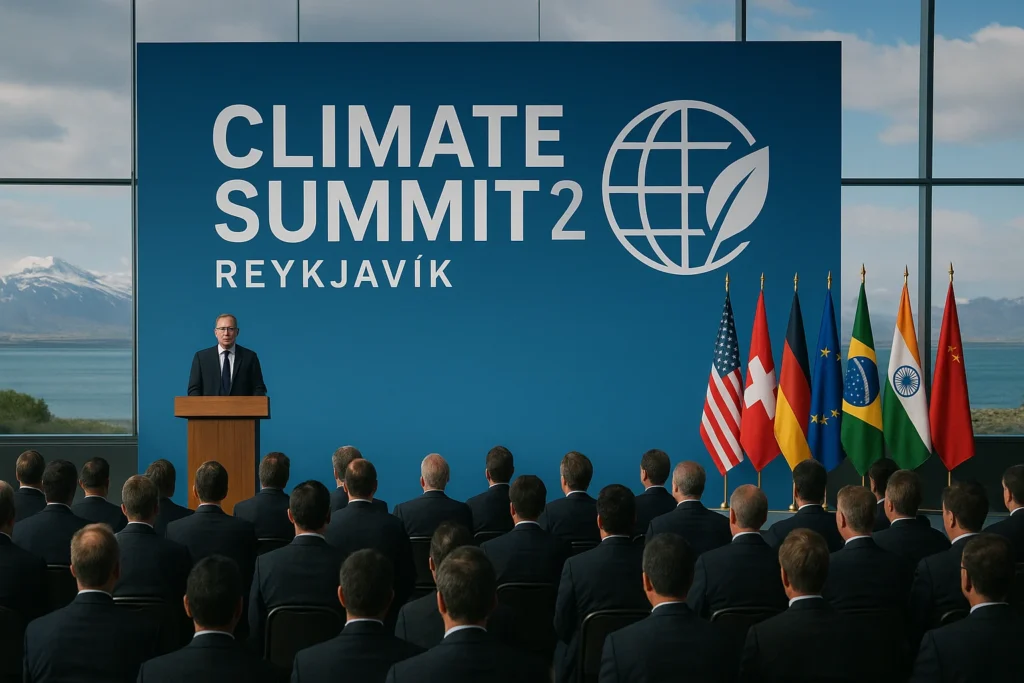

The Air of Reykjavík: A Prelude to Global Resolution
The wind that sweeps across Reykjavík is not merely weather; it is a chronicle written in cold air, a narrative carried from the vast, ancient ice caps of Vatnajökull and Langjökull. In the autumn of 2025, this wind bore witness to a gathering unlike any other in the annals of international diplomacy. Against a dramatic tableau of geothermal vents hissing steam into the perpetual twilight of the Arctic fall, delegates from 142 nations convened not for further deliberation, but for decisive, binding action. The International Climate Summit of 2025, hosted in Iceland’s starkly beautiful capital, transcended the familiar cycle of promise and postponement. This is the definitive, intricate story of the Glacier Accord—a pact that represents a fundamental recalibration of humanity’s relationship with its planet, moving from acknowledging crisis to engineering a specific, actionable survival strategy.
This summit, building upon but radically exceeding the framework of the 2015 Paris Agreement, was orchestrated under the leadership of Iceland’s Minister for the Environment, Energy, and Climate. It assembled a unprecedented coalition: world leaders, titans of finance, pioneers of green technology, and custodians of indigenous knowledge. Their unified objective was to address the most urgent facets of the climate emergency with surgical precision, focusing on the fastest lever to slow warming and protecting the world’s most vital freshwater reserves.
The Unignorable Data: The Scientific Imperative That Forced a New Pact
The journey to Reykjavík was a decade-long march through escalating scientific alarms and geopolitical friction. The Paris Agreement had been a monumental achievement in collective ambition, setting the critical goal of limiting warming to well below 2°C. Yet, its implementation revealed a fatal flaw: voluntary national contributions, however well-intentioned, were insufficiently coordinated and painfully slow against an accelerating crisis.
The years following Paris were a litany of shattered records. The World Meteorological Organization’s (WMO) annual “State of the Global Climate” reports became progressively more dire. The period from 2022 to 2024 was confirmed as the hottest three-year span in recorded history. But it was the specific, granular data on the planet’s frozen regions—the cryosphere—that served as the final, unambiguous catalyst for the Reykjavík summit.
The 2024 “State of the Cryosphere” report, a synthesis from the world’s leading glaciologists, presented findings that removed all space for equivocation. It declared that global glacier melt had accelerated beyond the worst-case projections of just a few years prior. Iconic glaciers from the Alps to the Rockies to the tropical Andes were retreating at existential speeds. Professor Michael Zemp, Director of the World Glacier Monitoring Service, provided a staggering metric: since the late 20th century, the world had lost over 9,000 billion tonnes of glacial ice. To visualize this, he equated it to “an ice cube covering the entire land area of Germany and standing 30 meters tall—vanished.”
The implications are hydrological, geographical, and civilizational. These glaciers are not scenic relics; they are strategic freshwater reservoirs for nearly two billion people. Their regulated meltwater sustains agriculture from the Punjab to California’s Central Valley, provides drinking water for megacities like Lima and Karachi, and powers hydroelectric dams that light entire nations. Their rapid decline threatens immediate catastrophe through Glacial Lake Outburst Floods (GLOFs) and long-term societal collapse through perennial drought. Concurrently, the meltwater from these vanishing ice masses has already contributed over 20 millimeters to global sea-level rise since 2000, a process accelerating with each passing year. This was the non-negotiable scientific reality that hung over every negotiation in Reykjavík: the planet’s vital signs were flashing red, and the time for incrementalism had expired.
The Strategic Focus: Why Methane Became the Centerpiece of Global Strategy
To comprehend the strategic genius of the Glacier Accord, one must move beyond the common narrative of carbon dioxide ($\text{CO}_2$) as the sole antagonist. While $\text{CO}_2$ is the principal long-term driver of climate change, its atmospheric longevity—centuries to millennia—means actions taken today yield results on a deferred timeline. The Accord’s architects, guided by the latest Intergovernmental Panel on Climate Change (IPCC) assessments, identified a more immediate, potent threat: methane ($\text{CH}_4$).
Methane is a greenhouse gas of a different, more ferocious character. While its atmospheric lifespan is roughly a decade, its heat-trapping potency is devastating. Over a critical 20-year period, methane is over 80 times more effective at warming the planet than an equivalent mass of $\text{CO}_2$. This molecular characteristic makes it the single most powerful lever humanity has to rapidly alter the near-term trajectory of global temperature rise. Cutting methane emissions is akin to applying an emergency brake on a runaway train; it is the fastest available method to slow the rate of warming, buying indispensable time for the deeper, systemic transition away from fossil fuels.
The Accord targeted anthropogenic methane with precision, focusing on its three primary sources:
- Fossil Fuel Systems: This encompasses leaks, venting, and flaring across the entire oil and gas supply chain, from wellheads and pipelines to storage facilities. The International Energy Agency (IEA) had long highlighted that a significant portion of these emissions could be eliminated at net-zero cost, as the captured gas represents saved product.
- Agriculture and Livestock: Enteric fermentation in ruminants like cattle and sheep, alongside the management of manure and the cultivation of flooded rice paddies, constitute a major, diffuse source.
- Solid Waste: The anaerobic decomposition of organic matter in landfills generates substantial methane plumes, often released directly into the atmosphere.
By concentrating on methane, the Accord addressed what the Center for Climate and Energy Solutions termed the “low-hanging fruit” of climate mitigation—actions that deliver massive climate benefits relatively quickly and often with economic co-benefits, such as improved air quality and resource efficiency.
The Architectural Blueprint: The Four Interlocking Pillars of the Accord
The document signed in the Harpa Concert Hall was a masterpiece of pragmatic, enforceable international law. It moved beyond aspirational language to establish a rigid architecture of obligation, innovation, finance, and verification. Each pillar is designed to be self-reinforcing, creating a system where failure in one area triggers accountability in another.
Pillar One: The 45% by 2032 Global Methane Reduction Mandate
This is the core, non-negotiable engine of the Accord—a binding commitment for all signatories to reduce anthropogenic methane emissions by 45% against a 2020 baseline by the year 2032. This target, aligned with the IPCC’s most ambitious mitigation pathways, necessitates immediate and transformative action across economies:
- Overhauling the Energy Sector: The Accord mandates universal adoption of Best Available Technology (BAT) for Leak Detection and Repair (LDAR). This requires the deployment of next-generation tools: hyperspectral infrared cameras mounted on drones and vehicles, continuous monitoring sensors at wellheads, and satellite-aided surveillance. Furthermore, it imposes a near-total ban on routine flaring and venting, compelling operators to capture and utilize the gas.
- Transforming Agricultural Practices: For livestock, the Accord funds the rapid scaling of feed additives (like 3-NOP or certain seaweed species) proven to reduce enteric fermentation by over 30%. It promotes advanced manure management through covered anaerobic digesters that capture methane for energy production. For rice cultivation, it subsidizes the global adoption of Alternate Wetting and Drying (AWD) techniques, which can cut field emissions by up to 50% while conserving water.
- Revolutionizing Waste Management: The treaty requires all major municipalities to implement comprehensive organic waste diversion programs (composting, anaerobic digestion) and mandates that all active landfills install and operate efficient gas collection and control systems, turning waste sites from emission sources into potential bioenergy hubs.
Pillar Two: The Global Glacier and Freshwater Preservation Fund (GGPF)
Recognizing that mitigation alone is insufficient, the Accord established the GGPF as its pillar of climate justice and adaptation. Financed through assessed contributions from Annex I (developed) nations, a levy on international maritime transport, and voluntary philanthropic capital, the GGPF operates as a permanent financial mechanism with a triple mandate:
- The Sentinel Initiative: Financing the densest-ever global network of high-altitude automated monitoring stations on the world’s most critical glaciers. These stations provide real-time data on ice thickness, melt rates, and glacial lake dynamics, feeding into early-warning systems for downstream communities.
- The Resilience Infrastructure Program: Funding large-scale engineering interventions. This includes controlled drainage projects for dangerous glacial lakes to prevent catastrophic GLOFs, and the construction of managed aquifer recharge systems and multi-purpose reservoirs to capture and store seasonal meltwater for use during dry periods.
- The Mountain Communities Pact: Directly financing the adaptation of vulnerable populations. This supports the transition to drought-resistant crops, the development of glacier-sensitive eco-tourism, the reinforcement of climate-resilient infrastructure, and the preservation of indigenous hydrological knowledge.
Pillar Three: The Open-Source Climate Technology Accelerator (OSCTA)
To prevent the Accord from becoming an unfunded mandate or a tool of technological monopoly, the OSCTA was created as a global digital commons. Modeled partly on successful open-source software movements, it legally compels signatory nations and private entities receiving public climate funding to share designated technologies under fair, reasonable, and non-discriminatory (FRAND) terms.
The OSCTA platform includes:
- A patent pool and licensing clearinghouse for key methane-abatement technologies.
- A digital library of best-practice manuals, engineering schematics, and case studies, translatable into multiple languages.
- A matchmaking interface connecting problem-holders (e.g., a city in Southeast Asia with landfill methane issues) with solution-providers (e.g., an engineer in Denmark with a novel digester design).
- Virtual innovation sandboxes where researchers can collaborate on pre-competitive R&D, dramatically accelerating the pace of solution development and deployment.
Pillar Four: The Independent Global Methane Watch (IGMW)
Transparency is the currency of trust in international agreements. The Accord solved the chronic issue of self-reported, inconsistent data by chartering the IGMW, an autonomous scientific body with a singular mission: to provide a single, verifiable, and public account of global methane emissions.
The IGMW operates a multi-layered surveillance system:
- Space-Based Surveillance: It ingests and analyzes data from a constellation of satellites, including public missions (like ESA’s Sentinel-5P) and dedicated private satellites (like MethaneSAT). These instruments can pinpoint large emission events down to individual facilities, identifying “super-emitters” across the globe.
- Atmospheric Modeling: Combined with ground-based measurement data from the Global Atmosphere Watch network, the IGMW uses inverse models to reconcile satellite observations with atmospheric concentrations, creating top-down emission estimates that can be compared to bottom-up national inventories.
- The Public Accountability Dashboard: All analyzed data is published on a real-time, publicly accessible digital platform. This dashboard maps major emission sources, tracks national and corporate progress against targets, and hosts verified reports. This radical transparency empowers civil society, investors, and the media to hold emitters accountable, creating a powerful market and reputational incentive for compliance.
The Human Dimension: Negotiations, Alliances, and Moral Force
The final text of the Accord is a sterile legal instrument, but its negotiation was a profound human drama, a clash of ideologies, economies, and moral imperatives played out in meeting rooms overlooking the North Atlantic.
- The Alliance of Small Island States (AOSIS) and the Climate Vulnerable Forum (CVF): These coalitions, representing nations facing existential threats from sea-level rise and extreme weather, were the uncompromising moral voice. They arrived not with technical position papers alone, but with cultural artifacts—woven mats from Pacific islands, jars of saline-tainted soil from Bangladesh—physical testaments to what was at stake. Their relentless advocacy ensured the GGPF was framed not as aid, but as obligatory compensation for loss and damage.
- The High Mountain Nations Consortium: Led by Peru, Nepal, and Kyrgyzstan, this group transformed the abstract concept of “glacier melt” into a tangible security crisis. They presented detailed topographical maps and hydrological models showing the precise villages and infrastructure in the path of potential GLOFs. Their technical expertise was crucial in shaping the practical, engineering-focused mandate of the GGPF.
- The Agricultural and Petro-State Blocs: Nations with economies heavily dependent on livestock, rice, oil, and gas negotiated from a position of perceived economic risk. The breakthrough came not from weakening targets, but from strengthening the support mechanisms. The OSCTA and detailed economic analyses showing the net profitability of methane capture (through saved gas and new energy products) turned the narrative from one of restrictive cost to one of modernization and opportunity.
- The Scientific Vanguard: Glaciologists like Professor Zemp and climate modelers provided the immutable foundation of facts. Their presentations, showing time-lapse satellite imagery of disappearing glaciers and graphs of atmospheric methane concentrations rocketing upwards, made technical delay or obfuscation politically untenable.
The atmosphere at the signing ceremony was one of exhausted solemnity, not triumphalism. As the Prime Minister of Tuvalu noted, holding the ceremonial pen, “Today, we have finally written a prescription for the patient. The fever is still raging. Now, we must all become nurses, ensuring the medicine is administered without fail.”
From Signature to System Change: The Implementation Horizon
The true test of the Glacier Accord begins the moment the ink dries. The treaty is designed as a perpetual-motion machine of accountability, with built-in mechanisms to force progress.
- National Implementation Plans (NIPs): Within 12 months, each signatory must submit a detailed, quantified NIP to the Accord’s Secretariat. These plans must include specific regulatory frameworks for the energy and waste sectors, revised agricultural subsidies and support programs, explicit budget allocations, and a schedule for domestic legislation. An independent Technical Review Committee, comprised of international experts, will publicly assess each NIP for adequacy and realism, with the power to request resubmission.
- The First Financial Catalysis: The inaugural board of the GGPF, with equal representation from donor and recipient nations, will convene to approve its first tranche of projects. Priority will be given to “break-the-glass” interventions in the Himalayas and Andes, where GLOF risks are most imminent. Concurrently, the OSCTA will launch its first “Global Innovation Challenges,” offering prize funding for breakthrough solutions in low-cost methane sensing and small-scale manure digestion.
- The First Accountability Cycle: At the 24-month mark, the IGMW will publish its First Biennial Global Methane Assessment. This report will be a watershed moment in global climate politics. It will not only aggregate national progress but will, for the first time, publicly attribute major emission events to specific industrial facilities and corporate entities, based on satellite data. This report will immediately become the benchmark for civil society litigation, shareholder activism, and diplomatic pressure.
The Ripple Effect: How a Global Pact Reshapes Local Reality
The success of the Accord will reverberate through economies, communities, and daily life in tangible ways:
- The Green Industrial Acceleration: The mandatory global demand for methane-abatement technology will spur a multi-trillion-dollar industrial revolution. This will generate millions of skilled jobs in manufacturing (sensors, compressors, digesters), deployment (specialized engineering and technician roles), and data services (analysis of satellite and sensor data).
- The Co-Benefit Dividend: Reducing methane emissions yields immediate local health benefits. Methane is a key precursor to ground-level ozone (smog), a dangerous respiratory irritant. Studies project that achieving the Accord’s targets could prevent over 200,000 premature deaths annually worldwide from improved air quality, while also boosting agricultural yields by reducing ozone damage to crops.
- Community-Level Transformation: In practical terms, the Accord means a city council securing GGPF grants to build a new water retention basin, protecting the town from both floods and drought. It means a consortium of farmers accessing OSCTA blueprints to build a cooperative biogas plant, turning waste into local electricity and fertilizer. It means citizens using the IGMW public dashboard to confirm their local landfill is complying with new capture regulations.
A Covenant with the Future: The Ultimate Meaning of Reykjavík
The Glacier Accord of 2025 stands as humanity’s most sophisticated collective response to a self-made existential threat. It is a covenant that acknowledges the past failures of incrementalism and voluntary action, and instead establishes a mandatory, engineered, and transparent system for planetary management. It represents the moment the geopolitics of climate change matured from a debate over burdens to a strategic operation of survival.
But a treaty, no matter how brilliantly constructed, is inert. It is a scaffold. The living structure—the preserved glacier, the sealed pipeline, the resilient farm, the stable climate—must be built by human hands. The final authors of this story are the engineers on offshore platforms, the software developers coding for the OSCTA, the farmers attending extension workshops, the voters scrutinizing their leaders’ implementation records, and the young activists who refused to let the world look away.
The wind from Reykjavík’s glaciers now carries a new compound: molecules of hope, rigorously bonded to molecules of obligation. The pact is the promise. The future, still volatile and uncertain, is the project. And the work, the monumental, unifying, essential work, belongs unequivocally to us all.