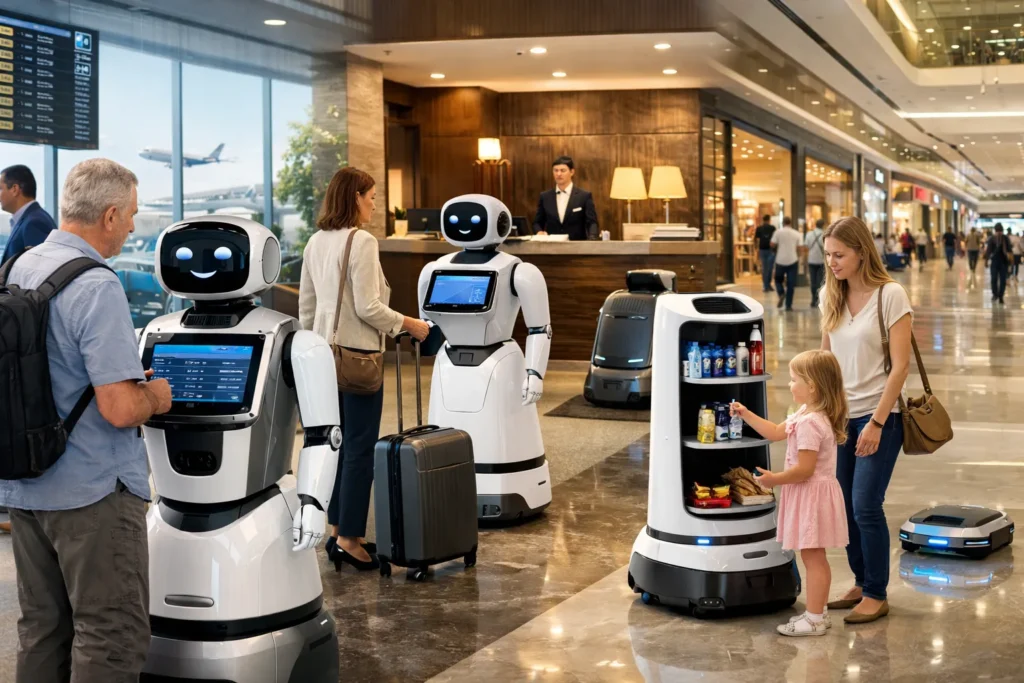

Imagine yourself standing in the middle of the Changi Airport in Singapore, one of the busiest travel hubs on the entire planet. You have just stepped off a fourteen-hour flight from London Heathrow. Your body is exhausted, your brain is foggy from the combination of bad airplane food and the inability to sleep in a cramped seat, and your connecting gate to Phuket is supposedly a twenty-minute train ride away through a terminal you have never visited. You see a sign pointing left, then another sign pointing right, and suddenly you are standing still while hundreds of other travelers flow around you like water around a rock. Panic begins to set in. Your phone battery is at five percent. The airport Wi-Fi is asking you to watch a thirty-second ad just to log on. You are lost.
Suddenly, a gentle whirring sound approaches from your left. It is quiet enough that you almost miss it, but distinct enough that you turn your head. A sleek, white, torso-high machine glides to a smooth stop directly in front of you. Its wheels lock into place with a soft click. Its screen flickers to life, displaying a pair of friendly, animated eyes that blink at you slowly. A warm, pleasant, gender-neutral voice emanates from its speakers: “You look like you might be searching for something. Can I help you find your gate today?” Relieved beyond words, you awkwardly tap your destination onto the touchscreen, your fingers fumbling slightly. The machine processes the information instantly. Its screen displays a map, and the voice chirps, “Gate D41. Got it. That is about a twelve-minute walk from here. Please follow me. I will go at your pace. If I go too fast, just tell me to slow down.” It then turns gracefully on its axis and begins to lead you through the crowd, navigating around a family with three strollers and a group of chatting teenagers without breaking stride. It doesn’t get frustrated when someone cuts it off. It doesn’t get tired. It doesn’t check its watch. It simply guides you to your destination, wishes you a pleasant flight, and then rolls away to find its next lost traveler.
This is not a scene from a futuristic movie trailer. This is not a concept video from a tech company showing what might be possible in the year 2040. This is happening right now, in thousands of locations across the globe, from South Korea to Germany to the United States. We are living through a quiet, steady, and undeniably helpful invasion. Service robots have officially left the factory floor. They are no longer locked inside cages, welding car parts in isolation or stacking pallets in warehouses where humans rarely venture. Instead, they are gliding across the polished floors of shopping malls during peak shopping hours. They are delivering extra pillows and towels in hotels at midnight. They are taking food orders in busy restaurants and running the food to your table. They are scrubbing the floors of hospitals during the night when the corridors are empty. They are patrolling the perimeters of public parks after dark.
This shift is not just a cool piece of technology that makes for good news headlines. It is a fundamental change in the way our cities operate, how businesses manage their budgets, how building architecture is designed, and how we, as the general public, experience the world around us. It is a revolution driven not by the desire for a sci-fi future, but by the very real, very urgent needs of the present: a massive shortage of human workers, a leap forward in artificial intelligence that was unthinkable a decade ago, and our non-stop demand as consumers for convenience, speed, and cleanliness.
The “Helpful Invasion” Begins: More Than Just Metal and Wire
When we hear the word “invasion,” our minds often jump to dark images from science fiction. We think of clunky, menacing machines with red glowing eyes trampling cities underfoot while humans run screaming. But the reality we are living in today is far more boring, and in many ways, far more beneficial to society. This invasion is not about kicking humans out of their jobs and replacing them with metal. It is about assistance and filling the gaps that humans are leaving behind due to demographic shifts and changing career preferences. It is a gentle invasion of helpful machines that are designed specifically to make our lives a little bit easier.
Think of it like this: for the last fifty years, we have been asking computers to handle our information. We asked them to manage our emails, to process our banking transactions, to host our social media profiles, and to stream our movies. Now, we are building machines that can handle our physical world. We are building robots that can vacuum the vast, sprawling floors of convention centers so that the human janitorial staff can focus on the tasks that actually require human judgment, like scrubbing the bathroom mirrors until they sparkle and emptying the trash cans before they overflow. We are building robots that can haul heavy linens and dirty dishes through the back hallways of hotels so that the housekeeping staff can spend more time chatting with guests, answering their questions about the local area, and ensuring their rooms are absolutely perfect.
These are not just remote-controlled cars with a bucket bolted on top. Today’s service robots are incredibly sophisticated pieces of machinery. They are packed with sensors that are similar to the ones that help your car parallel park itself, but there are more of them and they are more advanced. They are powered by artificial intelligence that lets them learn and adapt to their surroundings in real-time, second by second. They use a technology called SLAM, which stands for Simultaneous Localization and Mapping. This is a fancy engineering term that essentially means the robot can build a detailed map of a brand new place that it has never seen before while simultaneously figuring out where it is located on that map. It allows them to navigate the chaotic, unpredictable world of a busy airport terminal without bumping into a child, getting tangled in luggage, or falling down an escalator.
The global market for these machines is exploding in a way that few outside the industry realize. In 2025, the service robotics industry was valued at well over twenty-six billion dollars. By 2034, depending on which research firm you trust, it is projected to balloon to nearly one hundred and thirty-two billion dollars. That is massive, exponential growth, and it is fueled entirely by the fact that these robots are moving out of warehouses and into the spaces where we live, work, shop, and play.
Why Now? The Perfect Storm Creating Global Demand
You might be wondering, if robots are such a great idea, why are they only showing up in malls and airports now? Why didn’t this happen twenty years ago, or even ten years ago? The answer is that three major forces have collided at exactly the same moment in history to create the perfect environment for their widespread deployment. It is a perfect storm of economic necessity, technological advancement, and social change.
First, and most importantly, there is the labor shortage. In many developed countries like Japan, South Korea, Germany, the United Kingdom, and the United States, there simply are not enough working-age people to fill all the available jobs. Birth rates have been falling for decades. The massive baby boomer generation is retiring in huge numbers, and there are not enough young people entering the workforce to replace them. This is especially true in industries like hospitality, retail, and cleaning. These are jobs that are physically demanding, repetitive, often thankless, and sometimes occur during antisocial hours like the middle of the night. Finding someone who wants to scrub floors at two in the morning in a massive, empty convention center is incredibly difficult. In Japan, the government has been actively pushing a “New Robot Strategy” for years, specifically to use robots to fill the gaps caused by a shrinking workforce and an aging population. Companies are desperate for workers. If a robot can do the job that a human refuses to do, that robot becomes incredibly valuable, regardless of its upfront cost.
Second, there is the technology itself. The sensors and the artificial intelligence have finally caught up with the imagination of science fiction writers. For a long time, robots were essentially blind. They could only move along pre-programmed paths, like a train running on a track. If something was in the way, they would simply stop and beep for help. They could not see the obstacle, and they could not figure out how to go around it. Now, with advances in edge AI and computer vision, robots can see. They can identify objects and classify them. They can tell the difference between a stationary wall and a person who is about to move. They can predict the movement of a crowd and adjust their path accordingly. This technology allows them to operate safely right next to humans without causing accidents, which is the bare minimum requirement for putting them in a public space.
Third, there is the lingering shadow of the COVID-19 pandemic. The pandemic changed what customers expect from businesses. Suddenly, contactless service became not just a convenience, but a necessity for health and safety. People wanted to minimize human-to-human contact wherever possible. Robots that could deliver food to a hotel room without a human having to knock on the door became heroes overnight. Robots that could clean a hospital room with powerful UV light without a person having to enter and risk exposure were seen as essential, not optional. While the peak of the pandemic panic has subsided, the expectation for high levels of cleanliness and touch-free interaction has remained. Customers now notice when a bathroom is dirty, and they appreciate when a robot is handling the cleaning because it feels more scientific and thorough.
The Silent Cleaners: Robots Scrubbing Our Cities While We Sleep
The most widespread and visible type of service robot in public spaces today is not the one greeting you with a smile and a screen. It is the one cleaning up after you while you are asleep in your bed. Professional cleaning robots are the true workhorses of this new robotic workforce. According to industry reports from the International Federation of Robotics, they are consistently the second-largest category of service robots in the world, and their numbers are growing faster than almost any other type of robot.
Why are they so popular? The answer is brutally simple and comes down to basic economics. Cleaning is hard, repetitive, and often thankless work. It involves bending, stooping, pushing heavy machinery, and dealing with other people’s dirt and grime. Finding staff to do this work, especially for the overnight shifts, is incredibly difficult. Labor shortages in the cleaning industry have reached a crisis point in many major cities, with staff turnover being incredibly high. In fact, for many professional cleaning companies, the cost of labor can eat up to ninety percent of their total operating budget. That leaves very little room for profit or for investment in better equipment.
Enter the robots. They do not call in sick on a Monday morning because they went to a party the night before. They do not ask for raises every year. They do not get bored of pushing the same scrubber back and forth across the same floor for eight hours. They just work, quietly and efficiently, night after night.
The Mall After Dark
Consider your local shopping center, the one that is absolutely packed with teenagers and families on a Saturday afternoon. During the day, it is a chaotic mess of food spills, dirty footprints, and constant foot traffic. But at night, once the stores close their metal shutters and the lights dim to a dull, security-friendly glow, a fascinating transformation happens. A fleet of autonomous scrubbers emerges from their charging docks hidden away in the service corridors.
These are not your household Roomba that gently bumps into your furniture. These are heavy-duty industrial machines that weigh several hundred pounds and can scrub a path a meter wide in a single pass. These robots have spent their first day on the job “learning” the mall. Using LiDAR and high-resolution cameras, they have created a perfect digital map of the entire facility. They know exactly where the food court is located, which is statistically the dirtiest zone in any mall. They know which aisles are the widest and which corridors have tricky turns. They know the location of every single column and planter.
Every night, they will methodically scrub the same optimal path, ensuring the floors are spotless by the time the first mall walkers and coffee shop employees arrive in the morning. In massive complexes like the Shanghai Global Harbor shopping center, which covers tens of thousands of square meters, dozens of these robots work in perfect sync. They communicate with each other via a central cloud-based management system to avoid double-cleaning the same area and to make sure that between them, they cover every single inch of floor space that needs attention. They are managed by a single human supervisor who sits in a control room watching their progress on a screen.
The Hospital Wingman
In a hospital, cleanliness is not just about appearances or customer satisfaction. It is a matter of life and death. Healthcare-associated infections, often caused by superbugs that are resistant to antibiotics, are a constant and serious threat to patients who are already vulnerable. But even in this high-stakes, high-pressure environment, robots are lending a hand. Or, more accurately, they are lending a scrubber.
At prestigious institutions like the Peking Union Medical College Hospital, cleaning robots are equipped with special disinfection lights known as UV-C. This is a specific wavelength of ultraviolet light that is proven to destroy the DNA and RNA of viruses and bacteria, effectively killing them. These robots can be rolled into an operating room immediately after a surgery is completed. The doors close, the human staff leaves, and the robot floods the room with germ-killing ultraviolet light for a carefully timed period. This process kills ninety-nine point nine percent of viruses and bacteria on every exposed surface, from the operating table to the floor to the equipment trays, without exposing a single human cleaner to the dangerous radiation.
This frees up the hospital’s environmental services staff to focus on the tasks that require a human touch. They can focus on direct patient interaction, making someone feel comfortable and safe. They can focus on detailed cleaning of delicate medical equipment that cannot be exposed to UV light. They can focus on cleaning up spills that require judgment and care. The robot handles the brute force disinfection, and the human handles the nuanced care.
Taking It Outside
Cleaning robots are even braving the great outdoors, which is a much more difficult environment to navigate. In cities across Europe, the Middle East, and Asia, companies are deploying robots that can sweep public parks, university campuses, bike lanes, and even large parking lots. These outdoor robots face a much tougher challenge than their indoor cousins who work in the predictable environment of a mall.
They have to deal with rain that can mess with their sensors and make the ground slippery. They have to deal with bright, direct sunlight that can blind their cameras and make it hard to see. They have to deal with wildly unpredictable obstacles like stray dogs running across their path, rogue skateboards left on the ground, or tree branches that have fallen in the wind overnight. They have to navigate around park benches that have been moved since their last mapping run.
To handle all of this, these outdoor robots use a hybrid navigation system. Out in the open, under the clear sky, they use GPS satellites to know exactly where they are, just like the navigation app on your phone. But when they go under a thick cover of trees or between tall buildings where the GPS signal gets spotty and bounces around, they switch instantly to their visual cameras and LiDAR to navigate. This seamless switching allows them to keep a city’s public spaces clean and safe without a human needing to push a broom in the hot sun.
Your New Best Friend: Robot Guides and Concierges
While cleaning robots work hard behind the scenes, often while we are asleep, another class of machine is stepping right into the spotlight. These are the social service robots, and they are designed specifically to interact with you, the customer. Their entire reason for existing is to be friendly, informative, and helpful in a social context.
Have you ever been to a hotel and seen a robot waiting patiently for the elevator, right alongside human guests? These machines are becoming common and beloved sights in the hospitality industry. At the Hilton Atlanta, for example, the staff used to spend hours and hours every week just walking the halls delivering small items that guests requested by phone. Things like an extra towel, a forgotten toothbrush, a phone charger, or a bottle of water. This is a huge amount of wasted time and labor.
Now, a robot handles those deliveries. A staff member loads the robot up in the back office, types the room number into the screen, and sends it on its way. The robot navigates to the service elevator. It uses wireless signals to call the elevator. It gets in, turns around, and waits. When the doors open on the correct floor, it gets out and navigates the hallway, counting down the door numbers. When it arrives at the correct door, it does not knock. Instead, it uses the hotel’s phone system to call the room directly and play a recorded message: “Hello, your requested item has arrived. I am waiting outside your door.” The guest opens the door, grabs their item, and the robot turns around and heads back to the lobby to wait for its next task. It is efficient, it is fast, and it gives guests a fun and memorable story to tell their friends back home.
In airports and large shopping centers, these robots act as roving information desks. They are mobile, so they can go to where the lost people are, rather than waiting for lost people to come to them. The Cruzr robot is a perfect example of this new wave of customer service technology. It is a humanoid robot, meaning it has a head, a body, and arms, although it moves on wheels rather than legs. It has a large screen on its chest that can display information, and a friendly animated face on its head screen.
It can speak dozens of languages fluently, switching between them instantly based on the user’s selection. It can remember the exact location of every single store and gate in a massive, complex airport. It can even entertain children who are bored and restless while their parents are trying to figure out where to go. It will dance, tell a fun fact about the airport, or play a simple game on its screen. This turns a stressful moment of being lost into a moment of delight.
In retail stores, these robots are becoming powerful sales tools that actually increase revenue. At a VIVO smartphone store, for example, the Cruzr robot does not just point you to the latest model. It is a walking, talking brand ambassador. It can show you high-definition video reviews of different phones right on its chest screen. It can compare the specifications of two different models side-by-side so you can make an informed decision. It can even help you sign up for the store’s loyalty card by guiding you through the on-screen form. It turns a simple question like “Where are the headphones?” into a full brand immersion experience.
The robot can be programmed to be proactive. This means if you are standing in the middle of the store looking confused, glancing around, it will not wait for you to come to the counter. It will identify your body language as indicating confusion, roll up to you, and politely ask, “Hello, you look like you might be looking for something specific today. Can I help you find it?” This kind of engagement has been proven by retail studies to increase the amount of time customers spend in stores, which directly correlates to higher sales.
The Brains and the Eyes: How They Actually See the World
So, how do these machines actually work? How do they not constantly crash into walls or small children? It all comes down to a sophisticated suite of technologies that act as their eyes, ears, and brain. It is a field of engineering that combines hardware and software in incredibly clever ways, and it is advancing rapidly every single year.
The Eyes: Most service robots rely on a combination of different sensors, a concept that engineers call sensor fusion. No single sensor is perfect, so by combining them, the robot gets a much more reliable picture of the world.
They use cameras for visual recognition. The cameras allow the robot to read signs, recognize faces if that feature is enabled, and see colors. They use LiDAR, which stands for Light Detection and Ranging. This uses lasers to measure distance. The spinning thing you see on top of many robots and self-driving cars is a LiDAR sensor. It fires thousands of invisible laser pulses per second in every direction and measures how long each pulse takes to bounce back. This creates a precise three-dimensional point cloud map of the surroundings. They use ultrasonic sensors, which are like the ones that help your car detect an object when you are parking in a tight spot. These use sound waves to detect close-range obstacles, and they are especially good at detecting things made of glass that LiDAR lasers might pass right through or fail to register. They also use an IMU, or Inertial Measurement Unit. This is like the robot’s inner ear. It measures acceleration and rotation on three axes, helping the robot know if it is tipping over, spinning out, or sliding on a wet floor.
By combining data from all these sources in real time, the robot can build a highly detailed and reliable three-dimensional picture of its environment, even in tricky lighting conditions like a dark hallway with flickering lights or a sunny atrium with harsh shadows.
The Brain: That brain is the AI software, the code that makes sense of all that sensor data. It takes the three-dimensional picture and has to figure out what everything in it actually is. This is called semantic segmentation. Is that tall, flat object a stationary wall that the robot can safely drive next to? Or is it a person who is standing still but might move at any second? Is that small object on the floor a piece of trash that needs to be cleaned up, or is it just a weird shadow cast by a chair leg?
Advanced robots use something called dynamic path planning. This means they do not just follow a fixed, pre-programmed route from point A to point B. They constantly recalculate the best path based on what is happening right now. If a group of teenagers suddenly blocks the entire aisle, the robot does not just stop and wait forever like a lost puppy. It does not beep for help. It recalculates in milliseconds and finds a new way around them, even if that means taking a small detour down a different aisle and coming back. This ability to adapt on the fly is what makes modern robots seem almost alive.
The Safety Net: But what if the AI makes a mistake? What if it misidentifies an object or its path planning algorithm has a bug? This is where incredibly strict safety standards come into play. The software that controls the brakes and the motors is kept completely separate from the software that runs the face animations or the music. This is known as a safety-certified architecture. The company SYSGO, for example, provides the underlying operating systems for many of these robots, ensuring that the critical safety functions are isolated. This way, even if the entertainment system crashes and the screen freezes, the robot will still have the ability to stop immediately and safely if a person steps in front of it. It is a layered approach to safety that ensures these heavy, powerful machines can operate safely in crowded public spaces.
Mastering the Chaos: The Science of Navigation
Navigating a restaurant or a hotel lobby is actually one of the hardest challenges in all of robotics. Unlike a factory floor where everything is bolted down in a predictable place, public spaces are what engineers call dynamic and unstructured. Tables get moved for large parties. Chairs are pulled out and left in strange positions. Children run unpredictably. People change their minds and stop suddenly in the middle of the aisle. Service animals are present and behave differently than humans.
Recent breakthroughs in research have focused on making robot navigation smoother and more human-like. People do not like sharing space with a robot that moves in jerky, unpredictable, robotic ways. It feels unsafe. It feels unnatural. A study published in 2025 in the scientific journal Results in Engineering detailed a new navigation system designed specifically for a restaurant robot. The robot had to weave between closely spaced tables, avoid servers carrying hot food and trays, and navigate around guests’ feet that were sticking out into the aisle.
The researchers used a hybrid system. They combined an advanced path-planning algorithm called Hybrid A-star with a real-time collision avoidance system called the Dynamic Window Approach. Hybrid A-star is good at finding a path around large obstacles like tables. The Dynamic Window Approach is good at making tiny adjustments in real time to avoid moving obstacles like a person’s leg.
The results were impressive and measurable. They used a special controller, optimized by a Genetic Algorithm, to make the robot’s movements smoother and more efficient. They managed to cut the robot’s rise time in half. Rise time is how fast the robot gets going from a dead stop. They also almost completely eliminated the overshoot. Overshoot is that jerky wobble that happens when a robot stops, where it rocks back and forth a little bit before settling. This means the robot now moves with a confidence and fluidity that feels much more natural and safe to the humans dining around it.
The Robots-as-a-Service Revolution: Automation for Everyone
For a very long time, the single biggest barrier to owning a robot was the massive upfront price tag. A single, high-quality autonomous floor scrubber suitable for a large commercial space could cost as much as a brand-new luxury sports car. We are talking well over one hundred thousand dollars. Small and medium-sized businesses simply could not afford that kind of upfront capital investment. It was not in their budget. They could not justify spending that much money on a single machine, even if it would save them money on labor in the long run.
That has all changed with a new business model called Robots-as-a-Service, often abbreviated as RaaS. Think of it like subscribing to Netflix instead of buying every single movie and TV show on DVD or Blu-ray. You do not own the content; you just pay for access to it. With RaaS, a business does not actually buy the robot. They do not own the hardware. Instead, they sign a contract and pay a monthly subscription fee to the robot company.
That monthly fee covers everything. It covers the robot hardware itself. It covers all the software updates and new features as they are developed. It covers all the maintenance and repairs. If a wheel breaks or a sensor malfunctions, the robot company comes and fixes it at no extra cost. It even covers the insurance in many cases. The business simply pays a predictable monthly operating expense, just like they pay for their electricity or their internet connection.
This has been an absolute game-changer for the entire industry. A small, family-owned hotel in a place like Reading, Pennsylvania, can now afford a fleet of two or three delivery robots for the same monthly cost as hiring one part-time minimum wage employee. They get the benefit of automation without the huge financial risk. They do not have to worry about the robots becoming obsolete in three years when new, better software comes out, because the subscription includes upgrades. If the robot company releases a major software update that adds new features, the hotel gets it automatically as part of their subscription.
For the robot companies themselves, RaaS is also a fantastic business model. It provides a steady, predictable stream of income, which is called recurring revenue, rather than relying on occasional one-off big sales that can be unpredictable. It aligns the company’s interests perfectly with the customer’s interests. If the robot stops working well, the customer will stop paying the subscription. Therefore, the robot company is highly motivated to keep the machines running perfectly and to provide excellent customer support.
The Jobs Question: Are We Being Replaced or Upgraded?
It is the first question that pops into almost everyone’s head when they see a robot doing a job that a human used to do. It is a fair and important question, and the answer is far more nuanced than a simple yes or no. The evidence from economics and from companies that have already adopted robots suggests that the robots are not really taking jobs. Instead, they are taking tasks. Specifically, they are taking the tasks that humans really do not want to do.
The global economy is facing a massive demographic shift that is largely invisible to people who are not paying close attention. In many developed countries, there simply are not enough young people entering the workforce to replace the older generations who are retiring. The birth rate has been below the replacement level for decades in countries like Japan, Italy, Germany, and many others.
In the cleaning industry, for example, companies are desperate for workers. They have Help Wanted signs up on their websites and on job boards for months, sometimes years, with no applicants. If a robot can take over the monotonous, physically demanding, and frankly boring task of vacuuming a five-hundred-thousand-square-foot convention center all night long, it does not put a human out of work. There was no human to begin with, because the company could not find anyone to hire. Instead, it allows the human staff that the company does have to focus on more skilled, higher-value tasks. They can focus on deep-cleaning carpets with specialized steam machines. They can focus on polishing brass fixtures and making the entrance look impressive. They can focus on handling hazardous waste properly and safely. They can focus on managing the inventory of cleaning supplies and ordering more when needed.
Research from Japan, which is a country that is leading the world in robot adoption due to its shrinking workforce, supports this view. A major study on nursing-care robots found that facilities which introduced robots actually improved their staff retention rates significantly. The robots took over the heavy lifting, literally. They helped lift patients out of bed and move them to chairs, which is a task that causes a huge number of back injuries among nurses and caregivers every year. By reducing the physical strain on the human employees, the robots made the job less likely to cause injury and burnout. As a result, the human employees stayed in their jobs longer, and the quality of care for the patients went up because the staff were less exhausted and in less pain.
In restaurants, robots might run the food from the kitchen to the tables. This is a task that involves a huge amount of walking back and forth, which is tiring. But a human server still takes the order, which requires listening and judgment. The human server still checks on the customer’s happiness during the meal. The human server still opens the wine and performs the tableside service. The human server still processes the payment and handles any complaints. This means the human staff can spend more time building relationships with customers, which leads to better tips and a more enjoyable, social work experience. In many documented cases, businesses that have adopted robots have actually seen their staff turnover decrease because the human employees are less burned out from the back-breaking physical labor and can focus on the social aspects of the job that they actually enjoy.
When Things Get Tricky: The Edge Cases and Human Backup
Despite their impressive skills and advanced sensors, these robots are not perfect. They are incredibly good at dealing with the expected, the routine, the normal. But the real world is full of the unexpected. The hardest problems for them to solve are what engineers call edge cases. These are the weird, one-in-a-million situations that happen in the real world that you just cannot really program for in advance because you cannot predict them all.
For example, a delivery robot at the Gerald R. Ford International Airport in Michigan might be able to navigate through dense crowds of hundreds of people perfectly, using all its sensors and AI. But what happens if a child’s balloon pops right next to it? The sudden, sharp, loud sound could confuse its microphones and startle its obstacle detection system. The robot might interpret the sound as a threat or a collision. What happens if a maintenance worker leaves a bright yellow Wet Floor sign in a spot that was not on the morning’s digital map, and the sign is made of a material that the robot’s LiDAR cannot see well because it is reflective or transparent? The robot might not register it as an obstacle. What happens if a tired, stressed traveler drops a massive pile of luggage right in front of it in a narrow hallway, completely blocking the path in a way that the path planning algorithm cannot find a way around?
These situations, which a human would solve instantly by just saying “Excuse me” and stepping around the luggage or simply moving the sign, can completely stump a robot. Early generations of service robots, from just five or six years ago, would just stop dead in their tracks and start loudly beeping for help. They would flash a red light and wait for a human to come and rescue them. This is annoying for everyone nearby and defeats the purpose of having an autonomous machine.
However, the latest generation of robots are getting much better at handling these edge cases through a system called teleoperations or remote assistance. When the robot encounters a situation it cannot figure out, it does not just beep. It establishes a secure high-speed wireless connection, using 4G or 5G, and calls a human operator who might be sitting in a call center hundreds or even thousands of miles away. The operator can look through the robot’s cameras in real time, see the fallen luggage or the misplaced sign, and remotely draw a path on a screen for the robot to follow. The robot then executes that path, gets around the obstacle, and resumes its autonomous duties. This human-in-the-loop approach solves the problem instantly without anyone having to physically walk over and press a button, and it allows the robot to learn from the experience for next time.
The Trust Factor: Privacy and the Fear of Being Watched
As these robots roll into our public spaces, they are equipped with high-resolution cameras, directional microphones, and increasingly sophisticated facial recognition software. This inevitably raises a very important and valid question: are they watching us? The issue of privacy is one of the single biggest challenges facing the entire service robotics industry today.
People are understandably uncomfortable with the idea of a machine recording their every move in a mall or an airport. It feels like surveillance. It feels like something out of a dystopian novel. If the public does not trust the robots, they will not accept them, and the market for them will dry up completely. No business wants to install a robot that makes their customers angry or scared.
To combat this natural fear, engineers and designers are focusing on two main things: transparency and emotional design.
Transparency means that the robot’s functions should be obvious to anyone looking at it. If a robot has a camera, it should be clearly visible. It should not be hidden behind dark glass or disguised as something else. Many companies are now designing their robots to process all video data onboard the robot itself, in real time, and never upload it to the cloud unless it is absolutely necessary for a specific function. This is called edge processing. The robot might use its camera to see that a person is standing in front of it, so it knows to stop. But it does not need to record that person’s face, identify who they are, and send that information to a remote database. It just needs to know that there is an obstacle. By keeping the data local, on the device, they dramatically reduce the privacy risks.
Emotional design is about making the robot feel like a friendly helper, not a spy. This is where robots like Moxi from Diligent Robotics really shine. Moxi is used in hospitals to deliver supplies and help nurses with non-patient-facing tasks. It has big, expressive eyes on a screen that dart around, blink, and make eye contact. It makes little happy sounds and beeps that are designed to be friendly and non-threatening. Its entire physical design is soft, rounded, and approachable. There are no sharp edges, no dark, menacing colors.
This emotional connection helps build trust instinctively. When a machine seems friendly and harmless, when it acts like a helpful pet rather than a surveillance drone, we are much less likely to perceive it as a threat to our privacy. In customer-facing roles, this affective design is not just a nice extra feature. It is a core requirement for getting the general public to accept the robot’s presence in their everyday spaces.
Beyond the Mall: Specialized Robots in the Wild
While cleaning floors and guiding lost travelers are the most common and visible jobs for service robots, the definition of what a service robot can be is expanding rapidly. These machines are showing up in some surprising and highly specialized places, doing jobs that most people never even think about.
Robots in the Fields
Agriculture is facing a crisis in many parts of the world. Young people are leaving rural areas and moving to cities for what they see as better opportunities, and no one is left to pick the crops. Agricultural robots, sometimes called agribots, are stepping in to fill this gap. These robots face incredibly tough conditions that mall robots never have to deal with. They operate in mud, dust, blazing heat, and on uneven, slippery ground. But they are learning to do delicate tasks like harvesting ripe lettuce or strawberries, which requires a gentle touch to avoid bruising the fruit. They are also learning to do tough tasks like weeding, which requires extreme precision to avoid killing the crop while removing the weed. They use advanced computer vision to tell the difference between a weed and a valuable plant in real time. While the market is still emerging due to the massive technical challenges of working outdoors, the potential for these machines is absolutely massive.
Robots on the Water
Underwater robots, often called remotely operated vehicles or autonomous underwater vehicles, are another fascinating and rapidly growing segment. These are used for inspecting the hulls of massive ships for damage or corrosion, which is a dangerous job for a human diver. They are used for checking underwater pipelines for leaks in the oil and gas industry. They are used by scientists to study marine life in the deep ocean, places where humans cannot go without expensive and dangerous submersibles. These robots have to withstand massive water pressure and communicate through water, which radio waves cannot penetrate effectively. They use sonar, which is sound navigation and ranging, instead of cameras to see in the murky depths.
Robots in Disaster Zones
Search and rescue robots are becoming crucial tools for emergency responders, especially as climate change leads to more frequent and more extreme weather events like earthquakes, hurricanes, and floods. These robots are designed specifically to go where humans cannot, or should not, go. They can crawl into the tiny, unstable spaces inside collapsed buildings after an earthquake to look for survivors using thermal imaging cameras that can detect body heat. They can be thrown into floodwaters to assess the speed and depth of the current before a human rescuer goes in. They can navigate through smoke-filled rooms where visibility for a human is zero. These robots are often more rugged than their commercial cousins, and they have specialized tracks instead of wheels so they can climb over rubble and debris.
Robots on the Construction Site
Construction and demolition is dirty, dangerous work with a high rate of worker injury. Robots are now being used to autonomously demolish sections of a building. This is much safer than having a human with a jackhammer standing on a shaky platform high above the ground. The robot can be controlled remotely, or it can follow a pre-programmed demolition plan. Other robots are being developed for bricklaying. These machines can lay bricks much faster and more precisely than a human crew, and they do not get tired. While full autonomy on a chaotic, ever-changing construction site is still a distant goal, semi-autonomous machines that handle specific, repetitive tasks are already proving their worth and saving lives.
The Road Ahead: What the Next Decade Holds
So, where are we going with all of this? According to detailed market research from firms like IDTechEx, Fortune Business Insights, and the International Federation of Robotics, the next ten years will be a period of explosive growth and fundamental evolution for the service robot market. It will not just be more of the same robots doing the same jobs. The robots themselves will change, and they will become even more deeply integrated into the fabric of our lives.
We are going to see much more specialization. Instead of a one-size-fits-all robot that can kind of clean floors and kind of guide people, we will have hyper-specific machines designed for a single, narrow task. You might see a robot designed just for degreasing the floors of commercial kitchens. It would be resistant to heat and grease, and equipped with special high-pressure hot water sprayers and industrial soap dispensers. You might see a robot built specifically to patrol the perimeter of a data center at night, looking for intruders. It would have thermal cameras to see in the dark and highly sensitive microphones to listen for the sound of breaking glass or unusual noises.
We will also see robots become much more integrated into the Internet of Things, often called IoT. Your office building will know when the cleaning robot is scheduled to arrive. The building’s smart systems will automatically unlock the doors to the break room and the conference rooms for the robot. They will turn on the lights along its path to save energy elsewhere. The robot, in turn, will report back to the building manager. It will not just report that it cleaned the floor. It will report that it noticed a leaky pipe in the men’s room, based on the presence of water where it should not be. It will report that a light bulb was flickering in the hallway. It will become a mobile sensing platform, constantly gathering data about the state of the building, not just a cleaning tool.
We will also see the rise of true humanoid robots in limited, high-value, controlled roles. While the general-purpose robot that can do anything a human can do is still decades away, if it ever arrives at all, companies like Tesla with their Optimus robot and Boston Dynamics with their Atlas robot are pushing the boundaries of what is mechanically possible. In a controlled environment like the lobby of a luxury hotel or a high-tech corporate showroom, a humanoid robot that can shake hands, smile, make eye contact, and have a basic, scripted conversation could become the ultimate brand ambassador. It would be a powerful symbol of innovation and luxury. Analysts at major investment banks like Morgan Stanley predict that the humanoid robot market could eventually be worth trillions of dollars, but they also caution that widespread adoption in unstructured environments is likely still ten to fifteen years away.
Most importantly, we will see these robots become even more collaborative. They will not just be tools that we use, like a vacuum cleaner. They will be teammates. They will work alongside humans in a seamless, coordinated dance of efficiency. They will handle the dull, the dirty, and the dangerous work, the tasks that wear humans down and cause injuries. This will free us up to focus on the work that requires the things humans are best at: creativity, compassion, complex problem-solving, and social connection. The helpful invasion is just getting started, and it promises to make our public spaces cleaner, safer, more efficient, and perhaps, a little bit more interesting to move through.
Statistical Summary: The Measurable Impact of Service Robots
To better understand the scale of this shift and to prove that it is not just hype or marketing, it is helpful to look at some of the key performance indicators and statistics from the industry. The numbers below show that this is a fundamental shift in business operations with clear, measurable, and impressive results.
The cleaning efficiency metric shows that robots can increase floor coverage per hour by up to three hundred percent in large spaces like shopping malls and convention centers. This is because they do not need to take breaks, they do not get tired, and they can work through the night without stopping.
The operational cost reduction metric shows that businesses using robots for facility management can reduce their labor and maintenance costs by thirty to sixty percent. This is the primary driver for adoption in the cleaning industry.
In retail, the use of inventory robots like Tally from Simbe Robotics has been shown to improve on-shelf availability by over twenty percent. This means products are in stock when customers want to buy them, which directly increases sales.
The return on investment for robots in warehousing and logistics is remarkably fast. On average, companies recoup their entire investment in eleven months or less. After that, the robot is essentially generating pure savings.
A major survey of Japanese companies that have adopted service robots found an average labor-saving effect of twenty percent. This does not mean they fired twenty percent of their staff. It means they were able to handle a twenty percent increase in workload without hiring additional people.
In terms of navigation performance, recent advances in control algorithms have improved robot rise time by fifty percent and virtually eliminated the jerky overshoot that makes robots look clumsy. This makes them safer and more pleasant to be around.
The market growth is projected to be strong for the foreseeable future, with a compound annual growth rate of nearly twenty percent from 2026 to 2034. This is much faster than the overall economy.
Finally, in nursing care facilities in Japan, the introduction of assistive robots has been directly linked to improved staff retention because the robots reduce the physical strain and risk of injury for the human caregivers.
Key Players Shaping the Industry Landscape
The service robot landscape is filled with innovative companies, ranging from giant multinational technology corporations to tiny, agile startups. These are the names you are most likely to see on the robots that are rolling through your local spaces in the coming years.
SoftBank Robotics is a Japanese company that created two of the most famous social robots in the world, Pepper and Cruzr. Pepper was one of the first robots designed specifically to read human emotions. Cruzr is a more advanced platform focused on business applications like retail guidance and customer service. You will see Cruzr in airports, banks, and stores around the world.
Pudu Robotics is a Chinese company that has become a global leader in delivery robots for the restaurant industry. Their BellaBot robot, which has a cute cat face on its screen, is designed specifically to carry food from the kitchen to the tables. It is designed to be charming and appealing to diners. They also make the MT1 Max, which is a heavy-duty delivery robot for hotels and offices.
Diligent Robotics is an American company based in Austin, Texas. They created Moxi, a robot designed specifically for healthcare. Moxi helps hospital staff by delivering lab samples, fetching supplies, and handling other non-patient-facing tasks so that nurses and doctors can spend more time at the bedside. Moxi is designed with big, expressive eyes to be friendly and non-threatening in the stressful hospital environment.
Simbe Robotics is an American company that created Tally, the world’s first fully autonomous shelf auditing and inventory robot for retail. Tally rolls through store aisles multiple times per day, using cameras to scan shelves and check for empty spots, misplaced items, and pricing errors. It sends this data to store managers so they can fix problems quickly.
Aethon is an American company that has been in the robotics space for a long time. Their TUG robot is a workhorse used primarily in hospitals to transport heavy items like linens, food trays, and medical waste. It is a rugged, reliable robot designed for heavy-duty logistics.
Boston Dynamics is an American company famous for its viral videos of highly mobile robots. Their Spot robot, which looks like a yellow dog, is now being used commercially for industrial inspection tasks in factories, power plants, and construction sites. It can go where wheeled robots cannot, like up and down stairs.
iRobot is an American company that is the global leader in domestic floor cleaning. Their Roomba robot vacuum is the most successful consumer robot in history, with over forty million units sold worldwide. It paved the way for public acceptance of robots in the home.
Intuitive Surgical is an American company that makes the da Vinci surgical system. This is not an autonomous robot. It is a teleoperated system that allows surgeons to perform minimally invasive surgery with more precision and control than human hands alone can achieve. It is a perfect example of human-robot collaboration.
KUKA is a German company that is one of the world’s largest manufacturers of industrial robots. They are increasingly moving into the service robotics space, making robots for healthcare, logistics, and other service applications. They are known for their precision engineering and reliability.
Blue Ocean Robotics is a Danish company that focuses on robotics for healthcare. Their UV-Disinfection robot is used in hospitals around the world to autonomously kill germs and viruses in patient rooms and operating theaters using ultraviolet light. They were in high demand during the COVID-19 pandemic.
The Ethical Questions We Must Answer
As these robots become more common, society will have to answer some difficult ethical questions that go beyond just privacy concerns. These are questions that lawmakers, city planners, and business owners are only beginning to grapple with.
One major question is about accessibility. If a hotel replaces its human bellhops with a robot, how does a blind person interact with that robot? How does a person in a wheelchair use a touchscreen that is mounted at standing height? How does a person who does not speak the robot’s language ask for help? Designers must ensure that these machines are accessible to everyone, regardless of their physical abilities or language skills. If they are not, they risk creating a two-tiered system where some people get help and others are left behind.
Another question is about data ownership. When a robot moves through a space, it collects a huge amount of data about that space. It knows how many people were there at what times. It knows which stores were busiest. It knows which hallways were empty. Who owns that data? Does it belong to the robot company? Does it belong to the mall owner? Does it belong to the individual people who were recorded? These are complex legal questions that have not yet been fully answered.
There is also the question of responsibility. If a robot malfunctions and injures someone, who is liable? Is it the company that made the robot? Is it the business that deployed it? Is it the software developer who wrote the code? The current legal system is built around human actors, and it is struggling to adapt to a world where machines make autonomous decisions.
Finally, there is the question of human connection. If we replace more and more human interaction with robot interaction, what does that do to our society? A smile from a hotel clerk, a sympathetic ear from a nurse, a friendly chat with a cashier. These small human connections are part of what makes life pleasant. If we automate them away, we risk creating a world that is efficient but cold and lonely. Finding the right balance between automation and human interaction will be one of the defining challenges of the coming decades.
The Global Perspective: How Different Countries Are Adopting Robots
The adoption of service robots is not happening evenly around the world. Different countries have different attitudes, different needs, and different regulations, which leads to very different adoption patterns.
Japan is arguably the world leader in service robot adoption. This is driven by a demographic crisis. Japan has one of the oldest populations in the world and a very low birth rate. There simply are not enough young people to care for the elderly, to work in hotels, or to staff restaurants. The Japanese government has actively promoted robotics as a solution to this problem for decades. In Japan, robots are generally viewed positively, as helpful assistants. They are seen in hotels, nursing homes, schools, and public spaces everywhere.
South Korea is another country with very high robot density. The government has invested heavily in robotics research and development. South Koreans are generally very tech-savvy and open to new technology. Robots are common in Seoul’s massive subway system, in its airports, and in its many cafes and restaurants.
In Europe, the adoption is strong but varies by country. Germany, with its strong engineering tradition and manufacturing base, is a leader in industrial robots and is increasingly adopting service robots. The Nordic countries, like Denmark and Sweden, are leaders in healthcare and rehabilitation robotics. In Southern Europe, adoption has been slower, partly due to economic factors and partly due to different cultural attitudes towards automation and employment.
In the United States, adoption is driven primarily by the private sector. American companies are quick to adopt robots if they can see a clear return on investment. You will see many robots in American hospitals, airports, and warehouses. However, the US has not had the same level of government-led robot promotion as countries like Japan or South Korea. Adoption is more market-driven and uneven.
In China, the government has made robotics a national priority. The “Made in China 2025” plan explicitly targets robotics as a key industry for development. China is now the world’s largest market for industrial robots, and it is rapidly becoming the largest market for service robots as well. In Chinese airports, hotels, and shopping malls, robots are already a common sight, often more so than in the West.
Conclusion: Living with Our New Helpers
The robots are here, and more are coming. They are rolling down the aisles of our airports, scrubbing the floors of our hospitals, and delivering room service in our hotels. They are not the terrifying machines of science fiction. They are tools. They are helpful, efficient, and increasingly, they are everywhere.
This transition will not always be smooth. There will be technical glitches. There will be ethical debates. There will be jobs that change and disappear, and new jobs that are created that we cannot even imagine yet. There will be moments of frustration when a robot gets confused, and moments of delight when a robot does something unexpectedly charming.
But the trend is clear. The helpful invasion is not a temporary fad. It is a fundamental shift in how we manage our public spaces, driven by powerful economic and demographic forces that are not going away. The labor shortages are not going to reverse themselves. The technology is only going to get better and cheaper. The demand for convenience and cleanliness is only going to increase.
The future is one where humans and robots share space. It is a future where the dull, dirty, and dangerous work is increasingly done by machines, freeing us up to focus on the work that requires a human heart and a human mind. It is a future where, when you are lost and stressed in a giant airport, a friendly machine will glide up to you, smile with its animated eyes, and say, “Can I help you find your gate?” And you will be grateful that it did.