
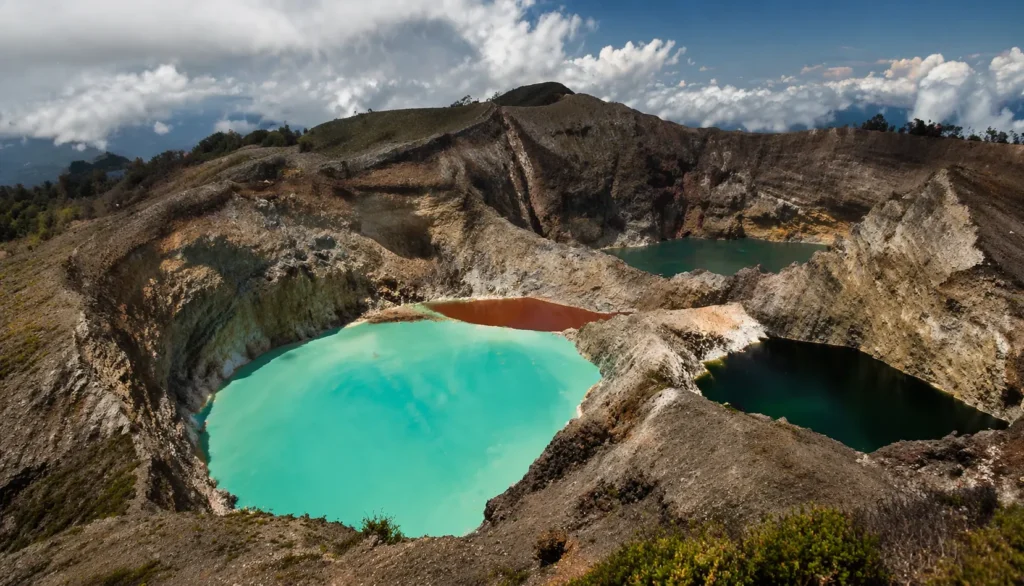

Imagine hiking up a volcano not to see red lava, but to stare down into three giant bowls of water. Now imagine that one of those bowls is bright turquoise blue, another is deep forest green, and the third looks like dark chocolate or even blood red. That is exactly what you will find on the island of Flores, Indonesia, at the top of Mount Kelimutu.
But here is the weird part. Those colors do not stay the same. They shift without warning. A lake that is blue today could turn green next month, or black, or even rusty red. No one can predict exactly when the lakes will change. Scientists have studied them for years, and still, the lakes keep their secrets. This makes Kelimutu one of the most fascinating and mysterious places on Earth.
In this article, we will walk you through the science, the legends, and the sheer beauty of these magical lakes. You will learn why the colors change, what the locals believe, how you can visit this natural wonder, and why the lakes have been surprising people for hundreds of years. We will also tell you real stories from travelers who saw the lakes change with their own eyes. We will break down every mineral, every gas, and every legend until you feel like you have already stood on that volcanic rim yourself. So grab a cup of tea, get comfortable, and let us journey to one of the strangest places on the planet.
What Makes Kelimutu Different from Every Other Volcano on Earth?
Most volcanoes are famous for spewing ash, lava, or smoke. Think of Mount Vesuvius in Italy, which buried the city of Pompeii. Think of Mount St. Helens in Washington State, which blew its entire top off in 1980. Think of Krakatoa, also in Indonesia, whose explosion was heard three thousand miles away. Those volcanoes are violent and destructive. They announce themselves with thunder and fire.
Kelimutu does not do that. Instead of erupting violently, it quietly releases gases from deep inside the Earth. Those gases rise up through three separate cracks in the ground, called craters. Over thousands of years, rainwater filled those craters, creating lakes. Rain is common on Flores because the island sits in a tropical zone. So the lakes never fully dry up. They just sit there, steaming slightly, brewing their strange chemical cocktails.
But because the gases are rich in different minerals, each lake becomes a chemical soup unlike the others. One lake might have lots of sulfur. Another might be full of iron. A third could have high levels of aluminum or chlorine. These minerals react with the water and with the air, producing colors that range from electric blue to muddy red to pale white to deep black. It is like having three separate kitchens, each cooking a different dish with different spices.
What is truly unique is that the lakes sit side by side, sometimes only a few hundred feet apart, yet they behave like total strangers. They do not mix. They do not look alike. They do not even change at the same time. One lake might be going through a red phase while its neighbor stays calm and blue. It is as if they are playing a game of dress-up with no rules. Scientists have tried for decades to find a pattern. They have taken thousands of water samples. They have installed monitoring equipment. But the lakes keep doing whatever they want.
That is why photographers, geologists, and curious travelers keep coming back. You never see the same Kelimutu twice. A person who visited in 2010 saw three completely different colors than someone who visited in 2020. And someone who visits next year might see something nobody has ever recorded before. That unpredictability is the heart of Kelimutu’s magic.
A Quick Look at the Three Sisters: Tiwi Ata Mbupu, Tiwu Nuwa Muri, and Tiwu Ata Polo
Locals do not call the lakes by boring scientific names like “Crater Lake One” or “Sulfur Pool A.” Instead, they have beautiful, meaningful names from the Lio language. The Lio people have lived on Flores for centuries, long before any scientist arrived with testing equipment. They named the lakes based on what they believed the lakes represented. Let us meet the three sisters properly.
Tiwi Ata Mbupu is the westernmost lake. Its name means “Lake of the Old People” or “Lake of the Spirits of the Ancestors.” Traditionally, this is where the souls of elders go after death. If you were a respected grandparent, a village leader, or a wise elder, your spirit would end up here. This lake is usually the most isolated of the three. It sits a bit apart from the others, as if the ancestors wanted some peace and quiet. Over the years, Tiwi Ata Mbupu has tended to show blues and greens, but it has also surprised people with pale whites and even grays.
Tiwu Nuwa Muri sits in the middle. Its name means “Lake of the Young Souls” or “Lake of the Young Maidens.” This is where the spirits of young people go. If you died young, before getting married or having children, your soul would go here. This lake is known for changing more often than the others. It is like the restless energy of youth. Sometimes it turns a startling emerald green. Sometimes it goes bright red like a rose. Sometimes it becomes a muddy brown that looks like coffee with too much cream. Locals say the young souls are playful and unpredictable, which is why their lake changes the most.
Tiwu Ata Polo is the southeastern lake. Its name means “Lake of the Evil Spirits” or “Lake of the Enchanted Ones.” This is where the souls of wicked people or magicians end up. If you practiced black magic, stole from your neighbors, or committed a crime, your spirit would be sent here. This lake often appears dark, sometimes black, sometimes brown, sometimes deep red like dried blood. It is the most feared of the three. Local children are told not to point at this lake or speak badly about it, because the evil spirits might hear and cause trouble.
These names are not just old stories that people tell for entertainment. They are living beliefs. Even today, many Lio people make offerings at the lakes. They leave flowers, rice, or cloth at the crater edge. They whisper prayers to their ancestors. They ask the young souls for good luck in love. They beg the evil spirits to stay calm and not cause eruptions or landslides. When you visit Kelimutu, you are not just looking at water. You are looking at a graveyard of souls, a place of worship, and a source of fear and hope all at once. That adds a layer of respect and wonder to any visit. You do not yell or laugh loudly at the crater rim. You speak softly. You move carefully. You feel like you are in a temple.
Why Do the Lakes Change Color? The Simple Chemistry Behind the Magic
You do not need a chemistry degree to understand Kelimutu. Let us break it down with simple comparisons and everyday examples. Think of the lakes as giant cups of tea. If you add lemon to black tea, it turns lighter because the acid changes the tea molecules. If you add milk, it turns creamy and pale. If you let it sit for too long, it might go dark and bitter as the particles settle. The lakes work the same way, except the “additives” are volcanic gases and minerals that bubble up from deep underground.
Here are the main ingredients that stir the pot, along with simple explanations of what each one does:
Sulfur is one of the most common volcanic gases. It often creates yellow, green, or blue-green colors. When sulfur mixes with water, it forms sulfuric acid. That acid changes how light bounces off the water molecules. If you have ever seen a pond with yellow sulfur deposits around the edges, you have seen a tiny version of what happens at Kelimutu. But at Kelimutu, the sulfur is so concentrated that the water can look like lime Jell-O or a tropical ocean.
Iron is another big player. Iron can turn water red, brown, or orange. That is why some of the Kelimutu lakes look like rusty nails or old blood. You have seen this before if you have ever left a metal tool out in the rain. The reddish-brown color that appears on the metal is iron oxide, also known as rust. The same chemical reaction happens in the lake water. When iron-rich gases hit the water, the iron oxidizes and turns the lake a dramatic red.
Aluminum and silicon are less famous but still important. These minerals can make water look milky white or light blue. Think of the white, cloudy look of water that has a lot of dissolved chalk or limestone. That is aluminum and silicon at work. When these minerals dominate, the lake looks almost like someone poured a gallon of paint into it.
Hydrogen sulfide gas is the one that smells like rotten eggs. You have probably smelled it near hot springs or swamps. At Kelimutu, hydrogen sulfide reacts with other elements to create dark, blackish stains. It can turn a lake from bright to gloomy in a matter of weeks.
Chlorine and carbon dioxide also play supporting roles. Chlorine can bleach colors, making them paler. Carbon dioxide can create bubbles that stir up sediments from the lake bottom, making the water look muddy or cloudy.
But here is the key: the volcano does not release the same amount of gas every day. Sometimes more sulfur comes up. Sometimes more iron. Sometimes the gases mix with rainwater differently because of the temperature or the season. Over months or years, the chemistry shifts, and the lake changes its color like a mood ring. A lake that is rich in iron today might get a sudden influx of sulfur tomorrow, and the red will turn into green as the two chemicals react.
Scientists have also noticed that the lakes can stratify, meaning the top layer might be one color and the bottom another. This happens because different minerals have different weights. Heavier minerals sink. Lighter ones float. Then a small earthquake, a change in gas pressure, or even a strong wind can stir the layers together, creating a whole new shade. That is why the changes can seem sudden and surprising. It is not that the lake slowly fades from blue to green. It might be blue on top and yellow on bottom for months, then one day the layers flip, and suddenly the whole lake is green.
Let us use a kitchen analogy. Imagine you make a salad dressing with oil and vinegar. The oil floats on top. The vinegar sinks. The dressing looks like two separate layers. Then you shake the bottle. Suddenly the whole thing becomes a single, cloudy mixture. That is exactly what happens at Kelimutu. The lakes are shaken by volcanic activity, and the colors blend into something new.
The Unpredictable Timeline: From Blue to Green to Red and Back Again
Let us look at real examples so you can see how wild these changes are. Scientists and local guides have kept records for decades. These are not rumors. These are documented color shifts that have amazed everyone who saw them.
In 2016, Tiwu Nuwa Muri was a stunning turquoise blue. Tourists took thousands of selfies with the bright water behind them. Travel bloggers called it “the most beautiful lake on Earth.” Then, over the next few months, it turned into a murky green. Locals said the young souls were feeling sad. By 2018, it shocked everyone by becoming coffee brown. Tourists who had seen photos from 2016 did not even recognize the lake. They asked if they were at the wrong crater. Then, without much warning, it switched to a reddish rust color. A guide named Yosef, who has worked at Kelimutu for twenty years, said he had never seen anything like it. “The lake was angry,” he told a reporter. “The water looked like blood.”
Tiwi Ata Mbupu has often stayed calmer. For many years, it remained a consistent greenish-blue. Elderly locals said the ancestors were at peace. But even it has surprised scientists by suddenly turning white or pale gray when high amounts of aluminum entered the water. In 2009, the lake went from green to white in just six weeks. Park rangers were baffled. They took samples and found aluminum levels ten times higher than normal. Then, just as suddenly, the aluminum levels dropped, and the lake went back to green.
Tiwu Ata Polo, the “evil spirit” lake, has had the most dramatic changes. In the early 2000s, it looked like a pool of blood. Locals held special ceremonies because they thought the ancestors were angry. They brought offerings of chicken eggs and rice. They chanted for three nights. Then the lake slowly turned from red to dark brown. In 2012, it became black. In 2015, it turned olive green. In 2019, it went back to dark red. Each time the lake changed, the villagers would gather at the base of the volcano and discuss what it meant. Some said the evil spirits were fighting among themselves. Others said the color changes were warnings about political troubles or natural disasters.
No pattern has been proven. You cannot say “every July, the lakes turn red.” You cannot say “after a big earthquake, the lakes turn green.” Scientists have tried to find correlations. They have compared color changes to seismic activity, rainfall, temperature, and even moon phases. Nothing fits. That is what makes Kelimutu both frustrating for scientists and thrilling for visitors. You roll the dice every time you climb that volcano. You might see the most beautiful blue water of your life. You might see something dark and scary. Or you might see a color that has never been recorded before.
There is a famous story about a Japanese geologist named Dr. Hideo Kato who visited Kelimutu every year for fifteen years. He took water samples, photographs, and gas measurements. He wanted to be the one to crack the code. But after fifteen years, he admitted defeat. He told a local newspaper, “Kelimutu does not follow human rules. The lakes have their own schedule, and they will not share it with us.” That is a humbling thought. We humans like to think we can understand everything if we just study it long enough. But Kelimutu reminds us that some things remain mysterious.
Local Legends: What the People of Flores Believe About the Color Changes
Now, let us put aside science for a moment. The people who live at the base of Kelimutu have their own explanations, and these stories are beautiful, sad, scary, and hopeful all at once. The Lio people have been telling these legends for generations, long before any scientist arrived with a testing kit. Their stories are not just fairy tales. They are a way of understanding the world and making sense of the strange things that happen on the mountain.
According to Lio tradition, when a person dies, their soul travels to the top of Kelimutu. A spirit guide meets them and leads them to one of the three lakes. Elders go to Tiwi Ata Mbupu. Young people go to Tiwu Nuwa Muri. Witches or criminals go to Tiwu Ata Polo. The lakes change color when the spirits are restless, happy, angry, or mourning. The colors are messages from the other side.
For example, if the young souls’ lake turns bright red, locals say the young spirits are dancing in celebration. Perhaps a wedding happened in the village below, and the young souls are happy for their living relatives. If it turns dark and murky, the spirits are fighting or grieving. Maybe there was a death in the village, and the young souls are mourning alongside the living. If the ancestors’ lake turns pale, it means the elders are sleeping peacefully. But if it turns black, it means they are warning the living about a coming disaster. Elders will gather and interpret the warning. They might advise the village to postpone a big event or to perform a special ceremony.
There is a famous story passed down through generations. Long ago, two young lovers from rival villages died on the same day. Their names were Lina and Renti. Their families had forbidden them from seeing each other because of an old feud. But the lovers met in secret by a river. One night, a crocodile attacked them, and both died. Their souls went to Tiwu Nuwa Muri. The next morning, the lake turned half blue and half red, split right down the middle. For three days, no one could explain it. Then an old priest climbed the mountain, looked at the lake, and began to cry. He said the lake was showing the two hearts of the lovers—still separate but together. One heart was blue like the river where they met. The other heart was red like the blood they shed. The priest told the villages that the feud must end. On the fourth day, the lake mixed into purple, and the villages made peace. To this day, some locals believe that when Tiwu Nuwa Muri turns purple, it is a sign that love has won over hatred.
Another legend tells of a wicked sorcerer named Ata Bupu. He lived in a village near the mountain and used his magic to steal crops, sicken children, and cause droughts. The people begged the mountain spirits for help. One night, a great wind blew, and the sorcerer disappeared. The next morning, Tiwu Ata Polo had turned black. The people knew the sorcerer’s soul had been thrown into the evil lake. And ever since, that lake has stayed darker than the others. Sometimes, on quiet nights, villagers say they can hear the sorcerer moaning from the crater.
There is also a gentler legend about a grandmother named Ine Lise. She was very old and very kind. She spent her life healing the sick and feeding the hungry. When she died, her soul went to Tiwi Ata Mbupu. The next day, the lake turned a beautiful soft blue, the color of the sky at dawn. And every time a grandchild of Ine Lise dies, the lake shimmers for a moment, as if welcoming them home.
Whether you believe the science or the legend, the result is the same: the lakes feel alive. They seem to have moods. They change when the world changes. And that is why visitors often stand in silence, just watching the water, wondering what the spirits are thinking. You do not have to be Lio to feel the power of the place. Something about standing on that volcanic rim, looking down at three impossible colors, makes you believe in things you cannot see.
How to Visit Kelimutu: A Practical Guide for Brave Travelers
If this article makes you want to book a flight to Indonesia, here is what you need to know. Visiting Kelimutu is not a casual trip. It takes effort, money, time, and a little bit of courage. But that effort is rewarded with one of the most unforgettable views on the planet. Thousands of people make the journey every year, and almost every single one of them says it was worth it.
Getting There: Step by Step
First, you need to get to Bali, Indonesia. Bali is the main international gateway. You can fly there from almost anywhere in the world. There are direct flights from Los Angeles, London, Sydney, Tokyo, and many other cities. Once you land in Bali, you will need to take a domestic flight to the island of Flores. Two main airports serve Flores: Ende and Maumere. Ende is closer to the volcano, so that is your best choice. The flight from Bali to Ende takes about an hour and a half. Small planes fly this route. They can be bumpy, so bring gum to pop your ears.
From Ende, you will drive to the village of Moni. Moni is the gateway town for Kelimutu. The drive takes about two hours by car or scooter. The roads are winding, narrow, and sometimes full of potholes. You will drive through jungle, past rice paddies, and through small villages where children wave at passing cars. You might see water buffalo standing in the road. You will definitely see more motorcycles than cars. If you get motion sickness easily, bring medicine. The twists and turns can be rough.
Once you reach Moni, you will find small hotels, guesthouses, and restaurants. This is not a luxury destination. Do not expect five-star resorts. You will get a clean room, a bed, a bathroom, and maybe a fan or air conditioning. Some guesthouses have hot water. Some do not. The food is simple but delicious: rice, vegetables, chicken, fish, and lots of spicy sambal sauce. The people of Moni are friendly and used to tourists. Many speak basic English. Learn a few words of Indonesian like “terima kasih” (thank you) and “selamat pagi” (good morning). It will make them smile.
The Hike to the Craters
From Moni, you will drive to the Kelimutu National Park entrance. The drive takes about twenty minutes. You will pay a small entrance fee. As of 2024, the fee is around 150,000 Indonesian rupiah for foreign tourists, which is about ten US dollars. Then you start hiking. The trail is about 1.5 miles (2.5 kilometers) uphill. It takes 30 to 60 minutes depending on your fitness level. The path is paved in some parts but steep in others. There are stairs cut into the mountain. There are switchbacks that make the climb easier. You will see tropical trees, monkeys swinging in the branches, and maybe even wild orchids if you look closely.
Take your time. Do not rush. The altitude is about 1,600 meters (5,200 feet) above sea level. That is not extremely high, but some people feel a little short of breath. Drink water. Stop and rest on the benches along the trail. Listen to the birds. The forest is alive with sounds. You might hear the call of the Flores hawk-eagle, a rare bird that lives only on this island.
Once you reach the top, there are viewing platforms. You cannot swim in the lakes. Do not even think about it. The water is highly acidic, with a pH level sometimes as low as 0.5. That is stronger than battery acid. It can burn your skin in seconds. Also, the water is hot in some spots, near boiling in others. And remember—locals consider the lakes sacred. Swimming would be deeply disrespectful. So just look, take photos, and be grateful.
Best Time to See the Lakes
Sunrise is the magic hour. Most visitors start hiking at 4:00 or 4:30 AM so they reach the top by dawn. Yes, that means waking up at 3:00 AM. Yes, it is hard. But trust me, it is worth it. The morning light makes the colors pop. The sun rises behind the lakes, painting the sky in shades of orange and pink. The mist rises from the craters like steam from a giant pot. The air is cool and fresh. And the crowds are smaller. By 8:00 AM, dozens of tour groups have arrived. By 10:00 AM, the viewing platforms are packed. So set that alarm clock. Drink some coffee. Put on your hiking shoes. The sunrise at Kelimutu is one of those rare experiences that you will remember for the rest of your life.
The dry season (April to November) is the best time to visit. In the rainy season (December to March), the paths get slippery, and fog often blocks the view. You could hike all the way to the top and see nothing but gray clouds. That has happened to many disappointed travelers. So plan your trip for the dry season if you can.
What to Pack
Here is a checklist of everything you will need:
- Sturdy hiking shoes with good grip. The path can be slippery, especially if it rained the night before. Do not wear flip-flops or fashion sneakers. Your ankles will thank you.
- A warm jacket. It is cold at 5:00 AM on a volcano. Temperatures can drop to 10°C (50°F) or lower. You might see your breath. A fleece or a light puffer jacket is perfect.
- A headlamp or flashlight. The trail is dark at 4:00 AM. There are no streetlights on a volcano. A headlamp leaves your hands free to hold onto railings.
- Water and a snack. The hike is short but steep. You will get thirsty. Bring a bottle of water and a granola bar or banana.
- Cash for the park entrance fee. There is no ATM at the volcano. Bring enough rupiah for the fee, plus extra for a guide if you want one.
- A camera or phone with good battery life. You will take hundreds of photos. Bring a power bank if you have one.
- Sunscreen and a hat. Once the sun rises, it gets hot fast. The tropical sun at high altitude can burn your skin in fifteen minutes.
- Rain poncho. Even in the dry season, mountain weather is unpredictable. A cheap poncho folds up small and can save your day.
Hiring a Guide
You do not legally need a guide to hike Kelimutu. The trail is straightforward. You can follow the crowds. But hiring a local guide from Moni village is a good idea for several reasons. First, guides know the best spots for sunrise photos. They will take you to the perfect angle. Second, guides can tell you legends and stories that you will not find in any guidebook. Third, hiring a guide puts money directly into the local economy. The people of Moni rely on tourism. A good guide costs about 200,000 to 300,000 rupiah (around 15 to 20 US dollars) for a half-day trip. That is a small price for a much richer experience.
Ask your guesthouse to recommend a guide. Look for someone who speaks English well and has good reviews from previous travelers. A guide named Anton is famous among backpackers. A guide named Maria is known for her knowledge of medicinal plants on the trail. Do a little research before you go.
The Role of Volcanic Activity: What Happens Deep Underground
Let us go deeper—literally. About one mile under the lakes, hot magma sits in chambers. Magma is liquid rock, hotter than any oven, glowing orange and red. That magma heats up underground water and rocks, creating high pressure. Gases like carbon dioxide, sulfur dioxide, and hydrogen sulfide escape through cracks called fumaroles. These cracks lead directly into the bottoms of the three crater lakes. Imagine a pot of water on a stove. The heat from the stove makes bubbles rise to the surface. The same thing happens at Kelimutu, except the “stove” is magma, and the “bubbles” are toxic gases.
Because each crater has a different set of cracks, each lake gets a different recipe of gases. Crater one might get 80% sulfur and 20% iron. Crater two might get 50% sulfur, 30% aluminum, and 20% chlorine. Crater three might get mostly iron and carbon dioxide. It is like having three different soda fountains, each dispensing a different flavor. Over time, the cracks can shift or clog up. An earthquake can open new cracks. A landslide can seal an old crack. That changes the recipe, and boom—the lake changes color.
Also, the water level matters. After heavy rains, more water dilutes the minerals, making colors lighter. During dry spells, the water evaporates, making the minerals more concentrated and the colors darker. So the weather and the volcano work together like two chefs adding ingredients to a stew. Too much rain? The stew gets watery. Too much heat? The stew reduces and becomes intense.
Scientists monitor Kelimutu constantly. The Indonesian Center for Volcanology and Geological Hazard Mitigation has installed seismometers, gas sensors, and water sampling stations. They take measurements every week. They look for signs of a bigger eruption. So far, the volcano is considered active but not dangerously eruptive. The last significant eruption was in 1968, and it was small. Still, visitors must follow park rules and stay on the viewing platforms. Do not go near the crater edges. Do not climb over the barriers. The ground can be unstable. A fall into the acidic water would be fatal.
There is a famous story from 1995. A French tourist climbed over a barrier to get a better photo. The ground gave way. He fell into Tiwu Ata Polo. His body was never recovered. The park rangers tell this story to every group of visitors. It is not meant to scare you. It is meant to keep you alive. Stay behind the barriers. Listen to the guides. Respect the mountain.
Photography Tips: Capturing the Unpredictable Colors
You will want photos. Everyone does. But photographing Kelimutu can be tricky because the colors change with the light and your angle. Here are simple tricks to get great shots, whether you have a professional camera or just a phone.
Use a polarizing filter if you have a real camera. It cuts through the glare on the water and makes the colors richer. Without a filter, the sun’s reflection can wash out the blues and reds. If you do not have a filter, try shooting from an angle where the sun is behind you. That reduces glare naturally.
Shoot at sunrise or sunset. Midday light makes the lakes look flat and pale. At dawn, the low sun creates shadows and highlights that show the texture of the water. The colors seem deeper, more intense. The same lake at noon might look boring. At sunrise, it looks like a painting.
Take multiple photos from different spots. The viewing platforms are at different heights and angles. A lake that looks green from platform one might look blue from platform two because of how the light hits the minerals. Move around. Experiment. Do not just stand in one place and snap one photo.
Do not edit too much. It is tempting to crank up the saturation and contrast to make the colors pop. But real Kelimutu is already surreal. Over-editing makes it look fake and cheap. A little brightness adjustment is fine. But if you find yourself turning the saturation slider all the way to the right, stop. Let the lake speak for itself.
Include the landscape. The lakes are beautiful alone, but they are even better with the volcano ridges, the morning mist, and the green forest around them. Zoom out. Show the whole scene. A photo of just blue water could be anywhere. A photo of blue water framed by volcanic rock and tropical trees is unmistakably Kelimutu.
Take video. Sometimes a photo cannot capture the way the water shimmers or the steam rises. Take a one-minute video. Pan slowly across the three lakes. Record the sounds: the wind, the birds, the distant voices of other travelers. Years later, that video will bring you right back to the mountain.
Ask a guide to take your photo. Local guides know the best spots for portraits. They know where to stand so the lake looks its best behind you. Do not be shy. They have taken thousands of photos for thousands of travelers. They are experts.
Environmental Threats: How Tourism and Climate Affect the Lakes
Kelimutu is a treasure, but it faces dangers. Some dangers come from nature. Some come from humans. Understanding these threats is important because you can be part of the solution, not the problem.
Tourism pressure. Thousands of visitors climb the volcano every year. That is good for the local economy. But it is hard on the environment. Trash gets dropped. The trail erodes. The noise scares away wildlife. The park has trash bins and rangers, but not everyone uses them. Some visitors leave behind plastic bottles, food wrappers, and even diapers. Rangers have to climb down steep slopes to pick up other people’s garbage. That is not fair. Pack out what you pack in. Bring a small bag for your trash. Leave no trace.
Climate change. The rainy seasons have become less predictable. Sometimes the rains are too heavy, causing landslides on the crater walls. Landslides can change the shape of the craters and affect how gases escape. Other times, there are long droughts, and the lake levels drop dramatically. If a lake dries up too much, the gases concentrate and can turn the water dangerously acidic. That might kill any microscopic life in the water and make the colors turn permanently dark or muddy. Scientists worry that climate change could disrupt the delicate balance that creates the beautiful colors.
Earthquakes. Flores is a seismically active island. Earthquakes happen often. Most are small and harmless. But a big earthquake could crack the crater walls, causing a lake to drain. That would be a disaster. The lake would be gone. The gases would escape into the air, potentially harming people and animals. Park rangers have emergency plans, but no one knows if those plans would work.
Volcanic unrest. Kelimutu is an active volcano. Someday, it might have a larger eruption. That eruption could destroy the lakes or change them forever. Scientists monitor the volcano closely. They watch for warning signs like increased gas emissions, ground swelling, or small earthquakes. So far, the volcano has been quiet. But nature is unpredictable. The same unpredictability that makes the lakes beautiful also makes them dangerous.
The Indonesian government has taken steps to protect Kelimutu. They limit the number of visitors per day during peak season. They have built proper viewing platforms to keep people away from the crater edges. They have installed signs explaining the rules. They also work with scientists to monitor water chemistry and volcanic activity. But the future of Kelimutu depends on responsible tourism. That means you—if you visit—should pack out your trash, stay on the paths, respect the sacred nature of the site, and follow the rules. Small actions add up.
Other Color-Changing Lakes Around the World (But None as Strange as Kelimutu)
Kelimutu is not the only color-changing lake on Earth. A few others put on similar shows, but none have three different lakes in one spot. Let us take a quick tour of the world’s other weird waters.
Lake Hillier in Australia is famously pink. It looks like bubblegum. Scientists think the color comes from bacteria that produce pink pigments. But Lake Hillier does not change much. It stays pink year after year. Beautiful, but predictable.
Grand Prismatic Spring in Yellowstone National Park, USA, changes colors with the seasons. The center is deep blue because the water is too hot for anything to live. The edges are orange, yellow, and green because of heat-loving bacteria called thermophiles. As the seasons change, the bacteria populations shift, and the colors shift with them. But Grand Prismatic is a hot spring, not a crater lake. And it is only one pool, not three.
Laguna Verde in Bolivia looks green because of high levels of arsenic and sulfur. It changes shades from light green to dark emerald depending on the wind and the light. But again, it is a single lake. And the changes are subtle, not dramatic.
Mount Pinatubo’s crater lake in the Philippines formed after a massive eruption in 1991. For years, it was a beautiful blue-green. Then, after a series of small earthquakes, it turned a murky green. Scientists said the earthquakes stirred up sediments from the bottom. But Pinatubo only has one lake. And it has not shown the wild, unpredictable swings of Kelimutu.
Boiling Lake in Dominica is exactly what it sounds like. The water is gray-blue and constantly bubbling. It changes color when volcanic gases increase, sometimes turning yellow or brown. But it is too dangerous to get close to, and it is not multiple lakes.
So yes, you can find other weird waters around the world. But nowhere else will you stand on the edge of one volcano and see three completely different colors staring back at you. That is Kelimutu’s superpower. It is a one-of-a-kind natural laboratory and a spiritual wonder all mixed into one. No other place on Earth combines chemistry, culture, mystery, and beauty in quite the same way.
Stories from Travelers: Real People, Real Experiences
Let us hear from people who have actually been there. These are real stories from real travelers. Their words will give you a feel for what the experience is really like.
Sarah from Canada, visited in 2019: “I almost did not make the hike. I was so tired from traveling. But my friend dragged me out of bed at 3 AM. I am so glad she did. When we reached the top, the sun was just starting to rise. The lakes looked like three different colored jewels. One was bright blue. One was dark green. One was almost black. I stood there for ten minutes without saying a word. I could not believe it was real. It looked like a movie set. But it was real.”
Joko from Java, visited in 2022: “I have been to Kelimutu three times. The first time, the young souls’ lake was red. The second time, it was green. The third time, it was brown. Each time felt like visiting a different place. I bring my children now. I want them to see how beautiful Indonesia is.”
Elena from Spain, visited in 2018: “The hike was harder than I expected. I am not very fit. I had to stop many times. But an old Indonesian woman passed me on the trail. She was maybe seventy years old. She smiled at me and said, ‘Slow is fine. Just keep going.’ So I did. And when I reached the top, I cried. Not from exhaustion. From beauty. I have traveled to forty countries. Kelimutu is in my top three.”
David from Australia, visited in 2023: “I am a geologist. I went to Kelimutu for work. But the science is only half the story. The local legends touched me more than the chemistry. When I stood at the evil spirit lake, I felt a chill. I do not believe in ghosts. But something about that dark water made me uncomfortable. My guide said, ‘That is respect. The lake is reminding you to be humble.’ I think he was right.”
Maya from India, visited in 2021: “I went alone. I was going through a difficult time in my life. At the top, I sat on a rock and watched the lakes for two hours. I did not take many photos. I just watched. The colors seemed to shift as the clouds moved. I felt like the lakes were telling me that change is natural. Nothing stays the same. That is not scary. That is beautiful. I left feeling lighter.”
These stories share a common thread. No one regrets going. Everyone is changed by the experience. Some are changed by the science. Some are changed by the legends. Some are just changed by the sheer unexpected beauty of three colorful lakes sitting on top of a volcano. But everyone agrees: Kelimutu is special.
What Scientists Are Still Trying to Figure Out
Even after decades of study, Kelimutu holds many secrets. Scientists have a list of unanswered questions. Let us look at what still puzzles the experts.
Why do the lakes change color at different times? If the same volcano feeds all three lakes, you would expect them to change together. But they do not. One lake might change while the others stay the same. That suggests that each crater is isolated from the others, even deep underground. But how isolated? And why? Scientists do not know.
Can we predict color changes? So far, no. Scientists have tried to build prediction models using data on gas emissions, water chemistry, and seismic activity. Nothing works. The lakes seem random. But maybe we are missing a key variable. Maybe the lakes respond to something we have not measured yet. Some researchers think deep groundwater flows might be the answer. Others think biological activity, like algae or bacteria, might play a role. The debate continues.
What is the role of living organisms? For a long time, scientists assumed the lakes were too acidic to support life. But recent studies have found tiny microbes living in the water. These are extremophiles, organisms that thrive in harsh conditions. Could these microbes be affecting the color? Could they be eating certain minerals and pooping out others? It is possible. But no one has studied this in depth yet.
How old are the lakes? We know the volcano is old. But the current craters might be relatively young. They could have formed during an eruption a few hundred years ago. Or they could be thousands of years old. Without drilling into the crater bottoms, it is hard to know. And drilling is dangerous and expensive.
Will the lakes ever stop changing? Maybe. If the volcanic activity decreases, the gas flows might become steady and predictable. The lakes would reach a chemical balance and stay one color forever. Or if the volcano becomes more active, the lakes might boil away entirely. Scientists monitor the volcano for signs of change. But no one can say what the long-term future holds.
These unanswered questions are not failures. They are invitations. Kelimutu invites us to stay curious, to keep asking, to never assume we know everything. That is a good lesson for life, not just for volcanoes.
The Cultural Importance of Kelimutu to the People of Flores
We have talked about the legends. But let us go deeper into the culture. The Lio people are not just storytellers. They have a rich, complex society that revolves around the mountain. Understanding their culture helps you understand why the lakes matter so much.
The Lio people live in villages scattered around the base of Kelimutu. They are farmers. They grow rice, corn, coffee, and vegetables. They raise chickens, pigs, and water buffalo. They live in houses made of wood and bamboo, with roofs of dried grass. Extended families live together in compounds. Elders are respected. Children are cherished. Visitors are welcomed.
Every year, the Lio people hold a ceremony called Penti. It is a harvest festival that thanks the ancestors for the food. During Penti, the village priest climbs Kelimutu to make offerings at the lakes. He brings rice, eggs, betel nut, and cloth. He prays to the ancestors in the old language. He asks for good health, good weather, and peace. When he returns, the whole village celebrates with dancing, music, and feasting. The ceremony can last for days.
If a lake changes color dramatically, the elders call a special meeting. They discuss what the change might mean. Sometimes they decide to hold an extra ceremony to calm the spirits. Sometimes they decide to change planting dates or move a wedding. The lakes are not just scenery. They are decision-makers. They influence when people plant their crops, when they marry, and when they mourn.
Young Lio people today face a choice. Some move to the city for work and education. They learn science in school. They understand that the lakes change because of minerals and gases. But many still respect the old beliefs. They might be chemists by day and spirit-believers by night. For them, science and legend are not enemies. They are two ways of understanding the same mystery. You can know why the water turns red (iron) and still believe the red means the young souls are dancing. Both can be true.
This dual way of thinking is beautiful. It does not force a choice between logic and magic. It allows both to exist. When you visit Kelimutu, try to hold both ideas in your mind. The lakes change because of chemistry. And the lakes change because the spirits have something to say. Which one is correct? Maybe both. Maybe neither. Maybe the truth is something we have not discovered yet.
Preparing for Your Trip: A Month-by-Month Guide
If you are serious about visiting Kelimutu, let us plan it out. Here is a month-by-month guide to help you prepare.
Six months before your trip: Start saving money. A trip to Kelimutu from the United States or Europe will cost at least $1,500 to $2,500 including flights, hotels, food, and activities. Check your passport. Make sure it is valid for at least six months after your travel dates. Book your international flight to Bali. The earlier you book, the cheaper it is.
Three months before your trip: Book your domestic flight from Bali to Ende. These flights fill up, especially in the dry season. Book your guesthouse in Moni. Look for places with good reviews. Ask if they can arrange a sunrise hike for you. Many guesthouses offer packages that include a guide and transportation.
One month before your trip: Start hiking on weekends to build your fitness. You do not need to be an athlete, but you should be able to walk uphill for 30 to 60 minutes without stopping. Buy your gear: hiking shoes, headlamp, warm jacket, rain poncho. Practice waking up early. Set your alarm for 4 AM a few times to get your body used to it.
One week before your trip: Check the weather forecast for Flores. Pack your bag. Bring layers so you can adjust to changing temperatures. Charge all your electronics. Download offline maps of Flores because cell service can be spotty. Notify your bank that you will be traveling so they do not freeze your credit card.
The day before your hike: Arrive in Moni. Rest. Drink water. Eat a good dinner. Go to bed early. You will be waking up before dawn.
The day of your hike: Wake up at 3 AM. Drink coffee or tea. Use the bathroom. Put on your hiking clothes and shoes. Meet your guide. Drive to the park entrance. Hike in the dark. Reach the top. Watch the sunrise. Take photos. Cry a little (it is allowed). Hike back down. Eat a huge breakfast. Take a nap. You have earned it.
The day after your hike: Explore Moni village. Visit the local market. Buy coffee or vanilla beans to bring home. Thank your guide. Leave a good review online. Share your photos with friends. Start planning your next adventure.
Final Thoughts: Why Kelimutu Deserves a Spot on Your Bucket List
Some natural wonders look better in photos than in real life. Niagara Falls is amazing, but you have seen it a million times on postcards. The Grand Canyon is stunning, but you know exactly what to expect. The Eiffel Tower is impressive, but it is just a tower. Kelimutu is different. No photo can capture the feeling of standing on that volcanic rim at 6:00 AM, watching the mist clear, and seeing three bowls of impossible colors appear beneath you. Your breath catches. Your heart beats faster. Your mind struggles to understand what your eyes are seeing.
You will not know which colors you will get. You might see the ancestors’ lake a calm turquoise and the young souls’ lake a shocking red. Or all three might be dark and moody. You might see a color that has never been recorded before. That uncertainty is not a drawback. It is the whole point. The lakes remind us that nature does not follow our schedules. It does its own thing. And sometimes, the most beautiful things in life are the ones we cannot predict or control.
If you go, go with respect. Remember the Lio people’s stories. Walk softly on the mountain. Take your photos, but also take a minute to just breathe and watch. Because those lakes have been changing colors for hundreds of years, and they will keep changing long after you have gone home. You are just a visitor in their long, colorful story. Make it a good visit. Leave nothing behind but footprints. Take nothing home but memories and photos.
Kelimutu is not just a destination. It is a reminder that the world is still full of mystery. In an age where we can google almost anything, where satellites have mapped every corner of the planet, where scientists have explained almost every phenomenon, Kelimutu stands as a quiet rebel. It changes when it wants. It keeps its secrets. And it invites us to stand in awe, to ask questions, and to accept that we do not have all the answers. That is a rare gift. Do not waste it.
Frequently Asked Questions (FAQ)
Can the lakes change color in one day?
Not usually. Major color changes happen over weeks or months. However, slight shifts in shade can happen within a day due to sunlight angles and cloud cover. A lake that looks blue at sunrise might look green at noon. But that is a trick of the light, not a chemical change.
Is it dangerous to hike Kelimutu?
It is safe if you stay on the trails and viewing platforms. The volcano is active but not erupting. The biggest dangers are slipping on wet paths, getting exhausted from the hike, or ignoring the barriers. Listen to your guide. Stay behind the railings. You will be fine.
Do I need a guide?
You do not legally need one, but hiring a local guide from Moni village is a good idea. They know the best sunrise spots and can tell you legends that you will not find in guidebooks. They also help the local economy. A guide costs about 150,000 to 300,000 rupiah (10 to 20 US dollars). Worth every penny.
What should I do if a lake changes color while I am there?
Enjoy it! You have witnessed something special. Tell the park rangers so they can report it to scientists. Take photos and videos from a safe distance. And if you are the superstitious type, say a small prayer to the spirits. It cannot hurt.
Are the lakes safe to touch?
No. The water is highly acidic. It can burn skin and damage clothes. Do not even dip a finger in. Do not throw rocks into the lakes. Do not try to take a water sample. Just look. The viewing platforms are there for a reason.
Can I visit Kelimutu with children?
Yes, but only if the children are old enough to hike and follow safety rules. The trail is steep and has drop-offs. Very young children or children who do not listen well should stay at the guesthouse. Teenagers who are responsible will love it.
What is the best time of year to visit?
The dry season, April through November. The rainy season (December to March) brings slippery trails and foggy views. You can still visit in the rainy season, but you might see nothing but clouds. Check the weather forecast before you go.
How much does the trip cost?
A budget traveler can do it for $500 to $800 including flights from Bali to Ende, hotels, food, and the park entrance. A luxury traveler might spend $1,500 or more. The biggest expense is the international flight to Bali. Once you are in Indonesia, things are relatively cheap.
Do I need any vaccinations?
Check with your doctor. Most travelers to Indonesia get vaccinated for hepatitis A, typhoid, and tetanus. Malaria is rare in the highlands of Flores, but you should still use mosquito repellent. Bring a basic first aid kit with bandages, antiseptic, and pain relievers.
What language do people speak in Moni?
Most people speak Lio at home. Many also speak Indonesian, the national language. Some people speak basic English. Learn a few words of Indonesian: “terima kasih” (thank you), “selamat pagi” (good morning), “tolong” (help), and “berapa harganya” (how much does it cost). A smile goes a long way.
A Final Story to Send You Off
Let me leave you with one last story. A few years ago, a young woman named Dewi from Jakarta visited Kelimutu with her grandmother. The grandmother was eighty-two years old. She had grown up on Flores but moved to the city as a young woman. She had not seen the lakes in sixty years.
They made the hike slowly. The grandmother leaned on a walking stick and on Dewi’s arm. They stopped many times. But they made it. When they reached the top, the grandmother looked at the three lakes and began to cry. Dewi asked what was wrong. The grandmother said, “Nothing is wrong. When I was a girl, the young souls’ lake was blue. Today it is red. That means my mother is dancing. She died when I was twenty. I have missed her every day. Now I know she is happy.”
Dewi later wrote about the experience online. She said, “I went to Kelimutu to see pretty colors. I left understanding that some things are deeper than science. The lakes are not just water and minerals. They are memory. They are love. They are connection.”
That is Kelimutu. It gives you what you need, not just what you expect. So go. See it for yourself. And let the lakes teach you whatever they have to teach.


ProDentim is a modern oral-health supplement formulated with specialized probiotics and naturally sourced ingredients to help maintain firm teeth
AquaSculpt is a high-quality metabolic support supplement created to help the body utilize fat more efficiently while maintaining steady
Backbiome is an advanced daily wellness supplement formulated to help support spinal comfort, reduce feelings of built-up tension, and promote freer, smoother movement throughout everyday life.
PurDentix is a revolutionary oral health supplement designed to support strong teeth and healthy gums. It tackles a wide range of dental concerns, including gum inflammation and tooth decay
GL Pro is a natural dietary supplement formulated to help maintain steady, healthy blood sugar levels while easing persistent sugar cravings.
Boostaro is a modern mens wellness formula created to support daily vitality, stamina, and confidence through a practical, natural routine.
NerveCalm is a high-quality nutritional supplement crafted to promote nerve wellness, ease chronic discomfort, and boost everyday vitality.