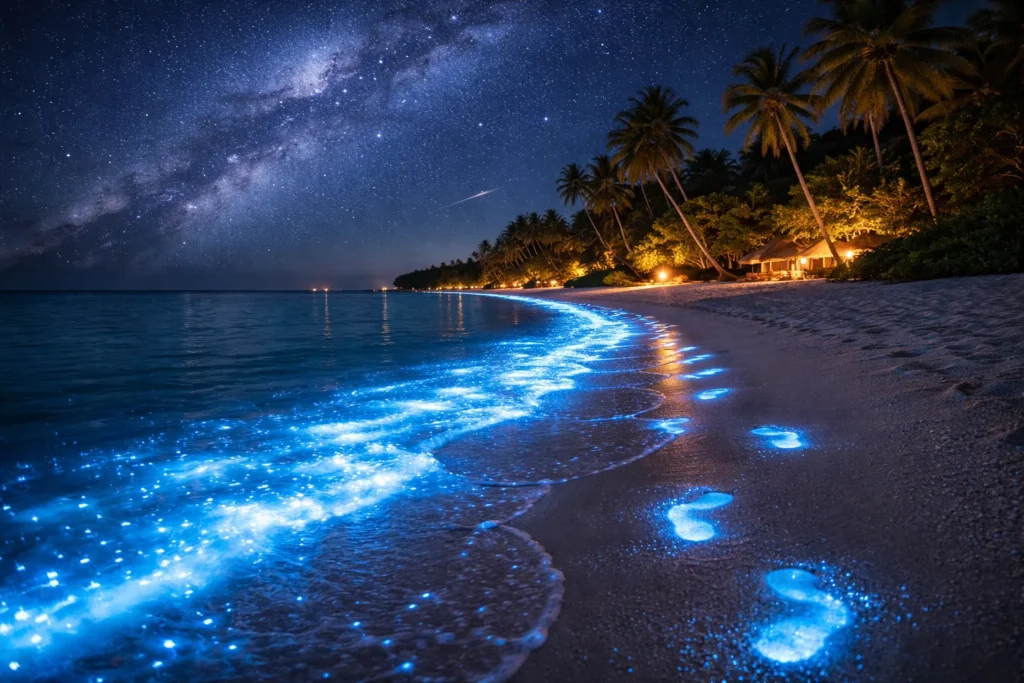

Imagine standing at the edge of the world. The sky above you is a deep, endless black, scattered with a million familiar stars. But something is different tonight. You look down, and the sand beneath your feet is not dark. It is sparkling. A gentle wave rolls in, and as it recedes, it leaves behind a trail of electric blue light that clings to the grains of sand like liquid sapphire. You take a step forward, and your footprint ignites. A burst of blue shoots out from under your toes, fading as quickly as a struck match. Another step, another burst. Soon, you are walking on a path of stars, leaving a trail of light behind you as if you are a character in a fairy tale.
This is not a dream. This is not a special effect. This is the reality of Vaadhoo Island in the Maldives, a place where the ocean has a secret. It is a place known around the world as the “Sea of Stars.” For years, photographs of this electric-blue shoreline have circulated the internet, sparking debates about whether such a place could truly exist. People have called it magic, called it a hoax, called it the most beautiful thing they have ever seen. And the truth is, it is all of those things. It is a natural phenomenon so rare, so delicate, and so breathtaking that it feels like a gift from the universe.
But to truly understand the glowing beach, you cannot just look at a picture. You have to dive into the story. You have to understand the tiny creatures that create the light, the island where they live, the people who call that island home, and the science and the wonder that come together to create one of the most spectacular sights on planet Earth. This article is your complete, all-encompassing guide. We will walk you through every detail, from the microscopic world of the phytoplankton to the practical steps of booking your journey. We will explore the best times to visit, the culture of the local Maldivian people, the other adventures that await you in the Raa Atoll, and the critical importance of protecting this fragile wonder for the future.
So, take a deep breath. Let the salt air fill your lungs. We are about to embark on a journey to the edge of the ocean, where the water turns to stars.
H2: The Microscopic Miracle: What Creates the Blue Light?
To understand the magic of Vaadhoo, we must first shrink ourselves down to a scale almost beyond imagination. We must enter the world of the microscopic. The glowing beach is not caused by minerals in the sand or reflections from the sky. It is caused by life. Specifically, it is caused by a type of marine plankton called dinoflagellates. These are not plants, though they use sunlight to make food. They are not animals, though they can move and hunt. They are something in between—a type of protist that has inhabited Earth’s oceans for hundreds of millions of years, long before the dinosaurs, long before humans ever walked on two legs.
These organisms are tiny. We are talking about creatures that are typically between 0.02 and 2 millimeters in size. To put that in perspective, a single grain of table salt is about 0.3 millimeters. A single drop of seawater can contain thousands of these dinoflagellates. You cannot see them with your naked eye. But when they gather in massive numbers, in what scientists call a “bloom,” their combined presence becomes visible. And when they are agitated, their combined light becomes a spectacle.
H3: The Chemistry of Light: Luciferin and Luciferase
The word for this natural light production is bioluminescence. It comes from the Greek words bios (life) and lumen (light). It is the same phenomenon that allows fireflies to light up summer nights and allows strange, alien-like creatures in the deep ocean to glow in the perpetual darkness. For the dinoflagellates of Vaadhoo, the mechanism is a remarkable piece of biological engineering.
Inside the cell of a dinoflagellate, there are tiny, specialized compartments called scintillons. It sounds like something out of a science fiction novel, but it is very real. Within these scintillons, the organism stores two key chemical ingredients: a molecule called luciferin and an enzyme called luciferase. On their own, these two ingredients are inert. They are like two halves of a key and a lock that haven’t been put together.
When the water around the dinoflagellate is disturbed—by a wave, by a fish swimming by, by a human foot—it creates a mechanical stress. This stress triggers a rapid change in the acidity, or pH level, inside the cell. This change acts like a key turning in a lock. It allows the luciferase enzyme to interact with the luciferin molecule. In a flash that lasts only a fraction of a second, the luciferase catalyzes a reaction that oxidizes the luciferin, releasing energy. That energy is not released as heat, but as light. It is one of the most efficient chemical reactions in nature, converting nearly 100% of the energy into light, with almost no waste heat. For comparison, an incandescent light bulb converts only about 10% of its energy into light; the rest is wasted as heat.
H3: Why Blue? The Science of Color in the Ocean
If you have seen the photographs, you know the light is always a brilliant, unmistakable shade of electric blue. This is not an accident. In the physics of light, different colors have different wavelengths. Red light has a long wavelength and is quickly absorbed by water. Blue light has a short wavelength and can travel the farthest through the ocean. It penetrates deeper and spreads wider than any other color.
For a tiny dinoflagellate trying to use its flash of light to communicate or to defend itself, it wants that light to be seen. Blue light is the most effective way to send a signal through the marine environment. It is the language of the ocean. Many deep-sea creatures also use blue bioluminescence for this very reason. When we stand on the shore of Vaadhoo, we are witnessing a form of communication that has been evolving in the darkness of the ocean for eons. It is a language written in light, and for a few precious nights a year, we are lucky enough to eavesdrop.
H3: Why Do They Glow? The Theories of Defense
Scientists have long debated the evolutionary reason for bioluminescence in dinoflagellates. Why would a tiny, drifting organism waste precious energy to produce a flash of light when it is disturbed? There are two main theories, and both are fascinating.
The first theory is known as the “burglar alarm” hypothesis. Imagine you are a tiny copepod, a small crustacean, and you are trying to eat a dinoflagellate. As you take a bite, the dinoflagellate flashes. That flash of light is like setting off a silent alarm. It attracts the attention of larger predators, fish or shrimp, who then come to investigate the flash. These larger predators see the copepod and eat it instead. The dinoflagellate sacrifices a momentary flash of light to summon a bigger predator to come to its defense. It is a brilliant strategy: if you are going to be eaten, at least take your attacker down with you.
The second theory is simply that the flash startles the predator. In the dark of the ocean, a sudden burst of blue light directly in your face can be disorienting. It might cause the copepod or other small predator to flinch and release its grip, giving the dinoflagellate a split-second chance to escape. Whether it is a startle response or a burglar alarm, the result is the same: a tiny flash of light that, when multiplied by billions, creates the sea of stars.
H2: Vaadhoo Island: The Heart of the Phenomenon
Now that we understand the what and the how, we must turn to the where. Vaadhoo Island is not just a random dot on a map. It is a living, breathing community with its own identity, its own history, and its own relationship with the ocean that surrounds it. The island is located in the Raa Atoll, which sits in the northern part of the vast Maldivian archipelago. To understand Vaadhoo, you must understand the geography of the Maldives as a whole.
The Maldives is a nation of superlatives. It is the flattest country on Earth, with its highest natural point standing only about 8 feet above sea level. It is made up of 26 ring-shaped atolls, which are essentially ancient volcanic craters that have been submerged for millennia, leaving behind only the coral reefs that grew on their rims. These atolls are scattered across roughly 35,000 square miles of the Indian Ocean. Within these 26 atolls, there are over 1,100 individual islands. Of these, only about 200 are inhabited by local Maldivian people. Another 150 or so have been developed into the luxury resorts that the country is famous for. The rest are uninhabited—wild, pristine patches of sand and vegetation.
Vaadhoo is one of the inhabited islands. It is small. You could walk from one end of the island to the other in about 20 to 30 minutes. It is not a resort island, and that is precisely what makes it special. There are no towering hotels, no swim-up bars, no manicured golf courses. Instead, there is a quiet community of a few hundred people who live their lives in rhythm with the tides. The main street is made of sand. The call to prayer echoes from the local mosque five times a day. Children play cricket on the beach. Fishermen repair their nets in the afternoon shade.
H3: Life on a Local Maldivian Island
Staying on Vaadhoo offers a glimpse into a way of life that has remained relatively unchanged for centuries, despite the rapid modernization of the capital, Malé. The Maldivian people, or Dhivehin, have a rich culture that blends South Indian, Sinhalese, and Arab influences. The language is Dhivehi, a unique Indo-Aryan language with its own script, Thaana. Islam is the state religion, and it permeates daily life. The pace is slow, deliberate, and deeply connected to the ocean.
Fishing is the lifeblood of the community. For generations, the men of Vaadhoo have set out on traditional wooden boats called dhoni. These boats, with their distinctive hulls and powerful diesel engines, are a common sight bobbing in the lagoon. The primary catch is tuna, specifically skipjack and yellowfin. Tuna is not just a food source; it is the foundation of Maldivian cuisine and economy. You will see tuna being smoked, dried, and processed in ways that have been passed down through families for centuries. The most famous local dish is mas huni, a breakfast staple of finely shredded smoked tuna mixed with grated coconut, onions, and chili, typically eaten with roshi, a soft, thin flatbread. It is simple, healthy, and delicious, and you will likely be served it every morning at your guesthouse.
The women of Vaadhoo are often skilled in crafts like thundu kunaa, the traditional Maldivian mat weaving. These colorful, intricately patterned mats are made from natural fibers and are a source of pride and a small source of income for many families. There is a sense of community here that is hard to find in the modern world. Neighbors know each other. Family is everything. And when travelers come to see the glowing beach, they are welcomed not as customers, but as guests.
H3: The Story of Rannamaari: Local Legends of the Light
Before science explained the bioluminescence, the people of the Maldives had their own stories. Like all cultures living close to the sea, they wove myths to explain the mysteries they witnessed. The glowing beach was no exception. Ask an elder on Vaadhoo, and they might tell you about Rannamaari.
In Maldivian folklore, Rannamaari was a sea demon or a spirit that demanded sacrifices from the people. According to one popular legend, Rannamaari would appear as a glowing light in the water, a sign that the demon was restless. The light was a warning. To appease the demon, a virgin girl had to be sent to a specific temple on the beach each month. This went on for many years until a brave old woman named Siyamai offered to go instead of the young girls. She filled her clothing with spices and crushed chili peppers. When the demon appeared as a glowing light in the water, she threw the spices at it, and the demon fled, never to return.
While the story of Rannamaari is a myth, it shows that the glowing water has been part of Maldivian consciousness for centuries. The light was seen as something powerful, something to be respected, something that bridged the world of the living and the world of the spirits. Today, while the old stories are less frequently told, the magic of the light remains. Some locals will still smile and tell you that the glowing water is the spirit of the sea dancing, a celebration of life beneath the waves.
H2: A Storytelling Journey: My Nights Beneath the Sea of Stars
To truly convey the magic of this place, we must step away from facts and figures for a moment and enter the realm of personal experience. Let me take you there through a story. Close your eyes for a moment and imagine.
The sun had set over the Indian Ocean with the usual Maldivian flair. It was a slow, dramatic descent, painting the sky in bands of fiery orange, soft pink, and deep violet. The palm trees on the beach became silhouettes, their fronds rustling in the gentle evening breeze. I was sitting on the wooden deck of a small guesthouse called “Island Home,” run by a local family. My host, a man named Ahmed, had lived on Vaadhoo his entire life. He had the weathered hands of a fisherman and the calm, knowing eyes of someone who understood the sea.
We were drinking kurumba, fresh coconut water, straight from the shell. The conversation was easy, drifting from the day’s fishing catch to the news from Malé. But there was an unspoken anticipation in the air. We were all waiting for the same thing.
“Tonight is the night,” Ahmed said, not as a question, but as a statement. He looked up at the sky. There was no moon. The stars were already beginning to appear, sharp and clear. “The tide is right. The wind is quiet. The water is warm.”
A group of us—travelers from Germany, China, Brazil, and myself—followed him down the sandy path. He carried a flashlight, but he pointed it at the ground, shielding the beam with his hand. Too much light, he explained, would ruin our night vision and might disturb the organisms.
When we stepped onto the beach, my first reaction was a strange disappointment. The ocean looked… normal. It was a vast, dark expanse, the waves crashing with a steady, rhythmic whoosh. I had seen the photos online. I had dreamed of this moment. And now, it just looked like any other beach at night.
Ahmed saw the look on my face and chuckled. “Patience,” he said.
He walked down to the water’s edge, where the foam of the last wave was sizzling into the sand. He knelt down and placed his hand flat on the wet sand, letting a tiny, trickling wave wash over his fingers.
And then it happened.
It was as if he had touched a live wire. A burst of electric blue light exploded from his hand, radiating outward in a perfect circle. It was so bright, so sudden, that the whole group gasped. The light lasted for only a second, but it left an afterimage burned onto my retinas. He swirled his hand in the shallow water, and the water turned to liquid light, spiraling around his fingers like blue smoke.
My heart was pounding. I walked to the water’s edge, my legs feeling shaky with excitement. A small wave rolled in, no higher than my ankles. It washed over my feet, and as it did, the sand around my toes ignited. I was standing in a puddle of stars. I took a step forward. Flash. A burst of blue light shot out from under my foot. I took another step. Flash. Another burst. Soon, I was walking along the shore, and every single footprint I left behind was a glowing blue imprint, fading slowly into the darkness.
I stopped walking and just stood there, letting the waves crash against my legs. With each wave, a sheet of blue light spread up the beach, covering my feet, swirling around my knees. It was like standing in a shallow pool of electricity. I looked out at the horizon. Every wave that rose up and curled over was outlined in blue. They would rise, dark and powerful, and as they began to break, a line of bright blue would trace their curl, like a neon sign being switched on. The wave would crash, and for a moment, the entire shoreline would be a brilliant, glowing white-blue.
The other travelers had spread out along the beach. I could see them in the darkness, each surrounded by their own halo of light. One person was jumping, and every time their feet hit the sand, a burst of blue exploded around them. Another was lying on their back in the shallow water, and their entire body was outlined in a soft, shimmering blue. The laughter was quiet, hushed, as if we were in a cathedral. No one was yelling. No one was playing music. We were all just standing in awe, watching the ocean turn into the night sky.
I remember looking up at the real stars, the ones in the heavens, and then looking down at the stars at my feet. For a moment, I felt like the world had been turned inside out. The boundary between sky and sea had dissolved. I was standing on a bridge of sand, suspended between two infinite fields of stars. It was a moment of pure, unadulterated wonder—the kind of moment that makes you feel small in the best possible way, a tiny speck in a universe that is so much more magical than we usually give it credit for.
We stayed there for hours. The time slipped away unnoticed. We didn’t check our phones. We didn’t take pictures (though we tried, and failed, to capture it). We just… watched. We watched until the first hint of gray appeared on the horizon, and the blue light began to fade, retreating back into the ocean with the rising sun. We walked back to our guesthouse in silence, each of us carrying the memory of that light inside us. It was the kind of night that changes you, even if only a little. It was a reminder that magic is real, and it lives in the ocean.
H2: The Traveler’s Guide: When to Witness the Wonder
If you are now dreaming of your own night on Vaadhoo, the next question is clear: when should you go? The bioluminescence is a natural phenomenon, not a scheduled performance. It does not happen every night. However, by understanding the conditions that create the bloom, you can dramatically increase your chances of witnessing the sea of stars.
H3: The Dry Season: November to April
The Maldives has two main monsoon seasons. The dry season, known as the Iruvai monsoon, runs from November through April. This is, without a doubt, the best time to visit Vaadhoo for the bioluminescence. During these months, the weather is characterized by clear skies, lower humidity, and, most importantly, calm seas. The wind is light, and the ocean surface is often as smooth as glass.
Why does this matter for the glow? The bioluminescent dinoflagellates are most concentrated when the water is calm. Strong winds and rough seas create turbulence that can break up the bloom, scattering the organisms over a wider area and diluting their concentration. Calm water allows them to gather in dense patches, particularly in the shallow lagoons and bays around the island. When the water is still, the organisms can also rise closer to the surface, making their light more visible when agitated.
The dry season also offers the most comfortable travel conditions. Rain is rare, the sun is intense but pleasant, and the temperature hovers around a perfect 80 to 85 degrees Fahrenheit (27 to 30 degrees Celsius). The visibility for snorkeling and diving is also at its peak during these months, making it the ideal time to combine your bioluminescence quest with other marine activities.
H3: The Moon Phase: The Critical Factor
If you only remember one thing from this guide, let it be this: the moon is everything. The brightness of the moon directly determines how visible the bioluminescence will be. The glow is a subtle light. It is not like a spotlight; it is more like the faint, shimmering glow of a firefly. A bright full moon will wash it out completely. The light of the moon reflecting on the water creates a glare that makes the blue glow invisible to the human eye.
Therefore, your goal is to visit during the new moon phase. This is when the moon is not visible in the night sky. The sky is at its darkest, the stars are at their brightest, and the conditions are perfect for seeing the subtle blue light of the phytoplankton. The nights immediately before and after the new moon, when the moon is just a thin crescent, are also excellent. The moon sets early, leaving the rest of the night in total darkness.
When planning your trip, check a lunar calendar. Aim to have your nights on Vaadhoo fall within a window of about three nights before the new moon to three nights after. If you book your stay during a full moon week, you may see nothing at all, and that would be a heartbreaking disappointment after such a long journey.
H3: Tides, Currents, and Local Knowledge
Beyond the season and the moon, the final variable is the tides and the ocean currents. This is where the expertise of your local hosts becomes invaluable. The dinoflagellates do not stay in one place. They drift with the currents. Sometimes, the bloom is concentrated on the eastern side of the island. Other times, it is on the western side. Sometimes, it is in the main lagoon near the jetty. Other times, it is around a small, rocky point that requires a short walk.
The local guesthouse owners and fishermen know these patterns intimately. They observe the water every day. They know which way the current is running and where the plankton are gathering. When you arrive, they will not just say, “Go to the beach.” They will tell you, “Tonight, go to the beach by the old mosque at 9:30 PM. The tide will be coming in, and the current will push the glow right onto the shore.” They have a sixth sense for it, built on a lifetime of watching the ocean.
Trust them. Do not wander off on your own to a random stretch of beach. Ask your host. They are your key to unlocking the best possible experience.
H3: Time of Night: Patience Pays Off
The glow can sometimes be visible shortly after sunset, as the last light of dusk fades. However, the best viewing is almost always later in the night, after 9:00 PM and often well past midnight. There are two reasons for this. First, it takes time for your eyes to fully adjust to the darkness. If you go to the beach right after sunset, your eyes are still accustomed to the light of day. It can take up to 20 minutes for your night vision to reach its peak, and even longer to become fully sensitive to the faint blue light.
Second, the ambient light from the island itself fades as people go to sleep. The guesthouses turn off their exterior lights. The village becomes dark. By 10:00 or 11:00 PM, you are in near-total darkness, which is exactly what you want. On a new moon night, with no artificial light and no moonlight, the bioluminescence can be so bright that it feels like you are walking in a dream.
H2: The Journey: How to Reach This Starry Shore
Getting to Vaadhoo is an adventure in itself. It is not a simple point-and-click destination. You cannot land at an international airport and take a taxi. The journey requires planning, patience, and a sense of adventure. But for those who make the effort, the reward is immense. The difficulty of the journey only adds to the feeling that you have discovered a truly remote and special place.
H3: Step 1: The International Gateway – Malé
Your journey begins at Velana International Airport (MLE), located on Hulhulé Island, right next to the capital city of Malé. This is the only international airport in the Maldives, and it is the entry point for nearly all visitors. You will find direct flights to Malé from major hubs around the world, including Dubai, Doha, Istanbul, Singapore, London, Frankfurt, and many cities in India and Southeast Asia.
When you arrive, you will step out of the arrivals hall into the warm, humid air of the Maldives. The airport is bustling, with representatives from resorts and guesthouses holding signs with their guests’ names. Your first task is to get oriented. You are not going to a resort with a speedboat waiting at the jetty. You are going to a local island in a distant atoll. You have a few more legs of the journey ahead.
H3: Step 2: The Domestic Flight – Into the Atolls
Vaadhoo is located in the Raa Atoll, which is a significant distance north of Malé. It is too far for a standard speedboat. Your primary option is to take a domestic flight from Malé to one of the regional airports in the northern atolls. There are two main airports you might use:
- Ifuru Airport (IFU): This is the closest airport to Vaadhoo. It is a small domestic airport located on the island of Ifuru, which is in the same Raa Atoll. The flight from Malé to Ifuru takes approximately 35 to 45 minutes. Several local airlines, such as Maldivian and Manta Air, operate this route.
- Dharavandhoo Airport (DRV): This is another domestic airport located in the nearby Baa Atoll, which is famous for its UNESCO Biosphere Reserve. It is slightly farther from Vaadhoo than Ifuru, but it is a very common gateway for this region. The flight time is similar, about 30 to 40 minutes.
The domestic flight itself is an experience. You will be flying in a small turboprop aircraft, often a Dash 8 or ATR. The planes are comfortable, but they fly at a lower altitude than international jets, giving you a spectacular aerial view of the Maldives. Look out the window. You will see the atolls spread out below you like a necklace of emeralds scattered on turquoise velvet. You will see the rings of coral reefs, the deep blue of the ocean channels, and the tiny, palm-fringed islands that make up this nation. It is a breathtaking introduction to the geography of the Maldives.
H3: Step 3: The Seaplane Option – A Splurge Worth Considering
If you are willing to spend more money and want the quintessential Maldivian experience, you can take a seaplane. Companies like Trans Maldivian Airways (TMA) operate a fleet of floatplanes that land directly on the water. Taking a seaplane is not just transportation; it is a sightseeing tour.
There are a few things to know about seaplanes. First, they are expensive, typically costing several hundred dollars per person for a one-way trip. Second, they only operate during daylight hours, usually between 6:00 AM and 5:00 PM. If your international flight arrives in Malé in the evening, you will need to spend a night in a hotel near the airport before taking a seaplane the next morning. Third, seaplanes have weight restrictions, so your luggage will be weighed carefully.
However, the experience is unforgettable. You will fly low over the atolls, skimming over the tops of islands, seeing the vibrant colors of the lagoons and the intricate patterns of the coral reefs. The seaplane will eventually descend and land with a gentle splash on the water near your destination. A boat will then come to pick you up and take you to Vaadhoo. It is a magical way to arrive, and for many, it is worth the extra cost.
H3: Step 4: The Final Leg – The Speedboat Transfer
Whether you arrive by domestic flight at Ifuru or Dharavandhoo, or by seaplane, the final leg of your journey is a speedboat transfer to Vaadhoo Island. This is a crucial step that must be arranged in advance. Your guesthouse on Vaadhoo will typically organize this for you. When you book your stay, they will ask for your flight details and will coordinate the boat pickup.
The speedboat ride usually takes between 20 and 40 minutes, depending on the weather and the starting point. The boat will be a fiberglass speedboat with powerful outboard motors. The ride can be bumpy, especially if the seas are a little rough, but it is exhilarating. You will cut across the open water, passing by other islands, sandbanks, and fishing boats. The water is a stunning shade of blue, and you will likely see flying fish skimming across the surface.
As the speedboat approaches Vaadhoo, you will see the island’s silhouette on the horizon. The first thing you will notice is the dense canopy of palm trees, then the small jetty, and finally, the cluster of white buildings that make up the village. The boat will pull up to the jetty, and you will be greeted by the owner of your guesthouse. You will step onto the island, and the adventure will truly begin.
H3: Step 5: Arrival and Acclimation
When you arrive, you will feel the shift in pace immediately. The air is quiet. There is no traffic. The only sounds are the wind in the palms and the distant crash of the waves. You will be shown to your guesthouse, which will likely be a simple, clean building with a few rooms arranged around a common courtyard or a rooftop terrace.
Take the first day to acclimate. Rest after your journey. Go for a walk around the island to orient yourself. Walk the sandy streets, greet the locals with a smile and a “Assalaamu alaikum” (the traditional Islamic greeting), and find the small shops where you can buy water, snacks, or souvenirs. Let the slow rhythm of the island wash over you. You are not here to rush. You are here to wait for the night.
H2: Staying on Vaadhoo: The Local Guesthouse Experience
Accommodation on Vaadhoo is a world away from the luxury resorts that the Maldives is famous for. There are no overwater bungalows here, no infinity pools, no private butlers. Instead, there are small, family-run guesthouses that offer a different kind of luxury: the luxury of authenticity, of human connection, and of living like a local.
H3: What to Expect from a Vaadhoo Guesthouse
The guesthouses on Vaadhoo are typically converted family homes. They are modest but comfortable. Your room will likely have air conditioning (a necessity in the tropical heat), a private bathroom, and a comfortable bed. Do not expect high-end amenities like minibars or flat-screen televisions. The focus is on simplicity, cleanliness, and hospitality.
The heart of the guesthouse is the common area. This might be a courtyard with a few tables, a rooftop terrace with a view of the ocean, or a shared living room. This is where you will eat your meals, meet other travelers, and chat with your hosts. The atmosphere is informal and friendly. You will likely find yourself sitting with the owner’s family, drinking tea, and learning about life on the island.
H3: The Food: A Taste of the Maldives
One of the highlights of staying in a local guesthouse is the food. The meals are home-cooked, using fresh ingredients, and they offer a genuine taste of Maldivian cuisine.
Breakfast is typically a spread of mas huni (the smoked tuna and coconut mixture), roshi (flatbread), fresh fruit like papaya and watermelon, and perhaps some eggs cooked to your liking. You will also be served hedhikaa, which are short eats—small snacks like bajiya (a pastry filled with fish and coconut) or gulha (deep-fried dough balls filled with smoked fish). And, of course, there will be sweet, milky tea.
Lunch and dinner often feature fresh fish, usually tuna, caught by the family that morning. The fish might be grilled, fried, or cooked in a rich curry with coconut milk, chili, and local spices. You might be served garudhiya, a simple, clear fish soup that is a Maldivian staple, eaten with rice, lime, chili, and onions. Vegetarian options are available, typically featuring root vegetables, pumpkin, and lentils cooked in flavorful curries.
Eating at a guesthouse is not just about the food; it is about the experience. You are sitting at the family’s table, sharing a meal that was prepared with care. It is a deeply personal and satisfying way to eat.
H3: The Role of the Host: More Than Just Accommodation
The owner of your guesthouse is not just a hotelier; they are your guide, your concierge, your cultural interpreter, and often your new friend. People like Ahmed, whom I mentioned earlier, are the soul of tourism on Vaadhoo. They have a deep pride in their island and a genuine desire to share its wonders with visitors.
Your host will arrange your speedboat transfers, organize excursions like snorkeling trips or fishing expeditions, and, most importantly, they will be your guide to the bioluminescence. They will know which nights are best, which beach to go to, and what time to go. They will often walk with you to the beach, ensuring you have the best possible experience.
They will also teach you about the local culture. They will tell you about the history of the island, explain the customs, and might even invite you to join a local celebration or a family gathering. Building a relationship with your host is what transforms a trip from a simple vacation into a meaningful journey.
H2: Beyond the Glow: Adventures in the Raa Atoll
While the glowing beach is the main attraction, Vaadhoo is also an excellent base for exploring the wider Raa Atoll. The atoll is a marine wonderland, offering some of the best snorkeling, diving, and island exploration in the Maldives. If you are making the long journey to this part of the country, you should take full advantage of everything the region has to offer.
H3: Snorkeling: Entering the Aquarium
The waters surrounding Vaadhoo are teeming with life. You do not need to take a boat to see it. The “house reef” off the beach is often just a short swim from the shore. Put on a mask, snorkel, and fins, and wade into the water. Within minutes, you will be floating over a world of vibrant color.
You will see schools of blue-striped snapper, butterflyfish with their intricate patterns, and parrotfish munching on coral. You might spot a moray eel peeking out from a crevice, its mouth opening and closing in a perpetual yawn. If you are lucky, you might see a hawksbill sea turtle gliding gracefully over the reef, its shell patterned like a mosaic. The coral itself, while facing challenges from climate change, can still be stunning, with formations of table coral, brain coral, and delicate branching coral providing shelter for a dizzying array of marine life.
For a more advanced snorkeling experience, your guesthouse can arrange a boat trip to nearby reefs. The Raa Atoll is known for its channels between the atolls, where the currents bring in nutrient-rich water that attracts larger marine life. These channel reefs can offer sightings of eagle rays, reef sharks, and large schools of barracuda.
H3: Diving: Exploring the Depths
For certified divers, the Raa Atoll is a hidden gem. While it may not have the international fame of the Ari Atoll or Baa Atoll, it offers pristine, less-crowded dive sites that are teeming with life. Dive centers operate out of some of the nearby islands or can arrange pickups from Vaadhoo.
The diving here is characterized by strong currents, which bring in the big pelagic fish. You can expect to see grey reef sharks, white-tip reef sharks, and perhaps even hammerheads if you venture to the outer reefs. Manta rays are a highlight of the region, with cleaning stations scattered throughout the atoll. Between December and April, you have a high chance of encountering these gentle giants. They will glide over the reef, their huge wings spanning up to 15 feet, as small cleaner fish pick parasites off their skin.
There are also wreck dives in the region, offering a glimpse into maritime history. The wrecks have become artificial reefs, encrusted with soft corals and home to schools of fish. The visibility in the Raa Atoll is often exceptional, ranging from 60 to 100 feet or more, making for unforgettable dives.
H3: Fishing: The Local Tradition
Fishing is not just an activity for tourists in the Maldives; it is a way of life. Joining a fishing trip is one of the most authentic experiences you can have. The most common trip is a sunset fishing excursion. You will board a traditional dhoni and head out into the lagoon as the sun begins to set.
The method is simple and effective: hand lines. You are given a spool of fishing line with a baited hook. You drop it into the water, wait for the tug, and then haul in your catch by hand. No fancy rods or reels. It is just you, the line, and the fish. The most common catch is snapper, grouper, or various species of reef fish.
The experience is as much about the atmosphere as it is about the fishing. As the sun sets, the sky explodes in color. The crew will often play music or tell stories. If you catch fish, the crew will often prepare it for you the next day, grilling it fresh for your dinner. It is a deeply satisfying experience to eat fish that you caught yourself, prepared in the local style.
H3: Island Hopping and Sandbank Visits
The Raa Atoll is made up of dozens of islands, each with its own character. Your guesthouse can arrange for a day trip to explore some of them. You might visit a neighboring local island to see a different village, visit a local school, or buy handmade crafts. Each island has its own unique vibe, from the bustling energy of a larger island to the sleepy quiet of a tiny fishing community.
Perhaps the most magical day trip is to an uninhabited island or a sandbank. Uninhabited islands are exactly what they sound like: small, pristine islands with nothing but palm trees, sand, and the ocean. You might be the only people there for the entire day. It is the ultimate castaway experience. You can swim, snorkel, have a picnic, and enjoy absolute solitude.
Sandbanks are even more ephemeral. These are tiny patches of pure white sand that emerge from the ocean during low tide. They are often no larger than a football field. Your boat will anchor nearby, and you can wade through the waist-deep water to reach the sandbank. For a few hours, you will have your own private paradise in the middle of the ocean, surrounded by endless turquoise water. It is a surreal and unforgettable experience.
H2: Protecting the Magic: Conservation and Responsible Travel
The glowing beach of Vaadhoo is a fragile wonder. It exists because of a delicate balance of environmental conditions. As more travelers discover this phenomenon, the pressure on the ecosystem increases. The future of the sea of stars depends entirely on how responsibly we visit it. Sustainable tourism is not just a buzzword here; it is a necessity.
H3: The Fragile Nature of the Phytoplankton Bloom
The bioluminescent bloom is not a permanent feature. It is a natural event that can disappear as quickly as it appears. Scientists who study these blooms note that they are highly sensitive to changes in water chemistry, temperature, and pollution.
One of the biggest threats is chemical pollution, specifically from sunscreens. Studies have shown that common sunscreen ingredients like oxybenzone and octinoxate are highly toxic to marine life. They can cause coral bleaching, disrupt the growth of algae, and, critically, can kill phytoplankton. When thousands of visitors enter the water each year wearing chemical sunscreens, those chemicals accumulate in the lagoon. Over time, they can suppress or even eliminate the dinoflagellate population.
Another threat is nutrient pollution. If there is improper sewage treatment or runoff from development, it can cause an overgrowth of certain types of algae. This can throw the ecosystem out of balance, potentially harming the dinoflagellates that need clean, clear water to thrive.
Finally, there is the threat of physical disturbance. While walking in the water is part of the magic, large groups of people stomping through the lagoon can stress the organisms. The dinoflagellates flash as a defense mechanism. If they are constantly agitated, they deplete their energy reserves and may die.
H3: How to Be a Responsible Visitor: A Code of Conduct
As a visitor, you have the power to be part of the solution. By adopting a responsible mindset and following a few simple rules, you can help ensure that the glowing beach continues to shine for generations to come.
1. Choose Reef-Safe Sunscreen: This is the single most important thing you can do. Before your trip, purchase a mineral-based sunscreen that uses non-nano zinc oxide or titanium dioxide. These ingredients sit on top of the skin and do not dissolve into the water. Avoid any sunscreen that lists oxybenzone, octinoxate, or octocrylene in the ingredients. Even better, wear a long-sleeved rash guard or swim shirt to minimize the amount of sunscreen you need to apply.
2. Use Red Light at Night: When walking to the beach at night, use a flashlight with a red light filter, or cover your phone’s flashlight with red cellophane. Red light does not travel as far in water as white or blue light, so it is less disruptive to the marine life. It also helps preserve your own night vision, allowing you to see the bioluminescence more clearly.
3. Minimize Disturbance: When you are in the water, move slowly and deliberately. Avoid stomping, splashing aggressively, or making large, frantic movements. Enjoy the glow, but do so with a gentle touch. Remember that every flash is a stress response from a tiny living creature.
4. Do Not Litter: This should be common sense, but it bears repeating. The ocean is full of plastic pollution, and it is devastating to marine life. Never leave anything on the beach. Bring a reusable water bottle to avoid buying single-use plastics. If you see trash on the beach, consider picking it up and disposing of it properly.
5. Support Eco-Conscious Guesthouses: Choose to stay at a guesthouse that actively promotes sustainable practices. Ask your host about their policies on waste management, water conservation, and their approach to the bioluminescence. The more travelers reward responsible businesses, the more the industry will shift towards sustainability.
6. Listen to Your Guides: The local hosts on Vaadhoo are the true experts. They have been living with this phenomenon their entire lives. If they say that a particular area is off-limits or that the conditions are not right for walking in the water, listen to them. Their guidance is rooted in a deep understanding of and respect for the local environment.
H3: The Role of the Local Community in Conservation
The local community on Vaadhoo is increasingly aware of the value of their natural asset. They are not just passive observers; they are becoming active stewards of the glowing beach. Many guesthouse owners have formed informal groups to share information about the bloom and to coordinate responsible viewing practices.
There are ongoing efforts to educate visitors before they arrive. Some guesthouses now send information about reef-safe sunscreen and responsible behavior in their booking confirmation emails. Others have started organizing beach clean-ups, turning a simple tourist activity into a community effort to protect the shoreline.
The economic benefit of tourism provides a powerful incentive for conservation. When the local community sees that the glowing beach brings income and opportunity, they are more motivated to protect it. This is the core of sustainable tourism: creating a system where conservation and economic well-being go hand in hand. By visiting Vaadhoo responsibly, you are not just a tourist; you are a partner in conservation.
H2: Frequently Asked Questions: Planning Your Trip
Let’s address some of the most common questions that travelers have when planning a trip to Vaadhoo Island.
Is the glowing beach guaranteed?
No. It is a natural phenomenon, not a man-made attraction. The bioluminescence depends on the presence of a phytoplankton bloom, which is influenced by water temperature, nutrient levels, currents, and other environmental factors. However, if you visit during the dry season (November to April) around the new moon, your chances of seeing it are very high. Most visitors during these optimal periods do get to witness it, at least to some degree.
Can I swim in the glowing water?
Yes, absolutely. It is perfectly safe. The dinoflagellates are not harmful to humans. Swimming in the bioluminescence is one of the most magical experiences you can have. When you swim, your entire body becomes surrounded by a cloud of blue sparks. It feels like you are swimming through a galaxy. Just be mindful of the local guidelines, and always be aware of tides and currents. Never swim alone at night.
Is it safe to stay on a local island like Vaadhoo?
Yes, it is very safe. The Maldives is a peaceful country with a very low crime rate. The local islands are family-oriented and welcoming to visitors. However, because the Maldives is a Muslim country, there are cultural norms to respect. When you are walking through the village, away from the beach, dress modestly. This means covering your shoulders and knees. Swimwear is only appropriate at the beach or at your guesthouse. Alcohol is not available on local islands, as it is prohibited for locals. Some guesthouses may be able to serve alcohol to tourists under a special license, but it is not common. If you want alcohol, you should stay at a resort.
What is the cost of a trip to Vaadhoo?
The cost varies widely based on your travel style, the season, and where you are flying from. Generally, staying on a local island is significantly more affordable than staying at a luxury resort. Your main expenses will be:
- International flights: Depending on your origin, this can be $500 to $1,500 or more.
- Domestic transfers: The domestic flight and speedboat transfer can cost between $250 and $500 per person round trip. Seaplanes are significantly more, often $400 to $700 per person round trip.
- Accommodation: Guesthouse rooms on Vaadhoo typically range from $50 to $150 per night, often including breakfast.
- Meals and excursions: Lunch and dinner at your guesthouse might cost an additional $20 to $40 per day. Excursions like snorkeling trips or fishing trips are usually $30 to $70 per person.
All in all, a one-week trip to Vaadhoo for two people, excluding international flights, might cost between $1,500 and $3,000, depending on choices. This is a fraction of the cost of a week at a luxury resort.
Can I take good photos of the bioluminescence?
This is a common challenge. The bioluminescence is stunning to the human eye, but it is notoriously difficult to capture with a standard smartphone camera. If you have a professional or mirrorless camera with manual controls, you will need a wide-aperture lens (f/1.4 to f/2.8), a tripod, and the ability to use a long exposure (15 to 30 seconds). You will also need to manually focus, as autofocus will struggle in the dark.
Many newer smartphones have “night mode” that can sometimes capture a faint glow, but the results are rarely comparable to the actual experience. My advice is to try to take a few photos, but then put the camera down. The most important thing is to be present, to use your own eyes, and to soak in the moment. The memory of the experience is worth more than any photograph.
What should I pack?
- Reef-safe sunscreen: This is essential.
- Rash guard or swim shirt: To minimize sunscreen use and protect from the sun.
- Insect repellent: Mosquitoes can be present, especially near vegetation.
- Modest clothing: Loose-fitting pants or long skirts, and shirts that cover your shoulders for walking in the village.
- Flashlight with a red light filter: For navigating at night without disturbing the glow.
- Snorkel gear: While many guesthouses offer it, bringing your own mask and snorkel ensures a good fit.
- Power adapter: The Maldives uses the British-style three-pin plug (Type G).
- Cash: Credit cards are not widely accepted on local islands. Bring enough US dollars or Maldivian Rufiyaa (MVR) to cover your expenses. Your guesthouse can help you exchange money if needed.
H2: Conclusion: The Invitation of the Stars
There are places in the world that you visit. And then there are places that visit you—places that leave a mark on your memory so deep that they become a part of who you are. Vaadhoo Island is one of those places. It is not just a destination; it is an experience that redefines your understanding of what is possible in the natural world.
We live in an age where so much of our lives is spent in front of screens, surrounded by artificial light, living in a world we have built for ourselves. We forget that we share this planet with creatures that have been here for hundreds of millions of years, creatures that can turn the ocean into a galaxy. We forget that magic still exists, not in fairy tales, but in the real, tangible world. We just have to be willing to go find it.
Vaadhoo asks you to make a journey. It asks you to travel across the world, to take small planes and speedboats, to arrive on a tiny island where the streets are made of sand and the pace of life is dictated by the tides. It asks you to be patient, to wait for the right night, the right tide, the right moon. And then, when the conditions are perfect, it rewards you with a gift that no money can buy.
It rewards you with a night where the stars fall from the sky and land at your feet. It rewards you with a moment of pure, unadulterated wonder, where you stand at the edge of the ocean and feel, for a brief, shining moment, that you are a part of something vast, ancient, and beautiful.
The invitation is open. The ocean is waiting to turn into stars. The only question is: will you answer the call?
Pack your bags. Book your flights. Choose your guesthouse. Be a responsible traveler. And get ready to witness one of the most spectacular natural phenomena on Earth. The Sea of Stars is not a myth. It is real. It is waiting for you on the shores of Vaadhoo Island. Go see it for yourself.