
Space is often called the final frontier. It is a place of breathtaking beauty, where humans have learned to float, work, and live in a world without gravity. We have watched astronauts bounce across the lunar surface, seen them sip floating bubbles of coffee, and marveled at the intricate dance of the International Space Station as it streaks across our night skies. It all looks so controlled, so flawless, so easy.
But for all the advanced technology, the years of rigorous training, and the meticulous planning that goes into every mission, space remains an environment that is deeply, fundamentally unforgiving. It does not care about our schedules. It does not warn us before it throws a curveball. It operates by its own brutal rules, and when something goes wrong, the laws of physics offer no mercy.
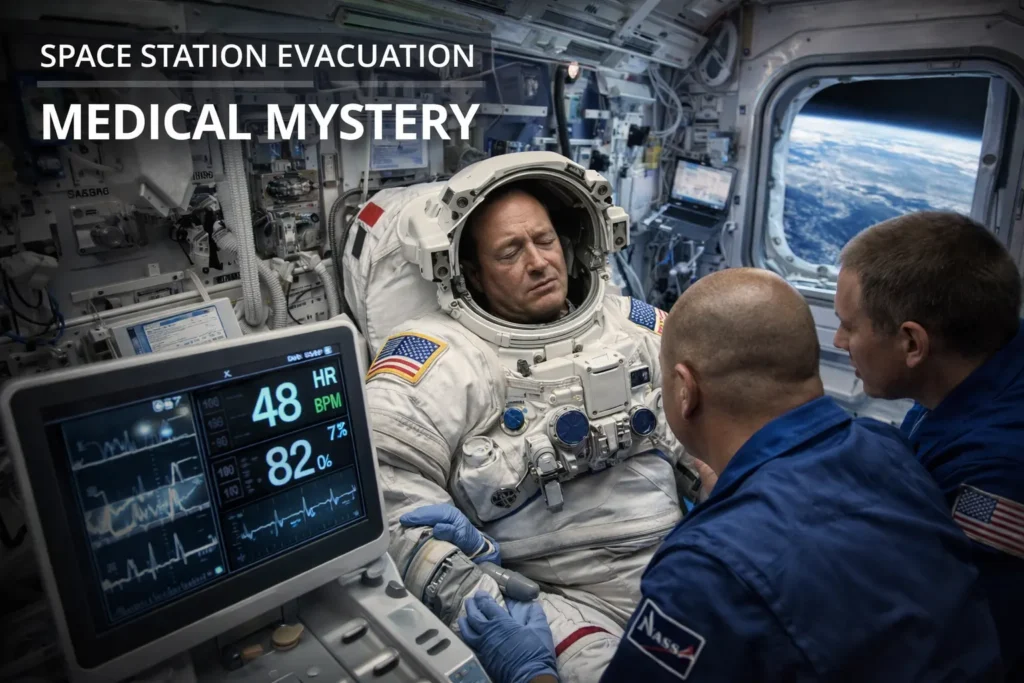
In January of this year, that reality hit home for NASA astronaut Michael Fincke with a force no one saw coming. During a routine mission aboard the International Space Station (ISS), Fincke experienced a sudden and terrifying medical emergency that turned the calm, ordered world of orbital operations into a scene of quiet chaos. In a place where help is literally 250 miles away, racing across the sky at 17,500 miles per hour, with the nearest hospital located on the ground directly beneath him, Fincke lost the ability to speak.
What followed was a frantic, real-life drama that forced mission control in Houston to consider something they rarely even mention in public briefings: evacuating the International Space Station. The lifeboats—the Russian Soyuz capsules docked to the station—were prepared. The ground teams worked around the clock. Flight surgeons held their breath.
Months later, the mystery remains unsolved. Doctors on Earth are still scratching their heads, running tests, and reviewing data. What exactly happened to Michael Fincke? Why did his voice simply vanish in the silence of space? And why hasn’t NASA been able to give the public a clear, definitive answer?
This is the story of a man who went silent in the most dangerous place in the world, the crew who stood by him, the ground teams who fought to save him, and the unanswered questions that still linger in the vacuum of space like ghosts waiting for closure.
The Veteran Who Lost His Voice: A Profile in Resilience
To understand why this incident sent shockwaves through the astronaut corps and all the way up to the highest levels of NASA administration, you have to first understand who Michael Fincke is. He is not a rookie. He is not a space tourist who paid for a seat on a commercial flight. He is not someone who went up for a quick thrill and got caught off guard.
Michael Fincke is the kind of astronaut that younger astronauts look up to—literally and figuratively. He is a veteran of multiple spaceflights, a man who has spent more time off the planet than most people spend on a long deployment overseas. Before this mission began, he had already logged over 380 days in space. To put that in perspective, that is more than a full year of his life spent floating in microgravity, looking down at the Earth from a window.
He has walked in the vacuum of space nine times. Nine times, he suited up in a bulky spacesuit, stepped outside the safety of the airlock, and trusted nothing but his training and his equipment to keep him alive while the Earth spun beneath him. He has repaired malfunctioning equipment, installed new modules, and performed complex tasks while floating in the most hostile environment humanity has ever dared to enter. He knows the International Space Station better than most people know their own neighborhoods. He can tell you which hatch leads where, which wire carries which current, and which thruster fires when.
In the world of NASA, Michael Fincke is considered the rock. He is the guy you want in the seat next to you when things go sideways. He is calm under pressure, analytical in crisis, and has trained for virtually every conceivable emergency scenario that the engineers could dream up. Fires, depressurization, ammonia leaks, toxic spills—he has run the simulations hundreds of times. He knows the checklists by heart.
So, when he started to feel unwell in January, the initial assumption among the crew and the ground teams was probably something minor. After all, space is notoriously hard on the human body. Fluids that normally pool in the legs due to gravity rush to the head, causing congestion that astronauts call “space face.” Bones lose density at an alarming rate. Muscles atrophy despite two hours of daily exercise. The inner ear gets confused, leading to disorientation and nausea. Astronauts get colds, headaches, motion sickness, and a host of other relatively mundane ailments all the time.
But this was different. This was not a stuffy nose or a headache that could be managed with a dose of medication from the onboard medical kit.
According to reports that trickled out in the weeks following the incident, Fincke began to experience a sudden and frightening neurological issue. Without warning, his ability to speak simply shut down. There was no slurring that built up over time. There was no gradual fading of his voice. It was as if a switch had been flipped, and the connection between his brain and his vocal cords had been severed.
Imagine the scene. You are in a tiny metal can, floating hundreds of miles above the Earth. The walls are lined with wires, computers, and life support systems that hum a constant, low melody. Outside the window, the Earth is a swirling masterpiece of blue and white, but inside, the world is small, cramped, and intimate. You are surrounded by your crewmates—people you have trained with for years, people you trust with your life.
And then, suddenly, you cannot form words.
You know what you want to say. You can hear your crewmates talking, asking you questions, waiting for your response. You can think clearly. Your mind is racing, trying to process what is happening. But your mouth won’t cooperate. The words are trapped somewhere between your brain and your lips. You open your mouth, and nothing comes out. Or perhaps only fragmented sounds emerge—sounds that do not resemble language.
For a veteran astronaut like Michael Fincke, a man who has built his entire identity around competence, control, and the ability to perform under pressure, this is not just scary. It is a mission-ending event. It is a fundamental betrayal of the body by the mind.
The silence that filled the cabin was louder than any alarm that could have sounded.
A Race Against Time: The Evacuation Plan That Almost Became Reality
When the first reports of a medical emergency filtered back to Mission Control in Houston, the atmosphere in the room shifted instantly. Flight controllers who spend their days monitoring oxygen levels, power consumption, and orbital trajectories suddenly found themselves holding their breath. The flight director, the person in charge of the entire mission at that moment, had to make split-second decisions that could determine the fate of the crew.
Mission Control is a place of controlled chaos on a normal day. There are dozens of consoles, each staffed by a specialist—the propulsion officer, the communications officer, the robotics officer, the flight surgeon. They speak in a clipped, technical language that sounds like a foreign dialect to outsiders. But when a medical emergency is declared, the rhythm changes. Voices become more urgent. Decisions that usually take hours of review are made in minutes.
NASA has protocols for almost everything. They have a flight surgeon on call 24 hours a day, seven days a week, 365 days a year. There are medical kits on the station that can handle stitches, dental emergencies, cardiac arrest, and even basic surgical procedures if absolutely necessary. The astronauts are trained in emergency medical response. They can perform CPR in zero gravity—a technique that requires specific positioning and teamwork because you cannot use your body weight to compress the chest.
But there is no MRI machine in space. There is no CAT scan. There is no neurology ward with specialists waiting to interpret the results. When an astronaut experiences a neurological event on the station, the flight surgeons on the ground are essentially working blind. They have telemetry data—heart rate, blood pressure, oxygen saturation—but they cannot see inside the astronaut’s head. They cannot determine with certainty whether a blood vessel has ruptured, whether a clot has formed, or whether something else entirely is happening.
When Fincke lost his voice, the flight surgeons in Houston knew immediately that they were dealing with something outside the scope of the onboard medical kit. This was not a laceration that could be sutured. This was not a toothache that could be managed with ibuprofen. This was a potential stroke, a potential aneurysm, a potential life-threatening event that required the kind of diagnostic tools that only exist on Earth.
This led to a decision that is not made lightly by anyone in the chain of command: the activation of an evacuation protocol.
Evacuating the International Space Station is not like taking the stairs down from a skyscraper. You cannot just grab your coat and walk out the door. The crew relies entirely on spacecraft that are docked to the station—usually a Russian Soyuz capsule or a SpaceX Dragon capsule. These spacecraft are designed to serve as lifeboats. They are always attached, always ready, always stocked with the supplies needed for re-entry and landing.
But using them is not simple. It requires coordination between two space agencies—NASA and Roscosmos—and sometimes others. It requires time to prepare the capsule, to perform checks, to strap the crew members into their custom-fitted seats. It requires a window of opportunity for landing, a location on Earth where recovery teams are standing by. And it requires a massive amount of risk.
If you evacuate the station, you are abandoning a one-hundred-billion-dollar laboratory. You are leaving behind years of scientific experiments, some of which are irreplaceable. You are leaving behind research that has taken months or years to set up. And you are doing it in a hurry, without the luxury of careful planning.
For several tense hours, the ground teams worked frantically to determine if Fincke’s condition was a stroke, a blood clot, a severe allergic reaction, or something else entirely. They needed to know if he could survive the violent forces of re-entry. Re-entering the Earth’s atmosphere in a Soyuz capsule is a brutal experience. The capsule experiences forces up to four or five times the force of gravity. It rattles, shakes, and heats up to thousands of degrees on the outside. For a healthy astronaut, it is uncomfortable but manageable. For an astronaut in the midst of a neurological crisis, it could be deadly.
The story that has emerged in the months since the incident suggests that NASA was on the verge of telling the crew to get in the lifeboats. The flight director had the authority to issue that order, and the flight surgeons were recommending it as a precaution. They were ready to send the astronauts home, leaving the station to run on autopilot—a scenario that has only happened a handful of times in the history of human spaceflight.
Ultimately, after hours of consultation, analysis, and monitoring of Fincke’s condition, the decision was made to stand down from the full evacuation. The crew remained on board. The lifeboats remained docked but ready. The crisis had not passed, but the immediate threat of death had receded enough to allow the team to take a breath.
But the fact that NASA got that close to ordering an evacuation tells you everything you need to know about how serious this situation was. This was not a minor health scare. This was a moment that could have ended the mission, scattered the crew across the globe, and left the station empty for the first time in years.
The Medical Mystery Deepens: What Doctors Still Don’t Know
Weeks turned into months. The silence from official channels was deafening. Fincke remained on the station for the remainder of his scheduled mission, performing his duties as best he could while continuing to undergo monitoring by the flight surgeons. The crew adapted. They worked around the situation. The mission continued.
Eventually, Fincke returned to Earth aboard a Soyuz capsule, landing in the remote steppes of Kazakhstan as Soyuz capsules have done for decades. Recovery teams were there to pull him from the capsule, to help him adjust to the crushing weight of gravity after months in space, and to transport him back to Houston for medical evaluation.
But even that return was shrouded in a kind of secrecy that is unusual for NASA. Typically, when a crew lands, NASA holds a press conference within a day or two. They talk about the science experiments that were completed, the milestones achieved, the health of the crew. They answer questions from reporters. They share photos and videos. It is a celebration of a successful mission.
This time, the press conferences were vague. The details were sparse. The questions about Fincke’s health were deflected or answered with carefully worded statements about privacy. The official line was that the crew was in good spirits and undergoing the standard post-flight rehabilitation. But anyone paying close attention could sense that there was more to the story.
Finally, Michael Fincke himself broke the silence. In a recent interview—his first extended public comments since the incident—he confirmed what many had suspected. He had experienced a medical emergency during the mission. He described it as a sudden, frightening event that rendered him unable to speak. He spoke of the fear, the uncertainty, and the professionalism of his crewmates who helped him through it.
But when the interviewer pressed for a diagnosis, the answers stopped.
Fincke said he is feeling better now. He said he is undergoing rehabilitation, working with doctors, and taking things one day at a time. He expressed gratitude for the support he received from NASA, from his family, and from the public. But the cause of the event? Officially, it remains undetermined. Unknown. A mystery.
This is where the story becomes frustrating for those of us who follow space exploration closely. How can a multi-billion-dollar agency like NASA, with access to the best medical minds in the world, not know what happened to one of its most experienced astronauts? How can they send a man into space, monitor his every heartbeat, track his every movement, and still be left with a question mark when something goes wrong?
There are a few theories floating around the space medicine community. None of them have been confirmed, but they offer a glimpse into the complexities of keeping humans alive in orbit.
The first theory is the fluid shift theory. In microgravity, fluids that normally pool in the legs due to gravity rush to the head. This increases pressure inside the skull. Astronauts often report feeling like they have a constant head cold. But the effects go deeper than that. The increased intracranial pressure can compress the optic nerve, leading to vision problems that sometimes become permanent. This condition is called Spaceflight Associated Neuro-ocular Syndrome, or SANS, and it is one of the biggest medical concerns for long-duration missions.
Could that increased pressure have affected a different part of the brain? Could it have pinched a nerve or caused a transient ischemic attack—a mini-stroke that resolves on its own? The symptoms of a TIA can include sudden loss of speech, and they often leave no lasting damage, making them difficult to diagnose after the fact.
The second theory is the stress factor. Even for a veteran like Michael Fincke, the stress of spaceflight is immense. You are isolated from everyone you love. You are living in a confined space with the same few people for months. You are sleeping in a bag strapped to a wall because there is no up or down. Your circadian rhythm is thrown off by the fact that the station orbits the Earth every ninety minutes, meaning you see sixteen sunrises and sixteen sunsets every single day. Sometimes, stress manifests in physical ways that doctors cannot immediately explain. There are documented cases of astronauts experiencing anxiety, depression, and even psychosis during long missions. Could extreme stress have triggered a neurological event?
The third theory is the most unsettling: this is something entirely new. We have been sending humans into space for more than sixty years. We have learned a tremendous amount about how the body adapts to microgravity. But we are still learning. Every time we think we have a handle on the risks, something new pops up. We did not know about the vision problems until astronauts started coming back with permanently altered eyesight. We did not know about the DNA damage caused by cosmic radiation until we started looking for it. Fincke’s case might be the first documented instance of a specific type of neurological event in space—a warning sign that there are still dangers we have not yet identified.
For now, NASA is calling it a private medical matter. They cite patient privacy laws, which is legitimate. Astronauts have the same right to medical privacy as anyone else. But for a taxpayer-funded agency that has historically prided itself on transparency, the lack of a clear answer creates a vacuum of information that gets filled with speculation.
People start to wonder: Was it a stroke? Was it a mental breakdown? Was it something in the environment on the station—a contaminant, a mold, a chemical leak that was never reported? The longer the silence continues, the more the speculation grows.
Life Inside the Tin Can: The Reality of Living in Space
To truly understand the gravity of this situation—pun intended—you have to picture the environment where it happened. The International Space Station is often described as being about the size of a six-bedroom house. That sounds spacious until you realize that those six bedrooms are packed with equipment, wires, computers, experiments, supplies, and life support systems. The actual living space for the crew is much smaller.
There is no privacy. There is no room to pace when you are stressed. There is no door you can close and lock to be alone with your thoughts. The walls are thin, the noise from fans and pumps is constant, and the smell is a unique blend of recycled air, antiseptic wipes, and the faint scent of six human bodies living in close quarters.
If you have a medical emergency on Earth, you call 911. Paramedics arrive in minutes. You are loaded into an ambulance and taken to a hospital where dozens of specialists stand ready. The process is so routine that we rarely think about it.
In space, your paramedics are your crewmates. They are trained in basic emergency medicine—they can take vital signs, administer medications, and perform CPR—but they are not doctors. They are engineers, scientists, and pilots who have spent years training for spaceflight, but their medical training is limited to what can be taught in a few weeks of classroom instruction and simulation.
When Fincke lost his ability to speak, his crewmates had to act. They had to stay calm in a situation that would terrify anyone. They had to check his vitals—heart rate, blood pressure, oxygen levels—using the medical equipment on board. They had to communicate with Mission Control, describing his symptoms in precise, clinical language that left no room for interpretation. They had to prepare the Soyuz capsule, just in case the order to evacuate came down.
Imagine the pressure. You are floating next to your friend, your colleague, someone you have trained with for years. You see fear in their eyes. They are trying to talk to you, trying to tell you what is happening, but nothing is coming out. They are trapped inside their own head, aware of everything but unable to communicate. You have to stay calm. You have to run the checklist. You have to be the paramedic, the engineer, and the friend all at once. And you have to do it while floating in zero gravity, where every movement requires effort, where tools and supplies are velcroed to the walls to keep them from drifting away.
This is the reality of human spaceflight that we often romanticize. We see the beautiful photos of Earth from orbit, the awe-inspiring spacewalks, the joyful reunions with family after landing. We rarely see the fear, the uncertainty, the moments when things go wrong and there is no easy fix.
Space is dangerous. It is isolating. And when something goes wrong, the margin for error is zero.
The Psychological Toll: When the Commander Falls
We often focus on the physical health of astronauts. We track their bone density, their muscle mass, their vision, their cardiovascular function. But what about their mental health? What about the psychological weight of living in space, of being cut off from everything familiar, of knowing that your life depends on machines that could fail at any moment?
When a medical emergency like this happens, it does not just affect the sick astronaut. It affects the entire crew.
Michael Fincke was the Commander of his mission. On the International Space Station, the Commander is the leader. They are responsible for the safety of the crew, the success of the mission, and the thousands of details that go into running a complex orbital laboratory. When the Commander goes down, the chain of command shifts. The other astronauts suddenly have to take on more responsibility while also worrying about their friend.
There is a term in aviation and spaceflight called “task saturation.” It is the point at which the demands of a situation exceed your ability to handle them. You are trying to do too many things at once, and the quality of your decision-making begins to degrade. When Fincke lost his voice, the rest of the crew was at risk of task saturation. They had to manage their own duties, monitor Fincke’s condition, communicate with the ground, and prepare for the possibility of evacuation—all at the same time.
And what about the psychological impact on Fincke himself? He is a man who has spent his entire adult life preparing for the worst. He trained for fires, for explosive decompression, for Soyuz malfunctions, for medical emergencies. But did he train for the sudden loss of his own voice? Did he train for the experience of being fully conscious, fully aware, but unable to communicate with the people around him?
Recovery is not just physical. Fincke has had to deal with the mental burden of being the patient in an environment where he was supposed to be the leader. He has had to undergo endless tests, rehabilitation sessions, and consultations with specialists. He has had to sit in waiting rooms and answer the same questions over and over again. He has had to confront the frustration of not having a clear answer, of not knowing why his body betrayed him.
In his recent statements, he has been optimistic. He says he is recovering well, that he is grateful for the support, that he is focused on the future. But you can hear the caution in his words. He is a professional. He knows that until the doctors figure out what happened, there is always the risk that it could happen again. He knows that his future as an astronaut—a career he has dedicated his life to—hangs in the balance.
A History of Space Health Scares: When the Body Rebels
Michael Fincke’s case is unique, but it is not the first time space has thrown a medical curveball at the men and women who dare to leave Earth. History is littered with strange health issues, bizarre symptoms, and moments of panic that were hidden from the public for years.
On the Apollo 7 mission in 1968, the crew caught horrible head colds. This sounds minor—we all get colds, right? But in zero gravity, a cold is a completely different beast. On Earth, mucus drains from your nose due to gravity. In space, it just pools in your sinuses. The astronauts were miserable. They were congested, in pain, and irritable. They argued with Mission Control, refused to wear their helmets during re-entry, and came home with a reputation for being difficult. But the medical lesson was clear: even a common cold can become a major problem in microgravity.
On the Skylab missions in the 1970s, astronauts experienced space motion sickness so severe that it threatened to end the program. The first crew was so sick that they could barely function for the first few days. They vomited repeatedly. They couldn’t eat. They couldn’t sleep. Mission Control considered bringing them home early. Eventually, they adapted, but the experience showed that the human body’s adjustment to weightlessness is far from automatic.
In the 1980s and 1990s, space medicine focused on the effects of long-duration missions. Astronauts on the Mir space station returned with weakened immune systems, muscle atrophy, and bone loss that took months to reverse. Some experienced psychological issues, including depression and conflicts with crewmates. The Russians, who had more experience with long missions, kept many of these issues quiet.
More recently, we have learned about the vision problems. A significant percentage of astronauts return from long-duration missions with permanently altered eyesight. The cause is believed to be the increased pressure on the optic nerve caused by fluid shifting to the head. Some astronauts have needed glasses for the first time in their lives. Others have experienced permanent changes to the shape of their eyeballs.
What makes Fincke’s case stand out is the unknown factor. With colds and vision problems, we at least know why they happen. We understand the mechanisms, even if we cannot always prevent them. With this speech loss, we are still in the dark. It is a reminder that space medicine is still in its infancy. We are planning to send humans to Mars in the coming decades, but we still do not fully understand how the human body behaves after six months in microgravity.
The NASA Communication Conundrum: Transparency vs. Privacy
Let’s talk about the elephant in the room: the lack of information coming from NASA.
In the age of social media, 24-hour news cycles, and a public that expects instant answers, NASA usually does a decent job of keeping people informed. They have millions of followers on Twitter, Instagram, and Facebook. They livestream rocket launches, spacewalks, and even the arrival of cargo spacecraft. They love to show off the science experiments, the stunning Earth views, and the human side of space exploration.
But when it comes to medical emergencies, they go quiet.
There is a reason for this, and it is not just about keeping secrets. Medical privacy laws in the United States—specifically the Health Insurance Portability and Accountability Act, or HIPAA—apply to astronauts just like they apply to everyone else. NASA cannot release specific medical details about an astronaut without that astronaut’s consent. Michael Fincke has chosen to keep the details of his condition private for now, and that is his legal right.
But there is also an institutional culture at NASA that leans toward secrecy when things go wrong. This culture has deep roots. During the Apollo program, NASA was famously tight-lipped about problems. The public did not know about the fire that killed three astronauts on the launch pad until after it happened. They did not know about the close calls, the near-disasters, the moments when missions almost ended in tragedy. NASA’s reasoning was that they did not want to panic the public, did not want to give ammunition to critics, and did not want to undermine confidence in the space program.
That culture has softened over the years. After the Challenger and Columbia disasters, NASA made a concerted effort to be more transparent. They released detailed reports, held public briefings, and invited independent investigators to review their processes. But when it comes to individual medical issues, the old instincts kick in.
The problem is that this culture of silence can backfire. When NASA says we do not know what happened, it creates a vacuum of information. And vacuums—in space and in public relations—get filled with speculation. People start to fill in the gaps with their own theories, their own fears, their own assumptions. The lack of a clear answer makes the mystery seem more sinister than it probably is.
There is also the question of what this means for future astronauts. If NASA is not transparent about the risks, how can future crews make informed decisions about whether to accept those risks? If a potential astronaut knows that a veteran like Michael Fincke experienced a mysterious neurological event, they might think twice about signing up. But if the details are hidden, they cannot make that calculation.
What This Means for the Future of Space Travel
If we are going to send people to the Moon for months at a time—and eventually to Mars for years—we need to solve the medical mystery that silenced Michael Fincke.
A mission to Mars is a completely different beast than a trip to the International Space Station. The ISS is in low-Earth orbit, just 250 miles above the surface. If something goes wrong, astronauts can be home in a few hours if a Soyuz or Dragon capsule is ready and the landing site is accessible. The journey from the ISS to Earth takes about three and a half hours.
Mars is a three-to-six-month journey one way. There is no evacuation from Mars. If an astronaut loses their ability to speak on the way to Mars, or on the surface of Mars, they are on their own. There is no rescue mission that can reach them in hours or even days. The next launch window might be months away. The crew would have to manage the situation with the resources they have, with no help from Earth except delayed radio communications that take anywhere from three to twenty minutes to travel each way.
This incident has likely become a major focus for NASA’s Human Research Program. The scientists and doctors who study the effects of spaceflight on the human body are probably looking at Fincke’s case in great detail, along with the vision issues, the bone loss, the immune system changes, and the other unexplained health events that have occurred over the years. They are trying to build a complete picture of the risks so that they can design countermeasures and protocols for future missions.
We might need better medical diagnostic tools on spacecraft. Right now, the ISS has a basic ultrasound machine and a collection of medical supplies that would be considered primitive by the standards of a modern emergency room. Future spacecraft might need portable MRI machines, advanced blood analyzers, or even artificial intelligence systems that can help diagnose conditions when a human doctor is not available.
We also need better training for crewmates. They are already trained in CPR, suturing, and basic emergency response. But they might need to become proficient in neurological assessments. They need to know how to identify a stroke or a seizure in a zero-gravity environment, where the symptoms can look very different than they do on Earth. They need to know how to perform a neurological exam while floating, how to use the available tools to gather data that doctors on Earth can interpret.
And we need better communication protocols. When an astronaut has a medical emergency, the crew needs to be able to get real-time advice from specialists on the ground. That is already possible on the ISS because the communication delay is measured in seconds. On a Mars mission, the delay will be measured in minutes. The crew will have to be more autonomous, more self-sufficient, more prepared to handle emergencies without immediate help from Earth.
The Road to Recovery: A Fighter’s Journey
As of today, Michael Fincke is on Earth. He is at the Johnson Space Center in Houston, Texas, where the astronaut corps is based. He is with his family, the people who have supported him through years of training, multiple spaceflights, and now this unexpected ordeal. He is doing his rehabilitation, working with doctors to regain his strength, his confidence, and his voice.
He has not retired. Knowing the type of person he is—a fighter, a pioneer, someone who has dedicated his life to exploration—it would not be surprising to see him try to get back into the rotation. Astronauts hate being grounded. They hate being told they cannot fly. The desire to go back to space is not just a career ambition for these people; it is a calling, a fundamental part of who they are.
But the road back is complicated. NASA has strict medical standards for flight status. Astronauts undergo regular physical exams, psychological evaluations, and performance tests to ensure they are fit for the demands of spaceflight. If the doctors cannot figure out what caused Fincke’s episode, they will likely deem him unsafe for future missions. You cannot send someone back to space if you do not know why they suddenly lost the ability to speak. The risk is too great, not just for Fincke but for the entire crew who would depend on him.
So Fincke remains in a kind of limbo. He is a hero who survived a terrifying ordeal in space, a man who faced the unknown 250 miles above the Earth and came back to tell the story. But he is also a patient in a medical mystery that no one has solved. He is waiting, like the rest of us, for answers that may never come.
Unanswered Questions That Linger in the Void
As we close this chapter—for now—several questions remain unanswered. They hang in the air like the astronauts do, waiting for gravity to pull them down, waiting for someone to provide closure.
Will NASA ever release the full details of what happened to Michael Fincke? Probably not, unless Fincke decides to write a book or give a tell-all interview. For now, the official record will remain vague, protected by privacy laws and institutional caution. The public will have to accept that some things about space exploration are not shared.
Could this happen to another astronaut? That is the scariest question of all. If NASA does not know the cause, they cannot prevent it. It could be a one-off anomaly specific to Fincke’s physiology—a random event that will never happen again. Or it could be a risk factor that applies to everyone who spends extended time in microgravity, a hidden danger that we have not yet identified. Until we know more, every astronaut who goes to space carries a tiny, unquantifiable risk of experiencing something similar.
Is the International Space Station safe? Despite this scare, the answer is likely yes. The station has been continuously occupied for over twenty-three years. It is a robust, well-maintained platform with redundant systems and a crew that is trained to handle emergencies. But this event showed that the margin for error in medical emergencies is still razor-thin. It showed that even with all our technology and all our training, there are things we cannot control, things we cannot predict, things we cannot fix.
What does this mean for the future of human spaceflight? It means we need to keep learning. It means we need to keep pushing the boundaries of space medicine, to keep developing new tools and new techniques for keeping astronauts healthy. It means we need to be humble about what we know and honest about what we do not know.
Conclusion: The Silence Speaks Volumes
Michael Fincke’s story is not just a story about a medical emergency on the International Space Station. It is a story about the limits of human knowledge, about the fragility of the human body, and about the courage it takes to explore the unknown.
We have sent rovers to Mars. We have built telescopes that can see the edge of the universe. We have learned to live in space for years at a time, to grow food in zero gravity, to 3D print tools, to recycle every drop of water. But when one man lost his voice in the void, we were left with only silence in return.
It is a humbling reminder that space is still the final frontier. It challenges us not just with engineering problems and political hurdles, but with the fragile, mysterious nature of the human body. We are made of flesh and blood, not steel and titanium. We are vulnerable in ways that machines are not. And when we leave Earth, we carry that vulnerability with us.
Michael Fincke is a survivor. He faced the unknown 250 miles above the Earth and came back. He is doing his rehab, spending time with his family, and figuring out what comes next. But the mystery of what happened to him in that silent, floating moment remains unsolved.
For now, we wait. We wait for science to catch up. We wait for the doctors to find an answer. We wait for Michael Fincke to speak again, not just with his voice but with his story. And we hope that the next time an astronaut faces the unknown in the darkness of space, we will be better prepared to bring them home.
Until then, the silence in space remains one of the most profound mysteries of human exploration. It is a reminder that for all our achievements, there are still things we do not understand. It is a call to keep asking questions, keep seeking answers, keep pushing forward. Because that is what exploration is. It is not knowing what is out there and going anyway.
Michael Fincke knew the risks when he climbed into that spacecraft. He went anyway. And now, in the quiet aftermath of his ordeal, we are left to wonder what really happened in the silence. Perhaps one day we will know. Perhaps we never will. But the story of the astronaut who lost his voice in space will remain a powerful reminder that even in the most advanced, most carefully planned endeavors, the human element remains the greatest mystery of all.