
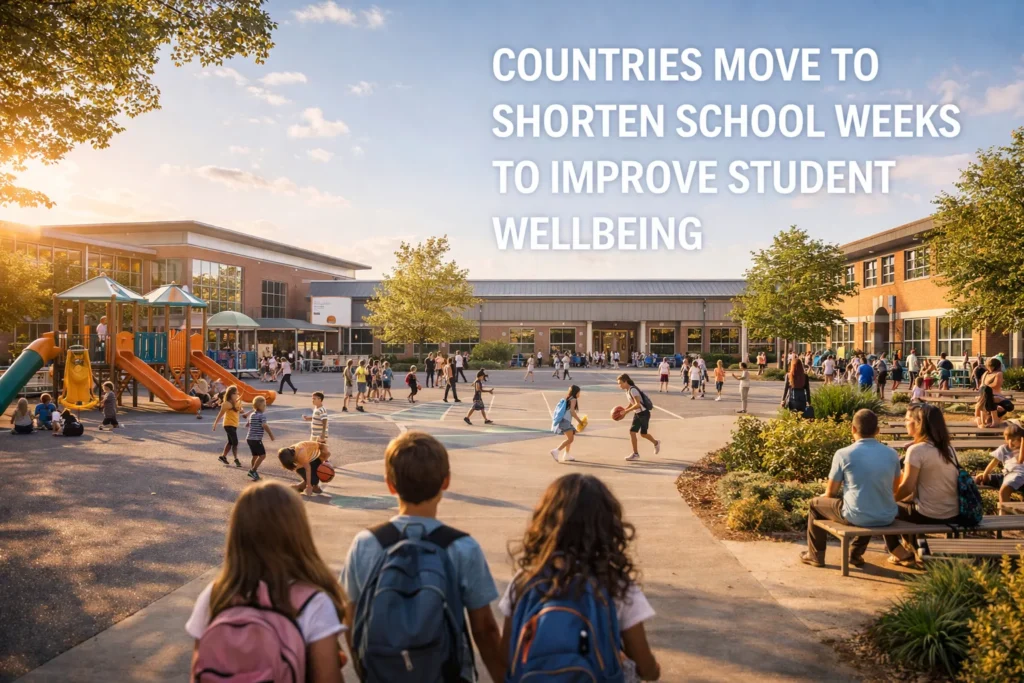

Prologue: The Friday Phenomenon—When Silence Became the Sound of Change
Imagine standing in the echoing quiet of a school hallway on what should be a bustling Friday morning. The lockers stand sentinel, unopened. The fluorescent lights in the empty gymnasium hum a lonely tune. Outside, a fleet of yellow buses rests in neat rows, their engines cold. This scene, once unimaginable in the rhythm of American life, is becoming commonplace. It represents a fundamental reordering of one of society’s most deeply ingrained institutions: the five-day school week.
For over a century, the Monday-through-Friday school schedule has been as unquestioned as the changing of the seasons—a temporal architecture inherited from the Industrial Revolution, designed to mirror factory shifts and condition young minds for a life of standardized labor. Yet today, that architecture is being dismantled, brick by brick, district by district. What began in the 1970s as a desperate, fuel-saving measure in a handful of remote rural districts has blossomed into a full-blown pedagogical and social movement. The four-day school week is no longer an anomaly; it is a legitimate, data-driven policy alternative gaining momentum from the sunbaked plains of Oklahoma to the tech hubs of Texas, and sparking curiosity from Sweden to South Korea.
This is not merely a story about a calendar change. It is a multifaceted narrative about a society at a crossroads, grappling with intersecting crises in teacher retention, student mental health, and educational equity. It is about communities seeking agency in an era of standardization, and about redefining success not just by test scores, but by the well-being of children and educators. This movement challenges our most basic assumptions about time and learning, asking: If we redesign the container of education, can we transform its contents?
As we embark on this deep exploration, we will trace the historical roots of our current system, dissect the complex pressures forcing change, follow the intricate logistics of implementation, and weigh the nuanced, often contradictory evidence of outcomes. We will listen to the voices from the front lines—the teachers, students, parents, and administrators living this experiment daily. This is the definitive account of the great school week transformation, a revolution measured not in days, but in the quality of the hours within them.
Part I: The Historical Foundation—How Time Was Institutionalized
The Agrarian Roots and Industrial Imposition
To comprehend the magnitude of shifting to a four-day week, one must first understand how the five-day model became sacrosanct. The American educational calendar is not a product of pedagogical science or developmental psychology. Its origins are decidedly pragmatic and economic.
In the 18th and early 19th centuries, formal schooling was irregular and seasonal, bending to the demands of an agricultural society. School terms were scheduled around planting and harvest, often occurring in winter and summer when children’s labor was less critical on the family farm. The concept of universal, standardized public education was nascent.
The catalyst for change was the Industrial Revolution. As populations migrated to cities and factories demanded a literate, numerically competent workforce, states began to enact compulsory education laws. The factory whistle dictated life’s rhythm, and schools naturally aligned with it. If parents worked from Monday to Friday, children needed supervision and instruction during those same hours. The landmark Kalamaazoo Case of 1874 legally established the use of public taxes to support secondary schools, cementing the move toward a systematized, state-run educational timeline.
The final consolidation came in the early 20th century, intertwined with the labor movement’s fight for the eight-hour day and the five-day workweek. Figures like Henry Ford, who instituted a five-day, 40-hour week in his plants in 1926, argued that workers needed leisure time to become consumers. This cultural shift reinforced the Monday-to-Friday pattern for all of society, including its schools. By the post-World War II baby boom, the image of the yellow bus arriving on five consecutive mornings was woven into the fabric of the American dream.
The Early Experiments: A Response to Crisis
The first cracks in this temporal monolith appeared during the 1973 OPEC oil embargo. As fuel prices quadrupled, rural school districts with vast bus routes faced existential budget threats. Cimarron, New Mexico, is widely credited as the first district to officially adopt a four-day week in 1973, purely as a cost-cutting measure. The logic was simple: one less day of bus runs meant dramatic savings on diesel.
These pioneer districts were met with intense skepticism. State departments of education worried about instructional hour mandates. Parents fretted over childcare. Early results were mixed, and when the oil crisis eased, many districts reverted to the traditional schedule. The idea, however, had been planted. It resurfaced periodically during economic downturns, always framed as a financial last resort, never as an educational improvement strategy.
The turn of the 21st century marked a subtle but critical shift. Districts began reporting unexpected secondary benefits—improved attendance, higher teacher satisfaction, and positive community feedback. The narrative started to evolve from “We do this to save money” to “We do this because it works better for us.” The stage was set for the movement’s modern era, where well-being would eclipse economics as the primary motivator.
Part II: The Converging Crises—A Perfect Storm for Change
The explosive growth of the four-day model in the last decade is not spontaneous. It is a direct response to a triad of intensifying systemic failures that have pushed the traditional model to a breaking point.
Crisis 1: The Collapse of the Teacher Pipeline
The most potent catalyst is the unprecedented staffing emergency in American education. The numbers paint a dire picture: nearly 8% of teachers leave the profession each year, with turnover in high-poverty schools exceeding 20%. Enrollment in teacher preparation programs has plummeted by over a third since 2010. The result is a desperate competition for qualified professionals, one that small and rural districts are structurally doomed to lose in a purely financial bidding war.
Dr. Samantha Greene, a superintendent in rural eastern Oregon, articulates the dilemma: “I have a starting salary that’s $15,000 less than the district across the state line. I can’t offer a vibrant downtown or specialized professional networks. What I can offer is time. When I present a candidate with a contract that includes every Friday for planning, rest, and life, I see their eyes light up. It’s a benefit that transcends dollars.”
Data validates this approach. A 2023 multi-state study found four-day districts received 45% more applications per opening than comparable five-day districts. More importantly, it acts as a retention tool against burnout—the chronic emotional exhaustion that drives talented educators from the classroom. By providing a dedicated, recurring window for grading, planning, and recuperation, the schedule addresses the “time poverty” that defines modern teaching. It transforms the profession from a relentless sprint into a more sustainable marathon.
Crisis 2: The Epidemic of Student Distress
Parallel to the teacher crisis runs a disturbing trajectory in student mental health. The Centers for Disease Control and Prevention reports that more than 4 in 10 teens feel “persistently sad or hopeless,” and emergency room visits for suicide attempts among adolescents have soared. The traditional school week, with its relentless barrage of academic pressure, social dynamics, extracurricular commitments, and homework, is increasingly viewed as a contributing environmental factor.
The four-day week is proposed as a systemic intervention. Pediatric psychologist Dr. Lisa Monroe explains: “Adolescent brains are not designed for the 7 a.m. to 10 p.m. grind we’ve normalized. They require more sleep, more unstructured downtime for neural integration, and more agency. The four-day model, by creating a consistent 72-hour break, builds in a circuit breaker. It allows the nervous system to reset. We’re seeing self-reports of lower anxiety and higher life satisfaction from students in these districts.”
Surveys from implementing districts consistently show 70-85% of students report reduced stress. The schedule eliminates the toxic “Sunday scaries”—the anxiety that builds as the weekend wanes. It provides time for therapy appointments, medical visits, and family connection without the stigma or academic penalty of missing school. In an era of profound adolescent distress, the extra day is framed not as a day off, but as a day for restoration.
Crisis 3: The Unsustainable Economics of Rural Schooling
While well-being is now the leading argument, economic reality remains a powerful undercurrent, particularly for the small rural districts where the model is most prevalent. These districts face a perfect storm: declining enrollment (which reduces state funding), an eroding local tax base, and skyrocketing fixed costs, especially for transportation and utilities.
The financial promise of the four-day week is seductive. The potential savings areas are clear:
- Transportation: Diesel fuel, vehicle maintenance, and driver salaries for buses traveling vast rural routes.
- Operational Costs: Electricity, heating, cooling, and water for school buildings.
- Support Staff: Hourly wages for cafeteria workers, custodians, and aides.
However, a decade of rigorous analysis has tempered expectations. A comprehensive 2022 report from the Brookings Institution concluded that average net savings range from a negligible 0.4% to a modest 2.5% of total district budgets. Why so low? Major cost drivers—teacher salaries and benefits, building mortgages, administrative salaries—are unchanged. Schools often remain open on Fridays for staff or community use, mitigating utility savings. Some districts incur new costs for fifth-day childcare programs.
The modern financial rationale is therefore more sophisticated. It’s not about windfall savings, but about strategic reallocation. The marginal savings from operations are redirected toward teacher supports, student programming, or curriculum materials. For a district on the fiscal brink, that 2% can mean the difference between preserving arts education or eliminating it. The schedule becomes a tool for fiscal triage and creative resource management.
The following table synthesizes the multifaceted drivers behind the movement and the complex realities that have emerged from early adoption:
| Primary Catalyst | The Initial Hope & Strategic Logic | The Emergent, Nuanced Reality |
|---|---|---|
| Teacher Recruitment & Retention | To solve staffing shortages by offering an unbeatable quality-of-life benefit, creating a competitive advantage in the labor market. | Creates a powerful short-term recruitment surge and reduces burnout symptoms. However, longitudinal studies show it may not solve long-term (5+ year) retention if underlying issues like low pay are not addressed. It’s a powerful perk, not a panacea. |
| Student Mental Health & Well-being | To act as a systemic intervention in the youth mental health crisis, reducing anxiety, improving sleep, and providing time for restoration and family connection. | One of the strongest, most consistent outcomes. High student satisfaction, reported reductions in stress, and measurable improvements in school climate (e.g., drops in bullying and fights). Addresses the “symptoms” of a pressured system. |
| Operational & Budgetary Efficiency | To achieve significant cost savings (20%+ was an initial dream) on transportation, utilities, and support staff wages. | Savings are real but marginal (typically 1-3%). The model is now sustained for its human resource benefits, not its financial ones. Successful districts use it as a tool for strategic reallocation, not just cuts. |
| Academic Optimization | To improve the quality of instruction through longer, more immersive blocks and reduce “dead time” lost to transitions and non-academic activities. | Results are highly contextual. Rural schools often see stable or slightly improved scores; suburban/urban schools more often see small declines. Success depends entirely on high-quality professional development for the new schedule. |
| Community & Family Alignment | To better synchronize school life with community rhythms (e.g., farming, local events) and increase family engagement with a shared day off. | Can significantly strengthen community bonds and provide flexible time for appointments and travel. Also creates new challenges in childcare and food security that must be proactively managed. |
Part III: The Logistics of Transformation—Blueprinting a New Educational Rhythm
Adopting a four-day week is an act of profound organizational redesign. It requires re-engineering everything from the bell schedule to the curriculum map, while building a new support ecosystem for the “fifth day.”
Re-engineering the School Day: The Pedagogy of Longer Blocks
The most immediate challenge is restructuring time. To meet state-mandated annual instructional hours (typically around 1,080), districts extend the remaining four days by 45 to 90 minutes. A day that once ran from 8:00 a.m. to 3:00 p.m. might now go from 7:45 a.m. to 4:15 p.m.
This shift from six 50-minute periods to four 90-minute “blocks” demands a pedagogical revolution. Teachers cannot simply lecture for twice as long. The most successful districts invest heavily in professional development focused on strategies for extended learning:
- The Workshop Model: Foundational in literacy, this structure uses mini-lessons, independent work time, and small-group differentiated instruction within a single block.
- Project-Based Learning (PBL): Long blocks are ideal for sustained inquiry, allowing students to research, design, collaborate, and create in a single sitting.
- Station Rotation: Students rotate through multiple activities (teacher-led instruction, collaborative projects, digital learning, independent practice) within one class period.
- Socratic Seminars and Debates: Complex discussions that require time for deep textual analysis and reasoned argumentation.
The goal is to foster deeper cognitive engagement—moving beyond coverage of material to mastery and application. As one high school science teacher noted, “I used to do a frog dissection in a frantic 45 minutes. Now, we spend a block discussing anatomy, ethics, and procedure, then dissect carefully, then analyze what we found. It’s the difference between checking a box and truly understanding.”
Confronting the “Instructional Gap”: A Matter of Quality vs. Quantity
Despite longer days, the arithmetic is inescapable: moving from 180 days to roughly 148 days means 32 fewer days of school. This “instructional gap” is the core of academic debate.
Critics argue that time-on-learning is the single most consistent predictor of achievement, and that this reduction inherently disadvantages students, particularly those from under-resourced backgrounds who may have fewer learning opportunities outside school.
Proponents counter with the theory of “quality over quantity.” They argue the traditional calendar is riddled with inefficiency: fragmented periods, frequent testing disruptions, half-days, and the notorious “post-holiday slump.” The four-day model, they contend, forces a distillation to essential, high-impact learning. The key is intentionality. Successful districts conduct “time audits” to eliminate wasted minutes and ensure every extended block is purposefully structured. The model doesn’t assume more time equals more learning; it assumes better-structured time equals deeper learning.
Building the Fifth-Day Ecosystem: From Childcare to Enrichment
The fate of the “fifth day” often determines the equity and success of the entire model. A day off without support exacerbates inequality; a day transformed into an opportunity can enhance it. Progressive districts approach this not as a problem, but as a chance to reinvent community learning.
Effective fifth-day architectures include:
- Optional Academic Support Hubs: Schools remain open for tutoring, credit recovery, and homework help staffed by teachers (often on a rotational stipend basis).
- Community Partnership “Campuses”: Districts partner with local organizations—libraries, museums, parks and rec departments, YMCAs, art centers—to provide low-cost enrichment “camps” focused on STEM, arts, outdoor education, or career skills.
- Work-Based Learning: For high schoolers, Fridays become dedicated internship or job shadowing days with local businesses, bridging education and the workforce.
- Targeted Intervention: Special education services and English language learner support can be concentrated on Fridays in smaller, more effective settings.
Concurrently, districts must address basic needs. “Backpack” meal programs are expanded to provide food for Friday and the weekend. Partnerships with social services can provide supervised, safe spaces for vulnerable youth. The most comprehensive models view the fifth day as a shared community responsibility, not merely a school closure.
Part IV: The Evidence—A Mosaic of Outcomes
After nearly a decade of widespread implementation, a substantial body of research allows us to move beyond anecdote and assess impacts with greater clarity. The findings are not uniform; they reveal a policy whose effects are deeply contextual.
Academic Achievement: The Great Geographic Divide
The most scrutinized outcome is academic performance, typically measured by standardized test scores. A seminal 2021 meta-analysis published in Educational Research Review, synthesizing 32 studies, provided nuanced clarity:
- Overall Effect: A small, statistically significant negative effect equivalent to about one month of learning loss. However, this average conceals dramatic variation.
- The Rural/Non-Rural Chasm: In urban and suburban districts, the negative effect was more pronounced (2-3 months of learning loss). In rural districts, there was generally no significant difference, and some studies showed slight gains in specific subjects like elementary math.
- Subject and Grade Variation: Mathematics appears slightly more vulnerable than reading. Middle school grades may be more affected than elementary or high school.
Researchers theorize this geographic split is due to differing out-of-school environments. In rural communities, the fifth day is more likely to be spent in structured family or farm work, or in small communities where informal supervision is common. In suburban settings, students may be more likely to experience unsupervised screen time. Furthermore, rural districts, often the early adopters, have had more time to refine their instructional approach to the longer blocks.
The Unambiguous Win: School Climate and Behavior
While academics are mixed, the evidence for improved school climate is robust and consistent. Multiple studies across different states report substantial reductions in disciplinary incidents:
- A study of Oklahoma schools found bullying incidents dropped by 39% and physical fights fell by 31% after switching.
- Districts in Colorado reported significant declines in in-school suspensions and disciplinary referrals.
- Teacher and student surveys consistently report lower perceived stress and higher satisfaction with the school environment.
The mechanism is psychosocial. The three-day weekend acts as a recurring “reset,” reducing the cumulative fatigue and irritability that fuel conflicts. Students and staff return more rested and less reactive. The reduction in transitions (fewer frantic Monday mornings) also decreases opportunities for conflict. This positive climate is a tangible, valuable outcome that, while not captured on a test score, directly affects the daily experience of learning.
The Teacher Retention Paradox: Short-Term Gain, Long-Term Question
The four-day week’s power as a recruitment tool is undeniable. Districts report application surges of 300-400% for open positions. Teacher job satisfaction surveys show overwhelming approval (often over 85%) of the schedule.
However, emerging longitudinal studies introduce a paradox. Research tracking districts over five to eight years reveals a disconcerting trend: while the schedule helps get teachers in the door and improves short-term morale, it may not keep them in the profession or in the district long-term. Studies in Missouri and Oregon found that after five years, teacher turnover rates in four-day districts reverted to or even exceeded state averages.
The implication is profound. The four-day week is a powerful hygiene factor—it prevents dissatisfaction—but it is not a powerful motivator in the long run. It cannot compensate for chronically low salaries, lack of administrative support, or difficult working conditions. It is a necessary but insufficient solution to the retention crisis. As one analyst noted, “You can’t pay teachers in time forever.”
The Equity Imperative: Risking the Opportunity Gap
The most serious ethical charge against the four-day model is that it exacerbates educational inequality. The concern is straightforward: affluent families can provide enriching fifth-day activities—music lessons, coding camps, museum visits. Low-income students may face unsupervised time, increased screen exposure, or family care responsibilities.
Research confirms this risk is real, but not inevitable. Studies show achievement gaps can widen in the first two years of implementation if no supports are provided. The key differentiator is intentionality and investment. Districts that treat the fifth day as a mere cost-cutting measure—simply locking the doors—do worsen inequality. Districts that invest in free, accessible, and engaging fifth-day programming can actually use the model to close opportunity gaps by providing experiences that disadvantaged students would otherwise never access.
The equity question, therefore, transforms from “Does the four-day week increase inequality?” to “Under what conditions can it be implemented equitably?” The answer lies in proactive, funded community partnerships and a steadfast commitment to serving the most vulnerable students first.
Part V: Global Perspectives—The Movement Beyond American Shores
The four-day school week is not a uniquely American phenomenon. While the U.S. has the highest number of implementations, countries worldwide are exploring compressed schedules, each adapting the model to their cultural and educational values.
Europe: Focusing on Well-Being and Efficiency
- Sweden: Several municipalities have piloted four-day weeks, explicitly prioritizing student and teacher mental health. Early results show improved wellbeing metrics but concerns about content mastery, leading to hybrid models with periodic “catch-up” weeks.
- France: With its already short school days but long year, French experiments focus on reducing carbon footprints by eliminating bus and parent car trips one day a week, framing the change as environmental policy.
- United Kingdom: Facing severe teacher shortages and budget cuts, dozens of schools in England and Scotland have adopted a four-day week, often maintaining the same daily hours and thus reducing total instructional time—a model most experts view as risky for outcomes.
Asia: Maintaining Academic Intensity
- Japan: Trials in Tokyo focus on reducing gakureki shakai (“academic background society”) pressure. However, the “free” day is often filled with mandatory club activities or private juku (cram school), illustrating the difficulty of changing deep cultural patterns around academic competition.
- South Korea: A handful of progressive private schools in Seoul have adopted the model as a direct challenge to the country’s notorious study culture, coupling it with radical homework reductions and a focus on project-based learning.
Developing Nations: A Pragmatic Solution
- The Philippines: In archipelagic regions, the four-day week accommodates long and often treacherous boat commutes for students and teachers.
- Kenya: Some rural schools use flexible four-day schedules during planting and harvest seasons, acknowledging the economic realities of family farming.
These global experiments highlight that the four-day week is a vessel into which different societies pour their own priorities: wellbeing in Sweden, environmentalism in France, crisis management in the UK, and pragmatic problem-solving in the Philippines. There is no single “correct” model, only contextually appropriate adaptations.
Part VI: Voices from the Revolution—Lived Experiences
Beyond data and policy are human stories. The movement’s true impact is measured in daily lives.
The Teacher: Sarah Jenkins, 7th-Grade Science, 15 Years Experience
“The longer blocks were terrifying at first. Then they became liberating. We can now design experiments that mimic real science—iterative, messy, time-consuming. I’m not just a deliverer of content; I’m a facilitator of investigation. And the Friday? It saved my career. I use it for deep planning, not the frantic Sunday-night scramble. I go to the doctor, do my grocery shopping when the store is empty. I come back on Monday genuinely excited to see my students. The chronic exhaustion that made me think about quitting is gone. This schedule treats me like a professional with a life outside school.”
The Student: Miguel Rodriguez, High School Junior
“Freshman year was five days, and I was a zombie. Now, I work at a vet clinic on Fridays. I’m getting real experience for my future career. I also sleep. A lot. My parents say I’m less irritable. The trade-off is that a bad 90-minute class feels like a prison sentence. You need teachers who know how to use the time, not just fill it. But overall? I’d never go back. School feels sustainable now, not like something I just have to survive.”
The Parent: The Chen Family, Parents of 10-Year-Old Twins
“The childcare panic was real. But our district was proactive. They worked with the city rec department to create ‘Discovery Friday’—affordable, fun camps with themes like robotics, theater, and outdoor skills. It’s different from school, and our kids love it. What we’ve gained is family time. Real, unstructured time. We take small trips, visit grandparents, or just hang out. It’s healed our family schedule. The key was the district didn’t abandon us; they built a bridge.”
The Administrator: Superintendent Rebecca Moore
“We learned the hard way that implementation is everything. We switched for the wrong reasons (just to save money) and didn’t support our teachers with training for the longer blocks. Our elementary math scores dipped. We had to pivot. We brought in instructional coaches, provided model lesson plans, and created a Friday academic lab for struggling students. We’re in year four now, and scores have recovered to above baseline. The lesson: the schedule doesn’t improve education; what you do within the schedule does. It’s a tool, not a solution.”
Part VII: The Road Ahead—Evolution, Hybrid Models, and Policy Frontiers
The four-day week movement is not static. It is evolving into more sophisticated, differentiated models as practitioners learn from early mistakes.
Emerging Hybrid and Flexible Models
- The 4+1 “Academy” Model: Four days of core academic instruction, with the fifth day dedicated to mandatory enrichment “academies” in arts, STEM, leadership, or career tech, often taught by community experts.
- The Staggered Schedule: Different grade bands (e.g., K-4, 5-8, 9-12) have different “off” days (e.g., Friday, Monday, Wednesday) to ease community-wide childcare burdens and allow for shared family time.
- The Flexible “Flex-Day”: A core four-day week with a voluntary, structured fifth day at school for interventions, passion projects, or quiet study space, providing flexibility for families and targeted support for students.
- The Seasonal Variation: A four-day week during standard terms, balanced with intersession “mini-terms” for remediation, acceleration, or unique thematic courses.
The Role of Technology as an Enabler
Technology is critical for maximizing the four-day model’s potential:
- Flipped Classrooms: Direct instruction via video frees class time for collaborative, hands-on application.
- Adaptive Learning Platforms: Programs like Khan Academy or i-Ready provide personalized, self-paced practice and tutoring on the fifth day.
- Virtual Check-Ins and Office Hours: Teachers maintain connection and support via scheduled online availability.
- Digital Portfolios: Allow for continuous assessment of project-based work that continues beyond the classroom.
The Policy Landscape: Regulation and Resistance
State legislatures are scrambling to respond. Approaches vary wildly:
- Restrictive States (e.g., Massachusetts, New Jersey): Maintain high minimum instructional day requirements (180+), effectively blocking a true four-day week.
- Permissive States (e.g., Oklahoma, Colorado, Oregon): Grant wide latitude through waiver processes, treating it as a matter of local control.
- Experimental States (e.g., Texas, Missouri): Have passed specific legislation creating pilot programs with rigorous data collection requirements to inform future policy.
- Reactionary States: Some, alarmed by early negative studies, are now proposing laws to ban or severely restrict the model.
The federal role remains minimal, though grant programs occasionally fund research studies. The debate is primarily a state and local battlefield, reflecting America’s decentralized education system.
Part VIII: Implementation Framework—A Strategic Guide for Communities
For a community considering this transition, success depends on meticulous, phased planning.
Phase 1: The Foundation (18-24 Months Out)
- Convene a Representative Task Force: Include teachers, parents, students, school board members, local business owners, childcare providers, and social service agencies.
- Conduct a Rigorous Needs Assessment: Analyze transportation costs, survey families on childcare needs and fifth-day preferences, map community assets (libraries, nonprofits, businesses).
- Develop a Financial Model: Project savings and new costs with conservative assumptions. Plan how any savings will be reinvested.
- Draft a “Why” Document: Articulate the primary goals (e.g., improve teacher recruitment, enhance student well-being). This becomes the guiding star.
Phase 2: Design and Engagement (12-18 Months Out)
- Design Multiple Schedule Options: Present 2-3 concrete calendar models with clear impacts on start/end times, holidays, and the fifth day.
- Launch a Comprehensive Engagement Campaign: Host community forums, conduct scientific surveys, use social media to educate and solicit feedback. Transparency is critical.
- Begin Teacher Professional Development: Start training on block scheduling, project-based learning, and differentiated instruction before the switch.
- Forge Community Partnerships: Secure memoranda of understanding with organizations for fifth-day programming.
Phase 3: The Pilot and Implementation (6-12 Months Out)
- Start with a Pilot Program: If possible, pilot the model in one or two schools for a year to work out kinks before district-wide rollout.
- Finalize the Fifth-Day Ecosystem: Publish a clear “menu” of affordable, accessible options for families.
- Establish a Robust Communication Plan: Regularly update all stakeholders on progress, logistics, and expectations.
Phase 4: Continuous Improvement (Ongoing)
- Collect Baseline and Ongoing Data: Academics (test scores, grades), operations (attendance, discipline), and perceptions (annual surveys of all stakeholders).
- Form a Continuous Improvement Committee: Meet quarterly to review data and make mid-course corrections.
- Commit to a Sunset Review: Decide in advance that after 3 years, the board will conduct a comprehensive review using the original “Why” document goals to decide whether to continue, modify, or abandon the model.
Epilogue: Redefining the Equation of Education
The four-day school week movement is more than a policy trend; it is a cultural symptom. It signals a growing disillusionment with industrial-era standardization and a yearning for an education system that honors human flourishing alongside academic achievement. It is part of a broader societal conversation about the nature of work, the right to rest, and the value of time.
The movement’s ultimate contribution may not be the universal adoption of a specific calendar. Its greater legacy may be in the questions it forces us to ask: What is school for? How do we measure its success? Is time a fixed container to be filled, or a flexible resource to be optimized?
The evidence thus far suggests there are no universal answers. The four-day week is a powerful tool that works exceptionally well in some contexts (tight-knit rural communities) and poorly in others (without strong supports for equity). It improves well-being and climate consistently, but its academic impact depends entirely on the quality of implementation.
As we look to the future, the most promising path is not dogma, but flexibility. The goal should not be to win an ideological battle for or against the four-day week, but to empower communities with the agency to design school schedules that reflect their unique values, needs, and assets. In some places, that will be a traditional five-day week; in others, an innovative four-day model; in still others, a hybrid approach we haven’t yet imagined.
The revolution is not in the number of days, but in the reclaiming of time as a moral and pedagogical resource. The silent hallways on a Friday are not just empty; they are full of potential—a blank space for communities to write a new definition of what it means to be educated. The final bell on this experiment is far from ringing. The lesson is still in progress.



What’s the deal with ph235? Thinking about giving it a look-see. Any recommendations?