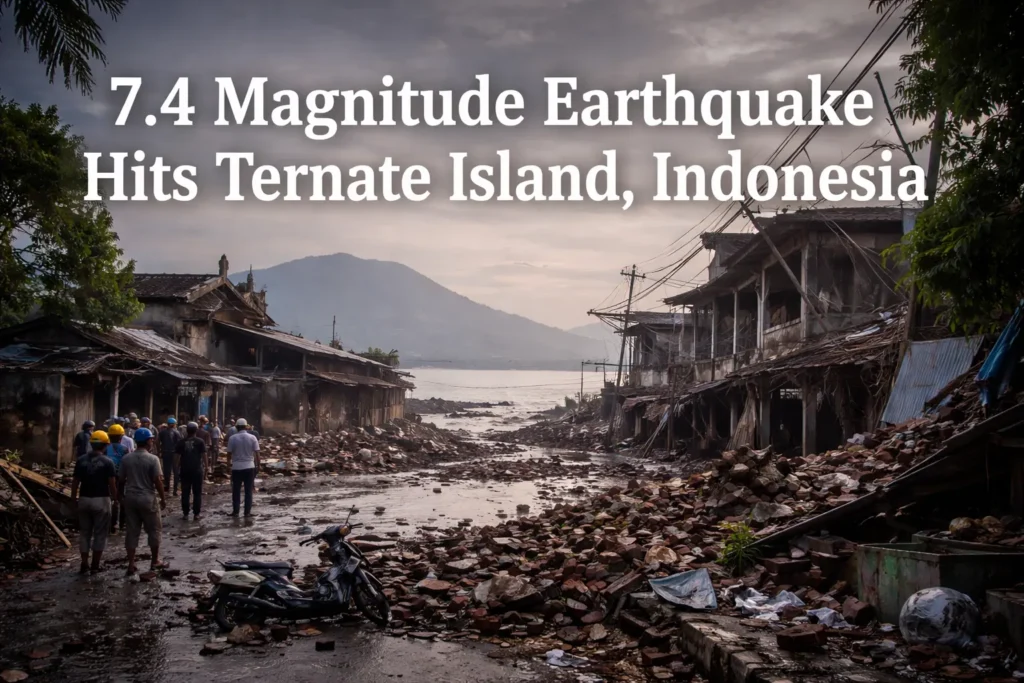

Introduction: The Day the Island Woke Up Angry
Before the sun had fully risen over the Maluku Sea, the island of Ternate was living its normal, quiet life. The roosters had crowed. The mosques had broadcast the first call to prayer, a gentle sound that echoed across the volcanic hills. Mothers were heating water for coffee. Fathers were tying their shoes. Children were groaning about going to school.
It was a Thursday. In many ways, it was just like any other Thursday on this small, beautiful, dangerous island in eastern Indonesia.
Then, at 6:48 in the morning, the world turned inside out.
The ground did not just shake. It lifted, dropped, and twisted all at once. A sound like a thousand trucks crashing into a concrete wall came from deep below. Plaster fell from ceilings like snow. Glass shattered. Cars parked on the street began to bounce. Dogs howled. Birds took flight in a panicked cloud.
This was no ordinary tremor. This was a 7.4 magnitude earthquake. And it had chosen Ternate as its stage.
Over the next several hours, the people of this island would face fear, loss, heroism, and survival. One person would lose their life. Many more would come close. Small tsunami waves would rush toward the shore. Buildings would crumble. Families would flee to the hills.
This is the full story. We will walk through every detail: the science, the human cost, the rescue efforts, the history of earthquakes in Indonesia, and what you can learn from this disaster. We will use plain language, real storytelling, and clear explanations. No fancy words. No shortcuts. Just the truth.
So sit down. Take a breath. And let us travel to Ternate, to that terrible Thursday morning, and see what happened when the earth roared.
H2: 1. The Morning Routine: A Snapshot of Life Before the Quake
To understand what was lost, we first need to understand what was normal.
Ternate is not a huge city like Jakarta or Surabaya. It is a small island that sits like a green jewel in the blue waters of North Maluku province. The island is dominated by Mount Gamalama, an active volcano that rises almost two kilometers into the sky. People live on its slopes, growing cloves and nutmeg. In fact, Ternate was once the world’s center for clove production. Sailors from Portugal, Spain, and the Netherlands fought wars over this tiny speck of land.
But on this Thursday morning, history was far from anyone’s mind.
At 6:00 AM, a fisherman named Agus was already out on his wooden boat. He had left at 3 AM, as he did every day. The stars were bright. The sea was calm. He cast his nets and waited. He thought about his daughter, who was turning seven next week. He wanted to buy her a new school bag.
At 6:15 AM, a teacher named Ibu Sari was ironing her white blouse. She taught English at the local junior high school. Her lesson plan that day was about family vocabulary. She had no idea that within an hour, her students would be learning a different lesson: how to survive.
At 6:30 AM, a construction worker named Joko was eating a plate of nasi goreng, fried rice with a fried egg on top. He was building a small grocery store near the port. The walls were brick. The roof was tin. He was proud of his work. He did not know that brick is a terrible material for earthquakes.
At 6:40 AM, an elderly woman named Nenek Fatima was brushing her teeth. She was 78 years old. She had lived through eight major earthquakes in her life. She told her grandchildren, “The earth moves like a boat sometimes. Do not be afraid.” She was not afraid. But she should have been.
At 6:45 AM, the first hint came. A low rumble. Like a big truck passing by. But there was no truck. Dogs on the street stopped walking. They sat down and began to howl. Some people noticed. Most did not.
At 6:48 AM, everything changed.
H2: 2. The First Ten Seconds: Pure Chaos
When a 7.4 magnitude earthquake hits, the first thing you feel is not the shaking. It is the sound.
Geologists call it an “infrasound” rumble, a deep noise that is felt more than heard. It comes from the rock breaking kilometers beneath your feet. It travels faster than the shaking itself. So for one or two seconds, you hear the earth growl. Then the ground moves.
On Ternate, that growl was terrifying.
Witnesses later described it as a mix between a lion’s roar and a freight train derailing. It came from every direction at once. And then the P-waves arrived. Those are the fast, push-pull waves that feel like a sudden jolt. People standing up were thrown off balance. Plates slid off tables. A man shaving in his bathroom cut his cheek when the mirror cracked.
Then came the S-waves. These are the slow, side-to-side waves that do the real damage. The ground moved horizontally, then vertically, then in circles. It is impossible to walk. It is hard to even crawl. Imagine standing on a giant waterbed while someone shakes the frame. That is what a 7.4 feels like.
In the port area, a crane collapsed into the water with a splash that sent waves across the harbor. At the market, stalls toppled like dominoes. Mangoes, fish, and bolts of cloth spilled into the mud. A vendor named Dewi was pinned under her own table. Her leg was broken. She screamed for help, but no one could hear her over the roar.
At the school, Ibu Sari grabbed her students and pushed them under their desks. Three boys tried to run outside. She shouted, “Duduk! Tetap di bawah!” which means “Sit! Stay under!” They listened. That saved their lives. Outside, a brick wall from the neighbor’s house collapsed onto the spot where they would have been standing.
At the hospital, nurses rushed to move patients away from windows. An old man on a ventilator watched his IV stand fall over. A pregnant woman in labor held her belly and cried. The lights flickered and died. The backup generator did not turn on for another four minutes. In the dark, with the ground still shaking, a doctor delivered a baby by the light of a mobile phone.
That baby was born into an earthquake. He will never know a world without that memory.
H2: 3. The Science of the Shake: Magnitude, Depth, and Epicenter Explained Simply
Let’s pause the story for a moment and talk about the numbers. Because numbers help us understand why this earthquake was so powerful.
The United States Geological Survey, or USGS, is the global authority on earthquakes. They have sensors all over the world. Within minutes of the shaking, their computers calculated three key things: magnitude, depth, and epicenter.
Magnitude: 7.4
Magnitude measures the energy released at the source of the earthquake. Think of it like a bomb. A magnitude 5.0 is like a small truck exploding. A magnitude 7.4 is like a small nuclear bomb. The scale is logarithmic, which means each whole number increase represents about 32 times more energy. So a 7.4 is not just a little bigger than a 6.4. It is roughly 30 times bigger. And it is about 1,000 times bigger than a 5.4.
To put that in human terms: a 7.4 earthquake releases energy equivalent to about 500 Hiroshima atomic bombs. That energy has to go somewhere. It goes into the ground. It travels in waves. And when those waves hit a city, they shake buildings like a dog shakes a rat.
Depth: 35 kilometers
Depth is how far down the break happened. The break, or “hypocenter,” was 35 kilometers below the Earth’s surface. That is about 21 miles down. In geological terms, that is shallow. Very shallow.
Why does depth matter? Because shallow earthquakes are closer to the surface, so more of the energy stays in the ground when it reaches your feet. A deep earthquake, say 200 kilometers down, loses much of its energy as it travels through rock. By the time it reaches the surface, it feels like a gentle roll. A shallow earthquake at 35 kilometers feels like a violent slam.
Imagine you are in a swimming pool. If someone jumps in from the side, you feel a big splash. That is a shallow earthquake. If someone jumps from the high dive, you feel a smaller ripple because the energy spreads out. Same idea.
Epicenter: 127 kilometers west-north-west of Ternate
The epicenter is the point on the surface directly above the hypocenter. It is not necessarily where the worst damage happens, but it is the center of the energy release. In this case, the epicenter was 127 kilometers away from Ternate city. That is about 79 miles. That is roughly the distance from New York City to Philadelphia.
So why did Ternate get hit so hard if the epicenter was so far away? Because 127 kilometers is nothing for a 7.4 earthquake. The seismic waves travel hundreds of kilometers in all directions. They lose some energy over distance, but not enough. A 7.4 can damage buildings 300 kilometers away. Ternate was well within the danger zone.
Think of it like throwing a rock into a pond. The epicenter is where the rock hits. The ripples spread outward. Ternate was not at the center, but it was close enough that the ripples were still huge.
So to summarize: big magnitude (7.4) + shallow depth (35 km) + relatively close epicenter (127 km) = serious destruction. That is the mathematical formula for a disaster.
H2: 4. The Human Toll: One Life, Countless Tears
We have to talk about the death. Because in all the numbers and science, we cannot forget that one human being died.
His name was Hasan. He was 52 years old. He worked as a night security guard at a small electronics shop near the central market. He had four children. His wife’s name was Siti. He liked to sing dangdut music while he cooked dinner. He had a mole on his left cheek. He always wore a faded green jacket, even when it was hot.
When the earthquake struck, Hasan was walking home after his night shift. He was tired. He was looking forward to a cup of sweet tea and a nap. He was passing between two buildings—a hardware store and a pharmacy—when the ground lurched.
The buildings did not collapse completely. But the walls on the upper floors cracked and spilled bricks downward. A single brick hit Hasan on the top of his head. That was all it took. One brick. One unlucky moment. He fell to the ground and never moved again.
His body was found an hour later by a neighbor named Rudi. Rudi tried to wake him. He shook his shoulder. He called his name. But Hasan was gone. Rudi sat down in the rubble and cried.
News traveled fast. By noon, everyone in the neighborhood knew. Siti, Hasan’s wife, collapsed when she heard. Her neighbors had to carry her inside. The children—two boys and two girls, ages 9 to 18—sat on the floor in shock. The oldest daughter, Wulan, kept saying, “But he was just coming home. He was just coming home.”
The funeral was held that afternoon, as is Muslim tradition. Because the ground was still shaking with aftershocks, the burial was rushed. They dug the grave on a hillside, away from buildings. The imam spoke words of prayer. Wulan threw the first handful of dirt. Then the second. Then the third. Then she could not throw any more because her hands were shaking.
One death. But that one death broke a family. That one death turned a wife into a widow and four children into half-orphans. That one death will echo through birthdays, weddings, and holidays for the rest of their lives.
Never say “only one.” Every number is a person. Every person is a world.
H2: 5. The Injured: Stories from the Clinic
Hasan was the only fatality, but dozens of people were injured. Some injuries were minor. Some were life-changing.
At the local clinic, Dr. Putra worked for 18 hours straight. He had not slept the night before because his own baby had a fever. Now, he was stitching wounds, setting bones, and handing out painkillers to a never-ending line of frightened people.
A woman named Mira came in with a deep cut on her forearm. She had been cooking when the earthquake hit. The shaking knocked a knife off the counter. It fell blade-first into her arm. Dr. Putra cleaned the wound and put in 12 stitches. Mira did not cry. She stared at the ceiling and whispered, “Thank God my children are alive.”
A man named Anton came in with a broken ankle. He had been standing on a ladder, fixing his roof, when the earthquake hit. The ladder fell sideways. He landed on his feet, but his right ankle bent the wrong way. The bone was not through the skin, but the ankle was already swollen to the size of a grapefruit. Dr. Putra gave him a splint and told him to go to the main hospital for an X-ray. But the main hospital was overwhelmed. Anton sat on a plastic chair for six hours before anyone could see him.
A little girl named Maya, age 6, came in with her grandmother. Maya had a gash above her left eyebrow. A picture frame had fallen off the wall and hit her. She was not crying. She was very quiet. Dr. Putra cleaned the cut and put three small stitches in. He gave her a lollipop. She took it but did not eat it. She just held it in her hand.
The worst case was a man named Budi. He was 45 years old. He had been riding his motorcycle when the earthquake hit. The road cracked in front of him. He swerved, hit a curb, and flew over the handlebars. He landed on his back. Now he could not feel his legs. Dr. Putra suspected a spinal injury. He called for an ambulance. The ambulance took two hours to arrive because roads were blocked with rubble. Budi lay on a mattress on the clinic floor, staring at the ceiling, asking over and over, “Will I walk again?”
Dr. Putra did not have an answer. He just held Budi’s hand and said, “We will do everything we can.”
H2: 6. Small Tsunami Waves: Why Size Does Not Equal Safety
When a major earthquake happens under the ocean, the first word on everyone’s mind is “tsunami.” And this earthquake did generate tsunamis. But the waves were small. How small? Reports varied, but most measurements showed wave heights between 10 and 50 centimeters. That is 4 to 20 inches. About the height of a ruler or a small dog.
So why does anyone care? Because small tsunamis are still dangerous. Let me explain why.
A normal ocean wave is caused by wind. It moves the top layer of water. When it hits the shore, it crashes and pulls back. You can swim through it. You can jump over it. It is usually harmless unless it is very big.
A tsunami is not a normal wave. It is caused by the sudden displacement of the entire water column—from the seafloor to the surface. When the seafloor moves up or down during an earthquake, it pushes or pulls billions of tons of water. That water then races outward at the speed of a jet airplane. In deep ocean, the wave might be only a few centimeters high. But when it reaches shallow coastal waters, it slows down and piles up.
Here is the key difference: a tsunami does not crash like a normal wave. It surges like a fast-rising flood. It keeps coming for minutes or even hours. It does not pull back between waves. It just gets higher and higher.
A 20-inch tsunami might not look scary. But 20 inches of moving water can knock an adult off their feet. Once you fall, the water tumbles you like a washing machine. You cannot breathe. You cannot see. You are hitting rocks, pieces of wood, broken glass. Even if the water is only knee-deep, the force can drag you out to sea.
In Ternate, the small tsunamis arrived about 20 minutes after the earthquake. People on the beach saw the water pull back first—a classic warning sign. The ocean floor was exposed. Fish flopped on wet sand. Then the water came back. It rose quickly, but not high enough to enter most homes. It flooded a few low-lying streets. It washed away some fishing boats that were tied to docks. It soaked the bottom shelves of a small convenience store near the shore.
No one was killed by the tsunamis. But several people had to climb onto roofs of cars to stay dry. A fisherman named Yono watched his boat float away. He had owned that boat for 22 years. He had inherited it from his father. He stood on the shore, up to his thighs in warm, muddy water, and watched his family’s history disappear over the horizon.
So yes, the tsunamis were small. But small does not mean harmless. And small does not mean you should ignore evacuation orders. In fact, the people who survived did exactly what they were supposed to do: they felt the earthquake, they did not wait for a warning, and they ran to higher ground. That discipline saved lives.
H2: 7. Aftershocks: The Terror That Would Not End
The main earthquake lasted about 35 seconds. But the fear lasted for days.
Aftershocks are smaller earthquakes that happen after a big one. They occur because the main quake changes the stress on nearby fault lines. The rocks settle into new positions, but they do not settle quietly. They snap and pop like a campfire dying down.
In the first 24 hours after the 7.4 quake, there were over 80 aftershocks. Most were too small to feel. But about a dozen were magnitude 4.0 or higher. A magnitude 4.5 aftershock hit at 9:15 AM. People who had just gone back inside to clean up ran out again screaming. A mother left her phone on the table. A man left his shoes. No one cared about things. They only cared about getting out.
The worst aftershock came at 2:30 in the morning. It was a magnitude 5.2. It was not as strong as the main quake, but it felt terrible because everyone was trying to sleep. Families had set up makeshift tents in open fields. They lay on blankets under plastic tarps. The rain started falling around midnight. Everyone was cold, wet, and exhausted.
Then the ground shook again. Children woke up crying. Elderly people prayed out loud. A man named Bambi had a panic attack. He could not breathe. His wife had to slap his face to snap him out of it.
By the second day, people were hallucinating. They would feel phantom shakes—false earthquakes that existed only in their minds. A woman would shout, “It’s shaking!” and everyone would run, only to realize the ground was perfectly still. This is a real psychological condition caused by trauma. Your nervous system gets stuck in fight-or-flight mode. It sees threats everywhere.
The aftershocks continued for weeks. Most grew weaker over time. But every single one reminded the people of Ternate that the earth beneath them was not a solid friend. It was a sleeping giant. And no one knew when it would wake up again.
H2: 8. Why Indonesia? A Deep Dive Into the Ring of Fire
If you look at a map of earthquakes around the world, you will see a pattern. Most of the big ones happen in a horseshoe-shaped zone that wraps around the Pacific Ocean. Scientists call this the Ring of Fire. Indonesia sits right in the middle of it.
But why? The answer is plate tectonics. Let me break this down in a way that makes sense.
The outer layer of the Earth is not one solid piece. It is broken into about 15 giant pieces called tectonic plates. These plates float on a layer of hot, soft rock called the mantle. The plates move very slowly—about as fast as your fingernails grow. But they are incredibly heavy. When two plates crash into each other, the results are dramatic.
Indonesia is a meeting point for three major plates: the Indo-Australian Plate, the Pacific Plate, and the Eurasian Plate. The Indo-Australian Plate is moving north at about 7 centimeters per year. That is fast for a tectonic plate. It is crashing into the Eurasian Plate. But instead of crumpling like two cars in a head-on collision, one plate dives under the other. Geologists call this “subduction.”
The diving plate scrapes against the plate above it. Friction builds up. For years, even decades, the plates are stuck. The pressure grows and grows. Eventually, the rocks cannot take it anymore. They break. The plates jerk forward. That sudden jerk is an earthquake.
The 7.4 quake near Ternate happened on a thrust fault along this subduction zone. A thrust fault is when one block of rock is pushed up and over another block. The seafloor was lifted by several meters. That lifting is what caused the small tsunami waves.
Indonesia has more earthquakes than almost any other country on Earth. On average, it experiences a magnitude 7.0 or higher earthquake once every two to three years. It experiences smaller, but still dangerous, earthquakes almost every day. Most are too small to feel. But the big ones come without warning.
Living in Indonesia means accepting this risk. It means building schools that can sway instead of snap. It means practicing evacuation drills. It means keeping a “go bag” packed with water, food, and important documents. It is not a perfect system. Far from it. But it is the only system the people of Ternate have.
H2: 9. Buildings That Fell and Buildings That Stood: The Engineering Lesson
Not all buildings are created equal. On the morning of the earthquake, some buildings turned into death traps. Others swayed like palm trees in a storm and survived. The difference was engineering.
Let us start with the bad buildings. In Ternate, many older homes and shops were made of unreinforced brick or concrete block. The walls were thick, which seems strong. But brick is brittle. It does not bend. When the ground shakes sideways, brick walls crack and crumble. The heavy roof then falls down. This is called a “pancake collapse,” and it is almost always deadly.
A two-story house on Jalan Merdeka collapsed completely. The first floor pancaked into the ground. The second floor fell on top of it. A family of five was inside. They survived only because they were in the kitchen, which had a steel beam that held up a small triangle of space. Firefighters pulled them out one by one. The mother had a broken arm. The father had a cut on his face. The three children were unharmed but could not stop crying.
Now let us look at good buildings. A new hotel near the beach had been built with reinforced concrete and steel rebar. The walls had steel bars running through them. The foundation was deep and tied together. When the earthquake hit, the hotel swayed like a tree. Plaster cracked. Lamps fell. But the structure did not fail. All 40 guests walked out alive.
A school that had been rebuilt after a previous earthquake used a technique called “base isolation.” The building sat on rubber pads that absorbed the shaking. The pads acted like shock absorbers on a car. The ground moved, but the building moved less. The school suffered only minor damage. Every child survived.
The lesson is clear: earthquakes do not kill people. Buildings kill people. If Ternate had better building codes and enforced them strictly, the damage would have been much less. But enforcing building codes is expensive. Poor families cannot afford steel and rubber. They use brick because it is cheap. And then an earthquake comes, and they pay the price.
After this disaster, local leaders promised to inspect all damaged buildings and require upgrades. Similar promises have been made after every earthquake in Indonesia for the past 50 years. Sometimes the promises are kept. Often they are not. The people of Ternate are hoping this time will be different.
H2: 10. The Rescue Effort: Ordinary People Becoming Heroes
When the shaking stopped, the official rescue workers did not arrive for hours. In that gap, ordinary people became heroes.
A man named Hendri ran to the collapsed market. He heard a woman screaming under the rubble. He did not have any tools. He used his bare hands to pull away bricks and broken wood. His fingers bled. His nails tore off. But he kept digging. After 20 minutes, he found Dewi, the vegetable seller who had been pinned under her table. He pulled her out and carried her to a waiting motorcycle. Dewi later said, “I would have died if not for Hendri. He is an angel.”
A group of teenagers formed a human chain to carry injured people from a collapsed house to the main road. The road was cracked and blocked, so no cars could get through. The teenagers carried an old man on a door used as a stretcher. They walked two kilometers. The old man weighed almost nothing. He thanked them with tears in his eyes.
A fisherman named Ahmad used his boat to rescue people from a low-lying neighborhood that was flooding from the small tsunami. He made three trips. He pulled 15 people out of the water. One was a pregnant woman. Another was a toddler. Ahmad did not think about his own safety. He just drove his boat into the flooded streets, dodging floating debris, until everyone was safe.
The official rescue teams arrived by noon. They came from the provincial capital, from the military base, and from neighboring islands. They brought heavy equipment: jackhammers, concrete cutters, thermal cameras to find trapped survivors. But by the time they arrived, most of the rescue work was already done. The ordinary people had already saved the ordinary people.
This is a pattern in disasters. The first responders are always the neighbors. They are the ones who pull you from the rubble. They are the ones who give you water. They are the ones who hold your hand while you cry. Official help is essential, but it is slow. Community help is fast. And in Ternate, the community showed up.
H2: 11. The Psychological Wound: Fear That Does Not Fade
Physical injuries heal. Broken bones mend. Cuts close. But the psychological wound of an earthquake can last for years, even a lifetime.
In the days after the quake, mental health workers from the Indonesian Red Cross went door to door. They looked for people who were not eating, not sleeping, or not talking. They found many.
A boy named Rizki, age 8, refused to go inside any building. He slept outside for three nights. He cried whenever a truck drove by because the rumble sounded like an aftershock. His mother tried to carry him inside. He screamed and clawed at her arms. A counselor sat with Rizki for two hours. She talked to him about his favorite cartoon. She drew pictures with him. Slowly, very slowly, he agreed to step inside the doorway. He would not go further. But it was a start.
A woman named Yuli could not stop shaking. Even when the ground was still, her hands trembled. She spilled her tea. She dropped her phone. She told a counselor, “I feel like the earthquake is still inside me.” The counselor explained that this was a normal reaction to trauma. She taught Yuli breathing exercises. Breathe in for four seconds. Hold for four seconds. Breathe out for four seconds. Yuli practiced for an hour. Her hands stopped shaking. But she knew the fear would return.
An old man named Pak RT (the neighborhood leader) could not sleep. Every time he closed his eyes, he saw the walls cracking. He heard the roar. He felt the ground dropping beneath his feet. He started drinking coffee all night just to stay awake. A doctor gave him mild sleeping pills. They helped for a few nights. But the nightmares came back.
The truth is that trauma does not go away. It changes you. You learn to live with it. You learn to carry it. But it never leaves. The people of Ternate will feel this earthquake for the rest of their lives. Every time a door slams, every time a heavy truck passes, every time the wind rattles the windows, they will wonder: Is this another one?
That is the hidden cost of natural disasters. It is not just the broken buildings. It is the broken sense of safety. Once the earth has betrayed you, you never trust it again.
H2: 12. Comparing to Past Disasters: Ternate 2026 vs. Aceh 2004 vs. Palu 2018
To understand how bad this earthquake could have been, we need to compare it to past Indonesian disasters. Two stand out: the 2004 Aceh earthquake and tsunami, and the 2018 Palu earthquake and tsunami.
Aceh 2004: The Worst in Modern History
On December 26, 2004, a magnitude 9.1 earthquake struck off the coast of Aceh, in northern Sumatra. That quake was 50 times more powerful than the Ternate quake. It lasted for almost 10 minutes. It caused a tsunami with waves as high as 30 meters—100 feet. That is as tall as a 10-story building.
The tsunami killed approximately 230,000 people in 14 countries. Indonesia alone lost about 170,000 of its citizens. Entire towns were erased. Bodies were found months later in trees and on rooftops. It remains one of the deadliest natural disasters in recorded history.
Palu 2018: The Tsunami in the Bay
On September 28, 2018, a magnitude 7.5 earthquake struck near the city of Palu, on the island of Sulawesi. That magnitude was very similar to Ternate’s 7.4. But the results were wildly different. In Palu, more than 4,000 people died. Thousands more were injured or missing.
Why was Palu so much worse? Three reasons. First, the Palu earthquake happened on a strike-slip fault, which caused a larger vertical displacement of the seafloor. Second, the bay at Palu is narrow and funnel-shaped. When the tsunami entered the bay, the walls squeezed the wave, making it taller—up to 6 meters in some places. Third, Palu’s soil was prone to liquefaction, a process where solid ground turns into liquid mud. Entire neighborhoods sank into the earth.
Ternate 2026: A Lucky Escape
So why was Ternate so much less deadly? Luck. Pure, simple, geological luck.
First, the epicenter was 127 kilometers away from the main populated area. In Palu, the epicenter was much closer to the city. Second, the seafloor displacement in Ternate was mostly horizontal, not vertical. That means less water was pushed upward. Third, the coastline around Ternate is steeper and more open. Tsunami waves do not pile up as much in open water.
But let us not celebrate too much. One person died. Dozens were injured. Hundreds of homes were damaged. The economic cost will be in the millions of dollars. Ternate was lucky compared to Aceh and Palu. But lucky is not the same as safe.
The people of Ternate know that the next big one could come at any time. They are not celebrating their escape. They are rebuilding, preparing, and hoping that their luck holds.
H2: 13. The Role of Technology: Early Warnings and Social Media
In 2004, when the Aceh tsunami hit, there was no early warning system in the Indian Ocean. People saw the ocean pull back. Some knew what that meant. Most did not. They walked onto the exposed seabed to collect flopping fish. Then the wave came and swept them away.
Today, Indonesia has a sophisticated early warning system. The agency in charge is called BMKG. They have hundreds of seismic sensors across the archipelago. When an earthquake is detected, computers automatically calculate its magnitude and location. Within five minutes, a tsunami warning is issued or canceled.
On the morning of the Ternate earthquake, the system worked. BMKG issued a tsunami warning for North Maluku and surrounding provinces within four minutes of the shaking. The warning went out through text messages, television, radio, and social media. People who had phones received an alert that said, “Warning! Tsunami possible. Move to higher ground.”
Did everyone receive the alert? No. Some people had their phones off. Some were in areas with no signal. Some ignored the alert because past warnings had been false alarms. But many people did receive it, and many did move. That saved lives.
Social media also played a role. Within minutes of the earthquake, videos began appearing on platforms like TikTok, Instagram, and Facebook. People filmed the shaking. They filmed cracked roads. They filmed the ocean pulling back. These videos spread quickly. People in nearby islands saw them and took action, even before official warnings reached them.
Of course, social media also spread misinformation. A fake video of a giant wave was shared thousands of times. The video was actually from a tsunami in Japan years earlier. But people did not know that. They panicked. They sent it to their families. This caused unnecessary fear.
The lesson is that technology is a tool. It can save lives if used correctly. But it can also confuse and frighten. The best approach is to trust official sources, but also to use common sense. If the ground shakes for more than a few seconds and you are near the coast, do not wait for a text message. Run.
H2: 14. Recovery and Rebuilding: The Long Road Ahead
The earthquake lasted 35 seconds. The recovery will last years.
In the first week after the quake, the focus was on emergency needs: food, water, shelter, and medical care. Aid agencies distributed rice, instant noodles, bottled water, and tarps. The Indonesian military set up field kitchens. Doctors without borders sent a team of trauma surgeons.
By the second week, the focus shifted to assessment. Engineers inspected every major building in Ternate. They put red tags on buildings that were too dangerous to enter. Yellow tags on buildings that needed repairs. Green tags on buildings that were safe. Hundreds of homes received red tags. Their owners had to move into temporary shelters.
The government promised compensation. Homeowners whose houses were destroyed would receive money to rebuild. But the process was slow. Paperwork got lost. Bureaucrats argued over budgets. People waited in long lines under the hot sun. Some gave up. They moved in with relatives instead.
By the third week, the rebuilding began. Construction crews poured new foundations. They used reinforced concrete and steel rebar, not just brick. They added diagonal bracing to walls. They anchored roofs to frames. These new buildings would be much stronger than the ones they replaced. But they were also more expensive. Some families could not afford the upgrades. They rebuilt the same way as before, using cheap materials. They were gambling that the next earthquake would not come during their lifetime.
The emotional recovery took longer. Support groups formed in community centers. People shared their stories. They cried together. They laughed together. They realized they were not alone. A local artist painted a mural on a surviving wall. It showed a phoenix rising from rubble. Underneath, someone wrote in Indonesian: “Kami tidak patah.” We are not broken.
By the end of the first month, life had mostly returned to normal. Schools reopened. Markets restocked. Fishermen went back to sea. But everyone carried a new awareness. They looked at the ground differently. They listened for rumbles. They checked their escape routes.
The recovery is not finished. It will never be finished. Because you do not recover from a disaster. You adapt to it. You grow around it. You learn to live with the scar.
H2: 15. Lessons for the World: What You Can Learn From Ternate
You do not live in Indonesia. You may never visit Ternate. But the lessons from this earthquake apply everywhere. Earthquakes happen in California, Japan, Chile, Turkey, Nepal, and many other places. You could be next.
Here are the most important lessons, written plainly.
Lesson One: Practice now.
Do not wait for an earthquake to figure out what to do. Practice “Drop, Cover, and Hold On” with your family. Find the safe spots in your home: under sturdy tables, against inside walls, away from windows. Find the danger spots: near bookshelves, under heavy light fixtures, next to unanchored appliances. Practice until it becomes automatic.
Lesson Two: Secure your space.
Walk through your home and look for things that could fall and hurt you. Water heaters should be strapped to walls. Bookshelves should be anchored. Heavy pictures should not hang above your bed. Televisions should be secured with straps. These changes cost little money but can save your life.
Lesson Three: Make a plan.
Decide where your family will meet after an earthquake. Choose two places: one right outside your home, and one outside your neighborhood. Choose an out-of-state contact person who everyone can call to check in. Practice your plan.
Lesson Four: Build a kit.
Prepare a bag with water, food, medicine, a flashlight, batteries, a whistle, and copies of important documents. Keep it near your door. In Ternate, people who had kits were able to leave immediately. People who did not had to waste precious minutes gathering supplies.
Lesson Five: Do not ignore nature.
If you feel an earthquake that lasts more than a few seconds, and you are near the coast, do not wait for a warning. The earthquake is the warning. Move to higher ground immediately. In Ternate, the people who ran to the hills survived. The people who waited died or were injured.
Lesson Six: Help your neighbors.
After the shaking stops, check on elderly neighbors, disabled neighbors, and families with small children. They may need help that they cannot ask for. In Ternate, neighbors saved neighbors. That is the most important lesson of all.
You cannot stop earthquakes. But you can stop earthquakes from turning into catastrophes. It takes preparation, education, and community. It takes people like you, reading this article, deciding to act.
H2: 16. Looking Forward: Will Ternate Be Ready Next Time?
The earth will shake again. That is not a prediction. It is a certainty. Ternate sits on the Ring of Fire. Another big earthquake will come. The only question is when.
Will Ternate be ready? The answer is complicated.
On one hand, the government has learned from past disasters. Building codes have been updated. Warning systems have been installed. Drills are held in schools. The people of Ternate are more aware than they were 20 years ago. They know the risks. They know what to do.
On the other hand, poverty is a stubborn enemy. Many families cannot afford to build earthquake-resistant homes. They live in flimsy shacks made of wood and corrugated iron. When the next big one hits, those shacks will collapse. Their children will die. No amount of warning can fix that.
Corruption is another problem. Construction companies sometimes cut corners. They use less steel than the code requires. They pour weaker concrete. They bribe inspectors to look the other way. When an earthquake hits, those buildings fail. The people inside pay the price.
So the answer is: maybe. Ternate is more ready than it was. But it is not ready enough. It will take years of investment, enforcement, and education to truly make the island safe.
In the meantime, the people live with uncertainty. They wake up every morning not knowing if the ground will stay still. They go to sleep every night not knowing if they will wake up. That is a hard way to live. But it is the only way they know.
Perhaps that is the final lesson of the Ternate earthquake. Life is fragile. The ground is not solid. The only thing that truly stands firm is the human spirit. The people of Ternate proved that. They felt the earth roar. They saw their world crack. And they did not break.
They rebuilt. They helped each other. They moved forward.
And so can we.
Conclusion: A Toast to the Survivors
Let us end where we began: on Ternate island, on a Thursday morning, when the earth roared.
One person died. That is a tragedy. But dozens of others lived. Hundreds of others pulled together. Thousands of others rebuilt. The story of this earthquake is not a story of destruction. It is a story of survival.
The fisherman Agus survived. He was out at sea when the quake hit. He felt nothing. He came home to find his house cracked but standing. He hugged his daughter and bought her that school bag.
The teacher Ibu Sari survived. Her school lost two walls, but no students. She taught her English lesson the next week. The vocabulary word of the day was “resilience.”
The construction worker Joko survived. The grocery store he was building collapsed. But he was not inside. He was drinking coffee across the street. He will rebuild it stronger.
The elderly woman Nenek Fatima survived. She was 78 years old. She had lived through eight major earthquakes. She told her grandchildren, “See? I told you. The earth moves like a boat. Do not be afraid.” They believed her.
And Hasan, the night security guard, did not survive. But his wife Siti and his four children did. They will carry his memory. They will tell his stories. They will live for him.
That is the human story. We fall. We get up. We fall again. We get up again.
The earth will roar again. But so will we.