
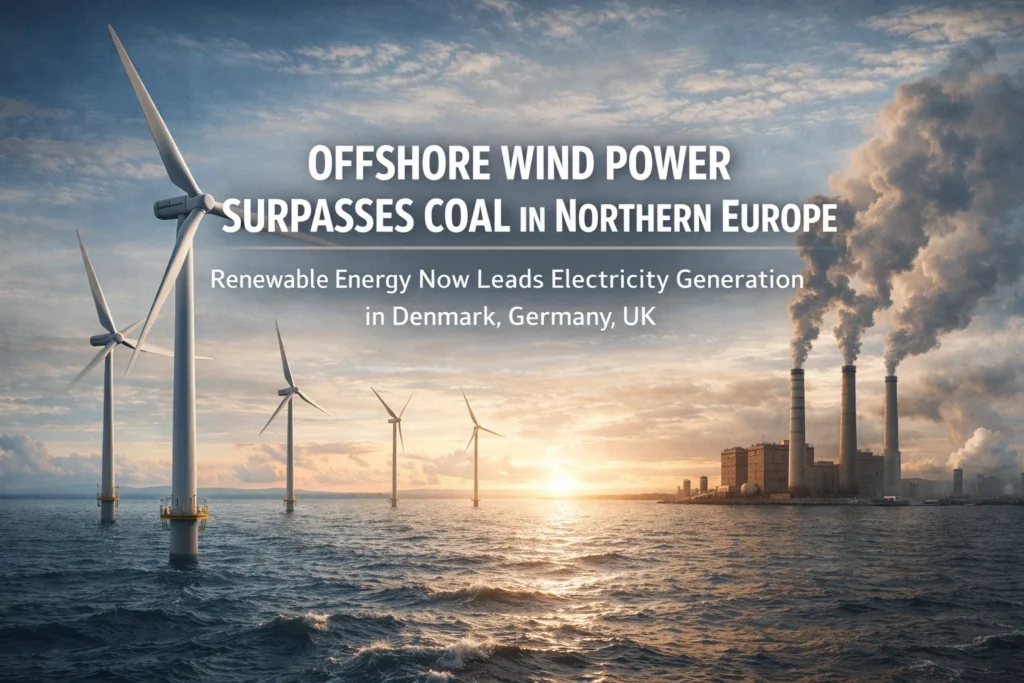

Volume One: The Prologue – Before the Turbines
Chapter One: The Last Smokestack
The winter of 2025 was not particularly cold in Northern Europe. Meteorologists recorded temperatures slightly above the thirty-year average. The North Sea was restless but not violent. On the Danish island of Samsø, residents went about their ordinary business. In the Ruhr Valley, manufacturing continued at its steady, post-pandemic pace. Along the east coast of Britain, commuters packed trains from Brighton to London Victoria. By all conventional measures, it was an unremarkable season.
Yet something remarkable was happening beneath the surface of ordinary life. For the first time since the Industrial Revolution began in the eighteenth century, the countries of Northern Europe were generating more electricity from the wind blowing across their coastal waters than from the coal buried beneath the earth of England, Germany, Poland, and beyond. The milestone passed without official ceremony. No heads of state gathered for photographs. No commemorative plaques were unveiled. The grid operators simply noted the data, confirmed it with redundant measurements, and continued their work of balancing supply and demand across millions of kilometers of transmission lines.
The last deep coal mine in the United Kingdom, Kellingley Colliery in North Yorkshire, had closed a decade earlier in 2015. Its winding gear was preserved as a museum piece, a monument to an industry that once employed a million British workers. The last coal-fired power plant in the United Kingdom, Ratcliffe-on-Soar, ceased operations in September 2024, its eight concrete cooling towers standing silent against the Nottinghamshire sky. Germany, which had long resisted coal phase-out dates, finally committed to retiring its remaining lignite fleet by 2030, with hard coal already eliminated from the generation mix. Denmark, the pioneer of offshore wind, had not burned coal for electricity since 2023.
The infrastructure of the coal age was being dismantled, repurposed, or simply abandoned. Coal import terminals along the Elbe, the Weser, and the Thames were being converted to handle biomass pellets, recycled construction materials, or offshore wind components. Railway lines that once carried unit trains of black rock from coastal ports to inland power stations now carried turbine blades in the opposite direction. The communities that had grown around coal mining—As Pontes in Spain, Jänschwalde in Germany, Turow in Poland—faced uncertain futures, their economic identities severed from the resource that had defined them for generations.
The offshore wind industry, meanwhile, was expanding at a pace that would have seemed fantastical even a decade earlier. In the German Bight, the Dutch North Sea, the Danish Straits, and the British waters of the North Sea and Irish Sea, installation vessels were driving monopiles into seabeds, lifting nacelles onto towers, and stringing export cables across hundreds of kilometers of seafloor. The scale was industrial in the truest sense: factories in Hull, Cuxhaven, Esbjerg, and Gdansk produced blades, towers, and foundations around the clock. Ports were being deepened and reinforced to accommodate vessels that had not existed when the century began. Universities were graduating engineers trained specifically in offshore renewable energy technologies. Financial institutions had dedicated offshore wind teams that rivaled their oil and gas divisions in size and sophistication.
The surpassing of coal by offshore wind was not a sudden event. It was the cumulative result of thirty-five years of incremental progress: better turbines, more efficient installation methods, lower financing costs, more supportive policies, and the steady accumulation of operational experience. It was the consequence of thousands of individual decisions made by engineers, investors, policymakers, and voters, each decision building upon those that came before. It was, in the words of the Danish energy economist Poul Erik Morthorst, “a forty-year overnight success.”
This book is the story of that success. It is a story about physics and finance, about geopolitics and industrial strategy, about marine biology and electrical engineering, about vocational training and international treaty negotiation. It is a story about how a group of countries with no particular advantage in sunshine, limited hydropower resources, and a legacy dependence on fossil fuels managed to build the world’s most advanced clean energy system from the water that surrounds them.
It is also a story about what comes next. The surpassing of coal is not the finish line; it is the confirmation that the bet placed decades ago was correct. The North Sea’s potential is only beginning to be tapped. The technologies that will unlock its deeper waters, integrate its output with the broader European energy system, and couple it with the decarbonization of transport, heating, and industry are still under development. The workforce that will build and operate this system is still being trained. The regulatory frameworks that will govern it are still being designed.
The coal age lasted approximately two hundred years. It reshaped human society in ways its early promoters could not have imagined. It powered industrialization, urbanization, and globalization. It lifted billions of people out of subsistence agriculture and into modern economies. It also destabilized the planet’s climate, poisoned air and water, and concentrated enormous wealth and power in the hands of those who controlled the resource.
The offshore wind age is younger than a single human generation. Its ultimate contours are not yet visible. But its trajectory is clear: expanding, accelerating, deepening. The wind will not run out. The sea will not be exhausted. The people of Northern Europe have finally learned to harvest the energy that has always been there, waiting for them to develop the tools and the will to capture it.
This is how they did it.
Chapter Two: The Geography of Wind
To understand why offshore wind achieved in Northern Europe what it has not yet achieved elsewhere, one must begin with geography.
Northern Europe occupies a unique position on the planet. Its western margins are washed by the North Atlantic Drift, an extension of the Gulf Stream that moderates temperatures and delivers frequent, intense low-pressure systems. These systems generate sustained winds that sweep across the North Sea, the Irish Sea, the English Channel, and the Baltic Sea with remarkable consistency. Unlike the monsoon-driven wind regimes of South Asia or the trade winds of the tropics, Northern Europe’s wind resource is characterized not by seasonal extremes but by year-round reliability.
The North Sea itself is exceptionally well-suited to offshore wind development. Its average depth is approximately ninety meters, but large areas—particularly the Dogger Bank, the German Bight, and the southern North Sea—are considerably shallower. The seabed consists primarily of sand, gravel, and stiff clay, materials that accept driven monopile foundations without the need for extensive rock excavation or pile drilling. The sea is enclosed on three sides, limiting fetch and reducing the extreme wave heights encountered in fully open ocean conditions. Existing oil and gas infrastructure provides transferable knowledge, transferable workforce, and—in some cases—transferable grid connections.
The distribution of population and industry amplifies these natural advantages. Northern Europe is densely populated and highly industrialized. Major demand centers—London, the Ruhr Valley, the Randstad, the Greater Copenhagen area, the Flemish Diamond—lie within two hundred kilometers of coastlines suitable for offshore wind development. Transmission distances are short by global standards. The need for long-distance, high-voltage direct current transmission, while increasing, remains modest compared to the distances that must be crossed in the United States, China, or Australia.
The political geography is equally favorable. Northern Europe consists of stable, wealthy democracies with functional administrative systems, independent judiciaries, and low corruption. Property rights are secure. Contracts are enforceable. Regulatory processes, while often slow and contentious, are generally predictable and transparent. These institutional characteristics matter enormously for capital-intensive infrastructure projects with multi-decade cost recovery periods. Investors will accept technology risk. They will accept construction risk. They will not accept sovereign risk.
The European Union provides an additional layer of institutional integration. EU competition policy ensures that state aid for renewable energy does not distort the internal market. EU environmental directives establish common standards for impact assessment and mitigation. EU energy legislation mandates unbundling of generation and transmission, promotes cross-border interconnection, and sets binding renewable energy targets. EU maritime spatial planning coordination encourages member states to align their offshore development plans. The European Investment Bank provides long-term, low-cost financing that commercial banks cannot match.
The United Kingdom, which left the European Union in 2020, remains closely integrated with continental European energy systems through interconnectors, harmonized technical standards, and continued participation in the North Seas Energy Cooperation forum. Brexit complicated but did not sever these ties. The Hamburg Pact of January 2026, signed by the UK alongside nine other nations, demonstrated that offshore wind cooperation transcends EU membership.
This combination of natural, economic, and institutional endowments is not replicated elsewhere. The United States has excellent offshore wind resources along its Atlantic coast but faces fragmented regulatory jurisdiction, limited state-level coordination, and a federal permitting process that has proven highly vulnerable to litigation. China has ambitious offshore wind targets and substantial manufacturing capacity but operates in deeper waters with more challenging seabed conditions and a less transparent investment environment. Japan and South Korea have deep coastal waters requiring floating technology and face intense competition for marine space from fisheries and shipping. The Southern North Sea’s combination of shallow water, strong wind, proximity to demand, and supportive institutions is genuinely exceptional.
Northern Europe did not choose offshore wind because it was the only option. It chose offshore wind because it was the best option. The region’s geography made offshore wind viable; its institutions made it investable; its political culture made it sustainable. These advantages were not inevitable. They were created, over centuries, by the accumulated decisions of countless individuals. But they were there, waiting to be exploited, when the need for clean, secure, indigenous energy became urgent.
Volume Two: The Technological Foundation
Chapter Three: The Physics of Harvesting Wind
A wind turbine is, at its most fundamental level, a device for converting the kinetic energy of moving air into rotational mechanical energy and then into electrical energy. The physics governing this conversion is well understood and has been for more than a century. The power available in a moving fluid is proportional to the cube of its velocity. Double the wind speed, and the available power increases eightfold. This cubic relationship explains why the consistent, moderately strong winds of the North Sea are so valuable compared to the variable, often light winds of inland Europe.
The fraction of available power that a turbine can actually capture is limited by Betz’s Law, named for the German physicist Albert Betz who derived it in 1919. No turbine can capture more than 59.3 percent of the kinetic energy in the wind passing through its rotor disk. Modern utility-scale turbines achieve coefficients of performance in the range of 45 to 50 percent, remarkably close to the theoretical maximum. Further improvements in aerodynamic efficiency are possible but will be incremental. The major gains in turbine performance over the past four decades have come not from better Betz compliance but from larger rotors, taller towers, and improved reliability.
The scaling laws governing wind turbines are both favorable and challenging. Power output scales with the square of rotor diameter, because the swept area increases with the square of radius. Doubling rotor diameter quadruples swept area and, all else equal, quadruples energy capture. Mass, however, scales approximately with the cube of rotor diameter, because blades must be thicker and wider to support their own weight as they grow longer. Doubling rotor diameter increases blade mass by roughly a factor of eight. This unfavorable scaling relationship creates diminishing returns to size increases and imposes practical limits on how large turbines can become before mass and cost become prohibitive.
Offshore turbines face additional physical challenges beyond those encountered on land. They must withstand saltwater corrosion, which attacks metallic components and degrades composite materials. They must survive wave loads that can exceed wind loads, particularly for bottom-fixed foundations in shallow to moderate water depths. They must contend with marine growth on submerged surfaces, which increases hydrodynamic drag and adds mass. They must be accessible for maintenance only when sea state conditions permit crew transfer, which may be less than half the days in a typical year. These challenges have driven significant innovation in materials science, structural engineering, and logistics.
The drive train is the heart of the turbine, converting slow rotational speed at the rotor hub to grid-compatible electrical frequency. Early turbines used gearboxes to step up rotational speed from approximately 15 to 20 revolutions per minute to approximately 1,500 revolutions per minute suitable for conventional generators. Gearboxes proved to be among the least reliable components, particularly under the variable, often turbulent loads encountered offshore. The industry has progressively shifted toward direct-drive configurations, in which the generator rotor is coupled directly to the turbine rotor without an intermediate gearbox. Direct-drive generators operate at low rotational speeds and require large diameters to achieve acceptable torque density, but they eliminate gearbox failures and reduce maintenance requirements.
Permanent magnet generators, which use neodymium-iron-boron magnets rather than electrically excited copper windings to create the magnetic field, offer higher efficiency and lower mass than electrically excited synchronous generators. They also require substantial quantities of rare earth elements, primarily neodymium and dysprosium, whose supply chains are concentrated in China. This dependence has raised concerns about long-term security of supply and has motivated research into magnet-free generator topologies that can achieve comparable performance.
The tower must support the nacelle and rotor at sufficient height to access stronger, less turbulent winds while withstanding the combined loads of wind, waves, and—for floating platforms—platform motions. Steel remains the dominant material for tower construction, although concrete and hybrid steel-concrete designs have been deployed. Tower height has increased dramatically as rotor diameters have grown. The Vestas V236-15.0MW, currently among the largest commercially available turbines, has a hub height of 155 meters. Including the rotor radius of 118 meters, the tip of the blade at its highest point reaches 273 meters above sea level—taller than most buildings in any European city.
The foundation transfers all loads from the turbine into the seabed and must maintain the tower’s vertical alignment within tight tolerances over the project’s twenty-five to thirty-five year design life. Monopiles—essentially giant steel tubes driven into the seabed—account for approximately 80 percent of installed offshore wind capacity in Europe. They are most economical in water depths up to approximately 40 meters, although recent innovations have extended their viable range to 50 meters and beyond. Jacket foundations, lattice steel structures similar to those used in the offshore oil and gas industry, are used in deeper water or where seabed conditions are unsuitable for monopile driving. Gravity base foundations, which rely on massive concrete or steel ballast for stability, are used where bedrock is too hard for pile driving or where environmental constraints limit underwater noise.
Floating foundations, the subject of intensive research and development, are not a single technology but a family of related concepts. Spar-buoy platforms consist of a deep, ballasted cylinder that extends far below the water surface, positioning the center of mass well below the center of buoyancy for inherent stability. Semi-submersible platforms achieve stability through wide spacing of multiple buoyancy columns, distributing the mooring loads and providing a large working deck area. Tension-leg platforms are held in place by vertical tendons tensioned by excess buoyancy, providing very low vertical motion but requiring specialized installation equipment. Each configuration offers different trade-offs among stability, mass, cost, and water depth capability.
The export cable connects the wind farm to the onshore grid, carrying power at high voltage to minimize losses over distances that may exceed 100 kilometers. Alternating current transmission is economical for relatively short distances and moderate capacities. Direct current transmission becomes preferable at distances beyond approximately 80 kilometers or for very large capacities, because it eliminates reactive power losses and allows asynchronous connection of different grid systems. The conversion from alternating current at the turbine level to direct current for transmission and back to alternating current for grid connection requires substantial, expensive converter stations, typically located offshore on platform substructures.
Array cables connect individual turbines to the offshore substation, carrying power at medium voltage—typically 33 or 66 kilovolts—over distances of a few kilometers. They are laid on or slightly beneath the seabed and are protected against fishing gear and anchor strikes by burial or rock placement. The trend toward larger turbines with higher ratings has driven an industry shift from 33 kV to 66 kV array systems, which can carry more power with lower losses for a given conductor cross-section.
Control systems govern every aspect of turbine operation, from yaw orientation to blade pitch to power converter switching. Modern turbines are densely instrumented with anemometers, accelerometers, strain gauges, temperature sensors, and electrical meters. Real-time data feeds into control algorithms that maximize energy capture while respecting operational constraints. Pitch control adjusts blade angles to regulate rotor speed and power output. Yaw control rotates the nacelle to face the prevailing wind direction. Torque control modulates generator loading to optimize power extraction. Supervisory control and data acquisition systems monitor thousands of parameters and alert operations teams to developing faults.
This technological system did not emerge fully formed. It evolved through decades of incremental improvement, occasional breakthroughs, and continuous learning from operational experience. The 450-kilowatt turbines at Vindeby in 1991 were state of the art for their time. They would be considered toys by contemporary standards. The 15-megawatt turbines being installed today will themselves appear primitive compared to the 25 or 30-megawatt machines that will likely dominate the market in 2040.
The physics has not changed. Betz’s Law remains as immutable as it was in 1919. The cubic relationship between wind speed and power remains as unforgiving. The unfavorable mass scaling of large rotors remains an unavoidable constraint. What has changed is the engineering: better materials, more sophisticated control algorithms, more efficient manufacturing processes, more reliable components, and the accumulated experience of thousands of turbine-years of operation in the harsh offshore environment.
Chapter Four: The Multi-Rotor Revolution
The dominant trajectory of wind turbine development has been toward ever-larger single rotors mounted on ever-taller single towers. This trajectory has been remarkably successful. Turbine ratings have increased by a factor of thirty since Vindeby. Rotor diameters have increased by a factor of seven. Energy capture per turbine has increased even more dramatically, because swept area scales with the square of rotor diameter and hub height accesses stronger, less turbulent winds.
Yet the single-rotor trajectory is encountering diminishing returns. The unfavorable cubic scaling of mass with rotor diameter means that each successive increment in size delivers progressively less marginal benefit. Very large blades require specialized manufacturing facilities that exist in only a few locations worldwide. Very large nacelles require installation vessels that are in critically short supply. Very large towers require port infrastructure that must be dredged and reinforced at substantial public expense. Very large turbines concentrate risk: the failure of a single 15-megawatt machine takes more capacity offline than the failure of five 3-megawatt machines.
Multi-rotor configurations offer an alternative trajectory. Instead of mounting a single large rotor on a single tower, mount multiple smaller rotors on a shared support structure. Two rotors of half the diameter sweep exactly the same area as one rotor of full diameter. But the mass of a rotor scales roughly with the cube of its diameter. Two half-diameter rotors have approximately one-quarter the mass of one full-diameter rotor, because each half-diameter rotor has one-eighth the mass and there are two of them. This dramatic mass reduction propagates through the entire system: lighter rotors mean lighter drive trains, which mean lighter nacelles, which mean lighter support structures and foundations.
The multi-rotor concept is not new. In the 1930s, the French engineer Georges Darrieus proposed a dual-rotor configuration for vertical-axis wind turbines. In the 1940s, the American Palmer Putnam built a two-bladed, 1.25-megawatt turbine on a hill in Vermont that used a two-rotor configuration for its exciter. In the 1970s, following the oil shocks, several research groups investigated multi-rotor concepts as a way to achieve large swept areas without the mass penalties of single very large rotors. These early efforts were abandoned as composite materials enabled lighter, longer blades and as the economic advantages of single-rotor scaling became apparent.
The revival of multi-rotor interest in the 2020s is driven by three factors. First, the diminishing returns to single-rotor scaling have become more pronounced as turbines have entered the 10 to 15-megawatt class. Second, the emergence of floating offshore wind creates new opportunities for multi-rotor configurations, because floating platforms are less constrained by tower height and can accommodate wider support structures than bottom-fixed foundations. Third, advances in control systems enable active management of the complex aerodynamic interactions between adjacent rotors.
El Beshbichi and colleagues at the Norwegian University of Science and Technology conducted the most systematic investigation of two-rotor system performance to date. Their study, published in Wind Energy Science in 2023, used high-fidelity aerodynamic modeling to quantify the performance differences between a 10-megawatt single-rotor turbine and an equivalent 2×5-megawatt two-rotor configuration. The results revealed both challenges and opportunities.
The primary challenge is asymmetric thrust. When two rotors operate side by side, each experiences the wind conditions at its specific location. If the wind direction shifts, the upstream rotor experiences different aerodynamic forces than the downstream rotor. This thrust imbalance creates a yaw moment that tries to twist the entire platform. The magnitude of this effect depends on rotor spacing, wind shear, turbulence intensity, and the specific control algorithms used to regulate each rotor independently.
The primary opportunity is load mitigation. Because the two rotors can be controlled independently, their combined thrust and torque can be modulated to reduce structural loads. In extreme wind conditions, one rotor can be feathered while the other continues generating, maintaining some power output while reducing the overturning moment on the support structure. In turbulent conditions, the rotors’ torque responses can be coordinated to cancel out some of the dynamic loads that would otherwise be transmitted to the tower and foundation.
El Beshbichi demonstrated that the yaw moment challenge can be effectively addressed through control system modifications. By adjusting the blade pitch and generator torque of each rotor based on real-time measurements of thrust imbalance, the controller can actively cancel the yaw moment. The control system must be fast enough to respond to turbulent wind fluctuations, requiring high-bandwidth sensing and actuation, but modern turbine control systems are fully capable of this task.
The industrial response to these research findings has been rapid. Mingyang Smart Energy, a Chinese wind turbine manufacturer, deployed a two-rotor floating offshore wind turbine in 2024. The OceanX platform mounts two 8.3-megawatt rotors on a shared V-shaped semi-submersible foundation, with each rotor operating independently. The company has announced plans for an even more ambitious OceanY configuration with two 25-megawatt rotors on a single platform, which would make it the highest-capacity offshore wind turbine ever deployed.
European manufacturers have been more cautious but are actively developing multi-rotor concepts. Vestas, Siemens Gamesa, and GE Renewable Energy all have active research programs investigating optimal rotor configurations, support structure designs, and control strategies. The European Union’s Horizon Europe program has funded the Multi-Rotor Offshore Wind Energy project, a four-year, €15 million research initiative involving twelve partners from eight countries.
The multi-rotor revolution, if it materializes, will not replace single-rotor turbines entirely. There will continue to be applications where single very large rotors are the optimal solution, particularly in deep water where the cost of floating platforms is dominated by the number of platforms rather than their size. But the multi-rotor approach expands the design space and offers an alternative trajectory for continued cost reduction. The industry is no longer locked into a single technological pathway.
Chapter Five: Floating Wind – Unlocking the Deep Ocean
Eighty percent of the global offshore wind resource lies in waters too deep for bottom-fixed foundations. This simple statistic has profound implications. It means that offshore wind cannot achieve its full potential without floating technology. It also means that the countries with the best offshore wind resources—Japan, South Korea, the United States West Coast, Norway, Scotland, Ireland, Portugal, France—are not the countries with the most shallow continental shelf.
Floating offshore wind turbines are wind turbines mounted on buoyant platforms held in position by mooring lines and anchors rather than fixed to the seabed. They float, exactly as ships float, displacing their weight in water and maintaining stability through a combination of ballast, buoyancy distribution, and mooring restraint. They are not anchored to a single point on the seabed but are held within a defined watch circle, typically a few tens of meters in radius, by catenary or taut mooring systems.
The fundamental physics of floating wind differs from bottom-fixed wind in two critical respects. First, the platform is free to move in six degrees of freedom: surge, sway, heave, roll, pitch, and yaw. Some of these motions, particularly pitch and roll, affect the aerodynamic performance of the rotor and impose dynamic loads not present in fixed-bottom installations. Second, the platform’s natural frequencies in heave, pitch, and roll must be tuned to avoid the predominant frequencies of ocean waves, which typically range from approximately 5 to 20 seconds. If the platform’s natural frequency coincides with a wave frequency, resonance can produce motion amplitudes that are catastrophic for both the turbine and the mooring system.
Three principal floating platform concepts have been developed to commercial or near-commercial readiness.
Spar-buoy platforms consist of a deep, slender cylinder that extends far below the water surface, typically 80 to 120 meters for a 10-megawatt turbine. The majority of the cylinder is ballasted with water, rock, or concrete to position the center of mass well below the center of buoyancy. This low center of mass creates a large righting moment when the platform tilts, providing inherent static stability. The deep draft requires water depth of at least 100 to 120 meters and limits installation options, because the fully assembled platform cannot be towed through shallow coastal waters. Spar-buoy platforms have been deployed at the Hywind Scotland and Hywind Tampen projects, both developed by Equinor.
Semi-submersible platforms achieve stability through wide spacing of multiple buoyancy columns, typically three or four columns arranged in a triangle or square. The waterplane area is distributed over a large footprint, providing a large righting moment for a given tilt angle. Semi-submersibles have much shallower draft than spars, typically 20 to 30 meters, enabling assembly in sheltered coastal waters and tow-out to the installation site. They require more steel than spars for a given turbine size but offer greater flexibility in water depth and seabed conditions. Semi-submersible platforms have been deployed at the WindFloat Atlantic project in Portugal and the Kincardine project in Scotland.
Tension-leg platforms are held in place by vertical tendons tensioned by the platform’s excess buoyancy. The tendons, typically steel tubes or synthetic fiber ropes, are anchored to the seabed and maintained in tension by ballasting the platform to achieve a net upward force. Tension-leg platforms exhibit very low heave and pitch motions because the tendons constrain vertical movement. However, they are sensitive to water depth variations, require precise tendon tensioning during installation, and are vulnerable to tendon failure. Tension-leg platforms have been deployed in the oil and gas industry for decades but have only recently been adapted for offshore wind, with the Gicon floating foundation among the few commercial examples.
The heave plate is a critical component of floating platform stability, particularly for spar and semi-submersible configurations. A heave plate is a horizontal plate, typically with diameter larger than the column to which it is attached, installed at the bottom of the platform. It performs three hydrodynamic functions.
First, it increases added mass. When the platform heaves vertically, it must accelerate a volume of water surrounding the heave plate. This added water mass can be several times the platform’s own mass, significantly increasing the system’s inertia and shifting its natural frequency away from wave excitation frequencies.
Second, it increases radiation damping. As the heave plate moves through the water, it radiates waves that carry away energy. This energy dissipation reduces the amplitude of resonant motions.
Third, it generates vortex shedding. Flow separation around the edges of the heave plate creates vortices that further dissipate energy and contribute to damping.
The HP_Flow project, conducted at the LHEEA ocean engineering basin in France and supported by the WEAMEC research consortium, systematically investigated heave plate design optimization. The project used a hexapod-mounted apparatus to impose forced heave and pitch motions on scale model columns equipped with various heave plate configurations. Researchers measured hydrodynamic forces with high-precision load cells and visualized flow patterns with particle image velocimetry.
The results, published in Ocean Engineering in 2025, revealed that heave plate geometry has substantially greater influence on damping performance than previously recognized. Perforated heave plates, with holes drilled through the plate thickness, exhibited significantly higher damping coefficients than solid plates. The perforation depth—whether the holes extended partially or completely through the plate—proved critical. Through-perforation, where hole depth equals plate thickness, achieved the highest damping values because it allowed flow communication between the upper and lower surfaces of the plate, enhancing vortex generation.
Hexagonal heave plate geometries also demonstrated superior performance compared to circular plates. The hexagonal shape generates a more complex vortex shedding pattern with multiple shedding frequencies, distributing the damping effect across a wider range of wave periods. The combination of perforation and hexagonal geometry achieved damping coefficients approximately 40 percent higher than conventional circular solid plates.
These laboratory findings are now being translated into commercial designs. Principle Power, the developer of the WindFloat semi-submersible platform, has incorporated perforated heave plates into its next-generation design. Equinor is investigating hexagonal geometries for future Hywind variants. The optimization of heave plate geometry represents a relatively low-cost, high-impact innovation that can improve platform stability, reduce structural loads, and ultimately lower the levelized cost of floating offshore wind.
The mooring system is the other critical component of floating wind technology. Its function is to maintain the platform within its allowable watch circle while withstanding extreme environmental loads from the hundred-year storm. Catenary mooring systems, which rely on the weight of suspended chain to provide restoring force, are simple and robust but require substantial seafloor footprint and impose large vertical loads on the platform. Taut mooring systems, using synthetic fiber ropes with nearly linear elastic stiffness, reduce footprint and vertical load but require more sophisticated anchor systems and are vulnerable to long-term creep and fatigue.
Shared mooring configurations, in which adjacent turbines anchor to common seabed points, offer potential cost reductions by reducing the total number of anchors and the length of mooring lines. A floating wind farm with ten turbines might require only twelve anchors under a shared configuration, compared to thirty anchors under individual configurations. The cost savings are substantial, but shared mooring introduces complex reliability and maintenance trade-offs. If one turbine’s mooring line fails, the adjacent turbine may be pulled out of position. Inspection and replacement of shared lines require coordinated scheduling and vessel operations.
The economic viability of floating offshore wind has improved dramatically over the past decade. The first floating projects, Hywind Scotland and WindFloat Atlantic, achieved levelized costs of energy in excess of €150 per megawatt-hour. Subsequent projects have reduced costs to approximately €80 to €100 per megawatt-hour. Industry targets for 2030 are in the range of €40 to €60 per megawatt-hour, which would make floating wind competitive with bottom-fixed wind in many locations and with conventional generation in high-electricity-price regions.
This cost reduction trajectory is achievable through a combination of continued technological improvement, economies of scale, and supply chain maturation. Larger turbines reduce the number of platforms required for a given project capacity. Optimized platform geometries reduce steel mass per megawatt. Serial production of standardized components reduces manufacturing costs. Dedicated installation vessels reduce offshore construction time. Operational experience reduces maintenance costs and improves availability. The cumulative effect of these incremental improvements over the coming decade will be transformative.
Volume Three: The Economic Architecture
Chapter Six: The Trillion-Euro Commitment
The Hamburg Pact of January 2026 committed ten Northern European governments to a level of offshore wind ambition unprecedented in scale and duration. The headline numbers are staggering enough to risk incomprehension. Three hundred gigawatts of installed capacity by 2050. Fifteen gigawatts of annual installation capacity between 2031 and 2040. One trillion euros in total economic activity. One hundred eighty-seven thousand direct and indirect jobs. Seventy billion euros in annual avoided fossil fuel imports. Fifteen percent reduction in continental carbon emissions attributable to North Sea offshore wind alone.
These numbers require contextualization to be meaningful.
Three hundred gigawatts is approximately three times the current total installed electricity generation capacity of the United Kingdom. It is roughly equivalent to 150 large nuclear reactors or 600 combined-cycle gas turbine plants. It is more than the entire current global installed wind capacity—offshore and onshore combined—outside of China. It will require, depending on turbine size and array configuration, between 30,000 and 50,000 square kilometers of marine space, an area roughly the size of Belgium and the Netherlands combined.
Fifteen gigawatts of annual installation capacity is approximately three times the maximum annual installation rate ever achieved by the European offshore wind industry. It implies the construction and commissioning of approximately 1,000 large turbines per year, every year, for a decade. It requires a fleet of installation vessels, cable-laying ships, and crew transfer vessels that does not currently exist. It requires port capacity that does not currently exist. It requires a workforce that does not currently exist.
One trillion euros of economic activity is not government spending. It is private capital mobilized by stable, predictable policy frameworks and invested in factories, vessels, ports, turbines, cables, and the thousands of other physical assets required to build and operate a 300-gigawatt offshore wind fleet. It is investment in tangible productive capacity that will generate electricity, revenue, and jobs for decades. It is an order of magnitude larger than the Marshall Plan, adjusted for inflation.
One hundred eighty-seven thousand jobs are not temporary construction positions. They are permanent careers in manufacturing, installation, operations, maintenance, engineering, project management, and the myriad support services that sustain a mature industrial sector. They are jobs that pay wages sufficient to support families, build homes, and fund retirements. They are jobs that cannot be outsourced, because offshore wind farms cannot be built in low-wage countries and the electricity they generate cannot be shipped in containers.
Seventy billion euros in annual avoided fossil fuel imports is not a forecast; it is a calculation based on current import volumes and projected fuel prices. Every billion euros saved on imports is a billion euros that remains in the European economy, available for domestic consumption, domestic investment, and domestic wages. It is a permanent improvement in Europe’s terms of trade. It is an annual dividend paid by the North Sea wind resource to European households and businesses.
Fifteen percent reduction in continental carbon emissions from a single technology deployed in a single marine basin demonstrates the extraordinary abatement potential of offshore wind. No other clean energy technology offers comparable emissions reduction from such concentrated geographic focus. Not solar photovoltaics, which require vast land areas and achieve lower capacity factors. Not onshore wind, which faces more severe siting constraints and lower wind speeds. Not nuclear, which is constrained by construction costs and lead times. Not carbon capture, which remains unproven at scale.
The Hamburg Pact is not merely a set of targets. It is a binding commitment by ten sovereign governments to coordinate their policies, align their regulatory frameworks, and mobilize their collective resources behind a shared industrial objective. The pact includes specific provisions for identifying 20 gigawatts of cross-border cooperation projects by the end of 2026, to be constructed through the 2030s. It includes commitments to investigate market arrangements for hybrid projects, develop targeted mechanisms for two-sided Contracts for Difference, and assess the H2-readiness of future converter stations.
The pact also includes accountability mechanisms. Signatories must report annually on progress toward their national and collective targets. The European Commission, which facilitated the negotiations, will publish biennial assessments of implementation. Industry partners have committed to specific investment volumes and cost reduction trajectories. Failure to meet commitments will be visible, and visible failure carries political costs.
The origins of the Hamburg Pact lie in the energy crisis of 2022. When Russia invaded Ukraine and subsequently throttled natural gas deliveries to Europe, the continent faced an immediate threat to its economic survival. Gas prices increased tenfold. Industrial facilities curtailed production. Households faced winter heating bills they could not afford. Governments spent hundreds of billions of euros on emergency relief. The vulnerability inherent in 58 percent energy import dependence was exposed in the most brutal possible terms.
The response to the crisis was swift and decisive. The European Union adopted the REPowerEU plan, increasing its 2030 renewable energy target from 40 percent to 45 percent and streamlining permitting procedures. Member states accelerated offshore wind leasing rounds. The European Investment Bank expanded its clean energy financing facilities. Industry responded by scaling up manufacturing capacity and committing to unprecedented investment programs.
The Hamburg Pact is the continuation of REPowerEU, not its replacement. It extends the ambition from 2030 to 2050, quantifies the investment and employment implications, and transforms a unilateral EU initiative into a multilateral North Seas agreement including the non-EU United Kingdom and Norway. It represents the maturation of European offshore wind policy from crisis response to long-term industrial strategy.
Chapter Seven: The Contracts for Difference Evolution
Contracts for Difference have been the primary investment de-risking mechanism for UK offshore wind and a model for similar schemes in other European countries. The mechanism is elegant in its simplicity. The government and the generator agree a strike price, typically determined through competitive auction. When the wholesale electricity price falls below the strike price, the government pays the generator the difference. When the wholesale price rises above the strike price, the generator pays the government the difference. The generator receives predictable revenue. Consumers benefit from capped electricity costs during high-price periods.
The CfD mechanism has been remarkably successful. It supported the UK offshore wind industry through its high-cost phase, driving cost reductions from approximately £140 per megawatt-hour in Allocation Round 1 to approximately £40 per megawatt-hour in Allocation Round 4. It attracted billions of pounds of private investment. It created thousands of jobs. It positioned the UK as a global leader in offshore wind deployment.
Success, however, creates new challenges. The CfD mechanism was designed for a world in which offshore wind was an expensive, emerging technology requiring substantial subsidy support. In that world, the one-sided CfD—with generator upside uncapped and consumer downside capped—was appropriate. Generators needed the potential for high revenues during high-price periods to compensate for the risks of investing in unproven technology at unproven sites.
Today, offshore wind in Northern Europe is frequently the cheapest source of new bulk electricity generation. The risk profile has fundamentally changed. The primary challenge is no longer cost reduction; it is system integration. The primary risk is no longer technology performance; it is revenue adequacy during negative price episodes. The policy instruments must evolve accordingly.
Two-sided CfDs represent the next evolutionary step. The two-sided CfD retains the downside protection of the traditional CfD—the government pays the generator when market prices are low—but adds upside sharing. When wholesale prices exceed the strike price, the generator pays the difference to the government. This transforms the CfD from a pure subsidy instrument into a revenue stabilization and consumer protection instrument simultaneously.
The economic rationale for two-sided CfDs is compelling. When wholesale electricity prices are high, generators earn windfall profits that are unrelated to their costs or investment decisions. These windfall profits represent a transfer from consumers to generators that serves no policy purpose. Capping generator revenues at a reasonable level and recycling the excess to consumers or to fund other energy transition priorities is economically efficient and politically attractive.
The design details matter enormously. The strike price must be set at a level that provides adequate investment incentive while preventing excessive consumer payments. The duration of the CfD must align with project financing requirements, typically fifteen years. The interaction with other revenue streams, particularly power purchase agreements and ancillary service payments, must be clearly specified. The treatment of negative price episodes must be carefully calibrated to avoid unintended consequences.
The UK government has signaled its intention to move toward two-sided CfDs for future allocation rounds. The Hamburg Pact commits signatories to working toward “targeted mechanisms such as cross-border and/or nationally implemented two-sided Contracts for Difference.” This is not merely technical language; it is a declaration that the era of asymmetric subsidy for offshore wind is ending and the era of symmetric revenue stabilization is beginning.
The cross-border dimension adds further complexity. A wind farm in the Dutch North Sea connected to both the Dutch and German grids under a two-sided CfD arrangement must determine which government pays when prices are low and which government receives payment when prices are high. These are not merely accounting questions; they touch on national sovereignty, fiscal responsibility, and the distribution of energy transition costs and benefits.
The resolution of these questions will require unprecedented levels of administrative coordination. Tax authorities must agree on the treatment of cross-border CfD payments. Competition authorities must ensure that coordinated CfD design does not distort the internal energy market. Grid operators must harmonize their curtailment protocols to ensure equitable treatment of hybrid assets. The timeline is ambitious: the first cooperation projects are to be identified by the end of 2026, with construction through the 2030s. The regulatory and market frameworks must be ready before the steel is cut.
Chapter Eight: The Conventional Offtake Challenge
The conventional offtake model for offshore wind is straightforward. The wind farm connects to the onshore grid at a single point of common coupling. The transmission system operator builds, owns, and operates the export cable infrastructure, recovering its costs through regulated use-of-system charges. The wind farm sells its output into the wholesale electricity market, receiving the prevailing market price or, if supported by a CfD, the difference between the market price and the strike price.
This model works well when wind farms are located relatively close to shore, when the onshore grid has adequate capacity to accept their output, and when the volume of offshore generation is modest relative to total system demand. None of these conditions hold for the next generation of offshore wind projects.
The ScotWind leasing round, conducted in 2021, awarded almost 28 gigawatts of seabed rights in areas very far from UK demand centers. The Crown Estate Scotland, acting on the Scottish government’s instruction, offered tracts in the deep waters west of Orkney, east of Aberdeen, and north of the Moray Firth. These are excellent wind sites with high average wind speeds and relatively low environmental constraints. They are also remote. The generation center of gravity of the UK electricity system has shifted dramatically northward and seaward.
The transmission infrastructure serving northern Scotland was not designed for 28 gigawatts of offshore wind. The high-voltage alternating current lines that carry power from the Highlands to the industrial Midlands and Greater London were developed incrementally over decades, responding to the gradual addition of hydroelectric stations, nuclear plants at Torness and Hunterston, and a modest volume of onshore wind. They are now approaching capacity. Reinforcement is planned—new undersea cables along the east coast, upgrading of the B6 boundary between Scotland and England—but these projects face construction delays, consenting risks, and inflationary pressures.
The economic consequence is negative price episodes. When the wind blows hard over northern Scotland on a mild weekend night, when industrial demand is low and the constrained transmission lines cannot export all available power, the wholesale electricity price collapses. It frequently falls below zero. Generators must pay to export their power—or be curtailed, ordered by the system operator to shut down.
Negative pricing is not merely a theoretical inconvenience. The UK CfD scheme has become increasingly strict on negative pricing treatment. Allocation Round 6 removed CfD support entirely during negative wholesale price episodes. A developer bidding into a CfD auction must now factor into its financial model the risk that, for an unknown number of hours per year, it will receive no revenue at all and will actually incur costs to remain online. This uncertainty makes final investment decisions harder to reach and financing more expensive.
The conventional offtake challenge is not unique to the UK. Germany faces similar constraints connecting offshore wind from the North Sea to industrial load centers in Bavaria and Baden-Württemberg. The Netherlands must reinforce its onshore grid to accommodate the 21 gigawatts of offshore wind planned for 2030. France is building new transmission infrastructure to connect floating wind farms in the Mediterranean and Atlantic. The problem is general; its manifestation in Scotland is simply the most acute.
The solution is not to stop building offshore wind. It is to evolve the offtake model from a single-purpose export facility to a multi-purpose energy hub. Instead of simply transmitting power to shore, offshore wind farms can produce hydrogen through electrolysis, store energy in batteries or other media, provide grid stability services, or interconnect with neighboring countries’ grids to balance generation and demand across wider geographic areas.
The hybrid interconnector concept is the most mature of these evolving offtake models. Instead of connecting a single wind farm to a single country, a hybrid project connects a wind farm to two or more countries simultaneously. The wind farm can export power to whichever country has the highest prices at any given moment, subject to available transmission capacity. The interconnector can also trade power between countries when the wind farm is not generating, capturing arbitrage value from differences in wholesale prices and generation mixes.
The North Sea Wind Power Hub consortium, involving the Dutch and German transmission system operators, has been developing hybrid interconnector concepts since 2016. The proposed hub-and-spoke configuration would concentrate multiple gigawatts of offshore wind capacity at a central platform in the Dogger Bank region, with interconnectors radiating to the Netherlands, Germany, the UK, Denmark, and Norway. The hub would serve as both a collection point for wind generation and a trading node between national electricity markets.
The regulatory and market frameworks for hybrid interconnectors do not yet exist. National regulatory authorities must agree on cost allocation methodologies for shared infrastructure. Transmission system operators must coordinate their grid planning and operational protocols. Market operators must develop cross-border trading arrangements that work for both wind generation and interconnector capacity. The European Network of Transmission System Operators for Electricity and the Agency for the Cooperation of Energy Regulators are actively developing these frameworks, but the work is complex and contested.
The hydrogen offtake model is less mature but potentially transformative. Instead of transmitting electricity to shore, an offshore wind farm could use its output to electrolyze water, producing hydrogen that is then transported to shore through pipelines. Hydrogen is storable, transportable, and usable across multiple sectors—power generation, industry, transport, heating. It can decarbonize applications that are difficult to electrify directly. It can provide long-duration energy storage that batteries cannot economically supply.
The technical challenges are substantial. Offshore electrolysis has not been demonstrated at commercial scale. The electrolyzers must operate in a marine environment, withstanding salt corrosion, platform motion, and limited access for maintenance. The hydrogen must be compressed or liquefied for pipeline transport, requiring additional energy input and equipment. The pipelines themselves must be laid across hundreds of kilometers of seabed, traversing varied terrain and avoiding conflicts with other marine users.
The economic challenges are equally substantial. Green hydrogen is currently significantly more expensive than the grey hydrogen produced from natural gas. The gap will narrow as carbon pricing increases and electrolysis costs decline, but it will not close completely without policy support. The European Union’s Hydrogen Strategy and the UK’s Hydrogen Strategy both include provisions for supporting early hydrogen projects through Contracts for Difference or similar mechanisms. The Hamburg Pact’s commitment to assessing H2-readiness of future converter stations reflects the expectation that offshore hydrogen production will become commercially viable within the pact’s implementation period.
The conventional offtake challenge is not a sign that offshore wind has failed. It is a sign that offshore wind has succeeded beyond anyone’s expectations, and that the regulatory and market frameworks designed for a smaller industry must now be redesigned for an industry that has grown up.
Volume Four: The Industrial Ecosystem
Chapter Nine: The Supply Chain Constraint
The turbines themselves are the most visible components of offshore wind farms, but they are not the most constrained components. The critical bottlenecks lie elsewhere, in the industrial capacity to manufacture, transport, install, and maintain the physical assets that constitute a 300-gigawatt offshore wind fleet.
Installation vessels capable of lifting 1,500-ton main assembly units are in critically short supply. The global fleet of offshore wind installation vessels numbers in the dozens, not hundreds. Each vessel costs approximately €400 million and requires three to four years from order to delivery. Vessel day rates have tripled since 2020, directly increasing project capital costs. The industry is ordering new vessels, but the lag between investment and availability is measured in years.
The vessel bottleneck is most acute for the largest turbines. A vessel that can lift a 10-megawatt nacelle may not be able to lift a 15-megawatt nacelle, which is approximately 50 percent heavier. The trend toward ever-larger turbines is making the existing installation fleet obsolete faster than new vessels can be delivered. Project developers must secure installation vessel reservations years in advance, often before final investment decisions have been reached, adding complexity and risk to project scheduling.
High-voltage direct current export cables are another bottleneck. The submarine cable manufacturing industry is concentrated among a few suppliers in Northern Europe and East Asia. Nexans, Prysmian, NKT, and Sumitomo account for the majority of global production capacity. Their order books extend years into the future. A project that has secured all necessary permits, completed its engineering design, and reached final investment decision may still face multi-year delays awaiting cable manufacturing and laying slots.
Cable laying vessels are similarly constrained. The global fleet of specialized cable ships is small and aging. New vessels are under construction, but shipyard capacity is limited and competing demands from telecommunications cable projects and interconnector developments are increasing. A single cable failure can take months to repair, during which entire wind farms may be unable to export full output. The industry is investing in improved cable protection and monitoring systems, but the fundamental constraint of limited vessel availability remains.
Port infrastructure is constrained across Northern Europe. Offshore wind projects require deep-water berths capable of receiving components transported by heavy-lift vessels, storage areas measured in hectares for staging towers, blades, and foundations prior to installation, and quayside craneage capable of lifting multi-hundred-ton assemblies. Many ports with suitable physical characteristics lack available land for expansion. Many ports with available land lack the necessary water depth. Many ports with both land and depth lack the necessary craneage.
Port development requires substantial public investment, because ports are typically owned by municipal or regional governments with limited capital budgets and restricted borrowing capacity. Private investment in port infrastructure is possible but requires long-term commitments from project developers that are difficult to secure before projects have reached final investment decision. The chicken-and-egg problem—ports cannot be developed without committed projects, and projects cannot proceed without developed ports—has constrained offshore wind expansion in several regions.
The Hamburg Pact’s industry partners have committed to investing €9.5 billion in supply chain capacities by 2030. This is substantial, but it is not obviously sufficient. The scale of the 300-gigawatt target implies supply chain investment an order of magnitude larger. The industry is effectively committed to a multi-decade capacity expansion program that must be executed while simultaneously delivering year-on-year cost reductions.
The investment requirements are distributed across the supply chain. Blade manufacturing facilities must be expanded and re-tooled for larger, more complex blade designs. Nacelle assembly plants must increase throughput and incorporate advanced automation. Tower fabrication yards must extend their height and diameter capabilities. Foundation manufacturing facilities must scale from bespoke fabrication to serial production. Cable factories must add new production lines. Vessel owners must order new ships. Port authorities must deepen berths and reinforce quaysides.
The geographical distribution of supply chain investment is politically sensitive. Every country wants its share of the 187,000 jobs projected by the Hamburg Pact. Every region wants its ports to become offshore wind hubs. Every community wants its workers to benefit from the energy transition. Coordinating supply chain investment across ten countries with distinct industrial policies, labor markets, and regional development priorities is a formidable political challenge.
The industry has responded by developing collaborative supply chain initiatives. The Offshore Wind Industry Council in the UK, the Offshore Wind Energy Netherlands program, the Danish Wind Industry Association, and similar organizations in other countries are working to identify supply chain constraints, facilitate investment, and coordinate workforce development. The European Commission’s Clean Energy Industrial Forum provides a platform for cross-border dialogue. The Hamburg Pact’s implementation framework includes provisions for monitoring supply chain development and identifying emerging bottlenecks.
The supply chain constraint is not an argument against the 300-gigawatt target. It is an argument for beginning the capacity expansion program immediately, investing in the factories, vessels, and ports that will be needed to build the offshore wind fleet of 2050. The lead times are long. The investment requirements are large. The consequences of delay are measured in gigawatts not built and emissions not reduced.
Chapter Ten: The Workforce Imperative
The numbers are stark. Europe’s offshore wind industry currently employs approximately 80,000 people across the continent. The Hamburg Pact projects this workforce will need to grow to 187,000 employees, with 140,000 serving the North Seas region directly. This represents more than 100,000 net new jobs created over approximately fifteen years—roughly 7,000 new workers per year, every year, for a decade and a half.
These are not interchangeable generalists. The FLORES project, a two-year European Union co-funded initiative involving fifteen partners from eight countries, conducted detailed workforce modeling and identified four occupational groups with the highest demand in the offshore renewable energy sector.
Science and engineering professionals are required for research, design, development, and innovation. They include mechanical engineers who design turbine components, electrical engineers who design collection and transmission systems, civil and structural engineers who design foundations and support structures, marine engineers who design installation and maintenance procedures, and environmental scientists who assess and mitigate ecological impacts. These professionals typically hold university degrees at bachelor’s, master’s, or doctoral level and require several years of supervised experience before they can work independently.
Administration and commercial business operations professionals manage the business functions of offshore wind development. They include project managers who coordinate multidisciplinary teams, financial analysts who model project economics and structure investment, procurement specialists who contract with suppliers and contractors, legal professionals who negotiate leases and power purchase agreements, and human resources professionals who recruit and develop talent. These professionals typically hold university degrees in business, finance, law, or related fields and require strong communication and negotiation skills.
Information and communication technology professionals develop and maintain the digital infrastructure of offshore wind. They include software engineers who program turbine control systems and wind farm management platforms, data scientists who analyze operational data to optimize performance and predict maintenance needs, cybersecurity specialists who protect critical infrastructure from malicious actors, and network engineers who design communication links between offshore assets and onshore control centers. These professionals typically hold university degrees in computer science, information technology, or related fields and require continuous learning to keep pace with rapidly evolving technologies.
Offshore renewable energy technicians install, operate, and maintain the physical assets of offshore wind farms. They include mechanical technicians who service drive trains and hydraulic systems, electrical technicians who troubleshoot power electronics and control systems, blade repair technicians who inspect and repair composite structures, and high-voltage technicians who maintain collection and transmission systems. These professionals typically complete vocational education and training programs of two to four years duration, supplemented by specialized offshore safety certification and supervised on-the-job experience. They are the occupational group with the highest projected demand in the FLORES modeling.
The challenge is compounded by demographics. Europe’s energy workforce is aging. The skilled technicians and engineers who built the first generation of offshore wind farms in the 2000s and 2010s are approaching retirement. They carry tacit knowledge—learned through years of hands-on experience, documented nowhere, transmitted only through apprenticeship and mentorship—that will be lost if not systematically transferred to the next generation.
At the Baltic Sea Offshore Wind Summit in Gdansk in March 2025, a panel of human resources professionals, training experts, and policy advocates dissected the workforce challenge with uncommon frankness. Their diagnoses converged on several themes.
The vocational education pipeline is inadequate. Agnieszka Rodak of the Pomeranian Centre of Competence for Offshore Wind Energy highlighted a fundamental mismatch in Poland: the demand for professions directly and potentially connected to offshore wind far exceeds the number of students pursuing relevant vocational training. This gap is not unique to Poland; it is evident across Northern Europe. Young people are not choosing vocational pathways at the rate required to replace retiring workers, let alone to support industry expansion.
Rodak emphasized the critical shortage of practical training teachers. Vocational education systems across Europe are struggling to recruit and retain instructors who combine pedagogical qualifications with current industry experience. A skilled turbine technician can earn significantly more in the offshore industry than as a vocational instructor. Until this compensation gap is addressed, the training pipeline will remain constrained.
The school-to-work transition is poorly managed. Rihards Stalmanis of BOTC Training identified the gap between training completion and industry integration as the primary problem. “It’s not about how to prepare them,” he said, “but about how we integrate these new people, new entrants to the industry. How can we manage that?” Companies consistently seek candidates with significant prior experience, but those candidates cannot gain experience without being hired.
The entry-level paradox, familiar throughout skilled trades, is acute in offshore wind because the consequences of inexperience are severe. An error during offshore installation or maintenance can cause millions of euros in damage, days of schedule delay, or serious injury. Companies are understandably risk-averse in their hiring decisions. But risk aversion, generalized across the industry, creates a collective action problem. No individual company has sufficient incentive to bear the costs of training entry-level workers when it cannot capture the full benefits of those workers’ subsequent productivity.
Stalmanis noted that with a solid basic background, the preparation time for specific offshore tasks is relatively short. His organization has adopted virtual reality technologies in training processes to enhance understanding among younger trainees, who respond more readily to immersive simulation than to classroom instruction. VR simulators cannot fully replicate the physical reality of a heaving crew transfer vessel approaching a turbine ladder in two-meter seas, but they can accelerate the development of procedural competence and hazard recognition.
Digital skills are increasingly essential. Ekaterine Gogoberishvili of WindEurope emphasized the significant gap between the digital competencies required by the offshore wind industry and the basic digital skills possessed by a large portion of the adult population. This gap cannot be closed through short-term upskilling programs; it requires systematic integration of digital literacy into secondary and post-secondary education.
The digital skills gap is most acute for technicians. Modern turbines are densely instrumented with sensors that generate terabytes of operational data. Technicians must be able to interpret this data using diagnostic software, not merely rely on visual inspection and mechanical troubleshooting. They must be comfortable working with tablet computers and mobile devices in the challenging environment of an offshore nacelle. They must understand basic principles of networking and cybersecurity to maintain the integrity of wind farm communication systems.
Adjacent maritime industries offer transferable talent. Gogoberishvili highlighted an underappreciated source of skilled workers: fishermen, oil and gas platform workers, merchant mariners, and other maritime professionals. Fishermen possess intimate knowledge of local sea conditions, vessel handling expertise, and mechanical aptitude with marine equipment. Oil and gas workers bring experience with offshore safety protocols, permit-to-work systems, and the discipline of working in hazardous environments. Merchant mariners are trained in navigation, cargo handling, and maritime regulations.
With targeted upskilling programs, these workers can transition to offshore wind careers faster and more cost-effectively than completely new entrants. Their maritime experience is directly transferable; they need only wind-specific technical training. Several European countries have established programs to facilitate this transition, including wage subsidies during training periods and recognition of prior learning for certification requirements.
The talent pool must be international. Božena Petikonis-Šabanienė of Ignitis Renewables stressed the interconnectedness of the regional talent pool. “I think that the potential really lies in all companies acting in this industry. So not only developers but also those who are in the value chain. I think they should join forces.” She strongly advocated for openness to international talent, drawing on the experience of countries with established offshore wind industries.
“One of things which very much strikes me today is that we need to be open for the international talent. We are not inventing the wheel. Offshore industry has already been operating in other countries for a long time. So, being open to learn is very important to get to this competence level.” Petikonis-Šabanienė shared a success story of attracting Lithuanian diaspora professionals back to the country—engineers and project managers who had gained offshore wind experience in Denmark, the UK, and Germany and were willing to return when challenging opportunities became available in their home market.
This pattern, repeated across Europe, demonstrates that talent flows follow investment. Build the projects, and the skilled workers will come. But the flows are not automatic. They require proactive recruitment, competitive compensation, and welcoming professional environments. Countries and companies that wait for talent to arrive will wait indefinitely.
The industry must improve its attractiveness. The panel also addressed the fundamental question of attraction. Why are young people not gravitating toward offshore wind careers? Petikonis-Šabanienė pointed to outdated perceptions of the energy industry as a whole. Many students still associate energy careers with coal mines, oil rigs, and smokestacks—industries their parents’ generation sought to escape.
Programs like Energy Smart Start that bring students into modern renewable energy facilities, that show them control rooms full of data displays rather than coal dust, that connect them with young technicians who earn competitive wages while contributing to climate solutions, are essential to shifting these perceptions. Rodak emphasized the need to communicate career development opportunities and wage levels. Offshore wind is a relatively new sector in Poland and other Baltic nations; students and career-changers simply do not know what jobs exist, what qualifications they require, or what compensation they offer.
The moderator raised the sensitive question of attracting migrant workers, given Europe’s aging population and projected workforce shortages. Gogoberishvili acknowledged ongoing European Union-level discussions regarding strategies for attracting both highly skilled and technically skilled workers, as well as potential frameworks for recognizing vocational education and training qualifications across Europe and beyond. Stalmanis agreed on the necessity of welcoming skilled workers to Europe. The alternative—constraining offshore wind expansion due to labor shortages—is economically and environmentally unacceptable.
Chapter Eleven: The Training Transformation
The workforce challenge is not merely one of quantity; it is equally one of quality and adaptability. The offshore renewable energy sector is characterized by “emerging, with an associated increasing complexity of frequently changing technologies and requirements.” Training systems must increase their ability to respond to rapid changes in the labor market and bridge the workforce’s skills gaps—not once, but continuously.
The guidelines developed within the FLORES project represent a systematic response to this challenge. They address not only the stimulation of dedicated training offers and the skilling processes for new workers expected in the offshore renewable energy sector, but also guarantee equality in access to training, contributing to a more diverse and inclusive workforce. The guidelines are not theoretical; they are derived from the direct experience of fifteen partner organizations across eight countries.
Industry-education partnerships are essential. Training providers cannot develop relevant curricula in isolation; they require sustained engagement with employers to understand current and emerging skill requirements. This engagement must be structured and continuous, not episodic. The Pomeranian Centre of Competence for Renewable Energy exemplifies this model, operating as a collaborative hub involving universities, vocational schools, and industry players to build a training center for practical workshops.
The Centre’s governance structure includes representatives from each stakeholder group, meeting quarterly to review training outcomes, identify emerging skill needs, and adjust program offerings accordingly. Industry partners provide equipment donations, guest lecturers, and internship placements. Educational partners provide pedagogical expertise, accreditation, and assessment. This collaborative approach ensures that training remains relevant to industry needs while maintaining educational quality and rigor.
Work-based learning is central to competency development. Offshore wind competencies cannot be acquired solely through classroom instruction or even advanced simulation; they require supervised practice in real or realistically simulated work environments. This poses particular challenges for an industry whose work sites are located tens of kilometers offshore, accessible only by vessel, with strict safety and operational protocols.
Innovative approaches are being developed and deployed. Extended internships embedded within construction and operations schedules allow trainees to participate in actual work activities under close supervision, gradually assuming greater responsibility as their competence develops. Onshore commissioning facilities replicate offshore conditions, enabling trainees to practice installation and maintenance procedures in controlled environments. Augmented reality systems overlay digital guidance on physical equipment, supporting trainees in performing unfamiliar tasks while building procedural memory.
The costs of work-based learning are substantial. Trainees require supervision that diverts experienced workers from productive activities. Equipment used for training is not available for commercial operations. Extended internships require stipends or wages that strain training budgets. These costs are investments in future workforce capacity, but they are immediate and tangible. Industry and government must share them.
Lifelong learning is a necessity, not an option. The technological basis of offshore wind is not static. Turbine sizes increase. Foundation designs evolve. Control algorithms become more sophisticated. Hydrogen integration, wave energy co-location, and floating wind deployment introduce entirely new skill requirements. Workers trained for the industry of 2025 will need retraining for the industry of 2035.
Continuous upskilling and reskilling throughout careers requires accessible, affordable training opportunities. Employers must provide paid time for training and recognize its value in performance evaluation and career progression. Training providers must offer flexible formats—evening courses, online modules, intensive workshops—that accommodate working schedules. Governments must support training costs through grants, tax incentives, or payroll levy schemes.
The FLORES guidelines recommend establishing individual training accounts that workers can draw upon throughout their careers, funded by employer contributions and government supplements. These accounts would give workers agency over their professional development while ensuring that training investments are not lost when workers change employers. Several European countries have implemented similar schemes in other sectors; adapting them to offshore wind is feasible with appropriate design adjustments.
Inclusivity is both a moral imperative and an economic necessity. The offshore wind workforce currently does not reflect the diversity of the societies it serves. Women are significantly underrepresented, particularly in technical and leadership roles. Ethnic minorities are underrepresented. Workers from disadvantaged socioeconomic backgrounds face barriers to entry. These representation gaps represent lost talent and constrain industry capacity.
The FLORES guidelines explicitly address strategies for attracting and retaining diverse talent. Targeted outreach to under-represented groups can counter stereotypes and provide role models. Inclusive workplace cultures, supported by diversity training and zero-tolerance harassment policies, ensure that all workers feel respected and valued. Flexible work arrangements accommodate workers with caregiving responsibilities or disabilities. Transparent career progression pathways demonstrate that advancement is based on merit, not networks.
Measurement is essential. Organizations cannot manage what they do not measure. The FLORES guidelines recommend that companies collect and report workforce diversity data, set improvement targets, and hold leadership accountable for progress. Industry associations should aggregate data across members to identify systemic barriers and share effective practices. Governments should require diversity reporting as a condition of permitting or subsidy eligibility.
Higher education plays a complementary role to vocational training. The Offwind master’s program, led by the Institut Polytechnique Paris, develops master’s-level engineers with specialized competencies in floating offshore wind technology. Students work with wave tanks to simulate 40-foot storms. They write code to model vortex cascades under perforated heave plates. They engage directly with industry partners on real-world design challenges.
The program’s explicit goal, in the words of fluid mechanics professor Luc Pastur, is to “inspire vocations” from the bachelor’s level all the way to PhDs. This pipeline from secondary education through doctoral research is essential for an industry that requires not only technicians but also researchers, designers, and innovators. The offshore wind industry of 2040 will be built on technologies that do not yet exist, designed by engineers who are currently in middle school.
Investing in their education is not a cost of doing business; it is the precondition for doing business at all.
Volume Five: The Maritime Co-Location Economy
Chapter Twelve: Harvesting Two Harvests
The ocean contains multiple energy vectors. Wind blows above the surface. Waves propagate across it. Currents flow beneath it. Temperature gradients exist between surface and depth. Salinity gradients exist where freshwater meets seawater. For most of the brief history of marine renewable energy, these vectors have been harvested separately—wind turbines in windy places, wave energy converters in wavy places, tidal turbines in high-current places, ocean thermal and salinity gradient technologies in specialized locations.
Separate deployment is inefficient. It multiplies environmental impacts, because each project requires its own seabed disturbance, its own export cable route, its own maintenance vessel visits. It consumes scarce marine space, allocating exclusive use zones for each technology individually. It duplicates expensive infrastructure, with multiple independent grid connections, mooring systems, and offshore substations. It forgoes the synergies that arise when technologies are designed to work together from the outset.
Combined wind-wave energy systems offer a different vision. Instead of deploying discrete technologies in dedicated sites, co-locate them on shared platforms. Mount wave energy converters on the same floating foundations that support wind turbines. Share mooring systems, power cables, and grid connection points. Coordinate control systems to optimize total power output while minimizing structural loads.
The concept has been studied academically for more than a decade. The European Union funded multi-purpose platform initiatives like MARINA Platform and TROPOS in the 2010s. Researchers at the Norwegian University of Science and Technology, the University of Exeter, and the Technical University of Denmark developed multiple hybrid concepts: the WindWaveFloat, the oscillating water column hybrid, the spar-torus combination. The wave energy contribution in these early studies remained stubbornly modest, typically accounting for less than 10 percent of total system output. The added complexity and cost of integrating wave energy converters seemed difficult to justify for such marginal energy gain.
Recent research has fundamentally altered this calculus. In February 2026, a study published in Results in Engineering introduced a novel combined wind-wave energy system integrating a semi-submersible floating offshore wind turbine with two 5-megawatt rotors and multiple torus-type wave energy converters. The torus—a donut-shaped buoy threaded around the platform’s central column—rises and falls with passing waves, driving a power take-off system that converts mechanical motion to electricity.
The key innovation was not the single-torus configuration, which previous studies had explored, but the multi-torus arrangement. The researchers modeled a configuration with multiple torus converters stacked or arrayed around the platform columns. The results were striking. The multi-torus configuration achieved a five-to-six-fold increase in wave energy capture compared to the single-torus baseline. Wave energy contribution rose from 1.35 percent to 8.85 percent of total mean power output. Simultaneously, the additional damping provided by the torus converters reduced platform pitch resonance, improving the operating conditions for the wind turbines themselves.
This is the synergy that earlier studies missed. Wave energy converters are not merely parasitic devices that add complexity for marginal energy gain. They are active motion control devices that can be tuned to damp resonant platform responses, reducing structural loads and fatigue damage while generating usable electricity. The power take-off system that converts wave motion to grid-ready electricity also dissipates energy, and that dissipation can be strategically directed to counter unwanted platform motions.
The control codesign framework developed by researchers at the University of Michigan and published in the Journal of Mechanical Design demonstrates the optimization potential of this approach. Rather than designing the platform and the wave energy converter separately and then attempting to integrate them, the codesign framework optimizes both subsystems simultaneously. The geometry of the floating spar, the dimensions of the torus, the stiffness and damping characteristics of the power take-off system, and the control algorithms that govern real-time power extraction are all treated as interdependent design variables.
The results of this integrated approach are compelling. The optimized spar-torus hybrid system achieved a 13 percent reduction in total system mass-to-power ratio compared to a standalone spar turbine. This is not a marginal improvement; it is a transformative one. Moreover, the researchers demonstrated that full control codesign—optimizing physical and control system parameters together—reduced the mass-to-power ratio by an additional 3.33 percent compared to sequential design, where the physical system is optimized first and the control system is optimized for that fixed physical design.
The wave energy contribution in the optimized codesigned system reached 11.29 percent of total annual energy production. One-ninth of the power output from a floating offshore wind platform, in other words, can be harvested not from the wind but from the waves. That is not a niche contribution; it is a substantial revenue stream that improves project economics while simultaneously reducing structural loads.
The implications for marine spatial planning are equally significant. Co-locating wind and wave energy conversion on shared platforms reduces the sea area required to achieve a given total energy output. This alleviates conflict with fishing interests, shipping lanes, and environmental conservation areas. It reduces the length of subsea cables and the number of seabed disturbances for mooring anchors. It is, in every sense, a more efficient use of ocean space.
Chapter Thirteen: The Platform as Power Plant
The logic of co-location does not stop at wind and wave. The offshore platform of the future may harvest multiple energy streams simultaneously, serve as a node in regional hydrogen networks, provide ancillary services to the electricity grid, and host activities entirely unrelated to energy production.
Hydrogen integration is the most mature of these multi-purpose concepts. The Hamburg Pact includes specific provisions for assessing, on a case-by-case basis, “for which future HVDC-converter stations H2-readiness is proportionate and cost-effective.” Where justified, stations could be designed in a way that keeps open the possibility of connecting offshore electrolysis in the future, provided that a robust cost-benefit assessment demonstrates that expected benefits outweigh additional costs.
This is not visionary speculation; it is engineering pragmatism. High-voltage direct current converter stations are among the most expensive components of long-distance offshore transmission systems. Retrofitting them for hydrogen production after construction is prohibitively expensive. Designing them with预留 space, additional electrical capacity, and compatible control interfaces adds modest incremental cost during construction. The pact’s signatories are effectively instructing project developers to make a choice: either justify why your converter station should not be H2-ready, or build it H2-ready.
Offshore electrolysis addresses one of the chronic challenges of green hydrogen production: electrolyzer utilization. Electrolyzers are capital-intensive assets that achieve acceptable economic returns only when operated at high load factors. An electrolyzer located onshore and powered by a dedicated offshore wind farm is idle whenever the wind is not blowing. An electrolyzer located offshore, adjacent to the wind farm, can be powered directly by the turbines’ DC output before conversion to AC for transmission, and can continue operating even when grid export is curtailed due to congestion.
The hydrogen produced offshore can be transported to shore through repurposed gas pipelines or dedicated hydrogen pipelines. It can fuel vessels equipped with hydrogen combustion engines or fuel cells. It can supply offshore industrial loads, such as oil and gas platforms seeking to decarbonize their power generation. It can generate electricity during peak demand periods through fuel cells or hydrogen-capable gas turbines, providing firm capacity that complements variable wind generation.
The technical challenges of offshore electrolysis are substantial but surmountable. Electrolyzers must be marinized to withstand salt corrosion, platform motion, and limited access for maintenance. Hydrogen compression or liquefaction equipment must be integrated into platform designs with severe space and weight constraints. Pipeline transport of hydrogen over long distances presents materials challenges, as hydrogen embrittles many steels. These challenges are the subject of active research and development programs across Europe.
Offshore solar photovoltaic integration is less mature but conceptually straightforward. The large horizontal surfaces of floating platforms—the decks of semi-submersibles, the topsides of substations, even the towers of turbines themselves—can host solar panels that generate additional electricity during daylight hours. The solar resource offshore is generally lower than onshore due to cloud cover and sea spray, but the incremental generation cost is minimal because the platform structure already exists.
The more significant opportunity is floating solar photovoltaic arrays deployed independently in the sheltered waters within wind farm boundaries. These arrays would require their own mooring systems and electrical connections but could share export cable infrastructure with adjacent wind turbines. The combination of wind and solar generation on the same site smooths the aggregate power profile, because wind speeds are often higher at night and in winter while solar generation peaks during daytime and summer.
Tidal energy can be integrated where wind farms are sited in areas with significant tidal currents. The fast-flowing waters around platform mooring systems, particularly the tensioned tendons of tension-leg platforms, create concentrated flow environments suitable for tidal turbine deployment. Tidal energy is highly predictable, because tidal flows follow astronomical cycles that can be forecast decades in advance. Adding predictable tidal generation to variable wind generation improves the reliability and value of the combined output.
Grid services can be provided from offshore platforms without energy conversion. Synchronous condensers—essentially large rotating machines that provide inertia and voltage support to the AC grid—can be installed on offshore substations to enhance grid stability. Battery energy storage systems can provide fast frequency response and arbitrage services. The economic case for offshore grid services depends on the specific characteristics of each grid connection point and the availability of alternative sources of stability.
Non-energy activities can also be co-located with offshore wind platforms. Aquaculture operations can be integrated within wind farm boundaries, with fish cages or shellfish cultivation structures sharing marine space with turbines. The structures themselves can serve as artificial reefs, enhancing local biodiversity and supporting commercial fisheries. Environmental monitoring equipment can be mounted on platforms, providing real-time data on ocean conditions, water quality, and marine life movements.
The multi-purpose offshore platform is not a single technology or even a single concept. It is a design philosophy that treats the platform not as a single-purpose energy generator but as an integrated energy hub capable of multiple simultaneous functions. The optimal configuration varies by location, by grid connection characteristics, by available marine space, and by the specific requirements of the energy system the platform serves.
This evolution is not merely technological; it is economic and institutional. It requires regulatory frameworks that recognize the value of co-location and multi-purpose infrastructure. It requires market designs that compensate generators for providing grid stability services, not just bulk energy. It requires marine spatial planning processes that allocate sea space for integrated energy systems, not discrete projects. The technology is advancing faster than the institutional frameworks that govern its deployment.
Volume Six: The Geopolitical Dimension
Chapter Fourteen: Energy Independence as National Security
The European Union imports 58 percent of its energy. This is not an abstract statistic; it is a structural vulnerability that has shaped European foreign policy for decades. The relationship with Russia was fundamentally conditioned by Gazprom’s role as the continent’s primary gas supplier. The relationship with the Gulf states is conditioned by their control of global oil markets. The relationship with the United States is increasingly conditioned by competition for liquefied natural gas cargoes.
Energy import dependence is not inherently problematic. The United States imports energy from Canada. Canada imports energy from the United States. Neither country considers this dependence a threat to its sovereignty or security. Import dependence becomes problematic when suppliers are unreliable, when prices are volatile, or when the dependence is concentrated on a single supplier with conflicting geopolitical interests. All three conditions have held for European energy imports in recent years.
Russia’s invasion of Ukraine in February 2022 exposed the full extent of European energy vulnerability. As Western countries imposed sanctions on Russian financial institutions, oligarchs, and officials, Moscow retaliated by throttling natural gas deliveries through the Nord Stream 1 pipeline. Flow reductions were initially attributed to technical issues—turbine maintenance, compressor station repairs—but the pattern of reductions coinciding with political escalation made the strategic intent unmistakable.
European gas prices responded immediately and dramatically. The Title Transfer Facility, the Dutch benchmark hub, saw prices increase from approximately €20 per megawatt-hour in early 2021 to more than €300 per megawatt-hour in August 2022. Industrial consumers curtailed production or shut down entirely. Fertilizer manufacturers, glass producers, ceramics manufacturers, and other energy-intensive industries faced existential crises. Households received government assistance to pay heating bills that had doubled or tripled. Government expenditures on energy relief across the European Union exceeded €600 billion.
The crisis was not solely about Russia. Global liquefied natural gas markets were already tight due to strong demand in Asia, production outages in Australia and Malaysia, and limited new liquefaction capacity coming online. European buyers entered the spot market as emergency purchasers, bidding up prices for cargoes that would otherwise have gone to Asian customers. The United States, Australia, and Qatar increased production and redirected cargoes to Europe, but supply could not keep pace with demand. The market cleared on price.
The experience seared itself into European policy consciousness. Energy is not merely a commodity to be purchased at the lowest available price. Energy is the lifeblood of modern economies, and dependence on unreliable or hostile suppliers for essential energy commodities is an unacceptable risk. The European Green Deal, adopted in 2019, was primarily framed as an environmental policy. REPowerEU, adopted in 2022, was framed as an energy security policy.
The Hamburg Pact extends and deepens the energy security logic. Expanding North Sea offshore wind to 300 gigawatts by 2050 will save Europe approximately €70 billion annually on fossil fuel imports. This is not a forecast of future fuel prices; it is a calculation of avoided imports at current prices. Every billion euros saved on imports is a billion euros that remains in the European economy. Every gigawatt of offshore wind capacity displaces gas imports equivalent to approximately 3 terawatt-hours of generation annually. Every 10 gigawatts of offshore wind reduces European gas import requirements by approximately 2 billion cubic meters per year.
These arithmetic relationships are not speculative; they are observable in operational data. When the wind blows strongly over the North Sea, gas-fired power plants in Germany, the Netherlands, Belgium, and the United Kingdom reduce their output. Gas storage withdrawals decrease. Gas imports decline. The correlation is direct, measurable, and increasing as offshore wind capacity expands.
The energy security benefits of offshore wind extend beyond import displacement. Distributed generation reduces the concentration of supply. A continent powered by hundreds of geographically dispersed offshore wind farms is far more resilient to disruption than a continent dependent on a few pipelines from a single supplier. An attack on one wind farm does not affect the others. A technical failure at one site does not cascade across the system. The diversity inherent in renewable generation is itself a security asset.
Offshore wind also enhances European influence in global energy markets. A Europe that no longer requires large volumes of natural gas imports is a Europe that can credibly advocate for ambitious global climate policy without hypocrisy. A Europe that generates its own electricity from its own wind resource is a Europe that can impose sanctions on aggressor states without fear of winter heating shortages. A Europe that has decarbonized its power sector is a Europe that has decoupled its economy from the volatile politics of fossil fuel exporting regions.
These are not secondary benefits; they are primary objectives of European integration. The European project was founded on the premise that economic interdependence would render war unthinkable and that shared institutions would reconcile national interests with collective security. Energy independence through offshore wind advances both objectives. It reduces dependence on external suppliers while deepening interdependence among European nations through shared infrastructure and coordinated planning.
Chapter Fifteen: The North Sea as European Infrastructure
The North Sea has been a strategic asset for centuries. It provided access to the Atlantic for the Dutch Golden Age, sheltered the British fleet during the Napoleonic Wars, hosted the oil and gas platforms that powered post-war European recovery, and now hosts the wind farms that will power the European green transition.
The Hamburg Pact explicitly reframes the North Sea as “the green power plant of Europe.” This is not merely rhetoric; it is a designation with legal, regulatory, and investment implications. Designating the North Sea as European strategic energy infrastructure unlocks access to trans-European energy networks funding streams, streamlines permitting processes, and signals political commitment to long-term development.
The concept of strategic infrastructure is well-established in European law. The Trans-European Networks for Energy regulation identifies Projects of Common Interest that contribute to energy security, market integration, and sustainability. These projects benefit from accelerated permitting, single national competent authorities, and eligibility for Connecting Europe Facility funding. The TEN-E regulation was revised in 2022 to explicitly include offshore wind infrastructure and to establish a framework for multi-country offshore grid development.
The Hamburg Pact builds on this foundation but goes beyond it. Instead of designating individual projects as Projects of Common Interest, the pact designates the entire North Sea basin as a strategic development zone. Instead of facilitating individual transmission projects, it commits to coordinated planning of generation and transmission infrastructure across ten countries. Instead of funding specific investments, it mobilizes private capital at unprecedented scale through stable, long-term policy commitments.
The institutional implications are substantial. Coordinated planning requires sharing of sensitive information about generation project timelines, transmission system development, and demand forecasts. Governments must disclose their national energy strategies to their neighbors and accept external scrutiny of their implementation. Transmission system operators must coordinate their grid expansion plans across borders, harmonizing technical standards and operational protocols. Regulatory authorities must agree on cost allocation methodologies for shared infrastructure that respect national sovereignty while enabling collective action.
These are not technical problems; they are political problems. They require trust among governments that have competed for industrial investment, disputed maritime boundaries, and clashed over fisheries management. They require willingness to compromise on national preferences for the sake of collective European objectives. They require acceptance that the benefits of coordinated action will not be distributed equally and that side payments or compensatory measures may be necessary to secure participation.
The Hamburg Pact’s signatories have demonstrated this willingness. The pact’s negotiation was not easy; it required multiple rounds of ministerial meetings, extensive technical working groups, and difficult compromises on issues ranging from seabed leasing schedules to CfD design. The final text reflects these compromises in its carefully qualified language and extensive provisions for further work. But the compromises were reached, the text was signed, and implementation has begun.
The North Sea’s transformation from a contested maritime space to a coordinated energy infrastructure zone is not complete. Many challenges remain unresolved. The integration of the United Kingdom, now outside the European Union, into EU energy governance frameworks requires innovative institutional arrangements. The coordination of national marine spatial planning processes remains imperfect. The allocation of costs and benefits from hybrid interconnector projects continues to be contested. The environmental impacts of basin-scale offshore wind development are not fully understood.
But the direction is clear. The North Sea is no longer viewed primarily as a source of oil and gas to be extracted by competing national champions. It is increasingly viewed as a shared European resource to be developed through coordinated action for collective benefit. This shift in perspective is as significant as the technological advances that made offshore wind viable.
Chapter Sixteen: The Global Export Opportunity
The offshore wind revolution is not confined to Northern Europe. China has become the world’s largest offshore wind market, installing more capacity in 2023 than all European countries combined. The United States is pursuing ambitious offshore wind targets from the Atlantic, Pacific, and Gulf of Mexico. Japan, South Korea, Taiwan, and Vietnam are developing substantial project pipelines. Brazil is assessing its offshore wind potential. India has announced targets for offshore wind development in the Gulf of Khambhat and the Gulf of Mannar.
Northern Europe’s significance lies not in being the largest market—that distinction now belongs to China—but in being the most mature, the most innovative, and the most institutionally developed. European developers have accumulated decades of operational experience. European turbine manufacturers have produced multiple generations of technology. European grid operators have integrated high penetrations of variable renewable generation. European financial institutions have developed sophisticated risk assessment and capital allocation capabilities. European policymakers have designed regulatory frameworks that balance investment certainty with consumer protection.
This accumulated experience is an exportable asset. European engineering consultancies are advising offshore wind developers worldwide. European certification agencies are establishing global standards for turbine design and installation. European transmission system operators are sharing grid integration expertise with their counterparts in Asia and North America. European port operators are partnering with emerging offshore wind hubs to transfer knowledge about logistics and supply chain management.
The export opportunity is substantial. The Global Wind Energy Council projects that offshore wind capacity outside Europe will reach 200 gigawatts by 2030 and 500 gigawatts by 2040. Each gigawatt of offshore wind development requires approximately €2-3 billion of capital investment. The global offshore wind market over the next two decades is measured in trillions of euros. Capturing a significant share of this market is essential for European industrial competitiveness.
European manufacturers currently hold a strong position in the global offshore wind supply chain. Siemens Gamesa, Vestas, and GE Renewable Energy account for the majority of offshore wind turbine supply outside China. European foundation fabricators, cable manufacturers, and installation vessel owners are global leaders in their respective segments. European engineering, procurement, and construction contractors have successfully delivered projects on four continents.
This position is not secure. Chinese manufacturers are aggressively expanding their offshore wind capabilities and have begun exporting turbines to European projects. South Korean and Japanese manufacturers are investing heavily in floating wind technology. United States policy is explicitly designed to build domestic supply chain capacity through local content requirements and investment tax credits. European industry cannot rest on its historical advantages; it must continue to innovate, invest, and improve.
The Hamburg Pact’s employment projections assume that Europe will maintain its global leadership position. The 187,000 jobs projected for 2031 include not only workers serving the North Seas market but also workers manufacturing components for export, providing engineering services to international clients, and operating European-owned assets in overseas markets. If Europe loses its competitive edge, these jobs will not materialize.
The floating wind technologies being developed in Norwegian fjords, French Mediterranean testing sites, and Scottish deep-water leases will be deployable off the coast of California, where the continental shelf drops steeply. The combined wind-wave energy systems being modeled in Paris and Ann Arbor will be relevant to island nations with abundant wave resources. The hydrogen integration strategies being piloted in the North Sea will inform energy planning in the Yellow Sea, the Sea of Japan, and the Gulf of Suez. The multi-rotor turbines being tested in Chinese waters will be manufactured under license or exported to markets worldwide.
Europe did not set out to dominate the global offshore wind industry. It set out to decarbonize its electricity system, improve its energy security, and create industrial jobs. Global leadership emerged as a byproduct of persistence. But it is now an explicit objective. The Hamburg Pact’s signatories recognize that leadership carries responsibilities and opportunities. Sharing experience, transferring technology, and building global supply chains are not acts of charity; they are investments in market development that will ultimately benefit European industry and European workers.
Volume Seven: The Environmental Coexistence
Chapter Seventeen: Sharing the Sea
Offshore wind farms are not ecologically neutral. Their construction generates underwater noise that can harm marine mammals. Their foundations introduce hard substrate into soft-bottom environments, altering benthic communities. Their rotors present collision risks for seabirds and bats. Their electromagnetic fields may affect electro-sensitive fish species. Their presence excludes certain fishing activities, displacing effort to other areas.
These impacts are real, but they must be assessed comparatively. The alternative to offshore wind is not no energy production; it is continued fossil fuel combustion with its well-documented and catastrophic impacts on marine and atmospheric systems. Climate change is already acidifying oceans, raising sea levels, and altering marine species distributions. The relevant comparison is not between offshore wind and pristine ocean; it is between offshore wind and the counterfactual of continued fossil fuel dependence.
Responsible developers address environmental impacts through rigorous impact assessment, careful site selection, operational mitigation measures, and—where residual impacts cannot be avoided—compensatory habitat creation or restoration.
Underwater noise during foundation installation is among the most significant acute impacts of offshore wind construction. Pile driving generates intense, impulsive sound that can injure or disturb marine mammals and fish. The peak sound pressure levels from driving a large monopile can exceed 180 decibels referenced to one micropascal at one kilometer distance.
Mitigation measures are effective and widely deployed. Bubble curtains surround the pile during driving, attenuating sound transmission through the water. Acoustic deterrent devices emit signals that encourage marine mammals to leave the immediate vicinity before pile driving commences. Soft-start procedures gradually ramp up hammer energy, giving animals time to move away. Seasonal restrictions limit construction during peak breeding or migration periods.
Habitat alteration effects are more complex. Monopile installation converts soft sediment seabed to hard substrate, displacing burrowing organisms but providing settlement surface for encrusting species. Scour protection—rock or concrete mattresses placed around foundations to prevent erosion—creates additional hard substrate and complex three-dimensional structure.
The ecological consequences of this habitat conversion are not uniformly negative. Hard substrates support diverse communities of sessile organisms—mussels, barnacles, anemones, hydroids—that attract mobile predators—crabs, lobsters, fish. Wind farm exclusion zones, where bottom trawling is prohibited, allow these communities to develop without disturbance. Several studies have documented increased abundance and diversity of benthic organisms and fish within operational wind farms compared to adjacent reference areas.
Whether these localized increases represent genuine ecological enhancement or simply redistribution of organisms from unprotected areas is contested. What is clear is that wind farms are not biological deserts. They support marine life, in some cases more abundant and diverse than the surrounding seabed.
Collision risk for birds and bats is the most visible ecological impact of wind farms. Rotor blades moving at tip speeds exceeding 80 meters per second present lethal hazards for flying animals. Mortality rates vary widely by species, site, and operational conditions.
The best available evidence suggests that collision mortality for most seabird species is low relative to natural mortality and other anthropogenic threats. However, certain species—particularly those that forage in offshore waters and exhibit low reproductive rates—are more vulnerable. Gannets, kittiwakes, and great skuas have been identified as priority species for collision risk assessment and mitigation.
Operational mitigation measures can reduce collision risk. Turbine curtailment during peak migration periods or in low-visibility conditions can significantly reduce fatalities. Blade painting to increase visual contrast can enhance detectability. Ultrasonic deterrents can warn bats away from rotor sweeps. These measures are not universally deployed; their cost-effectiveness varies by site and species.
Electromagnetic fields are generated by export and array cables carrying high-voltage alternating or direct current. These fields may be detectable by electro-sensitive species such as sharks, rays, and some bony fish. Laboratory studies have demonstrated behavioral responses to field strengths comparable to those emitted by buried cables. Whether these responses translate into population-level effects in the field is unknown.
Cable burial eliminates electromagnetic field exposure for organisms that remain in or on the seabed. Most export and array cables are buried at depths of one to two meters, which is sufficient to attenuate fields to background levels. Cables laid on the seabed surface, typically in areas where bedrock prevents burial, remain exposed but represent a small fraction of total cable length.
Fisheries displacement is the most socially contentious impact of offshore wind development. Wind farm exclusion zones, established for navigational safety and cable protection, remove fishing grounds from commercial exploitation. The extent of displacement varies by fishing gear type. Static gear—pots, nets, longlines—can often be deployed within wind farms with appropriate safety protocols. Mobile gear—bottom trawls, beam trawls, dredges—is generally excluded.
Fishing industry representatives argue that wind farm development is progressively reducing the area available for fishing in the North Sea. Wind farm developers counter that the area occupied by wind farms remains modest relative to total North Sea area and that the industry must adapt to changing ocean use patterns as part of the energy transition.
Several initiatives are exploring co-existence models. Fishing within wind farms using static gear has been demonstrated to be feasible with appropriate vessel traffic management and communication protocols. Aquaculture integration within wind farm boundaries is being piloted in Belgium and the Netherlands. Artificial reef effects of foundation structures may enhance local fish populations, potentially benefiting adjacent fisheries.
Strategic environmental assessment at the basin scale is essential for managing cumulative impacts of multiple wind farms. Project-level environmental impact assessment, required for individual development consent applications, cannot adequately assess the combined effects of 300 gigawatts of offshore wind on North Sea ecosystems. Basin-scale assessment, coordinated across jurisdictions and considering multiple stressors simultaneously, is necessary to identify ecologically sensitive areas, establish cumulative impact thresholds, and design adaptive management frameworks.
The OSPAR Convention, the regional seas agreement governing the Northeast Atlantic, provides a forum for such assessment. OSPAR’s North-East Atlantic Environment Strategy includes objectives for protecting marine biodiversity and ecosystems while supporting sustainable use of marine resources. The Hamburg Pact’s signatories have committed to working through OSPAR and other relevant international forums to ensure that offshore wind development proceeds within ecological limits.
Chapter Eighteen: The Circular Economy Imperative
Offshore wind farms have finite operational lives. Current projects are typically designed for twenty-five to thirty-five years of operation, after which they must be decommissioned or repurposed. The first generation of European offshore wind farms, including Vindeby and other pioneering projects, have already been decommissioned. Their components were removed from the seabed, transported to shore, and processed for material recovery or disposal.
The coming wave of decommissioning will be orders of magnitude larger than the first. The 300 gigawatts of offshore wind capacity projected for 2050 will eventually need to be decommissioned and replaced. The material flows involved are substantial. A single 15-megawatt turbine contains approximately 1,000 tons of steel, 50 tons of copper, 30 tons of aluminum, and 20 tons of composite materials. A 300-gigawatt fleet, assuming 15-megawatt average turbine size, comprises 20,000 turbines. The embedded materials total 20 million tons of steel, 1 million tons of copper, 600,000 tons of aluminum, and 400,000 tons of composites.
These materials are too valuable to waste. Steel can be recycled indefinitely without loss of properties. Copper and aluminum can be recycled with energy requirements approximately 5 to 10 percent of primary production. Composite materials—fiberglass and carbon fiber reinforced polymers—are more challenging to recycle but can be processed into cement kiln fuel, filler materials, or—through emerging chemical recycling technologies—depolymerized into virgin-quality resins.
The offshore wind industry has committed to circular economy principles. WindEurope, the industry association, has published a circular economy vision document outlining targets for 100 percent recyclability of decommissioned turbines, 100 percent recyclability of blades, and zero waste to landfill. Several manufacturers have announced blade recycling initiatives and established take-back programs for decommissioned components.
The technical challenges are substantial but surmountable. Composite recycling capacity must scale from pilot plants to commercial facilities. Logistics systems must be developed to transport decommissioned blades, which are too large for standard road transport, from ports to recycling facilities. Secondary material markets must be developed to absorb recycled composites at prices that justify collection and processing costs.
The economic case for circularity strengthens as primary material prices increase and waste disposal costs rise. Landfill disposal of composite materials is increasingly restricted or prohibited in European jurisdictions. Carbon pricing raises the cost of energy-intensive primary material production. Recycled content requirements, under discussion in European Union product policy, would create guaranteed demand for secondary materials.
The offshore wind industry cannot achieve circularity in isolation. It depends on steel mills, aluminum smelters, copper refiners, and composite recyclers that serve multiple sectors. It depends on waste management companies, logistics providers, and secondary material traders. It depends on research institutions developing improved recycling technologies and product designers specifying recycled content. Circularity is a system property, not a product attribute.
The Hamburg Pact does not explicitly address circular economy objectives, but the pact’s implementation framework includes provisions for monitoring supply chain sustainability. As the offshore wind fleet matures and decommissioning volumes increase, circular economy considerations will become increasingly central to industry strategy and policy development.
Volume Eight: The Human Dimension
Chapter Nineteen: Communities in Transition
The coal communities of Northern Europe have experienced decades of economic decline. Mines have closed. Power stations have been decommissioned. Younger workers have migrated to cities with better employment prospects. Older workers have taken early retirement or accepted long commutes to remaining industrial facilities. The social fabric of mining towns has frayed as schools have closed, shops have shuttered, and community organizations have lost members.
The energy transition is not responsible for this decline. Coal’s economic viability was eroding long before climate policy accelerated its phase-out. Mechanization reduced employment in deep mines from hundreds of thousands to tens of thousands. Competition from cheaper US coal, then cheaper renewables, then cheaper gas eroded coal’s market position. Air quality regulations required expensive emissions control equipment. The trajectory was clear, even if the timing was contested.
But the energy transition has concentrated the inevitable decline into a compressed timeframe. Coal communities that might have experienced gradual attrition over decades face abrupt plant closures with fixed dates. Workers with decades of experience and specific skills face uncertain futures. Local economies that have depended on coal-related payroll and procurement for generations must reinvent themselves without clear blueprints.
The Hamburg Pact’s signatories have acknowledged their responsibility to these communities. Just transition provisions are included in national energy strategies across Northern Europe. Germany’s Coal Commission developed a comprehensive plan for phasing out lignite mining and generation by 2038, with billions of euros in structural adjustment funding for affected regions. The Polish government has negotiated just transition funding from European Union cohesion policy programs. The UK government has established transition task forces for remaining coal communities.
Offshore wind offers employment opportunities for displaced fossil fuel workers. The skills required for offshore wind installation and maintenance overlap substantially with offshore oil and gas competencies. Mechanical technicians, electrical technicians, and crane operators can transition between sectors with relatively short upskilling programs. Vessel crews, safety specialists, and logistics coordinators possess directly transferable expertise.
The geographical mismatch between coal communities and offshore wind employment centers is significant but not insurmountable. Polish coal mining regions in Upper Silesia are located far from Baltic Sea coastal areas where offshore wind ports are developing. German lignite mining regions in the Rhineland and Lusatia are distant from North Sea coastal hubs. UK coal communities in South Wales, Yorkshire, and the Scottish Lowlands are not adjacent to the major offshore wind clusters in East Anglia and the Humber region.
Mobility support—relocation assistance, commuting subsidies, temporary housing—can address geographical mismatches but requires public investment. Training support—income replacement during upskilling programs, recognition of prior learning for certification requirements—is equally essential. Employment guarantees—offers of alternative employment to displaced workers—provide certainty that enables workers to plan their transitions.
The effectiveness of just transition programs depends on genuine engagement with affected workers and communities. Programs designed without worker participation are unlikely to meet worker needs. Communities that are merely consulted rather than empowered to shape their own futures will remain skeptical of transition promises. The energy transition cannot be imposed on coal communities; it must be developed with them.
Chapter Twenty: The Technicians’ Perspective
Mette Kristensen has worked in offshore wind for eighteen years. She began as a technician trainee at the Nysted offshore wind farm in Denmark, learning to climb turbines, troubleshoot control systems, and perform blade inspections. She now manages operations and maintenance for a portfolio of wind farms in the German Bight, supervising a team of forty technicians.
“The job has changed enormously,” she says. “When I started, we spent most of our time fixing things that broke. Gearboxes failed. Pitch systems malfunctioned. Yaw drives seized. We were constantly responding to alarms, traveling from turbine to turbine, trying to keep the farm running. Now, the turbines are much more reliable. We spend more time on preventive maintenance, condition monitoring, and data analysis. The physical work is still there—climbing, lifting, repairing—but it’s more planned and less reactive.”
Kristensen emphasizes the importance of safety culture. “Offshore wind is inherently hazardous. You’re working at height, with high voltage electricity, in a marine environment. A fall, a shock, a slip into the water—these are real risks. We’ve invested enormously in safety systems, training, and culture. The industry’s safety record is good, but it requires constant attention. Complacency is the enemy.”
She describes the satisfaction of the work. “You can see what you’ve accomplished. A turbine that wasn’t generating is generating again. A blade that was damaged is repaired. A farm that was operating at 80 percent availability is at 95 percent. There’s immediate feedback, tangible results. That’s rewarding.”
She also describes the challenges. “It’s hard on family life. I work seven days on, seven days off. When I’m offshore, I’m completely disconnected from home. My husband manages everything—school runs, appointments, social activities. We’ve made it work, but it requires both partners to be fully committed. Not everyone can do it.”
Kristensen is optimistic about the industry’s future. “We’re building something permanent. These wind farms will operate for thirty years, generate clean electricity for millions of people, employ thousands of workers. My daughter is twelve. She might work in this industry someday. That’s a legacy I’m proud of.”
Chapter Twenty-One: The Fishermen’s Perspective
Lars Jørgensen has fished the North Sea for forty-two years. His father fished before him, and his grandfather before that. His sixty-five-foot trawler, Nordlyset, has worked grounds from the Dogger Bank to the Norwegian Trench. He knows the seabed contours, the tide rips, the seasonal movements of cod, haddock, and plaice.
“Wind farms have taken some of our best grounds,” he says. “The Dogger Bank was always good for cod. Now it’s being covered with turbines. We can’t fish there anymore. It’s not just the exclusion zones. Even where fishing is technically allowed, it’s difficult. The turbines are obstacles. The cables are hazards. We have to work around them.”
Jørgensen acknowledges the necessity of the energy transition. “I’m not stupid. I know we need to move away from fossil fuels. I’ve seen the changes in the sea—warmer water, different species moving north, the plankton cycles shifting. Something is happening. But fishermen are being asked to bear the cost of that transition without adequate compensation.”
He describes the consultation process. “The developers come to our association meetings. They show maps, talk about their plans, ask for our input. We tell them where the important fishing grounds are, where the spawning aggregations occur, where the seabed is suitable for trawling. Sometimes they adjust their layouts. Sometimes they don’t. We have no veto, no leverage. We can object, but they have the permits.”
Jørgensen is skeptical of co-existence proposals. “They talk about fishing within wind farms using static gear. Pots, nets, longlines. That’s fine for crabbers, lobster fishers, some gillnetters. It doesn’t work for trawlers. We can’t tow gear between turbines. It’s too tight, too dangerous. We’d have to convert our vessels, change our methods, learn new skills. Maybe some younger fishermen will do that. I’m sixty-three. I’ll be retired before any of this is sorted out.”
He is also skeptical of compensatory habitat claims. “They say the turbine foundations act as artificial reefs, that fish aggregate around them, that we’ll catch more outside the exclusion zones because of spillover. Maybe. I haven’t seen it yet. What I see is less area to fish and more vessels competing for what remains.”
Jørgensen pauses. “I don’t hate wind farms. I hate that we weren’t part of the conversation from the beginning. We were an afterthought. They built the first farms, saw that fishing was affected, and then started thinking about how to manage the conflict. If they’d included us at the planning stage, we could have avoided some of the worst placements. Now we’re just reacting.”
Chapter Twenty-Two: The Investor’s Perspective
Claire Beaumont manages renewable energy investments for a London-based asset manager with €15 billion in infrastructure assets under management. Her portfolio includes offshore wind farms in the UK, Germany, the Netherlands, and France. She has participated in transactions totaling more than €5 billion.
“Offshore wind is an institutional asset class now,” she says. “Pension funds, insurance companies, sovereign wealth funds—they all want exposure. The cash flows are predictable, the inflation protection is good, the risk-adjusted returns are attractive compared to other infrastructure assets. A well-structured offshore wind investment can deliver 7 to 9 percent returns over twenty-five years with very low default risk.”
Beaumont describes the evolution of project financing. “Ten years ago, we were financing construction risk. Banks were nervous about technology performance, supply chain reliability, regulatory uncertainty. Now, construction risk is well understood. The technology is proven. The supply chain is established. The regulatory frameworks are stable. We can finance projects on a non-recourse basis with competitive terms.”
She identifies current challenges. “The biggest risk today is revenue adequacy during negative price episodes. CfD reform is essential. We need two-sided CfDs with clear negative price treatment. Without that visibility, it’s difficult to underwrite long-term debt. We also need clarity on cross-border hybrid projects. The revenue streams are more complex, the regulatory jurisdictions are multiple, the risk allocation is unclear. The Hamburg Pact commitments are helpful, but we need detailed implementation.”
Beaumont emphasizes the importance of policy stability. “What investors fear most is retroactive policy change. If a government changes the CfD strike price after financial close, or imposes windfall taxes that weren’t contemplated in the investment case, or reneges on grid connection commitments, we cannot absorb that risk. We price policy risk into our cost of capital. Stable, predictable policy reduces our required returns and lowers electricity costs for consumers.”
She is optimistic about floating wind. “The resource potential is enormous. The cost reduction trajectory is credible. The technology is progressing faster than expected. We’re actively looking for floating wind investment opportunities. The challenge is scale. The projects are still relatively small, the capital requirements are large, the risk-return profile is still evolving. We need a few more reference projects to establish performance track records.”
Beaumont reflects on her career. “I started in oil and gas investment banking. I financed pipelines, refineries, LNG terminals. That was the default career path for energy finance professionals fifteen years ago. Now, the majority of my colleagues are in renewables. The talent has shifted. The capital has shifted. The center of gravity of energy finance has moved, and it’s not moving back.”
Volume Nine: The Road Ahead
Chapter Twenty-Three: The 300-Gigawatt Pathway
The Hamburg Pact’s 300-gigawatt target for 2050 is ambitious but achievable. It implies average annual installation of approximately 12 gigawatts from 2030 to 2050, with lower installation rates in the 2020s as supply chain capacity expands and higher rates in the 2030s and 2040s as serial production achieves scale.
The installation profile is not linear. Early years are constrained by vessel availability, port capacity, and manufacturing capability. Middle years benefit from expanded supply chains and serial production efficiencies. Later years require repowering of first-generation wind farms and continued expansion into deeper waters with floating technology.
The 2020s are the foundation decade. Existing national targets—25 gigawatts for the Netherlands, 30 gigawatts for Germany, 50 gigawatts for the United Kingdom—must be delivered. Supply chain bottlenecks must be addressed through investment in vessel capacity, port infrastructure, and manufacturing facilities. Floating wind must progress from demonstration projects to commercial-scale arrays. Workforce development programs must expand training capacity and attract new entrants to the industry.
The 2030s are the acceleration decade. Annual installation rates increase to 15 gigawatts and remain at that level throughout the decade. Hybrid interconnector projects enter commercial operation, demonstrating the viability of multi-country offshore grids. Floating wind achieves cost parity with bottom-fixed wind in deep water sites. Hydrogen production from offshore wind becomes commercially viable, supported by carbon pricing and dedicated revenue mechanisms.
The 2040s are the maturation decade. The North Sea offshore wind fleet reaches 300 gigawatts. Repowering of first-generation farms begins, replacing 1990s and 2000s vintage turbines with modern machines of 20 megawatts or larger. Cross-border coordination is fully institutionalized, with joint planning, shared revenue mechanisms, and harmonized regulatory frameworks. The North Sea functions as an integrated European energy hub, balancing variable renewable generation across the continent.
This pathway assumes continued political commitment across multiple electoral cycles, consistent policy implementation despite changing government compositions, and sustained public support for energy transition costs. These are not trivial assumptions. Energy policy has historically been subject to partisan oscillation and short-term expediency. The offshore wind industry’s success to date reflects exceptional policy stability in lead markets like Denmark, Germany, and the United Kingdom. Extending that stability across ten countries and three decades is a formidable political challenge.
Chapter Twenty-Four: Beyond the North Sea
The North Sea is Northern Europe’s most advantageous offshore wind resource, but it is not the only one. The Baltic Sea, the Mediterranean Sea, the Atlantic Seaboard, and the Black Sea all offer substantial offshore wind potential that will be developed over the coming decades.
The Baltic Sea is shallower than the North Sea and largely sheltered from Atlantic swell, making it well-suited to bottom-fixed foundations. Its wind resource is somewhat lower than the North Sea, particularly in summer months, but still excellent by global standards. Its coastal states include Denmark, Germany, Poland, Sweden, Finland, Estonia, Latvia, Lithuania, and Russia. Geopolitical tensions with Russia complicate coordinated development, particularly in the eastern Baltic, but the eight European Union member states have committed to cooperative offshore wind expansion through the Baltic Energy Market Interconnection Plan.
The Baltic Sea’s offshore wind potential is estimated at approximately 90 gigawatts, of which Poland has announced targets for 11 gigawatts by 2040, Sweden for 30 gigawatts by 2045, and Finland for 20 gigawatts by 2050. Realizing this potential requires coordinated grid planning, harmonized regulatory frameworks, and resolution of maritime boundary disputes between Poland and Denmark and between Sweden and Finland.
The Mediterranean Sea presents different challenges and opportunities. Its waters are generally deeper than the North Sea, requiring floating technology for most commercial-scale development. Its wind resource is more variable, with strong seasonal winds like the Mistral in France and the Tramontane in Spain but lighter winds in summer months. Its coastal states include France, Spain, Italy, Greece, Croatia, Malta, Cyprus, and several North African countries with varying political stability and institutional capacity.
The Mediterranean’s offshore wind potential is substantial but its development timeline is longer than the North Sea’s. France has announced targets for 40 gigawatts of offshore wind by 2050, primarily floating. Italy has announced targets for 2 gigawatts by 2030 and 5 gigawatts by 2040. Greece has ambitious floating wind targets driven by its island decarbonization objectives. Cross-border coordination is less developed than in the North Sea, reflecting the Mediterranean’s greater institutional diversity and the absence of an existing energy cooperation forum comparable to the North Seas Energy Cooperation.
The Atlantic Seaboard offers excellent wind resources in the deep waters off Ireland, Portugal, and France. Ireland’s offshore wind potential is estimated at 30 gigawatts, primarily floating, with the government targeting 5 gigawatts by 2030 and 20 gigawatts by 2040. Portugal has demonstrated floating wind viability at the WindFloat Atlantic project and is targeting 10 gigawatts by 2030. France’s Atlantic coast offers strong, consistent winds and extensive continental shelf suitable for bottom-fixed foundations in shallower areas and floating in deeper waters.
The Black Sea is the least developed European offshore wind region but offers substantial potential. Romania, Bulgaria, Turkey, and Ukraine border the Black Sea, which has moderate wind resources and shallow waters suitable for bottom-fixed foundations. Development has been constrained by political instability, limited institutional capacity, and the ongoing Russian invasion of Ukraine. Post-war reconstruction of Ukraine’s energy system will include offshore wind as a component of decarbonization and energy security strategy.
The North Sea’s 300-gigawatt target is not the entirety of European offshore wind ambition. It is the leading edge of a continent-wide transition that will eventually encompass all European sea basins. The technologies, business models, regulatory frameworks, and workforce development strategies pioneered in the North Sea will be adapted and deployed across Europe. The Hamburg Pact’s significance lies not in being the final word on European offshore wind policy but in being the first credible, quantified, multi-government commitment to basin-scale coordinated development.
Chapter Twenty-Five: The Long View
The coal age lasted approximately two hundred years. It began in the eighteenth century, when British ironmasters discovered that coke made from coal could produce higher-quality iron than charcoal made from wood. It accelerated in the nineteenth century, when steam engines powered by coal drove factories, railways, and ships. It peaked in the twentieth century, when coal-fired power stations electrified homes and industries across the developed world. It declined in the twenty-first century, as environmental regulation, renewable energy, and natural gas displaced coal from electricity generation.
The offshore wind age is younger than a single human generation. The first commercial offshore wind farm began operating in 1991. The 300-gigawatt North Sea fleet projected for 2050 will be built over approximately sixty years—less than one-third of the coal age’s duration. The pace of change is accelerating.
What will the North Sea look like in 2050, when the Hamburg Pact’s 300-gigawatt target has been achieved? The turbines will be larger than today’s machines, certainly—perhaps 20 or 25 megawatts, with rotors spanning 300 meters. They will be spaced farther apart, reducing wake losses and allowing each turbine to capture undisturbed wind. Many will be floating, moored in waters 200 meters deep, accessing wind resources that bottom-fixed turbines cannot reach.
The wind farms will be connected by a dense network of subsea cables, linking national grids and enabling power to flow from areas of high generation to areas of high demand. Converter stations on artificial islands or large platforms will transform alternating current from collection networks to direct current for long-distance transmission and back again for grid connection. Hydrogen pipelines will run alongside power cables, transporting gaseous fuel produced by offshore electrolysis to onshore industrial users.
The North Sea will be a working sea, as it has been for centuries. Fishing vessels will navigate between turbines, setting nets and hauling pots. Shipping lanes will be maintained, their boundaries adjusted to accommodate wind farm arrays. Military training areas will be preserved, their operational requirements balanced against energy infrastructure needs. Nature reserves will be established in areas of particular ecological sensitivity, their boundaries respected by developers and operators.
The energy produced by this offshore fleet will power homes, businesses, and industries across Northern Europe. Electric vehicles will charge from North Sea electrons. Heat pumps will warm buildings from North Sea electrons. Hydrogen produced from North Sea electrons will fuel heavy transport, power industrial processes, and generate electricity when the wind is calm. The fossil fuel imports that once dominated European energy trade will be a memory, their physical infrastructure repurposed or decommissioned.
The workers who build and operate this fleet will be the beneficiaries of investments made decades earlier. The vocational students who enter offshore wind training programs in the 2020s will become senior technicians, supervisors, and managers by the 2040s. The engineering graduates who join turbine manufacturers, developers, and consultancies in the 2020s will become technical directors, chief engineers, and executives by the 2040s. The careers that begin today will span the entire development of the North Sea as Europe’s green power plant.
This future is not guaranteed. It requires continued political commitment, sustained investment, and successful resolution of the technological, economic, and institutional challenges documented throughout this chronicle. It requires public acceptance of the visible presence of turbines on the horizon and the invisible costs of transition embedded in electricity bills. It requires trust that the promised benefits will materialize and that the burdens of transition will be fairly distributed.
But the foundation has been laid. The technology is proven. The investment is mobilized. The workforce is training. The policy frameworks are established. The North Sea offshore wind revolution is no longer a vision or an aspiration; it is an industrial reality, underway and accelerating. The surpassing of coal is not the destination. It is the confirmation that the journey is worth continuing.
Epilogue: The Tide That Lifts All Boats
The Vindeby turbines were decommissioned in 2017. After twenty-five years of operation, the world’s first offshore wind farm had reached the end of its design life. The eleven turbines, each rated at 450 kilowatts, were dismantled and removed. Their foundations were extracted from the seabed. The site was restored.
But the knowledge generated by those eleven tiny turbines did not disappear. It propagated through the industry, through the engineers who moved from Ørsted to other developers, through the supply chains that scaled up from bespoke fabrication to serial production, through the regulatory frameworks that evolved from experimental permits to streamlined consenting processes. Vindeby is gone, but Vindeby’s legacy is embedded in every offshore wind farm operating today.
The Hamburg Pact is Vindeby’s legacy. The 300-gigawatt target is Vindeby’s legacy. The €1 trillion in mobilized investment, the 187,000 jobs, the €70 billion in annual import savings, the 15 percent reduction in European emissions—all of these flow from the decision, made thirty-five years ago in a Danish utility company, to try something that everyone said was impossible.
The coal-fired power plants of Northern Europe are closing. Some have already been demolished. Others are operating on reduced schedules, awaiting final shutdown dates. Their workers are retiring or retraining for careers in offshore wind. Their supply chains are diversifying into renewable energy components. Their host communities are reinventing themselves as centers of clean energy industry.
This transition has been neither smooth nor complete. It has faced opposition, delay, and reversal. It has required subsidies that raised electricity bills. It has imposed costs on communities dependent on fossil fuel employment. It has moved faster in some countries than others. It remains unfinished.
But the direction is clear. The capacity of offshore wind in Northern Europe has surpassed coal. The gap will only widen. The turbines will keep turning, the tide will keep rising, and the energy transition will continue.
Not because it is easy. Not because it is popular. Not because there are no difficult trade-offs or unresolved challenges.
Because it is necessary. And because, as the past thirty-five years have demonstrated, the people of Northern Europe are capable of achieving necessary things when they set their minds to them.
The wind does not stop. The sea does not rest. And the work is not done.



Dude, mocha777 is legit. The interface is clean and they have a bunch of games I haven’t seen anywhere else. Give it a whirl. mocha777
Got mwingamedownload on my phone and it’s not bad. Smooth downloads and the games run well. Good stuff, overall. mwingamedownload
The p898login is simpler than many other login. It is so convenient that I like it. p898login