
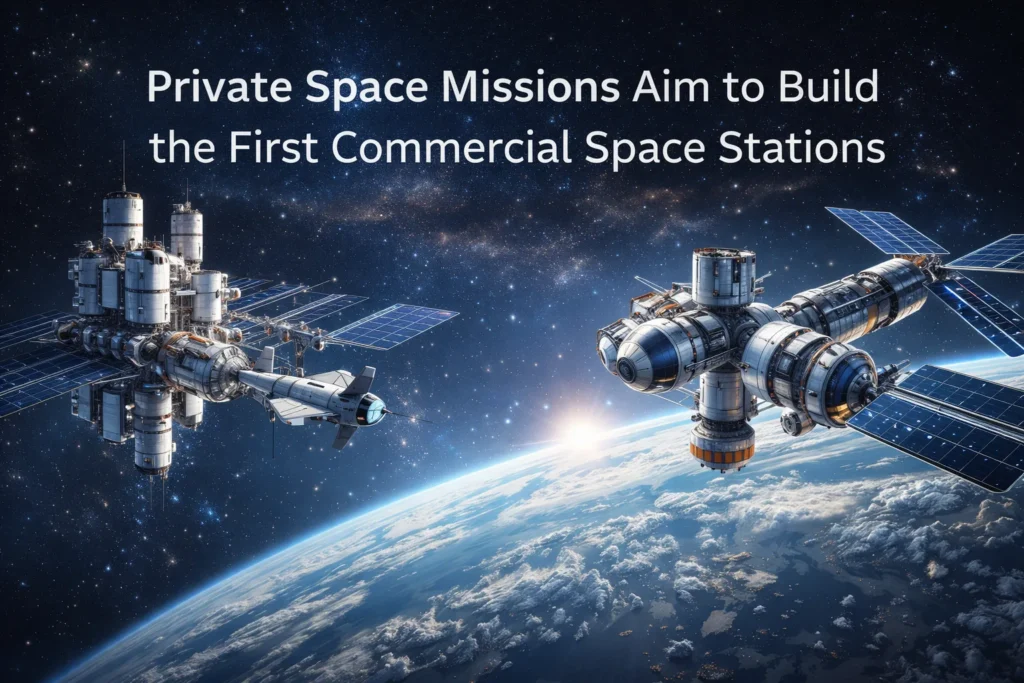

Imagine yourself standing in a quiet meadow on a warm summer evening. The sun has just dipped below the horizon, leaving behind a sky painted in shades of deep purple and orange. As the last light fades, the stars begin to appear, first just a few of the brightest ones, and then thousands upon thousands, scattered across the darkness like diamonds on black velvet. You look up, and you feel small, but you also feel connected to something vast and mysterious. For all of human history, that’s all the night sky has been: a beautiful, distant mystery to gaze at and wonder about.
But that is about to change forever.
Soon, if you know exactly where and when to look, you might just be able to spot a place where regular people are living, working, eating, sleeping, exercising, celebrating birthdays, and maybe even taking a vacation. It sounds like pure science fiction, the kind of thing you’d see in a movie like 2001: A Space Odyssey or Elysium or Interstellar. But this isn’t a movie trailer. This isn’t a concept artist’s dream. This is real. This is happening right now. Engineers are welding metal. Designers are sketching interiors. Business executives are calculating profit margins. Lawyers are writing contracts. This is the new space race, and it’s not between countries anymore. It’s between companies, and the prize is the biggest new market in human history: space itself.
For over twenty years, the International Space Station has been our only permanent home in the sky. Think of it as the world’s most amazing treehouse, a gigantic, government-funded, multinational project that required the cooperation of fifteen different countries working together for decades. Astronauts from the United States, Russia, Japan, Canada, and many European nations have lived there in a continuous rotation since the year 2000. That means there has been a human presence in space, without a single break, for over two decades. Think about that the next time you feel like you’ve had a long run of something. These men and women have conducted thousands of experiments, learned how to grow vegetables in zero gravity, studied the effects of long-term spaceflight on the human body, tested new technologies, and taught us more about what it takes to live beyond the safety of our planet than all the previous centuries of human history combined. The ISS is one of the greatest achievements of our species.
But that amazing treehouse is getting old. It’s like a beloved family cabin that has been through a hundred winters. The roof leaks. The plumbing is finicky. The wiring is outdated. The wood is starting to rot in places. You can keep fixing it, patching it, and replacing parts, but eventually, the cost of the repairs becomes more than the cabin is worth, and it’s just not safe to live in anymore. That’s exactly where we are with the ISS. It’s suffering from metal fatigue from the constant expansion and contraction as it moves from the blazing heat of the sun to the freezing cold of Earth’s shadow. There have been tiny, persistent air leaks that are hard to find and even harder to fix. The technology on board, while still functional, is from another era. It costs NASA alone about three to four billion dollars every single year just to keep it running. That’s a massive chunk of the space budget that could be used for other things, like building new rockets to go to the Moon or sending sophisticated robots to Mars.
So, after years of careful study and difficult discussions, the countries that run the ISS have made a decision. It’s time to let it go. The plan is to safely guide this massive structure, which is as long as a football field and weighs almost a million pounds, down into the Pacific Ocean. It will be aimed at a remote spot called Point Nemo, which is so far from any land that it’s officially known as the spacecraft cemetery. Dozens of old satellites and space stations have already been sent to their watery graves there. The ISS will join them around the year 2030. It will be a sad day, for sure, a day that marks the end of an incredible era. But it’s the right thing to do, and it’s also the beginning of something even more exciting.
For a long time, a big question hung in the air, unanswered and worrying. “What happens next?” “Do we just pack up our bags and abandon low-Earth orbit?” “Do we leave space to the robots and satellites?” The answer, which has become clearer and more thrilling with each passing year, is a loud, resounding, and enthusiastic “No way!” But the way we’re going back is fundamentally different. It’s not a sequel; it’s a whole new genre of movie. Instead of governments building the next treehouse with taxpayer money, they’re turning to the private sector. They’re turning to companies and saying, “The sky is no longer the limit. You build it, you own it, you operate it, you insure it, you market it, and we’ll be your best customer. We’ll rent lab space from you. We’ll buy tickets for our astronauts. We’ll help you succeed, because your success is the future of humanity in space.”
This is the story of that massive, world-changing shift. We are moving from a world of government-owned national laboratories to a future of privately-run commercial space stations. We are moving from a place that was only for highly-trained, government-selected astronauts who spent years preparing for their missions to a place that could be for university professors who want to run an experiment, for pharmaceutical companies that want to develop new drugs, for manufacturing startups that want to make things that can’t be made on Earth, for movie producers who want to film in zero gravity, for artists who want to create works inspired by the view, and maybe, just maybe, for you. This is the story of how space is going from a government program to a business, from a destination for a select few to a destination for many.
Part One: Why We Have to Move Out of the Old Neighborhood
Before we get too excited about the shiny new space malls and hotels, we need to have a proper conversation about the old neighborhood and why we have to move out. The International Space Station deserves our respect and gratitude. It’s a marvel of engineering, a testament to what humans can achieve when they work together across borders and cultures. It’s as long as a football field, has the living space of a six-bedroom house, and has been permanently occupied since before many of you reading this were born. That continuous human presence is an incredible achievement.
But as I said, the ISS is like that old car with five hundred thousand miles on it. You love that car. It got you to your first job, your first date, your cross-country road trip. It’s full of memories. But now the transmission is slipping, the check engine light is always on, strange noises are coming from the engine, and you’re finding rust in places you never expected. Sooner or later, the cost of the repairs exceeds the value of the car, and more importantly, it’s just not safe to drive on the highway anymore. You have to let it go.
The station is facing some serious structural issues that you can’t fix with duct tape and a good attitude. It’s suffering from metal fatigue. Every 90 minutes, the station goes from the blazing direct sunlight, where temperatures can reach 250 degrees Fahrenheit, to the cold darkness of Earth’s shadow, where temperatures plummet to minus 250 degrees. That’s a 500-degree temperature swing 16 times a day, every single day, for over 20 years. That constant expansion and contraction stresses every bolt, every seam, every piece of metal. It’s like bending a paper clip back and forth a thousand times. Eventually, it’s going to break.
There have been tiny, persistent air leaks that have puzzled engineers for years. They track them down, patch them up, and a new one appears somewhere else. It’s like trying to patch a balloon that’s slowly disintegrating. The station is also constantly being bombarded by tiny micrometeoroids and pieces of space debris. Most are smaller than a grain of sand, but at 17,500 miles per hour, even a grain of sand can do damage. The station’s shielding has taken hits, and while it’s held up so far, the risk only increases with time.
And then there’s the cost. We’re talking about three to four billion dollars a year just for NASA’s share. That’s a massive amount of money that could be used for other priorities. NASA has ambitious plans to go back to the Moon with the Artemis program, to build a space station called Gateway in lunar orbit, and eventually to send humans to Mars. That stuff isn’t cheap. By retiring the ISS and shifting to commercial stations, NASA can free up billions of dollars to focus on these deeper space exploration goals while still having a place in low-Earth orbit for research. It’s a smart financial move. It’s like selling the old fixer-upper house so you can afford to build your dream home.
The retirement plan is dramatic and carefully orchestrated. When the time comes, a team of Russian Progress spacecraft, which are essentially robotic space tugboats, will dock with the station. They’ll fire their engines at exactly the right time and for exactly the right duration to gently but firmly push the massive complex out of its stable orbit. The station will begin a slow, controlled descent. As it hits the upper atmosphere, the air resistance will start to tear it apart. The huge solar arrays will rip off first, then the trusses, then the modules. Most of it will burn up in a brilliant streak of fire across the sky, like a dozen shooting stars all at once. But some pieces, the densest parts, will survive the fiery re-entry and plunge into the ocean. They’ll land at Point Nemo, the most remote place on Earth, a spot in the southern Pacific Ocean that’s farther from any land than any other point on the planet. It’s the spacecraft cemetery, and it’s the final resting place for the greatest spaceship humanity has ever built.
But just because the old house is being torn down doesn’t mean we’re done with the neighborhood. The need for a place to do research in microgravity isn’t going away. It’s actually growing faster than ever. Scientists all over the world still need a place to figure out how to grow better protein crystals for designing new medicines. They need to understand how fire behaves without gravity, which is crucial for spacecraft safety. They need to study how fluids move in microgravity, which has applications from fuel systems to water purification. They need to understand how the human body adapts to long-duration spaceflight, which is essential for planning missions to Mars.
Plus, completely new ideas are emerging that weren’t even on the radar when the ISS was designed. Think about advanced manufacturing. On Earth, gravity is a real problem for certain processes. When you try to mix two liquids that don’t like to mix, like oil and water, gravity pulls the denser one down and they separate. In space, they can mix at the molecular level, creating new emulsions and alloys that are impossible on Earth. When you try to grow crystals, gravity causes imperfections. In space, you can grow perfect crystals. When you try to 3D print human tissue, gravity makes the soft structures sag and collapse. In space, you can print complex, layered tissues that hold their shape. This is called in-space manufacturing, and it could be a multi-trillion-dollar industry. It could revolutionize medicine, electronics, materials science, and more.
So, we need a new place. Not just a government lab, but a full-service business park in the sky. A place with different zones for different activities. A place with reliable power, high-speed internet, comfortable accommodations, and easy access. A place where companies can set up shop and focus on their work without having to worry about running the whole station themselves. We need space stations that are not just laboratories, but destinations. And that’s exactly what a new generation of private companies is building right now.
Part Two: Meet the New Space Landlords
So, who are these brave, visionary, and very well-funded people who are going to build our new homes in the sky? It’s not NASA. It’s not any government agency. It’s a bunch of private companies that are in a fierce, friendly, and incredibly exciting competition to be the first to open their doors for business. Think of them as landlords, but instead of renting you a one-bedroom apartment in the city, they’re renting you a fully-equipped laboratory module, a zero-gravity manufacturing facility, or a luxury suite with the best view in the solar system. Let’s take a deep, detailed dive into each of the main players and their ambitious, world-changing plans.
Axiom Space: The Clever Neighbors Who Are Adding a Wing to the Old House
First, there’s a company called Axiom Space, based in Houston, Texas, right in the heart of American spaceflight history. They are led by a team of people who have spent their entire careers in human spaceflight, including Michael Suffredini, who was the program manager for the International Space Station for a decade. If anyone knows how to build and run a space station, it’s these folks. They have a brilliantly simple and clever plan that minimizes risk and maximizes efficiency.
Instead of trying to build a whole new station from scratch and launch it all at once, which would be incredibly expensive and technically challenging, they’re going to start by attaching their own modules to the International Space Station itself. Imagine you live in an old house with your family. It’s a good house, but it’s getting run down. You have a plan to eventually move out and build your own place. But instead of waiting until you can afford to build the whole new house at once, you start by building a new wing onto the old house. You attach it, you connect it to the electricity and plumbing, and you start using it. It’s your space. Then, when the old house is finally condemned and ready to be torn down, you simply disconnect your wing, and voila, you have your own independent house. That’s exactly what Axiom is doing.
Their first module, which is already under construction in Italy by the same company that built many of the ISS modules, is called the Axiom Hab One. It’s scheduled to launch as early as 2026 on a SpaceX rocket. It will autonomously dock with the front end of the ISS, like adding a new car to a train. This module will provide crew quarters, life support, and power systems. It will be the foundation of their station.
Next, they’ll add a second module, the Axiom Hab Two, which will be for research and manufacturing. This is where companies can rent lab space to do their experiments. It will have standard laboratory racks that are compatible with the ones on the ISS, making it easy for researchers to transition their work.
Then comes the really cool part: they’ll add a third module called the Axiom Research and Manufacturing Facility, which will have even more lab space. And finally, they’ll add the Axiom Observatory, a module with a huge, 360-degree observation window. Imagine a room made almost entirely of glass, where you can float and watch the Earth drift by below. It will be the most incredible room with a view in the history of architecture.
While they’re attaching these modules, they’ll be using the ISS’s power, life support, and communication systems. They’re essentially piggybacking on the existing infrastructure, which saves them a fortune and allows them to start operating years sooner than if they had to build everything themselves. Then, when the ISS is finally retired around 2030, Axiom will simply detach its modules. They’ll become a free-flying, independent space station called the Axiom Commercial Space Station. It’s like moving out of your parents’ house but taking your entire bedroom, living room, and kitchen with you. It’s brilliant.
Axiom has already signed contracts with NASA to allow private astronauts to visit the ISS using Axiom’s missions. They’ve already flown several missions with private citizens, including astronauts from countries that are just starting their space programs. They’re building the experience and the customer base right now. They’re not waiting for the station to be finished. They’re already in the space tourism and private astronaut mission business. By the time their station is ready, they’ll have a proven track record and a list of customers waiting to go.
Orbital Reef: The Mixed-Use Business Park in the Sky
Next, there’s a powerful team-up between two of the biggest names in the new space economy: Jeff Bezos’s rocket company, Blue Origin, and a company called Sierra Space. They’re working together on a station they’ve named Orbital Reef. The name is perfect. A reef in the ocean is a vibrant, bustling ecosystem, full of different creatures living and working together. That’s exactly what they want to build in space.
They call Orbital Reef a “mixed-use business park” in orbit, and that’s the perfect way to picture it. They aren’t just building one thing; they’re building a destination, a hub, a central gathering place for everyone who wants to do something in low-Earth orbit. It will have different districts for different activities, just like a city on Earth has a financial district, a research district, and an entertainment district.
The design of Orbital Reef is incredibly cool and innovative. The core of the station will be built by Blue Origin, using their expertise in spacecraft and systems. But the most eye-catching part of the design comes from Sierra Space. They are building something called the LIFE Habitat, which stands for Large Integrated Flexible Environment. It’s an expandable, or inflatable, module.
Think of it like a camping tent, but for space. It launches in a small, compact package, folded up inside the nose cone of a rocket. It’s small enough to fit. Once it’s in orbit and attached to the rest of the station, it inflates with air, expanding to the size of a large, two-story house. We’re talking about a module that’s as big as a school bus, with a huge, open interior volume. This gives astronauts, scientists, and tourists way more room to move around than they’ve ever had before. Imagine floating from one end of this huge, open space to the other. It’s like going from a cramped studio apartment to a spacious, airy loft.
Sierra Space has already done incredibly rigorous testing of this technology. They built full-scale prototypes and then blew them up on purpose. They kept adding air pressure until the module burst, just to see exactly how strong it is and where the weak points are. It’s incredibly strong, far stronger than they need it to be for normal operations. It’s designed to be safe, reliable, and comfortable.
Orbital Reef isn’t just about the physical space. It’s about creating a whole ecosystem. They’re planning to have regular transportation services provided by Blue Origin’s New Glenn rocket and Sierra Space’s Dream Chaser spaceplane. The Dream Chaser is particularly cool. It looks like a mini-space shuttle. It can carry cargo and crew and land on a regular runway, just like an airplane. This means you could fly up to the station in a rocket and fly back to Earth in a spaceplane, landing at a spaceport. It’s going to make space travel feel much more routine and accessible.
Their goal is to make Orbital Reef the go-to destination, the central hub for the new space economy. They want to be the landlord for anyone who wants to do research, manufacturing, tourism, or even media and entertainment in space. They’re building a place where you can not only work but also live, with comfortable crew quarters, common areas, and that amazing view. They’re planning to have it operational by the late 2020s.
Northrop Grumman: The Veterans Building on What Works
Another major player is Northrop Grumman. They are the veterans of the space industry, the seasoned professionals who have been building critical hardware for NASA for decades. They’ve built major components of the ISS, including the modules where astronauts sleep and store supplies. Their approach to building a new space station is all about simplicity, reliability, and using what they know works. They’re not trying to reinvent the wheel. They’re taking proven technology and evolving it into the next generation.
Their proposed station is based on the designs of their Cygnus spacecraft. If you follow space news, you’ve probably heard of Cygnus. It’s a robotic cargo ship that regularly makes deliveries to the ISS, bringing up food, water, experiments, and supplies. It’s a workhorse. It’s reliable. It’s proven. Northrop Grumman’s plan is to take that same basic design and turn it into a human-rated habitat.
Their station would start with a core module, which is like a smaller, more modern version of the nodes on the ISS. Nodes are the connecting rooms that link different modules together. They’re the hallways and gathering places of the station. This core module would have docking ports for other modules, as well as for visiting spacecraft like SpaceX’s Dragon or Boeing’s Starliner.
Then, they would attach a large habitation module. For this, they’re partnering with a company called Dynetics, which is building a large inflatable habitat similar in concept to Sierra Space’s LIFE habitat, but with its own unique design. This would provide the spacious living and working areas that astronauts need for long-duration missions.
The beauty of Northrop Grumman’s approach is that it’s low-risk. They’re not inventing new technologies that might fail. They’re using systems that have already flown dozens of times and have a proven track record of success. Astronauts are already familiar with Cygnus and with Northrop Grumman’s systems. It’s a smart, no-nonsense, “if it ain’t broke, don’t fix it” approach. They want to create a reliable, continuous human presence in space, picking up right where the ISS leaves off, with technology that’s already trusted and understood.
They’re also thinking about sustainability. Their station is designed to be serviced and upgraded over time. Modules can be replaced as they age. New capabilities can be added. It’s not a one-and-done project; it’s a platform that can evolve for decades. This is exactly the kind of long-term thinking that’s needed to build a lasting infrastructure in space.
Starlab: The International Team with a Clear Focus
There’s also a team called Starlab, which is led by a company named Voyager Space, with major partners including Airbus, the European aerospace giant, and Lockheed Martin. This is an international team, which makes sense because space has always been an international endeavor, and they expect to have customers from all over the world.
Their station, also called Starlab, is designed to be a dedicated research and manufacturing platform. While other stations are focusing heavily on tourism, Starlab’s primary mission is to provide a continuous, world-class laboratory in space for scientists and companies. They want to be the premier destination for serious research.
The station design is based on a single, large module that’s launched on a single rocket. This simplifies the assembly process. You don’t have to launch multiple pieces and connect them in orbit. One launch, one station, ready to go. It will have a large inflatable habitat module for living space and a rigid module for laboratories and operations.
Having Airbus as a partner is a huge advantage. Airbus brings decades of experience building modules for the ISS and operating the European part of the station. They have strong relationships with the European Space Agency and with research institutions across Europe. This gives Starlab a clear path to serving the international market. They’re not just building an American station; they’re building a global station.
They’ve already signed agreements with several research organizations and companies who are interested in using their facilities. They’re focusing on building a customer base before the station even launches. They understand that the key to success in this new market is not just building a great station, but also building a great business. They need to understand what researchers need and provide it in a way that’s easy, affordable, and reliable.
Vast: The Bold Startup Thinking Bigger and Farther
Finally, there’s a newer, incredibly ambitious company called Vast. They’re based in California and they’re taking a “move fast and break things” Silicon Valley approach to space stations. They’re not content to just build a station in low-Earth orbit. They’re thinking about the far future, and they’re moving at a breathtaking pace.
Their first project is a small, one-module station called Haven-1. And here’s the amazing part: they plan to launch it as soon as August 2025. That’s next year. That’s incredibly soon. We’re talking about a privately-built, commercially-operated space station launching within 12 to 18 months. It will be launched on a SpaceX Falcon 9 rocket, and it’s designed to be a destination for short-duration missions.
They’ve already booked a mission with SpaceX to send four private astronauts to Haven-1 for up to 30 days. These won’t be government astronauts. They’ll be private individuals, researchers, or maybe even astronauts from countries without their own space programs. It’s a proof of concept, a way to demonstrate that they can build and operate a human habitat in space quickly and efficiently.
But Haven-1 is just the beginning. It’s a test flight, a prototype. Their long-term goal is much, much bigger. While all the other companies are focused on building stations in low-Earth orbit, close to home, Vast wants to build a station that will eventually be a destination in itself, far from Earth. Their ultimate goal? To be the first company to put a commercial space station in orbit around the Moon.
Think about that for a second. They want to build a permanent human outpost in lunar orbit. This station would be a vital pit stop, a fueling station, a transfer hub, and a base of operations for missions going to and from the lunar surface. Landers could launch from the Moon, dock with the station, and transfer crew, cargo, and samples. Astronauts could live and work there for months at a time, preparing for the next phase of their mission. It would be the first real “deep space” port, a home away from home as we begin to explore our celestial neighbor.
They’re playing the long game. They’re not just thinking about the next ten years. They’re thinking about the next fifty years. They see a future where humanity has a permanent presence not just in low-Earth orbit, but throughout the inner solar system. And they want to be the ones building the infrastructure that makes that future possible. It’s a breathtakingly bold vision, and they’re moving faster than almost anyone thought possible to make it happen.
Part Three: A Detailed Tour of Life Inside a Space Business Park
Okay, so we know who’s building them. We know their plans and their timelines. But what would it actually be like to live inside one of these new space stations? Forget everything you’ve seen in pictures and videos of the International Space Station. The ISS is an engineering marvel, a testament to human ingenuity, but it’s also a cramped, cluttered, and frankly, kind of messy place. It’s covered in wires, cables, duct tape, and scientific equipment. It was built for function, not for comfort. It was designed by engineers, not interior designers.
These new stations are being designed with the human experience in mind from the very beginning. They’re being built by companies that want to sell tickets, attract customers, and create a destination that people will want to return to. They know that if you’re going to charge someone millions of dollars for a week-long vacation, or if you’re going to convince a pharmaceutical company to rent lab space for years, you can’t just stick them in a metal closet with a sleeping bag velcroed to the wall. You have to create an environment that is not only functional but also comfortable, inspiring, and even luxurious.
Let’s start with the view. This is the number one reason anyone would want to go to space. The ISS has small, porthole-like windows that are mostly used for photography and observations. They’re not designed for just hanging out and staring. These new stations are planning to have massive, panoramic windows. We’re talking about giant domes, curved glass panels, and entire modules dedicated to observation.
Imagine a common area, a sort of space lounge, with a huge, floor-to-ceiling window that curves up and over your head. You can float in the middle of this room, surrounded by glass, and watch the Earth slowly drift by below. You’d see the entire continent of Africa, the deep blue of the Pacific Ocean, the swirling white clouds of a hurricane, the city lights of Europe at night, the vast green of the Amazon rainforest. You’d see 16 sunrises and 16 sunsets every single day. It would be a view that changes your perspective on everything. Every astronaut who has ever seen Earth from space talks about the “overview effect,” a profound shift in awareness that comes from seeing our planet as a single, fragile, beautiful blue marble floating in the blackness of space. These new stations are designed to give that experience to as many people as possible.
The interior design will be totally different from the ISS. Think of it like comparing a 1990s computer lab, with its bulky CRT monitors, beige boxes, and tangled cables, to the latest Apple Store, which is all clean lines, open space, beautiful lighting, and minimalist design. One is purely functional, the other is functional and cool. The modules will be much more spacious, with higher ceilings and open floor plans. The lighting will be carefully designed, with LEDs that can change color and intensity to simulate day and night, helping to regulate your body’s circadian rhythm and improve sleep. The materials will be softer, warmer, and more inviting. There will be plants growing on the walls, not just for food but for the psychological benefit of having living things around.
The private quarters will actually be private. On the ISS, astronaut sleeping quarters are about the size of a phone booth. You have a sleeping bag attached to the wall, a laptop, and maybe a few personal items velcroed to the panels. It’s cramped. On these new stations, crew quarters will be like small but comfortable hotel rooms. You’ll have a bed that’s actually a bed, with a mattress and a sleeping bag you can get into. You’ll have a desk, a window of your own, storage for your personal items, and maybe even a small entertainment system. It will be a place you can retreat to for some quiet time, a place that feels like yours.
The common areas will be designed for socializing and relaxation. There will be a galley, or kitchen, where you can prepare meals and gather with others. There will be a dining area with a table where you can sit and eat together, using magnets or velcro to keep your plates from floating away. There will be a lounge area with soft seating, big windows, and maybe even a screen where you can watch movies or video call your family back on Earth. There will be exercise areas with treadmills, stationary bikes, and resistance machines, because you absolutely have to exercise for two hours every day to keep your muscles and bones from deteriorating.
Daily life will still be a challenge, of course. Living in zero gravity is weird and takes some getting used to. You’ll have to learn how to eat without making a mess, using special containers and utensils. You’ll have to learn how to use a zero-gravity toilet, which uses airflow instead of water to move waste. You’ll have to be careful not to let your water bottle float away. You’ll have to get used to the fact that there is no “up” or “down,” and you can float in any orientation. But after a day or two, your brain starts to adapt, and it begins to feel almost normal.
The food will be a huge upgrade. On the ISS, astronauts mostly eat pre-packaged, freeze-dried, or thermostabilized food. It’s nutritious, but it’s not exactly gourmet. On a commercial station, with regular supply missions and a focus on customer experience, the food will be much better. Imagine getting a delivery of fresh fruit, vegetables, and even pre-prepared meals from famous chefs. There might be a small galley where you can heat up real food, or even do some simple cooking. Companies are already experimenting with growing fresh vegetables in space, and salads grown on the station could become a regular part of the menu. It’s a whole new level of living in space, moving from pure survival to actual comfort and enjoyment.
And then there are the spacewalks. For an extra fee, of course. Imagine putting on a spacesuit, stepping into an airlock, and then floating out into the vastness of space. You’d be attached to the station by a tether, but you’d be completely alone, floating in the void, with only your suit protecting you. You’d look down and see Earth spinning beneath you. You’d look up and see the blackness of space and the stars. It would be the ultimate adventure, the most incredible experience a human being can have. These new stations will make that possible for more people than just professional astronauts.
Part Four: The Ultimate Bucket List Trip: Space Tourism for Everyone (Eventually)
Let’s be completely honest with each other. The reason most of us are excited about all of this, the reason we’re reading this long article, is the idea of going to space ourselves. It’s the dream of space tourism. For decades, that dream has been reserved for a tiny, ultra-elite group of people. You had to be a military test pilot with perfect vision and nerves of steel. You had to be a scientist with a PhD in a relevant field. You had to be in absolutely peak physical condition. You had to be an astronaut, selected by a government after years of rigorous training.
But these new stations are fundamentally changing who gets to go to space. They are building hotels, and hotels need guests. They are building destinations, and destinations need visitors. They want to sell tickets. It’s that simple.
So, who is the first space tourist going to be? It won’t be an Olympic athlete. It won’t be a Navy SEAL. These companies are designing their trips for “normal” people. Now, “normal” is a relative term, and “normal” people will still need to be in reasonably good health. You probably shouldn’t have any serious heart conditions or uncontrolled high blood pressure. But you won’t need to be a super-athlete. You’ll just need to be healthy enough to handle the stresses of launch and the adaptation to weightlessness.
You will definitely need to go through some training. This isn’t like boarding a 747. You can’t just show up at the spaceport with your suitcase and hop on. You’ll probably spend a few weeks at a dedicated training facility. You’ll train in a centrifuge to get used to the G-forces of launch. You’ll practice emergency procedures, learning what to do if the alarm sounds. You’ll learn how to move around in zero gravity without crashing into things or getting tangled in your own limbs. You’ll learn how to eat, drink, and use the bathroom in space. You’ll be trained on all the systems you might need to use. But you won’t need to know how to fly the spaceship or fix a broken air filter. You’ll be a passenger, not a crew member. There will be professional astronauts or trained crew members on board to handle all the technical stuff.
The experience itself will be utterly, completely, and permanently life-changing. It will be the ultimate bucket list item, the thing you tell your grandchildren about for the rest of your life. Just picture it, step by step.
You arrive at the launch site, probably somewhere like Cape Canaveral or a new commercial spaceport. You go through final medical checks. You put on a sleek, modern spacesuit, not the bulky white ones from the old days, but something more like a stylish flight suit. You walk out to the launch pad with your fellow passengers. You see the rocket, towering above you, gleaming in the sun. It’s real. It’s happening.
You climb into the capsule and strap into your seat. There’s a countdown. Your heart is pounding. Then you hear the engines ignite, a deep, rumbling roar that you feel in your chest. The rocket lifts off, slowly at first, then faster and faster. You’re pushed back into your seat with three times the force of gravity. It feels like a giant is sitting on your chest. You can barely lift your arms. You watch through a small window as the sky turns from blue to deep purple to black.
Then, suddenly, the engines cut off. You’re weightless. You feel your stomach do a little flip. You unbuckle your harness and float out of your seat. You drift over to the window, and there it is. The Earth. Not in a photo, not on a screen, but with your own two eyes. You see the thin, impossibly fragile blue line of the atmosphere, the only thing protecting all of humanity from the cold, black void of space. You see the curve of the planet. You see your home continent, your country, your city, from an angle that almost no human in history has ever seen. You are an astronaut.
You spend the next few days or weeks on the station. You float through the modules. You try to do flips and somersaults in the big common area. You eat meals that float in front of you. You stare out the giant window for hours, watching the Earth drift by. You call your family on a video link and show them what it’s like. You make friends with your fellow travelers. You experience 16 sunrises and 16 sunsets every day. You feel the overview effect for yourself, that profound shift in perspective that makes you realize how precious and fragile our planet really is.
Then, all too soon, it’s time to go home. You climb back into the capsule. You say goodbye to your new friends in space. The capsule undocks, fires its engines, and begins its descent. You feel the G-forces again as you hit the atmosphere, but this time they’re pushing you forward. You see the plasma, the superheated air, glowing orange and red outside your window. The parachutes deploy with a jolt, and you gently splash down in the ocean. You’re back on Earth, but you’re not the same person who left. You’ve seen the world from above. You’ve touched the stars.
How much is this going to cost? Right now, the price tag is astronomical, pun intended. We’re talking tens of millions of dollars for a trip. It is definitely for the ultra-wealthy, for celebrities, for the first wave of adventure tourists who have more money than they know what to do with. Think of it like the early days of transatlantic ocean liners, or the first commercial airline flights. Only the rich and famous could afford to cross the ocean. Now, millions of people fly every year for a few hundred dollars.
The same thing could happen with space travel. The key is reusability. SpaceX has already shown that you can land a rocket and fly it again. Blue Origin is doing the same with their New Shepard rocket. As this technology becomes more common and reliable, and as more companies compete for your business, the price of a ticket will start to come down. It might take 20 years. It might take 30 years. But there is a very real, very plausible path to a future where a trip to a space hotel for a week is not just a fantasy for the ultra-rich, but a once-in-a-lifetime vacation that a regular middle-class family could save up for and afford. It might be like buying a luxury car or taking a safari in Africa. It’s expensive, but it’s achievable. It’s the democratization of space, and it’s coming.
Part Five: The Zero-Gravity Factory: Making Stuff You Can’t Make on Earth
Space tourism is the fun, exciting, headline-grabbing part of the story. It’s what gets the general public interested and excited. But the real money, the thing that will actually drive the long-term, sustainable economic growth of space, might be something else entirely: advanced manufacturing. It sounds like something from a futuristic novel, but space could become the next great factory floor, and the products made there could revolutionize life on Earth.
Why would anyone want to build a factory in such a difficult, expensive, and dangerous place? Because of microgravity. When you remove gravity from the equation, the fundamental rules of physics change for certain processes. Things that are impossible, difficult, inefficient, or imperfect on Earth become possible, easy, and perfect in space. It opens up a whole new world of material science.
Let’s start with medicine. This is probably the most promising and immediately valuable area. Our bodies are made of proteins, and these proteins have incredibly complex three-dimensional shapes. To understand how a protein works, and to design drugs that can interact with it, scientists need to know its exact shape. The best way to determine that shape is to grow the protein into a large, perfect crystal and then use a technique called X-ray crystallography to map its structure.
But on Earth, gravity messes this up. As the protein crystal grows in a solution, gravity causes convection currents. Warmer, less dense liquid rises, and cooler, denser liquid sinks. These currents jostle the growing crystal and create imperfections. Gravity also causes the crystal to settle at the bottom of the container, which can distort its shape. It’s like trying to build a perfect house of cards in a windstorm.
In microgravity, those forces disappear. There are no convection currents. The crystal floats freely in the solution. It can grow slowly, evenly, and perfectly. The resulting crystals are much larger and much more perfect than anything that can be grown on Earth. Scientists can then use these perfect crystals to determine the exact atomic structure of the protein. And once they know the exact shape, they can design new drug molecules that fit perfectly into that protein, like a key in a lock.
This could lead to breakthroughs in treating some of the most challenging diseases. Imagine a new drug for cancer that targets a specific protein only found on cancer cells, leaving healthy cells unharmed. Imagine a drug for Alzheimer’s that prevents the formation of the plaques that destroy brain cells. Imagine more effective, more targeted, and safer medicines for everything from arthritis to HIV. Several major pharmaceutical companies, including Merck and Bristol-Myers Squibb, have already conducted experiments on the ISS and are very interested in renting space on these new commercial stations to scale up their operations. This isn’t science fiction. It’s already happening.
Then there’s fiber optics. The entire internet, the backbone of our modern world, the thing that allows you to read this article right now, relies on fiber optic cables. These cables are thin strands of ultra-pure glass that carry data as pulses of light. They are made on Earth by heating a large glass preform and drawing it out into a long, thin fiber. But gravity causes tiny, microscopic imperfections and density variations in the glass as it’s drawn. These imperfections scatter the light, weakening the signal over long distances. That’s why fiber optic cables need repeaters, amplifiers, every few dozen miles to boost the signal.
In microgravity, you can draw fiber optic cables that are theoretically perfect. Without gravity pulling on the molten glass, it cools evenly and consistently, with no density variations or impurities. A cable made in space could carry a signal ten, or even a hundred, times farther than the best cable made on Earth without needing a signal booster. That would revolutionize global communications. Imagine internet speeds a thousand times faster than what we have now. Imagine being able to stream ultra-high-definition video from anywhere on the planet. Imagine connecting the world in ways we can only dream of today. That’s the potential of space-made fiber optics.
Another exciting area is the development of new alloys and materials. On Earth, when you try to mix two metals that don’t like to mix, like oil and water, gravity pulls the denser one down and they separate. Think of trying to mix lead and aluminum. They just won’t stay mixed. In space, without gravity to pull them apart, you can create perfectly uniform alloys of metals that are immiscible on Earth. These new materials could have incredible properties: super strength, ultra-light weight, high heat resistance, or unique electrical characteristics. They could be used to build better engines, lighter aircraft, more efficient electronics, and stronger building materials.
And perhaps the most futuristic and awe-inspiring idea of all is bioprinting. Scientists are already working on 3D printing with living cells to create human tissue. The goal, the holy grail, is to one day print functional, transplantable human organs. Imagine a future where there is no waiting list for a kidney or a liver. You just print a new one, made from your own cells, so there’s no risk of rejection.
But on Earth, printing something soft and squishy, like a layer of human cells, is incredibly difficult. Gravity makes the structure sag and collapse before it has a chance to set. It’s like trying to 3D print with Jell-O. You can only print very simple, flat structures.
In space, you can print complex, three-dimensional structures that hold their shape perfectly. The cells don’t sag, so you can build up layers and create intricate shapes with internal blood vessels and structures. We are a long, long way from printing a working human heart. The challenges are immense. But the first steps printing simple tissues like skin, cartilage, or miniature organs for drug testing could happen on these commercial stations within the next decade. These “organoids” would be incredibly valuable for medical research, allowing scientists to test new drugs on living human tissue without risking human lives. It’s the beginning of a revolution in medicine.
Part Six: The Dark Side of the Dream: Space Junk and Staying Safe
Now we have to talk about the scary part. The elephant in the room. The thing that keeps space engineers awake at night. All of this amazing progress, this bustling new neighborhood in the sky, comes with a pretty serious and growing problem: space junk. For over 60 years, we’ve been treating space like an infinite garbage dump. We’ve launched thousands of rockets and satellites and haven’t worried about the trash. Now, there are millions of pieces of debris zipping around Earth at insane speeds.
It’s not just old satellites, though there are hundreds of those. It’s spent rocket stages that have been left in orbit. It’s the remains of rockets and satellites that have exploded, either deliberately or accidentally. It’s bolts, tools, and cameras dropped by astronauts during spacewalks. It’s flecks of paint that have chipped off of spacecraft. It’s even a spatula that an astronaut lost once. And all of it, from a defunct school-bus-sized satellite to a tiny fleck of paint smaller than a dime, is moving at orbital velocity, roughly 17,500 miles per hour.
At that speed, a fleck of paint hits with the force of a bowling ball. A screwdriver hits with the force of a hand grenade. A small piece of debris the size of a marble carries the energy of a large truck crashing into a wall at 60 miles per hour. For a space station, this is an existential threat. A collision with a piece of debris, even a small one, could puncture a module, causing a catastrophic and rapid loss of air pressure. It could damage critical systems like power, communications, or life support. It could kill everyone on board.
The ISS has to deal with this threat all the time. It has shielding to protect against small impacts, but for larger pieces, it has to move. The station performs “debris avoidance maneuvers” fairly regularly, firing its engines to shift its orbit slightly to get out of the way of incoming junk. It’s like playing a high-speed, high-stakes game of dodgeball, but the balls are invisible, you can’t hear them coming, and getting hit means certain death.
Private space stations will have to deal with this same danger. They’ll be built in the same busy orbits where all this junk is concentrated, the orbits that are most useful for Earth observation, communication, and research. So, how will they stay safe?
First, they will have to be built with much better shielding than the ISS. Engineers are developing new, lightweight, multi-layer shielding materials that can absorb the energy of a high-speed impact. Think of it like a bulletproof vest for the whole station. The outer layer might be a thin sheet of metal that breaks up the debris, and then multiple layers of ceramic or Kevlar-like fabric that catch the fragments.
Second, they will have incredibly sophisticated tracking systems. The US Space Force and other organizations track hundreds of thousands of pieces of debris, but there are millions more that are too small to track. The stations will need their own sensors, probably radar and optical systems, to watch for incoming threats. They need to know where every piece of trackable debris is at all times, and they need to be able to predict potential collisions.
Third, and this is crucial, they need to be able to move. The stations will have powerful propulsion systems, probably electric thrusters or chemical engines, that can quickly and autonomously move the entire station out of the way of a potential threat. This needs to be fast, reliable, and automated, because sometimes there might be only a few hours’ or even minutes’ warning.
This is actually one area where private companies might have a significant advantage over a government-run program. They have a huge, direct financial incentive to keep their stations safe. If a tourist gets hurt, if a valuable manufacturing experiment is destroyed, if the station is damaged and can’t operate, their business is over. They can’t afford to take risks. They will invest in the absolute best protection technology because their profits, their reputations, and their customers’ lives depend on it.
Furthermore, this growing problem is creating a whole new industry: space debris removal. New companies are developing innovative technologies to clean up the junk. We’re talking about spacecraft that use large nets to capture dead satellites, or harpoons to spear larger pieces of debris, or robotic arms to grab and de-orbit junk. There are concepts for using lasers to gently nudge debris into a lower orbit where it will burn up in the atmosphere. There are ideas for magnetic tugs that can grab defunct satellites. This is becoming a serious business, and it will be essential for keeping the space environment safe for everyone.
Keeping space clean isn’t just an environmental issue anymore. It’s not just about being a good steward of the cosmos. It’s a fundamental, non-negotiable requirement for doing business up there. A busy, safe, thriving neighborhood requires everyone to take out the trash. The companies building these stations are acutely aware of this, and they are working on solutions. The future of the space economy depends on it.
Part Seven: A Stepping Stone to the Stars
These new commercial space stations are not the final goal of human spaceflight. They are not the destination. They are a step. An incredibly important, absolutely essential step. Think of them as the first highway rest stops on a long journey. Or the first frontier towns in the American West. They are the places where we learn how to live, work, and thrive in a new and challenging environment before we push farther into the unknown.
NASA’s big, bold, exciting goal is to go back to the Moon. Not just for a quick visit this time, not just to plant a flag and take some pictures, but to stay. They have a program called Artemis, which aims to land the first woman and the first person of color on the lunar surface by the middle of this decade. But that’s just the beginning. The long-term goal is to establish a sustainable, long-term human presence on and around the Moon. They want to build a base, a lunar outpost, where astronauts can live and work for months at a time, conducting science, testing technologies, and preparing for the next giant leap.
And after the Moon, the ultimate goal for many, the dream that has inspired generations, is Mars. Sending humans to the Red Planet is the hardest thing we’ve ever attempted. It’s a journey that will take months just to get there. The astronauts will be millions of miles from Earth, with no possibility of resupply or rescue. They’ll have to be completely self-sufficient for years. To do any of this, we need to test the technologies and systems that will keep astronauts alive for that long, in that harsh environment, so far from home.
These new commercial stations in low-Earth orbit are the perfect testing ground. They are close to home, only a few hundred miles up. If something goes wrong, if a system fails, if someone gets sick, help is not too far away. But they are still in the harsh environment of space. They still have to deal with microgravity, radiation, vacuum, and extreme temperatures. They are the ideal place to prove out the technologies we’ll need for the Moon and Mars.
They can be used to test new, more reliable, and more efficient life support systems. The current systems on the ISS still rely on regular resupply missions to bring up water and oxygen. For a Mars mission, you need a closed-loop system that recycles almost everything. You need to recover water from urine and sweat. You need to generate oxygen from carbon dioxide. You need to manage waste. These new stations can be used to test and refine these systems for years, making sure they are reliable and safe before they are sent on a multi-year mission to Mars.
They can be used to test new ways of growing food in space. Imagine a Mars mission with a greenhouse where astronauts can grow fresh vegetables, not just for nutrition but for the psychological benefit of having living plants and fresh food. These stations can be used to experiment with different crops, different hydroponic and aeroponic systems, and different lighting regimes. They can figure out how to maximize food production in a minimal amount of space.
They can be used to study, in even greater detail than the ISS allowed, how the human body handles long-duration spaceflight. We know about bone loss and muscle atrophy. We know about fluid shifts and vision problems. But there’s still so much we don’t understand about the long-term effects of radiation, the psychological effects of isolation and confinement, and how to keep astronauts healthy on a three-year round trip to Mars. These stations will be living laboratories for human physiology and psychology.
They will also serve as training grounds. The astronauts who will one day walk on the Moon or be the first humans to set foot on Mars might train on a commercial station first. They will live in the same kind of confined, dangerous environment. They will practice their spacewalks. They will learn to work as a team under the constant stress of being in a place where one small mistake can be fatal. They will learn to deal with emergencies and equipment failures. They will get a taste of what life will be like on a deep space mission, but with the safety net of being close to Earth.
And one day, these stations could become true gateways, the final departure points for voyages into the deep solar system. Imagine a massive interplanetary spaceship, built to take a crew to Mars. Instead of launching it all from Earth, which would be incredibly difficult and expensive because of the strong gravity, imagine building it in orbit, piece by piece, at a commercial station. You launch the components separately and assemble them at the station, like building a ship in a dry dock. The crew would launch from Earth in a small capsule, meet the ship at the station, and spend their last few days in a relatively spacious environment, doing final checks, loading supplies, and mentally preparing for the long journey ahead. The station becomes the last outpost of humanity, the final stop before the void.
Vast’s plan for a station in lunar orbit is exactly this vision. They want to build a permanent human outpost that will orbit the Moon. This station, which they’re calling a “deep space habitat,” would be a vital pit stop for missions going to and from the lunar surface. Landers could launch from the Moon, dock with the station, and transfer crew, cargo, and scientific samples. Astronauts could live and work there for months, using it as a base to explore the lunar surface and prepare for the next phase of their mission. It would be the first real “deep space” port, a home away from home as we begin to explore our celestial neighbor. It’s a stepping stone to Mars, and it’s being built by a private company.
Part Eight: The Ripple Effect on Earth: What This Means for You and Me
It’s very easy to look at all of this the rockets, the billionaires, the plans for space hotels and lunar bases and think, “This is cool and all, but what does it have to do with my life? I’m never going to be able to afford a ticket. I’m not a scientist. How does this affect me?” It’s a fair question, and it deserves a thoughtful answer. History shows us, again and again, that when humanity pushes into new frontiers, the benefits eventually, inevitably, ripple back to everyone.
Think about the great age of exploration, when European ships set sail across the oceans. The immediate goal was trade, spices, gold, and glory for the few. But the long-term result was the global economy we have today. The exchange of goods, ideas, plants, animals, and cultures transformed the entire world. Think about the exploration of the polar regions. The immediate goal was adventure and national pride. But the long-term result was new understanding of weather patterns, ocean currents, magnetism, and geology that benefits us all.
The same thing will happen with commercial space. The research done on these stations will directly lead to new products, new materials, and new medicines that will improve life on Earth for everyone.
Those perfect protein crystals grown in space could lead to a new drug that cures a disease affecting millions of people. That drug will be available on Earth. The super-strong, ultra-light alloys developed in microgravity could be used to build lighter, more fuel-efficient cars and airplanes, reducing our carbon footprint. They could be used to build safer bridges and taller skyscrapers. The perfect fiber optic cables made in space could make our internet a thousand times faster, enabling new technologies we can’t even imagine yet. The research on growing food in space could lead to new agricultural techniques that help us grow more food with less water and fewer chemicals here on Earth, helping to feed a growing global population.
It’s not just about the direct products. It’s about the innovation that comes from tackling incredibly difficult challenges. The Apollo program gave us countless spin-off technologies, from cordless power tools to advanced insulation to medical monitoring devices. The commercial space industry will do the same, but on a much larger scale. The need for better, more efficient, more reliable systems for living in space will drive innovation in energy storage, water purification, waste management, robotics, artificial intelligence, and materials science. These innovations will find their way into our homes, our hospitals, our factories, and our daily lives.
And it’s going to create a massive number of new jobs. This is one of the most important and overlooked aspects of the new space economy. We’re not just talking about rocket scientists and aerospace engineers, though we’ll need plenty of them. We’re talking about a whole new ecosystem of jobs that don’t even exist yet.
We’re going to need chefs who can figure out how to cook for a zero-gravity hotel, creating meals that taste good, are nutritious, and don’t float away in a cloud of crumbs. We’re going to need nutritionists who understand how the human body’s dietary needs change in microgravity.
We’re going to need plumbers who can fix a toilet on a spaceship. Not a regular toilet, but a complex, zero-gravity, vacuum-based system. We’re going to need electricians who can work on a station’s power grid, and mechanics who can maintain the exercise equipment and life support systems.
We’re going to need architects and interior designers who specialize in designing for three dimensions, for spaces where there is no up or down. How do you design a comfortable living space when the floor, walls, and ceiling are all the same? How do you create a sense of privacy and personal space in a module where you can float anywhere?
We’re going to need tour guides who can lead groups of tourists on their first spacewalk, keeping them safe while helping them have the experience of a lifetime. We’re going to need doctors who specialize in space medicine, who understand how the body adapts to zero gravity and how to treat medical emergencies far from an Earth hospital. We’re going to need physical therapists who can help people readjust to Earth’s gravity after a long stay in space, retraining their muscles and balance.
We’re going to need lawyers who specialize in “space law.” Seriously. Who owns the intellectual property for a drug developed on a space station owned by one company, built by another, and used by researchers from a third? What happens if a tourist gets hurt on a spacewalk? Who is liable? What are the laws? These are real questions that need real answers.
We’re going to need marketers to sell tickets, public relations people to manage the image of the stations, customer service representatives to help customers, and travel agents who specialize in space vacations. We’re going to need teachers to develop educational programs, and artists to create works inspired by the experience.
This new space economy isn’t just a fantasy. It’s not just a dream. It’s real, and it’s coming. Respected financial institutions like Goldman Sachs, Morgan Stanley, and UBS are already investing heavily in the space sector. They’ve published detailed reports predicting that the space economy could be worth hundreds of billions, or even trillions, of dollars in the coming decades. They see the potential, and they’re putting their money where their mouths are.
And while the big companies like Axiom, Blue Origin, and SpaceX get the headlines, they will need a massive network of smaller suppliers and service providers on Earth. They will need companies to build the smaller components, to grow and package the food, to provide the communication links, to handle the payroll, to manage the insurance, to do the public relations, and to sell the tickets. This isn’t just about a few big players. This is about creating a whole new sector of the economy, with opportunities for entrepreneurs, small businesses, and workers of all kinds.
The move to private space stations isn’t just about exploring the final frontier for the sake of exploration. It’s not just about national pride or scientific curiosity, though those are important. It’s about building a whole new part of our global economy, one that sits 250 miles above our heads. It’s about creating new industries, new jobs, new products, and new opportunities that we can’t even imagine yet. It’s about expanding the human sphere of influence beyond the boundaries of our planet, and bringing the benefits back home to everyone.
Part Nine: The Challenges Ahead: Making It All Work
Of course, building a space station is incredibly hard. Building a profitable, sustainable, safe commercial space station is even harder. There are enormous challenges that these companies will have to overcome, and not all of them will succeed. Some will fail. That’s the nature of business, and especially the nature of a new, risky, capital-intensive industry like this.
The first challenge is simply the cost. Developing, building, and launching a space station costs billions of dollars. Even with NASA’s support as an anchor tenant, these companies have to raise enormous amounts of capital. They have to convince investors that this is a good bet, that there is a market, that they can generate a return on investment. That’s a tough sell, especially in the early years before the stations are operational and generating revenue. We’ve already seen some companies struggle and drop out of the NASA competition. Only the strongest, best-funded, and most determined will survive.
The second challenge is the market. Is there actually enough demand for all these stations? NASA will be a customer, but NASA’s budget is limited. They will need other customers: foreign space agencies, private researchers, pharmaceutical companies, manufacturing startups, and tourists. Building a customer base from scratch is a huge challenge. These companies have to go out and sell something that doesn’t exist yet, at a price that is incredibly high, to customers who have never considered it before. They have to create a market where none existed. That’s a monumental sales and marketing challenge.
The third challenge is operations. Running a space station is incredibly complex. You have to manage life support systems, power systems, communications, thermal control, attitude control, and a dozen other critical functions. You have to deal with spacewalks, cargo missions, crew rotations, and emergencies. You have to keep your customers safe, healthy, and happy. You have to do all of this 24 hours a day, 7 days a week, 365 days a year, with no breaks. It’s like running a hotel, a research lab, a factory, and a spacecraft all at once, in the most hostile environment imaginable. The operational challenges are immense.
The fourth challenge is regulation. Who makes the rules for these new stations? The ISS is governed by intergovernmental agreements between the partner nations. But these are private stations, owned by private companies. What laws apply? What are the safety standards? Who is responsible for ensuring the station is safe? Who handles medical emergencies? What happens if there’s a crime? These are all new questions that governments and international bodies are just beginning to grapple with. The legal and regulatory framework for commercial space stations is still being written, and it will take years to sort out.
The fifth challenge is sustainability. These stations are not like the ISS, which was built to last for decades with regular maintenance and upgrades from a government program. These are businesses. They have to make money. They have to be cost-effective. They have to be designed for maintainability and upgradeability. They have to find ways to reduce costs, increase efficiency, and generate revenue over the long term. Building a sustainable business model for a space station is perhaps the biggest challenge of all.
Despite all these challenges, the companies we’ve discussed are pushing forward. They believe that the potential rewards are worth the risks. They believe that there is a future in space, and they want to be the ones building it. They are driven by a combination of vision, ambition, and the desire to be part of something historic. They are the new pioneers, the settlers of the new frontier.
Part Ten: The Future We’re Building Together
So, where does this leave us? What does the future look like? It’s impossible to predict exactly, but we can see the outlines, the broad strokes of what’s coming.
In just a few years, by the late 2020s, we will likely have not one, but multiple private space stations in orbit around Earth. Axiom will have its station, detached from the ISS and operating independently. Orbital Reef will be under construction, adding new modules and capabilities. Starlab will be operational, hosting researchers from around the world. And Vast will be pushing ahead with its plans for a lunar station.
Low-Earth orbit will no longer be a place with just one human outpost. It will be a neighborhood, with multiple destinations, multiple transportation options, and multiple activities. There will be research stations, manufacturing facilities, and tourist destinations. There will be a constant flow of traffic: cargo ships bringing up supplies, crew capsules bringing up new visitors, spaceplanes bringing people back home. It will be busy, dynamic, and exciting.
The research conducted on these stations will begin to bear fruit. We’ll see the first products made in space: perfect protein crystals for new drugs, advanced materials with unique properties, flawless fiber optic cables. We’ll see the first 3D-printed tissues, the first organoids for medical research. We’ll see breakthroughs in our understanding of human biology, material science, and fundamental physics.
Space tourism will become more common, though still expensive. The first wave of private citizens will have their lives changed by the experience of seeing Earth from above. They’ll come back with new perspectives, new ideas, and new stories to tell. They’ll be the ambassadors for space, the ones who can tell the rest of us what it’s really like.
And beyond low-Earth orbit, the first steps toward a permanent lunar presence will be taken. Vast’s lunar station, or something like it, will be built. Astronauts will live and work in orbit around the Moon, preparing for missions to the surface. The first lunar base will be established. Humans will be a two-planet species for the first time in history.
All of this is being built on the foundation of the private space stations we’re discussing today. They are the first step, the essential infrastructure that makes everything else possible. They are the proving ground, the test bed, the training ground, and the gateway. They are where we learn how to live and work in space, so that we can go farther.
The night sky is about to get a whole lot more interesting. Soon, those twinkling lights won’t just be distant stars and planets. They will be places. They will be destinations with names and purposes and stories. They will be research labs, factories, and hotels. They will be places where people are living, working, and building a future that, until recently, only existed in the pages of science fiction novels and the imaginations of dreamers.
The first space landlords are getting ready to open for business. The real estate rush is on. The new frontier is open for business. The question isn’t if we will live and work in space. It’s when. And for the first time in human history, the answer to “who gets to go?” might just be… you.
So, keep looking up. Keep dreaming. Keep imagining what it would be like to float above the Earth, to see our planet as a fragile blue marble in the vast darkness of space. Because that future is closer than you think. It’s being built right now, by engineers and entrepreneurs and visionaries who believe that humanity’s destiny lies among the stars. And one day, maybe sooner than you think, you’ll have the chance to go there yourself.
Are you ready to book your ticket? The universe is waiting.



**aquasculpt**
AquaSculpt is a high-quality metabolic support supplement created to help the body utilize fat more efficiently while maintaining steady, reliable energy levels throughout the day.
pafl3r