
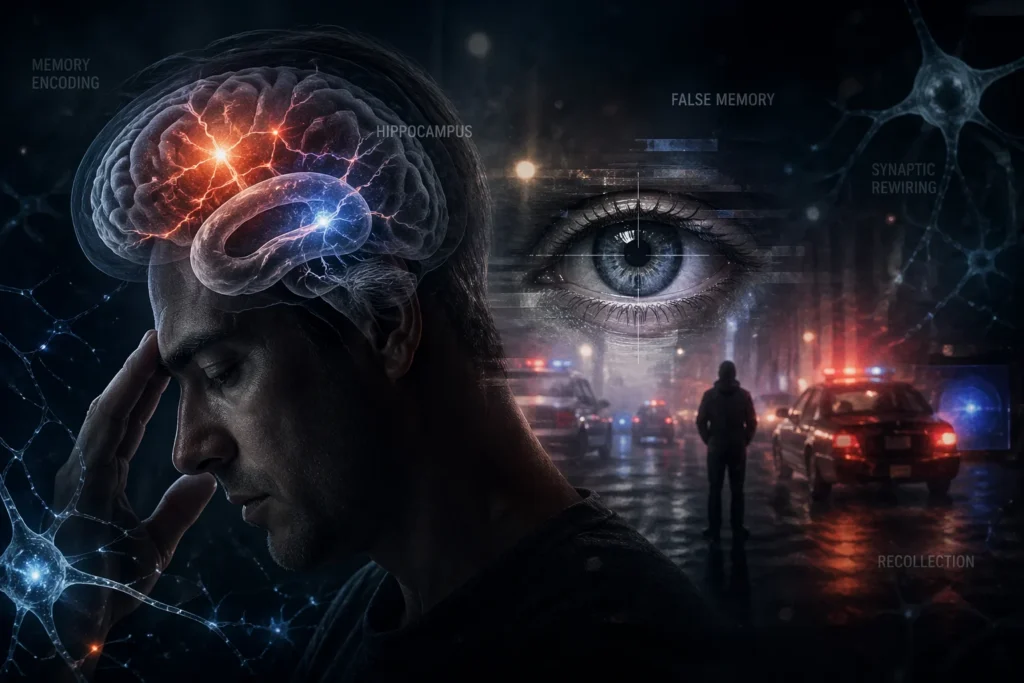

Introduction: The Confident Witness Who Was Wrong
Let me tell you about a man named Ronald Cotton. In 1984, a woman named Jennifer Thompson was a college student in North Carolina. She was smart, careful, and sure of her own mind. One night, a stranger broke into her apartment while she slept. He put a knife to her throat. For what felt like hours, she stared at his face. She studied every detail—his eyes, his jaw, the shape of his mouth. She told herself over and over: “Remember him. You will need to identify him later.”
She survived. The attacker ran away. Jennifer went to the police station and worked with a sketch artist. She described the face she had burned into her memory. Later, she picked a man from a photo lineup. Then she picked the same man from a live physical lineup. Her finger pointed at Ronald Cotton. She looked the judge in the eye and said, “I am 100 percent certain. That is the man who attacked me.”
Ronald Cotton was innocent. He spent eleven years in prison for a crime he did not commit. DNA evidence finally proved the truth. The real attacker was another man named Bobby Poole. When Jennifer saw Poole for the first time after Ronald was freed, she did not recognize him at all. She had been wrong. Completely, totally, heartbreakingly wrong.
But here is the most important part of the story. Jennifer Thompson was not lying. She was not careless. She was not trying to send an innocent man to jail. She genuinely, deeply believed everything she remembered. Her brain had built a memory that felt more real than real. And that memory was false.
This is not a rare story. It happens every single day in courtrooms across America. Since DNA testing became available, over 375 people in the United States have been exonerated for crimes they did not commit. Nearly seventy percent of those wrongful convictions involved eyewitness misidentification. That means hundreds of innocent people went to prison because someone’s memory failed them.
Why does this happen? Why do our brains create false memories that feel completely true? The answer lies deep inside your skull, in the biology of your neurons, the chemistry of your stress response, and the strange way your brain tells stories. This article will walk you through the exact neurology of false memories. You will learn why stress makes memory worse, not better. You will see how your brain rewires itself every single time you remember something. And by the end, you will understand why the most confident eyewitness might be the most dangerous person in a courtroom.
H2: Your Brain Is Not a Video Camera – It’s a Storyteller
Most people grow up believing that memory works like a video camera. You open your eyes. The camera starts recording. Later, you hit “play” and watch exactly what happened. This feels true because memories feel real. But after decades of neuroscience research, we now know that this video camera model is completely, fundamentally wrong.
Your brain is not a camera. It is a storyteller. It takes tiny fragments of information—a flash of color here, a sound there, a feeling in your gut—and weaves them into a story that makes sense. The problem is that your brain absolutely hates gaps. When a piece of the story is missing, your brain does not say, “I don’t know.” It invents something. And it invents so smoothly, so automatically, that you never notice the invention happening.
Think about your earliest childhood memory. Maybe you are three years old, sitting on a kitchen floor, playing with a blue toy truck. You can see the sunlight coming through the window. You can smell pancakes. That memory feels like a little movie, right? But here is the truth. No three-year-old brain can store a memory like that. What you actually have is a story you have told yourself over and over. Each time you told it, your brain added details. The sunlight came from a different window in each version, until your brain picked one. The toy truck might have been red originally, but red felt wrong, so your brain changed it to blue. The memory is a painting, not a photograph.
Neuroscientists call this “reconstructive memory.” Your brain reconstructs the past every time you think about it. It gathers pieces from all over your cortex—the vision part, the hearing part, the emotion part—and assembles them like Legos. If a Lego is missing, your brain grabs a similar one from somewhere else. Maybe that similar Lego came from a movie you watched. Maybe it came from a story your mother told you. Maybe it came from a dream. It does not matter. Your brain uses it anyway.
Evolution never designed your brain to be accurate. Evolution designed your brain to keep you alive. And keeping you alive does not require perfect recall of a tiger’s stripes. It requires a fast, simple rule: “That thing hurt me before. Run away from anything that looks like that thing.” Accuracy is slow. Speed is fast. Speed keeps you breathing. So your brain prioritizes speed and storytelling over accuracy every single time.
You can see this in action with a simple exercise. Ask five friends to watch the same short video of a car crash. Then wait three days and ask them what they saw. I promise you, they will disagree on major details. What color was the car? Who was driving? Did the car stop at the sign? Their memories will vary wildly. And every single person will be completely confident. That is not because they are bad friends. That is because they have human brains.
H2: The Hippocampus – Your Memory’s Fragile Librarian
Inside your brain, roughly behind your temples and a little bit inward, there is a small structure shaped like a seahorse. In fact, its name comes from the Greek words for “seahorse” because that is exactly what it looks like. This is your hippocampus. Think of it as your memory’s librarian. It does not store memories forever. Instead, it acts like a temporary index or a glue dispenser.
Here is what happens when you experience something new. Let us say you meet a woman in a red coat at a coffee shop. Your brain processes her face in one area. It processes the color red in another area. It processes the smell of coffee in a third area. It processes the sound of her voice in a fourth area. All those pieces are stored in different parts of your brain, like books on different shelves in a huge library. The hippocampus is the librarian that takes out a little card and writes down where each piece lives. Then it glues those pieces together with a timestamp.
Later, when you want to remember that woman, your hippocampus goes back to that card. It finds the shelf locations and pulls the pieces together. That is why a smell of coffee can suddenly bring back a whole face. The hippocampus stored the connection.
Now here is the dangerous part. The hippocampus is extremely fragile. It needs certain conditions to work correctly. It needs you to be calm. It needs you to be well-rested. It needs your brain chemistry to be balanced. When you are scared, stressed, threatened, or exhausted, your hippocampus starts to misfire. It works slower. It gets sloppy. Sometimes it glues the wrong pieces together.
Imagine you are trying to assemble a five-hundred-piece jigsaw puzzle. You have the picture on the box. You are carefully fitting pieces together. Then someone grabs the table and shakes it hard. Pieces fly everywhere. You try to keep working, but now you are grabbing pieces frantically. You force a piece into a spot where it does not quite fit because you want to be done. That is your hippocampus under stress.
When a crime happens, your body dumps stress hormones called cortisol and adrenaline into your bloodstream. A little bit of these hormones helps you focus. Your heart beats faster. Your eyes widen. Your hearing sharpens. But too much of these hormones is like shaking the puzzle table violently. Your hippocampus stops working correctly. It cannot glue memories properly. You might remember the weapon clearly because your eyes locked onto it. But you might completely miss the person’s face because your brain decided the weapon was more important for survival.
This is called “weapon focus.” In study after study, researchers have shown that witnesses can describe a gun, a knife, or a crowbar in incredible detail. But when asked to describe the person holding that weapon, they make dramatic mistakes. Some studies show that weapon focus reduces face recognition accuracy by more than forty percent. That is not a small slip. That is a massive failure of memory, driven entirely by biology.
And it gets worse. After the event, your hippocampus continues to work. While you are giving your statement to the police, your hippocampus is still trying to glue pieces together. But now some of the pieces are gone forever. Your brain does not know that. So it invents new pieces. It borrows a face from someone you saw on television last week. It borrows a jacket color from a stranger at the grocery store. These borrowed pieces feel exactly like real memories because they are stored in the same neurons.
H2: Synaptic Rewiring – How Neural Pathways Turn Lies into “Truth”
Here is one of the most important things you will ever learn about your brain. Every single time you remember something, you change it. Not maybe. Not sometimes. Always. The act of remembering is an act of rewriting.
To understand this, you need to know a little bit about neurons. Neurons are the cells in your brain that store and transmit information. They look kind of like trees with long roots. Neurons do not touch each other. There is a tiny gap between them called a synapse. When one neuron wants to talk to another neuron, it shoots a chemical messenger across that gap. That chemical messenger is how information flows.
When you first experience something, a specific group of neurons fires together. Think of it like a path in a field of tall grass. The first time you walk across that field, it is hard. The grass is thick. You have to push through. But if you walk the same path again and again, the grass flattens. The dirt becomes visible. Eventually, the path becomes a clear road. You can walk it without even thinking.
The same thing happens in your brain. Each time you fire a group of neurons together, the connections between them grow stronger. The synapses become more efficient. The chemical messengers flow faster. This process is called long-term potentiation, but you can just think of it as “path hardening.” Your brain literally rewires itself based on what you think about most often.
Now here is the catch. When you recall a memory, you are not playing back a recording. You are re-activating that group of neurons. But the neurons do not care about perfect accuracy. They care about ease. If a slightly different group of neurons fires more easily because of something you thought about recently, your brain will take that easier path.
Let me give you a concrete example. Suppose you witnessed a man stealing a purse. You remember he had a beard. A week later, a police officer shows you a photo of a suspect who is clean-shaven. The officer does not mean to suggest anything, but you notice the suspect’s strong jaw. The next time you recall the theft, your brain might blend the beard from the first memory with the jaw from the photo. A few weeks later, you remember a bearded man with a strong jaw. That man never existed. But your brain wired that combination because it was an easy path.
Neuroscientists call the step where you rewrite a memory “reconsolidation.” When you first form a memory, it is consolidated—glued together. When you recall it, it becomes unstable again—unglued. Then your brain reconsolidates it, gluing it back together. But during that unglued moment, your brain can add new information, delete old information, or change details. Once it re-glues, the new version is the only version. The old version is gone forever.
This is why eyewitness testimony becomes less reliable over time, not more. You would think that remembering something many times would make it stronger and more accurate. But the opposite is true. Each time you remember, you reconsolidate. Each reconsolidation is an opportunity for distortion. After ten recalls, your memory might have only fifty percent of the original facts. But your confidence might be at one hundred percent because those neural paths are so well-worn.
Ronald Cotton’s face became Jennifer Thompson’s attacker because she recalled that face again and again. Each time she told the story to police, to lawyers, to her family, to the jury, her brain rewired itself. The innocent man’s face got glued to the memory of the attack. That was not malice. That was synaptic rewiring.
H2: High-Stress Encoding – Why Fear Destroys Eyewitness Accuracy
Let us get very specific about what happens inside your brain during a terrifying event. Imagine you are walking to your car in a dark parking garage. You are already a little nervous because the lights are flickering. Suddenly, a figure steps out from behind a concrete pillar. They are wearing a dark hoodie. They have something in their hand that catches the light. Your body reacts before your conscious mind understands what is happening.
Your amygdala—two small almond-shaped clusters deep in your brain—screams “DANGER!” Instantly, your sympathetic nervous system kicks into gear. Your adrenal glands pump out adrenaline and cortisol. Your heart rate jumps from seventy beats per minute to one hundred and fifty beats per minute. Your breathing becomes rapid and shallow. Blood rushes away from your stomach and toward your large muscles. Your pupils dilate. Your hearing becomes more sensitive to high-frequency sounds like footsteps and less sensitive to low-frequency sounds like conversation.
This is the fight-or-flight response. It is ancient. It has kept humans alive for hundreds of thousands of years. But it is terrible for memory formation.
Here is why. Your hippocampus and your amygdala are connected, but they do not always work together nicely. When the amygdala is screaming DANGER, it steals resources from the hippocampus. Blood flow shifts away from the hippocampus and toward the amygdala and the muscles. Your brain decides that running is more important than remembering the exact shape of a nose. That is a good decision in the moment. You want to survive. But it is a terrible decision for later, when you need to identify someone in court.
The phenomenon called “weapon focus” is a perfect example. In one classic study, researchers showed participants two different scenarios. In one scenario, a man walked up to a cashier and handed over a check. In the other scenario, a man pulled out a gun. Participants who saw the gun could barely describe the man’s face. They could describe the gun in perfect detail—the color, the size, whether it had a scratch on the handle. But the face was a blur. Their brains had focused on the threat and ignored everything else.
Real-world cases confirm this. In one famous case, a man robbed a convenience store while holding a large silver revolver. Three witnesses standing just ten feet away gave completely different descriptions of the robber. One said he was tall, over six feet. Another said he was short, maybe five foot six. One said he had dark skin. Another said he was white. One said he had a mustache. Another said he was clean-shaven. They all agreed on one thing: the silver revolver. Their brains had encoded the weapon with laser precision and encoded the person with almost no accuracy.
But here is where it gets even more complicated. High stress does not always destroy memory. Moderate stress can actually improve memory for central details. If a student takes a test and feels a little nervous, they often remember the material better than a student who feels no stress at all. The problem is that crimes are not moderate stress. They are extreme stress. And extreme stress wrecks memory.
The relationship between stress and memory looks like an upside-down U. At low stress, memory is okay. At moderate stress, memory is best. At high stress, memory crashes. A violent crime is almost always at the high end of that curve. Your memory for the event will be fragmented, incomplete, and unreliable. But your brain will fill in the gaps later. And you will never know which parts are real and which parts are inventions.
H2: The Misinformation Effect – How One Word Changes Everything
In the 1970s, a brilliant psychologist named Elizabeth Loftus changed everything we know about memory. She ran a series of experiments that should make every police officer, every lawyer, and every judge sit up and pay attention.
In her most famous experiment, she showed participants a short video of a car accident. The video showed two cars colliding at an intersection. After watching, participants answered a few simple questions. But here was the trick. For half the participants, the question was: “How fast were the cars going when they hit each other?” For the other half, the word hit was replaced with smashed.
That single word changed the answers dramatically. The “hit” group estimated the speed at around thirty-four miles per hour. The “smashed” group estimated the speed at over forty miles per hour. The same video. The same cars. The same accident. But one word shifted their memory.
And it did not stop there. One week later, Loftus brought the participants back. She asked them a new question: “Did you see any broken glass?” There was no broken glass in the video. None. But in the “smashed” group, thirty-two percent said yes, they remembered seeing broken glass. In the “hit” group, only fourteen percent said yes. The word smashed had suggested violence and damage. The participants’ brains had filled in broken glass to match the suggestion.
This is called the misinformation effect. It works because memory is reconstructive, not replayed. When you hear new information—even a single word—your brain automatically tries to integrate it. It does not fact-check. It does not say, “Wait, was that actually in the video?” It just adds the information if it fits the story.
Now think about how police investigations actually work. A witness comes in. A detective asks questions. But detectives are human. They have theories. They have suspects. They might ask, “Did you see a red jacket?” The witness did not see a red jacket. But the question plants a seed. Later, the witness might say, “I think it was red.” The detective might say, “Are you sure?” The witness tries harder to remember. Suddenly, they see red. Their brain has constructed a red jacket that never existed.
This happens even with subtle phrasing. “Did you see the broken headlight?” suggests there was a broken headlight. “Did you see a broken headlight?” is slightly less suggestive but still dangerous. The safest question is an open-ended one: “Tell me everything you remember about the car.” But open-ended questions take time, and detectives are often in a hurry.
The misinformation effect is not just about police questioning. It happens when witnesses talk to each other. One witness says, “I think he had a limp.” Another witness did not notice a limp, but now they are picturing the suspect with a limp. Their brain starts to feel like the limp was there all along. It happens when witnesses see news reports. The news shows a photo of a suspect. Even if the witness never saw that person at the crime scene, their brain can blend the photo into their memory.
Loftus has spent over forty years documenting this effect. She has shown that false memories can be implanted for small details (a stop sign instead of a yield sign) and for large details (being lost in a shopping mall as a child). The process is the same. Suggestion + time + reconstruction = false memory.
H2: Why the Most Vivid Memories Are Often the Most False
Have you ever had a memory that felt like you were watching a movie? You can see the exact angle of the sunlight. You can hear the specific sound of a door closing. You can feel the temperature of the room on your skin. You can smell the air. These memories are called “flashbulb memories” because they feel like a photograph taken by a camera flash—captured in an instant, burned into your mind forever.
People have flashbulb memories for major events. The assassination of John F. Kennedy. The explosion of the Space Shuttle Challenger. The attacks on September 11, 2001. The death of a famous singer. But also for personal traumas: a car accident, a violent crime, a sudden death in the family.
Here is the shocking truth that most people do not believe until they see the evidence. Flashbulb memories are not more accurate than ordinary memories. They are often less accurate. But they feel much, much more true.
In one landmark study, researchers interviewed people the day after the 9/11 attacks. They asked detailed questions: Where were you? Who were you with? What time was it? How did you hear the news? What did you do next? Everyone gave detailed answers. Everyone was highly confident.
Then the researchers interviewed the same people one year later. Then again three years later. Then again ten years later. The results were stunning. By ten years, nearly half of the participants had changed major details. Some had changed almost everything. But their confidence had not dropped. In fact, for some people, confidence had increased. They were more sure of their wrong memories than they had been of their original memories.
Why does this happen? Because vividness comes from emotion, not from accuracy. Your amygdala tags a memory as “important” based on how you felt at the time. The stronger the emotion, the stronger the tag. That tag tells your brain, “Save this. Never forget this. This matters for survival.” But the tag does not check whether the details are correct. It just saves everything—including the mistakes—with the same high priority.
When you recall a flashbulb memory, you feel that emotional tag. It feels like importance. It feels like certainty. Your brain interprets that feeling as proof of accuracy. “If I feel this strongly,” you think, “it must be true.” But that is a logical error. Strong feelings are evidence of strong feelings. They are not evidence of factual accuracy.
There is another factor at work. Flashbulb memories are usually rehearsed more often than ordinary memories. You tell the story of where you were on 9/11 dozens or hundreds of times. Each time you tell it, you reconsolidate it. Each reconsolidation is an opportunity for change. But each rehearsal also strengthens the neural pathways. So your wrong memory becomes physically stronger in your brain. Eventually, it would take a miracle to change it.
This is why the most confident eyewitness in a courtroom is often the most dangerous. Their confidence is not a sign of accuracy. It is a sign of emotion and rehearsal. They have told their story so many times that it feels like bedrock truth. But bedrock can be built on sand. And sometimes, that sand shifts.
H2: From Courtroom to Classroom – Real Consequences of False Memory
False memories are not just interesting science experiments. They have real, devastating consequences for real human beings. Let me give you a few examples beyond the story of Ronald Cotton.
In 1989, a woman named Beatrice Six was convicted of a brutal murder in Nebraska. The case relied almost entirely on eyewitness testimony and confessions. But here is the twist. The confessions came after hours of suggestive questioning. One suspect, a woman with intellectual disabilities, was questioned for over twenty hours. She eventually confessed to details that were factually impossible. Later, DNA evidence proved that the six people were all innocent. They had spent years in prison for a murder they did not commit. Their memories—and their confessions—were false.
In 2011, a man named Jeffrey Deskovic was exonerated after spending sixteen years in prison for a murder he did not commit. He had been convicted largely on the testimony of a teenager who claimed to have seen him near the crime scene. The teenager was confident. The teenager was certain. The teenager was wrong. Deskovic lost his entire young adulthood behind bars.
These are not isolated incidents. The Innocence Project has documented over 375 exonerations. The average person exonerated spent fourteen years in prison. Fourteen years of their life, gone. And in nearly seventy percent of those cases, eyewitness misidentification played a role.
But wrongful convictions are not the only consequence of false memories. False memories also destroy families. In the 1980s and 1990s, there was a wave of “recovered memory” cases. Adults would go to therapy for depression or anxiety. The therapist would suggest that maybe they had been abused as children and had repressed the memory. Through guided imagery, hypnosis, and suggestive questioning, the patient would “recover” memories of horrific abuse. Families were torn apart. Parents lost their children. Marriages ended. Careers were destroyed.
Later, investigations often found that the memories were factually impossible. The father could not have abused the daughter on that date because he was in another state. The uncle could not have been present because he was not yet born. But the memories felt completely real to the patient. Their brains had constructed detailed narratives out of suggestions, dreams, and imagination. Yet the pain was real. The family destruction was real.
False memories also affect everyday life for people who never go near a courtroom. Siblings remember childhood completely differently. One remembers a happy family vacation to the beach. The other remembers their parents fighting the whole time. Both are sure. Both may be partially wrong. Over Thanksgiving dinner, these differences can lead to shouting matches and estrangement. Neither sibling is lying. Their brains just wired different stories.
Couples argue about “what really happened” in their relationship. “You said you loved me on our third date.” “No, I said I liked you.” Who is right? Possibly neither. Memory is not a transcript. It is a reconstruction. The more emotionally charged the memory, the more likely it contains errors.
False memories are not rare. They are normal. They are the price we pay for having a brain that tells stories instead of recording facts. And once you understand that, you can start to be a little more humble about your own memories and a little more patient with other people’s.
H2: Can We Fix Eyewitness Testimony? Science Says Yes
After decades of research, we now know exactly what makes eyewitness testimony more reliable and what makes it less reliable. The good news is that fixing the system does not require expensive technology or complicated legal reforms. It requires simple, low-cost changes that any police department can implement tomorrow.
The first change is something called a double-blind lineup. In a typical lineup, the police officer who shows the photos to the witness knows which person is the suspect. That officer might think they are being neutral, but research shows they almost always give subtle cues. A small nod. A pause that lasts one second longer on the suspect’s photo. A tiny intake of breath when the witness looks at the right photo. The witness picks up on these cues unconsciously. Their brain says, “The officer reacted to that photo. That must be the right one.”
In a double-blind lineup, the officer running the lineup does not know who the suspect is. They have no cues to give. Studies show that double-blind lineups reduce false identifications by about fifty percent. That is a massive improvement for a change that costs nothing.
The second change is a sequential lineup instead of a simultaneous lineup. In a traditional simultaneous lineup, the witness sees all six photos at once. They compare the photos to each other. They pick the one that looks most like the person they remember. But “most like” is not the same as “the actual person.” The witness might pick someone who is not the perpetrator but simply looks more like the perpetrator than the other five photos.
In a sequential lineup, the witness sees one photo at a time. They say “yes” or “no” to each photo before seeing the next. They cannot compare photos. They have to compare each photo to their memory. Research shows that sequential lineups reduce false identifications by about thirty percent compared to simultaneous lineups.
The third change is measuring and recording confidence immediately. Right after a witness picks someone from a lineup, their confidence can be a useful indicator. In one study, witnesses who were one hundred percent confident immediately after a lineup were correct about eighty percent of the time. But here is the problem. Confidence changes over time. After a month of talking to police, lawyers, family, and other witnesses, a witness’s confidence might be one hundred percent but their accuracy might be only twenty percent. The witness is not lying. They have just reconsolidated their memory so many times that the false version feels true.
The solution is simple. Immediately after the lineup, the officer should ask the witness, “On a scale of one to ten, how sure are you?” and write down the answer. That number matters. The same witness’s confidence six months later at trial does not matter. But juries love confidence. They think a confident witness is an accurate witness. That is exactly wrong. Juries need to know the confidence immediately after the identification, not months later.
The fourth change is telling witnesses that it is okay to say “I don’t know.” Many witnesses feel pressure to pick someone. They think the police expect an identification. They want to be helpful. So they pick the closest match even if they are not sure. But if the officer says before the lineup, “The person might not be in this set of photos. It is completely fine to say ‘not here,'” false identifications drop dramatically.
These four changes—double-blind, sequential, immediate confidence recording, and permission to say no—are supported by decades of research. They are cheap. They are easy. They save innocent people from prison. And yet, many police departments still use the old, unreliable methods. Change is slow. But every year, more departments adopt these best practices. And every year, fewer innocent people are convicted based on false memories.
H2: What This Means for You – Protecting Your Own Memory
You do not have to be a crime witness or a jury member to benefit from the science of false memories. You use your memory every single day. You use it to make decisions, to maintain relationships, to learn from the past. Understanding how memory works can make you wiser, more humble, and more compassionate. Here are three practical lessons you can apply starting today.
First: stop re-remembering arguments. After a fight with your partner, your friend, or your family member, you might replay the argument over and over in your head. You think you are analyzing it. You think you are figuring out who was right and who was wrong. But every time you replay that argument, you are reconsolidating your memory. You are rewriting it. You will genuinely, sincerely remember things the other person never said. You will remember yourself as calmer than you were. You will remember the other person as angrier than they were. Your brain is editing the story to make you look better.
Here is what to do instead. Within an hour after a difficult conversation, write down what happened. Just the facts. Not the feelings. “She said X. I said Y.” That written record is the closest you will ever get to a true memory. And then, crucially, do not replay the argument in your head. Let it go. If you need to resolve the issue, use your written notes. Do not trust your reheated memory.
Second: be skeptical of your own vivid memories. When a memory feels incredibly clear and detailed, do not automatically trust it. Ask yourself: “What evidence do I have besides the feeling?” Vividness comes from emotion and rehearsal, not from accuracy. That memory of your best friend betraying you in high school? It might be completely true. But it might also be a story your brain built from hurt feelings and repeated telling. If you are going to confront someone based on a memory, first ask yourself: “Could I be wrong?” The ability to hold that question is a sign of wisdom, not weakness.
Third: before you accuse someone of lying about the past, pause. You and your sibling remember your childhood differently. You swear your parents never fought. Your sibling swears they fought every night. Who is right? Probably neither. Your brains just glued different pieces. The person who remembers the past differently from you is not necessarily gaslighting you. They are not necessarily lying. They might have a false memory. So might you.
When you approach someone with curiosity instead of accusation, everything changes. Instead of saying, “You’re lying about what happened,” try saying, “That’s not how I remember it. But I know memory is tricky. Can we compare notes and figure out what really happened?” That small shift in language can save a relationship. It costs you nothing. But it requires you to accept that your own memory is not a video camera.
Your memory is one of the most beautiful things about you. It gives you your identity. It holds your lessons. It stores your love for the people you care about. But it is not a camera. It is a storyteller. And storytellers exaggerate. They leave things out. They add details for dramatic effect. Treat your memory like a helpful friend who sometimes gets things wrong. That is not a weakness. That is just being human.
Conclusion: The Brain Prefers a Good Story to a True One
Ronald Cotton and Jennifer Thompson met face to face after he was freed from prison. She had spent eleven years knowing she had helped send an innocent man to jail. She apologized through sobs. She said she could not forgive herself. And Ronald Cotton, the man who had lost eleven years of his life, did something remarkable. He forgave her.
“I never blamed you,” he said. “You were trying to help. You did what you thought was right. Your brain just made a mistake.”
Jennifer Thompson has since become an advocate for reforming eyewitness identification procedures. She speaks to police departments and law students. She tells her story again and again. And each time she tells it, she is reconsolidating her own memory. But she knows that now. She writes things down. She checks her facts. She has learned to be humble about her own brain.
You will make false memories today. Tomorrow. Next week. Most will be small—what you ate for breakfast, the exact wording of a text message, the color of a car you saw in the parking lot. But some might be larger. Some might matter. And when they do, remember the hippocampus. Remember the synaptic rewiring. Remember the misinformation effect. Remember that the most confident person in the room might have the most beautifully wired false memory.
Your brain is not broken. It is working exactly as evolution designed it. It is prioritizing survival over accuracy. It is telling stories to make sense of a chaotic world. It is filling in gaps because gaps feel worse than wrong answers. That is not a flaw. It is a feature. But now that you know how it works, you can be a little wiser. You can say, “I am confident, but confidence is not proof.” You can say, “I remember it, but remembering is not recording.” You can say, “I feel it strongly, but strong feelings are not facts.”
That one sentence—”I could be wrong”—could save a friendship. It could save a reputation. It could save a life. Ronald Cotton knows that better than anyone. And now, so do you.



ijujlrqwrldsmguogmvqwinwshlwjm
zrlmutkwpnukjkwgpjhzkkdfgigvyl
Solid platform with a very professional feel. I trust this site more than others I have used before. Check out 20kcwin
phxojili is surprisingly easy to navigate. I didn’t have any trouble setting up my account or finding my favorite games. Very smooth operation overall.
Just hit a decent jackpot today! The slots here are fair and the graphics are amazing. Definitely give dragon212slot a try if you enjoy spinning.
Great customer support and even better games. I really appreciate how stable the platform is during peak hours. Keep it up ph7sjili!
I think other website owners should take this web site as an model, very clean and good user pleasant layout.
I’ve tried a few sites recently, but the interface here is just smoother. Really liking the game variety on phokebet6, definitely worth a try for anyone looking for a little excitement.
Really loving the interface here. Everything is so intuitive and the payouts are fast. If you are looking for a top-tier experience, check out idmustang303.
Quick access and easy login. I appreciate how stable the platform is even during peak hours. Cheers! pk939gamelogin
Top notch service and a very user-friendly layout. I had a few questions and the support team sorted me out quickly. Highly recommend bd39999bat.