
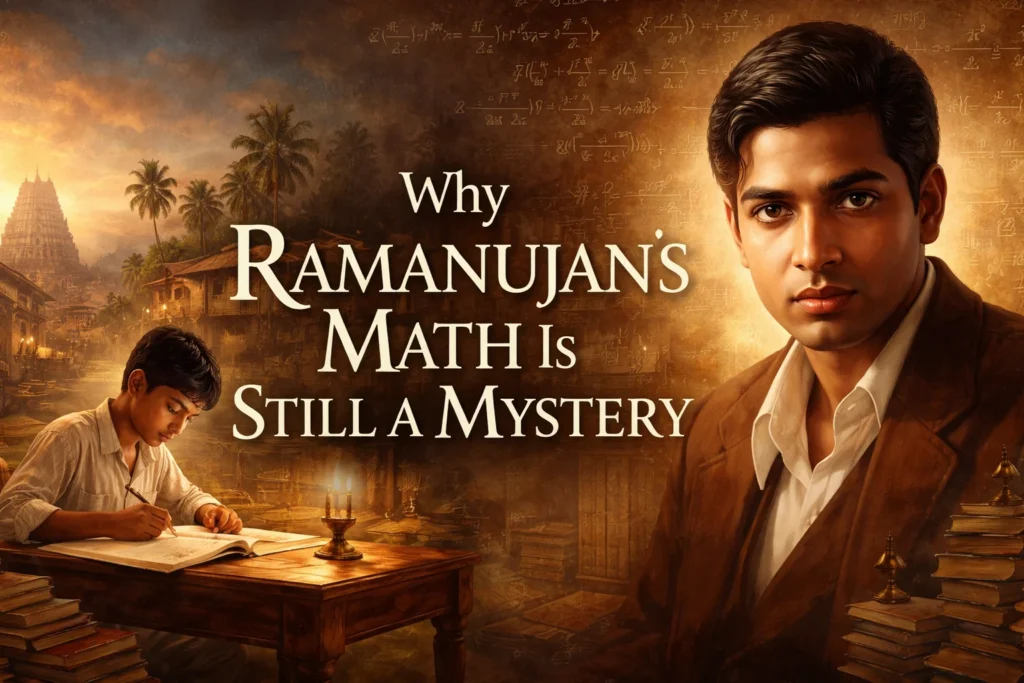

The Boy Who Saw Numbers Differently
In the hot, dusty town of Kumbakonam, South India, there once lived a boy named Srinivasa Ramanujan. He wasn’t the strongest student in school—at least not in subjects like history or English. But when it came to numbers, he saw things that no one else did.
While other kids struggled with multiplication tables, Ramanujan would sit alone for hours, scribbling fractions, square roots, and strange symbols into a small slate. He would erase one corner and fill it again, as if talking to the numbers themselves. His friends thought he was odd. His teachers sometimes thought he was daydreaming. But Ramanujan was not daydreaming. He was exploring a universe that only he could see.
By the time he was a teenager, he had filled several notebooks with thousands of formulas. These weren’t homework problems. They were wild, beautiful, and deeply strange equations—many of which even professional mathematicians would not understand for another hundred years.
His family didn’t know what to make of him. His mother would call him for dinner, and he wouldn’t hear her. His father, a clerk in a cloth shop, would shake his head and say, “The boy lives in another world.” And in a way, he did. Ramanujan lived in a world of infinite series, continued fractions, and modular equations. He breathed numbers the way the rest of us breathe air.
This is the story of how a poor clerk from Madras shocked the world, and why his math still feels like magic today.
A Childhood Spent in Silence and Scribbles
Ramanujan was born on December 22, 1887, in Erode, a small town in Tamil Nadu. His family moved to Kumbakonam when he was very young. His mother, Komalatammal, sang hymns at the local temple. His father worked hard but earned very little. They were not rich, but they made sure Ramanujan went to school.
At first, he seemed like an ordinary child. But by age ten, he had scored the highest possible marks in mathematics in his entire district. The school headmaster was so impressed that he showed Ramanujan’s papers to other teachers. They all agreed: this boy was special.
But here is the thing. Ramanujan did not just solve problems faster than others. He solved them differently. He would look at a geometry problem and see a path that no one else saw. He would turn an algebra question into a puzzle about infinite sums. His teachers sometimes marked him wrong simply because they could not follow his logic. Later, they would realize that he was right all along.
At age twelve, he borrowed a book called A Synopsis of Elementary Results in Pure and Applied Mathematics. The book contained thousands of formulas, but almost no explanations. Most students would have thrown it away in frustration. Ramanujan devoured it. He filled page after page with his own notes, proving every formula that the book had simply listed.
By fourteen, he had mastered trigonometry and infinite series. By sixteen, he had discovered his own method for calculating Euler’s constant, a mysterious number that appears everywhere in advanced math. And he did all of this without a teacher, without a tutor, and without any encouragement from the outside world.
The Strange World of Infinite Series and Continued Fractions
To understand why Ramanujan’s math is so strange, you have to understand two things: infinite series and continued fractions.
An infinite series is a sum that never ends. For example, imagine adding 1 + 1/2 + 1/4 + 1/8 + … forever. Even though you keep adding forever, the total never goes past 2. That is a simple example. Ramanujan worked with infinite series that were far more twisted. He would add fractions that bounced around like pinballs, and somehow they would land on a simple number like pi or e.
A continued fraction is even weirder. Instead of adding numbers, you keep stacking fractions inside fractions. For example:
That messy stack actually equals the golden ratio, a famous number. Ramanujan saw continued fractions everywhere. He wrote hundreds of them in his notebooks. Many of them looked like nonsense at first glance. But when mathematicians tested them with computers decades later, they worked perfectly.
What makes this so mysterious is that continued fractions are hard. Even today, most math students do not learn them until college. Ramanujan was playing with them as a teenager. He seemed to have a mental map of how these fractions behaved. He could look at a messy stack of fractions and say, “That equals the square root of two,” without writing a single step.
Imagine someone showing you a giant knot of strings and you instantly knowing exactly how to pull it apart. That was Ramanujan with continued fractions.
The First Notebook: A Treasure Chest of Unknown Formulas
When Ramanujan was about sixteen years old, he began writing his first notebook. It was not a clean, organized journal. It was a messy collection of scratch paper, school notebooks, and loose sheets, all stuffed together. He wrote in pencil and ink, sometimes sideways, sometimes upside down. He would cross things out and write new formulas in the margins.
This first notebook contained over 500 formulas. Some were simple, like the sum of the first n numbers. Others were shockingly complex, involving infinite products, nested square roots, and strange functions that European mathematicians had only begun to explore.
One of the most famous entries in the first notebook is a formula for the number pi. Ramanujan wrote:
This is an infinite product of square roots. It is beautiful, simple, and completely correct. But here is the mystery: where did it come from? The standard way to discover such a formula involves advanced trigonometry and complex analysis. Ramanujan had not studied any of that. He just wrote it down, as if he had seen it in a dream.
Mathematicians later discovered that this formula was actually a special case of a much deeper identity. That deeper identity was not proven until the 1980s. So for nearly a hundred years, Ramanujan’s formula sat in his notebook like a strange artifact. It worked, but no one knew why.
The Second Notebook: Going Deeper Into the Unknown
After finishing his first notebook, Ramanujan started a second one. This one was larger, more organized, and filled with even stranger material. He began exploring something called the partition function.
Partitioning is a simple idea. Take the number 4. How many ways can you write it as a sum of smaller numbers? You can write 4 as 4 itself. You can write 3+1, 2+2, 2+1+1, and 1+1+1+1. That is five ways. So the partition number of 4 is 5. For 5, there are 7 partitions. For 6, there are 11. For 10, there are 42. For 100, the number is huge: over 190 million.
Ramanujan became obsessed with partitions. He discovered that partition numbers follow surprising patterns. For example, he noticed that the partition number of 4 is 5, which is divisible by 5. The partition number of 9 is 30, which is divisible by 5. The partition number of 14 is 135, which is divisible by 5. He realized that if you take any number that ends in 4 or 9, its partition number is divisible by 5. He found similar patterns for 7 and 11.
These are called Ramanujan’s congruence properties. They were so unexpected that when he wrote to G.H. Hardy about them, Hardy thought they might be a coincidence. But Hardy tested them and found they held true. No one had ever seen anything like it.
Even today, mathematicians are still discovering new congruence properties. Ramanujan found three big ones. Later mathematicians have found more, but they are much rarer and harder to prove. Some believe that Ramanujan only scratched the surface. Others think that his three congruences are the only truly simple ones. The debate is still alive.
The Dark Years: Poverty, Rejection, and Loneliness
After finishing school, Ramanujan attended college in Madras. He was given a scholarship to study at Government College in Kumbakonam. But he failed his first year. Not because he was bad at math—he was brilliant at math—but because he refused to study anything else. He failed his English exam, his physiology exam, and his history exam. The scholarship was taken away.
He tried again at a different college, Pachaiyappa’s in Madras. The same thing happened. He aced the math portion but failed everything else. His professors were frustrated. One of them told him, “You are a genius in mathematics, but you will never get a degree if you cannot pass the other subjects.”
Ramanujan did not care about degrees. He cared about numbers. But without a degree, he could not get a good job. His family was poor. His mother and father needed his help. So he did the only thing he could: he became a clerk at the Madras Port Trust. He earned about 30 rupees a month, which was barely enough to survive.
Every day, he would go to work at the port, checking shipping papers and cargo lists. It was boring, repetitive work. But Ramanujan did it quickly and accurately, leaving his mind free to wander. His coworkers would see him staring at the ceiling, whispering numbers to himself. They thought he was strange. They had no idea that inside his head, infinite series were dancing.
After work, he would return to his small room, eat a simple meal of rice and vegetables, and pull out his notebooks. He would write for hours, often until two or three in the morning. His neighbors would hear him talking to himself, arguing with the numbers, laughing when something worked out beautifully.
These were the dark years. He was poor, unknown, and ignored. He had no one to talk to about his ideas. He was sickly, often suffering from stomach pain and fever. But he never stopped writing.
The Letter That Changed Everything
In 1913, Ramanujan decided to do something desperate. He wrote a letter to three famous mathematicians in England. The first two, H.F. Baker and E.W. Hobson, replied politely but said they could not help. They had never heard of Ramanujan and doubted that a clerk in India could have discovered anything new.
The third mathematician was G.H. Hardy at Cambridge University. Hardy was one of the best number theorists in the world. He was also famously careful. He did not like wild claims or sloppy thinking. When he opened Ramanujan’s letter, he almost threw it away. The handwriting was messy. The English was poor. And the letter was filled with formulas that looked like nonsense.
But something made Hardy stop. He looked more closely. The first few formulas were strange but possibly correct. Then he saw a formula for an infinite series that he had been studying himself. He knew that no amateur could have stumbled upon it. Then he saw a continued fraction that he had only seen in the most advanced journals. Then he saw something entirely new: a formula for the number of primes less than a given number, expressed as an infinite series that Hardy had never imagined.
Hardy called his colleague, J.E. Littlewood. Littlewood was also a brilliant mathematician. Together, they spent the next several hours testing Ramanujan’s formulas. Every single one worked. They looked at each other in disbelief. “This man,” Hardy said, “is the greatest natural mathematician I have ever seen.”
He wrote back to Ramanujan immediately. The letter began: “Your formulas are extremely interesting. I would like to see your proofs.” Ramanujan replied that he did not have proofs. He had only the formulas themselves. Hardy was frustrated but also fascinated. He arranged for Ramanujan to come to Cambridge.
The Journey to England: A Different World
In 1914, Ramanujan boarded a ship from Madras to England. It was his first time leaving India. He had never seen snow. He had never eaten Western food. He had never worn a heavy coat or lived in a house with central heating. Everything was strange to him.
The ship ride took several weeks. Ramanujan spent most of it in his cabin, writing in his notebooks. He did not mingle with other passengers. He did not enjoy the fresh sea air. He just wrote and wrote. When the ship finally docked in London, he stepped off looking pale and thin. He had barely eaten because he was a strict vegetarian and did not trust the ship’s kitchen.
Hardy met him at the station. He was shocked by how young and frail Ramanujan looked. He was also shocked by the notebooks. Ramanujan carried them in a small wooden box, tied with string. Hardy later wrote, “I felt as if I was meeting a character from a fairy tale. This boy had discovered so much, working alone in a dusty town, with no library and no teacher.”
Cambridge was beautiful but cold. The buildings were made of gray stone. The sky was often gray too. Ramanujan was given a small room at Trinity College. He was expected to attend lectures, eat in the dining hall, and follow the rules of the university. He struggled with all of it.
He did not understand the English accent. He did not like the food. He could not sleep because the cold made his bones ache. He missed the heat of India, the smell of jasmine, the sound of temple bells. He became homesick and lonely.
But he kept working.
The Partnership With Hardy: Fire and Ice
Hardy and Ramanujan made an odd pair. Hardy was tall, thin, and formal. He wore suits and spoke carefully. He was an atheist who believed only in logic and proof. Ramanujan was short, dark, and shy. He wore traditional Indian clothes when he could. He believed that his formulas came from a goddess. He rarely spoke in complete sentences in English.
Yet they worked together beautifully. Hardy provided the rigor. He would take Ramanujan’s wild formulas and help him prove them step by step. Ramanujan provided the intuition. He would see patterns that Hardy never could.
Hardy once said, “I learned from Ramanujan that every formula is a window into something deeper. He did not just find answers. He found questions that no one had thought to ask.”
They published several papers together. These papers are still read today. They cover topics like the partition function, modular forms, and the distribution of prime numbers. Each paper was a collaboration between Hardy’s careful logic and Ramanujan’s blazing insight.
But the collaboration was not always easy. Hardy would ask, “How did you get this?” Ramanujan would say, “I saw it in a dream.” Hardy would sigh and spend the next week reconstructing the proof. It frustrated him, but he also admired it. He later wrote, “Ramanujan’s mind worked in a way that I cannot fully understand. He saw connections that were invisible to the rest of us.”
The Famous Taxicab Number: 1729
The most famous story about Ramanujan involves the number 1729. Hardy used to visit Ramanujan in the hospital when he was sick. One day, Hardy arrived and said, “I came in a taxicab with the number 1729. It seemed like a very dull number.”
Ramanujan immediately replied, “No, Hardy. It is a very interesting number. It is the smallest number that can be expressed as the sum of two cubes in two different ways.”
Here is what he meant. Take 1 cubed, which is 1, and add 12 cubed, which is 1728. That gives 1729. Now take 9 cubed, which is 729, and add 10 cubed, which is 1000. That also gives 1729. No smaller number can be written as the sum of two cubes in two different ways.
How did Ramanujan see this instantly? He was not a computer. He did not have a calculator. He just knew. It was as if the numbers themselves spoke to him.
Mathematicians later discovered that 1729 is also special in other ways. It appears in connection with elliptic curves, a branch of math that is used in cryptography today. So a number that Hardy thought was boring turned out to be deeply interesting. Ramanujan had seen it immediately.
Today, 1729 is called the Hardy-Ramanujan number. And it has become a kind of symbol for Ramanujan’s genius: the ability to look at something ordinary and see the extraordinary hidden inside.
The Lost Notebook: A Second Treasure
After Ramanujan died in 1920, his notebooks were kept in the library at Trinity College. People knew they were important, but no one could fully understand them. For decades, they sat on shelves, gathering dust.
Then, in 1976, a mathematician named George Andrews was doing research at Oxford. He was looking through a box of papers that had been labeled “Ramanujan’s miscellaneous notes.” The box had been sitting there for over fifty years. No one had looked inside.
Andrews opened the box and found a pile of loose pages. The handwriting was Ramanujan’s. The formulas were unlike anything he had ever seen. He realized, with a shock, that he had just discovered a fourth notebook—what would later be called the Lost Notebook.
The Lost Notebook contained over 600 formulas. Most of them were about mock modular forms, a topic so advanced that only a handful of mathematicians in the world understood it. Ramanujan had written pages and pages about these forms, but he had never published them. Why? No one knows. Perhaps he was too sick. Perhaps he thought they were not ready. Perhaps he simply ran out of time.
When Andrews published his discovery, the math world exploded. Suddenly, there was a whole new set of Ramanujan’s formulas to study. And they were even stranger than the ones in the earlier notebooks.
Mock modular forms, it turns out, are not just mathematical curiosities. They are deeply connected to black holes, string theory, and quantum physics. Scientists are still trying to understand all the implications. But one thing is clear: Ramanujan was working on mock modular forms decades before physicists realized they needed them.
Why His Math Felt Like Magic to Cambridge
To understand why Ramanujan’s math seemed like magic, you have to understand how normal mathematics works. Most mathematicians build their work step by step. They learn from books. They read journals. They attend lectures. They know what problems are open and what tools are available.
Ramanujan did none of that. He did not read journals. He did not attend lectures. He did not know what problems were considered hard. He just sat in his room and thought.
And yet, he solved problems that had stumped the best minds in Europe. He discovered formulas that were decades ahead of their time. He saw connections that no one else saw.
Hardy once compared Ramanujan to Euler, the great 18th-century mathematician. Euler had produced an enormous amount of work, but he built on the work of others. Ramanujan, Hardy said, was more like a magician. “He pulled formulas out of thin air,” Hardy wrote. “They were true because they were beautiful.”
This is still mysterious today. We have brain scans of mathematicians. We have computer models of mathematical reasoning. We have AI that can solve calculus problems. But none of that explains Ramanujan. He remains a unique case: a self-taught genius who saw deeper than anyone before or since.
The Tragic End: A Short Life Cut Short
Ramanujan’s health had always been fragile. In India, he had suffered from stomach pain and fevers. In England, things got much worse. The cold, damp climate was terrible for him. He caught tuberculosis, a lung disease that was often fatal in those days. He also suffered from vitamin deficiencies because he could not eat most of the food in the Cambridge dining hall. He tried to cook for himself, but his tiny room had no proper kitchen.
In 1917, he collapsed. He was taken to a sanatorium, a kind of hospital for people with long-term illnesses. He spent months there, too weak to work. Hardy visited him often. They would talk about math, but Ramanujan was often too tired to write anything down.
In 1919, he felt well enough to return to India. He boarded a ship and made the long journey home. His family was overjoyed to see him. But he was not cured. He spent his last months in a small house in Kumbakonam, surrounded by his notebooks. He continued to work, even when he was bedridden.
On April 26, 1920, he died. He was 32 years old.
It is impossible to know what else he would have discovered if he had lived another 20 or 30 years. Hardy said that Ramanujan’s death was the greatest loss to mathematics in the 20th century. Others have said that his early death was like losing Mozart at the height of his creativity.
But here is the thing. Even in those short 32 years, Ramanujan left behind enough material for several lifetimes of research. Mathematicians are still working on his notebooks. Physicists are still finding his formulas in their equations. And every few years, someone announces a new discovery that was hidden in Ramanujan’s pages all along.
How Ramanujan’s Math Shows Up in Black Holes
Let’s jump forward to the 1990s. Physicists were trying to understand black holes. One of the biggest questions was: How much information can a black hole hold? The answer involves counting the number of microstates, which are like the tiny internal configurations of the black hole.
A physicist named Ashoke Sen was working on this problem. He derived a formula for the number of microstates. It was complicated and messy. But then he noticed something strange. His formula looked exactly like one of Ramanujan’s mock modular forms.
Sen was stunned. He double-checked his work. He consulted with other physicists. They all came to the same conclusion: Ramanujan had written down the mathematical language of black holes nearly a hundred years before anyone knew black holes existed.
This discovery made headlines around the world. Suddenly, Ramanujan was not just a historical figure. He was a living presence in modern physics. His mock modular forms are now standard tools in string theory, the branch of physics that tries to unite gravity with quantum mechanics.
And here is the strangest part. Ramanujan did not know any physics. He never studied black holes. He never thought about gravity or quantum mechanics. He was just playing with numbers. And yet, his numbers described the universe better than anyone could have guessed.
Quasicrystals and Ramanujan’s Theta Functions
In the 1980s, a scientist named Dan Shechtman was looking at a metal alloy under an electron microscope. He saw something impossible: a crystal with a five-fold symmetry. For years, scientists had believed that crystals could only have two-fold, three-fold, four-fold, or six-fold symmetry. Five-fold was considered impossible.
But Shechtman’s crystal was real. He had discovered what are now called quasicrystals. He won the Nobel Prize for it in 2011.
When mathematicians started studying quasicrystals, they found that the patterns in these strange materials matched something called Ramanujan’s theta functions. Theta functions are a type of infinite sum that Ramanujan had explored in great detail. He had drawn diagrams that looked almost exactly like the electron microscope images of quasicrystals.
Again, Ramanujan had no way of knowing about quasicrystals. He was not a materials scientist. He did not have an electron microscope. He was just writing down patterns that he found beautiful. And those patterns turned out to be the blueprints for a whole new class of materials.
This is one of the most amazing things about Ramanujan. He did not ask whether his math was useful. He did not care about applications. He just followed his curiosity. And time after time, the universe has shown that his curiosity was pointing toward deep truths.
Cancer Research and Mock Modular Forms
In 2023, a team of biologists and mathematicians published a paper linking Ramanujan’s mock modular forms to the growth patterns of cancer cells. They were studying how tumors expand in the human body. Tumors do not grow smoothly. They grow in fits and starts, with periods of rapid growth followed by periods of slow growth.
The team found that this pattern of growth could be modeled using mock modular forms. Specifically, they used formulas from Ramanujan’s Lost Notebook. The same equations that describe black holes also describe how cancer spreads.
No one had predicted this. It came out of nowhere. But when the researchers tested their model against real cancer data, it worked. The mock modular forms predicted the growth patterns with surprising accuracy.
This does not mean that Ramanujan’s math will cure cancer tomorrow. But it does mean that his formulas are now part of the toolkit that scientists use to understand one of the most challenging diseases of our time. And that is remarkable for a man who died in 1920, long before the first cancer drug was ever developed.
Computer Science and Ramanujan’s Partition Formulas
Partition numbers, which Ramanujan studied so deeply, have turned out to be incredibly useful in computer science. One area is cryptography, the science of secret codes. Modern encryption systems rely on the difficulty of factoring large numbers. Partition numbers appear in some of the most efficient factoring algorithms.
Another area is data compression. When you download a file or stream a video, the data is often compressed to make it smaller. Some compression algorithms use partition theory to find patterns in the data. Ramanujan’s congruence properties help these algorithms work faster.
Even something as simple as sorting numbers can involve partition theory. The fastest sorting algorithms are based on dividing data into smaller and smaller groups. That division process is mathematically similar to partitioning a number. So every time you search for a name in a phone book or sort a list of files on your computer, you are indirectly using ideas that Ramanujan explored in his notebooks.
None of this existed in Ramanujan’s time. Computers were science fiction. Cryptography was about simple ciphers. Data compression was not even a concept. And yet, Ramanujan had already done the math that would make all of these technologies possible.
The Mystery of Ramanujan’s Intuition
We have explained many things since Ramanujan’s time. We have sent rockets to Mars. We have decoded the human genome. We have built artificial intelligence that can beat the world’s best chess players.
But we still cannot explain how Ramanujan did what he did.
Some scientists have suggested that Ramanujan might have had a form of mathematical synesthesia. Synesthesia is a condition where one sense triggers another. Some people see colors when they hear music. Others taste shapes. Perhaps Ramanujan saw numbers as geometric patterns. Perhaps he could feel whether a formula was true, the way you feel whether a room is warm or cold.
Others have suggested that Ramanujan’s “visions” were a form of deep, subconscious processing. The human brain is capable of enormous computation, most of which happens below the level of conscious thought. Perhaps Ramanujan had trained his subconscious mind to solve math problems while he slept or meditated. When he woke up, the answers were simply there.
Still others point to his faith. Ramanujan believed that the goddess Namagiri appeared to him in dreams and wrote equations on his tongue. He was completely sincere about this. He never claimed to be the source of his own genius. He said it was a gift.
We may never know the full truth. But the mystery itself is part of Ramanujan’s legacy. He reminds us that human intelligence is not a simple machine. It can take strange and wonderful forms. It can produce beauty that even the discoverer does not fully understand.
What Modern Mathematicians Are Still Trying to Solve
Even today, decades after his death, there are open problems in Ramanujan’s notebooks. Here are some of the biggest ones.
First, there is the problem of mock modular forms. Ramanujan wrote down 17 examples and said, “I have found more, but I have no room to write them.” Mathematicians have spent decades trying to find the full theory. They have made progress, but they are not done. Every few years, someone discovers a new mock modular form that Ramanujan must have known about. It is like following a trail of breadcrumbs that leads deeper and deeper into the forest.
Second, there is the problem of his continued fractions. Many of them have been proven to work, but no one knows why they work. They seem to connect to quantum physics in ways that are still poorly understood. Solving this mystery could lead to new insights about the nature of matter and energy.
Third, there is the Ramanujan conjecture. This is a deep claim about the size of certain coefficients in a type of function called a modular form. The conjecture was partially proved in the 1970s, but a fuller version is still an active area of research. Solving it completely could unlock new ideas in number theory and possibly even in cryptography.
Fourth, there is the problem of his “lost” formulas. Even after the Lost Notebook was found, some of Ramanujan’s papers are still missing. Letters he wrote to friends and family sometimes contain formulas that appear nowhere else. Researchers are constantly hunting for new Ramanujan manuscripts in libraries, archives, and private collections. Every new discovery is like finding a message in a bottle from a genius who died a hundred years ago.
Graduate students today are told, “If you want a hard but solvable problem, go find an unproven Ramanujan formula.” It is one of the few areas of mathematics where a single person can still make a major discovery without a supercomputer or a research team. All you need is patience, curiosity, and a copy of Ramanujan’s notebooks.
The Human Side: Loneliness, Faith, and Persistence
It is easy to forget that Ramanujan was a real person, not just a formula machine. He was deeply religious. He credited his math to his family goddess, Namagiri. He followed a strict vegetarian diet. In England, he cooked his own meals because nothing in the dining hall was safe for him to eat.
He was also painfully shy. He spoke little English when he arrived. He had no friends outside of Hardy and a few other mathematicians. And he missed India terribly—the heat, the smell of spices, the sound of temple bells.
Yet he never stopped working. Even when he was coughing blood, even when he was too weak to hold a pen properly, he dictated formulas to Hardy. He knew he had little time, and he wanted to leave everything behind.
His letters to his mother are heartbreaking. He would write about the cold, the loneliness, and the strange food. He would ask about the temple festivals and whether the mango trees were blooming. He would say that he hoped to come home soon. But he never said that he was dying. He did not want to worry her.
When he finally returned to India, he was too weak to walk without help. He spent his last months in a small house, surrounded by his notebooks. His mother fed him with her own hands. His friends came to visit, but he often did not recognize them. His mind was still sharp, but his body was failing.
On his last day, he called for his notebooks. He wrote a few more formulas. Then he closed his eyes and never opened them again.
That is why his story is so powerful. It is not just about genius. It is about someone who had every reason to quit—poverty, illness, rejection—and kept going because he loved numbers more than comfort.
How Ramanujan Changed the Way We Think About Math
Before Ramanujan, many people thought mathematics was a slow, logical building of ideas. One stone on top of another. Proof by proof.
Ramanujan showed that there is another way. Sometimes, the mind can leap. Sometimes, intuition can outrun logic. And sometimes, a person working alone in a small room can see further than a hundred professors in a university.
He also changed how we find new math. Today, computers can check millions of equations. But computers cannot feel which equation is beautiful. Ramanujan had an unerring sense for beauty. Every formula he wrote felt elegant, surprising, and true.
That is why his notebooks are still studied. They are not just collections of facts. They are art. And like all great art, they reveal new meanings over time.
Hardy once said that the most beautiful mathematics is the kind that is both unexpected and inevitable. You look at a formula and think, “I never would have guessed that.” Then you think, “Of course. It could not be any other way.” Ramanujan’s formulas have that quality. They surprise you. Then they convince you. Then they stay with you forever.
Lessons for Young People Who Feel Different
If you are a student reading this who feels out of place—maybe you love a subject that your friends do not understand, or you think in ways that teachers do not expect—remember Ramanujan.
He was laughed at. He failed exams. He worked a boring job just to survive. But he never stopped filling his notebooks.
The world almost missed him. If Hardy had thrown away that letter, we might never have known Ramanujan’s name. But the world did not miss him. And now, more than a century later, his math is still surprising us.
So keep your own notebook. Keep scribbling. Keep asking weird questions. You never know which formula will turn out to describe a black hole, or a crystal, or a cure.
And if people tell you that you are wasting your time, remember that Ramanujan was told the same thing. He did not listen. And because he did not listen, the world is richer.
The Future of Ramanujan’s Math
What will the next hundred years bring? No one knows. But here is a safe prediction: Ramanujan’s math will continue to surprise us.
As computers get faster, we will be able to test more of his formulas. As physics gets stranger, we will find more places where his equations appear. As biology gets more mathematical, we will see his fingerprints in places we never expected.
There is even a project to translate all of Ramanujan’s notebooks into a computer-readable format. Once that is done, artificial intelligence systems will be able to explore his formulas in ways that humans cannot. The AI might find patterns that even Ramanujan missed. It might discover new formulas that fit right alongside the old ones. It might even solve some of the open problems that have stumped mathematicians for a hundred years.
But the AI will not be Ramanujan. It will not have his intuition, his beauty, his sense of wonder. That is something only a human mind can have. And that is why Ramanujan’s story is not just a story about math. It is a story about what makes us human: the ability to see patterns, to ask questions, and to fall in love with the strange and beautiful.
Conclusion: The Mystery Lives On
We have explained many things since Ramanujan’s time. We have split the atom. We have mapped the human genome. We have built computers that can beat anyone at chess.
But we still cannot fully explain how Ramanujan did what he did. His notebooks still contain unproven theorems. His mock modular forms still surprise physicists. His intuition remains a puzzle.
Maybe that is a good thing. A little mystery keeps science alive. If we knew everything, we would stop exploring. Ramanujan’s math is still a mystery because it was always ahead of its time—and maybe ahead of ours too.
The next time you see a number that feels boring, take a second look. Somewhere, in a dusty notebook in a library, there might be a formula waiting to turn that boring number into something beautiful. Ramanujan would have wanted you to find it.
And if you do find it, take a moment to thank a young man from a small town in South India who saw numbers differently. He had no degree, no fortune, no fame. He had only his notebooks and his dreams. And that was enough to change the world.
Frequently Asked Questions About Ramanujan
Why is Ramanujan called the man who knew infinity?
That is the title of his biography and a movie. It refers to his ability to see infinite patterns and series that most people cannot even imagine. He worked with infinity the way a painter works with color.
Did Ramanujan prove all his formulas?
No. He left most of them without proof. That is why modern mathematicians are still working on them. Proving a Ramanujan formula can take years of effort.
What is Ramanujan’s most famous formula?
Many would say his infinite series for pi, or the story of the number 1729. But his mock modular forms are probably his deepest legacy. They connect to black holes, string theory, and quantum physics.
Could Ramanujan have won a Nobel Prize?
There is no Nobel Prize for mathematics. The closest is the Fields Medal, which is given every four years to mathematicians under 40. Ramanujan died at 32, so he was eligible. But the Fields Medal did not exist until 1936, sixteen years after his death.
Is there a movie about Ramanujan?
Yes. The Man Who Knew Infinity (2015) stars Dev Patel as Ramanujan and Jeremy Irons as G.H. Hardy. It is a good starting point to see his life and his partnership with Hardy.
Are there still unsolved problems in his notebooks?
Yes. Mathematicians estimate that dozens of his formulas are either unproven or only partially understood. Some may require entirely new kinds of mathematics to solve. The work continues.
Did Ramanujan have a normal education?
No. He was mostly self-taught. He dropped out of college twice because he refused to study anything except math. He never earned a degree. His only formal training came from a single book that he borrowed from a library when he was twelve.
How did Ramanujan write so many formulas?
He wrote constantly. He filled notebooks at a rate that amazed everyone who knew him. Even when he was sick, even when he was dying, he wrote. He once said that he could not stop because the formulas kept coming.
What is the most surprising thing about Ramanujan?
For many people, it is the fact that his math keeps showing up in modern science. He was not trying to solve practical problems. He was just following his curiosity. And yet, time after time, his curiosity pointed toward deep truths about the universe.
What can young people learn from Ramanujan?
They can learn that passion matters more than credentials. Ramanujan had no degree, no connections, no money. He had only his love for numbers. And that was enough. If you love something deeply and work at it every day, you might surprise yourself—and the world.



26kc93
I appreciate, cause I found exactly what I was looking for. You have ended my four day long hunt! God Bless you man. Have a nice day. Bye
As a daily player I appreciate platforms that keep things fair and straightforward. My sessions have been smooth and the bonuses actually arrive on time. Check it out at indmwin
Really impressed with the graphics and the overall feel of the site. It feels very premium and secure. You should visit ph311jilipark.
As a big football fan I really appreciate how well they cover the sports markets here. The live streaming feature keeps me connected to every match and the in play betting options are super easy to navigate. I have been playing for a month now and the experience keeps getting better every single day. 20betargentina
Best casino experience I’ve had in a long time. The promotions are generous and the login process is secure. I really enjoy spending time at peso999casinologin.
Finally found a platform that doesn’t lag during peak hours. The user experience is top notch and the support team is very helpful. Give br616bet1 a try.
Теплоизоляционные материалы играет ключевую роль в поддержании комфортной температуры внутри здания.
Эффективная изоляция даёт возможность заметно уменьшить затраты на обогрев и охлаждение помещений.
https://annual-report.ru/sovmestimost-bazaltovoy-izolyatsii-s-drugimi-energoeffektivnymi-sistemami-zdaniya-85359273/
Помимо этого, изоляция защищает от образование конденсата, грибка и промерзания стен.
Таким образом, качественная изоляция гарантирует энергоэффективность и комфортный микроклимат в доме.
Тут портале вы сможете получить полезную информацию.
https://ipcfms.ru/read/166-aleksey-sekerin-iz-kurskoy-oblasti-stal-pobeditelem-vserossiyskogo-antifeyk-chempionata.html
Тут ресурсе удастся найти ценную информацию.
https://wolgograd.ru/column/2950-krossovki-v-krossfite-luchshie-modeli-dlya-trenirovok/
На данном веб-сайте есть шанс отыскать важную информацию.
https://sorrybabushka.ru/interesting/540-tekhnologiya-amortizatsii-sravnenie-air-boost-zoom-i-drugikh-sistem.html
I love how I can play on the go without any glitches. The app version is just perfect for my daily breaks. Cheers to kishphapp!
Really impressed with the selection here. It feels like a premium experience and the interface is very user-friendly. Highly recommend phnustarcebu for anyone looking for a solid platform.