

Introduction: The Bridge That Should Not Exist
Imagine you are walking through a misty forest in the mountains of Vietnam. The air is cool and wet. The trees are ancient, dripping with moss. You hear birds you have never heard before. Then, the fog clears for just a second. And there it is.
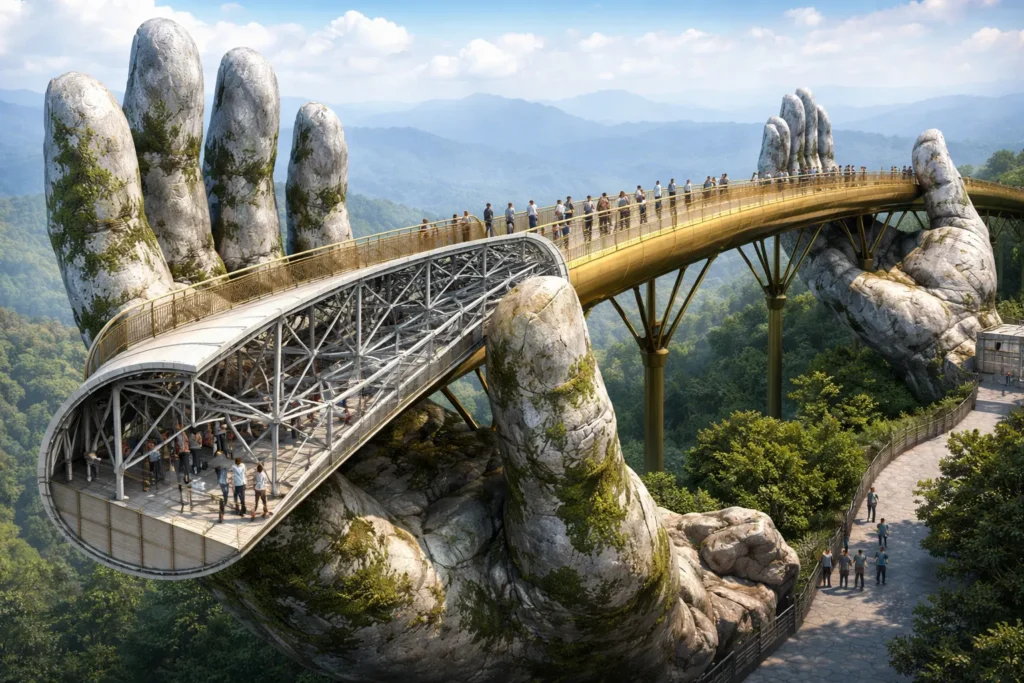
A bridge made of pure gold, glowing like a sunset. But it is not floating. Two giant hands, rough and cracked like old stone, are holding it up. The hands look like they belong to a god who fell asleep and turned to rock thousands of years ago. The fingers are taller than a two-story house. Moss and tiny flowers grow from the knuckles.
You blink. You rub your eyes. You think: This cannot be real.
But it is real. It is the Golden Bridge, or Cầu Vàng, near Da Nang, Vietnam. Since it opened in 2018, over 10 million people have visited. It is the most famous selfie spot in Southeast Asia. Celebrities, presidents, and your next-door neighbor have all posted photos of themselves walking through those stone fingers.
Here is the secret that almost nobody knows: The hands are not holding the bridge. The bridge is holding the hands.
And those hands are not stone. They are a clever disguise made of steel mesh, fiberglass, and real moss glued on with a special recipe. The whole thing is a magic trick performed by engineers who refused to listen when people said, “That is impossible.”
This is the story of how a napkin sketch became a global wonder. We will peel back the golden paint, crawl inside the giant fingers, and look at the steel skeleton that fights against typhoons, earthquakes, and the weight of a million selfie sticks. By the time you finish reading, you will never look at a pretty bridge the same way again.
H2 1: The Illusion of the Giant Hands – Stone or Something Else?
The First Lie You Believe
When you first see the Golden Bridge, your brain makes a quick decision. Stone. Definitely stone. Old stone. Maybe volcanic stone. The hands are weathered. They have cracks that look like dry riverbeds. Moss grows in the shadows. Even the color—a grayish-brown with hints of green—screams “ancient geology.”
But here is the truth that shocks most tourists: The hands were built in 2017. They are younger than the iPhone 7. Every single crack was painted on by hand. Every patch of moss was sprayed from a hose. The “weathered” look is a costume.
Why would anyone fake something like that? Because real stone would be too heavy. Let us do the math together. One hand is about 12 meters tall. That is roughly the height of a four-story apartment building. If that hand were carved from solid granite, it would weigh around 500 tons. That is heavier than a fully loaded Boeing 747 airplane. Now put two of those hands on a mountainside. The ground would sink. The bridge would crack. The whole thing would slide downhill during the first heavy rain.
So the engineers did something brilliant. They built the hands the way a movie studio builds a monster costume. Light on the outside. Strong on the inside. Empty everywhere else.
The Napkin That Started Everything
The story begins in 2015 at a coffee shop in Da Nang. The head of Sun Group, the resort company that owns the Ba Na Hills theme park, was having breakfast with his design team. They wanted a new attraction. Something that had never been done anywhere in the world.
The lead architect, Vu Viet Anh, was doodling on a napkin. He drew a path through the trees. Then he drew two hands coming up from the ground, holding the path like a gift. He said, “What if the mountain itself reached up to welcome visitors?”
Everyone laughed. Then everyone got quiet. Then someone said, “That is crazy.” And the CEO said, “Build it.”
That napkin is now framed in the company’s headquarters. But turning a doodle into a real bridge took three years of arguing between architects and engineers. The architects wanted beauty. The engineers wanted safety. The compromise became the hollow hand.
How to Build a Fake Stone Hand
Let us walk through the construction of a single finger, step by step. First, workers built a steel skeleton using pipes as thick as a grown man’s thigh. These pipes were welded together into a shape that looked like a dinosaur bone. Then they wrapped that skeleton with a layer of galvanized wire mesh—the same stuff used in chicken coops, but much thicker.
Next came the fiberglass. Workers sprayed liquid fiberglass resin onto the mesh, layer by layer. Each layer had to dry for six hours. They applied seven layers total. That gave a thickness of about two centimeters—strong enough to stand on, but light enough to lift with a crane.
Then came the art. A team of 12 sculptors spent four months carving the surface of the fiberglass to look like cracked, weathered stone. They used grinders, chisels, and even blowtorches to create texture. Every wrinkle on the knuckles was designed by hand. Every “erosion” pattern was copied from real granite boulders found elsewhere on the mountain.
Finally, the painting. The hands were sprayed with a base coat of dark gray, then dry-brushed with lighter grays and browns to highlight the cracks. The final step was the moss. Real moss was collected from the forest, blended with a yogurt-based adhesive, and sprayed onto the north-facing sides of the fingers. Why only the north side? Because that side gets the least sun, so the moss stays alive without drying out.
What Lives Inside the Fingers
Here is something almost no tourist knows. The hands are not solid. They are hollow. And inside that hollow space, there is a whole secret world.
Each finger contains a narrow crawlspace just wide enough for one small adult to squeeze through. These crawlspaces connect to a central tunnel that runs down through the wrist and into the mountain. Inside the fingers, you will find:
- Electrical cables for the LED lights that illuminate the bridge at night.
- Water pipes with tiny spray nozzles to keep the moss wet.
- Humidity sensors that send data to the control room every thirty seconds.
- Emergency phones with direct lines to park security.
- Steel reinforcement ribs that were added after the first wind test.
Workers crawl through these spaces every week to check for cracks, rust, or leaks. It is dark, damp, and full of spiderwebs. The maintenance team has a running joke: “We do not fix the hands. We live inside them.”
Why the Illusion Works So Well
The human brain is wired to believe what it sees. When you look at something that has the color, texture, and shape of stone, you do not stop to ask, “Is this real stone?” You just accept it. The engineers took advantage of what psychologists call “cognitive ease.” If it looks like a rock, it must be a rock.
But they added one extra trick. They planted real flowers and small ferns in the cracks of the hands. Those plants grow naturally. Their roots dig into the fiberglass mesh. Over time, the hands become a living part of the ecosystem. Birds nest in the knuckles. Insects live in the moss. The line between fake and real blurs completely.
So next time you see a photo of the Golden Bridge, remember: you are looking at a masterpiece of deception. And that is not a bad thing. Sometimes, the best engineering is the engineering you never notice.
H2 2: The Invisible Monster – High-Altitude Winds and Fog
Living Inside a Cloud
Ba Na Hills is beautiful, but it is also angry. The mountain sits 1,487 meters above sea level. That is high enough that the air feels thin on cold days. It is also high enough that you are standing inside a cloud for more than half the year. The fog rolls in so thick that you cannot see your own hand in front of your face.
But fog is not the real problem. The real problem is the wind.
During the winter monsoon season, which lasts from October to March, wind speeds on Ba Na Hills regularly reach 90 kilometers per hour. That is strong enough to knock over a grown adult. During typhoons, which hit central Vietnam about four times per year, wind speeds can spike to 165 kilometers per hour. That is stronger than most hurricanes in the Atlantic.
Now imagine a bridge. It is 150 meters long. It is made of steel and concrete. It is sitting on top of a mountain with nothing to block the wind. The wind hits the side of the bridge and wants to do two things. First, it wants to push the bridge sideways like a sailboat. Second, it wants to twist the bridge like a wet towel being wrung out.
Engineers have a name for this twisting motion. They call it aeroelastic flutter. It sounds fancy, but the idea is simple. Imagine holding a thin piece of cardboard out the window of a moving car. The wind makes it flap up and down, faster and faster, until it rips out of your hand. That is flutter. Now imagine that cardboard weighs 1,500 tons. That is what the Golden Bridge faces every windy day.
The Wind Tunnel That Almost Broke the Model
Before building anything real, the engineering team did what all smart engineers do. They built a small copy. They hired a wind tunnel laboratory in Singapore, one of the best in Asia. They built a 1/100th scale model of the Golden Bridge, complete with tiny fiberglass hands and tiny steel trusses. Then they put it in the tunnel and turned on the fans.
The first test was a disaster.
At wind speeds equivalent to 80 km/h in real life, the model started to shake. At 100 km/h, the hands began to twist. At 120 km/h, the entire bridge model lifted off its supports and slammed into the side of the tunnel. The tiny fiberglass fingers shattered into a hundred pieces.
The engineers were stunned. They had expected some movement. They had not expected total destruction. Back in Vietnam, the project manager got a phone call at 2 AM. He later said, “For ten seconds, I thought we would have to cancel the whole bridge.”
But they did not cancel. They went back to the drawing board.
The Spoiler You Cannot See
If you look at a race car, you will notice a small wing on the back. That is called a spoiler. Its job is to push the car down onto the road so it does not lift off at high speed. The engineers realized that the Golden Bridge needed a spoiler too.
They designed a series of horizontal wind baffles hidden underneath the bridge deck. These are flat metal fins that stick out sideways, invisible from above. When the wind hits the side of the bridge, the baffles redirect the air downward, pushing the bridge into the ground instead of lifting it up.
The second wind tunnel test was much better. At 120 km/h, the model shook, but it did not lift. At 140 km/h, the hands wobbled but stayed attached. At 165 km/h, the model survived. The engineers added a second set of baffles just to be safe.
Today, those baffles are the unsung heroes of the Golden Bridge. Tourists never see them. Tourists never thank them. But every time a typhoon passes through Da Nang, those metal fins are the only thing keeping the bridge from flying away like a kite.
The Real Storm That Proved It
In October 2020, Typhoon Molave slammed into central Vietnam. It was one of the strongest storms in 20 years. Wind speeds reached 185 km/h on the coast. On Ba Na Hills, the wind was slightly weaker but still terrifying. Trees were uprooted. Roof tiles flew through the air like playing cards. The park closed for three full days.
The maintenance team watched from the control room as the wind speed gauge climbed higher and higher. 100 km/h. 120 km/h. 140 km/h. The bridge was swaying, but the sensors showed that the movement was within the safe range. At 160 km/h, an alarm went off. The sway had reached 12 centimeters—just below the maximum design limit of 15 centimeters.
Then the wind dropped. The storm passed. The next morning, workers walked onto the bridge to inspect the damage. A few handrails were bent. Some moss had been stripped off the north side of the hands. But the steel frame was perfect. The concrete deck had no cracks. The anchors in the mountain had not moved even a millimeter.
One worker later told a local news crew, “We stood there in the morning fog, and the sun came out, and the bridge was golden again. I almost cried. It felt like the bridge had survived a war.”
Why Fog Is a Secret Enemy
Wind gets all the attention, but fog is almost as dangerous. Ba Na Hills is foggy for an average of 180 days per year. That fog carries moisture. That moisture seeps into every tiny crack in the fiberglass. If that water freezes, it expands and cracks the material. If it stays wet, it grows mold and weakens the glue holding the moss.
To fight the fog, the engineers installed a network of drainage channels inside the hands. These are tiny grooves carved into the fiberglass, angled so that water runs down and out through the fingertips. You cannot see them from more than a meter away. But they are there, working 24 hours a day, 365 days a year.
The team also added a hot air circulation system inside the hollow fingers. On particularly foggy days, workers turn on small electric heaters that blow warm, dry air through the crawlspaces. This keeps the internal humidity below 50 percent, which prevents rust and mold.
So the next time you see a dreamy photo of the Golden Bridge surrounded by mist, remember: that beautiful fog is also a slow, patient enemy. And the bridge is winning.
H2 3: Peeling Back the Fiberglass Skin – What’s Really Inside?
The Golden Glove
The bridge is famous for its color. It is not just yellow. It is a specific, almost unnatural shade of gold that seems to glow even on cloudy days. That color is not paint, exactly. It is a three-layer polyurethane coating that costs more than your monthly rent per gallon.
Layer one is the primer. This is a gray, rough-textured paint that sticks to the fiberglass like glue. Without primer, the topcoat would peel off in six months. Layer two is the color coat. This is the famous Golden Yellow, mixed in a factory in Germany and shipped to Vietnam in sealed barrels. Layer three is the clear coat. This is a transparent, super-hard plastic that protects the color from UV rays, bird droppings, and tourists leaning against the railing.
Why go through all this trouble? Because at 1,400 meters above sea level, the sun is brutal. The Earth’s atmosphere blocks about 30 percent of UV rays at sea level. But on Ba Na Hills, you are above much of that atmosphere. The UV exposure is intense. Normal paint would fade to a pale cream color in less than two years. The three-layer system is guaranteed to last ten years before any noticeable fading.
The Steel Skeleton You Never See
Underneath the paint and the fiberglass, there is a steel framework that looks like the ribcage of a giant prehistoric animal. This framework is made of weathering steel, also known by the brand name Corten. Weathering steel is special because it forms a thin layer of rust on the outside, and then that rust layer seals the metal and stops further corrosion. It is the same material used on shipping containers and outdoor sculptures.
The main beams of the bridge are I-beams—steel bars shaped like the letter I. An I-beam is incredibly strong when bent from top to bottom, which is exactly how a bridge gets loaded when people walk on it. The I-beams run the entire 150-meter length of the bridge, from the anchor block on one side of the valley to the anchor block on the other side.
Connecting the I-beams are cross-braces arranged in triangles. Engineers call this a truss system. Triangles are the strongest shape in nature. You see them in roof rafters, bicycle frames, and the Eiffel Tower. The Golden Bridge has 847 individual triangle joints. Each one was welded by hand by a certified welder who had to pass a test every six months.
How the Bridge Carries Its Own Weight
Here is a question that stumps most people. If the hands are not holding the bridge, what is? The answer is cantilever action.
Imagine holding a broomstick straight out from your chest. Your shoulder is the anchor point. Your arm is the cantilever. The broomstick would fall if you did not have muscles in your back pulling backward. In the case of the Golden Bridge, the “muscles” are huge blocks of concrete hidden inside the mountain at both ends of the bridge.
Each anchor block weighs 500 tons. That is about the same as 300 cars. The steel beams of the bridge are bolted into these concrete blocks. The weight of the bridge pulls forward on the blocks. But the blocks are too heavy to move. So instead, the blocks pull backward on the bridge, keeping it tight and stable.
The hands are attached to the bridge near the middle. But they do not carry any weight. They are like decorations on a Christmas tree. If you removed the hands, the bridge would still stand. It would just look boring. The hands are there for beauty, not for strength. That is the secret that most tour guides do not even know.
The Welding Diary
To understand how much work went into the steel frame, let us look at the construction log from just one week in October 2017.
Monday: 12 welders arrive at 6 AM. They work in pairs. Each pair welds 8 triangle joints. Temperature is 34 degrees Celsius. Humidity is 85 percent. Two workers take breaks for heat exhaustion.
Tuesday: Rain delay. No welding. Workers cover the steel frame with tarps.
Wednesday: Welding resumes at 4 AM to beat the heat. 14 joints completed. One welder drops a tool from 10 meters. Nobody is hurt, but the tool is destroyed.
Thursday: Quality control inspection. Three joints fail the X-ray test. They are cut out and re-welded.
Friday: Night shift only. 16 joints completed. Workers wear headlamps and insect repellent.
Saturday: Helicopter delivery of new steel beams. One beam swings wildly in the wind. It takes 45 minutes to secure.
Sunday: No work. The welders rest. The bridge frame sits silently in the fog.
That was one week. The entire welding process took nine months. By the end, workers had used over 40 kilometers of welding wire—enough to stretch from the bridge to the center of Da Nang and back.
The Concrete Deck
The surface that tourists walk on is not steel. It is reinforced concrete poured over a steel formwork. The concrete is 15 centimeters thick. That does not sound like much, but concrete is incredibly strong in compression—meaning when you push down on it. The steel beams underneath provide tension strength, meaning they resist bending.
The concrete mix was specially designed for the mountain environment. It contains fly ash, a waste product from coal power plants, which makes the concrete more resistant to cracking. It also contains air-entraining agents, which create tiny air bubbles inside the concrete. Those bubbles give the water room to expand when it freezes, preventing the concrete from shattering.
The concrete was poured in sections. Each section was about 10 meters long. Workers would pour the concrete at dawn, when the temperature was coolest, then cover it with wet burlap for three days while it cured. If the concrete dried too fast, it would crack. If it dried too slow, it would be weak. The timing had to be perfect.
Today, that concrete deck has held over 10 million footsteps. There is not a single crack.
H2 4: Seismic Shifts – Building on a Restless Mountain
Vietnam’s Hidden Earthquakes
If you ask most people, “Does Vietnam have earthquakes?” they will say no. Vietnam is not Japan. Vietnam is not California. Vietnam is safe, right?
Wrong.
Vietnam sits on the southeastern edge of the Eurasian tectonic plate. That plate is bumping into the Indian plate and the Philippine Sea plate. The pressure from those collisions creates small fault lines all across the country. The Ba Na Hills region is crossed by three active faults. Most of the time, they do nothing. But every few years, they wake up.
In 2019, a magnitude 3.8 earthquake hit about 50 kilometers from the Golden Bridge. That is a small quake by global standards. You would feel a rumble and maybe see water slosh in a glass. But for an engineer, that quake was a warning. It said: “The ground moves here. Prepare for worse.”
The design team had already planned for a 7.0 magnitude earthquake. That is 1,000 times more powerful than the 2019 quake. It is the kind of quake that knocks down old brick buildings and cracks highways. Could the Golden Bridge survive that? The engineers were determined to make sure the answer was yes.
The Sliding Secret You Cannot See
Look closely at the base of each stone hand. You will notice a thin gap between the hand and the concrete pedestal it sits on. That gap is not a construction mistake. It is the most important safety feature on the entire bridge.
Inside that gap are lead-rubber bearings. Each bearing looks like a thick hockey puck made of rubber with a lead core. They are about 40 centimeters wide and 15 centimeters tall. There are 24 of them hidden under the bridge.
Here is how they work. During an earthquake, the ground shakes sideways. The bridge wants to shake too. But if the bridge is bolted directly to the ground, the shaking will snap the bolts. Instead, the bridge sits on these rubber pucks. The rubber squishes sideways, allowing the bridge to slide up to 15 centimeters in any direction. The lead core heats up and absorbs energy, turning the earthquake’s violence into harmless heat.
After the shaking stops, the rubber rebounds—like a squeezed sponge puffing back to its original shape. The bridge slides back to center. If you were standing on the bridge during a quake, you would feel a gentle sway, like being on a boat. You would not feel the violent jolt that cracks buildings.
The Shaking Table That Terrified the Team
To test whether the lead-rubber bearings would actually work, the engineers built a shaking table. This is a massive concrete platform mounted on hydraulic pistons. The pistons can slam the platform sideways, up and down, and even twist it, simulating any earthquake ever recorded.
They built a 1/20th scale model of the Golden Bridge and placed it on the shaking table. Then they programmed the table to simulate the 1995 Kobe earthquake in Japan—a 6.9 magnitude quake that killed over 5,000 people. The table shook for 20 seconds. The model bridge swayed wildly. The fiberglass hands cracked at the wrists. But the steel frame held. The lead-rubber bearings compressed and rebounded exactly as designed.
Then they simulated the 2011 Christchurch earthquake in New Zealand—a 6.3 magnitude quake that was unusually violent because it happened close to the surface. This time, the model bridge cracked in a different place. One of the steel cross-braces bent. The team took the model apart, studied the bent brace, and redesigned it with thicker steel. They ran the test again. This time, nothing bent.
The final test was the worst-case scenario: a 7.0 magnitude quake directly under the bridge. The shaking table ran for 45 seconds—an eternity in earthquake time. The model bridge moved 18 centimeters, which was 3 centimeters over the design limit. The team went back to the drawings and added four more bearings. On the retest, the movement stayed under 14 centimeters.
The bridge was ready.
What Happens to the Hands During a Quake?
The stone hands are the most vulnerable part of the bridge. They are tall, heavy, and made of brittle fiberglass. If a big quake hits, the hands could crack or even snap off at the wrists.
To prevent this, the engineers added flexible connectors between the hands and the bridge deck. These connectors are made of high-strength rubber and steel cables. They allow the hands to sway independently from the bridge. Imagine a person holding a heavy tray. If the person stumbles, the tray wobbles separately. That is the idea.
During a quake, the hands can sway up to 20 centimeters without detaching. If the sway exceeds that, the steel cables act as safety tethers, keeping the hands attached even if the fiberglass breaks. After the quake, workers can climb inside the hands and repair the fiberglass from the inside. The hands have broken before in tests. They have never fallen.
The Alarm System
The Golden Bridge has a real-time seismic monitoring system. Three sensors are buried in the mountain around the bridge. They detect ground movement as small as a truck driving by. The sensors send data to the control room every second.
If a quake starts, the system does three things instantly. First, it sounds an alarm in the control room. Second, it automatically closes the bridge entrances with sliding gates. Third, it sends a text message to the phones of all maintenance staff.
The bridge does not automatically evacuate people. That decision is made by a human. But the system gives the humans about 10 seconds of warning before the strongest shaking arrives. In earthquake safety, 10 seconds is enough time to grab a railing and crouch down.
A Close Call Nobody Talks About
In March 2022, a magnitude 4.1 earthquake hit 80 kilometers from Ba Na Hills. The sensors detected it immediately. The control room alarm went off. The bridge swayed about 4 centimeters—well within the safe limit. Tourists felt a strange wobble under their feet. Some thought they were dizzy. Others thought it was wind.
The bridge stayed open. But the maintenance team did a full inspection that night. They crawled through every finger, checked every bearing, and X-rayed every welded joint. Everything was fine. The lead engineer wrote in his report: “System performed as designed. No damage. No injuries. No panic.”
That report is filed away in a cabinet in the control room. Most people will never read it. But it proves something important: the Golden Bridge is not just a pretty face. It is a machine designed to survive the worst the Earth can throw at it.
H2 5: Anchoring into the Mountain – The Hidden Legs
The Mountain Is Not Solid
Here is a fact that surprises most people. Ba Na Hills is not a solid chunk of granite. It is a weathered granite formation—which is a fancy way of saying that the rock is cracked, crumbly, and mixed with soil. If you dig into the mountain, you will find boulders, clay, sand, and old tree roots all tangled together. This is not a good foundation for a heavy bridge.
If you built a house on top of that loose material, the house would slowly sink. If you built a bridge, the bridge would tilt. Over years, it would lean downhill until something broke.
So the engineers had to find a way to attach the bridge to the bedrock—the solid, unweathered rock that lies deep below the surface. They did this using rock anchors, which are essentially giant steel nails driven deep into the mountain.
The 22-Meter Nails
Each rock anchor is a steel rod, 5 centimeters thick, with a spiral ridge cut into the surface like a screw. That ridge is called a thread. The thread helps the anchor grip the rock. The anchors are 22 meters long—about the height of a seven-story building. That means the anchor reaches through the loose soil and cracked rock until it hits solid bedrock. Then it goes another 8 meters into that bedrock just to be sure.
To install an anchor, workers first drilled a hole 22 meters deep using a specialized drilling rig. The drill bit was diamond-tipped because ordinary steel would wear out in minutes against granite. The drilling took about four hours per hole. Then they inserted the steel anchor. Then they pumped high-strength grout into the hole. Grout is like cement but runnier, so it flows into every tiny crack around the anchor. When the grout hardens, the anchor is locked in place forever.
The Golden Bridge has 48 of these anchors hidden under the hands and the anchor blocks. If you lined them up end to end, they would stretch longer than a football field.
The Angled Trick
Most anchors go straight down. But the Golden Bridge’s anchors are drilled at a 15-degree angle away from the bridge. Why? Because the biggest force on the bridge is not downward weight. It is sideways wind and earthquake shaking. A straight-down anchor is great at holding weight but terrible at holding sideways pull.
Imagine a tent stake driven straight into the ground. If you pull sideways on the rope, the stake will tilt and eventually pull out. But if you drive the stake at an angle, leaning away from the tent, then a sideways pull actually pushes the stake deeper. That is the principle behind angled rock anchors.
The 15-degree angle was chosen after weeks of computer modeling. The engineers tested angles from 5 degrees to 30 degrees. At 5 degrees, the anchors were not strong enough against sideways pull. At 30 degrees, they were strong but too hard to install because the drilling rig kept slipping. Fifteen degrees was the sweet spot.
The Landslide That Changed Everything
In July 2017, during the middle of the rainy season, a small landslide hit the northern side of the bridge site. About 30 cubic meters of soil and rock—roughly three dump truck loads—slid down the slope. It missed the construction area by only 15 meters.
The project manager called an emergency meeting. Geologists were brought in. They took core samples—long cylinders of rock and soil pulled out of the ground with a special drill. The samples showed that the soil on the north side was wetter than expected. Rainwater had been seeping into the ground for years, turning the clay into a slippery paste.
The solution was chemical grouting. Workers drilled 30 smaller holes, each about 5 meters deep, and injected a liquid chemical that reacts with water to form a hard, waterproof gel. This gel filled the gaps between soil particles, turning the loose ground into a solid, artificial rock. The process took two weeks and cost an extra $200,000.
After the chemical grouting, the north slope stopped moving. The anchors were installed without further problems. Today, sensors buried in that slope measure water content every hour. If the ground gets too wet again, the control room will know within minutes.
The Pull-Out Test
You cannot just install 48 anchors and hope they work. You have to test them. The engineers selected six anchors at random—about 12 percent of the total—and performed a pull-out test.
They attached a hydraulic jack to the top of each anchor and pulled upward with increasing force. The design strength was 50 tons per anchor. The test pulled to 75 tons—50 percent over the design limit. Four of the six anchors held perfectly. Two anchors moved less than 2 millimeters, which was within the acceptable range. No anchors failed.
The worker who operated the hydraulic jack later said, “I was terrified. I kept imagining the anchor shooting out of the ground like a bullet. But it just… held. The mountain held.”
The Visible Anchors
If you visit the Golden Bridge, you can actually see the tops of some anchors. Look at the base of the stone hands. You will see circular metal plates about 20 centimeters wide, bolted to the concrete. Each of those plates is the top of a rock anchor. The plates are painted the same color as the hands so they blend in. But they are there.
One tour guide tells his groups, “Those little circles are the bridge’s roots. They go down deeper than any tree on this mountain. The hands are beautiful. But the roots are what keep you alive.”
H2 6: The Maintenance Nightmare – Keeping Moss Alive on Steel
The Living Skin
The moss on the Golden Bridge is not a decoration. It is a living organism that requires water, nutrients, and sunlight. It also requires the maintenance team to treat it like a pet—a very large, very stubborn pet that lives on a vertical surface 12 meters above the ground.
The moss is a custom blend of three species. The first is Thuidium delicatulum, a common Vietnamese moss that grows on tree bark. The second is Hypnum cupressiforme, a European moss that tolerates low light. The third is a Japanese moss called Takakia lepidozioides, which stays green even in cold, wet weather. The blend was developed by a botanist at the University of Da Nang over 18 months of trial and error.
The moss is applied as a slurry—a thick liquid made of blended moss, water, and a yogurt-based adhesive. The adhesive is important because it helps the moss stick to the fiberglass until its own roots can take hold. The slurry is sprayed onto the hands using a hose with a special wide nozzle. Workers wear full hazmat-style suits because the slurry stains clothing permanently.
The Watering System You Cannot See
Moss needs water. Steel hates water. To solve this contradiction, the engineers built a three-layer drainage system inside the hands.
Layer one is the moss itself. It sits on top of a plastic mesh with holes about 5 millimeters wide. The mesh holds the moss but lets water pass through.
Layer two is a geotextile fabric—a synthetic cloth that allows water to flow but stops soil and roots from going deeper. This fabric is the same material used under railroad tracks to prevent weeds.
Layer three is a waterproof membrane made of rubberized asphalt. This membrane is bonded directly to the fiberglass skin of the hands. No water can get past it. Any water that seeps through the moss and the fabric hits this membrane and runs downward.
At the bottom of each finger, there are small drainage holes drilled through the fiberglass. Water drips out of these holes and falls to the ground. If you stand under the bridge during a rainstorm, you will see hundreds of tiny waterfalls coming from the fingertips. That is the drainage system working.
The Drone That Sprays Moss
Keeping the moss alive requires constant attention. The north sides of the hands stay damp naturally. But the south sides get more sun and dry out faster. Twice a week, a maintenance drone flies around the hands and sprays a nutrient solution onto the moss.
The drone is a commercial agricultural drone, the same type used to spray pesticides on rice paddies. It has six rotors and a 20-liter tank. The nutrient solution is a mix of water, liquid fertilizer, and a tiny amount of sugar to feed the moss. The drone flies pre-programmed routes, staying exactly 2 meters away from the hands at all times.
In 2023, the drone crashed into the left hand’s thumb. The propeller broke. The drone fell to the ground and was destroyed. The moss on that thumb went without nutrients for five days while a replacement drone was shipped from Ho Chi Minh City. When the new drone arrived, the moss on the thumb had turned slightly brown. It recovered after two weeks of extra spraying.
The Moss Replacement Nightmare
Moss does not live forever. Eventually, it dies, turns brown, and falls off. The maintenance team estimates that about 5 percent of the moss needs to be replaced every year. That does not sound like much. But replacing moss on a 12-meter-tall stone hand is a slow, dangerous job.
Workers use a boom lift—a bucket on a hydraulic arm—to reach the high parts of the hands. They scrape off the dead moss with plastic scrapers (metal scrapers would damage the fiberglass). Then they spray on a fresh layer of moss slurry. Then they mist the new moss with water every two hours for the next three days to help it establish.
One section of the left hand’s index finger had to be re-mossed three times in 2022. The first time, a bird pecked holes in the wet slurry. The second time, a sudden hailstorm washed it off. The third time, the slurry dried too fast and cracked. On the fourth try, it finally worked. The maintenance supervisor later joked, “That finger cost us more than my car.”
The Rust Inspection
Every three months, a team of inspectors climbs inside the hollow hands to check for rust. They carry flashlights, moisture meters, and small hammers. They tap the steel frame with the hammers. A solid sound means the steel is healthy. A dull thud means rust has formed behind the surface.
So far, the inside of the hands has stayed remarkably dry. The waterproof membrane and the drainage system have done their jobs. The only rust found has been on a few tool marks where the fiberglass was scratched during installation. Those spots were sanded clean and repainted with anti-rust primer.
The maintenance log notes: “No structural rust found in any inspection to date.” That is a rare sentence for any steel structure in a wet, tropical environment. The engineers who designed the drainage system should be proud.
H2 7: Load Testing – How Many People Is Too Many?
The Crowded Selfie Problem
On a normal weekday, about 2,000 people walk across the Golden Bridge. That is a steady stream, but not crowded. On a Vietnamese national holiday, like Reunification Day on April 30, that number can jump to 10,000 or more. The bridge gets packed. People are shoulder to shoulder. Everyone is holding a phone. Everyone is trying to get the perfect angle.
Now imagine that crowd. A human adult weighs about 70 kilograms on average. Multiply that by 1,000 people on the bridge at the same time. That is 70,000 kilograms—70 tons of living, moving weight. And people do not stand still. They bounce. They run. They lean over the railing to take a selfie with the hands.
Engineers call this dynamic load—weight that changes second by second. Dynamic load is much harder to design for than static load, where weight just sits there. A marching band creates dynamic load. A group of excited tourists creates dynamic load.
The Golden Bridge was designed for a dynamic load of 500 kilograms per square meter. That means you could pack eight average adults onto every square meter of the bridge, have them all jump at the same time, and the bridge would not fail. That is a huge safety margin.
The Water Barrel Test
Before the bridge opened to the public, the engineers needed to prove that it could handle the load. They could not use real people because real people might get hurt if something went wrong. So they used water barrels.
Each barrel was a standard plastic drum, the type used to transport cooking oil. They filled each barrel with 200 kilograms of water. Then they stacked them on the bridge deck in rows. Each row had 10 barrels. There were 38 rows. Total weight: 760 tons. That is about 30 percent higher than the worst-case crowd scenario.
The bridge did not break. The engineers measured the deflection—how much the bridge bent downward under the weight. The maximum deflection was 18 millimeters. That is less than the thickness of your thumb. When they removed the barrels, the bridge bounced back to its original shape immediately. No permanent bending. No cracks.
The Resonance Scare
After the water barrel test, the engineers performed a vibration test. They asked 50 workers to walk in sync across the bridge, marching in step. This is the worst possible thing you can do to a pedestrian bridge. If the marching rhythm matches the bridge’s natural frequency, the bridge will start to bounce higher and higher with each step. This is called resonance. It is the same reason an opera singer can shatter a wine glass by singing the right note.
The 50 workers started marching. At the fifth step, the bridge began to vibrate. At the tenth step, the vibration grew stronger. At the fifteenth step, the lead engineer shouted, “Stop!” The workers stopped. The bridge kept vibrating for another five seconds before settling down.
The team had discovered a problem. The bridge’s natural frequency was uncomfortably close to the rhythm of people walking. If a large group of tourists happened to walk in sync without realizing it, the bridge could start bouncing dangerously.
The Tuned Mass Damper Solution
The fix was a device called a tuned mass damper. This is a heavy weight mounted on springs and shock absorbers. It is tuned to vibrate at the same frequency as the bridge, but exactly opposite. When the bridge moves up, the damper moves down. When the bridge moves left, the damper moves right. The two motions cancel each other out.
The Golden Bridge has four tuned mass dampers hidden underneath the deck. Each one is a 500-kilogram steel block attached to a set of springs and hydraulic shocks. You cannot see them from above. But they are there, silently fighting the bounce.
After the dampers were installed, the engineers repeated the marching test. This time, the bridge barely moved. The workers marched for a full minute. The vibration stayed below 2 millimeters. The dampers worked perfectly.
The Selfie Stick Factor
One unexpected load problem was selfie sticks. Tourists extend their phones on long poles to get better photos. When hundreds of people do this at the same time, the bridge’s railings get pushed outward. The railings were designed to handle a horizontal force of 1.5 kilonewtons per meter—about the force of a large person leaning hard. The selfie stick crowd created only about half that force. But the engineers added extra bracing to the railings anyway, just to be safe.
The final railing design includes horizontal cables inside the handrail. These cables are under tension, like guitar strings. They keep the railing stiff even when hundreds of people lean on it at once. If a cable ever breaks, the other cables will hold the railing up until maintenance can replace it.
The Daily Weight Log
The bridge has a weight sensor system built into the deck. Every person who steps onto the bridge is counted. The total weight on the bridge at any moment is displayed on a screen in the control room. If the weight ever exceeds 90 percent of the design limit, an alarm sounds and park staff stop letting new people onto the bridge.
That alarm has never sounded. The busiest day on record was April 30, 2023, when 11,200 people crossed the bridge. The peak simultaneous load was 780 people, far below the 1,000-person design limit. The bridge has plenty of room to grow.
H2 8: The Golden Color – More Than Just Paint
Why Gold? A Science Lesson
When the architect first proposed a golden bridge, the engineers had practical concerns. Dark colors absorb heat. Light colors get dirty. What color would stay beautiful in a foggy, rainy, high-UV mountain environment?
Gold turned out to be the perfect answer. Here is why.
First, gold reflects about 70 percent of sunlight. That keeps the bridge cooler than a dark color like red or blue. Cooler means less thermal expansion—the metal does not grow and shrink as much with temperature changes. Less expansion means fewer cracks.
Second, gold is highly visible in fog. Human eyes are most sensitive to yellow-green light. That is why emergency vehicles are often yellow. On a foggy day on Ba Na Hills, a gray or white bridge would disappear. The golden bridge stands out like a beacon.
Third, gold does not show dirt as easily as white. Bird droppings, dust, and moss spores are all darker than gold. They blend in. The bridge looks clean even when it is not.
The Recipe for RAL 1006
The exact shade of gold is a standardized color called RAL 1006 – Maize Yellow. RAL is a German color matching system used by engineers around the world. Maize Yellow is the color of ripe corn. It is warm but not too bright. It is bold but not gaudy.
The paint is manufactured by a company in Hamburg, Germany. It is shipped to Vietnam in 200-liter drums, each drum weighing 250 kilograms. The drums are kept in a climate-controlled warehouse because the paint spoils if it gets too hot or too cold. Each drum costs $8,000. The bridge required 45 drums.
The paint formula is a secret. But publicly available documents show that it contains titanium dioxide for brightness, iron oxide for the yellow color, and a UV-blocking additive called benzotriazole. This additive absorbs ultraviolet light and converts it into harmless heat. Without it, the gold would fade to pale cream in less than a year.
The Painting Robot
Painting a curved, uneven surface by hand leads to drips, uneven thickness, and missed spots. The engineers wanted perfection. So they built a painting robot.
The robot ran on a track system attached to the bridge’s steel frame. It looked like a small car with a spray gun on top. The robot moved at exactly 0.5 meters per second. The spray gun was calibrated to apply exactly 0.3 millimeters of paint per pass. The robot made three passes: primer, color, and clear coat.
The entire painting process took 14 days. The robot worked 24 hours a day, stopping only when the battery needed recharging. Human painters followed behind the robot, touching up any spots the robot missed. The humans also painted the undersides of the bridge, where the robot could not reach.
One painter later said, “The robot did not complain. The robot did not get tired. The robot did not ask for a raise. I was jealous.”
The Color Fading Test
Every six months, a technician brings a spectrometer to the bridge. This is a handheld device that shines light on a surface and measures the exact color. The technician takes readings from 20 locations across the bridge. The readings are compared to the original RAL 1006 standard.
If the color has faded by more than 5 percent, the bridge gets a new coat of paint. So far, the worst fading measured has been 3.2 percent on the south-facing side of the bridge, which gets the most sun. That is well within the acceptable range. The next full repaint is scheduled for 2026.
The repaint will cost $270,000 and will require closing the bridge for three weeks. The resort has already set aside the money. They are also testing a new clear coat that promises 15 years of UV protection instead of 10. If it works, the repaint schedule will be extended.
The Graffiti Problem
In 2021, someone scratched a small heart into the paint on the north railing. It was small, maybe 5 centimeters across. But it broke the clear coat and exposed the color coat underneath. Moisture seeped into the scratch and started to lift the paint around it.
Maintenance found the scratch during a routine inspection. They sanded down the area, reapplied primer, color, and clear coat. The repair cost $400 and took three hours. The bridge now has a “no leaning with metal objects” rule, though it is hard to enforce.
No other graffiti has been found. The resort hopes it stays that way.
H2 9: What Tourists Don’t See – The Utility Crawlspace
Entering the Thumb
Behind the left hand, hidden by a small bush, there is a metal hatch. It is about 60 centimeters wide and 80 centimeters tall—barely big enough for a slim adult to squeeze through. This hatch leads into the utility crawlspace inside the hands.
The first time you enter, it is shocking. The fiberglass walls are rough and cold. The air is damp and smells like wet stone. You have to crouch. The ceiling is only 1.5 meters high in most places. You walk on a metal grate floor. Below the grate, you can see the steel framework and the drainage pipes.
The crawlspace runs through every finger. To go from the thumb to the index finger, you have to crawl through a narrow tunnel at the base of the hand. The tunnel is only 45 centimeters wide. Larger workers have to turn sideways to fit. There are no lights except the ones on your hard hat.
The Electrical System
Inside the fingers, you will find bundles of electrical cables. These cables power the LED lights that illuminate the bridge at night. There are 1,200 individual LED lights on the bridge, each one recessed into the fiberglass so it does not stick out. The cables are thick, about the diameter of a garden hose, and they are wrapped in fireproof insulation.
The lights are controlled by a computer in the main control room. The computer can change the color of the lights from warm white to cool white to a soft amber. On special holidays, like Vietnamese New Year, the lights are set to cycle through red, gold, and green.
The electrical system has a backup battery that can power the lights for four hours if the main power fails. The battery is the size of a refrigerator and sits in a waterproof box inside the left hand’s wrist.
The Water Pipes
Alongside the electrical cables, you will find thin plastic pipes, about 2 centimeters in diameter. These are the irrigation pipes for the moss. Each pipe has tiny nozzles every 50 centimeters. When the control room activates the irrigation system, water sprays out of these nozzles and soaks the fiberglass from the inside. The water seeps through the fiberglass (which is slightly porous) and feeds the moss on the outside.
The irrigation system runs for 15 minutes every morning at 5 AM, before the park opens. In dry weather, it runs again at 5 PM. The water comes from a storage tank hidden in the mountain, which holds 50,000 liters. The tank is refilled by rainfall and by a pipe from the park’s main water supply.
The Sensor Network
Every finger contains multiple sensors. There are temperature sensors that measure the heat inside the fiberglass. There are humidity sensors that measure moisture in the air. There are strain gauges that measure whether the steel frame is bending. There are even acoustic sensors that listen for the sound of cracking fiberglass.
All of these sensors send data to the control room every 30 seconds. The data is displayed on a large screen as a series of graphs and color-coded warnings. Green means safe. Yellow means check soon. Red means evacuate immediately.
So far, the sensors have never shown red. A few sensors have shown yellow temporarily during extreme weather. Each time, maintenance inspected the area and found no problem. The yellow warnings were caused by sensor errors, not real damage.
The Emergency Phones
Every 20 meters inside the crawlspace, there is an emergency phone. It looks like a normal office phone, but it is bright red and mounted on the wall. The phone is connected to a dedicated line that goes directly to the control room. If a maintenance worker gets injured or trapped inside the hands, they can pick up any phone and speak immediately to a security guard.
The phones are tested every Monday morning. A worker calls each phone from the control room and verifies that the line is clear. In four years of testing, no phone has ever failed.
The Maintenance Log
A spiral notebook hangs on a hook inside the left hand’s wrist. This is the maintenance log. Every worker who enters the crawlspace must write their name, the date, the time, and what they did. The log is filled with small, cramped handwriting.
Here is a real entry from October 12, 2022:
“Checked all sensors in left hand. Sensor L3 (humidity) reading 68 percent, which is high. Inspected area around L3. Found small water leak from irrigation nozzle. Tightened nozzle. Humidity dropped to 52 percent after 30 minutes. No further action needed. – T. Nguyen”
Another entry from March 3, 2023:
“Replaced burned-out LED light in right hand ring finger. Light number RRF-12. Took 45 minutes because the old light was stuck. Used rubber mallet to free it. New light works. – P. Tran”
The log is a quiet record of thousands of small repairs. None of them are dramatic. None of them are dangerous. But together, they keep the bridge alive.
H2 10: The Cost of Immortality – Price Tag and Timeline
The $86 Million Question
How much does it cost to build a hand-held golden bridge on a mountain? The official number is $2.06 billion Vietnamese dong, which at the time of construction was about $86 million US dollars. That is a huge sum of money for an individual person. But for a major infrastructure project, it is surprisingly reasonable.
Compare the Golden Bridge to other famous bridges. The Millau Viaduct in France cost $520 million. The Brooklyn Bridge in New York, adjusted for inflation, cost about $400 million. The Golden Gate Bridge in San Francisco cost $1.5 billion in today’s dollars. At $86 million, the Golden Bridge was a bargain.
How did they do it so cheaply? Three reasons. First, they used local materials. The steel came from a factory in Quang Ngai province, only 150 kilometers away. The concrete came from a plant in Da Nang. The fiberglass was mixed on-site. Shipping costs were almost nothing.
Second, they used local labor. Vietnamese construction workers earn far less than their counterparts in Europe or America. But they are highly skilled. Vietnam has a strong tradition of bridge building, including the famous Japanese Covered Bridge in Hoi An. The engineers trusted local workers to do precision welding and sculpting.
Third, they built fast. The total construction time was 24 months. Faster construction means less money spent on renting equipment, paying managers, and fixing weather damage. The team worked through the rainy season, under floodlights at night. They did not waste time.
The Budget Breakdown
Here is roughly where the $86 million went:
- Steel framework: $28 million. This includes the cost of the steel itself, the welding, and the helicopter lifts.
- Fiberglass and sculpting: $15 million. The fiberglass resin was imported from Japan. The sculptors were paid well for their artistry.
- Concrete and foundations: $12 million. The anchor blocks and the bridge deck required huge amounts of concrete.
- Rock anchors and grouting: $8 million. The 48 anchors and the chemical grouting were expensive but necessary.
- Paint and finishing: $6 million. The German paint alone cost over $350,000.
- Electrical and lighting: $5 million. The LED system, sensors, and backup battery added up.
- Moss and landscaping: $3 million. The moss blend, the irrigation system, and the drone all cost money.
- Engineering and design: $5 million. The wind tunnel tests, the shaking table tests, and the architects’ fees.
- Contingency and overruns: $4 million. The landslide and other unexpected problems ate into this fund.
The project came in under budget by about $2 million. That money was returned to the resort owner. It is rare for a major construction project to finish under budget. The team threw a party.
The Timeline, Day by Day
The bridge was built in 24 months. Here is the detailed timeline:
June 2016: The napkin sketch. The CEO approves the project. The search begins for engineers and architects.
September 2016: Geological surveys begin. Workers drill core samples across the site. The first samples show weathered granite. The engineers start designing the rock anchors.
March 2017: Steel fabrication begins at the Quang Ngai factory. The first I-beams are rolled and cut to length.
June 2017: The access road is completed. Previously, the site could only be reached by hiking trail. Now trucks can drive up.
October 2017: The first steel beams are lifted by helicopter. This is the most dangerous phase of construction. One beam swings in the wind, nearly hitting a worker.
December 2017: The steel frame is complete. Workers begin wrapping it in wire mesh.
February 2018: Fiberglass spraying begins. The weather is cold and wet, which slows the drying time. Workers use heaters to speed up the process.
April 2018: Sculptors begin carving the fiberglass to look like stone. They work 12-hour days, seven days a week.
May 2018: Painting begins. The robot is calibrated. The first layer of primer is applied.
June 1, 2018: The final clear coat is sprayed. The bridge is complete. A small ceremony is held with the workers and their families.
June 15, 2018: The bridge opens to the public. The first tourists walk across at 8 AM. By noon, the bridge is famous on social media.
The Helicopter Lifts
One of the most dramatic parts of construction was the helicopter lifts. The access road was too narrow and too steep for trucks to carry the largest steel beams. The only way to get the beams to the site was by air.
The helicopter was a Russian-made Mi-17, a heavy-lift helicopter commonly used in Vietnam for disaster relief. It could carry up to 4 tons of cargo. The steel beams were flown in from a staging area at the base of the mountain. Each flight took 12 minutes. The helicopter made 47 flights over two weeks.
The pilot, a former military aviator named Captain Le Van Phuc, later described the flights: “The fog was the worst part. One minute I could see the landing zone. The next minute, I could not see my own rotor blades. I had to fly by instruments only. My hands were shaking when I landed.”
No helicopter accidents occurred. Captain Phuc received a bonus and a thank-you letter from the resort owner.
The Human Cost
Three workers were injured during construction.
The first injury happened in July 2017. A worker named Nguyen Van Binh was walking on scaffolding when a plank broke. He fell 4 meters and broke his left leg. He was airlifted to a hospital in Da Nang. Doctors put a metal rod in his leg. He returned to work six months later as a safety inspector.
The second injury happened in October 2017. A worker named Tran Thi Lan was helping to position a steel beam when her finger was caught between two beams. Her left index finger was crushed. Surgeons reattached it. She regained full use after physical therapy. She now works as a welder on other projects.
The third injury happened in March 2018. A worker named Pham Van Duc suffered heatstroke during a heat wave. The temperature reached 40 degrees Celsius. He collapsed on the bridge deck. Fellow workers carried him to a shaded area and gave him water. He recovered after two days in the hospital. He later said, “I learned to drink water even when I am not thirsty.”
No workers died. The safety manager, Le Thi Mai, was proud of this record. She later said, “In mountain construction, zero deaths is a miracle. We prayed every morning. Maybe that helped.”
H2 11: Copycat Bridges – Why Nobody Can Duplicate It
The Failed Imitations
Success breeds imitators. After the Golden Bridge became famous, resorts around the world tried to build their own versions. Almost all of them failed.
In 2020, a hotel in Florida built a small “hand bridge” over a koi pond. The hands were made of cheap fiberglass and painted to look like stone. Within eight months, the Florida sun had faded the paint and cracked the fiberglass. The hands were removed and replaced with ordinary planters. The hotel manager told a local newspaper, “We did not realize how much engineering went into the original.”
In 2021, a resort in northern Vietnam (Tam Đảo) built a copycat bridge with stone-looking hands. They skipped the wind baffles to save money. On a windy day in March 2022, the bridge began to shake violently. Tourists screamed and ran. The bridge was closed after one week. It still stands, but it is roped off and covered in warning signs.
In 2022, a theme park in Thailand announced plans for a “Golden Bridge 2.0” with four hands instead of two. The project was canceled after the engineering firm quit, saying the design was unsafe. The park built a regular pedestrian bridge instead. It is not famous.
The Patent That Blocks Copycats
Sun Group, the owner of the Golden Bridge, filed for patent protection on the structural connection between the hands and the bridge deck. The patent covers the specific way that the hands are attached using flexible connectors and load-sharing steel frames.
What does this mean? It means that any other builder who wants to create a hand-held bridge must design a completely different attachment method. They cannot simply copy the Golden Bridge’s engineering. They have to invent their own.
The patent is valid in Vietnam, China, Thailand, and the United States. Sun Group has not yet sued any copycats, but they have sent cease-and-desist letters to two resorts in China. Both resorts removed their hand bridges within 30 days.
Why the Hands Must Be Structural
Most copycats make the same mistake. They treat the hands as decorations attached to an already-built bridge. The Golden Bridge treats the hands as structural elements that are integrated into the bridge’s load path.
Here is the difference. In the Golden Bridge, the hands are bolted to the same steel frame that carries the bridge deck. The hands and the deck move together. In a copycat, the hands are bolted to the railing or to a separate frame. When the wind blows, the hands sway independently from the deck. That independent sway creates stress at the attachment points. Eventually, the attachment points crack.
The Golden Bridge’s engineers spent months designing the hand-to-deck connections. They tested 14 different designs in computer simulations before choosing the final one. Copycats do not have that time or that budget. They guess. Guessing leads to failure.
The Moss Secret
Another reason copycats fail is the moss. Real moss on a vertical surface is difficult to maintain. The Golden Bridge has a custom moss blend, a hidden irrigation system, and a drone for spraying nutrients. Copycats use fake moss made of green plastic or painted fabric. Fake moss looks terrible up close. Tourists take one photo and then walk away.
One copycat in China used real moss but did not install a drainage system. The moss stayed wet against the fiberglass. Within six months, the fiberglass developed mold and began to rot. The bridge smelled bad. The resort replaced the moss with plastic. The reviews said, “Looks fake. Not worth the drive.”
The Lesson for Imitators
The Golden Bridge is not just a design. It is a system. The system includes the steel frame, the fiberglass skin, the wind baffles, the seismic bearings, the rock anchors, the drainage system, the irrigation system, the sensor network, and the maintenance crew. Copycats usually copy only the visible part—the hands and the golden color. They ignore the invisible parts. Then they wonder why their bridge fails.
A true copy would cost nearly as much as the original. It would take just as long to build. It would require just as many engineers. At that point, why copy? You might as well invent something new.
H2 12: The Future – Will the Hands Last 100 Years?
The 100-Year Design Life
Most steel bridges are designed to last 50 to 75 years with regular maintenance. The Golden Bridge was designed for 100 years. That means the bridge should still be standing in 2118. The people who will walk across it on its 100th birthday have not been born yet.
To reach 100 years, the engineers built in several long-term protection systems. The most important is sacrificial anodes. These are blocks of zinc attached to the steel frame inside the hands. Zinc is more reactive than steel. That means it rusts first. The zinc blocks slowly corrode away, but while they are corroding, the steel stays untouched.
The sacrificial anodes need to be replaced every 20 years. That is a simple job. Workers will climb inside the hands, unbolt the old zinc blocks, and bolt on new ones. The cost is low. The benefit is huge.
The Concrete’s Lifespan
The concrete deck is also designed for 100 years. Ordinary concrete starts to crumble after 50 years because water seeps in and rusts the steel reinforcement bars inside. The Golden Bridge’s concrete contains corrosion inhibitors—chemicals that coat the steel bars and prevent rust. It also contains silica fume, a super-fine powder that fills the tiny pores in the concrete, making it nearly waterproof.
The concrete was poured with a low water-to-cement ratio. Less water means fewer pores. Fewer pores mean less water intrusion. The concrete on the Golden Bridge is so dense that you could drop a bucket of water on it and the water would sit on top for hours before soaking in.
The engineers estimate that the concrete deck will need its first major repair in 2070. That repair will involve grinding off the top 2 centimeters of concrete and applying a new protective layer. It will take two weeks and cost about $1 million. The resort has a maintenance fund set aside.
Climate Change Threats
The biggest unknown is climate change. Ba Na Hills is getting wetter. Rainfall has increased by 15 percent since 2018. The rainy season now lasts two months longer. More rain means more moisture for the moss (good) but also more water seeping into the fiberglass (bad).
The resort is testing a dehumidification system inside the hands. This system uses a network of small fans and heating coils to blow dry air through the crawlspaces. The goal is to keep the internal humidity below 40 percent year-round. If the system works, the steel frame could last 150 years instead of 100.
The bigger threat is stronger typhoons. Climate models predict that typhoons in the South China Sea will become more intense over the next 50 years. Wind speeds could reach 200 km/h or higher. The Golden Bridge was tested to 165 km/h. It might survive higher winds, but nobody knows for sure.
The engineers are considering adding removable wind shields—panels that could be installed during typhoon season to block the wind from hitting the bridge directly. The shields would be stored in a shed at the base of the mountain. They would be heavy and expensive. No decision has been made yet.
The Next Generation of Maintenance
The current maintenance team is aging. The youngest member is 34 years old. The oldest is 59. The resort is training a new generation of workers to take over in the 2030s.
The training program includes climbing inside a full-scale mockup of the hands, built at the base of the mountain. Trainees learn how to inspect welds, test sensors, replace LED lights, and apply moss slurry. They also learn how to stay calm in the crawlspace, which can feel claustrophobic.
One trainee, a 22-year-old woman named Nguyen Thi Ha, said, “At first, I was scared of the dark and the tight spaces. But after a month, I felt like the hands were my home. I know every bolt. I know every pipe. I will take care of this bridge for the rest of my life.”
The Final Interview with the Lead Engineer
In 2023, a Vietnamese journalist interviewed Dr. Nguyen Quoc Huy, the lead structural engineer for the Golden Bridge. He was 67 years old and had retired from active engineering. He now lives in a small house near the beach in Da Nang.
The journalist asked, “What do you want people to remember about the bridge?”
Dr. Huy thought for a long time. Then he said:
“Most people see the hands. They take a photo. They post it online. They forget. But I want them to remember something else. I want them to remember that ordinary people built this. Welders. Sculptors. Concrete pourers. Moss sprayers. None of us had superpowers. We just worked hard. We made mistakes. We fixed them. And at the end, we made something beautiful.
The bridge will outlive me. It will outlive you. It will outlive everyone reading this article. One hundred years from now, some child will walk across it and say, ‘Wow, look at the giant hands.’ And that child will not know our names. But we will still be there. In the steel. In the concrete. In the moss.
That is immortality. Not bad for a bunch of engineers from a small country in Southeast Asia.”
The journalist thanked him. Dr. Huy nodded. Then he went back to watching the sunset over the sea.
Conclusion: Magic Is Just Math You Haven’t Learned Yet
The Golden Bridge looks like a fantasy. Golden light. Giant hands. Misty mountains. It is the kind of place that makes you believe in magic.
But now you know the truth. The hands are not stone. They are fiberglass. The bridge is not floating. It is cantilevered. The moss is not wild. It is sprayed from a drone. The gold is not paint. It is a three-layer polyurethane coating with UV blockers.
Every beautiful thing about the bridge is supported by an invisible layer of engineering. The wind baffles you cannot see. The seismic bearings you will never touch. The rock anchors buried 22 meters deep. The maintenance workers crawling through the dark at 2 AM.
Engineers are not wizards. They do not wave wands. They draw blueprints. They run tests. They make mistakes. They fix them. And sometimes, after years of hard work, they create something that looks like magic to the rest of us.
So the next time you see a photo of the Golden Bridge, do not just see the hands. See the 48 rock anchors. See the tuned mass dampers. See the lead-rubber bearings. See the man who did not sleep for three days begging the mountain to hold still.
That is the real engineering genius. It is not magic. It is better than magic. It is real.



I’ve recently started a website, the information you offer on this website has helped me tremendously. Thanks for all of your time & work. “Never trust anybody who says ‘trust me.’ Except just this once, of course. – from Steel Beach” by John Varley.
Whats up very nice site!! Man .. Excellent .. Wonderful .. I’ll bookmark your website and take the feeds alsoKI’m glad to search out so many useful info here within the put up, we want work out more techniques in this regard, thank you for sharing. . . . . .
The mobile version works perfectly and I can play anywhere on the go. Very convenient and fast loading times. Try 17jilicasinologin for a smooth ride.
Really impressed with the quality here. It is rare to find a site that is this stable and user friendly these days. Big thumbs up! bd09bt
This is the go-to spot for Jili fans. The games are always updated and the lag is non-existent. Big love to phjilibay.
Really impressed with the payout speed here. It is rare to find a site this transparent and fair. I’m definitely recommending ph777zk to my friends.
Downloading the APK was a breeze and the app runs like a dream. No glitches and fast loading times. I really like bd444betapk