
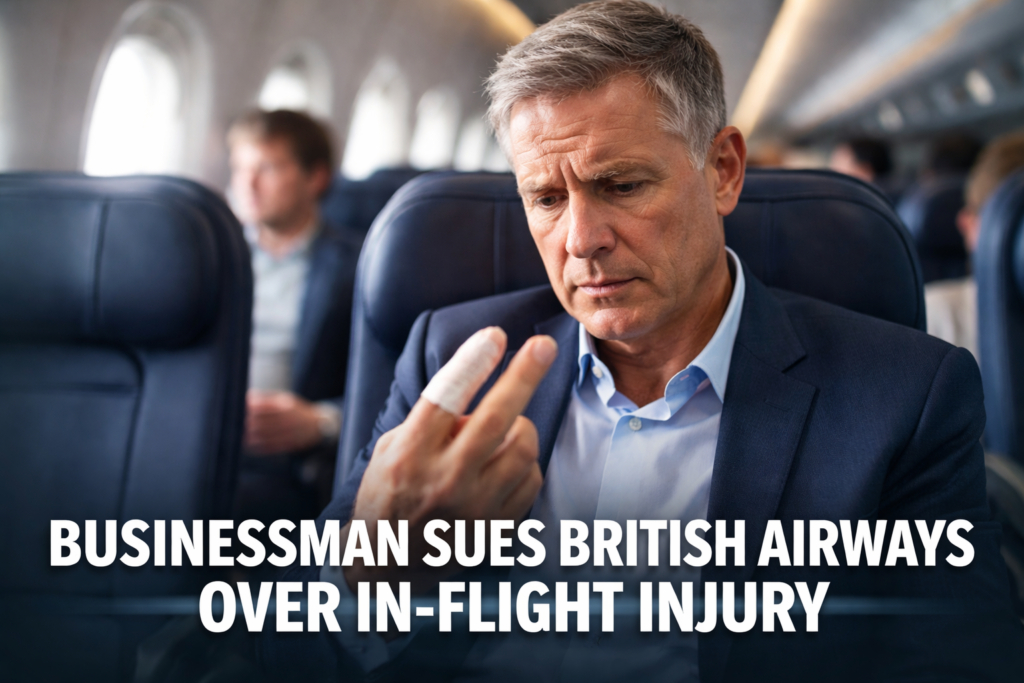

Introduction: A Vacation Turns Into a Legal Battle
Andrew Chesterton is 61 years old. He works in business. He is the kind of traveler who has probably flown dozens of times without any real trouble. He knows how to find his gate. He knows how to stow his bag. He knows how to order a coffee at 30,000 feet. Flying is routine for him. It is not scary or strange. It is just something you do to get from one place to another.
But one flight in 2023 changed his life. It changed how he sleeps. It changed how he thinks about small spaces. It changed how he feels every time he sees an airplane on TV or hears the word “Cincinnati.”
He was on a British Airways plane, heading from London’s Heathrow Airport to Cincinnati, Ohio. He was excited. It was a holiday trip. He had plans to relax, see new places, and take a break from work. Maybe he would eat some good food. Maybe he would visit a museum. Maybe he would just sit in a hotel lobby and read a book without any phone calls from the office.
Instead, he ended up with deep cuts on two of his fingers. Those cuts did not just hurt for a few days. They did not just need a few bandages. They led to flashbacks. They led to nightmares. They led to sleepless nights and jumpy days. And now, Andrew Chesterton is suing British Airways for more than £50,000.
That is not a small number. Fifty thousand pounds could buy a nice car. It could pay for a year of college. It could cover a down payment on a small house. But Andrew is not asking for this money to get rich. He is asking for it because he believes the airline failed him. He believes they left a hidden danger in the seat. And he believes that danger hurt him in ways that go far beyond two fingers.
This is not just a story about a small accident on a plane. This is a story about how a tiny, hidden sharp object in a seat can cause real mental suffering that lasts for months or years. It is a story about responsibility. It is a story about what we expect when we pay for a ticket. And it raises a big question that every flyer should ask: Who is responsible when an airplane hurts a passenger in a way nobody expected?
Let’s walk through what happened, why it matters, what the law says, what the mental health experts say, and what this lawsuit could mean for millions of flyers around the world.
H2: The Simple Act of Reaching Between Seats
Let us paint the picture clearly. It was a long flight from London to Cincinnati. Anyone who has sat in economy or premium economy knows the feeling. You board the plane. You find your seat. You buckle up. The plane takes off. For the first hour, you feel fine. You watch a movie. You sip a drink. You flip through the seatback magazine even though you have seen it before.
But then hour two comes. Then hour three. Then hour four. Your legs start to feel stiff. Your lower back begins to ache. Your neck gets tight from looking down at a phone or a screen. You shift around a lot trying to get comfortable. You cross your legs. You uncross them. You lean to the left. You lean to the right. Nothing helps for long.
This is the reality of modern flying. Seats are cramped. Legroom is shrinking. And passengers have to get creative just to survive a long-haul flight without too much pain.
Andrew Chesterton did what millions of passengers do every single day. He put his hand down between the seats. Maybe he was reaching for a phone that had slipped out of his pocket. Maybe he was just trying to adjust his jacket or pull down his shirt. Maybe he was feeling for a lost pen or a fallen snack wrapper. Or maybe he was simply trying to get more room for his elbow by pushing against the side of the seat.
We do that without thinking. It is a normal movement. It is not dangerous in most situations. You do it in your car. You do it in a movie theater. You do it on a bus or a train. You do it on your own couch at home. Your brain tells you that the space between two seats is harmless. It is just air and fabric and plastic. What could possibly hurt you there?
But this time, something was wrong.
Between the seats, hidden from plain sight, was a sharp object. We do not know yet exactly what it was. The court papers do not say. Maybe it was a broken piece of plastic from an old armrest. Maybe it was a jagged metal edge from a seat frame that had cracked. Maybe it was a stray screw that had come loose and was sticking up at an angle. Maybe it was part of a broken entertainment screen bracket. Or maybe it was something left behind by a previous passenger, like a broken pair of sunglasses or a snapped credit card.
What we do know is that it was sharp enough to cut two of Andrew’s fingers badly. Not a scratch. Not a nick. Deep cuts that drew blood immediately. The kind of cuts that make you gasp and pull your hand back fast.
Andrew pulled his hand back quickly. Blood was already showing. The pain hit him a second later. Have you ever cut your finger on something unexpectedly? That first second is strange. You do not feel much at first. Then the nerves wake up, and a hot, stinging pain rushes in. That is what happened to Andrew.
He looked down and saw the cuts. They were not paper cuts. These were deep, painful wounds that needed attention. Blood was dripping onto his pants, onto the seat, onto the armrest. He grabbed a napkin. Then another napkin. Then he asked the person next to him if they had a tissue.
For the rest of the flight, he had to deal with the bleeding and the sting. Every time he moved his hand, the cuts opened a little more. Every time he bumped his fingers against something, he winced. He wrapped his fingers as best he could. He tried to stay calm. He told himself it was just a cut. He told himself it would be fine.
But inside, he was already feeling something change. A small voice in his head was saying: This should not have happened. This was not my fault. Why was there something sharp there?
That voice would get louder in the weeks and months to come.
H2: Physical Pain That Refused to Go Away
When the plane landed in Cincinnati, Andrew did not just walk off and forget about it. He did not shrug and say, “Oh well, that’s travel.” The cuts were too serious for that. He needed medical care.
Think about what it is like to land after a long flight. You are tired. Your body is confused about what time it is. You just want to get your bag and find your hotel and lie down. But Andrew could not do that. He had to find a doctor. He had to explain what happened. He had to sit in a waiting room with his fingers wrapped in bloodied napkins.
Doctors looked at his fingers. They cleaned the wounds carefully. Dirt and tiny fibers from the airplane seat had gotten into the cuts. That raises the risk of infection. The doctors flushed the cuts with sterile liquid. They checked to see if any pieces of plastic or metal were stuck inside. They applied medicine to prevent bacteria from growing.
Then they bandaged him up. Not just a little Band-Aid. Real bandages that wrapped around his fingers and kept them immobilized. They told him to keep the bandages dry. They told him to watch for signs of infection like redness, swelling, or pus. They told him to come back if the pain got worse instead of better.
Andrew nodded. He paid the bill. He left. He tried to enjoy his holiday. But every time he used his hands, he was reminded of the plane. Every time he washed his hands, the water stung the cuts. Every time he picked up a fork or a coffee cup, he felt a twinge.
Even after the bandages came off days later, the pain did not fully leave. Finger cuts are tricky. We use our hands for everything. Typing. Cooking. Driving. Shaking hands. Opening doors. Tying shoes. Holding a phone. Every time Andrew used his injured fingers, he was reminded of the moment on the plane.
The physical pain was not extreme. It was not like a broken bone or a burn. But it was constant. It was a low-level ache that never quite went away. And every time he felt it, his brain went back to that moment. The reach. The sharp thing. The blood. The shock.
But the physical pain was only half the problem. The other half was hiding in his mind.
H2: Flashbacks and Nightmares – The Mental Toll No One Expected
This is where the story takes a surprising turn. Most people think of a cut finger as a small injury. You get a bandage. You move on. You forget about it by the end of the week. It is annoying, sure, but it is not life-changing. Right?
That is what Andrew probably thought too. At first. But then strange things started happening.
He would be sitting at home, maybe watching television or reading an email, and suddenly his mind would snap back to the plane. He would see the seat. He would feel the cut. He would hear the sound of his own gasp. For a few seconds, he was not in his living room anymore. He was back on British Airways flight whatever number it was, at 35,000 feet, bleeding into a napkin.
These are called flashbacks. A flashback is when your mind suddenly takes you back to a scary moment as if it is happening again right now. It is not a memory. Memories feel like the past. Flashbacks feel like the present. Your body reacts as if the danger is real and current. Your heart rate jumps. Your palms get sweaty. Your muscles tense up.
Andrew started having flashbacks several times a week. Sometimes several times a day. He would be in a meeting at work, and suddenly he would feel the cut again. He would have to excuse himself. He would go to the bathroom and splash water on his face and tell himself: You are not on the plane. You are safe. It is over.
But his brain did not believe it was over.
Then came the nightmares. At night, while trying to sleep, his brain replayed the accident over and over. Sometimes the dreams were exactly what happened. He would be on the plane. He would reach down. He would feel the sharp object. He would see the blood.
Other times, the dreams were twisted and more frightening. In one nightmare, the cut would not stop bleeding. In another, the sharp object was much larger, like a piece of broken glass or a knife. In another, he could not find anyone to help him. He would walk up and down the aisle, holding his bleeding hand, and every passenger would ignore him.
He would wake up sweating, his heart pounding, unable to fall back asleep. Then he would lie there in the dark, afraid to close his eyes again. Because he knew that if he fell asleep, the nightmare might come back.
Night after night, this happened. Sleep became something to fear instead of something to enjoy. Andrew started dreading bedtime. He would stay up late watching television just to avoid closing his eyes. He would drink coffee in the evening to stay alert, even though he knew it would make things worse.
His lawyers say these symptoms are real and serious. They are not making it up to get money. They are not exaggerating to win sympathy. Medical experts agree that a traumatic event—even something that seems small to an outsider—can trigger post-traumatic stress. The brain does not measure trauma in inches or pounds. It measures trauma in shock and helplessness.
Andrew felt helpless on that plane. He could not get off. He could not make the bleeding stop quickly. He could not go back in time and avoid reaching down. That feeling of helplessness stuck to him like glue.
This is not just about a cut finger anymore. This is about a man whose sense of safety was shattered at 35,000 feet. And once safety is shattered, it is very hard to put back together.
H2: Why £50,000? Breaking Down the Lawsuit Amount in Detail
You might be thinking: Fifty thousand pounds sounds like a lot of money for two cut fingers. Let us be honest. That number might make you raise your eyebrows. It might make you wonder if Andrew is being greedy or dramatic.
But let us break down exactly why the number is that high. When you understand what goes into a personal injury claim, the number starts to make more sense.
First, there are medical bills. Even if Andrew has health insurance, he had to pay for the initial visit to the doctor in Cincinnati. He had to pay for the cleaning and bandaging. He had to pay for any follow-up visits. He had to pay for any medicine. He might need to see a hand specialist if the cuts left any nerve damage or scarring. Those costs add up quickly. In some countries, a single doctor visit can cost hundreds of pounds. Add in supplies, follow-ups, and possible physical therapy, and you are easily at a few thousand pounds.
Second, there is lost income. Andrew is a businessman. Businesspeople often bill by the hour or depend on being sharp and focused. If the injury or the mental trauma stopped him from working normally, he may have lost money from his business. Maybe he had to cancel meetings because he could not sleep. Maybe he made mistakes in his work because his mind was foggy from nightmares. Maybe he had to take time off entirely to see doctors or therapists. Lost income is real money. It is not imaginary. It is pounds and pence that did not go into his bank account because of what happened on that plane.
Third, there are future medical costs. PTSD does not always go away quickly. Andrew might need therapy for months or even years. He might need to see a psychologist who specializes in trauma. He might need medication to help him sleep or to reduce his anxiety. Those are ongoing costs. The lawsuit number has to cover not just what he has already spent but what he is likely to spend in the future.
Fourth, there is pain and suffering. In legal terms, this is called “damages for personal injury.” The law says that if someone else’s carelessness hurts you, they should pay for your pain—not just your bills. Pain and suffering is a real category of damages. It recognizes that being in pain, having nightmares, and living with fear are not free. They take a toll on your quality of life. They steal joy from your days and peace from your nights. Courts have decided for many years that money can never fully replace what you lost, but it can acknowledge that you lost something real.
Fifth, there is a message. By asking for more than £50,000, Andrew is telling British Airways: “You need to take this seriously. You cannot ignore hidden dangers in your seats. You cannot hope that nobody gets hurt. If you cut corners on maintenance, it will cost you.” Sometimes lawsuits are not just about one person. They are about changing behavior. A big number gets attention. It makes airlines think twice before leaving sharp edges exposed.
So the number is not random. It is not pulled from thin air. It reflects medical costs, lost work, emotional harm, future treatment, pain, suffering, and the need for accountability. Is it a lot of money? Yes. But is it unreasonable for a man who now has nightmares and flashbacks because of an airline’s carelessness? That is what the court will decide.
H2: British Airways’ Responsibility – What Do Airlines Owe You?
When you buy a plane ticket, you are not just paying for a ride. You are not just paying for a drink and a bag of pretzels. You are paying for a safe ride. You are paying for the promise that the airline will take reasonable care of you while you are on their property.
This is not just a nice idea. It is the law. Airlines have a legal duty to keep their planes in good, safe condition. That includes the seats, the aisles, the trays, the windows, the overhead bins, and everything a passenger might reasonably touch. If something is broken, they need to fix it. If something is dangerous, they need to warn you or remove the danger.
Think about what “reasonable care” means. It does not mean the plane has to be perfect. It does not mean every screw has to be polished. But it does mean that there should not be hidden sharp objects in places where passengers put their hands. Reaching between seats is a normal thing to do. It is not weird or risky. So the airline should make sure that the gap between seats is safe.
If a seat has a sharp edge, that is a danger. If the airline knew about it and did nothing, that is negligence. If they did not know about it but should have found it during routine checks, that is also negligence. Either way, the airline is responsible.
British Airways has not said much publicly yet. Lawsuits like this often take months or years. The airline might argue that Andrew should have been more careful. They might say that putting your hand between seats is risky and that passengers should look first. They might say that the sharp object was not their fault because it was left by a previous passenger.
But passengers expect seats to be safe. Nobody expects a razor-sharp surprise in the gap. And airlines have cleaning and maintenance crews who are supposed to check for exactly these kinds of hazards. If a previous passenger dropped something sharp, the cleaning crew should have found it. If a piece of the seat broke, the maintenance crew should have fixed it.
Courts will have to decide: Was this a freak accident that could have happened to any airline? Or was British Airways sloppy with maintenance and cleaning? The answer to that question will determine who wins the case.
One thing is clear: Airlines owe their passengers a duty of care. That duty is not unlimited. You cannot sue because the coffee is too hot or the seat is too hard. But you can sue when a hidden sharp object cuts you badly enough to cause nightmares. That crosses the line from uncomfortable to unsafe.
H2: Hidden Dangers in Airplane Cabins – More Common Than You Think
Andrew’s story sounds unusual. It sounds like a one-in-a-million accident. But hidden dangers on planes are not as rare as you might hope. In fact, if you talk to flight attendants or aircraft mechanics, they will tell you that planes have all kinds of small hazards that passengers never see.
Every year, passengers report cuts from broken armrests. They report scratches from exposed screws that have come loose. They report bruises from falling luggage bins that did not latch properly. They report burns from hot surfaces that were not marked. They report cuts from sharp edges on entertainment screens that have cracked.
Planes fly thousands of hours every year. They take off and land over and over. Parts wear out. Plastic gets brittle and cracks. Metal edges get exposed when covers break off. Seats get bumped by luggage and cleaning carts. Things that were smooth become sharp over time.
And cleaning crews move fast. They have maybe 20 or 30 minutes to clean an entire plane between flights. They vacuum the floors. They wipe down the trays. They pick up big trash. But they do not always have time to run their fingers along every crack and crevice looking for sharp edges. That is not their job. Their job is speed and basic cleanliness.
One flight attendant told a news reporter once: “You would be surprised what we find between seats. Broken glass from a previous passenger’s drink. Sharp plastic from a cracked entertainment screen. Lost knives from meal services that got pushed down into the gap. Even syringes from passengers who need medication. It is not as clean down there as people think.”
Another mechanic said: “The gaps between seats are like black holes. Things fall in there and never come out unless someone digs around. And nobody digs around during a quick turnaround. So those gaps can collect dangerous objects for weeks or months.”
The difference is that most people do not get badly hurt. Most of the time, you reach down and feel nothing dangerous. Maybe you touch a crumb or a piece of dust. Maybe you touch a lost pen cap. No harm done. Andrew was unlucky. He found the one sharp thing that had been hiding there for who knows how long.
But his lawsuit might force airlines to inspect between seats more carefully. They might add a step to their cleaning checklist: “Check seat gaps for sharp objects.” They might use small tools to run along the edges and feel for cracks or breaks. That would take extra time and cost extra money. But it could protect future passengers.
Think about it: How many times have you run your hand down the side of a plane seat without looking first? Most of us do it all the time. We do it without even thinking. We trust that the seat is smooth and safe. Andrew trusted that too. And that trust cost him.
H2: The Human Side – What Nightmares and Flashbacks Really Feel Like
Let us pause the legal talk for a moment. Let us put down the numbers and the arguments and the court procedures. Let us talk about what nightmares and flashbacks actually feel like, because unless you have experienced them, it is very hard to understand. They sound like small problems. They sound like things you should just get over. But they are not.
A nightmare is not just a bad dream. We all have bad dreams sometimes. You dream that you are late for a test. You dream that you are falling. You dream that you are being chased. You wake up, shake it off, and go back to sleep. That is normal.
But the kind of nightmares Andrew has are different. They are vivid. They are terrifying. They are repetitive. And they do not go away when you wake up. They are like a movie that plays inside your head while you are helpless. You cannot turn it off. You cannot look away. You cannot change the channel. You are stuck watching the same scary scene over and over.
And when you wake up, your body acts like the danger is still there. Your heart is racing. Your breath is fast and shallow. You are sweating even if the room is cold. You look at your hands to make sure you are not bleeding. You look around the room to make sure you are not on the plane. For a few seconds, you are not sure where you are or what is real.
A flashback is even stranger. You might be doing something totally normal. Washing dishes. Walking to the mailbox. Sitting in a meeting. Driving to the grocery store. And suddenly, without any warning, you are back on the plane. You hear the engine noise. You feel the vibration of the floor. You smell the recycled air. You feel the sharp object cutting your fingers.
For a few seconds, you lose touch with where you really are. The present moment disappears. The past becomes the present. You might gasp. You might grab your hand. You might look around in confusion. People might ask if you are okay, and you do not know how to answer because you are not sure what just happened.
Andrew Chesterton is a 61-year-old businessman. He is not a fragile person. He has probably handled stress before. He has probably dealt with difficult clients, tight deadlines, and personal losses. He is a grown man with a career and a life. But trauma does not care how tough you are. It does not check your resume before it attacks. It can hit anyone. It can hit a soldier in a war zone. It can hit a car crash survivor. And it can hit a businessman who cut his fingers on an airplane.
That is why his lawsuit is not just about money. It is about validation. He wants a court to say: “What you went through was real. It mattered. It was not your fault. And British Airways should have prevented it.” He wants someone in authority to look at his nightmares and his flashbacks and say, “Yes, that counts. Yes, that is harm. Yes, you deserve compensation.”
Money will not erase the nightmares. But it can pay for therapy. It can pay for lost work. And it can send a message that hidden dangers on planes have real consequences.
H2: What Other Passengers Can Learn From Andrew’s Story
You do not have to be a lawyer to take lessons from this case. You do not have to be a frequent flyer or a business traveler. If you ever set foot on an airplane, there are things you should know. Here are five lessons every passenger should carry with them.
First, look before you reach. Between seats, under armrests, around entertainment screens, and behind tray tables can hide sharp edges. Before you slide your hand into a tight space, take a quick peek. Use your eyes before you use your fingers. It takes one second and could save you a lot of pain.
Second, report injuries immediately. If you get cut, scratched, or hurt on a plane, tell a flight attendant right away. Do not wait until you land. Do not assume it is nothing. Ask them to write a report. Get a copy if you can. Take photos of your injury and the object that caused it. Get the names and seat numbers of witnesses. This evidence is gold if you need to make a claim later.
Third, watch your mental health after an accident. If you start having bad dreams, feeling jumpy, avoiding normal activities, or reliving the moment, talk to a doctor. PTSD is not just for soldiers. It can happen after a car crash, a bad fall, an assault, or even a cut on a plane. Do not be ashamed. Do not tell yourself to just get over it. Get help.
Fourth, keep records. Save your boarding pass. Save your baggage tag. Save your medical bills. Save your pharmacy receipts. Write down what happened while it is fresh in your mind. Include the date, the flight number, the seat number, and the names of any crew members who helped you. These details matter.
Fifth, know your rights. Airlines have insurance for exactly this kind of thing. They expect to pay claims when passengers get hurt. You do not have to suffer in silence. You do not have to accept a voucher for a free flight as compensation. A lawyer who knows aviation injury cases can help you understand what you deserve. Many lawyers will give you a free first meeting to hear your story.
Andrew did all of these things. He reported the injury. He kept records. He saw doctors. He talked to lawyers. That is why his case is moving forward. If he had just shrugged and walked away, nothing would change. British Airways would never know there was a sharp object in that seat. And someone else might have gotten cut next week.
H2: The Bigger Picture – Will This Lawsuit Change Airline Safety?
Some lawsuits are just about one person’s pain. They are small. They are quiet. They get settled for a few thousand pounds, and nobody ever hears about them. But other lawsuits push entire industries to do better. They become famous. They get written about in newspapers and talked about on television. They make companies nervous. And that nervousness leads to change.
Andrew Chesterton’s case could be the second kind. It has already been reported by major news outlets. People are already talking about it online. Other passengers are coming forward with their own stories of hidden dangers on planes. That is how change starts. One person stands up, and then others realize they are not alone.
If Andrew wins, British Airways might have to inspect seats more deeply between flights. They might have to train cleaning crews to check for sharp edges. They might have to redesign seat gaps so nothing sharp can hide there. They might have to install smoother materials that do not crack or break as easily. All of that costs money. But it is cheaper than losing a £50,000 lawsuit every time someone gets hurt.
Other airlines will watch closely. They do not want to be the next one sued. So they will look at their own planes. They will ask their own mechanics: Do we have sharp edges anywhere? Are our seat gaps safe? They will make changes even before a court orders them to. That is how lawsuits improve safety across an entire industry.
In the best-case scenario, Andrew’s nightmare leads to safer planes for everyone. That is how progress often happens. Someone gets hurt. They fight back. They refuse to be silent. And the world becomes a little safer for the rest of us. You might never know Andrew’s name. But if airlines start checking seat gaps more carefully, you can thank him.
But there is a sad truth too. Even if Andrew wins. Even if he gets every penny he asks for. Even if British Airways apologizes publicly. He cannot undo the flashbacks. He cannot erase the nightmares. The money helps him pay for therapy and lost work and medical bills. But the fear may stay with him for a long time. Maybe forever. Trauma leaves marks that do not show up on X-rays.
That is why he is doing this. Not for revenge. Not for greed. Not for fame. But so that other people do not have to feel what he feels. So that some other passenger, on some other flight, does not reach between the seats and find a hidden sharp object waiting for them. He is fighting for a small piece of a safer world.
H2: What Happens Next in the Court Case?
As of now, British Airways has not admitted fault. They have not said they are sorry. They have not offered to pay. The case is still early. Lawyers on both sides are preparing their arguments. This process takes time. Sometimes years.
Here is how it will likely unfold.
First, both sides will gather evidence. Andrew’s lawyers will ask British Airways for maintenance records for that specific plane. They will want to see when the seats were last inspected. They will want to know if any other passengers reported sharp objects on that plane. They will interview the flight crew. They will ask if anyone else complained about that seat before.
British Airways’ lawyers will ask for Andrew’s medical records. They will want to see if he had any mental health problems before the flight. They will want to know if his nightmares could be caused by something else, like stress from work or problems at home. They will probably hire their own doctor to examine Andrew and give a second opinion.
Second, there might be a settlement. Most lawsuits end before trial. Both sides sit down with a mediator and try to agree on a number. British Airways might offer Andrew a sum of money to drop the case. That saves everyone time, money, and stress. Andrew might accept if the offer is fair. But he might refuse if he feels the offer is too low or if he wants a public apology.
Third, if no settlement happens, the case goes to trial. A judge or a jury will hear the evidence. Andrew will sit in the courtroom and describe the moment of the cut. He will describe the flashbacks and the nightmares. He will show pictures of his injured fingers. He will answer questions from British Airways’ lawyers, who will try to poke holes in his story.
Doctors will testify about PTSD and how a small accident can cause big mental harm. Mechanics will testify about airline safety standards. British Airways will explain what they do to keep seats safe. They will argue that they are not responsible for every tiny hidden object.
Then the judge or jury will decide. They will say yes or no to Andrew’s claim. If yes, they will decide how much money he should get. The number could be more than £50,000 or less. It depends on how convincing the evidence is.
The verdict will send a signal. A win for Andrew says: “Airlines, check your seats better. Hidden sharp objects are not acceptable.” A win for British Airways says: “Passengers assume some risk when they reach into tight spaces. Not every accident is the airline’s fault.”
No matter who wins, this case is already changing how people think about airplane injuries. It is making passengers more aware. It is making airlines more nervous. And it is starting a conversation about safety in places nobody usually looks.
H2: Frequently Asked Questions About Airline Injury Lawsuits
Let us answer some common questions in plain language. These are the things people often ask when they hear about a case like Andrew’s.
Can you really sue an airline for a cut finger?
Yes, if the cut happened because the airline was careless. Every passenger has the right to a reasonably safe environment. A hidden sharp object in a seat is not reasonable. The size of the injury does not matter as much as the cause. If the airline failed in their duty to keep the plane safe, you can sue.
How long do you have to file a claim?
It depends on the country and the route. For flights leaving the United Kingdom, you usually have two to three years from the date of the injury. Andrew filed in 2024 or 2025, which is well within the time limit. If you wait too long, you lose your right to sue forever.
Do you need a lawyer?
Strongly recommended. Airline lawyers are very experienced. They do this every day. You want someone who knows aviation law and personal injury inside and out. A good lawyer will know what evidence to collect, what questions to ask, and how much your case is worth. Many personal injury lawyers work on “contingency,” which means they only get paid if you win.
Can you claim for nightmares and flashbacks?
Yes. Mental trauma is a real injury under the law. You need medical records and expert testimony to prove it, but the law allows it. PTSD, anxiety, depression, and sleep disorders are all valid categories of harm. You do not have to have a broken bone to be hurt.
What if the airline offers a voucher instead of money?
You do not have to accept. Vouchers are cheap for airlines. They cost them almost nothing. Cash compensation is what the law provides for injuries. A good lawyer will tell you never to accept a voucher in place of real money. Once you accept, you usually cannot sue later.
What if I was partly at fault?
In many legal systems, you can still recover money even if you were partly to blame. The amount might be reduced based on your share of fault. For example, if the court says Andrew was 20 percent at fault for not looking first, he might only get 80 percent of the damages. But he would still get something.
How much is my case worth?
That depends on many factors: the severity of your injury, the cost of your medical care, how much work you missed, how long your symptoms last, and whether the airline was very careless or just a little careless. No two cases are exactly the same. A lawyer can give you a realistic range.
H2: A Final Word on Flying, Fear, and Fairness
Andrew Chesterton boarded that flight to Cincinnati looking forward to a holiday. He was excited. He was relaxed. He had no idea that a small, hidden piece of sharp material was waiting for him between the seats. He got off the plane with bleeding fingers, a shaken mind, and a long road of recovery ahead.
He is not a celebrity. He is not looking for fame. He is not trying to ruin British Airways. He is a 61-year-old businessman who believes that airlines should not get away with hidden dangers. He believes that nightmares after a flight are not normal and should not be ignored. And he believes that £50,000 is a fair price for the pain he has endured.
You may never be in Andrew’s shoes. You may fly a hundred times and never get a single scratch. But the next time you fly, and you go to slide your hand between the seats, pause for just one second. Look first. Because the sharp thing hiding there might belong to an old broken part. Or it might belong to someone else’s nightmare waiting to happen.
British Airways now has to answer for what was in that gap. And passengers everywhere will be watching. Not because they want to see an airline punished. But because they want to know that when they fly, someone is looking out for them. Someone is checking the gaps. Someone is making sure that a simple reach between seats does not become a memory that haunts them for years.
Flying is already stressful enough. Long lines. Delayed flights. Cramped seats. Overpriced food. You should not have to worry about hidden blades waiting to cut you. You should not have to fear that a moment of normal movement will turn into a nightmare you cannot wake up from.
Andrew Chesterton is fighting to make sure that future passengers do not have to worry. That is why his story matters. That is why his lawsuit matters. And that is why, even if you never meet him, you might owe him a small thank you the next time you fly.
Because of him, someone might check that gap. Someone might fix that sharp edge. And someone might sleep a little better at night, knowing that one businessman stood up and said: This is not okay. Fix it.



This is a very good tips especially to those new to blogosphere, brief and accurate information… Thanks for sharing this one. A must read article.
I’m not sure why but this site is loading incredibly slow for me. Is anyone else having this issue or is it a issue on my end? I’ll check back later on and see if the problem still exists.
Great platform with a very intuitive layout. I love how easy it is to navigate through the different sections. asiabetlogin makes everything so much simpler for the user.
The app version is a game changer. I can play wherever I am without any lag. Totally worth downloading from 01gameapk
The app version is a game changer. I can play anywhere and the connection is always stable. Love 881betloginapp.
I’ve tried a few sites lately, but the experience here is just smoother. The payouts are fast and the games are super addictive. Definitely checking out senja128slot again tonight!
If you love slots, this is the place to be. I hit a nice win yesterday and the withdrawal process was seamless. vipwin88slot is the real deal.
Very professional setup and the promotions are actually rewarding. I feel like a valued player every time I log in. Cheers to brbetfalcons
Super addictive gameplay and the graphics are top notch. It’s the perfect place to unwind and try your luck. ph111jili is where the action is.