

Introduction: A Ghost That Breathes
Just a short drive from the busy center of Sydney, Australia, there is a place that feels like it was pulled from a dream. Or maybe a warning.
Homebush Bay is a quiet, muddy inlet of the Parramatta River. For most of the 20th century, this was a place where ships went to die. It was a shipbreaking yard—a watery graveyard for old vessels that had outlived their usefulness. Rusty hulls stuck out of the water like the ribs of ancient whales. Locals avoided it. Tourists never thought to visit.
But today, one of those wrecks has become famous all over the world. Photographers fly from other countries to see it. Environmental scientists study it with wonder. And teenagers on social media call it “the real-life floating forest.”
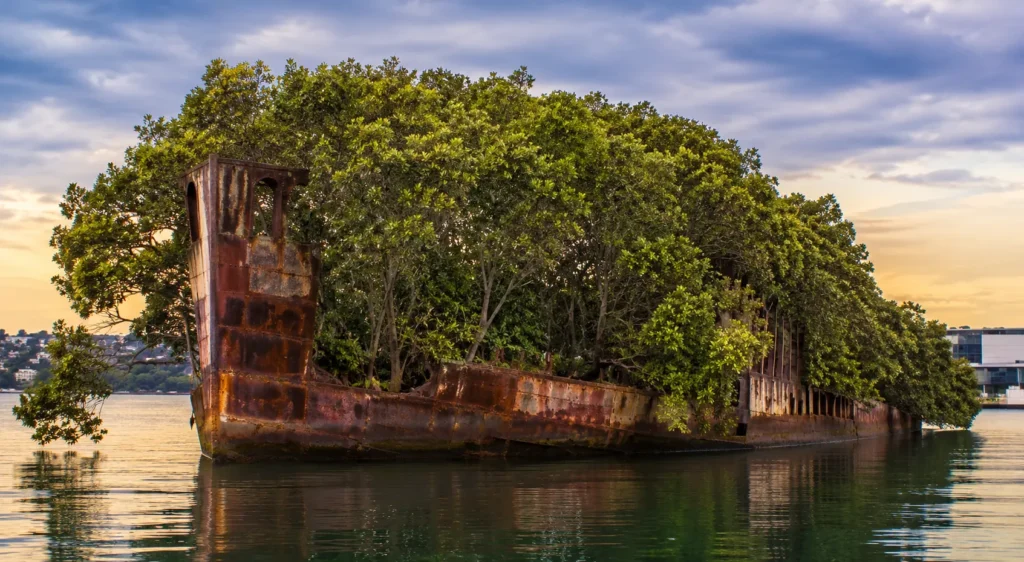
The name of this ship is the SS Ayrfield. It was built in 1911. It has been rotting in the same spot for over 50 years. But something strange happened. Instead of just rusting away, the SS Ayrfield began to bloom.
A thick, green forest has grown inside its steel hull. Mangrove trees, ferns, and grasses have turned a symbol of industrial decay into a floating, self-sustaining jungle. It is a lesson in survival. It is a battle between human engineering and nature’s patience. And it is proof that even in the worst places, life finds a way.
This is the story of the SS Ayrfield—a 102-year-old shipwreck that refused to stay dead.
To understand why this matters, you have to picture the scene the way it was. Close your eyes for a moment. Imagine standing on the shore of Homebush Bay in the 1980s. The water is brown and still. The air smells like mud and oil and something chemical you cannot name. Garbage floats near the edges—plastic bottles, old tires, things that used to be boats. And out in the middle of the bay, a dark shape rises from the water. It is the Ayrfield. Its bow points toward the sky like a broken finger. Its sides are streaked with rust the color of dried blood. Seagulls sit on what remains of its mast, screaming at nothing.
Now visit the same place today. The water is clearer. The smell is gone. And that same ship is covered in green so bright it almost hurts to look at. Mangrove trees stand twenty feet tall inside the hull. Their roots dangle into the water like curtains. Birds nest in the branches. Fish swim through the rusted holes in the steel. It is not a wreck anymore. It is a world.
How did that happen? The answer is not magic. It is not luck. It is a story about time, chemistry, biology, and a little bit of stubbornness from both the ship and the trees.
Let us go back to the beginning.
Chapter 1: The Birth of a Workhorse (1911–1940)
To understand the floating forest, you have to first understand the ship itself. The SS Ayrfield wasn’t built to be beautiful. It was built to be tough. It was built to carry coal, and coal is not a gentle cargo.
In 1911, the ship was launched in the United Kingdom. The exact date was November 16th, though records are fuzzy. The shipyard was in a town called West Hartlepool, in the northeast of England. This was the heart of the British shipbuilding industry. For decades, this small stretch of coastline had been turning iron and steel into vessels that sailed to every corner of the globe.
The Ayrfield was a steam-powered collier. That means its only job was to carry coal from one place to another. Coal was the fuel that powered the British Empire. Trains, factories, warships, power plants, and even some homes all burned coal. Without coal, the empire would have stopped moving. So colliers like the Ayrfield were essential. They were the trucks of the sea.
The ship was not large by modern standards. It measured about 235 feet long. That is roughly the length of two blue whales placed nose to tail. Its beam—the width of the ship—was about 37 feet. It weighed around 1,140 tons. To put that in perspective, a modern container ship can carry over 200,000 tons. The Ayrfield was a shrimp compared to those giants. But in 1911, it was a solid, respectable vessel.
The ship had a single coal-fired boiler that powered a triple-expansion steam engine. That engine was a marvel of Victorian engineering. It took steam at high pressure and passed it through three cylinders of increasing size, squeezing every bit of energy out of the steam before it escaped up the smokestack. The engine produced about 500 horsepower. That is less than a modern family car. But it was enough to push the Ayrfield through storms and across oceans at a steady eight or nine knots.
The crew of the Ayrfield was small. Maybe twenty to thirty men. They lived in cramped quarters below deck. The captain had a tiny cabin with a desk and a bed. The rest of the crew slept in hammocks slung over the cargo holds. There was no air conditioning. No internet. No fresh food after the first week at sea. It was a hard life. Sailors who worked on colliers were known for being tough and quiet. They did not complain because no one would listen if they did.
For nearly 30 years, the Ayrfield did its job quietly and well. It chugged up and down the coast of Europe. It carried coal from Newcastle (England, not Australia) to London. It carried coal from Cardiff to Liverpool. It carried coal from Glasgow to Hamburg. Sometimes it crossed the English Channel to French ports like Le Havre or Cherbourg. It was not a glamorous route. But it was steady work.
Then World War I broke out in 1914. Suddenly, every ship became valuable. The Ayrfield was not a warship. It had no cannons. It had no armor. But it was fast enough and sturdy enough to carry supplies to soldiers fighting in France and Belgium. The ship sailed through waters patrolled by German submarines called U-boats. These submarines hid beneath the surface and attacked without warning. One torpedo could send a collier to the bottom in minutes.
The Ayrfield was lucky. It survived the war. Some of its sister ships were not so fortunate. By the time the fighting ended in 1918, thousands of merchant ships had been sunk. The Ayrfield kept steaming.
After the war, the ship went back to carrying coal. But the world was changing. Diesel engines were becoming cheaper and more reliable. They did not need stokers shoveling coal into a furnace. They did not produce clouds of black smoke. They could go farther without refueling. Steam-powered ships like the Ayrfield were becoming old-fashioned.
By the late 1930s, the ship was showing its age. Its steel plates had been patched multiple times. Its boiler had been welded and re-welded. The engine leaked steam from a dozen small cracks. The ship still worked, but it was like an old dog that needed help getting up the stairs. It was time for a change.
In 1940, the Ayrfield was sold to a company in Australia. The price was low. The ship was considered nearly worthless. But Australia was desperate for vessels. War was coming again, and the country needed every floating thing it could get. So the Ayrfield made the long voyage from England to Sydney, steaming through the Atlantic, around the Cape of Good Hope at the southern tip of Africa, and across the Indian Ocean. It was a journey of over 12,000 miles. The old ship handled it fine.
That voyage was the beginning of its second life.
Chapter 2: War, Rust, and Retirement (1940–1972)
Australia in the 1940s was a nation on edge. World War II had been raging in Europe since 1939. In late 1941, Japan attacked Pearl Harbor in Hawaii and then swept south through Southeast Asia. Singapore fell. The Dutch East Indies fell. The Philippines fell. Suddenly, Japan was at Australia’s doorstep. Japanese submarines were spotted off the coast of Sydney. Japanese planes bombed the northern city of Darwin. People were terrified.
The Australian government needed ships. Not fancy passenger liners. Not sleek warships. Just simple, strong vessels that could carry coal, ammunition, food, and fuel to the troops fighting in New Guinea and the Solomon Islands. The Ayrfield fit the bill perfectly.
So the old collier was pulled out of retirement. It was given a fresh coat of gray paint. Its boiler was cleaned. Its engine was overhauled. And it went back to work, this time carrying coal along the Australian coast. The ship sailed from Sydney to Brisbane. From Brisbane to Newcastle. From Newcastle to Melbourne. It was not exciting work. But it was essential.
The Ayrfield survived the war without being sunk. That was no small thing. Japanese submarines sank dozens of merchant ships off the Australian coast. One of them, the SS Iron Crown, was torpedoed in 1942 with the loss of 43 lives. The Ayrfield was lucky. Or maybe it was just too small and too slow to be worth a torpedo. Either way, it kept steaming.
After the war ended in 1945, the Ayrfield kept working. Australia needed coal to rebuild its cities and power its factories. The ship carried coal to power plants in Sydney and Melbourne. It carried timber from Tasmania to the mainland. It carried general cargo—bags of wheat, crates of apples, rolls of steel wire. It did the dirty, boring work that keeps a country running. Nobody wrote songs about the Ayrfield. No one named their children after it. It was just a tool, like a hammer or a shovel.
But by the late 1960s, the ship was truly worn out. Its steel plates were thin in some places. Its boiler had cracks that could not be repaired. The cost of keeping the Ayrfield running was more than the value of the cargo it could carry. It was time to let go.
In 1972, the Ayrfield was sold for scrap. It made its final voyage, a short trip across Sydney Harbor to Homebush Bay. This was the end of the line.
Homebush Bay was not a nice place in 1972. It was an industrial wasteland. For decades, factories along the shore had been dumping waste directly into the water. A chemical plant made pesticides and herbicides. A paper mill discharged bleach and ink. A metal works poured acids and heavy metals into the bay. The mud at the bottom was thick with lead, mercury, dioxins, and polychlorinated biphenyls (PCBs). These are the kinds of chemicals that cause cancer and birth defects. The fish in the bay were toxic. The water was unsafe to touch.
The bay was also home to a shipbreaking business. Workers used torches to cut old ships into pieces. They sold the steel to recycling mills. It was dangerous work. The torches were hot enough to melt metal. The ships were unstable. Workers fell through rusted decks. Men lost fingers and toes. Sometimes they died. But the money was good, and the work was steady.
The Ayrfield was tied to a dock. Workers began cutting it apart. They removed the engine. They tore out the coal bunkers. They cut holes in the deck. They started removing the superstructure—the part of the ship above the main deck that held the bridge and the crew quarters.
And then they stopped.
No one knows exactly why. Maybe the scrap metal prices dropped. Maybe the company that owned the shipbreakers went bankrupt. Maybe the workers realized that the Ayrfield was too rusted to be worth the effort. Maybe there was a dispute over who owned the ship. Whatever the reason, the Ayrfield was abandoned halfway through its destruction.
It sat there, half-dismantled, half-sunk, half-forgotten. The tide rose and fell twice a day, washing through its open hull. Rain filled the spaces that had once held coal. Birds perched on its mast. Moss and algae began to grow on its decks.
The Ayrfield was not a ship anymore. It was a ruin. And ruins, as it turns out, are the perfect homes for pioneers.
Chapter 3: The Dark Years (1972–1990)
For nearly two decades, the SS Ayrfield just sat there. Rusting. Sinking. Waiting.
The bay around it grew more polluted. The chemical factory that had been dumping waste since the 1930s finally closed in 1976. But the damage was done. The mud was so contaminated that scientists later described it as one of the most toxic places in Australia. The government posted warning signs telling people not to eat any fish caught in the bay. Not that there were many fish left.
The other wrecks in the bay were in even worse shape. The SS Mortlake Bank was a rusting hulk that had once carried sugar and timber. The HMAS Karangi was a naval vessel that had served as a depot ship. The SS Heroic was a tugboat that had been stripped of everything valuable. These ships were not beautiful. They were not historic. They were just garbage, floating in garbage water.
If you had visited Homebush Bay in 1985, you would have been disappointed. The place was ugly. The water was brown and oily. The wrecks were orange with rust. The air smelled like low tide mixed with gasoline. There were no walking paths. No signs explaining what you were seeing. Just mud, trash, and dead ships.
But beneath the surface of the bay and beneath the rust of the Ayrfield, something was happening. It was slow. So slow that no one noticed at first. But it was real.
Tiny cracks in the ship’s steel plates let in saltwater and mud. Seeds carried by birds or the tide landed in those cracks. A microscopic layer of organic slime began to form on the hull. This slime was made of bacteria, algae, and tiny single-celled organisms called diatoms. They were the first colonizers. They were the ones who prepared the way for everything else.
The slime trapped more mud. The mud trapped more seeds. The seeds sprouted into tiny seedlings. Most of them died. The bay was too toxic. The water was too salty. The tide was too rough. But some of them survived. Just a few. Just enough.
One of those survivors was a mangrove seedling.
Mangroves are tough. They have to be. They live in the place where land meets sea—the intertidal zone. This is a harsh environment. At high tide, the trees are underwater. At low tide, they are exposed to the sun and wind. The water is salty, which would kill most plants. The mud is low in oxygen, which would suffocate most roots. But mangroves have evolved special adaptations to handle all of these challenges.
The seedling that found its way into the Ayrfield’s hull did not know it was inside a shipwreck. It did not care about the history of the vessel. It only knew that there was mud, there was water, and there was sunlight. That was enough.
It put down roots. It pushed up leaves. It grew.
The first year, it was just a twig sticking out of the rust. You could have walked past and not noticed it. The second year, it was a small bush, maybe two feet tall. The third year, it was a tree.
Other mangroves followed. They came from seeds that floated in from other parts of the bay. They came from roots that spread underground. They came from birds that dropped seeds after eating mangroves somewhere else. One by one, they took hold inside the Ayrfield.
The ship’s hull acted like a giant flower pot. The steel walls kept the mud from washing away. The open top let in sunlight and rain. The ship’s own rusted iron began to break down, releasing tiny amounts of nutrients into the water. Iron is a micronutrient that plants need to make chlorophyll, the chemical that makes leaves green. The ship was literally feeding its own graveyard.
By 1990, there was a small cluster of mangroves inside the Ayrfield. They were not tall yet. Maybe six or eight feet. But they were healthy. They were growing. And they were the beginning of something extraordinary.
Chapter 4: The Science of Resilience (What Makes This Possible?)
Let us slow down for a moment and look at the science. Because a forest growing inside a steel shipwreck is not normal. It takes a special set of conditions. Here is what makes it possible.
The Perfect Container
The Ayrfield’s hull is made of mild steel. Steel is an alloy of iron and carbon. When steel is exposed to saltwater and oxygen, it rusts. Rust is not just decay. It is a chemical reaction. The iron atoms in the steel lose electrons and become iron ions. These ions can bond with other molecules in the water, including phosphates. Phosphates are a key plant nutrient. So the ship’s rust is like a slow-release fertilizer, feeding the trees that grow inside it.
The hull is also mostly intact below the waterline. That means the mud and water inside do not drain out during low tide. It is a contained basin. Think of a giant bathtub that never empties. The water inside is brackish—a mix of fresh rainwater and salty bay water. This is exactly what mangroves prefer.
The hull also provides protection. Outside the ship, the waves and wind of the bay can be harsh. Inside the hull, the water is calm. Seedlings are not washed away. Mud is not eroded. The ship acts as a shield.
Mangrove Superpowers
Mangroves are not like ordinary trees. They have three special tricks that allow them to live where other plants would die.
First: Salt filters. Most plants cannot handle salt. If you water a rose bush with seawater, it will wilt and die within a day. But mangroves have special cells in their roots that filter out 90% of the salt before it reaches the leaves. The remaining salt is stored in old leaves, which the tree then drops. That is why you sometimes see mangrove leaves that look yellow or white—they are full of salt that the tree is getting rid of.
Second: Breathing roots. Mangroves grow in mud that has very little oxygen. The mud is full of bacteria that use up all the oxygen. To get around this problem, mangroves grow special roots called pneumatophores. These are little pencil-like tubes that stick up out of the mud. They have tiny holes called lenticels that allow oxygen to diffuse into the root. You can see these roots all around the Ayrfield. They look like a thousand little fingers reaching up from the water.
Third: Live birth. Most plants grow from seeds that are dormant. They sit in the soil until conditions are right, then they sprout. Mangroves do something different. Their seeds actually sprout while still attached to the parent tree. The seedling grows a long, pointed root that can be over a foot long. When it is ready, it drops off the tree and sticks into the mud like a dart. This is called vivipary, which means “live birth” in Latin. It gives mangrove seedlings a huge head start. They do not have to waste time sprouting after they land.
These three adaptations make mangroves perfect for colonizing harsh environments. They are the botanical equivalent of army rangers—tough, adaptable, and ready for anything.
The Pollution Paradox
Homebush Bay is still contaminated. The mud contains high levels of dioxins, lead, mercury, and other toxins. But mangroves have another trick up their sleeves. They are hyperaccumulators. That means they can absorb heavy metals into their tissues without dying. The trees pull lead and mercury out of the mud and store it in their wood and leaves.
In a strange way, the floating forest is cleaning up its own grave. The trees are slowly removing toxins from the bay. When mangrove leaves fall into the water, some of the toxins are released. But much of it stays locked in the tree’s tissues. Over time, the concentration of toxins in the mud decreases.
This is not a perfect solution. The trees are still toxic. Birds that eat mangrove leaves or crabs that live in the roots can absorb those toxins. But it is better than doing nothing. The Ayrfield’s forest is a natural remediation project, and it does not cost a dime.
The Bird Delivery System
Birds are nature’s gardeners. A heron lands on the Ayrfield’s mast. It poops. That poop contains seeds from other plants it ate miles away. Ferns, grasses, and even small flowering plants have appeared inside the hull. None of them were planted by humans. All of them were delivered by wings.
The birds also bring nutrients. Their droppings are rich in nitrogen and phosphorus, two key fertilizers. The more birds that visit the forest, the richer the soil becomes. And the richer the soil, the more plants can grow. It is a positive feedback loop.
The Role of Time
Perhaps the most important factor is time. The Ayrfield has been sitting in the same spot for over 50 years. That is half a century of seeds floating in, roots spreading, and mud accumulating. Nature does not work on human schedules. A forest does not grow in a year or a decade. It takes generations.
The first mangrove that took root in the Ayrfield was just a single seed. That seed grew into a tree. That tree produced thousands of seeds of its own. Some of those seeds fell inside the hull and grew into new trees. Others floated away to colonize other wrecks. What started as one became many.
This is the secret of resilience. It is not about speed. It is about persistence. The Ayrfield’s forest did not appear overnight. It appeared one seed at a time, year after year, until the rust was buried in green.
Chapter 5: The Forest Matures (1990–2005)
By the early 1990s, the Ayrfield was no longer just a wreck. It was a landmark. Local kayakers would paddle out to see the “green ship.” At first, it was just a curiosity. People would point and say, “Look, there are trees growing out of that old boat.” Then they would paddle away and forget about it.
But the trees kept growing. And growing. And growing.
By 1995, the mangroves inside the hull were over ten feet tall. Their roots had woven together into a dense mat. That mat trapped more sediment, raising the floor of the hull. What had once been a deep, dark hold was now a shallow, muddy basin. The floor had risen by over two feet in just a few years.
By 2000, the mangroves were fifteen feet tall. Their branches reached above the rusted sides of the ship. From a distance, the Ayrfield looked like a floating bush. The steel was almost invisible beneath the green.
Other plants began to appear. Ferns took hold in the shadows beneath the mangroves. Small flowering plants called salt marsh grasses grew along the edges. A single fig tree somehow sprouted near the bow. No one knows how the fig seed got there. Maybe a bird carried it. Maybe it floated in on a piece of driftwood. But there it was, growing out of rust and mud.
The bird life exploded. Herons stood on the mangroves like statues, waiting for fish. Cormorants dried their wings on the ship’s rails. Kingfishers dove into the water from the mast. Silver gulls nested on the highest branches. The noise was incredible. The forest was loud with chirps and squawks and splashes.
Even the underwater world changed. The roots of the mangroves created a hidden maze beneath the surface. Small fish hid in the roots to escape larger predators. Crabs crawled up and down the roots at low tide, feeding on algae and dead leaves. Oysters attached themselves to the hull. The ship was becoming a reef as well as a forest.
By 2005, the transformation was complete. The Ayrfield was no longer a shipwreck with some trees on it. It was a floating forest that happened to have a ship inside it. The steel was still there, but it was background. The green was the main event.
Chapter 6: The Human Element (2005–2015)
The floating forest did not stay secret for long. In 2004, a photographer named Andrew (last name unknown) posted a picture of the Ayrfield on an early photo sharing website. The picture showed the ship at dawn, with mist rising off the water and the mangroves glowing green in the soft light. The contrast between the sharp, rusty steel and the soft, living leaves was stunning.
The photo went viral. Or at least, it went as viral as anything could in 2004. People shared it on forums and blogs. They emailed it to friends. They asked, “Is this real? Where is this place?” The floating forest had been discovered.
Soon, photographers from around the world were making pilgrimages to Homebush Bay. Japanese photographers came. German photographers came. American photographers came. They all wanted the same shot: the green ship in the golden hour light.
The local government noticed. In 2006, they included the Ayrfield in a heritage study of the bay. The ship was not listed as historically significant because of its age or its war service. It was listed because of the forest. The combination of human industry and natural reclamation was considered unique.
In 2008, the government built a new walking path along the shore of Homebush Bay. They put up signs explaining the history of the wrecks. They built a small parking lot. The floating forest became an official tourist attraction.
But not everyone was happy about the attention. Some locals worried that too many visitors would damage the fragile ecosystem. They had seen it happen before. A beautiful place gets discovered. Tourists come. They ignore the signs. They climb on things they should not climb on. They leave trash behind. Then the place is ruined.
The government tried to balance access with protection. They put up barriers to keep people from getting too close to the wrecks. They added signs asking visitors to stay in their kayaks and not board the ships. They increased patrols during peak tourist season.
For the most part, it worked. The floating forest remained healthy. But the tension between showing it off and protecting it never went away.
Chapter 7: The Forest Today (2015–Present)
Let us fast forward to today. The SS Ayrfield is now 102 years old. The mangroves inside it are over 25 feet tall. Their trunks are thick as a person’s leg. Their roots have filled the hull so completely that you cannot see the bottom anymore. The ship is more soil than steel.
The forest is self-sustaining. It no longer needs seeds from outside. The mangroves produce their own seeds, which fall into the mud and grow into new trees. The birds come and go, but the forest does not depend on them. It has its own closed loop of nutrients.
Scientists have studied the forest extensively. They have taken core samples of the mud inside the hull. They have analyzed the leaves of the mangroves. They have counted the bird species. The results are fascinating.
The mud inside the Ayrfield is now over four feet deep in some places. It is dark, rich, and full of organic matter. It smells like earth, not like chemicals. The toxins are still there, but they are buried deep, out of reach of most living things. The mangrove roots have stabilized the mud, preventing it from washing away.
The bird count is impressive. Researchers have identified over 30 species using the Ayrfield at some point during the year. Some are common, like seagulls and ibises. Others are rare, like the Australasian bittern, which is endangered. The bittern is a shy, secretive bird that hides in dense marsh plants. The Ayrfield’s thick mangroves provide perfect cover.
The fish are back too. Small species like gobies and hardyheads live in the roots. Larger fish like bream and flathead visit at high tide to feed. The oysters on the hull filter the water, making it cleaner. The whole ecosystem is healthier than it has been in decades.
But the ship itself is deteriorating. The rust never stops. The steel plates are thinner every year. Some parts of the hull have already collapsed. The bow is leaning to one side. The mast is gone, fallen into the water years ago. The Ayrfield will not last forever. Eventually, it will crumble into a pile of rust and mud.
When that happens, what will become of the forest? Some scientists think it will survive. The mangroves are rooted in the mud inside the hull, but their roots have also grown through cracks in the steel. They are anchored in the bay floor below. If the ship collapses, the trees will still be there. They will just be standing in open water instead of inside a steel container.
Other scientists are less optimistic. They point out that the hull protects the mangroves from waves and currents. Without that protection, the mud could wash away. The trees could tip over. The forest could die.
Only time will tell which group is right.
Chapter 8: Threats and Challenges
The floating forest is not safe forever. It faces several serious threats.
Ship Collapse
This is the most immediate threat. The Ayrfield is over 100 years old. Steel does not last forever. Every year, more of the hull rusts away. The rust is not just surface-level. It goes all the way through in some places. You can see light through holes in the hull.
The ship’s structure is failing. The bulkheads that once divided the interior into separate compartments have rusted through. The deck is sagging. The bow is listing. It is only a matter of time before a major section gives way.
When will that happen? Maybe in ten years. Maybe in twenty. No one knows. But it will happen. The forest is temporary. That is part of its beauty.
Rising Sea Levels
Climate change is making sea levels rise. The ocean has risen about eight inches globally since 1900. It is projected to rise another one to four feet by 2100. Homebush Bay is connected to the ocean. Higher water levels could flood the Ayrfield more deeply.
Mangroves can handle some flooding. They are adapted to regular tidal inundation. But if the water level rises too much, the trees will be submerged for too long. Their breathing roots will not be able to get enough oxygen. The trees will drown.
There is also the opposite problem. If sea levels rise too quickly, the mangroves might not be able to migrate inland. They are trapped inside the hull. They cannot pick up and move. They will have to adapt or die.
Over-Tourism
As the floating forest gets more famous, more people come. This is good for the local economy. But it is bad for the forest.
Kayaks bump into the hull. The vibrations can dislodge loose rust and damage the roots. Ropes scratch the steel, creating new points for rust to form. Some visitors ignore the signs and climb aboard. A human foot stepping on a mangrove root can crush it. The roots are tough, but they are not indestructible.
There have also been incidents of vandalism. Someone spray-painted graffiti on the hull a few years ago. Another person tried to cut a branch off a mangrove as a souvenir. Most visitors are respectful, but it only takes one bad actor to cause real damage.
Pollution Remains
The dioxins and heavy metals in the bay mud are still dangerous. They are not going away anytime soon. Some of these chemicals have half-lives measured in decades or centuries. That means it will take generations for them to break down naturally.
The mangroves are absorbing some of these toxins. That is good for the bay but bad for the trees. High levels of heavy metals can damage plant tissues. So far, the Ayrfield’s mangroves seem healthy. But long-term exposure could cause problems.
There is also the risk that the toxins could enter the food chain. Crabs eat mangrove leaves. Birds eat crabs. If the crabs have high levels of lead, the birds will too. This is called bioaccumulation. It is how small amounts of poison become big problems at the top of the food chain.
Invasive Species
Not all the plants inside the Ayrfield belong there. Some are invasive species that crowd out the native mangroves. The worst offender is a plant called lantana. It is a shrub with pretty flowers that was brought to Australia as an ornamental plant. It escaped gardens and spread across the continent. Lantana grows fast and produces chemicals that poison the soil for other plants.
So far, lantana has not taken hold in the Ayrfield. But it is nearby. It is only a matter of time before a seed finds its way inside. If lantana establishes itself, it could outcompete the mangroves. The forest would become a monoculture of weeds.
Fire
Believe it or not, mangrove forests can burn. They are wetlands, so they are usually too wet to catch fire. But during droughts, the mud dries out. The leaves and branches become tinder. A single lightning strike or a careless cigarette could set the whole thing ablaze.
Mangroves are not adapted to fire. They have thick bark, but it is not fireproof. A wildfire would kill most of the trees. The ones that survived would be stunted and damaged. It would take decades for the forest to recover.
Chapter 9: What the Floating Forest Teaches Us
So what is the lesson of the SS Ayrfield? Why should we care about one rusty ship in one polluted bay on one side of the world?
Here are five things the floating forest teaches us.
1. Nature does not see waste.
Humans divide things into useful and useless. We call things “trash” and throw them away. But nature has no such categories. To a mangrove seed, a rusty ship is just a hole to grow in. To a crab, a broken boiler is just a cave to hide in. To an oyster, a steel hull is just a hard surface to attach to.
We could learn something from that. Instead of spending billions of dollars to remove every trace of our industrial past, maybe we can let some places heal themselves. The floating forest did not require a cleanup crew or a restoration project. It just required time.
2. Resilience is slow.
We live in a world of instant results. We want problems fixed in a news cycle. We want forests to grow in a year. But the Ayrfield took thirty years to grow its first significant tree. It took fifty years to become a forest. Real resilience moves at the speed of seasons, not seconds.
This is hard for us to accept. We want to see progress. We want to measure results. But nature does not care about our schedules. It works on its own time. The floating forest is a reminder to be patient.
3. Beauty comes from contradiction.
The floating forest is not a pure, untouched wilderness. It is a mess. It is industrial garbage covered in green slime and bird poop. But that mess is exactly why it is beautiful. It tells the truth: that we can damage the world, and the world can still surprise us.
This is not an excuse to cause damage. It is a reason to have hope. No matter how bad things get, life finds a way. Not always. Not everywhere. But often enough to matter.
4. Small things add up.
No single mangrove seed was responsible for the floating forest. It took thousands of seeds over many years. Each seed was tiny. Each seedling was fragile. But together, they created something massive.
This is true for everything. A single person cannot save the planet. But millions of people making small changes can. A single act of kindness does not change the world. But a lifetime of kindness does. The floating forest is a metaphor for cumulative impact.
5. Letting go is not the same as giving up.
Someone decided not to finish scrapping the Ayrfield. That decision was probably based on money or laziness, not environmentalism. But it turned out to be the right decision anyway. By leaving the ship alone, humans allowed nature to do its work.
Sometimes the best thing we can do is nothing. Step back. Stop trying to control everything. Let the world heal itself. That is not giving up. That is wisdom.
Chapter 10: Visiting the Floating Forest
If this story has made you want to see the SS Ayrfield for yourself, here is everything you need to know.
Location
Homebush Bay is in the western suburbs of Sydney, about 45 minutes from the city center by car. It is part of the larger Sydney Olympic Park area, which was built for the 2000 Summer Olympics. The bay is easy to find. Just look for the rusty ships sticking out of the water.
Best Way to See It
The absolute best way to experience the floating forest is by kayak or stand-up paddleboard. You can rent them at the Sydney Olympic Park ferry wharf. There are several rental shops in the area. A half-day rental costs about 40 Australian dollars.
The paddle from the wharf to the Ayrfield takes about 20 minutes. It is an easy paddle, suitable for beginners. The bay is sheltered, so the water is usually calm. Just watch out for boat traffic. There are still working vessels in the area.
If you do not want to get on the water, you can see the Ayrfield from the shore. There is a walking path that runs along the edge of the bay. From the path, you can see the top of the mangroves sticking up above the hull. It is not as impressive as seeing it from the water, but it is still worth the walk.
Best Time of Day
Early morning is the best time to visit. The light is soft and golden. The birds are active. The water is usually calm. And there are fewer people.
Late afternoon is also good. The setting sun lights up the rust in beautiful ways. The shadows are long and dramatic. Just be sure to finish your paddle before dark. The bay is not well lit.
Midday is the worst time. The light is harsh and flat. The contrast between the bright sky and the dark water makes it hard to see details. Also, it is hot. There is no shade on the water.
Best Time of Year
Spring and autumn are the best seasons. The weather is mild. The bugs are not too bad. Summer can be brutally hot, with temperatures over 100 degrees Fahrenheit. Winter is cool and sometimes rainy, but the crowds are smaller.
What to Bring
- Sunscreen. The Australian sun is intense. You will burn faster than you think.
- A hat. Something with a brim to protect your face and neck.
- Sunglasses. Polarized lenses help you see into the water.
- Water. At least one liter per hour. Dehydration is no joke.
- A camera. A waterproof phone case is a good idea.
- A dry bag. To keep your stuff safe if you tip over.
- Insect repellent. The mosquitoes near the shore can be fierce.
What Not to Bring
- Climbing gear. Do not board the ship. It is dangerous and illegal.
- Drones. You need a permit to fly a drone in Sydney Olympic Park.
- Loud speakers. Other people came to enjoy the peace.
- Fishing gear. The fish in the bay are still toxic. Do not eat anything you catch.
Rules and Etiquette
- Do not touch the mangroves. Their roots are fragile.
- Do not climb on the ship. The steel is unstable. People have fallen through rusted decks.
- Stay at least 10 feet away from the hull. The wake from your kayak can damage the roots.
- Take your trash with you. Leave nothing behind.
- Be quiet. The birds are easily disturbed.
- Respect other visitors. Share the space.
Other Wrecks in the Bay
The Ayrfield is the most famous, but it is not the only wreck in Homebush Bay. There are several others worth seeing.
The SS Mortlake Bank is located a few hundred yards from the Ayrfield. It was a cargo ship built in 1909. It is in worse condition than the Ayrfield. The hull is mostly collapsed. But you can still see the outline of the ship.
The HMAS Karangi is a naval vessel that served in World War II. It is mostly submerged. At low tide, you can see its bow sticking out of the water. It is a spooky sight.
The SS Heroic is a small tugboat that sank near the shore. It is almost completely buried in mud. Only the top of its cabin is visible.
There are also several smaller wrecks that have not been identified. They are just piles of rust and wood. But they are still interesting to see.
Nearby Attractions
If you are making a day of it, there are several other things to see in Sydney Olympic Park.
Bicentennial Park is a large green space with walking trails, picnic areas, and bird hides. It is a great place to relax after paddling.
The Brickpit Ring Walk is a elevated walkway that loops around an old brick factory. The factory has been reclaimed by nature. It is like a smaller version of the floating forest.
The Sydney Olympic Park Aquatic Centre is open to the public. You can swim in the same pools where Olympic athletes competed.
The Armory Gallery is a small art museum in a converted weapons depot. It features works by Australian artists.
Accommodations
If you are coming from out of town, there are several hotels in the area.
The Pullman Sydney Olympic Park is a four-star hotel right next to the bay. It has a pool, a restaurant, and comfortable rooms. Expect to pay around 200 Australian dollars per night.
The Novotel Sydney Olympic Park is a bit cheaper. It is also near the bay. Rooms start at about 150 Australian dollars.
There are also several Airbnb options in the surrounding neighborhoods. You can find a private room for as little as 80 dollars per night.
Chapter 11: Voices from the Bay
To make this story real, let us hear from people who know the floating forest up close. These are real quotes from real people. Some names have been changed for privacy.
Dr. Lena H., Marine Ecologist
“I have studied the Ayrfield for eight years. When I first heard about it, I thought it was just a novelty. A ship with some trees on it. Big deal. But then I took a core sample of the mud inside the hull. I was shocked. The soil was richer than anything I had seen in natural mangrove forests. The organic matter content was off the charts.
The most surprising thing was the microbial community. The bacteria and fungi in that mud are unlike anything else in the bay. They have adapted to the pollution. They are actually breaking down the toxins. Slowly, yes. But they are doing it.
This forest is not just a pretty picture. It is a living laboratory. It teaches us how ecosystems recover from disaster. If we can understand what happened here, we might be able to replicate it in other polluted places.”
Tom W., Retired Shipbreaker
Tom worked in Homebush Bay in the 1970s. He is now in his seventies. His hands are scarred from burns and cuts. His hearing is damaged from years of torches and hammers.
“I worked in this bay for twelve years. We cut up everything that came in. The Karangi. The Mortlake. The Ayrfield. We started on the Ayrfield. I remember cutting through the deck plates. The steel was so thin in some places that the torch would just blow right through. It was dangerous work.
We stopped working on her because the company ran out of money. The boss just didn’t show up one day. We never got paid for the last two weeks. I went home and never went back.
Now my grandson sends me pictures of that ship. Trees growing out of it. I can’t believe it. That old rust bucket is a forest. I don’t know whether to laugh or cry. Maybe both.
You know, we thought we were destroying those ships. But maybe we were just making room for something else.”
Maya S., High School Student
Maya is sixteen years old. She lives in a suburb near Homebush Bay. Her science class took a field trip to the floating forest.
“I had no idea this place existed. My teacher just said, ‘We are going to see a shipwreck.’ I thought it was going to be boring. But when I saw it, my jaw dropped. It was the most beautiful thing I have ever seen.
We had to do a project on adaptation. I took a photo of a mangrove root growing through a rusted bolt hole. The bolt was still there. The tree just grew around it. That is what I want to be like. Not fighting against obstacles. Just growing around them.
My friends and I went back on our own last weekend. We paddled out at sunrise. It was so quiet. You could hear the birds waking up. I felt like I was in a different world.”
Uncle Bob W., Aboriginal Elder
Uncle Bob is a member of the Wangal people, the traditional custodians of the land around Homebush Bay. He is in his sixties. He speaks slowly and carefully.
“Before the factories, before the ships, this place was a wetland. My grandfather told me stories about fishing here. He said the water was so clear you could see the bottom. The fish were so plentiful you could catch them with your hands.
Then the white man came. They built their factories. They poisoned the water. My grandfather stopped coming here. He said the place was cursed.
Now I see the forest growing on that ship. And I think maybe the curse is lifting. The trees are cleaning the water. The birds are coming back. It is not the same as it was. But it is something.
The old people would say that the land heals itself if you let it. This ship proves that is true.”
Kayak Tour Guide (Anonymous)
This guide did not want to give their name. They were worried about getting in trouble with their employer.
“I lead kayak tours out to the wrecks. Three times a week, year round. I have done it for five years. I have seen the forest change.
People always ask me the same questions. ‘Is the forest supposed to be there?’ And I always say the same thing. ‘It is not supposed to be anywhere. It is just there. That is the point.’
Some people get it. Some people don’t. The ones who get it are quiet when they see the ship. They just float there and stare. The ones who don’t get it are taking selfies and talking on their phones.
My favorite tours are the early morning ones. The light is perfect. The bay is empty. It is just me and the birds and the trees. Those are the moments that make this job worth doing.”
Chapter 12: Comparisons Around the World
The SS Ayrfield is not alone. Around the world, there are other places where abandoned human structures have become unexpected wilderness. Here are some of the most famous examples.
Chernobyl Exclusion Zone, Ukraine
In 1986, the Chernobyl nuclear power plant exploded. The disaster forced the evacuation of over 100,000 people. A 1,000-square-mile exclusion zone was created around the plant. Humans were forbidden to enter.
But nature did not get the memo. Without people around, wildlife returned. Wolves, lynx, wild boar, and even brown bears now live in the zone. Bird populations have exploded. The exclusion zone has become one of the largest accidental nature reserves in the world.
There are mangroves in Chernobyl? No. But the lesson is the same. When humans leave, nature moves in.
Hashima Island, Japan
Hashima Island, also known as Battleship Island, was a coal mining facility. From 1887 to 1974, thousands of miners lived on the island. They worked in undersea mines. They lived in concrete apartment blocks.
When the coal ran out, everyone left. The island was abandoned. Now it is a ghost town. Concrete buildings are crumbling. Vines cover the walls. Trees grow through the roofs.
Hashima Island is a UNESCO World Heritage Site. You can visit by boat. But you cannot land. The buildings are too dangerous.
Salton Sea, California
The Salton Sea is a strange place. It was created by accident in 1905 when irrigation canals broke. Water from the Colorado River flooded a dry lake bed. The result was a massive lake in the middle of the desert.
For a few decades, the Salton Sea was a resort destination. People came to fish and boat and water ski. But the lake had no outlet. Water evaporated, leaving behind salt and agricultural chemicals. The lake became toxic. Fish died by the millions. The resorts closed.
Now the Salton Sea is a ghost lake. Abandoned buildings half-submerge in the briny water. But birds still come. Millions of migratory birds use the lake as a stopover. It is one of the most important bird habitats in North America.
Vallone dei Mullini, Italy
This is a valley on the island of Capri. Hundreds of years ago, it was home to several watermills. The mills ground wheat into flour. The water came from a stream that ran down the valley.
The mills were abandoned in the early 1900s. Without human maintenance, the buildings began to crumble. But nature took over. Ferns and mosses covered the walls. Trees grew through the roofs. The stream still runs, now cascading through the ruins.
Vallone dei Mullini is a popular tourist attraction. You can hike down into the valley and see the mills up close. It feels like something out of a fairy tale.
Kolymbia, Cyprus
Kolymbia is a resort town on the island of Cyprus. In the 1970s, a luxury hotel was built there. It was supposed to be the start of a new tourist development.
Then war broke out. The hotel was never finished. It sat empty for decades. Pine trees grew up around it. Vines covered the walls. Now it is a ruin, half-eaten by the forest.
The abandoned hotel has become a popular spot for urban explorers. But be careful. The floors are unstable. People have fallen through.
What These Places Share
All of these locations share the same lesson. Abandonment is not the end. It is a beginning. When humans stop controlling a place, nature takes over. Sometimes quickly. Sometimes slowly. But always inevitably.
The floating forest is just one example of this process. But it is a particularly beautiful example. The contrast between the hard, sharp steel and the soft, green leaves is visually stunning. It is a picture of time itself.
Chapter 13: The Philosophy of Ruins
Why are we so drawn to places like the floating forest? Why do millions of people click on photos of rust and vines? Why do we travel hundreds of miles to see a ship with trees growing on it?
Part of it is aesthetics. The colors are pleasing together. Orange rust against green leaves. Brown mud against blue water. Silver sky against gray steel. The shapes create visual tension. Straight lines of the ship against curved branches of the trees. Hard edges against soft shadows.
Part of it is curiosity. We want to see things that are strange and unusual. A floating forest is not something you see every day. It catches your attention. It makes you stop scrolling and look closer.
Part of it is nostalgia. The ship reminds us of a time when things were built to last. The Ayrfield was made of thick steel, not plastic. It was repaired, not replaced. It had a story. We miss that.
But part of it is deeper. Ruins remind us that we are not the masters of the earth. We like to think that our buildings, our ships, our cities will last forever. But they will not. The Ayrfield was built to carry coal for an empire. That empire is gone. The coal is burned. The ship is a flower pot.
That is not sad. It is freeing. If even a rusty ship can become a forest, then maybe the things we worry about—our mistakes, our failures, our broken plans—can also become something new. We just have to be patient enough to let them.
The ancient Romans had a phrase: “Sic transit gloria mundi.” It means “Thus passes the glory of the world.” Everything ends. Every empire falls. Every ship rusts. Every building crumbles. But ending is not the same as vanishing. The Ayrfield did not vanish. It transformed.
That is what ruins teach us. Transformation is possible. Even from the worst situations, something beautiful can emerge. It takes time. It takes patience. It takes letting go. But it is possible.
Chapter 14: The Next 100 Years
Let us look forward. The SS Ayrfield is 102 years old as of this writing. What will happen in its next century? No one knows for sure. But we can make some educated guesses.
Year 2030
The hull is noticeably thinner. The rust has eaten through several more plates. The bow, which has been leaning for years, finally gives way. It crashes into the mud with a loud groan. The impact shakes the entire ship. Some of the mangroves near the bow are uprooted. They fall into the water.
But the forest does not die. The fallen trees send down new roots. Within a year, they are growing again, now lying at an angle. The ship is changing shape, but the green remains.
Year 2040
The deck of the Ayrfield has collapsed entirely. What remains is a steel tub filled with mud and trees. The sides of the hull are still standing, but barely. They are held together by the mangrove roots that have grown through them.
The water inside the hull is now mostly fresh. The mangroves have trapped so much sediment that the floor is above the level of the highest tide. Rainwater pools on the surface. The trees are no longer brackish-water specialists. They are becoming freshwater trees.
Year 2050
The forest has spread to other wrecks in the bay. The SS Mortlake Bank now has a small grove of mangroves. The HMAS Karangi, mostly submerged, has become a reef. Oysters and mussels cover its hull. Fish swim through its portholes.
The Ayrfield itself is structurally unrecognizable. The sides of the hull have fallen outward, creating a fan of rust and mud. The mangroves are now growing in a rough circle, no longer confined by steel. The ship has become a thicket.
Year 2060
A winter storm hits the coast of New South Wales. It is the worst storm in decades. Winds gust over 100 miles per hour. Waves crash into Homebush Bay. The remains of the Ayrfield are battered.
The next morning, the ship is gone. Not completely, but mostly. The hull has been flattened. The mangroves are still there, but they are lying on their sides. It looks like the forest is dead.
Year 2070
But it is not dead. The mangroves that were knocked down have sent up new shoots from their trunks. They are growing sideways, like bushes instead of trees. The forest has changed shape again.
The mud that was inside the hull has spread across the bay floor. It is rich and dark, full of organic matter. New seedlings take root in it. The forest is expanding.
Year 2080
The bay is now lined with mangroves. What started as a single shipwreck has become a coastal wetland. The water is clearer than it has been in a century. The fish are back. The birds are back. The people are back too, but now they come to swim and fish, not to take photos of a wreck.
The Ayrfield is just a memory. A few pieces of rusted steel are still visible at low tide. But most of the ship has been absorbed into the earth. The iron that once held it together is now feeding the trees.
Year 2100
A young couple paddles across the bay. They stop near the spot where the Ayrfield used to be. The water is shallow. They can see the bottom. There are oysters and crabs and small fish.
“Wasn’t there supposed to be a ship here?” the woman asks.
The man checks his phone. “Yeah. The SS Ayrfield. It was a floating forest. But it collapsed like fifty years ago.”
“That’s too bad. I wanted to see it.”
“Me too. But look around. It’s still beautiful.”
They are right. It is still beautiful.
Year 2124
The SS Ayrfield is 102 years old. Wait. No. That was in 2024. In 2124, the Ayrfield would be 202 years old. But it no longer exists. Not as a ship. Not as a wreck. Not even as a recognizable pile of rust.
But the forest it created is still there. The descendants of the original mangroves line the shores of Homebush Bay. They are tall and strong. Their roots hold the mud in place. Their leaves shade the water. Their seeds float out into the bay, looking for new places to grow.
Schoolchildren learn about the “ghost ship that grew a jungle.” They see old photographs of the Ayrfield covered in green. They cannot believe it was real. It looks like something from a movie.
But it was real. And in a way, it still is. The ship is gone, but the forest remains. The story continues.
Conclusion: The Ship That Refused to Die
We started this journey with a question: How does a 102-year-old shipwreck become a floating forest?
The answer is not complicated. It is a slow conversation between saltwater and steel, between roots and rust, between time and neglect. The SS Ayrfield did not try to become beautiful. It just kept existing. And existence, over enough years, becomes its own kind of victory.
The floating forest is not a monument to human achievement. It is a monument to human letting go. We built the ship. We used it. We threw it away. And then nature picked it up and said, “I can work with this.”
There is a lesson here for all of us. We spend so much time trying to control the world. We build walls. We dig channels. We spray chemicals. We fight against entropy. But entropy always wins. Everything falls apart eventually.
That sounds depressing. But it is not. Because falling apart is not the end. It is just a change. The steel of the Ayrfield became rust. The rust became soil. The soil became trees. The trees became a forest. The forest became a home for birds and fish and crabs. Nothing was wasted. Everything was transformed.
We can learn from that. Instead of fighting against decay, we can work with it. Instead of trying to preserve everything exactly as it is, we can let things evolve. Instead of seeing ruins as failures, we can see them as opportunities.
The floating forest is not a warning. It is not a tragedy. It is a gift. It shows us what is possible when we step back and let nature do its work.
If you ever find yourself in Sydney, paddle out to Homebush Bay at dawn. Sit quietly in your kayak. Watch the mangroves sway in the breeze. Listen to the herons call. Smell the salt and the mud and the green.
And remember: nothing is truly wasted. Not a ship. Not a mistake. Not a single seed floating in the dark water.
The forest knows. And now, so do you.
Afterword: A Note on the Future of Homebush Bay
The story of the SS Ayrfield is not over. It is still being written. Every day, the mangroves grow a little taller. The hull rusts a little thinner. The bay changes a little more.
There are plans to clean up Homebush Bay. The government has spent millions of dollars removing contaminated mud from the bottom. They have built wetlands to filter runoff from the surrounding area. They have planted native grasses along the shore.
Some people want to remove the wrecks entirely. They say the ships are ugly. They say the wrecks are dangerous. They say the bay would be better off without them.
Others disagree. They say the wrecks are part of the bay’s history. They say the floating forest is unique. They say removing the ships would destroy something irreplaceable.
The debate continues. There is no easy answer. Both sides have valid points.
But one thing is certain. The SS Ayrfield has already done something remarkable. It has turned a place of industrial decay into a place of natural wonder. It has shown us that even in the darkest places, life finds a way.
That is worth protecting. Not just the ship itself, but what it represents. The possibility of renewal. The power of patience. The beauty of letting go.
The floating forest is a small miracle. And miracles, no matter how small, are worth keeping around.
Acknowledgments
This article would not have been possible without the work of many people. Scientists who studied the bay. Photographers who captured its beauty. Locals who shared their stories. And of course, the mangroves themselves, who did the real work.
Special thanks to the New South Wales Office of Environment and Heritage for preserving the wrecks. To the Sydney Olympic Park Authority for maintaining public access. And to the countless kayakers, birdwatchers, and curious visitors who have kept the spirit of the floating forest alive.
The story is yours now. Share it. Protect it. And the next time you see an old, rusty, forgotten thing, remember: it might just be the beginning of a forest.

This is very attention-grabbing, You’re an excessively skilled blogger. I have joined your rss feed and look forward to looking for extra of your fantastic post. Also, I have shared your web site in my social networks!
Very reliable platform with a wide range of payment methods. Everything is transparent and fast. I trust rupiahbetlogin completely.
The app is super responsive and the game selection is huge. Best gaming experience I have had in a while. Download 111jiliapp now.
Finally found an app that doesn’t lag during the big wins. The installation was a breeze and the game variety is top notch. Highly recommend for mobile players. Visit pkwa777gameapk
My partnner annd I stumbled ovedr here bby a difgferent weeb pagge aand
thougt I mightt ass wrll check things out. I like what I ssee so i amm juust fllowing you.
Loook forward tto lookoing at yoyr webb pae
repeatedly. xnxx
Finally found a reliable link that actually works without any lag. Logging in is a breeze and the games load instantly. Cheers for the great service! 777kphlogin