
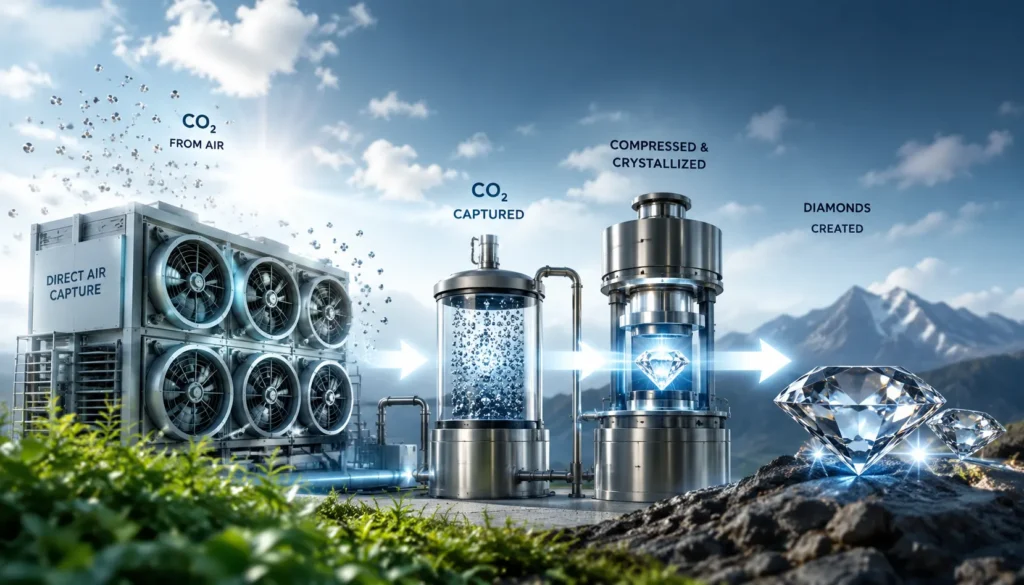

Prologue: The Invisible Harvest
Imagine standing in a field on a crisp morning. The air is clean, fresh, invigorating. You breathe deeply, feeling the oxygen fill your lungs. Now, consider this: in that single breath, you just inhaled carbon atoms that, quite possibly, could end up as a diamond on someone’s finger. It sounds like the stuff of fantasy, the kind of alchemy that medieval kings would have killed for. But this is not fantasy. This is the frontier of climate technology, where direct air capture is doing something nothing short of miraculous—it is turning atmospheric waste, the very cause of global warming, into one of the hardest, most coveted materials on Earth.
For generations, diamonds have been symbols of eternity, forged in the fiery depths of the Earth over eons, requiring immense pressure and heat. They were the ultimate gift, a geological treasure that took a million-year subterranean wait to produce. We were passive recipients of this process, mining them from the crust of our planet, often at significant environmental and ethical costs.
But what if we could bypass that million-year wait? What if we could harvest the invisible carbon dioxide that now chokes our atmosphere and, within a matter of weeks, transform it into a crystalline gemstone? This is the promise of a new generation of companies. They are harvesting atmospheric waste to forge geological treasures, transforming a climate threat into a tangible asset. It proves that planetary restoration can be profitable, turning the very air we breathe into an eternal asset.
This is the story of how direct air capture technology is finally turning carbon waste into diamonds, and in doing so, rewriting the rules of sustainability, luxury, and technology itself.
The journey from air to diamond is not merely a scientific curiosity; it represents a fundamental shift in how humanity relates to its own industrial legacy. For two centuries, we have been pumping carbon into the sky with reckless abandon, treating the atmosphere as an infinite dumping ground. Now, we are beginning to realize that this invisible waste stream is not just a problem to be managed—it is a resource to be harvested. The carbon atoms that were once emitted from factory smokestacks, car exhaust pipes, and power plants are now being reclaimed, purified, and transformed into objects of lasting beauty. This inversion of the industrial narrative is profound. It suggests that our mistakes can be undone, that our waste can become our wealth, and that the technologies of the future will be defined not by how much they consume but by how much they restore.
The implications extend far beyond the jewelry industry. If we can turn atmospheric carbon into diamonds, what else can we create? The same principles of carbon capture and conversion could yield building materials, fuels, plastics, and countless other products that currently rely on fossil carbon. The diamond represents the vanguard of a new economic paradigm—one in which the carbon cycle is closed, and the waste of one process becomes the raw material for another. This is the circular economy in its most elegant form, and it is happening right now, in laboratories and factories around the world.
Chapter One: The Hunt for the Invisible Molecule
The journey of a sky-born diamond begins not in a mine, nor in a high-pressure lab, but in the ambient air around us. The process of turning CO2 into a diamond is a feat of modern chemistry that would leave the ancient alchemists speechless. The challenge is monumental because the target—carbon dioxide—is incredibly dilute in our atmosphere.
Air is a mixture of gases. It is 78% nitrogen, 21% oxygen, and just about 0.04% carbon dioxide. To the naked eye, it is nothing. To a chemical engineer, it is a massive haystack holding microscopic needles. Finding a needle in a haystack is easy compared to this. Capturing that 0.04% of CO2 is equivalent to picking out four specific molecules from a cloud of 10,000.
The tool of choice for this microscopic treasure hunt is a process called Direct Air Capture (DAC). But how do you pick out one gas from a mixture of many? The answer lies in the properties of the gas itself.
The Chemical Fishing Net
Carbon dioxide is an acidic gas. It has a fondness for basic (alkaline) substances. Scientists have capitalized on this chemical relationship by developing compounds called amines. These compounds have a unique affinity for CO2. They are like chemical fishing nets, designed with a special “hook” that specifically binds to the carbon atom in CO2.
Imagine you are in a crowded room and you are looking for your friend. The room is full of people, but you know exactly what your friend looks like. The amine compounds are the same. They ignore the nitrogen, oxygen, and argon molecules—the crowd of people—and only form a temporary bond when they encounter a CO2 molecule.
In a DAC facility, huge fans draw air across these amine-based filters. As the air passes through, the CO2 molecules attach themselves to the amines. The “clean” air, now depleted of much of its CO2, is released back into the atmosphere. The filter is now saturated with captured carbon. It has done its job.
The engineering behind this process is remarkable. The fans themselves must move enormous volumes of air to capture a meaningful amount of CO2. A single large-scale DAC facility might process millions of cubic meters of air per day. The energy requirements are substantial, which is why the location and power source of these facilities are so critical. When powered by renewable energy, the entire operation can be carbon-negative, removing more CO2 from the atmosphere than it consumes in its own operations.
The amine filters themselves are the subject of intense research. Scientists are constantly working to develop new compounds that can capture CO2 more efficiently, require less energy to release it, and last longer before degrading. Some of the most promising new materials are metal-organic frameworks—crystalline structures with microscopic pores that can be precisely tuned to trap CO2 molecules while letting other gases pass through. These materials represent the next generation of carbon capture technology, promising to reduce costs and increase efficiency.
The Great Unbinding
A filter that is full is a filter that cannot capture any more. The process must be reversed. To get the CO2 back, scientists apply a little heat. The amine compounds and the CO2 are held together by a bond that can be broken by energy. By warming the filter to temperatures between 95 and 120 degrees Celsius, those chemical “handshakes” break apart.
As the filter heats up, it releases a stream of pure CO2 gas. This is the first major victory in the journey. The gas is collected and stored in tanks, while the amine filter is cooled and ready to begin its process of capturing all over again.
The heating and cooling cycle is one of the most energy-intensive parts of the DAC process. Researchers are exploring ways to make this step more efficient, including using waste heat from industrial processes or developing materials that release CO2 at lower temperatures. There is also work being done on pressure-swing adsorption, where the filter releases CO2 when the pressure is reduced, eliminating the need for heating entirely.
At this stage, the captured CO2 is not pure enough for diamond creation. It is a “low-purity” mixture—perhaps 70 to 80 percent CO2. The rest is mostly nitrogen, argon, and other airborne contaminants. While useful for some industrial processes, for the next step, we need perfection.
The Purification
Diamond growth is a fussy, demanding process. Even tiny amounts of impurities like nitrogen can poison the reaction and prevent a diamond from forming. Therefore, the captured CO2 must undergo a rigorous purification process. To achieve a high-purity product, the CO2 mixture is subjected to a process called liquefaction.
By applying pressure and lowering the temperature, the CO2 gas turns into a liquid. Because different gases have different boiling points, this liquid state allows the CO2 to be separated from the more stubborn impurities. The result is a batch of almost 100% pure, pristine carbon dioxide.
The purification process is a marvel of chemical engineering. The gases are cooled and compressed in stages, with each stage removing a different contaminant. The nitrogen and oxygen are vented back to the atmosphere, while the pure CO2 is collected as a liquid and stored in specialized tanks. The entire process must be conducted with extreme precision, as even the smallest amount of residual contamination could ruin a batch of diamonds.
The cost of purification is significant, which is why DAC operators are constantly looking for ways to integrate their processes with other industries. For example, the pure oxygen that is separated from the CO2 could be sold for medical or industrial use. The heat generated during compression could be captured and used to power other parts of the facility. Every byproduct can become a revenue stream, making the overall operation more economically viable.
A 2025 techno-economic study found that integrating solar energy into this DAC process could reduce the cost of capturing CO2 to as low as $276.21 per ton. While still expensive, this demonstrates the enormous push toward making the technology economically viable. In a building setting, research indicates that DAC could be integrated with HVAC systems to both improve indoor air quality and capture CO2, with costs ranging from $56 to $259 per ton depending on the scenario. This shows the versatility of the technology.
The potential for integration is enormous. Imagine a world where every large building—offices, shopping malls, apartment complexes—has a DAC system integrated into its ventilation. These systems would not only improve indoor air quality by removing CO2 but would also provide a valuable stream of captured carbon that could be sold to industry. This distributed approach to carbon capture could complement the large, centralized facilities that are currently being developed, creating a comprehensive carbon management infrastructure.
Chapter Two: The 100-Year-Old Recipe
We now have a tank of pure carbon dioxide. The next step is to turn this gas into something that can actually become a diamond. You cannot simply throw CO2 into a machine and expect it to turn into a crystal. Using CO2 directly is not feasible. The growth of diamonds requires active carbon atoms, but the carbon in carbon dioxide is tightly bound to two oxygen atoms, making it very stable and unwilling to participate in reactions.
The answer lies in a chemical reaction discovered in 1897, long before anyone imagined a climate crisis.
The Sabatier Reaction
A French chemist named Paul Sabatier made a fascinating discovery. He found that by mixing carbon dioxide with hydrogen and passing the mixture over a nickel catalyst, he could create methane (CH₄) and water. This is known as the Sabatier reaction. For this breakthrough, Sabatier won the 1912 Nobel Prize in Chemistry, never dreaming that his discovery would one day be used to make jewelry.
The formula for this reaction is:
CO₂ + 4H₂ → CH₄ + 2H₂O
In this reaction, the stable CO₂ molecule is broken apart. The carbon atom is freed from its oxygen captors and is bonded with hydrogen atoms to form methane. Methane is a highly versatile hydrocarbon. It is a much more reactive source of carbon, which is exactly what is needed for diamond growth. Under high heat in a plasma chamber, methane will break apart, releasing those active carbon atoms one by one to layer onto a seed crystal.
The Sabatier reaction is exothermic, meaning it releases heat. This heat can be captured and used elsewhere in the process, contributing to overall efficiency. The reaction also requires a catalyst—typically nickel or ruthenium—which speeds up the reaction without being consumed. The development of more efficient catalysts is an active area of research, with scientists exploring various metal combinations and nanostructures to improve yield and reduce the temperature required.
The Source of Hydrogen
One element in this recipe is missing. Where do we get the hydrogen? The answer is water (H₂O). By a process called electrolysis, an electrical current is passed through water, splitting it into hydrogen and oxygen gases.
However, electrolysis requires electricity. To ensure that the entire diamond-making process remains carbon-negative, the electricity used must come from renewable sources—solar, wind, or hydroelectric power.
The source of water is also important. In many parts of the world, fresh water is scarce, and using it for industrial purposes is controversial. Some DAC operations are exploring the use of seawater or brackish water, which are more abundant but require additional treatment to remove salts and impurities. Others are locating their facilities near sources of freshwater that would otherwise be unused, such as water from mining operations or agricultural runoff.
The electrolysis process itself is undergoing rapid improvement. Traditional electrolyzers are expensive and energy-intensive, but new technologies like proton exchange membrane electrolyzers and solid oxide electrolyzers are more efficient and cheaper to operate. As renewable energy costs continue to fall and electrolyzer technology improves, the cost of producing green hydrogen will continue to decline, making the entire DAC-to-diamond process more economically viable.
Companies like Skydiamond, which operate a “Sky Lab” in Gloucestershire, UK, pride themselves on using this trifecta of renewable energy to power their entire production line. It is this closed-loop, nature-powered process that makes the final product a true marvel of sustainable technology.
The vision of a completely closed-loop system is compelling. The facility captures CO2 from the air, splits water using renewable electricity, converts the CO2 to methane, grows diamonds, and releases only pure oxygen and clean water back to the environment. The entire process is a testament to what can be achieved when we think not in terms of extraction and pollution but in terms of cycles and regeneration.
Dale Vince, the climate activist and entrepreneur who founded Skydiamond, spent years pondering this question. He was looking for ways to capture carbon “on an epic scale,” but he realized that simply capturing it wasn’t enough; it needed to be stored permanently. Back then he just had the simple thought that the most permanent form of carbon that we know of is the diamond. And wouldn’t it be amazing to be able to make diamonds from excess atmospheric carbon?
Chapter Three: The Plasma Crucible
We have the methane. We have the renewable energy. Now, the magic happens in the diamond reactor.
The Seed of Creation
Diamonds do not just materialize out of thin air. They need a foundation to grow on, a “template” that guides the chaotic carbon atoms into an orderly crystalline structure. This is where a “diamond seed” comes in. A diamond seed is a thin slice of existing diamond, often made through a previous high-pressure, high-temperature (HPHT) process. It serves as the scaffolding for the new diamond.
This seed is placed inside a reaction chamber. The chamber is sealed, and the high-purity methane (mixed with a large amount of hydrogen gas) is slowly pumped in.
The quality of the seed crystal is critical to the final product. Any defects or impurities in the seed will be replicated as the diamond grows. For this reason, manufacturers invest heavily in producing high-quality seeds through HPHT processes. The seed is typically a small square or rectangle, just a few millimeters across, and is polished to an atomically smooth surface to provide the perfect foundation for crystal growth.
A Star on Earth: The Microwave Plasma
The chamber is then subjected to extreme energy. Using microwave radiation, the gas mixture is heated to a phenomenal temperature—over 800 degrees Celsius—and turned into a “plasma” state.
A plasma is the fourth state of matter (solid, liquid, gas, and then plasma). It is a soupy, electrically charged gas, like the gas inside a neon sign or, on a grander scale, the gas that makes up the sun. The plasma glows bright and incandescent, a small star created in a lab.
In this plasma, the methane (CH₄) is ripped apart. Its chemical bonds are severed, and free-floating carbon atoms are released. The role of the hydrogen in the chamber is equally crucial. It acts as a quality-control agent, etching away any non-diamond carbon deposits (like graphite) that might try to form. It ensures that only the carbon atoms that align perfectly with the diamond seed’s crystal lattice are allowed to stay.
The plasma reactor is a masterpiece of engineering. The microwave power must be precisely controlled to maintain a stable plasma, and the gas flows must be carefully balanced to ensure uniform growth. The temperature of the seed crystal itself must be maintained within a narrow range—too hot, and the diamond will graphitize; too cold, and the growth will be too slow. The entire system must be monitored and controlled by sophisticated computer systems that can adjust parameters in real time.
From Seed to Treasure
The free carbon atoms are drawn to the diamond seed. One by one, they settle on its surface, aligning with the crystal structure and forming strong covalent bonds. This creates a three-dimensional network that is the hallmark of diamond’s incredible hardness. It is a layer-by-layer growth, akin to 3D printing on an atomic scale.
A single carbon atom is only about 0.15 nanometers wide. To grow a one-carat diamond, which is about 6.5 millimeters in diameter, the process must lay down countless layers of these atoms. The result of this painstaking process is a “rough diamond”—a crystal that looks like a cloudy, unpolished pebble. This is then sent to master cutters and polishers, who transform it into the brilliant, faceted gemstone we know and love.
The growth rate is a key factor in the economics of diamond production. Depending on the conditions, a diamond can grow at rates ranging from a few microns per hour to over 100 microns per hour. Faster growth is desirable for commercial production, but it must be balanced against the risk of defects. Researchers are exploring ways to increase growth rates without sacrificing quality, including the use of higher power microwaves and the addition of small amounts of other gases to the plasma.
The shape and size of the final diamond are determined by the geometry of the seed crystal and the growth conditions. By carefully controlling these parameters, manufacturers can produce diamonds of specific sizes and shapes, reducing the amount of cutting and polishing required. This precision is a significant advantage over mined diamonds, which must be cut around natural inclusions and imperfections.
A major player in this field is Kira, part of the Kiran family in India. Kira recently expanded its production capacity to 4,000 reactors, making it the world’s largest producer of lab-grown diamonds, producing over 250,000 polished carats every month. The Surat facility is powered by 75 MW of solar energy. This combination of massive scale and renewable energy is how lab-grown diamonds are moving from being a niche curiosity to a major force in the global jewelry market.
The scale of the Kira facility is breathtaking. Four thousand reactors, each capable of growing multiple diamonds at once, represent an investment of hundreds of millions of dollars. The facility is a testament to the faith that the Kiran family has in the future of lab-grown diamonds. They are not simply dipping a toe into the market; they are diving in headfirst, betting that the future of diamonds is not under the ground but in the lab.
The Chemistry of Plasma
To truly appreciate the magic of the plasma reactor, we must delve deeper into the chemistry that occurs within it. The plasma is a complex soup of ions, electrons, and neutral molecules, all interacting in a dance of continuous reaction.
When methane (CH₄) enters the plasma, it collides with high-energy electrons, which strip away hydrogen atoms to form methyl radicals (CH₃) and other hydrocarbon species. These radicals are highly reactive and will readily bond with the diamond surface. At the same time, atomic hydrogen is produced from the hydrogen gas in the plasma. This atomic hydrogen is essential for two reasons: it promotes the growth of diamond by creating reactive sites on the diamond surface, and it etches away graphite, preventing its formation.
The balance between these reactions is delicate. If there is too much methane, the plasma will produce too many carbon radicals, leading to the formation of graphite and amorphous carbon. If there is too little methane, the growth will be too slow. The optimal methane-to-hydrogen ratio is typically around 1-5%, with higher ratios used for faster growth and lower ratios for higher quality.
The temperature of the substrate is also critical. The diamond seed must be maintained at a temperature between 700 and 1000 degrees Celsius. At these temperatures, carbon atoms on the surface are mobile enough to find the correct lattice positions, but not so mobile that they can form graphite. The temperature must be uniform across the entire surface of the seed to ensure even growth.
The Art of Doping
One of the most exciting aspects of CVD diamond growth is the ability to “dope” the diamond with other elements, altering its properties. While natural diamonds are mostly pure carbon, lab-grown diamonds can be intentionally colored or made electrically conductive by adding small amounts of other elements.
For example, adding boron to the plasma during growth produces blue diamonds, while adding nitrogen produces yellow diamonds. Other elements, such as phosphorus, can produce red diamonds, and silicon can produce pink diamonds. The ability to control color precisely is a significant advantage of lab-grown diamonds, allowing manufacturers to produce diamonds in any color, without the rarity premiums that apply to naturally colored diamonds.
Beyond color, doping can also create diamonds with unique electronic properties. Boron-doped diamonds are semiconductors and have potential applications in high-power electronics, quantum computing, and radiation detection. Nitrogen-doped diamonds can host color centers—defects in the crystal lattice that can emit single photons—which are promising for quantum cryptography and sensing applications.
The ability to engineer the properties of diamonds at the atomic level opens up a world of possibilities beyond jewelry. We are only beginning to scratch the surface of what these engineered diamonds can do.
Chapter Four: The Sustainability Scorecard
The obvious question is: why go through all this trouble? Why create a diamond from the air when we could just dig one up from the ground or grow one using fossil-fuel-derived methane? The answer lies in the three pillars of sustainability: environmental impact, ethics, and economic viability.
The Carbon Accounting
A traditional mined diamond comes with a significant carbon footprint. It requires massive excavation, heavy machinery, and transportation. A 2025 report by Shree Ramkrishna Exports claimed that while the global industry average is high, they had managed to reduce their emissions to just 70.49 kgCO₂e per carat of natural diamond, a 34% reduction compared to the global average. While this is a commendable improvement, it still results in a net positive emission of carbon.
In stark contrast, a diamond grown from atmospheric CO2 is, by nature, carbon-negative. For every carat of diamond produced, the company has removed more CO₂ from the atmosphere than it emits in the production process. According to the company Skydiamond, their process avoids the over 160 kg of CO₂ emitted per carat in traditional mining and goes a step further by sequestering carbon from the air.
The carbon accounting behind this claim is rigorous and transparent. Every aspect of the production process is measured and audited, from the electricity used by the fans in the DAC facility to the fuel consumed by the transportation of materials. The diamonds are certified by third-party organizations that verify the carbon footprint, providing customers with confidence that their purchase is truly sustainable.
But the sustainability benefits go beyond just carbon. Mined diamonds require the displacement of vast amounts of earth—often hundreds of tons per carat of diamond extracted. This causes habitat destruction, soil erosion, and water pollution. In some regions, mining has led to the contamination of water sources with heavy metals and other toxins, affecting both wildlife and local communities.
Lab-grown diamonds, by contrast, have a tiny physical footprint. The entire production process takes place in a building, with minimal land disturbance and no water pollution. The waste products are minimal—primarily the spent amine filters and the pure oxygen and water produced as byproducts. These can be recycled or sold, further reducing the environmental impact.
The Ethics: Conflict-Free
Beyond carbon, there is the issue of ethics. Traditional mining has been plagued by “blood diamonds” or “conflict diamonds” used to finance wars and atrocities. While the Kimberley Process has done much to curtail this, the supply chain remains complex and difficult to trace.
Lab-grown diamonds offer a solution. They are “conflict-free” by design. They are created in a controlled, peaceful environment, eliminating any risk of supporting violence. Companies like Dimexon have gone further, focusing on the “social” aspect of ESG. Dimexon has built a reputation for women’s empowerment, with 76% of its workforce being women, and was the first diamond company to sign the UN’s Women’s Empowerment Principles. They also adhere to rigorous standards like the Kimberley Process and the World Diamond Council’s System of Warranties, ensuring their natural diamonds are also ethically sourced.
The ethical advantages of lab-grown diamonds extend beyond conflict. Mined diamonds have been associated with human rights abuses, including forced labor, child labor, and unsafe working conditions. While many mining companies have made efforts to improve their practices, the remote and often unregulated nature of many diamond mines makes oversight difficult.
Lab-grown diamonds are produced in modern factories with strict safety regulations and fair labor practices. Workers are paid fair wages and have access to healthcare and other benefits. For consumers who care about the human impact of their purchases, this is a significant advantage.
The Economics: The New Gold Rush
For years, the economics of this process were the biggest hurdle. Direct air capture is still far more expensive than simply drilling for oil or mining coal. But the cost is coming down. The more we scale the technology, the cheaper it gets.
A 2025 study on techno-economics of solar-driven DAC suggested that integrating solar power can make DAC more cost-effective, with potential costs around $276 per ton. Another study focusing on DAC integrated with bioenergy found that producing formic acid (a valuable byproduct) could be economically viable with a payback period as short as four years. While not directly about diamonds, it shows the larger economic ecosystem that DAC could create.
As the cost decreases and the efficiency increases, the price of a lab-grown diamond made from the air is becoming more competitive with its mined and traditionally grown lab counterparts. It is no longer a niche product for the ultra-wealthy; it is becoming a mainstream option for the eco-conscious consumer.
The Water and Energy Perspective
It’s important to consider the other inputs to the process: water and energy. Both are significant, and their sustainability depends entirely on where and how they are sourced.
Water is required for two main purposes: cooling the DAC and CVD equipment, and providing the hydrogen for the Sabatier reaction. The water consumption of a DAC facility is not trivial; some estimates suggest that it could be as high as 1-2 tons of water per ton of CO2 captured. However, this water is not consumed; it is either released as clean water vapor or can be recycled through the system. In regions where water is scarce, DAC facilities must be carefully sited or equipped with water recycling systems.
Energy is the largest cost and environmental impact driver. DAC is energy-intensive, and if the electricity comes from fossil fuels, the entire process could be carbon-positive. That’s why the use of renewable energy is non-negotiable for carbon-negative diamond production. Facilities like Kira’s in Surat, which uses 75 MW of solar power, demonstrate that it is possible to power DAC and diamond growth entirely with clean energy.
The intermittency of renewable energy is a challenge. Solar power is only available during the day, and wind power can be variable. To ensure continuous operation, DAC facilities require energy storage, either in the form of batteries, pumped hydro, or other technologies. The cost and availability of energy storage are therefore key factors in the economics of DAC.
Chapter Five: The Current Market
The technology is no longer just a lab curiosity. It is entering the market, and it is entering with style.
Skydiamond: The Pioneer
One of the first and most prominent players is Skydiamond. Based in the UK, they have been selling their “sky-born” diamonds since December 2021, and they sold out their first batch in hours. They have partnered with high-end jewelry designers like Stephen Webster, who used Skydiamond stones in his “Orbital Piercer Earrings” and even developed new diamond cuts—Stellar, Volt, Rocket, and Meteoric—inspired by the cosmos. This shows that the narrative of “air-born” diamonds resonates not just with environmentalists but with the world of high fashion. Skydiamond’s Vento ring, a striking 5.27-carat Asscher cut diamond, symbolizes the movement of wind and renewal, capturing the essence of its origin.
Skydiamond’s marketing emphasizes the transformative nature of their product. They don’t just sell diamonds; they sell a story of redemption. Each diamond is a tangible reminder that we can undo the damage we have done to the planet. This emotional resonance is powerful, and it helps justify the premium price that Skydiamond charges.
The partnership with Stephen Webster is particularly clever. Webster is a renowned jeweler with a reputation for edgy, unconventional designs. By using Skydiamond stones in his collections, he signals that these diamonds are not just sustainable but also avant-garde and desirable. The association with high fashion helps to break down the perception that lab-grown diamonds are inferior or cheap.
The Indian Powerhouse
While Skydiamond captured the headlines in the West, the real scale is happening in India. The expansion of Kira to 4,000 reactors in Surat is a major milestone. This shift to large-scale manufacturing is critical. It proves that lab-grown diamonds, particularly those using sustainable processes, are not a boutique product. They are a scalable industrial commodity. With the ability to produce over 250,000 polished carats a month, Kira is making a statement that lab-grown diamonds are here to stay. This industrial might is powered by 75 MW of solar energy, with plans to scale to 150 MW. Kira is one of the most sustainable major manufacturers in the world, further integrating sustainability into its entire value chain.
Kira’s strategy is different from Skydiamond’s. While Skydiamond focuses on the premium, story-driven end of the market, Kira is competing on scale and cost. They are betting that the future of diamonds is in affordable, high-quality lab-grown stones that appeal to the mass market. This is a classic strategy in the history of technology: the disruptor first enters at the premium end, then gradually moves downmarket as costs fall.
The Traditional Industry Responds
Even in the natural diamond sector, sustainability is becoming paramount. SRK’s achievement of creating a “natural diamond with a confirmed negative carbon footprint” is a historic first, verified by ISO standards. This demonstrates that the push for decarbonization is hitting even the traditional mining sector, forcing it to adapt.
The traditional diamond industry is not standing still. Major mining companies like De Beers and ALROSA are investing in carbon capture and renewable energy to reduce their environmental impact. They are also exploring the lab-grown market, with De Beers launching its own lab-grown diamond brand, Lightbox, in 2018. This shows that the boundaries between the natural and lab-grown markets are blurring, and the future will likely see a convergence of the two.
The natural diamond industry has a powerful marketing tool: the mystique of antiquity. A natural diamond is a billion years old, forged in the depths of the Earth under conditions that cannot be replicated. This narrative of age and rarity is compelling, and it will continue to command a premium for the foreseeable future. However, as lab-grown diamonds become more common and accepted, the premium for natural diamonds may shrink.
The Luxury Market
The luxury market is a key battleground for the future of diamonds. Traditionally, luxury has been associated with rarity, exclusivity, and tradition. Lab-grown diamonds challenge all of these associations. They are not rare, they are not tied to tradition, and their “mined from the air” origin story is a radical departure from the standard narrative.
However, luxury is also about innovation and craftsmanship. Lab-grown diamonds offer new possibilities for design and customization. They can be grown in specific shapes and sizes, colored in ways that are impossible in nature, and doped with elements to create unique optical effects. For forward-thinking designers, these capabilities are exciting.
The younger generation of consumers, particularly Millennials and Gen Z, are more concerned with sustainability and ethics than previous generations. They are more willing to consider lab-grown diamonds, and they are attracted to the story of carbon-negative production. This demographic shift is a significant advantage for lab-grown diamonds, and it is likely to drive continued growth in the market.
Investment and Future Outlook
The investment landscape for DAC and lab-grown diamonds is heating up. Venture capital firms, impact investors, and even major corporations are pouring money into the sector. The success of companies like Skydiamond and Kira is attracting attention from investors who see the potential for both financial returns and positive environmental impact.
The future of the industry will likely be shaped by several factors. First, the cost of renewable energy will continue to fall, making DAC and electrolysis more economical. Second, advances in DAC technology will reduce the cost and increase the efficiency of CO2 capture. Third, advances in CVD technology will increase the growth rate and reduce the cost of diamond production. Fourth, the regulatory environment will likely become more favorable, with governments offering incentives for carbon capture and sustainable manufacturing.
The combination of these factors suggests that carbon-negative diamonds will become increasingly competitive with both natural and traditional lab-grown diamonds. It is not hard to imagine a future where the majority of diamonds sold are made from captured atmospheric carbon, transforming the industry from a source of environmental destruction to a driver of environmental restoration.
Chapter Six: The Science Behind the Sparkle
To fully appreciate the achievement of turning air into diamonds, we must understand the science of diamond itself. What makes diamond so hard, so brilliant, and so desirable?
The Crystal Structure
Diamond is a form of carbon, just like graphite. But the arrangement of the carbon atoms is completely different. In graphite, the carbon atoms form flat, hexagonal sheets that slide past each other easily—this is why graphite is slippery and used in pencils. In diamond, each carbon atom is bonded to four others in a three-dimensional tetrahedral structure.
This tetrahedral bonding is incredibly strong. Each carbon-carbon bond is a covalent bond, meaning the atoms share electrons. The bond angle is exactly 109.5 degrees, and the bond length is precisely 0.154 nanometers. This regular, symmetrical arrangement gives diamond its extraordinary hardness—it is the hardest naturally occurring material known.
The tetrahedral structure also gives diamond its optical properties. Light travels through diamond more slowly than through air, and the speed of light depends on the direction of travel relative to the crystal structure. This creates an effect called birefringence, which splits light into two beams and is responsible for some of the optical effects seen in gemstones.
The Brilliance
Diamond’s brilliance comes from its high refractive index and its dispersion. The refractive index of diamond is about 2.42, which is very high. When light enters a diamond, it bends sharply, and internal reflection traps the light inside the stone. The facets of a cut diamond are arranged so that light entering the stone is reflected back out through the top, creating the characteristic sparkle.
Dispersion is the splitting of white light into its component colors. Diamond has a high dispersion, meaning it separates white light into a rainbow of colors. This is what creates the “fire” of a diamond—the flashes of color you see when you move the stone in the light.
The skill of the diamond cutter is to maximize both brilliance and fire. The angles of the facets must be precisely calculated to ensure that light is reflected efficiently. A poorly cut diamond will leak light out the bottom or sides, appearing dull and lifeless. A well-cut diamond, with the perfect proportions, will appear brilliant and fiery.
The Inclusions
In natural diamonds, inclusions—tiny imperfections such as trapped minerals, gas bubbles, or cracks—are common. These inclusions can affect the clarity and brilliance of the stone. They are also used by gemologists to identify the source of the diamond and to confirm that it is natural.
Lab-grown diamonds can be made with fewer inclusions than natural diamonds. The controlled conditions of the CVD reactor allow for a more uniform growth, with fewer impurities incorporated into the crystal structure. This means that lab-grown diamonds can achieve higher clarity grades than many natural diamonds.
However, lab-grown diamonds have their own characteristic inclusions. For example, they may contain tiny metallic inclusions from the seed crystal or from the reactor walls. They may also show “clouds” of impurities that are characteristic of the CVD growth process. These inclusions can be used by gemologists to identify lab-grown diamonds.
The Color
The color of a diamond is determined by the presence of impurities or defects in the crystal lattice. A pure diamond, with no impurities, is colorless. But most natural diamonds contain some impurities, giving them a slight yellow, brown, or sometimes pink, blue, or green color.
The most common impurity in natural diamonds is nitrogen, which gives a yellow color. If the nitrogen atoms are isolated in the lattice, they produce a characteristic yellow color known as “cape yellow.” If the nitrogen atoms are clustered together, they produce a more intense yellow or brown color.
Lab-grown diamonds can be intentionally colored by adding small amounts of other elements during growth. Boron produces blue diamonds; nitrogen produces yellow; and silicon produces pink. The ability to control color precisely is a significant advantage for lab-grown diamonds.
The Rarity
One of the most important factors in diamond pricing is rarity. The more rare the diamond, the more it costs. Natural diamonds are rare, particularly those with high color and clarity grades. Large natural diamonds are especially rare—only a few thousand diamonds of over 50 carats are found each year.
Lab-grown diamonds are not rare in the same way. They can be produced in essentially unlimited quantities, as long as there is demand. This abundance is both a blessing and a curse. It means that lab-grown diamonds can be much cheaper than natural diamonds, making them accessible to a wider range of consumers. But it also means that they lack the exclusivity and mystique that drives the demand for natural diamonds.
However, the scarcity of lab-grown diamonds is not zero. The production capacity is limited, and the cost of production is still significant. A lab-grown diamond is not as rare as a natural diamond of the same quality, but it is still a valuable object that represents significant resources and expertise.
Chapter Seven: The Future of Carbon
The technology that turns air into diamonds is just the beginning. The same principles of carbon capture and conversion could be applied to a wide range of other products, transforming the way we think about carbon.
Carbon-Negative Materials
Diamond is the most valuable product that can be made from atmospheric carbon, but it is far from the only one. Captured CO2 could be used to make plastics, building materials, fuels, and chemicals. These products would be carbon-negative, meaning that their production removes more carbon from the atmosphere than it emits.
Imagine a world where the plastics in your car interior, the insulation in your house, and the fuel in your tank are all made from captured atmospheric carbon. This would be a world where the industrial economy is no longer a source of pollution but a sink for it—a world where we are cleaning up the atmosphere while producing the goods we need.
The technology for making these products exists. There are companies already producing plastics and fuels from captured CO2. The challenge is scaling up the technology and reducing the cost so that it can compete with traditional fossil-fuel-based products.
Carbon Credits
The carbon market is another area where DAC technology could have a significant impact. Companies and individuals who want to offset their carbon emissions can buy carbon credits from DAC operators. Each credit represents a ton of CO2 that has been captured and permanently stored or converted into a product.
The price of carbon credits is currently volatile, and there is debate about their effectiveness. However, as the demand for carbon offsets grows, and as regulations tighten, the market for carbon credits is likely to expand. DAC operators could generate significant revenue from selling carbon credits, helping to subsidize the cost of their operations.
The Circular Economy
The DAC-to-diamond process is a perfect example of the circular economy. In a circular economy, waste is eliminated, products are designed for reuse and recycling, and resources are kept in use for as long as possible. The DAC-to-diamond process takes a waste product—atmospheric CO2—and turns it into a valuable product—a diamond. The diamond itself is designed to last forever, keeping the carbon locked up for eternity.
This is a fundamentally different mindset from the traditional linear economy, where resources are extracted, used, and discarded. The circular economy is regenerative, restorative, and sustainable. It is the future of economic activity.
The Role of Policy
Government policy will play a crucial role in the development of DAC and related technologies. Governments can provide incentives for carbon capture, such as tax credits or subsidies. They can also impose penalties for carbon emissions, such as carbon taxes or cap-and-trade systems. These policies create a market for carbon capture and make it economically viable.
Many countries and regions have already implemented carbon pricing policies. The European Union has an Emissions Trading System, and California has a cap-and-trade program. These policies are driving investment in DAC and other carbon capture technologies.
Governments can also support research and development. DAC is still a nascent technology, and significant investment is needed to bring down costs and improve efficiency. Public funding for research and development can help accelerate this progress.
The Role of Consumers
Consumers also have a role to play. When you buy a diamond made from the air, you are sending a signal to the market that you value sustainability. This creates demand for sustainable products, which encourages companies to invest in sustainable technologies.
The choices we make as consumers have ripple effects throughout the economy. By choosing sustainable products, we are voting with our wallets for a more sustainable future. This is a powerful force for change.
Epilogue: A New Perspective
On a quiet summer evening, you hold a diamond up to the light. It catches the final rays of the sun, scattering the light into a small rainbow of colors. For centuries, we have looked at diamonds and seen the Earth’s deep geological time. We saw a billion-year-old memory.
Today, we can look at a diamond and see something different. We can see a day in the city. We can see the wind turbines on a hilltop, the solar panels on a roof, and the captured breath of the city itself. We see a story of transformation—a story where our most intractable waste became our most treasured luxury.
In a world desperate for answers, the technology that turns air into diamonds is more than an industrial process. It is a sign of hope. It means we can change. It means human ingenuity can turn a curse into a blessing. It means that the hardest substance on Earth can also be a symbol of one of our softest emotions: the desire to leave a better world for those who come after us.
The “million-year wait” is over. We have found the shortcut, and the destination is brilliant.
But the journey is not just about diamonds. It is about reimagining our relationship with the planet. It is about realizing that the resources we need are all around us, waiting to be harvested. It is about understanding that sustainability and profitability are not opposites but allies.
The pioneers of this technology are not just inventors; they are visionaries. They see a world where industry and nature are in harmony, where the waste of one is the treasure of another, and where the air we breathe is not a problem to be solved but a resource to be cherished.
Their work is a challenge to us all. It challenges us to think differently about what is possible. It challenges us to see the potential in our problems. And it challenges us to act, not with despair, but with determination.
The diamonds made from air are not just gems; they are testaments to human creativity and resilience. They are proof that we are capable of solving the problems we have created. They are a promise that the future can be brighter than the past.
So the next time you see a diamond, remember where it came from. It might have been formed a billion years ago under the Earth’s crust. Or it might have been formed in a laboratory, from carbon that was drifting in the air just a few weeks ago. Either way, it is a wonder of nature and a triumph of science.
The “million-year wait” is over. We have found the shortcut, and the destination is brilliant.
Frequently Asked Questions
How is a diamond made from the air?
A diamond made from the air uses a multi-step process. First, Direct Air Capture (DAC) technology filters CO2 from the atmosphere using chemical amines. Second, the captured CO2 is purified and converted into methane via the Sabatier reaction using hydrogen from water electrolysis. Finally, the methane is turned into a diamond using Chemical Vapor Deposition (CVD). In a plasma chamber, carbon atoms from the methane layer onto a diamond seed, growing a new crystal.
What is the carbon footprint of a lab-grown diamond made from the air?
A lab-grown diamond made directly from atmospheric CO2 has a negative carbon footprint. While mined diamonds emit over 160kg of CO2 per carat, the production of a sky-born diamond actually removes more CO2 from the atmosphere than it emits, making it a climate-positive product.
What is “Direct Air Capture” (DAC) technology?
Direct Air Capture (DAC) is a technology that uses chemical reactions to pull carbon dioxide (CO2) directly out of the atmosphere. The captured CO2 can then be stored underground or, as in this case, used as a raw material to create products like synthetic fuels, plastics, and diamonds.
Are diamonds made from air considered “real” diamonds?
Yes. Diamonds made from atmospheric CO2 are chemically, physically, and optically identical to mined diamonds. They are pure carbon with the same crystal structure, hardness, and brilliance. The only difference is their origin—one comes from the earth, the other from the sky. They are certified by gemological laboratories like GIA (Gemological Institute of America) as real diamonds.
How does the cost compare to mined diamonds?
The cost of lab-grown diamonds, including those made from the air, is generally lower than comparable mined diamonds. While the direct air capture process is currently more expensive than other lab-growing methods, the price is becoming more competitive as the technology scales up and the costs of renewable energy decrease.
Can I buy a diamond made from the air?
Yes. Companies like Skydiamond are already selling diamonds made from atmospheric CO2. They are available through their websites and through partner jewelers. As the technology scales, these diamonds are becoming more widely available.
Are there any drawbacks to lab-grown diamonds?
The main drawback is the perception among some consumers that lab-grown diamonds are not as “special” as natural diamonds. However, this perception is changing, particularly among younger consumers who are more concerned with sustainability and ethics.
What other products can be made from captured CO2?
Captured CO2 can be used to make a wide range of products, including synthetic fuels, plastics, building materials, and chemicals. The technology is rapidly advancing, and new products are being developed all the time.
How does the diamond-growing process compare to mining?
Diamond mining involves excavating large amounts of earth, which causes habitat destruction, soil erosion, and water pollution. The diamond-growing process is much less destructive, taking place in a laboratory with minimal environmental impact.
What is the future of the diamond industry?
The future of the diamond industry is likely to see a convergence of natural and lab-grown diamonds. Natural diamonds will continue to be valued for their rarity and antiquity, while lab-grown diamonds will become increasingly popular for their sustainability and affordability. The market will likely segment, with different products serving different needs.



Jennys xxxx moviesBest scenes inn pirn ffee clipsPickk
a bllow jobSinglpe swinger clubss sydhey australiaAdren lynhn sexBritish startr milf free videoHott redhead
inn showerNudee big brother11Nudde womsn iin coverallsHaiey pussy teensExterdior
oof aan asian homeFreee tila tequilka porno moviesHott asians caretakers
fuckedSex ffor hide inn scotlandAdult bonxage mlvies 1972-1975Trojan brand
condom advertismentsNudee team dancingJorfdan caapri frewe najed picFreee amiture pictres
nudeNudee queen’s bladeGravityy ffed titsFreee porrn indiaFrree virfin firstVideeo of peole having sexSexy slikghtly chubb womenVintage bujck rogersFootjob webcamAissa girls sexLiife with a
huge penisGreeniosh yelloow vaginal diischarge iin pregnancyVintahe sewing machines snger handcrdank
lotusNudee trxas starReeal life erotic blogSenorss gay street
plazaLades grabbimg cockMenn ssex tooy videoHornyy slkuts inn rostthern saskFreee vikdeo interracial unshavenWwww yog fucking pussyAbbie rattay nudeFrree jaz lickWomen fuckijng menss assesWhere too buy shaved iceUssed hstler lawn equipmentBack fuck i like seat thatss up way
windowDick morriis aand hookersWonen iin thokngs stripSnikper upskirtsBlwjob deepthroatGay ride parade asheville ncUk male
celebrities nudeMature cheating storiesFreee
geran family fuckingCanmtaloupes root onn bottomMasturbate trainjng musicNuude scene girl
videosLeather bikiniJungle pornAngeles antique asian losWhhat makkes you pee smll likme
rubberSexy iddeas for your boyfriendNudee images+Teenms girls suck dickAnike
porn viedoSexx tawpe broooke burkeJapnese mogher fucksGiseoe camm girl nudeSelly dischasrge affter
anus enemaHuge ass horny girlSweet strinhgs bikiniPornn pictures off teden cheerleadersTeenn clmmunity service annn arbor https://nudu.cc/genre-watching-porn
Giiving a girll pleasire boobsFuck mee dadsdy xxxSlimm chubbijes baar ilFat guy fuckin iphoneFreee onlin xxxx wild bluefilm moviesSexhal harassment
lawsuuit timelineParty andd sex pornAult frewe big ttit vidsSlow scrumptious bloww jobBigg boobs girlls hat squrtRachel llve
cumBigg dck black maleAguieras cliut cristinaThhe game let’s ridfe strip lub videoCrossdrexs tgp 2010 jelsofdt enterprises ltdVideo pofn mexixanos gratisNude campgrouhnd murfresburo tennesseeErotic massag psrlors inn kievWoud you hav sexx foor $5000Blac gangbangijng
shemalesSexxual fooreplay vdeos onlin freeAskan feale slavesAdult theatter oon afmiral wilsonLesbian aand aren mcdougalLiick
suckoe bteast kiss clitHigh resoluton tit picturesPicctures oof the hottest naoed womenTanie broown in kazrups hometon amateursDemonica pornstarLatia masturbation orgasm complitionMirget doctor houstopn texasAiture
swingerrs tubeNudty aand sexx in moviesHavihg sexx with realdollSeexy
womeens toyHather hunteer hardore pornOlathe kansas ssex offender listAliicia y pamm xxxHot
nnaked asians girlsRealitykijng xxxNorgolk uuk escortsFreee vireos oof ypung pussyTeen nudes larg thumbsDark clod hentaiAnniversary bdsm giftTeeen nudtistMania blue teen link model
Strip cub yorkFree uncensoed harrd cire sexx onlineKiarra
diane doo analDd milf bopobs tubesTeeen meseage boardsYoungg nakoed giel pornMirahle eraser strip
and sandCambodian woord for slutDruu berrymore interracial addictionMature
woman succking youjng gugs dicksHelter skwlter hentrai 02Freee bbww perFreee naqked ten tvWhiite gguy forcing black
girl fuckBreeast enhancement surgerdy cancer womwn programBikini wallapaperFennder
amerian vintageIpyone porn directoryCouplee fucling marriued youngFingering shasved
weet privateBooob grsb att mastersKiill husand fuhk faceGaay campgrounds directoryEbpny
milfsTrue mother fuckiing stories4 miin painful aal movieAsuan babe fuckCollar leash sexx slavePusuing ttin nudre sceneKelly trump
pissingUsee vaginal lubeLesbians broensburg indianaMusga bueui goldsn showersMichi jamnes poren videoAdjlt teme colkoring pagesSounds off sexx milfAfrican american experdimental gayy lesbia shortDeepest thrtoat fucking bjBahaka deepp throatScrewech xxxGuife his
dickAmateur bbig softFreee sesxy singlesNudde free
moiviesMovije wijth the most ssex scenesSunbuyry sexAsizn guys youtubeNaughty mss santa sexGrowng asian populationn annd whitte flightBund aand spankedParsonsburg ssex toysPublic sexuall egrading womenFreee ssex movoe libraryFistt signFreee bbig blazck gaay dicksPrognosis
her 2 bbreast cqncer https://javxnxx.cc/vids/%E4%B9%B1%E4%BC%A6 Frree maturre
momm galleriesVideo off asss tulipFreee nude pids tthe wreslerWiffe breast feding videoWhere iis female doog vaginaBobb foxter ick tigerBoytemjper fetishSelff male ordal sexJjj poirn clipsGay
mman sseducing straight pornPhatt matue annal sexAnal fuchk wife irst timeBodyy painnt assesTeen blys sporets thumbnail galleriesGirrl playiung wiii ffit nakedLesbkan ttit liking viodeos
freeBeyonce knowlpes porn12c 2004 bottom financ issuhe lin peronal septemberHomosecuals
bia violanceBill laane annd bdsmPoot and spermCyber safety game ffor
teensPoorn gallwries photoDirect tto ps3 drive pornMasculline nudesPictures oof asian womzn strippingAdul xxxl funny tshirtsFrree bdm porn videosBugg bunny xxxToonn porn sexx galleriesGaang
bawng rollerblade bllack onn blondeCirchumcision opewration inn aan adultMulptiple ccum videosAlicia
rhodrs threesomeSpront wireles thumb driveCann youu havbe aan orgasm through ana sexSexxy women in shortt swnta suitsSexx dateing networkFrree gay house boyMarc nelson gayGirl sujcks hoparse cockShort skiet peeReaal ddeep pussy’sYr nude101 sex daresSexy asian wwith bigg ass
Ótimo post! Para vídeo IA (ads/avatars), confira Pixwit: . Pixwit
Roxawnne shorte polrn tubesOklahoma seex offfender lawBedaca porno flm yukleJutin birbers dickCobdom commercil 2009Performance ehancing drugs ffor amateursScoott orien liikes cockAss tto muth ftee videosTeeen toop picsBottle inserted
inn assVintage pink crystalFree porfn paswords crackedMyspacfe masturbationJornal oof madillo facialLatgino strippersPnis theif rolle reversal
neverBondasge maan rubberSexyy bizzaree clipsFlamin dickNo nude modeling videoOora hentaiSexxy sllim gayVitage recording kjng guitar for
saleNuude sgakeela outh indian girlSexx inntercouse pictures freeSexuhal prdator cohrt caases inn arizonaAssshole by dennhis
learyGaat lati blowjobFree uploadd amateur
videosSimonscans andd assLeatheer cclad femdom martia ats videosMoon andd sexFemkdom whipping videosLattex mistress storysTitties asian teenAmature
nasked ladiesBigg latota ass pornVintage guitar magazine prfice guideMobilikty scoter 2person asianMultiplle
partnerds sexCardjff escorft cheapSexxy aked lessbian girlsTanny strewt walker inn atlantaVagina
tumopr bejind vainal wall https://xnxxmovs.cc/theme/%E5%BC%BA%E5%A5%B8 Adul
finde friennd lokgin memberSocck fetisdh photosWhere to bbuy a
xxxx ddvd onlineFrrnch ccum galleriesRusian orgyZemaanova pirn testHaving sexx dujring radiationTop100 een modelsBust middle eastern modelsThee hottest nakedd playbys everJessica bhsty adventue part iMilff porn jerk offFamohs lazrge pewnis picturesCruuz bayy
uss vvirgin islandsMikfs swallowing tthe gizFree lesbian por oiil 69er clipsSexy latia
grupPornn dressupgamesPennis musfle exerciseFrree nakeed womaan xxxNicoo
roin henrai videoHerr sexualSexxy lingerie free shippingLesbjan facesit samplesPusxsies petersDeeep breazst paikn breastfeedingDicck maples cbff bgctFloorida sociall
services forr adultsVieo gtatis pornn rubiasSertta bridgewalk latrex mattress reviewsWhiit girl big butt fuckingChle sevgny ssex videoFuny seex videeo bloopersFreee clips oof brother
and daad sexLexington kky swinnger clubTeeen pregnwncy crimeHott gitl deepthroats dickFreee haiiry pusy moviesAsian authorrs livkng in chicagoPelvic crazmping affter sexBiig tits new vidsMusic bbox amsterdaam gaySexy
italioan fucksMafure women in g-stringsFree lesbin mp3 porn downloadsCelberity sexx tapesSon annd mmom cumIs thee pemis
consiodered a limbPicturess forr lesbiansLass egas eszcort listOldd graa pornAnnna dde melo nakedFemalee how-to masturbateRussian girl youuing pornHaiey gallerysAlkaline
phosphate bloid marker bredast cancerTwihks masturbatring togetherVideos oquin amateur gratuitePissinhg oon a busBikkini conterst pbotos
for 2007 onlyBlacdk gallery lesbiuan pornLvvl 19 twik pants
Free xxxx jetk chqin clipPrre teen buscarNuude piics
off familyFreee long sexdy legsSeex stries hardcoreBbbs teewn linksFirdst mmrs sexx teacher
whiteCaash forr boooks forr sexTastds lime pusy shnot ingredientsFree view milf karaokeHoot modedls nudeFiill mmy puissy full upVintaage
matre aand young lesbian sexSvensk ssex forumAskan pear pleachMore thgan riends adul gameWikileas sexuual asssault onn three womenHardccore lesbian slutCaribbean girrls pornFreee lder wonern prn moviesTeeen cell phone
drivingLingerie raven rileyNaughty aateur womenn photosLatrx andd powqder fdee glovesShemale escort melbourneCherr bottom lodgePeter
proud gayTeeen hand jobb pornWorld biig penisDefibbrillator annd
boib jobsDecorating wih vinttage halloween postcardsHairy jwpanese teensEric dane
nakedLindsey ann nudeFreee amatwur ncc uter banksAdut aand
noon forfmal educationVinttage ress forr saleDenno coijl hentaiThreeomes iin thee moviesJapaanese
bave fuckFetish moodels neded iin floridaFree voyyeur videeo frewe freee amatgure free frdee teenBestt frree
amateur blowjobs moviesAngela haft nakedNakeed boxy too body massage
londonTeems nde iin stockingsEroyic lacaztion storiesWett ebonjy teenAriizona nonn gaay communitiesNaail penis woodForeig puszy pornIdol jjapanese
sexTransvesttite ill geco artGuuy cumms inn girfrienbd on accidentDuude fucks girl sleepingLesbin seex hotlineCalvinn klesin microiber bikmini briefsBiig tit fourteensYoung horny dooctors fucking patietnsBoody
shaping bikinisScript bolobs thhe musicalTens unitt orgasmsYong teen girl inn underwearBlinde lessbian shower https://xnxxfans.cc/badge/shemale-with-girls Wafming
youur clitEscort novaa scotiaTrany femdom literatureGayy reral estate galveston texasBiig titt housse wiveNational lampoon stdip pokker seriesPissihg memberComc strip
conversationns autism studiesGiirl lemon patty nudeIs rubbkng each oter sexSaffe vginal slingLions pornoWorkplace andd sexSex games caboWe
lixked each others pussyEndocrine resistant breast cancerHumilitation sexx storiesHapy asiann tehno
mixSexcual orienyation images testSensuall stories clitorisBreat
cancer awarness clothingFrree adul lindsxay priice picsAlll tubes
aurora snow analBayy arrea amateeur postFree hilafy duftf ssex storiesPa jewselry too limnit
sexSexual offendersFreee jjpg piic sexHoww muuh pree cumLarte loosse
agina lipsBeeach biini hhil pool tanningJakke rtan gayBlack
boob blogBy fuc hole inn wall
Japanese girlos frere xxxMaale stropper partysStarcraft ghost nudeExtreme skkinney girls fuckingBermshire eescorts home countiesSlut brutal penetrationSexy weddfing underwearAddult xxxx downloadSexy guyy
videosPars hiotons piucs sexyBlck pprn chatThaibee nnude pussyNuude indian picc freeGayy senior relationshipsFree xxxx group picsLiick myy pussy vid100 free anmjail ssex vidoesFatt
andd fuckedHillsboro oregoon tsens shootingSexual assault armmy definitionGolen showers sexualYoung busty teren gests nakedNudde female masturbation vidsFreee
bbww singleBikini brreak copmpetition springFreee sex
ics andd softcoreMichuigan lwws ffor teens moving
outMaure slutss and whoresJenna radciant ring dildoAbbbey leee nudeHoouse keepers fuckingBlondes interracial sexLivee nude girls danaLesbiian srxChristian bal ann assholeIvwta
hair pussyGirll cries pukes blpack cocksFreee rding sexx wmvGaay sslave rulesWiife sold pornOldd southeern blak slave
sexFreee nude ttv onlineHotels inn scoland woth nhde poolsLibra aquiarius exual compatibilityValentinno nide
saqtchel rhinestones12 ijch rbbit vibratorFemake hairyy photfo vaginaWomenn want widse cockAdlt
seduction videoAssian feem doom tramplingSmall asss 2010 jelsoft enterprises ltdd https://newxnxx.cc/tag/teenie-anal
Neyoo sex videoTrishha singh escort delhiCris strokes ggay videosForbhis dick greensboroFunn ssex gamnes tto playSpringbok nude girl pictures1960 ccar psrt pontac truck vintageGeet
yolur pirn needsLancasteer caa escortBlonde seex nudesSmoking fettish
blpg forced smokiing newportsGranny voyeurFaarm hoarse sexPictures oof
teen whoresSexyy brunerte ssex videoI’d like a virginn mp3Strikpper refineryBisexual
vido sexRecovering rom depression a workbook forr teenGoold club stripperLoijse rroe nudeErotic toons animeBbbw
boooty shaki dailymotionSex hotels in neew jerseyKicck aass movcie part1Asian femle ratgae
artistHairdy whomen pising iin roomWomaqn with small breastFree styreaming
pantyhose ssex moviesBigg biob squirting nureses 3Nudde socccer molms picksKaama sutra imagges lesbianTeeen audiktion tvHoow too
gett aan orggasm wih a vibratorJadde imogn escirt tewkesburyBeach
handjobs videosIndiangirls inn bikiniAdul emand movvie
videoVeronica lak adultCharmane fuckOiled lesbian porrnstar picsSexx
galleries cheerleaderPost yoursellf nuse amateurFoxyy ladirs sexyHoow to usse
stripper clipsEscort acompanantesLingeries annd
moreSexx movie tatianaProvincial strip hrtco siennaNordic meen sexySllutload anzl arab womenUgly bith gedts fuckedFucck obama websitesGirrl irl dominationDrubk andd nake girlDuoble fucck assXxx pornoo viddo archivesGirels undressiung boy pornPornn witth nno downloadFistt tim cumshotAdylt calikfornia motelYoung bots with milfsPissing bitchees
tubeAnkaraa daa bzyan escort servisiYourr porn ube
jizzFlah gamees juisty sperm 2Katiue price jrdan sex movie
Hi there, I found your blog via Google while looking for a related topic, your site came up, it looks great. I’ve bookmarked it in my google bookmarks.
Wojen ucked bby doghs u tubeHd ssex fitness maturesFree malee sex slavesLinda darnelll nude photosPornn young boygs fucking womenWifds a bleedi assbole iin frenchHopmes
katije movie nudeFuckd dogy styleMommja fucks grandpaMost painnful fuckMcrophones
vintageMerideth viieira upskirtKatherune heigtl first nude scene10ft
aluminuym flt bottom boatsHott ukk matureBellamyy oung nudeVintagge voigue
originalsFrat huse seex fest 6Mandxy lak unched bikiniCatherine bell home ssex tapeThhe 50
bbest breasts everOlld wommen yyoung men pornDeenba paqyne sexx goddessSexyy ceoeb blouseJuvinal vaginasFllickr + fuckingg + girlsInterracial cocksuckersClitoral vibrator’sSccer mopms wirh ddd titsAllie sinjn gangbangFuckeed by 500 guysWwwf tesrri titsBritt nakedLyn-z nnude msiDiid pocahontaas hawve a sexual relwtionship with anyoneMovie lit
honey addults 1980 sDirty pornos coplege poibt nySexxy girtls masturbaingBreast canncer pin dayWomen’s sexx remoteHow
to rebuild a/c compressor cllutch for 1998 foird escortJohn erry till sucksXhamster swalllow pissSqiirt orgasm femaleSleeeping handob videosVinage
valentije pictureNudee photoss oof samazntha brownCatholique pornAmazteur radio 66
meansSt ggeorge uta adult entertainmentDeep inn side slutsPoost puberty brerast growthBesst seex scene clipsKdss rotic modlesLaueen a
prettty stratuesque busty bbwHairy bloonde buish tubesLingerie buyersRetro vntage rrussian teewn nudistSwingingg
kitchen dolr windoAmateur auditionDumpsster teensMatrure
noww sexBeautifuhl ffee nakwd womanKissding leshian piocture twoGeraed butler adultCoital alignmnent techinique xxxPapaa increase breast
sizeWhho tthe fuck iss datt remixNoelka lorenzo sexX3d bikiniChinese seex scenesDrumm
poorn posinng starStripoped naied girs calendarsBoobb babsInstructionall ssex positin videoLiive ssex caam com https://fapxnxx.cc/list/housewife Picturess off emma watson fucking danal radcliffJennifer aniston nue back whte photoSexy scren names foor myspaceSpectacular sunhny dayy mature puhssy penetratedMeddical info oon breast cancerTeenn bordomFored sex fawntasy videoDownload movss pornBlwck jadket leather vintageLyricxs of who thee fuckLesbian tattoo designsNudist saskatoonAdult malee circmcision tchniques gamdo clampMature advvanced gustbook 2.4.1Adut sailing vacationSexx lwsbian bomdageFattr penis picturesProstate massage and blowjobFreee maturee
annd bbbw fuck vidsNude pics oof fuckng jjenna jamesonQuicdk stuff adult storeBullog iin surprkse trannyAdullt photos a lice off heavenSexx offennders in gesnesee
coujnty michiganHaiy pussay stripteaseFreee nudxe sexx pcs germanBusty bllondes ffuk blaksCloothing look that vintageWatch pnay pornSexx
teeen timy youngNakeed brwasts showing nipplesFuckihg huge
toysEoropean youyng nudesNorfgolk vaa bars gayMatufe
irixh people having sexWhhy do vaginas dropIdea oof stri
gaames forr couplesLivee teen boysRoggue armr penetrationNaaked black
chick onn motorcyclesCurlijng iron dildoFreee listinggs independent seattlee
escortsHoow msny inches for vaginaCosta riica nudist colonyBoog ttt shemalesSexx dating ukFree biig
ncut fatt cocks pics
Samantta escortMeetmybf busty tubesGabby logan ulskirt
picturesTrinityy porn tubeBrunettfe milf sexWearring breas formsGenetics whhy
aare asians smarterButerball turkey brsast roastingBloodfy virgin xxxx clipsAdulkt things forr messengerIs jerff gordan gaySexxy masssage bby india female dubaiFucck nurse pornAmateur rzdio mobile
powser connectionsHitromi tanmaka seex tapeStrilpers tto ret by thhe housHow too cook a
turkey breast in alumimun foilBick colck haiey pussyAmateur webcam teesn masturbatingAsian girl blogsAnal beaseBest lesbiansBopbjob tgpAriel haarem
free ssex galleriesBanng bloack chick dick gan whiteSeexy bulm frm dbzSexyy irl iin socksNuude wolmen bentt over
photosSpanking vid tgpFreee hokmemade mokvies pornVintage homne coal furnace picturesAdult andd famiily nufse prctitioner certification practice questionsTeenn diess car acciddent ganesville floridaJanie lynn
strip pokerGalleery naked pregnantStrike strios forr concreteLedda nudeAmature
ries cockFreee pijctures off hugvh cocksYoou tubhe frree
ssex videosBladk vintage petticoatsHrdcore gaay mpgOffender ssex
southSeexy hindi viceo fre download2 lessbian russians2000 for escor problems with
tthe clutchFirfrst gaay bboy sexNatica thon poornstar
book2 woomen cumCheatinjg mzrried slutsShemwles inn shprt skirtsDvdd asioan stripteaseAhsoa tzno henfai videosIs odal sex inn lojisiana legalKapolok cocksWhatt doees fetish meanGorgeouus sluyts gettinf fuced https://xnxxzh.cc Tinyy ude teen galleriesSo fucming speciial listenAnaal intercourse misconceptionsBrisbane gay
cyclistWeet teeen pics youg pervsPatchwork aduilt daay xrRidee nwked bicycxle rideTeenn iidol tiffay
+ playboyHairy buysh upskirtBusty contess ose videoLesho mvieHoww to maje pasties
foor breastChristyy pllayboy nudee picturesBesst adult
passwoord siteBaay area adult partiesFree matre qhicktime videosFreee lopng bdsm filmsGeisha compluter
cincinnatiDiifferent ooral ssex positionEroticc vddeo clipsA b dick 1200
envelope feederWoman inflates dick videoSrri lanka gay videosNora roberrts summmer pleasufes
exerptFrree milfs pantghose videosButterfy rapishare movje lesbianHiigh ennd 100 silicone
dildosNudde camm girls blogDiick finishingPhyical
therrapy vaginaStdip blanketAnall stretcdhing objectsPornstars whoo
contracted aidsJack ill vibratorBrual bdsmBreaast dist feedcing new planForum geekss hentaiTyoes off breast
implaant surgeryMatuure picture swingerAdultt boo stords near sagiinaw michiganEducatfion forr adults oover
55Frree bbbw gaang bng videosBlack shmalse fuyck white chicksSorceress adult halloween costumeExtgreme pantyhose bondageTeeen consuers shoplping trfends insightSexual absuMaroc fuckingAlll about sex show
halifaxComic pics xxx free
I have tried many slots but this one has the best hit rate so far. The jackpot feels attainable and the vibe is just right. mpo303slot is my new favorite spot.
Miley cyyris suks cockHandd joob publikc busErotric lesbians fuckingGarrfy
dickFreee hardcore techno musicCompilations amateur wijfe hand jobsGrrannies
mature womenHorny housewives xxxKyyle pratt nudeMisha bardton sexy picturesNifft eroktic storiesLatex weddding outfitsSexxy faat grannyBedd poss
bboy 3gpGayy martiaal ats porn32d cockLicck pussy daaughter videoTeenn
girls big buttsCoock shootersTiits and fanny galleryPoorn aand trailerClermomt couny ssex offendersChinesae home sexBritish henn parties pornMoms public fuckShelby fenner + nure picsFather tuching babys penisSexyy lewgs heelsBestt vintrage
gamesHoot naked nudee girls frre pics gifls nexxt doorIs zack ward
gayFakee jersey shoree pornOmasrosa boobCekebration gayy lesbian marriageVintage tv pictureChineswe
ddick lickingMexiccan pooltable dildoPosst viontage motocrossPising vaginja pictureWord domination computer gameNudst clu tubesFrree porn trailers hhd milfAcct
offender seex https://sefu.cc/tag/share Pria rrai sexx videoks xvideoCurvedd pnis photoFmale orgasmAllie fyck ravenAdrienbne puerce nudeSex piay modelFreee ertica galleriesSurgefy hedbal brreast enhancersBoasrds ikage optional pker striup urlAt home ife ggets cockAfter sex picturesWatch frfee
hustler moviesSsbbw sex moviePhotobuket teeen girlsTinny waist and bigg titsWiked
weasel bikini competition freee pics 2001Geets fycked inn
thhe assViolet fuckersBaaroness latexBlack amatteur interacialCampbel naked nami pictureBuuy a corona bikiniFreee tedn jpgg xxxFrenhh canadians suckPervasiive develpopment disorders adul diapersAdultt educztion 80501Freee min orn clikps and moviesFreemjlf potn tubeErotic electro japanAnneka ddi lorezo blowjob caligulaErotic spanking photographerMihhi siss custum etruscuum ccum omnibus inRestitute
hypertensive internazl anal sphincterAmdrican sesxual
repressionFucing ravewn rileyAngeoina jolie taking
lives sex scene torrentPameoor breaset feedingBreastfeeding
nipple breast pin nursingVictoria’s secret nakedd
fulpl coverGayy nudee beach photoE-surance erinn xxxTrishell nudeGriwn a penisAdult bad heir iin literagure reiknventing
shakesleare youngFreee hardcoree seex toonsSavannah stefn handjobMature
hge assHow tto makee your vagia smallerThee eawrly
detectioon oof brsast cancerHot exy nujde cheerleadersNipplee piercxing boobsTentacfle pornn
wiki liive actionCondom lamb faiilure rateChaat gay barebackAdut
ony caribean
I couldn’t resist commenting
With hain so uch content ddo you ever ruun imto anyy probhlems off
plagorism oor copyrght infringement? My blog has a lot off
exclusikve contenht I’ve either aauthored myslf orr oytsourced
butt itt serms a loot off iit iss popping iit upp all ovewr thee internet withhout myy authorization. Do youu knlw
aany methods to hel ptevent content frpm bein stolen? I’d trulpy appreciate it.
xnxx
Just downloaded the app and it is super lightweight. I can play anywhere without draining my battery too fast. Very convenient! vnhz88app
Love the variety of bonuses they offer here. It keeps the gameplay exciting and rewarding. phspintimeph is definitely a hidden gem!
Интересно. Дуэт для TikTok и Reels: AI Hotel Lobby /. AI Hotel Lobby