

The Bonfire You Never See
Imagine a pair of sneakers. They are crisp. White leather. The laces are still factory-straight. The box smells like new cardboard and hope. A teenager in Ohio saved three months of allowance for a pair just like these.
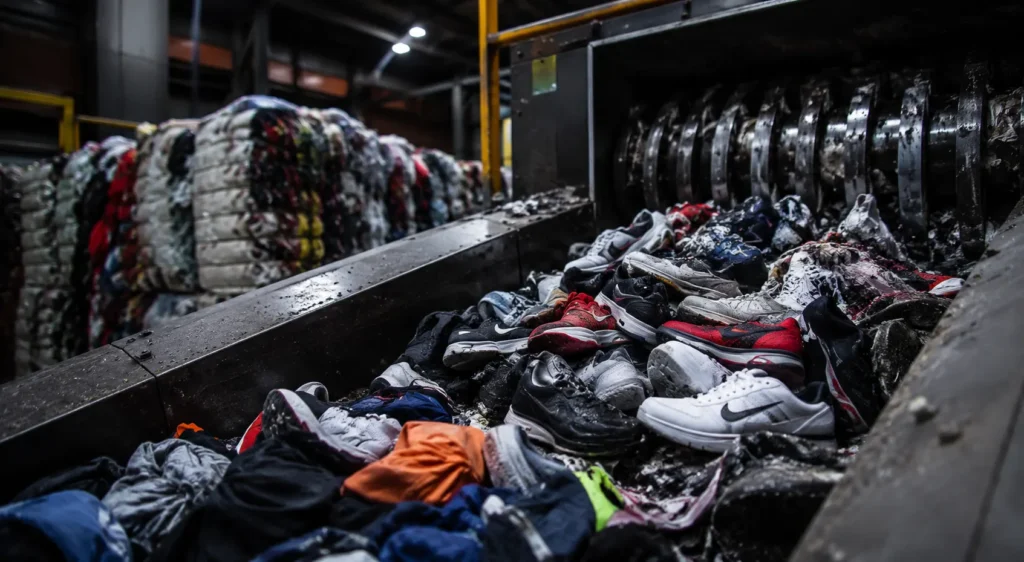
Now imagine that same pair, brand new, being fed into an industrial shredder. The blades chew through the rubber sole. Bits of suede fly into the air. Within seconds, that two-hundred-dollar shoe becomes confetti. The sound is awful. A grinding, crunching, metal-on-rubber scream. And then silence.
It sounds crazy, right? Why would a company destroy its own products? Why not sell them for half price? Why not give them to kids who need shoes?
But this happens every single day. Not in secret back alleys. In plain sight. Major sports brands—Nike, Adidas, Puma, Under Armour, and many others—admit to doing it. They call it “inventory write-off” or “product destruction.” Activists call it waste. Economists call it a strategy. Warehouse workers call it heartbreaking.
This article will walk you through the strange, sad, and very calculated reason why burning money sometimes makes more sense than selling it for less. You will learn the history. You will meet the people who push the buttons on the shredders. You will see the math that makes destruction profitable. And you will understand why change is coming, but very slowly.
Chapter 1: The Backstory – How We Got Here
Let’s rewind forty years. Put yourself in a mall in 1985. Fluorescent lights. Tile floors. The smell of cheap pizza and perfume. In the back of a store called Athlete’s Foot, a pair of Nike Air Jordans sits on a shelf. The price tag says sixty-five dollars.
That was real money back then. A family of four could eat dinner at a restaurant for twenty dollars. Gas was just over a dollar a gallon. So sixty-five dollars for a pair of basketball shoes? That felt like a lot. But people paid it.
Here is what happened if those Jordans did not sell. The store manager would wait a month. Then two months. Then they would move the shoes to a different shelf. A small red sticker would appear. “Marked down: $49.99.” If they still did not sell? Another sticker. “$39.99.” Then “$29.99.” Eventually, someone would buy them. Maybe a kid with less money. Maybe a dad who needed work boots. The shoes got worn. No one got hurt.
That was the old way. It was simple. Make shoes. Sell shoes. If shoes don’t sell, lower the price. Repeat.
Then something changed.
In the 1990s, a new idea started creeping into boardrooms. It was called “brand equity.” That is a fancy way of saying: the value of your name. Nike was not just a shoe company anymore. Nike was a symbol. When you wore a Swoosh, you were saying something about yourself. You were fast. You were cool. You belonged to a tribe.
The problem with discounting is that it kills brand equity. A sixty-five-dollar Jordan on a clearance rack for twenty dollars? That makes the Swoosh feel cheap. And if the Swoosh feels cheap, why would anyone pay sixty-five dollars for the next pair?
By the early 2000s, sports brands stopped being just about sports. They became about status. Sneakers were no longer for running. They were for flexing. A limited-edition Adidas Yeezy could cost two hundred twenty dollars retail, but resell for eight hundred dollars the next day. People camped out overnight. Fights broke out in parking lots. Websites crashed from too many clicks.
Brands realized something powerful. Scarcity creates desire. If everyone can have it, no one wants it. That is human nature. We want what we cannot have. We chase the rare thing. The limited thing. The thing our neighbor does not own.
So brands began making fewer pairs than people demanded. This is called artificial scarcity. That is a fancy way of saying “making less on purpose.” It feels backwards. Most businesses want to sell as many units as possible. But luxury businesses—and sports brands had become luxury businesses—want to sell fewer units at higher prices.
Here is the problem with that strategy. Sometimes you guess wrong. Sometimes you make too much. Sometimes a design flops. Sometimes a famous athlete gets arrested, and suddenly no one wants their shoe. Sometimes a global pandemic hits, and stores close, and supply chains freeze, and suddenly you have a mountain of unsold sneakers with no place to go.
Now you have a warehouse full of perfectly good products. And you have a choice. That choice is harder than you think.
Chapter 2: The Three Options – And Why Two Are Dangerous
When a brand finds itself sitting on piles of unsold inventory, they really have three paths forward. Let me walk you through each one like a flowchart. By the end, you will understand why destruction starts to look reasonable. Not good. Not moral. But reasonable.
Option 1: Sell it at a deep discount.
This seems obvious. Put the shoes on the clearance aisle. Mark them down seventy percent. Sell them to discount stores like Ross, TJ Maxx, or Marshalls. Get some money back. Reduce the pile. Everyone goes home happy.
But brands hate this. Why? Because once a two-hundred-dollar shoe sells for twenty dollars, that two-hundred-dollar price tag looks like a lie. Customers learn to wait for the sale. Why pay full price when you can get the same thing in three months for ninety percent off?
And worse: the person who paid two hundred dollars feels like a fool. They might never buy from you again. They might post an angry review. They might tell their friends not to trust your brand.
There is a name for this in business school. It is called “price image.” Your price image is what people think you cost on average. If your price image drops, you cannot raise it again easily. Once a customer sees a Nike shoe for twenty dollars, they will always wonder if twenty dollars is the “real” price.
Also, discount stores are dangerous for another reason. They often mix authentic products with fakes. A shopper at Ross might buy a discounted Adidas shoe, then later see a counterfeit Adidas shoe at a flea market, and start to think Adidas shoes are just generally cheap and sketchy. The brand loses control of its story.
Option 2: Donate the products to charity.
Give the shoes to people who need them. Shelters. Disaster relief. Schools. This sounds wonderful, right? The brand gets a tax write-off. People get shoes. The planet does not get more garbage. Everyone wins.
But there is a hidden problem. A huge problem. Donated shoes often end up in overseas markets. A trader in Ghana, Ukraine, or the Philippines buys bales of donated clothes for pennies per pound. Then they sell them on the street for a fraction of retail. Suddenly, a “luxury” brand is everywhere for cheap. The brand loses control of its image.
And if that brand also sells new products in that country at full price? No one buys the expensive ones. Why would they? The market is flooded with donated goods that look exactly the same but cost almost nothing.
This actually happened to a major brand in the early 2010s. They donated thousands of pairs of unsold sneakers to a disaster relief effort in Haiti. Those sneakers ended up in street markets for three dollars a pair. The same model was still being sold in Miami for one hundred dollars. Tourists started bringing back cheap Haitian sneakers and showing them off online. The brand’s image took a huge hit.
Also, charities do not always want your leftovers. They have limited storage space. They have sorting costs. They have to pay workers to separate usable shoes from broken ones. Sometimes, donating is just as expensive as destroying.
And there is a weird moral problem too. When you flood a poor community with free or cheap shoes, you destroy local shoemakers. Small businesses that make sandals or boots cannot compete with free Nike shoes. So you end up hurting the very people you wanted to help.
Option 3: Destroy the inventory.
Shred it. Burn it. Bury it. This costs money too—shipping, shredding, disposal fees. You get zero dollars back. You look bad in the news. Environmentalists hate you.
But brands still choose this option. A lot. More than most people realize.
Why would a company pay to destroy its own goods? Because Option 1 and Option 2 come with long-term costs that are bigger than the short-term cost of shredding. Discounting lowers your price image. Donation lowers your brand exclusivity and can backfire in foreign markets. Destruction keeps everything clean. No cheap shoes in the system. No donated goods flooding street markets. Just a clean, controlled end.
Let that sink in. Destruction keeps everything clean.
Chapter 3: The Math of Destruction – Why Waste Is Cheaper Than Devaluing
Let us pretend you are the CEO of a sports brand called FastKicks. You are not real. But your problems are real. You made one hundred thousand pairs of a new sneaker called The Thunder. Retail price: one hundred fifty dollars.
The Thunder was supposed to be a hit. You paid a famous rapper to wear them in a music video. You ran ads during the NBA playoffs. But something went wrong. Maybe the rapper got canceled. Maybe the design looked weird in person. Maybe the economy went bad and people stopped spending. Whatever the reason, The Thunder did not sell.
Now you have twenty thousand pairs left. That is three million dollars in unsold shoes sitting in a warehouse in Memphis. Every day they sit there, you pay rent on that warehouse. You pay insurance. You pay security.
Now you have a choice.
If you discount The Thunder to thirty dollars, you might sell all twenty thousand pairs. That is six hundred thousand dollars. Not bad. You turn a three million dollar problem into a six hundred thousand dollar recovery.
But here is what happens next year. You release The Lightning. Same price. One hundred fifty dollars. Customers remember The Thunder. They remember that it dropped to thirty dollars. They think, “I will just wait. FastKicks always discounts their shoes eventually.”
So instead of buying The Lightning at one hundred fifty dollars, they wait. And wait. And wait. Sales drop by half. Now you have forty thousand unsold pairs of The Lightning. The problem just doubled.
Now imagine this cycle repeating for five years. Every year, you make a little less at full price. Every year, you discount a little more. Eventually, your brand is known for two things: high starting prices and huge clearance sales. You become a discount brand. Your most loyal customers—the ones who paid full price—feel betrayed. They leave for a competitor who never discounts.
Now let us run the destruction math.
If you destroy The Thunder instead of discounting it, what happens? No cheap pairs exist in the world. No TikTok videos of someone finding The Thunder at Ross for twenty dollars. No memories of a huge sale.
Customers learn a different lesson. They learn: “If I do not buy FastKicks at full price, I might never get them at all.” That scarcity feeling returns. So when The Lightning drops, they buy early. At full price.
In other words, destroying three million dollars worth of shoes today protects thirty million dollars in future sales. Maybe more.
That is the math. And it works. That is why publicly traded companies—companies with a legal duty to maximize shareholder profit—choose destruction again and again.
Nike admitted in its 2019 annual report that it destroyed over one hundred million dollars worth of products. That is just what they reported. Real numbers are likely much higher. Adidas said they destroyed over five hundred thousand pairs of Yeezys alone after their partnership with Kanye West ended. Not because the shoes were flawed. Not because they were unsafe. Because keeping them for sale would hurt the brand’s image.
Let me repeat that. Half a million pairs of shoes. Destroyed. Because keeping them would have made the brand look less exclusive.
Chapter 4: The Emotional Side – How It Feels to Watch Good Stuff Get Killed
Let us step away from spreadsheets and quarterly reports. Let us talk about people. Because behind every shredded sneaker is a human being who has to push the button.
I once met a warehouse worker named Carla. This was a few years ago. I was researching a story about returns processing. Carla worked at a third-party logistics center in Indiana. Her job was to handle returns for a major sports brand. Not the brand’s own warehouse. A contractor. A big gray building with no logos on the outside.
She agreed to talk to me on the condition that I did not use her last name or the brand’s name. She was afraid of getting fired. We met at a diner off the highway. She drank black coffee and twisted a napkin in her hands.
Carla described her job like this. Every morning, she would clock in at seven. She would walk past rows of metal shelving. On those shelves were thousands of shoeboxes. Some were returns from online orders. Some were overstock from stores that had closed. Some were shoes that had been tried on once and sent back.
“Most of them were perfect,” she said. “You could put them right back on a shelf. No one would ever know.”
But the brand had strict rules. Shoes could only be resold if the box was pristine, the laces were factory-tied, and there was zero sign of wear. If the box had a dent? Shred. If the insole had a faint footprint? Shred. If the laces had been untied and retied? Shred.
Carla showed me pictures on her old phone. Racks and racks of sneakers. Bright colors. Neatly stacked. Some still had the tissue paper inside. Some had the little cardboard insert that keeps the toe box stiff.
“We had to crush them,” she said. “Every Thursday was destruction day.”
Her job was to feed the shoes into a mobile shredder. The machine was about the size of a small car. It had a conveyor belt and a set of rotating steel blades. The blades were sharp enough to eat through rubber, leather, and foam like butter.
She wore safety goggles and thick gloves. The sound was the worst part. A low grinding roar that vibrated in her chest. Bits of shredded shoe would fly up and stick to her hair. She said she would find pieces of neon green foam in her ears hours later.
“The kids’ shoes got me,” she said. “Tiny Jordans. Sparkly Adidas with little hearts on them. Some still had the store tag on with a kid’s name written in marker. Like a grandmother bought them for a birthday and then returned them.”
She tried not to look at the colors. She tried to think of the shoes as objects. Not as things that belonged to someone. Not as things that could have protected a child’s feet from broken glass or cold pavement.
“I asked my boss once,” Carla said. “I said, ‘Could we just drive these to the shelter down the street? It’s ten minutes away.’ He said it was against policy. Something about ‘brand integrity’ and ‘liability.’ He said if a donated shoe fell apart and someone got hurt, the brand could get sued.”
She nodded toward the window. “I don’t work there anymore. I couldn’t do it. Made me feel sick every Thursday.”
Carla is not alone. There are hundreds of Carlas across the country. In Pennsylvania, Texas, California, Ohio. Warehouse workers who have to destroy perfectly good products because the math says destruction is cheaper than donation. Most of them hate it. Some of them have leaked videos to the press. A few have been fired for trying to sneak shoes out to homeless shelters.
One former Adidas worker in Germany told a newspaper that he once watched a hundred and fifty pairs of brand-new Ultraboosts get shredded. He said he went home and cried. His wife thought someone had died.
Chapter 5: The Environmental Wreckage – What Happens After the Shredder
Now let us talk about the planet. Because what happens after the shredder is just as bad as the shredding itself.
Most sneakers are not recyclable. That is a hard truth that the sports brands do not like to advertise. A typical shoe has maybe twenty different materials. Foam. Rubber. Glue. Leather. Fabric. Plastic. Metal eyelets. Nylon threads. The foam might be EVA. The rubber might be natural or synthetic. The glue is often a petroleum-based adhesive that never fully dries.
Separating those materials costs more money than the materials are worth. You would have to pay a worker to carefully cut apart each shoe. Foam goes in one bin. Rubber in another. Glue cannot be separated at all. It is baked into the fabric.
So when a shoe gets shredded, most of it goes to one of two places. A landfill. Or an incinerator.
Landfills are giant holes in the ground lined with plastic so that toxic liquid does not leak into groundwater. But the plastic liners eventually crack. And even if they do not crack, the shoes sit there for decades. The average sneaker takes thirty to forty years to decompose. Some parts never decompose. The foam breaks down into tiny microplastics that blow away in the wind or wash into rivers.
Incineration is not much better. Burning shoes releases carbon dioxide, toxic fumes, and heavy metals into the air. The fumes can cause breathing problems for people who live near the incinerator. The ash that is left over still has to be buried somewhere.
According to the Ellen MacArthur Foundation—a group that studies waste—the entire fashion industry dumps one garbage truck full of textiles into landfills or incinerators every single second. Every second. That is sixty trucks per minute. Thirty-six hundred trucks per hour.
And sports brands are a big part of that. Why? Because performance materials like polyester, nylon, and synthetic leather are almost impossible to recycle at scale. Unlike a cotton t-shirt, which can be shredded and turned into industrial rags, a high-performance running shoe has to be lightweight, breathable, water-resistant, and durable. Those qualities come from complex chemistry. Complex chemistry is hard to un-mix.
Some brands have tried to fix this. Nike has a program called Reuse-A-Shoe that grinds old sneakers into material for basketball courts and running tracks. Adidas has shoes made from ocean plastic. Puma has a recycling program in a few countries. Under Armour has experimented with plant-based foams.
But here is the uncomfortable truth. Those programs are tiny. In 2022, Nike made over seven hundred million pairs of shoes. Their recycling programs handled less than one percent of that. Ninety-nine percent of Nike shoes eventually end up in a landfill, an incinerator, or a shredder.
One environmental researcher I spoke to put it bluntly. “Recycling for sneakers is mostly a marketing story,” she said. “It makes consumers feel better about buying new shoes every six months. But the actual tonnage being recycled is a drop in the bucket.”
Chapter 6: The Legal Loopholes and Hidden Tax Benefits
Here is something most articles do not tell you. Destroying inventory can also be a tax move. A clever one.
In the United States, the tax code allows businesses to deduct the cost of unsold inventory that is destroyed. Let me explain how that works.
Remember our FastKicks example? You made a shoe for fifteen dollars. You planned to sell it for one hundred fifty dollars. If you sell it, you pay taxes on the one hundred thirty-five dollar profit. If you destroy it, you do not get the one hundred fifty dollars. But you do get to deduct the fifteen dollars you spent making it. That deduction lowers your taxable income. So you pay less to the government.
Is that a huge benefit? Usually not. Fifteen dollars per shoe is small compared to the one hundred fifty dollars you lost. But when you are destroying millions of shoes, those fifteen-dollar deductions add up.
There is a bigger tax benefit too. In some countries, destroying inventory allows a company to claim a “loss on disposal.” That loss can be carried forward to offset future profits. So if you have a bad year with lots of destruction, you pay less tax in the good years that follow.
Some politicians have tried to close these loopholes. In France, a 2021 law made it illegal for companies to destroy unsold non-food products. They have to donate or recycle. The penalty is huge. Up to fifteen thousand dollars per day for companies that break the rule.
Germany has considered a similar law. So has the state of California.
But here is how brands get around the rules. They ship their unsold inventory to countries with looser laws. A shoe that cannot be destroyed in France can be shipped to a warehouse in Belgium. Then destroyed there. Or shipped to Morocco. Or Turkey. Or any country that does not ask questions.
This is called “waste tourism.” It is the same trick the fashion industry uses for old clothes. Send the problem somewhere else. Make it someone else’s air to breathe. Someone else’s groundwater to drink.
In 2022, an investigation by a European environmental group found that a major sports brand had shipped over two hundred tons of unsold shoes to a landfill in Ghana. The shoes were supposed to be “recycled.” But the recycling facility did not exist. The shoes just sat in a pile. Children played on them.
When reporters asked the brand about it, they said they were “investigating” and “committed to sustainability.” Nothing changed.
Chapter 7: The Consumer’s Role – Are We Part of the Problem?
Let us be honest with ourselves. We love limited editions. We love “drops.” We love the thrill of buying something before it sells out. We love posting photos of rare sneakers on social media. We love the feeling of owning something that other people cannot have.
Brands did not invent artificial scarcity by accident. They learned it from us. They watched how we behave. They saw that when Nike releases five thousand pairs of a shoe and five hundred thousand people try to buy them, the hype is real. The news covers it. Resellers make fortunes. The shoe becomes legendary.
That system works great for the shoes that sell out. But it punishes the shoes that do not. If a shoe is not cool, it is worthless. And worthless inventory gets shredded.
So in a strange way, every time we chase a limited drop, we tell brands: “Keep making things rare. Keep making artificial scarcity. And keep destroying the leftovers.”
But there is good news. Consumer pressure works. It really does. Not always. Not quickly. But it works.
In 2020, a video went viral on social media. It showed a pile of shredded Adidas sneakers in a German field. The video was filmed by a local farmer who had found the pile on his property after a storm. The farmer was angry. The shoes were everywhere. In his crops. In a nearby stream. His cows were stepping on bits of shredded foam.
The video got millions of views. People were outraged. They tweeted at Adidas. They called for boycotts. A few celebrities joined in. Within a week, Adidas promised to stop using virgin polyester by 2024. They also promised to find ways to recycle more shoes.
Did they keep those promises? Sort of. They made progress. But they did not solve the problem. The shredding continues. Just more quietly now.
Nike launched a program called Nike Refurbished. Here is how it works. When someone returns a pair of Nike shoes, instead of shredding them, Nike cleans them, repairs small damages, and sells them at a discount. The discount is not huge. Maybe twenty or thirty percent. But it is better than shredding.
The program started in a few stores in the United States. Then it expanded to Europe. Now it is in dozens of countries. It is still tiny compared to the total number of returned shoes. But it is a start.
The lesson is this. Companies change when they are embarrassed. When a video goes viral. When a hashtag trends. When customers stop buying. That is your power. That is the only power regular people have. Use it.
Chapter 8: What Would a Better System Look Like?
Let us imagine a world where sports brands do not destroy unsold sneakers. What would that world look like? What would it take to get there?
First, make everything recyclable from the start.
This is called design for circularity. Instead of building a shoe out of twenty different materials that cannot be separated, you build it out of one material. Or two materials that snap apart easily. No glue. No mixed fabrics. Just pure materials that can be melted down and turned into new shoes.
Some companies are trying this. Adidas’s Futurecraft Loop was a shoe designed to be fully recyclable. You wear it. You send it back. Adidas melts it down and makes a new shoe. The problem was cost. The Loop cost more to make than a normal shoe. And customers did not like the way it looked. It was not cool. So the program stalled.
But the technology exists. It just needs to get cheaper. And it needs to get cooler.
Second, stop making so many different styles.
Most unsold inventory happens because brands release hundreds of new shoes every year. Nike alone releases over a thousand different shoe models per year. That is almost three per day. Many of those models are very similar. A slightly different color. A slightly different logo placement. A slightly different foam density.
If brands released fifty good shoes instead of three hundred random ones, there would be less leftover. They could focus on quality instead of quantity. They could perfect each design. They could build real demand instead of fake hype.
But the fashion system rewards newness. Shoppers expect new styles every season. Stores expect new shipments every month. Changing that expectation would take years.
Third, embrace the circular economy.
The circular economy is a fancy way of saying “no waste.” In a circular system, everything gets reused. Your shoes are not yours forever. You pay a monthly fee. You wear the shoes. When they get worn out, you send them back. The company cleans, repairs, and re-rents them. No ownership. No waste.
Some startups are trying this. A company called Thousand Fell makes sneakers that can be fully recycled. Another company called Rothy’s makes shoes from recycled water bottles. Both offer mail-back programs where you send your old shoes and get a discount on new ones.
But the big brands are scared. They are scared of losing the “ownership” feeling. People like owning things. People like having a closet full of shoes that belong to them. Renting feels different. Less permanent. Less special.
Fourth, change the law.
This is the biggest one. If governments banned destroying unsold clothes and shoes unless they are truly unsafe, brands would be forced to donate, recycle, or redesign. France has started this. A few other European countries are considering it.
But global brands just ship their waste elsewhere. So we need a global treaty. Something like the Paris Agreement for fashion waste. A treaty that says: no country can accept unsold clothing or shoes from another country unless they have the facilities to recycle them properly.
That treaty does not exist. It might never exist. But activists are working on it.
Chapter 9: The Human Truth – It Is Not Evil, It Is Just Broken
Here is the thing most people miss. The person deciding to shred those shoes is not a villain. It is not a mustache-twirling monster cackling over a conveyor belt of sneakers.
It is a mid-level manager in an office park outside Portland or Herzogenaurach or Boston. They have spreadsheets. They have a quarterly profit target. They have a boss who says, “Do not let our brand look cheap.” They have shareholders who demand growth every single quarter, no excuses.
That manager is not thinking about a teenager in Ohio who cannot afford sneakers. Or a landfill in Indonesia. Or Carla the warehouse worker in Indiana. They are thinking about survival. If they do not meet their numbers, they get fired. And the next person does the same thing.
The system is broken. Not the people.
I once interviewed a former supply chain director for a major sports brand. He asked not to be named. He told me about a meeting he sat in where a vice president said, “I do not care if we have to burn them. Just get them out of the warehouse.”
The supply chain director pushed back. He suggested donation. He suggested recycling. He suggested selling the shoes to a discount chain in a different country where the brand had no presence.
The vice president shot down every idea. “If a single pair of these shows up in a discount store in a market where we sell full price, I will personally fire you,” he said.
The supply chain director left the meeting feeling sick. But he understood the logic. He had seen what happened to another brand that tried donation. That brand’s donated shoes ended up in a market in Lagos, Nigeria, right next to fake versions of the same shoes. Customers could not tell the difference. The brand’s sales in West Africa dropped forty percent in one year.
So he gave the order. Shred them. Thousands of pairs. Brand new. Into the shredder.
“It was the worst day of my career,” he told me. “But I did not know what else to do.”
Major sports brands are not evil. They are logical. Coldly, painfully logical. And that logic says: destroy the unsold pair to protect the sold ones.
Until we change the rules—by law, by design, or by demand—the shredders will keep chewing. And every morning, somewhere, a perfect pair of sneakers that someone could have worn becomes dust.
Chapter 10: What You Can Do – Real Steps That Actually Help
You are one person. Can you fix a global industry by yourself? Probably not. That would be like trying to shovel a beach into a bucket. But here is what actually moves the needle. Small actions. Repeated. By millions of people.
Buy less, but better.
Every pair you buy at full price reduces the chance that another pair gets destroyed. That sounds strange, but it is true. When you buy at full price, you tell the brand: “Make more of this. Do not discount. Do not destroy.” When you wait for a deep sale, you tell the brand: “Your products are not worth full price. Discount or destroy. I do not care.”
Support brands that publish their destruction numbers.
Nike now reports how much they destroy every year. Adidas does too. Puma is starting. Some smaller brands like Allbirds and Veja destroy almost nothing. They make smaller batches. They sell directly to customers. They do not have warehouses full of unsold goods.
Reward those brands with your money. Even if they cost a little more. Even if they are not as cool. Money talks. The only language brands understand is money.
Write to your representatives.
Ask them to support laws like France’s Anti-Waste Law. This is not a partisan issue. Democrats and Republicans both claim to hate waste. Both claim to care about the environment. Ask them to put those words into action.
A single letter will not change anything. But a thousand letters? Ten thousand? That gets noticed. Staffers read those letters. They put them in a folder. When the folder gets thick enough, the politician pays attention.
If you work in a warehouse or store, speak up.
Ask your manager if unsold shoes can be donated. Many managers assume it is not allowed. Sometimes they are wrong. Sometimes the policy has room for exceptions. Sometimes you can be the Carla who asks the question that changes a rule.
And if they say no? Document it. Take photos. Share them with journalists or activists. Whistleblowers have started more change than any other group in the fashion industry.
Do not shame brands on social media. Shine a light.
A tweet that says “Nike is evil” gets ignored. It is too broad. Too angry. Too easy to dismiss. But a video of shoes being shredded? With a timestamp and a location? That goes viral. Viral videos change policies.
Be specific. Be calm. Be factual. “On March 15, at this warehouse in Indiana, I watched three hundred pairs of new shoes get shredded. The shoes were not damaged. Here is the video.” That is hard to ignore.
Buy secondhand.
The most sustainable shoe is the one that already exists. Platforms like eBay, Poshmark, Depop, and StockX are full of barely worn sneakers. Some are even brand new, still in the box, sold by resellers who bought too many.
When you buy secondhand, you are not creating new demand for destruction. You are rescuing a shoe that might have otherwise been shredded. And you are paying less. Win-win.
Chapter 11: A Brief History of Shredding – Where Did This Start?
To understand where we are, it helps to understand where we came from. The practice of destroying unsold goods did not start with sneakers. It started with luxury handbags and watches.
In the 1970s, Swiss watchmakers had a problem. Japan had invented quartz watches. Quartz watches were cheaper and more accurate. Swiss mechanical watches were not selling. Warehouses filled up.
The Swiss watch industry came together and made a deal. They would buy back unsold watches from retailers. Then they would destroy them. Crush them. Melt them. Throw them into lakes.
Why? Because if those unsold watches showed up on discount shelves, the entire Swiss watch industry would look cheap. And if it looked cheap, no one would ever pay full price again.
The strategy worked. The Swiss watch industry survived. Luxury became stronger than ever.
Fast forward to the 1990s. Luxury fashion brands like Louis Vuitton and Gucci started doing the same thing. Unsold handbags? Shredded. Unsold belts? Burned. Unsold scarves? Cut into pieces so no one could wear them.
At first, the public was shocked. News stories ran with headlines like “Gucci Destroys Millions in Unsold Goods.” But the shock faded. People got used to it. The brands kept doing it.
By the 2000s, the practice had trickled down to sports brands. Nike watched what Louis Vuitton was doing. They saw the math. They saw that destruction protected prestige. And they started doing the same thing.
What was once a secret practice became standard. Today, almost every major sports brand has a destruction policy. Some are more transparent than others. Some try to hide it behind “recycling” claims. But the basic logic is the same. Destroy the unsold. Protect the sold.
Chapter 12: The Psychology of Scarcity – Why We Want What We Cannot Have
Let us take a detour into psychology. Because none of this makes sense unless you understand how the human brain works.
In the 1970s, a psychologist named Robert Cialdini studied why people want things. He found a simple rule. The harder something is to get, the more we want it. He called this the “scarcity principle.”
Cialdini ran an experiment. He asked people to rate chocolate chip cookies. One jar had ten cookies. Another jar had two cookies. People said the cookies from the two-cookie jar tasted better. Same cookies. Same recipe. Same baker. Just fewer of them.
Scarcity makes things feel valuable. Even when they are not.
Sports brands know this. They have known it for decades. That is why they create artificial scarcity. That is why they make fewer pairs than people want. That is why they destroy leftovers instead of discounting them.
But here is the dark side of the scarcity principle. When a brand destroys unsold shoes, they are not just protecting their price. They are protecting the feeling of scarcity. If every shoe that was ever made was available forever at a discount, nothing would feel rare. Nothing would feel special. And we would stop caring.
In a strange way, the shredder is the machine that makes sneakers feel magical. Without the shredder, every sneaker is just a shoe. With the shredder, some sneakers become treasures.
That is twisted. But it is true.
Chapter 13: The Reseller Economy – A New Problem
We cannot talk about sneaker destruction without talking about resellers. Because resellers are both a cause of the problem and a victim of it.
Here is how reselling works. A brand announces a limited-edition shoe. Five thousand pairs. Two hundred dollars each. The shoes go on sale at ten AM. Within seconds, bots buy most of them. Real people get nothing.
The resellers who ran those bots now own the shoes. They list them on resale platforms for five hundred dollars. A thousand dollars. Sometimes more.
This is bad for the brand. The brand only made two hundred dollars per pair. The reseller makes the rest. The brand gets no credit for the high price. The brand looks like it lost control.
But here is the twist. Resellers also get burned sometimes. They buy a thousand pairs of a shoe they think will be hot. Then the shoe flops. No one wants it. Now the reseller has a thousand pairs of dead stock. They cannot return them to the brand. Most brands do not accept returns from resellers.
So the reseller tries to sell the shoes at a discount. Fifty percent off. Seventy percent off. Eventually, they sell them for less than they paid. They lose money.
Where do those discounted shoes end up? On discount sites. On eBay. On flea markets. And that is exactly where the brand does not want them. Cheap shoes. Brand new. In the wild.
So the brand has two enemies. Discount stores. And desperate resellers.
Some brands have started fighting back. Nike has sued resellers. Adidas has tried to block bots. But the reseller economy is huge. Billions of dollars per year. It is not going away.
And as long as resellers exist, unsold inventory will exist. And as long as unsold inventory exists, brands will face the choice: shred or discount.
They almost always choose shred.
Chapter 14: The Cost of Shipping Waste Around the World
Let us talk about the trucks. The ships. The planes. Because destroying unsold shoes does not just happen in one place. It happens all over the world. And moving waste around is expensive and polluting.
A shoe made in Vietnam. Shipped to a warehouse in Los Angeles. Then shipped to a shredder in Texas. Then shipped to a landfill in Oklahoma. That is a lot of miles. A lot of diesel fuel. A lot of carbon dioxide.
One study estimated that the average pair of destroyed sneakers travels over ten thousand miles before it ends up in the ground. Ten thousand miles. For a shoe that was never worn. Never even tried on.
And here is the saddest part. Many of those miles are completely unnecessary. The shoe could have been donated to a shelter down the street from the warehouse. But instead, it traveled across an ocean and a continent just to be burned or buried.
There is a word for this. “Idiocy.” But the brands do not see it that way. They see it as brand protection. Worth every mile. Worth every gallon of fuel.
Chapter 15: A Hopeful Ending – Small Signs of Change
I want to end this long article on a hopeful note. Because despite everything I have written, change is happening. Slowly. Quietly. But really.
In 2023, a group of university students in Amsterdam started a campaign called “Shredded No More.” They stood outside Adidas headquarters with signs made from shredded sneakers. They handed out flyers. They got local news coverage.
Adidas invited them inside for a meeting. A real meeting. With real executives. The students presented a plan. Donate unsold shoes to a local charity that teaches homeless people how to repair sneakers. The charity would then sell the repaired shoes at low prices. The brand would get a tax write-off and good publicity.
Adidas said yes. Just a pilot program. Just one warehouse. But yes.
In 2024, Nike announced that they would stop destroying returns in North America. Instead, every returned shoe would be cleaned, repaired, and resold through Nike Refurbished. They promised that by 2026, zero percent of returned shoes would go to landfill or incineration.
That is a big promise. We will see if they keep it.
In 2025, the European Union proposed a new law. The law would ban the destruction of unsold textiles across all twenty-seven member countries. No exceptions. No loopholes. Shredding would become illegal.
The law has not passed yet. But it has support. From young voters. From environmental groups. From some brands who are tired of looking bad.
So here is the truth. The system is broken. But it can be fixed. Not overnight. Not by one person. But by millions of people demanding better. By laws that force change. By designers who build shoes that do not need to be shredded.
The next time you lace up a fresh pair of sneakers, remember. Somewhere, an identical pair just died so yours could feel special. But maybe one day, that will stop.
Maybe one day, we will look back at shredding new sneakers the same way we look at burning books. A strange, sad habit from a less wise time.
That day is not here yet. But it is coming.
Final Words – What You Carry With You
You made it to the end. That is a lot of words about shoes and shredders and spreadsheets. Thank you for staying with me.
Here is what I hope you take away.
First, the problem is real. It is not a conspiracy theory. It is not a hoax. Major sports brands destroy millions of pairs of perfectly good shoes every year. They do it on purpose. They do it to protect their image.
Second, the problem is not evil. It is structural. It comes from a system that rewards scarcity and punishes discounting. The people in charge are not monsters. They are trapped in a game with rules that lead to waste.
Third, the problem can be fixed. Not easily. Not quickly. But really. Laws can change. Designs can improve. Consumer habits can shift. Every shredder can be turned off.
And finally, you have power. Not absolute power. Not power to fix everything overnight. But real power. The power to buy carefully. The power to speak up. The power to share what you have learned.
Tell a friend about this article. Post it somewhere. Bring it up at dinner. The more people know, the harder it becomes for brands to hide behind “brand integrity.”
The shredders are loud. But conversations can be louder.



Hello, you used to write wonderful, but the last several posts have been kinda boring… I miss your tremendous writings. Past several posts are just a little out of track! come on!
Finally found a site that actually treats players right. Great variety of options and the customer support is top notch. Highly recommend idayam11
We are a group of volunteers and starting a new scheme in our community. Your web site offered us with valuable info to work on. You’ve done an impressive job and our entire community will be thankful to you.
Really love the interface and the variety of games available. It feels very smooth on mobile. Highly recommend phfh777 to everyone.
Top notch service and the registration process was a breeze. I had a great run last night. Head over to idmagnum188 and see for yourself!
F*ckin’ amazing issues here. I am very happy to peer your article. Thank you so much and i am looking forward to contact you. Will you kindly drop me a mail?