

Introduction: The Ground Beneath Our Feet
Imagine waking up one morning. You pour a cup of coffee. You look out your kitchen window. Across the street, your neighbor’s house is gone. Not destroyed. Not burned. Gone. Lifted off its foundation. Loaded onto a giant trailer. And moved three miles to the east.
Now imagine that this is not a disaster. It is a plan.
This is not science fiction. This is Kiruna, Sweden. A small city located 90 miles north of the Arctic Circle. A place where the sun does not set in summer and barely rises in winter. A place built on top of one of the largest iron ore mines on planet Earth.
For over a century, this mine has been the heartbeat of Kiruna. It pays for schools. It heats homes. It gives people jobs. But the mine is also a hungry giant. Every day, it digs deeper. Every day, the ground above it sinks a little more. Cracks appear in roads. Walls lean sideways. The entire city is slowly being swallowed.
So Sweden made a radical choice. If the city cannot stay where it is, and the mine cannot stop digging, then the city must walk.
This is the story of how engineers are dismantling a town, lifting historic wooden churches onto rolling pallets, and rebuilding civilization two miles away—all while the mine keeps running below.
But before we get into the moving buildings and the giant machines, we need to go back. Way back. Because the story of Kiruna did not start with a crack in the ground. It started with a man, a mountain, and a piece of rusty rock.
Part 1: The Discovery That Changed Everything
A Man, A Mountain, And A Reddish Rock
The year is 1696. A reindeer herder named Anders Håkansson is walking through the mountains. He is not looking for treasure. He is looking for his lost animals. The land is harsh. Snow covers everything for most of the year. The wind cuts through leather coats like knives. Wolves howl at night. Bears wake up hungry in the spring.
But Håkansson notices something strange. A hillside that looks… rusty. Like iron left out in the rain. He chips off a piece. It is heavy. Dense. Dark red in some light, almost blue-black in others. He turns it over in his hand. It feels different from normal rock. Colder. Heavier. Almost like metal already.
He takes it home. He does not know it yet, but he is holding the key to Sweden’s future.
For over 200 years, nothing happens. The mountain is remote. There are no trains, no roads, no cities. It is just frozen wilderness. The nearest town is days away on foot. In winter, the temperature drops to forty below zero. Metal tools freeze to your skin. Wood splits from the cold. Only the Sami people, with their reindeer herds, can survive here year-round.
But in the late 1800s, the world changes. Steam engines need steel. Railroads need rails. Warships need armor. Iron is suddenly the most valuable rock on Earth. Countries fight wars over iron deposits. Companies send explorers to the ends of the Earth looking for more.
The Swedish government sends geologists to the mountain. They drill into the rock. They bring back samples. They test them in laboratories in Stockholm. What they find is almost impossible to believe.
The Mountain Is A Pure Lump Of Metal
Most iron mines are messy. You dig up a ton of rock, and maybe 30% is iron. The rest is waste. Sand. Clay. Quartz. Stuff you have to separate and dump somewhere. It is expensive and dirty.
Not here.
In Kiruna, the iron ore is 60% to 70% pure. That is almost unheard of. It is like finding a gold nugget the size of a car. The mountain is not a mountain. It is a giant, frozen slab of metal disguised as a hill.
The geologists wrote reports that sounded like fairy tales. “The ore body is massive,” one wrote. “It extends deeper than our drills can reach. The quality is consistent. The phosphorus content is low. This is the finest iron ore in Europe.”
Sweden had a problem, though. The mine was in the middle of nowhere. No workers wanted to live in a frozen wasteland just to dig rocks. Even with good pay. Even with promises of adventure. The cold alone scared most people away.
So the government did something smart. They did not just build a mine. They built a city.
The Birth Of Kiruna
In 1898, the first surveyors arrived. They carried compasses, measuring tapes, and notebooks. They walked the land for months, marking where the streets would go. They chose a spot about two miles east of the mine entrance. Flat ground. Good drainage. Close enough to the mine for walking, far enough away that the blasting would not shake the windows.
The plan was drawn up by Per Olof Hallman, a famous city planner from Stockholm. Hallman had designed beautiful neighborhoods in the capital. Now he was designing a town in the Arctic. He wanted it to be special. Not just a mining camp—a real city. With parks. With wide streets. With a church that would make people proud.
Construction began in 1899. Workers arrived by train, then by horse, then on foot. They built wooden barracks first. Then a railway station. Then a general store. Then a bakery. By 1900, Kiruna was a tent camp with about 200 people. By 1910, it had wooden houses, a railway, a school, and a church. The town was beautiful. Clean. Orderly. The streets were wide. The homes had electricity and indoor plumbing—luxuries even in big cities back then.
The deal was simple: come work in the mine, and Sweden will give you a good life.
For seventy years, it worked perfectly.
The Mine’s Golden Age
From 1910 to 1980, Kiruna grew like a weed. The population went from 200 to 10,000 to 20,000. New neighborhoods sprouted on every hillside. Apartment buildings went up. A hospital. A swimming pool. A cinema. A hotel for visiting businessmen.
The mine expanded too. The first miners used picks and shovels. By the 1920s, they had pneumatic drills. By the 1950s, they had electric trains running through the tunnels. By the 1970s, they had remote-controlled loaders and computer-assisted blasting.
Iron ore from Kiruna built the bridges of Stockholm. It built the rails of the Trans-Siberian Railway. It built the hulls of German U-boats in World War I and British tanks in World War II. Both sides in both wars bought iron from Kiruna. Sweden stayed neutral, but its iron shaped the battles.
The people of Kiruna knew this. They were proud. Their work mattered. Their city was not some forgotten corner of the Arctic. It was the engine room of Swedish industry.
But engines wear out. And ground, no matter how solid it seems, does not last forever.
Part 2: The Invisible Enemy Below
How A Mine Eats The Ground
To understand why Kiruna is sinking, you have to understand how the mine works.
There are two main ways to dig iron. The first is an open pit. You just blast a giant hole in the ground, like a quarry. It is cheap and easy, but it leaves a massive scar on the landscape. And it only works if the ore is close to the surface.
Kiruna used to do that. From 1900 to 1960, they carved a giant bowl out of the mountain. You can still see it today. It is called the “Great Hole.” It is almost a mile long and 600 feet deep. From the edge, you look down and see tiny trucks driving on switchback roads. It feels like looking into the Grand Canyon, except the walls are black and gray instead of red and orange.
But the easy iron ran out. The open pit could not go any deeper without the walls collapsing. To get the rest of the ore, the miners had to go underground. That is when they switched to the second method: sublevel caving.
Sublevel caving sounds like a technical term. It is actually pretty simple. Imagine a stack of dinner plates. You pull the bottom plate out. What happens? The plates above drop down. Now imagine those plates are made of rock, and the rock contains iron. When you break the bottom layer, everything above settles into the empty space. The ground surface sinks slowly, like a deflating balloon.
Here is how it works in the mine, step by step:
- Miners dig a series of tunnels under the mountain. They look like a honeycomb. Each tunnel is about 50 feet above the one below it. The tunnels stretch for miles in every direction.
- They drill holes up into the ceiling of the lowest tunnel. The holes are 2 inches wide and 30 feet deep. They drill dozens of holes in a grid pattern.
- They pack those holes with explosives. Dynamite. Thousands of pounds of it.
- Boom. The ceiling collapses. A controlled collapse. The rock breaks into chunks the size of refrigerators. It falls down into the tunnel below.
- The broken rock is scooped up by giant loaders and dumped into waiting ore trains. Each train has 20 cars. Each car holds 60 tons. A good blast fills 10 trains.
- The trains haul the rock to the surface. At the top, the rock goes into crushers. Then conveyors. Then processing. Then ships. Then steel mills around the world.
The trick is that when you collapse the ceiling, the ground above the ceiling also sinks. And above that? More rock. And above that? Topsoil. And above that? Houses, schools, a hospital, and 17,000 people.
The mine does not dig a tunnel directly under your living room. That would be illegal. The subsidence zone is mapped carefully. The miners know exactly where the ground will sink. They just cannot stop it. The sinking is a physical law. When you remove rock from underground, the space above has to fill in somehow.
The ground settles slowly—millimeters per year at first, then centimeters, then inches. It is not a sudden sinkhole. You do not wake up one morning with your house in a crater. It is a slow, grinding, unstoppable drop. Like watching a clock’s hour hand move. You cannot see it happening, but after a year, you realize everything is lower than it used to be.
By the year 2000, the ground in central Kiruna had sunk nearly three feet. Some apartment buildings tilted so badly that water pipes burst. Doors would not close. Windows cracked diagonally. The city was not falling apart overnight. But it was falling apart. Slowly. Inevitably. Like a tree rotting from the roots up.
The First Warning Signs
The first signs appeared in the 1980s. A road near the mine entrance developed a bump. Not a pothole—a hump. The ground had lifted slightly before it started sinking. Engineers call this “heave.” It happens when the collapsing rock pushes sideways and upward. The road looked like a speed bump that grew over time.
Then came the cracks. Small at first. Hairline fractures in basement walls. Then wider cracks in parking lots. Then cracks in the foundations of the old wooden houses. Homeowners patched them with concrete and hoped for the best.
In the 1990s, the cracks got worse. The city hired a geotechnical firm to drill test holes. They brought in devices called extensometers—long metal rods that you stick into the ground to measure movement. The extensometers told a clear story: the ground was sinking, and the rate was increasing.
By 1995, the sinking was measurable in inches per year. The city council held emergency meetings. They invited experts from the mining company. They invited geologists from the university. They invited engineers from Stockholm.
The experts all said the same thing: This is not going to stop. The mine is going deeper every year. The subsidence zone is expanding. Eventually, the city center will be affected.
Eventually came faster than anyone expected.
The Crack In The Church Floor
The Kiruna Church is famous. It is made of wood. Tall, red, with a bell tower that looks like a Sami tent—the traditional home of the indigenous reindeer herders. Swedes voted it the most beautiful building in the country. Tourists come from all over the world to see it. Postcards of the church sell in every gift shop.
In 1998, the groundskeeper noticed a crack in the floor. He was mopping after a Sunday service. The mop caught on something. He looked down. A thin line ran across the wooden floor near the altar, like a pencil mark.
At first, it was thin as a hair. The groundskeeper mentioned it to the pastor. The pastor said, “Wood expands and contracts. It is probably nothing.”
Six months later, it was wide enough to stick a finger into. The pastor called a carpenter. The carpenter said, “This is not normal movement. This is the ground shifting.”
A year after that, the altar leaned slightly to the left. Not enough to notice from the back of the church. But if you stood at the pulpit and looked down, you could see it. A tilt. Just a degree or two. Enough to make the candles slide if you did not set them carefully.
Church officials called in engineers. The engineers brought lasers and measuring tools. They set up targets on the walls, the floor, the ceiling. They measured distances between targets. They waited a month. They measured again.
The news was bad. The ground under the church was sinking unevenly. One corner was dropping faster than the opposite corner. It was like setting the church on a seesaw. Eventually, the wooden beams would twist and snap. The church would not fall down immediately. But it would become unsafe. The roof would start to leak. The walls would bow. The bell tower would lean like the Tower of Pisa.
The mine company, LKAB (which stands for Luossavaara-Kiirunavaara AB), sent its own experts. They did not argue. They agreed. The church had to move.
That was the moment everything changed. If you have to move a city’s heart—its church—then you have to move everything else too.
Part 3: The Impossible Decision
Two Choices, Both Terrible
In 2004, LKAB sat down with the city government. The meeting was held in the town hall, in a windowless conference room. The map on the wall showed the subsidence zone in red. The red area had grown every year. By 2030, it would cover the entire city center.
The mine was digging deeper. By 2030, it would reach 2,700 feet below the surface. That is more than half a mile straight down. The subsidence zone would expand directly under the city center. The red area on the map would swallow the church, the school, the hospital, the main square.
The city had two choices.
Choice One: Do nothing. Let the mine keep digging. Let the ground keep sinking. Eventually, the cracks would get worse. Some buildings would have to be torn down. Roads would become wavy like roller coasters. The city would shrink, block by block, until it was just a few streets on the edge of a giant hole. The people who stayed would live in constant fear. Every creak of the floorboards would sound like a warning.
Choice Two: Stop the mine. Seal the tunnels. Walk away from 80% of the remaining iron ore. That iron was worth billions of dollars. It would mean firing 2,000 workers. It would mean no taxes for the city. No money for schools or roads. Kiruna would become a ghost town, like the old mining camps in the American West—Bodie, California, or Rhyolite, Nevada. Places where you can still see the empty buildings, the rusted machinery, the graves of people who thought the boom would last forever.
Neither choice was good. One killed the city slowly. The other killed it all at once.
The meeting was tense. People raised their voices. The mine company representatives said, “We cannot stop. The world needs iron. Our workers need jobs.” The city council members said, “We cannot let our homes be destroyed. We have children. We have elderly. We have a cemetery.”
Then a young city planner named Christer Vinsa suggested a third option. It sounded crazy at first. People laughed. But the more they talked about it, the more it made sense.
Choice Three: Move the city.
Not abandon it. Not shrink it. Pick it up and put it down somewhere else.
The Three-Mile Walk
The new location is only two to three miles east of the old city center. In a car, that is five minutes. On foot, it is an hour. But for a city? Moving two miles is a nightmare.
Think about everything underground in a modern town. Water pipes. Sewer lines. Electrical cables. Internet fiber. Heating pipes (remember, this is the Arctic). Streetlights. Traffic signals. Gas lines. Phone lines. You cannot just unplug a city and plug it back in. It is a giant, complicated machine with thousands of moving parts. Each part connects to other parts. If you disconnect one pipe, a whole block loses water. If you disconnect one wire, a whole neighborhood loses power.
But the engineers realized something important. They did not have to move the whole city at once. They could move it in pieces. One block at a time. One building at a time. One pipe at a time. The new city could be built while the old city was still standing. Then, when the new city was ready, the old city would be dismantled. Like a hermit crab moving from one shell to another.
The plan was presented to the public in 2005. The city printed brochures. They held town hall meetings. They set up a website with maps and timelines. They answered thousands of questions.
The plan looked like this:
- Phase 1 (2004-2010): Study everything. Map every building. Test the soil. Drill test holes. Talk to every resident. Figure out what can be moved and what must be rebuilt.
- Phase 2 (2010-2020): Move the biggest buildings first. The church. The town hall. The train station. Build the new city center. Lay new pipes and wires. Pave new streets.
- Phase 3 (2020-2035): Move the neighborhoods. Apartment blocks. Schools. Daycares. Shops. Restaurants. The hospital. The police station. The fire station.
- Phase 4 (2035-2050): Finish the new city. Demolish the old buildings that cannot be saved. Plant forest over the old foundations. Let the mine dig underneath empty land. Restore the old cemetery in its new location.
The total cost? Over $3 billion. That is three thousand million dollars. More money than most small countries have in their entire budget.
The mine company agreed to pay for most of it. Why? Because moving the city was cheaper than stopping the mine. The iron ore under Kiruna is worth over $100 billion. Spending $3 billion to save $100 billion is good math. Even better when you add in the taxes the mine pays, the jobs it provides, the economic activity it generates.
The city would pay for the rest—about $500 million—by selling bonds and taking loans. The Swedish national government kicked in some money too, as a gift to preserve a historic town.
The deal was signed in 2007. The move was officially happening.
Part 4: How To Move A Building (Without Breaking It)
The Church On Wheels
Let me describe the most ridiculous, amazing, and brilliant thing I have ever heard.
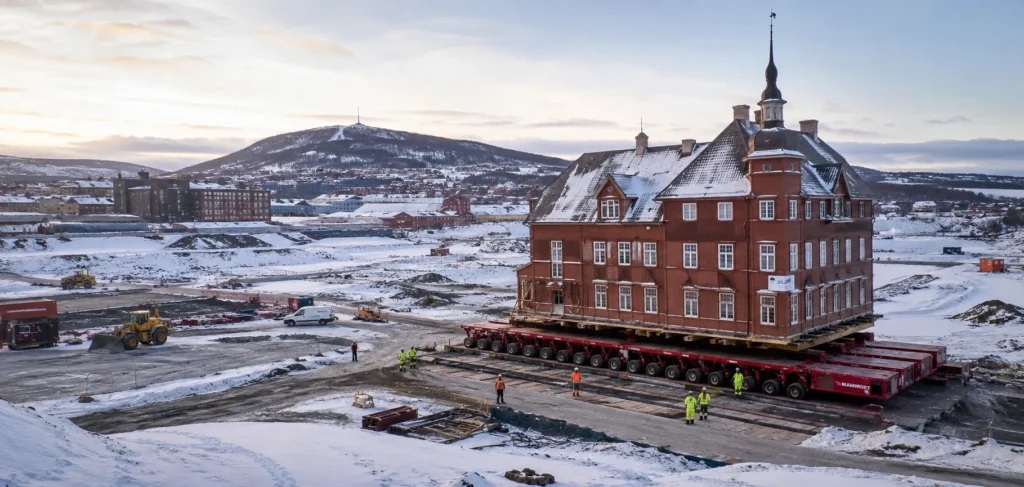
The Kiruna Church weighs 2,500 tons. That is as heavy as 400 elephants. It is made of wood, which is flexible but also fragile. Wood can bend a little, but it cannot stretch. Too much stress and it splits. The church has a 100-foot bell tower. The tower is not attached to the main building with steel beams. It is held in place by wooden pegs and gravity. And the whole thing is bolted to a concrete foundation that is cracking apart.
The engineers had to move this building three miles without breaking a single carved wooden decoration. Without cracking a single window. Without loosening a single peg in the bell tower. And they had to do it in the Arctic winter, when temperatures drop to thirty below zero and the ground is frozen solid.
Here is how they did it:
Step 1: Freeze the ground. The soil under the church was soft and wet. It was a mix of sand, clay, and water. If you tried to lift the church, the weight would push the soil sideways. The church would sink like a spoon into pudding. So the engineers drilled small pipes into the ground around the foundation. They pumped a special liquid through the pipes. The liquid was a brine—salt water cooled to twenty degrees below zero. The brine froze the soil solid as rock. The frozen zone extended ten feet in every direction and fifteen feet deep.
Step 2: Cut the building loose. The foundation was a thick slab of concrete. The engineers dug tunnels under the slab. They used water jets to cut through the soil without disturbing the frozen ground. Then they slid giant steel beams under the entire building. The beams were twelve inches thick, twenty feet long, and spaced every four feet. They looked like railroad tracks. These beams acted like a sled. The church sat on the sled, and the sled sat on the frozen ground.
Step 3: Lift. Hydraulic jacks were placed under the steel beams. Each jack could lift 200 tons. They were connected to a central computer. The computer raised all the jacks at the same time, one millimeter per second. It took three days to lift the church high enough to slide dollies underneath. The lift was so slow and so smooth that you could stand inside the church and not feel anything. The only sign that something was happening was the view out the windows—the ground slowly dropping away.
Step 4: Roll. The dollies were remote-controlled platforms with dozens of small wheels. Each dolly was about the size of a dining room table. The wheels could turn independently, like a shopping cart wheel, so the dollies could steer. The dollies moved at a speed of about 500 feet per hour. Slower than a person walking. At that speed, the three-mile trip took nearly two full days. The church crept across the landscape like a glacier. Traffic was stopped. Power lines were lifted. Trees were cut down. The church went straight through a playground, a parking lot, and a small forest.
Step 5: Lower. At the new site, the engineers had already poured a fresh concrete foundation. The foundation was larger than the old one, to account for future sinking (because the new site is also above the mine, just farther from the center). They lowered the church onto the new foundation using the same hydraulic jacks in reverse. Then they removed the jacks. Then they removed the dollies. Then they removed the steel beams. Then they un-froze the ground by pumping warm water through the pipes.
The church did not crack. Not one window broke. Not one carving chipped. The organ, which is over 100 years old and made of thousands of tiny pipes, was still in tune. The bell tower did not shift. The roof did not leak.
That is not luck. That is engineering.
The Town Hall’s Strange Journey
The town hall was different. It was not old and pretty like the church. It was a 1960s concrete box—functional, ugly, and heavy. Concrete is strong in compression (pushing together) but weak in tension (pulling apart). If you try to lift a concrete building unevenly, it will snap like a cracker. And the town hall had no historical value, so the engineers did not have to be delicate. They just had to get it from point A to point B without destroying it.
So the engineers did not lift the town hall. They rolled it.
First, they cut the building off its foundation. This was done with diamond wire saws. The saws cut through the concrete like a hot knife through butter. The building was now sitting on the ground, not attached to anything.
Then they built a giant concrete “tray” under it. The tray was poured in sections over several weeks. It was twelve inches thick and covered the entire footprint of the building. The bottom of the tray was smooth as glass. They greased the ground underneath with a thick layer of industrial lubricant. The lubricant smelled like diesel and felt like slime.
Then they attached cables to the back of the tray. The cables were attached to giant winches—the same kind used to pull ships into dry dock. The winches were anchored to steel posts driven deep into the ground.
Then they started the winches. The building moved. Slowly. Incredibly slowly. One foot per minute. It looked like a child pulling a sled. Except the sled weighed 5,000 tons—as much as 800 elephants.
The journey took one week. At the new site, they lowered the tray onto a new foundation. They poured concrete around the edges to lock it in place. Then they demolished the old foundation and recycled the concrete into gravel for new roads.
From the outside, you cannot tell the building moved. The doors still fit. The windows are still square. The floors are still level. But if you look closely at the parking lot, you can see the old foundation holes filled with gravel. Reminders of where the building used to stand.
Moving The Apartment Blocks
Not every building can be moved whole. Some are too big. Some are too damaged. Some are just not worth the cost. For those, the engineers use a different method: dismantle and rebuild.
But they do not just knock the building down. That would be wasteful. Instead, they take the building apart piece by piece. Each brick is numbered. Each window is labeled. Each door is removed with its hinges and screws. The pieces are loaded onto trucks and driven to the new site. Then the building is reassembled like a giant LEGO set.
This method was used for the old school buildings. The schools were built in the 1950s and 1960s. They had no historical value, but the people of Kiruna were attached to them. Generations of children had learned to read in those classrooms. The chalkboards still had doodles from the 1970s. The gym floors still had the scuff marks of a thousand basketball games.
The dismantling took three months. The reassembly took six months. The new schools are identical to the old ones—same floor plan, same windows, same doors. But they have new wiring, new plumbing, new insulation, and new heating systems. They are better than the old schools. Stronger. Warmer. Safer.
The children who return to school in the fall do not notice the difference at first. The hallways smell the same (cafeteria food and floor wax). The lockers are in the same order. The playground has the same swings and slides. Only when they look out the window do they realize something is different. The view is new. The old mountain is behind them now. The new city spreads out in front.
Part 5: The Underground Infrastructure
The City Beneath The City
Above ground, Kiruna is a town of houses and streets. Below ground, it is a spaghetti bowl of pipes and wires. None of that can be moved easily.
Water pipes are the biggest problem. The pipes that bring fresh water into Kiruna are made of cast iron. They are four feet underground, below the frost line. In the Arctic, the frost line is deep—about six feet. If you put a water pipe above the frost line, the water inside will freeze and burst the pipe. So the pipes are buried deep.
Moving a water pipe means digging a trench. The trench must be six feet deep, three feet wide, and miles long. That is a lot of digging. And you cannot just leave the old pipes in the ground. They will rust and leak and contaminate the soil. You have to dig them up and remove them.
The same goes for sewer pipes. Sewer pipes are even worse because they contain human waste. If a sewer pipe breaks, it is a health hazard. The city cannot afford to have old sewer pipes leaking under the old city while new sewer pipes are being installed under the new city. So the installation has to be coordinated carefully. The new pipes go in first. Then the old pipes are disconnected and flushed out. Then the old pipes are dug up and recycled.
Electrical cables are easier. They are not buried as deep, and they do not leak toxic sludge. But there are hundreds of miles of electrical cable in Kiruna. The cables run from the power plant to every building, every streetlight, every traffic signal. Moving them means digging new trenches, laying new cable, connecting new junction boxes, and then disconnecting the old cable. It is a huge job, but it is not technically difficult. It just takes time.
Heating pipes are the most interesting. Kiruna has a district heating system. That means a central plant burns fuel (wood chips, mostly) to heat water. The hot water is pumped through insulated pipes to every building in the city. The buildings use the hot water to heat their radiators. Then the cooled water is pumped back to the plant to be reheated.
District heating is efficient. It is cheaper than having every building burn its own oil or gas. But it requires a network of pipes that connects everything. Moving the district heating system means relocating the central plant, laying new pipes, connecting every building to the new pipes, and then disconnecting the old pipes. The work has to be done in the summer, because you cannot shut off the heat in the winter. People would freeze.
The engineers solved this by building the new heating system first. The new plant was built on the edge of the new city. The new pipes were laid in a loop around the new neighborhoods. Then, building by building, the plumbers disconnected the old pipes and connected the new ones. Each building was without heat for about four hours. The work was done in August, when the weather is mild (by Arctic standards). No one froze.
The Road Network
Roads are not as hard to move as pipes, but they are still a challenge. The old roads in Kiruna are cracked and sinking. Some have developed waves—ripples in the asphalt that make your car bounce like a boat on rough water. The waves are caused by the uneven sinking of the ground. One part of the road drops faster than another part, creating a bump.
The new roads are built on better ground. The engineers selected a site where the bedrock is close to the surface. Bedrock does not sink. It is solid rock. The new roads are built on a layer of crushed stone laid directly on the bedrock. Then a layer of sand. Then a layer of asphalt. The asphalt is thicker than normal—eight inches instead of four—to resist cracking in the cold.
The new roads are also wider. The old roads in Kiruna were narrow, designed for horse carts and early cars. The new roads have bike lanes, bus lanes, and wide sidewalks. They are lit with LED streetlights that automatically dim when no one is walking nearby. They have heated gutters that melt snow and carry the water away.
The street names are the same. The main street in the old city was called Hjalmar Lundbohmsvägen, after the mine’s first manager. The main street in the new city is also called Hjalmar Lundbohmsvägen. The old signs were saved and reinstalled. It is a small thing, but it helps people feel at home.
Part 6: What Happens To The People?
The Human Side Of The Move
Buildings are easy. People are hard.
When you tell someone they have to move their home, they get upset. Even if the new home is nicer. Even if it is free. Even if the old home was sinking and cracking and falling apart. Home is not just a building. It is the smell of the kitchen. The squeaky step on the stairs. The tree in the backyard where your kid learned to ride a bike. The wall where you marked their height every birthday. The spot on the carpet where the dog slept.
Kiruna’s leaders understood this. They did not just announce the move and expect everyone to follow orders. They spent years talking to residents. They held hundreds of meetings. They put maps on the walls of community centers and said, “Where do YOU want to move?” They set up a hotline that anyone could call with questions or complaints. They printed a newsletter every month with updates on the move.
Here is the deal the city made with every resident:
- If you own a house, the mine company will buy it from you at full market value. The value is determined by an independent appraiser. If you disagree with the appraiser, you can hire your own. The mine company will pay for both appraisals. Then they will help you buy or build a new house in the new city. The difference in cost between the old house and the new house is covered by LKAB. If your new house costs more than the old house was worth, the mine company pays the difference. If your new house costs less, you keep the extra money.
- If you rent an apartment, you get first choice of a new apartment in the new city. Your rent will not go up for five years. If you are elderly or disabled, you get priority for ground-floor units. If you have a large family, you get priority for larger units. The new apartments have better insulation, better windows, and better heating. Your utility bills will be lower.
- If you own a business, the mine company pays for your move. They pay for movers, packing materials, and any damage that occurs during the move. They also pay for lost income during the moving days. If your business has to close for a week, the mine company writes you a check for the average weekly income from the previous year.
- If you do not want to move at all, you can sell your property and leave Kiruna. No hard feelings. The mine company will still pay you market value. You can take the money and buy a house anywhere in Sweden.
Most people chose to stay. Kiruna is a small town. People know each other. They wave at each other from across the street. They borrow sugar from neighbors. They watch each other’s kids. Leaving Kiruna would mean leaving that network of relationships. Starting over in a new town where you do not know anyone. For many people, that is scarier than moving their house.
But not everyone is happy. Some older residents do not want to move again. They have lived in the same house for forty years. They buried their spouses in the old cemetery (which is also being moved—graves and all). The new city feels strange to them. The streets are wider. The buildings are newer. It does not smell like home yet. It smells like new paint and fresh lumber. Not bad smells, but unfamiliar.
One woman, aged 82, told a reporter: “I understand why we have to move. I am not stupid. The ground is sinking. The mine is digging. I get it. But I am tired. I moved here as a bride in 1964. I raised my children in this kitchen. I cooked thousands of meals on this stove. Now I have to learn a new stove. A new bathroom. A new view from my window. It is not fair. But life is not fair.”
Her son lives next door. He is moving too. He said: “My mother will be fine. She complains now, but once she is in the new house, she will decorate it exactly like the old one. She will hang the same pictures on the same walls. She will put the same rug in front of the same fireplace. Within a month, it will feel like home. She just needs time.”
That is the real cost of the mine. Not dollars. Not engineering problems. Broken hearts and anxious nights and the fear of the unfamiliar.
The Children Of Kiruna
Children handle the move differently than adults. For them, the move is an adventure. A chance to explore new places, meet new friends, find new hiding spots.
The city built new schools first, so children would have a stable place to learn while their homes were being moved. The new schools have bigger playgrounds, newer equipment, and better indoor spaces. The children love them. They do not miss the old schools at all.
But the children do miss the old neighborhoods. They miss the shortcuts through alleys that no longer exist. They miss the big tree in the park that was cut down to make room for the new road. They miss the old ice rink, which was not moved because it was too cheap to be worth saving. The new ice rink is nicer—indoor, heated, with real boards and glass. But it is not the same. The old rink was outdoors. You could see the stars while you skated. The new rink has a roof.
One teenager told me: “The old city was ours. We knew every crack in the sidewalk. We knew which fences we could jump and which had barbed wire. We knew which windows we could tap to get our friends to come outside. The new city is clean and nice, but it does not have any secrets yet. Give us ten years. We will make secrets.”
The Business Owners
Moving a business is harder than moving a house. A house is just a place to sleep and eat. A business is a source of income. If the move goes wrong, you could lose your livelihood.
The Kiruna bakery is a good example. The bakery has been in the same family for three generations. The current owner, Lars, learned to bake from his father, who learned from his grandfather. The bakery is famous in northern Sweden for its cinnamon buns. People drive from hours away to buy them.
The old bakery was in a building from 1920. The ovens were custom-built to fit the space. The counters were worn smooth by decades of use. The floor sloped slightly—not from sinking, just from age.
When Lars heard that the bakery had to move, he panicked. How do you move a bakery? The ovens weigh thousands of pounds. They are made of brick and steel. You cannot just pick them up and put them on a truck. They would crack.
The city sent a team of engineers to help. The engineers designed a plan. The ovens would be dismantled brick by brick. Each brick would be numbered. The bricks would be packed in crates and driven to the new location. Then the ovens would be rebuilt exactly as they were. The same bricks in the same order.
The move took two months. The bakery was closed for six weeks. Lars lost income. The mine company wrote him a check for the lost income. He used the money to pay his employees while the bakery was closed.
The new bakery is in a modern building. The ovens work just like the old ones. The counters are the same—they were moved whole. The floor does not slope anymore. Lars misses the slope. It was quirky. But he admits the new floor is easier to clean.
The cinnamon buns taste exactly the same. The recipe did not move. It lives in Lars’s head.
Part 7: The Cemetery
Moving The Dead
There is a cemetery in Kiruna with 3,000 graves. Some are over 100 years old. The ground under the cemetery is sinking. If left alone, the tombstones would topple and the coffins would crack. The bodies inside would be disturbed. The cemetery would become a hazard—broken stone, exposed remains, collapsed earth.
The city faced a difficult question: what do you do with a cemetery that is sinking?
The answer, after much debate, was to move it.
But you cannot just dig up graves and toss them in a truck. That would be disrespectful. The dead deserve dignity, even if they are not around to appreciate it.
So the city hired a team of archaeologists, clergy, and funeral directors. They worked together to design a process for moving the cemetery.
Here is how it works:
Step 1: Identification. Every grave has a record. The city’s archives contain maps of the cemetery, showing who is buried where. The archaeologists compare the maps to the actual graves. Some graves are unmarked. The stones have fallen over or been removed. The archaeologists use ground-penetrating radar to find the coffins. The radar sends signals into the ground. The signals bounce off the coffins and return to the surface. The computer turns the signals into a map of what is underground.
Step 2: Notification. The city contacts the living relatives of the deceased. In some cases, the relatives live in Kiruna. In other cases, they have moved away. The city searches for them using public records, social media, and word of mouth. If a relative is found, they are given a choice: the grave can be moved to the new cemetery, or the remains can be cremated and the ashes scattered. Most relatives choose to move the grave. They want their ancestors to stay in Kiruna.
Step 3: Excavation. On a scheduled day, the grave is dug up by hand. The archaeologists use shovels and trowels, not backhoes. They work slowly and carefully. The coffin is exposed. The lid is removed (if the wood has not rotted). The remains are examined. Any personal items—jewelry, watches, photographs, religious medals—are documented and removed for cleaning.
Step 4: Transfer. The remains are placed in a new coffin. The new coffin is made of untreated wood, which will biodegrade slowly. The personal items are placed in the coffin with the remains. The coffin is sealed. It is loaded onto a hearse and driven to the new cemetery.
Step 5: Reburial. At the new cemetery, a new grave has been dug. The new grave is the same depth and orientation as the old one. The coffin is lowered. The grave is filled. A new tombstone is installed. The tombstone is a replica of the old one, cleaned and repaired. If the old tombstone was too damaged to save, a new one is carved with the same information.
Step 6: Closure. A small ceremony is held at the new grave. A clergy member says a few words. The relatives (if present) place flowers. Then the grave is left to rest.
The process is slow. The city moves about 200 graves per year. At that rate, the entire cemetery will take 15 years to move. But no one is in a hurry. The dead have waited this long. They can wait a little longer.
When asked if this was strange, one worker said: “They are still our neighbors. You do not leave your neighbors behind.”
Part 8: The Mine Below
A City That Never Sleeps
While the city moves above ground, the mine never stops below.
LKAB operates 24 hours a day, 365 days a year. Christmas Day? The mine is running. Midsummer’s Eve (the biggest holiday in Sweden)? The mine is running. New Year’s Eve? The mine is running. The workers take turns. Some work days. Some work nights. Some work twelve-hour shifts for two weeks, then get two weeks off. The mine is like a living thing. It breathes. It eats. It never sleeps.
In 2023, the mine produced over 27 million tons of iron ore. That is enough iron to build 300 Eiffel Towers. Every single week. The mine employs about 2,000 people directly. Another 5,000 people work in jobs that depend on the mine—truck drivers, mechanics, cooks, cleaners, teachers, nurses. The mine is the reason Kiruna exists. Without the mine, Kiruna would be a tiny village of reindeer herders and maybe a few tourists.
The ore trains run on a loop. They load up at the bottom of the mine, drive up a spiral ramp to the surface, dump the rock into crushers, then go back down. The crushers break the rock into pieces the size of a fist. Then a conveyor belt carries the crushed rock to a processing plant. The conveyor belt is three miles long. It is covered to keep the dust from blowing away.
The processing plant separates the iron from the waste rock using magnets. Because iron is magnetic, it is actually pretty simple: you blow the crushed rock past a giant magnet. The iron sticks to the magnet. The waste falls away. The waste is called tailings. The tailings are mixed with water and pumped into a giant settling pond. The solids settle to the bottom. The water is cleaned and reused. Nothing is dumped into rivers or streams.
The pure iron powder is then mixed with a little water and rolled into marble-sized balls. These balls are called pellets. The pellets are baked in a giant oven at 2,400 degrees Fahrenheit. The baking makes them hard as rocks again. The pellets are then loaded onto trains and shipped to the port of Narvik in Norway. Narvik is on the coast. The fjord there never freezes, even in winter, because of warm ocean currents.
From Narvik, ships carry the iron pellets to steel mills in Germany, China, the United States, and many other countries. They become car doors, bridge cables, skyscraper frames, ship hulls, train tracks, and a million other things. Everything made of steel started as a rock in the ground. In many cases, that rock came from Kiruna.
The Deepest Tunnels
The main tunnel is called the “Malmberget.” It is shaped like an upside-down pyramid. The top is wide. The bottom is narrow. The miners have to go down a spiral ramp that looks like a parking garage. The ramp is wide enough for two trucks to pass. It is lit with fluorescent lights. The walls are sprayed with concrete to keep them from crumbling. It takes 20 minutes to drive from the surface to the deepest working face.
At the bottom, the temperature of the rock is 85 degrees Fahrenheit. Not hot, but much warmer than the surface. The air is damp. The lights are harsh. The machines are loud. Miners wear earplugs, hard hats, steel-toed boots, and reflective vests. They carry gas detectors on their belts. The gas detectors sniff for carbon monoxide, methane, and hydrogen sulfide. If the detector beeps, it means dangerous fumes. Everyone evacuates immediately.
The drilling rigs are remote-controlled. The operator sits in a room above the tunnel, watching screens. The screens show video from cameras mounted on the rig. The operator uses joysticks to move the rig, position the drill, and fire the explosives. This is for safety. If the tunnel collapses, the operator is not inside it. The rig can be replaced. The operator cannot.
Every shift, the miners blast a new section of ceiling. The blast is so loud that you feel it in your chest. The shockwave travels through the rock and makes the walls vibrate. After the blast, giant loaders scoop up the broken rock and dump it into the ore trains. One train holds 60 tons. A good shift fills 200 trains. That is 12,000 tons of rock. In one shift. In one small section of the mine.
When the shift ends, the miners drive back up the spiral ramp. They park their cars in the underground parking garage (yes, the mine has a parking garage—it is carved out of the rock near the entrance). They take a elevator to the surface. They walk to the locker room. They shower (the mine pays for soap and towels). They change into clean clothes. They go home to their families in the new city—the city that is moving because of the work they just did.
That is the strange loop of Kiruna. The miners are moving their own homes. They are digging the hole that forces their families to relocate. And they are okay with it. Because the mine is not just a job. It is their grandfather’s job. It is their father’s job. It is their children’s future. The mine is in their blood.
A Day In The Life Of A Miner
Let me introduce you to Erik. He is 34 years old. He has worked in the Kiruna mine for 12 years. His father worked here for 30 years. His grandfather worked here for 25 years. Erik is a third-generation miner.
Erik wakes up at 4:00 AM. His shift starts at 6:00. He eats a quick breakfast—cereal and coffee. He kisses his wife and two children (still sleeping). He drives to the mine. The drive takes 10 minutes. The new city is closer to the mine than the old city was. That is one benefit of the move.
He arrives at 5:30. He puts on his work clothes. He checks his equipment. He attends the safety meeting. The safety meeting lasts 15 minutes. The supervisor reviews the plan for the day. They talk about hazards. They talk about last week’s accidents (minor ones—a twisted ankle, a pinched finger). They talk about weather (the surface is cold, but underground is warm).
Erik drives down the ramp at 6:00. He reaches the bottom at 6:20. He parks his car in a niche carved into the tunnel wall. He walks to the control room. The control room is a small metal box on legs. It has windows on all sides. The windows are reinforced with wire mesh to stop flying rock.
Erik sits in front of the screens. He picks up the joysticks. He moves the drill rig into position. The rig is 500 feet away from the control room. Erik cannot see it directly, but he can see it on the screens. The cameras are mounted on the rig and on the walls of the tunnel.
He drills the holes. The drill bit spins and pounds. Rock dust fills the air. The dust is sucked away by a ventilation system. The ventilation system is powered by giant fans on the surface. The fans move millions of cubic feet of air every hour. Without the fans, the miners would suffocate.
He loads the explosives. The explosives come in plastic tubes. Each tube is three feet long and two inches wide. He slides the tubes into the holes. He connects the tubes with detonating cord. The cord will carry the signal to set off the explosives.
He retreats to the control room. He counts down. Three. Two. One. Fire.
The explosives go off in sequence. The blast is not one big boom. It is a series of smaller booms, one after another, like a giant rolling drum. The ground shakes. The control room rattles. Dust billows.
Erik waits. The ventilation system clears the dust. He watches the cameras. The ceiling is gone. Rock is piled on the floor of the tunnel. The loaders move in. They scoop up the rock and dump it into the trains.
Erik repeats this process for the next 11 hours. He blasts three more sections. He drills hundreds of holes. He uses thousands of pounds of explosives. By the end of his shift, he has helped produce 3,000 tons of iron ore.
He drives back up the ramp. He showers. He changes. He drives home. He arrives at 7:00 PM. His children are already in bed. His wife has saved him dinner. He eats. He watches 30 minutes of TV. He falls asleep on the couch. His wife wakes him and sends him to bed.
Tomorrow, he will do it again.
That is the life of a Kiruna miner. Hard. Repetitive. Dangerous. But meaningful. Erik knows that the iron he digs will become something useful. A bridge. A train. A hospital bed. A wind turbine. He is proud of that.
He also knows that his work is sinking the city. That bothers him sometimes. He thinks about it when he sees the cracks in the old roads, the empty lots where buildings used to stand. But he tells himself that the move is fixing the problem. The new city is safe. The old city was doomed anyway. At least this way, the mine can keep running and the city can keep living.
It is not a perfect answer. But it is the only answer Erik has.
Part 9: The New Kiruna
A City Built For The Future
The old Kiruna grew organically. Someone built a house. Someone else built a store next to it. Then a school. Then a road. Over a hundred years, it became a maze of odd angles and narrow streets. It was charming, but it was not efficient. The streets did not line up. The pipes were tangled. The electrical grid was a mess of patches and repairs.
The new Kiruna is different. It is designed all at once, on a blank piece of land. The city planners had the rare opportunity to start from scratch. They could fix all the problems of the old city. They could add features that the old city never had. They could plan for the next hundred years, not just the next ten.
Architects from around the world submitted plans. There were dozens of proposals. Some were wild—floating buildings, domed cities, underground neighborhoods. Some were boring—just a grid of streets and boxes. The winning design was called “Kiruna 4 Ever.” It was designed by a Swedish firm called White Arkitekter. It was neither wild nor boring. It was thoughtful. Practical. Beautiful in a simple way.
Here is what the new city has:
A New Church. Actually, it is the same church. Just moved. But they built a new park around it. The park is shaped like a compass rose, pointing north, south, east, and west. It is a reminder that the church has moved, but it has not lost its way. The park has benches, flower beds, and a small playground. In the summer, it is full of families. In the winter, it is full of snow.
A New Town Hall. The old ugly concrete box got a facelift. They added a glass front and a green roof covered in moss. The moss insulates the building in winter and cools it in summer. It also absorbs rainwater so the sewers do not flood. Inside, the town hall has a public cafeteria, a meeting room for the city council, and offices for city employees. The cafeteria serves cheap, good food. It is popular with miners on their lunch breaks.
A New Main Street. Instead of a straight line, the new main street curves gently. Architects call this “the path of discovery.” As you walk, new buildings appear around each corner. There are benches every 200 feet. In the winter, heated sidewalks melt the snow automatically. No shoveling. The street is lined with shops, cafes, and restaurants. There is a bookstore, a clothing store, a hardware store, a pharmacy, a bakery, and a pizza place. The pizza place is always busy.
A New Train Station. The old station was tiny. It had one platform and a small waiting room. The new station is a glass dome that looks like an iceberg. Inside, there are charging stations for electric cars, bike storage, and a small grocery store. When you get off the train from Stockholm, you step into a warm, bright space—a shock after the dark Arctic outside. The station is designed to handle snow. The roof slopes steeply so the snow slides off. The entrances have air curtains—jets of warm air that blow down from the ceiling to keep the cold out.
A New “Mine View.” The city planners left a gap between the buildings on the east side. From that gap, you can look west and see the old Great Hole. It is a deliberate reminder. The mine is not hidden. It is part of the landscape. Part of the story. The gap is called “Mining Square.” There is a plaque that explains the history of the mine and the move. Schoolchildren visit on field trips.
A New Sports Complex. The old sports complex was outdated. The ice rink had a leaky roof. The swimming pool had cracked tiles. The new complex has two ice rinks, a 50-meter swimming pool, a gym, a climbing wall, and a running track. It is open to the public. The fees are low. The city subsidizes the complex because they believe sports keep people healthy and happy.
A New Library. The old library was in a converted grocery store. It was cramped. The new library is a beautiful wooden building with floor-to-ceiling windows. It has a children’s section with a play area, a teen section with video games, a quiet reading room, and a cafe. The library hosts events—author readings, book clubs, lectures, movie nights. It is the cultural heart of the new city.
Moving The Dirt (And The Dead)
Two weird things about moving a city that nobody thinks about until it happens:
1. The topsoil. Under every yard, park, and garden in the old city is a layer of living soil. Full of worms, bacteria, fungi, insects, roots, and seeds. It took centuries to build that soil. If you just pave over the new city, nothing will grow. The soil is dead. It is just dirt. So the engineers are literally scraping up the top six inches of soil from the old city and trucking it to the new city. They spread it like a blanket over the new yards. Then they replant the old trees in the new soil. It is the most extreme gardening project in history. Thousands of truckloads of soil. Millions of worms relocated. And it works. The trees survive. The grass grows. The gardens bloom.
2. The cemetery. We talked about this already. Moving the dead is slow and strange. But it is also a sign of respect. The people of Kiruna do not abandon their ancestors. They bring them along.
The Old City’s Fate
What happens to the old city when everyone leaves?
Most of the buildings will be demolished. The materials will be recycled. Wood will become chips for biomass heating. Concrete will be crushed into gravel for new roads. Metal will be melted down and reused.
Some buildings will be left standing. The old mine entrance will be preserved as a museum. The old railway station (the first one, from 1902) will be kept as a historic monument. A few streets will remain as ghost streets—empty, silent, slowly being reclaimed by forest.
The land will be given back to nature. The city will plant native trees and shrubs. Within 50 years, the old city will be a forest. Within 100 years, only the most careful observer will notice the straight lines of old streets under the trees. Within 200 years, even those will be gone. The forest will have erased everything.
That is the plan, anyway. The mine company is required by law to restore the land. They have set aside money for the restoration. They have hired biologists to oversee the planting. They are serious about it. They know that the world is watching. If they do a bad job, they will look bad. And LKAB cares about its reputation.
Part 10: The Critics And The Doubters
Not Everyone Claps
For all the amazing engineering, the Kiruna move has critics. Some have valid points. Some are just angry. But all of them deserve to be heard.
The Environmentalists: They say the mine should just close. Yes, the iron is valuable. But the mine creates carbon emissions. The trains and ships burn diesel. The processing plant uses huge amounts of electricity. Sweden has committed to being carbon neutral by 2045. Keeping the mine open makes that goal harder to reach.
The mine company responds: “Without our iron, other countries would just dig their own mines. Probably in places with weaker environmental laws. Our mine is highly regulated. We use renewable electricity (hydro power). We recycle 90% of our water. We are investing in electric trucks and trains. Closing our mine would not save the planet. It would just move the pollution somewhere worse. And it would cost thousands of jobs.”
The Historians: They say moving the historic buildings is not the same as saving them. A building is not just its wood and nails. It is its location. The church belongs on the old hill, where the miners built it with their own hands in 1912. Moving it to a new lot, even a nice lot, changes its meaning. It becomes a replica of itself. A copy. A fake.
The city responds: “We agree. It is not ideal. We would prefer to leave the church where it is. But the alternative was watching the church crack in half. Would you rather have an original building in a new spot, or no building at all? The church is still the church. The wood is the same. The nails are the same. The organ is the same. The only thing that changed is the address.”
The Indigenous Sami: The Sami people have herded reindeer in this region for thousands of years. The mine has already disrupted many migration routes. The reindeer avoid the mine. They smell the dust and hear the noise. They go around. The new city is building new roads, new power lines, new housing developments—all on land that the reindeer used to cross. The Sami say the mine company did not consult them enough. They have filed lawsuits to stop some of the construction.
The mine company responds: “We have set aside land for reindeer crossings. We have built underpasses so the animals can go under the roads. We meet with Sami leaders every month. We have paid compensation for the land we have used. But we cannot stop the mine. That is not negotiable. The Swedish government has decided that the mine is important for the national economy. We are following the law. We are trying to be good neighbors. But we are a mining company, not a conservation group.”
The “Stay And Fight” Crowd: A small group of residents refused to move. They stayed in their old houses even after the city declared those blocks unsafe. They said the move was a conspiracy. They said the mine company was lying about the subsidence. They said the cracks were normal. They said they would not be bullied.
The city had to go to court to force them out. It was ugly. Neighbors stopped speaking to each other. One man chained himself to his front door. The police had to cut the chain. He was arrested. He spent a night in jail. He was released with a warning. His house was demolished a week later.
That man now lives in the new city. He does not talk to reporters. But his wife told a local newspaper: “He still cries sometimes. He misses his workshop. The new workshop is fine. It is just not his. He will get over it. Or he won’t. I do not know.”
Part 11: The Future Of The Moving City
What Happens Next?
The move is about halfway done as of 2026. Here is the timeline for the coming years:
2026-2028: The old hospital closes. A new hospital opens in the new city. It has more beds, a bigger emergency room, a helicopter pad on the roof, and a maternity ward with private rooms. The old hospital building will be torn down and recycled. The bricks will become part of a new park. The park will be called “Hospital Park.” There will be benches and walking paths. A plaque will say: “On this site stood the hospital that served Kiruna for 80 years.”
2028-2030: The old school district moves. Five schools, two daycares, one high school. This is the most complicated phase because you cannot interrupt classes. The plan is to move the schools during summer vacation. Teachers will pack their classrooms in June. Construction crews will move the buildings in July. Teachers will unpack in August. First day of school is September 1—in the new location. The school buses will have new routes. The crossing guards will have new corners. The children will learn new shortcuts.
2030-2035: The last neighborhoods move. This includes the retirement home. Moving elderly residents with medical needs is very difficult. Some have dementia. Some are bedridden. Some are on oxygen. The city has hired extra nurses and ambulances for moving week. Every resident gets a “moving buddy”—a volunteer who stays with them the whole time, holding their hand, talking to them, keeping them calm. The moving buddies are trained in first aid and emergency response. They are mostly young people from the local high school. They earn community service hours. Many of them become friends with the elderly residents. They visit after the move. They bring cookies. They listen to stories.
2035: The old city center is empty. The roads are torn up. The foundations are filled in. The mine continues to dig directly underneath. Within ten years, the old city will be a shallow crater. Within fifty years, it will be covered in forest. Only the most careful observer will notice the straight lines of old streets under the trees.
2050: The mine reaches its planned depth of 4,000 feet. The subsidence zone stops expanding. The new city is stable. The moving is complete. Kiruna becomes a tourist attraction. People come from all over the world to see “the city that walked.” They take pictures of the church on its new hill. They eat lunch in the glass train station. They walk the curved main street and wonder what the old city looked like. The tourist information center sells T-shirts that say: “I Moved Kiruna.” They are popular.
The Final Irony
Here is the strangest thing about Kiruna.
The new city is built on top of… more iron ore.
Not as much as the old spot. But enough. LKAB has already mapped it. The ore body extends eastward underground. It is deeper and smaller than the main ore body. But it is still valuable. In about 100 years, when the current mine is exhausted, the company may start a new mine. A deeper mine. A wider mine.
And if that happens, the ground under the new city will start to sink.
Which means Kiruna may have to move again.
The city planners know this. They built the new city on a grid that can be moved in pieces. The new church is already on a foundation designed for jacking. The new hospital has disconnect points for every pipe and wire. The new school buildings are modular—they can be unbolted and loaded onto trucks.
Kiruna is not a moving city. It is a movable city. A city built like a ship, ready to raise anchor and sail across the land whenever the ground below gets too hungry.
Some people think this is crazy. Why build a city that might have to move again? Why not just move to a place with no iron ore? Why not just close the mine and be done with it?
But the people of Kiruna have a different view. They say: All cities move. They just move slowly. One building at a time. One generation at a time. Kiruna just does it faster. And with better planning.
A miner told me once: “My grandfather came here with a tent. My father came here with a wooden house. I came here with a concrete apartment. My daughter will come here with—I don’t know—a 3D-printed bubble? But she will come. Because the iron is here. And where the iron goes, we go. That is not crazy. That is just living on top of a mountain of metal.”
Lessons For The World
Kiruna is a small city in a cold country. But its story matters to everyone. Because every city on Earth is sinking, in its own way. Not into the ground, necessarily. But into the future. Into problems that have not been solved yet. Into challenges that seem impossible.
The lesson of Kiruna is not about engineering. It is about community. The people of Kiruna did not panic. They did not fight each other. They did not wait for someone else to save them. They sat down together. They argued. They cried. They compromised. And they made a plan.
That plan is not perfect. Some people got hurt. Some people are still angry. Some buildings could not be saved. But the city survived. The people survived. The mine survived. And when the ground starts sinking again, in a hundred years, their grandchildren will sit down together and make a new plan.
That is how civilization works. Not with miracles. With meetings. With compromises. With hard work and late nights and the stubborn refusal to give up.
Conclusion: The City That Refused To Die
Every few decades, a story comes along that sounds too strange to be true. A city moving itself to escape a giant hole. A church rolling down the highway. A cemetery digging up its own dead. A miner blasting the ground under his own home.
But Kiruna is real. The cracks in the old roads are real. The frozen ground under the old foundations is real. The new hospital, the new school, the new train station—all real. The 2,500-ton church on wheels—real. The 5,000-ton town hall sliding on grease—real. The 3,000 graves being moved one by one—real.
What makes Kiruna special is not the engineering. Other cities have moved buildings. Other mines have caused subsidence. Other communities have faced disaster. What makes Kiruna special is the agreement. The mine company, the city government, and most of the residents agreed on a shared future. They did not sue each other into bankruptcy. They did not wait for disaster. They planned. They compromised. They cried. They moved.
In a world where most problems get kicked down the road to the next generation, Kiruna is a rare example of a community looking at an impossible situation and saying: “We will fix this. It will be expensive. It will be painful. But we will do it together. Now. Not later. Now.”
The mine below keeps blasting. The city above keeps moving. And every morning, a miner in a hard hat kisses his wife goodbye, drives to the spiral ramp, and descends into the earth to dig the iron that pays for the wheels rolling his home to safety.
That is the story of Kiruna. Not a tragedy. Not a triumph. Just a stubborn, frozen, iron-willed city refusing to die.
Glossary Of Terms
Subsidence – The gradual sinking of ground because of empty spaces below.
Iron ore – Rock that contains enough iron to be mined for profit.
Sublevel caving – A mining method where you blast the ceiling of a tunnel to make rock fall down.
Hydraulic jack – A machine that uses liquid pressure to lift very heavy things.
Dolly – A wheeled platform used to move heavy objects.
Subsidence zone – The area where the ground is sinking because of mining.
LKAB – The Swedish mining company that owns the Kiruna mine. The letters stand for “Luossavaara-Kiirunavaara Aktiebolag.”
Sami – The indigenous people of northern Scandinavia who herd reindeer.
Conveyor belt – A moving belt that carries materials from one place to another.
Carbon neutral – Producing no net carbon dioxide emissions.
Extensometer – A device that measures how much the ground is moving.
Tailings – The waste rock left over after iron is extracted from ore.
Pellets – Small balls of iron ore that have been baked hard for shipping.
District heating – A system where a central plant heats water and pumps it to many buildings.
Bedrock – The solid rock layer beneath the soil.
Key Numbers
- 17,000 – Population of Kiruna
- 2,700 feet – Current depth of the mine
- 4,000 feet – Planned depth of the mine by 2050
- 27 million tons – Iron ore produced per year
- $3 billion – Estimated cost of moving the city
- $100 billion – Estimated value of remaining iron ore
- 2,500 tons – Weight of the church
- 5,000 tons – Weight of the town hall
- 3 miles – Distance the city is moving
- 1900 – Year the mine opened
- 2050 – Year the move is expected to be complete
- 82 – Age of the woman who did not want a new kitchen
- 3,000 – Number of graves in the old cemetery
- 200 – Number of graves moved per year
- 2,000 – Number of people employed directly by the mine
- 5,000 – Number of people employed in mine-related jobs
A Final Word
I wrote this article because I wanted to understand how a city could move without breaking. I visited Kiruna in the winter, when the sun never rose above the hills. Everything was blue and white and silent. The new city looked like a drawing—too neat to be real. The old city looked like a patient in a hospital—bandaged, empty, waiting for the end.
I stood at the edge of the Great Hole. The wind came up from the pit, smelling of rock dust and cold iron. I thought about the miners below, blasting the ceiling, collapsing the ground under their own homes. I thought about the church on wheels, crawling across the tundra at half a mile per hour. I thought about the graves, dug up and reburied. I thought about the 82-year-old woman learning a new stove.
And I thought: This is what survival looks like. Not pretty. Not perfect. Just stubborn.
The ground is sinking. The city is walking. And somewhere, a reindeer herder’s great-great-great-granddaughter is sipping coffee in a new kitchen, looking out at a new view, waiting for the next time the earth decides to move.
But she is not afraid. Because she knows: when the earth moves, Kiruna moves with it.



This is a very good tips especially to those new to blogosphere, brief and accurate information… Thanks for sharing this one. A must read article.
I like this website very much so much excellent info .
The login process is super quick and I had no issues setting up my account. Everything feels very professional and secure. Give it a go at jilibet020comloginregister
Easy access and no hassle at all. I appreciate how straightforward the site is without all the unnecessary clutter. jili988login is a winner.
Quick and easy login process. I appreciate how they keep the site secure and easy to access from my mobile phone. Glad I found jljl72login.
Honestly the best experience I have had with a slot site recently. The payouts are fair and the interface is super smooth. Definitely check out jili988casinologin if you want a reliable place to play.
I’ve been playing here for a while now and the withdrawal process is surprisingly fast. Definitely one of the most reliable platforms I’ve found recently. Check out vnhn88 for a great experience.
The APK installation was a breeze. Everything works perfectly on my Android phone. Get your plus777downloadapk here.