
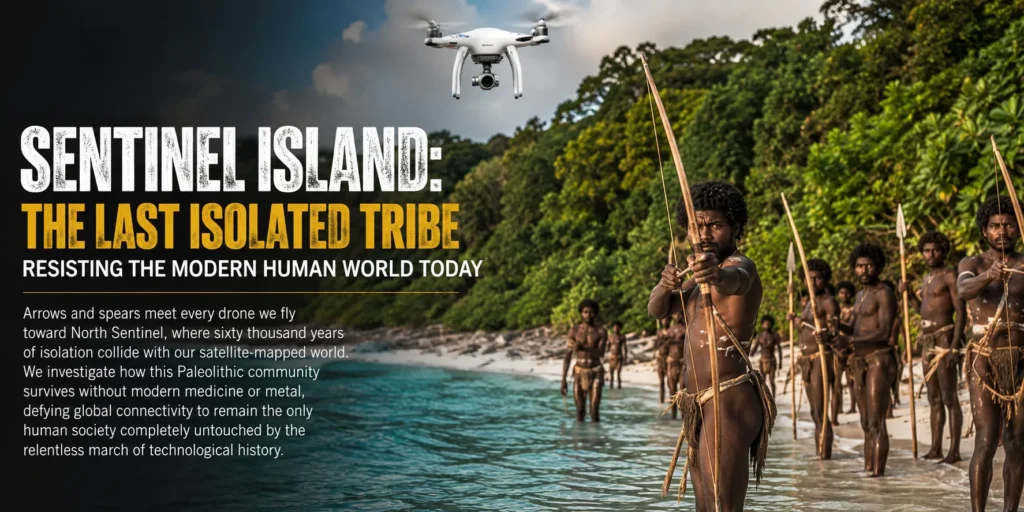

While you scroll through social media, a tribe on a tiny island fires arrows at helicopters. This is the true story of North Sentinel Island—60,000 years of isolation, the last uncontacted people on Earth, and why they have chosen war over Wi-Fi.
Part 1: The Drone’s Last Picture
The video lasts only eleven seconds. It is shaky, grainy, and looks like it was filmed inside a sandstorm. But what you see will freeze your blood.
A young man stands on a white beach. He is shirtless. His skin is dark and smeared with red clay. Around his neck hangs a shell necklace—hand-drilled, each bead placed by someone who loved him. He holds a bow that is nearly as tall as he is. The bowstring is made from twisted plant fiber, strong enough to pull a hundred pounds. He draws the string back to his ear. The arrow is not a toy. It is tipped with iron that his people scavenged from a shipwreck decades ago. They do not know how to make iron. But they know how to sharpen it until it can cut bone.
He is not aiming at a deer or a fish. He is aiming at the buzzing drone hovering forty feet above his head. The drone is sleek and white. It has a camera that can see in 4K. It belongs to a journalist sitting in a boat a half mile away. That journalist has spent ten thousand dollars on this expedition. He thinks he is about to make history.
Thwip.
The camera spins. The screen goes black. We hear the sound of the drone hitting sand. Then footsteps. Then the noise of the arrow being pulled out of the shattered plastic. Then silence.
That drone—which cost two thousand dollars, which flew for thousands of miles, which carried a memory card full of footage—now lies in pieces on the sand. And the man on the beach? He picks up the wreckage, looks at it for a moment, then walks back into the jungle. He does not smile. He does not wave. He simply disappears between the green walls of the trees.
Welcome to North Sentinel Island. Population: approximately 50 to 150. No one knows for sure. Cell phone reception: zero. Running water: zero. Electricity: zero. Desire to meet you: less than zero.
This is the story of the last tribe that refuses to join the modern world. Not because they are stupid. Not because they don’t know we exist. But because they do know—and they have made a choice that every other human society on Earth has refused to make. They have chosen isolation. And they have chosen war.
Part 2: A Map With a Hole In It
Pull out your phone. Open Google Maps. Zoom in on the Bay of Bengal, between India and Myanmar. You will see the Andaman and Nicobar Islands—a chain of hundreds of tropical islands, most of them friendly. Some even have resorts. Tourists go there for Christmas. They post photos of sunsets and coconuts.
But look closer. Just west of South Andaman Island, you will see a small, dark green blob. It is about twenty-three square miles. That is roughly the size of Manhattan. But there are no yellow taxi cabs here. There are no streetlights. No pizza delivery. No schools. No hospitals. No roads, no towns, no ports marked on any map. Just a jagged coastline and a single label: North Sentinel Island.
And then, in bold red letters, a warning that appears when you zoom in far enough: “Restricted Area. Do not approach.”
That is not a suggestion. That is a death warrant. The Indian government, which technically owns the island, has drawn a three-mile exclusion zone around it. That means no boats. No planes. No drones. No scientists. No missionaries. No tourists with selfie sticks. If you enter that zone, you are breaking the law. But more importantly, you are breaking a promise that the world made to this tribe.
Fishermen who drift too close do not call for help. They simply disappear. Their families wait on the dock. The boats come back empty. Sometimes the boats don’t come back at all.
Why? Because the Sentinelese—that is what anthropologists call them, though no one knows what they call themselves—do not negotiate. They do not trade. They do not accept gifts. They do not wave. They do not smile. They shoot first, and they never ask questions.
For sixty thousand years—longer than the Pyramids, longer than agriculture, longer than the last Ice Age, longer than the domestication of dogs—this tribe has lived on that island. They have never farmed a single seed. They have never smelted metal from rock. They have never written a word or built a wheel. They have never worn shoes. They have never seen a car, a phone, or a photograph. They do not know that humans have walked on the moon. They do not know that the Roman Empire existed. They do not know that the Earth is round.
And yet, they are still here. We are the ones who have changed. We are the ones who cannot sit still. We are the ones who have built skyscrapers and atom bombs and social media platforms that make us miserable. They have built a life that works. And they have decided that your life—with all its comforts—is not worth the price.
Part 3: The Day the World Tried to Say Hello (And Got an Arrow in the Shoulder)
Let us rewind to 2006. Two drunk fishermen from India, Sunder Raj and Pandit Tiwari, are out late at night. They have been drinking cheap rum. They are laughing. They are not watching the water. They anchor their small wooden boat too close to North Sentinel. The currents around the island are tricky—they pull you in and don’t let go. The fishermen fall asleep on the deck.
When they wake up, the tide has pushed them against the coral reef. The boat is stuck. The hull is cracked. Water is seeping in. They shout for help. The jungle answers.
By the time a coast guard helicopter arrives, the fishermen are dead. Their bodies lie on the beach, facedown in the sand. Their throats have been cut with sharpened wooden arrows. The wounds are clean. Whoever did this knew exactly what they were doing. The Sentinelese stand over the bodies, shaking their weapons at the sky. There are maybe twenty of them—men, women, and children. The women hold smaller bows. The children hold sharp sticks. They are not afraid. They are angry.
The helicopter hovers at five hundred feet. The pilot radios back to base: “They are aggressive. Repeat, they are aggressive.” The tribe shoots arrows at the spinning blades. The arrows fall short. But the message is clear. The helicopter leaves. The bodies are never recovered. The Indian government holds a press conference. They say, “We will not attempt recovery. The risk to the tribe is too high.” The fishermen’s families weep. But they understand.
Now, before you call the Sentinelese savages, before you say they are monsters—stop. Take a breath. And understand this: The Sentinelese have a long memory. Their memory is not written in books. It is written in their bones. It is passed down from parent to child in stories that have been told for thousands of years. And their memory says: Outsiders bring death.
In the 19th century, a British naval officer named Maurice Vidal Portman decided he was going to “befriend” the Sentinelese. He was not a bad man, by the standards of his time. He was curious. He wanted to study them. He thought he could help them. In 1880, he led a group of armed sailors to North Sentinel. They searched the jungle for hours. Finally, they found an elderly couple and four children. Portman kidnapped them. He brought them back to his base on another island. He gave them food. He gave them blankets. He thought he was being kind.
The captives immediately fell sick. Their bodies had never encountered common cold viruses. They had never met the flu. They had never seen measles. Their immune systems were strong against the germs of their own island. But against the germs of the British Empire? They had no defense. Within days, the man and his wife were dead. Their bodies grew hot with fever. They coughed blood. They died holding hands. The children? They died soon after. One by one. Four children. Four tiny graves.
Portman was horrified. He wrote in his journal that he had made a terrible mistake. He returned the bodies to the island. He left them on the beach. He watched from his boat as the Sentinelese emerged from the jungle. They saw their dead family members. They did not attack. They simply stood there. Then, according to Portman, “they retired to the jungle, weeping.”
The Sentinelese learned that lesson one hundred and fifty years ago. They have never forgotten. Every drone, every helicopter, every smiling anthropologist with a bag of coconuts and a pocket full of vitamins—to them, it is not a gift. It is a Trojan horse. You are not bringing peace. You are bringing plague. And they will kill you before you get close enough to sneeze.
Part 4: How Do They Live? (No Amazon Prime, No Problem)
You might be thinking: How do one hundred people survive on a small jungle island without supermarkets, without refrigerators, without antibiotics, without Netflix to distract them from their problems?
The answer is elegant, brutal, and incredibly smart. It is a system that has been tested by sixty thousand winters. It has survived tsunamis, cyclones, droughts, and the collapse of every empire that has risen and fallen around them.
Let us walk through a typical day on North Sentinel Island. Imagine you wake up at dawn. You are sleeping in a lean-to made of three wooden poles stuck in the ground, leaning together at the top like a teepee. You have woven palm fronds over the frame. Rain runs off the sides. Wind passes through but slows down. You are warm enough because your body heat stays inside the small space. There are no windows. There is no door. You simply crawl out through a gap in the fronds.
Food: The ocean is your refrigerator. And it is always full. The Sentinelese catch fish with nets made from plant fibers. They weave these nets by hand. It takes a woman about three days to make a net big enough to feed her family for a week. They also hunt sea turtles. This is dangerous work. A sea turtle can weigh three hundred pounds. Its bite can take off a finger. But turtle meat is rich and fatty. The shell can be used as a bowl. The bones can be used as tools.
To catch a turtle, a Sentinelese man will swim out at night with nothing but a wooden harpoon. He floats on his back. He waits. The turtle comes up for air. The man dives. He drives the harpoon into the turtle’s neck. Then he rides the turtle until it tires. If he does it wrong, the turtle drags him under. If he does it right, he drags the turtle to shore and his whole village eats for three days.
They also hunt wild pigs. These are not farm pigs. These are angry, tusked, jungle pigs that will charge a human without warning. The Sentinelese hunt them with dogs. Yes, they have dogs. Not many—maybe ten or fifteen on the whole island. The dogs are small, scruffy, and half-wild. They find the pigs and corner them. Then the men move in with spears. It is loud. It is bloody. It is over in seconds.
They eat stingrays, which they stab with barbed spears. They eat crabs, which they boil in the shells. They eat honey from giant wild bees. To get the honey, a man climbs a hundred-foot tree. He has no rope. He has no harness. He uses a strip of vine to tie his ankles together so he can grip the trunk with his feet. He climbs with his arms. The bees swarm around his face. They sting his eyelids. He keeps climbing. He reaches the hive. He breaks off a chunk of honeycomb and drops it to the ground. Then he climbs down. His children eat the honey raw, wax and all.
Water: There are no rivers on North Sentinel. But there are natural springs. Rainwater soaks into the ground and bubbles up in three or four places where the rock is cracked. The Sentinelese know exactly where every drop of fresh water comes out of the sand. They drink from cupped leaves. They carry water in hollowed-out gourds. They do not boil it. They do not filter it. Their stomachs have evolved to handle the bacteria that would send you to the emergency room.
Shelter: Besides the lean-tos, they also build larger huts for ceremonies. These are big enough for twenty people to sit in a circle. The roof is thatched with palm leaves. The floor is packed dirt. There is no furniture. There are no decorations except for a few shells and bones hung from the rafters. These huts are rebuilt every few years when the termites eat the poles.
Fire: This is the strangest fact for modern people. The Sentinelese do not know how to start fire from scratch. Seriously. They have never invented the bow drill or the hand drill. They carry embers with them everywhere. When a family moves from one camp to another, the mother carries a smoldering log wrapped in wet leaves. The ember can stay alive for days if she blows on it gently. If the fire goes out, she has to walk to a neighbor’s hut and borrow a live coal. It has been this way for sixty thousand years. They have never needed to invent a better way, because their fire never goes out unless they want it to.
Tools: They do not have metal. But they do have iron. Wait, how? Shipwrecks. Over the centuries, dozens of ships have crashed into the coral reefs around North Sentinel. The most famous is a merchant ship called the Nineveh, which wrecked in 1897. The Sentinelese swam out to the wreck. They pulled pieces of iron from the hull. They hammered those pieces against rocks to shape them into arrowheads and spear tips. They have been using that same iron for over a hundred years. They do not know how to melt it. But they know how to sharpen it until it can cut through bone.
Medicine: There is none. Not in the way you think. If you break a leg on North Sentinel, you do not get a cast. You do not get painkillers. You either heal, or you die. If you get an infection from a cut, your body either fights it off, or you do not wake up. That sounds horrifying to us. But the Sentinelese have evolved for this. Their immune systems are different from yours. They have antibodies that you do not have. They can eat raw crab without getting sick. They can drink muddy water without vomiting. But a common cold—the kind you would not even stay home from school for—could wipe out half their population. That is not an exaggeration. That is exactly what happened when outsiders made contact in the past. That is why they shoot first.
Part 5: The Most Famous Death You’ve Never Heard Of
You probably do not remember 2018. That was the year of Avengers: Infinity War and “Baby Shark” and the royal wedding. But for anthropologists, for the Indian government, for anyone who cares about uncontacted tribes—2018 was a nightmare. It was a disaster that had been predicted for decades. And it happened because one young man believed his faith was stronger than an arrow.
His name was John Allen Chau. He was twenty-six years old. He grew up in Washington state. He was a trained missionary. He had already tried to reach the Sentinelese twice before. Each time, he had been turned back by fishermen who refused to take him closer than five miles. But John was determined. He believed that God had called him to bring Christianity to the last unreached people on Earth. He wrote in his journal: “God, give me the words to say. Let me be Your light in the darkness.”
He paid local fishermen twenty-five thousand dollars to smuggle him to the island. That is a fortune in the Andaman Islands. The fishermen knew it was illegal. They knew it was dangerous. But they had families to feed. They agreed.
On November 15, 2018, John stepped onto the beach. He brought a Bible, a wetsuit, a pair of scissors, a soccer ball, and a terrible idea. The tribe appeared from the jungle. There were maybe ten of them. They screamed. They did not scream in fear. They screamed in anger. They shot arrows. One arrow hit his Bible—the book he brought to save them. The pages exploded. John turned and ran back to the boat. He was not hurt, but he was shaken.
That night, he wrote in his journal: “I’m scared. But God is with me.”
The next day, he tried again. This time, he brought gifts. He left the scissors and the soccer ball on the sand. He backed away. A young Sentinelese boy came forward. He picked up the scissors. He looked at them. Then he looked at John. The boy did not smile. He ran back to the jungle. A few minutes later, the tribe came out again. This time, they were carrying a dead pig. They laid the pig on the sand in front of John. Then they pointed at him. Then they pointed at the pig.
Anthropologists later explained what this meant. The Sentinelese were not being friendly. They were giving John a warning. They were saying: This is what happens to outsiders who come here. You will end up like this pig.
John did not understand. Or maybe he understood and did not care. He tried to sing worship songs to them. He sang “Jesus Loves Me” in English. The tribe screamed louder. They shot more arrows. One arrow hit John in the leg. He ran again.
On the third day, November 17, John told the fishermen he was going alone. He said he would not come back until the tribe accepted him. He paddled a small kayak to the shore. The fishermen watched through binoculars. They saw the tribe surround John. They saw him fall. They saw the arrows go into his chest. They saw his body dragged along the sand. They saw the tribe bury him somewhere in the jungle.
The fishermen fled. They did not call for help immediately because they were scared of being arrested. When they finally told the police, India was furious. They arrested seven fishermen. They sent a helicopter to find John’s body. The tribe shot arrows at the helicopter. The helicopter left.
To this day, John Chau’s remains are on North Sentinel Island. The United States government officially asked India to retrieve them. India said no. They said that sending a recovery team would risk killing the entire tribe with foreign diseases. They said that John broke the law. They said that the tribe has the right to defend their home.
John’s family eventually forgave him. His mother gave a statement to the press. She said: “He loved God more than he loved his own life.” Some people called John a hero. Some called him a fool. But everyone agreed on one thing: He should never have gone.
That is the power of this island. It does not care about your passport, your religion, or your money. It does not care about your good intentions or your heartfelt songs. It cares about one thing: being left alone.
Part 6: The Tsunami That Didn’t Kill Them
On December 26, 2004, the Indian Ocean experienced one of the deadliest natural disasters in recorded history. A massive earthquake under the sea—magnitude 9.1—ripped the ocean floor apart. The energy released was equal to twenty-three thousand atomic bombs. The earthquake lasted nearly ten minutes. It was so powerful that it shifted the entire island of Sumatra by over a hundred feet.
Then came the waves.
Tsunamis over sixty feet tall smashed into coastlines from Indonesia to Somalia. In some places, the water traveled two miles inland. It picked up cars, trains, houses, and ships. It threw them against buildings. It pulled them back out to sea. Over two hundred and thirty thousand people died. It was a horror that the world watched on live television.
The Indian government was overwhelmed. They had to check on hundreds of islands. One of those islands was North Sentinel. They flew a helicopter over the island to look for survivors. The pilot expected to see corpses. He expected to see flattened trees and washed-away huts. He expected to find the tribe dead, buried under mud and debris.
Instead, he saw a Sentinelese warrior standing on the highest point of the island. The man was covered in red clay. He held a bow. He had an arrow nocked. He looked up at the helicopter. He drew the string back to his ear. And he shot an arrow at the spinning blades.
That was the world’s answer. The tribe had survived. Not only survived—they had thrived. How? How did a tribe without satellites, without weather radios, without any warning system at all manage to escape a tsunami that killed a quarter of a million people?
The answer is older than writing. The Sentinelese have oral traditions that have been passed down for thousands of generations. Their grandparents told them stories. Those stories came from their grandparents, who heard them from their grandparents, all the way back to the last time a great wave hit the island. The story goes like this:
When the sea pulls back, when the water leaves the beach and the fish are flopping on the sand, do not go to collect the fish. Do not walk out on the wet sand. Run. Run away from the water. Run toward the high ground. Run until you cannot see the ocean anymore. Then climb a tree. And wait.
The Sentinelese saw the water pull back in 2004. They did not stand there confused. They did not walk out to look at the stranded fish. They ran. They grabbed their children and their dogs and their smoldering fire logs. They ran to the highest hill on the island. They climbed trees. They waited. The wave came. It washed over the beach. It flooded the lower jungle. But the hill was high enough. The trees were tall enough. The tribe stayed dry.
Later, when aid groups tried to air-drop food and medicine onto the island, the Sentinelese threw spears at the pallets. They did not want your charity. They did not trust it. And honestly? They were probably right. A plastic bottle of Coke would have been worthless to them. A bag of rice would have rotted in the humidity. A blanket contaminated with flu germs could have killed them. They knew this. They did not need your help. They had their own way.
Part 7: Are They the Last Ones?
Here is the question that keeps anthropologists up at night. It keeps government officials awake during meetings. It bothers everyone who cares about the future of human diversity: How much longer can the Sentinelese survive?
On one hand, they have been doing this for sixty thousand years. They are not helpless. They are not “primitive” in the way you think. The word “primitive” comes from a Latin word meaning “first.” The Sentinelese are not first. They are not last. They are simply different. Their society is not a failed version of your society. It is a different version entirely. It is a fortress designed to keep you out. And it works. It has worked for longer than any kingdom, any empire, any religion that you have ever heard of.
On the other hand, their problems are new. Climate change is raising sea levels. A single bad storm could wash away their fresh water springs. The ocean is getting warmer. The fish are moving to colder waters. The turtles are laying fewer eggs. A passing cargo ship could spill oil on their fishing grounds. A tourist with a selfie stick could—against all laws—land on their beach and sneeze.
And here is the hardest truth: The Sentinelese are not immortal. They do not have superhero immune systems. They have isolated immune systems. That is very different. Their bodies know how to fight the germs of their own island. But they have no defense against the germs of the outside world. If COVID-19 ever reached that island, it would not be a pandemic. It would be an extinction event. One hundred percent mortality. No survivors. No help. No hospital ships. No vaccines. Just a silent beach and empty huts and the wind blowing through the palm fronds.
That is why, in 2025 and 2026, the Indian government has doubled down on protection. They now have coast guard patrols circling the island twenty-four hours a day, seven days a week. They arrest any fisherman caught within five miles. They have seized boats. They have thrown tourists in jail. They have officially declared North Sentinel a “Scheduled Tribe” with the highest legal protection under Indian law. Translation: If you go there, you are the invader. Not them. You are breaking the law. You are endangering lives. And if you die, your death is your own fault.
Some people argue that the Indian government should do more. They say that the Sentinelese need vaccines. They say that we have a moral duty to protect them from disease, even if it means making contact. But every time this argument comes up, the anthropologists push back. They point to history. They point to the Andamanese tribes that did make contact. The Great Andamanese people, for example. When the British came, there were five thousand of them. Today, there are fewer than fifty. Most of them died from diseases brought by well-meaning outsiders. The Jarawa tribe, another Andaman island group, was contacted in the 1990s. Within a decade, half of them were dead from measles and flu.
The Sentinelese have watched this happen to their neighbors. They know. That is why they shoot.
Part 8: The Strange Case of the Coconut Man
Not every attempt to contact the Sentinelese ended in arrows. There is one exception. One man. One strange, gentle, extraordinary exception.
His name was Triloknath Pandit. He was an Indian anthropologist. He worked for the government. In the 1960s, 1970s, and 1980s, he made a series of expeditions to North Sentinel. Unlike the British officers of the past, unlike the missionaries with their Bibles, Pandit did not try to capture anyone. He did not try to preach. He did not try to bring gifts of metal or cloth. He brought only one thing: coconuts.
Coconuts grow on most of the Andaman Islands. But they do not grow on North Sentinel. The Sentinelese had no way to get them. Pandit thought that maybe, just maybe, the tribe would accept a gift that they actually wanted.
He approached the island slowly. He stood on the bow of his boat. He held up a coconut. He shouted something friendly in a language he did not know. The tribe came to the beach. They shouted back. They did not shoot immediately. Pandit threw the coconut into the water. The tribe watched it float. One young man waded out and grabbed it. He bit into it. He drank the milk. He shouted something to the others. They all ran into the water to collect more coconuts.
Over the years, Pandit returned again and again. He always brought coconuts. He always stayed in his boat. He never tried to land. He never tried to touch anyone. The tribe began to expect him. They would gather on the beach when they saw his boat. They would hold out their hands. Pandit would throw coconuts. The tribe would catch them. Sometimes, a young man would hold up an arrow and pretend to shoot. Then he would laugh. Pandit laughed too.
But Pandit never got out of the boat. He knew that the moment he stepped onto the sand, the rules would change. He respected the line. And because he respected it, the tribe tolerated him. He was the closest any outsider has ever come to friendship with the Sentinelese.
When Pandit retired in the 1990s, the visits stopped. The Indian government decided that even these friendly coconut drops were too risky. What if a coconut carried a virus? What if Pandit sneezed and the wind carried the germs? They ended all contact. Today, the Sentinelese no longer see friendly boats full of coconuts. They only see drones, helicopters, and the occasional lost fisherman. They have gone back to shooting first.
Some people say that Pandit missed his chance. Others say he was the only one who did it right. He did not try to save them. He did not try to convert them. He did not try to study them up close. He simply offered a gift and left. That is the closest thing to love that the outside world has ever shown the Sentinelese.
Part 9: The Ten Unanswered Questions
No one knows the answers to these questions. The Sentinelese do not have a written language. They do not have a radio. They do not talk to outsiders. Everything we know about them comes from watching from a distance—through binoculars, through drones, through the occasional glimpse from a helicopter. Here are the mysteries that remain:
1. What do they call themselves? “Sentinelese” is a name given by outsiders. They probably have a word for their people in their own language. We will never know what it is.
2. How many of them are there? Estimates range from fifty to one hundred and fifty. The Indian government says around eighty. But no one has done a census. The tribe does not stand still for headcounts.
3. Do they have a leader? Most small tribes have a headman or a council of elders. But we do not know if the Sentinelese have one chief or if they make decisions together.
4. What language do they speak? From a distance, researchers have recorded sounds. They seem to speak a language related to the other Andamanese languages. But no one has ever made a dictionary. No one knows how to say “hello” or “thank you” or “please don’t shoot.”
5. Do they have religion? They almost certainly have spiritual beliefs. They bury their dead. They leave offerings. But what gods do they pray to? What stories do they tell about the stars? No one knows.
6. Do they have marriage ceremonies? They pair up. They raise children. But do they have a wedding ritual? Do they exchange gifts? Do they dance? Unknown.
7. Do they have music? Anthropologists have heard rhythmic chanting from the beach. But no instruments have been seen. Do they sing? Do they drum on hollow logs? Probably. But we cannot be sure.
8. How do they resolve arguments? Every society has conflict. Do the Sentinelese fight? Do they have a justice system? Do they exile troublemakers? No data.
9. Do they know about other people? Do they know that there are other islands? Do they know that there is a mainland called India? Do they know that white people exist? They have seen boats and helicopters. But do they understand where those things come from? Unknown.
10. Are they happy? This is the most important question. And the answer is that we cannot know. Happiness is not a universal concept. What makes you happy—a phone, a paycheck, a vacation—would mean nothing to them. What makes them happy—a full belly, a dry hut, a successful hunt—might not be enough for you. But they have survived for sixty thousand years. They have not died out. They have not surrendered. They have not asked for help. Maybe that is happiness. Or maybe it is something else entirely. They are not telling.
Part 10: What They Teach Us About Ourselves
You might think this is a story about a weird, violent tribe on a tiny island in the middle of nowhere. You would be wrong.
This is a story about choice.
Every other human society on Earth has, at some point, traded isolation for connection. We traded hunting for farming. We traded villages for cities. We traded letters for telegrams, telegrams for phone calls, phone calls for emails, emails for text messages, text messages for social media. We told ourselves that each trade made us richer, smarter, happier, more connected. We told ourselves that loneliness was a problem that technology could solve.
The Sentinelese looked at that trade and said: No thanks.
They saw the British with their guns and their diseases. They saw the missionaries with their strange books and their strange songs. They saw the fishermen with their rum and their empty promises. They saw the anthropologists with their notebooks and their questions. They saw the tourists with their cameras and their entitlement. And they decided that an arrow through the chest is a better answer than a slow death from a virus they cannot see. They decided that isolation is not a curse. It is a shield.
Are they happy? We do not know. They do not have a word for “happiness” the way we do. They have words for “full belly,” “dry shelter,” “enemy gone,” “children alive.” Maybe that is enough. Maybe that is more than enough. Maybe we are the ones who are confused. Maybe we are the ones who have traded real happiness for cheap dopamine.
Here is what we do know: In 2026, you are reading this on a screen that contains more information than the entire Library of Alexandria. You have vaccines, airplanes, pizza delivery, and the ability to FaceTime someone on the other side of the planet in less than a second. You have never been hungry for more than a few hours. You have never been truly cold. You have never had to fight for your life with a wooden spear.
And yet, somewhere in the Bay of Bengal, on a small green island that does not appear on any tourist map, a man with a wooden bow and a stone-tipped arrow is living a life that has not changed since the woolly mammoth walked the earth. He does not know your name. He does not know your country. He does not know your religion. He does not want to. And for the first time in human history—for the first time since the Sentinelese first lit a fire on that beach sixty thousand years ago—the rest of the world has agreed to respect that.
That is not a tragedy. That is not a failure. That is a miracle. That is the only miracle that the modern world has managed to produce. We have learned to leave one tribe alone. We have learned that not every door needs to be knocked on. We have learned that some people do not want to be saved.
Part 11: What Happens Next? (And Why You Should Care)
So what does the future hold for North Sentinel Island? There are three paths. One is hopeful. One is terrifying. One is simply sad.
Best case: The Sentinelese remain uncontacted for another sixty thousand years. The Indian government keeps its promise. The coast guard patrols remain vigilant. No more John Chaus. No more curious YouTubers with drones. No more fishermen drunk on rum. The tribe lives, breeds, hunts, fishes, and dies in peace. We watch from satellites. They shoot at drones. The standoff continues. It is not a perfect solution. But it is a peaceful one.
Worst case: A fishing boat wrecks on the reef during a storm. The survivors are not missionaries—just poor fishermen trying to stay alive. They swim to shore. The Sentinelese kill them. It is self-defense. But one survivor has measles. He does not know it. He coughs on a bush before he dies. A Sentinelese child touches that bush. The child brings the virus back to the village. Within two months, the island is silent. No more arrows. No more fires. No more smoke rising through the trees. Just empty huts and bones.
Most likely case: Climate change gradually degrades the island. The sea level rises. The fresh water springs become salty. The fish move to colder waters. The coral reefs bleach and die. The turtles stop coming. The tribe shrinks. Birth rates fall. Old people outnumber young people. One day, a coast guard helicopter flies over and sees no smoke from the cooking fires. They wait a week. No smoke. They wait a month. No smoke. They lower a camera. Empty huts. The last uncontacted tribe is gone. And we never even heard their language. We never learned their songs. We never knew their names.
That is the sorrow of this story. We cannot save them without killing them. And we cannot leave them alone without slowly losing them. There is no good answer. There is only the least bad answer. And the least bad answer is to do nothing. To keep the patrols in place. To enforce the exclusion zone. To arrest the curious and the reckless and the faithful. To let the Sentinelese live their own lives and die their own deaths.
It is not satisfying. It is not heroic. It is not the ending that Hollywood would write. But it is the only ending that respects their choice. And after sixty thousand years, they have earned the right to choose.
Part 12: The One Rule You Must Never Break
Here is the end of the lesson. You might be curious. You might think, “I will just sail close. Just a peek. Just a photo. No one will know.”
Do not do it.
Not because you will be arrested. Not because you will be fined ten thousand dollars. Not because India will put you in a prison cell that smells like fish and regret. Do not do it because you will be killed. And your death will be painful. And no one will come to save you.
But worse—your death will be used by others as an excuse. Your family will beg the government to “rescue” your body. Politicians will demand action. News crews will camp outside the coast guard headquarters. And that rescue mission will land on the beach with masks and gloves and medicines and good intentions. And every person who steps off that boat will carry a universe of germs. And within a month, the last arrow will fall from a dead hand. The last fire will go out. The last child will cough and shiver and close their eyes.
All because you wanted a selfie. All because you wanted to be the one who made contact. All because you thought the rules did not apply to you.
The Sentinelese are not a zoo exhibit. They are not a challenge for your Instagram. They are not a mission field for your religion. They are not a research project for your anthropology degree. They are human beings. They are exactly as human as you are. They have mothers and fathers and children and dogs. They laugh. They cry. They get scared. They fall in love. They hold funerals. They tell stories around the fire.
And they made a choice ten thousand years ago. They are still making that choice today. Their choice is simple: We do not want you here.
Listen to them. Respect them. Leave them alone. Watch from the satellite. Read the articles. Write your school report. Then close your laptop and be grateful. Be grateful that somewhere on this crowded, noisy, connected, overpopulated, overstimulated planet—there is still a place that refuses to answer the door. There is still a people who have not sold their souls for a smartphone. There is still a society that has not been flattened by the steamroller of progress.
North Sentinel Island is not a failure of the modern world. It is the last success of the ancient one. Let it stand.
Epilogue: The View From the Boat
Imagine you are standing on the deck of a coast guard boat. It is dawn. The sun is rising over the Bay of Bengal. The water is calm. Two miles away, you can see the green shape of North Sentinel Island. It looks like a whale sleeping on the surface of the sea.
You raise your binoculars. You see the beach. It is empty. You see the tree line. It is still. You hear the birds. You hear the waves. You hear nothing else.
Then you see a puff of smoke. Someone is lighting a cooking fire. You see a figure—small, distant, dark against the sand. The figure is carrying something. A fish? A child? You cannot tell. The figure stops. It looks out at the water. It looks in your direction. It stands very still.
You lower your binoculars. You do not wave. You do not shout. You simply watch. And you think: That person has no idea what a smartphone is. That person has never seen a car. That person has never heard of America or China or Russia or the United Nations. That person has no debt, no email, no password to remember, no alarm clock to wake up to. That person is free in a way that you will never be.
Then the figure turns and walks back into the jungle. The smoke rises. The sun climbs higher. The boat engine rumbles beneath your feet. You check your phone. You have thirty-seven unread messages.
And you wonder: Who is really free?



You could certainly see your enthusiasm in the paintings you write. The arena hopes for even more passionate writers such as you who aren’t afraid to say how they believe. At all times follow your heart. “Man is the measure of all things.” by Protagoras.
I went over this site and I think you have a lot of excellent info, saved to fav (:.
Safe, secure, and very efficient. I have had zero issues with my deposits and withdrawals here. puasbetlogin is the real deal.
Really impressed with the variety of betting options. There is something for everyone here. I am sticking with 87a777bet
Just hit a decent win and the withdrawal was processed almost instantly. This is how it should be done. Visit erabet888
Installing the app made everything so much easier. No more refreshing the browser, just instant access to the games. Love using bdr777betapk on my phone.
Finally found a site where the login process is actually fast and doesn’t glitch. Had a great run last night with some big wins. Highly recommend jilijililogin to everyone.
The registration process was a breeze and I was able to start playing in under two minutes. Everything feels very professional here at jilibet88loginregister