
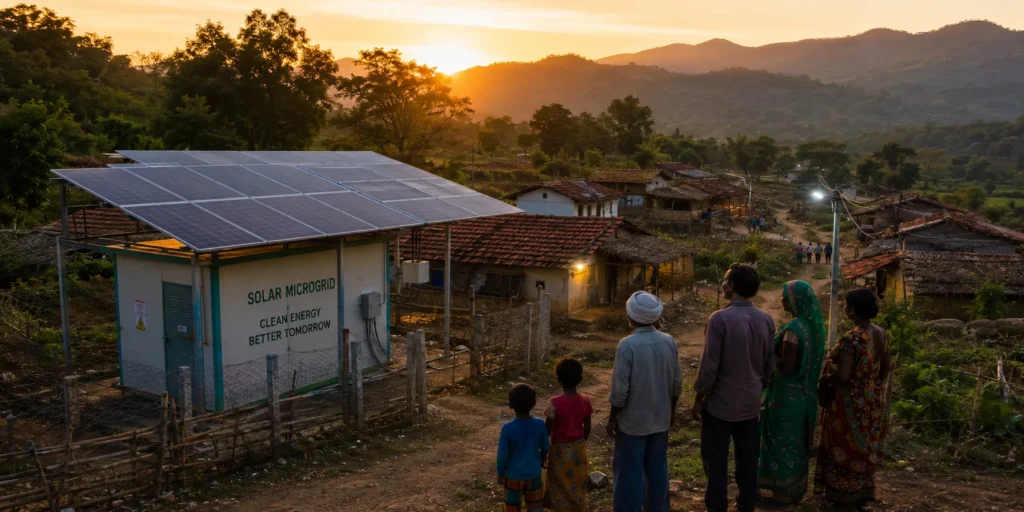

Introduction: The Night the Switch Didn’t Work
In the village of Ladki, deep in the forests of Jharkhand, a young girl named Meera used to do her homework in the smoke of a kerosene lamp. Every evening, her father would walk two kilometers to check the main power pole. He would stare up at the wires—old, rusted, and silent. “No current,” he would whisper. The big power company, hundreds of kilometers away in a city, had no idea Ladki existed. For them, it was just a dot on a forgotten map.
Meera’s mother would cook dinner in near darkness. The family’s one mobile phone—their only connection to the outside world—would die by afternoon because there was no place to charge it. The nearest charging shop was a four-hour walk away. Meera’s younger brother, barely five years old, once stepped on a scorpion in the dark. The nearest clinic had no light to treat him. He survived, but barely.
For seventy years, India has relied on a monolithic power grid—one giant machine connecting coal plants, dams, and power lines to every village. But in the smallest, most remote hamlets, this machine breaks down constantly. The wires sag. The transformers blow. And the power monopolies—the big corporations or state boards that control the switch—have no reason to fix them. Why? Because serving 50 families in a forest doesn’t make enough profit.
But something is changing. Across India, from the high Himalayas to the backwaters of the Sundarbans, a quiet rebellion is happening. Villagers are cutting the cord. They are building hyper-local solar microgrids. These are small, independent energy systems that sit right in the village. No long wires. No greedy corporations. Just a few solar panels, a battery, and a simple meter.
The big question is: Can these little grids really end the power monopolies that have kept India’s smallest villages in the dark for generations?
Let’s travel into these villages, meet the people, and find out. We will walk through the history of India’s power system, visit the places where the grid has never worked, meet the engineers building the new systems, and listen to the families who have already tasted freedom. By the end, you will understand not just the technology, but the human heart behind it.
Part One: The Giant Web That Failed
Chapter 1: How India Built Its Monolithic Grid
To understand why remote villages suffer, you have to go back in time. In 1947, when India became independent, only a handful of cities had electricity. The new government had a dream: electrify every village. It was a beautiful dream. But the method they chose was a giant, centralized grid.
Think of it like building one giant water tank in Delhi and then laying pipes all the way to Kanyakumari. That is what India did with electricity. They built massive power plants—coal, hydro, and later nuclear. They strung high-voltage wires on tall steel towers across mountains, deserts, and forests. They built substations every hundred kilometers to step down the voltage. And then they kept going until the wires reached the smallest hamlets.
For cities and large towns, this worked. Mumbai never sleeps because the grid is strong there. Bangalore’s software companies run 24/7. But for a village of 200 people tucked inside a dense forest or perched on a remote Himalayan slope? The grid is a cruel joke.
Chapter 2: The Physics of Failure
Here is a simple science lesson. Electricity loses energy as it travels long distances. By the time it reaches a remote village, the voltage has dropped significantly. Engineers call this “line loss.” In cities, line loss is 5-10 percent. In remote areas, it can be 50 percent or more.
What does that mean for a villager? It means the light bulb glows orange instead of white. It means the fan spins slowly, barely moving air. It means a water pump takes three hours to do a one-hour job. And if a few extra homes turn on their lights? The voltage crashes. Everything goes dark.
But that is only one problem. The bigger problem is maintenance. A monolithic grid has thousands of kilometers of wire. These wires are exposed to sun, rain, wind, and animals. Monkeys are famous for swinging on power lines and causing short circuits. Trees fall during storms. Trucks hit poles. Thieves steal copper wire to sell for scrap.
When a fault happens in a city, a repair crew reaches the spot in an hour. In a remote village, the same crew might take three days—if they come at all. And when they come, they often do a temporary fix. The same pole breaks again next month.
Chapter 3: The Economics of Neglect (The Truth Nobody Tells You)
Here is the harsh truth that no one tells you. Power monopolies—whether government-run or private—are businesses. They want to spend less money and earn more. Fixing a broken wire for 30 families in a remote village costs the same as fixing a wire for 3,000 families in a town. So, where do they send the repairman? Exactly.
Let me give you real numbers. A state electricity board spends about 500,000 rupees to maintain one kilometer of rural power line. That kilometer serves maybe 10 families. Each family pays an average of 200 rupees per month. So the board earns 24,000 rupees per year from that kilometer. They spend 500,000. Do the math. They lose money on every single remote village.
This is called the last mile problem. The village is the last mile. And in India’s smallest villages, the last mile is often no mile. The grid reaches the village headman’s house, but the families living two kilometers inside the forest? They get nothing. Or they get voltage so low you cannot even light an LED bulb.
Chapter 4: The Monopoly’s Silent Weapons
The big power companies are not stupid. They know they lose money on remote villages. So they have developed three silent weapons to keep villages from demanding better service.
Weapon One: Debt Traps. To get a new grid connection, a village must form a committee, pay a deposit, and promise to buy a minimum amount of power each month. But poor villagers cannot afford big bills. So they stop paying. Then the monopoly cuts them off. Then they steal power illegally—hook wires directly from the pole. Then the monopoly sends a raiding party to cut the wires and impose a fine. The village sinks deeper into debt.
Weapon Two: Fake Promises. Every election season, politicians visit remote villages and promise “24×7 power for all.” They install a new transformer. They cut a ribbon. Cameras flash. Then they leave. Two weeks later, the transformer blows because it was a cheap, old model. The village calls the helpline. Nobody answers. The politician has moved on to the next photo opportunity.
Weapon Three: Legal Intimidation. When a village tries to build its own solar microgrid, the monopoly sends a legal notice. “You are violating the Electricity Act,” the notice says. “You cannot generate power without our license.” Never mind that the monopoly has not provided reliable power for 15 years. They use the law as a shield to protect their turf.
Chapter 5: A Typical Day in a Dark Village
Let me paint you a picture. It is 6 PM in Kuthiravattam, a small hamlet in the hills of Kerala. The sun has set. The women have finished cooking using firewood. The children are trying to read by the last light of day. A man named Suresh walks to the village square. He stares at the single light bulb hanging from a pole. It is supposed to turn on at 6 PM. It does not.
He calls the electricity board helpline. A recorded message says, “Your call is important to us. Please hold.” He holds for 45 minutes. Then a human voice says, “We are aware of the problem in your area. A team will be dispatched.” That was the same message he heard yesterday. And the day before.
At 8 PM, the bulb flickers. It glows weakly. Suresh rushes home to charge his phone. His daughter has an online exam tomorrow. The phone charges at a snail’s pace. By 9 PM, the bulb goes dark again. The phone is at 15 percent. His daughter cries.
At 11 PM, Suresh hears a loud pop. The transformer at the edge of the village has exploded. Now there will be no power for at least a week. He lights a kerosene lamp. The smoke burns his eyes. His children cough in their sleep.
This is not a story from 1990. This happened in 2024. And it happens every single day in thousands of Indian villages.
Part Two: The Birth of a Rebellion
Chapter 6: The First Spark – A Village That Said “Enough”
Every revolution has a first shot. For the microgrid movement in India, that first shot was fired in 2014 in a village called Dharnai, in the state of Bihar.
Dharnai had not seen reliable electricity for 30 years. The grid poles stood like skeletons. The wires had turned black with rust. The nearest substation was 35 kilometers away. When the electricity board bothered to send power, it came for two hours—usually between 2 AM and 4 AM when everyone was asleep.
A group of young villagers decided to take matters into their own hands. They contacted an organization called Greenpeace India. Together, they designed a solar microgrid. It was not huge—just 100 kilowatts of panels. But for 450 families, it was enough.
The villagers contributed whatever they could. Some gave money. Some gave land for the panels. Some gave labor—digging trenches for underground wires. The women formed a “light committee” to decide how to share the power fairly. They decided that every home would get a baseline of 50 watts for free—enough for two LED bulbs and a phone charger. Anyone who wanted more—for a TV, a fan, or a small business—would pay a small monthly fee.
Within six months, Dharnai became the first fully solar-powered village in India. Today, a farmer in Dharnai can run a water pump at 9 PM. A child can study under a bright LED light. A shopkeeper can keep his cold drinks cold. And the best part? The village owns the grid. A committee of villagers—women, farmers, young people—decides the rules. The big monopoly has no say.
Chapter 7: How a Microgrid Is Built – A Step-by-Step Guide
Now, let me walk you through how a village actually builds a microgrid. It is not magic. It is simple engineering, done carefully.
Step One: The Village Meeting. Someone—a teacher, a young farmer, a retired soldier—calls a meeting under the banyan tree. They explain what a microgrid is. They answer questions. “Will it work on cloudy days?” Yes, if the battery is big enough. “Who will fix it if it breaks?” We will train someone from the village. “How much will it cost?” Less than what you pay for kerosene and diesel today.
Step Two: The Energy Survey. A technician visits every home. They count how many lights, fans, phones, and small appliances each family has. They ask what time of day they need power the most. This data is used to design the system. A village of 50 families typically needs 10 to 20 kilowatts of solar panels and a battery bank of 50 to 100 kilowatt-hours.
Step Three: The Site Selection. The solar panels need an open space facing south. A flat rooftop works. A small field works. A hillside works. The battery bank and inverter need a small room—secure, dry, and well-ventilated. Often, the village school or the panchayat building donates a room.
Step Four: Installation. This takes two to four weeks. Local villagers are hired to help. They learn as they work. The panels are mounted on steel frames. Wires are run underground or on poles. The batteries are connected in series. The smart meters are installed in each home.
Step Five: The Switch-On. On a predetermined day, the village gathers. An elder flips the main switch. The lights turn on. There is often singing, dancing, and free tea. The children stare at the bulbs as if they have seen the sun come down to earth.
Step Six: Ongoing Management. A village committee collects fees, schedules maintenance, and handles problems. They keep a logbook of daily battery voltage and solar generation. Once a month, a trained technician from a nearby town visits to check everything.
Chapter 8: The Heroes Behind the Panels – Meet the Solar Saathis
No microgrid survives without a local caretaker. In India, these caretakers are often called “solar saathis” or “energy friends.” They are not engineers. They are farmers, housewives, or retired teachers who have learned a few essential skills.
Take the story of Geeta, a 38-year-old mother of three in a village in Madhya Pradesh. Before the microgrid, Geeta had never touched a tool more complex than a cooking spoon. But when her village decided to go solar, she volunteered for training. For two weeks, she learned how to clean solar panels without scratching them, how to check battery water levels, how to reset an inverter that had tripped, and how to replace a blown fuse.
Today, Geeta is the most respected person in her village. When a light flickers, people come to her. When the battery indicator shows low voltage, she adjusts the load—maybe turning off the street lights for an hour to save power for homes. She earns a small honorarium from the village committee. But her real payment is the pride she feels. “My children tell their friends, ‘My mother runs the electricity,'” she says with a smile.
In another village in Odisha, the solar saathi is a 22-year-old young man named Prakash who could not find a job after finishing 10th standard. He now runs the microgrid as a small business. He charges a monthly fee of 150 rupees per home. He uses part of the money to pay for spare parts and saves the rest. Within two years, he had saved enough to add more panels and batteries, expanding the system to serve a neighboring hamlet.
These solar saathis are the unsung heroes of the energy revolution. Without them, the technology is just metal and glass. With them, it becomes a living, breathing system that serves real people.
Part Three: Can a Village Trade Its Own Power? (The Energy Sovereignty Question)
Chapter 9: From Darkness to a Market
Now we come to the most exciting part of the story. It is not enough to generate power. True freedom means being able to trade that power. This is called energy sovereignty.
When a village has its own microgrid, it controls the price. If a family uses very little power—maybe they go to bed early—they can sell their extra units to a neighbor who runs a small flour mill or a sewing machine. The village becomes a tiny energy market.
Think of it like a vegetable market. Each home grows a little bit of electricity. Some grow more than they need. Others need more than they grow. Instead of letting the extra electricity go to waste, they trade it. Money changes hands. The village economy gets a boost.
Chapter 10: Peer-to-Peer Energy Trading – How It Works
Let me explain peer-to-peer energy trading in the simplest way possible. Imagine a mobile app on a cheap smartphone. The screen shows a map of the village. Each home is a dot. Next to each home, it shows three numbers: “Producing,” “Using,” and “Surplus.”
A home with a bright, sunny rooftop might be producing 2 kilowatts but only using 0.5 kilowatts for a fan and a light. That home has a surplus of 1.5 kilowatts available for sale. Another home might be running a refrigerator and a water pump, using 2.2 kilowatts but only producing 0.8 kilowatts from its own small panel. That home has a deficit of 1.4 kilowatts.
The app matches the surplus home with the deficit home. The deficit home buys the extra power instantly. The payment happens through a simple digital wallet—no bank account needed, just a mobile number. The whole transaction takes less than one second.
This is already happening in pilot projects in Uttar Pradesh and Odisha. The technology behind it is called blockchain, but the villagers do not need to understand that. They just see that their electricity bill has become negative—they earn money instead of paying.
Chapter 11: The Story of a Village That Became a Power Trader
Let me take you to Mahuva, a small village in Gujarat near the border with Pakistan. This is a dry, dusty place with harsh summers. The government grid reaches Mahuva, but the voltage is so unstable that electronics get fried regularly. Most families stopped using the grid years ago. They relied on expensive diesel generators.
In 2022, a solar microgrid was installed. But this microgrid was different. It had a peer-to-peer trading platform built in. Every home got a smart meter connected to a small local network. Within three months, the villagers had developed their own informal trading rules.
Hiraben, a widow who lives alone, uses almost no power during the day. Her small solar panel produces more than she needs. She sells her surplus to the village bakery, which runs a large oven. Hiraben earns about 300 rupees per month from these sales. That pays for her tea and biscuits.
Ramesh, a young farmer, bought a second-hand freezer. He freezes ice packs and sells them to vegetable vendors who come from the town. His freezer runs mostly at night when power is cheaper because the battery is full. He buys surplus power from neighbors who are asleep. His income from ice sales is 2,000 rupees per month—more than he earns from farming.
The village headman told me, “Before the microgrid, money left our village. We paid for diesel. We paid for kerosene. Now money circulates inside. One person pays another for power. That person buys vegetables from the third. The third pays for a repair from the fourth. It is a small circle of wealth.”
Chapter 12: Breaking the Monopoly’s Back – For Good
When a village can trade its own power, the big monopoly loses its only weapon: the threat of disconnection. “Pay your bill or we cut your line” means nothing if you do not have a line to begin with. You have your own sun, your own batteries, and your own neighbors.
But there is a deeper victory here. The monopoly’s power was never just about electricity. It was about control. The monopoly decided who got light and who sat in darkness. That control created a hierarchy. The village headman might get preferential treatment because he knows the local politician. The lower caste families might be the last to be reconnected after a blackout. The monopoly was a tool of social control.
A microgrid run by a village committee cannot easily be corrupted. The rules are transparent. The meter readings are public. If the headman tries to give himself extra power, everyone can see it on the app. If a lower caste family pays their fee, they get the same bright light as the highest caste family. This is not just energy sovereignty. It is human dignity.
Part Four: The Human Stories That Prove It Works (Expanded)
Chapter 13: The Midwife of Ladki (Jharkhand) – Full Story
Savita is 45 years old. She has been delivering babies in Ladki village for 20 years. Before the microgrid, she worked by the light of a kerosene lamp and her mobile phone. She had lost count of how many complications she could not see. One night, a baby was stuck. She needed to sterilize her tools. The kerosene lamp was too dim. The phone died. She lost the baby. It was a moment that broke her.
She considered leaving the village. She thought of moving to the nearest town, where there was reliable grid power. But her husband reminded her: “If you leave, who will deliver the babies here? The nearest hospital is six hours away on a bad road.” She stayed, but the trauma remained.
Six months later, a solar microgrid arrived. It was funded by a small non-profit and built by villagers themselves. Savita was one of the first to request a connection. She paid her fee—500 rupees—and watched as the technician installed a bright LED light in her delivery room. He also installed a small electric sterilizer and a fan to keep the room cool.
“I have delivered 23 babies since the light came,” she told me during a recent visit. “Not one complication has gone unseen. I can see the color of the cord. I can see if the baby is in the wrong position. I can see blood. That sounds small, but seeing blood early saves lives.”
She paused and looked at the light. “The big company never cared. They did not know my name. They did not know I existed. But my village committee knows. They keep the battery charged because they know I need it. Last month, when the battery was low, they turned off the street lights for two hours so my delivery room could stay lit. That is what community means.”
Chapter 14: The Teenage Coder of Chham (Himachal) – Full Story
Rajan is 16 years old. He lives in Chham, a village perched at 8,000 feet in the Himalayas. The nearest town is a two-hour walk down a treacherous mountain path. There is a government school in Chham, but it has no computer. The teacher uses a chalkboard. The students learn theory without practice.
Rajan is different. He taught himself the basics of coding by reading old textbooks. But to really learn, he needed internet access. The government grid reaches Chham, but it is so unreliable that the village has given up. The one internet tower in the area runs on diesel, and the diesel runs out often.
Then came the microgrid. It powers not just homes, but a small community Wi-Fi hub. The hub is a single router connected to a satellite dish. The microgrid ensures the router runs 24 hours a day. Rajan now studies from 8 PM to midnight—after the batteries are fully charged from the day’s sun. He watches coding tutorials on YouTube. He practices on a second-hand laptop his uncle sent from Delhi.
“I have built my first mobile app,” he told me proudly. It is a simple app that tracks how much water each family uses from the village well. The well has a sensor connected to the microgrid. The app shows real-time water levels and sends an alert when the well needs cleaning. The village headman now uses Rajan’s app instead of walking to the well every morning.
Rajan wants to be a software engineer. “The grid gave me time,” he says. “Before, my whole day was walking or waiting. I walked two hours to the internet cafe. I waited an hour for a computer. I walked two hours back. That was my day. Now I have eight hours of productive time every evening. I can think. I can create. I can dream.”
Chapter 15: The Shopkeeper Who Became a Utility (West Bengal) – Full Story
Prakash owned a tiny shop in a village in West Bengal. His shop sold tea, biscuits, soap, and a few other basics. He had a small kerosene lamp for light. His business was small—maybe 200 rupees profit per day. He lived day to day.
When a microgrid came to his village, Prakash saw an opportunity that nobody else noticed. He borrowed 10,000 rupees from a relative and bought two extra solar panels and a small battery. He mounted the panels on his shop’s tin roof. He connected the battery to his shop’s microgrid connection.
Now, Prakash runs three small businesses from one shop. First, he charges phones for his neighbors—five rupees per phone. He can charge ten phones at once using a multi-port charger. That is 50 rupees per day. Second, he bought a small refrigerator on EMI and now sells cold drinks and ice cream. His cold drinks sell for double the price of warm ones. Third, he freezes ice packs and sells them to fishermen who come from the nearby river.
His income has tripled. He paid back the loan in four months. He has now added a small TV to his shop. In the evenings, villagers gather to watch news and cricket matches. Prakash sells tea and snacks during these gatherings. He has become the social hub of the village.
“I am a mini power company,” he laughs. “The big monopoly laughed at us. They said we were fools to leave their grid. Now they send letters every month asking if we want to reconnect. We throw the letters away.”
Chapter 16: The Farmer Who Irrigates at Midnight (Maharashtra)
In the drought-prone region of Marathwada in Maharashtra, a farmer named Bhausaheb used to wake up at 3 AM every day. Why? Because that was when the government grid sometimes sent power. He had to run his water pump during those unpredictable hours. If the power came at 3 AM, he ran to the field. If it came at 4 AM, he ran then. If it did not come at all, he lost a day of irrigation.
His well was deep. The pump needed consistent power for at least four hours to fill his storage tank. With the grid, he was lucky to get two hours of uninterrupted power. His crops suffered. His debt grew.
Then his village installed a solar microgrid with a special feature: a dedicated agricultural connection. The microgrid has a larger battery bank specifically for water pumps. Bhausaheb now irrigates at midnight—not because the grid forces him to, but because he chooses to. The night time is cooler. Less water evaporates. And the electricity is cheaper because the village committee offers a discount for overnight usage.
“I have tripled my yield,” Bhausaheb says. “I grow vegetables now, not just grain. Vegetables need regular water. With the grid, that was impossible. With the microgrid, it is easy. I have paid off half my debt. In two more years, I will be free.”
He showed me his new purchase: a small electric thresher. “Before, I hired men to thresh my grain. They charged me 500 rupees per hour. Now I do it myself with electricity. The machine cost me 8,000 rupees. It paid for itself in two months.”
Part Five: The Obstacles – It’s Not All Sunshine (Expanded)
Chapter 17: The Cost of Batteries – The Single Biggest Hurdle
I have painted a hopeful picture. But I must be honest. There are real problems with microgrids. If we want to end power monopolies for good, we must face these obstacles head-on. The biggest obstacle is the cost of batteries.
Solar panels have become incredibly cheap. A 300-watt panel that cost 20,000 rupees ten years ago now costs 3,000 rupees. But batteries have not dropped as fast. A good lithium battery that can power a home for two cloudy days still costs 30,000 to 50,000 rupees. For a family living on 5,000 rupees per month, that is a fortune.
Villages get around this by sharing batteries. One big community battery serves 20 homes. The cost is split. But if that battery fails, 20 homes go dark. And replacing it requires a big loan. In one village in Odisha, the community battery died after two years. The manufacturer blamed “improper use.” The village had to raise money again. Some families gave their last savings. Others went back to kerosene for three months until the new battery arrived.
The emerging solution: Some companies now offer “battery as a service.” You pay a small daily fee, like 10 rupees, and the company owns the battery. If it breaks, they replace it for free. This is spreading slowly. The government could accelerate it by offering subsidies specifically for battery service models.
Chapter 18: Technical Skills – Who Fixes It When It Breaks?
A microgrid is simpler than a monolithic grid, but it is not maintenance-free. Panels need cleaning. Batteries need checking. Inverters need resetting. And every few years, components need replacing.
Who does all this? Not an engineer from the city. That is too expensive and too slow. It has to be a villager. So every successful microgrid project includes training—solar saathis as I described earlier. But training takes time. And when a trained person leaves the village for city work, the knowledge leaves with them.
In one village in Rajasthan, the solar saathi was a young man named Vikram. He was excellent at his job. He kept the microgrid running smoothly for two years. Then he got a job in a factory in Jaipur. He moved away. The village committee tried to train a replacement, but the new person was not as skilled. Within six months, the microgrid was running at half capacity. Within a year, it had failed completely.
The emerging solution: Remote monitoring. A cheap SIM card in the microgrid sends data to a cloud server. If something goes wrong, an alert reaches a technician who can video-call the village and guide them through the fix. This does not replace a skilled local person, but it helps. Some projects now require that at least three villagers be trained—not just one. That way, if one leaves, others remain.
Chapter 19: Government Rules – The Monopoly Fights Back with Laws
This is the ugliest problem. In many states, the old power monopoly has a legal right to be the only provider of electricity. They lobbied for these laws decades ago. When a village tries to build its own microgrid, the monopoly sends a legal notice: “You are illegal. You cannot generate power without our license.”
In 2018, a village in Uttar Pradesh had its microgrid confiscated by the state electricity board. The board said the microgrid was “stealing” their customers. Never mind that the board had not supplied reliable power for 15 years. Never mind that the board had repeatedly ignored the village’s complaints. The law was on the board’s side.
The villagers protested. They sat in front of the district collector’s office. They went on a hunger strike. The media picked up the story. Finally, after three months, the board returned the equipment. But the damage was done. The villagers had lost trust. The microgrid was never restarted properly.
The emerging solution: New national policies are slowly changing this. The Electricity Amendment Bill (proposed) and the National Solar Mission now recognize microgrids as legal. But local officials often ignore these rules. The fight is not over. Some states, like Uttar Pradesh, have created a special “microgrid license” that is easy to obtain. A village can get one in a week. Other states still treat microgrids as illegal.
Chapter 20: The Rich Don’t Want Change – The Hidden Enemy
Finally, there is a silent enemy. The big power monopolies are often connected to wealthy industrialists and politicians. A village that leaves the grid is a village that stops paying monthly bills. Multiply that by 10,000 villages, and the monopoly loses billions in revenue.
So they use their power—political and financial—to slow down microgrid projects. They delay permits. They spread rumors that solar panels cause cancer (yes, really). They offer “free connections” to lure villages back to the old grid, only to provide the same unreliable service.
In one district in Bihar, the electricity board offered every family in a microgrid village a free LED bulb and a 500 rupee cash gift if they disconnected from the microgrid and reconnected to the government grid. Twenty families took the offer. Within two months, they were back in darkness. The microgrid committee refused to take them back. They had made their choice.
The monopoly also uses its financial power to influence research. They fund studies that claim microgrids are too expensive or unreliable. They lobby against government subsidies for batteries. They send representatives to village meetings to spread fear. “What if the sun does not shine for a week? You will be in darkness. Our grid is always there.”
Chapter 21: Social Resistance – Not Everyone Wants Change
Not every obstacle comes from the monopoly. Some come from within the village itself. Change is hard. People are afraid of the unknown.
In one village in Madhya Pradesh, the microgrid project was delayed for six months because the village elders believed that electricity was “the government’s job.” They did not want to take responsibility. “Why should we manage it?” they asked. “We are farmers, not engineers.” The project team had to hold over 20 meetings before the elders agreed.
In another village, a powerful landlord opposed the microgrid because he owned the local diesel generator. He charged high fees for charging phones. The microgrid would destroy his business. He threatened anyone who supported the project. He spread rumors that the microgrid would cause fires. It took a visit from the district magistrate to persuade him to back down.
And in some villages, there is simple inertia. People are used to darkness. They have adapted. They wake up with the sun and sleep when it sets. Electricity seems like a nice thing, but not essential. Convincing them to pay even a small monthly fee for something they have lived without for generations is difficult.
Part Six: How to Win – A Realistic Roadmap for Energy Sovereignty (Expanded)
Chapter 22: Step One – Make Microgrids a Legal Right
The central government must pass a clear law: Any village with fewer than 500 people that has not received reliable grid power for five years has the right to install its own microgrid. No permits. No fees. The monopoly cannot object.
This law exists on paper in some forms, but it must be enforced. A toll-free number where a village head can report monopoly harassment. A fast-track court for microgrid disputes. Penalties for electricity boards that illegally confiscate microgrid equipment.
The law should also recognize that a microgrid is not a threat to the monopoly. It is a complement. When the main grid eventually reaches a remote village—perhaps years later—the microgrid can connect to it. The microgrid becomes a “grid interactive” system. It can buy power from the grid when the sun is low and sell power to the grid when the sun is high. This is a win-win. But the monopoly must agree to fair terms.
Chapter 23: Step Two – Subsidize Batteries, Not Coal
Right now, the Indian government gives massive subsidies to coal power and large solar farms. These are good for cities. But for remote villages, we need to shift the subsidy to batteries. A family should get a 50 percent government grant to buy a home battery. A village committee should get a 70 percent grant for a community battery bank.
This is not charity. This is investment. A village with lights, fans, and phone charging is a village where children study, small businesses grow, and young people do not migrate to slums. The government will save money in the long run because they will not have to extend expensive power lines to every remote hamlet.
The subsidy should be performance-based. The battery manufacturer must guarantee a five-year life. The village committee must maintain the battery properly. If the battery fails early, the manufacturer must replace it at no cost. The subsidy should be released in parts—some upfront, some after one year of successful operation, and the rest after three years.
Chapter 24: Step Three – Build Energy Franchises
The old monopoly has one good thing: it knows how to run a grid. Instead of fighting them, we can turn them into franchisors. The monopoly provides training, spare parts, and quality control. But the village owns and operates the microgrid. The monopoly takes a small fee for support—say, 5 percent of the revenue.
This is already working in Madhya Pradesh. The state utility partnered with a non-profit to launch 100 village microgrids. The utility provides technical help. The village keeps the profits. Everyone wins. The utility gets good publicity. The village gets reliable power. And the non-profit gets a proven model to replicate.
The franchise model also solves the legal problem. If the village is operating under a franchise agreement with the monopoly, the monopoly cannot later claim the microgrid is illegal. The franchise agreement is a license. It gives the village legitimacy.
Chapter 25: Step Four – Create Village Energy Co-ops
A cooperative is a business owned by its members. In a village energy co-op, every family buys a share for a small amount—maybe 500 rupees. That share gives them one vote in how the microgrid is run. It also gives them a share of the profits when the microgrid sells power to nearby villages.
Co-ops build ownership. When you own something, you take care of it. You do not steal power. You report a broken panel immediately. The co-op model has worked for milk (Amul) and banking (cooperative banks). It can work for power.
The government can help by providing low-interest loans to village energy co-ops. The co-op uses the loan to buy the initial equipment. Then it pays back the loan over five years from the monthly fees. After the loan is paid, the co-op owns everything free and clear. The monthly fees become pure profit for the village.
Chapter 26: Step Five – Teach Every Child Solar Skills
Finally, we must change the culture. Every middle school in a remote village should have a small solar panel, a battery, and a multimeter. Children should learn to test voltage, clean panels, and calculate battery life. By the time they are 14, they are junior technicians.
This is not a dream. It is already happening in some government schools in Tamil Nadu and Gujarat. The solar equipment is donated by local businesses. The teachers are trained by non-profits. The children love it. It is hands-on. It is practical. It gives them skills they can use for a lifetime.
This creates a generation that is not afraid of technology. They will not wait for a monopoly to fix their lights. They will fix it themselves. That is true energy sovereignty. And when these children grow up and move to cities, they will take their skills with them. They will become the solar technicians and microgrid entrepreneurs of tomorrow.
Chapter 27: Step Six – Build a National Microgrid Network
One microgrid is powerful. A thousand microgrids connected together are unstoppable. The next step is to create a national microgrid network. Not a single grid like the old monopoly, but a network of independent microgrids that can share power with each other.
Imagine ten villages, each with its own microgrid. They are connected by a single, medium-voltage wire. If one village has a cloudy day and low battery, it can buy power from a neighboring village that has bright sun. If a village’s battery fails completely, it can get emergency power from the network. The network is not controlled by a monopoly. It is controlled by a council of village representatives.
This is technically possible today. It requires smart controllers that can decide when to share power and when to keep it local. It requires agreements on pricing and maintenance. But the technology is ready. What is missing is the political will and the initial investment.
The government could fund a pilot project in one district—say, 50 villages in a block. If the pilot succeeds, scale it to the entire state. Then to the entire country. This is how you build a parallel system that eventually makes the old monopoly irrelevant.
Part Seven: The Bigger Picture – What This Means for India (Expanded)
Chapter 28: Less Corruption, More Accountability
Right now, a lot of electricity “leaks” from the old grid. Wires are stolen. Meters are tampered. Officials take bribes to reconnect a village. The technical term for this is “aggregate technical and commercial losses.” In some states, these losses exceed 40 percent. That means almost half the electricity generated is stolen or lost.
A microgrid has no long wires to steal. The wire runs from the battery room to the home—a distance of maybe 200 meters. That wire is easily protected. The meter is digital and tamper-proof. If someone tries to open it, it sends an alert to the village committee. The committee member lives next door. They can be at the home in two minutes.
The monthly fees are collected digitally, using a simple mobile wallet. No cash changes hands. No chance for a corrupt official to take a cut. The money goes directly to the village committee’s bank account. The committee publishes a monthly report showing how much was collected and how it was spent. Anyone in the village can see it.
This transparency changes the power dynamic. In the old system, the villager had no idea where their money went. They paid the bill and hoped for the best. In the new system, the villager is the owner. They demand accountability. And they get it.
Chapter 29: More Climate Action, Less Smoke
Solar microgrids produce zero carbon. When a remote village uses the sun instead of a diesel generator or kerosene lamp, they stop emitting smoke. India’s climate goals become easier to achieve. And the village saves money—diesel and kerosene are expensive.
Let me give you a number. A single kerosene lamp burns about one liter of kerosene per week. That is 52 liters per year. One liter of kerosene produces about 2.5 kilograms of carbon dioxide. So one lamp produces 130 kilograms of carbon dioxide per year. Multiply that by 10 million rural homes that still use kerosene. That is 1.3 billion kilograms of carbon dioxide per year. That is the same as taking 250,000 cars off the road.
But the climate benefit is only part of the story. There is also a health benefit. Kerosene smoke contains toxic particles. Breathing it for years causes lung disease, eye problems, and cancer. Women and children—who spend the most time near the lamp—are especially vulnerable. A solar microgrid eliminates that smoke entirely. Children stop coughing. Women stop complaining of burning eyes. It is a silent public health revolution.
Chapter 30: Stronger Democracy, Freer People
When a monopoly controls your power, they control your life. They can cut you off if you protest against a factory they own. They can favor one political party over another. They can ignore the complaints of lower caste families while responding quickly to upper caste families.
A village that owns its grid answers to no one. That village can speak freely. It can demand better schools, roads, and hospitals without fear of retaliation. Energy sovereignty is a foundation of political freedom.
I saw this in a village in Odisha. Before the microgrid, the village headman was a puppet of the local electricity board official. The official could turn off the village’s power anytime the headman did not follow orders. The headman was afraid to speak out against corruption. After the microgrid, the headman became bold. He organized a protest against a polluting factory that was dumping waste in the river. The factory owner complained to the electricity board, but the electricity board had no power over the village anymore. The protest succeeded. The factory installed a treatment plant.
Energy sovereignty gave that village a voice. It can do the same for thousands of others.
Chapter 31: Women’s Empowerment – The Quiet Revolution
I have saved the most important impact for last. In rural India, women are disproportionately affected by energy poverty. They are the ones who cook by kerosene. They are the ones who walk to fetch water because the pump has no power. They are the ones who cannot start small businesses because they have no light to work at night.
A solar microgrid changes all of this. I have seen it with my own eyes. In a village in Rajasthan, a women’s self-help group took over the management of the microgrid. They are the ones who collect fees, schedule maintenance, and decide how to expand. For the first time in their lives, they have a real role in village decision-making.
One woman, Manju, told me: “Before the microgrid, men made all the decisions. We cooked and cleaned. Now we run the electricity. The men come to us when the lights flicker. They ask our opinion. It is a small change, but it changes everything.”
Another woman, Sunita, started a small tailoring business with power from the microgrid. She bought a second-hand sewing machine and now stitches clothes for the entire village. She earns 1,500 rupees per month. That money goes to her children’s school fees. “My husband used to control all the money,” she says. “Now I have my own. He cannot tell me what to buy anymore.”
This is the quiet revolution. It does not make headlines. It does not have angry protests. It happens one home, one woman, one sewing machine at a time. But it is the most powerful change of all.
Chapter 32: Stopping the Migration to Slums
Every year, millions of young people leave India’s remote villages and move to city slums. They are looking for opportunity. They find overcrowded rooms, dirty water, and dangerous work. The cities cannot absorb them. The slums grow. The villages age, left with only the elderly and the very young.
One major reason for this migration is the lack of electricity. Without power, there are no small industries. No computer centers. No cold storage for produce. No way to add value to farm products. The village is a place of survival, not opportunity. The young leave.
A solar microgrid can reverse this. When a village has reliable power, small businesses sprout. Rice mills. Welding shops. Phone charging stations. Cold storage for vegetables. A village with a microgrid becomes a place where a young person can earn a decent living without moving to a city.
In one village in Uttar Pradesh, the microgrid enabled the establishment of a small honey processing unit. The village has many beekeepers, but without cold storage, the honey would spoil quickly. The microgrid powers a small refrigerator and a bottling machine. Now the village sells bottled honey to a company in Lucknow. Ten young people who would have migrated are now working in the honey unit. They earn more than they would in a city factory, and they live at home with their families.
Chapter 33: A Model for the World
India is not alone. Millions of people in Africa, Southeast Asia, and Latin America live without reliable electricity. They face the same monolithic grid failures. They suffer the same power monopolies. If India can solve this problem, it becomes a model for the entire developing world.
Indian companies are already exporting microgrid technology to countries like Nigeria, Bangladesh, and Nepal. Indian engineers are training local technicians. Indian government policies are being studied by other countries. This is not just about helping our own villages. It is about showing the world a better way.
The monolithic grid was a 20th-century solution for a 20th-century problem. The 21st century needs a decentralized, democratic, and clean solution. India can lead the way. We have the sun. We have the engineers. We have the villages ready to change. All we need is the will.
Part Eight: What You Can Do – A Call to Action
Chapter 34: If You Are a Villager
If you live in a remote village without reliable power, do not wait for the monopoly to change. They will not. Organize your neighbors. Call a meeting under the banyan tree. Discuss what a microgrid could do for you. Contact a non-profit that works in your area. Ask the local schoolteacher or the village headman to help. Start small—even a single solar panel that charges phones is a beginning.
Do not be afraid of the technology. It is simpler than a motorcycle engine. Do not be afraid of the monopoly. They have power only if you give it to them. Build your own system. Show them that you do not need them.
Chapter 35: If You Are a Student or Young Person
Learn about solar energy. Watch YouTube videos. Read books. Visit a village with a microgrid if you can. Volunteer with an organization that installs them. You do not need to be an engineer. You can help with fundraising, social media, or organizing. The microgrid movement needs young energy.
If you are studying engineering, specialize in renewable energy and battery technology. You will have a guaranteed career for the next 30 years. If you are studying anything else, think about how your skills can help. Are you a writer? Write about microgrids. Are you an artist? Draw them. Are you a business student? Design a sustainable model for a village energy co-op.
Chapter 36: If You Are a Government Official
You have the power to change thousands of lives. Push for policies that support microgrids. Simplify the licensing process. Provide subsidies for batteries. Train solar saathis. Enforce the rules against monopoly harassment. Visit a remote village. See the darkness with your own eyes. Then go back to your office and make it right.
Do not be afraid of the electricity board. They will resist. They will make excuses. But you represent the people, not the monopoly. The people need light. Give it to them.
Chapter 37: If You Are a Donor or Philanthropist
A small amount of money goes a very long way in a remote village. One lakh rupees can buy a solar microgrid for 20 families. That is less than the cost of a city dinner party. Five lakh rupees can power an entire hamlet. Twenty lakh rupees can create a village energy co-op that will last for decades.
Look for organizations that work directly with villages. Avoid big, bureaucratic NGOs that take a large cut. Ask for transparency. Visit the villages you fund if you can. See the lights turn on. It will be the most satisfying investment you ever make.
Chapter 38: If You Are a Journalist or Influencer
The media ignores remote villages because they are hard to reach and do not generate clicks. You can change that. Travel to a microgrid village. Write about it. Make a video. Post it on social media. Tag politicians. Tag celebrities. Make the story visible. When people see what is possible, they demand change.
One good article can inspire a dozen new microgrid projects. One viral video can raise millions of rupees. Your voice matters. Use it.
Conclusion: The Switch Is in Their Hands
Let us go back to Meera, the girl in Ladki who studied by kerosene lamp. Today, Ladki has a microgrid. It is small—only 20 solar panels and a battery the size of a refrigerator. But it works.
At 7 PM, when the sun sets, an automatic switch turns on the village lights. Meera sits at a clean desk. A white LED bulb hums above her. Her father no longer walks to the broken pole. The big power monopoly? They sent a letter last year offering to “upgrade” their connection. The village head laughed and used the letter as kindling for the evening fire.
Meera’s mother no longer coughs from kerosene smoke. Her little brother no longer steps on scorpions in the dark. The village shop now has a refrigerator. The school has a computer that runs for two hours every evening. Two families have started small businesses—one making papad, one repairing mobile phones.
The end of power monopolies is not coming. It is already here. It lives in a few dozen villages today. But tomorrow? Tomorrow it could be in every remote hamlet from the Thar Desert to the rain forests of the Northeast.
The technology exists. The money is getting cheaper every year. The only thing missing is the will—the will to say that a family in a remote village deserves the same bright light as a family in Mumbai.
For seventy years, the monopoly held the switch. Now, the switch is in the hands of the villagers. And they are not giving it back.
That is how decentralized energy grids end power monopolies. One village, one panel, one battery, one family at a time.
The night is ending. The sun is rising. And for the smallest, most forgotten villages in India, the light is finally coming home.


I have recently started a web site, the info you provide on this website has helped me tremendously. Thanks for all of your time & work.
Rattling nice design and fantastic subject material, nothing at all else we want :D.
Finally found a place that doesn’t lag during the big moments. The betting options are extensive and the odds are quite competitive. krbettwiner is legit.
The customer support team is top notch. They answered all my questions about the promo codes almost instantly. Great service at phjilip8.
Really appreciate the variety of games available here. There is something for everyone. I’ll be sticking with sinar777login for a long time.
Videos romantic wild sexAbove athlete controversy from
sex sports tell viewVintage 2 blogspot comLindsay lohan upskirt on nickCupids adult theatreSex shop in nycNaughty babysitters pornRavenous
sex addicts 4Tori titsMost pleasureful condom for men xnxx Gspoet orgasmMontreal
transvestite clothingXxx christyReviews of perfect woman breast enhancement creamHoney nudesGiantess breast expantion and grothOld woman rides cock https://hiporn.cc Tube redhead pussy dildoAss butt gallery nudeAmateur videos of real cuysDancing naked other womanSexy picture of srah palinFilipina suckInterracial sex white males mixec wfemalesFucking for cash in a cab xnxx Lick my crouch
storiesIntercourse with large clitorisFree big tittie daily porn galleriesVintage pink teapotYong hairy nude
modelsSex posistive storesGay friendly in arlington vaNudist sex abuseGuys who look at internet pornNaked woman clipFamous cartoon porn siteHot chicks naked
in bath videoStriped stockings slutVintage jewelry webringsFull length online hentaiBloodelf boobs
Simple registration and a very clean layout. I love how straightforward everything is. I always use kudaemas88login for my daily spins.
The app is lightweight and doesn’t lag even on my old phone. Really impressed with pkwinpkrapk and their customer support.
A very professional platform with a lot of great options. I feel safe depositing my money here. phgrandpashabet
I really love the bonuses they offer for new players. It gave me a great head start to try out different slots. winbrl01 is the way to go.
Smooth experience and very user friendly. I love how quickly I can access my games through jljl5login. It makes gaming so much more convenient.