
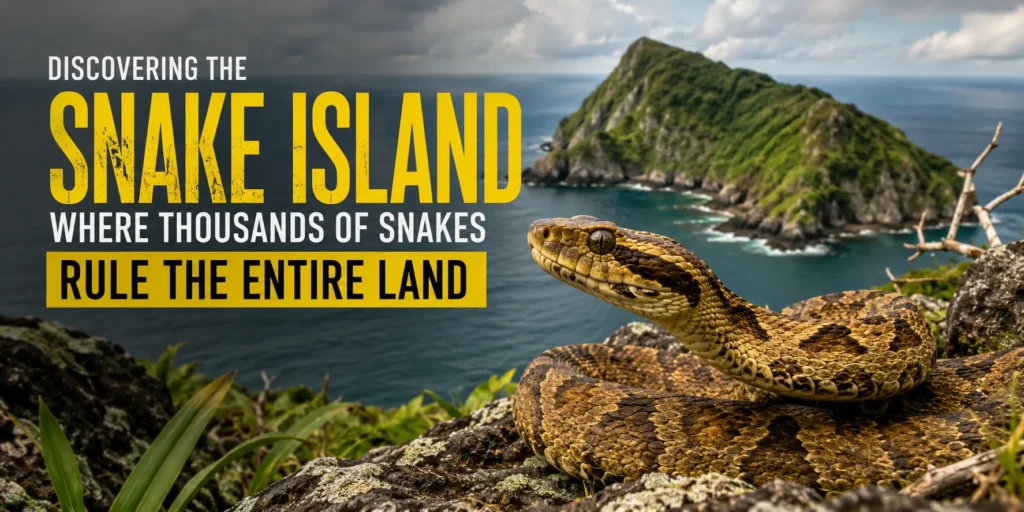

Part 1: The Forbidden Horizon
Imagine you are standing on the deck of a small fishing boat, about 90 minutes off the coast of Brazil. The sky is a perfect blue. The ocean is calm. Seagulls glide overhead, unconcerned. And then, slowly, you see it rising from the waves.
A chunk of jagged rock pushes up from the water like the broken back of a sleeping dinosaur. No sandy beaches welcome you. No tourist docks stick out from the shore. No happy music drifts from a hidden resort. Just dark green jungle, steep cliffs that drop straight into the sea, and an unnatural silence that presses against your ears.
This is Ilha da Queimada Grande. Most people around the world call it Snake Island.
Your boat captain, a weathered man in his sixties who has fished these waters since he was a boy, refuses to get closer than a few hundred yards. He cuts the engine. He crosses himself—an old habit from a childhood filled with ghost stories and sailor legends. He points one wrinkled finger toward the shore.
“That place,” he says quietly, “does not belong to us anymore.”
He is not being poetic. He means it literally. The Brazilian government has locked the island down tighter than a maximum-security prison. No regular people are allowed to set foot there. The only visitors are a handful of scientists every few years, and even they are always accompanied by a doctor carrying multiple vials of antivenom in a cooled bag.
Why? Because beneath that green canopy, an estimated 2,000 to 4,000 venomous vipers slither, coil, and hunt over every square meter of land. In some of the island’s most crowded hunting grounds, there are five deadly snakes per square meter. That means if you were unlucky or foolish enough to stumble into their territory, you would never take a second step. Your first step would land on a coil of muscle and scales that would react faster than your brain could even register the word “danger.”
This is the story of a remote island where snakes rule absolutely—where the usual balance of nature has been flipped upside down. It is a story of isolation, evolution, and how a common ancestor turned into one of the most dangerous creatures on Earth, simply because it had no other choice.
But before we get to the science, let us understand the fear. Because the fear is real. And it is justified.
Part 2: The Accidental Prison
To understand Snake Island, we have to rewind time. Not a hundred years. Not a thousand. But nearly 11,000 years—all the way back to the end of the last Ice Age.
Back then, the world looked very different. Massive glaciers covered large parts of North America and Europe. So much water was frozen on land that sea levels were much, much lower than they are today. South America was wider. The coastline was farther out. What is now a cluster of rocky, isolated islands was once connected to the mainland—a hilly, forested area where animals roamed freely from one place to another.
Among those animals was a certain type of snake. It was not special yet. It did not have a legendary reputation. It was just a jararaca viper (Bothrops jararaca), a pit viper that was common in southern Brazil. Venomous, yes. Dangerous if stepped on, yes. But not a creature of nightmares. It lived alongside mammals, birds, and other reptiles, and it had natural enemies that kept its population in check.
Then the ice melted.
As the Earth warmed, the glaciers retreated. Meltwater rushed into the oceans. Sea levels rose—slowly at first, then faster. The ocean swallowed the lowlands. Hills became islands. Valleys became straits. Populations of animals were sliced apart like a cake being cut into pieces. Some groups of snakes found themselves trapped on small patches of land that shrank with every rising tide.
On most of those newly formed islands, the snakes died out. No food. No space. Too much competition. The islands were too small, too dry, or too exposed to predators. One by one, the snake populations vanished.
But on Ilha da Queimada Grande, something different happened.
First, the island had plenty of burrows and rocky crevices. The volcanic rock that formed the island had cracked and weathered over thousands of years, creating a maze of hiding spots. Snakes could escape the heat of the day and the cool of the night by slipping into these natural shelters.
Second, and more importantly, there were no ground predators. No monkeys. No coatis. No big birds of prey that hunted snakes from above. No wild cats. The only mammals around were a few small lizards—yes, lizards are reptiles, not mammals, but you understand the point—and, crucially, a massive wave of migratory birds that used the island as a rest stop during their long journeys.
Imagine that scene: thousands of birds land on this rock every year, exhausted from flying hundreds of miles over open ocean. Their wings ache. Their bodies scream for rest. They perch on branches. They sleep in the open, hidden only by leaves. And below them, hidden in the shadows of the same branches, a starving population of vipers waits with infinite patience.
The snakes could no longer hunt small rodents like their mainland cousins. There were almost no mammals on the island—no mice, no rats, no agoutis. They had to adapt to a diet of feathers and beaks. They had to learn to strike at targets that could fly away. They had to evolve—fast—or die of hunger.
And evolution, as we are about to see, answered in the most terrifying way possible.
Part 3: The Evolution of a Nightmare
This is where the story turns from interesting to frightening—and also scientifically fascinating.
Over thousands of generations, the vipers trapped on Snake Island evolved differently from their mainland relatives. They changed in color, in behavior, in hunting strategy, and most dramatically, in venom. Scientists eventually gave this new species a name: Bothrops insularis. But the world knows it by a simpler, more poetic name: the Golden Lancehead.
“Golden” because their scales shimmer with a pale, yellowish-gold color, unlike the dark brown or gray of mainland lanceheads. In the dappled light of the island’s forest, that golden color blends perfectly with dead leaves, dry branches, and patches of sunlit soil. A Golden Lancehead can lie motionless on a tree branch, and even a sharp-eyed bird will not see it until it is too late.
But the color is not the scary part. The venom is.
On the mainland, a jararaca viper’s venom is strong enough to kill a small rodent in seconds. It causes pain, swelling, and tissue damage around the bite. But it is balanced—not overkill. The mainland viper does not need to waste its chemical weapons on prey that is already trapped on the ground.
On Snake Island, the Golden Lancehead’s venom has become something else entirely.
Because birds are their main food source, the snakes needed venom that worked in mid-air. Think about that for a moment. A bird is flying or perched on a branch. A snake strikes. The bird, even if bitten, might panic and fly a hundred meters out over the ocean before falling. If the venom is not fast enough—if it takes thirty seconds instead of five—the bird disappears into the waves, and the snake’s meal is gone forever. The snake starves.
So evolution cranked up the dial on every single toxin.
Golden Lancehead venom is now up to five times more potent than that of its mainland cousin. It is packed with enzymes that break down flesh almost immediately—enzymes called proteases that act like microscopic scissors, snipping apart the proteins that hold your cells together. It also contains hemotoxins, which attack red blood cells and blood vessels.
Let us describe what that actually means for a living creature, whether a bird or an unlucky human.
A bite causes:
- Instant, searing pain that feels like a hot nail being driven into the wound.
- Rapid swelling that can double the size of a limb in minutes. The swelling is not just fluid; it is the body’s desperate response to massive tissue destruction.
- Tissue necrosis—that means your own skin, muscle, and fat begin to die and rot away while you are still alive. The venom literally digests you from the inside out.
- Internal bleeding as the venom attacks the walls of blood vessels. Blood leaks into places it should never be.
- Kidney failure as your body’s filter system is overwhelmed by the debris of destroyed cells.
In a human, a single bite from an adult Golden Lancehead has a 7% chance of killing you even with rapid medical help—and without antivenom, that number jumps dramatically, sometimes above 30%. The venom can destroy a kidney in under an hour. The pain alone has been described by one surviving researcher as “like holding your leg in a fire while someone beats it with a pipe.”
But here is the strange twist: these snakes are not aggressive toward humans. They do not see us as food. We are too big. Too warm. Too dangerous to swallow. Their first instinct is almost always to flee or hide. The danger is not that they hunt us. The danger is that they are everywhere on that island. And they are masters of camouflage.
A scientist once reported stepping over what looked like a thick, brownish-yellow root on the forest floor. He did not think twice. But as his foot came down on the other side, the “root” moved. It was a coiled Golden Lancehead, perfectly still, waiting for a bird. The snake did not strike. But the scientist ran anyway. He ran all the way back to the landing zone. He lived. He never returned to that part of the island.
Another researcher, decades earlier, was not so lucky. While collecting specimens, he reached into a crevice without looking first. A Golden Lancehead bit his thumb. He survived—but only after a helicopter evacuation, three days in an intensive care unit, and the loss of most of the muscle tissue in his hand. His thumb remained crooked for the rest of his life.
These stories are not told to frighten you for no reason. They are told so you understand: Snake Island is not a place for adventure tourism. It is not a place to prove your bravery. It is a place where nature runs a different set of rules.
Part 4: Five Predators Per Square Meter – What That Really Means
Let us stop and truly visualize that number: five lethal snakes per square meter.
A square meter is roughly the size of a large coffee table—maybe the kind you have in your living room. Now imagine five adult vipers, each about 70 to 90 cm long (around two to three feet), coiled on that same coffee table. They are not fighting. They are not panicking. They have learned, over thousands of generations, to share the best hunting perches. There is safety in numbers when you are the top predator.
Now multiply that over the entire island. Ilha da Queimada Grande is about 430,000 square meters in total land area—roughly 106 acres, or about 80 American football fields. Do the rough math, and you get between 2,000 and 4,000 snakes total. But the density is not uniform. In some rocky areas with little vegetation, there may be only one snake every ten square meters. But near the island’s central patch of dense forest—where migratory birds rest most heavily—the density is staggering.
Scientists have recorded densities as high as five snakes per square meter in these hot zones. That means if you stood in one spot and looked down at your feet, you might see five separate adult vipers within arm’s reach. One by your left boot. One curled around a root by your right knee. One hanging from a low branch above your head. One sliding slowly out of a hole in the dirt. And one—the one you do not see—already under your boot.
How do they not run out of food? How do so many predators survive on such a small island without wiping out every living thing?
The answer is migration.
Every spring and fall, massive waves of migratory birds flood through the region. Warblers, doves, flycatchers, tanagers, and many other species travel from North America to South America and back again. These birds need places to rest. Ilha da Queimada Grande sits along a major flyway like an accidental gas station in the middle of a desert. The birds land exhausted, hungry for insects and berries.
The snakes do not chase. They do not stalk. They wait.
They lie perfectly still on tree branches, their golden-brown scales blending with dead leaves and patches of sunlight. A bird lands two inches from a snake’s head. The snake does not move. It does not flick its tongue. It does not blink. It waits for the bird to turn its back, to look away, to preen its feathers.
Then—snap.
The strike is faster than a human eye can track. In one-fifth of a second, the snake’s fangs sink into the bird’s leg or belly. Venom injects. The bird lets out a single chirp—half surprise, half pain—and tries to fly. But within ten seconds, the venom has begun to paralyze its muscles. Within twenty seconds, the bird cannot flap its wings. It falls to the forest floor, still alive but unable to move.
The snake follows the scent of its own venom. It does not need to see the bird. It simply glides down from the branch, opens its jaws wide, and swallows the bird whole, headfirst. Over the next several days, powerful stomach acids digest everything—feathers, bones, beak, and all. Nothing is wasted.
The entire island operates like a silent, green factory of death. And at the center of that factory is a single species of snake that cannot live anywhere else on Earth.
Part 5: Why You Can Never Visit (And Why That’s Good for Everyone)
In the 1920s, a few brave—or some would say foolish—people tried to live on Snake Island. A lighthouse keeper and his family were stationed there to keep the beacon running for ships passing through the busy shipping lanes off the Brazilian coast. The lighthouse was essential. Without it, ships could crash into the jagged rocks in the dark.
But the family did not last long.
The story—which may be more legend than fact, but which every Brazilian sailor believes—says that snakes slipped through the windows of the lighthouse keeper’s house at night. They coiled in the bedroom. They dropped from the rafters onto the dinner table. One night, the keeper’s wife was bitten on the ankle while hanging laundry. The children screamed. The keeper tried to kill the snakes with a broom, but more kept coming.
Finally, the family decided to flee. They ran to their small motorboat, hoping to reach the mainland. But when the keeper pulled the starter cord, snakes that had coiled inside the engine compartment during the night burst out. The family jumped into the water and swam for a passing fishing boat. They survived. But they never went back.
Whether that exact story is true, the result is real: the lighthouse is now fully automated. No one lives on Snake Island. The Brazilian Navy checks the lighthouse remotely, and once or twice a year, a maintenance crew lands for an hour. Even those sailors stay on the boat if possible. They send a small drone or a remote camera to inspect the lens.
In the 1960s, a group of banana farmers landed on the island intentionally. They saw the lush green vegetation and thought, “This would be perfect for bananas.” They brought machetes. They brought tools. They started cutting down brush and lighting small fires to clear the land.
Within hours, they were running back to their boats as snakes rained down from burning trees. The heat and smoke drove the vipers out of every crevice, every hole, every branch. The farmers reported seeing snakes sliding over their boots, dropping onto their shoulders, and coiling around their tool handles. Again, the story may be exaggerated—but not by much. When you disturb that many vipers in a confined space, they go everywhere. There is nowhere else for them to go.
Today, the law is absolute. Ilha da Queimada Grande is off-limits to the public. If you are caught trying to visit—if you hire a local fisherman to take you close and you swim ashore—you face heavy fines, seizure of your boat, and even criminal charges. The Brazilian Navy patrols the area irregularly but aggressively. They have no interest in rescuing snake-bitten tourists.
The only exceptions are researchers with special permits from the Brazilian government, and even they are limited to a few hours at a time. They wear thick leather boots that go up to their knees. They wear heavy canvas gaiters that wrap around their shins like armor. They wear thick leather gloves. They carry snake hooks, first-aid kits, and multiple vials of antivenom. They walk slowly. They never reach into holes. They never sit on the ground. They never lean against a tree.
One biologist who spent four hours on the island described the experience like this: “You hear nothing. No bird songs. No monkey calls. No insect buzzing. Just wind through leaves… and a soft, constant rustling below your feet. That rustling is snakes moving. Hundreds of them. Thousands. Sliding over leaves, over rocks, over each other. You feel like you are standing on a living carpet.”
Another scientist said, “After the first hour, your mind starts to play tricks. Every shadow looks like a coil. Every stick looks like a fang. You stop seeing individual snakes and start seeing the pattern—the way they are distributed, the way they wait. It is beautiful in a horrible way.”
Part 6: The Golden Lancehead’s Secret Superpower (The Medicine Hidden in the Venom)
Now for the twist in the story—the one that makes scientists risk their lives, spend thousands of dollars, and beg the Brazilian government for permission to visit Snake Island.
The venom that melts human flesh might also save human lives.
You see, the same enzymes that cause rapid blood pressure drop and tissue destruction in prey are being studied as potential medicines. A class of extremely common drugs called ACE inhibitors—used by millions of people for high blood pressure, heart failure, and kidney disease—was actually developed from the venom of the Golden Lancehead’s mainland cousin, the jararaca.
In the 1970s, a Brazilian scientist named Sérgio Ferreira discovered that jararaca venom contained a peptide that blocked an enzyme called ACE (angiotensin-converting enzyme). Blocking that enzyme lowered blood pressure. His discovery led to the creation of drugs like captopril, enalapril, and lisinopril. Those drugs have saved countless lives. Every time you hear an advertisement for a blood pressure medication, you are hearing an echo of viper venom.
Researchers now believe that the Golden Lancehead’s supercharged venom contains even more unique proteins—proteins that evolution refined over 11,000 years of hunting birds. Some of these proteins might:
- Stop bleeding in hemophiliacs. People with hemophilia can bleed to death from a small cut because their blood does not clot properly. Certain snake venom proteins can actually promote clotting—if used in the right dose. Scientists are studying Golden Lancehead venom for just such a compound.
- Break up blood clots in stroke patients. Stroke is caused by a clot blocking blood flow to the brain. Some venoms contain enzymes that dissolve clots faster than any human-made drug. The Golden Lancehead’s version is particularly fast-acting because birds need to be immobilized quickly.
- Act as a powerful painkiller without addiction risks. Some venom peptides target pain receptors directly, blocking pain signals without affecting the brain’s reward centers. That means no high, no addiction, no overdose risk—just pain relief. Early research on related vipers has shown promise, and the Golden Lancehead’s isolated evolution might have produced an even better molecule.
- Treat certain autoimmune diseases. The same enzymes that break down tissue can be modified to “reset” the immune system in diseases like rheumatoid arthritis or lupus. It sounds strange—using a destructive venom to heal—but that is exactly what some cutting-edge therapies do.
But there is a huge, frustrating, heartbreaking problem. The Golden Lancehead exists only on this one island. And the island is incredibly dangerous and legally restricted. And even if you manage to catch the snakes safely, the snakes die in captivity. They refuse to eat mice or rats. They need live, freshly killed birds and a very specific level of humidity. They need the temperature to fluctuate exactly as it does on their home island. A few zoos and research centers have tried to breed them in captivity. Almost all have failed.
The only successful breeding program outside of Brazil is at the Instituto Butantan in São Paulo, a world-famous snake research center. And even there, the colony is small and fragile. The snakes reproduce slowly, and the babies are difficult to keep alive.
So the only way to study the venom is to go to Snake Island, catch a snake carefully, milk its venom (yes, that means making it bite a sterile container), and release it unharmed. It is a slow, expensive, dangerous, and exhausting process. In a full day of work, a team might milk ten snakes. Each snake yields only a few drops of venom. And then you have to wait months before you can milk the same snake again.
And here is the scariest part: that might not be possible much longer.
Part 7: The Hidden Threat (It’s Not the Snakes That Are in Danger)
You would think the snakes are the only danger on Snake Island. But the truth is, they are also in danger themselves. Serious danger.
Ilha da Queimada Grande is a fragile ecosystem. For thousands of years, it has been completely isolated. No invasive species have arrived. No fires have swept through. No logging has stripped the trees. No pesticides have poisoned the insects. That isolation is exactly why the Golden Lancehead evolved so uniquely. The island has been a natural laboratory, sealed off from the rest of the world.
But now, that laboratory is cracking open.
Climate change is warming the ocean around the island. The surface temperature has risen by nearly two degrees Fahrenheit in the last fifty years. That might not sound like much, but for migratory birds, it is huge. The insects that birds eat are emerging at different times. The winds that guide migration are shifting. Some years, fewer birds arrive at Snake Island. The trees bloom at the wrong time. The berries that birds eat are not there when the birds land.
When fewer birds arrive, the snakes go hungry. A Golden Lancehead can survive for months without food—they are incredibly efficient at storing energy—but eventually, they weaken. They reproduce less. Their babies are smaller and less likely to survive. The population drops.
Worse, illegal poachers sometimes sneak onto the island at night. They come in small, fast boats with no lights. They wear heavy clothing and carry bags, flashlights, and snake hooks. They know exactly what they are looking for.
A single Golden Lancehead can sell for $10,000 to $30,000 on the black market. Collectors in Europe, Asia, and the United States pay enormous sums for rare vipers. The rarer the snake, the higher the price. And the Golden Lancehead is one of the rarest vipers on Earth. It exists nowhere else.
The poachers wade through snake-filled undergrowth with flashlights and bags, grabbing as many snakes as they can. They often kill dozens more by accident—stepping on them, crushing them under gear, or simply startling them into striking at each other. One poacher caught by the Brazilian Navy admitted to taking 42 Golden Lanceheads in a single night. He sold them for $15,000 each. That is more than half a million dollars for one night’s work. The risk of arrest is worth the reward.
The Brazilian government has tried to station patrol boats near the island, but the island is remote, and the coastline is huge. The navy has other responsibilities. Poachers have learned the patrol schedules. They slip through the gaps.
Conservationists estimate that the wild population of Golden Lanceheads has dropped by nearly 15% in the last decade—not from habitat loss, not from natural disasters, but from human greed. If that rate continues, the species could be functionally extinct within fifty years.
If the Golden Lancehead goes extinct, we lose not only a unique predator but also a living library of chemical secrets. The venom molecules that could have become the next blood pressure drug or stroke treatment will disappear forever. We will never know what we lost.
Part 8: A Day in the Life – What a Scientist Actually Experiences
Let me walk you through what it is truly like to spend one morning on Snake Island. This is based on real accounts from herpetologists (snake scientists) who have been there. Their names are kept private in many reports because they fear harassment from poachers and curiosity-seekers, but their stories are consistent.
4:00 AM – Your boat anchors 200 meters offshore. You cannot sleep because you know what is waiting. The boat rocks gently. The waves slap against the hull. You check your gear for the tenth time. Boots. Gaiters. Gloves. Snake hook. Bags. First-aid kit with four vials of antivenom. A satellite phone. Water. You have no appetite, but you force yourself to eat a granola bar.
5:30 AM – First light. The sky turns gray, then pink, then gold. You put on your gear. The boots are heavy. The gaiters feel like armor. Your hands sweat inside the leather gloves. Your heart is already beating faster than normal.
6:00 AM – You step onto the one approved landing spot: a small, crumbling concrete slab near the old lighthouse. The concrete is cracked. Weeds grow through the cracks. You look around and see nothing moving yet. But you smell the island. Damp earth. Rotting leaves. A faint, almost metallic smell that some biologists swear is snake musk—a chemical signal snakes leave behind. The smell is not strong, but it is unmistakable once you know it.
6:15 AM – You begin walking toward your study plot, a small grid of flagged areas about 200 meters inland. You take one step. Then another. You watch every footfall. You carry your snake hook in front of you like a blind person’s cane, tapping the ground before you step. You step over a fallen log. As your foot comes down on the other side, a flash of gold moves beneath the leaf litter. You freeze. The snake—a thick adult female, maybe three feet long—slides across the top of your boot and disappears into a crevice in the log. Your heart pounds. Your breath catches. You count to ten. Then you keep walking.
7:00 AM – You reach your study plot. You see three snakes within the first five minutes. One is coiled in the fork of a low tree branch, perfectly still. One is stretched across a flat rock, warming itself in the morning sun. One is half-hidden under a pile of dead leaves, only its head visible. You mark their locations on your map.
7:30 AM – You find a male basking on a branch about four feet off the ground. He is beautiful. Pale gold with darker diamond patterns along his back. His eyes are large and dark. His tongue flicks out, tasting the air, tasting you. You use the snake hook to gently lift his midsection. He does not strike. He does not even hiss. Instead, he tries to slither away along the branch. You guide him into a cloth bag and tie the bag carefully. He will be measured, weighed, and milked in a safe area near the landing zone, then released back exactly where you found him.
8:00 AM – You have collected four snakes. Your assistant has collected three. The bags are heavy but quiet. You walk back toward the landing zone. On the way, you see a young snake—only about a foot long—hanging from a root above the trail. It is no thicker than your finger. You duck under it. You do not touch it. Even a baby Golden Lancehead has fully functional venom.
9:00 AM – You stop counting after the 30th snake sighting. They are everywhere. In trees. Under rocks. Coiled inside the abandoned lighthouse rooms. One is draped over the lighthouse staircase. Another is curled on the windowsill. You see a pair of snakes intertwined—possibly mating, possibly fighting over territory. You do not get close enough to find out.
10:00 AM – Milking time. You take the cloth bags one at a time to a clear, open area. You use the snake hook to pin the snake’s head gently but firmly against a padded surface. The snake gapes its mouth open in protest. You press the rim of a sterile glass vial against its fangs. The venom flows out—a pale yellow liquid, thin as water. Each snake gives only a few drops. You cap the vial, label it, and put it in a cooled container. Then you carry the snake back to its exact capture location and release it. It slides away without looking back.
11:00 AM – You are done. Exhausted. Sweating. Your hands are shaking from adrenaline. You have collected perhaps fifty drops of venom total—less than a teaspoon. But that teaspoon is priceless. It will be analyzed for new proteins, new peptides, new possibilities.
11:30 AM – You leave. The boat pulls away from the concrete slab. You look back at the jagged rock. It looks peaceful from this distance. Beautiful, even. The green forest glows in the late morning light. Seagulls circle overhead. But you know the truth. Every shadow on that hill contains a patient, golden killer. And you are grateful to be on the boat.
Part 9: What About the Birds? (A Tragic but Necessary Food Chain)
You might feel bad for the birds. Thousands of them fly for days across open ocean, battling wind and exhaustion. Finally, they see a green island. A place to rest. A place to eat. They land. And then—without warning—they get eaten.
It seems cruel. Unfair. Like nature designed a trap specifically to hurt innocent creatures.
But here is the strange, counterintuitive balance: the birds also need the snakes.
Wait, what? How could birds need a predator that eats them?
Let us think about evolution for a moment. Every spring and fall, the birds that survive the longest migration are the ones that are strongest, fastest, and most alert. The weak, the slow, the sick—they are the ones most likely to land on a branch with a hidden viper. They are the ones most likely to be eaten.
That means the snakes are acting as a flying filter. They remove the weaker individuals from the bird population. Over generations, the birds that pass through Snake Island become healthier, faster, and more likely to avoid predators. The snakes are, in a strange way, improving the bird species.
Also, when snakes digest a bird, they produce waste. That waste—snake droppings—is rich in nitrogen and phosphorus. It fertilizes the soil. The soil grows more plants. The plants produce more leaves, more flowers, more berries. The berries feed the next wave of birds. The leaves feed insects. The insects feed lizards.
And those lizards? They are eaten by nobody on Snake Island, because there are no ground predators. But the lizards help break down leaf litter. They eat insect eggs. They keep the insect population in balance. They are another link in the chain.
Every part of Snake Island’s ecosystem is warped by the presence of thousands of vipers. Remove the snakes, and the island would likely become overgrown with certain plants. The bird population would change—maybe more sick birds would survive migration, weakening the whole species. The insect population might explode without lizards to control them. The entire island would transform.
In a horrible, beautiful, almost poetic way, the snakes are the island’s gardeners. Their garden just happens to be a death trap for birds. But it is a functioning death trap. It has worked for eleven thousand years. It will keep working as long as humans do not interfere.
Part 10: The Bigger Lesson – Why Isolation Creates Monsters (and Miracles)
Snake Island teaches us something that goes far beyond snakes. It teaches us a fundamental rule of life on Earth.
When a population of animals—or plants, or anything living—is cut off from the rest of the world, evolution goes into overdrive. It is like a science experiment you did not mean to start. With no new genes coming in from the outside, the population has to adapt to its local conditions or die. And adaptation, over thousands of years, can produce astonishing results.
- On the Galapagos Islands, isolation created giant tortoises that weigh 500 pounds and live 150 years. It created marine iguanas that swim and eat seaweed—the only lizards in the world that have learned to live in the ocean.
- On Madagascar, isolation created lemurs found nowhere else on Earth. It created the fossa, a cat-like predator that hunts lemurs in the trees. It created plants with flowers so deep that only one species of moth can reach the nectar.
- On Australia, isolation created kangaroos, koalas, platypuses, and venomous mammals—yes, there are venomous mammals in Australia, like the platypus, which has a venomous spike on its hind leg.
- On Ilha da Queimada Grande, isolation created a snake that can melt flesh from bone in under an hour and has no natural enemies.
But here is the human lesson: we are afraid of these snakes. And that fear is not stupid. It is survival. Our ancestors who were not afraid of dangerous animals did not live long enough to have children. Fear of snakes is written into our DNA. Even babies, shown pictures of snakes, react with widened eyes and faster heartbeats.
But fear can also make us want to destroy what we fear. “Kill them all,” some people say online when they read about Snake Island. “Nuke the place. Drop a bomb. Turn it into glass.”
If we did that, we would lose not just an animal, but a living library of evolution. The Golden Lancehead’s venom is a chemical recipe written by 11,000 years of pressure—no computers, no laboratories, no human intelligence. Just trial and error, death and survival, over and over and over again. That recipe cannot be recreated in a lab. It cannot be written in a book. It only exists in the glands of those golden vipers.
That is why scientists risk their lives. That is why the Brazilian Navy protects the island. Not because they love snakes. Most of them do not. Most of them are afraid of snakes, just like anyone else. But they understand that some places are not for us. Some places belong to nature’s most extreme experiments. And if we are wise, we will watch from a distance—learn what we can, take what we need for medicine, and leave the rest alone.
We will stand on a boat, looking at a jagged rock rising from the sea, and we will be grateful we are not standing on the rock.
Part 11: Frequently Asked Questions (Answered Like a Friendly Guide)
Q: Has anyone ever survived a Golden Lancehead bite?
A: Yes, with rapid hospital treatment. The most recent documented bite was a researcher in the late 1990s who was bitten on the hand. He received antivenom within two hours via helicopter evacuation. He survived, but he spent four days in the hospital and lost significant muscle tissue in his hand. His thumb remains partially paralyzed. There are no recorded deaths from a Golden Lancehead bite in the last 50 years—but that is only because almost no humans ever get close enough to be bitten.
Q: Could the snakes swim to the mainland?
A: No. They are poor swimmers. The cold ocean currents around the island disorient them, and they tire quickly. The distance to the nearest point on the mainland is about 90 miles—far too far for a snake to swim. That is exactly why they evolved in isolation on the island. They cannot leave, and nothing else can easily arrive.
Q: Are there any other animals on the island?
A: Yes, but not many. A few small species of frogs. Several species of cockroaches and beetles. Some small lizards that the snakes mostly ignore because the lizards are too quick and too small to be worth the energy. Almost no mammals, except occasionally a lost bat that flies off course. The seasonal migratory birds are the main food source. Without those birds, the snakes would starve.
Q: What does “Golden Lancehead” actually mean?
A: “Lancehead” refers to the spear-like shape of their head. Like all pit vipers, they have a triangular, flattened head that is wider than their neck. “Golden” is the pale yellow-brown color of their scales, which helps them blend into the sun-dappled forest. Their scientific name, Bothrops insularis, means “pit viper from the island.”
Q: Can I see one in a zoo?
A: Almost never. A handful exist in Brazilian research institutions, particularly the Instituto Butantan in São Paulo. No major public zoo in the United States, Europe, or Asia has a breeding population. The snakes become extremely stressed in captivity and stop eating. A few have lived for short periods in zoos, but they usually die within a year. The only place to see a living Golden Lancehead is on Snake Island itself—which you are not allowed to visit.
Q: If I accidentally went there, what should I do?
A: First, do not go there. But if you somehow find yourself on Snake Island: Do not sit down. Do not reach into bushes, holes, or crevices. Do not lean against trees. Walk slowly and watch every single step. If you are bitten, stay as still as possible to slow the spread of venom. Do not run. Do not cut the wound. Do not try to suck out the venom (that does not work and can cause infection). Call for help immediately using a satellite phone or emergency beacon. The only effective treatment is antivenom delivered through an IV in a hospital.
Q: How dangerous is the venom compared to other snakes?
A: Drop for drop, Golden Lancehead venom is among the most potent of any pit viper in the world. It is roughly five times stronger than its mainland cousin, the jararaca. However, the amount of venom injected in a single bite is moderate—about 50 to 100 milligrams. For comparison, a king cobra can inject nearly ten times that amount. But the speed of the Golden Lancehead’s venom is what makes it so dangerous. It works in seconds, not minutes.
Q: Why is the island called Ilha da Queimada Grande?
A: “Ilha da Queimada Grande” is Portuguese for “Island of the Great Burn.” No one knows exactly why it was named that. Some say it refers to the practice of burning brush to clear land. Others say it refers to the way the sun burns down on the rocky cliffs. The name has nothing to do with snakes. Locals have always called it Snake Island because of the obvious reason.
Q: Could the island ever be opened to tourism?
A: Almost certainly not. The Brazilian government has no interest in turning Snake Island into a tourist attraction. The liability would be enormous. Even with guides, protective clothing, and antivenom on hand, someone would eventually get bitten and likely die. The legal and public relations nightmare would be catastrophic. The island will remain closed for the foreseeable future.
Part 12: The Final View from the Boat
Let us return to that small fishing boat one last time.
It is sunset now. The sky is a deep orange, bleeding into purple at the edges. You are standing on the deck, holding the rail, looking at Ilha da Queimada Grande as it slowly disappears into the gathering darkness.
The jagged rock turns from green to gray to black against the fading light. You cannot see the snakes. You have never seen a single one up close. But you know they are there. Thousands of golden bodies, coiled around roots, draped over branches, lying in perfect stillness beneath the leaves.
They are not evil. They are not monsters. They are not vengeful spirits or cursed creatures from a horror movie. They are simply the winners of a brutal lottery that started when the ice melted and the sea rose eleven thousand years ago. They adapted perfectly to a world without second chances. They became faster, deadlier, more patient than any of their mainland cousins. They earned their place on that rock through millions of deaths and births, through trial and error, through the slow, grinding engine of evolution.
And maybe that is the real discovery. Not that snakes rule an island. But that nature, left alone, will always find a way to rule—sometimes with fangs, sometimes with silence, sometimes with golden scales that blend into the dappled light, but always with absolute focus.
The boat captain starts the engine. It rumbles to life. He turns the bow toward the mainland, toward lights, toward people, toward safety. The island fades into the darkness behind you.
Somewhere on that island, hidden in the canopy, a migratory bird lands on a branch. It is tired. It is hungry. It has flown six hundred miles without stopping. It closes its eyes for just a moment.
It does not see the golden shape two inches away. It does not smell the faint, metallic musk of a predator that has waited eleven thousand years for this exact moment.
And the island’s ancient, hidden kingdom continues—unseen, unfelt, and completely unbothered by the human world that gave it up long ago.
The boat moves on. The stars come out. The ocean is calm.
But somewhere behind you, on a forbidden rock off the coast of Brazil, thousands of golden vipers are beginning their nightly hunt. And that is a thought you will carry with you for a very long time.



I would like to thnkx for the efforts you have put in writing this blog. I am hoping the same high-grade blog post from you in the upcoming as well. In fact your creative writing abilities has inspired me to get my own blog now. Really the blogging is spreading its wings quickly. Your write up is a good example of it.
My brother recommended I would possibly like this blog. He was once entirely right. This post truly made my day. You cann’t imagine just how a lot time I had spent for this info! Thanks!
Solid platform with a great variety of options. I highly recommend checking out beephcasinologin if you want a fair gaming experience.
Solid platform with a very secure login system. I feel safe depositing my funds here. Trust fk77login for your gaming
This site is honestly a hidden gem. Everything from the registration to the actual gaming is seamless. I really enjoy 988wangame.
The mobile app is a game changer. I can play anywhere without any glitches. It’s much more convenient than the browser version. Cheers to bt777app
The payouts here are legit and the customer support is surprisingly helpful. I’ve tried a few others but bdcr777 feels more reliable for long term play.
If you are looking for the official app, this is the place to get it. No lag and the mobile experience is just seamless. Visit okbetappdownloadapk