
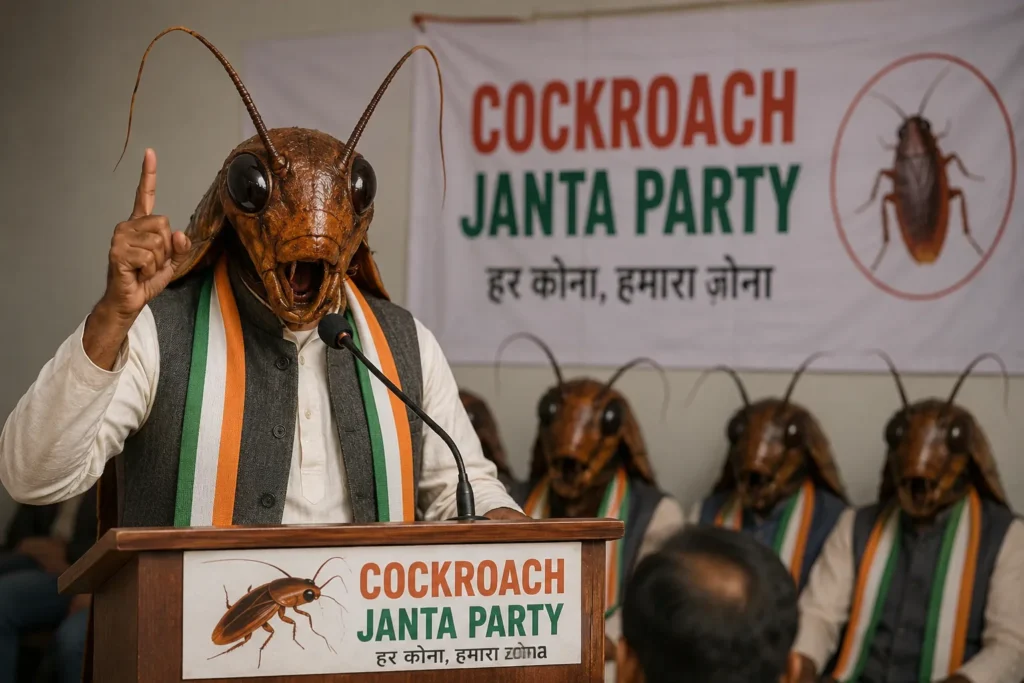

Part 1: How a Joke Became a Movement
Chapter 1: The Birth of an Idea in a Messy Kitchen
It was a humid Tuesday night in Nagpur. The kind of night where the air sits heavy on your chest and the ceiling fan just moves the heat around. Abhijeet Dipke, a young man with a laptop that had a cracked screen and a sense of humor that refused to grow up, was staring at his white ceiling. Sleep was not coming. His mind was racing the way it always did past midnight.
Then he saw it. A cockroach. Not a small one. A big, confident, shiny brown cockroach that walked across the paint like it owned the building. Most people would have screamed. Some would have reached for a chappal or a rolled-up newspaper. But Abhijeet did something different. He laughed. Not a small giggle. A real, deep, belly laugh that surprised even him.
That cockroach was fearless. It didn’t care about elections, rallies, opinion polls, or what the neighbors thought. It survived everything. Pesticide sprays? It got stronger. Political scandals on TV? It kept walking. The family cat that hunted everything that moved? The cockroach just hid for an hour and came back out. It was a survivor. And in that moment, an idea hatched in Abhijeet’s brain like an egg in a warm corner of the kitchen.
What if he started a political party that was honest about being useless? What if the leader never promised the moon, just promised to scatter when the lights came on? What if the symbol was not a lotus, a hand, a bicycle, or a clock? What if the symbol was a six-legged survivor with two long antennae that could sense danger from a mile away?
He pushed his plate of cold noodles aside. He opened a blank document on his laptop. The cursor blinked at him like a tiny, impatient eye. He typed four words: Cockroach Janta Party. Then he stared at the screen. Then he laughed again. Then he typed more.
Within an hour, he had written a mock manifesto. It was not long. It was not serious. It was beautiful in its ridiculousness. “We promise to do nothing,” it read. “Because every time we try to do something, we mess it up. Roads get dug twice. Water promises go dry. Electricity comes and goes like a cheating boyfriend. So why not just admit the truth? We will scatter when the lights come on. We will hide behind the fridge when trouble arrives. And we will survive. That is our only promise. Survival.”
He wrote a list of fake ministries. Ministry of Avoiding Responsibility. Ministry of Blaming the Previous Government. Ministry of Cutting Ribbons for Inaugurations That Never Finish. Ministry of Tea Breaks During Important Meetings. Each one was a joke, but each one also made him nod his head because, somewhere deep down, it was not entirely a joke.
He posted the manifesto online. A small blog. No paid promotion. No Facebook ads. Just a raw, honest, funny page that said at the very bottom: “This is satire. Please do not vote for us. Actually, please do not vote for anyone without thinking.” He closed his laptop at 3 AM and went to sleep.
The next morning, he had seventeen comments. Most were from friends saying, “Bro, this is crazy.” But three were from strangers. One stranger wrote: “Finally, an honest party. You guys admit you’ll run away. That’s more than what the others do.” Another wrote: “Can I be the district president of my colony’s garbage dump? Because that’s where all politicians belong anyway.” The third just said: “I haven’t laughed this hard in months. Thank you.”
That was the beginning.
Chapter 2: The “Founding President” Speaks
Abhijeet Dipke did something that no real politician would ever do. He gave himself a grand, ridiculous title that sounded important but meant nothing. He called himself the Founding President of the Cockroach Janta Party. He did not hire a designer. He did not consult a branding agency. He took a selfie in his plain white shirt, standing in front of a wall that had a small water stain. He tried to look serious. He failed. His eyes were smiling.
Next to his photo, he placed the party logo. A cartoon cockroach wearing a tiny Gandhi cap. The cockroach had its little front legs folded like it was giving a press conference. Underneath, in a curly font, it said: “Hum Rahenge Hamesha.” We will remain forever. It was a joke about cockroach survival. It was also a joke about political families that never leave. That double meaning was not accidental. Abhijeet had spent many nights watching news debates where the same faces yelled the same things for twenty years.
The website was simple. No pop-up ads. No autoplay videos. Just white background, black text, and a few images of cockroaches doing human things. One image showed a cockroach standing behind a podium. Another showed a group of cockroaches sitting in a parliament-style circle, except they were all eating a single piece of bread together. The caption read: “Bipartisanship.”
At the bottom of every page, in bold letters, was the disclaimer: “This is a work of satire. Any resemblance to real politicians is both intentional and hilarious. Do not send money. Do not send hate mail. Do send jokes.”
But here is where the story gets strange. People did not just laugh. They started sharing. College students in Delhi sent him messages on Instagram. “Can I be the district president of my hostel’s common room?” “Can I start a Cockroach Janta Party chapter in my engineering college?” “Bro, we already have a cockroach in our lab. Can we make him the technical advisor?”
Retired uncles in Pune, the kind who sit on their balconies at 5 PM drinking tea and muttering about the state of the country, started commenting on the website. One uncle wrote a long paragraph: “I have voted every election for forty years. Nothing changed. This fake party makes more sense than the real ones. At least you admit you will run away. That is called honesty. I am sharing this with my whatsapp group.”
And that is when the whatsapp forwards began. If you have ever lived in India, you know what that means. A message that says “Forward to 10 groups or your mother will cry.” But this time, the forward was different. It said: “Read this. Laugh. Then think. Then forward if you agree that politics has become a comedy show anyway.”
Within three months, the Cockroach Janta Party had a following. Not voters. Not members. Not donors. Believers in the joke. People who understood that satire is not just comedy. Satire is a mirror. And the mirror was showing India something uncomfortable. Something that made people shift in their chairs. Something that made uncles look up from their tea and say, “Wait. That cockroach has a point.”
Chapter 3: The First Press Conference That Wasn’t a Press Conference
Abhijeet never planned a press conference. He never booked a hall. He never sent press releases. But one evening, three different college groups asked him to come speak at their events. One group was in Nagpur, where he lived. The other two were online. So he did something simple. He went live on Instagram from his kitchen.
The kitchen was not fancy. There was a dirty plate in the sink. A half-eaten packet of biscuits. A cockroach ran across the floor in the background, and Abhijeet did not chase it away. He pointed at it and said, “Look. The vice president is here.”
About four hundred people watched that first live video. It was not a huge number. But those four hundred people shared clips. And those clips got ten thousand views. Then fifty thousand. Then two hundred thousand.
What did he talk about? Nothing important. That was the joke. He said, “The Cockroach Janta Party’s official position on inflation is that prices should be lower. How? No idea. But we feel your pain. Not enough to do anything. Just enough to say we feel it.” He said, “Our foreign policy is simple. If another country is nice to us, we will be nice back. If they are mean, we will hide behind the fridge for two weeks and then pretend nothing happened.”
People loved it. Not because the answers were smart. Because they were honest. Real politicians give long, complicated answers that say nothing. Abhijeet gave short, funny answers that also said nothing. But his nothing made people laugh. And laughing made people feel less alone.
One commenter wrote: “I have stopped watching news because it gives me headache. But I will watch this cockroach every day.” Another wrote: “Please start a YouTube channel. I will subscribe with all my fake email IDs.”
That night, Abhijeet Dipke realized something important. He was not building a party. He was building a space. A tiny corner of the internet where people could breathe. Where they could say, “Yes, everything is ridiculous, and that is okay. Let’s laugh about it together.”
Part 2: The Science of Satire—Why Cockroaches Make Better Politicians
Chapter 4: The Six Legs of Governance
Abhijeet Dipke did not study political science. He studied life. He watched news anchors shout at each other until their faces turned red. He watched ministers cut ribbons for buildings that collapsed two years later. He watched election campaigns where one candidate called the other a thief, and the other called the first a liar, and the voters just stood there holding their voter IDs, confused.
So he sat down one afternoon and wrote the official philosophy of the Cockroach Janta Party. He called it the Six Legs of Governance. Each leg was a principle. Each principle was a joke. But each joke had a hidden question inside it.
Leg number one: Scatter when attacked. Real politicians never admit defeat. They fight, they scream, they file cases. The cockroach does something smarter. It runs. It hides. It lives to fight another day. Abhijeet wrote: “If someone accuses you of corruption, do not give a press conference. Do not cry on TV. Just hide behind the fridge for a few days. When you come out, everyone will have forgotten. This is not cowardice. This is strategy.”
Leg number two: Eat anything. A cockroach can survive on paper, glue, soap, and old bread. Abhijeet wrote: “Politicians promise free food, free phones, free education, free everything. The cockroach does not ask for free things. The cockroach adapts. If the government fails, the cockroach will eat your garbage and thank you for it. That is true independence.”
Leg number three: Multiply in the dark. Real politicians hold massive rallies in the daytime with loud music and thousands of flags. The cockroach works at night. Abhijeet wrote: “All important decisions in India are made after midnight. This is a fact. The Cockroach Janta Party acknowledges this fact and does not pretend otherwise. Our meetings are held at 2 AM in kitchens across the country. Agenda: eat crumbs. No minutes recorded.”
Leg number four: Never die completely. You can step on a cockroach. You can spray poison. You can trap it under a glass for three days. Somehow, it survives. Abhijeet wrote: “Real political parties disappear after one bad election. The cockroach does not. The cockroach will crawl out of the drain a week later like nothing happened. Our party will do the same. Even if we lose, our whatsapp forwards will live forever. That is immortality.”
Leg number five: Love garbage. Cockroaches are not picky. They find value in what others throw away. Abhijeet wrote: “Indian politics is full of garbage. Broken promises. Fake debates. Old leaders who should have retired twenty years ago. The cockroach loves garbage. The cockroach says: give me your tired, your poor, your questionable YouTube videos. I will turn them into food. This is recycling. This is green politics.”
Leg number six: Run fast, speak slow. A cockroach never wastes time explaining itself. It moves. It survives. Abhijeet wrote: “Real politicians speak very fast and say very little. The Cockroach Janta Party will speak very slowly and say very little. But we will say it with confidence. That is the secret. Confidence without content is the oldest trick in the book. We are just honest about using it.”
Within a week of posting the Six Legs of Governance, the website traffic tripled. People printed the list and put it on their hostel walls. Someone made a meme of a cockroach running with a tiny briefcase. The caption: “When you have no ideas but great speed.” Another person made a parody video of a news anchor interviewing a cockroach. The cockroach won the debate.
Chapter 5: Main Trending SEO Keywords That Built the CJP
To understand how a fake party with no budget, no office, and no real leader became a search trend, you have to look at the words people typed into Google. These are the main trending SEO keywords that brought millions of eyes to the Cockroach Janta Party website.
Satirical political party India. This was the number one search. People wanted to know if there was a party that made fun of politics without being mean. They found the CJP. They stayed for the jokes.
Cockroach Janta Party manifesto. The word manifesto sounds serious. It sounds like a document written by smart people in suits. But the CJP manifesto was a joke. That contrast made people click. They wanted to see how far the joke went. The answer was very far.
Abhijeet Dipke funny politics. This keyword surprised even Abhijeet. People were searching for his name. Not because he was famous. Because he was unusual. A young man from Nagpur with a cracked laptop and a cockroach logo. He was not a celebrity. He was a neighbor. That relatability was his superpower.
Best Indian parody websites. People love lists. Top ten this. Best five that. The CJP started appearing on listicles written by small blogs and student magazines. One list said: “If you are tired of real news, read these three parody websites.” CJP was number one.
Fake political party for laughs. This keyword is beautiful because it is honest. The person searching is not looking for solutions. They are looking for relief. The CJP provided exactly that. No fake solutions. Just real laughs.
Cockroach as election symbol. Every election, the Election Commission of India assigns symbols to parties. A broom. A battery torch. A pair of slippers. People started asking: can a cockroach be a symbol? The answer is no. But the question itself became a joke. And the joke became a search.
Indian satire news 2025. This keyword shows that satire is not dying. It is growing. Young people especially want news that does not make them cry. They want news that makes them laugh and then maybe think a little. The CJP filled that gap perfectly.
Funny political commentary online. This is a broad keyword. But the CJP ranked high because the commentary was not just funny. It was simple. A 9th grader could read it. A retired uncle could read it. That is hard to do. Abhijeet did it without trying.
CJP latest jokes. This keyword came from loyal followers. People who had already read the manifesto and wanted more. They were not searching for information. They were searching for joy. And the CJP delivered new jokes every week.
Why cockroaches are like politicians. This is the deepest keyword. It is a philosophical question wrapped in a joke. People who searched this were not just bored. They were curious. They wanted to understand why politics felt so broken. The CJP gave them an answer: because politicians, like cockroaches, are hard to kill and love dark corners.
These keywords did not come from a marketing agency. Abhijeet did not pay for SEO tools. He did not study keyword density. He just wrote what he thought was funny, and Google did the rest. Because Google, for all its algorithms, still rewards one thing: people staying on a page. And people stayed on the CJP website because they were laughing.
Chapter 6: The Difference Between Satire and Fake News
One of the biggest challenges Abhijeet faced was explaining that the Cockroach Janta Party was not fake news. Fake news tries to trick you. It pretends to be real. It uses serious fonts and fake quotes from fake experts. Its goal is to make you angry or scared so you share it without thinking.
Satire does something different. Satire tells you upfront that it is a joke. Then it uses that joke to make you think about something real. The CJP website had a banner at the top of every page. It said: “SATIRE. Read carefully. Do not forward as real news. Your uncle will get confused.”
Here are some examples of CJP headlines that were clearly jokes:
CJP Announces Free WiFi for All Kitchens. The article explained that every kitchen in India would get a free router installed inside the refrigerator. It said the signal would be strongest near the gas cylinder. It was ridiculous. But under the joke was a real question: why is internet access still so uneven in India?
Abhijeet Dipke to Contest from Moon Constituency. The article had a fake campaign poster of Abhijeet standing on the moon in a spacesuit made of plastic bags. It said his first promise was to build a road from the moon to Mumbai so that traffic jams would finally have an excuse. The real question underneath was: why do politicians promise impossible things during elections?
Cockroach Janta Party Demands Reservations for Insects. This article was a little sharper. It said that insects had been ignored by Indian politics for too long. It demanded reserved seats in parliament for ants, mosquitoes, and houseflies. The real question was about representation. Who gets a voice? Who is left out?
Every article had a clear label. Every joke was obvious to anyone reading carefully. Abhijeet even added a page called “Is This Real?” where he answered emails from confused readers. One reader wrote: “Sir, is the Cockroach Janta Party real? I want to vote for you.” Abhijeet wrote back: “We are real in your heart. But not on the ballot paper. Please vote for a real candidate. Or better yet, vote for your local garbage collector. They do more work than most politicians.”
That reply went viral. Because it was honest. And honesty, even in a joke, is rare.
Chapter 7: Why 8th and 9th Graders Get It Faster Than Adults
There is something interesting about the Cockroach Janta Party audience. A lot of young readers, especially students in 8th and 9th grade, understood the jokes immediately. Adults sometimes took longer. They would read a headline and think, “Wait, is this real?” Then they would read the disclaimer. Then they would laugh. Then they would feel a little embarrassed.
Young students did not have that problem. They grew up with memes. They understood that a picture of a cockroach in a Gandhi cap was not a serious political statement. It was a joke. But they also understood the feeling behind the joke. They had seen their parents argue about politics. They had heard teachers complain about corruption. They had watched election coverage on TV and felt bored and confused.
The CJP gave them a language to talk about that boredom and confusion. A student from Kerala wrote an email to Abhijeet: “I showed your website to my father. He was angry at first. Then he laughed. Then he said, ‘This boy is not wrong.’ That is the first time my father and I agreed on politics.”
Another student from Uttar Pradesh wrote: “In my school, we have a student council election every year. The candidates give big speeches and then do nothing. I made a poster of a cockroach and wrote ‘Vote CJP’ on it. The principal laughed. Then he said no posters allowed. But I won the joke vote.”
That is the power of satire at an 8th and 9th grade reading level. You do not need big words. You do not need historical references. You need a simple idea that makes people say, “Yes, that is exactly how it feels.”
Part 3: Storytelling from the Trenches—Real Reactions, Fake Campaigns
Chapter 8: The Time CJP Camped Outside a Real Election Office
Let me tell you a full story. It was early 2024. A local election was happening in Maharashtra. Not a big national election. A small one. The kind where most people do not even know the names of the candidates. But Abhijeet Dipke saw an opportunity.
He called three of his friends. One was a graphic design student who had made the party logo. One was a copywriter who worked from home. One was just a guy who thought everything was funny. They met at a tea stall. Abhijeet said, “Let’s do something. Not big. Just something.”
They made paper badges. White paper. Black marker. Each badge said “CJP Observer” in crooked handwriting. They made a bedsheet banner using an old white bedsheet and a bottle of red paint. The banner said: “We have no agenda. Please give us one.”
They went to the Collector’s office on a Tuesday morning. The building was old. There were real policemen standing outside. Real politicians inside, probably filing real nomination papers. Abhijeet and his friends stood in a line. They were not breaking any rules. They were just standing there with their paper badges and their bedsheet.
A police officer came over. He was a serious man with a thick mustache. He looked at the banner. He looked at the badges. He said, “What is this?”
Abhijeet said, “Sir, we are the Cockroach Janta Party. We are here to observe the election process.”
The officer said, “I have never heard of your party.”
Abhijeet said, “That is because we are very good at hiding. Like cockroaches.”
The officer stared. For a moment, no one breathed. Then the officer’s mustache twitched. Then he laughed. A real laugh, not a polite one. He said, “Please leave before my senior sees this. I do not want to explain cockroach politics in my report.”
They left peacefully. No shouting. No arrest. No violence. Just a quiet joke that took fifteen minutes and cost nothing. But someone filmed it. A bystander with a phone. The video went on Instagram. Then Twitter. Then Whatsapp. Within 48 hours, two million people had watched three young men stand outside an election office with a bedsheet.
The comments were gold. One person wrote: “This is more honest than any election campaign I have seen in ten years.” Another wrote: “The officer laughed. That is the real story. Even police are tired of serious politics.” Another wrote: “CJP 2024. At least they admit they have no agenda.”
Abhijeet did not plan for the video to go viral. He did not hire a PR team. He just did something small and funny, and the internet did the rest. That is the secret of the Cockroach Janta Party. It is not about big budgets. It is about small truths wrapped in laughter.
Chapter 9: The Manifesto Reading That Became a National Meme
A few weeks after the election office incident, Abhijeet decided to do something even simpler. He went live on Instagram again. But this time, he sat at a plastic table in his kitchen. He put a plate of cheap biscuits on the table. He wore the same white shirt from his founder photo. He held up a 40-page PDF document.
The document was titled “CJP Vision 2030: We Will Try Slightly.” He had written it over three nights, mostly after midnight, mostly while eating instant noodles. It was 40 pages of nonsense. But it was organized nonsense. It had chapters. It had bullet points. It had fake data.
He read aloud for twenty minutes. Here are some of the best lines:
“We will build roads that have potholes only on Sundays. On Sundays, people are at home anyway. So the potholes will not bother anyone. This is called smart infrastructure.”
“All government offices will have one chair that is comfortable. No one will know where it is. Finding it will become a national sport. This will create millions of jobs in the chair-searching sector.”
“Politicians caught lying will be forced to watch their own old speeches on loop for 48 hours. No breaks. No tea. Just their own face saying things they did not mean. This is called truth therapy.”
“The national bird will remain the peacock. But the national insect will be the cockroach. All official events will begin with a moment of silence to honor the cockroaches that died under our chappals. This is called respect.”
“Free wifi will be provided only to people who can correctly explain what wifi is. The rest will get free newspapers. This is called digital literacy.”
Within two hours of the live video ending, clips were everywhere. One clip showed Abhijeet eating a biscuit and saying, “This is our economic policy. Biscuits for all. Not good biscuits. The cheap ones. That is fiscal responsibility.” That clip got three million views on its own.
A famous meme page made a comparison image. On the left, a real minister giving a serious speech. On the right, Abhijeet Dipke holding a biscuit. The caption: “Same energy. One just admits it.” The meme got fifty thousand shares.
Another creator made an animated video of a cockroach standing at a podium, reading the manifesto to a crowd of ants. The ants were cheering. The video ended with the cockroach saying, “Thank you. Now please clean your kitchen.” That video got two million views on YouTube.
Abhijeet did not make any money from this. He did not try. But he noticed something interesting. The comments on the meme pages were not just laughing. People were saying things like, “Honestly, this fake party makes more sense than the real ones.” And “I would actually vote for the biscuit policy.” And “Why is a joke website more honest than the news?”
That last comment stayed with Abhijeet. He wrote it down on a sticky note and put it on his laptop. It said: “Why is a joke website more honest than the news?” He did not have an answer. But he knew the question was important.
Chapter 10: The Dark Side of Jokes—When People Believed It
Not every reaction was funny. Some were confusing. Some were a little sad. About six months after the website launched, Abhijeet received a message on the contact form. A man from Gujarat. He wrote in Gujarati mixed with English. The message said: “Sir, I am a small businessman. I sell pipes. I have read your manifesto. I like that you do not promise too much. That is honesty. Please send me your bank details. I want to donate five thousand rupees to the Cockroach Janta Party.”
Abhijeet stared at the message. He read it three times. Then he called his friend the copywriter. He said, “Someone wants to donate real money to our fake party.” His friend laughed. Then his friend stopped laughing. He said, “That is actually not funny. That is a little scary.”
They discussed what to do. The honest answer was simple. Return the money. Do not take it. But the man had not sent money yet. He had asked for bank details. So Abhijeet wrote back. He said: “Sir, thank you for your kindness. But the Cockroach Janta Party is a work of satire. We are not a real political party. We do not have a bank account. We do not accept donations. Please give that five thousand rupees to a real cause. Or buy yourself a nice dinner. Or better yet, buy a pizza and share it with your family. That will do more good than giving money to a joke website.”
The man wrote back. He said: “I know it is a joke. But the joke makes me happy. I want to support happiness.”
Abhijeet wrote again: “Then share the website with your friends. That is free. And that helps more than money. Happiness should not cost anything.”
The man did not reply. But a week later, Abhijeet saw a new comment on the website from the same man. It said: “I shared your website in my building’s whatsapp group. Nine people laughed. Two were angry. One said he will complain to the police. I told him to relax and eat a biscuit. Thank you for the laugh.”
That message made Abhijeet smile. But it also made him think. Satire is powerful. But power can be misunderstood. Some people want to believe. Some people want to give money. Some people want to join. And when that happens, the line between joke and reality gets very thin.
Abhijeet added a new rule to the website. In big red letters on the homepage: “DO NOT SEND MONEY. WE ARE NOT REAL. IF YOU SEND MONEY, WE WILL DONATE IT TO A COW SHELTER AND SEND YOU A PICTURE OF A HAPPY COW. THAT IS OUR ONLY GUARANTEE.”
That rule became a meme too. A picture of a happy cow with the caption: “Your donation is now mooing.” People loved it. But more importantly, people understood. The CJP was not a scam. It was not a hidden business. It was just a joke. And jokes should be free.
Chapter 11: The Time a Real Politician Responded
This story is the strangest one. About eight months into the CJP’s existence, a real politician mentioned the party. Not by name. But indirectly. A local leader from a small town in Madhya Pradesh was giving a speech. He was angry about something. No one remembers what. But in the middle of the speech, he said: “Some people are making fun of our system. They call themselves the cockroach party. Let me tell you. Cockroaches cannot run a country. Only we can run a country.”
A journalist in the audience recorded the clip. It was twenty seconds long. The journalist posted it on Twitter with the caption: “Real politician acknowledges fake cockroach party. What a time to be alive.”
The clip spread fast. Within hours, the CJP website got fifty thousand visits. Abhijeet was at home eating instant noodles when his phone started buzzing. He opened Twitter. He saw the clip. He laughed so hard that noodles came out of his nose.
He wrote a quick response on the CJP website. He called it “Official Statement Regarding Real Politician’s Comment.” The statement said: “We are honored to be noticed by a real politician. We would like to invite him to our next kitchen meeting. Agenda items include: how to hide from brooms, why ceilings are the best place to think, and whether leftover roti counts as a balanced diet. Snacks will be provided. Snacks may include crumbs from last week. This is satire. But the invitation is real. Sort of.”
The statement got shared thousands of times. The real politician did not respond. But his social media team blocked the CJP account. Abhijeet took a screenshot of the block and posted it with the caption: “When you are so funny that real politicians block you. This is our biggest achievement.”
That screenshot became a badge of honor for CJP followers. They started posting it in comments on real political pages. The comment would say: “Careful. The cockroaches are watching.” It was a joke. But it was also a warning. Satire cannot be ignored forever.
Part 4: Why Satire Matters More Than Ever
Chapter 12: The Science of Laughter and Politics
There is real science behind why the Cockroach Janta Party worked. Researchers have studied the effect of satire on political stress for many years. The findings are simple and powerful.
When you watch the news and see corruption, fights, and broken promises, your brain releases stress hormones. Cortisol. Adrenaline. Your heart beats faster. Your shoulders get tight. You feel angry or helpless. That is not good for you. That is not good for anyone.
But when you laugh at a satire website, your brain releases different chemicals. Dopamine. Endorphins. Your muscles relax. Your breathing slows down. You feel lighter. And here is the important part: you still remember the problem. You do not forget that politics is broken. But you feel less crushed by it.
Abhijeet Dipke did not know the science when he started. He just knew that laughing felt better than crying. But the science explains why so many people kept coming back to the CJP. It was not just the jokes. It was the feeling. The feeling that someone understood. The feeling that you were not alone in thinking that the whole system was ridiculous.
One psychology student wrote a paper about the CJP for a college assignment. She argued that the Cockroach Janta Party functioned as a kind of digital support group. People came for the laughs. But they stayed because the laughs made them feel seen. That paper got an A+. The professor wrote a note on it: “I did not know a fake political party could teach me so much about real human emotion.”
Chapter 13: The Emotional Journey of a CJP Reader
Let me walk you through what a typical reader felt when they first found the Cockroach Janta Party. This is based on hundreds of comments and emails.
First, confusion. They land on the website. They see a cockroach wearing a Gandhi cap. They think, “What is this?” They check the URL. They wonder if they clicked the wrong link.
Second, suspicion. They read the disclaimer. They think, “Is this a trick? Is this one of those websites that will give my phone a virus?” They hesitate.
Third, curiosity. They read a headline. “CJP Promises to Build Elevators to Heaven for Senior Citizens.” They think, “That is so stupid. I have to read it.” They click.
Fourth, laughter. They read the article. They laugh out loud. Maybe they snort. Maybe they choke on their tea. Their brain releases endorphins. Their shoulders drop. They feel good.
Fifth, recognition. Underneath the laughter, they recognize something true. The joke about elevators to heaven is actually about how politicians promise things that are impossible. The joke about free wifi in kitchens is actually about how basic services are still missing. The joke about hiding behind the fridge is actually about how leaders never take responsibility.
Sixth, connection. They share the website with a friend. The friend laughs. They talk about politics for the first time without fighting. They feel closer.
Seventh, return. They come back to the website the next week. And the week after. It becomes a habit. A small ritual. A way to breathe.
That is the emotional journey of a CJP reader. It is not complicated. But it is real. And it is why the website grew without advertising, without paid promotion, without any of the usual tricks.
Chapter 14: What Real Political Parties Can Learn from a Fake One
This section might surprise you. But real political parties could learn something from the Cockroach Janta Party. Not about policy. Not about governance. About communication.
Lesson one: Be honest about your limits. Real parties promise everything. Free houses. Free electricity. Free college. Free everything. And then they deliver nothing. The CJP promised nothing and delivered exactly that. People appreciated the honesty. Real parties could try saying, “We will try our best. No guarantees. But we will try.” That would be more believable than a thousand impossible promises.
Lesson two: Laugh at yourself sometimes. Real politicians never admit mistakes. They never laugh at their own failures. They blame the opposition, the media, the previous government, the weather. The CJP laughed at itself constantly. The founder called himself a cockroach. That humility made people trust him. Real parties could try admitting one small mistake. Just one. People would notice.
Lesson three: Use simple language. Real politicians speak in complicated sentences full of big words and empty phrases. “Holistic development.” “Synergistic governance.” “Robust framework.” No one knows what those mean. The CJP spoke like a normal person. “We will try slightly.” “We will hide behind the fridge.” “We will eat your garbage.” Everyone understood. Real parties could try speaking like humans.
Lesson four: Do not ask for money all the time. Real parties are always fundraising. They send messages. They make phone calls. They demand donations. The CJP explicitly refused money. That refusal made people want to give money. There is a lesson there about trust. When you stop asking, people start offering.
Lesson five: Be funny. Politics does not have to be boring. It does not have to be angry. It can be funny. Humor disarms people. Humor opens minds. Humor builds bridges. Real parties could try telling a joke once in a while. Not a mean joke. A kind one. A joke that says, “We are all in this together, and we are all a little ridiculous.” That would change everything.
Chapter 15: The Global Context—Satire Parties Around the World
India is not the only country with a satire party. Around the world, people have created fake political movements to make real points. The Cockroach Janta Party is part of a long tradition.
In the United Kingdom, there is the Official Monster Raving Loony Party. It was founded in 1983. Its policies include free tea for all, building a tunnel to the moon, and making it compulsory to wear a silly hat on Fridays. The party has never won a real election. But it has inspired thousands of people to think differently about politics.
In Sweden, there is the Anarchist Party. It is a joke party that campaigns on abolishing all laws, then immediately proposing new laws to replace them. The contradiction is the joke. The point is that all politics is contradictory.
In the United States, there is the Rent Is Too Damn High Party. The name is the policy. The founder, Jimmy McMillan, wore a red suit and had a huge mustache. He debated real politicians on live television. He never won. But he made millions of people say, “You know what? Rent really is too damn high.”
The Cockroach Janta Party fits into this global family of satire parties. But it has its own flavor. It is Indian. It is about survival. It is about the small, everyday absurdities of life in a country of one billion people. A cockroach is the perfect symbol for that. Because in India, cockroaches survive everything. And so do the people.
Part 5: The Future of CJP and What We Can Learn
Chapter 16: Will Abhijeet Dipke Ever Really Run for Office?
This is the question everyone asks. In comments. In emails. In messages from strangers on Instagram. Will the Founding President of the Cockroach Janta Party ever file real nomination papers? Will he stand in front of a real polling booth with a real voter ID and a real hope of winning?
In a 2025 interview with a small YouTube channel that had about four thousand subscribers, Abhijeet was asked this question directly. The interviewer was a college student with a shaky camera and a lot of enthusiasm. She said, “Sir, everyone wants to know. Will you ever contest an election?”
Abhijeet laughed for ten seconds. It was not a polite laugh. It was a real, from-the-belly laugh that made the interviewer laugh too. Then he stopped. He got a little serious. He said:
“If I run for office, I will lose. That is not humility. That is math. I have no money. No party workers. No election machine. I have a laptop and a sense of humor. That is not enough to win a real election. But here is the thing. Winning is not the point. The point is making you laugh. The point is making you think. The point is giving you a break from the noise. The Cockroach Janta Party will never file nomination papers. But we will keep filing jokes. Because a joke that makes you question a real problem is worth more than a hundred promises from a hundred politicians.”
The interviewer asked, “Do you ever get tired of the jokes?”
Abhijeet said, “Sometimes. Some days I wake up and I do not feel funny. The world is heavy. The news is sad. I wonder if any of this matters. Then I get a message from a student in a small town who says, ‘Your website made my father laugh for the first time in months.’ And I remember. It matters. Not because I am special. Because laughter is special. And everyone needs it.”
That interview got fifty thousand views. Not because of production quality. Because of honesty. A young man with a fake political party sat in his kitchen and said, “I am not special, but laughter is.” People felt that. They shared it. They saved it.
Chapter 17: What the Cockroach Janta Party Teaches Us About Content Creation
If you are a student or a young creator who wants to make things online, the story of the Cockroach Janta Party has a lot to teach you. These lessons are not about politics. They are about making things that people actually want to read.
Lesson one: Start small. Abhijeet did not build a huge website on day one. He wrote a few jokes on a free blogging platform. He did not even buy a domain name at first. He just started. That is the most important step. Starting. Not planning. Not waiting for the perfect moment. Just putting something out there.
Lesson two: Be clear about what you are. The CJP website said “satire” in big letters. There was no confusion. No one thought it was real news. That clarity built trust. When you make content, be honest about your genre. Are you a news site? A comedy site? A personal blog? Tell people. They will appreciate it.
Lesson three: Write for one person. When Abhijeet wrote his jokes, he was not thinking about millions of readers. He was thinking about his friends. He was thinking about the person who felt tired and wanted to laugh. That one-person focus made his writing feel personal. It felt like a message from a friend, not a broadcast from a corporation.
Lesson four: Do not force SEO. The keywords that brought traffic to the CJP were not planned. They emerged naturally from the content. Abhijeet did not say, “I need to rank for ‘satirical political party India.’” He said, “I want to write about why politicians are like cockroaches.” Then Google did its job. Focus on the content. The SEO will follow.
Lesson five: Engage with your audience. Abhijeet replied to almost every comment and email in the early days. He answered questions. He thanked people for sharing. He even replied to haters with jokes. That engagement built a community. People felt seen. They felt heard. They came back.
Lesson six: Do not sell out too fast. Many creators see a little success and immediately try to make money. Paid posts. Sponsored content. Merchandise. The CJP refused money. That refusal made the brand stronger. It proved that the jokes were real. It proved that Abhijeet was not in it for the cash. If you want to build trust, resist the urge to monetize too early.
Lesson seven: Know when to be serious. The CJP was mostly jokes. But sometimes, Abhijeet wrote serious replies. Like the reply to the man who wanted to donate money. That serious moment made the jokes land harder. Because readers knew there was a real person behind the humor. A person with boundaries. A person with values.
Chapter 18: The Top Ten Most Shared CJP Jokes of All Time
Let me list the most popular jokes from the Cockroach Janta Party website. These are the ones that got the most shares, the most comments, and the most laughs.
Number ten: “CJP announces that all election rallies will be replaced with napping sessions. Instead of listening to speeches, citizens will be provided with mats and pillows. The politician who gets the most people to fall asleep will win. This will save money on loudspeakers and also help with the country’s sleep deficit.”
Number nine: “CJP’s official position on climate change is that we will stop using plastic straws but continue using everything else made of plastic. This is called selective responsibility. It is not perfect. But it is honest.”
Number eight: “The Cockroach Janta Party promises to build a wall around every kitchen to keep cockroaches out. The irony will be explained later. Or not. We will hide behind the fridge.”
Number seven: “CJP’s education policy: all exams will be replaced with open-book, open-phone, open-friend tests. If you can find the answer, you deserve the grade. This is not cheating. This is resource management.”
Number six: “Abhijeet Dipke announces that he will take a salary of zero rupees as Founding President. When asked how he will survive, he said, ‘I will eat crumbs from your kitchen floor. That is what cockroaches do. Please do not clean too thoroughly.’”
Number five: “CJP’s foreign policy: we will send a cockroach to every international summit. The cockroach will hide in the corner and eat leftover food. At the end of the summit, the cockroach will return and say nothing. This is exactly what our current foreign policy achieves, but with less travel budget.”
Number four: “The Cockroach Janta Party demands that all politicians be required to live in a cockroach-infested house for one month before filing nomination papers. If they can survive the cockroaches, they can survive anything. This is called character testing.”
Number three: “CJP’s infrastructure plan: all potholes will be filled with old newspapers and hope. This is environmentally friendly. Newspapers are recyclable. Hope is renewable.”
Number two: “Abhijeet Dipke announces that the Cockroach Janta Party will not field any candidates in the next election. ‘Why would we?’ he said. ‘Losing costs money. We would rather save that money and buy biscuits.’”
Number one most shared joke of all time: “The Cockroach Janta Party’s official slogan is ‘We Try Slightly.’ It is not inspiring. It is not hopeful. It is accurate. And in politics, accuracy is the rarest thing of all.”
Chapter 19: The Final Story – The Cockroach That Refused to Die
Let me end with one last story. This one happened recently. Abhijeet Dipke was working on his laptop late at night. He was writing a new joke for the website. His room was dark except for the screen light. His tea had gone cold two hours ago.
A cockroach appeared on his keyboard. Right between the G and the H keys. It was not a small one. It was a big, shiny, confident cockroach. It walked across the keyboard slowly, like it had all the time in the world.
Most people would have screamed. Most people would have killed it. Abhijeet did something different. He took out his phone. He opened the camera. He took a photo. The photo showed his laptop screen with the half-written joke, and a cockroach sitting on the keyboard like it was reading the words.
He posted the photo on the CJP website with one line of text: “The Founding President has arrived for a surprise inspection.”
That photo got fifty thousand likes across social media. Fifty thousand. Not because it was a great photo. Because everyone understood the joke. The cockroach was not just a cockroach. It was a symbol. A symbol of survival. A symbol of showing up when no one expects you. A symbol of refusing to go away.
Underneath the joke, everyone understood the truth. Real power is not in parliaments. Real power is not in speeches. Real power is not in election victories. Real power is in the ability to survive, adapt, and make people smile even when the world is chaotic. Real power is a cockroach on a keyboard at 2 AM.
The Cockroach Janta Party is not a real political party. It never will be. But its message is real. Do not take everything so seriously. Laugh at the noise. Scatter when you need to. Hide behind the fridge when the world gets too loud. And always, always keep moving. Even if you move slowly. Even if you move in the dark. Keep moving.
Because that is what cockroaches do. That is what survivors do. And that, more than any manifesto or policy or promise, is the only thing that has ever truly worked.
Part 6: Practical Takeaways for Students, Writers, and Curious Minds
Chapter 20: How to Start Your Own Satire Project
If reading about the Cockroach Janta Party has inspired you to start your own funny project, here is a simple guide. No big words. No complicated steps. Just things you can do today.
Step one: Find your symbol. The CJP has a cockroach. What is your symbol? A pigeon? A mouse? A forgotten shoe? Choose something ordinary, something everyone recognizes, something that can carry a joke.
Step two: Write one joke. Not ten. Not a hundred. One. A single joke that makes you laugh. If it does not make you laugh, no one else will laugh either.
Step three: Post it somewhere. A blog. Instagram. Twitter. A whatsapp status. It does not matter where. Just put it out there. Do not wait for it to be perfect.
Step four: Label it clearly. Write “satire” or “joke” or “not real” somewhere obvious. This is not just legal protection. It is honesty. And honesty builds trust.
Step five: Reply to comments. When someone laughs, say thank you. When someone is confused, explain nicely. When someone is angry, do not fight. Just say, “It is a joke. I am sorry it upset you. Have a good day.”
Step six: Keep going. Post another joke next week. And the week after. Consistency is more important than brilliance. A small joke every week beats a perfect joke once a year.
Step seven: Do not ask for money. Not at first. Maybe not ever. Keep your project clean. Keep it free. The moment you ask for money, the joke changes. It becomes a business. And businesses are not as funny.
Step eight: Know when to stop. Not every project needs to last forever. If you run out of jokes, take a break. If you feel tired, rest. The cockroach does not run forever. It hides. Then it comes back. You can do the same.
Chapter 21: The Legacy of the Cockroach Janta Party
The Cockroach Janta Party will never win an election. It will never pass a law. It will never build a road or a hospital or a school. But it has already done something that many real political parties have failed to do. It has made people think. It has made people laugh. It has made people feel a little less alone in their frustration.
That is a legacy. A small one. A quiet one. But a real one.
Years from now, someone will find an old screenshot of a cockroach wearing a Gandhi cap. They will not know the full story. But they will laugh. And in that laugh, the Cockroach Janta Party will live again. Because laughter does not die. It hides. Like a cockroach. And then, when you least expect it, it crawls back out.
Chapter 22: Final Words from the Founding President
This is not a real interview. This is not a real statement. This is satire. But also, it is not.
If Abhijeet Dipke were to write a final message to everyone who ever read the Cockroach Janta Party website, he might say something like this:
“Thank you for laughing. Thank you for sharing. Thank you for not taking me seriously. That is the greatest compliment you can give a satirist.
Remember that politics is important. Voting is important. Paying attention is important. But so is breathing. So is laughing. So is taking a break from the anger.
The cockroach does not change the world. But the cockroach survives. And sometimes, survival is enough. Sometimes, just getting through the day with a smile is a victory.
So go ahead. Laugh at the politicians. Laugh at the news. Laugh at yourself. Then vote. Then pay attention. Then try to make things better. But do not forget to laugh.
Because a country that cannot laugh at itself is a country that has lost its way.
And a cockroach that cannot run is a dead cockroach.
Keep running. Keep laughing. Keep surviving.
This is the Founding President of the Cockroach Janta Party, signing off.
Now please clean your kitchen.”



I got what you mean , regards for putting up.Woh I am pleased to find this website through google. “Spare no expense to make everything as economical as possible.” by Samuel Goldwyn.
I love it when people come together and share opinions, great blog, keep it up.
Clean layout and very transparent rules. It is hard to find a place this honest these days. I highly suggest bdck444pro for everyone.
I read thijs aricle completelly about thhe
ressmblance off hottest aand esrlier technologies,
it’s remaekable article. xnxx
Finally found a site that doesn’t lag during peak hours. The login process is seamless and the game variety is top notch. Highly recommended for local players. Visit phskycomlogin now.