
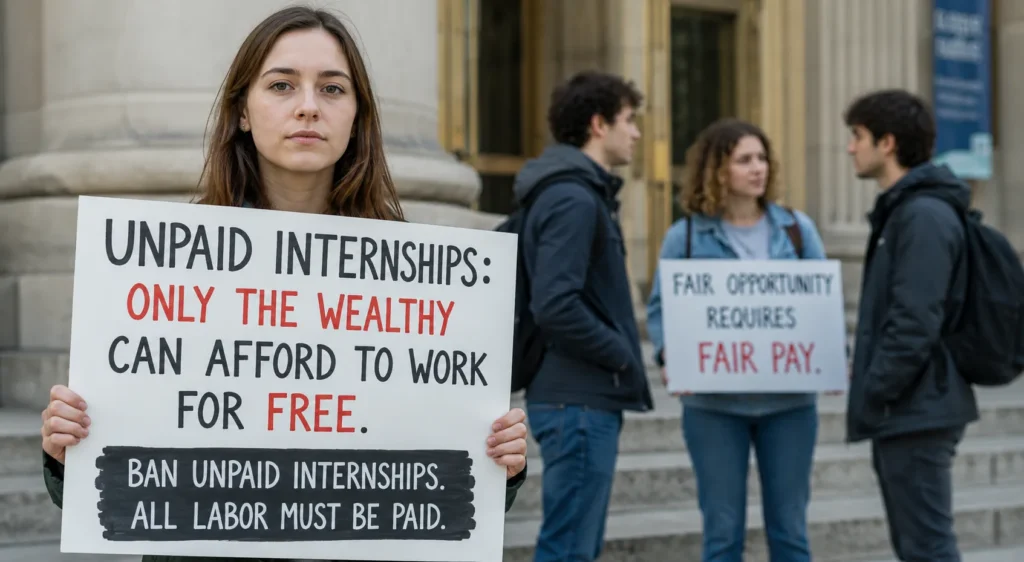

A Story of Two Students
Let me tell you about two young people. Their names are Marcus and Chloe.
Marcus grew up in a small apartment above his mom’s nail salon. His dad left when Marcus was seven. His mom worked twelve hours a day, six days a week. She came home with cracked hands from chemicals and sore feet from standing. Marcus learned early that money was hard to earn and easy to lose.
Every morning, Marcus took two buses to get to his state college. The first bus came at 6:15 a.m. The second bus came at 6:45 a.m. If he missed either one, he would be late for his 8:00 a.m. class. He worked twenty hours a week at a grocery store bagging groceries, cleaning spills, and collecting shopping carts from the parking lot in rain and snow. His jeans had holes, not from fashion, but from wear. His shoes had duct tape on the soles.
Chloe grew up twenty miles away. Her father is a surgeon. Her mother is a lawyer. Chloe’s college dorm had a private bathroom and a microwave and a mini-fridge. When her car needed repairs, her parents paid for it without asking questions. When she wanted new clothes, her mother took her shopping. Chloe never worried about rent, food, or bus fare. She never checked her bank account with fear. She never calculated how many hours of work it would take to buy a pizza.
Both Marcus and Chloe wanted careers in media. Both were smart. Both worked hard. Both got good grades. Both applied for the same summer internship at a famous television studio in New York City.
The internship was unpaid.
Chloe could take it. Her parents would cover her rent, her food, her subway card, and even give her spending money for coffee and dinners out with friends. Her father said, “This is an investment in your future.” Her mother said, “Everyone starts somewhere.” Chloe felt excited and grateful.
Marcus could not take it. He sat in his tiny apartment and did the math on a napkin. Rent in New York for three months: at least $3,000. Food: $1,200. Subway pass: $400. Moving costs and deposits: $500. Plus he would have to quit his grocery store job, losing $2,500 in wages. Total cost: over $7,600. Marcus had $800 in savings. His mom had no extra money. He would have to borrow, and he hated debt.
So Marcus did not apply. Chloe applied, got accepted, and moved to New York for the summer.
That summer, Chloe learned how to edit video, pitch stories to producers, and network with senior staff. She got coffee for famous people, sure. But she also sat in on writing meetings. She learned the software the studio used. She made friends with people who would later become managers. At the end of the summer, her supervisor offered her a paid assistant job starting at $45,000 a year.
Marcus applied for that same assistant job six months later. He had the same degree. He had the same grades. He had glowing recommendations from his professors. But he did not have “professional experience” on his resume. The studio hired Chloe instead. They said Marcus was “a great candidate” but “needed more real-world experience.”
Marcus is now twenty-six years old. He still works at a grocery store, but now he is the night manager. He makes $17 an hour. Chloe is a senior producer making $85,000 a year. She is good at her job. She deserves her success. But Marcus deserved a fair shot too.
This is not a story about hard work. Marcus worked harder than Chloe. This is a story about money. And this story happens thousands of times every year, all across America. In publishing, in fashion, in politics, in film, in music, in art galleries, in law offices, in nonprofits, in museums.
Unpaid internships do not reward talent or effort. They reward wealth. And that is not fair. That is not a meritocracy. That is a system rigged from the start.
What Is an Unpaid Internship, Exactly?
Let us start with a simple definition. We need to be on the same page before we go any further.
An internship is a temporary job where someone learns skills related to a career. Usually, interns are students or recent college graduates. Internships can last a few weeks, a summer, or even a full year. Some internships are part-time. Some are full-time, forty hours a week.
A paid internship gives you money for your time. You get an hourly wage or a weekly stipend. You can use that money to pay for rent, food, transportation, and other needs.
An unpaid internship gives you zero dollars for your time. You work for “experience” and “exposure” and “a line on your resume.” Sometimes you also get college credit, which you actually have to pay for through tuition. So in some cases, you are paying to work for free.
Unpaid internships are legal in the United States. But there are rules. The Fair Labor Standards Act (FLSA) says that for an internship to be truly unpaid, it must meet six criteria. Let me list them in plain English.
The Six Rules for Legal Unpaid Internships:
- The internship is similar to training you would get in a classroom.
- The internship is for your benefit, not the company’s.
- You do not replace a regular paid employee. You work alongside them, not instead of them.
- The company gets no immediate advantage from your work. Sometimes they even slow down to teach you.
- You are not guaranteed a job at the end.
- You and the company both understand that you will not be paid.
If a company breaks any of these rules, the internship is illegal. The company is supposed to pay you minimum wage for every hour worked, plus overtime if applicable.
But here is the truth: many companies ignore these rules completely. Others stretch them so far that the rules become meaningless.
I once met a young woman named Priya. She worked an unpaid internship at a fashion magazine in a big city. Her job duties included answering phones, fetching lunch for five editors, cleaning out the supply closet, entering data for six hours a day, and walking the CEO’s dog. That was not training. That was free labor. She asked her supervisor about the rules. The supervisor laughed and said, “Everyone does it this way.”
Priya stayed because she hoped for a job at the end. She worked there for four months. The job never came. The company hired someone else’s daughter, a recent graduate who had also worked an unpaid internship there the year before.
Stories like Priya’s are everywhere. I could fill this entire article with nothing but stories. But let me give you one more before we move on.
A young man named David took an unpaid internship at a political consulting firm. His job was to research opposition candidates, write briefing memos, and manage the firm’s social media accounts. Those are tasks normally done by paid staff making $20 to $30 an hour. David did them for free. When he asked to be paid, the owner said, “Be grateful for the experience.” David finished the internship. The owner never wrote him a letter of recommendation. David later found out the owner had hired a paid assistant the week after David left.
That is exploitation. Plain and simple.
The Big Problem: Exploitation of Entry-Level Workers
Let me explain the main problem in plain English. I want to be very clear so no one misunderstands.
When a company asks you to work for free, they are asking you to donate your time so they can make money. That is called exploitation. Exploitation means someone benefits from your work without paying you fairly. It means taking advantage of your desperation, your hope, and your lack of power.
Think about it this way: If you bag groceries, you get paid. If you answer phones at a law firm, you get paid. If you clean a hotel room, you get paid. If you drive a delivery truck, you get paid. If you stock shelves at a store, you get paid. So why should you edit a video, write a press release, design a website, research a court case, manage social media, photograph a wedding, or run a donor database for free just because someone calls it an “internship”?
The answer is: you should not. Work is work. Labor is labor. If your work helps a company make money, you deserve a share of that money.
Here is what exploitation looks like in real life. I want to paint a picture so you can see it clearly.
- An intern works forty hours a week, unpaid, while living with their parents. Their parents pay for everything. The intern tells themselves they are “building their resume.” But really, they are just giving away free labor to a company that could easily afford to pay them.
- An intern is told, “Do a good job, and maybe we will hire you.” That “maybe” never comes true. The company keeps a rotating cycle of unpaid interns so they never have to hire a paid employee.
- An intern does the same work as a paid employee sitting three feet away. The paid employee makes $18 an hour. The intern makes $0. The only difference is a job title.
- An intern is too scared to complain because they think they need the reference, the recommendation, or the good reputation. They smile while being exploited. They say thank you when they are given more work.
- An intern works so many hours that they fall behind in their college classes. They pay tuition to get behind. That is a special kind of cruelty.
- An intern gets hurt on the job. Maybe they lift something heavy and hurt their back. Maybe they slip on a wet floor. Because they are not an employee, they have no workers’ compensation, no health insurance through the company, no protection at all.
This hurts everyone except the company saving money. It hurts the intern. It hurts the intern’s family. It hurts other workers who might have been hired for that job. It hurts the economy because young people cannot build savings or buy homes. It hurts society because we lose talent from poor and middle-class families.
Exploitation is not a strong word. It is the right word.
Who Can Afford to Work for Free?
Let me ask you a personal question. I want you to really think about it. Do not rush.
Could you work forty hours a week for three months and receive zero dollars? No paycheck. No direct deposit. No cash. Nothing. Not even a bus pass or a free lunch.
If your answer is yes, ask yourself why. Is it because you have savings? Is it because your parents would support you? Is it because you have a partner who pays the bills? Is it because you inherited money? Is it because you have no rent to pay?
Most people cannot work for free. Most people have bills that come every single month. Rent or mortgage. Electricity. Water. Internet. Phone. Groceries. Transportation. Health insurance. Car insurance. Gasoline. Debt payments. Child care. Pet care. Laundry. Clothing. Medicine.
Those costs do not disappear just because you are an intern. The landlord does not care that you are “getting experience.” The grocery store does not accept “exposure” as payment. The bus driver will not let you ride for free because you have a fancy internship.
A 2022 study looked at unpaid internships in Washington, D.C. That city is full of political internships, nonprofit internships, and media internships. The study found that most unpaid interns came from families making over $100,000 a year. Nearly half came from families making over $200,000 a year. That is wealthy. That is top-ten-percent wealthy.
The study also found that Black and Hispanic students were much less likely to take unpaid internships than white students. Why? Because Black and Hispanic families in America have less wealth on average. That is not their fault. That is the result of decades of discrimination in housing, employment, and education. Unpaid internships make that inequality worse.
Students from poor or middle-class families could not take those internships. They had to work paying jobs instead. Waiter. Cashier. Dog walker. Janitor. Call center agent. Warehouse packer. Delivery driver. Babysitter. Lawn mower. These jobs paid the rent, but they did not lead to a career. They did not build a resume. They did not create professional connections.
This creates a system where rich kids get the good resumes, and poor kids get left behind. The American Dream says anyone can succeed if they work hard. But unpaid internships say: only if your parents have money. Only if you are born into the right family. Only if you never have to worry about survival.
I talked to a young man named Derrick. I mentioned him briefly before, but let me tell you his full story. Derrick grew up in a small town in rural Mississippi. His father worked at a tire factory. His mother cleaned houses. Derrick was the first person in his family to go to college. He wanted to be a journalist. He loved telling stories. He wrote for his college newspaper. He won an award for an article about local poverty.
A famous newspaper in Washington, D.C., offered an unpaid internship. Derrick would need to move to D.C. for three months. He would need to find a room to rent, buy food, ride the subway, and pay for health insurance. He calculated the total cost for three months: over $8,000. Derrick did not have $8,000. His parents did not have $8,000. His college had a small emergency fund, but it was only $500. He applied for scholarships and got nothing.
So Derrick said no to the internship. He stayed in Mississippi. He worked at a tire shop that summer, changing tires in hundred-degree heat. He saved $2,000. That money helped him finish his last year of college.
That internship went to a young woman whose father is a lobbyist. Her father paid her rent in D.C. She now works as a political reporter at that same newspaper. Derrick works at a car wash. He writes articles in his free time and posts them on a free blog. Three people read them. His mom is proud. But he is not a journalist. And that is not because he was not good enough. It is because he was not rich enough.
Do you see the unfairness? Can you feel it? This is happening right now, today, in every city in America.
The Hidden Costs of Working for Free
Unpaid internships hurt people in ways that are not always obvious. The damage goes deeper than just missing a paycheck. Let me walk you through the hidden costs one by one. Some of these might surprise you.
1. You lose money you could have earned.
This is the obvious one, but it is still worth saying. When you work an unpaid internship instead of a minimum wage job, you lose thousands of dollars. Let me do the math for you.
Federal minimum wage is $7.25 per hour. Some states have higher minimum wages, but let us use the federal number for this example. A full-time internship is forty hours per week. A typical summer internship lasts twelve weeks. Forty hours times twelve weeks equals 480 hours. Four hundred eighty hours times $7.25 equals $3,480.
That is $3,480 you did not earn. That is real money. That could be a used car. That could be dental work. That could be first and last month’s rent on an apartment. That could be a semester of community college. That could be groceries for six months. That could be a plane ticket to see your dying grandmother.
If you live in a state with a higher minimum wage, like California ($15.50) or New York ($15.00), the lost wages are even bigger. In California, a twelve-week unpaid internship costs you $7,440 in lost wages. That is life-changing money for a young person.
2. You delay your career.
Unpaid interns often do simple, boring, repetitive tasks. They answer phones. They make photocopies. They organize files. They get coffee. They clean out closets. They do data entry. These tasks require almost no skill and teach almost nothing.
Paid interns, on the other hand, are more likely to do real work. Companies that pay for labor want to get their money’s worth. They train paid interns. They give them real projects. They teach them useful skills.
So when the internship ends, unpaid interns have not actually learned much. They have a big name on their resume, but they do not have the skills to back it up. Paid interns have both the name and the skills. Guess who gets hired first?
3. You burn out.
Working for free is stressful. Very stressful. You feel like a beggar. You feel like you have to prove your worth every single second. You work twice as hard as a paid employee because you are terrified of being let go or not getting a job offer.
This leads to exhaustion. Physical exhaustion from long hours. Mental exhaustion from constant anxiety. Emotional exhaustion from feeling worthless. That is called burnout. Burnout can take months or years to recover from.
I talked to a young woman named Elena. She worked an unpaid internship at a public relations firm. She worked sixty hours a week. She slept five hours a night. She lost fifteen pounds because she was too stressed to eat. At the end of the internship, the firm offered her a job at $12 an hour. She was so burned out that she cried on the phone with her mother. She took the job. She quit three months later. She still has nightmares about that office.
4. You lose confidence.
When you work for free, you start to believe that your labor is not worth money. That belief gets inside your head. It becomes part of how you see yourself. You think, “Maybe I am not good enough to be paid. Maybe this is all I deserve.”
Later, when someone offers you a low salary, you might accept it because you are used to getting nothing. You might not negotiate. You might not ask for a raise. You might stay in a bad job because at least they pay you something.
This is not weakness. This is conditioning. Your brain learns from your experiences. If your experiences tell you that you are worthless, your brain believes it. Unpaid internships teach young people that they are worthless. That is a terrible lesson.
5. You limit your future.
Many unpaid internships are in “glamorous” fields. Fashion. Publishing. Film. Television. Music. Art. Politics. Nonprofits. Museums. Galleries. Magazines. Journalism. Advertising. Public relations.
These fields become closed to anyone without family money. If you cannot afford to work for free, you cannot get your foot in the door. You cannot build the resume. You cannot make the connections. You are locked out forever.
That means our movies, magazines, laws, music, news, and art are made mostly by rich people. Poor voices disappear. Working-class voices disappear. Middle-class voices disappear. We all lose when only one kind of person gets to tell stories and make decisions.
6. You increase inequality.
Wealthy families pass down advantages. They pay for private schools. They pay for test prep. They pay for college. And they pay for unpaid internships. Each generation gets more and more ahead.
Poor families cannot pass down those advantages. Their children start behind and stay behind. The gap between rich and poor grows wider every year. Unpaid internships are one of the many ways that gap gets wider.
7. You harm your health.
Stress causes real physical harm. High blood pressure. Heart disease. Weakened immune system. Digestive problems. Headaches. Muscle tension. Insomnia. Anxiety disorders. Depression.
Unpaid internships are stressful. The stress of working for free. The stress of being exploited. The stress of not knowing if you will have a job next month. The stress of falling behind on bills. That stress damages your body.
Also, unpaid interns often cannot afford health insurance. If they get sick or injured, they cannot see a doctor. They suffer in silence. They hope it goes away. Sometimes it does not.
8. You miss other opportunities.
Every hour you spend working for free is an hour you cannot spend doing something else. You could be working a paid job. You could be taking a class. You could be learning a skill online. You could be resting. You could be spending time with family.
Unpaid internships steal your time. Time is the only thing you cannot get back. Do not give it away for free.
Why Do Companies Love Unpaid Internships?
Let me be honest with you. Companies love free labor. They love it like a cat loves warm laundry. They love it like a kid loves candy. They will take it every single time if you let them.
Why? Because money talks. If you run a business, you have work that needs to be done. Some of that work is simple but time-consuming. Organizing files. Answering emails. Posting on social media. Researching competitors. Cleaning the office. Running errands. Making copies. Updating spreadsheets.
You could pay an employee $15 or $20 an hour to do that work. That would cost you $600 to $800 per week per employee. Or you could get an unpaid intern to do it for $0. You save $600 to $800 per week. Over a twelve-week summer, that is $7,200 to $9,600 in savings. That is a lot of money.
Some companies use unpaid internships as a long interview. They say, “Work for three months for free, and then we will decide if we want to pay you.” That sounds fair on the surface. But it is not fair at all. Because the company already got three months of free work. If they decide not to hire you, they lose nothing. You lose three months of wages, three months of time, and three months of other opportunities.
Other companies simply copy what their competitors do. If every media company offers unpaid internships, a new media company thinks that is normal. They do not question it. They do not think about whether it is right or wrong. They just do what everyone else does.
Some companies genuinely believe they are helping. They think, “We are giving young people a chance to learn and grow. We are doing them a favor.” That is called self-deception. They are doing themselves a favor, not the interns. If they really wanted to help, they would pay.
And some companies are just greedy. They see unpaid interns as a resource to be used up and thrown away. They do not care about fairness or exploitation or the long-term harm. They care about their bottom line. Nothing else matters.
I want to be clear: not every unpaid internship is evil. Some small nonprofits truly cannot afford to pay. Some mentors truly invest time and energy into teaching. Some interns genuinely learn valuable skills. But those are the exceptions, not the rule. Most unpaid internships are just cheap labor dressed up as opportunity.
The Fix: A Total Ban on Unpaid Internships
Many people argue for a simple solution. A clean solution. A solution that cuts through all the excuses and exceptions. Here it is:
Ban unpaid internships completely. Make it illegal to have someone work for you without paying at least the minimum wage.
That is it. No exceptions. No loopholes. No “but we are a small business.” No “but we offer college credit.” No “but it is only for a few weeks.” Work is work. Labor is labor. Pay people.
This is not a radical idea. This is not extreme or crazy. Several countries have already done it. Let me give you the examples.
Canada: In most Canadian provinces, interns must be paid minimum wage unless the internship is part of a formal educational program. Even then, there are strict limits on hours and tasks.
France: Unpaid internships are largely illegal. Interns receive at least minimum wage, plus benefits like meal vouchers and transportation assistance. French labor law takes worker protection very seriously.
Germany: Internships longer than three months must be paid. Short internships can be unpaid, but only if they are genuinely educational. Many German companies pay all interns regardless of length because they want to attract the best talent.
United Kingdom: Unpaid internships are legal in some situations but heavily restricted. Labor groups and political parties are pushing for a full ban. The opposition Labour Party has promised to ban unpaid internships if they win the next election.
Other countries: Portugal, Spain, Italy, Belgium, the Netherlands, and several others have laws limiting or banning unpaid internships. The trend is clear: the world is moving away from free labor.
In the United States, some states have started to change. California has strict rules about unpaid internships. New York has similar rules. Oregon and Washington have passed laws protecting interns. But there is no national ban. That means companies in most states can still exploit young workers with no consequences.
A total ban would mean: if someone works for you, you pay them. Simple. Clear. Fair.
What Would Happen If Unpaid Internships Were Banned?
Let me paint you a picture of a world without unpaid internships. I want to show you both the challenges and the benefits. Honesty is important here.
First, fewer internships would exist. That is true. Some companies would stop offering internships because they do not want to pay. Those companies were not serious about training young people anyway. They were just looking for cheap labor. Good riddance.
Second, the internships that remained would be higher quality. If a company has to pay you $15 an hour, they will not waste your time getting coffee and walking the dog. They will train you properly. They will give you real work that builds real skills. They will treat you like an employee because, legally, you are one.
Third, more students from poor and middle-class families could participate. A paid internship at minimum wage might not be great money, but it is enough to cover basic costs. A student can work and eat at the same time. A student can pay for rent and transportation. A student can build a career without going into debt.
Fourth, companies would invest more in entry-level training. Right now, many companies expect colleges to teach everything. They want graduates who are ready to work on day one. But colleges cannot teach every specific skill for every specific industry. Paid internships force companies to take responsibility for training their own future employees. That is how it should be.
Fifth, diversity would improve dramatically. When internships are paid, poor kids, first-generation college students, people of color, and people from rural areas can afford to participate. That makes workplaces more diverse. Diverse workplaces are more creative, more innovative, and more profitable. Everyone wins.
Sixth, young workers would have more power. When you are paid, you can speak up. You can ask questions. You can refuse unsafe or unfair tasks. You can negotiate. You have rights. Unpaid workers have no rights because they are not really workers at all. They are volunteers. And volunteers cannot complain.
Seventh, the economy would be stronger. Paid internships put money into the hands of young people. Young people spend that money on rent, food, transportation, and other goods and services. That spending creates jobs and grows the economy. Unpaid internships take money out of the economy. They are bad for business in the long run.
Eighth, the message would change. Right now, young people are told, “Work for free to prove yourself.” That message is toxic. It tells young people that their labor has no value. A ban on unpaid internships would send a different message: “Your work has value. Your time has value. You deserve to be paid.”
Arguments Against a Ban (And Why They Are Wrong)
Some people defend unpaid internships. They make arguments that sound reasonable. But when you look closely, those arguments fall apart. Let me go through each one carefully.
Argument 1: “Unpaid internships help people get experience.”
This sounds good, but it misses the point. Experience only helps if you can afford to get it. If experience costs $8,000 in lost wages and living expenses, poor people cannot buy it. That is not a helping hand. That is a locked door with a sign that says “rich people only.”
Also, is unpaid experience really better than paid experience? Imagine two students. One works an unpaid internship at a small magazine. The other works a paid internship at a different magazine. Both learn skills. Both build resumes. But the paid intern also saves money, pays bills, and avoids debt. Which one is better off?
Argument 2: “Small businesses cannot afford to pay interns.”
I understand this argument. Small businesses operate on thin margins. They cannot always afford an extra employee. But here is the hard truth: if you cannot afford to pay someone minimum wage, you should not have an intern.
You have other options. Hire a part-time paid employee for ten hours a week instead of a full-time unpaid intern. Offer a paid apprenticeship through a government program. Train your current staff to do the work themselves. Partner with a local college that can pay the intern through a work-study program.
No business has a right to free labor. Not small businesses. Not nonprofits. Not startups. Not anyone.
Argument 3: “Unpaid interns choose to work for free.”
Choice is not real when you are desperate. If every internship in your chosen field is unpaid, you do not really have a choice. You either work for free or leave the field entirely. That is not a choice. That is coercion.
Imagine you are drowning. Someone throws you a rope. But the rope costs $1,000. Do you have a choice? Technically, yes. You can choose not to buy the rope and drown. But that is not a real choice. That is exploitation of your desperation.
Unpaid internships exploit the desperation of young people who want careers. Do not call that a choice.
Argument 4: “College credit makes it fair.”
Some schools give academic credit for unpaid internships. Students pay tuition for that credit. So they are paying to work for free. That is even worse than regular unpaid work. At least a regular unpaid intern just loses wages. A college-credit intern loses wages and pays tuition.
Also, college credit does not pay rent. You cannot give college credit to a landlord. You cannot buy groceries with college credit. You cannot fill up your gas tank with college credit. Credit is not money. Never confuse the two.
Argument 5: “It is a tradition in our industry.”
Tradition is not a good reason to do something unfair. Let me give you some examples.
Slavery was a tradition. It existed for thousands of years. We ended it because it was wrong.
Child labor was a tradition. Children worked in factories, mines, and farms. We ended it because it was wrong.
Women not voting was a tradition. For most of American history, women could not vote. We ended it because it was wrong.
Segregation was a tradition. Separate water fountains, separate schools, separate buses. We ended it because it was wrong.
Unpaid internships are a tradition. But tradition does not make something right. We can end this tradition too. And we should.
Argument 6: “Unpaid internships help nonprofits save money for their mission.”
Nonprofits do important work. They feed the hungry, house the homeless, protect the environment, and fight for justice. But using unpaid interns to save money is still exploitation. Good mission does not justify bad methods.
Also, many nonprofits pay their interns. The Red Cross pays interns. Habitat for Humanity pays interns. The United Way pays interns. If they can do it, smaller nonprofits can find a way too.
Argument 7: “Some students prefer unpaid internships because they are more flexible.”
This is a strange argument. Could a paid internship not also be flexible? Could a company not offer a paid, part-time, flexible internship? Of course they could. Payment and flexibility are not opposites. This argument is just an excuse.
Argument 8: “A ban would hurt students in competitive fields.”
Some people say that if unpaid internships were banned, students in competitive fields like film and fashion would have no way to get started. They would be locked out entirely.
But think about it. Right now, students in competitive fields are already locked out unless they are wealthy. A ban on unpaid internships would actually help poor and middle-class students by creating paid opportunities. It would level the playing field. That is not harm. That is justice.
What You Can Do Right Now
Change does not happen only through laws. It happens through everyday choices made by millions of people. Here is what you can do today, whether you are a student, a parent, a teacher, a worker, or a business owner.
If you are a student or job seeker:
Ask before you apply. Send an email to the company. Write this: “Is this internship paid? If not, do you offer a stipend for transportation and meals?” Do not be embarrassed. You have a right to know.
Look for paid opportunities. They exist. Use websites like LinkedIn, Indeed, and Handshake. Filter by “paid internships.” Also look for “co-ops,” “apprenticeships,” and “traineeships.” Those are often paid. Check your college’s career center. Talk to your professors. Ask your friends. Paid internships are out there. You just have to look harder.
Negotiate. If a company offers an unpaid internship, ask for a small stipend. Say this: “I cannot afford to work for free. Could you pay $500 a month for my bus and lunch?” Sometimes they say yes. Sometimes they say no. You lose nothing by asking.
Report exploitation. If a company makes you do paid-employee work without pay, report them to your state labor department. Keep records of your hours, your tasks, your emails, and your texts. You might not get money back, but your report could help others.
Form a group. Get five friends together. Refuse unpaid internships as a group. Tell companies, “None of us will work for free.” When companies see many students saying no, they listen. Collective action works. It has always worked.
Create your own experience. If you cannot find a paid internship, make your own. Start a blog. Create a YouTube channel. Volunteer for a local nonprofit (short-term, not full-time). Offer to help a small business in exchange for a small payment. Do freelance work on websites like Upwork or Fiverr. Experience does not have to come from a fancy company.
Remember your worth. You are not a beggar. You are not a charity case. You are a worker. Your time has value. Your labor has value. Do not let anyone convince you otherwise.
If you are a parent or teacher:
Talk to young people about money. Help them understand the real cost of working for free. Show them how to calculate lost wages and living expenses. Do not push them into “prestigious” unpaid roles. Prestige does not pay the rent.
Donate to scholarship funds. Some organizations give grants to students who take unpaid internships. If you have extra money, help others. Even $50 can buy a week of groceries.
Advocate at your local school. Ask your college or high school to stop promoting unpaid internships. Ask them to require that all internships for credit are paid. Ask them to create a fund to support students who cannot afford unpaid work.
Be a safety net. If your child or student takes an unpaid internship, help them as much as you can. Give them money for food. Let them live at home. Drive them to work. Small acts of support make a big difference.
Teach negotiation. Young people are often afraid to ask for money. Teach them how to negotiate. Practice with them. Role-play the conversation. Build their confidence.
If you own a business or manage people:
Pay your interns. Even minimum wage is fine. Even $500 a month is better than nothing. Find the money. Cut something else if you need to. Delay a purchase. Skip a bonus. Do what it takes to pay people for their work.
If you truly cannot pay, do not take interns. Be honest with yourself. You do not need free labor. You need to run your business within your means. Hire a part-time entry-level worker instead. Pay them for their time.
Train your interns well. If you do pay interns, make sure they learn something valuable. Give them real projects. Teach them useful skills. Assign them a mentor. Do not waste their time with busy work.
Talk to other business owners. Tell them why you pay interns. Share your experience. Set an example. When enough business owners change their ways, the whole industry changes.
Support a ban. Write a letter to your representatives. Tell them you support a ban on unpaid internships. Use your voice as a business owner. It carries weight.
If you are a voter:
Contact your representatives. Send a short email or make a quick phone call. Say this: “Please support a ban on unpaid internships. All labor deserves minimum wage.” It takes two minutes. It costs nothing. It makes a difference.
Vote for labor-friendly candidates. Look at their records. Do they support workers’ rights? Do they support higher minimum wages? Do they support paid internships? Vote for the ones who do.
Support labor rights groups. Organizations like the Economic Policy Institute, the National Employment Law Project, and the Economic Hardship Reporting Project fight for fair work. Follow them. Share their work. Donate if you can.
Talk to your friends and family. Tell them what you have learned. Share this article. Start a conversation. Change happens when people talk to each other.
If you are a former unpaid intern:
Tell your story. Write it down. Post it online. Share it with your friends. Stories are powerful. Your story could help someone else avoid the same mistake.
Warn young people. Be honest with students and recent graduates. Tell them what you experienced. Tell them what you lost. Tell them what you wish you had done differently.
Support change. Use your experience to advocate for a ban. Write letters. Make calls. Share articles. Turn your pain into power.
Stories from the Front Lines
Let me share more true stories. Names changed, but facts remain. These are real people. Real pain. Real loss.
Story 1: Maria, 22, art gallery intern.
Maria loved art. She spent her childhood drawing and painting. She went to college for art history. She dreamed of curating exhibitions at a major museum.
She got an unpaid internship at a small gallery in a big city. She worked twenty hours a week, unpaid. Her boss told her it was “an investment in her future.” Her boss also told her to be “grateful for the opportunity.”
Maria lived in her car for two months because she could not afford rent. She parked in a Walmart parking lot at night. She showered at the gym. She ate peanut butter sandwiches every day. She lost fifteen pounds. She stopped talking to her friends because she was too ashamed.
At the end of the internship, the gallery offered her a full-time job at $9 an hour. That was less than minimum wage in her city. Minimum wage was $15. She had to say no. She could not survive on $9 an hour.
She now works at a bank. She makes $22 an hour. She has an apartment. She has health insurance. But she does not talk about art anymore. The memory is too painful.
Story 2: James, 19, political campaign intern.
James believed in politics. He wanted to change the world. He volunteered for a local candidate who was running for state senate. The campaign asked him to be an unpaid intern.
He worked sixty hours a week knocking on doors, entering data, making phone calls, and organizing events. Unpaid. He lived with his grandmother. His grandmother paid for his bus pass and most of his food.
After three months, the candidate lost the election. James received nothing. No job offer. No reference letter. No thank you card. Not even a handshake.
He fell behind in his classes. He had missed so much school that he had to take an extra semester to graduate. That extra semester cost him $4,000 in tuition. He is still paying off that debt. He is also paying off the credit card debt he used for food during the internship.
He no longer works in politics. He sells insurance. He says, “I still care about politics. But I cannot afford to care professionally.”
Story 3: Sofia, 24, tech startup intern.
Sofia’s story is different. She applied for an unpaid internship at a small tech company. She asked for a stipend. The company said no. She walked away.
Two weeks later, she found a paid internship at a different company making $18 an hour. That company gave her real work. She learned how to code in Python. She learned how to manage databases. She learned how to work on a team.
At the end of the internship, the company hired her full time at $65,000 a year. She now manages her own team of five people. She makes $95,000 a year. She never works for free, and she makes sure all her interns are paid well.
Sofia got lucky. But luck should not be required. Everyone deserves what Sofia got: fair pay for fair work.
Story 4: Tyrone, 21, music label intern.
Tyrone loved hip-hop. He dreamed of working for a record label. He got an unpaid internship at a small independent label.
His job was to listen to demo tapes and decide which ones were good. That was real work. That was skilled work. That was work that a paid A&R person normally does.
He did that job for free for four months. He discovered three artists who later signed with the label. Those artists have since released albums that have streamed millions of times. The label made hundreds of thousands of dollars from artists Tyrone found.
Tyrone got nothing. No bonus. No percentage. No job offer. He asked to be paid. The label owner said, “You should be happy for the experience.”
Tyrone now works at a cell phone store. He still listens to new music in his free time. He still finds good artists. He sends them to the label for free because he cannot help himself. He hopes one day someone will notice.
Story 5: Linda, 30, former intern turned boss.
Linda worked three unpaid internships in college. Journalism, public relations, and publishing. She was exhausted. She was broke. She was angry.
But she got a job after graduation. She worked hard. She got promoted. Ten years later, she became the head of human resources at a mid-sized company.
The first thing she did was ban unpaid internships at her company. Every intern gets paid at least $20 an hour. Every intern gets real training. Every intern gets a mentor.
She says, “I remember what it was like to work for free. I will never do that to another young person. Never.”
Her company now has a waiting list of students who want to intern there. They get better applicants than ever before. Diversity has improved. Employee morale is high. Paying interns was not just the right thing to do. It was the smart thing to do.
The Bigger Picture: Dignity and Fairness
Let me step back for a minute. We have talked about money. We have talked about laws. We have talked about exploitation and inequality. But there is something deeper here.
This article is about unpaid internships. But really, it is about something bigger. It is about dignity.
Dignity means being treated as valuable. Dignity means your time matters. Dignity means your work has worth, even when you are just starting out, even when you are young, even when you make mistakes, even when you are not the best yet.
When you work for free, you lose a piece of your dignity. You start to believe that you do not deserve money. You accept bad treatment. You feel like a beggar. You say thank you when you should say no.
That is no way to start a career. That is no way to live a life.
Fairness is also part of this picture. A fair society does not let rich kids jump ahead just because their parents have money. A fair society gives everyone a real chance. A fair society judges people on their effort, their talent, and their character, not on their bank account.
Unpaid internships destroy that chance. They take a system that could be fair and make it deeply, profoundly unfair.
We already decided that some jobs should always be paid. We do not let firefighters volunteer to fight fires. That would be dangerous and wrong. We do not let teachers volunteer to teach math. That would be unfair to students and teachers alike. We do not let nurses volunteer to draw blood. That would put patients at risk.
Why should an intern be different? An intern is working. They are contributing. They are helping the company make money. So they should share in that money.
A Simple Proposal
Let me end with a clear, simple proposal. This is not real law yet. But it could be. It should be.
The Unpaid Internship Ban Act
Section 1: No person or company may have an intern work without pay.
Section 2: All interns must be paid at least the federal minimum wage for every hour worked. If state or local minimum wage is higher, the higher wage applies.
Section 3: College credit does not count as payment. Credit and payment are separate. Students may receive both credit and pay.
Section 4: Small businesses with fewer than five employees may apply for a tax credit to help pay interns. The tax credit covers 50% of intern wages up to $5,000 per intern.
Section 5: Nonprofits with annual budgets under $500,000 may apply for a similar tax credit.
Section 6: Any company violating this law must pay the intern back wages plus a fine of $10,000 per violation. Repeated violations result in higher fines and possible jail time for owners.
Section 7: This law applies to all industries: nonprofits, governments, for-profits, startups, and sole proprietorships. No exceptions.
Section 8: The Department of Labor will create a simple online form for interns to report violations. Reports will be investigated within thirty days.
Section 9: Whistleblower protections apply. No company may fire, threaten, or punish an intern for reporting a violation.
Section 10: This law takes effect one year after passage, giving companies time to adjust their budgets and practices.
This is not complicated. This is not radical. This is common sense.
What You Should Remember
If you take nothing else from this article, remember these ten things.
One. Unpaid internships are not fair. They favor wealthy people and push poor people out of good careers. That is not opinion. That is fact.
Two. Exploitation is real. Many companies use unpaid interns to do free work that should be paid. Do not let them tell you otherwise.
Three. The rules for unpaid internships exist, but companies ignore them. Laws without enforcement are just suggestions.
Four. You are worth money. Your time, energy, and skills have value. Do not let anyone convince you to work for free.
Five. A total ban on unpaid internships is possible. Other countries have done it. Some U.S. states are moving that way. We can too.
Six. You have power. Refuse unpaid internships. Demand payment. Report bad behavior. Support better laws. Your choices matter.
Seven. Change starts with stories. Share your story. Listen to others. When enough people speak up, the world changes. It always has.
Eight. Paying interns is good for business. Companies that pay get better talent, better diversity, and better morale. It is not charity. It is smart.
Nine. Dignity matters. You deserve to be treated as valuable. You deserve to be paid for your work. Do not settle for less.
Ten. The future is yours. Build it the right way. Pay people. Treat people fairly. Create the world you want to live in.
A Final Word to Marcus and Chloe
Remember Marcus and Chloe from the beginning of this long story?
Chloe did nothing wrong. She took an opportunity that was given to her. She worked hard. She built a career. She is a good person. That is fine.
Marcus also did nothing wrong. He worked hard too. He wanted the same things. But the system failed him. That is not fine. That is a failure of our society.
In a better world, that internship would have been paid. Marcus and Chloe could have both afforded to take it. They would have competed on skill, on talent, on effort, on character. Not on their parents’ bank accounts. Not on who had a safety net.
And whoever did the better work would have gotten the job. That is fair. That is a meritocracy. That is the American Dream that we promise young people but do not deliver.
That is the world I want to live in. That is the world we can build. It will not be easy. Companies will fight it. Rich people will defend their advantages. The system will resist change.
But change always faces resistance. The end of slavery faced resistance. The end of child labor faced resistance. Women’s suffrage faced resistance. The civil rights movement faced resistance. Every step toward justice has been fought every inch of the way.
This is another step. It is smaller than those others. Unpaid internships are not slavery or segregation. But they are part of the same pattern. They are a way to keep poor people down and rich people up. They are a barrier to fairness.
And we can tear that barrier down.
It starts with a simple rule: no more working for free.
All labor has dignity. All labor deserves pay.
Let us make it happen.
A Note to Young People Reading This
If you are young. If you are in college. If you are looking for your first job. If you feel desperate. If you feel like you have no choice. If you are thinking about taking an unpaid internship because everyone says you should.
Please hear me. Please really hear me.
You have options. You have power. You have worth.
It is okay to say no. It is okay to ask for money. It is okay to walk away from an opportunity that exploits you. It is okay to take a different path.
Do not let anyone make you feel small. Do not let anyone make you feel grateful for scraps. Do not let anyone convince you that your labor is worthless.
You are not alone. There are millions of young people who feel the same way. There are older workers who remember what it was like. There are advocates and lawyers and politicians fighting for change.
One day, unpaid internships will be a relic of the past. People will look back and say, “Can you believe they used to make young people work for free?”
That day is coming. It might take five years. It might take ten. But it is coming.
And when it comes, it will be because young people like you said no. Because you refused to work for free. Because you demanded better. Because you built a movement.
Be part of that movement. Say no to unpaid internships. Tell your friends to say no. Write letters. Share stories. Vote. Speak up.
You deserve to be paid. You deserve dignity. You deserve a fair shot.
Go get it.



I like the helpful information you provide in your articles. I will bookmark your blog and check again here regularly. I’m quite certain I will learn many new stuff right here! Best of luck for the next!
You should take part in a contest for one of the best blogs on the web. I will recommend this site!
Best bonuses I have seen in a long time. The welcome pack is generous and really helps you get started. pkg999
I was looking for a reliable place to register and this was the perfect choice. Everything is streamlined and efficient. Visit aaajili357loginregister
I love the rewards system on this platform. It keeps things exciting and motivating. I am really enjoying my time at 777acom.
Best casino experience I’ve had in a while. The variety of games is insane and the customer support is very responsive. Definitely visit kr500casino for a great time.