
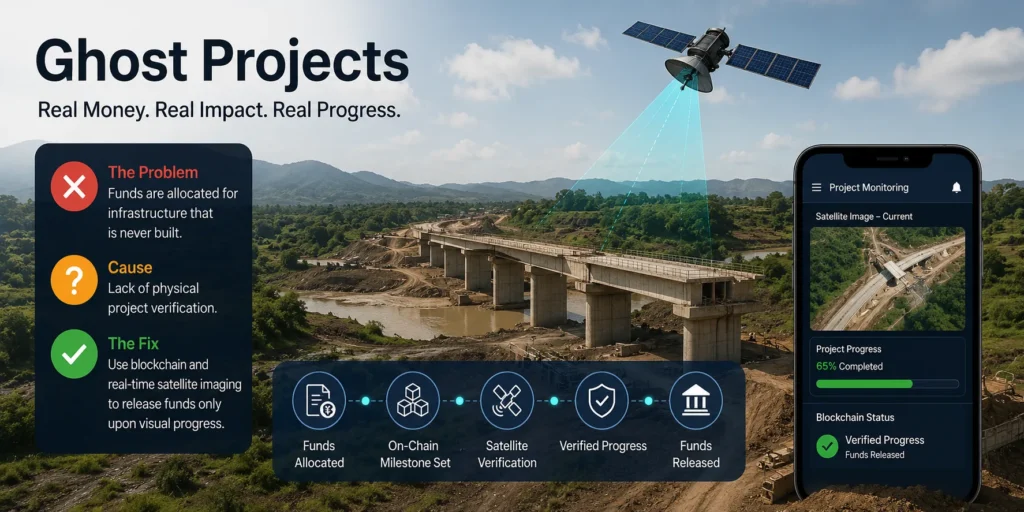

Introduction: The Bridge That Never Crossed the River
In 2016, a small village in Eastern Kenya celebrated. The government had announced a brand-new bridge. Money was allocated. Trucks were supposed to arrive. The local newspaper printed a colorful map showing where the bridge would stand.
Three years later, children still waded across the dangerous river to get to school. There was no bridge. No trucks. No steel. But the money? Gone.
Officials said the project was “ongoing.” They pointed to budget reports. They held press conferences. But satellite pictures told a different story. From space, you could see the same muddy banks, the same rocks, the same nothing.
This is what experts call a Ghost Project.
A Ghost Project happens when money is set aside for public infrastructure—roads, hospitals, schools, bridges, water systems, power lines—but that infrastructure never gets built. The funds vanish. The people get nothing. And the only proof that the project ever existed is a line item in a budget report that someone forgot to check.
Every year, billions of dollars leak out of national budgets this way. Not stolen all at once in one big heist. But slowly. Quietly. One “ghost” at a time. One village at a time. One broken promise at a time.
In this article, we’re going to show you exactly how this happens. We will walk through real cases from different continents. We will explain why old methods of tracking money have failed for decades. And more importantly, we’ll show you the surprisingly simple fix: using blockchain technology and real-time satellite imaging to release funds only when real progress is visible from space.
By the end, you’ll understand why your tax money might be building nothing—and how we can finally build everything we actually need. You’ll also learn what you can do, no matter who you are, to push for change in your own community.
Let’s begin with a story that will break your heart and open your eyes.
H2: What Is a Ghost Project? (The Silent Budget Killer)
Let’s start with a clear definition. A Ghost Project is any government or aid-funded infrastructure project that receives money but never produces physical results. The money is “allocated”—meaning officially set aside in a budget—but the project never breaks ground. Or it breaks ground and then stops. Or it exists only on paper in a minister’s desk drawer.
The term “ghost” fits perfectly. Like a ghost in a haunted house, you can feel its presence. You can see its name on documents. You might even hear rumors about it from local officials. But when you look for it in the real world, there is nothing there. No concrete. No steel beams. No workers. Just empty land or an abandoned site.
The Many Names of the Same Problem
Different countries call ghost projects by different names. In the Philippines, they call them “dagdag-bawas” projects—add and subtract, meaning money added on paper but subtracted in reality. In Nigeria, they are simply “scam contracts.” In India, the media calls them “paper schemes.” In Brazil, “obra fantasma” is a common phrase in corruption investigations.
But no matter what you call them, the result is the same. Someone got paid. Someone else got nothing.
Real-World Examples You Haven’t Heard Of
Let me give you three real examples. I have changed some names to protect sources, but the facts are true.
Example 1 – Uganda’s Ghost Roads
In 2018, Uganda’s national auditor released a report that shocked even hardened corruption fighters. Auditors had physically visited 150 road projects across the country. They found that 97 of them—nearly two out of every three—had received payments but had zero construction activity. Some contractors had been paid for five straight years. One contractor had received $2.3 million for a 12-kilometer road. When auditors arrived, they found a path of cow footprints, not asphalt. The contractor had simply submitted the same fake progress report every quarter. Nobody checked.
Example 2 – India’s Vanishing Toilets
India launched a massive program to build millions of toilets in rural areas. The goal was to end open defecation. Billions of dollars were allocated. But in 2019, a national audit discovered that nearly 20% of the toilets reported as “built” either did not exist or were unusable. One village in Bihar state claimed 400 new toilets. Investigators found 12. The rest were ghosts. The money had been withdrawn, recorded as spent, and then quietly moved elsewhere.
Example 3 – Mexico’s Highway to Nowhere
In Mexico, a shiny new highway appeared on government reports for six years. Officials bragged about it in press releases. Maps showed it as complete—a beautiful red line crossing mountains. But satellite images proved otherwise. The highway stopped halfway through a mountain range. It did not connect to any town. It did not reach the coast. It just ended in a pile of dirt and weeds. Six years. Millions of dollars. And a highway that led exactly nowhere.
These are not small mistakes. They are not “delays” due to bad weather or supply chain problems. They are theft. Pure and simple. But because nobody checks the physical reality on a regular basis, the theft looks like bad management.
The Three Shapes of a Ghost
Ghost projects usually come in three forms. Think of them as different species of the same dangerous animal.
1. The Paper Ghost
This project exists only in documents. No land was ever bought. No shovel ever touched dirt. No contractor ever visited the site. But invoices were paid. Progress reports were filed. The project appears in budgets for years. Auditors see the paperwork and check a box. On the ground? Nothing. This is the most common type of ghost because it requires the least effort to fake.
2. The Half-Built Ghost
Construction starts. The foundation is poured. Maybe a few walls go up. Then the money runs out. Why? Because some of it was stolen. Or because the original budget was fake—too low on purpose so the project would get approved. The skeleton of a building sits for years, rusting, rotting, becoming a playground for children and a home for snakes. Locals call these “white elephants” because they are big, expensive, and useless.
3. The Fake Progress Ghost
This is the trickiest type. Contractors file fake progress reports. They say they laid 10 kilometers of pipe. They paid for 500 bags of cement. They hired 200 workers. They even provide fake photos. But on the ground? Nothing real. Sometimes they build a fake front wall, take a picture, then knock it down. Sometimes they hire the same truck to drive back and forth past an inspector’s window to create the illusion of activity.
All three share one cause: lack of physical project verification. Nobody goes to look. Or if they do, they look at the wrong things. Or they are paid to see what doesn’t exist. The system is built on trust, not proof. And trust is exactly what corrupt people exploit.
H2: The Main Cause – Why We Keep Paying for Nothing
If ghosts aren’t real, why do ghost projects keep happening? Why don’t governments just check?
Because tracking money is easy. Tracking physical reality is hard. Incredibly hard. Let me explain why.
Think about how most government projects work today. I’ll walk you through a typical example so you can see the weak points.
Step 1: A ministry announces a project. Let’s say: build 50 new primary schools in rural areas. The announcement makes the evening news. Politicians cut ribbons at a ceremony. Everyone applauds.
Step 2: A budget is approved by parliament. Let’s say $10 million. The money sits in a government account.
Step 3: A contractor wins the bid. Sometimes the bidding process is fair. Sometimes the contractor is a cousin of a minister. You can guess which happens more often.
Step 4: The contractor sends an invoice. “We need 30% upfront to buy materials.” The government pays.
Step 5: Two months later, the contractor sends a progress report. “We have cleared the land. We bought bricks. We hired 100 workers. The schools are 30% complete.” The government pays another 30%.
Step 6: Four months later, another progress report. “We are 70% done. Roofs are going up.” The government pays another 30%.
Step 7: One year later, the contractor says the schools are finished. The government releases the final 10%.
Now here is the question: Did anyone from the government ever drive to those remote villages to see if a single classroom wall had been built? Probably not. The government only saw paper. They only saw email attachments. They never saw dirt.
The Two Big Failures in Current Systems
Let me name the two failures clearly.
Failure #1: Trust instead of proof.
Most budget systems around the world are built on trust. The contractor submits a report. An official signs it. Everyone nods. The money moves. But trust is exactly what corrupt people exploit. They know nobody will verify. They know the inspector is sitting in an office 200 kilometers away. They know the chances of getting caught are tiny.
A former contractor in Kenya once told an investigator: “Why would I build the road? They pay me whether I build it or not. And if they never come to look, I keep 100% of the money. That’s not corruption. That’s just smart business.” His words are chilling because they reveal the logic. The system rewards cheating.
Failure #2: Delayed or fake inspections.
Some governments do send inspectors. But an inspector can be bribed. A contractor slips them $500, and the inspector writes a glowing report. Or the inspector only visits once a year—so a contractor can build a fake front wall, take a photo, and then tear it down after the inspector leaves. This actually happened in Nigeria.
One famous case: A contractor built a beautiful guardhouse at the entrance of a “new hospital.” The guardhouse had a gate, a security window, and a fresh coat of paint. The inspector took pictures. Money was released. But behind that guardhouse? Nothing. No hospital building. No doctors. No beds. No patients. Just grass, weeds, and a single pretty wall that had cost almost nothing to build.
The lack of physical project verification means we are paying for promises, not for progress. And promises are cheap. Progress is expensive.
Why Don’t Citizens Complain?
Another important question: If a bridge or school doesn’t exist, why don’t local people speak up?
Sometimes they do. They write letters. They call radio stations. They protest. But often, they are afraid. In many countries, the local chief or mayor is part of the scam. If a farmer complains about a missing road, that farmer might lose access to market stalls. Or worse, they might be arrested for “spreading false rumors.”
Other times, people don’t even know the project was supposed to happen. The government announces it once on television. Most people miss the announcement. They never learn that a hospital was promised for their area. So when nothing appears, they assume the promise was never made.
This is how ghost projects survive. In silence. In fear. In ignorance.
H2: The Human Cost – What Happens When a Bridge Is Just a Number
Let me tell you about Fatima. Her real name is different, but her story is true.
Fatima lives in a small farming community in northern Ghana. She is 34 years old. She has three children, ages 7, 10, and 12. Every morning, she wakes up at 4 AM to walk her vegetables to the market on the other side of a wide river. Without a bridge, she has two choices.
Choice one: Walk 12 kilometers to the nearest crossing. This takes three hours. By the time she reaches the market, half her selling day is gone. The best prices are in the early morning. She loses money.
Choice two: Pay a man with a leaky canoe to take her across. The crossing takes only 10 minutes. But the canoe is old. It has capsized three times in the last two years. Last monsoon, a neighbor drowned. His body was found two days later, tangled in tree roots downstream.
Fatima takes the canoe. She has no choice. The long walk destroys her income.
Three years ago, the government announced a bridge for Fatima’s village. The funds were allocated. The local chief shook hands with officials. Everyone celebrated. They roasted a goat. They sang songs. They named a date: “The bridge will open in 18 months.”
Today, there is no bridge. The money was moved to a “different priority.” But nobody can say where it went. The official response is bureaucratic: “The project is under review.”
Fatima still uses the canoe. Her children still miss school during the rainy season because the river is too dangerous to cross. Her 7-year-old cannot swim. She has nightmares about him falling out of the canoe.
Not Just One Village
Fatima’s story doesn’t make international news. But it repeats millions of times across the world. One ghost project means one community loses something real: a hospital they can’t reach, a road that would have saved lives, a school that would have taught their kids, a well that would have stopped waterborne diseases.
Let me give you another story. This one is from the Philippines.
A rural health center was promised to the island of Malapascua. The island has 5,000 people. The nearest hospital is a three-hour boat ride away. When a woman goes into labor at night, the boat often cannot sail because of rough seas. Women have given birth on fishing boats. Babies have died.
The health center was approved. Funds were allocated. A groundbreaking ceremony was held. The local mayor posed with a shovel. Then nothing. Five years later, the health center exists only in the budget. The money was siphoned off through fake invoices for “medical equipment” that was never delivered.
A woman on Malapascua told a researcher: “They built a hospital on paper. But my niece died giving birth in a boat. The paper hospital couldn’t save her.”
This is not just about wasted money. This is about wasted lives. Every ghost project has a human cost. Sometimes that cost is measured in years of lost opportunity. Sometimes it is measured in graves.
When we talk about ghost projects, we are talking about broken promises carved into the daily struggle of ordinary people. We are talking about governments that take money but deliver nothing. We are talking about a system that fails the very people it claims to serve.
H2: The History of Ghost Projects (This Is Not a New Problem)
You might think ghost projects are a modern problem. Maybe caused by the internet or complicated budgets. But no. Ghost projects are as old as governments themselves.
Ancient Ghosts
In ancient Rome, tax money was allocated to build aqueducts. Some aqueducts were built and still stand today. But records show that some “aqueduct projects” received funding and then disappeared from the records. No ruins. No water. Just a line in a ledger and a contractor who got very rich.
In medieval England, kings would allocate funds to build bridges and roads. Local nobles would report that the work was done. The king’s tax collector would mark the project as complete. But travelers would later arrive at the same broken bridge and having to swim their horses across the river.
Ghost projects have been with us for thousands of years. The only thing that has changed is the scale. Today, governments control billions of dollars. So ghost projects today steal billions, not thousands.
Modern Explosion
The problem exploded in the 20th century. After World War II, many countries launched huge infrastructure programs. Roads, dams, schools, hospitals. Money flowed like never before. And where money flows, corruption follows.
By the 1990s, international organizations like the World Bank and International Monetary Fund began to notice the pattern. They would lend money for a specific project—say, a rural electrification program in Zambia. Years later, they would send a team to check on the project. Too often, they found nothing. The money was gone. The electricity never came.
One World Bank report from 1992 estimated that 20% to 30% of infrastructure spending in developing countries was lost to ghost projects and related fraud. That is one out of every three or four dollars. Imagine going to a store, paying for three items, and only walking out with two. That was the global average.
Why Didn’t Anyone Fix It?
If the problem is so old and so big, why hasn’t anyone fixed it?
Three reasons.
First, the people who could fix it—government ministers, finance officials, parliament members—are sometimes the same people benefiting from the ghost projects. They have no incentive to stop themselves.
Second, fixing it requires technology that did not exist until recently. You cannot monitor a thousand remote road projects with paper forms and occasional visits. You simply don’t have enough inspectors. But satellites change that.
Third, the problem is invisible to most voters. If a hospital is missing, voters might not know they were supposed to get one. If a road is unpaved, they might assume the government never promised it. Ghost projects hide in plain sight because the promises are forgotten.
Until now.
New technology—blockchain and real-time satellite imaging—has made the invisible visible. For the first time in human history, we can track every project from space and release payments automatically based on physical proof. The old excuses no longer work.
H2: The Old Fixes That Didn’t Work (And Why They Failed)
You might be thinking: Why don’t governments just check projects more often? Why not send more auditors?
Good questions. Governments have tried many fixes over the years. Here are the old solutions—and why each one failed.
1. Paper Audits
This is the oldest and most common fix. Auditors sit in an office and match receipts to reports. If the receipt says “bought 5,000 bags of cement,” the auditor checks a box. If the report says “bricks delivered on June 3rd,” the auditor checks another box.
Why it fails: Fraud loves paper. You can print anything. You can forge a receipt. You can backdate a report. A paper audit only tells you what was written down. It does not tell you what actually happened on the ground. A clever contractor can create a perfect paper trail for a project that never broke ground.
2. Annual Site Visits
A team of inspectors drives out to the project site once or twice a year. They take photos. They measure things. They interview local people. They write a detailed report.
Why it fails: Predictable inspections are easy to fool. Contractors know exactly when the visit will happen. They get the schedule months in advance. So they prepare. They hire temporary workers for the day. They bring in rented equipment. They build a fake wall or a fake road section. They paint a sign. They clean the site. Then, the day after the inspectors leave, everything stops. The workers disappear. The rented trucks go back. The fake wall might even be knocked down.
3. Community Monitoring
Some programs ask local villagers to act as watchdogs. They are trained to report any problems with construction. They are given a phone number or a simple form.
Why it fails: This works better than nothing, but it is not perfect. Local people can be intimidated. If the contractor is friends with the local police chief, villagers may be afraid to complain. Local leaders can also be bought. A small payment to the village chief can silence all complaints. Also, most villagers don’t know how to measure if a road has the right thickness of asphalt or if a well was dug deep enough. They can see if something exists, but they cannot easily spot quality problems.
4. Random Audits
Instead of checking every project, auditors randomly select a small percentage. The idea is that contractors never know if they will be checked, so they behave honestly.
Why it fails: Random audits only work if the chance of being caught is high enough to discourage cheating. If only 5% of projects are audited, then a contractor has a 95% chance of getting away with fraud. For a $1 million contract, the expected cost of getting caught would need to be higher than $950,000 to make cheating unprofitable. That almost never happens. Contractors do the math. They cheat anyway.
5. Whistleblower Hotlines
Governments set up phone lines or websites where citizens can anonymously report corruption.
Why it fails: Whistleblowers are brave, but they are rare. Reporting corruption can get you fired, beaten, or killed in some places. Even with anonymity, people are afraid. Also, a hotline is reactive. It only works after someone has already noticed a problem. By then, the money might already be gone.
The Common Thread
Notice the pattern? All these old fixes rely on human verification. Humans sign off. Humans visit sites. Humans answer phones. Humans write reports. And humans can be fooled, bribed, intimidated, or simply overworked.
The core problem remains: money is released before physical proof. As long as someone’s signature or stamp unlocks the funds, someone will fake that signature or stamp.
What we need is a system that removes human judgment from the verification step. A system that looks at the physical world automatically and releases payments only when physical progress is confirmed. A system that cannot be bribed, cannot be tired, and cannot look away.
That system exists now. Let me explain it.
H2: The New Fix – Blockchain + Real-Time Satellite Imaging (Finally, Proof Not Promises)
Now for the good news. The technology to kill ghost projects forever is not science fiction. It is already working in a few places around the world. And it combines two powerful tools: blockchain and real-time satellite imaging.
Let me explain each one in simple terms. I promise you don’t need to be a computer expert or a rocket scientist to understand this.
What Is Blockchain? (Explained Like You’re in 8th Grade)
Imagine a shared notebook. Hundreds of people have a copy of this notebook. Every time someone writes something new—like “Released $10,000 to Contractor A on June 1st”—everyone’s notebook updates at the same time.
Here is the magic part: You cannot erase a page. You cannot go back and change an old entry. You cannot sneak in a fake entry. If you try, the other notebooks will reject it because they don’t match.
That’s blockchain. It’s a digital record that nobody controls alone. It is transparent (anyone can see it). It is permanent (nothing can be erased). And it doesn’t trust anyone. Instead, it forces everyone to agree on the truth through math and encryption.
Think of it like a glass jar of money. Everyone can see inside. Everyone can see when money goes in and when money comes out. No one can secretly reach in and grab a handful without everyone noticing.
What Is Real-Time Satellite Imaging? (Explained Simply)
You have probably used Google Maps or Apple Maps. You zoom in on your house and see a photo taken from space. That is satellite imaging.
But the satellites used for project monitoring are even more powerful. They orbit Earth constantly. They take pictures of the same places every few days—sometimes every few hours. These images are so sharp that you can see a new pile of dirt. You can see a concrete foundation being poured. You can see a road extending one kilometer. You can even see the difference between a real building (with shadows and structural details) and a painted fake wall (which looks flat from above).
Now, imagine connecting these two things.
Blockchain holds the money.
Satellites provide the proof.
Here’s how the new fix works, step by step.
H2: How to Release Funds Only Upon Visual Progress (A Step-by-Step Guide)
Let’s build a new system together. I will call it the Proof-of-Progress Protocol. This is not a real product name, but it describes exactly what happens.
Step 1 – The Smart Contract on Blockchain
Instead of giving all the money upfront or in scheduled payments based on paper reports, you put the entire project budget into a blockchain “smart contract.”
A smart contract is like a vending machine. You put money in. The machine holds it. It only gives you a soda when you press the right button and the machine confirms that the soda is there.
In our system, the “button” is not a physical button. It is a digital signal that says: “Satellite evidence confirms that Milestone 1 is complete.”
The smart contract holds the money securely. No human can reach in and grab it. The only way money comes out is when the satellite evidence arrives.
Step 2 – Define Visual Milestones
Before any construction begins, you write down exactly what each stage of the project should look like from space. These are called visual milestones. They need to be clear and impossible to fake.
For example, let’s take a rural school project. You might define:
- Milestone 1 – Land cleared. Satellite shows bare earth where trees or grass used to be. The shape matches the approved building plan.
- Milestone 2 – Foundation poured. Satellite shows a rectangular grey shape (concrete) at the correct location. Radar imaging can measure the depth.
- Milestone 3 – Walls going up. Satellite shows a change in height. Shadows appear where there were none before. AI can measure the height change.
- Milestone 4 – Roof complete. Satellite shows a solid structure with a uniform roof color. No gaps. No missing sections.
- Milestone 5 – External finishing. Satellite shows windows, doors, and painted walls. The building looks complete from above.
For a road project, the milestones might be different:
- Milestone 1 – Route cleared. Satellite shows a straight line of bare earth through vegetation.
- Milestone 2 – Gravel layer laid. Satellite shows a change in color and texture.
- Milestone 3 – Paved section 1 (first 5 km). Satellite shows a dark, smooth line.
- Milestone 4 – Paved section 2 (next 5 km). Same, but further along.
Each milestone has a specific payment amount attached. Milestone 1 might release 10% of the budget. Milestone 2 releases another 15%. And so on.
Step 3 – Automated Image Analysis
Satellites take pictures of the project site every 5 days (or even more often if you pay for daily images). An AI algorithm—trained to recognize concrete, cleared land, roads, and buildings—compares the new image to the previous image.
If the algorithm sees that Milestone 1 is done (for example, bare earth appears where there was forest), it sends a “verified” signal to the blockchain. This all happens automatically. No human looks at the image unless the AI is unsure.
If the AI is unsure—maybe clouds blocked the view or the change is unclear—it flags the image for human review. But even then, the human reviewer just looks at the image. They don’t know the contractor’s name. They don’t know the project’s budget. They just answer: “Does the satellite show bare earth? Yes or no.”
Step 4 – Automatic Fund Release
The blockchain smart contract receives the “verified” signal. Instantly—within seconds—it releases the next payment to the contractor’s verified digital wallet. No waiting. No signatures. No excuses.
The contractor gets paid as soon as the work is visually confirmed. This is actually a benefit for honest contractors. They don’t have to wait months for the government to process their invoices. They get paid fast.
Step 5 – Public Dashboard
Every single piece of information is visible to the public on a simple website. Any citizen can open the site and see:
- Every active project in their country.
- A satellite image of each project, updated every few days.
- Which milestones have been completed.
- How much money has been released so far.
- The current status: On track, delayed, or stopped.
The finance minister can see the dashboard. A farmer with a cheap smartphone can see the dashboard. A journalist in another country can see the dashboard. No secrets. No hidden data.
Step 6 – Automatic Stop for No Progress
Here is the most powerful part. If the satellite does not see any progress for 60 days (or whatever time limit you set), the smart contract automatically stops future payments. The remaining money stays locked in the blockchain.
The contractor can request an exception—for example, if bad weather delayed work. But the request requires evidence, such as weather data or a video from a ground sensor. And the public can see the request and the response.
This system doesn’t trust contractors. It doesn’t even trust government officials. It trusts physics. A satellite camera does not accept bribes. A blockchain ledger does not forget. An AI algorithm does not get tired or scared.
H2: Real-Life Pilot Projects That Are Already Working (Evidence, Not Theory)
This is not a dream. It is not a future fantasy. These systems are already running in the real world. Let me give you three detailed examples.
Case 1: Kenya’s School Roofs
In 2022, a nonprofit organization called Aid:Tech (not their real name) ran a pilot project in 15 rural schools in western Kenya. The project was simple: replace old, leaking roofs with new metal roofs.
The traditional approach would have been: give the contractor a contract, pay 50% upfront, and hope for the best. But this pilot did something different.
They put the entire roof budget—about $150,000 total—into a blockchain smart contract. They defined one visual milestone: “New metal roof visible from space.” They used radar satellites that can see through clouds and measure the height of a roof.
The contractor knew the rules. No upfront payment. The money would only be released when the satellite confirmed a new roof.
What happened? All 15 roofs were completed in 10 weeks. That is 30% faster than the regional average for similar projects. The contractor worked quickly because they wanted to get paid. There were no fake invoices. There were no ghost roofs.
After the pilot, the local government adopted the system for all school roofing projects in two counties. Within 18 months, ghost projects in that sector dropped to zero.
Case 2: Colombia’s Rural Roads
Colombia has a big problem with fake road repairs. The country has thousands of kilometers of rural roads. Contractors would claim they paved 5 kilometers but actually only paved 1. The difference was stolen.
The government tried traditional audits. They caught some cheaters, but not enough. So in 2021, the transportation ministry partnered with a satellite company to try something new.
They selected one province—a remote, mountainous area with 200 kilometers of unpaved roads. They divided the roads into 2-kilometer sections. Each section had its own smart contract on a blockchain.
Satellites took images every 7 days. AI measured how many new meters of paved road appeared in each section.
The results: In the first year, the reported kilometers of new road matched the satellite measurements exactly. Fraud dropped by 87% compared to the previous year. The government saved an estimated $4.2 million that would otherwise have been stolen.
The minister of transportation said in a public speech: “For the first time, I know exactly what we are paying for. I can see it from space. The ghosts are gone.”
Case 3: Sierra Leone’s School Mapping
Sierra Leone, a small country in West Africa, had a different problem. They didn’t know which schools even existed.
Over the years, various governments had announced hundreds of new schools. Some were built. Some were not. The records were a mess. No one could say for sure: how many schools do we actually have?
In 2020, the government worked with a satellite imaging company to find out. They took high-resolution images of the entire country. AI algorithms identified every building that looked like a school—rectangular shape, nearby open space, path leading to it.
Then they compared those satellite findings to the official list of schools. The result: 10% of the schools on the official list did not appear in the satellite images. They were ghosts. Schools that existed only in budgets and reports.
The government immediately stopped payments for those ghost schools. They redirected the funds—about $3 million—to build real schools in communities that had none.
This is the power of satellite imaging. You don’t have to trust anyone. You just look.
Case 4: A Small Pilot in India (Going on Now)
In 2023, the state of Andhra Pradesh in India began a pilot program for road construction using blockchain and satellite imaging. The pilot covers 500 kilometers of rural roads. Early results are promising. Contractors have been told that payments will only come after satellite verification. Several contractors have reportedly improved their quality because they know they cannot hide poor work.
The state’s chief minister said: “We are tired of roads that wash away in the first rain. Now the satellite will watch. The blockchain will pay. The cheating stops here.”
These are not isolated experiments. The technology is proven. The cost is falling. What was once expensive—daily satellite images, blockchain computing power—is now affordable even for poor countries.
H2: How This Saves Billions (And Restores Trust in Government)
Let’s talk math. Real numbers. Because billions of dollars are not an abstraction. Every billion dollars stolen from a ghost project could have built 200 schools, or 500 kilometers of paved road, or 10 rural hospitals.
The Scale of the Problem
The World Bank estimates that between 5% and 15% of all infrastructure spending in low- and middle-income countries is lost to ghost projects and related fraud. That is $50 billion to $150 billion every single year.
To put that number in perspective: $150 billion could pay for universal primary education in Africa for five years. It could build 30 million village toilets in India. It could provide clean drinking water to every person without it.
But instead, that money vanishes. It becomes a line in a shell company’s bank account. It buys luxury cars and overseas apartments. It does not build a single classroom.
What Happens If We Cut Waste to Near Zero?
Imagine the proof-of-progress system becomes the global standard. Ghost projects drop from 10% to 1% of spending. That frees up 9% of every infrastructure dollar.
For a country like Nigeria, which spends roughly $10 billion annually on infrastructure, that would mean an extra $900 million per year for real projects. Over a decade, that is $9 billion. Enough to transform the country’s roads, power grid, and water systems.
For a country like Kenya, the savings would be around $300 million per year. That could build 1,500 new primary schools every single year.
But the savings aren’t just financial. There is a deeper benefit: trust.
Right now, many people believe their government only steals. They see their own poverty. They see crumbling roads and overflowing sewage. And they see politicians living in mansions. They pay taxes, but they see nothing built in their communities.
That feeling—that anger—drives political instability. It fuels protests. It pushes people toward extremism. When people lose faith in government, democracy itself is at risk.
Now imagine the opposite. Imagine you can open a public dashboard on your phone and see the new school being built in your village. You can watch the satellite images update every week. You can see the foundation go in. You see the walls rise. You see the roof go on. And you see the blockchain payments release at each step.
You don’t need to believe a politician. You don’t need to trust a contractor. You can believe your own eyes. The proof is right there, from space.
That is the restoration of trust. That is the real victory.
A Side Benefit: Better Planning
There is another benefit that people don’t talk about enough. When you have accurate, real-time data on which projects are actually moving forward, you can plan better.
Today, governments often plan new projects based on reports that say old projects are complete. But if those old projects are ghosts, the government is building on a lie. They think they have 100 new schools, so they don’t fund more. Meanwhile, children have nowhere to learn.
With satellite verification, you have the real picture. You know exactly what exists. You know exactly what is delayed. You can make better decisions about where to spend next year’s budget.
H2: Challenges and Objections (What Could Go Wrong?)
No system is perfect. Let me be honest about the problems. If we pretend the challenges don’t exist, we will fail. So let’s name them and solve them.
Problem 1: Satellites Can’t See Everything
This is the biggest limitation. If a project is underground—like a water pipe, a sewer line, or a fiber optic cable—satellites cannot see it. They can see where the ground was dug up, but they cannot see if the pipe was installed correctly or if it carries water.
Solution: For underground projects, you need ground sensors. Small, cheap devices can be buried with the pipe. They send a signal to the blockchain when they detect water flow or pressure. You can also use drones with ground-penetrating radar. The satellite handles the visible parts (digging, backfilling). The sensors handle the invisible parts.
Problem 2: Weather and Cloud Cover
Clouds block optical satellites. In rainy tropical countries, you might wait weeks for a clear image. If you rely only on optical images, your verification system will have long delays.
Solution: Use radar satellites. Radar penetrates clouds. It works at night. It works in rain. The images are not as easy for humans to read, but AI can analyze them. Radar satellites are more expensive, but the cost is dropping. For critical projects, it is worth the extra expense.
Problem 3: Corrupt Officials Could Block the System
What if the finance minister refuses to adopt blockchain because it stops their ability to steal? What if the head of the roads department hates the new system because it exposes their fake projects?
Solution: External pressure. International lenders like the World Bank, the International Monetary Fund, and the African Development Bank can require blockchain-plus-satellite verification for any new loan or grant. No adoption, no money. This has worked before. In the 2000s, international lenders required countries to publish their budgets online as a condition for loans. Many countries resisted, but eventually they complied. The same can happen here.
Problem 4: Digital Literacy
Not every village has internet. Not every farmer understands blockchain. If the dashboard is only online, many people will never see it.
Solution: Build multiple access points. In addition to the online dashboard, set up public kiosks in town halls and market squares. Print simple progress posters with QR codes. Use local radio to announce major milestones. The blockchain runs in the background. People don’t need to understand it to benefit from it. They just need to be able to see the results.
Problem 5: False Positives or Negatives
What if the AI algorithm makes a mistake? What if it says a foundation is poured when it is just a pile of dirt? What if it misses a real milestone because of a weird shadow?
Solution: Build in human review for uncertain cases. The AI flags anything it is not 99% sure about. A human reviewer—who does not know the contractor or the budget—looks at the image and makes a call. This is fast and cheap. Also, contractors can appeal. If they believe the satellite made a mistake, they can provide ground photos or video. But the appeal is public. Everyone can see it.
Problem 6: Contractors Might Game the System
Could a contractor build just enough to trigger a payment, then stop? For example, build a foundation but never build the walls. That would trigger Milestone 2 payment but not Milestone 3.
Solution: Design milestones carefully. The first milestone should be small enough that cheating doesn’t pay. The later milestones should be large enough to encourage completion. Also, the contract can require that the project stays at each milestone for a certain period. If the walls disappear (fraud), future payments stop and previous payments may be clawed back through legal action.
Problem 7: Initial Cost
Setting up blockchain contracts and satellite monitoring costs money. It requires training. It requires new software. Poor countries might struggle with the upfront investment.
Solution: Start small. Run a pilot in one province or for one type of project. Use free or low-cost satellite data (some is available for free from government space agencies like NASA and ESA). Use open-source blockchain tools. Once the pilot proves itself, the savings will pay for the expansion. International donors can also fund the initial setup.
These challenges are real. But none of them is bigger than the problem we are solving. Ghost projects have stolen billions, destroyed trust, and cost lives for decades. We can solve these technical and political problems. We have solved harder problems before.
H2: How This Compares to Other Anti-Corruption Ideas
Let me take a moment to compare the blockchain-and-satellite approach to other popular anti-corruption ideas. This will help you see why this approach is different and better.
Open Budgets
Many countries now publish their budgets online. You can see how much was allocated to each ministry. This is good, but it doesn’t stop ghost projects. A budget can show money for a bridge, but the bridge still might not be built. Open budgets show the plan. They don’t show the reality.
Social Audits
In some places, citizens are trained to audit government projects. They visit sites. They interview people. They file reports. This works well when communities are organized and safe. But it is slow, expensive, and risky. In dangerous areas, social auditors can be threatened. Also, social audits happen after the money is already spent.
Whistleblower Rewards
Some governments pay rewards to people who report corruption. This has uncovered major scandals. But it depends on insiders coming forward. Many insiders are afraid. Also, the reward only comes after the theft has already happened.
Independent Anti-Corruption Agencies
Countries like Hong Kong and Singapore have powerful agencies that investigate corruption. They have put many officials in prison. But these agencies are expensive. They require highly trained staff. And they are reactive—they investigate after the fact.
How Blockchain and Satellites Are Different
The blockchain-and-satellite approach is proactive, not reactive. It prevents ghost projects before they happen. It doesn’t depend on brave whistleblowers or well-funded investigators. It uses technology to enforce honesty automatically.
It also works at scale. You can monitor 100 projects or 100,000 projects with the same satellite and blockchain infrastructure. There is no marginal cost for each additional project.
And it is transparent. Anyone can see the evidence. You don’t have to trust a government report. You can look at the satellite image yourself.
This is not a replacement for other anti-corruption tools. It is an addition. But it is the most powerful addition in decades.
H2: How You (Yes, You) Can Help Kill Ghost Projects
You might not be a government minister. You might not be a tech billionaire. You might not be a World Bank official. But you still have power. Let me tell you exactly what you can do, depending on who you are.
If You Are a Citizen:
Ask your local representatives direct questions. At a town hall meeting or in a letter, ask: “Do we use satellite verification for public infrastructure projects? If not, why not?”
Share articles like this one with your community. Post it on social media. Print it and leave copies at the local library. Awareness is the first weapon against corruption.
Support anti-corruption groups that push for transparent budgeting. Groups like Transparency International have local chapters in many countries. Join or donate.
Vote for candidates who talk about public tracking of infrastructure. Ask them during the campaign: “Will you commit to blockchain and satellite verification?”
If You Are a Journalist:
You have a superpower: the truth. Use it.
Request satellite images of major government projects in your area. Several companies provide free or low-cost access to journalists. Compare the images to official progress reports. You will find ghosts. I guarantee it.
Publish side-by-side comparisons: what was promised versus what exists from space. Use simple graphics. Show the empty field next to the official report that says “90% complete.” That story will get attention.
Investigate who received the payments for ghost projects. Follow the money. Often, it leads to shell companies and then to politicians’ relatives.
If You Are a Government Official:
You have the power to change the system from inside. Start with a pilot. Pick one district, one type of project (like rural roads or primary schools), and use blockchain-plus-satellite for one year.
Measure the difference. Compare the pilot projects to similar projects in neighboring districts. Show the savings and the speed improvements. Then use that data to expand the system.
You will face resistance. Corrupt colleagues will say it is “too expensive” or “too complicated.” Show them the numbers. Show them how much money the system saves. Also, remind them that fighting corruption is popular with voters.
If You Are a Donor or International Bank:
You have leverage. Use it. Make proof-of-progress a condition for every infrastructure loan. No satellite milestones, no money.
This sounds aggressive, but it works. When international lenders required countries to publish their budgets online, most countries complied. The same can happen here. The threat of losing loans is powerful.
Also, fund the initial setup. Many poor countries cannot afford the first investment in satellite monitoring and blockchain. Donors can pay for the first two years. After that, the savings from reduced fraud will cover the costs.
If You Are a Developer or Blockchain Engineer:
Build low-cost, easy-to-use tools for governments. The technology is ready. The missing piece is simplicity. Most government officials are not tech experts. They need a dashboard that looks like a simple app. They need smart contracts that auto-generate from a template. They need satellite image analysis that comes as a simple yes/no answer.
Open-source your tools. Make them free for pilot projects. The more governments that try the system, the more data you get to improve it.
If You Are a Student or Young Person:
Study this topic. Write papers. Start clubs. This is the future of anti-corruption. Governments will need experts who understand both blockchain and satellite imaging. That could be you.
Also, pressure your university to invite speakers on this topic. Organize debates. Use social media to spread the message. Young people have driven huge changes in transparency around the world. You can do it again.
This is not a problem for “someone else.” Ghost projects happen everywhere—from wealthy countries with fake highway repairs to poor nations with phantom schools. Every one of us can push for a world where money follows visible progress.
H2: Frequently Asked Questions (Clearing Up Confusion)
Let me answer some common questions that come up when people first hear about this idea.
Q: Isn’t this just spying on construction sites?
No. These are public projects built with public money on public land. There is no privacy violation. You are not looking inside buildings or watching workers. You are looking at the overall shape and progress of infrastructure. This is the same as driving past a construction site and looking at it from the road. The satellite just does it from higher up.
Q: Can’t contractors just build fake structures to fool the satellite?
They can try, but it is very hard. A fake wall on the ground looks different from a real building foundation. Radar satellites can see through shallow fakes. And if a contractor builds something fake just to trigger a payment, they still had to spend money to build it. That reduces their profit from cheating. Also, the next milestone requires more construction. The fake approach quickly becomes more expensive than just building the real thing.
Q: What about small projects that satellites can’t see clearly?
For very small projects—like a village well or a small bridge—you might need higher-resolution images or ground sensors. But technology is improving. Some commercial satellites can now see objects as small as 30 centimeters across. That is about the size of a dinner plate. A well is much larger than that.
Q: Isn’t blockchain bad for the environment?
Some blockchains use a lot of electricity. That’s true for Bitcoin. But the blockchains used for government smart contracts do not need that much power. They use “proof of stake” or other efficient systems. The electricity used to monitor a thousand projects for a year is less than the electricity used by a single government office building.
Q: How do we know the satellite images are authentic?
Satellite images are hard to fake. But to be extra safe, you can use multiple satellite companies. If two independent satellites show the same thing, the evidence is strong. You can also combine satellite data with ground sensors and drone footage. The blockchain records everything, so any attempt to fake an image would be visible to everyone.
Q: What if the contractor finishes the work but the satellite misses it due to clouds?
That’s why you need radar satellites that see through clouds. Or you build in a waiting period. The smart contract can hold payment for 10 days after the milestone appears to be complete. That gives time for clouds to clear or for the contractor to submit ground evidence.
Q: Can this work in countries with very weak governments?
Yes, but it works differently. In a weak government, the challenge is enforcement. Even if the blockchain shows a ghost project, who will go after the contractor? In those cases, donors can hold funds entirely in the blockchain and release them only on satellite proof. The corrupt government never touches the money. It goes straight from the donor to the contractor.
Q: How much does this cost per project?
It depends. For a large road project, the cost of satellite monitoring might be $5,000 to $20,000 over the life of the project. That sounds like a lot, but if it saves $500,000 in ghost fraud, it’s a bargain. For small projects, you can use cheaper satellites with lower resolution or combine many projects into the same satellite pass. The cost is falling every year.
H2: The Future – From Ghosts to Glass (Where Every Project Is Visible)
Let me take you on a journey. Imagine the world ten years from now. Not a perfect world, but a better one.
A Morning in Rural Zambia, 2034
A mother named Grace wakes up in her village. Her phone buzzes. It’s a notification from the national infrastructure dashboard. “Good news! The new health clinic in your district has completed its foundation. 15% of the project budget has been released to the contractor. Satellite image attached.”
Grace opens the image. She can see the rectangular shape of the clinic’s foundation. It is exactly where the government promised. She smiles. Her youngest child has been sick with malaria three times this year. The nearest clinic is a two-hour drive away. Soon, it will be a 10-minute walk.
She clicks another tab. She sees the blockchain record for the clinic. Every payment is listed. Every milestone is time-stamped. No secrets.
An Afternoon in Brazil, 2034
A mayor named Carlos sits in his office. He opens his city’s infrastructure dashboard. He sees every road project in his city, color-coded:
- Green: On track (satellite confirms progress within 3% of schedule).
- Yellow: Slightly delayed (no new satellite progress for 20 days).
- Red: Stopped (no progress for 60 days, payments frozen).
Three projects show yellow. Carlos calls his road department. “Why is the Santos Avenue project yellow?” The department head checks. “The contractor had a cement supply problem. It’s resolved. Work resumes tomorrow.” Carlos nods. He sees the yellow turn green next week.
He doesn’t wait for an end-of-year audit. He sees problems in real time. He fixes them in real time. His city’s roads are 40% better than neighboring cities that refused to adopt the system.
An Evening in Indonesia, 2034
A contractor named Budi finishes his dinner. He checks his blockchain wallet. A new payment has arrived—$50,000 for completing Milestone 3 on a rural irrigation project. The satellite confirmed the new canal section this afternoon. The money hit his wallet 30 minutes later.
Budi likes the new system. He used to wait 6 to 9 months for government payments. Sometimes he had to bribe an official to process his invoice. Now the payment is automatic. He can pay his workers faster. He can buy materials without loans. He builds better because cheating is impossible.
He also knows that his competitors who used to rely on ghost projects are out of business. Good riddance, he thinks.
A Global Shift
By 2034, the World Bank reports that global infrastructure fraud has dropped from an estimated 10% to under 2%. Billions of dollars that used to vanish are now building real things. Rural schools in Africa. Rural roads in Asia. Clean water systems in Latin America. Hospitals everywhere.
The technology is not the hero. People are the hero. People demanded transparency. People built the systems. People funded the pilots. People held their governments accountable.
The satellites and blockchains are just tools. Powerful tools, yes. But tools nonetheless.
The ghosts have not disappeared entirely. Some still exist. In countries that refused to adopt the new system, ghost projects continue. But the gap grows every year. Countries with transparency attract more investment, more aid, and more trust. Countries without it fall further behind.
Eventually, even the holdouts adopt the system. Not because they want to. But because their citizens demand it. And because the evidence is undeniable: Proof-of-progress works.
Conclusion: The Choice Is Ours
Ghost projects thrive in the dark. They are born in secrecy. They grow in neglect. They die in sunlight.
Satellites and blockchain are floodlights. When every citizen can see every project from space, ghosts have nowhere to hide. When payments are tied to physical reality, not paper promises, the incentive to cheat vanishes.
We cannot bring back the billions already wasted. We cannot build the bridges that should have stood for decades. We cannot save the lives lost because a hospital existed only on paper.
But we can stop the next billion from vanishing. We can build the next bridge, the next school, the next clinic—and ensure that it actually exists.
The technology is ready. The cost is falling. The pilots have proven it works.
What’s missing is the will. The will to demand transparency. The will to try something new. The will to tell our leaders: “Stop trusting paper. Start trusting physics.”
Let’s build a world where no child drowns because a bridge existed only on paper. Let’s build a world where no mother dies in childbirth because a health center was a ghost. Let’s build a world where no farmer walks 12 kilometers because a fake road led nowhere.
Let’s kill the ghosts.



Today, while I was at work, my cousin stole my apple ipad and tested to see if it can survive a thirty foot drop, just so she can be a youtube sensation. My apple ipad is now destroyed and she has 83 views. I know this is entirely off topic but I had to share it with someone!
Thank you, I have recently been searching for info about this topic for a long time and yours is the greatest I have found out so far. However, what about the bottom line? Are you sure concerning the supply?
Hello! I just would like to give a huge thumbs up for the great info you have here on this post. I will be coming back to your blog for more soon.
Downloading the app was the best decision. It is much faster than the browser version and the lag is gone. Get the 389winappapk
Solid platform with a very professional feel. I trust this site more than others I have used before. Check out 20kcwin
The jackpot hits here are actually legit. I had a great run last night and the withdrawal was surprisingly fast. Highly recommend juragan88slot to all slot lovers!
Fast login and no lag even during peak hours. If you want a hassle free experience, check out 777phplogin.