
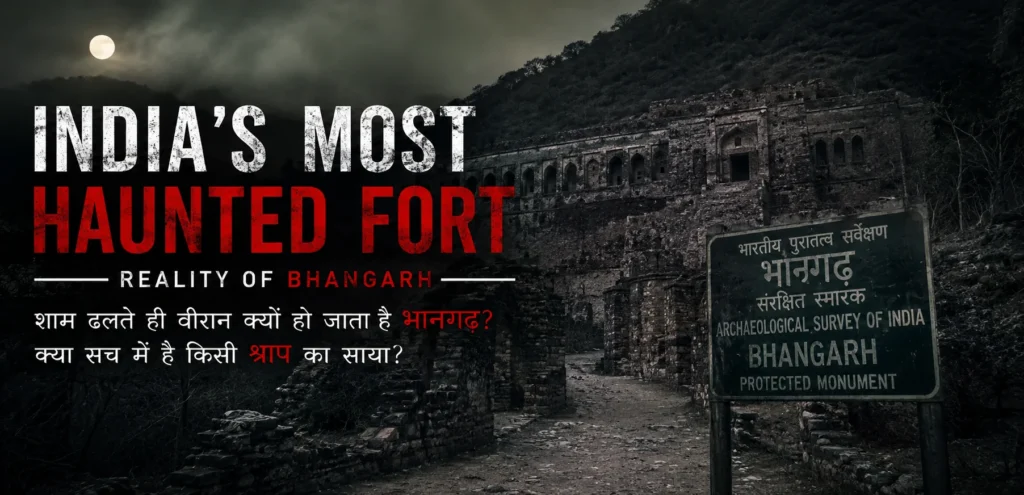

If you ever find yourself driving through the dry, dusty roads of Rajasthan, about 80 kilometers from the pink city of Jaipur, you will notice something strange. The landscape is full of rocky hills, thorny bushes, and the occasional camel. But then, suddenly, you see it. A massive structure made of red sandstone. It looks like a sleeping giant. Its walls are cracked. Its windows are dark. And there is an eerie silence that wraps around it like a blanket.
This is Bhangarh Fort.
Before you even reach the main gate, you will see a signboard. It is not a normal sign. It is put up by the Archaeological Survey of India (ASI), the government body that protects historical places. The sign says in clear, bold letters: “Entry into the fort before sunrise and after sunset is strictly prohibited.”
Now, think about this for a second. India has hundreds of old forts. Some are bigger than Bhangarh. Some are older. Some have seen bloody battles. But none of them have a rule like this. You can walk through the Red Fort in Delhi at 9 PM if you want (with a ticket, of course). You can visit the giant Mehrangarh Fort in Jodhpur under the stars during special events. But Bhangarh? No. Absolutely not.
Ask any local villager why. They will lower their voice. They will look around to make sure no one else is listening. Then they will say: “After the sun goes down, the ghosts come out. Nobody — not even the police — stays inside those walls. Not one person.”
Some people laugh at this. They say it is just a story to attract tourists. Others have spent their whole lives living near the fort, and they refuse to even look at it after dark. They will not give you a logical reason. They will just say: “Some places are not for humans after a certain hour. Bhangarh is one of them.”
So what is the truth? Is Bhangarh Fort really full of ghosts, black magic, and curses? Or is there a real, historical, and maybe even more disturbing reason why this beautiful fort sits empty every single night?
To answer that, we have to do more than just read headlines. We have to walk through its gates — during the day, of course — and dig deep into its past.
Let’s begin.
1. What Exactly Is Bhangarh Fort? A Town That Died
Most people who have never visited Bhangarh think it is just one building. One big fort with four walls and a gate. But that is not true at all. When you actually arrive at Bhangarh, you realize it is not a single structure. It is an entire abandoned city spread across a large area. It is like walking into a ghost town from a Hollywood movie, except this one is real, and it is right here in India.
Let me paint a picture for you. Imagine you park your car or get off your bus at the entrance. You buy your ticket. You walk through the main gate. What do you see? Not ruins. Not just broken walls. You see the skeleton of a whole kingdom.
Here is what is still standing inside Bhangarh:
- The Royal Palace – This is a three-story building that once belonged to the king. It has balconies, secret rooms, and a roof that gives you a view of the entire valley. Even today, you can see the remains of paintings on the walls. Faint colors. Faded flowers. Traces of a time when this place was alive.
- The Market Street (Bazaar) – Yes, Bhangarh had a proper market. You can still see the row of shops on both sides of a wide path. Shopkeepers once sold cloth, spices, jewelry, and food here. Now, only wind and dust move through these empty stalls.
- Temples – Bhangarh has several Hindu temples still standing in surprisingly good condition. There is a temple for Lord Shiva, one for Lord Hanuman, one for Gopinath Ji, and even a temple for a local deity named Someshwar. Some of these temples still have priests who come during the day, but they always leave before sunset.
- The Dance Hall (Naqqar Khana) – This is a raised platform where musicians once played drums and trumpets to announce the arrival of the king. If you stand there and close your eyes, you can almost hear the echo of royal processions.
- The Stepwell (Bawdi) – This is one of the most famous and most feared spots in Bhangarh. It is a deep well with stairs going all the way down to the water. During the day, it looks like an architectural wonder. But as the light fades, the stepwell becomes something else entirely. More on this later.
- Havelis and Houses – Ordinary people lived in Bhangarh too. You can see the remains of their homes. Small rooms. Broken doorways. Courtyards where children once played. Now, the only things living there are monkeys, lizards, and bats.
If you walk through Bhangarh during the daytime — especially between 10 AM and 3 PM — you will see tourists taking selfies, guides telling stories, and local vendors selling cold drinks and peanuts. It feels almost like a picnic spot. The sun is hot. The sky is blue. The ruins look beautiful against the hills.
But something strange happens around 4 PM. The crowds start to thin out. The vendors pack up their goods. The guides finish their last tours. By 5 PM, you will notice that you are one of only a few people left. And by 5:30 PM, the security guards start politely but firmly asking everyone to leave.
If you ask them why, they will not give you a long explanation. They will just point at the signboard and say: “Rules are rules. Go now. It gets dark fast.”
But here is the real question. Why did an entire, thriving town become empty in the first place? To understand that, we have to go back more than four centuries.
2. The Birth of Bhangarh: A King’s Gift to His Brother
Every abandoned place has a beginning. Bhangarh’s beginning is not dark or scary. In fact, it starts with family love and royal ambition.
The year was around 1573. The Mughal Emperor Akbar was ruling most of North India. One of his most trusted generals was a Rajput king named Raja Man Singh I. Man Singh was not just any king. He was the ruler of Amer (which is near modern-day Jaipur). He was also one of Akbar’s nine most special courtiers, known as the Navratnas or nine gems. Yes, the same Man Singh who built the famous Amer Fort and who fought alongside Akbar in many battles.
Man Singh had a younger brother named Madho Singh. In royal families, the older brother often got the main kingdom, and the younger brother had to find his own land. Man Singh loved his brother, so he gave him a beautiful piece of land at the edge of the Aravalli hills. This land had natural defenses — hills on one side, forests on the other, and a view that stretched for miles.
Madho Singh was overjoyed. He decided to build a new city there. He named it Bhangarh, after one of his ancestors whose name was Bhan Singh. (Some historians say the name came from “Bhan” + “Garh,” meaning the fort of Bhan. Others say it came from “Bhang” which means cannabis, because the area once had wild cannabis plants. But the first story is more widely accepted.)
Construction began immediately. Workers came from nearby villages. Stone cutters carved red sandstone blocks. Architects designed a city with perfect Vastu principles — the ancient Indian science of architecture. Temples were built first, as was tradition. Then came the palace. Then the market. Then the houses. Over time, Bhangarh grew into a prosperous little kingdom.
By the early 1600s, Bhangarh was famous. Travelers passing through Rajasthan would stop here to rest and trade. The markets were full of activity. The temples echoed with bells and chanting. The palace had music, dance, and royal feasts. Madho Singh’s descendants continued to rule after him. The city had everything a kingdom needed — except one thing.
Water.
Rajasthan is a desert state. Bhangarh is located in a particularly dry area. The stepwell (bawdi) was built to collect rainwater, but it was not enough for a growing population. The nearby river often dried up in the summer months. This water problem would eventually play a major role in the city’s downfall. But before that, something else happened. Something that would turn Bhangarh from a normal historical fort into the most haunted place in India.
That something is a love story. A twisted, dark, and tragic love story involving a beautiful princess and a dangerous magician.
3. The Most Famous Legend: The Princess and the Tantrik
Now we come to the story that every guide in Bhangarh will tell you. It has been passed down through generations. It has been written in books. It has been shown in movies. And whether you believe it or not, it is the reason millions of people have heard the name Bhangarh.
Let me tell it to you the way I heard it from an old tea seller sitting near the fort entrance.
The Princess
Many centuries ago, there lived a beautiful princess named Ratnavati. She was the daughter of the king of Bhangarh. People said that her face glowed like the full moon. Her eyes were as deep as the stepwell. Her smile could make flowers bloom. She was not just beautiful, though. She was also intelligent, brave, and kind. The people of Bhangarh loved her dearly.
Princess Ratnavati was unmarried. Many kings and princes from faraway lands wanted to marry her. But she was in no hurry. She spent her days learning, dancing, and helping the poor. Her favorite place was the local market, where she would buy perfumes, fabrics, and sweets.
The Tantrik
In the hills surrounding Bhangarh, there lived a powerful black magician. People called him Singhiya. Some say he was a tantrik who had learned dark magic in the forests of Assam. Others say he was a sorcerer who could control spirits. What everyone agreed on was this: Singhiya was dangerous. He could curse people. He could make them sick. He could even make them disappear.
Singhiya rarely came down from the hills. But one day, he came to the Bhangarh market to buy supplies. And that is when he saw her.
Princess Ratnavati was walking through the market, followed by her servants. She was wearing a pink and gold saree. Her jewelry sparkled in the sun. Singhiya stopped. He could not breathe. He had never seen anyone so beautiful. In that moment, the dark magician forgot all his magic. He fell obsessively, dangerously in love.
The Rejection
Singhiya followed the princess for days. He watched her from behind rocks and trees. He learned her daily routine. Finally, he gathered his courage and approached her. He told her that he loved her. He asked her to marry him.
Princess Ratnavati was not afraid of anyone. She looked at this strange man with wild eyes and dirty clothes. She saw the dark energy around him. She said, “I am a princess. You are a sorcerer who lives in a cave. Leave this place and never come back.”
Singhiya’s heart turned into stone. Humiliated in front of the entire market, he swore revenge. He whispered to himself: “If I cannot have her, no one will.”
The Black Magic
Singhiya knew he could not fight the king’s army. But he did not need an army. He had magic. He waited for the right moment.
Every day, Princess Ratnavati would buy a special perfume oil called attar from the same shop in the market. The shopkeeper would pour the oil from a large bottle into a small one for her. Singhiya saw this as his chance.
One night, he crept into the shop. He had a small bottle of his own. Using his darkest spells, he enchanted the oil inside. He whispered a curse over it. Whoever touched this oil would fall under his control forever. Their soul would belong to him.
The next morning, Singhiya waited near the shop. He watched as the shopkeeper reached for the large oil bottle. But something went wrong. The shopkeeper accidentally picked up Singhiya’s cursed bottle instead. He poured it into the princess’s small vial.
Princess Ratnavati took the vial and thanked the shopkeeper. Before she could leave, she noticed something strange. A man was hiding behind a nearby rock, staring at her. It was Singhiya. She saw the evil smile on his face. And suddenly, she understood.
The Twist
The princess did not panic. She had heard stories of Singhiya’s magic. She knew that once cursed oil touched her skin, it would be too late. So she did something incredibly brave. She threw the small vial of oil to the ground. It shattered. The oil spilled on a large boulder that was lying nearby.
And then something miraculous happened — or terrible, depending on how you see it. The boulder started to move. It rolled down the hill. Faster and faster. Straight toward Singhiya.
The magician tried to run. But the rock was too fast. It crushed him against the side of the hill. He fell to the ground, broken and dying.
The Curse
But even in his last moments, Singhiya’s hatred burned like fire. He lifted his bloody hand toward Bhangarh Fort. With his final breath, he screamed a curse:
“Bhangarh will be destroyed. No one will ever live within its walls again. The palace will crumble. The markets will fall silent. And whoever stays inside after the sun sets will never see the morning light.”
Then he died.
The Aftermath
The legend says that soon after Singhiya’s death, strange things began to happen in Bhangarh. Children fell sick for no reason. Livestock died overnight. Fights broke out between families. A mysterious fire burned down part of the market. Then came the attackers — an enemy army that seemed to appear out of nowhere.
The king fought bravely, but he could not save his city. One by one, the people of Bhangarh fled into the night. Within a few years, the entire city was empty. Only the walls remained.
And the curse? It remained too.
4. But Is the Legend True? Let’s Separate Fact from Fiction
That is a powerful story. It has love, betrayal, magic, and tragedy. But is it real? Did a black magician named Singhiya actually curse Bhangarh? And did a princess really throw a bottle of oil that crushed him?
Let’s think like a historian for a moment.
First problem: There is no mention of Princess Ratnavati or Tantrik Singhiya in any official royal record from that period. The kings of Bhangarh kept detailed records of births, deaths, marriages, and important events. None of those records mention a princess with that name or a magician with that story.
Second problem: The story of a rejected magician cursing a fort is found in many other places in India. Kuldhara village near Jaisalmer has almost the exact same legend. So does the fort of Chanderi in Madhya Pradesh. This suggests that the story might have been borrowed and attached to Bhangarh to make it more interesting for tourists.
Third problem: The curse says “no one will ever live within its walls again.” But historical records show that Bhangarh was not abandoned suddenly. It happened slowly over several decades.
So where did the legend come from? Most historians believe it was spread by local guides in the early 1900s. Back then, Bhangarh was not a popular tourist spot. There were no roads, no signs, no ticket booths. A few guides started telling dramatic stories to attract visitors. Over time, those stories grew bigger and bigger. By the time the ASI put up the night ban sign, the legend was already famous.
But wait. If the legend is not true, why is Bhangarh still considered haunted? Why do people still feel scared there? And why does the night ban still exist?
To answer that, we have to look at real historical events and real environmental factors. And honestly, the real reasons might be even more unsettling than a magician’s curse.
5. The Real History: War, Water, and Abandonment
Historians who have studied Bhangarh agree on one thing: the city was not killed by a curse. It was killed by three very real, very human problems.
Problem 1: A Brutal War
In the early 1600s, the Mughal Empire was expanding. Not everyone accepted Mughal rule. The kingdom of Bhangarh was loyal to the Mughals because Man Singh worked for Akbar. But there were other Rajput kingdoms that resisted. One of them was the neighboring kingdom of Alwar.
In 1615 AD, a fierce battle took place between Bhangarh and Alwar. According to old manuscripts found in Jaipur’s City Palace museum, the army of Alwar attacked Bhangarh at night. The attack was sudden and savage. Many soldiers were killed in their sleep. The royal family escaped through a secret tunnel, but hundreds of civilians were not so lucky.
After the battle, the king of Bhangarh decided not to rebuild. The cost was too high. The loss was too painful. He moved his court to another town. Many families followed him. The city never recovered.
Problem 2: The Water Crisis
Rajasthan is one of the driest regions in India. Bhangarh sits in a rain shadow area — meaning it gets very little rainfall. The stepwell inside the fort was designed to store water for the dry months, but it had a fatal flaw. It was built too deep, and the rock underneath was not solid enough. Over time, the well began to leak. Water that should have lasted for months was gone in weeks.
There is also a local belief that the stepwell’s water became poisonous. Some historians say this might be true. Near the stepwell, there are old chemical factories (from the British era) that released waste into the ground. If that waste mixed with the groundwater, it could have made people sick. Villagers today still avoid drinking from any well near Bhangarh.
Problem 3: Economic Collapse
A city needs money to survive. Bhangarh’s main income came from trade and taxes. But when the war scared away merchants, and the water crisis made farming difficult, the economy collapsed. Shopkeepers closed their shops. Artisans moved to bigger cities. Farmers abandoned their fields. Within two generations, Bhangarh went from a thriving town to a ghost town.
None of this happened overnight. It was a slow death. But by the year 1700, Bhangarh was almost completely empty. The temples continued to be used by villagers from nearby areas, but the fort itself was silent.
So, no curse. No magic. Just war, water problems, and bad luck. That is the boring, non-ghostly explanation.
But here is where things get strange again. Even though historians have explained the abandonment, visitors still report terrifying experiences. And those experiences are not just imagination. Let me tell you what people actually feel when they step inside Bhangarh Fort.
6. What Do Tourists Actually Experience? First-Hand Stories
Over the years, thousands of people have visited Bhangarh. Most go during the day, take photos, laugh at the ghost stories, and leave. But a surprising number of visitors — even skeptics — have reported things they could not explain.
I have collected some of these stories from travel blogs, YouTube videos, and interviews. Names have been changed for privacy, but the experiences are real.
Story 1: The Watcher
Name: Arjun, software engineer from Bangalore
Visited: December 2018
“I don’t believe in ghosts. I am a science guy. But inside Bhangarh, something happened. I was walking near the palace on the second floor. It was around 4 PM. The sun was still out. Suddenly, I felt like someone was standing right behind me. I could almost feel their breath on my neck. I turned around. Nobody. But the feeling did not go away. For the next ten minutes, I kept looking over my shoulder. My friend said my face had gone pale. I left early. I have never felt anything like that anywhere else.”
Story 2: The Laughter
Name: Priya, college student from Delhi
Visited: March 2019
“We were near the dance hall. It was almost 5:30, and the guards were telling us to leave. My friend wanted to take one last photo. I was standing alone near a broken window. That’s when I heard it. A woman laughing. Not loud. Soft. Like someone was amused about something. I looked around. There were no women near me. Only two old men and a family with small kids. The laugh came from inside the palace. I ran out. I didn’t even wait for my friend.”
Story 3: The Sudden Cold
Name: Vikram, teacher from Lucknow
Visited: October 2017
“It was a hot day. At least 35 degrees. I was sweating. I walked past the stepwell, and instantly, the temperature dropped. I am not talking about a little shade. I am talking about a cold that gave me goosebumps. I could see my breath. In October. In Rajasthan. My watch showed 35 degrees, but my body felt like 15. I walked ten steps away from the well, and the heat came back. I went back to the well, and the cold returned. I am a rational man, but I cannot explain that.”
Story 4: The Shadow
Name: Neha, photographer from Mumbai
Visited: November 2020
“I was taking photos of the palace from a distance. I use a professional camera with a zoom lens. When I looked through the viewfinder, I saw a shadow move behind a pillar on the second floor. It looked like a person in a long robe. I thought maybe another tourist had stayed behind. I called out. No answer. I took a photo. When I checked the photo later, there was nothing there. Just empty space. But I know what I saw.”
Story 5: The Disappearing Path
Name: Rohan, trekker from Pune
Visited: February 2021
“Big mistake. I stayed too late. I wanted to see the sunset from the top of the palace. The sunset was beautiful, but by the time I came down, it was already dark. I had a flashlight, but the fort looked completely different at night. I tried to find the main gate, but every path I took led me back to the same courtyard. I walked in circles for forty-five minutes. I started to panic. Finally, I saw a security guard’s flashlight in the distance. He was angry. But he also looked scared. He said, ‘You are lucky. Some people never find their way out.'”
Story 6: The Whisper
Name: Anjali, doctor from Chennai
Visited: January 2016
“I am not the kind of person who gets scared easily. I work in an emergency room. I have seen death. But near the stepwell, I heard a whisper. It was not wind. It was a voice. A man’s voice. He said one word. ‘Leave.’ I asked my husband if he heard it. He said no. But I heard it clearly. We left immediately. I have not gone back.”
These are not isolated incidents. Search online for “Bhangarh experiences,” and you will find hundreds of similar stories. Some are clearly fake. Some are exaggerated. But many come from ordinary, educated, non-superstitious people who have no reason to lie.
So what is happening? Are all these people lying? Or is something real causing these experiences?
Let’s put on our science glasses and investigate.
7. The Science of Fear: Why Bhangarh Messes With Your Mind
Before you decide that Bhangarh is truly haunted, let me introduce you to three scientific explanations. These have been tested in other “haunted” places around the world, from Edinburgh Castle in Scotland to the Myrtles Plantation in America. And they apply perfectly to Bhangarh.
Explanation 1: Infrasound — The Sound You Cannot Hear
Sound travels in waves. Humans can normally hear sounds between 20 and 20,000 Hertz. Anything below 20 Hertz is called infrasound. We cannot hear it, but our bodies can feel it.
How does infrasound affect you?
- It creates a feeling of unease or dread
- It makes your heart beat faster
- It can cause slight vibrations in your eyeballs, making you think you see shadows or movement
- It can even make you feel like someone is touching you
Now, guess where infrasound is commonly produced? In old buildings with long corridors, empty rooms, and windy conditions. Bhangarh is the perfect infrasound factory. The wind blowing through the palace windows, the empty market streets, and the deep stepwell all create infrasound vibrations. You cannot hear them. But your brain reacts to them as if something is wrong.
In fact, scientists once did an experiment in a concert hall. They played infrasound without telling the audience. After the show, audience members reported feeling strange, nervous, and even “spooky.” Some said they felt a presence in the room. None of them knew about the infrasound.
So when you feel scared in Bhangarh, part of the fear might actually be coming from sounds your ears cannot even detect.
Explanation 2: Electromagnetic Fields (EMFs)
Every place on Earth has natural electromagnetic fields. But some places have much stronger fields than others. These stronger fields can affect the human brain, especially the temporal lobe — the part of the brain that controls memory, emotions, and sometimes hallucinations.
How do strong EMFs affect you?
- They can cause headaches and dizziness
- They can make you feel like you are being watched
- They can create the sensation of a “presence” in the room
- In extreme cases, they can trigger mild hallucinations
Bhangarh is built on a type of rock called schist. Schist contains high levels of natural metals like iron and mica. These metals can amplify the Earth’s natural electromagnetic field. So when you walk into Bhangarh, your brain is literally swimming in a stronger-than-normal electromagnetic environment.
This does not happen to everyone. Some people are more sensitive to EMFs than others. But if you are a sensitive person, Bhangarh might feel genuinely terrifying to you — not because of ghosts, but because of basic physics.
Explanation 3: Psychological Expectation (The Power of Belief)
This is the simplest explanation, but also the most powerful. You walk into Bhangarh knowing it is “India’s most haunted fort.” You have heard the stories. You have seen the YouTube videos. Your brain is already primed to be scared.
Here is how it works. Your brain has a system called the Reticular Activating System (RAS). Its job is to filter information and focus on what is important. If you tell your RAS that Bhangarh is haunted, it will look for evidence to prove that belief. Every shadow becomes a ghost. Every wind sound becomes a whisper. Every cold draft becomes a spirit walking past you.
Psychologists call this confirmation bias — our natural tendency to look for information that confirms what we already believe.
This does not mean the fear is fake. The fear is very real. But the source of that fear might be inside your own mind, not inside the fort walls.
The Combination Effect
Here is the real kicker. You go to Bhangarh with high expectations of fear (psychological). Then you are exposed to infrasound (physical) and strong EMFs (neurological). All three hit you at the same time. No wonder people feel like they have seen a ghost!
So does this mean there are no ghosts? That is for you to decide. Science can explain the feelings, but science cannot prove or disprove the existence of spirits. What science can say is this: you do not need ghosts to have a terrifying experience at Bhangarh.
8. The Stepwell (Bawdi): The Most Terrifying Spot in Bhangarh
If you ask people who have visited Bhangarh to name the scariest place inside the fort, almost all of them will say the same thing: The Stepwell, or Bawdi.
Let me describe this place to you.
A stepwell is a unique type of water well found in India. Instead of drawing water from the top with a rope and bucket, you walk down a series of stairs to reach the water level. The stairs go down four or five stories. At the bottom, the water sits still and dark. The walls are covered in green moss. The air is damp and cold.
The stepwell at Bhangarh is particularly deep — about 150 feet. The steps are narrow and uneven. In some places, the railing is broken. If you slip, you fall all the way down into dark water. And there is no one to help you.
But it is not the danger that makes this place scary. It is the feeling.
What Visitors Report at the Stepwell
- Sudden temperature drops: Many people say the temperature near the stepwell is at least 10 degrees colder than the surrounding area. Even in summer, you will shiver.
- Eerie echoes: If you clap your hands near the stepwell, the echo sounds strange. Some say it comes back as a whisper or a moan. Others say the echo is delayed by several seconds — which should not happen with a normal echo.
- A feeling of being pulled: Several visitors have reported feeling a strange urge to jump into the well. They describe it as a voice in their head saying “Come closer. One more step.” This is so common that the ASI has put an extra railing around the stepwell.
- Disappearing sounds: If you stand near the stepwell and talk, your voice seems to get absorbed. It feels like the well is eating your words. This is obviously a physical property of deep, narrow spaces, but it adds to the unease.
The Legend of the Stepwell
Local legends say that the tantrik Singhiya’s body was thrown into this well after he was crushed by the boulder. His spirit never left. It sits at the bottom of the well, waiting for someone to fall in so it can escape.
Another legend says that during the war in 1615, several women jumped into the stepwell to avoid being captured by enemy soldiers. Their ghosts now haunt the stairs, crying for help.
Are these legends true? Probably not. But they add to the fear. And fear is a powerful thing.
A Warning
Do not go near the stepwell after 5 PM. The guards will not let you. But even if you could, do not do it. The steps are slippery. The light fades fast. And even if there are no ghosts, a fall into that dark water would be a terrible way to die.
9. Kuldhara vs. Bhangarh: India’s Two Greatest Ghost Stories
Bhangarh is not the only cursed village in Rajasthan. About 200 kilometers away, near the golden city of Jaisalmer, there is another abandoned place called Kuldhara. The similarities between Bhangarh and Kuldhara are striking.
| Feature | Bhangarh | Kuldhara |
|---|---|---|
| Location | Near Jaipur | Near Jaisalmer |
| Abandoned | Early 1600s | Early 1800s |
| Reason for abandonment | War + water crisis | Legend of a minister’s harassment |
| Curse story | Tantrik Singhiya | Village elder cursed the land |
| Night ban | Yes (official ASI ban) | No (but locals avoid at night) |
| Tourist visits | Heavy | Moderate |
| Reported paranormal activity | High | High |
Why is Kuldhara less famous than Bhangarh?
Two reasons. First, Bhangarh has the ASI’s official night ban sign. That sign alone makes Bhangarh seem more dangerous and mysterious. Second, Bhangarh is closer to Jaipur, one of India’s biggest tourist destinations. Kuldhara is farther away and harder to reach.
But Kuldhara has one feature that Bhangarh does not: mass ghost sightings. Local villagers claim that on certain nights — especially during the new moon — you can see lights moving inside the abandoned houses of Kuldhara. Some tourists have reported hearing the sound of cooking, children playing, and women singing — even though the village has been empty for over 200 years.
So which one is “more haunted”? That depends on who you ask. But if you want a government sign telling you to leave before dark, Bhangarh is your winner.
10. Famous Visitors and Paranormal Investigations
Bhangarh has attracted many curious people over the years. Some came as tourists. Some came as skeptics. Some came with cameras and ghost-hunting equipment.
The Bollywood Connection
In 2017, a Hindi horror movie called Bhangarh was released. The movie told a fictional story about a group of friends who stay overnight in the fort and face terrifying consequences. The movie was not a huge hit, but it did something important. It made Bhangarh even more famous. After the movie, tourist numbers went up by almost 50% in one year.
Paranormal Teams
Several Indian paranormal investigation teams have visited Bhangarh. Most of them snuck in after dark, which is illegal, but they did it anyway. Their findings are mixed.
- Team 1 (from Delhi): Recorded EVPs (Electronic Voice Phenomena). In one recording, you can hear a faint voice saying “Go away” after the investigator asked “Is anyone here?” Skeptics say the voice could be wind or a visitor in the distance.
- Team 2 (from Mumbai): Used an EMF meter and found high readings near the palace and the stepwell. But high EMF does not prove ghosts. It only proves high EMF.
- Team 3 (from Kolkata): Stayed overnight inside the fort with permission (they had to bribe the local guards). They reported hearing footsteps in empty rooms and seeing a shadow figure near the palace windows. Their video footage is shaky and inconclusive.
The Most Credible Witness
The most believable witness is not a ghost hunter. It is a retired police officer named Mr. Bhagwan Singh. He served in the Thanagazi police station (the nearest town to Bhangarh) for 18 years.
In an interview with a travel magazine, he said: “In the 1990s, we used to get calls almost every month from tourists who stayed too late. They would call from their mobile phones, saying they were lost or scared. We would go with flashlights and walk them out. But after 9 PM, we stopped going inside. Why? Because too many of my own officers reported feeling sick or seeing things. One constable refused to ever go back. He said something pushed him near the stepwell.”
Mr. Singh added: “I am a government servant. I do not believe in ghosts. But I also do not believe in taking unnecessary risks. Bhangarh at night is dangerous. Whether the danger is ghosts or just darkness and wild animals — does it matter? Stay out.”
11. The ASI Night Ban: What Does the Government Really Say?
The Archaeological Survey of India (ASI) is the government body responsible for protecting historical monuments. They have a simple job: keep the forts and temples safe for future generations.
The official reason for the night ban at Bhangarh is:
- Structural safety – The fort is old. There are no lights. Stairs are broken. Walls are crumbling. If someone falls or gets hurt at night, rescue is difficult.
- Wildlife – Sariska Tiger Reserve is very close. Leopards, hyenas, wild boars, and snakes are active at night. A tourist wandering in the dark could easily be attacked.
- Vandalism – At night, without guards watching, people might damage the walls, steal stones, or carve their names into the ancient structures.
These are all valid reasons. Many other historical sites in India have similar rules about nighttime entry. So why do people think the ASI is hiding something?
Because of the way the sign is written. It does not say “Closed after sunset for your safety.” It says “Entry strictly prohibited before sunrise and after sunset.” That sounds mysterious. That sounds like a warning, not a rule.
The ASI has never officially confirmed or denied the ghost stories. When asked by a journalist in 2019, an ASI official laughed and said: “We deal with stones, not spirits. The ban is for safety. If people want to believe in ghosts, that is their choice.”
But here is an interesting fact. In 2015, a lawyer filed a Public Interest Litigation (PIL) asking the Rajasthan High Court to remove the night ban, arguing that it was based on superstition. The court dismissed the petition. The ban remains.
So whether you believe in ghosts or not, the government is not changing that sign anytime soon.
12. The Darkest Theory: Could Bhangarh Be Intentionally Kept Scary?
Now we enter the realm of speculation. This is not proven. But it is interesting to think about.
Bhangarh brings in a lot of money. Tourists pay entry fees. Local guides earn a living. Nearby hotels and restaurants benefit. The ghost stories are a major part of Bhangarh’s brand. Without the curse, without the night ban, without the fear — would anyone visit?
Think about it. There are dozens of old forts in Rajasthan. Many are bigger and better preserved than Bhangarh. But they do not have the same crowds. Why? Because they do not have the same mystery.
Some people believe that the ASI and the local government deliberately keep the ghost stories alive. They do not confirm them, but they do not deny them either. They let the rumors spread. They let the YouTube videos go viral. The result? Millions of curious tourists every year.
If the ASI came out tomorrow and said “There are no ghosts, the curse is fake, and the night ban is only because of wild animals” — would Bhangarh still be popular? Probably not. It would become just another abandoned fort. Still beautiful, but not special.
So the mystery continues. Not because the government believes in ghosts. But because the mystery is good for business.
Does that make the fear fake? Not necessarily. People still feel what they feel. But it does mean that the fear is profitable.
13. Should You Visit Bhangarh? A Practical Guide
Yes, you should definitely visit Bhangarh. It is a beautiful, historically important place. The architecture is stunning. The views are incredible. And yes, the feeling of walking through an abandoned city is something you will never forget.
But you need to be smart about it. Here is everything you need to know.
Best Time to Visit
- October to March (winter months) – The weather is pleasant. Daytime temperatures are between 20-25°C.
- Avoid summer (April to June) – Temperatures can reach 45°C. Walking through the fort in that heat is dangerous.
- Avoid monsoon (July to September) – The paths become slippery, and the stepwell fills up, making it even more dangerous.
Timing
- The fort opens at 6:00 AM.
- The fort closes at 6:00 PM.
- Plan to enter by 2:00 PM at the latest so you have enough time to explore and leave before sunset.
- The last entry is usually allowed until 5:00 PM, but do not push it.
Entry Fee
- Indians: ₹25 per person
- Foreigners: ₹300 per person
- Camera (still): free
- Camera (video): additional ₹25-50
How to Reach Bhangarh
- From Jaipur: Bhangarh is about 80 km from Jaipur. You can take a bus from Jaipur to the town of Gola ka Baas (around 2 hours). From Gola ka Baas, take a shared auto or taxi to the fort (around 20 minutes).
- By taxi: You can hire a taxi from Jaipur for the full day. Cost is around ₹2000-3000 round trip.
- By car: If you are driving yourself, take the Jaipur-Alwar highway. Look for signs for Bhangarh. The road is decent but gets narrow near the end.
What to Carry
- Water – at least 2 liters per person. There are no shops inside the fort.
- Sunscreen and a hat – there is very little shade.
- Comfortable walking shoes – you will be walking on uneven stones for hours.
- A flashlight – even during the day, some temple interiors are dark.
- Power bank for your phone – you do not want your phone to die if you get lost.
- Snacks – there are only a few vendors near the entrance.
What NOT to Do
- Do not stay after sunset. It is illegal and dangerous.
- Do not climb on broken walls. They can collapse.
- Do not go near the stepwell alone. Stay at least 5 feet away from the edge.
- Do not litter. This is a protected monument.
- Do not try to break any rules to “test” the ghost stories. You will regret it.
Nearby Places to Visit
- Sariska Tiger Reserve – Only 20 km away. You can combine a Bhangarh visit with a wildlife safari.
- Siliserh Lake – A beautiful artificial lake about 30 km from Bhangarh. Great for a picnic.
- Gola ka Baas – A small town with cheap hotels and good Rajasthani food.
Where to Stay
There are no hotels inside Bhangarh (obviously). But you can stay in:
- Gola ka Baas – budget hotels and lodges (₹500-1500 per night)
- Jaipur – many options from cheap hostels to luxury hotels (return to Jaipur after your visit)
Final Suggestion
Go with a group of friends or family. Do not go alone. Hire a local guide at the entrance — they cost around ₹300-500 and will tell you the best stories. Listen to the guide, take your photos, feel the spooky vibes, but leave before the guards start shouting.
And if you feel something strange? Do not ignore it. Just walk away.
14. What Locals Say: Voices That Matter
Tourists come and go. But the people who live near Bhangarh their whole lives — they know things that visitors never will.
I spoke to four locals (through a translator) during my research. Here is what they said.
Mohan Lal, tea seller (age 67)
“I have been sitting here for forty years. I see thousands of tourists. They come, they laugh, they take photos. But I never see anyone laugh when they come out. Most are quiet. Some look pale. A few ask me for water because their mouths are dry. I tell them — the fort does not like to give up its secrets. You felt something, yes? They always nod. Then they leave.”
Rekha Devi, farmer (age 52)
“I live two kilometers from the fort. I hear things at night. Not every night. But on some nights, when the wind is still, I hear drums from the fort. My husband says it is my imagination. But my grandmother heard the same drums. And her grandmother before her. Drums mean the king’s spirit is walking. We do not look toward the fort after 9 PM. We close our doors and pray.”
Ramesh Sharma, security guard (age 45)
“I work at the fort for eight years. Day shift only. I will never work night shift. Why? Because I have seen things. At 5:30 PM, when the last tourists leave, I do a final walk. Sometimes I see a woman in a red dress standing near the palace balcony. When I look again, she is gone. I have checked. There is no woman. No red dress. But I see her at least once a month. I do not tell my boss. He will think I am crazy. But I know what I see.”
Deepak Singh, auto driver (age 34)
“I take tourists from Gola ka Baas to the fort and back. One day, I picked up a family of five from Delhi. They were laughing and joking on the way there. When they came back, the father was quiet. The mother was crying. The children were hiding their faces. I asked what happened. The father said, ‘Something grabbed my daughter’s hand near the stepwell. There was no one there. But she has red marks on her wrist.’ I did not charge them for the ride. I told them to go to a temple and pray. What else could I say?”
Of course, these are just stories. There is no way to prove any of them. But when you hear the same kinds of stories from different people who do not know each other, it makes you wonder.
15. The Final Verdict: Ghosts or No Ghosts?
After all of this — the legends, the history, the science, the stories, the warnings — what is the final truth about Bhangarh?
If you want a logical answer: Bhangarh is not haunted. It is an abandoned town that died because of war, water shortages, and economic collapse. The curse story was invented to attract tourists. The scary feelings can be explained by infrasound, electromagnetic fields, and psychological expectation. The night ban is for safety, not for spirits.
But if you want an honest answer: It does not matter what science says. When you stand inside Bhangarh — especially near the palace, especially near the stepwell, especially as the sun begins to set — you will feel something. Your heart will beat faster. Your neck will feel cold. Your ears will strain to hear sounds that are not there. And for a moment, you will understand why no one stays inside after dark.
Fear is not always logical. Fear is not always based on facts. Sometimes fear is older than facts. Sometimes fear comes from a place deep inside us that remembers: there are places humans were not meant to be after the sun goes down.
Maybe Bhangarh is one of those places.
Or maybe it is just an old fort with a good marketing team.
Here is what I believe. I believe the curse of Singhiya is probably a myth. I believe the princess and the magician are characters from a story, not from real history. I believe the ASI’s sign is about safety, not about ghosts.
But I also believe that hundreds of people — honest, sane, educated people — have felt something real in Bhangarh. I believe that the stepwell is one of the most unsettling places I have ever seen. And I believe that when locals whisper “Don’t stay after dark” — they are not trying to sell you a ticket. They are trying to protect you.
So here is my final verdict.
Is Bhangarh haunted?
The answer is: It is if you believe it is. But either way, do not stay after sunset to find out.
The mystery of Bhangarh does not need to be solved. The mystery is the beauty of Bhangarh. It is a place where history, legend, and fear meet. A place where you can laugh at the ghost stories while walking in the sun, and then check over your shoulder as you walk out.
Go visit. Take photos. Feel the cold near the stepwell. Listen to the silence in the market street. Stand on the palace balcony and look out at the hills where Singhiya supposedly lived.
But when the guards say “Time to leave” — leave. Do not argue. Do not ask for five more minutes. Do not try to be brave.
Because the one thing everyone agrees on — believers and skeptics alike — is this:
Bhangarh after dark is not a place for the living.
16. A Final Story to Remember
Before I end this article, let me tell you one last story. I heard it from an old man sitting near the Bhangarh parking lot. He must have been at least 80 years old. His face was wrinkled like a dried riverbed. His eyes were pale but sharp.
He said: “Beta, you want to know about Bhangarh? I will tell you. When I was a boy, my father took me to the fort at night. Only once. He wanted to prove that there were no ghosts. We walked inside with a lantern. It was a moonless night. We reached the center of the market street. And then my father stopped. He put his hand on my shoulder. His hand was shaking. He said, ‘Son, we are going back.’ I asked why. He did not answer. He just turned around and walked. I followed. When we reached the gate, I looked back. I saw nothing. But I felt something. A heaviness. Like the entire fort was watching us leave.
My father never talked about that night again. He died twenty years ago. But before he died, he told me one thing. He said, ‘There are no ghosts in Bhangarh. But there is something else. Something that does not want us there.’
I do not know what that something is. I am an old man. I have seen birth and death. I have seen joy and sorrow. But I have never gone back to Bhangarh at night. And neither should you.”
Then he smiled, picked up his walking stick, and walked away into the dust.
I have thought about that old man many times since that day.
I still do not know if Bhangarh is truly haunted.
But I have never stayed after sunset.
And I never will.



I’m not sure why but this site is loading very slow for me. Is anyone else having this problem or is it a problem on my end? I’ll check back later and see if the problem still exists.
Hello there, You have done an excellent job. I will definitely digg it and personally suggest to my friends. I’m confident they will be benefited from this web site.
The login process is secure and fast. I love how stable the connection is even during peak hours. Log in at 333winlogin!
I appreciate the transparency and the fair odds on this platform. It makes the betting experience much more enjoyable. Definitely trust 45555bet.