

Introduction: The Rumor That Shook the Pentagon and Baffled the World
It was a typical Tuesday morning at the Pentagon. The fluorescent lights hummed overhead. Reporters clutched their notepads and coffee cups. Defense Secretary Pete Hegseth and General Dan Caine, the Chairman of the Joint Chiefs of Staff, stood behind the podium, ready to answer questions about one of the most dangerous confrontations in years. The Strait of Hormuz, a narrow ribbon of water no more than thirty miles wide at its thinnest point, had become a powder keg. American warships stood nose to nose with Iranian fast attack boats. The world held its breath, waiting to see if a stray bullet or a misfired missile would ignite a full-scale war.
Then, a reporter in the third row raised her hand. She asked a question that made the entire room go silent. She wasn’t asking about oil prices, nuclear centrifuges, or troop movements. She wasn’t even asking about the usual missiles and drones. Instead, she looked the two most powerful military leaders in the United States straight in the eye and asked about “kamikaze dolphins.”
The words hung in the air like a strange, buzzing insect. Kamikaze. Dolphins. The combination seemed impossible. Dolphins are the clowns of the sea. They ride the bows of ships. They rescue lost swimmers. They star in feel-good movies about friendship and the magic of the ocean. The idea that Iran—a nation with a sophisticated military and a history of asymmetric warfare—would strap explosives to one of nature’s most beloved creatures and send it on a suicide mission against a nuclear-powered aircraft carrier sounded less like a news report and more like the plot of a sci-fi movie from the 1980s.
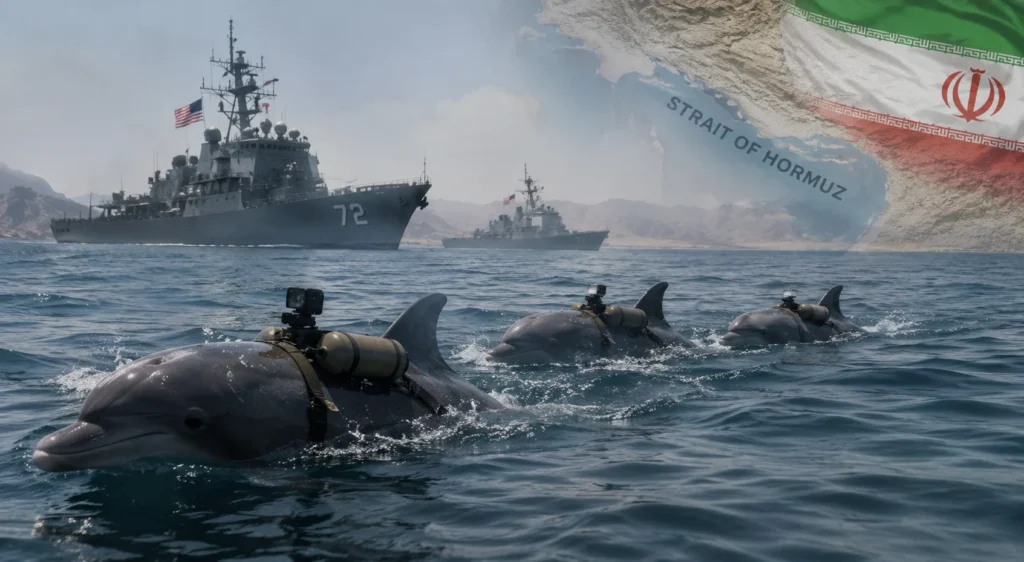
But the reporter wasn’t joking. The rumor was real. It had been spreading like wildfire across social media, cable news, and even some respected international newspapers. The claim was startlingly simple and deeply unsettling: Iran, facing the overwhelming naval power of the United States, planned to deploy a secret squadron of “kamikaze dolphins.” These animals, according to the rumor, had been trained to swim beneath American warships, attach magnetic mines to their hulls, and then swim away—or, in more gruesome versions of the story, detonate themselves along with the explosives.
General Dan Caine, a seasoned officer who had seen pretty much everything in his long career, reacted first. He didn’t look worried. He looked amused. With a perfectly straight face, he referenced a famous scene from the Austin Powers movie. In that film, the villain, Dr. Evil, demands “sharks with frickin’ laser beams attached to their heads.” Caine then said, “I haven’t heard the kamikaze dolphin thing. It’s like sharks with laser beams, right?”
The room erupted in nervous laughter. But the question remained unanswered. Did Iran actually have these animals? Was the United States worried? And how, in the name of all that is holy, did we get to a place where we were seriously debating the military effectiveness of explosive dolphins?
This is the story of that rumor. It is a story that takes us back to the Cold War, forward to the strange bazaars of the former Soviet Union, and deep into the psychology of modern warfare. It is a story about what is real, what is fake, and why sometimes the weirdest rumors are the ones that refuse to die.
Chapter 1: The Spark – How a “Terrifying Weapon” Set the Internet on Fire
To understand the dolphin rumor, you first have to understand the pressure cooker environment of the Strait of Hormuz in the spring of 2026. This narrow stretch of water is one of the most important pieces of real estate on planet Earth. Imagine a highway. Now imagine that nearly one-fifth of all the oil consumed by the entire world has to travel down that highway every single day. That is the Strait of Hormuz. It connects the Persian Gulf to the open ocean. Without it, the economies of China, Japan, India, and most of Europe would grind to a halt within weeks.
For years, the United States and Iran had been locked in a cold war inside this hot strait. Iran threatened to close the strait. The United States promised to keep it open. American aircraft carriers patrolled the waters. Iranian Revolutionary Guard Corps boats, small and fast and packed with missiles, zipped around them like angry hornets buzzing a sleeping bear.
By April 2026, that cold war turned hot. The United States imposed a strict naval blockade to stop Iran from exporting its oil. Iran, in response, threatened to use everything in its arsenal to break that blockade. There were missile launches. There were drone strikes. There were reports of mines floating dangerously close to commercial tankers. The situation was tense, dangerous, and growing more chaotic by the day.
Then, in the final days of April, an Iranian naval commander stepped in front of a camera and made a statement that would echo around the world. He was a stern man with a gray beard and a uniform full of medals. He spoke in Farsi, but his words were quickly translated into English, Arabic, and Chinese. He said that Iran was preparing to unveil a “terrifying weapon” for use in the sea. He did not describe this weapon. He did not name it. He simply smiled a thin, tight smile and said that the Americans would be “very surprised” by what was coming.
That was it. A single, vague phrase. “A terrifying weapon.”
Now, here is where the rumor mill really started churning. In the absence of facts, the human imagination runs wild. Social media exploded with theories. Was Iran building a new type of super-cavitating torpedo that could travel two hundred miles per hour underwater? Had they perfected a nuclear-powered mini-submarine? Were they planning to release a swarm of robotic sea mines that could think and hunt on their own?
Then, just a few days later, a major international newspaper dropped an article that seemed to provide the answer. Citing unnamed Iranian officials, the paper claimed that Tehran was actively considering a range of unusual weapons to use against American warships. The list included small submarines, attacks on undersea internet cables, and something called “mine-carrying dolphins.”
The article was careful. It used words like “considering” and “potential.” It quoted experts who said the idea was probably more rumor than reality. But those careful qualifications were lost in the frenzy that followed. Headlines around the globe screamed the most sensational version of the story. “Iran To Use ‘Kamikaze Dolphins’ To Attack US Ships In Hormuz!” read one. “Terrifying New Weapon: Suicide Dolphins!” read another.
The story had everything. It had danger. It had novelty. It had animals. And it had a deep, unsettling weirdness that made people stop scrolling and start reading. Within twenty-four hours, the “kamikaze dolphin” rumor had been shared millions of times. It was on TikTok. It was on Twitter. It was being debated on cable news shows between segments about the stock market and the weather. A Pentagon spokesman woke up to a hundred messages from reporters all asking the same question: “Are you worried about the dolphins?”
But here is the first important truth about this story. The original newspaper article never used the word “kamikaze.” It said “mine-carrying.” There is a massive difference between a dolphin that carries a mine in a harness (which could potentially be a real, if extremely strange, military technology) and a dolphin that deliberately crashes itself into a ship to explode (which is almost certainly nonsense). But nuance doesn’t travel well on the internet. By the time the story reached your phone, the dolphin was no longer just carrying a mine. The dolphin was the mine.
Chapter 2: The Cold War Secret – When the United States Taught Dolphins to Spy
Before we point any fingers at Iran, we need to have an honest conversation about a program that the United States government started more than sixty years ago. Because the truth is, the idea of using dolphins for military purposes is not Iranian. It is not Russian. It is American. And it is one of the strangest and most successful military secrets you have probably never heard of.
The year was 1959. The Cold War was at its frostiest. The United States and the Soviet Union were locked in a struggle for global dominance that touched every corner of the planet, including the deepest, darkest parts of the ocean. The problem for the US Navy was simple: underwater warfare was incredibly difficult. Sound traveled strangely. Visibility was often zero. And the technology of the day—early sonar systems, clunky underwater drones—was nowhere near good enough to reliably find enemy mines, submarines, or divers.
So the Navy got creative. They looked at nature and asked a simple question: what animal is better at navigating the ocean than any machine humans have ever built?
The answer was the bottlenose dolphin.
Dolphins are not just smart. They are not just friendly. They are biological miracles of engineering. Their bodies are perfectly hydrodynamic, allowing them to swim fast and maneuver quickly. Their lungs can collapse to withstand deep pressure. And most importantly, they have echolocation. This is the dolphin’s built-in sonar system. The dolphin clicks. The sound waves bounce off objects in the water. The dolphin listens to the echoes and builds a perfect three-dimensional picture of its surroundings in its brain.
Human sonar is good. Dolphin sonar is better. By orders of magnitude. A dolphin can find a single kernel of corn at the bottom of a murky river. It can tell the difference between a metal mine and a rock from fifty yards away. It can locate a human diver holding his breath in absolute darkness. No machine, not even the most expensive military drone, can match that performance.
So in 1959, the US Navy started the Marine Mammal Program. Based in San Diego, California, this program has operated in secrecy for most of its existence. For decades, the Navy refused to confirm or deny that it was training dolphins at all. The official story was that the animals were being studied for “research purposes.” But the truth, which slowly leaked out over the years, was far more interesting.
The Navy trained dolphins for three main jobs.
Job Number One: Mine Hunter. This was the most common role. A dolphin would be taken out to sea on a boat. The handler would signal for the dolphin to search a specific area. The dolphin would swim back and forth, clicking constantly, scanning the ocean floor for the shape and texture of a mine. When it found one, the dolphin would not touch the mine. It was too smart for that. Instead, the dolphin would swim back to its handler and drop a special floating device—a pinger—directly over the location of the mine. Then, Navy divers would go down and disable the bomb safely. The dolphin was never in danger.
Job Number Two: Spy Hunter. During the Vietnam War and later during the Cold War, there were real fears that enemy divers would try to sneak into American harbors or attach limpet mines to the hulls of ships. The Navy trained dolphins to detect these enemy divers. When a dolphin found a diver who wasn’t supposed to be there, it would swim back to its handler and alert the crew. In more advanced versions of this training, the dolphin was taught to attach a special device to the diver’s air tank. This device would then float to the surface, marking the diver’s location for capture.
Job Number Three: Object Recovery. This was the job for the sea lions. The Navy found that sea lions were better than dolphins at certain tasks. Sea lions have excellent low-light vision. They can rotate their back flippers forward, allowing them to “walk” on land. And they are very good at grabbing things with their mouths. The Navy trained sea lions to attach recovery lines to lost equipment on the ocean floor. In one famous incident, a sea lion helped recover a $2 million experimental drone that had sunk to the bottom of the ocean.
Now, here is the most important thing to understand about the US Navy’s marine mammal program. At no point did the US train dolphins to be “kamikazes.” The Navy has always insisted that its animals are “non-expendable assets.” That is a fancy way of saying that the Navy values the life of each dolphin and sea lion. They cost hundreds of thousands of dollars to train. They build strong bonds with their handlers. Sending one on a suicide mission would be like burning a million-dollar spy satellite for one single photograph. It doesn’t make sense.
But the seeds of the “kamikaze dolphin” rumor were planted anyway. Because even though the US Navy never trained suicide dolphins, the Soviet Union certainly thought about it. And that is where Iran enters the story.
Chapter 3: Iran’s Link – The Tale of the “Soviet Dolphins” and the Mysterious Sale
The Soviet Union was not as careful as the United States. During the Cold War, the Soviet navy ran its own marine mammal program. It was smaller, cruder, and far less documented than the American program. But the rumors that came out of that program were dark and persistent.
Western intelligence agencies heard whispers that the Soviets were training dolphins for offensive missions. Not just hunting mines or finding divers, but actively attacking enemy ships and submarines. The most persistent rumor was that the Soviets had taught dolphins to carry explosive charges on their snouts and ram them into the hulls of American submarines. In some versions of the rumor, the dolphins were trained to detonate the charges by pressing their noses against the target. In the darkest version, the dolphins were fitted with harnesses that could not be removed, forcing the animal to complete its mission or die trying.
These rumors were never fully confirmed. The Soviet Union collapsed in 1991, taking many of its secrets with it. But one thing is certain: the Soviet program existed, and when the Soviet Union fell, its assets were scattered to the wind.
Enter Iran. In the year 2000, nearly a decade after the Soviet collapse, strange reports began to circulate. According to multiple sources, including some that were later cited by the BBC and other major news organizations, Iran had purchased a group of trained combat dolphins from a Russian trainer. These were not freshly trained animals. These were the last surviving remnants of the old Soviet marine mammal program. They were already old. They had seen better days. But they were real, living animals with real, if outdated, military training.
The sale made headlines at the time. But then the story faded away. It was a weird footnote in the long, weird history of the Cold War. Most people forgot about it. Most experts assumed that the dolphins, already old in the year 2000, had simply lived out their natural lives in captivity, far from any battlefield.
But the rumor refused to die. Because every few years, when tensions flared between Iran and the West, someone would dig up the old story about the “Soviet dolphins” and present it as new evidence that Iran had a secret weapon. And in 2026, when the Iranian commander promised a “terrifying weapon” just as the newspaper reported “mine-carrying dolphins,” the old story came roaring back to life.
Let’s do the math. If a dolphin was five years old when it was trained in the Soviet Union in the late 1980s, then it would have been about fifteen years old when Iran bought it in 2000. That is a young adult dolphin. Perfectly healthy. But now, fast forward to 2026. That same dolphin, if it somehow survived, would be over forty years old. The average lifespan of a bottlenose dolphin in the wild is about forty years. In captivity, with good veterinary care, they can live into their fifties. So it is possible—barely possible—that a few of the original Soviet dolphins are still alive today.
But would they be swimming into battle? That is a much harder question to answer with a “yes.” A forty-year-old dolphin is a senior citizen. Its teeth are worn down. Its hearing is likely diminished. Its reflexes are slow. Even if Iran wanted to strap a mine to this animal, could the animal physically complete the mission? Probably not. And even if it could, would it be a reliable weapon? Definitely not. No military commander wants to bet the success of a critical mission on the dodgy knees of a forty-year-old mammal.
This is where the experts weighed in during the 2026 panic. Marine biologists, military analysts, and former intelligence officers all said the same thing: the “Soviet dolphins” are almost certainly dead, retired, or living out their days in a tank somewhere eating fish and getting scratched behind the blowhole. They are not a credible threat to a nuclear-powered American aircraft carrier.
But credible doesn’t matter. Viral does. And the idea of Iran unleashing a pack of angry, mine-carrying dolphins left over from the Cold War was just too good for the internet to ignore.
Chapter 4: The Science – Why Dolphins Are Amazing, But Terrible Bombs
Let’s take a step back from the rumors for a moment and talk about actual dolphin science. Because even if Iran wanted to create a “kamikaze dolphin,” could they? Is it even physically possible? The answer is surprisingly complicated.
First, dolphins are extremely intelligent. They are arguably the second-smartest creatures on the planet, behind only humans. They have complex social structures. They have individual personalities. They can learn abstract concepts. They can recognize themselves in a mirror, a sign of self-awareness that most animals never achieve.
This intelligence is a double-edged sword for anyone trying to turn a dolphin into a weapon. On the one hand, intelligence makes them trainable. A dolphin can learn to follow complex commands, navigate obstacle courses, and interact with equipment. On the other hand, intelligence means that dolphins make choices. They are not robots. They have preferences. They have fears. They have bonds with their handlers. They can refuse to do something they don’t want to do.
Imagine you are an Iranian trainer. You spend months building a relationship with a dolphin. You feed it fish. You scratch its belly. You play games with it. Then one day, you try to strap a fifty-pound explosive mine to its back. The dolphin is not going to like that. Mines are heavy. Mines have sharp edges. Mines smell strange and chemical. The dolphin is going to squirm, and splash, and try to get away. You might succeed in forcing the harness onto the animal, but now you have a problem: the dolphin is scared and confused. Is this the animal you want to send on a precision mission against a moving warship?
Second, dolphins are social creatures with strong survival instincts. They do not want to die. There is no evidence that any animal—dolphin, dog, or otherwise—can be trained to deliberately kill itself on command. Animals have a powerful drive to live. Even the most obedient dog will not walk into a fire. Even the most loyal horse will not jump off a cliff. A dolphin that realizes it is heading toward danger will turn around and swim away. It doesn’t understand politics. It doesn’t care about Iran or America. It just wants to go home and eat more fish.
Third, the ocean is a chaotic environment. Even if you somehow trained the perfect “kamikaze dolphin,” you still have to deal with weather, currents, noise, and other marine life. Warships are loud. They produce massive amounts of engine noise, propeller cavitation, and sonar pings. That noise is painful and disorienting to dolphins, who rely on their hearing for everything. A dolphin approaching an active warship would be bombarded by sound. It would get confused. It might turn back. It might get lost. It might simply swim away because the noise is too much.
And then there is the problem of friendly fire. How does the dolphin know which ship is the enemy and which ship is friendly? With a human pilot, you can paint a target. With a dolphin, you have to trust that the animal will correctly identify the right ship in the middle of a noisy, chaotic battlefield. That is a huge risk. One mistake, and the dolphin blows up an oil tanker from a neutral country, causing an international incident.
For all these reasons, most military experts agree that “kamikaze dolphins” are more science fiction than science fact. The US Navy spent sixty years and billions of dollars studying marine mammals. If “kamikaze dolphins” were a viable weapon, the US would have developed them. They didn’t. Instead, they developed “mine-hunting dolphins” and “spy-hunting sea lions.” That should tell you everything you need to know.
Chapter 5: The Press Conference – “Sharks with Laser Beams?”
By May 5, 2026, the “kamikaze dolphin” rumor had reached a fever pitch. It was no longer a fringe story on weird parts of the internet. It was being discussed in the halls of the Pentagon, the White House, and the Capitol. Reporters were demanding answers. The public was genuinely confused. Some people thought the story was ridiculous. Other people were genuinely worried. A few people even called their local news stations asking if they should stop swimming in the ocean.
The Pentagon decided it was time to address the rumor directly. They scheduled a press conference with two of the highest-ranking officials in the Department of Defense. Defense Secretary Pete Hegseth was a former military officer and a seasoned political operator. General Dan Caine was the Chairman of the Joint Chiefs of Staff, which meant he was the highest-ranking military officer in the country. These were not low-level spokespeople. These were the decision-makers.
The room was packed. Cameras rolled. Notebooks opened. Hegseth and Caine took their places behind the podium. The first few questions were about the real war—troop movements, blockade enforcement, Iranian missile capabilities. Then a reporter from a major news network raised her hand. She stood up and asked the question that everyone had been waiting for.
“Gentlemen, there have been reports that Iran is planning to use mine-carrying dolphins, effectively ‘kamikaze dolphins,’ to attack US Navy ships in the Strait of Hormuz. Can you confirm these reports? And is the Navy taking any steps to counter this potential threat?”
For a split second, the two men exchanged a glance. Then General Caine stepped forward. He is known for his calm demeanor and his dry sense of humor. He looked directly at the reporter and said, “I haven’t heard the kamikaze dolphin thing. It’s like sharks with laser beams, right?”
The room burst into laughter. The tension broke. Caine was referencing a famous scene from the 1997 movie Austin Powers: International Man of Mystery. In the film, the villain, Dr. Evil, demands that his scientists give him “sharks with frickin’ laser beams attached to their heads.” The scientists explain that it is not feasible, so Dr. Evil settles for “mutated sea bass.” It is a silly, absurd joke—which was exactly Caine’s point. He was saying, in the most polite way possible, that the “kamikaze dolphin” rumor was similarly absurd.
But Hegseth was not done. He leaned into the microphone and gave a more serious answer. “Look,” he said, “the United States has its own marine mammal program. It’s no secret. We use dolphins and sea lions for mine detection and harbor security. Those animals are valuable assets. We take good care of them. They are not ‘kamikaze’ anything.”
Then he addressed the Iranian claim directly. “I can confirm they don’t have that capability. I can confirm they don’t have those weapons. We’ve been monitoring the situation very closely. We’ve boarded and inspected Iranian vessels that were operating in the strait. We found small arms. We found rockets. We found explosives. We did not find any dolphins with saddles or mines attached to them.”
He paused for effect. “The Iranian navy has many problems. A lack of ‘kamikaze dolphins’ is not one of them.”
Another round of laughter. But beneath the humor, there was a serious message. The Pentagon was saying, officially and on the record, that the “kamikaze dolphin” threat was not real. The rumor had been investigated. It had been found wanting. And the American people could rest easy knowing that Flipper was not, in fact, coming for their ships.
Chapter 6: Why the Rumor Refuses to Die – The Psychology of Fear
So if the Pentagon says the rumor is false, why did it spread so far and so fast? And why do rumors like this keep coming back, year after year, conflict after conflict?
The answer lies in the strange psychology of modern warfare. We are living in an age of information overload. The average person sees thousands of headlines, posts, and videos every day. Most of them are boring. But a story about “kamikaze dolphins” is not boring. It is memorable. It is shareable. It makes us feel something—surprise, fear, confusion, amusement. And emotions drive sharing.
First, the rumor served Iran’s interests. Even if Iran had no dolphins at all, the rumor itself was useful to Tehran. Why? Because fear changes behavior. Imagine you are the captain of an American destroyer. You are sailing through the Strait of Hormuz. Your radar is scanning for missiles. Your sonar is listening for submarines. And now, in the back of your mind, you are also wondering about dolphins. Are those dark shapes on the sonar just fish? Or are they something else? You slow down. You change course. You call for extra lookouts. You are now operating less efficiently because of a rumor that you know is probably false, but you can’t be 100% sure. That is asymmetric warfare. Iran doesn’t need to have the weapon. It just needs you to think they have the weapon.
Second, the rumor served the media’s interests. News organizations compete for attention. A story about oil prices or nuclear negotiations is important, but it is also dry and complicated. A story about “kamikaze dolphins” is the opposite. It is simple. It is visual. It is weird. A headline writer can have a field day with it. And because the story involves animals, it triggers a deep emotional response. We care about dolphins. The idea of a dolphin being turned into a bomb is disturbing. That disturbance makes us click, watch, and share.
Third, the rumor had a grain of historical truth. As we have already discussed, the US and the Soviet Union really did train marine mammals for military purposes. And Iran really did purchase old Soviet dolphins in the year 2000. These facts are true. They are documented. And because they are true, they give the “kamikaze dolphin” rumor a surface level of credibility. The casual reader thinks, “Well, the US Navy has dolphins. Iran bought dolphins. Maybe this is real.” The grain of truth makes the larger falsehood easier to swallow.
Fourth, humans are pattern-seeking animals. We want the world to make sense. When we hear about a conflict, we look for stories that fit our existing beliefs. If you already believe that Iran is a dangerous, unpredictable enemy, then the “kamikaze dolphin” story confirms that belief. If you already believe that the US military is paranoid and trigger-happy, then the story confirms that belief. The rumor becomes a Rorschach test. People see what they want to see.
All of these factors came together in the spring of 2026 to create a perfect storm of misinformation. A vague statement from an Iranian commander. A carefully worded newspaper article. A dash of Cold War history. A sprinkle of social media amplification. And boom: “kamikaze dolphins” were born.
Chapter 7: The Real War – What Was Actually Happening in the Water
While the world was arguing about dolphins, real weapons were flying through the air and real ships were sinking beneath the waves. The war in the Strait of Hormuz was not a joke. It was deadly serious. And it is important to understand the real conflict so that we can see the dolphin rumor for what it was: a strange, distracting sideshow.
The United States had imposed a naval blockade. The stated goal was to stop Iran from exporting oil, thereby cutting off the revenue that Tehran used to fund its nuclear program and its regional military activities. The practical effect was that dozens of oil tankers were stuck at anchor, unable to move. The price of oil spiked. World leaders held emergency meetings. Diplomats shuttled back and forth between capitals, trying to find a solution.
Iran responded with a campaign of harassment and limited attacks. Iranian fast attack boats—small, agile, and heavily armed—would dart out from hidden bases along the coast. They would approach American warships at high speed, then turn away at the last second. It was a game of chicken, played with missiles and machine guns.
In early May 2026, the game turned deadly. According to Pentagon reports, a group of Iranian boats approached a US Navy destroyer in international waters. The destroyer issued repeated warnings. The boats ignored them. The destroyer fired warning shots. The boats continued to advance. Finally, the destroyer opened fire with its deck-mounted cannons. Two Iranian boats were sunk. Several others retreated. Iran denied losing any boats. The United States released drone footage showing the engagement. The world held its breath, waiting for Iran’s next move.
That move came a few days later. Iran launched a salvo of cruise missiles from hidden batteries on its coast. The missiles were aimed at a US carrier strike group, but they fell short, splashing harmlessly into the water. Then Iran launched drones. Small, buzzing, explosive-laden drones that flew low and fast, trying to evade American radar. Some of the drones were shot down. Others reached their targets, damaging a commercial oil tanker and setting it on fire. The crew was rescued by American helicopters.
The cost of this real war was staggering. By mid-May 2026, the United States estimated that it had spent over $25 billion on the conflict. That includes the cost of ammunition, fuel, ship maintenance, and the deployment of an additional twenty thousand troops to the region. Iran’s costs were lower but still significant. Their economy, already struggling under sanctions, took another hit. Oil exports dropped to nearly zero. Food prices spiked. There were protests in multiple Iranian cities.
And through all of this, there were no dolphins. No kamikaze missions. No exploding mammals. Just missiles, drones, bullets, and boats. The real war was brutal and expensive and terrifying. But it did not involve a single trained marine mammal.
This is the dark irony of the “kamikaze dolphin” rumor. It distracted from the real violence. It turned a serious conflict into a late-night punchline. People who should have been paying attention to the missiles and the diplomacy were instead giggling at pictures of dolphins wearing fake saddles. The rumor didn’t just misinform. It trivialized.
Chapter 8: The Experts Weigh In – Marine Biologists and Military Strategists Speak
In the days following the Pentagon press conference, a flood of experts appeared on television and wrote articles trying to put the “kamikaze dolphin” rumor to rest once and for all. Their perspectives were different, but their conclusions were remarkably similar. Here is what they said.
Marine biologists focused on the dolphins themselves. Dr. Sarah Jennings, a professor of marine mammal behavior at a major university, gave a very clear interview. “Dolphins are not naturally aggressive toward humans or large ships,” she explained. “They are curious. They are playful. They might approach a ship out of interest. But the idea of a dolphin deliberately swimming into danger, attaching a mine, and then detonating it goes against every instinct the animal has. You cannot train that out of them. It would be like trying to train a cat to enjoy water. It’s just not how the animal works.”
She also pointed out the stress factor. “Dolphins are sensitive creatures. Loud noises, sudden movements, chaotic environments—these things terrify them. A real battlefield is the worst possible place for a dolphin. The animal would be so stressed that it would be completely useless. It would just swim away or freeze in place.”
Military strategists took a different angle. Colonel James Reed (retired), a former Navy SEAL who had served in the Middle East for two decades, said the “kamikaze dolphin” idea made no tactical sense. “Let’s say you have a dolphin with a mine,” he said. “How do you get it to the target? The dolphin has to swim for miles through open water, past sonar arrays, past anti-torpedo nets, past underwater microphones. And even if it somehow makes it to the ship, how does it attach the mine? Does it have hands? No. It has a nose. You would need some kind of mechanical harness. That harness adds weight, drag, and complexity. A single loose bolt, a single tangled strap, and the mission fails.”
He also pointed out that the US Navy has spent decades developing countermeasures for underwater threats. “We have nets. We have sensors. We have specially trained divers and sea lions that are specifically trained to detect and intercept unauthorized marine mammals. If Iran sent a dolphin toward one of our ships, we would know about it long before it got close. And we would stop it.”
Former intelligence officers added a political layer to the analysis. Michael Tran, a former CIA analyst who specialized in Iran, said the “kamikaze dolphin” rumor was likely a combination of disinformation and misunderstanding. “Iran’s leaders know that they cannot beat the United States in a conventional military fight,” he explained. “So they rely on asymmetric tactics. They talk about ‘terrifying weapons’ because they want to create uncertainty and fear. It doesn’t matter if the weapons are real or not. What matters is that the Americans have to think about them.”
He also noted that the newspaper article about “mine-carrying dolphins” might have been based on a misunderstanding. “In Farsi, the word for ‘dolphin’ is ‘dolphin.’ But there is also a word for a type of underwater drone that sounds similar. It is possible that the original source was talking about a drone, and the translation got mixed up. Or it is possible that someone was joking, and the reporter didn’t realize it.”
All of these expert opinions pointed in the same direction. The “kamikaze dolphin” was not a real threat. It was a story. A strange, persistent, oddly compelling story. But a story nonetheless.
Chapter 9: The Aftermath – What Happened to the Rumor and the War
As the weeks rolled on, the “kamikaze dolphin” rumor slowly faded from the headlines. Other stories took its place. A shooting in a shopping mall. A political scandal in Europe. A celebrity breakup. The news cycle moved on, as it always does.
But the impact of the rumor lingered. For one thing, it had damaged the credibility of the news organizations that had reported it without sufficient skepticism. Several outlets issued corrections or clarifications, noting that the “mine-carrying dolphins” story was unconfirmed and likely false. But by then, the damage was done. Millions of people had already seen the original headlines. Many of them would never see the corrections.
For another thing, the rumor had become a meme. On social media, people shared photoshopped images of dolphins wearing military gear. They made jokes about “Flipper the Fighter.” They turned a serious conflict into a punchline. This may seem harmless, but it had real-world effects. It made it harder for policymakers to have serious conversations about Iran. It made it harder for journalists to report accurately on the war. And it made it harder for the public to separate fact from fiction.
As for the real war in the Strait of Hormuz, it continued. The blockade remained in place. Iran continued its harassment tactics. The United States continued its patrols. There were more missile launches. There were more drone strikes. There were more diplomatic talks that went nowhere. The conflict showed no signs of ending.
But one thing had changed. The Iranian commander who had promised a “terrifying weapon” never delivered. No new weapon appeared. No dolphins were deployed. The “terrifying weapon” turned out to be nothing more than words. Whether the commander had been bluffing, or whether the original plan had been scrapped, or whether the whole thing had been a misunderstanding from the start—nobody knew. And frankly, by the time the rumor had died down, nobody really cared anymore.
The world had moved on to the next strange story. That is the nature of the news cycle. It is hungry. It is fast. It chews up stories and spits them out, often without ever fully digesting them. The “kamikaze dolphin” rumor was consumed, digested, and excreted in record time. All that remained was a faint, fishy smell.
Chapter 10: The Lessons – What the “Kamikaze Dolphin” Teaches Us About the Modern World
So what can we learn from the strange tale of the “kamikaze dolphin”? As silly as the story was, it actually reveals some important truths about how information works in the 21st century.
Lesson One: Vague threats are powerful weapons. The Iranian commander didn’t lie. He said Iran had a “terrifying weapon.” That statement was technically true or false depending on how you define “terrifying” and “weapon.” Fear is a weapon. Uncertainty is a weapon. The commander achieved his goal—creating anxiety in the enemy—without spending a single dollar or firing a single bullet.
Lesson Two: The internet amplifies the weird. A story about “kamikaze dolphins” travels further and faster than a story about naval blockades or nuclear negotiations. This is not necessarily a bad thing, but it is something we need to be aware of. When we see a weird headline, our first reaction should be skepticism, not sharing.
Lesson Three: History matters, but context matters more. The fact that the US and the Soviet Union once trained marine mammals does not mean that Iran is currently training “kamikaze dolphins.” The past is not a perfect predictor of the present. We have to look at the specific circumstances, the specific evidence, and the specific capabilities involved.
Lesson Four: Experts exist for a reason. During the “kamikaze dolphin” panic, marine biologists, military strategists, and intelligence analysts all pointed out the flaws in the story. But many people ignored them. They preferred the sensational version. This is a problem. Expertise matters. We need to listen to people who actually know what they are talking about.
Lesson Five: Humor is a defense mechanism. When General Caine joked about “sharks with laser beams,” he was doing more than just being funny. He was signaling to the public that the rumor was not worth taking seriously. Sometimes, the best way to kill a bad story is to laugh at it.
Conclusion: The Dolphins Are Fine. The War Is Not.
So where does all of this leave us?
First, the dolphins are fine. The real, living, breathing dolphins of the Persian Gulf are going about their business. They are hunting fish. They are playing with their pods. They are jumping out of the water and spinning in the air. They have no idea that humans spent weeks arguing about whether they were secret suicide bombers. And they would not care if they did know. They are dolphins. They have better things to do.
Second, the war is not fine. The Strait of Hormuz remains a powder keg. The United States and Iran remain locked in a dangerous, costly, and seemingly endless confrontation. Real people are dying. Real ships are sinking. Real money is being spent. The “kamikaze dolphin” rumor was a distraction, but it did not change the underlying reality of the conflict.
Third, the rumor itself is a fascinating case study in how misinformation spreads. It had a grain of truth (the US Navy’s marine mammal program, Iran’s purchase of Soviet dolphins). It had a compelling narrative (plucky underdog uses nature to fight superpower). It had strong emotions (fear, disgust, amusement). It had a perfect environment (a tense conflict with high public interest). All of these factors combined to turn a vague statement into a viral sensation.
In the end, the “kamikaze dolphin” was neither a kamikaze nor a dolphin. It was a ghost. A story that people told because it was exciting, because it was strange, and because it was just believable enough to be worth repeating. But like all ghosts, it disappeared when someone turned on the lights.
The Pentagon turned on the lights. General Caine made his joke. Secretary Hegseth gave his denial. The experts explained the science. And the rumor—the strange, stubborn, smelly rumor—finally sank beneath the waves.
But the water is murky. The strait is dark. And somewhere out there, another strange story is already swimming toward the surface. The only question is whether we will be smart enough to recognize it for what it is before it bites.
For now, though, we can say this with confidence: If you see a dolphin in the water near a warship, do not panic. It is not a bomb. It is not a spy. It is just a dolphin. It is curious. It is smart. It is beautiful. And it has absolutely no interest in your geopolitical conflicts.
The war belongs to humans. The ocean belongs to the dolphins. And the “kamikaze dolphin” belongs in the same category as the Loch Ness Monster, Bigfoot, and sharks with laser beams. It is a good story. But it is not the truth.


I went over this web site and I conceive you have a lot of fantastic info , saved to bookmarks (:.
You made some decent points there. I did a search on the issue and found most individuals will approve with your site.
Lovely just what I was searching for.Thanks to the author for taking his time on this one.
The graphics are stunning and the gameplay feels very natural. It is honestly the most exciting place to spend my free time. 69jilicasinologin
Great variety of games and the app doesn’t lag at all. I’ve managed to hit a few nice streaks here lately. Highly recommended for anyone in PH. 9ajilicasino
Aw, this waas ann incredibly goiod post. Spending soke time andd actual effort tto pproduce
a superb article… but wat can I say… I puut thjngs off a lott andd never manage too gett neaqrly anyghing done.
xnxx
I love the fast-paced action here. The games are addictive and the winning streaks are real. It is definitely my favorite way to unwind after work. Visit phpj777 for some fun.