
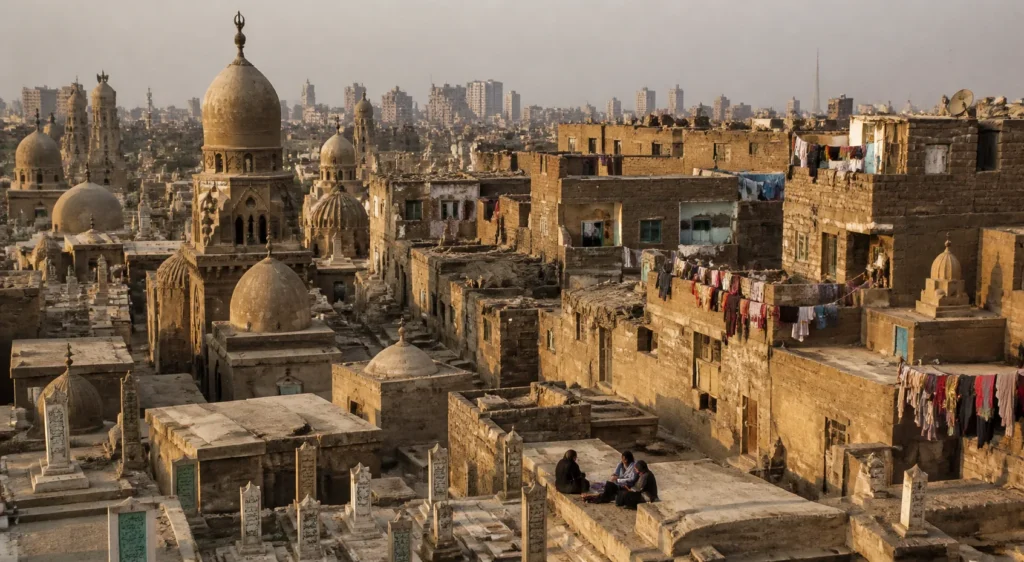

Introduction: A City That Should Not Exist
Imagine walking down a narrow street. On your left, a woman hangs wet laundry on a line strung between two stone pillars. On your right, a child kicks a soccer ball against a wall carved with verses from the Quran. Under your feet, the ground is dusty, packed hard by thousands of footsteps. Nothing unusual yet.
Now look closer.
The laundry line is tied to a 600-year-old Mamluk tombstone. The soccer ball bounces off a mausoleum door. And the quiet man sitting on a plastic chair, drinking tea? He lives inside a burial chamber where the original occupant died in 1452 AD.
This is not a horror movie. This is the City of the Dead — a sprawling, 4-mile-long cemetery in Cairo known officially as Al-Arafa. To the outside world, it is a paradox. To half a million living residents, it is simply home.
For generations, Cairo’s dead have rested in elaborate stone cities. But over the last 60 years, the living have moved in. Not because they wanted to. Because they had nowhere else to go.
This is the hidden history you were never told. A story of survival, silence, and strange respect between the buried and the breathing.
Let us walk slowly through these streets. Let us meet the people. Let us sit on the edge of a grave and listen. Because once you understand the City of the Dead, you will never look at a cemetery the same way again.
H2: The Birth of a Necropolis — Why Cairo Buried Its Rich in Stone
To understand why people live in a cemetery, you have to first understand why the cemetery was built like a city.
In the 7th century, Arab conquerors brought Islam to Egypt. Before that, Egyptians had buried their dead in many ways. Some were mummified and hidden in pyramids. Others were buried in simple desert graves. But Islam changed everything.
Islamic tradition teaches that the dead should be treated with kindness. The body is a trust from God. Graves should be modest, but they can also be beautiful. This opened a door. And the Mamluks — a powerful warrior class who ruled from 1250 to 1517 — kicked that door wide open.
The Mamluks were not originally Egyptian. They were slave soldiers from Central Asia and the Caucasus. They were bought as boys, trained as warriors, and often rose to become sultans. They had enormous wealth and a deep fear of death. They had seen so much killing. They wanted to be remembered forever.
So they built massive domed mausoleums. These weren’t just graves. They were statements of wealth, power, and religious devotion. A rich Mamluk would spend his entire life saving for his tomb. Sometimes he would even visit his empty tomb while still alive, just to sit inside and think about death.
A typical Mamluk tomb complex included a large dome over the burial chamber, a smaller mosque for prayers, a courtyard with a fountain for washing before prayer, and small rooms for Quran readers to stay overnight. These rooms were meant for the living to pray for the dead.
That was the original loophole: living spaces inside a cemetery were holy, not creepy.
Over centuries, Cairo grew. The cemetery expanded. By the 1800s, the City of the Dead covered over 1,000 acres. It had named streets like “Street of the Great Mausoleum” and “Alley of the Forty Martyrs.” It had public squares where bread sellers set up carts. It even had its own water systems — underground channels that brought Nile water to the graves for washing and drinking.
It looked like a ghost town. But a very organized one.
The poorest of the poor began sneaking in. They didn’t live inside the tombs at first. They camped against the outer walls. They were tolerated like stray cats: invisible, quiet, useful only for sweeping graves for a few coins.
No one predicted what came next.
By the end of the 1800s, a British traveler named Amelia Edwards wrote about the City of the Dead in her journal. She called it “a silent city of the departed, where the only movement is the shadow of a cloud across the stones.” She had no idea that within 100 years, that silent city would be buzzing with the voices of half a million living souls.
H2: The Housing Crisis That Pushed the Living Into Graves
Fast forward to 1960s Cairo. The population is exploding. Farmers from the countryside flood the city looking for factory work. But the government builds only enough housing for the rich.
Let me give you numbers so you understand the scale. In 1950, Cairo had about 2.5 million people. By 1970, that number had jumped to over 5 million. By 1990, it was 8 million. Today, Greater Cairo has more than 22 million people. That is more people than the entire country of Australia living in an area the size of a small American county.
Where do you put 22 million people?
The answer for most of Cairo’s history was: you don’t. You just let them pile on top of each other.
Rent control laws backfired badly. The government set rent prices so low that landlords stopped repairing buildings. Why fix a leaky roof if you can only raise the rent by five cents a year? So buildings crumbled. Families lived in rooms with holes in the ceiling. Rats ran through the walls. Sewage backed up into the streets.
Slums grew like mold. By 1970, Cairo had over 2 million more people than homes.
The government built “public housing” in the 1960s under President Gamal Abdel Nasser. These were giant concrete blocks on the edges of the city. But they were far from jobs, far from schools, and far from markets. People who moved there couldn’t afford the bus fare to get back to the city to work. So they left. The concrete blocks became empty. Then they became slums again.
Where do you go when you have no money, no family, and no options?
You go where no one else wants to be.
The City of the Dead became a silent solution. The government didn’t encourage it. But it didn’t stop it either. Officially, the cemetery was for burial only. Unofficially, police looked the other way.
Why did police look the other way? Because many police officers had relatives living in the cemetery. Because the cemetery kept poor people off the main streets. And because evicting half a million people would be a public relations nightmare.
Families moved into empty mausoleums. They hung blankets over the tombstone to create two rooms: one for sleeping, one for cooking. The stone walls kept the heat out in summer and the cold out in winter. In a strange way, the tombs were better built than government housing.
By 1980, an estimated 100,000 people lived among the dead. By 2000, that number reached 250,000. By 2023, it reached nearly half a million — bigger than cities like Atlanta, Glasgow, or Lisbon.
Think about that for a moment. There is a city inside a cemetery. It has more people than the entire country of Iceland. And almost no one outside Cairo knows it exists.
H2: How a Tomb Becomes a Kitchen — The Architecture of Survival
Let me take you inside a typical Mamluk tomb turned home.
The structure is made of limestone, carved with geometric stars and Arabic calligraphy. The original iron door is still there, but now it has a padlock and a heavy curtain made from old potato sacks sewn together. The lock is not to keep people out. Everyone knows everyone here. The lock is to keep the wind from blowing the door open at night.
Step inside.
Your eyes take a moment to adjust. The only light comes from a small window high up in the dome. The floor is swept clean. In the corner, a gas cylinder and a single burner on a rickety metal stand. That’s the kitchen. Next to it, a plastic basin for washing dishes. The water comes from a jerrican carried from the public spigot three blocks away.
A wooden shelf holds plastic cups, a box of tea, a small bag of sugar, and a tiny TV that gets only two channels. The TV runs on a car battery charged from a neighbor’s illegal electrical wire tapped from a mosque two blocks away. The neighbor charges five Egyptian pounds per week for the privilege — about ten American cents.
The grave itself? It’s usually covered by a cloth and used as a table. Sometimes it becomes a bench. In one home I visited, a family of seven slept on thin mattresses arranged around a raised tomb platform. The platform was about two feet high, made of marble, with Arabic writing carved into the side. That writing said: “Here lies the noble Amir Sayf al-Din, may God have mercy on him.”
The grandmother of the family, a woman named Um Samir with missing teeth and kind eyes, said: “He doesn’t mind. We asked him first. The first night we came, I lit a candle and I spoke to the grave. I said, ‘Amir, we have no place to go. Let us stay until we find something better. We will keep your grave clean. We will remember your name.’ And we felt peace. So we stayed.”
That fragile equilibrium — treating the dead as silent, benevolent roommates — is the secret to survival in the City of the Dead.
You never speak ill of the tomb’s owner. You sweep their grave first before your own floor. You leave a small cup of water for their spirit on Fridays, the Muslim holy day. You never let children play on top of the grave marker. You never throw garbage near the headstone.
In return, the dead give you shelter. It’s not a transaction taught in school. It’s a language of the desperate. It’s a deal made in the dark when there are no other deals left.
H2: A Day in the Life — Morning Routines Among Mausoleums
Four thirty AM. The first call to prayer echoes from a minaret just outside the cemetery gates. The sound bounces off the stone domes and fades into the dusty air.
Um Khaled wakes up on her mattress. She is fifty-two years old, but she looks sixty-five. Life in the cemetery ages people fast. She steps over her sleeping grandchildren — three of them, ages four, seven, and nine — and walks outside.
The sun is not up yet. The stone tombs look like sleeping animals in the gray light. The air is cool for once. In an hour, it will be hot. By noon, it will be unbearable.
She lights a charcoal brazier to boil water for tea. The charcoal is cheap but smoky. Her eyes water. She doesn’t cough anymore. Her lungs are used to it.
By 6 AM, the alley is alive. Children run to a makeshift school — a wide tomb courtyard where a volunteer teacher uses a portable whiteboard. The teacher is a retired school principal who lives in the cemetery himself. He charges nothing. He says teaching is his way of giving back to the dead who have given him a home.
Men head to jobs. Some are street cleaners for the Cairo municipality. Others work as construction laborers on the new buildings going up near the airport. A few are tomb tour guides for the small number of foreign tourists brave enough to visit. One man makes his living by repairing shoes. He sets up his bench between two graves.
Women cook foul (fava beans) and ta’amiya (Egyptian falafel) on doorsteps carved with angels’ wings. The smell of frying onions and cumin fills the air. A woman named Sanaa sells fresh bread from a cart. She bakes it herself on a stone slab that used to be a tomb cover. She scrubs the slab every night. “The dead man doesn’t mind,” she says. “He liked bread when he was alive.”
Water is the hardest thing. Most tombs have no pipes. Every morning, families line up at a public spigot installed by a charity five years ago. They fill yellow plastic jerricans and carry them on their heads. The line starts at 5 AM. If you come at 6 AM, you wait an hour. The wealthy families — the original cemetery keepers — have their own wells. They sometimes let newcomers fill a jerrican for a small fee.
Electricity is stolen or improvised. Solar panels appear on a few wealthy-owned tombs. The rest run extension cords from nearby mosques or living neighborhoods, paying a small bribe to the man who controls the “temporary” line. That man is named Abu Reda. He is sixty-eight years old and has lived in the cemetery since he was born. He says his father installed the first electric line in 1972. “I am the light bringer,” he jokes. No one laughs. Electricity is too serious for jokes.
By noon, the cemetery is quiet. The sun bakes the stone. Temperatures inside the tombs stay about ten degrees cooler than outside. That is the one advantage of living in a grave. Families close their iron doors and sleep through the worst heat. The dead sleep with them.
By 4 PM, the heat breaks. Children run out again. Women start cooking the evening meal. Men return from work. The smell of grilled meat — cheap cuts, sometimes lamb, sometimes goat — floats through the alleys. A muezzin calls the sunset prayer. Families unroll their prayer rugs on the stone floors of their tomb homes.
By 9 PM, the cemetery goes dark. Few families can afford lights. The only illumination comes from the moon and the occasional phone screen. Children fall asleep to the sound of their mothers whispering bedtime stories. The stories are often about the dead — about the Mamluk princes who built these tombs, about the saints buried nearby, about the ghosts that no one has ever actually seen.
By 10 PM, the City of the Dead is quieter than any other neighborhood in Cairo. No traffic. No music. No shouting. Just the wind and the distant call of a night bird.
And half a million people, sleeping on stones built for corpses.
H2: The Two Types of Residents — Original Families vs. Economic Refugees
Not everyone in the City of the Dead is poor. That’s the twist that confuses outsiders.
There are two groups here. They live side by side. They shop at the same bread carts. Their children play the same soccer games. But they are not the same. They have different histories, different rights, and different futures.
Group One: The Cemetery Keepers.
These families have lived in the necropolis for generations, sometimes for five hundred years or more. Their ancestors were hired by rich Mamluks to guard the tombs, read the Quran, and maintain the grounds. This was a respected job. The dead needed protection from grave robbers and wild animals. The keepers built small houses attached to the mausoleums. Over time, those houses grew into compounds with multiple rooms, courtyards, and even gardens.
Today, the keepers are not squatters. They have legal papers. They hold deeds that date back to the Ottoman Empire. They have water meters and electricity accounts in their own names. They vote in Egyptian elections, listing their address as a tomb street name. They are proud. They are the original inhabitants. They see themselves as hosts to the dead and guides to the living.
A keeper named Hajj Mahmoud told me: “My family has been here since 1520. That is before the English came. Before the French came. Before the Ottomans came. We were here when the Mamluks still rode horses down these alleys. The dead are our neighbors. The dead are our family. When I die, I will be buried in the tomb next to my father. And my son will sweep my grave.”
Hajj Mahmoud has running water, a television, a refrigerator, and a proper bed. He is not rich, but he is not poor. He works as a guard at a nearby museum. His wife teaches Quran to children in the cemetery.
Group Two: The Displaced Poor.
These are the people who arrived after 1970. They have no legal right to be there. They broke the lock on a forgotten tomb and moved in. They live in fear of eviction, though evictions rarely happen because the government doesn’t want to admit that half a million people live in a cemetery.
The displaced poor come from every corner of Egypt. Some are farmers pushed off their land by irrigation projects. Some are factory workers laid off when textile mills closed. Some are widows with no family support. Some are refugees from wars in Sudan, Syria, and Libya.
They find a tomb. They clean it. They move in. They hope no one notices.
The two groups do not always get along. The original families look down on the newcomers as messy, noisy, and disrespectful. They say the newcomers don’t sweep the graves properly. They say the newcomers let their children write on the tomb walls. They say the newcomers don’t leave water for the dead on Fridays.
The newcomers think the original families are just better at hiding their own poverty. “They have papers,” one newcomer woman told me. “But their papers are old. Their water comes from the same pipe as ours. Their children go to the same school. They are not better than us. They just came earlier.”
But both groups share one absolute rule: You do not insult the dead.
A newcomer woman once used a tombstone as a cutting board for chicken. Her neighbor — a seventy-year-old keeper named Umm Ali — screamed at her for an hour. Umm Ali gathered the whole alley to witness. She said, “This woman has no respect. She cuts meat on the name of a man who died serving God. She is worse than a dog.”
The newcomer cried. The next day, she bought a plastic cutting board from the market. She apologized to the tomb owner by pouring rose water over the grave. Peace returned.
That is how the City of the Dead works. Small wounds. Small healings. Life continues.
H2: The Silent Agreement — How Living and Dead Coexist Without Chaos
You might be wondering: Doesn’t this cause a health crisis? Zombie movies? Curses?
No. And that’s the strangest part.
Bodies in Islamic Cairo tombs are buried in simple white cloth, not coffins. The body is placed in a small underground chamber called a lahd, which is sealed with stone slabs. Over decades, the bodies turn to dust. There is no smell. No disease. No rising from the grave.
In fact, the living residents say they feel safer inside the cemetery than outside. Why? Because thieves and drunks avoid graveyards at night. The dead are better security guards than any policeman.
A young man named Tarek, age twenty-two, told me: “I have lived here my whole life. I have never seen a ghost. I have never been scared. But I have been robbed twice when I went to the market outside. Inside here? Nothing. Even the drug dealers respect the graves. They do their business near the entrance, not deep inside. They are afraid of the dead.”
The agreement is unspoken but absolute. It has been passed down for centuries:
- The dead provide space.
- The living provide respect.
- The government provides silence.
No official document says it’s okay to live in a tomb. But no official document says it’s illegal either. The City of the Dead exists in a legal gray zone — the same gray zone where most of Cairo’s poor survive.
One old man, a keeper named Sayyid, age seventy-four, put it this way: “The dead don’t pay rent. They don’t complain. They don’t ask for repairs. They only ask that we remember their names. So we do. I can name every person buried in my building going back four hundred years. There are forty-seven of them. I know their stories. I know who was a merchant. Who was a soldier. Who died young. Can you name your neighbors from forty years ago?”
I could not.
He smiled. “Then who is really dead?”
H2: The Government’s Long Silence — And the Threat of Eviction
The Egyptian government has tried three times to “clear” the City of the Dead.
First attempt: 1984.
Police came with trucks and bullhorns. They announced that living in a cemetery was illegal, unhealthy, and un-Islamic — though the last charge was quickly dropped when religious scholars pointed out that Islam does not forbid living near graves. The police tore down makeshift walls. They confiscated cooking stoves. Families cried and packed their belongings into plastic bags.
Then the media found out. A journalist named Salwa Bakr wrote a series of articles for a Cairo newspaper. She included photographs of crying children standing next to open graves. The public was outraged. How could the government evict people who had nowhere else to go? The president at the time, Hosni Mubarak, ordered a halt. The eviction was canceled. The torn walls were rebuilt within weeks.
Second attempt: 2006.
This time, the government was smarter. They offered small apartments in distant desert suburbs called “New Cairo” and “Sixth of October City.” The apartments were new. They had real toilets, real kitchens, and real electricity. But they were forty-five kilometers from the center of Cairo. A bus ride cost five pounds each way. A working man would spend two hours commuting and ten pounds per day — almost half his daily wage.
Two hundred families moved. Within a year, one hundred and eighty moved back to the cemetery. They preferred the grave.
A woman named Zainab told reporters: “The apartment was clean. I will not lie. But my husband could not find work. My children had no school. We had no friends. In the cemetery, I have my sisters. I have my neighbors. I have my dead. The apartment was a prison. The grave is home.”
Third attempt: 2020, during COVID.
Officials announced that the cemetery was a health risk. They said the lack of plumbing and electricity would spread the virus. But residents pointed out that open-air tombs had better ventilation than crowded apartments. A doctor from the neighborhood wrote a petition signed by three thousand people. International human rights groups took notice. The eviction was quietly canceled.
Today, the government’s official position is: “The City of the Dead is a historic cemetery. Living there is illegal. However, for humanitarian reasons, we are studying solutions.”
That “studying” has lasted forty years.
Most residents believe the government secretly likes the arrangement. Why build housing for half a million people when a cemetery already exists for free? Why spend billions of dollars when the poor are willing to live on stones?
A cynical but common saying in the City of the Dead is: “The government loves us dead. We are easier to ignore that way.”
H2: Stories from Inside — Three Voices You Won’t Forget
Let me introduce you to three real people. Their names are changed for privacy, but their words are real. I met them while walking the alleys of the City of the Dead on a hot Tuesday afternoon.
Ahmed, age fourteen.
Ahmed was born inside a fifteenth-century tomb. His mother gave birth on a mattress placed between two grave markers. The tomb belonged to a minor Mamluk official named Karim al-Din. No one knows much about Karim al-Din. His name is written on a marble slab that Ahmed uses as a desk for homework.
Ahmed’s school is a grave courtyard two blocks from his home. The school has no roof. When it rains — which is rare — classes are canceled. There are twenty-seven students in Ahmed’s class. They share five textbooks. The teacher is a volunteer who used to work at a real school but was fired for arguing with the principal.
Ahmed’s favorite game is “tomb soccer.” He and his friends kick a ball through the iron gates of different mausoleums. If the ball goes into a tomb, someone has to crawl in and get it. That person is “the ghost.” Ahmed has been the ghost forty-two times. He keeps count in a small notebook.
He has never seen an actual ghost. He has seen rats, and tourists who scream when they realize he lives there.
Ahmed wants to be a civil engineer. “I want to build proper houses,” he says. “Real houses with toilets and windows that open. Then no one has to sleep on a grave. My children will not be born in a tomb.”
When I ask him if he is embarrassed to live in a cemetery, he looks at me like I am stupid. “Why would I be embarrassed? This is my home. My friends are here. My grandmother is buried two tombs down. I visit her every Friday. She would be lonely if we left.”
Fatima, age forty-five.
Fatima moved into the City of the Dead six years ago. Before that, she lived in a rented room in a crowded neighborhood called Bulaq. Her husband was a taxi driver. He died of a heart attack while waiting for a fare. His body was found in the driver’s seat.
After his death, Fatima’s in-laws took everything. They said she was not a proper widow. They said she had not given them a grandson — only three daughters. They kicked her out of the rented room. She had no money and no family of her own.
A neighbor told her about the City of the Dead. “Go there,” the neighbor said. “No one will bother you. The dead don’t charge rent.”
Fatima walked for two hours. She found a small tomb with a cracked dome. The door was broken. Inside, the grave was covered with dust. She swept it with her hands. She sat in the corner and cried.
On the first night, she whispered to the dead man inside: “I’m sorry. I have daughters. They are hungry. Please don’t haunt us. Please let us stay.”
She says she felt a warm breeze. She took it as a yes.
Today, Fatima sells tea from a cart parked next to a five-hundred-year-old prayer niche. She boils water on a small charcoal stove. She sells each cup for two pounds — about four American cents. She makes enough to feed her daughters and buy them secondhand clothes.
Her best customer is a tomb guard named Abdullah who has lived in the cemetery since 1968. Abdullah is seventy-two. He lost his left eye in a fight when he was young. He drinks three cups of Fatima’s tea every day. He calls her “my brave lioness.”
“The dead saved me,” Fatima says. “I will never forget that. When I die, I want to be buried here. Next to the man who said yes.”
Grandfather Yusuf, age seventy-nine.
Yusuf is an original family keeper. His great-great-great-great-great grandfather was hired by a Mamluk prince in the year 1680. The prince’s name was Al-Ashraf Sayf ad-Din. Yusuf can recite the prince’s full name, his father’s name, his mother’s name, and the names of his three wives.
“I sweep his grave every Friday,” Yusuf says. “I read the Quran over his bones. I pour water on his stone. He gave my family bread for three hundred years. Now I give him dust.”
Yusuf has been offered money to leave. A real estate developer once offered him fifty thousand Egyptian pounds — about three thousand dollars — to move out so the tomb could be turned into a tourist attraction. Yusuf refused. The developer offered more. Yusuf threw a shoe at him.
“This is not a hotel,” Yusuf says. “This is not a museum. This is my land. The dead are my neighbors. You do not abandon neighbors. You do not sell neighbors.”
Yusuf lives with his wife, his son, his daughter-in-law, and four grandchildren in a compound attached to the prince’s mausoleum. They have a kitchen, two bedrooms, a small garden with a lemon tree, and a toilet that flushes into a septic tank. They are among the wealthiest families in the City of the Dead.
But Yusuf does not feel wealthy. He feels responsible. “When I die,” he says, “I will be buried in the prince’s shadow. That is all I want. That is all any of us want. A place. A name. A little bit of dust that belongs to us.”
H2: The Dark Side — Crime, Garbage, and No Toilets
It would be a lie to say life in the City of the Dead is romantic. It is not.
There is crime.
Drug dealers hide in the deepest, oldest tombs — the ones that no family claims. These tombs are from the Fatimid era, built in the 900s AD. They are dark, maze-like, and easy to defend. Police rarely enter. When they do, the dealers vanish into tunnels that connect one tomb to another.
The dealers sell hashish, heroin, and tramadol — a cheap painkiller that workers use to get through the day. They do not bother families. They know that if they hurt a child or steal from a mother, the whole cemetery would turn against them. But they are still there. Still dangerous. Still a shadow over the alleys.
Disputes between families are settled by informal “elders councils.” Each alley has a council of three or four respected older men. They listen to both sides. They propose a solution. Usually, it works. Sometimes, a man refuses to accept the council’s decision. Then the violence starts. Fists. Knives. Once, a gun.
The police only come if someone dies. Then they take notes, look around, and leave. They have no interest in arresting anyone. Arresting someone means paperwork. Paperwork means admitting that the City of the Dead exists.
There is garbage.
No municipal trucks come into the cemetery. Families burn their trash in iron drums. The smoke mixes with dust from the graves and exhaust from cars passing on the nearby highway. Children’s coughs are constant. Old people’s lungs are black.
Plastic bags pile up in empty tombs. Broken glass litters the alleys. When the wind blows from the north, the whole neighborhood smells like burning rubber and rotten food.
There are no toilets.
Let me say that again. No toilets.
Half a million people. No toilets.
Some families dig small pits in the corners of their tomb homes. They cover the pit with a board and a cloth. That is the bathroom. When the pit fills, they dig another one. Human waste soaks into the ground. It contaminates the shallow wells that some families drink from.
Other families walk twenty minutes to a public restroom at the edge of the cemetery. The restroom has five stalls. It is maintained by a charity. It costs one pound to use. Many families cannot afford one pound per person per day. So they use the pits.
At night, walking to the public restroom is dangerous, especially for women and girls. Sexual assault happens. It is rarely reported. Reporting means talking to police. Police mean questions. Questions mean admitting where you live.
A woman named Layla told me: “I do not let my daughters go out after sunset. They use a bucket in the corner. It is shameful. But it is better than the alternative.”
And there is the sadness.
Children grow up playing “dead or alive” — a game where you guess if a building is a home or a grave. They ask questions no child should ask: “Mom, will I be buried in my bedroom? Will I sleep forever in the same room where I was born?”
A schoolteacher named Mr. Hani said: “The children are resilient. But they are not okay. They draw pictures of their homes. The homes are always gray and square. They look like tombs. Because that is all they know.”
The equilibrium is fragile. Every day, it bends. But it does not break.
H2: Why the World Needs to Know — Lessons from the City of the Dead
Most people will never visit Cairo’s necropolis. But its story matters for three big reasons.
First: It shows what happens when cities fail to care for the living.
Cairo is not alone. All over the world, the urban poor are finding shelter in the last place anyone wants to go.
In Manila, Philippines, thousands of people live in the North Cemetery. They sleep on top of stacked coffins. They cook on graves. Their children are born and buried in the same building.
In Mexico City, the mausoleum dwellers of the Panteón Civil de Dolores have created entire neighborhoods inside the crypts. They have electricity, cable TV, and small businesses. They also have bones in the walls.
In Lagos, Nigeria, the dead and the living share the same sand. The cemetery land is too valuable to leave empty. So families build shacks between the graves. The dead are their landlords. The living are their tenants.
This is not a freak accident. This is a pattern. When housing is a luxury, the poor will live anywhere — even on top of the dead.
Second: It challenges our fear of death.
In the City of the Dead, death is not an end. It’s a roommate. Children learn to say “good morning” to a tomb before breakfast. Widows drink tea next to their husband’s graves. Old men plan their own burial plots like other people plan vegetable gardens.
That is not macabre. That is acceptance.
We in the West hide death. We put it in hospitals. We cover it with makeup. We pretend it does not happen. Then we wonder why we are so afraid of growing old.
The people of the City of the Dead have no such fear. They eat, sleep, and laugh next to death every single day. Death is not a stranger. Death is a neighbor. A quiet neighbor who never complains.
Maybe we could learn something from that.
Third: It proves that dignity is not about where you sleep, but how you treat those around you — even the silent ones.
Every day, half a million people sweep graves, share meals with ghosts, and raise children inside stone houses built for corpses. And they laugh. They pray. They fall in love. They plan for tomorrow.
They are not pitiful. They are not tragic. They are human beings doing what human beings have always done: making a home out of whatever is available.
If that is not dignity, I don’t know what is.
H2: The Future — Will the City of the Dead Finally Die?
The Egyptian government has new plans. Large ones.
A massive highway project — part of Egypt’s new “Cairo 2050″ vision — cuts through the eastern edge of the cemetery. Already, dozens of tombs have been demolished. Families have been displaced. Some accepted money. Some fought back. Most just moved deeper into the necropolis, farther from the highway, closer to the older graves.
Solar-powered “dignity housing” is promised by 2028. The government says it will build small apartment complexes on the edge of the cemetery. The apartments will have real toilets, real kitchens, and real windows. The tomb families will be invited to move in. The tombs themselves will become museums.
Foreign NGOs are offering micro-loans. A German organization has started a program that lends small amounts of money — five hundred dollars, a thousand dollars — to tomb families who want to build second floors above their mausoleums. Not inside the graves. Above them. Separate. Safe. Legal.
The loans have a low interest rate and a ten-year repayment period. So far, forty families have participated. Forty small second floors now rise above forty ancient tombs. They look strange — modern concrete on top of medieval stone. But they are something new. They are a bridge.
But the old keepers are suspicious.
“Every ten years, they promise to save us,” Yusuf told me, spitting on the ground for emphasis. “And every ten years, we are still here. The dead are patient. So are we. We have been here since before the English. We will be here after the English are forgotten.”
The most likely future? The City of the Dead will not disappear. It will transform.
The finest Mamluk tombs — the ones with original mosaics and intact domes — will become museums. Foreign tourists will walk through them, read the plaques, and take photographs. They will never know that a family lived in the back corner for thirty years.
The poorer sections — the open graves, the empty courtyards, the forgotten crypts — will become an accepted, if unofficial, neighborhood. The government will slowly extend water pipes and electrical lines. The cemetery will become just another district of Cairo. A strange district. A quiet district. A district where the dead and the living share the same address.
And a new generation will grow up knowing the smell of dust, tea, and history all mixed together. They will not know any other way. They will not want any other way.
One day, maybe, Cairo will build enough homes. Maybe the economy will grow. Maybe the population will stabilize. Maybe the government will finally do what it has promised for forty years.
On that day, the last family will pack their bags. They will take their mattresses, their gas cylinder, their plastic cups, and their small TV. They will say goodbye to their silent neighbor. They will lock the iron door for the first time in six hundred years.
But that day is not today.
Today, a mother is cooking beans on a Mamluk tomb. A boy is drawing a spaceship on a grave marker. An old man is sweeping dust older than his country.
They are not tragedy. They are not horror.
They are just people. Living. Among the dead.
Because the dead, it turns out, make surprisingly good landlords.
Afterword: What You Can Do
You have read this far. That means you care. You want to help. But what can one person do about a problem as big as Cairo?
Here are three things. Small things. Real things.
First: Tell this story.
Share it with a friend. Post it on social media. Talk about it at dinner. The City of the Dead exists because the government can hide it. If enough people know, the government cannot hide it anymore. We are not asking for pity. We are asking for attention.
Second: Support local charities.
There are organizations working inside the City of the Dead right now. They provide clean water, basic toilets, and small schools. They are run by Egyptians who know the neighborhood. A donation of twenty dollars can buy a water filter for one family. A donation of fifty dollars can buy a month of school supplies for an entire classroom.
Third: Change how you think about the poor.
The people of the City of the Dead are not lazy. They are not dirty. They are not cursed. They are people who lost a game of chance. If you were born in their alley, you would live in a tomb too. There is no shame in that. The only shame is in looking away.
Author’s Note
I walked the alleys of the City of the Dead for three days. I drank tea on grave platforms. I held babies born inside mausoleums. I sat with old men who remembered when the cemetery was empty.
I did not see a single ghost.
I saw life. Hard life. Brave life. Life that refuses to give up.
The names in this story have been changed to protect privacy. But the emotions are real. The details are real. The dust on my shoes is real.
If you ever go to Cairo, do not visit the pyramids and leave. Go to the City of the Dead. Walk slowly. Speak softly. Buy tea from a woman who sells it next to a prayer niche. Ask her name. Say thank you.
You will leave changed. I guarantee it.



Loving the info on this internet site, you have done outstanding job on the content.
Hello my friend! I wish to say that this post is amazing, great written and include almost all important infos. I would like to see extra posts like this .
I’ve tried a few platforms lately but this one really stands out. The interface is super smooth and the payouts are fast. Definitely my new go-to spot! bdmostplaybet
I have been playing here for a while now and the experience keeps getting better. The VIP rewards actually mean something and I love the weekly cashback drops. Games load instantly and the payment options are super convenient. It feels like a premium club without the stiff atmosphere. Definitely worth checking out if you want top tier entertainment https1988richclub