
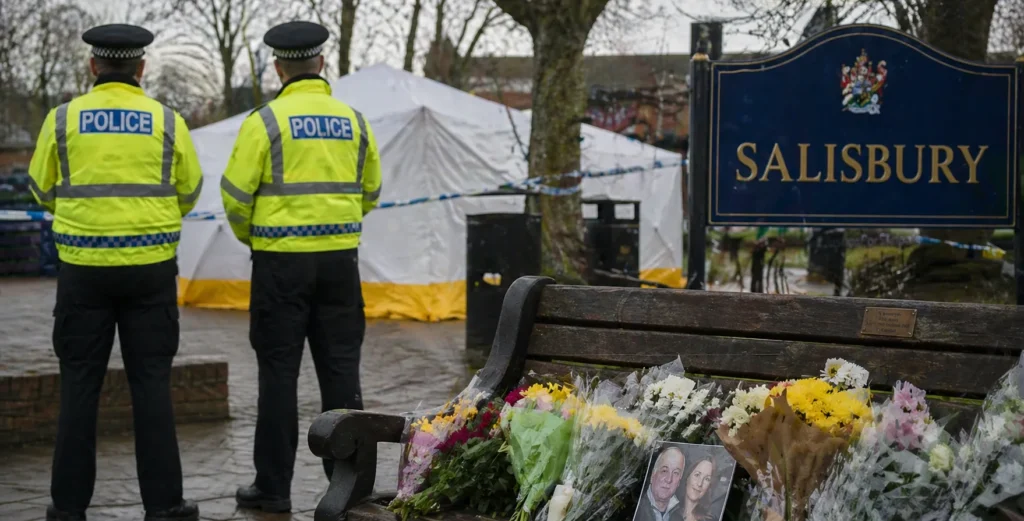

In March 2018, a quiet English city became the center of a spy mystery that looked like something out of a movie. A former Russian spy and his daughter went out for lunch on a sunny Sunday afternoon. A few hours later, they were found unconscious on a park bench, fighting for their lives. What happened next would cause one of the biggest diplomatic fights between Russia and the West since the Cold War.
This is the story of Sergei and Yulia Skripal. It’s a story about secret agents, a rare nerve agent called Novichok, and a mysterious perfume bottle. It includes a police officer who got sick just by doing his job and a woman who died months later after finding a forgotten box. Let’s break it down, piece by piece, so you can understand exactly what happened, why it mattered, and how it changed the world.
1. Who Was Sergei Skripal? A Spy Who Switched Sides
To understand the poisoning, you first have to understand the man at the center of it all: Sergei Skripal. His life before that sunny afternoon in Salisbury reads like a thriller novel.
Back in the 1990s, Sergei was a colonel in Russian military intelligence, which is known as the GRU. That means he was a high-ranking spy for Russia. The GRU is not like the KGB, which was more famous in the West. The GRU was tougher, more secretive, and focused purely on military secrets. Sergei had power. He had respect. He had access to some of Russia’s most sensitive information about spies living in Europe.
His job was to gather secrets and protect Russian interests. He worked in Russia’s embassies and military offices. He traveled around Europe. He ran spy networks. But somewhere along the way, things changed. The Soviet Union had fallen apart in 1991, and Russia was going through rough times in the 1990s. Money was short. The government was weak. People were angry. Many in Russian intelligence felt betrayed by their own leaders.
Sergei started to feel frustrated with his own government. He later said he was upset with the corruption he saw. He felt that Russia was no longer the country he had sworn to serve. Some reports say that financial problems also played a role. Being a spy does not always pay well, especially in the chaotic 1990s.
In the mid-1990s, the British intelligence service, MI6, approached him. They had been watching him for a while. They believed he was unhappy and might be willing to talk. They asked him to become a double agent. That is a fancy way of saying he would pretend to work for Russia while secretly working for the UK.
Sergei said yes.
For nearly ten years, Sergei passed secret information to the British. He revealed the names of dozens of Russian spies working undercover in Europe. He gave away secret codes. He explained how the GRU operated. He also helped British intelligence understand Russian thinking about the war in Chechnya and about NATO expansion. This was a massive betrayal in the eyes of Moscow. Sergei was not just a traitor; he was one of the most damaging double agents the Russians had ever faced.
In 2004, Russia caught him. How? The Russians later claimed they had a mole inside MI6. But no one knows for sure. What is known is that Sergei was arrested outside a restaurant in Moscow. He was taken away in handcuffs. He was accused of high treason.
He was tried in a closed military court. There was no jury. There was almost no press. The judge found him guilty. He was sentenced to 13 years in a harsh prison called Lefortovo. Lefortovo is known for its tiny, dark cells and constant interrogations. Sergei spent years there, isolated and broken.
But in 2010, he was freed as part of a “spy swap” — a trade where Russia and the West exchanged captured agents. This happened on a tarmac in Vienna. Planes from Russia and the United States met. Spies were walked across the tarmac and exchanged. Sergei ended up in Salisbury, England, a beautiful old city with a famous 123-meter-tall cathedral. The cathedral spire is so tall that you can see it from miles away. The city has medieval streets, old pubs, and a river called the Avon.
The British government gave Sergei a small house, a new identity, and a small pension. He lived a quiet life, gardening and keeping to himself. Neighbors said he was polite but never invited anyone inside. He walked his dog. He bought groceries at the local shop. He seemed like a harmless old man. He thought he was safe. He was wrong.
2. A Happy Visit from Daughter Yulia
Fast forward to March 2018. Sergei’s daughter, Yulia, decided to fly from Moscow to England to visit her dad. Yulia was not a spy. She was a normal woman in her early thirties. She worked in retail, helping manage stores that sold clothing and household goods. She lived a quiet life in a Moscow apartment with her boyfriend. She had no idea that her trip would turn into a nightmare.
Yulia and her father had a complicated relationship. They had not seen each other often since the spy swap. She was angry at him for betraying Russia. She was angry that he had left her mother back in Russia. But family is family. She missed him. And now, years had passed. She wanted to see the old man and maybe forgive him.
Yulia arrived at Heathrow Airport in London on March 3, 2018. She took a train to Salisbury. The train ride is about ninety minutes through the English countryside. She probably looked out the window and saw green fields, small villages, and sheep. Nothing to suggest danger.
For a few days, they had a nice time together. They went to the cemetery to visit the graves of other family members, including Yulia’s grandmother who had settled in England. They went for walks along the river. They talked about old times. They probably argued a little too, as families do. But overall, it was a happy reunion. They caught up on lost time. Everything seemed perfectly normal.
On Sunday, March 4, 2018, Sergei and Yulia decided to go out for lunch. It was a pleasant, cool day. The temperature was around 8 degrees Celsius, about 46 degrees Fahrenheit. The sky was gray but dry. Perfect weather for a walk.
They walked into the center of Salisbury. Salisbury’s city center is small and easy to navigate. There is a main square, some old market buildings, and lots of small shops. They went to a restaurant called Zizzi — an Italian chain. Zizzi is popular with families and tourists. It serves pizza, pasta, and salads.
What did they order? Police later released some details. Sergei had a pizza. Yulia had pasta. They also shared some garlic bread and had soft drinks. They ate for about an hour. They seemed happy. A waiter later remembered them laughing at one point.
After lunch, they strolled over to a pub called The Mill. The Mill is a cozy pub right on the river. It has wooden floors, low ceilings, and outdoor seating. They had a drink. Yulia probably had a glass of wine. Sergei might have had a beer. They sat near the window and watched the water.
Then they decided to head home. Sergei lived on a quiet residential street called Christie Miller Road. To get there from the city center, you have to walk about ten minutes. But they never made it.
3. The Discovery on the Park Bench
At around 4:15 PM, a local nurse and her daughter were walking through the Gillingham shopping mall in Salisbury. The mall is not a huge American-style mall. It is a small indoor shopping area with a few stores, a pharmacy, and a bench. They noticed two people slumped over on a wooden bench outside the mall.
The man and woman were not moving. Their eyes were rolled back. They were making strange, gasping noises — sounds like someone struggling to breathe. Their faces were pale, almost blue. They had foam at the corners of their mouths.
The nurse, whose name is Freya Church, realized immediately this was not a normal overdose or a simple fainting spell. She had seen overdoses before. This was different. The way their bodies were contorted looked like a seizure. She called an ambulance.
Paramedics arrived within minutes. But they had no idea what they were dealing with. They treated Sergei and Yulia like normal emergency patients. They checked their pulses. They put them on stretchers. They carried them into the ambulance. Soon, the paramedics themselves started feeling dizzy and nauseous. Their eyes started watering. They had to pull over and be treated too.
The police arrived. At first, officers thought the pair might have taken bad heroin or fentanyl. Fentanyl was in the news at that time as a dangerous street drug. The police officer in charge, Sergeant Nick Bailey, searched Sergei’s pockets. He found a business card for a local church and some cash. Nothing unusual. He leaned over the bodies. He touched the bench. He touched Sergei’s jacket. He had no protective gear.
Sergei and Yulia were rushed to Salisbury District Hospital. Both were in critical condition. Doctors there had never seen anything like it. The patients’ pupils were tiny pinpricks. Their muscles were twitching uncontrollably. Their blood pressure was crashing. Their breathing was stopping.
Doctors fought to keep them alive. They put tubes down their throats to help them breathe. They gave them medicines to raise their blood pressure. But for weeks, no one was sure if they would survive. Yulia was put into a medically induced coma — meaning doctors gave her strong drugs to shut down her brain so it could heal. Sergei was also put into a coma.
4. The Big Break: A Rare Russian Nerve Agent
Back at the park bench, detectives were getting worried. Sergeant Nick Bailey, the first police officer at the scene, went home that night feeling fine. But the next morning, he woke up with terrible pain. His eyes were watering. He felt dizzy. He touched his own face and felt a strange tingling. He collapsed in his kitchen. His wife called an ambulance. He was rushed to the same hospital as the Skripals.
Now, three people were fighting for their lives: Sergei, Yulia, and a police officer who was just doing his job.
What was going on? The hospital called in experts. They ruled out street drugs. They ruled out food poisoning. They ruled out carbon monoxide. Whatever this was, it was strange and extremely dangerous.
The British government sent scientists from Porton Down. Porton Down is a top-secret military laboratory hidden in the countryside of southern England. It has been studying chemical and biological weapons since World War One. The scientists there have seen almost everything. They have suits that look like spacesuits. They have sealed rooms where they can handle deadly poisons safely.
They took samples from Sergei, Yulia, the bench, and the restaurant. They also took samples from Sergeant Bailey’s uniform. They worked around the clock, seven days a week. Within days, they made a chilling discovery.
The poison was Novichok.
Novichok is a Russian word that means “newcomer.” It is a group of nerve agents developed by the Soviet Union in the 1970s and 1980s. The Soviets were trying to create weapons that could not be detected by normal military tests. They succeeded. These weapons were designed to be undetectable and far more deadly than other nerve agents like VX or sarin.
How deadly? A tiny drop the size of a pinhead can kill a person in minutes. But Novichok is different from other nerve agents. It comes in two parts. The two parts are not dangerous separately. You can transport them safely. But when you mix them together, they become a deadly poison. This makes Novichok easier to smuggle across borders.
Novichok attacks the nervous system. It blocks an enzyme called acetylcholinesterase. That enzyme is like a light switch for your muscles. Normally, it turns your muscles off after they have moved. Without that enzyme, your muscles never turn off. They spasm and contract until you cannot breathe. Your heart races. You sweat and drool. Then your lungs fill with fluid. You suffocate. It is a terrible way to die.
Experts confirmed that this specific type of Novichok could only have been made in Russia. The recipe was secret. The manufacturing process was unique. The chemical signature — think of it like a fingerprint — matched samples that Western scientists had obtained from Russian defectors years earlier. It was never made anywhere else. For the British government, this was the smoking gun.
But there was another problem. Novichok breaks down quickly in water and sunlight. That meant the poison on the park bench could not have been there for very long. The attack must have happened just hours before the Skripals collapsed. The attackers were likely still in the country.
5. The British Government Points the Finger at Russia
On March 12, 2018, British Prime Minister Theresa May stood up in the House of Commons — the main hall of the UK government. The House of Commons is a famous room with green leather benches. It is where British members of parliament debate and argue. It is usually loud and rowdy. That day, it was silent.
Theresa May spoke slowly and firmly. She said it was “highly likely” that Russia was behind the poisoning of Sergei and Yulia Skripal. She said the Novichok used in the attack came from Russia. She said there were only two possible explanations. Either the Russian government did it directly, or they lost control of their chemical weapons and they fell into the hands of criminals. Either way, Russia was responsible.
She gave Russia a deadline: explain how their illegal nerve agent ended up in Salisbury by the end of the week, or face consequences. The deadline was midnight on March 13, 2018.
Russia’s response? Deny, deny, deny. The Russian government called the accusations “nonsense” and “a circus show.” Vladimir Putin’s spokesman, Dmitry Peskov, said that Russia had destroyed all its chemical weapons years ago under international supervision. He said the accusations were “wild” and “unacceptable.”
Russian diplomats in London suggested that maybe the British government poisoned Skripal themselves to make Russia look bad. They pointed out that the British had a history of using dirty tricks. They also said that maybe the Novichok came from a different country, like Slovakia or the Czech Republic. Those countries quickly rejected the claim and said Russia was lying.
The Russian embassy in London even posted a tweet that said, “If the British government wants to blame someone, maybe they should look in the mirror.” The tweet was later deleted, but screenshots survived.
But the UK had proof. Scientists at Porton Down had matched the Novichok to a specific batch previously identified in international investigations. The chemical structure was unique to Russian labs. The head of Porton Down publicly said, “We have no doubt this agent came from Russia.”
Days passed. Russia failed to give a credible answer. They did not explain how their nerve agent was used on British soil. They did not provide any evidence of their innocence. They just kept denying.
So, Theresa May struck back.
6. The Big Diplomatic Expulsion
On March 14, 2018, just after midnight, the UK announced it would expel 23 Russian diplomats. These were not just any diplomats. The UK said many of them were actually undeclared intelligence officers — spies working undercover as cultural attachés or trade representatives. They had just one week to pack up and leave the country.
Why 23? That number was symbolic. The UK intelligence community believed that 23 was the number of known Russian spies working openly in London. There were more working secretly, but 23 was the public number. By expelling them, the UK was saying, “We know who you are. Get out.”
The Russian diplomats had to leave with their families. That meant children had to be pulled out of British schools. Spouses had to leave their jobs. It was a huge disruption to their lives. The last of them flew out of London on a special plane on March 20.
But that was just the beginning.
The United States jumped in to support its ally, the UK. President Donald Trump, who sometimes seemed friendly toward Russia, surprised many people by taking a hard line. He ordered the expulsion of 60 Russian diplomats from the US. That was the largest expulsion in American history. He also shut down the Russian consulate in Seattle. Why Seattle? Because it was close to a US submarine base at Bangor. The US didn’t want Russian spies snooping around nuclear submarines.
Then, a wave of solidarity swept across Europe and beyond. More than 25 countries followed suit. Germany expelled 4 Russian diplomats. France expelled 4. Poland expelled 4. Italy expelled 2. Spain expelled 2. Canada expelled 4. Australia expelled 2. Ukraine expelled 13. The list went on. Even small countries like the Netherlands and the Czech Republic joined in.
In total, more than 150 Russian intelligence officers were kicked out of Western countries. It was the largest collective expulsion of Russian spies since the height of the Cold War. For a few weeks, flights from Moscow to London, Paris, Berlin, and Washington were full of Russian diplomats and their families, all heading home in disgrace.
Russia, of course, responded by expelling the same number of Western diplomats from Moscow. That is standard practice in spy games. When one country kicks out spies, the other country kicks out the same number. But the damage was done. Russian intelligence operations across the West were crippled for years.
The message was clear: attacking someone on Western soil with a chemical weapon would not be tolerated. The world was watching. And the world was angry.
7. The Victims: Fighting for Life in the Hospital
While world leaders were yelling at each other and diplomats were packing their bags, Sergei and Yulia Skripal were lying in hospital beds, each fighting their own private battle. The hospital, Salisbury District Hospital, is a modern but unremarkable building on a hill. It is not the kind of place you expect to treat victims of chemical warfare. But that is exactly what happened.
The poison was attacking their muscles, their eyes, and their ability to breathe. Doctors used massive doses of atropine — a standard antidote for nerve agents. Atropine works by blocking the same receptors that the nerve agent attacks. But you need huge amounts. A normal dose for a heart patient is maybe one milligram. The Skripals received hundreds of milligrams. They were essentially being poisoned in a different way to save their lives.
But Novichok is stubborn. Atropine alone was not enough. Doctors also tried other experimental drugs, including something called obidoxime. These drugs help reactivate the enzyme that Novichok blocks. But they are not perfect. They work better on some nerve agents than others. For Novichok, the results were mixed.
Nurses and doctors had to wear protective suits just to enter their rooms. The suits were hot, uncomfortable, and made it hard to move. They had to work in shifts because the suits could not be worn for more than an hour at a time. Some nurses reported headaches and dizziness after leaving the room, even with the suits on. The hospital had to set up special decontamination showers for anyone who came into contact with the patients.
Yulia was in a coma for 20 days. Her father was in even worse shape. At one point, doctors feared he would never wake up. His muscles had wasted away. He had lost a dangerous amount of weight. He developed pneumonia from lying still for so long. He needed constant suctioning to clear fluid from his lungs.
But slowly, miraculously, they started to improve. Yulia opened her eyes first. She was confused. She did not know where she was. She did not remember the park bench. She asked for her phone. A nurse gently explained what had happened. Yulia cried.
Sergei followed weeks later. His recovery was slower. He had nerve damage in his hands and feet. He could not walk at first. He could barely hold a cup of water. He had to learn to do basic things again, like a stroke patient in rehabilitation.
By May 2018, both were out of critical danger. The hospital held a small press conference. A doctor said, “We are pleased to report that both patients are no longer in critical condition. They are improving, but they have a long road ahead.”
But they were not the same. They had trouble walking, talking, and remembering things. The nerve agent had done lasting damage to their nervous systems. Yulia later said in a recorded statement that the whole experience was “a blur” and that she was “extremely lucky to be alive.”
Sergeant Nick Bailey, the police officer who was poisoned just by touching the bench, also survived. But he too suffered health problems for months. He lost a dangerous amount of weight. He had nightmares. He developed anxiety and depression. He later said the pain was “unimaginable” and that he still could not walk far without getting tired.
8. The Mystery of the Perfume Bottle
Here is where the story gets even stranger. For months, no one knew exactly how the Novichok got onto Sergei and Yulia. Detectives searched their home, the restaurant, the pub, and the bench. They found tiny traces of Novichok on the front door of Sergei’s house — on the handle. That made sense. If someone had put poison on the door handle, Sergei would have touched it when he came home. Then Yulia would have touched it. Then they would have eaten lunch and touched their mouths.
But the big clue came months later, from a completely unexpected place.
On June 30, 2018 — almost four months after the Skripals were poisoned — a 45-year-old British woman named Dawn Sturgess collapsed at a house in Amesbury, a town just eight miles from Salisbury. She was with her boyfriend, Charlie Rowley. Both of them suddenly became extremely sick. Their eyes rolled back. They started gasping for air. It looked exactly like the Skripal case.
An ambulance rushed them to the hospital. But Dawn was in worse shape than the Skripals had been. She had received a much larger dose of Novichok. Doctors fought for her life for eight days. They put her in a coma. They used every drug they had. But on July 8, 2018, Dawn Sturgess died. She was a mother of three children. She had a history of drug problems and homelessness, but she was trying to get her life back together. Her death was a tragedy.
Charlie survived after weeks in the hospital. He was weak and confused, but he lived. He later gave a long interview to the police.
Police were confused. Was this another targeted attack? Were more Russian spies coming after someone else? But Dawn and Charlie were ordinary people with no spy connections. They were recovering drug users who lived a quiet, troubled life in a small apartment. They had no enemies in the Kremlin.
Then, detectives found the source. Charlie told them: a few days earlier, he had found a small box in a litter bin near his apartment. Inside the box was a bottle. It looked like a women’s perfume bottle — a dark, Nina Ricci brand bottle with a rounded shape and a spray nozzle. Charlie thought it might be someone’s lost property. He took it home.
He gave the bottle to Dawn. She was excited. She thought it was expensive perfume. She sprayed it on her wrists. She even joked that it smelled a bit strange. Minutes later, she collapsed. Charlie also touched the bottle and got sick, but he had only touched the outside. Dawn had sprayed it directly onto her skin.
The bottle contained Novichok. The same batch that poisoned the Skripals. It was not perfume at all. It was a weapon.
9. Piecing the Puzzle Together: How It Was Done
Now that the perfume bottle was found, investigators could finally put the pieces together. Here is what they believe happened.
Russian intelligence officers — spies from the GRU unit 29155, which specializes in assassinations abroad — flew to England with a small amount of Novichok hidden inside a fake perfume bottle. The bottle had been specially made. It looked like a Nina Ricci brand perfume bottle, but it had a hidden compartment. The compartment contained two separate liquids that would mix only when sprayed.
The spies flew to London on March 2, 2018. They used fake names and fake passports. They stayed in a cheap hotel near London’s Victoria Station. They paid in cash to avoid leaving a trail. They had only a small bag with them. Inside that bag was the perfume bottle, wrapped in plastic.
On March 3, they took a train to Salisbury. They walked around the city for several hours. They probably scouted Sergei Skripal’s house on Christie Miller Road. They saw the front door. They saw that Sergei was home because the lights were on. They waited for the street to be empty.
On March 4, the day of the poisoning, they returned to Salisbury in the early morning. The streets were quiet because it was Sunday. One of the spies walked up to Sergei’s front door. He took out the perfume bottle. He carefully sprayed a small amount of liquid onto the door handle. The liquid was clear and had almost no smell. He then wiped the bottle with a cloth, put it back in his bag, and walked away.
Why did they use a perfume bottle? Because it was small and easy to hide. Also, if someone saw it, they would think it was just a woman’s accessory. It was a clever disguise.
The spies then left Salisbury. They took a train back to London. They probably threw the perfume bottle in a public trash bin somewhere in Salisbury or London. They did not want to carry it through airport security. They flew back to Moscow on March 4, the same day as the poisoning. They were back in Russia before the Skripals were even found on the bench.
But the bottle did not stay in the bin. Weeks later, someone else found it. Or maybe it was moved by a homeless person. Ultimately, Charlie Rowley found it while dumpster diving — looking for valuable items he could sell or use. He found the perfume bottle and thought he had hit a small treasure. Instead, he found death.
Later, in September 2018, British police released pictures of two Russian men whose real names were later revealed as Alexander Petrov and Ruslan Boshirov. The UK said these were GRU agents using fake names. Their real names, according to investigators, were Anatoliy Chepiga and Alexander Mishkin. Both were decorated Russian intelligence officers. Chepiga had been awarded Russia’s highest medal, Hero of the Russian Federation, for his work.
When the BBC interviewed Petrov and Boshirov (using their fake names), they claimed they had just gone to Salisbury to see the beautiful cathedral. They said the city’s “spire was beautiful” and that they were interested in the cathedral’s history. They said they had no idea why the British police thought they were spies. They insisted they were innocent tourists.
But few believed them. Their flight details, hotel records, and travel patterns showed they were trained operatives. They flew from Moscow to London on a quick, two-day trip. They went directly to Salisbury and back. They never took any photos of the cathedral. They never bought any souvenirs. They never ate in any restaurants — they bought groceries from a small shop and ate in their hotel room. That is not how tourists behave.
10. The International Fallout: Sanctions, Finger-Pointing, and a Never-Ending Story
The Skripal poisoning did not just fade away. It changed how the West deals with Russia for years afterward.
The United States imposed new, tough economic sanctions on Russia. These sanctions targeted Russian banks, energy companies, and defense industries. They made it harder for Russia to borrow money or buy advanced technology. The European Union agreed with the UK’s findings and imposed its own sanctions. NATO expelled eight Russian officials from its headquarters in Brussels. For several years after 2018, relations between Russia and the West were frozen. Diplomats stopped talking. Ambassadors were recalled. High-level meetings were canceled.
The incident also gave the UK a chance to lead a unified Western response. After Brexit, many Europeans worried that the UK would become isolated. But during the Skripal crisis, European countries stood firmly with Britain. It was a rare moment of unity.
In Russia, the official story remained the same: Russia had nothing to do with it. In fact, Russian state TV suggested that British spies poisoned Skripal to distract from Brexit. One popular Russian talk show host said, “The British are always lying. They lied about Iraq. They lied about Libya. Now they are lying about this.” Some conspiracy theories claimed the entire thing was staged. One theory said that Sergei Skripal was actually dead and that a body double was being used. Another said that the Novichok was planted by British intelligence to frame Russia.
The truth, according to every Western intelligence agency and the global chemical weapons watchdog (the OPCW), was clear: Russia was responsible. The OPCW sent independent inspectors to Salisbury and Amesbury. They tested samples. They issued a 70-page report. The report said, without any doubt, that the substance was Novichok and that it was of a type developed in Russia.
But without a confession from Moscow, the case remains officially unsolved in criminal courts. No one has been arrested or charged in the United Kingdom for the attack. Russian law does not allow extradition, so Petrov and Boshirov are safe in Moscow. British prosecutors have issued arrest warrants for them, but they will never be served.
Dawn Sturgess’s family continues to demand justice. In 2021, a coroner’s inquest ruled that Dawn was unlawfully killed. The coroner said there was “no doubt” that the Novichok was brought to Salisbury by Russian intelligence. But the British government has not been able to bring charges against anyone for her death.
11. Where Are They Now? After the Poisoning
Sergei and Yulia Skripal both survived. In May 2018, Yulia was discharged from the hospital. She was still weak. She needed a wheelchair for long distances. She had to move slowly. A few weeks later, Sergei was also discharged. He was in worse shape. He could not walk without a cane. He had lost nearly 20 kilograms, or about 44 pounds. His face was pale and thin.
The British government placed them in a secret, safe location under new identities. They have not been seen in public since. A few videos and recorded messages were released. In one video, Yulia thanked hospital staff and the British people for their support. In another, she denied that she wanted help from the Russian embassy. The Russian embassy had tried to visit her in the hospital, but she refused to see them.
Many experts believe the Skripals are now living somewhere in the United Kingdom — or maybe even Australia or New Zealand — under witness protection. They have new names, new houses, and new lives. They cannot contact their old friends or family in Russia. They cannot go back. If they did, they would be arrested for treason again.
Yulia reportedly wanted to return to Russia at first. She missed her boyfriend and her friends. But then she realized she could never be safe there. Russian intelligence would find her. She might be poisoned again. So she stayed in hiding. Her boyfriend eventually moved to England to be with her. They got married in a small, secret ceremony in 2021. That news came out only because a local newspaper in Salisbury accidentally published a wedding announcement without realizing who she was.
Sergei, meanwhile, lives a quiet life. He cannot garden anymore because his hands shake. He cannot walk far. He spends most of his time reading and watching television. He reportedly regrets his decision to become a double agent. He once told a visitor, “I thought I was doing the right thing. Now I don’t know.”
Sergeant Nick Bailey, the first officer on the scene, now suffers from anxiety and depression. He left the police force in 2019. He wrote a book about his experience, saying the poisoning “stole a part of me that I’ll never get back.” He lives in a small town in northern England. He avoids Salisbury. He says he cannot even drive past a park bench without feeling sick.
Dawn Sturgess died. Her children grew up without their mother. Her family holds a memorial every year on July 8, the anniversary of her death. They place flowers on the bench where Charlie Rowley found the perfume bottle. That bench is now a small shrine. People leave notes and candles. Some leave perfume bottles as a reminder.
Charlie Rowley, who survived, moved away from Amesbury. He could not stand living in the same apartment where Dawn collapsed. He reportedly struggles with guilt. He was the one who brought the perfume bottle home. He blames himself, even though the police have told him it was not his fault. He has been in and out of rehabilitation programs. He rarely gives interviews.
12. What Novichok Means for the Future of Warfare
The Skripal case taught the world something scary: chemical weapons are not just on battlefields. They are not just in history books. They can be used in quiet suburban neighborhoods, on ordinary doors and park benches. Novichok is so powerful that a tiny, invisible amount can kill. It can be hidden in everyday objects like a door handle or a perfume bottle.
Since 2018, governments have tightened security around chemical weapons. The OPCW added Novichok to its list of banned substances. The Chemical Weapons Convention, an international treaty, now specifically names Novichok as a prohibited agent. Countries that signed the treaty are required to destroy any Novichok stocks they have. Russia, which signed the treaty, still denies having any Novichok.
But the big worry is that other countries or even non-state groups might try to copy the technology. Novichok is not easy to make. It requires advanced chemistry and specialized equipment. But the recipe is out there. Some of it has been published in old Soviet documents that are now available online. Terrorist groups could theoretically try to make their own version.
Experts also worry about the “perfume bottle” method. The idea of hiding a chemical weapon in a consumer product is terrifying. How do you stop someone from spraying a deadly poison on a door handle in a busy city? You cannot search every tourist for a perfume bottle. You cannot test every public surface for nerve agents. The only real defense is good intelligence — knowing who the attackers are before they strike.
The Skripal poisoning also showed that Russia was willing to use chemical weapons on foreign soil to kill a traitor. That was a red line that had not been crossed since the Cold War. In the 1970s and 1980s, Russian spies used poisons like ricin and thallium. But those were relatively crude compared to Novichok. Novichok is a military-grade weapon. Using it against a single old man in a small English city was like using a nuclear bomb to kill a fly.
It also showed that even years after the Cold War, old spy rivalries are still very much alive. Russia still hunts traitors. The West still protects defectors. The game has not changed much since the 1960s. Only the weapons have gotten more sophisticated.
13. The Human Cost: More Than Just Headlines
It is easy to read about spy stories and treat them like entertainment. But the Skripal case had real human costs. Lives were destroyed. Families were torn apart. A woman died because she found someone’s trash.
Think about Dawn Sturgess. She was not a spy. She was not a politician. She was a woman with problems. She had struggled with addiction. She had been homeless. She was trying to rebuild her life. She had three children who loved her. She had just gotten a new apartment. She was happy about the perfume bottle. It was a small luxury in a hard life. And then she was gone. Her children will grow up without their mother. Her family will never be the same.
Think about Charlie Rowley. He is not a hero or a villain. He is a man who made a mistake. He found something that looked valuable. He wanted to make his girlfriend happy. Instead, he killed her. He will carry that guilt every day for the rest of his life. He cannot go to the grocery store without remembering. He cannot smell perfume without flinching.
Think about the paramedics, the police officers, and the nurses. They did their jobs. They tried to save lives. They ended up poisoned themselves. Some of them still have headaches and memory problems. Some of them are afraid to go back to work. They did not sign up for chemical warfare. They signed up to help people in their community.
Think about the people of Salisbury. Their quiet, beautiful city became a crime scene. Tourists stopped coming. Shops closed. People were afraid to touch door handles. Some parents would not let their children play outside. The city’s famous cathedral, which had stood for 800 years, was surrounded by police tape. It took years for the city to recover. Even now, some people avoid the bench where the Skripals were found. They take a different route to work.
And think about Sergei and Yulia. They went out for pizza on a Sunday afternoon. That should have been a happy memory. Instead, it was the beginning of a nightmare. They lost their health. They lost their home. They lost their identity. They are hiding somewhere, wondering if the Russians will try again. Sergei is old now. He is tired. He just wants to finish his life in peace. But peace is not something he can afford.
14. Lessons Learned and Unlearned
What should we take away from the Skripal poisoning? Here are a few lessons.
First, chemical weapons are still a real threat. Many people thought they were a problem of the past. After the end of the Cold War, countries destroyed most of their chemical weapons stocks. But the Skripal case showed that some countries kept small, secret caches. And they are willing to use them.
Second, intelligence work is dangerous. Sergei Skripal thought he was safe in England. He was not. Once you betray a powerful government like Russia, you can never truly be safe. They have long memories. They have many resources. They will wait years, even decades, for revenge.
Third, ordinary people can get caught in the crossfire. Dawn Sturgess did not know anything about spies or nerve agents. She just wanted to smell nice. She died because two Russian spies left their weapon in a trash bin. The people who suffer the most are often those who are already suffering.
Fourth, international cooperation works. When the UK asked for help, the US, Europe, and other allies responded quickly. They expelled Russian spies. They imposed sanctions. They stood together. That unity sent a powerful message. It showed that even in a divided world, some things are still wrong.
Finally, there is such a thing as justice. But it is slow. It is imperfect. Dawn Sturgess’s family has not seen anyone arrested for her death. Petrov and Boshirov are free in Moscow. The Skripals are in hiding. The British government has tried, but it cannot force Russia to cooperate. Sometimes, the bad guys get away. That is a hard truth.
15. Final Thoughts: A Sunday Afternoon That Changed Everything
The Skripal poisoning is a classic spy tragedy. It has victims, villains, mystery, and a lot of unfinished business. For a father and daughter who just wanted to eat pizza together on a Sunday afternoon, the price was their health, their home, their identity, and nearly their lives.
As you go about your own Sunday afternoons — eating lunch, walking in the park, sitting on a bench — remember that the world is stranger and more dangerous than we often think. There are people out there who are willing to use terrible weapons for political reasons. There are ordinary people who get swept up in events they do not understand.
But there are also heroes. The nurse who called the ambulance. The paramedics who kept working even as they got sick. The doctors who stayed up all night trying to save their patients. The police officers who kept investigating even when they were afraid. The people of Salisbury who refused to let fear win.
The story of that park bench in Salisbury will be told for decades — as a lesson in how governments sometimes play for keeps, and how ordinary people can get caught in the crossfire. It is a reminder that the Cold War never really ended. It just changed its clothes. And it is a warning that there are lines we should never cross, even in the name of national security.
Sergei and Yulia Skripal are alive. That is the best that can be said. They are alive, but they are not living. They are surviving. And somewhere in a quiet English city, on a wooden bench surrounded by flowers and notes, a mother lies in a grave because she wanted to smell like perfume.
That is the real story of the Skripal poisoning. It is not just a spy story. It is a human story. And it is not over yet.
Key Takeaways (In Simple Terms):
- What happened? A former Russian spy living in England and his daughter were poisoned with a rare nerve agent called Novichok in March 2018.
- Who did it? The UK, the US, the EU, and the global chemical weapons watchdog said it was almost certainly Russia’s intelligence agency (the GRU). Russia denied it and continues to deny it.
- How did it happen? Russian spies hid Novichok in a fake perfume bottle and sprayed it on the front door handle of Sergei Skripal’s home. The leftover bottle was later found by a homeless man, who gave it to his girlfriend. She died.
- Was anyone killed? Sergei and Yulia Skripal survived after weeks in critical condition. But a British woman named Dawn Sturgess died after accidentally spraying the perfume bottle on her wrists.
- What were the results? More than 150 Russian spies were expelled from Western countries. New sanctions were placed on Russia. Relations between Russia and the West became much worse and have not fully recovered.
- Where are they now? The Skripals are in hiding under new identities. Dawn Sturgess is dead. Her boyfriend survived but carries deep guilt. The Russian spies are back in Moscow, protected by Russian law. No one has been formally charged or convicted for the attack.
- Is it over? The case remains unsolved in criminal courts. The British government has issued arrest warrants, but Russia will not extradite its citizens. Dawn Sturgess’s family continues to demand justice. The story is not over.



You can certainly see your enthusiasm in the work you write. The arena hopes for more passionate writers such as you who aren’t afraid to mention how they believe. At all times follow your heart.
I like this web blog very much, Its a rattling nice post to read and obtain info . “There is no human problem which could not be solved if people would simply do as I advise.” by Gore Vidal.
With almost everything which appears to be developing inside this area, many of your points of view are generally rather exciting. Nevertheless, I am sorry, because I can not give credence to your whole idea, all be it exhilarating none the less. It looks to everybody that your commentary are generally not entirely validated and in actuality you are generally yourself not entirely confident of the point. In any event I did enjoy examining it.