

Introduction: The Day the Ocean Woke Up
Imagine you are standing on a beach in Peru. The sand is brown and warm under your feet. The sky is a perfect blue. But something feels wrong. The water, which is usually cold enough to make your toes numb, feels like bathwater. You wade in up to your knees. It is strange. It is unsettling.
A local fisherman named Carlos watches you from his wooden boat. He is not smiling. He has been fishing these waters for forty years. His father fished here before him. His grandfather too. Carlos knows the ocean like you know your own bedroom. And right now, he is scared.
“The anchovies are gone,” he says, spitting into the water. “The birds are gone too. Even the seals have left.”
You look out at the horizon. The water is flat and strangely green. Normally, this coast is one of the richest fishing grounds on Earth. Cold water rises from the deep ocean, carrying nutrients that feed billions of tiny plants called phytoplankton. Those plants feed the anchovies. The anchovies feed the birds, the seals, the bigger fish, and finally the humans.
But when the water turns warm, that whole food chain collapses. The nutrients stay deep down. The phytoplankton starve. The anchovies swim away or die. The birds fly inland looking for food. The seals follow the fish. And Carlos goes home with an empty boat.
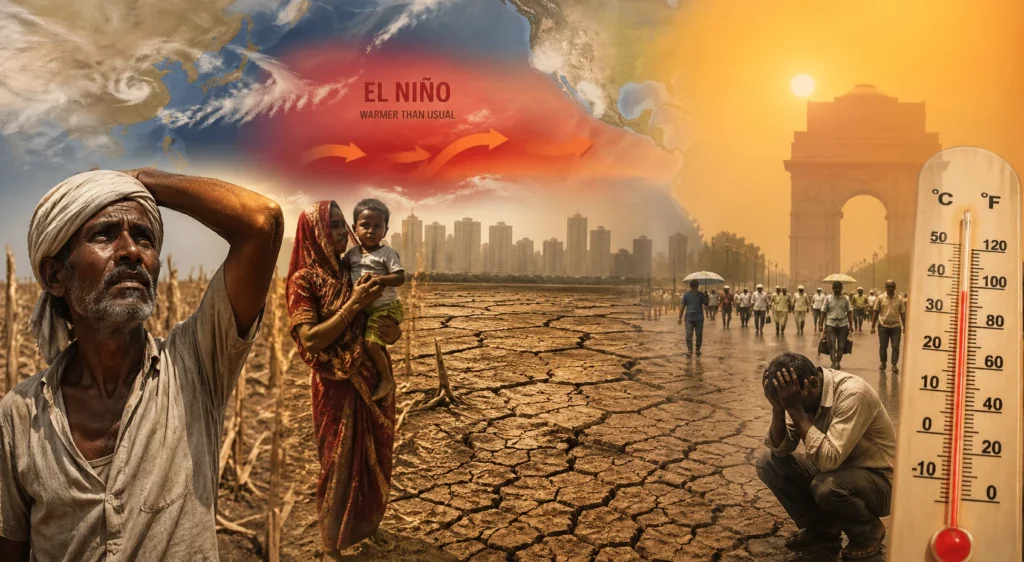
Far above Carlos’s head, a satellite the size of a small car is passing over the Pacific Ocean. It is run by scientists in Colorado and Tokyo. The satellite measures the temperature of the ocean surface with incredible precision. In early 2026, its sensors start flashing red. The central Pacific is 2.8 degrees Celsius warmer than normal. That number is not just a statistic. It is a alarm bell.
This is the beginning of a Super El Niño.
Over the next twelve months, that warm water will trigger a chain of events that reaches every corner of the planet. It will affect the rain that falls on your hometown. It will affect the price of bread in your grocery store. It will affect the health of your grandparents and the future of your children. It will expose the weak spots in our governments, our economies, and our moral compasses.
This is a story about an ocean with a fever. But it is also a story about us. About the choices we make when the warning signs are right in front of us. About the famines of the past that we swore never to repeat. About the silent crisis of hunger and disease that creeps up while we are looking at our phones.
Let me take you on a journey. We will start in the middle of the Pacific Ocean, where the mystery begins. Then we will travel back in time to the 1870s, when a similar El Niño killed millions because of human cruelty and neglect. We will walk through a future heatwave that turns streets into ovens. We will sit with a farmer watching her crops wither. We will stand in a grocery store watching prices climb. We will visit a hospital where a new kind of sickness is filling the beds. And we will end with hope—small, practical things that ordinary people can do to protect themselves and their neighbors.
The ocean is speaking. It is time to listen.
H2: What Exactly Is a Super El Niño? (And Why Should You Care?)
Let’s start with a simple picture. Imagine you have a giant bathtub. The bathtub is the Pacific Ocean. Normally, the water is calm. There is a fan blowing across the top of the tub from east to west. That fan is called the trade winds. It pushes the warm water toward the western side of the tub—near Australia and Indonesia.
On the eastern side of the tub—near South America—cold water rises from the bottom to replace the warm water that blew away. This is called upwelling. It is why Peru’s coast is cold and full of fish.
Now, imagine that fan suddenly slows down. Or stops. Or even reverses direction. That is what happens during El Niño. The trade winds get lazy. The warm water that was piled up near Australia sloshes back toward the middle of the tub. It spreads out like a giant warm blanket across the entire central and eastern Pacific.
This warm blanket is huge. We are talking about an area bigger than the United States. And it is not just warm at the surface. The heat goes down hundreds of feet. That much warm water releases an enormous amount of heat into the atmosphere. It changes the paths of jet streams and storm tracks. It shifts where rain falls and where droughts happen.
A “normal” El Niño happens every two to seven years. The water warms by about one degree Celsius. That is enough to cause noticeable changes in weather patterns around the world. But a “Super” El Niño is different. The water warms by more than 2.5 degrees Celsius. The effects are magnified. Everything that a normal El Niño does, a Super El Niño does worse.
The last time we had a Super El Niño was 2015-2016. That event caused a drought in Ethiopia that left 10 million people needing food aid. It caused wildfires in Indonesia that released more carbon dioxide than Japan does in a year. It caused the Great Barrier Reef to bleach—which means the coral turned white and started to die. It caused a Zika virus outbreak in the Americas because the warm weather allowed mosquitoes to spread further than usual.
But here is the scary part. The Pacific Ocean in 2026 is storing about thirty percent more heat than it did in 2015. That extra heat comes from global warming—the carbon dioxide and methane we have been pumping into the atmosphere for over a century. The ocean has absorbed most of that extra heat so far. It has been protecting us from the worst effects of climate change. But now that heat is coming back up.
Think of it like this. If you heat a pot of water on the stove, nothing happens for a while. The water just sits there, getting warmer. Then, when it reaches a certain temperature, it starts to boil. The bubbles come faster and faster. The steam fills the kitchen. That is what is happening in the Pacific. We have been heating the pot for decades. Now it is starting to boil.
Why should you care if you live in Ohio, or England, or South Africa? Because the ocean controls the atmosphere. The atmosphere controls the weather. And the weather controls your life in ways you probably do not think about.
The rain that waters your food comes from the ocean. The wind that cools your house comes from the ocean. The storms that knock out your power come from the ocean. When the ocean sneezes, the whole planet catches a cold.
A Super El Niño is not a disaster that happens somewhere else. It is a disaster that happens everywhere, all at once, in different forms. Some places get too much rain and flood. Some places get no rain and dry up. Some places get heat that kills. Some places get cold that freezes. And all places get higher food prices and more sickness.
That is why you should care. Because the ocean’s fever is about to become your fever.
H2: A Ghost Story from the 1870s – The Great Famine No One Remembers
To understand what is coming in 2026, we have to go back in time. Not ten years. Not fifty years. But nearly one hundred and fifty years. We are going to the year 1877.
Close your eyes and imagine a village in southern India. The village is called Madurai. It is hot—hotter than usual. The sun beats down on clay roofs. The cows are thin. Their ribs show through their skin. The wells are dry. Women walk six miles each morning to a muddy puddle that passes for a river. They carry brass pots on their heads. By the time they get home, half the water has sloshed out.
This is not a normal dry season. This is the beginning of the Great Famine of 1876-1878. At the time, people thought it was a curse from the gods. They thought the British rulers had committed some sin. They thought the stars were misaligned.
Now we know the truth. The Pacific Ocean was experiencing a Super El Niño.
Scientists have reconstructed the climate of the 1870s using tree rings, coral growth bands, and old ships’ logs. The picture is clear. The trade winds collapsed. The warm water spread across the Pacific. The monsoon rains that normally water India’s farms never came.
The monsoon is like a heartbeat for India. It arrives in June, usually around the same week every year. It rains steadily for two months. The rivers swell. The fields turn green. Farmers plant their rice and millet and lentils. By October, the harvest is ready. The grain fills the storage bins. The cycle repeats.
But in 1876, the heartbeat stopped. June came. No rain. July came. A few drops, then nothing. August came. The sky stayed blue and cruel. September came. The farmers prayed in the temples. October came. The seeds that had been planted in hope had turned to dust.
By early 1877, the grain bins were empty. People started eating the seeds they had saved for next year. Then they ate the cattle. Then they ate the leather from their sandals. Then they ate the bark from the trees. Then they started to die.
The British ruled India at that time. They had grain. Lots of grain. Warehouses in Calcutta and Bombay were full to the rafters. The British government also had ships and trains to move that grain. They had administrators who could organize relief efforts.
But they did not.
Why? Because of an idea. A very dangerous idea that sounds smart but kills people. The idea was called laissez-faire, which is French for “let it be.” The British officials believed that the market would solve the famine. If grain prices went up, they thought, merchants would bring more grain to the market. If people could not afford the grain, they thought, that was their own problem. Giving free food to the poor, they thought, would make the poor lazy.
So they did almost nothing. They set up a few relief camps. They offered wages for road-building projects. But the wages were too low to buy enough food. The camps were too far away for the weakest people to reach. And the officials spent more time arguing about economic theory than handing out grain.
The result was one of the worst famines in human history. By the time the rains finally returned in 1878, between 5.5 million and 10 million people had died. Most of them were poor farmers. Most of them were children. Most of them died of starvation or of diseases that their weakened bodies could not fight off.
And it was not just India. The same Super El Niño caused famines in China, Brazil, and South Africa. In China, between 9 and 13 million people died in the Northern Chinese Famine of 1877-78. In Brazil, the drought destroyed cattle ranches and forced hundreds of thousands of people to migrate to the Amazon, where many died of disease. In South Africa, the drought turned grasslands into dust and killed livestock, which led to the collapse of the native Xhosa economy.
Historians call this period the “Late Victorian Holocausts.” A scholar named Mike Davis wrote a whole book about it. His argument is painful but true: the famines were not natural disasters. They were political disasters. The El Niño provided the dry weather. But human choices—colonial greed, free-market ideology, racism, and neglect—turned drought into mass death.
Now fast forward to 2026. We have satellites that can measure the temperature of the ocean from space. We have computer models that can predict El Niño six months in advance. We have the internet, which can spread warnings instantly. We have global food reserves, emergency response agencies, and a hundred years of lessons learned.
But do we have the will to use them? Or will we repeat the mistakes of the 1870s, just with better technology and nicer clothes? That is the question that keeps climate scientists awake at night.
H2: The Heat is Coming – Deadly Heatwaves Across the Country
Let’s jump forward in time again. It is now June 2026. You live in a medium-sized city—maybe it is Kansas City, or Louisville, or Richmond. You are not in the desert. You are in the heart of America. Summers are usually warm here, but nothing crazy. Highs in the upper eighties. A few days in the low nineties. You have an air conditioner, but you only use it a few weeks each year.
This year is different.
The weather app on your phone says it is 102 degrees at 11:00 in the morning. The “feels like” temperature is 115 because of the humidity. The app has a red warning triangle on it. It says: “Excessive Heat Warning. Stay indoors. Check on elderly neighbors.”
You look out the window. The street shimmers like water. The asphalt is soft under your shoes. The mailbox is too hot to touch. The birds are silent. Even the squirrels have disappeared into the shade.
This is not just a hot day. This is a dangerous day. Your body has a narrow range of temperatures it can handle. About 97 to 99 degrees Fahrenheit inside your core. When the outside temperature gets above your body temperature, your cooling system—sweating—starts to struggle. Sweating works because the sweat evaporates and takes heat with it. But when the humidity is high, the air is already full of water. The sweat cannot evaporate. It just sits on your skin, doing nothing.
At that point, your body starts to cook. Your heart beats faster, trying to pump blood to your skin to cool it down. Your kidneys work harder. Your brain gets confused. You stop thinking clearly. You might not even realize how hot you are.
Then comes heat exhaustion. You feel dizzy. Your muscles cramp. You feel nauseous. You have a headache that will not go away. This is your body screaming at you: “Get out of the heat!”
If you do not listen, the next stage is heatstroke. Your body temperature goes above 104 degrees. Your skin stops sweating. You become delirious. You might pass out. Your organs start to fail. Without emergency medical treatment—cold water immersion, ice packs, IV fluids—you will die.
In a normal summer, heat kills more people in the United States than hurricanes, tornadoes, and floods combined. About 600 to 700 people die of heat-related causes each year. Most of them are elderly, poor, or have chronic health conditions. Most of them die in their own homes, without air conditioning, because they cannot afford to run it or because their landlord never installed it.
But in a Super El Niño summer, those numbers triple or quadruple. In 2026, we could see 2,000 or 3,000 heat deaths just in the United States. And that is the good news. The bad news is for countries like India, Pakistan, and Nigeria, where air conditioning is rare and the population is huge.
Let me paint you a picture of a heatwave in India during a Super El Niño. It is May 2026. The city is Ahmedabad, a bustling place of 8 million people. The temperature hits 118 degrees. But the wet bulb temperature—remember that term?—is 95 degrees. At that level, a healthy young person sitting in the shade will die within six hours.
The hospitals are overwhelmed. Patients fill the hallways. Ice is in short supply because the power grid is strained. Fans run constantly but push around hot air. The morgue runs out of space. Bodies are stacked in a cold storage truck behind the building.
Outside, the city slows down. The markets close by noon. The streets are empty. The only people moving are the vegetable sellers, who have no choice, and the rickshaw drivers, who have no savings. Every evening, the news reports the death toll. Every evening, the number is higher than the day before.
This is not a scene from an apocalyptic movie. This is a scene from 2015, when a heatwave in India and Pakistan killed at least 3,500 people. And 2015 was not even a Super El Niño year. It was a strong El Niño, but not the strongest. In 2026, the heat will be worse. The humidity will be higher. And the number of vulnerable people—the elderly, the sick, the poor—will be larger because of population growth.
The heatwave does not just kill people directly. It also kills them indirectly. Heat makes existing health conditions worse. A person with heart disease is more likely to have a heart attack during a heatwave. A person with asthma is more likely to have an attack because the stagnant air traps pollutants. A pregnant woman is more likely to go into early labor. An elderly person with dementia might wander outside and collapse before anyone notices.
The heatwave also breaks the infrastructure. Power lines sag and fail. Transformers explode. When the power goes out, air conditioners stop working, refrigerators stop working, water pumps stop working. A heatwave becomes a blackout becomes a humanitarian crisis. In 2021, a heatwave in the Pacific Northwest—a place not known for extreme heat—killed hundreds of people because many homes did not have air conditioning. Now imagine that on a national scale.
The lesson is simple. Heat is the most underrated disaster. It does not tear roofs off houses. It does not make dramatic television footage. It kills quietly, one person at a time, in apartments and hospitals and streets. And a Super El Niño turns up the volume on that silent killer.
H2: When the Monsoon Stumbles – A Farmer’s Diary
Let me introduce you to someone. Her name is Lakshmi. She is fifty-two years old. She has three children and eight grandchildren. She lives in the state of Maharashtra, in western India. Her village is called Pabal. It is a small place of about two thousand people. Most of them are farmers like her.
Lakshmi wakes up every day at 4:30 in the morning. Before the sun rises, she milks the goats. She sweeps the dirt floor of her house. She lights a small fire to boil water for tea. Then she walks to her field.
Her field is about two acres. It is not large by American standards—you could fit it in a suburban backyard. But that field is everything to Lakshmi. It feeds her family. It pays for her grandchildren’s school fees. It is her identity. Her father farmed this same land. His father before him. The stones in the field have the shape of her grandmother’s footstep.
Lakshmi grows millet and pigeon peas. Millet is an ancient grain that grows well in dry conditions. It is healthy—full of protein and iron. It does not need as much water as rice or wheat. For generations, millet was the food of the poor. Now, because of climate change, millet is becoming the food of the smart. But Lakshmi does not think about that. She thinks about the rain.
The monsoon is supposed to arrive in early June. Lakshmi watches the sky every morning. She looks for the clouds that pile up on the horizon like gray mountains. She smells the wind for the scent of wet earth. She listens to the radio for the weather forecast.
In a good year, the rain comes steadily. Not too much—that would wash away the seeds. Not too little—that would leave the plants thirsty. It comes in the afternoon, after the heat of the day, and lasts for an hour or two. The next morning, the field is damp and fresh. The seeds sprout. The green shoots push up through the brown soil.
In a bad year, the rain is late. A week late. Two weeks late. Then a month late. Lakshmi has to decide: plant now and hope, or wait and lose the growing season. If she plants now and the rain does not come, the seeds rot in the dry ground. If she waits too long, the plants will not have enough time to mature before the dry season returns.
In a Super El Niño year like 2026, the rain is not just late. It is wrong. It might come as a short, violent storm that dumps two inches in an hour. The water runs off the hard ground instead of soaking in. It carries away the topsoil—the most precious thing Lakshmi owns. Then it stops. And does not come back for three weeks.
By August, Lakshmi’s millet plants are stunted. They should be waist-high. They are knee-high. The pigeon peas should have purple flowers. They have yellow leaves that curl at the edges. Lakshmi walks through the field, touching the plants gently, like a mother checking on a sick child. She knows what is coming. A poor harvest. Maybe no harvest at all.
In November, Lakshmi will harvest what little she has. Instead of ten bags of millet, she will have two. Instead of five bags of pigeon peas, she will have one. She will take the grain to the market. The price will be high—that is the one good thing. But she will have so little to sell that it does not matter.
She will keep enough for her family to eat for a few months. Then she will have to buy grain. The price will be three times higher than last year. The money she saved for her grandson’s school fees will go to buy rice. The money she saved for a new roof will go to buy lentils.
And then the hunger will begin. Not the dramatic starvation of the 1870s—not yet. But a low, constant hunger. The kind that makes you feel tired all the time. The kind that makes the children cry at night. The kind that makes the old people fade away, one by one, from sicknesses that should not kill them.
Lakshmi is not alone. Her story is happening in a thousand villages across India. It is happening in the corn fields of Zimbabwe. It is happening in the wheat fields of Australia. It is happening in the coffee plantations of Colombia. All at the same time, because of the same warm water in the same ocean.
The monsoon is the lifeblood of South Asia. Two billion people depend on its rhythm. When that rhythm breaks, everything breaks. The wells run dry. The rivers shrink. The livestock die. The farmers go into debt. The children drop out of school to work. The young men leave for the cities, looking for any job, any way to survive.
And the cities are not ready for them. The slums are already overcrowded. The water system is already strained. The jobs are already scarce. A million farmers moving to the cities in a single year does not create opportunity. It creates desperation.
This is the hidden story of El Niño. Not the dramatic headline of the heatwave or the flood. But the slow, grinding disaster of a failed harvest. It does not happen in one day. It happens over six months. It does not make the evening news every night. But it changes lives forever.
H2: Your Grocery Bill – The Invisible Tax on Climate Chaos
Let’s leave the farm and go somewhere familiar. Let’s go to your local grocery store. The one with the squeaky shopping carts and the fluorescent lights and the kid at the checkout who never smiles.
It is October 2026. The air conditioning is struggling. The store is warm. You grab a cart and start walking.
First stop: the bread aisle. You pick up a loaf of generic white bread. The price tag says $6.49. Last year, that same loaf was $2.99. You blink. You look again. $6.49. You put it back. You look for the cheapest bread you can find. It is $4.99. You put that in your cart, but your stomach sinks.
Next stop: the meat section. Chicken breasts. $8.99 per pound. A year ago, they were $3.49. Ground beef. $10.99 per pound. Pork chops. $9.49. You skip the meat aisle entirely.
Next stop: the produce section. A bag of six apples. $7.00. A head of lettuce. $4.00. A bag of carrots. $5.00. A small carton of strawberries. $9.00. You buy the carrots because they are the cheapest. You put the apples back.
Next stop: the international aisle. Rice. A five-pound bag of generic white rice. $12.00. A year ago, it was $4.00. You buy it anyway because rice is the one thing that will fill your children’s stomachs. You buy two bags. You do the math in your head. That is $24 just for rice.
Next stop: the dairy case. A gallon of milk. $6.50. A dozen eggs. $9.00. A small tub of butter. $7.00. You buy the milk because you have a toddler. You skip the eggs. You skip the butter.
You look in your cart. Bread. Rice. Carrots. Milk. That is it. That is $45 worth of food that will last your family of four maybe three days. Your weekly grocery budget used to be $100. Now it is $200 just for the basics.
You are not alone. Everyone in the store is making the same calculations. A mother with two young children is putting back the orange juice. An elderly man is squinting at the price of canned soup. A college student is counting coins at the register.
What happened?
The answer is back in the Pacific Ocean. The Super El Niño disrupted harvests all over the world at the same time. Brazil’s soybean crop failed. Soybeans are used to feed chickens and pigs. Fewer soybeans means higher meat prices. Australia’s wheat crop failed. Wheat is used to make bread, pasta, and cereals. Less wheat means higher bread prices. India’s rice crop failed. Rice is the staple food for half the world. Less rice means higher rice prices. Palm oil plantations in Indonesia and Malaysia suffered from drought. Palm oil is in everything—cookies, crackers, soap, shampoo, biodiesel. Less palm oil means higher prices for all of those things.
In a normal year, if one region has a bad harvest, another region picks up the slack. If Brazil has a drought, the United States exports more soybeans. If India has a poor monsoon, Thailand exports more rice. The global food system has redundancy built in. It can absorb local shocks.
But a Super El Niño is not a local shock. It is a global shock. Almost every major food-producing region is affected at the same time. The United States is not immune. The southern United States gets drier during an El Niño. The Midwest might get too much rain at the wrong time. The combination of droughts, floods, and heatwaves reduces yields everywhere.
The result is a synchronized food crisis. Supply drops. Demand stays the same. Prices rise. And they keep rising because traders on the commodity exchanges in Chicago and London get nervous. They buy up grain futures, driving prices even higher. Sometimes they hoard grain, waiting for prices to go up more. It is not illegal. But it is immoral.
The food price spike of 2008 gave us a preview. Between 2006 and 2008, the price of rice tripled. The price of wheat doubled. The price of corn doubled. The result was riots in more than thirty countries. People burned tires in the streets of Haiti. The prime minister of Thailand was forced to resign. Egypt’s government spent billions on food subsidies to keep the peace. And then the Arab Spring happened in 2011, which many analysts say was partly caused by high food prices.
Now imagine that food price spike, but worse. And imagine it happening while the world is also dealing with a pandemic, or a war, or an energy crisis. The combination could be explosive.
The people who suffer the most are not the people in the grocery store in America or Europe. They are the people who spend most of their income on food. In rich countries, the average family spends about 10 to 15 percent of their income on food. In poor countries, that number is 50 to 70 percent. A poor family in Nigeria or Bangladesh spends most of their money on rice, beans, and cooking oil. When those prices double, they do not have the cushion to absorb the shock. They eat less. They eat cheaper, less nutritious food. Their children go to bed hungry.
And hunger is not just an empty stomach. Hunger is a weakened immune system. Hunger is a child who cannot concentrate in school. Hunger is a pregnant mother who gives birth to a low-weight baby. Hunger is an old person who falls and breaks a hip because their muscles are weak. Hunger is the silent partner of every other crisis.
The grocery store is where the Super El Niño becomes real for ordinary people. You cannot see the warm water in the Pacific. You cannot see the failed harvest in India. But you can see the price tag. And that price tag tells a story of climate, economics, and human suffering all wrapped together.
H2: The Silent Public Health Crisis – What the Headlines Miss
When people talk about El Niño, they talk about weather. Heatwaves. Droughts. Floods. Wildfires. Those are the things that make the news. They are dramatic. They have images of burning houses and flooded streets.
But there is another story. A quieter story. A story that unfolds in hospitals, in kitchens, in the bodies of pregnant women and young children. This is the silent public health crisis of the Super El Niño. It kills just as many people as the weather disasters, maybe more. But it kills slowly, invisibly, one person at a time.
Let me tell you about three different ways that a Super El Niño makes you sick.
The first way: infectious diseases.
Mosquitoes love warm, wet weather. Not the kind of wet that comes from a flood—that washes away their breeding grounds. But the kind of wet that comes from puddles, from slow-moving water, from clogged drains and open containers. A Super El Niño creates perfect mosquito conditions in many parts of the world.
Dengue fever is the most common mosquito-borne disease in the tropics. It is also called “breakbone fever” because the pain is so severe. You get a high fever, a terrible headache, pain behind your eyes, and joint pain so bad you cannot move. Most people recover after a week or two. But a small percentage develop a severe form called dengue hemorrhagic fever, which causes internal bleeding and can kill you.
In 2026, expect a massive dengue outbreak. The warm, wet conditions will allow the Aedes mosquito—the one that carries dengue—to spread further than usual. Cities in Southeast Asia, Latin America, and Africa will see case numbers double or triple. Hospitals will run out of beds. The blood supply will be strained.
Malaria is another mosquito-borne disease that gets worse during El Niño. The Anopheles mosquito that carries malaria likes warm, stagnant water. In the highlands of East Africa and South America, areas that are normally too cold for malaria will become warm enough. People who have never been exposed to malaria will suddenly be at risk. They will have no immunity. The death rate will be high.
Then there is Zika. You might remember the Zika outbreak of 2015-16, which happened during the last Super El Niño. Zika is usually mild for adults—a rash, a fever, red eyes. But if a pregnant woman gets infected, the virus can cause microcephaly in her baby. The baby is born with an abnormally small head and brain damage. Thousands of babies in Brazil were affected in 2015-16. Their families are still caring for them today.
The second way: mental health.
We usually think of mental health as separate from weather. But the link is strong. A farmer who loses his crop does not just lose money. He loses his purpose. He loses his ability to provide for his family. He loses his identity.
In rural India, Australia, and the United States, suicide rates go up during droughts. The pattern is clear. Prolonged dry conditions lead to financial stress, which leads to depression, which leads to suicide. Men in their thirties and forties—the primary breadwinners—are the most vulnerable.
In 1997-98, another strong El Niño, rural Australia saw a spike in suicides. Farmers who had survived for generations on the same land suddenly found themselves unable to pay their debts. Some shot themselves in their own fields. Some drove their tractors into rivers. Some just walked into the bush and never came back.
In India, the method is often pesticide. A farmer drinks the same poison he uses on his crops. It is quick. It is accessible. And it is a public health tragedy that rarely makes the international news.
The mental health crisis does not stop with farmers. People who lose their homes to floods or wildfires experience post-traumatic stress. People who cannot find work because the economy has slowed down experience anxiety and depression. Children who go hungry have higher rates of behavioral problems. All of these mental health effects are real, measurable, and long-lasting.
The third way: respiratory illness.
When land gets dry during an El Niño, wildfires burn. Indonesia is the most famous example. Each year, farmers clear land for palm oil plantations by burning forests. In a normal year, the fires are manageable. In an El Niño year, the fires are uncontrollable.
In 2015, the Indonesian fires burned for months. The smoke spread across Southeast Asia. Schools closed in Malaysia. Airports closed in Singapore. Hospitals filled with people struggling to breathe. A study later estimated that the smoke caused 100,000 premature deaths. Most of those deaths were not dramatic. They were old people with weak lungs. They were children with asthma. They were men and women whose bodies finally gave out after weeks of breathing poisoned air.
The same thing happens in the Amazon during El Niño droughts. The forest burns. The smoke drifts across Brazil, Bolivia, and Peru. In California, El Niño does not usually cause fires—it brings rain instead. But the year after an El Niño, when the rain stops and the vegetation that grew during the rainy season dries out, the fire risk is extreme.
Respiratory illness from smoke is a slow killer. It does not kill you today or tomorrow. It damages your lungs over time. A child who breathes smoke for three months will have reduced lung function for the rest of their life. An adult with asthma will have more attacks. An elderly person with emphysema will die years earlier than they would have otherwise.
These three silent crises—infectious disease, mental health, respiratory illness—do not make the front page. They do not cause governments to declare emergencies. But together, they kill more people than the heatwaves and the floods. They are the hidden cost of the Super El Niño. And they will keep killing long after the ocean returns to normal.
H2: Policy Failures – Why We Keep Making the Same Mistakes
Let me tell you a story about a meeting that never happened.
It is September 2025. A conference room in Geneva, Switzerland. Around a long wooden table sit representatives from the World Meteorological Organization, the Food and Agriculture Organization, the World Health Organization, and the Red Cross. Also at the table are scientists from the United States, Japan, China, and Europe. They have been watching the Pacific Ocean for months. The data is clear. A Super El Niño is forming.
The scientists present their findings. The water is warming faster than expected. The trade winds are weakening. The computer models show a 90 percent chance of a major event starting in early 2026. They show maps of where the rains will fail and where the floods will come. They show projections of crop yields and disease outbreaks.
The representatives listen. They nod. They take notes. Then they go back to their offices. They write reports. They send emails. They hold internal meetings. But they do not do much else.
Why? Because no one has the authority. The World Meteorological Organization can issue warnings, but it cannot force countries to act. The Food and Agriculture Organization can give advice, but it cannot divert food supplies. The World Health Organization can declare emergencies, but it cannot pay for vaccines or hospital beds.
Each country is responsible for itself. And within each country, responsibilities are split across multiple agencies. The agriculture department handles crops. The health department handles diseases. The disaster management agency handles emergencies. The finance department handles budgets. They do not always talk to each other. They do not always agree.
This is the first policy failure: fragmentation.
The second policy failure is short-term thinking. Politicians think in election cycles. An El Niño lasts longer than a typical election campaign. The effects—hunger, disease, economic stress—take months to appear. By the time the crisis is obvious, it is too late to prevent it. And the politicians who were in office when the warning signs appeared have often moved on to other jobs.
In 2015, the international community raised about $15 billion for El Niño relief after the fact. That money paid for food aid, medical supplies, and temporary shelters. It saved lives. But if that money had been spent before the El Niño—on drought-resistant seeds, on water storage tanks, on mosquito net distribution, on public health campaigns—it would have saved even more lives at a lower cost.
The third policy failure is inequality. Rich countries can protect themselves from El Niño. They have air conditioning. They have modern hospitals. They have food reserves. They have insurance. Poor countries do not. And within poor countries, rich people can protect themselves while poor people cannot.
The 1870s famine in India was made worse by British policies that prioritized profits over people. In 2026, the same dynamic exists. It is less obvious. There are no colonial rulers in pith helmets. But the global economic system still favors the wealthy. Food is a commodity. It goes to the highest bidder. If a poor country cannot afford to buy grain on the world market, its people starve.
The fourth policy failure is denial. Even in 2026, with all the evidence in front of them, some leaders will refuse to act. They will say the scientists are exaggerating. They will say the models are wrong. They will say that preparing for a disaster is a waste of money. This is not ignorance. It is a choice. A deadly choice.
I am not saying that governments have done nothing. Some have done a lot. India has built heat action plans for its cities. Ethiopia has created a safety net that gives food aid to millions of people in drought years. Australia has invested in drought-resistant crops and early warning systems. These are good policies. They save lives.
But they are not enough. They are patches on a leaking roof. What we need is a fundamental shift in how we think about climate disasters. We need to stop treating each El Niño as a surprise. It is not a surprise. We know it is coming. We have known for decades. The only surprise is that we keep failing to prepare.
Here is a simple test. Ask your local government: “What is your plan for the next El Niño?” The answer might be a blank stare. Or a vague reference to federal disaster funds. Or a promise to study the issue. What it rarely is is a specific, funded, ready-to-implement plan that covers heatwaves, food prices, disease outbreaks, and emergency relief.
That is the failure. And until we fix it, the pattern will repeat. Drought. Hunger. Disease. Blame. And then the next El Niño.
H2: Adaptation – What Can Ordinary People Do Right Now?
I have spent a lot of time talking about problems. The ocean is warming. The heat is coming. The rains are failing. The prices are rising. The governments are failing. It is a lot. It is overwhelming.
But here is the good news. You are not powerless. There are things you can do, starting today, to protect yourself, your family, and your community. These are not grand political solutions. They are small, practical, everyday actions. They will not stop the El Niño. But they will help you survive it.
Start with your home.
If you own your home, insulate it. Good insulation keeps heat out in the summer and heat in in the winter. It is one of the best investments you can make. If you cannot afford full insulation, start small. Seal the cracks around your windows and doors. Hang heavy curtains that block the sun. Plant a tree on the west side of your house to provide afternoon shade.
If you rent, talk to your landlord. Show them the data about rising heatwaves. Explain that a well-insulated building saves them money on repairs and turnover. If they will not act, learn where your nearest cooling center is. Libraries, churches, and community centers often open their doors during heatwaves. Know the location before you need it.
Buy a fan. A small electric fan costs very little to run and can make a huge difference in how hot you feel. If you can afford it, buy a backup battery for your phone and your fan. A portable power bank costs twenty or thirty dollars. When the power goes out, you will be grateful for it.
Store water. Not just drinking water, but water for washing and cooking. Fill old soda bottles or milk jugs and keep them in a closet. Two weeks of water is a good target. You may never need it. But if the water system fails during a heatwave or a drought, you will be glad you have it.
Start with your pantry.
Food prices will rise. That is almost certain. Buy non-perishable food now, while it is still cheap. Rice, beans, lentils, oats, pasta, canned vegetables, canned fruit, cooking oil, salt, sugar. These foods last for years if stored properly. Rotate through them so nothing goes bad. A three-month supply is a good goal for most families.
Learn to cook with less meat. Meat is expensive and will become more expensive. Beans and lentils are cheap, healthy, and filling. They are also shelf-stable. Learn a few recipes now—lentil soup, bean chili, rice and beans. Your wallet will thank you.
If you have any outdoor space, grow something. A single tomato plant in a pot on a balcony can produce twenty or thirty tomatoes. A bag of potatoes will sprout in a dark closet. Lettuce grows in a shallow tray on a windowsill. You do not need a farm to grow food. You just need dirt, water, and sunlight. Even a small amount of homegrown food reduces your grocery bill and gives you a sense of control.
Start with your health.
If you or your family members have chronic health conditions, talk to your doctor now. Ask what you should do during a prolonged heatwave or a period of poor air quality. Make a plan. Stock up on medications. Know the signs of heat exhaustion and heatstroke.
Check on your neighbors. The elderly, the disabled, and the very young are the most vulnerable. Offer to pick up groceries for an elderly neighbor. Share your fan with a family that has none. Start a text chain with the people on your block. Agree to check in on each other during extreme weather.
Learn basic first aid. Heatstroke, dehydration, and respiratory distress are not complicated to treat if you know what to do. A few hours of training can save a life. Many community centers offer free or low-cost first aid classes.
Start with your community.
Talk to your local library, church, mosque, temple, or community center. Ask if they have a plan for heatwaves or food price spikes. If they do not, help them make one. A cooling center does not need much—a room with air conditioning, chairs, water, and a phone. A food pantry does not need much—a shelf, a volunteer, and a distribution schedule.
Pressure your local government. Attend city council meetings. Ask questions. “What is the city’s heat action plan?” “Where are the cooling centers located?” “How will the city help low-income residents pay for air conditioning?” These are not radical questions. They are basic questions of public safety. Make your voice heard.
Support farmers. Buy directly from local farmers when you can. Join a community-supported agriculture program. Donate to organizations that help farmers adapt to climate change. A dollar spent on drought-resistant seeds is a dollar that comes back as food on your table.
Start with your mind.
This is the most important step. Do not give in to despair. The problems are real. The suffering is real. But so is your ability to act. Despair is a luxury that poor people cannot afford. And right now, we all need to think like poor people. We need to be practical, resilient, and determined.
Remind yourself that humans have survived El Niños for thousands of years. We have survived worse. The difference between then and now is that we have knowledge. We have technology. We have the ability to see the future through computer models and satellites. That knowledge is power. Use it.
Talk to your children about what is happening. Do not scare them. Inform them. Explain that the ocean is warming and that the weather will be strange for a while. Explain that the family is taking steps to stay safe. Give them small tasks to do—helping with the garden, checking on the water supply, learning the signs of heatstroke. Children feel less scared when they have a job to do.
And finally, remember Lakshmi. Remember Carlos the fisherman. Remember the ghosts of the 1870s. You are not alone. This is a global crisis, but it is also a human crisis. And humans, when we work together, are capable of extraordinary things.
H2: A Letter to the Future – What We Tell Our Grandchildren
Let us jump ahead in time one last time. It is now the year 2050. You are sitting on a porch somewhere. Maybe it is your childhood home. Maybe it is a small apartment in the city. Maybe it is a village in a country you never imagined living in.
Your grandchild is sitting next to you. She is twelve years old. She has just learned about the Super El Niño of 2026 in her history class. The teacher showed them the graphs of the warm water in the Pacific. The photos of the dried-up fields. The old news reports about food prices and hospital lines.
“Nana,” she says. “What was it like? What did you do?”
You think for a moment. You remember the fear. The long lines at the grocery store. The heat that pressed down on you like a hand. The silence of the empty streets. The news reports that got worse every week.
But you also remember something else. You remember the neighbors who checked on each other. The church that opened its doors to anyone who needed a cool place to sleep. The community garden that grew on a vacant lot. The feeling of working together, of not being alone, of being part of something larger than yourself.
“It was hard,” you say. “Really hard. The heat was terrible. The food was expensive. A lot of people got sick. Some people died. I will not lie to you about that.”
Your grandchild waits. She wants more.
“But here is what I remember most,” you say. “I remember your great-grandmother. She was eighty-two years old. She could not afford an air conditioner. So we brought her a fan. We checked on her every morning. We brought her cold water and cold fruit. We made sure she was okay. And she survived. She lived to be ninety-two.”
“I remember the farmer we sponsored. Through a charity, we sent money to a woman in India. Her name was Lakshmi. She had lost her millet crop to drought. The money helped her buy seeds for the next season. She sent us a letter. A real paper letter. She said, ‘The rain came back. My field is green again. Thank you.’ I still have that letter somewhere.”
“I remember the day the prices started to come down. It was almost a year after the El Niño started. The ocean cooled off. The rains came back to normal. I went to the grocery store, and a loaf of bread was $3 again. I stood in the aisle and cried. I was so relieved.”
Your grandchild is quiet. Then she asks: “What did you learn, Nana?”
You smile. You have been waiting for this question.
“I learned that the ocean is not separate from us. When the ocean gets sick, we get sick. I learned that governments are slow and clumsy. They can help, but you cannot rely on them to save you. You have to save yourself and your neighbors. I learned that the poor always suffer first and worst. And I learned that we are capable of so much more than we think. When we have to, we find a way.”
“And what about now?” she asks. “What should I do?”
“You should remember,” you say. “Remember that the world is connected. The warm water in the Pacific becomes the bread on your table. The failed harvest in India becomes the hungry child in your city. You cannot escape the climate. You can only adapt to it. And the best way to adapt is together.”
Your grandchild nods. She looks out at the sky. The sun is setting. The air is warm but not too warm. The birds are singing. Life goes on.
That is the future you are building right now. Every action you take—every can of beans you store, every neighbor you check on, every phone call you make to your city council—is a brick in that future. The Super El Niño of 2026 will come. It will be hard. But if we prepare, if we care for each other, if we learn from the mistakes of the past, we will survive.
And one day, we will tell our grandchildren the story. Not as a tragedy. But as a story of resilience.
Conclusion: The Ocean is Speaking. Are We Listening?
We have traveled a long way together. We started on a beach in Peru, with a fisherman named Carlos staring at warm water. We went back in time to the 1870s, to the famines that killed millions because of human cruelty and neglect. We walked through a future heatwave that turned ordinary streets into danger zones. We sat with a farmer named Lakshmi as her crops withered. We stood in a grocery store watching prices climb beyond reach. We visited hospitals filled with silent, slow-moving disasters. We looked at governments that knew what was coming but failed to act. And we ended with hope—small, practical things that ordinary people can do.
Now we are here. At the end. But also at the beginning.
The Super El Niño of 2026 is not a certainty. It is a probability. The ocean is warming. The signs are clear. But nature is unpredictable. Maybe the trade winds will hold. Maybe the warm water will stay in the west. Maybe we will get lucky.
But luck is not a strategy. Hope is not a plan. The only thing that works is preparation. And preparation is not just about buying rice and filling water bottles. It is about changing how we think. We need to stop seeing El Niño as a distant weather event and start seeing it as a shared human challenge. We need to stop waiting for the government to save us and start taking responsibility for ourselves and our neighbors. We need to remember the lessons of the 1870s—that indifference kills, that delay kills, that ideology kills—and we need to choose differently.
The ocean is speaking. The warm water is its voice. The dying coral is its cry. The failed monsoon is its sigh. The question is not whether we hear it. The question is whether we listen.
Listening means acting. Acting means preparing. Preparing means surviving. And surviving means one day, when your grandchild asks you what you did during the great El Niño of 2026, you will have a story to tell. A story of fear, yes. But also a story of courage. A story of loss, yes. But also a story of love.
Go now. Check on your neighbor. Fill your pantry. Learn the signs of heatstroke. Plant something. Vote for leaders who take climate seriously. And remember: the ocean is not your enemy. It is your teacher. And the lesson is this—we are all in the same boat. And the boat is warming.
Let us sail it together.

I was very pleased to find this web-site.I wanted to thanks for your time for this wonderful read!! I definitely enjoying every little bit of it and I have you bookmarked to check out new stuff you blog post.
The app installation was seamless and the performance is top-notch. No lags during the big wins which is exactly what I need. Download it via jili979download.
Logging in is seamless and the game loading speeds are impressive. I love how organized the lobby is. I’ll be sticking with jjwingamelogin for a while.
The most transparent platform I have used in the PH region. Very intuitive design and easy to navigate. polymarketphilippines is the way to go.